A History of the County of Warwick: Volume 6, Knightlow Hundred. Originally published by Victoria County History, London, 1951.
This free content was digitised by double rekeying. All rights reserved.
'Parishes: Offchurch', in A History of the County of Warwick: Volume 6, Knightlow Hundred, ed. L F Salzman (London, 1951), British History Online https://www.british-history.ac.uk/vch/warks/vol6/pp194-198 [accessed 30 April 2025].
'Parishes: Offchurch', in A History of the County of Warwick: Volume 6, Knightlow Hundred. Edited by L F Salzman (London, 1951), British History Online, accessed April 30, 2025, https://www.british-history.ac.uk/vch/warks/vol6/pp194-198.
"Parishes: Offchurch". A History of the County of Warwick: Volume 6, Knightlow Hundred. Ed. L F Salzman (London, 1951), British History Online. Web. 30 April 2025. https://www.british-history.ac.uk/vch/warks/vol6/pp194-198.
In this section
OFFCHURCH
Acreage: 2,286.
Population: 1911, 279; 1921, 306; 1931, 323.
Offchurch is a parish and village 3 miles east of Leamington Spa. On the north and west it is bounded by the river Leam, and on the south by a small stream running close to the Warwick branch of the Oxford Canal and joining the Leam near Quintonhill; this was called the Quensenbrok in 1411. (fn. 1) The Fosse Way crosses the parish diagonally from south-west to northeast, being a metalled road throughout its limits though not a main road, and another ancient highway, the Welsh Road, crosses the Fosse Way more or less at right angles in the centre of the parish and runs through the village, which is connected by other by-roads with Hunningham, Long Itchington, and Radford Semele. There is a little woodland, and the park of Offchurch Bury, once a seat of the Knightleys and later of the Earls of Aylesford, occupies a large loop in the river Leam in the west. The ground rises from 175 ft. above sea level near the river to 346 ft. on the eastern edge of the parish. The L.M.S. railway from Rugby to Leamington crosses the parish but there is no station.
Dugdale (fn. 2) quotes a tradition that 'this hath been a town of no small note in the Saxons time', considering the manorial name 'Bury', more common in the Home Counties in this sense, to signify a fortified place and linking the name of the village with King Offa. Camden (fn. 3) went further and indulged in a romance about Offa's son Fremund, 'a man of great renown', being murdered and 'buried at his Father's Palace, now called Offchurch'. It is not, however, mentioned at all in Domesday Book, or earlier, and at no time since accurate records of population were kept has it been of more than average size. (fn. 4) Traces of an Anglo-Saxon cemetery were found about 1875 south of the church close to the road to Long Itchington. (fn. 5)
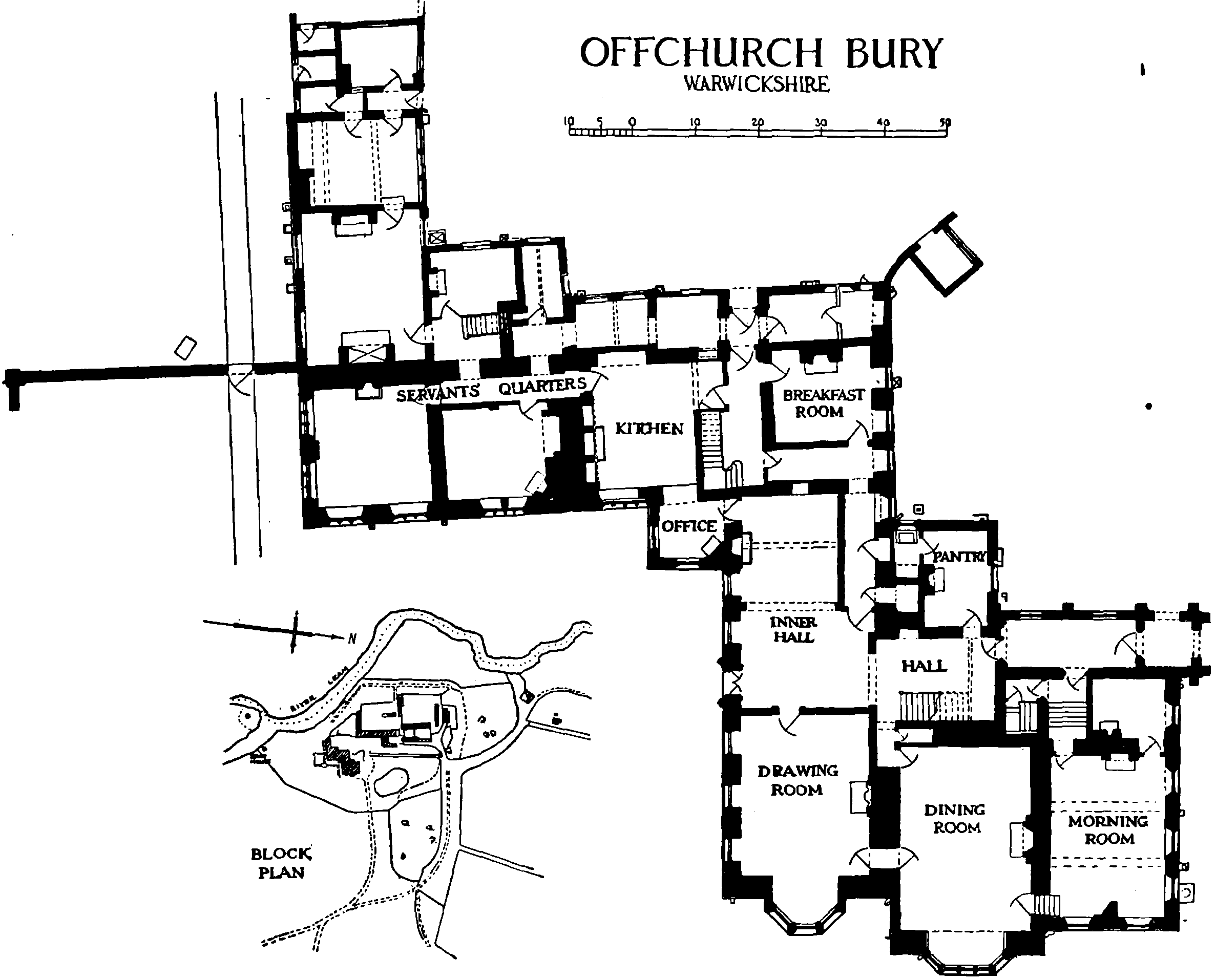
Plan of Offchurch Bury
Offchurch bridge, carrying the Welsh Road over the Leam, was in 1661 a horse bridge of stone and wood construction and in need of repair; two years later the inhabitants of Offchurch and Cubbington were presented at Quarter Sessions about this, and the cost of rebuilding it entirely in stone was to be referred to the Grand Jury at the next assizes. (fn. 6) In 1654 the 'mounds' in the churchyard were in decay, and were ordered to be repaired by all parishioners able to pay levies, though they conceived themselves not bounden thereto. (fn. 7) In 1664 the Lord Chancellor was petitioned to allow a brief to be issued on behalf of Edward Arnold of Offchurch, who had within a year suffered two serious fires at his premises, the total damage being £255. (fn. 8)
The village, mostly lying at the foot of a hill to the north-east of the church, contains a few timber-framed cottages, the majority of which have modern additions.
Offchurch Bury, the seat of Henry Leslie Johnson, stands near the north-east corner of its extensive park which occupies a bend of the River Leam. The house is built of stone, the earlier part, now servants' quarters, dating from the time of Henry VIII and retaining many of the original roof timbers. The east front of this wing retains its large stone mullioned and transomed windows and small gables. Modern alterations have obscured the development of the northern and eastern portions of the house, most of which was probably built in the 17th century, though the porch and lobby on the north, with a four-centred arch to the doorway, may be earlier. The walls of the dining-room are of exceptional thickness. In this and the drawing-room the bay windows were added, replacing sash windows, early in the 19th century. (fn. 9) A few of the rooms have 17th-century oak panelling, and in the drawing-room there is a fine carved mantelpiece in the style of the late 18th century.
There is a good range of 18th-century stabling, with a clock-tower containing a contemporary clock. A brick dovecote of the same period, with pepperpot roof, stands at the north end of the North Walk. Uncertain traces of a possible moat can be seen in the neighbourhood of the house.
Manor
OFFCHURCH is not mentioned by name in Leofric's foundation charter of Coventry priory, or in Domesday Book, but the wording of the confirmation of the charter by Henry III in 1267 (fn. 10) implies that the place was in possession of this priory from its foundation. In 1236 John son of William held one tenth of a knight's fee of the prior, (fn. 11) in whose 'barony' Offchurch and Ufton were returned in 1316. (fn. 12) Free warren was granted in 1257, (fn. 13) and in 1279 the prior held 3 carucates in demesne, 5½ virgates held by 8 free tenants, and 14½ virgates let out to 28 tenants at will, with 3 water-mills, also court leet, gallows, and assize of bread and ale. (fn. 14) The total revenue of the monastic estate in 1291, including rents, livestock, and perquisites of court was £26 12s. 0¾d. (fn. 15) One of the mills was that quitclaimed to the priory by Hugh, rector of Offchurch, with 2 acres of land and common of fishery in the Leam from Quensen Bridge to Guy's Cliff, in exchange for 2 acres called Milneacre, a croft, and half a virgate, except the messuage thereto belonging, in 1252. (fn. 16) Small alienations of messuages and land were made to the priory at various dates between 1223 and 1349, (fn. 17) and the total value of the Coventry estates in 1535 was £38 18s. 10d., including £13 6s. 8d. for the rent of the manor. (fn. 18) For some time before the Dissolution the manor and its appurtenances were leased by the priory; to Richard Palmer and Margery his wife before 1504, (fn. 19) and to various members of the Alcocke family, who were in possession in 1542 when the capital messuage of Offchurch was granted to Sir Edmund Knightley and Lady Ursula his wife, in tail male, with contingent remainder to his brother Sir Valentine, or to the right heirs of his mother. (fn. 20) At this date the premises included a chapel and burial-ground, a stone dovecote, the lofty hall of 'le Yate Howse Volte Porte', the buildings lying between the hall and the 'Frenche Walle', and several water from 'le vycars takkyng' beside 'le Conyngre' as far as Radford mere. Sir Edmund died within a year of this grant (fn. 21) but his widow seems to have had a life tenure, (fn. 22) and in 1561–2 a fresh grant, in accordance with the terms of the one of 1542, was made to Sir Valentine Knightley. (fn. 23) He bequeathed Offchurch to his fourth son Edward, (fn. 24) who was dealing with the manor in 1585 (fn. 25) and 1604. (fn. 26) The Offchurch branch of the Knightley family remained Roman Catholics, and in 1626 the manor was taken into Crown hands and leased for 21 years to John Pecke. (fn. 27) The direct male line died out with Sir John Knightley, Edward's great-grandson, who died in 1688, having quarrelled with his own kin and bequeathed the manor to John Wightwick, his wife's grandson by her first husband, on condition that he took the surname Knightley. (fn. 28) The Wightwick Knightleys held the manor till the middle of the 19th century; (fn. 29) Jane, only daughter and heir of John Wightwick Knightley married Heneage, Lord Guernsey, afterwards 6th Earl of Aylesford, in 1846, (fn. 30) and in 1850 he was lord of the manor. (fn. 31) His widow held the lordship in 1900 (fn. 32) and was still living at Offchurch Bury in 1910. (fn. 33)
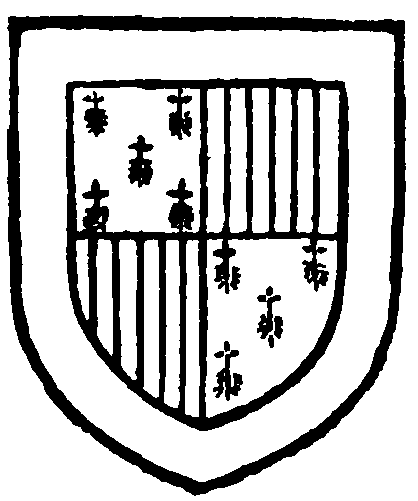
Knightley, Quarterly ermine and paly or and gules a border azure.
Two of the three Offchurch mills mentioned in 1279 can be traced to the 16th and 17th centuries. One, known as Offchurch Mill, formerly held by William Chanonhouse, was in 1546–7 in the tenure of Edward Sadler of Fillongley, to whom the priory had granted a 41-year lease in 1536 for 66s. 8d., and one, Quins' Mill (on the Quensen brook), had been let in 1530 for 31 years at 28s. 4d. to Henry Phillippes, and was in 1547 in the hands of Edward Phillippes, his assignee. (fn. 34) These two water-mills are mentioned in 1631. (fn. 35)
Church
The parish church of ST. GREGORY stands on the crest of the hill above the village. It consists of chancel with north vestry, nave with south porch, and west tower, and is built of the local red sandstone.
The nave dates from the early part of the 12th century; owing to the failure of the foundations the chancel arch, of which the piers are badly out of the perpendicular, collapsed and had to be reconstructed, apparently in the 14th century, with the addition of buttresses on the south and, probably, north. The chancel seems to have been partly rebuilt at the same time and perhaps lengthened, and a south porch erected. In the 15th century the tower was erected. Late in the 16th century the roof of the nave was reconstructed at a lower pitch, and it may have been at this time that the clumsy and very massive buttress on the north side, overlapping the north door, was built. (fn. 36) In the 18th century, square-headed two-light windows were cut in the side walls of the nave, immediately under the eaves, probably to light galleries. In 1866 the chancel was almost entirely rebuilt, (fn. 37) in the course of which operation there were found in the wall parts of a stone coffin (now outside the north wall of the nave) and the heads of two (fn. 38) small round-headed windows (described below), which were set in the north and south walls when rebuilt. A combined vestry and organ-chamber was built on the north of the chancel in 1898.
In the chancel the east window, of three cinquefoiled lights with geometrical tracery, is modern, as is the small trefoil opening in the gable above it. In the north wall are two deeply splayed 12th-century lights; their heads are each cut from a single block of stone and externally are surrounded by in the one case a single and in the other a double row of cable moulding. (fn. 39) In the south wall is a third window, smaller and with the cable replaced by a conventionalized serpent. (fn. 40) West of the two windows on the north is a modern archway containing the organ and the entrance to the vestry. East of the window in the south wall is a modern twolight window, and west of it a narrow priest's door with hollow-chamfered two-centred head and hood-mould ending in moulded stops. Between this and the chancel arch is a low side window of a single rectangular light with a shouldered head, in a deeply chamfered recess; one jamb has a bolt-hole, presumably for a shutter. Externally the buttresses at the angles and in the middle of the south wall are modern; early-19th-century views show clumsy semi-pyramidal buttresses or ramps, one at the south-east angle and the other west of the priest's door, adjoining the nave buttress; they were probably set up in the 18th century. Internally there are bad cracks in the masonry at the eastern angles, particularly on the north. Close to this angle, in the north wall, is a square aumbry; opposite to it is a piscina with round bowl under a chamfered two-centred head.
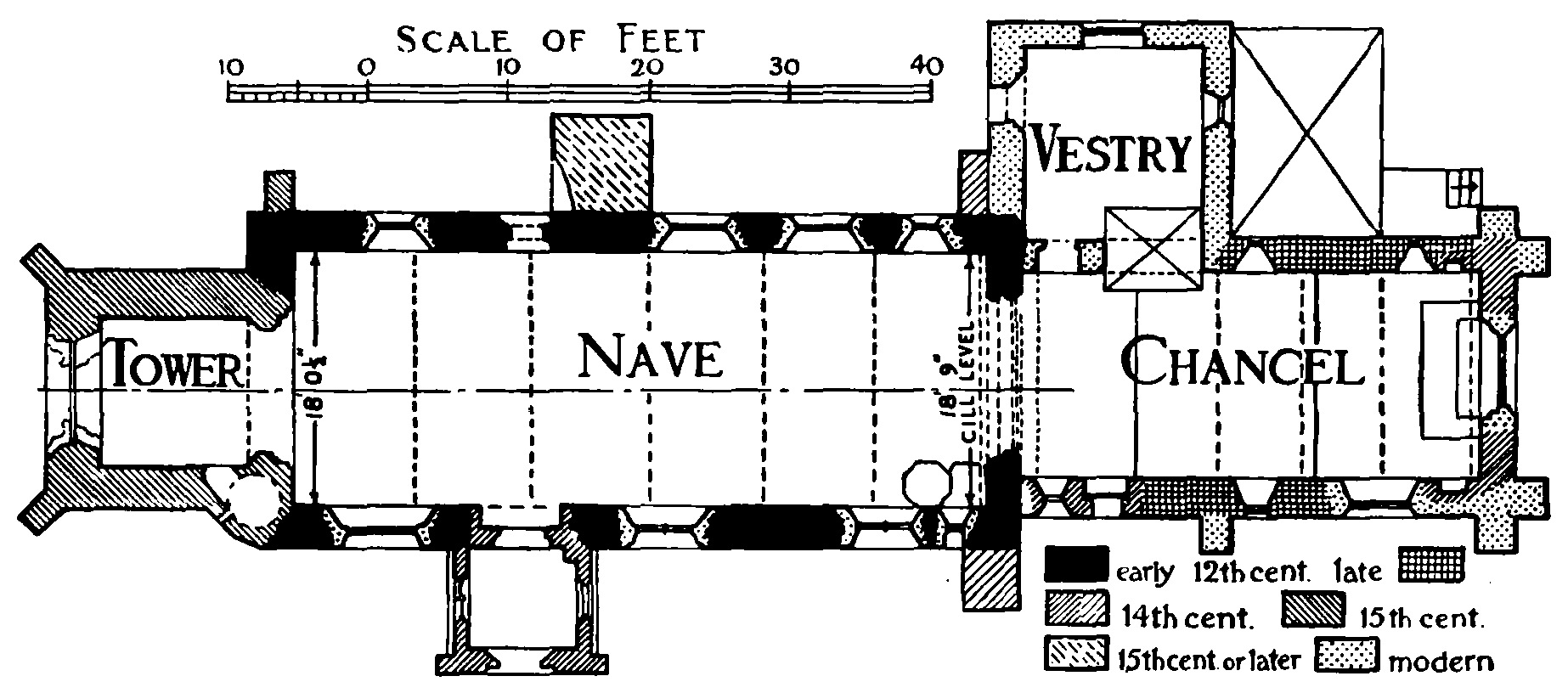
Plan of Offchurch Church
As already stated, the imposts of the chancel arch are much out of the vertical, the southern by more than 9 inches. They are of two square orders with detached angle-shafts, which have plain cushion capitals and abaci with diaper ornamentation; the bases resemble inverted cushion capitals. The flat pointed arch, rebuilt in the 14th century, has two wave-moulded orders.
In the nave the windows are all modern: in the north wall those at the east and west are single lights and between them are two two-light windows; in the south wall are three, each of two lights with a cinquefoil in the head, and at the extreme east, at a higher level, a small single light. At some uncertain period the north wall evidently showed signs of slipping; the north door was blocked and plastered over, and a huge buttress was set up, overlapping its east jamb. In 1833 the plaster was removed and part of the buttress cut back (fn. 41) to show this fine early-12th-century doorway. It has a semicircular head of two orders, the first square and the second with an edge roll, and above this is a band of varied diaper carving. The shafts and bases have been renewed, but the cushion capitals, with scrolls cut at the corners, and the plain splayed abaci are original; on the face of the stones beside the capitals is more diapering. Internally the north doorway is a much narrower plain round-headed arch, suggestive in proportions and general appearance of pre-Conquest work.
The 14th-century south door has a two-centred head with two moulded orders, the inner continuous, while the outer falls on detached pillars with capitals and bases of which the stonework has been renewed. The porch, of the late 14th century, has a small modern two-light window in each side wall. The doorway has a segmental pointed head of three moulded orders, continued on the jambs, where the two outer are provided with capitals and bases; there is a hood-mould. The roof of the porch appears to have collapsed at some time and the whole gable, including the arch of the doorway, to have been reconstructed. At each side of the entrance is a low buttress with a chamfered offset, above which, at the springing level of the door arch, are remains of the moulded and panelled bases of shafts, presumably once carrying pinnacles. The door into the church is massive, with moulded ribs, and is ancient but of uncertain date.
On either side of the porch at roof level in the south wall of the nave can be seen one of the blocked 18thcentury windows mentioned above, and another is visible in the north wall. The low-pitched trussed roof apparently dates from the late 16th century, one of the cross-beams bearing a date said to be 1592. (fn. 42)
The 15th-century tower opens to the nave by a lofty two-centred arch of two chamfered orders, which are carried down the jambs but interrupted at the springing of the arch by moulded quasi-capitals. The tower (fn. 43) has western angle buttresses rising, with three offsets, to the level of the belfry. At the south-east angle the buttress is combined with the stair-vice, which is entered by an inner doorway with a four-centred head and is lit by three slits on the south. On the west face is a doorway with four-centred arch, double-chamfered, and above it is a modern three-light window, over which is a clock-face, dated 1837. (fn. 44) The belfry windows are of two lights with a quatrefoil above, in a twocentred head, and appear to be original. The battlements of the parapet have a simple moulding which is continuous round the merlons.
The font is modern. There is a good early-18thcentury pulpit of oak, inlaid and having a carved cornice.
In the chancel are a number of marble tablets, dating from the end of the 17th century onwards, to members of the Knightley family. Built into the north wall of the nave, outside, are fragments of a 14th-century coffinslab.
There are four bells: (fn. 45) the first and third by Robert
Handley of Gloucester (last quarter of the 15th century) inscribed respectively—
sancte micael ora pro nobis, and
virginis egregie vocor campana marie.
The second is by Newcombe of Leicester, 1605; and
the fourth by Mathew Bagley, 1681.
The communion plate includes an Elizabethan cup of 1576 and a paten of 1699.
The registers (fn. 46) of baptisms begin in 1669 but are irregular until 1682, after which date burials are entered, but the record of marriages runs only from 1694.
Advowson
The church was appropriated to Coventry Priory in 1260, (fn. 47) and was worth £7 in 1291. (fn. 48) The vicarage was valued at £7 7s. 6d., with 8s. for procurations and synodals, in 1535, (fn. 49) at which time the great tithes were farmed for £6 13s. 4d. (fn. 50) The tithes of the rectory had been leased by the prior before 1538 for 60 years to Thomas Gardener of Coventry, which lease having been acquired by Henry Porter of Fletchamstead, was renewed to him as a lease of 21 years in the following year. (fn. 51) The rectory itself was granted to John Hales of Coventry in 1545, (fn. 52) who bequeathed it to his brother Bartholomew. (fn. 53) The latter passed it, with the advowson, to Thomas Morgan in 1582, (fn. 54) who settled it on his wife Mary (Saunders) for her life, and then to his brother Anthony, the latter's daughter Bridget, who married Anthony Morgan, and her male heirs. (fn. 55) Her son Thomas Morgan was dealing with the rectory and advowson in 1624. (fn. 56) By 1666 the advowson was in the hands of the Knightleys. (fn. 57) and it descended with the manor till the present century, the trustees of the Dowager Countess of Aylesford being patrons in 1915. (fn. 58) The patronage is now held by the provost and chapter of Coventry. (fn. 59)
Charities
John Haddon by will dated 21 August 1867 bequeathed £500 to the vicar and churchwardens of Offchurch, the income to be applied for the benefit of the poor of the parish. The annual income of the charity amounts to £12 19s. 4d.
William Haddon by will dated 31 March 1877 gave £200 to the churchwardens and overseers of the parish, the income to be distributed on St. Thomas's Day among the aged or infirm poor of the parish. The annual income of the Charity amounts to £4 11s.
Jane Wightwick, Dowager Countess of Aylesford, by will dated 19 October 1906 bequeathed £200, the interest to be applied in support of the dispensary in the village of Offchurch. Trustees of the charity are appointed pursuant to a scheme of the Charity Commissioners dated 17 February 1914. The annual income of the charity amounts to £7 10s. 4d.