
A History of the County of Warwick: Volume 6, Knightlow Hundred. Originally published by Victoria County History, London, 1951.
This free content was digitised by double rekeying. All rights reserved.
'Parishes: Whitnash', in A History of the County of Warwick: Volume 6, Knightlow Hundred, (London, 1951) pp. 255-257. British History Online https://www.british-history.ac.uk/vch/warks/vol6/pp255-257 [accessed 24 April 2024]
In this section
WHITNASH
Acreage: 1,239.
Population: 1911, 525; 1921, 570; 1931, 586.
Whitnash occupies a strip of country about 3 miles long but less than a mile wide, running from the Fosse Way towards the Leam valley. On the north-east it is separated from Radford Semele by a tributary of the Leam; the surface is fairly level, at an altitude of 200 to 250 ft. above sea level. The parish is partly bounded on the south-west by the road from Warwick to Harbury, and is crossed by that from Leamington Spa to Tachbrook, the village being built along a loop on the east side of this latter road. There are a few black and white timber-framed cottages, but most of the houses are of modern red brick, as the village is only about a mile from Leamington and there has been considerable ribbon development at the ends of the village street and along Tachbrook Road; for this reason the population density (nearly 50 per 100 acres) is high for a rural parish. The former G.W.R. main line runs the length of the parish, following the course of the stream above mentioned, but there is no station. There is little woodland and much of the parish is taken up with the 18-hole golf course of the Leamington and County Golf Club. Whitnash was a very late-inclosed parish, the Act, relating to 1,090 acres, not being obtained till 1847 or the award till 1851. (fn. 1)
Dr. Thomas Holyoake (? 1616–75), in turn soldier, medical practitioner, and priest, was rector here 1660–74, (fn. 2) and the family of Walter Savage Landor has held manorial rights here for over a century.
Manors
WHITNASH, a 2-hide vill, was in 1086 held by Humfrey of Hasculf Musard. The pre-Conquest tenant had been Alured. (fn. 3) The overlordship of Robert Musard as to two fees in Leamington (Hastings), Whitnash, and Haseley was recognized in 1235–6, (fn. 4) and as late as 1503 the manor of Whitnash was stated to have been held of him. (fn. 5)
Humfrey the Domesday tenant was the ancestor of the Hastang family, Whitnash again being grouped with Leamington and Haseley, but as one knight's fee only, formerly held of John Hastang, in 1428. (fn. 6) In the early 13th century Thomas de Charlecote seems to have been the Hastangs' tenant, his 'court' (? manor-house) being mentioned in a fine of 1221, (fn. 7) and his son Thomas receiving a messuage and a virgate in 1262 from Simon de Radefford and Emma his wife. (fn. 8) The younger Thomas was also lord of Haseley, being sometimes known as Thomas de Haseley; he held the manor of Robert de Hastang for half a knight's fee in 1279, when the demesne included 3 carucates of land and a water-mill with a great pool, and there were 6 freeholders of 3½ virgates and 19 servile tenants with 7 virgates and 6¼ acres. (fn. 9) His son Robert de Haseley granted a messuage, carucate of land, and 117s. 5½d. rents in Whitnash to Robert de Kington and Alice his wife in 1313. (fn. 10) In 1373, when this estate was occupied by Margery widow of William de Kington, the reversion of it was granted by Simon le Hare of Stony Stratford (Bucks.) and his wife Maud (Kington) to James de Benyngton of Coventry. (fn. 11)
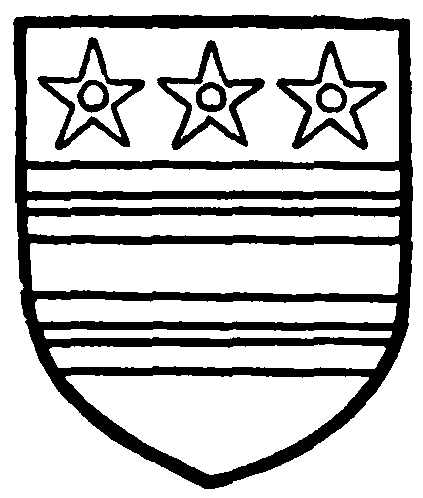
Medley. Sable two gimel bars argent and a chief argent with three molets sable thereon.
Robert's grandson Thomas granted the manor in 1346 to Thomas Savage of Tachbrook Mallory, in whose family it descended till another Thomas Savage granted it (1483) to Benedict Medley of Warwick; (fn. 12) at the death of the latter in 1503 it was worth £8 and was assessed at a quarter of a fee. (fn. 13) His great-grandson Henry made a settlement on his marriage in 1563 with Frances, elder daughter of Clement Throckmorton of Haseley, and died in 1578, when his son Henry was 14. (fn. 14) Clement, son of the younger Henry Medley, sold the manor in 1604 to Robert Wale, (fn. 15) whose family seem to have possessed it when Dugdale was writing. The Medleys had also been lords of Tachbrook Mallory, later the property of a branch of the Wagstaffe family of Harbury, of whom Sir Combe Wagstaffe appears as vouchee in a recovery of Whitnash in 1665. (fn. 16) John Rouse, a beneficiary under Sir Combe's will, (fn. 17) his wife Mary, and Cecily Wagstaffe were dealing with the manor in the same year. (fn. 18) Frances, daughter of Sir Combe Wagstaffe's nephew Thomas, of Bishop's Tachbrook, brought the manor by marriage to the Bagot family, her husband Sir Edward dealing with it in 1710, (fn. 19) his son Sir Walter in 1758–9, (fn. 20) and his grandson William, 1st Lord Bagot, in 1799. (fn. 21) The Tachbrook estate, and also apparently manorial rights in Whitnash, were bought by the 2nd (Brooke) Earl of Warwick, who was returned as lord of the manor in 1802. (fn. 22)
The Frevilles of Tamworth Castle had an interest in Whitnash, which descended through Margaret, third daughter and coheir of Sir Baldwin Freville (died 1400) to her husband Sir Hugh Willoughby; it was worth 48s. at the partition of the estates in 1423. (fn. 23) They made a settlement of their third of this manor in tail male, with contingent remainder to Margaret's right heirs, in 1435, (fn. 24) and she with her second husband Sir Richard Bingham settled the entire manor (there having been a redistribution of the estates in 1452) (fn. 25) on themselves for their lives in 1454. (fn. 26) Sir Henry Willoughby, Sir Hugh's grandson, sold this manor to Benedict Medley, who already possessed the main manor, in 1499. (fn. 27)
Another manor appears at the end of the 16th century when John Colborne died (1600) holding a manor of Whitnash of the Crown. (fn. 28) His son Edmund passed it to Henry Colbourne in 1605 and the latter and Katherine Colborne, widow, to William Searle in the following year. (fn. 29) This may be the manor of which Robert Olney was vouchee in 1638, (fn. 30) and which he and his wife Elizabeth passed to William Bolton, senior and junior, in 1648. (fn. 31) Edward Bullocke and his wife Elizabeth (Bolton) dealt with the manor in 1666, (fn. 32) and their son Edward with Mary (Child) his wife in 1695. (fn. 33) From 1730 a manor in Whitnash was held by the Willes family, (fn. 34) including (1767) Sir John Willes, Chief Justice of Common Pleas, whose father was rector of Bishop's Itchington. (fn. 35) Sir John's grandson Edward, who succeeded his father the Rev. Edward Willes of Newbold Comyn in 1820, (fn. 36) conveyed it the following year to John Campion, (fn. 37) who was possibly acting for Henry Eyres Landor, to whom Edward Willes sold the manor about this time. (fn. 38) Mr. Landor, who had previously inherited four farms in Whitnash from his mother, (fn. 39) who was descended from the family of Savage, formerly lords of Whitnash, held the manor at his death in 1866, (fn. 40) when it passed to a niece and eventually to his great nephew the Rev. R. E. H. Duke, who was said in 1932 to hold two-thirds of the manor, the other third being held by 'Miss Landor'. The Rev. R. E. H. Duke died in 1932, (fn. 41) his heir being his grandson Peter J. H. Duke. (fn. 42)
A mill, a virgate of land, and 8 acres of meadow, valued at 20s., were given to Kenilworth Priory by John Lok and William Neweman in 1338; (fn. 43) and rents of 117s. 10½d. in Whitnash and Wellesborne to the chantry of God and St. Mary in Guy's Cliffe chapel by Richard, Earl of Warwick, in 1430. (fn. 44) The Knights Hospitallers had in 1279 four messuages held by them of Aitrop Hastang. (fn. 45) About 1200 Richard Kenteis granted to Oseney Abbey (Oxon.) the lordship of two virgates in Whitnash held by Eleutherius the priest and by Margaret, this gift being confirmed by Aitrop and by Humfrey Hastang. (fn. 46)
Church
The church of ST. MARGARET stands in a very small churchyard at the northern end of the village. It consists of a chancel, nave, south aisle, west tower, vestry, and south porch. Except for the tower the church has been practically rebuilt within recent times, the chancel in 1855, the aisle in 1867, and the nave in 1880. The old church, judging from a drawing in the Aylesford Collection, consisted of chancel, aisleless nave (both probably of 13th-century origin), and the existing tower, and an 18th-century south porch. The modern walls are built of brickwork faced with ashlar, the roofs are of trussed rafters of steep pitch, covered with tiles, and the floors are tiled. The east tracery window of the chancel is of three trefoil lights with pointed arch and hood-mould, with head-stops. On the south side there are three lancet windows and a narrow doorway, probably 15th-century, with a segmental-pointed head of one splay carried down to moulded stops, restored but partly original. The north side has two lancet windows with hood-moulds, and a vestry with a window of two trefoil lights and a quatrefoil in the head. The lancet at the western end has a transom to form a low-side window, mostly restored but partly original. The south aisle has a pitched roof, and a porch at the west end with doors opening into the nave and aisle lighted by two trefoil lights on the west. The entrance has a pointed moulded arch, moulded capitals and bases with red sandstone shafts. The door to the nave has a pointed arch of two continuous orders, and that to the aisle a segmental-pointed arch of two moulded orders on moulded capitals and bases with red sandstone shafts. The aisle is lighted by a tracery window of two trefoil lights, and one of three lights; there is a similar one of three lights at the east end, with a pierced trefoil in the gable. The north wall of the nave is divided by buttresses into three bays with a tracery window of two trefoil lights, a pointed arch and hood-mould in the east bay, and similar windows, but of three lights, in the other two bays. The tower is built of sandstone ashlar and dates from the latter part of the 15th century; it rises in two stages, with a moulded plinth, an embattled parapet, and diagonal buttresses, in five stages at the western angles and of three stages on the eastern corners, splayed on their west faces. The west door-way has a four-centred head of one wide splay carried down to moulded stops, and immediately above is a window, in two chamfered orders, of three trefoil lights with a pointed arch and hood-mould with head-stops; above is a clock dial. The belfry windows on all four faces have four-centred heads, of two splays, with two trefoil lights. On the south face there are two loop-lights to the tower staircase, and a small rectangular light to the ringingchamber.
The chancel (27 ft. 10 in. by 15 ft.): the east window
has a moulded rear-arch on attached shafts, moulded
capitals and bases, and hood-mould with foliated stops.
On the south side there is a piscina and sedilia with
cinquefoil heads and hood-moulds. The lancet windows
have wide-splayed jambs and pointed rear-arches.
Fixed to the wall is a brass, 24 in. high, with two
figures in civilian costumes of c. 1500, assigned by
a modern inscription (1856), to Benedict Medley
(d. 1503) and his wife. (fn. 47) Also on this wall is a memorial
to Thomas Morse, Rector of Ashow and Whitnash,
died 1784. On the north side there is a wide pointed
entrance arch of two splays to the vestry and organ.
Fixed on this wall is an incised brass with traces of red
and black enamel, of a cleric holding a chalice with a
paten, and an inscription to Richard Bennet, M.A.,
rector, who died 8 February 1531(2). There is also
a mural tablet to Nicholas Greenhill, for 40 years rector
of the parish, died 1650. Below is a small brass
inscription by R. Boles who was Greenhill's successor,
as follows:
This Greenhill Periwiged with snow
Was leauild in the Spring
This Hill the Nine and Three did know
Was Sacred to his King
But he must Downe, although so much Divine
Before he rise never to set but shine.
Ri. Boles Mr. Art. 1689.
Opposite there is a similar small brass by the same hand, with a long epitaph written by Boles to himself and dated 1689.
The nave (52 ft. 5 in. by 17 ft. 8 in.) has two small dormer lights in the trussed rafter roof, and the aisle is separated from the nave by two pointed arches springing from responds and a shaft with foliated capitals. The pointed tower arch is of two continuous chamfers, and the chancel arch of two orders is supported on short coloured marble shafts, with floriated capitals, resting on carved corbels. The pulpit is on the south side of the arch and has carved trefoil panels, coloured marble shafts, and an octagonal stem of coloured marble shafts with carved capitals. The font stands to the west of the south door and is dated 1848.
The south aisle (28 ft. 9 in. by 14 ft.) has a trussed rafter roof, with a small rose window in the west gable. The windows have chamfered pointed rear-arches and the door to the porch a segmental one.
The tower (10 ft. 3 in. by 10 ft.) has a splay in the south-west angle for the staircase doorway which has a four-centred head and is fitted with its original door hung on strap hinges. The west door has a four-centred rear-arch and has an early counterboarded door. The tower is curtained off for use as a vestry.
There are two bells by Mathew Bagley, 1680, and four by J. Taylor, three of 1892 and one of 1896. (fn. 48)
The registers begin in 1679.
Advowson
The church was originally given, between 1121 and 1129, by Lesceline widow of Humfrey the Domesday tenant of Whitnash, to Nostell Priory (Yorks.), (fn. 49) but she subsequently made a new grant of it, in conjunction with her husband Ralph de Mare, including 60 acres of land and the priest's manse, (fn. 50) to Kenilworth Priory, this latter grant being confirmed by Aitrop Hastang, who conceded the gifts made by his men when the church was dedicated, namely '8 acres of land in one part of the vill and 10 acres in the other'. (fn. 51) The grant was further confirmed by Henry II. (fn. 52) The prior and convent held the advowson up to the Reformation, but the church was not appropriated; in 1291 it was worth £4 (fn. 53) and in 1535 £5 9s. 8d. over and above an annual pension of 2s. to the monastery, dating back to the reign of John, and 8s. for procurations and synodals. (fn. 54) After the Dissolution the advowson remained with the Crown till 1587–8 when it was granted to Richard Branthwaite. (fn. 55) By 1615 it had been acquired by Sir Thomas Leigh. (fn. 56) Sir William Bromley presented in 1675 and his son William in 1690, (fn. 57) probably by concession of the Lords Leigh, whose representative still holds the advowson.