A History of the County of Chester: Volume 5 Part 2, the City of Chester: Culture, Buildings, Institutions. Originally published by Victoria County History, London, 2005.
This free content was digitised by double rekeying. All rights reserved.
J S Barrow, J D Herson, A H Lawes, P J Riden, M V J Seaborne, 'Local government and public services: Medical services', in A History of the County of Chester: Volume 5 Part 2, the City of Chester: Culture, Buildings, Institutions, ed. A T Thacker, C P Lewis (London, 2005), British History Online https://www.british-history.ac.uk/vch/ches/vol5/pt2/pp49-58 [accessed 9 May 2025].
J S Barrow, J D Herson, A H Lawes, P J Riden, M V J Seaborne, 'Local government and public services: Medical services', in A History of the County of Chester: Volume 5 Part 2, the City of Chester: Culture, Buildings, Institutions. Edited by A T Thacker, C P Lewis (London, 2005), British History Online, accessed May 9, 2025, https://www.british-history.ac.uk/vch/ches/vol5/pt2/pp49-58.
J S Barrow, J D Herson, A H Lawes, P J Riden, M V J Seaborne. "Local government and public services: Medical services". A History of the County of Chester: Volume 5 Part 2, the City of Chester: Culture, Buildings, Institutions. Ed. A T Thacker, C P Lewis (London, 2005), British History Online. Web. 9 May 2025. https://www.british-history.ac.uk/vch/ches/vol5/pt2/pp49-58.
In this section
MEDICAL SERVICES
The two medieval hospitals treating the sick and diseased, St. Giles's leper house at Spital Boughton and St. John's outside the Northgate, both survived the Dissolution but had ceased to provide medical care by 1537 and the early 17th century respectively. (fn. 1) In 1602–5 and 1647–8 the Assembly built plague cabins on the edge of the Roodee, between the Water Tower and the river. (fn. 2) A charity dispensing medicines to the poor was set up in 1721 with an endowment of £100 under the will of Peter Cotton. Its apothecary and surgeon were appointed by the city corporation, (fn. 3) and it still existed in 1757, when the governors of the newly established infirmary pressed the corporation to transfer the endowment to them. (fn. 4)
The general infirmary, opened in 1755, in time provided services more comprehensive than many voluntary hospitals, so that other medical institutions developed more slowly in Chester than in some similar towns. (fn. 5) The infirmary was especially distinguished by its pioneering fever wards (1784), which obviated the need for a separate fever hospital, and by a dispensing and out-patient service which ran on an unusually large scale. The only other voluntary dispensaries were therefore late, small, and specialized. (fn. 6) As befitted an important county town, Chester was exceptionally well served by medical men in the 18th century, (fn. 7) and dental practitioners were established from the 1790s. (fn. 8)
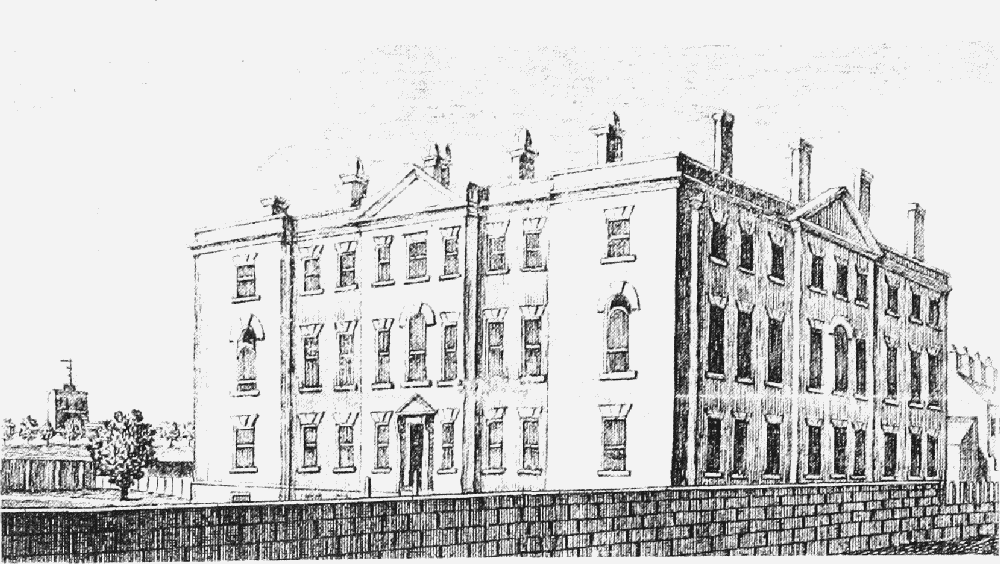
Chester infirmary, before 1830
Chester Royal Infirmary
Chester infirmary was founded after William Stratford, physician, left £300 in 1753 to endow a county infirmary. He had the recent local examples of infirmaries in Liverpool (1744), Shrewsbury (1745), and Manchester (1752). A committee appointed at the Chester assizes drew up proposals and gathered subscriptions; the subscribers then elected a management committee, which formulated statutes, appointed the first staff, fitted up a temporary hospital in the Blue Coat school, and sought advice in Liverpool and Manchester. (fn. 9) Out-patients were treated from 1755; the first in-patient was admitted in 1756. (fn. 10) It was among the first dozen provincial infirmaries. (fn. 11) Renamed Chester Royal Infirmary in 1914, (fn. 12) it never received a royal charter and became a limited company in 1937. (fn. 13)
The infirmary was intended for those too poor to pay for medical care at home. Under the earliest statutes, it did not admit pregnant women, children under seven years, infectious diseases, or inoperable and incurable cases. Patients were admitted by subscriber's ticket on Tuesdays; emergencies at any time at the discretion of the medical staff. Only the apothecary and the matron were salaried; the honorary physicians and surgeons attended patients without payment on a rota. (fn. 14)
In 1758 the governors bought a site for a new hospital in the Crofts facing City Walls Road. The building, designed by William Yoxall and completed in 1761, was built of brick and formed a quadrangle round a courtyard; it was of two principal storeys with basements and attics. Offices occupied the raised ground floor and included a board room, library, waiting and receiving rooms for the in-patients, and bedrooms and sitting rooms for the staff; long wards, each with 24 beds, were in the north and south ranges of the first and attic floors, men in the south range and women in the north; nurses' rooms, staircases, and the chapel were placed in the east and west ranges, one of the staircases in a projecting bay on the east, the other rising from the entrance hall on the west; the basements were too poorly lit, drained, and ventilated to be used. There was no provision to segregate patients with different types of illness, and no day rooms for those convalescing. (fn. 15) Despite the governors' complacent view in 1807 that the building was 'spacious and convenient', (fn. 16) there was growing dissatisfaction with it, led by Dr. George Cumming, honorary physician 1804–6 and thereafter a governor. (fn. 17) A report in 1824 concluded that the infirmary was 'essentially defective' in comparison with more recent hospital buildings. (fn. 18) After much controversy, (fn. 19) alterations were completed in 1830 by the county architect William Cole junior. He divided the long wards into smaller rooms, lowered the ground level on all sides except the south in order to allow the basements to be used, and inserted two new blocks within the central courtyard, narrowing it on the north and south. The courtyard blocks contained nurses' rooms, bathrooms, and W.C.s, and incorporated a corridor running round the inner side of the original building, permitting better use of the east and west ranges. Both original staircases were removed and a single staircase in the east range was substituted; Cole added a canted bay to the projecting eastern bay and moved the chapel into it on the first floor. It was now possible to make small day rooms as well as separate wards for different categories of patient, including surgical, medical, convalescent, accident, and ophthal mic cases. The same number of beds was provided as before, but the total space per bed was increased by over half. At the same time the rooms on the ground floor were rearranged to accommodate a separate suite for the dispensing department. (fn. 20)
The governors of the infirmary initially comprised the numerous individuals who subscribed 2 guineas a year or more, together with the honorary physicians and surgeons. General meetings of the governors appointed the staff and controlled policy; day-to-day management was carried out by a weekly board open to any governor. (fn. 21) The open weekly board was replaced from 1827 to c. 1833 (fn. 22) and permanently in 1865 with a board of management comprising the honorary medical officers and representatives elected by the governors. (fn. 23) In the 20th century the board included elected governors, members of the medical staff, and representatives of Chester city and Cheshire, Denbighshire, and Flintshire county councils, local churches, and other bodies. (fn. 24)
In the early years the subscribers were mostly from Chester: 70 per cent in 1778/9 as against 18 per cent from the rest of the county and 12 per cent from north Wales. The proportion of non-Cestrians grew as the subscription list lengthened: by 1839/40 the figures were 41 per cent Chester, 38 per cent Cheshire, and 20 per cent north Wales. (fn. 25) In 1806 the board discouraged parishes from subscribing on the reasoning that subscriptions from individuals were easier to collect. (fn. 26) The railway companies operating from Chester subscribed from 1838 at the infirmary's request because of the frequency of accidents to their employees. (fn. 27) Subscribers and benefactors were entitled to nominate patients by ticket according to the value of their donations. The entitlement for subscribers of 2 guineas (much the commonest sum) was set at one in-patient or two outpatients in 1763 but was frequently changed: one of each from 1799; two in-patients and any number of out-patients from 1816; two and ten from 1831; and two and six from 1854. (fn. 28)
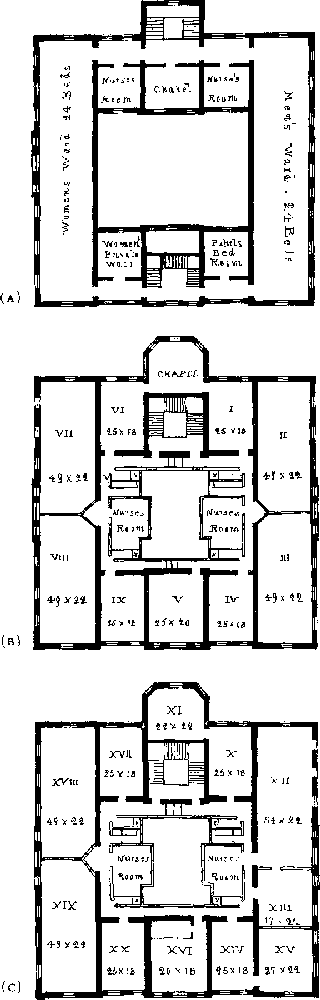
Chester infirmary, plans: (a) first floor, 1761; (b) first floor, 1830; (c) second floor, 1830
The cost of running the infirmary stood a little under £2,000 a year c. 1800 and rarely exceeded £3,000 before 1870. (fn. 29) As in most voluntary hospitals, subscriptions alone were never sufficient to meet running costs, even with a peak of c. 500 subscribers in the first two decades of the 19th century, let alone when their number dropped to 400 or fewer by mid century. Average annual subscriptions fell from £1,113 in the years 1806–20 to £959 in 1831–42 but recovered slowly to over £1,000 in the 1860s. There were periodic efforts to gain new subscribers, as in 1779, 1807, and 1831. (fn. 30) The financial gap was met partly by legacies and gifts, which amounted to almost half the subscription income in 1806–20 and over two thirds in 1831–42. Surpluses were invested, so that the income from dividends rose from £319 in 1806/7 to £651 in 1841/2. Fund-raising events in the earlier 19th century included church collections, subscription assemblies during Chester races, and a bazaar sale which brought in £1,500 in 1832. There was also regular income from the fees paid by medical apprentices (£210 for a fiveyear apprenticeship) and for treating patients belonging to other institutions in the city: the workhouse from 1784, the county gaol at Chester castle from 1785, and the city council's watch committee (for police constables and prisoners in police cells) from 1857. (fn. 31) The infirmary was nevertheless sometimes in severe financial difficulties: economy measures limited the number of in-patients to 60 in 1786, and to between 30 and 50 from 1799 to 1807. (fn. 32)
The number of in-patients admitted each year rose from under 300 in the 1760s and 1770s to average over 500 between 1787 and 1817 (even allowing for lower numbers in the 1800s) and over 600 in the 1820s. (fn. 33) In 1775 half the in-patients were from city parishes, a fifth from elsewhere in Cheshire, and a quarter from north Wales. (fn. 34) Unlike most other voluntary hospitals before the mid 19th century, (fn. 35) the Chester infirmary also treated many out-patients, who were of course mainly from the city. Out-patients outnumbered inpatients from the first. (fn. 36) Out-patient services were extended in 1764, when a dispensing service was set up to sell medicines at cost price to the poor, (fn. 37) though until c. 1783 only a few hundred people made use of it each year. (fn. 38) By the late 1780s (presumably because the medicines were then given free) the numbers had grown to over 3,000 a year, and from 1791 the dispensary was open every day. (fn. 39) Under pressure from Dr. Cumming, the infirmary organized a separate dispensary branch with its own rooms and staff in 1829 to treat out-patients and home patients. (fn. 40) It was so successful that numbers had to be limited by a change in the rules a decade later. (fn. 41) The infirmary coped adequately with a disaster in 1772, when 23 were killed and 53 injured in a gunpowder explosion at a puppet show in Watergate Street. (fn. 42)
The infirmary at first had only one paid medical officer, the apothecary, who doubled as administrator. (fn. 43) The medical duties were separated from financial matters in 1794 and from the secretaryship possibly in 1815, when the post was renamed house surgeon. (fn. 44) By 1825 the house surgeon was spending most of his time visiting patients at home and in the workhouse and gaol. (fn. 45) An assistant was appointed in 1829 to take charge of home visiting, and a dispensing surgeon in 1831 for the out-patients. (fn. 46) The home visiting service was at its most extensive and burdensome c. 1900 (fn. 47) and continued until 1921, by when the government's national insurance scheme had made it unnecessary. (fn. 48)
Until the 1850s the normal complement of honorary officers was three physicians and three surgeons. (fn. 49) Under John Haygarth, physician 1767–98, the infirmary became in 1784 the first in Britain to admit smallpox patients, who were isolated under rules which he had developed during the epidemic of 1777–8. (fn. 50) Haygarth's methods were widely admired and copied. (fn. 51) The infirmary treated smallpox and fever patients in rooms within the original building until 1851, but then excluded them in line with practice elsewhere. (fn. 52) Fever patients were required to pay for their maintenance, 4s. a week from 1784, 7s. from 1831; the money came either from their parish overseers or from the governors on whose tickets they had been admitted. (fn. 53)
The scale and nature of the infirmary's care changed with national trends from the 1860s. The number of in-patients grew inexorably from (in round figures) 700 admitted in 1867 to 1,550 in 1917 and 4,400 in 1937; out-patients from 5,000 to 6,000 and 14,000 in the same years; the average daily bed occupancy from 92 in 1900 to 182 in 1937. (fn. 54) The infirmary continued to serve a wide area: in 1873 half the in-patients were from Chester and about a quarter each from other places in Cheshire and north Wales. (fn. 55) In the 20th century there were proportionately fewer from Chester: in 1927 the city and county each accounted for about 30 per cent and the principality 40 per cent. (fn. 56)
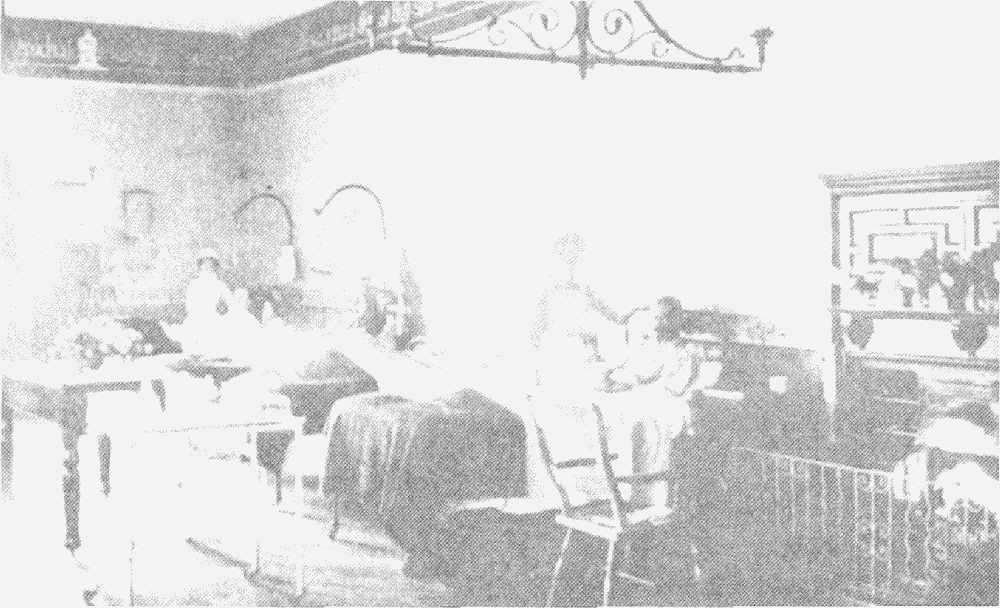
Infirmary ward, c. 1906
The medical staff grew too. A dental surgeon was appointed in 1853, and an ophthalmic surgeon in 1885, both as honorary positions. (fn. 57) Including retired honorary officers kept on as 'consulting' surgeons and physicians, (fn. 58) by 1900 there were 11 honorary medical officers, increasing to 22 in 1920 and 28 in 1947. The salaried medical staff numbered 3, 6, and 11 in the same years. (fn. 59)
Modern nursing was introduced gradually in the 1860s and 1870s, though never through a Nightingaletrained matron. Efforts were made between 1865 and 1867 to replace the existing infirmary servants, (fn. 60) and from 1869 a deaconess appointed by the diocese of Chester assisted with training; (fn. 61) one of the first of the middle-class trainees was Rose, daughter of Canon Charles Kingsley. (fn. 62) The number of nurses, including probationers, grew from 13 in 1880 to 24 in 1890 and 52 in 1911. In 1947 the nursing and technical staff numbered 130. (fn. 63) In the late 19th and earlier 20th century the infirmary ran a district nursing service in poor areas and hired out private nurses to wealthier households. (fn. 64)
Separate wards for smallpox patients were opened in the grounds east of the old building in 1868. (fn. 65) They were in use until the city's isolation hospital was opened in 1899, (fn. 66) when they were converted into nurses' rooms. (fn. 67) The range of medical and surgical care available was continuously expanded in the later 19th and earlier 20th century in line with medical advances. For example, X-ray equipment was acquired in 1902 and a pathological laboratory in 1907 — both gifts of G. W. Hayes — and departments for gynaecology, psychiatry, and orthopaedics were established between 1924 and 1937. (fn. 68)
The increase in patients and staff necessitated new building on the 5-a. Infirmary field north of the original block, which had been bought in 1859 to prevent any building close to the hospital and as a recreational area. (fn. 69) The Humberston wing, extending south-east of the 1761 building and designed by T. M. Lockwood to provide rooms for nurses and servants, was opened in 1892. (fn. 70) The main impulse, however, came from a highly critical report on the existing buildings in 1909 by the hospital pundit Sir Henry Burdett, (fn. 71) which found that the wards were among the most cramped in the country. (fn. 72) The infirmary raised over £30,000, and a new wing, designed by W. T. Lockwood in consultation with Paul Waterhouse, was opened by George V in 1914. It was named after the principal benefactor, Albert Wood. Refurbishment of the older buildings continued until 1917. (fn. 73) The Humberston wing was enlarged in 1923 and another new block was opened in 1931. (fn. 74) By 1939 there were 225 beds. (fn. 75)
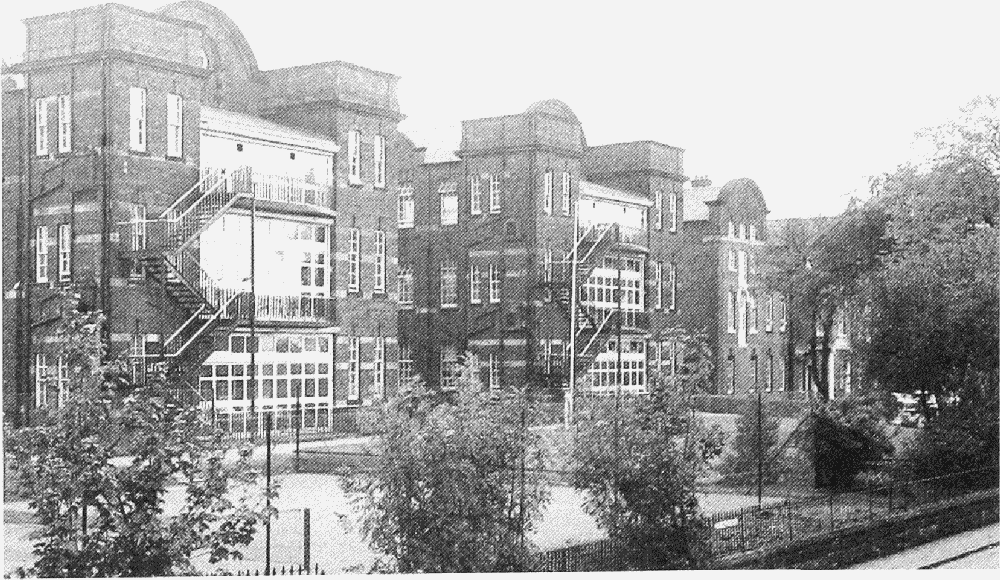
Chester Royal Infirmary, 1964: wards of 1913 and (right) 1761 building
Running costs became a major problem after c. 1870, growing slowly from under £3,000 a year to £7,000 by 1914, then accelerating to over £20,000 by 1920, £40,000 by 1940, and £90,000 in 1947. Subscriptions (which were more or less static after 1880), investment income, and payments for services were not meeting expenditure even in the 1870s, and the infirmary increasingly depended on private gifts and charitable fund-raising. From 1883 the 1st and 2nd dukes of Westminster gave usually £500 a year from visitors' entrance fees at Eaton Hall; annual church collections, disappointing c. 1860, revived from 1871 with the national Hospital Sunday campaign and raised c. £400 a year; and the Chester and District Working Men's Hospital Saturday Association (part of another national organization) was formed in 1886 to collect weekly payments from working men. (fn. 76) After 1918, as throughout the voluntary hospital sector, new methods of financing were adopted: the 'Oxford scheme' of weekly insurance payments was introduced in 1922, (fn. 77) and means-tested fees for non-members of the scheme followed in 1931, when the ticket system was finally abandoned. The financial saviour of the infirmary, however, was the Deeside Voluntary Hospital Committee, set up in 1929 to collect employees' weekly contributions, which were deducted from pay and augmented by their employers. By 1938 the Deeside scheme had 55,000 members and an annual income of £23,500. Even so, when the infirmary was brought into the new National Health Service in 1948 it was running an annual deficit of £20,000 and selling its investments. (fn. 78) The infirmary continued as part of the N.H.S. until it was closed in 1994. (fn. 79)
City Hospital (former Workhouse)
Patients from the workhouse on the Roodee were treated by the infirmary's physicians and surgeons from 1759, (fn. 80) and from 1784 the guardians of the poor were regular subscribers to the infirmary. (fn. 81) By 1830 they were paying £40 a year, a sum which Dr. Cumming of the infirmary thought should be increased to £150 to cover 1,500 cases a year. (fn. 82) By the 1850s others were being treated by the poor-law union's own medical officer. (fn. 83) From 1864 or 1865 all sick paupers were attended by him, and the guardians stopped using the infirmary's out-patient service. (fn. 84) Hospital wards with 247 beds were provided at the new workhouse built in Hoole Lane in the late 1870s. (fn. 85) The Local Government Act of 1929 transferred the workhouse to city council control, under which the hospital was at first named St. James's and later the City Hospital. In 1947 all the workhouse buildings were made over to the hospital. (fn. 86) They were demolished after the N.H.S. closed the hospital in 1991. (fn. 87)
Maternity Care
The main gap in the infirmary's medical provision was maternity care, deliberately so, because of the fear of cross-infection. In 1798 Dr. Griffith Rowland founded the Benevolent Institution as a subscription charity to provide midwives for poor women in Chester. Rowland acted alone as its surgeon until 1812; thereafter a panel of five or more gave their services free. The Institution was managed by a ladies' committee and employed a matron and four midwives. The income from annual subscriptions was £48 in 1799 and £140 c. 1820. (fn. 88) At first the midwives worked from their own homes, but in 1899 the duke of Westminster adapted a house in Grosvenor Street as a nurses' home. Then or a little later it also had two maternity beds. In 1904 the Institution was approved for training. (fn. 89) In 1897 the midwives attended 402 confinements. (fn. 90) After the National Insurance Act of 1911 gave maternity benefit to all insured women, the Institution was soon treating more patients privately than on subscribers' tickets. The ticket system had been dropped by 1920. (fn. 91)
The growing demand after the First World War for in-patient maternity care led the Institution to convert premises at no. 16 Whitefriars into an eight-bed maternity hospital, which opened in 1925; at the same time the Institution merged with the Chester District Nursing Association. (fn. 92) In 1937 a more extensive midwifery service was begun by a joint committee of the D.N.A. and the city council. The maternity hospital closed in 1938 after maternity wards were opened at the City Hospital, (fn. 93) and the home nursing service was taken over by the city council in 1948. (fn. 94)
Other Nursing
District nursing in the late 19th century was provided both by the infirmary and by the Chester Diocesan Deaconess Institution, established in 1869. The latter changed its name in 1900 to the Chester District Nursing Association. (fn. 95) In the early 20th century a lady superintendent and five district nurses, working from no. 10 Water Tower Street and supported by subscriptions and donations from individuals, churches, and charities, treated c. 1,000 cases and made over 20,000 visits a year. The D.N.A. united with the Benevolent Institution in 1925, (fn. 96) and continued in existence thereafter as a charitable organization, renamed the Chester Sick Poor Fund in 1953. (fn. 97)
Isolation Hospitals
Although the infirmary treated smallpox and other infectious diseases, it refused in 1832 and 1849 to take in cholera patients. (fn. 98) Temporary cholera hospitals were built on the land which became Grosvenor Park during the outbreak of 1866, and at Infirmary field in 1892. (fn. 99)
The city council opened its own isolation hospital on the south side of Sealand Road almost at the city boundary in 1899 to meet its statutory obligation to provide treatment for patients with certain notifiable infectious diseases, among which scarlet fever, diphtheria, and typhoid were the most common. The hospital was designed by Harry Beswick with an administration block and four separate pavilion wards, accommodating 46 patients in all. It cost £21,300. In 1900 the corrugated-iron buildings at Infirmary field were moved to an even more remote site off Bumper's Lane, south of the isolation hospital, and arranged as two wards for up to 12 smallpox patients. (fn. 100) Besides cases from the city, the hospital took in patients paid for by neighbouring local authorities as well as some private referrals from further afield, though it was reluctant to make permanent arrangements which reserved a fixed number of beds for the use of other authorities except after 1905 for the Tarvin, Malpas, and Tarporley joint hospital board. (fn. 101) The hospital usually had between 10 and 20 patients at any one time, and coped with more serious outbreaks by putting up temporary accommodation. When smallpox infected 67 people in 1903, for example, the council's public health committee put up tents near the smallpox wards. Its other measures including opening vaccination points in Lower Bridge Street and Saltney, closing schools in Handbridge, and cancelling or postponing some of the regular summer entertainments, and fatalities were restricted to just six. In 1909 tents were again used for an outbreak of scarlet fever. (fn. 102) The hospital took tuberculosis patients from 1914 under an arrangement with the county council, but stopped doing so in 1938 when the Cheshire Joint Sanatorium was enlarged. (fn. 103) The smallpox wards, virtually disused after 1903, housed German prisoners of war in 1918–19. (fn. 104) As part of the changes leading up to the creation of the National Health Service, the isola tion hospital was closed in 1947 and patients were treated at Clatterbridge Hospital on Wirral until isolation wards were opened at the City Hospital. The buildings at Sealand Road were made over to the city council's public assistance committee and reopened in 1948 as an old people's home, Sealand House. (fn. 105)
Psychiatric Care
There were two private madhouses in Foregate Street in 1787 but none was licensed thereafter. (fn. 106) A county lunatic asylum was opened in 1829 under the legislation of 1828. (fn. 107) The magistrates bought a 10–a. site, later enlarged to 55 a., on elevated ground west of Liverpool Road on the boundary of the city and Bache. The asylum was designed by William Cole junior and built in red brick with simple stone dressings to a conventional neo-classical design. It was mainly of two storeys with full-height basements and had a long range of 21 bays facing Liverpool Road and shorter return wings to the rear at each end. The main range consisted of a pedimented central block of five bays and an extra storey, flanking wings of five bays, and three-bay end pavilions, projecting by one bay and with canted fullheight bays on their side elevations. The basements of the main range were occupied by the kitchen, stores, laundry, brewhouse, and bakehouse. In the central block there were offices for the medical superintendent, matron, and other staff on the ground floor; the committee room, doubling as the chapel, and bedrooms for the senior staff on the first floor; and servants' bedrooms on the second floor. The rest of the building accommodated 20 private patients and 70 paupers, and allowed for segregation by class and sex. Women occupied the wings on the north, men those on the south. On each side the private patients had bedrooms in the ground floor of the main range, with a gallery to the rear commanding views over the countryside to the west. The most disturbed patients were in the basements of the return ranges, and other paupers on the first floor above them. Each category of inmates had a separate 'airing ground' complete with a covered walk for use in poor weather. The corner pavilions were taken up by day rooms with bay windows, bathrooms, and warders' offices, the last having internal windows into the day rooms as well as external ones looking over the airing grounds. (fn. 108) In 1853, following an unfavourable report by the Lunacy Commissioners, the first resident medical superintendent was appointed; in 1854 he abolished mechanical restraint and allowed most patients to work, play games, and go for walks. (fn. 109) The number of patients grew almost continuously until the 1960s, passing 500 in the 1860s, 1,000 c. 1910, 1,500 in the 1920s, and reaching almost 2,000 in the 1930s. The staff similarly increased from 37 in 1848 to 255 (including 15 medical staff) in 1938. (fn. 110)
Building kept pace with the growth in numbers. (fn. 111) North and south wings accommodating 80 patients were added to the original block in 1849, and two east wings containing day rooms in the 1870s. All were of two storeys. Two detached ward blocks, designed by T. M. Penson with Gothic detailing, were built between 1857 and 1862 to the west. The chapel was moved before 1849 to the upper floor of a short wing added on the west. A free-standing chapel, in Early English style, was completed west of the original block in 1856 and survived in 2000. It has a short chancel, a nave of six bays, and north and south porches, and is in brick with stone dressings and slate roofs.
A complete new hospital with five ward blocks accommodating 404 men was built between 1895 and 1898 north of the original asylum to designs by Grayson and Ould, and on its completion the earlier wards were given over to women patients. The county architect, Harry Beswick, designed a block for epileptic patients (completed 1912), a 440-bed infirmary annexe at the north end of the site (1915), and a new isolation hospital at the south end (1916, later demolished). A nurses' home was built in 1938.
The name of the asylum was changed to the County Mental Hospital in 1921, Upton Mental Hospital when it joined the N.H.S. in 1948, and Deva Hospital in 1950. (fn. 112) In 1960 it acquired a former military hospital a mile up the road at Moston as a 370-bed annexe. (fn. 113) The capacity of the hospital was reduced drastically from 1964 as successive concepts of 'care in the community' were substituted for hospitalization, and by 1991 it had only 473 beds. (fn. 114)
Other Dispensaries
A dispensary for skin complaints was established in 1889 at rented premises in City Walls Road near the infirmary. It was funded mainly by subscribers and survived until national health insurance was introduced in 1912; it provided free treatment to an average of over 800 patients a year on an income rarely more than £100. (fn. 115) There was a Homoeopathic Institution in Lower Bridge Street in 1855, (fn. 116) and a free homoeopathic dispensary was founded by Edward Thomas (d. 1906) in Pepper Street in 1878. He and his son Dr. Edward Haynes-Thomas ran it until c. 1912. It was supported by subscribers and in 1889 treated 248 patients on an income of £50. (fn. 117)
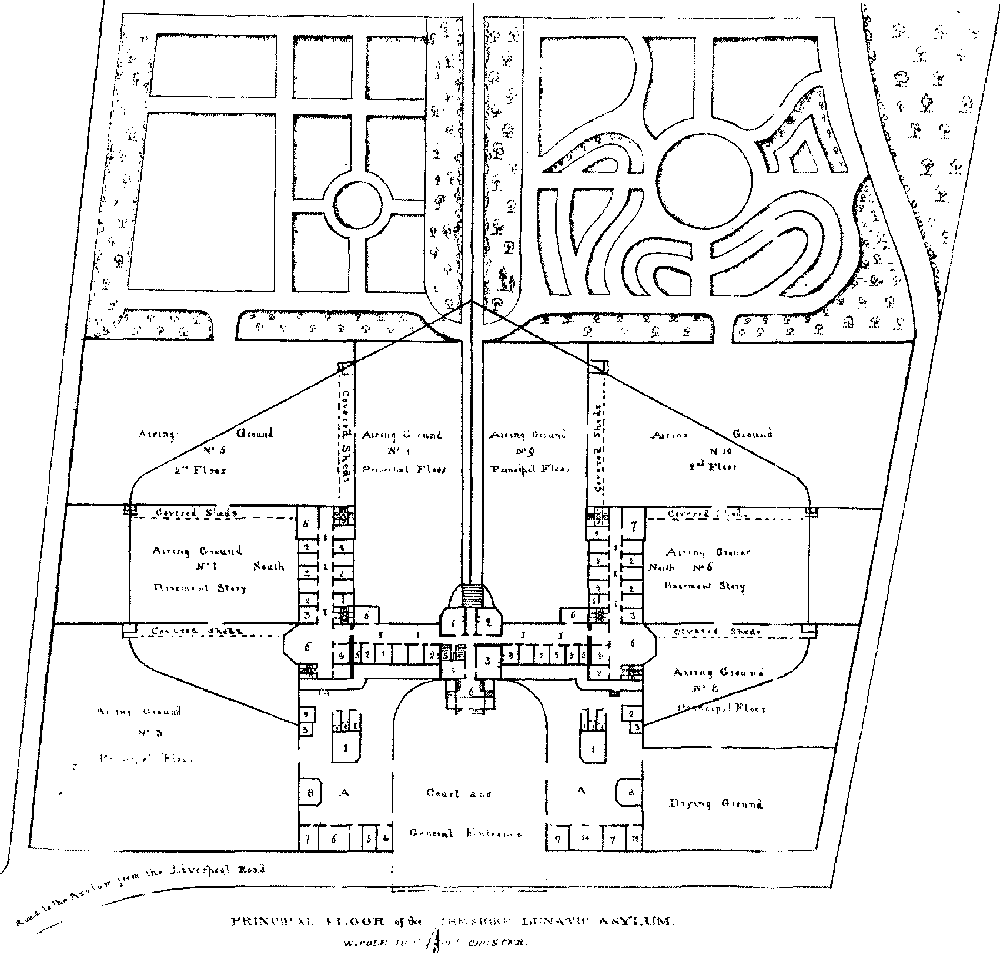
Cheshire lunatic asylum, original plan, 1828
National Health Service
Plans to co-ordinate the work of the Royal Infirmary and the City Hospital were being made from 1929, (fn. 118) and by 1945 they were working closely together under the auspices of the wartime Emergency Medical Service. (fn. 119) On the formation of the National Health Service in 1948, they were grouped with smaller hospitals at Boughton Heath (the former Tarvin poor-law union workhouse), Ellesmere Port, and Runcorn under the Chester and District hospital management committee (H.M.C.). The mental hospital had its own H.M.C. Both came under Liverpool regional board and were united as West Cheshire H.M.C. in 1965. They were reorganized in 1974 within Cheshire area health authority and in 1982 came under Chester health authority, in Mersey region, which ran all the health services within the local authority districts of Chester and most of Ellesmere Port. (fn. 120)
After 1948 the Royal Infirmary specialized in surgery and out-patients, and the City Hospital in chronic illness, and chest, maternity, paediatric, and general medical cases, a division foreshadowed by their strengths before nationalization. (fn. 121) Pre-war plans for the expansion of the infirmary were eventually revived and a large out-patient and casualty department was opened on Infirmary field in 1963. (fn. 122) After the creation of the West Cheshire H.M.C., it was decided in 1968 to concentrate all the district's hospital services at the Liverpool Road site (hitherto the county mental hospital), which in anticipation was renamed West Cheshire Hospital. (fn. 123) The maternity unit was transferred from the City Hospital to a new building at the south end of the site in 1971. (fn. 124) A new general wing was opened in 1983, when several departments moved from the infirmary, and the City Hospital was left as a 120-bed geriatric unit. (fn. 125) The City Hospital closed entirely in 1991 when geriatric care was moved, and the rest of the departments still at the infirmary moved to Liverpool Road in 1994. West Cheshire Hospital was renamed the Countess of Chester Hospital in 1984. (fn. 126)
Private Hospital
A private hospital, the Grosvenor Nuffield, was opened in Wrexham Road with 30 beds in 1975 and was enlarged in 1984 to accommodate 40 beds. (fn. 127)