A History of the County of Chester: Volume 5 Part 2, the City of Chester: Culture, Buildings, Institutions. Originally published by Victoria County History, London, 2005.
This free content was digitised by double rekeying. All rights reserved.
J S Barrow, J D Herson, A H Lawes, P J Riden, M V J Seaborne, 'Economic infrastructure and institutions: Railways', in A History of the County of Chester: Volume 5 Part 2, the City of Chester: Culture, Buildings, Institutions, ed. A T Thacker, C P Lewis (London, 2005), British History Online https://www.british-history.ac.uk/vch/ches/vol5/pt2/pp91-94 [accessed 2 May 2025].
J S Barrow, J D Herson, A H Lawes, P J Riden, M V J Seaborne, 'Economic infrastructure and institutions: Railways', in A History of the County of Chester: Volume 5 Part 2, the City of Chester: Culture, Buildings, Institutions. Edited by A T Thacker, C P Lewis (London, 2005), British History Online, accessed May 2, 2025, https://www.british-history.ac.uk/vch/ches/vol5/pt2/pp91-94.
J S Barrow, J D Herson, A H Lawes, P J Riden, M V J Seaborne. "Economic infrastructure and institutions: Railways". A History of the County of Chester: Volume 5 Part 2, the City of Chester: Culture, Buildings, Institutions. Ed. A T Thacker, C P Lewis (London, 2005), British History Online. Web. 2 May 2025. https://www.british-history.ac.uk/vch/ches/vol5/pt2/pp91-94.
RAILWAYS
There were abortive railway schemes in the mid 1820s to link Birmingham and Birkenhead via Chester, and by 1835 for a branch from the city to the Grand Junction's Birmingham-Warrington line at Crewe. (fn. 1)
The Chester and Crewe and the Chester and Birkenhead Railways were incorporated separately in 1837, (fn. 2) and both lines were opened in 1840, by when the former was owned by the Grand Junction. (fn. 3) The line from Crewe entered the city alongside the canal in Boughton; that from Birkenhead came in through Upton and Newton, east of Liverpool Road. (fn. 4) They met on the city boundary north-east of Chester at the hamlet of Flookersbrook, a low-lying area which the railway companies drained. Their stations, near one another and reached along Brook Street, were wooden shacks and converted houses, including Brook Lodge, which survived in a derelict condition into the 1940s or later. (fn. 5) Although the two lines connected, there were no through trains. (fn. 6)
After the Chester-Crewe line was authorized those already interested in a rail connexion between Holyhead (Ang.) and the Midlands proposed a line from Holyhead to Chester. The Chester and Holyhead Railway Company was incorporated in 1844 to build on a route much of which had already been surveyed by George Stephenson. (fn. 7) To carry the line out of Chester, Stephenson proposed a route leading west from Brook Street, with a tunnel under Upper Northgate Street, the line then emerging to bridge the canal, cut through the north-west corner of the city walls, and cross the Roodee on a viaduct leading to a bridge over the Dee. (fn. 8) The first two miles to Saltney were shared by the Shrewsbury and Chester Railway, a company formed by merger in 1846. (fn. 9) The lines diverged at Saltney Junction, near Hough Green, the Holyhead line heading due west into Wales, the Shrewsbury line curving south to cross the main road (later Chester Street) by a bridge and leave the city parallel with the national boundary. A station and later extensive sidings were built at Saltney. The G.W.R. closed the station to passengers in 1917 but reopened it in 1932. At Saltney Wharf on the Dee were more sidings and a goods station which closed in 1937. (fn. 10)
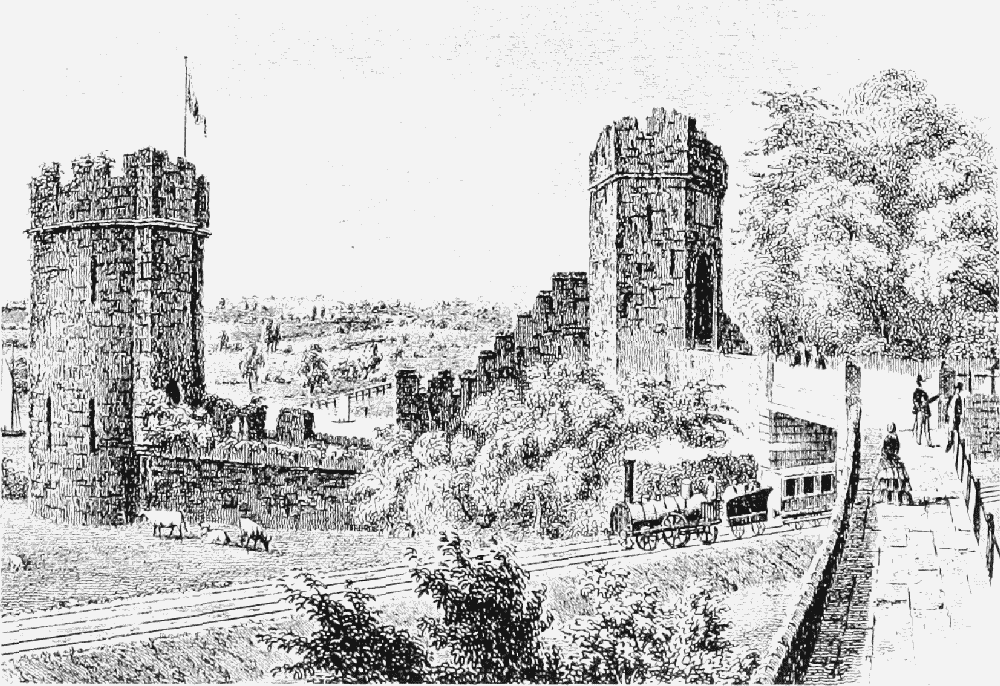
Train for north Wales passing under city walls, 1867
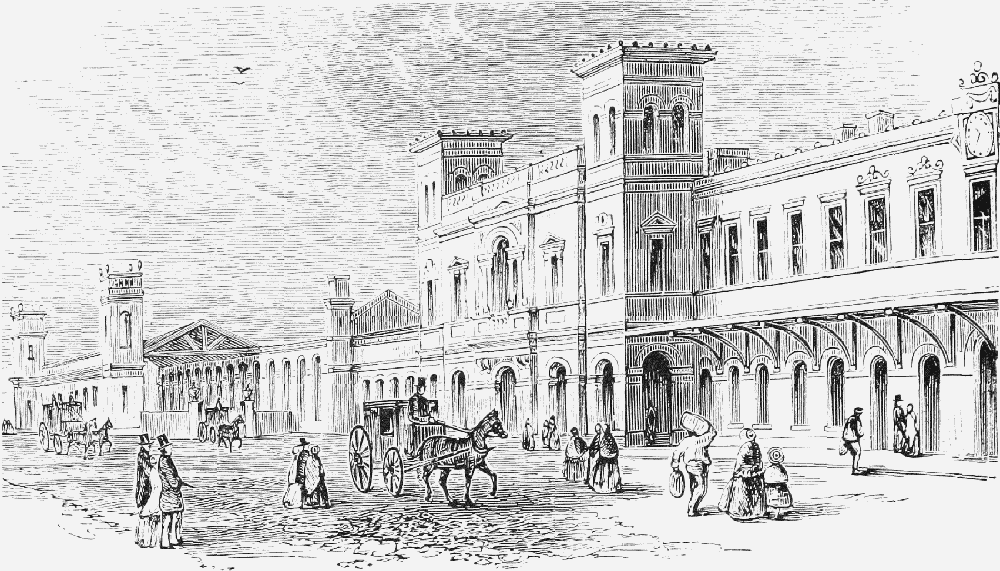
General railway station, 1890s
The Shrewsbury and Chester opened its line as far as Ruabon (Denb.) in 1846 and to Oswestry and Shrewsbury in 1848. (fn. 11) A serious accident took place in 1847, when one of the cast-iron girders of the Dee bridge broke, plunging a train into the river and killing five people. (fn. 12) The bridge was repaired and in 1870–1 was rebuilt in brick and wrought iron. (fn. 13)
The Chester and Holyhead Railway was opened to Bangor (Caern.) in 1848 and to Holyhead in 1850. (fn. 14) A line to Mold (Denb.), branching from the Holyhead line just outside the city, was opened in 1849 by the same company. (fn. 15) It was extended to Denbigh in 1869, thus providing access along lines already open to Ruthin (Denb.) and Corwen (Merion.). (fn. 16)
The Chester and Birkenhead had meanwhile been absorbed in 1847 into the Birkenhead, Lancashire, and Cheshire Junction Railway. In the same year the new company opened a branch from its main line at Helsby to a junction just east of Brook Street station in Chester. (fn. 17)
By the late 1840s Chester was thus already a busy rail junction whose stations were quite inadequate. A general station, to be run jointly by the companies concerned, was first mooted in 1845 and approved in 1847. (fn. 18) Completed in 1848, it was designed by Francis Thompson on the lines of his earlier station at Derby, as a long two-storeyed Italianate building in dark red brick with facings of Storeton stone. (fn. 19) There was only one through platform, over 1,000 ft. long, and a scissors junction allowed up trains to use one end and down trains the other. Offices for the railway companies were housed on the first floor, with booking hall, refreshment rooms, and other passenger accommodation beneath. (fn. 20)
As generally in the early 1840s, (fn. 21) passenger traffic was far more lucrative than goods: in 1846 the Chester and Birkenhead carried over 173,000 passengers who brought in over £15,600, while goods and mails accounted for under £2,500. The line to Ruabon carried over 60,000 passengers in its first six months. (fn. 22) Chester was nevertheless an obvious site for a large goods depot. In 1841 the newly appointed secretary of the Grand Junction, Mark Huish, began a goods agency at Chester, (fn. 23) and by 1849 the goods yard employed a staff of 67, handling 180,000 tons a year, (fn. 24) rising by 1855 to up to 80 trains a day carrying 684,000 tons a year. (fn. 25) Although the gap between freight and passenger income narrowed, the number of passengers also rose steadily to almost 1,500,000 in 1858, of whom nearly 300,000 were through passengers and over 350,000 were excursionists visiting Chester. There were nearly 100 passenger trains a day in 1855. (fn. 26)
In and after the 1850s there was great rivalry between the two main companies operating trains from Chester: the London and North Western (L.N.W.R.), into which the Grand Junction had been merged in 1846, and the Great Western (G.W.R.), which took over the Shrewsbury and Chester in 1854. The L.N.W.R., which had operated the trains on the Holyhead and Mold lines from their opening, took over the Chester and Holyhead company in 1858 and later acquired others, so that it could run trains from Chester throughout north Wales. A branch line from Tattenhall Junction on the Chester-Crewe line to Whitchurch (Salop.), opened in 1872, enabled the L.N.W.R. to run trains from Chester into G.W.R. territory at Shrewsbury. One area of contention between the two companies was resolved by compromise: in 1860 the Birkenhead, Lancashire, and Cheshire Junction was vested in them jointly, to be run as a separate concern, the Birkenhead Railway. (fn. 27)
By the mid 1860s Chester General station had passed from the General Station Committee to a joint committee of the L.N.W.R. and G.W.R. There were refreshment rooms from the start and a bookstall by 1860. (fn. 28) The Queen Hotel opposite the station was opened in 1860. (fn. 29) City Road, suggested in 1846 to link the station more directly with the town, (fn. 30) was built in the early 1860s jointly by the station committee and the city council. (fn. 31)
A large area of land was eventually taken over for railway purposes around General station. To its north, a triangle of tracks allowing interchange between the lines to Saltney and Birkenhead was surrounded by sidings. The goods depot lay north-east of the passenger station. (fn. 32)
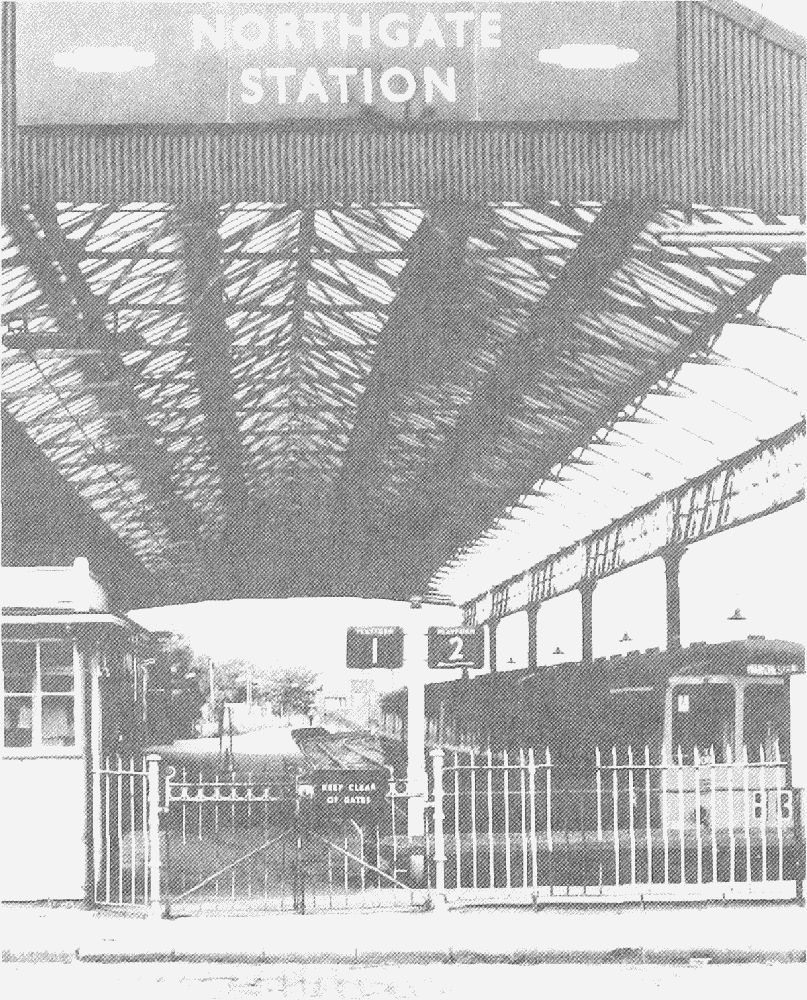
Northgate station, 1960s
Further expansion of the local rail network was proposed in the early 1860s, (fn. 33) but the Act of 1867 for a line from Mouldsworth to a new station in Windmill Lane (later Victoria Road) was not implemented for some years. It was opened by the Cheshire Lines Committee (C.L.C.) in 1875, primarily for a passenger service to Manchester. (fn. 34) The line entered the city through Newton, crossed over the Birkenhead line at Brook Lane and curved sharply south to Northgate station, built virtually over the Upper Northgate Street tunnel. There was no connexion between the new line and the existing ones. (fn. 35) In 1876 Northgate station had c. 20 staff and its goods yard east of the passenger station was handling c. 1,000 tons a month. (fn. 36) A new line from Northgate station to Birkenhead, Connah's Quay (Flints.), and Wrexham was authorized in 1888 for the Manchester, Sheffield, and Lincolnshire Railway (renamed the Great Central in 1897), one of the proprietors of the C.L.C. The line, opened in 1890, passed under Liverpool Road, over Parkgate Road, across an embankment, and out through Sealand (Flints.), with stations at Liverpool Road and Blacon. (fn. 37)
Chester General greatly enlarged its passenger accommodation in 1890, building two new through platforms with their own suite of refreshment and waiting rooms. (fn. 38) The main line to Saltney was given extra tracks between 1900 and 1904, necessitating major engineering works to widen the tunnels, the Roodee viaduct, and the bridge over the Dee. (fn. 39)
In 1887 over 100 passenger trains left Chester each weekday, a number which rose to c. 200 in 1910 and 1938. (fn. 40) In the 1890s Chester was regarded as 'a great railway centre . . . one of the most important in England'. (fn. 41) The L.N.W.R. and G.W.R. both ran services to London, the former via Crewe, the latter via Shrewsbury and Birmingham. The L.N.W.R.'s other main line from Chester was to Holyhead and Llandudno (Caern.), with many connecting services in north Wales. It also ran direct trains from Chester on the line to Mold, Denbigh, and Corwen, to Shrewsbury via Whitchurch, and to Liverpool via Runcorn. The Birkenhead Railway's trains ran to Liverpool via Birkenhead, and to Manchester Exchange via Warrington. All those services were from General station. From Northgate station the C.L.C. ran a service to Manchester Central via Northwich, and the Great Central one to Connah's Quay. When the railway companies were grouped in 1923 the L.N.W.R. became part of the London, Midland, and Scottish Railway (L.M.S.R.) and the Great Central part of the London and North Eastern Railway (L.N.E.R.). The Birkenhead Railway was jointly managed by the L.M.S.R. and the G.W.R. In the 1920s and 1930s the enlarged companies ran direct trains to places as far away as Aberdeen, Dover, Bournemouth, and Pwllheli (Caern.).
From the 1950s British Railways began to withdraw services and close stations and lines. Liverpool Road station was closed to passengers in 1951 and Saltney finally in 1960; (fn. 42) services to Whitchurch ceased in 1957 when the branch from Tattenhall Junction was closed, (fn. 43) and those to Connah's Quay and New Brighton in 1968 when the same fate met the lines west from Northgate station. Blacon station also closed then. Northgate station itself closed in 1969 once services to Manchester Oxford Road were able to operate from Chester General. (fn. 44) The station was afterwards demolished and its site and that of sidings to the north were redeveloped with housing estates.
Chester nevertheless retained frequent trains to many destinations, and in 1995 there were c. 150 every weekday, serving the lines to Crewe and London, Liverpool, Manchester via both Warrington and Northwich, north Wales, and Wolverhampton via Wrexham and Shrewsbury. (fn. 45)