
A History of the County of Chester: Volume 5 Part 2, the City of Chester: Culture, Buildings, Institutions. Originally published by Victoria County History, London, 2005.
This free content was digitised by double rekeying. All rights reserved.
'Leisure and culture: Cathedral music and music festivals', in A History of the County of Chester: Volume 5 Part 2, the City of Chester: Culture, Buildings, Institutions, (London, 2005) pp. 273-275. British History Online https://www.british-history.ac.uk/vch/ches/vol5/pt2/pp273-275 [accessed 20 April 2024]
CATHEDRAL MUSIC AND MUSIC FESTIVALS
The origins of Chester's music festivals lay in the musical tradition established at the cathedral after 1541. (fn. 1) The statutes of 1544 provided for six minor canons, six conducts or singing-men, eight choir boys, and a choir master and organist. (fn. 2) A degree of continuity with the abbey is suggested by the fact that John Birchley, the monks' last organist, was re-employed by the new chapter. (fn. 3) By 1567 his office was sufficiently well regarded to attract Robert White, a distinguished composer of settings of the Latin liturgy, and later organist at Westminster Abbey. The cathedral was then the focus of considerable musical activity, and much involved in the musical side of the mystery plays. (fn. 4) White's successors, Robert Stevenson (1570–99) and Thomas Bateson (1599–1608), were also composers and maintained high musical standards at the cathedral. (fn. 5) By 1602 the lay clerks included Francis Pilkington, a composer of lute songs and madrigals, who became a minor canon in 1612 and precentor from 1617 until his death in 1638. (fn. 6) Between 1608 and 1646, however, the organists included only one figure of note, Randolph Jewett (1643–6), son of a former mayor, pupil of Orlando Gibbons, and composer of anthems. (fn. 7)
After the Restoration the cathedral's music was undistinguished. An attempt at improvement was made in 1727 when the chapter appointed Edmund Baker, a pupil of Thomas Arne and Chester's first professional organist since 1660, but the choir remained unsatisfactory and in 1741 Baker was unable to supply a conduct capable of singing at sight to help Handel rehearse Messiah while he waited at Chester to take ship for Dublin. Nevertheless, Baker was an accomplished musician and by the 1740s the city had become 'a very musical place'. By then John Prescott, a prebendary of the cathedral, held a weekly concert attended by 18–20 performers, gentlemen, and professors. Prescott, who was deprived of his stall in 1746, seems to have tried hard to promote an interest in music in Chester. He paid Baker to teach the harpsichord to singing boys and pupils of the cathedral school and in 1739 secured a free place there for the young Charles Burney. (fn. 8) Concerts were also occasionally performed at the Exchange, especially in aid of the infirmary from the late 1750s. (fn. 9)
Baker's successor, Edward Orme (1765–77), a man of some social position who became sheriff of Chester in 1773–4, organized the city's first music festival in 1772, at which three of Handel's oratorios, Messiah, Samson, and Judas Maccabeus, were performed in the cathedral nave. Further festivals took place in 1783, 1786, 1791, 1806, 1814, 1821, and 1829. Although Handel continued to dominate the programme, in 1806 Haydn's Creation was performed and in 1821 there were works by Mozart, Haydn, and Pergolesi. The festivals became increasingly grand, and by 1806 the four days of performances were a major social occasion attended by royalty and involving many of the principal musicians of the day. Their popularity, however, made the dean and chapter fearful of 'abuses and irreverence', and they refused permission for further festivals after 1829. (fn. 10)
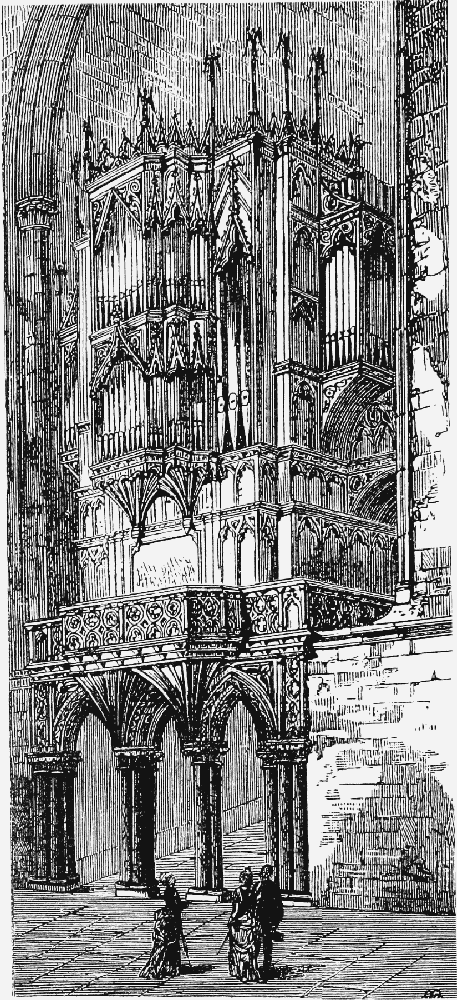
Cathedral organ of 1875
Under Dean Anson (1839–67) the cathedral's musical standards were raised. A great new organ was introduced, the number of choristers was increased to the statutory eight, and a separate choir school was founded. (fn. 11) Further improvements took place under the precentor Hylton Stewart (1877–90) and organist J. C. Bridge (1877–1925) and in the 1880s large-scale choral works were occasionally performed and a triennial festival of parish choirs was established. Aided by another splendid organ installed in 1875, Bridge revived the music festival in 1885, with two days of concerts and choral evensong at the cathedral. Thereafter, festivals were held triennially. The performances, which included choral works by Handel, Haydn, Mendelssohn, Spohr, Verdi, and Berlioz, were generally held in the cathedral and invariably conducted by Bridge himself. The last took place in 1900. (fn. 12)
The cathedral continued its choral tradition throughout the 20th century, despite the closure of the choir school in 1977. In 1978 the music festival was again revived. By the early 1980s it had become a major annual event, lasting c. 10 days and involving soloists, ensembles, and orchestras of international distinction. By then it was held in several locations, of which the cathedral remained the principal. (fn. 13)