A History of the County of Chester: Volume 5 Part 2, the City of Chester: Culture, Buildings, Institutions. Originally published by Victoria County History, London, 2005.
This free content was digitised by double rekeying. All rights reserved.
J S Barrow, J D Herson, A H Lawes, P J Riden, M V J Seaborne, 'Leisure and culture: Education', in A History of the County of Chester: Volume 5 Part 2, the City of Chester: Culture, Buildings, Institutions, ed. A T Thacker, C P Lewis (London, 2005), British History Online https://www.british-history.ac.uk/vch/ches/vol5/pt2/pp277-291 [accessed 3 May 2025].
J S Barrow, J D Herson, A H Lawes, P J Riden, M V J Seaborne, 'Leisure and culture: Education', in A History of the County of Chester: Volume 5 Part 2, the City of Chester: Culture, Buildings, Institutions. Edited by A T Thacker, C P Lewis (London, 2005), British History Online, accessed May 3, 2025, https://www.british-history.ac.uk/vch/ches/vol5/pt2/pp277-291.
J S Barrow, J D Herson, A H Lawes, P J Riden, M V J Seaborne. "Leisure and culture: Education". A History of the County of Chester: Volume 5 Part 2, the City of Chester: Culture, Buildings, Institutions. Ed. A T Thacker, C P Lewis (London, 2005), British History Online. Web. 3 May 2025. https://www.british-history.ac.uk/vch/ches/vol5/pt2/pp277-291.
In this section
EDUCATION
Before 1700
A grammar school is known to have existed at St. John's church in 1353, perhaps the same as that recorded in 1368. (fn. 1) There was also a school associated with the abbey, replaced in 1541 by a grammar school under the control of the dean and chapter of the cathedral. (fn. 2) The history of the new foundation, which provided for a master, an usher, 24 scholars, and eight choristers and was known as the King's school, is given elsewhere. (fn. 3)
The King's school remained a centre of classical instruction throughout the period, sending pupils to the universities, but it is highly probable that other privately run schools existed in Chester, of which no records have survived before c. 1700. In 1539 the Assembly ordered that all children over the age of six should be 'set to the school to learn their belief and other devotions, prayers, and learning, or else to such other good and virtuous ... occupation whereby they ... may obtain ... an honest living'. (fn. 4) The phrase 'set to the school' might be a reference to the abbey school or to the existence of otherwise unrecorded petty schools in Chester. The Assembly was also linked with Robert Offley's charity, established in 1596, which provided an exhibition worth £5 at Brasenose College, Oxford, for the son of a Chester citizen, to be elected by the Assembly. (fn. 5) The surviving subscription books for schoolmasters and others in Chester diocese do not begin until 1669 and do not give the occupations of the subscribers. (fn. 6) Other than the master and usher of the King's school, there is little evidence for schoolmasters in Chester in the 17th century. The puritan John Glendal, curate of St. Peter's 1628–42, sent one of his pupils to Cambridge University, (fn. 7) and there was a private school in the period 1685–1705. (fn. 8) The educational functions performed by the well developed system of guilds were of considerable importance but were manifested in such matters as the rules governing apprenticeships rather than in formal schools. (fn. 9)
The 18th Century
The 18th century was an age of benevolence and patronage in the development of education in Chester. As the commercial centre of a prosperous agricultural region and the seat of a bishopric situated close to the estates of a leading landowner (the Grosvenor family), Chester was well placed to be in the forefront of educational provision. The Society for Promoting Christian Knowledge had been founded in London in 1699 and only a year later a Blue Coat school on the model which it advocated was established by public subscription under the patronage of Nicholas Stratford, bishop of Chester, and Sir Richard Grosvenor, 4th Bt. A purpose-built school was erected in Upper Northgate Street in 1717 on a site donated by the corporation (Fig. 172, p. 278). One of the earliest schools of its type outside London, it concentrated on the teaching of the church catechism, reading, writing, and arithmetic, and provided boarding accommodation for 40 boys, who wore blue school uniform. (fn. 10) The cathedral authorities were also responsible for setting up a Blue Girls' school in 1720, where sewing, knitting, and spinning were added to the curriculum. The girls met at first in the boys' school building but later occupied a succession of other premises until a new school was built in Vicars Lane in 1872 by the 1st duke of Westminster. In 1783, largely through the initiative of Dr. John Haygarth, the pioneering physician of the Chester infirmary, the number of boarders at the boys' school was reduced to 25 and a day school was begun for 60 boys known as 'green caps'; their number was doubled to 120 in 1784. (fn. 11)
The social and economic character of the city also attracted middle-class nonconformists. Wesleyan Sunday schools were organized at the Octagon from 1781 and in St. John Street from 1782; a Congregationalist Sunday school met in Queen Street from 1803. (fn. 12) Dr. Haygarth was the prime mover in the establishment of a Society for the Promotion of Sunday and Working Schools for Girls in 1787. The enterprise was influenced by the growth of Sunday schools in Chester, but recognized the limitations of providing education on only one day in the week. It extended to girls attending on weekdays the type of vocational education already being provided for boarders at the Blue Girls' school. (fn. 13)
All the schools for poor children were supported by private patronage and were heavily religious in tone. The development of middle-class education took more cognizance of secular subjects, and Chester in the 18th century became an important centre for private schools. The King's school retained its reputation as a classical school but by 1709 most of the 120 boys attending it were fee-payers; boarders were also mentioned later in the century. (fn. 14) In addition there were at least 44 private schools in existence during the 18th century, more after 1750 than before. (fn. 15) Over half were run by women, an indication of how middle-class girls received their education at a time when there was no public provision for them. In 1781 the Chester Guide listed 15 private school teachers: there were three women running boarding schools and 12 schoolmasters, including two dancing masters and a musician. (fn. 16) Private tutors also gave evening lectures on scientific and other subjects and contributed to the varied cultural life of the Georgian town. (fn. 17)

Blue Coat school entrance
1800–70
Chester's rapid economic growth and the doubling in size of its population between 1801 and 1861 naturally had a considerable effect on the provision of education. Private philanthropy remained the principal response but it was now organized on a more systematic basis, with the cathedral authorities playing a leading role. The Church of England founded the National Society for Promoting the Education of the Poor in 1811 and in the following year a National school for boys was established in Chester. In 1816 it was rehoused in a new building, on the corner of Upper Northgate Street and George Street, known as the Diocesan school. (fn. 18) The Sunday and working schools for girls were also reorganized in 1816 and became a National school for girls with the title of the Chester Consolidated Sunday and Working school. It met first in the basement of the Blue Coat school but moved to a new site between Princess Street and Hunter Street in 1854. (fn. 19) A third elementary school opened in Vicars Lane in 1813 and contained c. 300 boys and girls taught on the National system by a master and mistress appointed and paid by the marquess of Westminster. (fn. 20) It became known as the Grosvenor St. John's school.

Bishop Graham Memorial Ragged School, used as Chester City Mission, 1966
In 1825, as the problem of educating very young children began to receive attention, the Chester Infant School Society was formed under the patronage of Charles Blomfield, bishop of Chester. Infants' schools were opened in the Kaleyards (1826), Russell Street (1827), Handbridge (1828), and later at St. Martin'sin-the-Fields (1860). (fn. 21)
The appointment of the liberal evangelical John Bird Sumner as bishop in 1828 gave further impetus to the provision of elementary education and to the training of elementary-school teachers. A diocesan board of education was set up in 1839 and its training college for schoolmasters, in Parkgate Road from 1842, (fn. 22) opened a practising school for boys on the site in 1843 which became the male equivalent of the Consolidated girls' school, since both recruited their pupils from all the parishes in Chester. (fn. 23) For that reason the College boys' school and Consolidated girls' school came to be regarded as somewhat superior elementary schools.

Victoria Road British school
Several parishes in the city set up their own National schools. (fn. 24) The Grosvenor family had already established a school in Vicars Lane for St. John's parish, and others were built by Christ Church in Cornwall Street in 1842 and by St. Mary's in 1846. (fn. 25) The new ecclesiastical district of St. Paul's, Boughton, held a day school from c. 1830, with a new building in 1857. Another National school was opened in Linenhall Street in Holy Trinity parish in 1869. (fn. 26)
The National schools charged small weekly fees, and a marked increase in the number of very poor children unable to pay led to the formation in 1851 of the Chester Ragged School Society, which recognized the need for free education for poor, orphaned, and neglected children. Ragged schools were established at Boughton (1852) and in St. Olave's parish (1852), with a third in Princess Street (1868) known as the Bishop Graham Memorial school (Fig. 173). (fn. 27) In 1863 the Boughton school was reorganized as an industrial school to which magistrates could send children who had committed minor offences. (fn. 28) Boughton, together with the workhouse school, which moved with the workhouse from the Roodee to Hoole Lane in 1878, (fn. 29) were the recipients of children who for social or other reasons could not be fitted into the contemporary educational system.
The non-Anglican churches also established their own schools in Chester during the period. A Wesleyan day school developed in 1839 from the Sunday school in St. John Street but the nonconformist British School Society did not establish a branch in Chester until 1867. A British school had opened in Christleton Road, Great Boughton, in the previous year and another opened in Victoria Road in 1867, with a new building in 1871. (fn. 30) Roman Catholic schools became eligible for government grants in 1847, and the St. Werburgh's schools were built in Queen Street in 1854. In the same year the Dee House convent opened a boarding school for Catholic girls, to which day pupils were later admitted. (fn. 31)
In the earlier 19th century, because of a decreasing demand for the classical languages, the King's school was in decline, in common with many other endowed grammar schools. By 1814 the classics were no longer being taught and, although Latin was later reintroduced, the school was classified by the Taunton Commissioners in 1867 as third-grade. (fn. 32) The mid 19th century was therefore the heyday of the private schools. In 1840 the Chester Directory noted 16 boarding and 26 day schools run by private individuals. Five of the boarding schools were for 'gentlemen' and eleven for 'ladies'. (fn. 33) In 1853 a private day school for boys, the Collegiate Institution, was set up by John Brindley in a house in Abbots Grange previously occupied by a girls' boarding school. Competition from other schools forced its closure c. 1857. (fn. 34)
The most valuable experiment in secondary education during the period was the science school which developed within the diocesan training college. (fn. 35) Several early training colleges ran schools for middleclass boys, whose fees were used to subsidize the largely working-class students training to be elementary school masters, but only at Chester under the remarkable Arthur Rigg were science and technology given such prominence. In other circumstances, the science school might have developed into an independent public school similar to those at Liverpool (1843) or Rossall (1844), but it faded away following Rigg's retirement in 1869.
Scientific and technical subjects developed on a more permanent basis in response to a growing demand from older students, encouraged by a number of professional men in Chester, among whom Charles Kingsley, a canon at the cathedral, was the most notable example. A mechanics' institute was formed in 1810 and reorganized in 1835, moving to St. John Street in 1845, from which a public library developed in 1874. (fn. 36) A school of art was organized in association with it after 1853 and regular classes in science were also held after the founding of the Chester Society of Natural Science, Literature, and Art in 1871. Other branches of learning were stimulated by the Chester Architectural, Archaeological, and Historic Society, which was established in 1849. (fn. 37)
1870–1902
The majority of members of Chester city council opposed the formation of a school board under the 1870 Education Act, chiefly on grounds of expense, and claimed that Chester already had sufficient elementary schools provided by the voluntary bodies. (fn. 38) The Education Department in London adopted the rule of thumb that there should be sufficient elementary school places for a sixth of the population, but the calculation of school places in Chester was complicated by the uneven distribution of the schools and by the existence of a number of schools outside the city boundary (notably at Hoole and Saltney) which city children also attended. In 1872 it was agreed that there was a shortfall of 1,373 places. Virtually the whole deficiency was in places for girls and infants, reflecting the more generous provision already made for boys. (fn. 39)
The chief proponents of a school board were the nonconformists, led by the (Unitarian) Revd. J. K. Montgomery, secretary of the British Schools Association, who considered that non-denominational schools should be provided from the rates for 'the poorest class of children belonging to all denominations, and those unconnected with any'. (fn. 40) The council responded by setting up a school accommodation committee, which held its first meeting in 1873 under the chairmanship of the dean of Chester. It proposed that a voluntary rate of 6d. in the pound should be raised to meet the £4,073 needed to supply the deficiency in school places, warning that otherwise a school board would have to be set up. (fn. 41)
Despite the warning, contributions to the voluntary rate were disappointing. The managers of several Anglican schools offered to extend their premises without calling on the rates, but money was still needed to accommodate more infants at the Victoria Road British school and in a proposed new British school to be held in a former chapel in Commonhall Street. By 1874 the voluntary rate had produced only £1,018, most of which was distributed to the British schools. (fn. 42) That to some extent satisfied nonconformist opinion, but the Commonhall Street school, which opened in 1875, was forced to close in 1876 through lack of funds. (fn. 43) No more was heard about a school board.
As the city's population rose, the number of pupils on the registers of the city's elementary schools increased, from 5,347 in 1877 to 6,988 in 1900. (fn. 44) The extra accommodation was provided wholly by voluntary effort. Infants' departments were opened by the Wesleyan school in 1871 and at the Boughton British school in 1880. The Roman Catholics expanded their schools at St. Werburgh's and in 1883 opened another in Cuppin Street in connexion with the new church of St. Francis. On the Anglican side, the duke of Westminster financed a new school at St. Mary's, Handbridge (1876), and rebuilt the St. John's school in Vicars Lane (1883). The new Grosvenor St. John's school was designed by E. R. Robson, architect to the London school board, (fn. 45) but was modified during construction. Other church schools were opened in the parishes of St. Oswald (1873), where the school was named after the new church of St. Thomas, and St. Peter (1874), while St. Michael's school (1879) took over from St. Olave's ragged school in Lower Bridge Street. An infants' school was opened in 1877 in the mission church of St. Barnabas, Sibell Street, and another off Sealand Road in 1883. By 1900 there were 20 elementary schools in the city, organized in 39 departments. In denominational terms, 11 per cent of the children were in Catholic schools, 19 per cent in nonconformist, and 70 per cent in Anglican. (fn. 46)
Although a school board had been avoided, the provisions of the Education Act of 1876 made it obligatory for the council to appoint a school attendance committee, which met at almost weekly intervals from 1877. (fn. 47) A school attendance officer was appointed, assisted by an 'out-door officer', a police constable in plain clothes. The implications of enfor cing school attendance soon became clear. At the committee's behest, the collector of the improvement and lamp rates made a house-to-house survey and reported that 847 children aged between 5 and 13 were not attending any school. (fn. 48) Bylaws setting out the requirements of the Act were adopted and notices were sent to parents and employers outlining the new arrangements. Teachers were required to keep increasingly elaborate records, registrations of births were obtained on a regular basis, and a private medical practitioner was employed to certify absences through illness. In 1878 the committee sent out 2,513 notices to parents whose children were not attending school regularly, and many of the parents were called to interview by members of the committee. In 1878 the magistrates fined 112 parents and imprisoned five for the non-attendance of their children. (fn. 49) The number of fines rose to 460 in 1900 and each year some parents were imprisoned. (fn. 50) A small number of refractory boys were sent to the industrial school at Boughton or to the training ship Clio in the Menai Strait. Aided by such measures, school attendance rose from 75 per cent in 1878 to 82 per cent in 1900, matching the average for England and Wales as a whole. When the school attendance committee was replaced under the provisions of the 1902 Education Act, it was praised for its thoroughness, efficiency, and modest cost. (fn. 51)
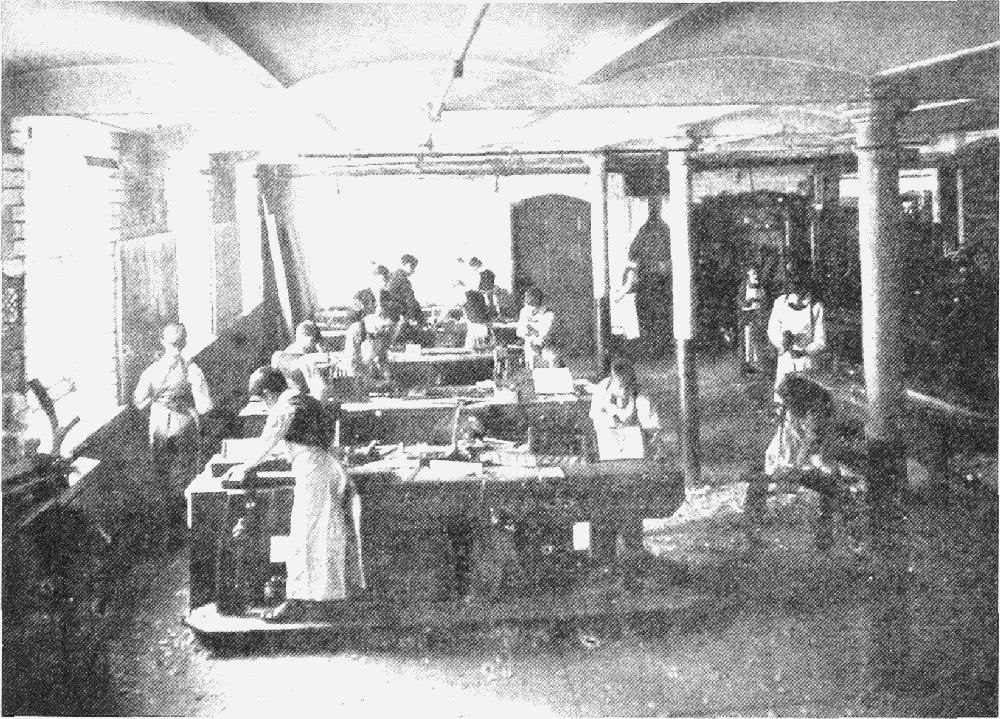
Technical school at Grosvenor Museum, c. 1906
The College school for boys and the Consolidated school for girls charged higher fees than the other elementary schools in the city and in 1885 became 'higher-grade' schools offering a somewhat more advanced curriculum. (fn. 52) The boys' school moved to a new building on the college site in 1900, designed on the central-hall plan by the county architect, H. Beswick, (fn. 53) while the girls' school's building in Hunter Street was extended. The demand for secondary education was still largely being satisfied by private schools: in 1871 there were at least 40 private schools in Chester, 30 of them for girls. Several of the larger and longer established boys' schools in the 1870s occupied such notable buildings as the old Albion Hotel and Bridge House in Lower Bridge Street, 'Derby House' (Stanley Palace) in Watergate Street, and Forest House in Foregate Street, though Gamul House had closed as a boarding school in the 1860s. (fn. 54) However, the King's school was now being reformed, and acquired an impressive new building near the cathedral in 1879. (fn. 55) The Queen's school was established for middle-class girls in 1878 and moved to a new building in City Walls Road in 1883. (fn. 56)
Evening classes in art and science were held at the mechanics' institution in St. John Street, while the archaeological and natural history societies met in the Albion Rooms in Lower Bridge Street. Chiefly through the generosity of the duke of Westminster, all those activities were centralized in the Grosvenor Museum, completed in 1886 to the design of T. M. Lockwood. The classes were able to gain grants from the Science and Art Department at South Kensington. (fn. 57)
The city council adopted the Acts of 1889 and 1890 which permitted local authorities to raise a penny rate and to claim excise duties ('whisky money') in aid of technical education. In 1892 a technical day school for boys was established in the Grosvenor Museum and the council granted it £711 a year in return for representation on the school's governing body. The day-school fee of £10 a year proved to be too high to attract pupils and was later halved, while some scholarships for boys from the elementary schools were made available with the help of Robert Oldfield's charity. (fn. 58)
1903–18
Chester, a county borough, became a local education authority in 1902, and an education committee comprising 18 councillors and 9 co-opted members began work in 1903. (fn. 59) A. E. Lovell, previously on the staff of Chester College, was appointed director of education. (fn. 60) The abolition of fees in most of the elementary schools in 1907, and a declining birth rate, reflected in a drop in the average attendance in Chester's elementary schools from 6,243 in 1904 to 5,788 in 1913, largely solved the difficulties of securing school attendance, which rose to 90 per cent. (fn. 61)
The main problem facing the new authority was the unsatisfactory state of the voluntary school buildings, many of which were old and overcrowded. Government inspectors reported numerous deficiencies, confirmed by the city surveyor. (fn. 62) Although under the 1902 Act the authority was responsible for maintaining the voluntary schools, the external structure of the buildings remained the responsibility of the voluntary bodies. There was prolonged correspondence with the managers of the Wesleyan, British, and Catholic schools, and of the older Anglican schools, all of whom were short of funds. In the event, the Wesleyan school in St. John Street closed and was replaced by a new council school in Love Street in 1909. The Boughton British school was taken over by the authority in 1905 and replaced by a new council school in Cherry Grove Road in 1910. The Victoria Road British school was also taken over by the council in 1909 and later extended. The Roman Catholics were opposed to the non-denominational education given in the council schools: the managers further enlarged St. Werburgh's school, but in 1913 the Board of Education withdrew recognition from St. Francis's school because of the inadequate state of its building. (fn. 63) It carried on without government or rate aid and did not regain recognition until 1922. (fn. 64)
Some of the older Anglican schools were also forced to close. In 1908 Christ Church boys' school and the Diocesan boys' school were closed and the pupils transferred to a new council school in George Street. The Bishop Graham Memorial school was taken over by the authority in 1909 and closed in 1915, while the infants in St. Barnabas's school and the Wesleyan school annexe in City Road were transferred to a new council infants' school which opened in Egerton Street in 1910.
The new council schools in Love Street and George Street were designed by H. Beswick, and those in Cherry Grove and Egerton Street by W. T. Lockwood in association with John Douglas. (fn. 65) The Love Street school was designed as a higher-grade school for boys and girls, matching the College and Hunter Street schools, which remained under Anglican control. Between 1903 and 1913 the authority spent £41,400 on new elementary school buildings, the Anglicans £6,800 on improvements, and the Catholics £5,000. (fn. 66) Annual expenditure on elementary education from the rates reached c. £12,000 before the outbreak of the First World War, (fn. 67) and the elementary school rate rose to 1s. 2d. in the pound. In 1911 Chester's elementary education rate was noted as 15th from the bottom in a list of 44 county boroughs, (fn. 68) a reflection of the continuing (though somewhat reduced) contribution of the voluntary bodies and, arguably, the better social conditions in Chester compared with the larger industrial towns; the authority did not, for example, consider it necessary to adopt the permissive Education (Provision of Meals) Act of 1906. (fn. 69)
Although from 1902 the King's and Queen's schools began to receive grants from the Board of Education, improvements were needed, especially in their provision for science teaching. Proposals that the local authority should make grants to them were opposed by the Ratepayers' Association, which considered that the parents whose children were benefiting from the schools should pay. (fn. 70) The Chester Evangelical Free Church Council, which disliked the Anglican connexions, particularly of the King's school, argued that rate aid should be limited to non-denominational schools. (fn. 71) Opposition also came from the private schools in the town, (fn. 72) which in 1905 were said to be providing as many secondary school places as the public schools. Among the numerous private establishments were Arnold House school in Parkgate Road, which had 90 boys, compared with 112 at the King's school, and a school in Upper Northgate Street which had 80 girls, compared with 170 at the Queen's school. (fn. 73) Arnold House had existed probably since c. 1871 but evidently closed in 1909. (fn. 74) The Dee House Convent school was also gaining popularity, and took some non-Catholic girls. (fn. 75)
None of the schools met the needs of working-class parents, who wanted schools with more vocational courses and lower fees. They were provided for boys at the technical school in the Grosvenor Museum, while girls hoping to become pupil-teachers in the elementary schools attended classes which were transferred to rooms below the race stand on the Roodee in 1905. (fn. 76) Since many pupils at both institutions lived in the Cheshire education authority's area rather than the county borough, a joint scheme was agreed to build a new secondary school, which opened as the City and County school in Queen's Park in 1912. (fn. 77) Designed by W. T. Lockwood at a cost of £12,194, it provided accommodation for 120 boys and 150 girls in separate departments. (fn. 78)
When the boys moved out of the Grosvenor Museum, the evening classes for older students in technical and commercial subjects expanded. The administrative and financial complications arising from the fact that the museum also housed the school of art and local learned societies were finally resolved when the city council took over the museum building in 1915. (fn. 79)
1918–44
The Education Act of 1918 raised the minimum school leaving age to 14 and set out a programme of further advance in education, which fell victim to the economic crises of the ensuing years. (fn. 80) A. E. Lovell retired as director of education in 1923 and was succeeded by Richardson Peele, a young Oxford graduate who had read for the bar and was initially appointed as secretary to the education committee. (fn. 81)
Continuing inflation after the war raised costs without making much improvement in real terms. About half of the total expenditure on elementary education continued to be covered by government grants, but rate-borne expenditure also increased from £11, 973 in 1913 to £30,378 in 1935, with the elementary school rate rising from 1s. 2d. to 3s. 6d. in the pound. Yet the number of children in average attendance in Chester's elementary schools declined from 5,788 to 5,399 over the same period. That was the result of a continued fall in the birth rate and of a larger proportion of children attending secondary schools. There was no new building and the number of elementary schools (five council and 13 voluntary) remained the same. In 1935 Catholic schools held 13 per cent of elementary school children in Chester, council schools 34 per cent, and Anglican schools 53 per cent. (fn. 82) Among the important advances made in elementary education during the period were the virtual elimination of non-certificated teachers, a reduction in the number of over-sized classes, and the further development of practical subjects for older children.
With the rapid rise in demand for secondary education between the wars, more free places were made available at the King's and Queen's schools, and in 1921 the Board of Education recognized Dee House Convent school as a secondary school. (fn. 83) All three schools received annual grants from both the city and county authorities, that from Chester rising from £718 in 1921 to £1,100 in 1935, when the rate for secondary education was 9d. in the pound. (fn. 84) The strength of parental demand, however, showed itself chiefly in relation to the City and County school. It had been designed for 270 pupils but by 1922 the number attending had risen to 497, and overflow classes were once again held in the Grosvenor Museum and at the racecourse. (fn. 85) In 1925 the school cloakrooms were converted into classrooms and the authority purchased an adjoining site upon which hutments were erected. (fn. 86) The number of children attending reached a peak of 580 in 1932. (fn. 87)
More than half of the pupils at the City and County school came from the county area, and the Cheshire authority paid capitation fees for them, but it was unwilling to share the cost of building another school in the city since it had its own plans for a new secondary school in Wirral. (fn. 88) In 1929 Richardson Peele, who had by then become director of education, wrote of the 'deplorably inadequate' accommodation at the school, (fn. 89) but the situation did not markedly improve until a new boys' school, delayed by the outbreak of the Second World War, opened in 1941. It was designed by Charles Greenwood, the city surveyor, in neo-Georgian style, and was called the City grammar school. (fn. 90) The 1912 building was then wholly occupied by the girls and was called the City high school.
The fees charged at the City and County school were considerably lower than those at the King's and Queen's schools and free places were also awarded annually on the results of an examination taken by 11-year-old children in the elementary schools. The number of free places awarded to city children remained fixed at c. 15 a year, while the number of fee-payers increased. Holders of free places constituted about half the total number of city pupils at the school in the 1920s, declining to a third in the 1930s when the pressure of numbers was at its height. (fn. 91)
The limited access to the grammar schools in Chester resulted in the further development of the three higher-grade elementary schools at the Love Street, College boys', and Hunter Street girls' schools, which became 'central' schools, recruiting their pupils on the results of the 11-plus examination. (fn. 92) Fees were abolished in 1919 and the number of pupils in attendance rose from 851 in 1922 to 971 in 1935, by which year half the senior pupils were above the statutory leaving age. (fn. 93) Though still classified as elementary schools, they had become embryonic secondary schools at which all the places were free. Children who were not selected for the grammar or central schools remained in the 'all-age' elementary schools. Elementary-school leavers could attend evening classes at the Grosvenor Museum or in Love Street school, though small fees were payable. There were on average c. 300 mainly part-time students in the school of art in each year during the period, with c. 400 in what was called the technical institute at the Grosvenor Museum, and c. 300 in the 'junior department' at Love Street. (fn. 94) In 1929 the director of education complained of the impossibility of expanding the work in the museum building and asked the committee to decide 'whether the present stagnation is to be permanent', (fn. 95) but improvements had to wait until after the Second World War.
In 1935 a new junior and infants' school was opened in Lache, in the first of the new housing estates planned for the outskirts of the city as the economic situation improved. (fn. 96) A notably innovative nursery school was also opened on the Lache estate in 1935 by a pioneering committee of women in connexion with the Nursery School Association. The principal benefactors were Mr. and Mrs. Alfred Haworth, who financed the building in memory of their daughter Hilary. It was run on a voluntary basis until the council took responsibility for it in 1940. (fn. 97)
With the establishment of more new housing estates in the previously agricultural districts of Newton and Blacon, (fn. 98) a new junior and infants' school was opened in Kingsway West at Newton in 1939 and a new junior school off Saughall Road, Blacon, in 1940, replacing a school which had been meeting in the village hall since 1930. (fn. 99) Largely as a result of the movement of population away from the centre of the city, three of the older Anglican schools closed: Holy Trinity in 1939, St. Michael's in 1941, and St. Peter's in 1942. The Blue Girls' school also closed in 1940 and the Blue Coat boys' school in 1949.
Private schools continued to be of some importance in Chester, though there were far fewer of them than before the First World War. Among the dozen or so were Walmoor College, a girls' boarding school established in Walmoor Hill, the house which the architect John Douglas had built for himself overlooking the river from Dee Banks, and its successor on the same premises after c. 1930, Hampton House, a boys' preparatory school earlier established at King's Buildings, King Street. In 1939 Hampton House advertised itself as preparing boys for public schools and the Royal Navy. It evidently closed during the Second World War. (fn. 100)
1944–74
Richardson Peele continued as director of education until 1960, when he was succeeded by his deputy, H. J. Hack, with the title of chief education officer. (fn. 101) On his retirement in 1966, L. E. Griffiths was appointed as his successor. (fn. 102)
The Second World War brought a halt to further development, but more significant was the Education Act of 1944, which had far more effect on education in Chester than the 1918 Act. Further changes were necessitated by the more rapid increase in the city's population from the 1930s and the incorporation of Hoole urban district into the city in 1954. That incorporation was followed by the reorganization of the church elementary schools in Hoole to form the Westminster Road Church of England junior school and the All Saints' Church of England infants' school; the elementary school built by the county council in Clare Avenue in 1912 became Hoole primary school in 1955. The former elementary schools in the rest of the city were also reorganized during the 1950s. As a result of the reorganization and the building of more new primary schools in Blacon and Newton, the number of children in Anglican schools was further reduced. In 1962, of the 6,093 children in primary schools in Chester, 64 per cent were in council schools, 20 per cent in Anglican, and 16 per cent in Roman Catholic. (fn. 103)
The King's, Queen's, and Dee House Convent schools became direct-grant grammar schools under the Education Act of 1944 and were largely financed by the Ministry of Education. About 40 free places each year were available to city children, but the main providers of free grammar-school education were the City grammar school for boys and the City high school for girls, which between them in 1962 accommodated 1, 056 children or 28 per cent of the maintained secondary-school population. (fn. 104) Overall, about a third of Chester children over the age of 11 were receiving a free grammar-school education.
The secondary modern schools introduced in accordance with the 1944 Act were initially based on the central schools established before the war. In 1953, however, new schools were built on a large site which the authority had acquired on Old Wrexham Road. Overleigh secondary modern boys' school accommodated boys formerly in Love Street school, and St. Bede's Roman Catholic secondary modern school took boys and girls from the senior departments of St. Werburgh's school. In 1958 Hoole secondary modern school was built in Kingsway, Newton, for older children in Hoole and Newton, and in 1963 the College and Hunter Street schools were replaced by a new secondary modern school in Blacon Avenue called Bishops' school. Finally, in 1967 Charles Kingsley secondary modern school was opened in Blacon for the girls formerly at Love Street. (fn. 105)
The completion of the reorganization did not, however, satisfy public opinion in Chester. Although the 1944 Act had spoken of the need for 'parity of esteem' between secondary modern and grammar schools, the demand for grammar-school places continued unabated and overrode political and religious differences. In 1962 the education committee expressed its opposition to the introduction of nonselective comprehensive schools covering the whole range of ability, but allowed the General Certificate of Education examination to be taken in two of the secondary modern schools and permitted some late transfers to the grammar schools. (fn. 106) Nevertheless, parental opposition to the 11-plus selection examination increased still further and in 1963 the city council asked the education committee to devise 'a plan for an alternative method of selection for secondary education pending the ultimate introduction of comprehensive education'. (fn. 107)
When in 1965 the Department of Education and Science required all local education authorities to plan for comprehensive secondary education and for the proposed raising of the schools leaving age to 16, wideranging discussions were held with parents and teachers in Chester and a number of possible schemes were considered. (fn. 108) The new chief education officer, L. E. Griffiths, favoured a three-tier system, chiefly to avoid the creation of very large schools, and in 1967 the authority agreed in principle that there should be 'a three-tier system of education on a co-educational basis with transfer at 8-plus and 12-plus and with three high schools in the Hoole, Blacon and Queen's Park areas'. (fn. 109) Co-education for all secondary-school children was almost as radical a departure from traditional practice in Chester as acceptance of the comprehensive principle.
The new system was introduced in 1972, from which date most of the infants' schools became first schools, while most of the junior schools and two of the secondary modern schools became middle schools. (fn. 110) The secondary modern school at Hoole was enlarged to accommodate the full ability range and became Kingsway high school, the Charles Kingsley school became Blacon high school, and the City boys' and girls' grammar schools were united to form Queen's Park high school. In addition, a Roman Catholic high school was established in the building of the former Overleigh secondary modern school, in exchange for the St. Bede's school building, which became a local authority middle school. The Dee House Convent school was closed and its pupils transferred to the Catholic high school. The Anglicans objected to the designation of the Bishops' school as a middle school, and eventually, in 1984, it too became a high school, on a new site in Great Boughton. (fn. 111) The award of free places at the King's and Queen's schools came to an end in 1976, when direct grants were also withdrawn; they then became independent, largely fee-paying schools. The Queen's school remained in City Walls Road near the centre of Chester but the King's school had moved to a new building on Wrexham Road in 1960, where extensions were built with private funds and gifts from local businesses. (fn. 112)
Although the main focus of attention throughout the period was the development of primary and secondary education, courses for students who had left school continued to be held in the Grosvenor Museum and several other premises in Chester. In 1948 the authority decided to bring the courses together under one roof and purchased a large site in Eaton Road, Handbridge, for a proposed new college of further education. H. J. Long was appointed principal in the same year and the college was completed in instalments. The first phase opened in 1956 when classes in engineering and building were transferred, followed by science and general education (1957) and commercial subjects (1958). A library, refectory, assembly hall, and gymnasium were opened in 1958 and the school of art moved from the Grosvenor Museum to the new building in 1962. The completed college was officially opened in 1963. (fn. 113) H. J. Long retired in 1965 and considerable expansion took place during the principalship of A. J. Bristow between 1966 and 1981. In 1972 there were 560 full-time and nearly 4,000 part-time students; (fn. 114) numbers were still rising when the county council took over the college in 1974.

Chester College, Parkgate Road: chapel (left) and College school (right)
1974–2000
In 1974 Chester ceased to be an independent local education authority, and the city's schools came under the control of the county council through a considerably enlarged education district with administrative headquarters in Ellesmere Port. Upton-by-Chester high school and six primary schools in Upton, Upton Heath, Vicars Cross, and Boughton Heath were added to the county borough's schools in the city's catchment area. The county council retained the comprehensive school system in Chester but during the 1980s reintroduced the more usual age range of 5–7 for infants' schools and 7–11 for junior schools. First and middle schools were phased out, and children over the age of 11 continued to be transferred to comprehensive high schools. In 2000 the total primary enrolment was 5,980 pupils, of whom 25 per cent were in Church of England and 11 per cent in Roman Catholic schools. There were 5,493 pupils in secondary schools, 18 per cent and 16 per cent respectively at the church-aided Bishops' Blue Coat Church of England school and the Catholic high school. (fn. 115)
Chester College of Further Education occupied a number of older buildings as its work continued to expand: Greenbank in Eaton Road (1983) for catering courses, the former Bishops' school in Blacon (1985) for art and crafts, and the Grange at Ellesmere Port (1985) for dance and drama. In 1986 the college was renamed West Cheshire College and in 1993, under the provisions of the Further and Higher Education Act of 1992, was removed from local authority control to be financed by the Further Education Funding Council. (fn. 116) That was a clear indication of the growing intervention of central government in education as a whole and of the correspondingly reduced influence of local authorities.
A handful of private schools continued in existence at the end of the 20th century, including Abbey Gate school, begun as a kindergarten in Abbey Square c. 1934, which became a junior school after the Second World War, and later moved into the buildings of the former Victoria Road British school after its closure as a state-sector school in 1973. (fn. 117)
Chester College
Chester College was founded as a diocesan training college for schoolmasters in 1839 and moved into purpose-built premises in Parkgate Road in 1842. (fn. 118) The architects were J. C. and G. Buckler and the building cost £10,000, most of which came from voluntary subscriptions. (fn. 119) A model or practising school, afterwards known as the College school, was at first held in the basement but moved to a separate wing c. 1844. (fn. 120) A chapel, designed by J. E. Gregan of Manchester, was added in 1847.
The first principal was the Revd. Arthur Rigg (1839–69), who had been educated in the Isle of Man and at Christ's College, Cambridge, where he graduated in mathematics in 1835. He was appointed at the remarkably young age of 27 and had charge of a small staff and three separate institutions within the same building. In addition to the training department for 50 young men intending to become elementary-school teachers, there was a day school for 110 local elementary-school boys, and a boarding school (called the commercial and later the science school) for 70 fee-paying boys. (fn. 121) Rigg was deeply interested in science and technology and his science school acquired a national reputation. Sir Henry Cole and Richard Redgrave of the Science and Art Department sent their sons to it and one of the science tutors was William Crookes, fellow and later president of the Royal Society. (fn. 122) The timetable provided that the students in the training department should spend two hours a day on 'industrial occupations', in which it appears that the boys of the science school also participated. (fn. 123) Out-buildings were used for such activities as metalworking, carpentry, stonecarving, and bookbinding. (fn. 124) A separate science laboratory was built in 1855. (fn. 125) The students themselves helped with the building of the chapel and made some of the stainedglass windows and interior furnishings; they also made scientific apparatus for sale to schools. (fn. 126) In the 1860s fears of the rising cost of education led to the introduction nationally of 'payment by results' and a severe drop in the demand for teachers throughout the country. In 1867, while there were 51 pupils in the science school, there were only five in the training department. (fn. 127) Rigg resigned in 1869 to pursue his scientific interests with the Royal Society of Arts in London.
Rigg was succeeded by the vice-principal, the Revd. J. M. Chritchley (1869–86). The Education Act of 1870 created a new demand for elementary-school teachers and the college governors decided to concentrate on teacher training, which they saw as the original purpose of the college. In 1873 there were 89 teacher-training students and only 19 boys in the science school. (fn. 128) By 1885 there were 110 students and the science school had closed. (fn. 129) The parts of the building occupied by the science school were taken over by the training department.
The next principal, the Revd. A. J. C. Allen (1886–90), quarrelled with the governing body and resigned. His successor, the Revd. J. D. Best (1890–1910), had been principal of the church training college at Derby. The number of students, all resident, continued to be c. 110 but student life became a little more varied. (fn. 130) A further broadening of horizons resulted from the use of practice schools in Liverpool and from the agreement made in 1908, as a condition of receiving a government grant, that up to half of the students could be nonAnglicans. (fn. 131) In 1900 a new model school was built and the old one became the students' dining room. A new lecture block was built in 1907.
The Revd. R. A. Thomas (1910–35), who succeeded Best, had been educated at the King's school in Chester and Trinity Hall, Cambridge. During the First World War the college was occupied by a public school evacuated from Kent, and Thomas became an Army chaplain. During the inter-war period the number of students averaged 150. (fn. 132) In 1928 land was purchased to enlarge the college site to 30 a. and in 1931 a new lecture block was built for more advanced work in science, art, and craft. (fn. 133) Most students took a two-year course, but in the 1920s the college was affiliated to Liverpool University, to which some students proceeded to take a degree; others took a three-year course in Chester which combined a teaching certificate with an external London degree. (fn. 134) In the early 1930s the falling birth rate and financial crises led to proposals from the Church of England Board of Finance that three of the strongest colleges (Chester, Lincoln, and Bristol) should be temporarily closed to enable the other church colleges to pay their way. The bishop of Chester, Geoffrey Fisher, led the opposition to the proposals, which were defeated in the Church Assembly in 1933. (fn. 135)
The Revd. H. S. Astbury (1935–53) succeeded Thomas. Two new hostels and a gymnasium were planned, but only the gymnasium was completed before the outbreak of the Second World War. The college was requisitioned by the Army, and Astbury, who had won an M.C. during the First World War, rejoined the chaplaincy service. The college reopened in September 1945. The Liverpool Institute of Education, set up to co-ordinate the work of the training colleges in the area, became the responsibility of Liverpool University in 1952. (fn. 136) Thereafter, university staff became involved in the setting and marking of college examinations.
Considerable development took place under the Revd. A. J. Price (1953–65), formerly principal of Goldsmiths' College, London. The rising birth rate after the war created an unprecedented demand for teachers. The number of students at the college rose from 150 to 550 and the teaching practice area for a time included Suffolk, Shropshire, and the Isle of Man. (fn. 137) New hostels planned before the war were completed in 1953 and 1954, an assembly hall was built in 1959, and a new dining hall in 1963. The former college school, which moved to Blacon in 1963, was taken over for college use and a second gymnasium and three more hostels opened in 1965. Of particular significance for the future was the admission of three female students (all married women) in 1961. (fn. 138)
Sir Bernard de Bunsen (1965–71) was the first lay principal of the college and had previously been the vice-chancellor of the University of East Africa. The number of students increased to 923 and a new tower block of lecture rooms opened in 1971. A four-year B.Ed. degree, validated by Liverpool University, was taken by a small number of matriculated students. The constitution of the college was democratized by the introduction of an academic council for the staff and a guild council for the students. A new social centre was opened in 1971. (fn. 139)
Sir Bernard de Bunsen was succeeded by Dr. Malcolm Seaborne (1971–87), a Cambridge graduate and formerly a senior lecturer at the University of Leicester School of Education. His aim was to phase out the non-matriculated entry and to develop a college in which all the students were reading for degrees. (fn. 140) In 1972 the number of students rose to 959, but in the following year the government announced a drastic reduction in teacher-training places which resulted in the closure or merger of many colleges. It became essential to diversify the college courses, and that was achieved with the help of Liverpool University, which agreed to validate courses leading to a B.A. in Combined Studies (General, 1975; Honours, 1983). (fn. 141) The university also agreed to validate a B.A. in Health and Community Studies (1980) and a B.Sc. (1985), to both of which Honours were later accorded. A postgraduate certificate in education, a range of specialist diplomas, and an M.Ed. degree were also introduced. By 1979 the student entry was fully matriculated, half of the students were women, and a third came from homes over 100 miles distant from the college. (fn. 142) In 1986 there were 559 undergraduates taking the B.A. or B.Sc. degree, 349 taking the B.Ed., and 58 mature students taking graduate or postgraduate courses; a further 266 students were taking degrees or diplomas part-time. (fn. 143) The main building work carried out was a new library (opened 1977), a new resource centre (1983), and a 'student village' of self-catering and self-financing flats (1987).
Dr. Seaborne retired in 1987 and was succeeded by the Revd. E. V. Binks, (fn. 144) previously principal of St. Katharine's College, Liverpool. The accelerating national demand for higher education led to a radical change in the methods of financing it. Colleges which took more students without increasing staff costs were permitted to extend their accommodation, and cooperation with local businesses and other agencies was actively encouraged. As a result of those policies, the numbers attending courses at the college increased rapidly and in 1992 there were 819 students taking the B.A., 666 the B.Ed., and 269 the B.Sc. full-time courses. The number of full-time postgraduate and in-service students had risen to 89 and the number of part-time students had also risen dramatically. Of particular importance was the participation of the college in 'Project 2000' for the education of nurses. In 1991 Chester College and the Chester and Wirral College of Nursing and Midwifery combined to provide education and training for 200 nurses a year preparing for a certificate in nursing studies validated by Liverpool University, and in 1992 student nurses from Crewe and Macclesfield joined with those in Chester and Wirral for a course leading to the award of a higher education diploma. The regional health authority financed a new headquarters building on the college site for nurse education (1991), while official funds and savings on staffing provided a library extension (1991) and a new building for art and technology (1992). A local industrialist helped to finance a new lecture hall complex (Molloy Hall, 1990). The profits derived from vacation conferences made possible the conversion of the principal's house in the old college building into a conference centre (1988). St. Thomas's vicarage was purchased for teaching rooms (1988), and new student flats were built alongside it (Douglas Court, 1992). (fn. 145) Further premises were brought into use in 1996, when the department of history was relocated to the former Blue Coat school, Northgate Street (leased from the Blue Coat Foundation). By the time Binks retired in 1998, students wearing gowns had become an annual event in Chester, the college having been responsible for the organization of degree ceremonies in the cathedral, on behalf of Liverpool University as the awarding body, since 1993.
The new principal, Professor T. J. Wheeler, led a bid for the college to be granted its own degree-awarding powers and oversaw continued expansion, including the opening of a new sports hall (1998) and the launch of a major new department of Business and Management (1999). By 1999–2000 there were c. 5,000 registered undergraduates (of whom about 1,000 were parttime) and 2,500 postgraduate students. Of the four schools of study into which the college was then arranged, 38 per cent of students were based in the school of Science and Health, 28 per cent in Arts and Humanities, 28 per cent in Nursing and Midwifery, and 6 per cent in Education, (fn. 146) a reflection of the shift of emphasis in the college's work which characterized the closing decades of the 20th century.
List of Schools opened before 1974 (fn. 147)
| Name of School | Opened | Closed | Location |
|---|---|---|---|
| 1 King's | 1541 | Cathedral precinct (fn. 148) | |
| 2 Blue Coat | 1700 | 1949 | Upper Northgate St. (fn. 149) |
| 3 Blue Girls' | 1720 | 1940 | Blue Coat School? (fn. 150) |
| 4 Consolidated Girls' (fn. 151) | 1787 | 1963 (fn. 152) | Hunter St. (fn. 153) |
| 5 Diocesan | 1812 | 1908 (fn. 154) | Upper Northgate St. (fn. 155) |
| 6 Grosvenor St. John's | 1813 | 1964 | Vicars La. (fn. 156) |
| 7 Kaleyards Infants' | 1826 | 1891 | Frodsham St. |
| 8 Russell Street Infants' | 1827 | 1890 | Russell St. |
| 9 Handbridge Infants' | 1828 | 1860 (fn. 157) | Handbridge |
| 10 Boughton St. Paul's | 1830? | 1973 (fn. 158) | Boughton (fn. 159) |
| 11 Wesleyan | 1839 | 1909 (fn. 160) | St. John St. (fn. 161) |
| 12 Christ Church | 1842 | 1855 (fn. 162) | Cornwall St. |
| 13 College | 1843 | 1963 (fn. 163) | Parkgate Rd. (fn. 164) |
| 14 St. Mary's (fn. 165) | 1846 | 1972 | St. Mary's Hill |
| 15 Lache cum Saltney | 1851? (fn. 166) | 1909 | |
| 16 Boughton Ragged (fn. 167) | 1852 | 1908 (fn. 168) | Boughton |
| 17 St. Olave's Ragged | 1852 | 1876 (fn. 169) | St. Olave St. |
| 18 Dee House Convent | 1854 | 1972 (fn. 170) | Little St. John St. |
| 19 St. Werburgh's R.C. | 1854 | Queen St. (fn. 171) | |
| 20 Christ Church Girls' and Infants' | 1855 (fn. 172) | 1960 | Cornwall St. |
| 21 Christ Church Boys' | 1855 (fn. 173) | 1908 (fn. 174) | Westminster Rd. (fn. 175) |
| 22 St. Martin's Infants' | 1860 (fn. 176) | 1862 | Linenhall St. |
| 23 Westminster Road Girls' and Infants' | 1865 | 1955 (fn. 177) | Westminster Rd. |
| 24 Boughton British (later Council) | 1866 | 1910 (fn. 178) | Christleton Rd. |
| 25 Victoria Road British (later Council) | 1867 | 1973 | Victoria Rd. (fn. 179) |
| 26 Bishop Graham Memorial Ragged | 1868 | 1915 | Princess St. |
| 27 Holy Trinity | 1869 | 1939 | Linenhall St. |
| 28 All Saints' C. of E. Boys' | 1870 | 1955 (fn. 180) | School St. (fn. 181) |
| 29 Wesleyan Infants' | 1871 (fn. 182) | 1909 (fn. 183) | Pepper St. (fn. 184) |
| 30 St. Thomas's (fn. 185) | 1873 | Walpole St. | |
| 31 St. Peter's Infants' | 1874 | 1942 | Hamilton Pl. (fn. 186) |
| 32 Commonhall Street British Infants' | 1875 | 1876 | Commonhall St. |
| 33 Handbridge St. Mary's | 1876 | 1984 | Handbridge |
| 34 St. Barnabas's Infants' | 1877 | 1909 (fn. 187) | Sibell St. |
| 35 Queen's | 1878 | City Walls Rd. (fn. 188) | |
| 36 St. Michael's with St. Olave's | 1879 (fn. 189) | 1941 | St. Olave St. |
| 37 St. Francis's R.C. | 1883 | 1972 (fn. 190) | Cuppin St. |
| 38 Sealand Road C. of E. Infants' | 1883 | 1921 | South View Rd. |
| 39 Technical Day | 1892 | 1907 (fn. 191) | Grosvenor Museum |
| 40 City and County Girls' (City High) (fn. 192) | 1905 | 1972 (fn. 193) | Queen's Park Rd. (fn. 194) |
| 41 City and County Boys' (City Grammar) (fn. 195) | 1907 (fn. 196) | 1972 (fn. 197) | Queen's Park Rd. (fn. 198) |
| 42 George Street Council | 1908 (fn. 199) | 1948 | George St. |
| 43 Love Street Council | 1909 (fn. 200) | 1967 (fn. 201) | Love St. |
| 44 Cherry Grove Council | 1910 (fn. 202) | Cherry Grove Rd. | |
| 45 Egerton Street Council Infants' | 1910 (fn. 203) | 1992 | Egerton St. |
| 46 Boughton Reformatory | 1911 | 1929 | Boughton (fn. 204) |
| 47 Hoole Junior and Infants' | 1912 | Clare Ave. | |
| 48 Blacon Junior | 1930 | Warwick Rd. (fn. 205) | |
| 49 Lache Junior and Infants' | 1935 | Hawthorn Rd. | |
| 50 Hilary Haworth Nursery | 1935 | Sycamore Dr. | |
| 51 Newton Junior and Infants' | 1939 | Kingsway West | |
| 52 Boughton Nursery | 1941 | 1973 | Richmond Terrace, Hoole La. |
| 53 Bowling Green Bank Nursery | 1941 | 1953 | off Brook St. |
| 54 Blacon Infants' | 1953 (fn. 206) | Carlisle Rd. | |
| 55 Overleigh St. Mary's (fn. 207) | 1953 (fn. 208) | 1972 | Old Wrexham Rd. |
| 56 St. Bede's R.C. Secondary Modern | 1953 (fn. 209) | 1972 (fn. 210) | Old Wrexham Rd. |
| 57 Westminster C. of E. Junior | 1955 (fn. 211) | 1972 (fn. 212) | Westminster Rd. |
| 58 All Saints' C. of E. Infants' | 1955 (fn. 213) | School St. (fn. 214) | |
| 59 Highfield Junior and Infants' | 1955 | Blacon Point Rd. | |
| 60 Hoole Secondary Modern (fn. 215) | 1958 | Kingsway (Kingsway High) | |
| 61 Woodfield Junior and Infants' | 1959 | Somerset Rd. | |
| 62 Bishops' High (fn. 216) | 1963 (fn. 217) | Blacon Ave. (fn. 218) | |
| 63 St. Theresa's R.C. Infants' | 1964 | Blacon Point Rd. | |
| 64 Dee Point Infants' and Junior | 1964 | Blacon Point Rd. | |
| 65 Charles Kingsley Secondary Modern (fn. 219) | 1967 (fn. 220) | Melbourne Rd. (Blacon High) | |
| 66 J. H. Godwin Infants' | 1968 | 1968 | Melbourne Rd. |
| 67 Belgrave Infants' | 1968 | Five Ashes Rd. | |
| 68 St. Werburgh's R.C. Infants' | 1968 (fn. 221) | Lightfoot St. | |
| 69 Mount Carmel R.C. Junior | 1969 | Kipling Rd. | |
| 70 St. Clare's R.C. Primary | 1972 (fn. 222) | Hawthorn Rd. | |
| 71 St. James's C. of E. Junior | 1972 (fn. 223) | Hoole La. | |
| 72 Catholic High | 1972 (fn. 224) | Old Wrexham Rd. | |
| 73 Queen's Park High | 1972 (fn. 225) | Queen's Park Rd. | |
| 74 St. Mary's Nursery | 1972 | St. Mary's Hill | |
| 75 Boughton St. Paul's Infants' | 1973 (fn. 226) | Boughton | |
| 76 Victoria Infants' | 1973 | Cheyney Rd. | |