
A History of the County of Chester: Volume 5 Part 2, the City of Chester: Culture, Buildings, Institutions. Originally published by Victoria County History, London, 2005.
This free content was digitised by double rekeying. All rights reserved.
'Leisure and culture: Museums', in A History of the County of Chester: Volume 5 Part 2, the City of Chester: Culture, Buildings, Institutions, (London, 2005) pp. 294-297. British History Online https://www.british-history.ac.uk/vch/ches/vol5/pt2/pp294-297 [accessed 26 April 2024]
In this section
MUSEUMS
Water Tower Museum
Within a year of its foundation in 1835 the Chester Mechanics' Institution resolved to establish a museum of working models, natural history, and antiquities. Benefactors gave objects for display and the city council offered a lease of Bonewaldesthorne Tower and the Water Tower on the city walls (often called the Upper and Lower Water Towers) at a nominal rent. An appeal raised £290 and the museum opened in 1838. Its hours were noon to 8 p.m. each day except Sunday. (fn. 1)
An admission fee of 6d. probably restricted entrance to well-off visitors, though a reduced rate of 3d. was later introduced for railway excursionists. A camera obscura, highly popular with visitors, was installed in 1840 and an observatory in 1848; in 1864 the Roman hypocaust and other remains recently discovered in Bridge Street were reassembled at the foot of the tower. The museum made a profit and was a source of great local pride, (fn. 2) but sophisticated visitors were conscious of its limitations: the American writer Henry James in 1872 called the towers 'receptacles for the dustiest and shabbiest of tawdry back-parlor curiosities'. (fn. 3)
The museum came into the ownership of the city council along with the rest of the Mechanics' Institution's assets in 1876. (fn. 4) The city recognized at an early stage that the Water Tower was unsuitable for a museum, but the council committee responsible had its hands full with arrangements for the new public library. The surviving exhibits were put into order and the museum opened each summer between the hours of 10 a.m. and 5 p.m. (fn. 5)
The Water Tower was closed in 1901–2 while the adjacent city wall was rebuilt; when it reopened in 1903 it attracted 12,000 visitors over the season, paying 1d. to get in. (fn. 6) In 1907 the exhibits included models of the Grosvenor Bridge, Overleigh Lodge, and the Northgate, and collections of militaria, prints, ethnography, and curiosities. (fn. 7) The Water Tower was closed to the public at the end of summer 1916. After taking advice from Professor Robert Newstead, the honorary curator of the Grosvenor Museum, the council decided in 1921 not to reopen it but to offer the collections to the Archaeological and Natural Science societies and sell whatever they did not want. (fn. 8)
Both towers were then let for non-museum use, (fn. 9) but by the early 1930s the city was aware of their tourist potential and in 1948 let them again on condition that the public be admitted. (fn. 10) In 1954 they were brought under the Grosvenor Museum, which reopened them in 1962 as an historical museum of medieval Chester, showing dioramas and local finds. (fn. 11) After refurbishment c. 1980 they were still open in 1995. (fn. 12)
Grosvenor Museum
The city council saw its acquisition of the Mechanics' Institution in 1876 as an opportunity to create a proper town museum, combining the existing collections of the Institution and the Natural Science and Archaeological societies with new galleries for sculpture and pictures. The existing Institution building in St. John Street was unsuitable for museum use and no alternative site immediately became available. (fn. 13) Meanwhile the societies, both of which had been collecting since their inception, and the Schools of Science and Art were all looking for permanent premises. An appeal for funds for a new building was launched in 1883 with the duke of Westminster as president and the dean of Chester as secretary. The duke gave a site in Grosvenor Street, which was enlarged by purchase, and £4,000 towards a total building cost estimated at £10,650. T. M. Lockwood designed an assymetrical museum in red brick with stone dressings in a free Renaissance style. When opened in 1886 it had the societies' natural history and archaeological displays and an art gallery on the ground floor, leaving the two upper floors for the (by then amalgamated) School of Science and Art. The building was managed by a committee on which the two societies together had equal representation with the school. (fn. 14) Both museum and school soon needed more space and a wing was added at the rear in 1895. (fn. 15)
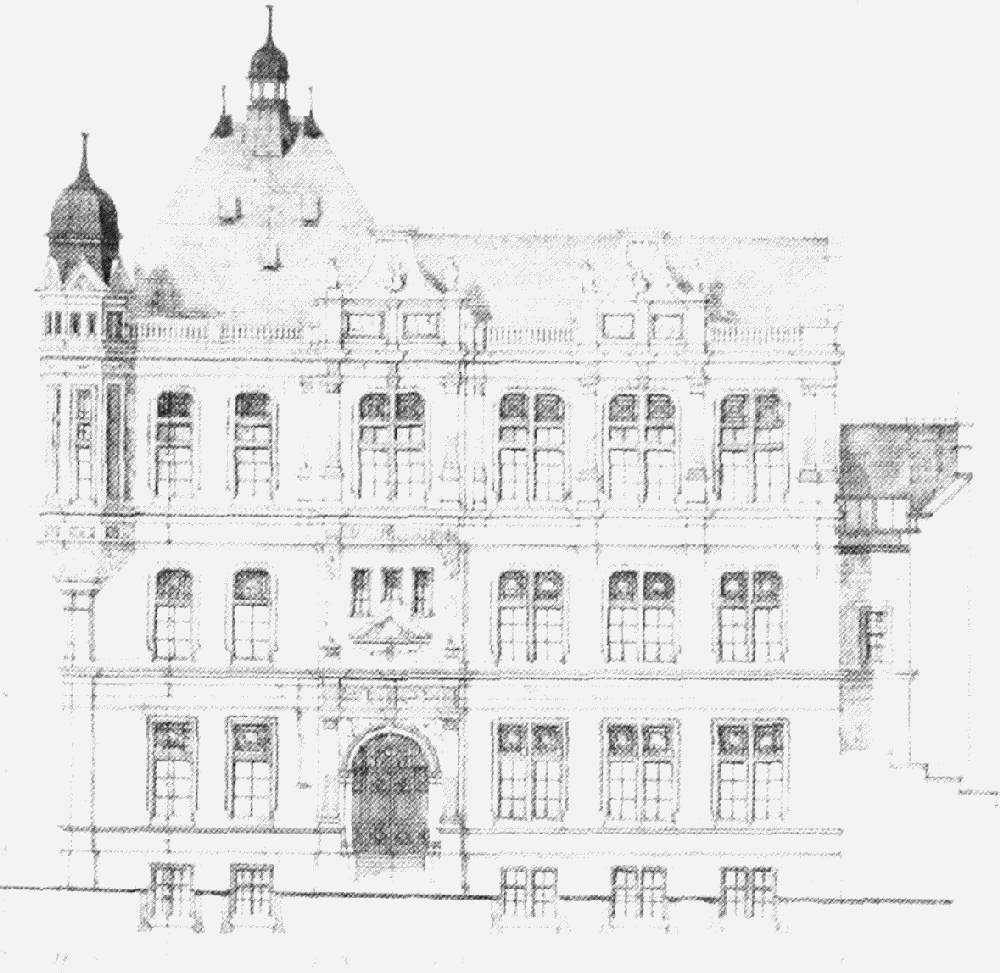
Grosvenor Museum, T. M. Lockwood's design, 1884
From 1892 to 1912 the museum also housed a technical day school funded by the city council, and after the city became a local education authority under the 1902 Education Act it took responsibility for the building as a whole, including the museum. (fn. 16) The museum's voluntary management committee approached the council as early as 1904 with the proposal that the council take over its duties, and the council was keen to do so despite the objections of the Chester Traders' Association to supporting a museum from the rates, but the transfer was delayed until 1915. (fn. 17) Under the new arrangements the corporation leased parts of the building to the societies for meetings and displaying their collections. (fn. 18) Management of the building by the city council prolonged its use for further educational purposes, and the whole building (except for a lecture theatre used by the two societies) was turned over for museum use only when the School of Art left in 1962. (fn. 19)
In 1936 the council commissioned from the nationally renowned archaeologist Mortimer Wheeler a report on the city's future museum provision. It began to act on his recommendations in 1938 by agreeing with the societies to take over direct management, (fn. 20) but further progress was delayed by the Second World War. The honorary curator, Professor Robert Newstead, who had served in one capacity or another since 1886, died in 1947, and his brother Alfred retired as part-time assistant curator in 1948, (fn. 21) when the city appointed as its first professional curator the Roman archaeologist Graham Webster. During his time (1948–55) existing collections were catalogued and redisplayed, assistant curators were appointed, and the creation of period rooms in a house in Castle Street behind the museum was begun. (fn. 22) The Grosvenor was thereafter in the hands of museum professionals and the augmentation of its collections, increase in its staff and activities (including archaeological and educational), and improvement of its displays were almost continuous. (fn. 23) The city council retained control at local government reorganization in 1974 despite being urged by the curator and the Archaeological Society to turn it over to the county council. (fn. 24)
The museum's most important collection, of national importance, was the Roman sepulchral monuments mainly discovered during repairs to the city walls between 1887 and 1892. (fn. 25) Other collections of local significance were Anglo-Saxon pennies acquired mostly in the 1950s, Chester-hallmarked silver, the topographical watercolours of Moses Griffith (1747–1819), and the 'consciously picturesque' and hugely popular watercolours of Victorian Chester by Louise Rayner (1829–1924). (fn. 26)
Other Museums
Chester's ever-growing appeal to tourists led to a proliferation of small museums in the 20th century. Already by 1900 the upper floor of King Charles's Tower on the city walls housed a small private museum, (fn. 27) though it underwent many vicissitudes. The city council let the tower in 1912 to Edward Davies, who showed a collection of artefacts connected with the history of Chester and was given an extended lease in 1917, despite being in arrears with the rent, because Professor Newstead commended the value to the city of his local antiquarian knowledge. (fn. 28) Davies's collection remained on display (fn. 29) and was given to the city in 1955, after which King Charles's Tower was refitted by the Grosvenor Museum as an historical museum of the Civil War in Chester. (fn. 30)
Stanley Palace, bought by the Chester Archaeological Society for conversion to a museum in 1865 but sold back to the 15th earl of Derby in 1889, in the early 1920s housed 'a museum of 1,000 curios'. (fn. 31)
The Cheshire Regiment, which had a collection of old military equipment on display in the officers' mess at the castle by 1903, established a museum in the Agricola Tower there in 1923. In 1972 it moved to new rooms in the former barrack block as the Cheshire Military Museum, still under regimental control but augmented by the collections formed at Dale Barracks (at Moston, just north of Chester) and by the Cheshire Yeomanry at the Drill Hall in Albion Street. Artefacts belonging to other regiments were added c. 1978. (fn. 32)
After Holy Trinity church in Watergate Street was turned into a guildhall in 1963 (fn. 33) a small museum was established in the former vestry to display documents and artefacts belonging to the city guilds. (fn. 34) Another redundant city-centre church, St. Michael's in Bridge Street, was converted by the city council in 1975 into the Chester Heritage Centre, publicized as Britain's first. Designed as a focal point for Chester's partication in European Architectural Heritage Year (1975), it contained displays about the city's historic buildings and their conservation. (fn. 35) The Grosvenor Museum later rearranged the displays to form an introduction to the history of the city and its buildings. (fn. 36)
The most substantial of the private-enterprise museums of the late 20th century was established in 1974 by Nickerson Investments Ltd., which turned the former Grosvenor St. John's school in Vicars Lane into the British Heritage Exhibition. (fn. 37) Its main feature was a full-size reconstruction of part of the Rows in Victorian times. In 1976 the Centre attracted 65,000 visitors, to the Grosvenor Museum's 119,000. (fn. 38) Nickerson sold the Centre in 1984 to a local businessman, who reopened it as the Chester Visitor Centre with craft shops inserted in the 'Victorian street'.
The other commercially run museums were Chester Toy Museum, opened in Lower Bridge Street in 1983; (fn. 39) the Dewa Roman Experience, opened in 1993 in a former motorcycle showroom in Pierpoint Lane off Bridge Street, which featured reconstructions of a Roman galley and streets and an archaeological excavation; (fn. 40) and On the Air, a museum of broadcasting opened in Bridge Street Row in 1994 as an extension of a business selling vintage gramophones. (fn. 41) Both the Toy Museum and On the Air, however, closed in the late 1990s.