
A History of the County of Buckingham: Volume 4. Originally published by Victoria County History, London, 1927.
This free content was digitised by double rekeying. All rights reserved.
'Parishes : Wotton Underwood', in A History of the County of Buckingham: Volume 4, (London, 1927) pp. 130-134. British History Online https://www.british-history.ac.uk/vch/bucks/vol4/pp130-134 [accessed 24 April 2024]
In this section
WOTTON UNDERWOOD
Ottone (xi cent.); Vittona, Wtton (xii cent.); Wotton next Brehill (xiii cent.); Wotton juxta Bernewode, Wotton subtus Bernewode (xiv cent.); Wotton Underwood (xvi cent.).
This parish, called Underwood from its proximity to Bernwood Forest, has always been well wooded. (fn. 1) Of the 2,600 acres comprised within its borders, 360 are still covered with woods and plantations, 193 are arable land, and 1,937 permanent grass. (fn. 2) The soil is of clay on a subsoil of Kimmeridge Clay and Portland Beds. The average height is 300 ft. above the ordnance datum. In the 16th century some lands in this parish were inclosed by Edward Grenville, (fn. 3) whose descendant and heir Richard Grenville in 1742 joined with other landowners here in the inclosure of 1,668 acres. (fn. 4)
The northern boundary is formed by Akeman Street, from which runs Kingswood Lane in a southerly direction skirting the park of Wotton House. The only remaining parts of the house erected by Richard Grenville in 1704 (fn. 5) are the detached wings containing the kitchen and stables. The principal portion, which was of brick with stone dressings and pilasters, was burnt out in 1820, and was rebuilt, (fn. 6) the main features of the old elevations being to a certain extent preserved. The kitchen and stable wings are pleasant examples of the freer manner of the period; each is of one story with a modillion cornice and a tiled hipped roof containing an attic floor lighted by dormer windows. The principal windows have wood mullions and transoms with leaded casement lights, and each roof is crowned by a clock and cupola. The railings and gates of the forecourt are particularly good examples of early 18th-century wroughtironwork.
South-east of the house are the church, school, and vicarage in the little village which contains a few buildings of 17th-century date. In 1862 it was described as consisting of cottages, each with a plot of garden ground, built by the Marquess of Buckingham in the second decade of the 19th century. (fn. 7) Windmill Hill, north-east of the large lake in the grounds of Wotton House, is probably the site of the mill which belonged to the manor in the 16th and 17th centuries. (fn. 8) In the south of the parish Grenvilles Wood, known by this name from the 17th century, (fn. 9) adjoins Rushbeds Wood in Brill. Both are skirted by the Oxford and Aylesbury tramroad, which has a station at the south-east end of Wotton Underwood. Lawn Farm, which stands near, probably preserves the name of Wotton Lawnd, a common in 1580 (fn. 10) and untill its inclosure in 1742, when it contained 500 acres. (fn. 11) The Kingswood branch of the Wotton tramway runs in a northerly direction. Moat Farm, which stands east of the village, is a 17th-century house considerably restored, with vestiges of a moat, (fn. 12) once, it is said, part of the manor of Ham and owned by the Mercers' Company. (fn. 13)
There are now stations on the Great Central railway and the Brill and Quainton Road branch of the Metropolitan and Great Central railway.
Manors
The manor of WOTTON, later GRENVILLE'S MANOR, which Eddeva wife of Ulward held before the Norman Conquest with right to tell, was amongst the lands of Walter Giffard in 1086, (fn. 14) and belonged to the honour of Giffard. (fn. 15) The overlordship of the whole followed the descent of Long Crendon (q.v.) until the death of the elder William Marshal, of whom two knights' fees in Wotton were held. (fn. 16) One of these descended with Long Crendon (fn. 17) until 1275, when William de Valence became overlord. (fn. 18) There appears to have been some doubt as to the overlordship rights, the tenants of the manor asserting it to be within the liberty of William de Valence and not in that of the Earl of Gloucester, whose bailiffs restored to William de Scobingdon some cattle wrongfully taken by Eustace de Grenville, tenant of Wotton. (fn. 19) Eustace lost his case, but the overlordship rights of William de Valence did not suffer, and this fee descended with the manor of Pollicott Cressy in Ashendon (fn. 20) (q.v.), of which it was held from 1346 to 1618. (fn. 21)
Though the tradition that a Grenville was lord of Wotton before the close of the 11th century seems to be without foundation, (fn. 22) it is likely that the connexion of this family with the parish began at an early date. Gerard de Grenville, who held three knights' fees of the honour of Giffard in 1166, (fn. 23) died in or before 1184, when 100 marks were due from his nephew for his lands in Buckinghamshire. (fn. 24) This nephew was probably Eustace de Grenville, (fn. 25) who was succeeded by Richard de Grenville mentioned in connexion with Wotton in 1213 (fn. 26) and alive in 1236. (fn. 27) His son Eustace de Grenville was in possession (fn. 28) in 1255 and in 1284. (fn. 29) He was succeeded in or before 1302 by his son Richard, (fn. 30) who was returned as sole lord of the parish in 1316, (fn. 31) and held in 1324. (fn. 32) In 1329 the manor was settled on Richard for life with remainder to his son William, and contingent remainders to a younger son Edmund and daughters Margery, Nichola and Agnes. (fn. 33) Richard de Grenville died before Michaelmas 1336, when his widow Joan transferred her rights in Haddenham to his son William. (fn. 34) In the spring of 1346 William with his wife Margaret made a settlement of lands in Haddenham. (fn. 35) He may have died shortly afterwards, as the names of John Sergeant, evidently a trustee, and his tenants Agnes and Nichola de Grenville, William's sisters, are returned for the feudal assessment of that year in Wotton and Haddenham. (fn. 36) William de Grenville was certainly dead by 1351. (fn. 37) Agnes de Grenville, whom he must have married after the death of Margaret between 1346 and 1351, (fn. 38) received in 1365 a quitclaim from William Freysel and his wife Margery. (fn. 39) Sixteen years later it was settled on Agnes by her son Thomas de Grenville. (fn. 40) Thomas, who was living in 1400, (fn. 41) was succeeded by his son Richard, (fn. 42) lord in 1419 and 1420, (fn. 43) whose widow Christina was described as late of Wotton under Bernwood in 1452, when she was in money difficulties. (fn. 44) From Eustace, their son and heir, (fn. 45) one of the gentlemen of Buckinghamshire whose names were returned by the Commissioners of 1433, (fn. 46) Wotton descended to his son and heir Richard, (fn. 47) lord until 1518, when he was succeeded by his son Edward. (fn. 48) Another Edward Grenville, eldest son of the last, inherited Grenville's Manor, first so-called, in 1536, (fn. 49) and was entrusted to the guardianship of John Josselyne about two years later. (fn. 50) In 1548 he was of age, and entered into possession. (fn. 51) He and his wife Alice held together in 1582, (fn. 52) and until his death in 1585. (fn. 53) As wife, or more probably, widow of Walter Dennis (fn. 54) Alice was still seised in 1604 when Richard Grenville, her first husband's brother and heir, was succeeded by his son of the same name. (fn. 55) Fourteen years later the second Richard died lord of Wotton Underwood, leaving by his widow Frances another Richard, then aged six, (fn. 56) at whose death in January 1665–6 the manor descended to his son, also Richard Grenville. (fn. 57) He died in 1719, leaving a son, another Richard, (fn. 58) who married Hester Temple, (fn. 59) by whom his will was proved in March 1726–7. (fn. 60) Richard, their eldest son, (fn. 61) who was lord of Wotton Underwood in 1733 (fn. 62) and 1742, (fn. 63) became Earl Temple at his mother's death in 1752. (fn. 64) She had succeeded to the estate of her brother Richard, Viscount Cobham, at Stowe, which henceforth became the family's chief seat, and with which Wotton descended until the death of the last Duke of Buckingham and Chandos in 1889. (fn. 65) The title of Earl Temple and the estate at Wotton then passed to his nephew William Stephen GoreLangton, whose son Algernon, now Earl Temple, has been lord of the manor of Wotton Underwood since 1902. (fn. 66)
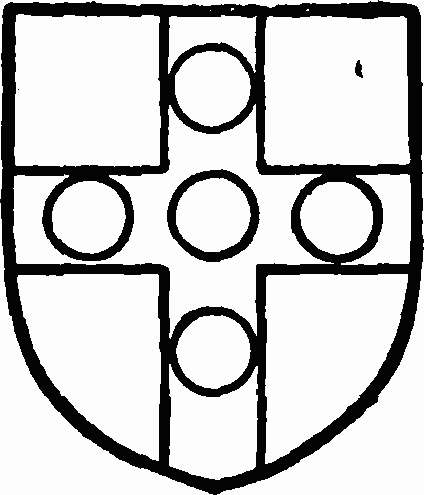
Grenville. Vert a cross argent with five roundels gules thereon.
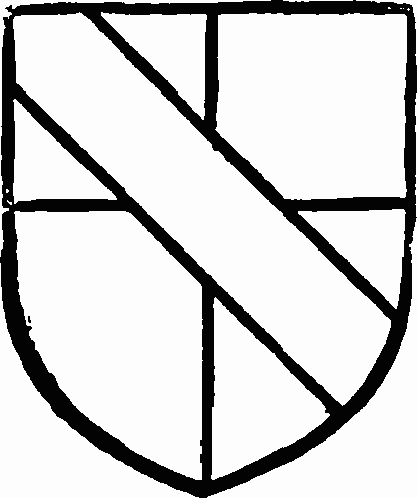
Gore-Langton, Earl Temple. Quarterly table and or a bend argent.
A dovecote belonged to the manor in 1618. (fn. 67)
The second knight's fee in Wotton, held of the honour of Crendon in the early 13th century (see Wotton Manor), corresponds to FIELDHAM, HAM, HAM-CUM-WOTTON, or from the later 15th-century WOTTON MANOR. Before 1276 (fn. 68) the overlordship was attached to the honour of Gloucester, (fn. 69) and descended with Easington Manor (see Chilton) to Edward Duke of Buckingham, who held it in 1510. (fn. 70)
Robert de la Rokele (fn. 71) was holding this fee early in the 13th century. (fn. 72) William de la Rokele, (fn. 73) who was holding Ham Mill of the Templars in 1185, probably held it before him. Robert de Tattershall enfeoffed the heirs of William Cantelow, holders in 1255. (fn. 74) From the Cantelow heirs Fieldham descended with Ellesborough Manor to William la Zouche, (fn. 75) who was holding in 1299. (fn. 76) He granted Fieldham before 1302 to one of his younger sons, John la Zouche, (fn. 77) for life. (fn. 78) He was living in 1325, when William la Zouche made a settlement of this manor in remainder on another son William. (fn. 79) The latter appears, however, to have died before his father, for in 1346 John, a descendant of John la Zouche, the former tenant for life, was holding Fieldham. (fn. 80) This manor had reverted before 1370 (fn. 81) to William grandson and heir of William la Zouche, who died in 1352. (fn. 82) Except for certain settlements, (fn. 83) this manor followed the descent of the manor of Ham in Waddesdon (q.v.) from this date.
The manorial court mentioned at the end of the 13th century (fn. 84) used to be held by the Mercers' Company at Moat Farm. (fn. 85)
Two virgates of land in Ham, on which stood a mill, were granted by Gerard de Grenville to the Knights Templars, who were holding in mesne in 1185 (fn. 86) and 1255 of the honour of Giffard. (fn. 87) Their tenant at the earlier date was William de la Rokele, at the later the heirs of William Cantelow, then lords of Fieldham Manor (q.v.). Richard de la Rokele was probably the Cantelows' subtenant in respect of this property. (fn. 88) At least three representatives of his family had holdings in Wotton in 1284, (fn. 89) but no later reference to the mill has been found except that a pasture in Ham called 'the mill' was leased in 1521 for twenty-one years to Christopher Wren. (fn. 90)
An estate in Wotton, known from the 15th century as BEREWELLS MANOR, was held of the manor of Pollicott Cressy in Ashendon, (fn. 91) the last reference to this overlordship occurring in 1548. (fn. 92) In 1518 it was said to be attached to the Grenvilles' manor in Wotton, which was similarly held of the Pollicott fee, (fn. 93) and was probably an integral part of that manor until 1308, when John de Grenville and Jane his wife granted lands in Wotton to Richard son of Humphrey de la Rokele and Basilia his wife and the issue of Basilia, in default of which, remainder to Richard son of the said Richard de la Rokele. (fn. 94) It has not been found possible to trace the connexion between the various members of this family, who held until the 14th century. (fn. 95) In 1284 the heirs of Humphrey de la Rokele, Peter and John de la Rokele were returned as lords, but probably in connexion with Ham Manor. (fn. 96) Peter and John de la Rokele four years later brought an action to recover their common pasture in Wotton of which they had been disseised. (fn. 97) Eustace de la Rokele is mentioned in 1311, (fn. 98) and in 1328 his son Peter was sued for debt on two different counts. (fn. 99) There is no further trace of the Rokeles in Wotton, and the estate passed to the Berewell family, from whom it acquired its distinctive name. In 1358 Nicholas Berewell bought a small property in Wotton from William Freysel and his wife Margery, (fn. 100) and John Berewell bought a considerable amount of land in this parish from Sir William Wakelyn and his wife Gille twenty-eight years later. (fn. 101) This may be the John, son of Richard Berewell, whose son and heir William acquired additional lands in Wotton of the fee of Easington, otherwise Gloucester fee, by his marriage with Joan daughter of Thomas Langport. (fn. 102) In 1463 Annis or Agnes, daughter of William and Joan, and her husband Ralph Ingoldsby, sued Edmund Rede and other of her father's trustees in Chancery for the recovery of the manor of Berewells. It was urged in the defence that William had granted half Berewells by nuncupatory will to his second wife, another Joan, and the other half to his son Thomas, who was to inherit the whole on Joan's death. (fn. 103) The issue of the suit has not been recorded. In course of time Berewells seems to have come into the possession of Edmund Hall, who towards the close of the 15th century acquired land in Wotton of Harry Harper alias Tyes. (fn. 104) In 1509 Isabel widow of Edmund and sister of William Temple, was seised of a manor in Wotton (fn. 105) which from its later history must be identified with Berewells. This was settled by William on Isabel at her marriage with Walter Wilcocks, (fn. 106) and two years later Walter and Isabel sold it to Robert Dormer. (fn. 107) In 1515 Robert granted it to Richard Grenville in exchange for an Oxfordshire manor, (fn. 108) and it is probable that after 1548, when the last mention of Berewells in public records occurs, (fn. 109) it was absorbed once more in Grenville's Manor. (fn. 110)
Church
The church of ALL SAINTS consists of a chancel measuring internally 28 ft. by 16 ft., north vestry, nave 41 ft. 6 in. by 21 ft., south aisle and west tower; it is built of stone rubble and roofed with lead.
The chancel was probably built about 1320, but the whole fabric has been so much restored and enlarged that precise dates cannot be assigned to either chancel or nave. The south aisle, founded originally for a chantry in 1343 by William Grenville, was rebuilt in 1710 and became a mortuary chapel for the Grenville family. It was extensively repaired in 1800 by George Marquess of Buckingham, and again practically rebuilt in 1867 by the last Duke of Buckingham and Chandos. The tower dates from about 1800, and the vestry is modern.
The chancel has in each side wall a 14th-century trefoiled light considerably restored. Modern arches open to the north vestry and the east end of the aisle or chapel. In the east wall is a modern threelight window with an original 14th-century reararch. In the south wall is a modern piscina recess with a medieval sexfoil bowl. The pointed chancel arch, though much restored, probably dates from the 14th century.
The nave is lighted by three 15th-century windows on the north and a modern window at the southwest, all of two lights with traceried heads. In the north wall is also a 15th-century doorway with a fourcentred head. A modern doorway to the tower on the west preserves a 12th-century lintel, enriched with diaper ornament, perhaps a relic of an earlier church on this site. On the south an arcade of three pointed arches, dating from 1867, opens to the mortuary chapel. It is designed in the early 14th-century manner and has clustered pillars and responds with moulded capitals and bases, the two western bays being filled with unglazed tracery supported by slender shafts.
The tower, which is of two stages, is lighted by wide pointed windows with wood frames and is surmounted by an embattled parapet and lead spire. On the parapet is the inscription 'Thomas A Beckett hujusce ecclesiae presbyter MDCCC.'
The mortuary chapel contains several monuments to members of the Grenville family. At the east end is a marble slab with the brass figures of Edward 'Greneveile' (d. 1585), and of Alice his wife, daughter of William Haselwood, the figure of a chrisom child, an incised marginal inscription, and matrices for three shields. On the south wall are tablets to Richard Grenville (d. 1665–6) and Eleanor daughter of Richard Grenville (d. 1688); on the north wall are two stone shields of Grenville. In a modern recess in the west wall is a 16th-century recumbent effigy of a lady in ruff and veil, with a modern and obviously erroneous inscription commemorating Agnes de Wightham, wife of William de Grenville, who died in 1386. On the same wall are two kneeling figures, a man in plate armour and lady in full skirt and ruff, also of the 16th century. There are also monuments to Richard, last Duke of Buckingham and Chandos (d. 1889), Anna Eliza, Duchess of Buckingham and Chandos (d. 1836), and Caroline, Duchess of Buckingham and Chandos (d. 1874), besides several tablets and slabs to other members of the Grenville family. In the tower is a plain oak chest.
The tower contains a ring of six bells: the treble and tenor are by Thomas Mears of London, 1800; the third, fourth and fifth by Edward Hemins, of Bicester, 1728; and the second, recast by Hemins in 1728, bears the additional inscription, 'Alicia Dennis vidua dedit me huic parochiae. 1615.' There is also a small bell, with no inscription.
The communion plate includes a chalice and cover paten of 1589.
The registers begin in 1599.
Advowson
The church, a peculiar of Canterbury, (fn. 111) belonged to the priory of St. Gregory, Canterbury. (fn. 112) It is said to have formed part of the endowment of Bentley Priory, a cell of that house, and to have reverted, on the suppression of the smaller religious houses in the early years of Henry VIII, to St. Gregory, (fn. 113) whose prior was seised in 1535 of lands and rent in Wotton (fn. 114) which had belonged to the Prior of Bentley in 1291. (fn. 115) After the Dissolution the possessions of the priory of St. Gregory were granted in an exchange to the see of Canterbury, (fn. 116) to which the advowson of Wotton Underwood belonged (fn. 117) until the archbishop granted it to the Marquess of Buckingham in 1805, (fn. 118) from which date it has followed the descent of the manor (q.v.). The rectory descended with the advowson until 1742, when Richard Grenville acquired it in exchange for Muswells Farm in Brill and Boarstall. (fn. 119)
Tithes granted before 1102 by Walter Giffard to the abbey of St. Faith in Longueville and enjoyed by its cell, the alien priory of Newton Longville, (fn. 120) came in 1441, with other possessions of that house, to New College, Oxford. (fn. 121) These, under the name of Longville's Portion, were the subject of a dispute between the archbishop's lessee and the warden and scholars in 1673. (fn. 122) In 1742 Richard Grenville acquired the Longville tithes from New College, in exchange for an annuity of £5 from his lands in Brill called Little London. (fn. 123)
Charities
John Hart, by his will proved in the P.C.C. 15 May 1665, demised (inter alia) an annual rent-charge of £3 issuing out of Easington Manor, Oxfordshire, for apprenticing a poor boy. The annuity, less land tax, has from time to time been accumulated by reason of there being no applicants for apprenticing. By a scheme of the Charity Commissioners of 28 January 1913 it was provided that, in so far as the trustees cannot apply the income in apprenticing, it may be applied in the assistance of poor boys or girls in outfits and advancement in life.
Richard Smith, by his will proved in the Archdeacon's Court at Oxford 15 April 1725, bequeathed £5, the income to be distributed in bread. The principal sum is in the hands of the parish, in respect of which 5s. is distributed among ten of the most needy persons.