A History of the County of Buckingham: Volume 4. Originally published by Victoria County History, London, 1927.
This free content was digitised by double rekeying. All rights reserved.
'Parishes : Hillesden', in A History of the County of Buckingham: Volume 4, ed. William Page (London, 1927), British History Online https://www.british-history.ac.uk/vch/bucks/vol4/pp173-180 [accessed 30 April 2025].
'Parishes : Hillesden', in A History of the County of Buckingham: Volume 4. Edited by William Page (London, 1927), British History Online, accessed April 30, 2025, https://www.british-history.ac.uk/vch/bucks/vol4/pp173-180.
"Parishes : Hillesden". A History of the County of Buckingham: Volume 4. Ed. William Page (London, 1927), British History Online. Web. 30 April 2025. https://www.british-history.ac.uk/vch/bucks/vol4/pp173-180.
In this section
HILLESDEN
Hildesdún (x cent.); Ulesdone, Ilesdone (xi cent.).
The parish of Hillesden has an area of about 2,600 acres, of which the greater part is laid down in permanent grass; there are 310 acres of arable land and 12 acres woods and plantations. (fn. 1) The soil is clay. A small branch of the Ouse forms the boundary on the south and south-east, in which district the land is lowest (about 260 ft. to 280 ft. above the ordnance datum). Towards the centre and the west of the parish the ground is undulating and rises gradually, but the highest part (from 360 ft. to 380 ft.) is in the north. The village is divided into three parts, known as Church End, Barracks and Lower End. (fn. 2)
At Church End stand the church, the vicarage and the school. Little of secular architectural interest remains in the parish beyond a 17th-century brick house to the south of the church and a small half-timber cottage of c. 1600 at the Barracks. The chief point of interest is Hillesden House, the site of which is still to be traced to the east of the church, where irregularities in the ground indicate the lines of its foundations, while the remains of three terraces, the brick walls of the garden, and the fish-pond suggest the lay-out of the grounds.
The Dentons, who held Hillesden (fn. 3) for more than 200 years, were a family of considerable local importance. (fn. 4) Sir Alexander Denton, the head of the house at the time of the Civil War, had married a cousin of John Hampden, (fn. 5) but his Royalist sympathies were well known. In 1642 a Parliamentary soldier, Nathaniel Wharton, boasted of having, with a file of men. 'marched to Sir Alexander Denton's park, who is a malignant fellow, and killed a fat buck.' (fn. 6)
In January 1643–4, when the Parliamentary forces held Aylesbury and Newport, Captain Jecamiah Abercromby and a troop of Parliamentarians occupied Hillesden House, the Royalist men in the neighbourhood having retreated before them. (fn. 7) A contemporary record, with Parliamentary sympathies, states that the taking of the house was 'much to the ease and comfort of the poor inhabitants of the almost wasted county of Buckingham,' which was oppressed by the owners of the great house. (fn. 8) Less than a month later, however, Abercromby, making a sortie, was captured by Captain Peter Dayrell and his party defeated. (fn. 9) It was after this, early in February, that Col. William Smith was sent from the king's forces at Oxford with a small troop to garrison Hillesden House, which, lying nearly midway between Oxford and Newport, might prove a strong support to the king's operations in the former city. (fn. 10) At this time there were in the house, besides Sir Alexander's children, several other relatives, his sisters and nieces, and some of the Verney family. (fn. 11) He afterwards wrote to Sir Ralph Verney that he himself had only come accidentally to Hillesden House, to remove his family, the king having placed a garrison there. (fn. 12) The actual garrison appears to have amounted to about 263 men. (fn. 13)
Col. Smith assumed command. He built additional accommodation for men and horses, had a trench dug inclosing the house and the parish church, and made foraging expeditions in the district. One of these led to a dispute with the owner of some cattle taken; the man appealed to the governors at Newport and Aylesbury, who thereupon awoke to the growing danger of the garrison at Hillesden. A force was dispatched thither from Aylesbury, but, finding the garrison fully prepared, retired without accomplishing anything. Between this and the second attack the defenders at Hillesden replenished their ammunition and summoned the countryside under penalty of a fine to come and keep garrison and continue the work of fortification. (fn. 14) But the enemy moved with great promptitude. An order made by the committee of both kingdoms to Col. Oliver Cromwell, about this date, instructs him, his forces being about Hillesden, to stay in those parts and 'to be as active to the prejudice of the enemy as with your safety you may.' (fn. 15) He advanced on Hillesden, encamping in Claydon at the spot known as Camp Barn, the night before the siege. Sir Samuel Luke, governor of Newport, advanced also, and the besiegers, amounting to about 2,000 strong, appeared before Hillesden House, which was unprepared for such a rapid approach, before nine o'clock on the morning of 4 March 1643–4. (fn. 16)
According to Luke's own dispatch the house at once sounded a parley and Col. Smith sent out to ask for terms. An unconditional surrender was demanded, and this being refused the assault commenced. From the first the defenders were overpowered. Their fortifications and entrenchments were incomplete and proved inadequate; a retreat was made to the church and house, and in a second assault the church was taken, whereupon Col. Smith surrendered on a promise of quarter. Luke states that his men 'in less than a quarter of an hour were masters of the house and works.' He seems, however, having made prisoners of the defenders, to have violated his promise, many of the garrison being slain without mercy. He also speaks in his dispatch of the spoils gained—thirteen barrels of powder with match and ball proportionable, the cellars full of good beer, the stables full of horses, and yards full of oxen and beasts. The day after the siege a soldier discovered a large sum of money and treasure hidden in the wainscoting. A rumour that the king's troops were advancing from Oxford created great panic, and for this and other reasons the captors evacuated Hillesden the day after the siege, setting fire to the house, which was entirely destroyed. (fn. 17)
The casualties during the siege amounted to about forty on the side of the defenders and not above six of the attacking side, which included 'no officer killed or hurt save onely Col. Pickering and that onely a little chocke under the chin with a musquet balle.'
As regards the inhabitants of the house, the women and children were left in a beggared condition, though not molested by the enemy, and some of them at least found a refuge in the Verneys' house at Claydon.
Sir Alexander Denton and Col. Smith with other officers were taken prisoners and subsequently removed to the Tower. (fn. 18) In a letter of about this time Sir Alexander says, 'You may see what I suffered in two dayes cannot but be allmost every man's fortune by degrees, if these most unhappe tymes continue but a short tyme.'Ralph Verney also wrote to Edmund Denton, 'Suffer me to tell you how much I am afflicted for the ruin of sweet Hilesdon, and the distreses that hapened to my aunt and sisters.'
Sir Alexander bade his steward cause a view to be taken of the house that he might have some certain information of the ruin caused by the fire, whether it would be possible to rebuild the walls that remained standing 'if the distraction of the times should settle,' adding that he was 'yet in health notwithstanding these many misfortunes are fallen upon me, and my comfort is I knowe myself not guilty of any faulte.' But his accumulated misfortunes told upon him; his eldest son Col. John Denton was killed in August 1644, and at the end of the year his health gave way and he died without regaining his liberty on New Year's Day 1644–5.
The house was afterwards rebuilt; a letter of 1648 contains the information that 'they are building there again and intend to set up a little house where the old one stood.' (fn. 19) In the following century it is described as a 'good old house,'and became famous as the house of Mr. Justice Denton, the contemporary and friend of Browne Willis. After the sale of the estate by Thomas Coke, afterwards Earl of Leicester, it was pulled down about the second decade of the 19th century. (fn. 20)
Manors
Land at HILLESDEN is mentioned in the Anglo-Saxon charter of 949, (fn. 21) to which reference has been made in Chetwode (q.v.). Before the Conquest Alric, a thegn of King Edward, held a manor here; in 1086 it was assessed at 18 hides as part of the lands of Walter Giffard, first Earl of Buckingham. (fn. 22) It was afterwards held by the third Walter Giffard, second earl, (fn. 23) who died without issue in 1164, and when his inheritance was finally divided in 1191 between William Marshal, Earl of Pembroke, and Richard de Clare, Earl of Hertford, (fn. 24) the overlordship of Hillesden, which amounted to a half fee, passed to the latter, (fn. 25) and descended with the earldoms of Hertford and Gloucester until the death of Gilbert de Clare in 1314, (fn. 26) when it become the portion of his sister Margaret, wife of Hugh Audley, (fn. 27) and so passed through heiresses to the Earls of Stafford. (fn. 28) It was held by Humphrey Earl of Stafford and Duke of Buckingham in 1460, (fn. 29) but is not afterwards mentioned.
Walter Giffard's tenant in 1086 was Hugh, (fn. 30) probably Hugh de Bolebec, who held of Walter elsewhere in the county. (fn. 31) Walter de Bolebec held Hillesden in the reign of Henry II. (fn. 32) His daughter and coheir married Robert de Vere, third Earl of Oxford, (fn. 33) and inherited Hillesden. (fn. 34) The fourth earl subinfeudated it towards the middle of the 13th century, but a mesne lordship here continued to be held by the Earls of Oxford, (fn. 35) and is last mentioned in 1584. (fn. 36)
Hugh de Vere, the fourth earl, granted the manor to his daughter Isabel on her marriage with John de Courtenay of Okehampton. (fn. 37) He had inherited Waddesdon Manor (q.v.), with which Hillesden descended for nearly 300 years. It was bestowed in dower on Isabel in 1274, (fn. 38) and was later held by her second husband, Oliver de Dinham. (fn. 39) Eleanor, the next dowager countess, held Hillesden in 1316, (fn. 40) and it formed part of the portion of Anne, widow of Hugh Earl of Devon, reverting at her death in 1441 to their son Thomas Earl of Devon. (fn. 41) After the attainder of his son Thomas in 1461 it was granted by Edward IV in 1462 to Walter Devereux, Lord Ferrers, (fn. 42) but was afterwards restored like Waddesdon to the Earls of Devon. (fn. 43)
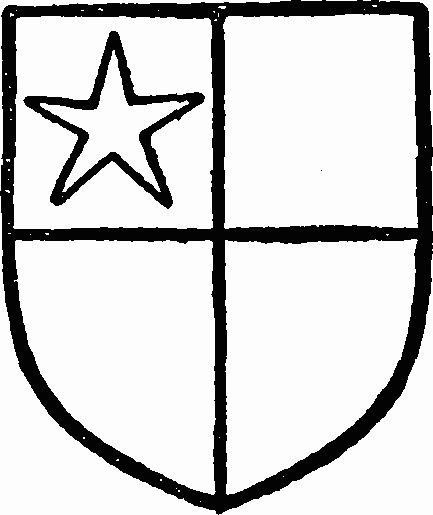
Vere Earl of Oxford. Quarterly gules and or with a molet argent in the quarter.

Courtenay Earl of Devon. Or three roundels gules and a label azure.
At the attainder of the Marquess of Exeter in 1539 the history of the two manors diverges, Hillesden being granted by Edward VI in 1547 to Thomas Denton and Margaret his wife and their heirs. (fn. 44) Thomas was Treasurer of the Temple and M.P. for Buckinghamshire in 1554. (fn. 45) Margaret survived her husband, who died in 1558, when their son Alexander was sixteen years of age. (fn. 46) Alexander died in January 1576–7. (fn. 47) His son Thomas was sheriff of the county in 1600, (fn. 48) received the honour of knighthood at Salden House in 1603, (fn. 49) and was member for Buckingham Borough from 1604 to 1628. (fn. 50) He died in 1633. (fn. 51) His son Alexander, who inherited Hillesden, (fn. 52) was made a knight in 1617, (fn. 53) and he, too, represented the borough, being a member of the Long Parliament until, being 'disabled to sit,' John Dormer was elected in his place. (fn. 54) He was the defender of Hillesden House during the siege and died in prison in 1645. (fn. 55) Hillesden was afterwards held by Alexander's second but first surviving son Edmund, who in 1651 begged discharge of this manor on the grounds that it had been granted him by Parliament. (fn. 56) Sir Alexander, before his death, had been greatly involved in debt, and there appears to have been some question of selling part of his estate to satisy his creditors. (fn. 57) Hillesden was retained by the family, however, although Edmund, succeeding to an impoverished estate and a ruined house, appears to have done little towards retrenchment. (fn. 58) He died in 1657, having by his will, dated 17 October 1657, made provision for his wife and children out of Hillesden Manor. (fn. 59) His son Alexander was M.P. for the brough of Buckingham in 1690–8, (fn. 60) dying seised of Hillesden in 1698, when his eldest son Edmund succeeded. (fn. 61) He was created a baronet in 1699, (fn. 62) but died without issue in 1714, when his brother Alexander inherited the property. (fn. 63) Alexander, who was also a member of Parliament, (fn. 64) was in addition Recorder of Buckingham, a justice in the court of Common Pleas, and chancellor of the Prince of Wales. (fn. 65) He died in March 1739–40, (fn. 66) leaving no issue, his heir being his sister's son, George Chamberlayne, whom he had adopted and who afterwards took the name of Denton, (fn. 67) under which name he was returned to Parliament on 4 May 1741 as member for Buckingham Borough. (fn. 68)
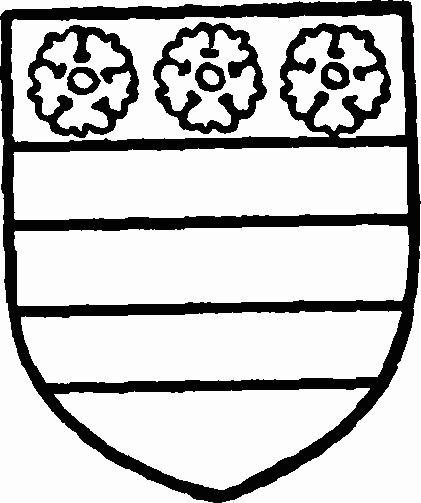
Denton of Hillesden. Argent two bars with three cinqfoils gules in the chief.
The descent of Hillesden Manor is identical at this time with that of Buckingham, under which account their joint history for the next 100 years is given (q.v.). The Duke of Buckingham and Chandos was lord of Hillesden Manor as late as 1847, (fn. 69) but it had passed before 1854 to Mr. James Morrison of Basildon Park, Berkshire, (fn. 70) from whom it descended to Mr. Hugh Morrison of Fonthill House, Fonthill Gifford, Wiltshire, grandson of James Morrison by his second son Alfred. (fn. 71) He sold the estate in October 1910, some of the tenants purchasing the farms held by them, while others were acquired by Christ Church, Oxford.
The capital messuage of the manor is first mentioned in 1274, (fn. 72) and is invariably included in all extents of the manor as given in inquisitions down to the 16th century.
A mill belonged to the manor in 1086, (fn. 73) and in 1279–80 Roger de Martinall quitclaimed two mills in Hillesden to John Giffard. (fn. 74) A 17th-century deed records the existence of a mill in the parish. (fn. 75)
Land in Hillesden was held of the Earls of Oxford by other sub-tenants than the Courtenays in the 13th and 14th centuries. In 1203 Ralf Triket granted 15s. in lieu of dower in certain lands here to Agnes daughter of Maud, who renounced her right in them to the Knights Templars. (fn. 76) In 1207 Simon Pateshull made a life grant to Ralf of 9 virgates in Hillesden, retaining to his own use a capital messuage with fishpond and garden. (fn. 77) Walter Pateshull is mentioned in 1221, (fn. 78) and in 1254–5 Simon Pateshull held 2½ hides, apparently of the Earls of Oxford. (fn. 79) In 1284 Eustace de la Hesche held, (fn. 80) but the land had passed before 1302 to Nicholas Trimenel, (fn. 81) who is returned as lord in 1316. (fn. 82) He was sued by John Trimenel and Elizabeth his wife for this property, called a manor, the case lasting from 1314 to 1317. (fn. 83) John Trimenel, kt., held in 1346 (fn. 84) and in 1360, (fn. 85) and Roger Trimenel in 1371, (fn. 86) but no further record of it appears.
One hide of land in Hillesden was held before the Conquest by Alric son of Goding, (fn. 87) and was included in 1086 among the lands of the Count of Mortain. (fn. 88) With the count's other lands it afterwards formed part of the honour of Berkhampstead, belonging to the little fee of Mortain, (fn. 89) and was so held by the Earls of Cornwall with that honour as late as the 15th century. (fn. 90)
The count's tenant in 1086 was Rannulf. (fn. 91) An entry in the Pipe Roll of 1166–7, 'HildestonMarescaldi,' (fn. 92) may refer to this part of Hillesden, as Ralf Marshal held a carucate of land here in 1234, (fn. 93) and in 1284–6 Ralf Marshal held 2 hides, for a third of a fee, of the honour of Berkhampstead. (fn. 94) The tenants under the Marshals at that date were the Abbots of Nutley, (fn. 95) who were already seised earlier in the 13th century, (fn. 96) and so remained (fn. 97) as late probably as the Dissolution. It is difficult to trace the subsequent history with any certainty. The abbots also held land in Hillesden of the Earls of Oxford in the 13th century. (fn. 98) In 1535 the abbot's estate in Hillesden consisted of the rectory lands only, (fn. 99) to which, however, manorial rights appear to have been attached. (fn. 100) Possibly, therefore, the entire Nutley property had been amalgamated into this one holding, the descent of which is given below.
The origin of the RECTORY MANOR is probably to be found in the lands granted with the church to Nutley by Walter Giffard. (fn. 101) In 1291 the abbey's lands pertaining to the church property amounted in value to £3 18s. 9d. per annum, including rent, courts, escheats and value of works. (fn. 102) In 1535 the annual value of the rectory at farm was £19 8s. (fn. 103) In 1538 a complaint was made against Roger Giffard of Claydon and his sons for having persuaded the abbot to falsify a lease of the parsonage made some time before to Thomas Giffard of Twyford (Berks.), and for having personally injured the latter. (fn. 104) After the Dissolution the rectory was granted in 1542 to the Dean and Chapter of Christ Church, Oxford, (fn. 105) the present owners of the tithes and of about 200 acres of land.
In 1555 the dean and chapter granted an eightyyear lease of the parsonage and mansion-house to Roger Giffard, whose efforts to sublet the property led to considerable litigation. (fn. 106) The tithes were afterwards held on lease by the Dentons. (fn. 107)
Church
The church of ALL SAINTS consists of a chancel 30 ft. 6 in. by 18 ft., north chapel of the same length, 18 ft. 6 in. in width, a two-storied vestry at the north-east of the chapel 15 ft. 6 in. by 9 ft., nave 46 ft. 6 in. by 18 ft. 6 in., north and south transepts each 13 ft. 6 in. by 12 ft. 6 in., north aisle 8 ft. 6 in. wide, south aisle 8 ft. wide, west tower 10 ft. square, and a north porch. These measurements are all internal.
The present building is a very fine and complete example of the style of the late 15th century, having been rebuilt, with the exception of the tower, shortly after the year 1493. (fn. 108) The church which it replaced was probably a 12th-century cruciform building, and fragments of the west walls of its transepts are perhaps incorporated in the short west walls of the existing transepts, which are considerably thicker than the other walls. The unequal settlement of the south wall of the south transept at its junction with the west wall affords additional evidence, as no material settlement has occurred elsewhere. Prior to the entire rebuilding, the still surviving west tower, which is of mid-15th-century date, appears to have been added or reconstructed. In the last century a thorough restoration, completed in 1875, was carried out by Sir Gilbert Scott.
The north side of the chancel is almost entirely occupied by an arcade of two bays opening to the north chapel; the arches are of three moulded orders and spring from a central pier of lozenge plan with attached shafts at the cardinal points and in the centre of each face, all having moulded octagonal capitals and independent bases of the same form standing upon double plinths about 2 ft. 6 in. in height. The responds repeat the half plan of the pier. The east window is of five lights, divided by a transom and cinquefoiled in both tiers, the depressed four-centred head being filled by vertical tracery descending some distance below its springing. The glass line is placed at the middle of the wall and the jambs are elaborately moulded on both faces, while the head, like those of all the other windows of the body of the church, has an external label. Below the sill internally is a moulded string-course, stopped and returned upon itself for the high altar, and continued upon the north wall on either side of the arcade. The two south windows, the jambs of which are moulded like those of the east window, are each of four transomed and cinquefoiled lights, rising without other tracery into a flat four-centred head; below their sills is a bold string-course, deeper, and placed at a slightly lower level than that below the east window. Above the string-courses the whole of the blank surface of the east and side walls of the chancel is richly panelled in three stages, the two lower having compartments with cinquefoiled and traceried heads, while the uppermost stage, a mere frieze, has smaller and narrower cinquefoiled compartments, cut into by the heads of the windows and the arches of the north arcade. Crowning the whole, immediately below the roof, is a band of sculptured angels in high relief, those upon either side of the east window, which extends the whole height of the chancel, bearing instruments of music, an organ, a guitar, a harp, and a violin, while the rest hold scrolls of music. The chancel arch is of two pointed and moulded orders separated by casements, and has responds with attached shafts to each order, the curves of the shafts of the outer orders finishing flush with the wall faces. The roof is concealed by a modern flat-pitched plaster ceiling, said to be of the same design as the original ceiling; it is divided by moulded oak ribs into small squares, and each square is again divided saltirewise by subsidiary ribs. At the east end of the south wall is a shallow piscina niche having leaf-carved spandrels and a projecting semioctagonal basin. Immediately over the niche is a credence recess half covered by the monument of Dr. William Denton described below. On either side of the east window are semioctagonal image brackets, that on the north having circular quatrefoiled panels on each face, while the southern bracket is plainly moulded. The lower stage of panelling is omitted on this wall, and immediately below the second stage are sculptured angels, one over each bracket, holding shields with the emblems of the Passion. Externally the walls rise from a moulded plinth, and are crowned by a cornice surmounted by elaborately panelled battlements, with pinnacles at the eastern angles and at the centre of each side wall. A moulded stringcourse runs round the exposed walls below the sills of the windows, and there is a buttress of two stages between the south windows, the south-eastern angle having a pair of buttresses of the same type. The plinth and string-course are continued round the whole church, interrupted only by the north-east vestry and the tower.
The walls of the north chapel have stone panelling in two stages divided by an embattled transom, the upper panels having cinquefoiled ogee heads with tracery, while the lower panels have heads of the same form without tracery. The flat-pitched ceiling is modern, and of the same type as that of the chancel. The east window is of four lights with an embattled transom, the lights being cinquefoiled in both stages, while the depressed four-centred head is filled with quatrefoil tracery. On either side are semi-octagonal image brackets, that on the north having cinquefoiled panels in each face. In the north wall is a four-light window with an embattled transom, but in other respects like the south windows of the chancel, though less lofty, and placed like the east window at a lower level. To the east of it is an elaborately moulded doorway with a four-centred head and traceried spandrels opening to the vestry. At the south-east is a piscina niche with a cinquefoiled ogee head and carved leaf spandrels, but all trace of the drain has now disappeared. On the west an arch like the chancel arch, but smaller, opens to the north transept. The walls of the chapel are treated externally like those of the chancel, but the battlements are plain.
The two-storied vestry adjoining the chapel has an octagonal turret at the north-east containing the stairs to the upper floor, and the walls rise to the same height as those of the north chapel. The room on the ground floor has an external doorway with a fourcentred head at the south-east, and is lighted by single lights with four-centred heads on the east, north, and west. At the north-east is a doorway opening to the stair-turret. The upper room has a blocked doorway in the east wall, which was probably a private entrance from Hillesden House, and must have been approached by a bridge. In the east wall is a square-headed cinquefoiled light, and on the north and west are two-light windows of the same type. All have external labels, and a bold string-course, continued round the north-east turret, runs beneath their sills. A doorway with plain rebated jambs and a four-centred head leads to the stair-turret. In the south wall is a series of seven radiating loopholes, four now blocked, with a larger opening, also blocked, towards the east end. The stairs in the turret, which is lighted by loops, are continued upwards to the roof, upon which they open by a doorway with a four-centred head; the central newel is surmounted by a column with a moulded base and capital supporting a plain vault of fan form. The turret rises above the embattled parapet of the vestry, and is crowned by a moulded cornice and panelled battlements, from the pinnacled angles of which spring cusped flying buttresses meeting in the centre, where they are strengthened by an octagonal column and support a central crocketed pinnacle.
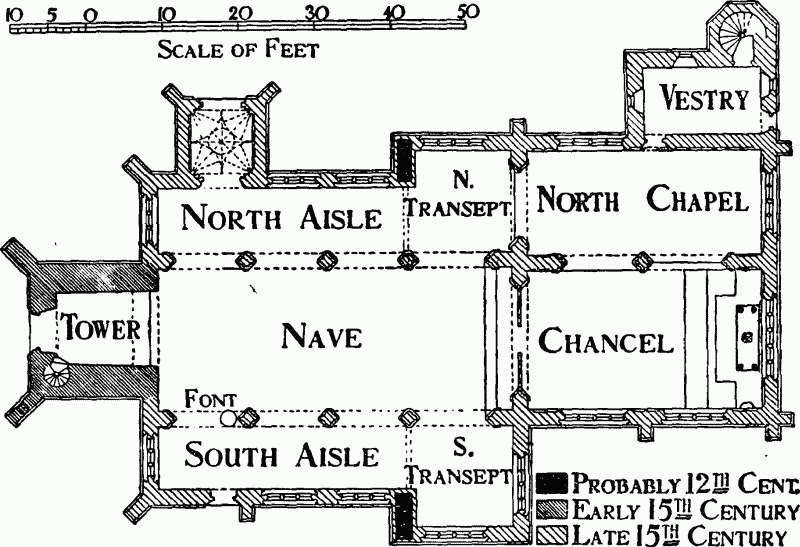
Plan of Hillesden Church
The nave arcades are each of four bays with pointed arches of two hollow-chamfered orders separated by casements. The piers have each four attached shafts with octagonal capitals, and stand upon high octagonal plinths. The arches opening to the transepts are of the same width, but are raised higher by lifting the eastern halves of the eastern piers. The responds repeat the half plan of the piers, and are like those of the chancel arch. The upper entrance to the rood-loft still remains above the south-east respond, and has in its western jamb a pocket which received the end of the top-rail of the loft. The clearstory is lighted by three square-headed windows of five cinquefoiled lights on either side, placed so close together as to form almost a continuous wall of glass. The north transept is lighted on the north by a transomed window of four uncusped lights under a four-centred head, and the south transept has a window of the same design in its south wall, but the east window is like the south windows of the chancel. Each aisle has two windows in its side wall and one in the west wall, all of three uncusped lights under four-centred heads. The north doorway has a fourcentred head moulded continuously with the jambs, and a flat rear arch; the smaller and less elaborate south doorway has a head of the same form. Flat segmental arches, about 9 in. in thickness, divide the ceilings of the aisles and transepts and form the only separation between them. Both transepts have embattled parapets, and follow the general exterior treatment of the eastern portion of the church, the north transept being designed externally as a continuation of the north chapel; the aisles are also embattled, but the parapet of the three western bays of the nave is plain, the embattled parapet of the chancel being continued over the eastern bay only. The nave, transepts, and aisles have modern flat-pitched plaster ceilings with oak ribs, copied from their predecessors of the late 15th century.
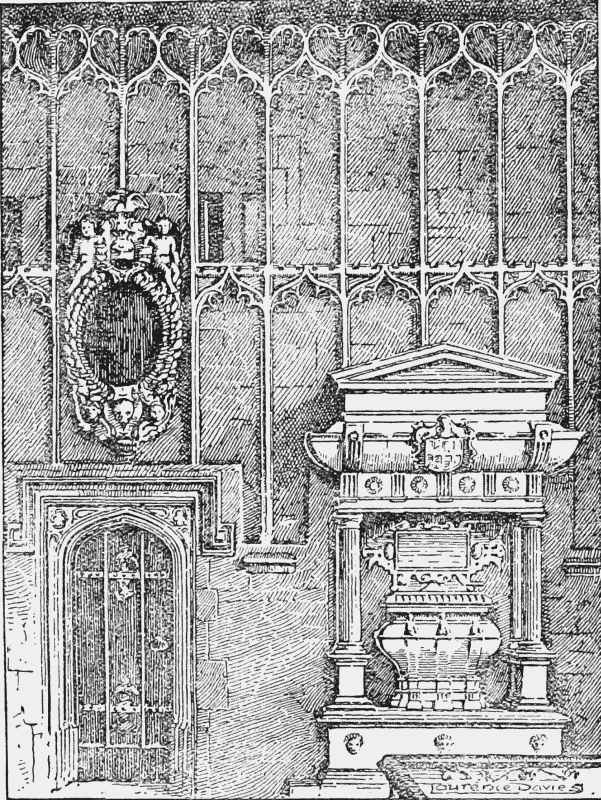
Hillesden Church: North Doorway and Stone Panelling of the North Chapel
The mid-15th-century west tower is of three stages with a south-west stair-turret, western diagonal buttresses and an embattled parapet. The tower arch is pointed and of two orders, the outer moulded with a chamfer continued down the meeting angles of the nave and tower walls, while the inner order, which is moulded with a sunk chamfer, dies into the side walls of the tower. The arch is inclosed on the nave side by a label with head-stops. In the west wall of the ground stage is a doorway with moulded jambs and a depressed head, and above it is a pointed window of two cinquefoiled lights with tracery in the head. The ringing stage is lighted from the west by a plain opening, while the bell-chamber has pointed and traceried windows of two cinquefoiled lights on all four sides. All the detail is of the original date of the tower.
The north porch, an extremely rich piece of work, has a low-pitched gable and a moulded cornice surmounted by panelled battlements. At the angles are buttresses with panelled upper stages. The porch is ceiled by a modern fan-vault, the original vault, if ever completed, having gone by the date of Scott's restoration. (fn. 109) The vaulting shafts remain in each angle, and the shape of the wall ribs is shown by the form of the panelling upon the side walls. The north doorway is inclosed on the porch side by narrow trefoiled panels, and above the head is fine tracery work. The outer doorway, which is inclosed by similar panelling on the inner side, has a four-centred head within a square external labelled head, and is most elaborately wrought with panelled jambs and soffits. Above the doorway externally is a richly carved niche with a projecting semi-octagonal canopy crowned by a finialled cupola. The base of the niche is elaborately moulded and the whole is flanked by pinnacled flying buttresses worked on the wall-face of the porch.
Below the present altar table is a 15th-century stone altar slab with two consecration crosses remaining upon it. The font is circular and stands upon an octagonal stem of later date than the bowl, which is of the 13th-century; the oak cover is of the 17th century. Twelve consecration crosses, two now hidden, still survive on the walls of the chancel, chapel, transepts and aisles, each consisting of a cross formy inclosed within a circle about 10½ in. in diameter.
The rood screen, which is contemporary in date with the rebuilding of the church, remains in a very perfect condition, only the parapet of the loft having gone. It is divided into three bays with pointed heads by posts with small attached shafts having foliated capitals, from which spring the ribs of the vaulted coves beneath the projecting loft. The lower portion of each bay has four linen-fold panels with moulded styles supporting a rail enriched with running foliage, and the upper portion has four open lights with ogee heads and foliated cusping, above which, filling the pointed head, is tracery of mixed vertical and flamboyant character. The middle bay opens in two leaves, the tracery in the head being fixed, while the mullions detach themselves immediately below the springing of the heads of the lights. The face of the western beam of the loft above the vaulted cove is enriched with a bold vine-pattern, but the eastern beam is plain. In the chancel are two late 15thcentury desk-fronts, with two tiers of linen-fold panelling, moulded rails and buttressed muntins. Nine benches with panelling of the same date remain in the nave. A low screen, made up with fragments of deskfronts like those in the chancel, separates the north chapel from the adjoining transept. The doorways from the stair-turret to the upper and lower rooms in the vestry building retain their original batten doors, that to the upper room having a moulded framing planted upon it, and a lozenge pattern scratched on the battens, with nails at the intersections; the strap hinges to both doors are also original, and form good examples of the ironwork of the period. The door in the north doorway, on the external face of which is an almost obliterated carving of the sun, moon and stars, is also of original late 15th-century date. It has been considerably damaged by bullet holes, probably during the Civil War. In the north transept is a fine mid-17th-century pew having on the front and sides carved bolection moulded panels in two ranges, the lower range of panels being pedimented. In the north chapel is a 17th-century communion table, and in the vestry is preserved a chest of the same date.
The remains of late 15th-century glass are important and valuable. The finest is that in the four upper lights of the east window of the south transept, illustrating eight legends of St. Nicholas. Each light contains two subjects, and under each subject is a descriptive Latin hexameter inscribed in black letter. The upper panel in the northernmost light and the corresponding panel in the next light illustrate the legend of the cups. In the first is represented a three-masted ship at sea, from which the boy is seen falling overboard with the golden cup in his hand. Upon the ship are two sailors lowering the sail, while the father looks on, leaning his elbows on the rail of the poop. The hull of the ship is of a yellow colour and the figures wear bright colours, but the faces are almost white. Underneath is inscribed 'Cadit puerulus quem mox sal(va)t Nicholaus.' In the second panel the father and mother are seen kneeling at the altar of St. Nicholas, whose seated figure, wearing episcopal vestments, is placed at the north end of the altar. Behind his parents stands the boy holding the gold-covered cup; below is the inscription 'Tunc offert cyphum grates (sic) pro mun (er)e reddens.' The third panel, continuing from north to south, illustrates the relief of the famine at Myra by St. Nicholas. The saint is shown in the foreground standing by the shore without nimbus or vestments to indicate that the event occurred in his lifetime. Near him are sailors pouring out corn into sacks, while in the background is a large three-masted ship with figures. Underneath is inscribed 'Multiplicat frugem presul quam nave recepit.' The next three panels illustrate the legend of St. Nicholas and the Jew of Calabria. In the foreground, helping themselves to the Jew's treasure, are seen the robbers, truculent ruffians, armed with sword and axe, and wearing brightcoloured clothes, the northern of the two nearer figures being clad in a crimson tunic with green hose, while the southern figure has a purple tunic with slashed sleeves. In the background is the Jew setting out on his journey, staff in hand, and threateningly warning the figure of St. Nicholas to keep guard over his wealth in his absence. He wears a crimson cloak trimmed with gold, and has a flowing white beard. Below the panel is inscribed 'Que tulerant (fures) bona cogit reddere presul.' The next panel shows St. Nicholas appearing to the robbers, and in the background the Jew attacking the saint's image with his staff, the subject being thus described: 'Auro furato baculo flagellat amicum.' In the remaining panel of the series is shown the restitution of the treasure to the Jew, who is drawn in the foreground, receiving back from the robbers a gold casket, which appears in the two former panels. In the background is a gate-house with trees and foliage. Below is inscribed 'Restituit rursus latro quod sustulit aurum.' The last two panels illustrate the restoration to life of the boy strangled by the devil disguised as a pilgrim. In the foreground of the first panel the devil is seen strangling the boy, whom he has forced to a half-kneeling position, while the food which had been brought out to him drops from the dish in the boy's hands. In the background is a house with a half-gable, and above its walls is seen the father, who clasps his hands in horror, with two guests beside him. The incident is described by the line: 'Strangulat hic (demon) puerum (pul) menta ferentem.' In the last panel the boy lies dead on the ground with his parents kneeling by him, and in the doorway of the house, from which the guests are looking out, appears St. Nicholas. Beneath is the inscription, 'Mortuus ad vitam rediit precibus Nicholai.'
In the heads of the lower lights of the windows are fragments of other panels which probably illustrated further legends of St. Nicholas, as in the head of the fourth light is the fragmentary inscription in black letter 'eledgite (eligite ?) NicholaŨu ĩ episcopum.' In nine of the ten lights of the tracery of the east window of the chancel are fragments of canopied figures, that in the second light from the north having been entirely destroyed. The remaining figures, taken from north to south, are as follows: in the first light, a pope, perhaps St. Gregory; in the third light, St. Peter; in the fourth, a figure with a book, perhaps St. Paul; in the fifth, a figure with a nimbus, probably St. John Baptist; in the sixth, St. John the Evangelist; in the seventh, St. George; in the eighth, St. Christopher; in the ninth a bishop, perhaps St. Augustine; and in the tenth a second bishop, perhaps St. Ambrose. Fragments of canopy work also remain in the two south windows. Other fragments also survive in the east and north windows of the north chapel, including an Annunciation and a Majesty. In the south-east window of the south aisle are two heads of bishops, with part of the figure of an archbishop holding a crozier, and in the next window to the west is a third bishop's head.
In the upper room of the vestry are preserved some fragments of moulded stone from the former church, a carved female head of the 14th century, and some worn 15th-century tiles. A sundial set in the south buttress of the nave bears the date 1601 and the name 'Georg …de Fraisne,' with the inscription 'Sic transit gloria mundi.' In the churchyard on the north side of the church is the base, stem, and fragment of the head of a fine 14th-century cross. The shaft is octagonal, and the remaining portion of the head is carved with the ball-flower.
Against the north wall of the north chapel is an elaborate alabaster monument to Thomas Denton, who died in 1558. The monument is of the table type and has a pilastered base with shields of arms, and upon the top are the recumbent effigies of Thomas Denton and his wife, both considerably damaged. He is wearing plate armour with a tabard of his arms, and his head rests on his crested helm. At the north-east of the chapel is a beautifully designed monument to Alexander Denton, who died in 1576, and his second wife Mary, who died in 1574; the inscription states that she was the daughter of Sir Roger Martyn. Upon the same wall is also a monument to Thomas Isham, who died in 1676. At the south-east of the chancel is a monument to Dr. William Denton, physician to Charles I and Charles II, who died at an advanced age in 1691. Two other monuments of interest remain on the south side of the chancel; one is a large and elaborate monument of marble with portrait busts commemorating Sir Alexander Denton, one of the justices of the court of Common Pleas, who died in 1739, and his wife Agnes, who died in 1753. The other, a mural tablet, commemorates George Woodward, 'Envoy Extraordinary from the King of Great Britain to the King and Republic of Poland,' who died at Warsaw in 1735, at the age of thirty-eight. He was the son of George Woodward of Stratton Audley and of his wife Anne, daughter of Alexander Denton.
There is a ring of six bells: the treble and second, by Henry or Matthew Bagley, both inscribed 'Alexander Deanton EqS 1681'; the third inscribed 'Prayse ye the Lord M.B. (Matthew Bagley) 1681'; the fourth 'Henricus Bagley me fecit'; the fifth recast by Mears & Stainbank in 1893 and bearing the inscription of the bell which it replaced, 'W. Hall made me 1756'; and the sixth, also recast by Mears & Stainbank, bearing the inscription of the former bell, 'Pro rege et ecclesia Alexander Denton Robert Corbett Church Warden Henry Bagley made me 1721.'
The plate consists of a silver cup of 1811; a paten without marks or inscription; a fine silver flagon inscribed, 'The Gift of the Honble Alexander Denton one of the Justices of His Majesty's Court of Common Pleas, and Chancellor to his Royal Highness Frederick Prince of Wales, to ye Parish of Hillesden in the County of Bucks, 1737,' and bearing the marks of the year 1736; and a plated caudle-cup, the base of which may be silver, though without marks.
The registers begin in 1594.
Advowson
The church of Hillesden was granted to Nutley Abbey before 1164 by Walter Giffard and Ermengard his wife, (fn. 110) and confirmed to the monastery by subsequent charters of kings and popes. (fn. 111) A vicarage is mentioned in the early part of the 13th century, (fn. 112) but no presentations to it are found in the episcopal registers, the church being served by a canon of Nutley. After the Dissolution the vicarage was granted with the rectory in 1542 to the Dean and Chapter of Christ Church, Oxford, (fn. 113) but the living was only held as a perpetual curacy from that time until 1868–9, (fn. 114) at which date a vicarage was formed, presentation to which is still made by the dean and chapter.
A complaint was made against Nutley Abbey in 1344 that this and other of their churches were destitute of vicars, (fn. 115) and in the next century it was found that the abbey had allowed the chancel and other parts of the church to become very ruinous. (fn. 116)
At the time of the Dissolution an annual stipend of £4 was paid to the incumbent, which sum was afterwards continued by the rectors. In 1680 the churchwardens certified at a visitation that there was no house, glebe or endowment saving 40s. which Alexander Denton paid to the churchwardens. This allowance was augmented by the college to £20 per annum, which the lessee tenants, the Dentons, on being permitted to nominate a minister, increased to £30; in addition, they gave the ministers very generous entertainment at their house. (fn. 117) Further augmentations to the curate's stipend were made during the 19th century. (fn. 118)
In 1548 the commissioners returned that land in the parish to the annual value of 2s. had been given for the keeping of an obit in the church. (fn. 119)
Charities
Francis Clarke, by his will proved 27 July 1910, bequeathed £500 consols, the dividends to be distributed among the deserving sick and aged poor. The stock is held by the official trustees, and the annual dividends, amounting to £12 10s., are duly applied.