A History of the County of Buckingham: Volume 4. Originally published by Victoria County History, London, 1927.
This free content was digitised by double rekeying. All rights reserved.
'Parishes : Lillingstone Dayrell', in A History of the County of Buckingham: Volume 4, ed. William Page (London, 1927), British History Online https://www.british-history.ac.uk/vch/bucks/vol4/pp187-191 [accessed 30 April 2025].
'Parishes : Lillingstone Dayrell', in A History of the County of Buckingham: Volume 4. Edited by William Page (London, 1927), British History Online, accessed April 30, 2025, https://www.british-history.ac.uk/vch/bucks/vol4/pp187-191.
"Parishes : Lillingstone Dayrell". A History of the County of Buckingham: Volume 4. Ed. William Page (London, 1927), British History Online. Web. 30 April 2025. https://www.british-history.ac.uk/vch/bucks/vol4/pp187-191.
In this section
LILLINGSTONE DAYRELL
Lelinchestane (xi cent.); Lullingestan, Lyllingstan, Lillingeston Parva (xii-xiii cent.); Lillingston Dayerel (xiv cent.).
This parish covers 1,873 acres, of which 1,267 acres are permanent grass, 261 arable, and 74 woods and plantations. (fn. 1) The soil is clay. A stream borders the east side of the parish, flowing southward, and is joined about half-way down by a small tributary. The land rises from about 300 ft. above the ordnance datum in the south-east to over 500 ft. in the extreme north-west.
The houses of the village are grouped round the road to Buckingham. Tile House, standing in wellwooded grounds, is the property and residence of the lord of the manor, Mr. Abraham John Roberts. In the park is a large sheet of water, and an avenue leads from the house to the eastern boundary where Tile House Farm stands. Old Tile House, which also stands in the park, is a brick and stone building with a tiled roof. There were five messuages here called the Tile House in 1615, (fn. 2) but the present house was built by Sir Marmaduke Dayrell, (fn. 3) a member of a younger branch of the family, (fn. 4) between 1693 and 1697, the former date with the Dayrell arms being on a stone over the porch and the latter date on the head of one rain-water pipe, while the initials M.D. occur on another. The house was much altered in the 19th century. It is of two stories with attics, and the original windows have wooden mullions and transoms. Inside some original some original panelling and other fittings remain. The property descended in the cadet branch of the Dayrell family (fn. 5) until after the death of Marmaduke Dayrell, when, in order to raise portions for his widow and children, his trustees sold it, about 1796, to Abraham Roberts, (fn. 6) ancestor of the present owner.
The rectory, formerly called Pondclose House, is a 17th-century building of brick and stone roofed with tiles and slates. It was refronted in the 18th century, and additions were made to it in the 19th century. On the east side of the house are the remains of some fish-ponds.
Near the church was the Old Manor House, which was taken down in 1767. (fn. 7) Richard Dayrell, who died in 1704, spent a large sum on the house and estate, at least £4,000 he stated in his will, 'as appear in a book of accounts I have kept for that purpose called the Lillingstone Book which my eldest son may reap the benefit of.' (fn. 8) Browne Willis, about 1735, states that the manor-house had 'lately been handsomely fitted up.' (fn. 9) A smaller manor-house was built by Richard Dayrell in 1792. (fn. 10)
Lillingstone House with a park of about 20 acres is the property of the lord of the manor and the residence of the Hon. Mrs. Archibald Douglas-Pennant.
The site of Luffield Priory exclusive of the church lay in the north-west of the parish, but there is now no trace of the buildings above ground. A little to the east of the site at Chapel Green are the remains of the 15th-century chapel of St. Thomas of Canterbury. This chapel was apparently founded by Robert Dayrell and Ralf his son, who in the 13th century gave to Luffield Priory the piece of land on which it stands. (fn. 11) It is built of stone and has now a thatched roof. It was converted into two dwellings and partly rebuilt in the 17th century. There still exist traces of the 15th century east window of the chapel, the west doorway and west window over it, all now blocked and the east window partially covered by a 17th-century chimney stack.
The royal forest of Whittlewood extended into the parish. At least one member of the Dayrell family was ranger of the forest, and certain hunting rights were held by them from an early date, in token of which they owned a horn known as the 'purlieu horn' that was in the possession of the lord of the manor as late as 1885 and bore the date 1692. (fn. 12)
Manors
Before the Conquest LILLINGSTONE DAYRELL and Lillingstone Lovell evidently formed one vill of 10 hides, (fn. 13) but by 1086 they had become two vills, each of 5 hides, the one in Buckinghalmshire and the other in Oxfordshire. The 5 hides comprising the manor of Lillingstone Dayrell, formerly held by Syric, a man of Queen Edith, were in 1086 part of the lands of Walter Giffard. (fn. 14) As parcel of the honour of Giffard the manor passed to the Earls of Pembroke (fn. 15) and so to the Talbots. (fn. 16) The overlordship rights, apparently amounting only to a view of frankpledge, were held here by the Talbot family as late as 1419. (fn. 17)
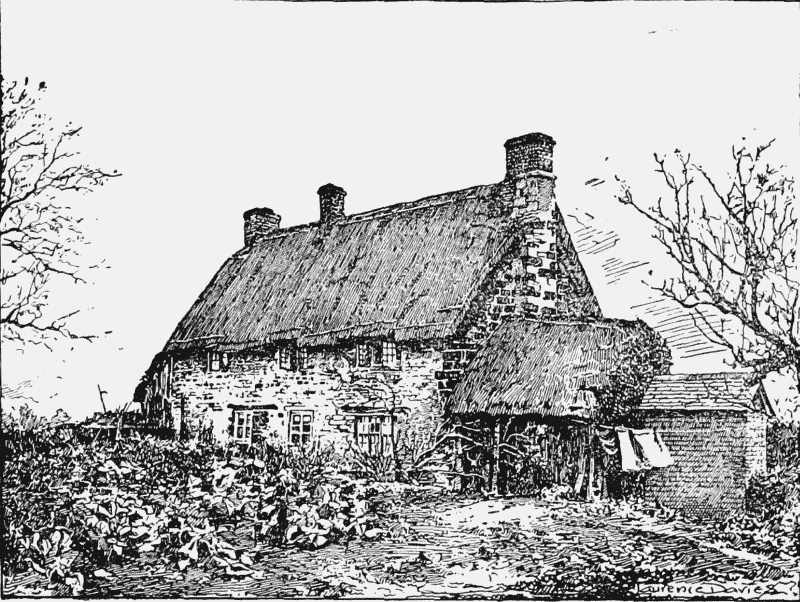
Cottage At Chapel Green, once the Chapel of St. Thomas of Canterbury
Walter Giffard's tenant in 1086 was Hugh, (fn. 18) most probably the Hugh de Bolebec whose granddaughter and heir married Robert de Vere, Earl of Oxford, (fn. 19) as a mesne lordship was held here by the earl in the 13th century (fn. 20) and continued to be held with this title, (fn. 21) the last mention of it occurring in 1634. (fn. 22) The family whose name was later associated with the parish was settled here in the 12th century and probably earlier, for in 1166–7 Dairel owed half a mark for 'Litlingestan.' (fn. 23) In 1194–5 a dispute arose between Richard, brother of Ellis Dayrell, and Maud, who may have been the widow of Ellis, as to whether Richard was seised in demesne as of fee of a messuage in Lillingstone which Maud held. (fn. 24) At the same date, (fn. 25) and again in 1199, (fn. 26) Ralf Dayrell is mentioned in connexion with this county, and was probably lord of Lillingstone, as he certainly held lands here in 1232, (fn. 27) and his son Henry was lord of the fee in 1234–5. (fn. 28) Henry Dayrell was succeeded before 1254–5 by another Ralf, (fn. 29) evidently his son, as in 1262 Ralf granted a messuage in Lillingstone to Richard Grusset and Emma his wife, (fn. 30) daughter of Henry. (fn. 31) and they, at the instance of the donor, granted it to Henry's widow Jane to hold of them for her life for the yearly rent of a rose. (fn. 32) Ralf still held in 1278–9, (fn. 33) and was followed before 1284–6 by his son Henry. (fn. 34) In 1297 Henry Dayrell quitclaimed the manor to John de Foxley and Constance his wife. (fn. 35) In 1301 Henry son of Henry Dayrell, while still a minor, claimed that by reason of that deed he had been unjustly disseised of the manor. (fn. 36) Henry, the father, who was still alive, maintained that he was justified in making the conveyance, and added that, as his son had never been in seisin of the manor, the claim of unjust disseisin was impossible, a view which was upheld by the court. (fn. 37) John de Foxley was returned as holding the manor in 1302–3, (fn. 38) and two years later he recognized the claim of Alice, widow of Henry Dayrell, sen., to a third of the manor as dower. (fn. 39) In a further dispute John de Foxley is stated to be the guardian of Henry, the son. (fn. 40) The quarrel, however, was finally settled in 1309, when John de Foxley and Constance quitclaimed to Henry Dayrell and Emma his wife all their right in two-thirds of the manor, and their reversionary right in the third held by Alice in dower, on payment by Henry and Emma of £100 sterling. (fn. 41) Henry Dayrell still held in 1316. (fn. 42) John Dayrell, who presented to the church in 1328, (fn. 43) and Jane his wife were seised in 1332–46. (fn. 44) Roger, his son, (fn. 45) was lord in 1369 (fn. 46) and member for the county in 1388, 1390, 1393–4 and in 1399. (fn. 47) He married Joan Agmondesham, and was succeeded, after 1407, by his son John, who died in 1417, leaving two sons, Paul and Thomas. (fn. 48) Nicholas Dayrell, possibly the brother of John, (fn. 49) presented to the church in 1441. (fn. 50) Paul Dayrell died seised of the manor in 1491, having previously made a settlement of it; his heir was his son Thomas, aged twenty-four. (fn. 51) Thomas married Dorothy Danvers; his son Paul, who succeeded him in 1524, married as his first wife Margaret daughter of John Cheyne. (fn. 52) He died in 1556, leaving a son of the same name, (fn. 53) who married Frances Saunders (fn. 54) and made various settlements of the manor in 1561, (fn. 55) 1573–4 (fn. 56) and 1602. (fn. 57) He died in 1606, and his son and grandson, both called Thomas, were successively lords of the manor. (fn. 58) The grandson died in 1628, ten years after his father, without male issue, so that Lillingstone passed to his brother Peter Dayrell, (fn. 59) who took an active part in the Civil War as an ardent Royalist. (fn. 60) In 1646 he compounded for his delinquency in adhering to the king's cause, and a fine of £788 was imposed. (fn. 61) He died in 1667. (fn. 62) His two elder sons, Thomas and Peter, died without issue, the latter in 1670, when the third son, Anthony, rector of the parish, became the heir. (fn. 63) Anthony's son Thomas died in 1685, his heir being his uncle Paul, who died in 1690, leaving a daughter Frances, and, as male heir, his brother Richard, who married Frances Tucker. (fn. 64) He, at his death in 1704, was followed by his son Peter, (fn. 65) who died unmarried in 1725. His brother Thomas, rector of the parish, died in 1729, (fn. 66) leaving a son Richard, who was still a minor at this date, but afterwards inherited the property (fn. 67) and also held the rectory. (fn. 68) After his death in 1767 (fn. 69) his sons Richard and Paul held successively, dying without issue in 1800 and in 1803 respectively. (fn. 70) The third son, Henry, who held a commission in the Royal Navy, died in 1823, and his son Richard, captain in the Navy, became lord of the manor, dying in 1841, when his heir was Edmund Francis Dayrell. (fn. 71) His son Captain Edmund Marmaduke Dayrell, R.N., was lord of the manor as late as 1885, (fn. 72) at about which date the property was sold to Mr. Abraham John Robarts, the present owner.
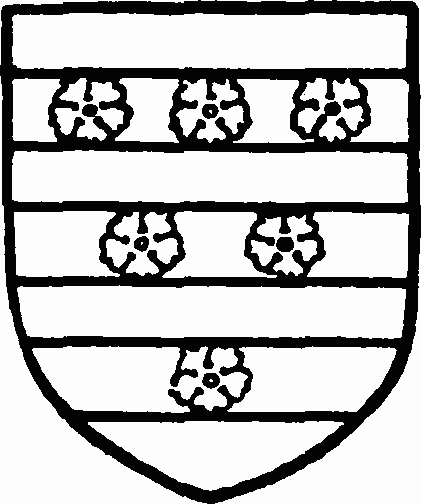
Dayrell of Lillingstone. Argent on three bars sable six cinqfoils argent.
There was a mill appurtenant to the manor in 1602. (fn. 73) In 1610 there were two mills, one of which, called the old mill, was then used as a cottage. (fn. 74) A water-mill is again referred to in 1706. (fn. 75) In 1628 a rabbit warren and a dovecot were included in the appurtenances. (fn. 76)
In 1369 Sir Henry Green, kt., died seised of the manor of HEYBARNE, held of the lord of Lillingstone Dayrell, partly in Northamptonshire and partly in this county. (fn. 77) The part in this county, which was later said to amount to a toft and a carucate of land, called Heybarnefield, in Lillingstone Dayrell, (fn. 78) was worth only 40d. per annum at the above date because it was in the forest of Whittlewood, and so had been much harmed by the king's beasts. (fn. 79) Sir Thomas Green, kt., son of Sir Henry, died seised in 1391 (fn. 80), leaving a son Thomas, whose widow Mary, after her husband's death in 1417, (fn. 81) held until her death in 1434, (fn. 82) when their son Thomas inherited. (fn. 83) By the end of the 16th century this property had passed to Peter Wentworth, (fn. 84) lord of the manor of Lillingstone Lovell (q.v.), with which it afterwards descended. (fn. 85)
Church
The church of ST. NICHOLAS consists of a chancel measuring internally about 29 ft. 7 in. by 13 ft. 8 in., north organ chamber and vestry, nave 31 ft. 7 in. by 16 ft. 1 in., north and south aisles each 6 ft. 9 in. wide, west tower 9 ft. 2 in. square, and a south porch 7 ft. by 5 ft. 6 in.
The east and west walls of the nave, with the chancel and tower arches, are the only survivals of a late 11th-century aisleless church with a western tower. Early in the 13th century the chancel appears to have been rebuilt and lengthened, the walls of the western portion following the line of the original walls. The tower, if ever completed, must have been in a ruinous condition at this time, as the window in the west wall of the nave, which now looks into the tower, is of about the same date as the older work in the chancel. About 1240 the tower seems to have been rebuilt, and to the same period may be assigned the coupled lancet windows in the side walls of the eastern half of the chancel. In the last half of the 13th century the aisles were added to the nave and a new east window was inserted in the chancel, the recess on the north and the wall arcade on the south being formed at the same time. The north wall of the chancel is reported to have been in ruins in 1366 (fn. 86); the 13th-century detail here bears marks of resetting and suggests that the whole wall has been rebuilt, probably a few years after this date. Beyond the addition of the south porch and the insertion of a window in the south aisle in the early 15th century no further structural alterations appear to have been undertaken in the middle ages. At a later period the north aisle appears to have been pulled down to supply material for the repair of the church; this was probably done at some time in the 17th century, as, according to Browne Willis, there was no north aisle existing in 1735. The uppermost stage of the tower has evidently been rebuilt, perhaps during the 18th century. In 1868 the church was restored by Street, who rebuilt the north aisle and added the north vestry and organ chamber. The walling generally is of limestone rubble, but the south porch has a facing of rough ashlar work. The roofs of the body of the church are tiled.
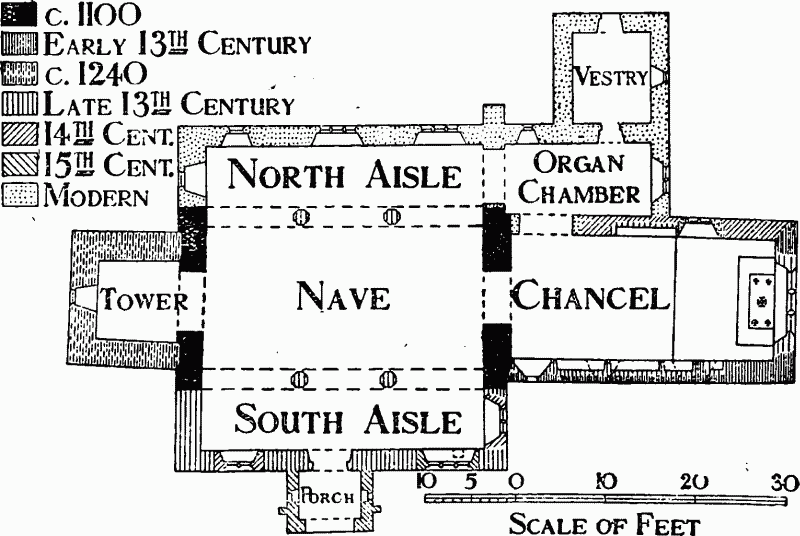
Plan of Lillingstone Dayrell Church
The late 13th-century east window of the chancel is a fine and interesting example of the transition from plate to bar tracery. The head is two-centred, and it is of three lights, the central light being higher and wider than the side lights; the tracery above is formed by three trefoiled circles with pierced spandrels between them. The mullions are shafted, and the rear-arch also springs from attached shafts with moulded capitals and bases. The coupled lancet at the northeast, originally inserted about 1240 and reset at the later rebuilding of the wall, has a lozenge ornament between the heads of the lights externally, and a circular flower ornament in a corresponding position internally, now partly covered by the rear-arch. The wide recess to the west of the window has a segmental two-centred head subdivided by forked ribs springing from a central moulded corbel. Both the main head and the ribs are hollow-chamfered, and there are small shafts at the angles of the jambs. The whole work is very rough, and the junction of the ribs with the main head is clumsy in the extreme, the result, doubtless, of unskilful rebuilding. At the west end of the wall is a modern arch opening to the organ chamber. At the east end of the south wall is a late 13th-century piscina with a projecting bowl and credence shelf and a trefoiled ogee head. The label inclosing the head is linked to the label of the contemporary wall arcade which occupies the remainder of the lower part of the wall. Above the arcade are two windows, the eastern a coupled lancet window of the same date as that in the opposite wall, but more elaborately moulded externally, the mullion being shafted and enriched with dog-tooth ornament, while the western window is a lancet of the early 13th century. The end bays of the arcade beneath are narrower than the two middle bays, the easternmost bay having a stilted semicircular head, while the other bays have two-centred segmental heads; all spring from attached shafts with moulded bases and capitals, and the abaci are ornamented with the nail-head. The two eastern bays formed sedilia, and the westernmost bay contains an early 13th-century low-side window rebated for a shutter. The labels are linked horizontally and stopped by a mask-stop on the west. The chancel arch, which is semicircular and of rough workmanship, springs from plain square jambs with chamfered imposts.
The north and south arcades of the nave are each of three bays and are alike in detail; the arches are two-centred and of two chamfered orders, and are supported by octagonal columns with moulded capitals and water-table bases standing on octagonal plinths with square sub-plinths. The outer orders die upon the end walls of the nave, the inner orders being carried by moulded corbels, and the arches are inclosed by labels on both nave and aisle faces. The north arcade, which had been built up, was considerably restored when the north aisle was rebuilt, and the bases are modern. The tower arch is like the chancel arch, but the imposts have been recut; above it is an early 13th-century lancet, now looking into the tower.
The modern north aisle is designed in the style of the 13th century. The south aisle retains no original windows; the east window is an insertion of the 14th century, and is of three trefoiled lights with reticulated tracery in the head, while at the west end of the south wall is a two-light window of the same date and type. The remaining window at the opposite end of the same wall is a square-headed early 15th century insertion of three cinquefoiled lights. The south doorway, which is contemporary with the aisle, has a two-centred head of two orders, the outer order having shafted jambs, while the inner order is continuous.
The tower rises in three plain stages, the ground and intermediate stages being lighted by plain lancets on the west, and the rebuilt bell-chamber by coupled lancets on all four sides. The early 15th-century south porch has a pointed outer doorway of two chamfered orders, and is lighted from each side by a quatrefoil. The walls rise from a boldly moulded plinth and have small two-stage buttresses on the east and west; the roof is steeply pitched and covered with stone flags.
The font and fittings are modern. In the sanctuary floor are preserved eight early 13th-century tiles with raised designs, and some 14th-century red and yellow 'slip tiles' are placed in the floor on the north and south sides of the chancel. Hung on the north wall of the chancel is a pulpit-hanging embroidered with the Dayrell arms and bearing the inscription '1659 Donum Thomae Dayrelli Armigeri.' Above it are also hung two funeral helms, one probably made up from a 16th-century close helmet, while the other seems to be a modern imitation.
The earliest monument in the church is a table tomb in the third bay of the arcade, on the south side of the chancel, commemorating Paul Dayrell (d. 1491) and his wife Margaret, the date of whose death is not given. In the covering slab are their brass figures, he in the plate armour of the period, and she in a gown trimmed with fur. Below the figures is the inscription, 'Hic jac[e]t paulus dayrell Armig' et Margareta uxor eius qui quidem | paulus obiit xxix die Marcii A° dñi m°cccc° lxxxxj q. a[n]i[m]ab[us] ppicietr de[us]' In the back of the recess in the north wall of the chancel is a brass, with a headless figure, to Richard Blakysley, a former rector (d. 1493). The inscription is as follows: 'Hic sub pede jacet d∼n Ric[ard]us blakysley quond[a]m Rector istius eccl[es]ie qtilde; obiit sexto die aprilis A° d[omi]ni m°cccclxxxxiij° cui[us] a[n]i[ma]e ppicietr de[us] amen.' Standing in the middle of the chancel is a fine table tomb to Paul Dayrell (d. 1556) and his third wife Dorothy (d. 1571), widow of William Saunders, with their recumbent effigies. On the sides are shields of arms and the kneeling figures of their nine sons and six daughters. At the angles are small baluster columns supporting a Doric frieze, in the metopes of which are carved elephants' heads and the Saunders coat, alternating with Dayrell cinqfoils. Beneath the altar is a floor slab to William Cave, a former rector (d. 1635). The slab is traditionally said to be the original altar slab, but no crosses are visible on the exposed side, though they may exist on the underside. The dimensions of the stone render the tradition not improbable. On the south wall of the chancel is a monument to a later Paul Dayrell (d. 1690). There is also a floor slab at the east end of the chancel to Frances, the wife of Matthew Wilkes and daughter of Peter Dayrell (d. 1694).
There are three bells: the treble by John Warner & Sons, 1868, the second by Edward Hall, 1726, and the tenor by Richard Chandler, 1674.
The plate consists of a silver cup of 1604, ornamented with an embossed pattern, and evidently a secular vessel; a second cup with the date letter partly obliterated, but probably belonging to the 1618–37 cycle; a standing paten of 1662, a second paten of 1797, presented in 1811; and a modern flagon.
The registers begin in 1584.
Advowson
In a late 12th-century charter concerning lands in this county the name of Philip, chaplain of Lillingstone, is given as a witness. (fn. 87) The church appears to have been in the patronage of the Dayrell family from an early date, and the living is still in the gift of the lord of the manor. (fn. 88) In 1366 it appears that the vicar had the right-hand side of the rectory with the hall and a chamber and cellar on the east, the kitchen and brew-house and two-thirds of the garden. (fn. 89) In 1278–9 it was found that the church was endowed with I virgate of land (fn. 90); it was valued at £5 in 1291 (fn. 91) and at £8 in 1535. (fn. 92) In 1291 an annual sum of 6s. 8d. was paid to the priory of Newton Longville, (fn. 93) to which Walter Giffard had granted certain tithes in Lillingstone in the 11th century. (fn. 94)
Charities
It appeared from a board in the church that Frances Wilkes in 1674 gave £40 for clothing poor women yearly, and that Elizabeth Dayrell in 1679 gave £50 for apprenticing a boy every five years; but these charities have been lost sight of.
The Rev. John Langham Dayrell, by his will, proved in the P.C.C. 18 October 1832, bequeathed £300 consols, the annual dividends, amounting to £7 10s., to be laid out in the distribution of clothing at Christmas among the poor.
The sum of stock is held by the official trustees, who also hold a further sum of £63 3s. 1d. consols, representing a sum of money awarded under an Act of 1852–3 (fn. 95) for disafforesting the forest of Whittlewood, otherwise Whittlebury, as compensation to the poor in lieu of any rights to sere and broken wood. The annual dividends of £1 11s. 4d. are applied in the distribution of coal at Christmas.