
A History of the County of Buckingham: Volume 4. Originally published by Victoria County History, London, 1927.
This free content was digitised by double rekeying. All rights reserved.
'Parishes : Maids Moreton', in A History of the County of Buckingham: Volume 4, (London, 1927) pp. 198-205. British History Online https://www.british-history.ac.uk/vch/bucks/vol4/pp198-205 [accessed 12 April 2024]
In this section
MAIDS' MORETON
Mortone (xi cent.); Morthone (xiii cent.); Maydemorton (xvi cent.).
The parish covers about 1,365 acres, of which 376 are arable, 786 permanent grass and 26 woods and plantations. (fn. 1) The ground slopes from a level of about 400 ft. above the ordnance datum in the northwest to about 270 ft. in the south-east. The soil is clay and gravel and the subsoil gravel.
The village lies in the south-west of the parish, along the Buckingham to Towcester road, a mile north-east of Buckingham station on the Bletchley and Banbury section of the London and North Western railway. It contains many 17th-century houses and cottages of timber frames with brick or plaster filling and thatched roofs. Its most interesting feature is the fine 15th-century church of St. Edmund, said by tradition to have been built by two maiden ladies of the Pever family, whence the name Maids' Moreton. (fn. 2) A slab in the nave of the church possibly marks their grave. The church and rectory-house stand at the southern end of the village, high among fine trees. They look down upon Buckingham at the foot of the hill below, the Ouse occupying the foreground. On its banks is a picturesque water-mill, and between it and the town the Grand Junction Canal winds along through the meadows in a course very similar to that of the river, which at one point it joins. About half a mile south-east of the rectory is College Farm, the property of All Souls College Oxford. The Manor, occupied by its owner, Miss Andrewes, stands west of the church and rectory. A fine avenue, about three-quarters of a mile in length, leads south-west from here through plantations of fir down the hill-side to Buckingham.
Maids' Moreton Manor House, built near the site of the old manor and the residence of Mr. Arthur Lucas, lies off Church Street. It was formerly called Moreton House, and was the early home of the late Bishop Browne of Winchester and of Sir Thomas Gore Browne. (fn. 3) From this street Main Street branches north-west through the village, passing the school (built in 1854), the Elms, occupied by Miss Boyd, and at the centre of the village Moreton Lodge, dating from 1715, the property of Baroness Kinloss and residence of Sir A. C. Thornhill, bart. At the northern end of the village is Moreton House, occupied by the owner, Mrs. Henry Bull. Where Main Street joins the Towcester road the Wesleyan chapel, erected in 1869, stands, with Manor Farm, a 16th-century house of stone with modern additions in brick, a little to the south of it. Tradition marks it as once the home of the two maids of Moreton. Upper Farm, according to a date in a chimney stack, was built in 1624, and has later additions. It is of timber and plaster or brick and has tiled and slated roofs. Some of the windows still retain their mullions. The village has in its vicinity the reservoir of the Buckingham Corporation Waterworks.
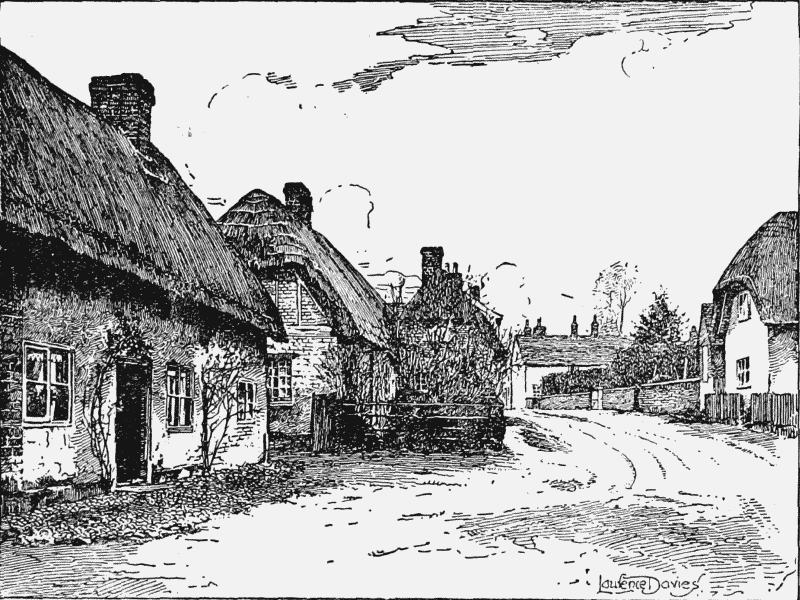
The Village, Maids' Moreton
The parish was inclosed in 1801 by Act of Parliament. (fn. 4)
Manors
In 1086 5 hides in MORETON were held by Lewin of Nuneham, the preConquest owner. (fn. 5) They descended with his chief manors of Mursley and Salden to the Fitz Niels, (fn. 6) by whom they were subinfeudated in the early 13th century (fn. 7) for three parts of a fee, the Fitz Niels being answerable to the king for scutage and ward to Northampton Castle, assessed at 7s. 6d. (fn. 8) From 1300 to 1346, the last date at which the connexion of the Fitz Niels with Moreton is recorded, the service due was returned at half a fee. (fn. 9)
Their place as overlords appears to have been taken by the holders of the honour of Gloucester, which had a large interest in Maids' Moreton (see below). Already in 1272, after the death of the tenant, Gilbert de Clare Earl of Gloucester had entered the manor and occupied it for a year. (fn. 10) Evidence points to the identity of part of this 5-hide manor with the carucate of land afterwards known as GREENHAMS MANOR in Moreton and held of the honour of Gloucester in the early 15th century. (fn. 11)
It is probable that the first tenant under the Fitz Niels was Walter de Morton, about the beginning of the 13th century. (fn. 12) His estate, said to be one and a quarter fees in Moreton geldable to the king, passed to Paul Pever, who about 1247, by grant from Henry III, appropriated to himself hidage worth 10s. and suit and view of frankpledge worth 2s. each. (fn. 13) He had also acquired Chilton Manor, with which the manor descended for about sixty years. (fn. 14) After the death of Emma, widow of Paul Pever's son John, Walter de Morton occupied the manor in succession to Gilbert de Clare, Earl of Gloucester, and was in possession in 1274. (fn. 15) During his tenure the house had deteriorated to the value of 10 marks, and he had carried away a press and apple-mill worth 20s. (fn. 16) This Walter de Morton may be identical with the Walter de Morton whom Paul Pever succeeded, and his descendants appear to have held lands in Moreton as tenants to the Pevers. (fn. 17) John Pever, Paul's grandson, had succeeded to the manor by 1279, when he claimed view of frankpledge, (fn. 18) and freedom from suit of court and hundred, which his father and grandfather had enjoyed. (fn. 19) John Pever was still holding the manor in 1302, (fn. 20) but seems to have parted with it before his death in 1315, when he was returned as patron of the advowson only, (fn. 21) the manor passing to Richard de Bayhous, who held with Katherine his wife in 1337 (fn. 22) and was still lord in 1346. (fn. 23) Nothing is known of this estate for the next sixty years, but it probably reappears in the carucate of land in Moreton of which Hugh Greenham died seised in 1407. (fn. 24) He and his wife Katherine had previously, in 1384, acquired rights in lands here from John Warde of Buckingham. (fn. 25) His property passed to his grandson John, son of his son Thomas, who died on 12 November 1408. (fn. 26) The heir was Hugh's son William, aged twenty-six, who died on 8 December 1412, leaving a son Thomas to inherit Moreton Manor. (fn. 27) The custody of Thomas during his minority was granted to Queen Joan, and by her on 10 April 1413 to Nicholas, Bishop of Bath. (fn. 28) Thomas attained his majority on 4 October 1420, (fn. 29) and on 4 May 1430, as Thomas Greenham of Ketton (Hunts.), conveyed the manor to Sir John Basynges and others, (fn. 30) who released it to him on 1 April 1433. On the same day Thomas Greenham granted lands in Moreton to William Purefoy and others, by whom the manor of Morel on was then granted to John Horwood and Robert Somery. (fn. 31)
On 1 April 1442 Robert Somery granted this property as the manor of Moreton called Greenhams to Henry VI, (fn. 32) by whom in the following month it was granted to All Souls College, Oxford, (fn. 33) the present owners. It was leased by the warden in 1493 as the lordship of Moreton to Robert Woodward, jun., of Buckingham, (fn. 34) and in 1518 to John Harris, (fn. 35) who in 1535 was paying a rent of £7 6s. 8d. for the manor of Moreton with the mill there called 'Brent Myll.' (fn. 36) Old leases existing among the archives of All Souls show that, as the manor of Greenhams, many separate leases were made of it to the Harris family in the 16th century (fn. 37) and to John Easton in the 16th and 17th centuries. (fn. 38) It was held with the Christ Church manor in the 18th century on lease by Edward Bate, who died in 1717. (fn. 39) In 1801, 1808, and 1815 it was leased to Edwin Oakley Gray of Buckingham by the college. (fn. 40) In 1862 the lessee was the Rev. Wm. Andrewes Uthwatt, (fn. 41) succeeded by Mrs. Uthwatt about 1883. The manorial rights are now vested in Miss Andrewes.
In 1794 the park belonging to Greenhams was leased to Richard Geast of Blyth Hall, near Coleshill, with assignment thereof to Edwin Oakley Gray. (fn. 42)
Two hides of land in Moreton, always reckoned as part of Stowe, to which they appear to have been appurtenant in 1086, were granted with it by Robert Doyley and Roger de Ivry to the college founded by them in the church of St. George in Oxford Castle, and were in the possession of the canons before 1130. (fn. 43) With Stowe they passed to Oseney Abbey, which was said to hold them of the fee of Robert Doyley in the 13th century. (fn. 44) The abbot enjoyed view of frankpledge, waif and stray and other liberties in this estate, (fn. 45) which was assessed at £5 2s. 6½d. in 1535. (fn. 46) These 2 carucates were subinfeudated by the abbot for a yearly rent of 3s. 4d. to the Greys of Wilton, and proofs of their tenure exist from 1370 to the mid15th century. (fn. 47) The estate remained in the abbey until the Dissolution, (fn. 48) when it formed part of the endowment of the cathedral church of Christ and St. Mary, Oxford. (fn. 49) It remained in the possession of the Dean and Chapter of Christ Church, Oxford, who held the manor as late as the early 19th century. (fn. 50) Part of their estate in Maids' Moreton was held under them on lease by William Moore at his death in 1600, (fn. 51) and came to his son John, at whose death in 1620, without issue, it passed to William's widow Elizabeth, then described as Elizabeth Every, widow, who married John Moore and held these lands with him. (fn. 52) In the 18th century Edward Bate, the lessee of All Souls Manor was said to have been tenant also of this manor, (fn. 53) of which in 1801 Samuel Churchill was lessee. (fn. 54)
In 1086 4 hides in Moreton were held as one manor under Walter Giffard. (fn. 55) Alric son of Goding had previously held two of these hides as one manor, Ederic, a man of Asgar the Staller, 1½ hides as one manor, and Saward, a man of Toti, half a hide, all three being able to sell and assign their land. (fn. 56) This manor was parcel of the honour of Giffard or Gloucester, (fn. 57) of which it was held for one fee (fn. 58) until the 16th century, when the king claimed to be lord of the honour. (fn. 59) In the 13th century the Earls of Gloucester, as overlords, (fn. 60) had view of frankpledge in Moreton and all royal rights as from time immemorial. (fn. 61) View of frankpledge and a court leet in Moreton are also mentioned in the 14th and 15th centuries. (fn. 62) The Temples, who obtained Stowe in Elizabeth's reign, received a grant of free warren here in 1616, (fn. 63) and Lord Cobham about 1735, and the Marquess of Buckingham in the early 19th century, put forward a claim to be lords of the paramount manor in Maids' Moreton, as held of the honour of Gloucester, of which they were lords. (fn. 64)
The under-tenant in 1086 was Turstin, evidently identical with the Turstin son of Rolf who held Great Missenden at that date. (fn. 65) Either he or his successors subinfeudated these 4 hides in Moreton, the intermediary lordship thus created descending with the manor of Great Missenden (q.v.) and, like it, dividing into moieties, after the death of Hugh de Sanford, about 1234, between his two daughters and co-heirs, Christine wife of John de Pleseys and Agnes wife of Walter Husee. (fn. 66) These interests in Moreton are last heard of in 1346, when Hugh de Pleseys and Thomas de Missenden were jointly responsible for the fee to the Earl of Gloucester. (fn. 67)
The subinfeudation had probably taken place before 1202, when Reynold son of Ascur granted to Richard son of Emma 1 hide in Moreton at a rent of 12s. yearly, excepting from the grant his chief messuage and two assarts at 'Smalethornes' and 'Portgrave,' which he reserved to himself and his heirs. (fn. 68) In 1226 there is mention of the wood in Moreton of William son of Reynold, (fn. 69) who in 1254 held that moiety of the fee which was dependent on the Husees, the other moiety being then held by Ellis le Drueys. (fn. 70) By 1268 they had granted to Matthew de Stratton, Archdeacon of Buckingham, lands which before his death in that year he granted to the abbey of Oseney, by a deed conferring on the abbey in free alms all his court of Moreton which he had of the gift of William son of Reynold, with all its appurtenances within the towns and fields of Moreton, whether of the fee of St. Gregory or of other fees, with a messuage and lands which he had of the gift of John and Robert sons of William de Morton, of Henry son of the said Robert, with all that he had of the gift of Ellis le Drueys and Alina his wife. (fn. 71) In 1279 Ellis le Drueys's half-fee was extended at 2 hides and 3 virgates, and Ralf Kam was intermediary between him and Hugh de Pleseys. The bequests of William son of Reynold and of his relatives to Oseney Abbey evidently comprised all his estate in Moreton, for in 1279 the abbot was answerable to Henry Husee for the half-fee due from William's 2 hides in Moreton. (fn. 72) A hide and 3½ virgates were then held of the abbot by John de Morton, (fn. 73) who shortly afterwards acquired Ellis le Drueys's portion, (fn. 74) and the Walter de Morton holding in 1316 may have been his representative, (fn. 75) for during the 14th and 15th centuries the Abbot of Oseney and the heirs of John de Morton are returned as joint lords of this part of Moreton. (fn. 76) The Oseney portion was doubtless granted with the rest of the abbey's land in this parish to the Dean and Chapter of Oxford at the Dissolution, (fn. 77) and the Mortons' holding may have been represented by the 7 virgates and capital messuage which the Moore family, also lessees of Christ Church (see above), held of the honour of Gloucester in the 17th century. (fn. 78)
A 2-hide manor in Moreton, previously held by Ulvric, a man of Alric son of Goding, who could sell, was included in 1386 among the lands of Walter Giffard. (fn. 79) It may perhaps be in part accounted for by the lands attached to the honour of Gloucester in the 15th century, (fn. 80) and held by the Bartons of Thornton (fn. 81) (q.v.). Some of these were granted with other lands in Crendon and Foscott for the foundation of a chantry at Thornton by Isabella Barton. (fn. 82) At the Dissolution All Souls College, Oxford, paid 10s. 8d. from its manor in Moreton for the yearly distribution of alms and 6 lb. of corn at Thornton, and were also liable for the stipend of the chaplain celebrating there for the Bartons' souls. (fn. 83)
Other Barton lands descended with the Castle House in Buckingham to the Fowlers, of whom Richard Fowler was in possession in 1477, (fn. 84) and then to their heirs the Lamberts. (fn. 85) They passed to Sir Edward Bagot, bart., by his marriage with Mary daughter and heir of William Lambert, to whom livery of her property was granted in 1639. (fn. 86) They are said to have been subsequently held by Sir George Moore, created a baronet as Sir George Moore of Maids' Moreton in 1665, (fn. 87) and sold by him to Dr. George Bate, physician to Charles I, Oliver Cromwell and Charles II. (fn. 88) He was born in 1607 at Moreton, where his father, George Bate, was rector until his death in 1643. (fn. 89) Edward Bate succeeded his father, the doctor, in 1669, and was described by Browne Willis as 'an excellent, active J.P. . . . a good neighbour and friend.' (fn. 90) He built a mansion-house near the church, where he died in 1717; the house subsequently passed to Samuel Churchill and Edwin Gray, lessee of Greenhams Manor, to which it was said to belong. (fn. 91)
Lands in Moreton were also held by the abbey of Biddlesden, (fn. 92) the convent of Elstow, (fn. 93) and the hospital of St. John of Buckingham. (fn. 94)
Lewin of Nuneham held a mill worth 10s. with his manor in 1086, (fn. 95) probably the water-mill held by John Pever in 1279. (fn. 96) The Brend or Brent Mill was held by All Souls College in 1483, (fn. 97) and leased by them then and at subsequent dates.
Church
The church of ST. EDMUND consists of a chancel measuring internally about 25 ft. 11 in. by 15 ft. 11 in., south vestry 6 ft. 8 in. square, with a modern westward extension, nave 40 ft. 3 in. by 23 ft. 11 in., west tower 13 ft. 3 in. by 12 ft. 3 in., north porch 9 ft. by 6 ft. 5 in. and south porch 6 ft. 10 in. by 7 ft.
The present church was entirely rebuilt about 1450, its refoundation being traditionally ascribed to the munificence of the two maiden daughters of the last Thomas Pever, who died in 1429. The only remains from the former church are the late 12thcentury font and some 12th-century moulded stones, re-used in the rear arches of the windows of the north porch. As might be expected in the case of a building erected at a single period, the whole work is carried out in a most complete and elaborate manner, and may challenge comparison with any existing examples of contemporary date in the country. The vestry, porches, and ground stage of the tower are fan-vaulted, and the design of the tower itself is especially remarkable for the boldness and originality displayed in the design of the two upper stages. The walling throughout is of limestone rubble, the south wall of the chancel and the walls of the original vestry being covered with rough-cast. The building was restored in 1882–7, when the vestry was enlarged by the westward extension, which touches the south-east angle of the nave.
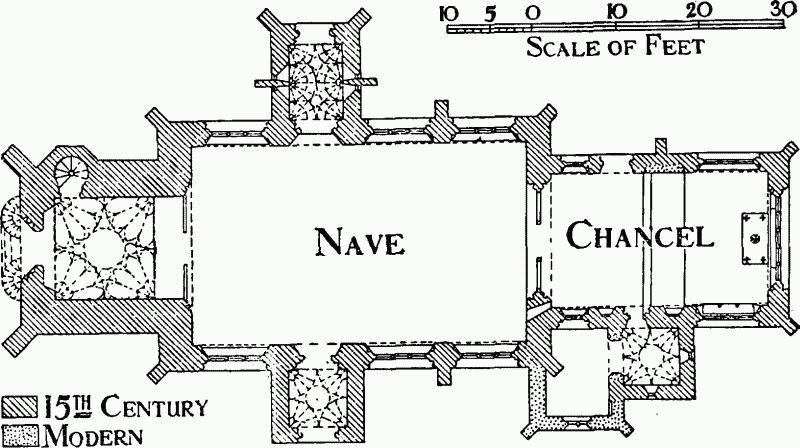
Plan of Maids' Moreton Church
The east window of the chancel is of five cinquefoiled lights with transomed vertical tracery in an elliptical head; internally the jambs are brought down to the ground, and the inner fillets of the mullions, interrupted only by a transom-like moulding at the sill, are continued below the foot of the lights and stopped upon a blocking of stone extending beneath the three middle lights, and probably intended for fixing the high altar. The tracery is set near the middle of the wall, and the jambs are moulded with wide casements on both faces, the casement being stopped internally at the sill level, below which the jambs have a plain splay. The rear arch is concentric with the outer head, and is continuously moulded with the jambs. To the north of the window is a moulded image bracket. A similar treatment is adopted in the case of all the other windows of the chancel and nave, the fillets of the mullions being stopped upon stone benches set back about 3 in. from the internal face of the wall. At the east end of the north wall is a window of three trefoiled lights with floreated cusping and vertical tracery in a segmental two-centred head with almost straight sides. To the west of this window are two narrow recesses with segmental two-centred heads, the western recess, in the lower part of which is the north doorway, extending nearly the whole height of the chancel, while the head of the eastern recess, which is now blocked by a monument, is placed lower to clear the foot of the wall-post of the adjacent roof-truss. At the east end of the wall is a small window of two cinquefoiled lights with quatrefoil tracery in a two-centred head. In the south-east angle of the chancel is a shaft piscina with a moulded semi-hexagonal basin and a shaft of the same form. The south-east window is like the corresponding window in the opposite wall, but the bench in the recess below the sill is divided by buttressed mullions into three sedilia, each having a richly panelled semi-hexagonal projecting canopy with a cinquefoiled and sub-cusped ogee arch in each face and miniature pinnacled buttresses at the angles. The soffits of the canopies have mock vaulting, and the whole work is of great elaboration. It has been a good deal restored, the crowning cornice being apparently modern. To the west of the window are three narrow recesses, the whole height of the chancel, with straight-sided pointed heads and splayed jambs, hollow chamfered at the angles; the middle recess does not descend to the floor level, but is stopped above the head of the vestry doorway, while each of the others has a stone bench with two rectangular panels at the back, stopped at the general sill level to correspond with the treatment of the window recesses. At the west end of the wall, now looking into the vestry, is a window like the corresponding window in the opposite wall. The wide and lofty chancel arch is of two continuously moulded orders, separated by deep, narrow casements. In the east face of the south respond is a squint from the nave having an opening with a trefoiled head. Externally the walls of the chancel rise from a boldly moulded plinth, which is continued round the whole building, and are crowned by a moulded cornice and plain parapet with a weathered coping, the east wall having a lowpitched gable. All the windows are labelled, and there is a slight set-back at the level of their sills, capped by a heavy chamfered weather-course, which is utilized to form the label of the north doorway; at the eastern angles and in the centre of the north wall are slender buttresses of two offsets.
The south vestry is lighted by small square-headed windows in the east and south walls, each being of a single trefoiled light, rebated for a shutter, with plain pierced spandrels in the head. At the south-east is a rectangular recess possibly intended for a piscina. An archway on the west opens to the modern extension. The cones of the fan-vault have trefoiled panelling and spring without corbels from the four angles of the vestry, while the centre of the vault is occupied by a multifoiled circle with floreated cusping inclosing a large four-leaved flower.
The nave is divided into four bays by the spacing of the roof trusses, and in each of the first, second, and fourth bays on either side is a tall, finely-proportioned window of three transomed lights, cinquefoiled in both stages, with vertical tracery in a two-centred head. In the third bay on either side are the north and south doorways, each set within a recess of the same character as those in the chancel, and rising to the same height as the heads of the windows. The north doorway is of two moulded orders separated by a casement, the head of the outer order being brought to a septfoiled form by pierced cusping with trefoiled sub-cusping. The south doorway is less elaborate and has a four-centred head moulded continuously with the jambs. Placed in the casement mould of the east jamb of the south-east window is a moulded image bracket supported by a carved angel. Though it does not quite fit its position, the presence of a broken piscina in the back of the window recess suggests that it has never been moved, but was probably placed here at some time subsequent to the building of the church as an additional ornament to the altar, which must have occupied this corner of the nave. Immediately to the south of the chancel arch is the squint to the chancel, which has an opening with a cinquefoiled four-centred head towards the nave. The walls are crowned externally by a moulded cornice and plain parapet, and there is a buttress of two offsets between the two eastern windows on each side, the angles being emphasized by diagonal buttresses of the same number of offsets.
The west tower has an embattled parapet and is of three slightly receding stages with diagonally set buttresses at the angles and a vice at the north-west. The ground stage opens to the nave by a four-centred arch of three orders with continuously moulded jambs towards the nave. The orders are separated by casements, the inner being moulded with a swelled chamfer on each face and the outer orders with hollow chamfers. The fan-vaulted ceiling of the ground stage has a central circular opening and the cones, which have trefoiled panelling with floreated cusps, spring from quartercircular corbels supported by carved angels and enriched with flowers; the work, though bold and vigorous, is somewhat coarse and the mouldings are heavy. The west doorway has a four-centred head and an elaborate external canopy supported by two richly panelled cones of fan-vaulting springing from roll shafts which form the outermost members of the suite of jamb mouldings. The canopy itself is flat, and, as the supporting cones do not meet, the intervening portion of the soffit is divided into plain rectangular panels. The cornice of the canopy is enriched with flowers and crowned by an embattled parapet with triangular-headed merlons having trefoiled panels. Immediately above is a window of four cinquefoiled lights with tracery in a two-centred head. A single large recess in each face of the tower includes the windows of the two upper stages, that on the north being made narrower to clear the stair-turret. Each recess has splayed jambs and a two-centred segmental head with pierced septfoil cusping, the cusps terminating in a large trefoiled flower, and is subdivided by a central pier of V-shaped plan rising into the apex of the head; the string-course dividing the stages, with the wall off-set above it, is continued round the recess and the central pier. In each of the two upper compartments thus formed is a single trefoiled light to the bell-chamber (the eastern light on the north side is now blocked), while the ringing chamber is lighted by one smaller trefoiled light only in the lower stage of the recess, the blank compartment containing a trefoiled panel. The crowning cornice has gargoyles at the four angles of the tower, and the merlons of the embattled parapet have circular piercings.
The north porch has a buttress in the centre of each side wall and diagonal buttresses at the northern angles, the walls being crowned by an embattled parapet and moulded cornice with gargoyles at the angles. The outer entrance has a four-centred head continuously moulded with the jambs and rising into the cornice which is lifted to clear it. The ceiling is formed by a fan-vault of elaborate character arranged in two bays and springing from vaulting shafts with moulded capitals and bases placed in the angles and at the centres of the north and south walls. The cones of the vault have trefoiled panelling, and each bay has a sculptured boss, that of the southern bay having vine foliage, while the northern boss has a wreath of roses. The porch is lighted from each side by a pair of trefoiled lights placed on either side of the central shaft; some moulded 12th-century stones from the former church have been re-used in the rear arches of these lights.
The south porch is smaller and less elaborate, being without buttresses and having a plain parapet in place of battlements. In the centre of the parapet, over the outer entrance, which has moulded jambs and a three-centred head inclosed by a label, is a small niche with a trefoiled head under an ogee canopy with flanking pinnacles, crockets and finial. The ceiling has a fan-vault of the same character as that of the vestry, but the cones spring from shafts in the angles.
The original roofs of the chancel and nave remain. The wall-plates are moulded and the trusses are of the king-post type with chamfered tie-beams strutted from moulded wall-posts by curved braces, and all the spandrels are traceried. The chancel roof is of two bays and the wall-posts rest on moulded corbels, those on the north being of stone, while those on the south appear to be of wood. There are carved bosses at the intersections of the main timbers, and under the tie-beam of the central truss is a boss carved with a seated figure of our Lord with one hand raised. The nave roof is of four bays with carved bosses of the same character as those of the chancel roof, and the wallposts are supported by carved corbels of stone and wood.
The altar table, an elaborate piece of work, bears the date 1623 and the name, presumably of the donor, John Moore (More). The font has a circular bowl of the late 12th century, with a band of acanthus and pellet ornament, and stands on a modern base. The oak chancel screen is of original 15th-century date; it is divided into three bays by buttressed and pinnacled uprights standing on a heavy chamfered sill. The lower portion has cinquefoiled panelling with small piercings in the panels, while in each bay of the upper portion are four open lights with cinquefoiled ogee heads and tracery; the central bay opens in two leaves, and the screen is crowned by a moulded cornice originally surmounted by brattishing, of which the stumps alone remain. Upon the top of the screen, at either end against the jambs of the chancel arch, is placed the half-figure of an angel holding a passion shield; these may have been corbel fronts or bosses from the roof, but if so they had been removed from the church, to which they were restored by Lady Kinloss, into whose possession they had come. The north doorway of the nave retains its original richly traceried door, and the plain door in the north doorway of the chancel is probably also original. In the outer entrance of the north porch is an early 17thcentury double door set in a frame with a balustered 'fanlight' in the head, the balusters of which spring from a centre composed of a semi-elliptical block of wood bearing the date 1637 and the initials PR. IA. IN. WA. with a shield of the arms of Pever. In the lights of the tracery of the east window of the chancel is some fragmentary 15th-century glass, including some pieces of scrolls, one inscribed, 'miserere i . . . dns,' a second '[A]ve maria,' while a third has a heart with five wounds upon it. In one of the trefoiled upper lights of the north-east window is a figure with a halo in white and gold upon a blue background, perhaps an angel playing a harp, while in the quatrefoil in the head of the north-west window is a vernicle, also in white and gold. Fragments of figures and canopy work also remain in the west window of the tower. At the back of the sedilia is a late 15th-century painting of the Last Supper, much damaged by a coating of whitewash, and possibly painted over at a later period. Remains of painted decoration are still visible on the east truss of the nave roof, and eight incised consecration crosses contained in circles about 8 in. in diameter and coloured red, remain in the nave between the north and south windows and on either side of the chancel arch.
In the floor of the nave near the north doorway is a slab with three brass shields of the 15th century, charged with the arms, a cheveron with three fleurs de lis thereon, for Pever, and the indents of two female figures and an inscription plate. The indents now contain modern figures designed in the style of the period, and an inscription commemorating the two sisters Pever, whose memorial the slab is traditionally supposed to be. Above the north doorway is a 17thcentury painted inscription with the arms of Pever, commemorating the founding of the church in the following terms: 'Sisters and Maids Daughters Of The Lord Pruet (for Pever) The Pious And Munificent Founders of this Church.' On the south wall of the chancel over the vestry doorway is a tablet to Frances daughter of Thomas Attenbury, who died, aged seven years, in 1685. The inscription states that Thomas Attenbury was Alderman of Buckingham and servant to King Charles II and King James. Blocking the recess in the centre of the north wall is an elaborate monument to Edward Bate (d. 1717) and his wife Penelope (d. 1713). The monument is framed by marble columns with gilded bases and composite capitals supporting a curved pediment with a shield of arms. In the nave is a floor slab to John Birtwisle (d. 1697) and his wife Philippa (d. 1696).
There is a ring of six bells, four by Henry Bagley, 1717, and the tenor by John Briant of Hertford, 1806.
The plate is composed of a modern set and another of Sheffield plate.
The registers begin in 1558. The first volume bears at the commencement the title 'The Old Register of Mayde-Moreton ffaythfully transcribed by Matt. Bate, Rector.' Matthew Bate succeeded his father as rector in 1643. An interesting entry under the year 1642 describes the damage done to the church by 'ye souldiers att ye command of one called Colonell Purefoy of Warwickshire,' and goes on to explain, 'we conveighed away what we could, and among other things ye Register was hid and for that cause is not absolutely perfect for divers yeares.'
Advowson
With the 2 hides of land granted by Robert Doyley and Roger de Ivry to the college founded by them in the church of St. George in Oxford was bestowed the chapel of Moreton, (fn. 98) subsequently transferred with this property to the abbey of Oseney. (fn. 99) The abbey must have granted the advowson to the owners of the 5-hide manor held by John Pever in 1279, at which date the advowson was in his hands. (fn. 100) It continued to be held by the Pevers after they had parted with the manor, (fn. 101) following the same descent as Broughton in their descendants the Broughtons, (fn. 102) and being sold by Lady Agnes Paulet, Marchioness of Winchester (daughter of William, first Lord Howard of Effingham, by his first wife Katherine, daughter and co-heir of Sir John Broughton (fn. 103) ), to Richard Blake of Buckland (Berks.), on 22 July 1600. (fn. 104) After an intermediate conveyance it came in 1603 to George Bate, rector of Moreton and father of the famous doctor, whose descendants held until 1719, when it was purchased by Thomas Coxed. (fn. 105) His widow sold it in 1732 to John Larken, from whom it was acquired in 1733 by Hartley Sandwell. (fn. 106) He conveyed it in 1750 to William Hutton, (fn. 107) whose relatives, the Hutton Long family, retained it until about 1860, (fn. 108) when it was acquired by the Rev. W. A. Uthwatt. (fn. 109) His representative, Miss Andrewes, is the present patron.
Walter Giffard bestowed the tithes of his demesne lands in Moreton on the priory of St. Faith, Longueville, Normandy, (fn. 110) and they descended with Newton Longville Manor (q.v.), the prior of that place claiming a minute portion of tithes in Moreton Church in the 14th century. (fn. 111)
Lands for the maintenance of a lamp in the church were valued at 2s. 4d. yearly at the suppression of the chantries, (fn. 112) and were granted in 1553 to Sir Edward Bray, John Thornton and John Danby. (fn. 113)
Charities
The parochial charities have by a scheme of the Charity Commissioners of 20 March 1913 been amalgamated under the title of the United Charities, comprising the charities following, namely:—
1. The charity of John Smart, mentioned on a board in the church dated 1743; trust fund, £158 2s. 6d. consols, with the official trustees, the annual dividends, amounting to £3 19s., to be distributed in bread.
2. Charity of William Scott, for apprenticing, founded in or about 1800 by will; trust fund, £164 3s. 9d. consols, with the official trustees, producing £4 2s. yearly.
3. The poor's allotment, containing 26 a. 1 r. 26 p., allotted to the poor on the inclosure of the parish in 1801, in lieu of common rights. The net income, which in 1912 amounted to £36 6s., is distributed in coal.
The church land consists of 1 a. o r. 30 p., let at £3 a year, which is applied to church expenses.
This parish is entitled to participate in the charity of William Elmer for clothing. (See under parish of Beachampton.)