A History of the County of Buckingham: Volume 4. Originally published by Victoria County History, London, 1927.
This free content was digitised by double rekeying. All rights reserved.
'Parishes : Marsh Gibbon', in A History of the County of Buckingham: Volume 4, ed. William Page (London, 1927), British History Online https://www.british-history.ac.uk/vch/bucks/vol4/pp205-209 [accessed 30 April 2025].
'Parishes : Marsh Gibbon', in A History of the County of Buckingham: Volume 4. Edited by William Page (London, 1927), British History Online, accessed April 30, 2025, https://www.british-history.ac.uk/vch/bucks/vol4/pp205-209.
"Parishes : Marsh Gibbon". A History of the County of Buckingham: Volume 4. Ed. William Page (London, 1927), British History Online. Web. 30 April 2025. https://www.british-history.ac.uk/vch/bucks/vol4/pp205-209.
In this section
MARSH GIBBON
Mersa, Merse (xi cent.); Gibbemers (fn. 1) (xiii cent.); Mershe Gybbewine, Gibwyne, Mershe-juxta-Twyford (xiv cent.); Marsh Gibbon (xvi-xx cent.).
This parish, on the Oxfordshire border, covers 2,817 acres, nearly the whole of which is permanent grass. (fn. 2) The soil and subsoil are clay; the principal crops produced are wheat, beans and oats. The parish, which is watered by the River Ray, lies low, varying from 255 ft. above the ordnance datum in the north to 204 ft. in the south.
Marsh Gibbon village is large, its main street extending nearly a mile in length. Many of the cottages date from the middle of the 19th century, when Sir Henry Acland, bart., master of Ewelme, together with the Ewelme trustees, greatly improved the condition of the village. It had suffered from a long suit in Chancery, from the Inclosure Act and nonresident landlords, but under his care the houses were rebuilt, modern sanitation introduced, and a dispensary and reading room started. (fn. 3)
The church and rectory occupy a central position; the latter, erected in 1846, (fn. 4) possibly replaced the Parsonage House of five bays of stone and timber which stood here in 1607. (fn. 5) North of the church is a mineral spring known as Stompe or Stump Well, while to the west are traces of entrenchments supposed to have been thrown up by the Parliamentary army when they marched through Marsh Gibbon in June 1645. (fn. 6)
The Manor House, belonging to Ewelme almshouses, lies immediately south of the church. It is a stone building of two stories and an attic, dating mainly from the Elizabethan period, but somewhat altered in the early 17th century, when the attic was added, and partially refaced in the 18th century. The central block, which faces east, has a wide twostoried bay window with moulded stone mullions and transoms, and the lateral wings are lighted by oakmullioned windows of the 17th century. The roofs are tiled and have four gables on the east front with 17th-century barge-boards and apex pendants, while rising from the roofs are two groups of diagonal chimney shafts. The hall occupies the ground floor of the central block and is entered through a porch with a stone moulded archway and oak inner doorway, the latter having an original studded door and iron fittings. On the north side of the hall is an original wide stone fireplace with a four-centred arch and moulded jambs, and at the north-east is an early 17th-century staircase with square newels, bell-shaped finials and turned balusters. The main staircase, constructed in a wing which projects at the southwest and entered from the hall by a 16th-century moulded oak doorway, has square newels with acorn finials, turned balusters and moulded handrails, and is of original 16th-century date to the first floor, but the upper flights are later, and have newels like those of the stairs at the north-east of the hall.
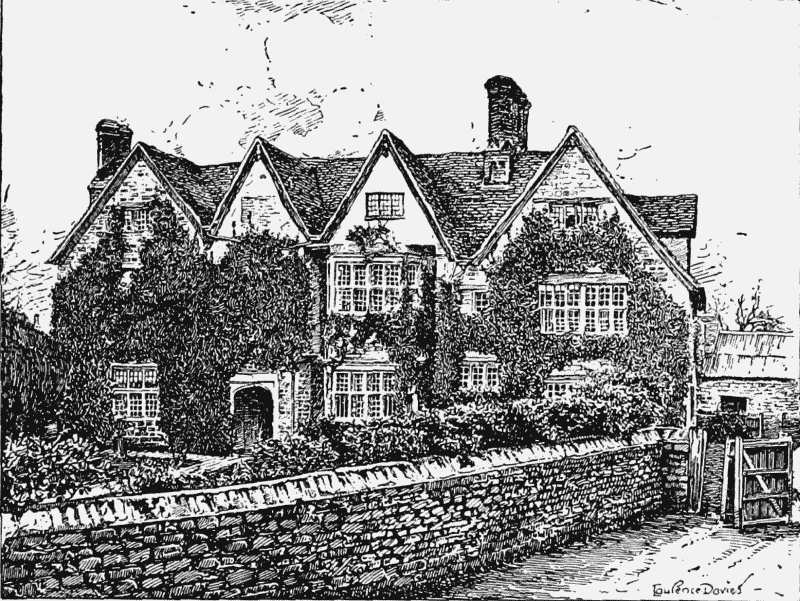
The Manor House, Marsh Gibbon
Westbury Manor dates from the 17th century, though it has been considerably altered since. It retains its original staircase, and there are fragmentary remains of a moat near the house.
The village contains several houses of the 16th and 17th centuries, built principally of stone with tiled or thatched roofs; many of these retain original mullioned windows and brick chimney shafts. A 16thcentury inn in Church Street has an original panelled main door with strap hinges. In Clark's Yard, at the bottom of Church Street, is a house dated 1680. Immediately east of the church is an old stone barn, probably a tithe barn, which is lighted by narrow loopholes and has an external stairway.
Townsend is the name given to the west end of the village. Scott's Farm (recently renamed the Priory Farm) and Townsend Farm date from the 16th century, though the former has been largely rebuilt, and Mercia Farm and the Greyhound Inn are of the 17th century. Little Marsh and Summerstown are detached portions on the east side of the village, and now much depopulated.
Marsh Gibbon contains a Congregational chapel built in 1851.
The parish was inclosed by Act of Parliament in 1841, when 5 acres were allotted to a recreation ground. (fn. 7) Gubbins Hole Farm, in the east of the parish, still recalls at the present day the Gibbewins, the early holders of Westbury Manor.
Manors
In this parish under Edward the Confessor Ulf son of Borgerete owned land which in 1086 had passed to the Count of Mortain and was assessed at 11 hides. (fn. 8) No further mention of overlordship occurs in the manor, which was held in free alms until 1348, (fn. 9) and afterwards of the king in chief. (fn. 10)
At Domesday the alien monks of Grestein in Normandy were the tenants in MARSH of the Count of Mortain, whose father had founded their abbey and who was himself a munificent benefactor to their house. (fn. 11) Early in the 13th century the Abbot of Grestein appears to have enfeoffed John de Montague, whom he summoned in 1213 for arrears of a yearly rent of £ 18 and 1 mark due from the manor of Marsh (Bucks.) and Harrington (Northants). Montague asserted that his lands had long been in the possession of the king, who had demised them to three knights, Henry Tregoz, Michael de Poynings and Enjuger de Bohun, (fn. 12) but late in the year he is found claiming the advowson, (fn. 13) and in 1218 he received acknowledgement from William de Dunmear of services due from a hide of land which he, William, held of John in Marsh. (fn. 14) Seven years later John de Montague renounced all right to services due from a hide of land held by the rectors of Marsh. (fn. 15) John de Montague died in or about the year 1228, and the abbot claimed that before his death John had released the manor to the abbey. (fn. 16) Warin Basset and Katherine his wife, who was the daughter of John de Montague, in consequence sued the abbey for the recovery of the manor, here described as 3 carucates of land. They complained that when John de Montague was of unsound mind and on his death-bed the abbot had by undue influence obtained the grant of the manor. The abbot in reply said that John de Montague had been perfectly rational when he made the enfeoffment, his only infirmity having been goitre (gutturnosus), and that in return for the enfeoffment he, the abbot, had pardoned him all arrears of service in the manor to the value of 200 marks. (fn. 17) Warin Basset and his wife eventually recognized John's charter to the abbot, who retained the manor. (fn. 18) Grestein Abbey continued to hold the manor, which in the 14th century was attached to their cell of Wilmington (co. Sussex), (fn. 19) until 1348, (fn. 20) when the abbot and convent acquired royal licence to demise to the king's merchant Tideman de Lymbergh for 1,000 years Marsh and other manors. (fn. 21) Two years later, Tideman having obtained further licence, (fn. 22) transferred Marsh to Michael de la Pole and Thomas and Edmund his brothers, whose father William de la Pole obtained in 1354 a release from the abbot and convent of all their rights in the premises, (fn. 23) which release was renewed five years later to Thomas de la Pole. (fn. 24) His death took place in 1361, (fn. 25) and the following year Katherine, his daughter, a minor and a ward of the king, died seised of the manor of Marsh. (fn. 26) Her heir was then stated to be her uncle Michael de la Pole, (fn. 27) who in 1380 acquired licence to grant Marsh to his son Richard de la Pole for life. (fn. 28) In 1384 Michael de la Pole made a further settlement with remainder to his sons Thomas, William and Richard de la Pole. (fn. 29) The following year he was created Earl of Suffolk, (fn. 30) but was attainted for treason in 1388, and fled to France, where he died in 1389. (fn. 31) In accordance with the earlier settlement his son Richard held Marsh till his death in 1403, (fn. 32) when, his brother William having died in 1390 without male issue, (fn. 33) the manor passed to the other brother, Thomas de la Pole, though the heir male was stated to be the eldest brother, Michael Earl of Suffolk. (fn. 34) Thomas was dead by 1411, the year of the death of his widow Elizabeth, (fn. 35) and his son Thomas died in 1420 seised of the manor, (fn. 36) of which one-third was assigned to his widow Anne in dower. This third included two bays in the west of the 'hall,' with free entry and exit, one bay and half of a large grange there in the north, one-third profits of dove-house, three bays of a certain 'cowshepene,' one-third of 'le Rekeyerd' and 'le Barleycroft,' besides other messuages and crofts. (fn. 37) Thomas de la Pole, son and heir of Thomas and Anne, (fn. 38) was only three years old at the time of his father's death, and died in 1430 still a ward of the Crown. (fn. 39) Though he had a sister Katherine, at this date aged fourteen, in pursuance of the settlement of 1384, Marsh now passed to his cousin William de la Pole, Earl of Suffolk. (fn. 40) In 1437 William de la Pole and Alice were given licence to establish an almshouse at Ewelme in Oxfordshire, (fn. 41) and by 1442 the foundation, which included in its endowments the manor of Marsh, was complete. (fn. 42) A final confirmation was obtained from the earl and his wife in 1447. (fn. 43) Ewelme escaped at the Dissolution, doubtless because the king was the immediate patron of the almshouses. (fn. 44)
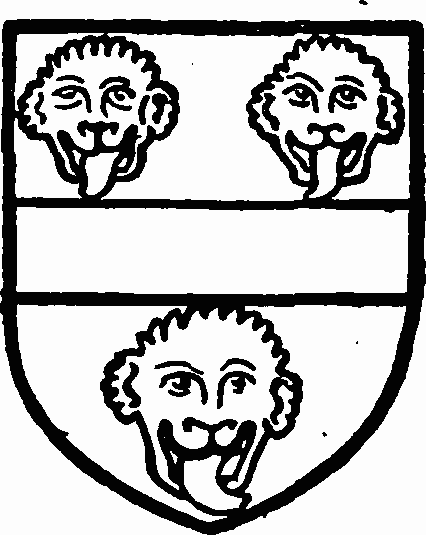
Dela Pole Azure a fesse between three leopards' heads or.
Between 1582 and 1588 leases of the manor were made to Edward Cary, William Tipper, and others, (fn. 45) and in 1617 the mastership of Ewelme was granted by James I to augment the stipend of the Regius Professor of Medicine in the University of Oxford, and has since been attached to that professorship. (fn. 46) Marsh Manor has thus remained in the possession of the trustees of the Ewelme almshouses, who act as a corporate body as lords of the manor, which they have been in the habit of leasing. (fn. 47)
A second manor in Marsh Gibbon parish is known as WESTBURY MANOR, and represents the 4-hide manor which William Fitz Ansculf held here in 1086. (fn. 48) As the manor was a parcel of the barony of Dudley (fn. 49) the overlordship followed the descent of the manor of Newport Pagnell (fn. 50) (q.v.). In 1626, when last mention of the overlordship has been found, Westbury Manor was said to be held of the manor of North Marston. (fn. 51)
Ailric had held Marsh Manor (fn. 52) in the reign of Edward the Confessor, and when dispossessed by William Fitz Ansculf remained as under-tenant in heaviness and misery (graviter et miserabiliter). (fn. 53) He was succeeded at some time in the following century by a family of Gibbewin or Gibevin, of whom the earliest known member, Ralph Gibbewin, was living in 1166. (fn. 54)
In 1213 Geoffrey son of Ralph Gibbewin is found disputing with John de Montague, who claimed the advowson of Marsh Church. Geoffrey Gibbewin then claimed that his land in Marsh belonged to the barony of Dudley, and that the chancel and the greater part of the church stood within that fee. (fn. 55) He further said that in the reign of Henry II Gervase Paynel had brought a suit against Ralph Gibbewin, his father, and had then released the advowson to him. During this suit, which lasted eleven years, Richard father of John de Montague had made no claim to the advowson. (fn. 56) Geoffrey Gibbewin did not substantiate his claim to the advowson, but certainly continued to hold his manor. He was justiciar under Henry III, (fn. 57) his death taking place previous to 1236, when Robert Lisle (de Insula) and Robert son of Brian are stated to be his heirs in a plea against the Abbot of Oseney concerning lands in Marsh. (fn. 58) Probably Geoffrey left two daughters as co-heirs. A year or two later Giles Lisle had succeeded Robert Lisle, and held this fee with Robert Brian. (fn. 59) Two tenants with these names held 4 hides (the Domesday assessment) in 1254–5. (fn. 60) Robert Brian, probably a successor of Robert Brian of 1236, is mentioned in 1278–9, (fn. 61) while his widow Jolenta held this manor together with Giles Lisle (who must also be considered a successor to the earlier Giles) in 1284–6. (fn. 62) Jolenta Brian had been followed by Robert Brian in 1302–3, who held with Giles Lisle. (fn. 63) In 1308 Peter Brian transferred 6 virgates of land, 14 acres of meadow, and 6s. 11d. rent in 'Mershe Gybbewine' to John de Grenstede, parson of Bledlow, and William his brother, (fn. 64) while Giles Lisle alienated his share, here given as fifteen messuages, 8 virgates, and 12s. rent, to Richard Damory and Margaret his wife in 1313. (fn. 65)
In 1316 Richard Damory and William Mersh (possibly the William of the enfeoffment of 1308 by Peter Brian) are returned as joint owners. (fn. 66) The following year Richard Damory obtained a grant of free warren here. (fn. 67) William de Bledlow, representing the Brian portion of this estate, is found holding in 1323. (fn. 68) Richard Damory died seised of land here in 1330, (fn. 69) which was still held by his widow Margaret in 1346, (fn. 70) at which date William de Westbury held the other portion of this manor. (fn. 71) Nothing more has been found concerning the Damorys in this parish, and the name of Westbury, later attached to this manor, shows that it was the Brian share which persisted. Its history during the following century it has not been found possible to trace, but it appears to have formed part of the original endowment of the Mystery or Company of Cooks which was incorporated by charter of Edward IV in 1482. (fn. 72) It was retained by the company until 1529, in which year they sold it to Robert Dormer. (fn. 73) He shortly after enfeoffed William Howel, who by his will, made 31 November 1557 and proved 20 October 1558, left Westbury Manor to John Howel, his eldest son, with remainder to Henry Howel, a younger son. (fn. 74) John Howel died in 1575, whereupon the masters of the Cooks Company trumped up an 'odious suit,' to the effect that the original sale to Robert Dormer had been void because the corporation was misnamed in the indenture. They accordingly put in a tenant of their own, Edmund Croft, against whom Henry Howel brought an action for ejectment. (fn. 75) Henry Howel won his case, and is found making a settlement of Westbury Manor in 1587. (fn. 76) He survived until 1625, when his son Edward, aged forty years and more, is given as heir, though the widow Margaret was to hold Westbury for her life. (fn. 77) She died before 1638, when Edward Howel alienated the property to Richard Francis. (fn. 78) He died in 1659, (fn. 79) his widow Elizabeth surviving him two years. She left legacies to the children of her son William Francis by his first wife Martha, Richard, another son, receiving Westbury Manor. (fn. 80) By his will, dated 18 December 1665, Richard left the manor to his nephew Thomas, son of William Francis. (fn. 81) Thomas Francis held the manor in 1670 (fn. 82) and died in 1698. His widow Anna Maria Francis conveyed Westbury in 1701 to John Townsend and his heirs. (fn. 83) John Townsend settled the property in 1709 (fn. 84) and died in 1714, (fn. 85) and his descendant Mary Townsend, later wife of William Guy, (fn. 86) carried on a lawsuit some years after with the trustees of the Ewelme almshouses, who owned the other manor in this parish. As lady of Westbury Manor she claimed the whole waste and cottages within the larger manor. (fn. 87) The litigation extended over the years 1743–7, but her name and that of her husband William Guy are found as late as 1765 in documents recording settlements of the manor. (fn. 88) At this latter date their son Townsend Guy (fn. 89) is referred to, but the manor was sold in 1777 to John Dixon. (fn. 90) It was subsequently in the possession of George Hitchcock, from whom it passed to Richard Ivens. He claimed to be lord of the reputed manor of Westbury in 1841, (fn. 91) and was still in possession in 1862. (fn. 92) In 1883 it was purchased by Mr. Thomas H. Phipps, in whose family it remains.
Church
The church of ST. MARY THE VIRGIN consists of a chancel measuring internally 28 ft. 6 in. by 18 ft., south vestry, nave 50 ft. by 18 ft., north and south transepts each 16 ft. square, north aisle 10 ft. wide, south aisle 6 ft. wide, south porch, and west tower 12 ft. square. It is built of stone rubble.
An aisleless cruciform church, probably without any tower, was built here in the middle of the 13th century. A south aisle was added at the end of that century, and a western tower some twenty years later, while the south porch was built in the 15th century. In the early part of the succeeding century a clearstory was added to the nave, which at the same time was reroofed, and many of the details of the church were renewed. In 1860 the chancel was repaired, and in 1880 the north aisle was added, the tower rebuilt, and the church generally restored.
The chancel has three lancets in each lateral wall, only some internal jamb stones of which are original, and there are three modern lancets in the east wall. A tomb recess on the north contains a late 13thcentury coffin-lid, on which is carved an elaborate foliated cross. The pointed chancel arch of two orders is modern.
The eastern part of the nave opens to the transepts by 13th-century pointed arches, which have semioctagonal responds with foliated capitals of refined design; the eastern capital on the north is further enriched with carved human heads, but both this and the corresponding capital on the south have been partially cut into for the fixing of a later rood-loft, the upper doorway of which remains on the south side, with a small blocked window above it. West of the transept arches are arcades opening to the aisles; that on the south, of two pointed arches supported by an octagonal pillar and responds with moulded capitals and bases, dates from about 1300, and the north arcade is a modern copy of it. The tower arch is modern, but some 14th-century stones have been rebuilt in the responds. The clearstory has two 16thcentury windows on the south, each of two plain lights under a square head, and two modern windows on the north. The open timber roof over the nave dates from about 1510, though it has been considerably repaired; its moulded trusses are supported on stone corbels, two of which are plain: one has a carved grotesque figure and the others figures of angels holding shields or scrolls.
The north transept is lighted from the north by two original lancets, which have moulded labels with internal foliated stops, and from the east by a window of three cinquefoiled lights inserted in the 15th century. On the east wall are three plain brackets and two pointed piscinae, the latter evidently marking the positions of two mediaeval altars which stood against the east wall, each having a piscina on the south side. The south transept communicates with the south aisle by a pointed arch, which is probably contemporary with the aisle, and in the south wall is a fivelight traceried window of about 1500; a round-headed piscina with a quatrefoil bowl and a double locker in the south wall are probably of this latter period. Both transepts are supported at their external angles by 15th-century diagonal buttresses, and have open timber roofs of the same period and character as that over the nave.
There are two windows in the south aisle, the eastern, of three plain lights under a square head, dating from the 16th century, and the other, of two trefoiled ogee lights with tracery under a square head, dating from about 1350. The south doorway, which has a four-centred head, is of the 15th century, but has been considerably restored. The south porch is lighted by a small window in each lateral wall, both of which are very much restored, and is entered through an original four-centred arch with restored responds. Rebuilt in the walls of the modern north aisle are a 13th-century lancet, similar to those in the north transept, and two 16th-century windows, each of three plain lights under a square head.
The tower is of two stages, with an embattled parapet and corner pinnacles, and western diagonal buttresses; the old material has been re-used in its rebuilding, but the details have been much restored. The ground stage has a west doorway with a pointed arch in a square head, and a three-light window above, both dating from the 15th century, though restored; the bell-chamber is lighted from the north by a pointed window of two trefoiled lights of about 1400, and from the other sides by square-headed two-light windows dating from the 15th century.
On the east wall of the south transept is a monument to the Rev. John Dod, B.D., rector of the parish (d. 1698). There is a 17th-century carved oak chair in the chancel, and a communion table in the vestry is probably of the same period, while incorporated in the seating of the nave are several early 17th-century oak pews. The base and lower part of the octagonal shaft of a 15th-century churchyard cross stand near the south porch.
The tower contains a ring of five bells and a small bell: the treble is by W. Taylor of Oxford, 1848; the second, third and fourth are all by Richard Chandler, 1678, and the tenor is by J. Warner & Sons of London, 1854. The small bell, inscribed 'H. K.,' is doubtless by Henry Knight, cast probably in the early 17th century.
The communion plate includes a cup and cover paten with the London hall-marks for 1674, and both inscribed 'Marsh-Gibbons Bucks. 1675'; a large paten of 1720, given by Robert Clavering, S.T.P.; and a plated flagon.
The registers begin in 1577.
Advowson
The early history of the church of Marsh Gibbon is closely connected with the two manors, the lords of both of which claimed the advowson. It was eventually acknowledged to belong to the Abbot of Grestein, and is later found attached to his cell at Wilmington, the advowson being repeatedly in the king's hands on account of war with France. (fn. 93) On the grant of the manor to Ewelme in 1442 the advowson of the church was specially exempted, (fn. 94) and continued to remain with the de la Pole family until the attainder of Edmund de la Pole in January 1503–4. Charles Brandon Duke of Suffolk presented Andrew Leason in 1533, (fn. 95) but the advowson was then resumed by the Crown, with whom the patronage remained (fn. 96) until 1853, when it was transferred to the Bishop of Oxford, (fn. 97) by whom it is now exercised.
In 1291 the church of Marsh Gibbon was assessed at £16, (fn. 98) and at the Dissolution the rectory was worth £22. (fn. 99)
At various times the right of presentation was granted for one turn. Thus in 1546 Lord Russell obtained a turn (fn. 100); Richard Hampden in 1689 (fn. 101) and the Earl of Nottingham in 1691 (fn. 102) received similar grants.
In 1660 Matthew Bate, brother of the king's physician, and Josiah Howe, who claimed that he and his brothers 'were all eminent sufferers in His Majesty's service,' both petitioned for the living on the death of Dr. Evans, (fn. 103) but were put on one side in favour of Dr. Say. (fn. 104)
Among the rectors of Marsh Gibbon may be noted Robert Clavering (1671–1747), later Bishop of Peterborough, who was made rector in 1719, and James Douglas Lord Douglas, who was appointed exactly 100 years later. (fn. 105)
Charities
Unknown Donor's Charity.—This charity consists of 5 a. at Piddington, Oxfordshire, held on a lease for 2,000 years, created in 1628, the rents whereof are applicable for the benefit of aged and infirm poor or in apprenticing. The land is let at £10 a year, which is applied in the maintenance of a poor apprentice.
The poor's allotment, or Tender Land, containing 10 a., was acquired in 1841 under the Inclosure Act. The rent is annually distributed in coal.
Under the same Act 5 a. were set apart as a recreation ground, which is under the control of the Parish Council.
The Church of England school is endowed with a rent-charge of £12 14s. by Sophia Shepherd, by deed dated 16 August 1847. The same donor, by deed dated 6 September 1847, gave a sum of £742 14s. 1d. consols, the annual dividends, amounting to £18 11s. 4d., to be applied for the support of the same school. The stock is held by the official trustees.