A History of the County of Buckingham: Volume 4. Originally published by Victoria County History, London, 1927.
This free content was digitised by double rekeying. All rights reserved.
'Parishes : Westbury', in A History of the County of Buckingham: Volume 4, ed. William Page (London, 1927), British History Online https://www.british-history.ac.uk/vch/bucks/vol4/pp263-267 [accessed 9 May 2025].
'Parishes : Westbury', in A History of the County of Buckingham: Volume 4. Edited by William Page (London, 1927), British History Online, accessed May 9, 2025, https://www.british-history.ac.uk/vch/bucks/vol4/pp263-267.
"Parishes : Westbury". A History of the County of Buckingham: Volume 4. Ed. William Page (London, 1927), British History Online. Web. 9 May 2025. https://www.british-history.ac.uk/vch/bucks/vol4/pp263-267.
In this section
WESTBURY
Westberie (xi cent.); Westbir' (xii cent.).
Westbury is a parish with a large detached portion, amounting to 1,148 acres, separated from it by Shalstone and Biddlesden. The part round the church covers 1,381 acres, of which 654 are arable, 588 permanent grass, and 20 woods and plantations, (fn. 1) Westbury Wild in the north of the parish being the only wood of any size. The soil and subsoil are mixed, clay, loam and gravel, and a good building stone is found here. The slope of the land is from north to south and varies from 425 ft. to 313 ft. above ordnance datum. In the neighbourhood of the Ouse, which forms the southern boundary, the land is liable to flood.
The small village, which is situated in the southwest of the parish, contains several 17th-century stone cottages with thatched roofs. The modern manorhouse is occupied by Sir Samuel Scott, bart. Southwest of the manor-house is the parish church of St. Augustine standing on low ground and nearly hidden by surrounding trees. Near the church is the vicarage, a 17th-century stone house of two stories with modern brick additions. It was probably built in 1661, the date on a stone reset in the modern work, and retains on the north two original woodmullioned windows. Westbury has a village green on which stands a remarkably fine elm. (fn. 2)
Fulwell and Westbury station, on the Banbury branch of the London and North-Western railway, is in this parish.
Westbury was inclosed by Act of Parliament in 1764, (fn. 3) and the detached part was in 1884 transferred to Biddlesden for civil purposes. (fn. 4)
Among place-names occur Waterslede, Corhale and Midelcherweie in the early 13th century, (fn. 5) and meadow called Winstonslake in the 16th century. (fn. 6)
Manor
Alnod Cilt, a thegn, held WESTBURY MANOR in the Confessor's reign, (fn. 7) being dispossessed at the Conquest when Westbury was granted to the Bishop of Bayeux. (fn. 8) Roger, the tenant in 1086, was probably Roger de Ivri, (fn. 9) for after the confiscation of the Bishop of Bayeux's fief, and the erection of the holdings of his chief tenants into baronies, (fn. 10) Westbury was attached to the honour of St. Walery, into which Roger de Ivri's lands were absorbed. (fn. 11)
Thomas de St. Walery is mentioned as connected with Westbury in 1196, (fn. 12) and Gunnora de St. Walery in 1198. (fn. 13) The St. Walery Honour was later held by the Earls of Cornwall, and between 1240 and 1335 Westbury Manor is said to be held of the earls as of this honour. (fn. 14) After the latter date the St. Walery Honour, as far as this manor is concerned, appears to have become merged in the larger honour of Wallingford. (fn. 15) A view for the honour of Wallingford was held at Westbury, Court Rolls being preserved at the Record Office dating from the 15th century. In 1422 a 'certain rent' of 13s. 4d. was paid by the tithing men of Westbury to the honour.
Westbury was subinfeudated to a family which took its name from the parish. Walter de Westbury held here before 1198 (fn. 16) and was succeeded by his son, William de Westbury, (fn. 17) some time before 1203. In the latter year William conveyed to Ralph Hareng all his land in Westbury, including that held in dower by Eleanor de Westbury, his mother. (fn. 18) Seven years later a carucate of land and other appurtenances which William de Fraxino (le Freyne) and Philippa his wife held of William de Westbury were settled by the latter on Ralph Hareng. (fn. 19) In 1218 he received licence to impark his wood of Westbury towards the abbey of Biddlesden. (fn. 20) His death took place before 1230, in which year Ralph Hareng, his son, paid 50 marks for renewing his father's charter to impark. (fn. 21) Ralph Hareng, jun., was returned as holding the vill a few years later, (fn. 22) while his mother Isabella (fn. 23) held Westbury in dower in 1254–5. (fn. 24) Within the next twenty years a partition of Westbury took place between this family and Simon de St. Lys; the method of acquisition, whether by descent or alienation, has not been discovered. The history of Radclive, however, which runs parallel to that of Westbury, rather points to the former method, for in Radclive (q.v.) Simon de St. Lys is found holding simultaneously with Isabella Hareng.
In 1278–9 Joan de Somery, whose connexion with the Hareng family has not been established, was returned as lady of Westbury. Her property included 2 hides, half a virgate of land, 10 acres of wood and 4 acres of park, of which she held one hide in demesne. (fn. 25) Before 1284 she had been succeeded by Edmund de Salenewe, Aula Nova or Newhall, as the name alternatively appears. (fn. 26) Edmund was still holding in 1302, when he acquired licence to demise his manor for eight years. (fn. 27) Beatrice his widow was assessed for Westbury in 1316, (fn. 28) and two years later obtained licence to demise the manor for a period of twelve years. (fn. 29) In 1330 John de Newhall, possibly her son, transferred 'two parts of the manor' of Westbury to Ewald Lestrange or Strange, (fn. 30) who died seised in 1335. (fn. 31) His heir was his kinsman, Roger Strange of Knockin, (fn. 32) but his widow Alice, subsequently married to Hugh le Freyne, held Westbury in dower. (fn. 33) In 1373 Roger Strange of Knockin, son of the above Roger, (fn. 34) granted Westbury Manor to John, son of John Strange of Walton, co. Warwick (perhaps representing a branch of the family), and Mabel his wife and their issue. (fn. 35) In 1396 the said John Strange again alienated the manor to another member of the family, Alan Strange, with whose name in the alienation appears that of Margaret his wife, daughter of John Wyard. (fn. 36) A remainder settlement here gives the names of Michael, Thomas, John and Baldwin Strange, brothers of Alan Strange, and Philippa and Ida his sisters. (fn. 37) Alan Strange died in 1417, but no mention is made of the manor in the inquisition then taken, though he was said to hold by knight service of the honour of Wallingford 2s. annual rent from a messuage and carucate of land held by John Hardwick in Westbury. (fn. 38) His heir was stated to be his daughter Eleanor, then aged twelve and more, (fn. 39) but Westbury appears to have continued in the male line of the Strange family, for in 1485 Thomas Strange died seised of this estate. (fn. 40) His heirs were his daughters Anne and Margaret, aged nine and six respectively. (fn. 41) Westbury was assigned to Anne, who carried it in marriage to John Strange of Little Massingham, Norfolk. (fn. 42) After his death in 1514 (fn. 43) she married Sir Edward Knyvett, and, left again a widow in 1528, (fn. 44) joined in 1540 with Barbara, wife of Robert Mordaunt, and her daughter and heir by her first husband, in making a settlement of the manor (fn. 45) on Robert and Barbara Mordaunt and their heirs. In pursuance of this settlement Westbury passed to their son, Robert Mordaunt, who died in possession in 1602. (fn. 46) Lestrange Mordaunt, son of his brother Henry, was his heir, (fn. 47) and he in 1621 alienated the manor to Laurence Washington, (fn. 48) who had succeeded his father Laurence Washington in 1619. (fn. 49) He held until 1639, when he conveyed it to Sir Thomas Littleton, bart., (fn. 50) whose estate in Westbury was assessed at £300 in 1647 as that of a delinquent. (fn. 51) His son and heir, Sir Henry Littleton, with his widow Catherine, (fn. 52) transferred it in 1650 to Roger Price, sen., and Roger Price, jun. (fn. 53) Roger Price, sen., died in Spain in 1677, (fn. 54) and Roger Price, jun., Sheriff of Buckinghamshire in 1680, (fn. 55) obtained an Act in 1689 empowering him to make a settlement of Westbury Manor on his wife Elizabeth, and a like settlement on his brothers George, Thomas, Ingham and Joseph, in respect of their wives. (fn. 56) Roger Price died in 1694 (fn. 57) and was survived by his widow Elizabeth for some years, for in 1709, together with her son Thomas, she made a settlement of Westbury Manor. (fn. 58) Thomas Price died in 1733, (fn. 59) and the following year Campbell Price, his son, (fn. 60) suffered a recovery of the manor. (fn. 61) It was probably his daughter and heir who brought Westbury by marriage into the Withers family, (fn. 62) of whom Benjamin Price Withers presented to the church in 1753, (fn. 63) and by his will dated 1771 settled Westbury Manor on his descendants for ever. (fn. 64) One of the same name held the manor in 1789 (fn. 65) and also exercised patronage in Westbury in 1814. (fn. 66) The Price Withers family died out at the beginning of the 19th century. The family of Gurden of Brackley, which succeeded, took the name of Withers, owing to the last Withers being godfather to the heir of the Gurdens. (fn. 67) Westbury was retained by them until 1854, when it passed by purchase to the Hon. Percy Barrington, (fn. 68) who succeeded his brother as Viscount Barrington in 1886. After his death in 1901 it was purchased by Sir Samuel Scott, bart., the present owner.
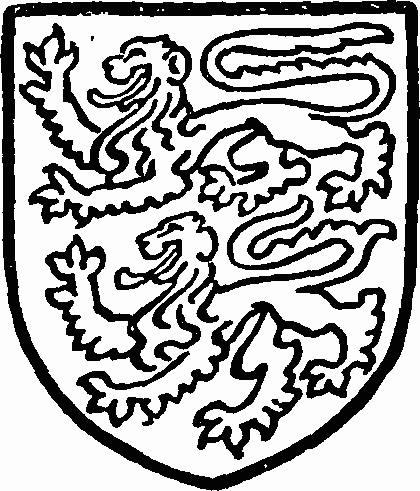
Strange. Gules two lions passant argent.
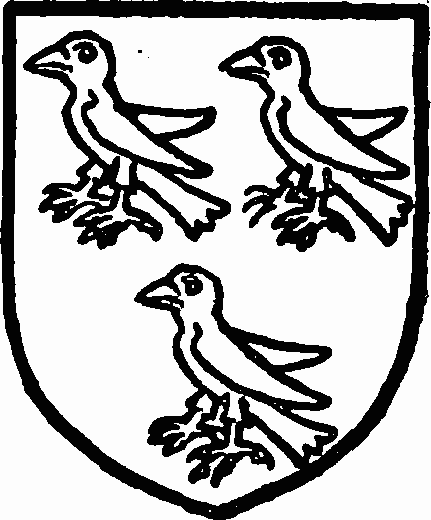
Price of Westbury. Argent three Cornish choughs.
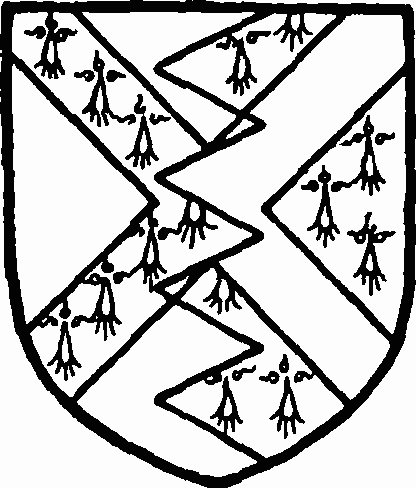
Scott, baronet. Party indented argent and pean a saltire countercoloured.
In 1302–3 Simon de Grenehulle was said to hold 'the manor of Westbury' for one fee, (fn. 69) and in 1346 William de Cauntelow held two parts of this fee of the honour of Wallingford, Rose widow of Simon de St. Lys holding the third part. (fn. 70) No further mention of this fee has been found.
The family of St. Lys, as above stated, had an important holding of the St. Walery Honour in Westbury during the 13th century. (fn. 71) First mention is found of them in Westbury c. 1260, when Simon de St. Lys of Radclive made a grant of lands in Westbury which was witnessed by Jordan de St. Lys of Westbury. (fn. 72) In 1274 Simon de St. Lys recovered seisin of 7 acres of wood here. (fn. 73) Five years later the same Simon was said to own in this parish 2 virgates in demesne, 10 acres of wood, and 4 of park. He had also one virgate in villeinage and four cottagers. (fn. 74) The name of Simon de St. Lys appears under Westbury in the feudal assessment of 1284–6. (fn. 75) He died in 1288, leaving a widow Isabel and a son, Andrew, then a minor, (fn. 76) who in 1301 (fn. 77) and 1316 (fn. 78) held of the Earl of Cornwall here by knight service. He was contemporaneous with Agnes widow of Roger de St. Lys, who claimed dower in Westbury in 1327, (fn. 79) and was succeeded by Ralph de St. Lys, (fn. 80) who conveyed his fee to Ewald Strange, lord of the manor, (fn. 81) whose history it henceforth shares.
Part of the Hareng property in Westbury appears to have come to the Chastillon family, who certainly succeeded to the Hareng lands in Thornton (q.v.) with which their estate in Westbury descended. Mentioned in their possession in 1279, (fn. 82) it was described as the park of Westbury in the following year, (fn. 83) and was specified in 1440 as 60 acres of wood and the park. (fn. 84) These distinctions probably corresponded to the Royes and Makeloms Parks of twenty years later (fn. 85) which may perpetuate the names of Rose (Royse) Chastillon and her son Malcolm (Malculmus, Masculinus), the 13th and 14th-century owners. They were still attached to the Thornton estate (q.v.) in the early 17th century as lands and woods in Westbury. (fn. 86)
One mill is mentioned in Westbury at Domesday. (fn. 87) It was known in the 13th century as Hunt Mill. (fn. 88) It remained attached to the honour of Wallingford (fn. 89) though separated from the manor, and in the 15th century is found in the ownership of the lords of Shalstone Manor. Philip Purefoy died seised in 1468, (fn. 90) and further mention of it in this family occurs during the two following centuries. (fn. 91) Hunts Mill still stands at the south-eastern corner of the parish.
Mention is found of a second water-mill in Westbury in the 17th century. In 1608 Thomas Slye died seised of various hereditaments in Westbury, (fn. 92) which, on the death of his son William in 1615, were described as a water-mill and lands held of Sir Lestrange Mordaunt bart. as of his manor of Westbury by a rent of 13½d., 2 lb. of wax, and a pair of spurs. (fn. 93) This mill is probably to be identified with one standing on the Ouse at the west end of the village at the present day. (fn. 94)
In addition to Elstow no fewer than seven religious houses held land in this parish in the 13th century and earlier. The master of St. Thomas Acon held land here as in Buckingham (q.v.). (fn. 95) Its extent was said to be in 1278 10 acres of assart not hidated. (fn. 96) At the Dissolution two closes of wood called Heremytes Grove or Heremytes Fields in Westbury, containing 28 acres, occupied by John Lambert, lately belonging to St. Thomas Acon, were granted for life to John Josselyn. (fn. 97) In 1543 Richard Andrews of Hayles, Gloucestershire, obtained the reversion in fee of this grant, (fn. 98) which was confirmed to him, two years later. (fn. 99) Biddlesden Abbey acquired lands in this parish early in the 13th century from a family of Lega, of whom Thomas and John sons of Richard de Lega and Susanna their mother made various grants, confirmed by their overlords Ralph Hareng and his son Ralph. (fn. 100) After the Dissolution these lands appear to have been acquired by the Temple family, who were also lords of Stowe (q.v.). Described in 1603 as 'lands' held of the manor of East Greenwich, (fn. 101) and in 1638 as lands and view of frankpledge extending into Westbury, late of Biddlesden, (fn. 102) this property is in the 18th and 19th centuries erroneously called a manor. (fn. 103) The hospital of St. John of Brackley in 1278–9 owned a virgate of land in Westbury for which the master rendered a yearly rent of one pound of cummin. (fn. 104) This holding was augmented in 1301, when John le Poer obtained licence to alienate to the hospital a messuage and 35 acres of land and the moiety of an acre of meadow. (fn. 105) Roger and Walter Hardel likewise made a grant in 1336. (fn. 106)
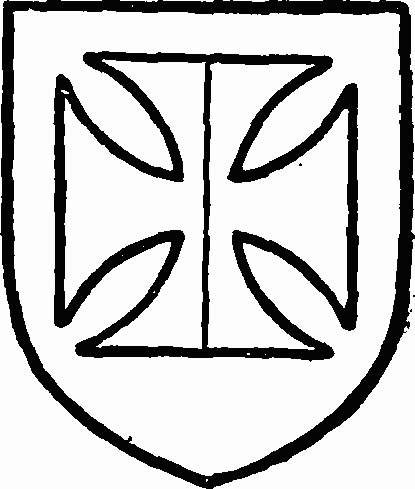
St. Thomas Acon. Sable a cross formy party argent and gules.
The Prioress of Catesby, Northants, owned land in Westbury of which mention is first found in 1278–9, when it was assessed at one carucate of assart and 3 acres of wood. (fn. 107) In 1309 this property was referred to as a manor in an action for waste brought by the prioress against the lessees. (fn. 108) In 1363 she received pardon for acquiring in mortmain from Richard Chastillon of Leckhampstead 18s. rent here. (fn. 109) At the Dissolution the priory owned rents in Westbury valued at £4 14s., (fn. 110) and these were leased in 1537 to John Giffard. (fn. 111) In 1278–9 Hogshaw Preceptory owned a virgate of land and a water-mill, for which Jordan Bastard paid a yearly rent of 30s. (fn. 112)
Luffield Abbey had an early grant of lands in Westbury (fn. 113) which were valued in 1291 at 3s. (fn. 114) They are mentioned in 1512, when they were leased to William Tyler for thirty-four years. (fn. 115) It seems likely that this estate is represented by the view attached to the manor of Luffield and extending into Westbury in 1701. (fn. 116) In 1267 an early charter of Robert Doyley to St. George's Chapel, Oxford, was exemplified in favour of the Abbot and canons of Oseney. (fn. 117) It contains mention of land in Westbury which was held by Oseney till the Dissolution, when, described as a messuage and 16 acres of land, it was said to be worth 7s. (fn. 118) It was granted in 1541 to John Wellesbourne, who also obtained the advowson. (fn. 119)
Church
The church of ST. AUGUSTINE consists of a chancel measuring internally 30 ft. by 17 ft., south vestry and organ chamber, nave 40 ft. by 20 ft. 6 in., north aisle 6 ft. wide, south aisle 7 ft. wide, north porch, and west tower 8 ft. 6 in. square. It is built of rubble with stone dressings, and the roofs are covered with slate and tiles.
The church dates from the 12th century, and consisted then of the present nave and probably a small chancel. In the 13th century the chancel was rebuilt and widened towards the north, and the small tower, which projects some 4 ft. into the west end of the nave, was added. The south aisle was built at the end of the 13th century and the north aisle some twenty-five years later, though the latter was considerably repaired at a subsequent period. The fabric was restored in 1863, and the vestry and porch are modern.
The chancel is lighted by a modern traceried window in the east wall, an original lancet at the east end of each side wall and a 14th-century low-side window at the north-west, the last being of one trefoiled light with a transom, below which the light is blocked. All these windows have modern rear arches. At the west end of the south wall are a modern arch and doorway to the vestry and organchamber, and at the east end is a piscina with a cinquefoiled ogee head and modern bowl. The wide chancel arch, dating from the 13th century, is of two chamfered orders, the outer continuous down the jambs and the inner supported by semi-octagonal responds with moulded capitals. Above the capitals the arch has been rebuilt.
The nave is of three bays, and has a modern clearstory with circular cusped windows. Both arcades are of three pointed arches supported by octagonal pillars and responds with moulded capitals and bases. The south arcade dates from the end of the 13th century, and the capitals of its responds are embellished with nail-head ornament. The north arcade is of about 1320, though the mouldings of its capitals and bases seem to have been somewhat altered at a subsequent period. The pointed tower arch in the west wall of the nave is of a single order with an indented label, and dates from the early 13th century; the responds, which are formed of octagonal shafts with moulded capitals and bases, do not appear to be in their original position. There is a square-headed recess to the south of the chancel arch which probably formed the reredos of a nave altar, but its lower part is now built up. At the north-east of the nave is a small ogee-headed piscina of about 1400, without bowl. Both aisles have been extensively restored, and, with the exception of some old jamb stones re-used in the north aisle, the windows and doorways are modern. Several fragments of mediaeval wrought stones have been incorporated in the walling of the south aisle, among them a 15th-century carved head.
The tower, which has been considerably restored, is of three stages, and has a modern saddle-back roof. The windows of the ground stage and bell-chamber are modern, and the ringing chamber is lighted by small loops on the north and south.
The font and pulpit are modern. There are some fragments of old painted glass reset in the south window of the vestry, and on the floor of the chancel are several mediaeval encaustic tiles.
The tower contains a ring of three bells: the second is by Henry Bagley, 1711; the treble, which was also by Henry Bagley, 1711, but had become broken in two parts, was recast in 1898; the tenor, inscribed with seven letters in Gothic capitals, arranged independently, is of about 1600, and probably from the Bedford foundry.
The communion plate consists of a cup and cover paten of 1592 and a plated flagon and two patens of the 18th century. (fn. 120)
The registers begin in 1558.
Advowson
The church of Westbury, though not mentioned in the charter of confirmation of Henry II, (fn. 121) appears to have been early granted to Elstow Abbey, which some time previous to 1225 had instituted a perpetual vicarage there. (fn. 122) In 1278 the endowment of the church included 2 virgates of land and a 'cottage,' for which the abbess paid 20s. yearly. (fn. 123) In 1291 the abbess was assessed there for rents and heriots worth £1 9s. 6d. (fn. 124) At the Dissolution the rectory was worth 100s. (fn. 125) and the vicarage £10. (fn. 126) The rectory and advowson were granted in 1541 to John Wellesbourne, (fn. 127) who died in 1548. (fn. 128) His son and heir John Wellesbourne with Anne his wife made a settlement in 1594 on John Sill, (fn. 129) who had married their daughter Elizabeth Wellesbourne. (fn. 130) John Sill predeceased John Wellesbourne, who died in 1611, when Elizabeth, then the wife of Edward Mole, inherited the advowson and rectory of Westbury. (fn. 131) Her son Wellesbourne Sill united with herself and husband to make a settlement in 1632. (fn. 132) He died in the spring of 1634 leaving his widow Philippa and his son Wellesbourne, then aged sixteen, to survive him. (fn. 133) In 1660 Wellesbourne Sill alienated both rectory and advowson to Roger Price, (fn. 134) then lord of Westbury Manor. He and his family built the vicarage house c. 1661 and also augmented the vicarage with the great tithes. (fn. 135) The advowson has since been retained by the lords of the manor, (fn. 136) and is at present the property of Sir Samuel Scott, bart.
In 1328 Andrew de St. Lys obtained licence to alienate land in Westbury in mortmain to a chaplain to celebrate in St. Mary's chapel, Radclive. (fn. 137)
Nathaniel Markwick, the divine, was vicar of Westbury 1692–4. (fn. 138)
Charities
The Poor's Allotment, acquired in 1764, on the inclosure of the parish, contains 21 a. 1 r. 37 p., producing £12 a year, which is applied in the distribution of small sums of money.
The church allotment, also allotted under the same Act in lieu of lands in the common fields belonging to the church, consists of 5 a. 1 r. 27 p., let at about £6 a year, which is carried to the churchwardens' general account.