A History of the County of Buckingham: Volume 4. Originally published by Victoria County History, London, 1927.
This free content was digitised by double rekeying. All rights reserved.
'Parishes : Bradwell', in A History of the County of Buckingham: Volume 4, ed. William Page (London, 1927), British History Online https://www.british-history.ac.uk/vch/bucks/vol4/pp283-288 [accessed 30 April 2025].
'Parishes : Bradwell', in A History of the County of Buckingham: Volume 4. Edited by William Page (London, 1927), British History Online, accessed April 30, 2025, https://www.british-history.ac.uk/vch/bucks/vol4/pp283-288.
"Parishes : Bradwell". A History of the County of Buckingham: Volume 4. Ed. William Page (London, 1927), British History Online. Web. 30 April 2025. https://www.british-history.ac.uk/vch/bucks/vol4/pp283-288.
In this section
BRADWELL
Bradewelle (xi cent.).
This parish covers 917 acres, which are devoted to agriculture, with the exception of about one-sixth. (fn. 1) The soil is light clay, the subsoil clay and stone, the chief crops being wheat, oats, barley and beans. The ground falls from about 300 ft. above the ordnance datum in the south and east to about 200 ft. in the north, the land along the Ouse banks being liable to floods.
In the south-west of the parish is the scattered village of Old Bradwell, thus called to distinguish it from the modern red brick railway settlement to the north. The church of St. Lawrence lies at the southern end of Old Bradwell, with the Manor Farm a little to the north. At a short distance to the north-west is the Moat House, (fn. 2) formerly the ancient manor-house. The vicarage stands about 300 yards from the church, on a road which leads past the Methodist chapel and Bradwell House (now in the occupation of Mrs. Bellairs-Harries) to the school erected in 1891 by the London and North Western Railway Company.
New Bradwell, though annexed to Stantonbury ecclesiastically, still forms part of the parish for civil purposes. It is chiefly inhabited by the men employed in the London and North Western railway works at Wolverton. The Wolverton and Newport Pagnell branch of this line, which separates this railway settlement from the rest of Bradwell, has a station here, opened in 1867, while at its south-western end the parish is traversed by the main line. The Grand Junction Canal passes through the parish on the north. The church which was erected for New Bradwell and Stantonbury either lost or omitted to obtain the necessary 'instrument' for transferring the rights and privileges of St. Peter's, Stantonbury, to St. James's, and a special Act of Parliament had to be passed in 1909 for this purpose and to legalize 1,000 marriages which had been celebrated there. New Bradwell possesses also a Primitive Methodist chapel in Thompson Street, a Baptist chapel in North Street, a Gospel hall in Caledonian Road, a school, and gasworks, the property of the railway company. The church and school were opened in 1860. At Corner Pin, the extreme north-western corner of New Bradwell, an interesting find of bronze implements was made in 1879, on a site now occupied by the County Arms Hotel. (fn. 3)
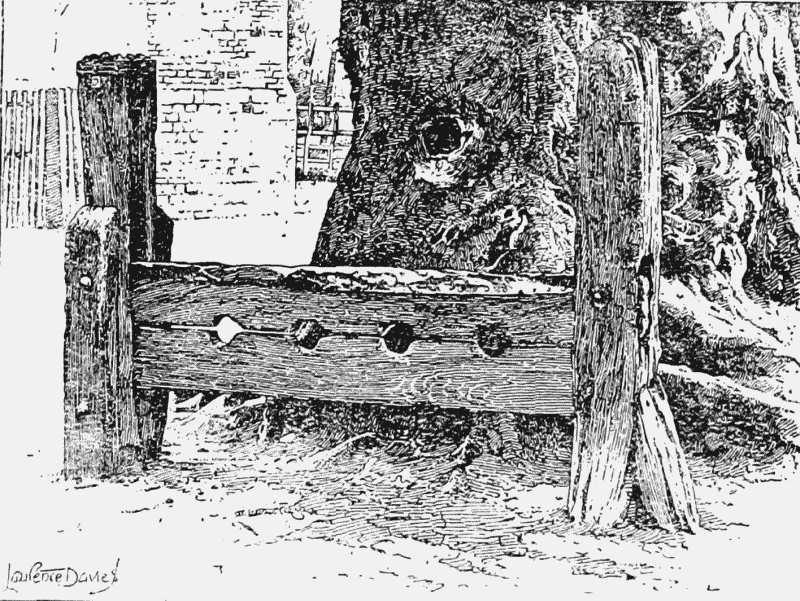
The Stocks, Bradwell (now removed)
To the north-east of the village are the remains of the earthworks of a small mount and bailey castle, of the history of which nothing is known. It may have been thrown up by a member of the baronial family of Bayeux, who held one of the manors in Bradwell, at the time of the 'anarchy' of Stephen's reign. The castle never had any masonry defences, and its earthworks are now becoming indistinct.
Separated from Bradwell by the railway main line is Bradwell Priory, formerly extra-parochial, (fn. 4) but now a parish of 447 acres. It has a soil of cold clay, with subsoil stone and clay, the chief crops grown here being wheat, barley and beans. 'Bradwell Abbey,' a mansion built out of the ruins of the Benedictine monastery of St. Mary, now used as a farm-house, contains some wainscoted, spacious and lofty rooms. (fn. 5) There are remains of a moat and of the priory fishponds, and an avenue leads to the house, to the northeast of which the small chapel still survives, though now disused and converted into a lumber store for farm purposes. (fn. 6) A rental of the priory or manor of Bradwell of some date between 1524 and 1531 describes a considerable range of buildings, the houses of the inner court, the outer court, the gate-house, the hall (55 ft. by 24 ft.), the chamber called the King's Chamber, the prior's chamber, four low parlours, a dorter with five cells, chapter-house, cloisters, and 'a little chapel without the church which may not well be spared.' (fn. 7)
The chapel, referred to above, the only trace of the priory buildings left in the time of Browne Willis, (fn. 8) is a small rectangular building, measuring 17 ft. by 9 ft. 6 in., built of rubble partly coated with cement and roofed with tiles. The east wall probably dates from the 12th or 13th century, and has on the cast face a 14th-century semi-octagonal respond with a moulded capital, and the springers of an arch or arcade which formed part of the conventual buildings running eastward from this point, while a projection at the northern end of the wall probably indicates its original extension in that direction. The chapel built against this wall dates from the mid-14th century, and has in each of the north and south walls a square-headed window, now blocked, of two lights with tracery, and in the west wall a large threelight window with reticulated tracery in a pointed head. The low pointed doorway in the west wall has had a richly moulded head and jamb shafts, all of which are now considerably decayed. In the south wall is a blocked pointed doorway with continuous mouldings enriched with ball-flower ornament, and below the sill of the south window is an ogee-headed piscina, now without a bowl, while high in the wall at the southwest is a row of six quatrefoils which have perhaps been reset. Near the north end of the east wall is a large moulded niche with an ogee head, a label with grotesque stops, flanking pinnacles, and inclosing gable. The building has a semicircular plastered ceiling of the 17th century with paintings of that period now becoming indistinct.
Three hundred acres of land in Bradwell and Wolverton were inclosed by the Prior of Bradwell for pasture on 7 March 1506–7, (fn. 9) and 25 acres were inclosed, imparked and stocked for game by Sir John Longville in 1501, (fn. 10) probably at a subsequent date being occupied as park lands by the owners of the Abbey Manor. The parish was inclosed by an Act of Parliament of 1788; the award, dated 17 March 1789, is in the custody of the clerk of the peace. (fn. 11)
Among place-names have been found Stony Hill and Stubborn Hill Closes (fn. 12); Church Lane, Butler's Lane (fn. 13); Seklo Hill (Close) and Grange Farm (fn. 14) (xvi cent.); Lingard Pightle, Bear Close, Upper Monks Meadow, Ferries Farm (fn. 15) (xviii cent.).
Manors
Before the Conquest an estate of 1½ hides in BRADWELL was held by Alviet, a man of Queen Edith, who could sell. (fn. 16) By 1086 this had passed into the possession of Walter Giffard. (fn. 17) It was afterwards attached to the honour of Giffard, (fn. 18) rights over Bradwell being claimed both by the Earls of Gloucester (fn. 19) and their successors the Earls of Stafford (fn. 20) and Dukes of Buckingham, (fn. 21) and also by the Valences, Earls of Pembroke, (fn. 22) and their descendants, the Talbots, Earls of Shrewsbury, (fn. 23) their claims being acknowledged as late as 1460 (fn. 24) and 1614 (fn. 25) respectively.
There is no trace of any holder in fee of this estate after the Domesday tenant Walter Achet until the first quarter of the 13th century, when Peter Barre or Barry, under Alexander de Redham, owned the manorial rights. (fn. 26) In the subdivision of the Giffard honour, which took place in 1245, (fn. 27) the greater part of Bradwell fell to the Valences, Earls of Pembroke, under whom the Barrys continued to hold, and on the death of Simon Barry before 1318 his son Robert owed 20s. as relief to the Earl of Pembroke. (fn. 28) Philip Aylesbury, to whom Robert Barry appears to have transferred the manor, sued the earl for distraining his cattle at Sladefurlong, Bradwell, alleging that the relief had been paid. (fn. 29) This Philip Aylesbury, who was returned as lord in 1316, (fn. 30) may have been a son of the Walter Aylesbury by whom complaint was made in 1307 that certain persons had forcibly entered his house at Bradwell and carried away his goods. (fn. 31) The Aylesbury; held this fee, (fn. 32) described in 1418 as the manor of Bradwell near Moulsoe, (fn. 33) with their manors of Drayton Bcauchamp, Milton Keynes, and Broughton (q.v). After the death of Hugh Aylesbury in 1423 it must have passed with the two latter to the Staffords in spite of a quitclaim three years later to the Chaworths, their co-heirs, (fn. 34) since it continued to descend with Milton Keynes in the Stafford family (fn. 35) until 1571, when Sir Humphrey Stafford sold it to Michael Colles or Collys. (fn. 36) In 1603 Michael Colles, described as late of Elmdon (co. Warwick), Mary his wife, and Humphrey his eldest son and heir, sold the manor to Roger Fuller, then of Great Brickhill, for £1,400. (fn. 37) Its appurtenances in Bradwell and Stantonbury included six messuages, one of which, adjoining the churchyard, was called Parker's Place or the Over House. (fn. 38) Roger Fuller bequeathed the manor to his younger son John in tail-male, with remainder in default to another younger son Roger, and died on 8 December 1613. (fn. 39) In 1656 John Fuller settled the manor on his son Roger, (fn. 40) on his marriage with Anne Gilpin, (fn. 41) and they made a further settlement in 1668. (fn. 42) Roger Fuller held Bradwell till his death in May 1700, when he was succeeded by his son another Roger. (fn. 43) The latter appears to have died without issue sometime after 1707, leaving three sisters as his co-heirs: Elizabeth, married to Thomas Mercer of Hackleton, in the parish of Horton (co. Northampton), and Ann and Mary Fuller, (fn. 44) the two latter dying unmarried between 1732 and 1757. (fn. 45) They appear to have been described on a tombstone in the churchyard as ladies of the manor, (fn. 46) of which Browne Willis wrote that in 1757 the Mercers, heirs of their sister Elizabeth, were sole owners. (fn. 47) In 1776 (fn. 48) and 1783 (fn. 49) the manor was held by Thomas Mercer, probably a son or grandson of Thomas Mercer and of Elizabeth Fuller. In 1787 it was sold by Thomas Mercer and Sarah his wife to William Bailey, (fn. 50) lord of the manor at the passing of the Inclosure Act for the parish in the following year, (fn. 51) and still lord when Lysons wrote, circa 1813. (fn. 52) Before 1862 it had become the property of William Selby Lowndes of Whaddon, (fn. 53) and is still held by the Lowndes family with Whaddon (q.v.).
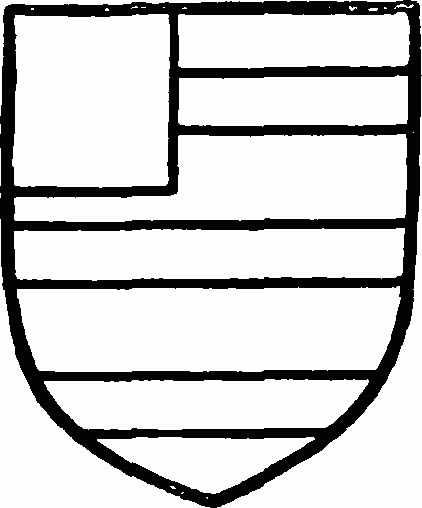
Fuller. Argent three bars and a quarter gules.
That part of the original manor which was annexed by the Earl of Gloucester was obtained in fee by a family of Bradwell, Hugh de Bradwell holding in 1386. (fn. 54) He had been replaced in 1392 by Thomas de Bradwell, (fn. 55) still holding in 1399 (fn. 56) and 1403. (fn. 57) In 1460 the heirs of Hugh de Bradwell were returned as lords of the fee. (fn. 58)
A manor of 2 hides and 3 virgates in BRADWELL, held before 1066 by two thegns, Sibi and Godwin, men of Alric son of Goding, who could sell, was entered in the Domesday Survey among the lands of Miles Crispin, (fn. 59) and, as part of the honour of Wallingford, (fn. 60) passed to the Earls of Cornwall, who held it in the late 13th (fn. 61) and early 14th centuries, (fn. 62) and from them to the Princes of Wales, Edward Prince of Wales (the Black Prince) dying seised of a fee in Bradwell in 1376. (fn. 63)
This manor was held in 1086 by a sub-tenant William, (fn. 64) and part of it was obtained later by the family of Bayeux (Baus, Bauis, Baiois, Because, Beuhuse). In a charter dating apparently 1151–4 William de Bayeux is referred to as lord of part of this estate. (fn. 65) William son of Hugh de Bayeux granted land in Bradwell, part of which was held of the honour of Newport, to the Prior of Tickford and others in 1199 (fn. 66) and 1202, (fn. 67) and, with the consent of Maud his wife and William his heir, granted other lands to Bradwell Priory. (fn. 68) Avis widow of William de Bayeux claimed land in Bradwell as dower in 1230, (fn. 69) and Aumary de Henton, who was responsible for the scutage in 1234, (fn. 70) may have been guardian of another William de Bayeux who paid this scutage in the following year. (fn. 71) He was perhaps identical with the William de Bayeux who made a grant of land in 1241, (fn. 72) and with the William de Bayeux described as heir of his grandfather Hugh in 1274. (fn. 73) In 1284 William de Bayeux, probably a son of the last William, was returned as holding 11 virgates of land in Bradwell under the Earl of Cornwall's sub-tenant, Hugh de Filleberd, (fn. 74) this intermediary lordship not being recorded, however, in 1302, when the holders in fee were described as the heirs of William de Bayeux. (fn. 75) By 1346 a small part of the holding had been obtained by the Prior of Tickford, William de Bayeux being in possession of the rest. (fn. 76) An order was issued in 1348 for the arrest and imprisonment in Bedford gaol of William de Bayeux of Bradwell, indicted for many homicides and felonies, (fn. 77) and no further record of the Bayeux family in Bradwell exists. This fee was held by John Kimble in 1379, (fn. 78) but cannot be further traced.
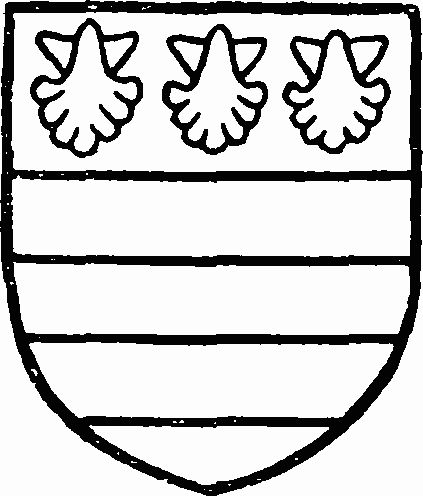
Bayeux. Gules two bars and in the chief three scallops argent.
The remainder of the Domesday manor of Miles Crispin was later acquired in fee by the Bradwell family, Robert de Bradwell exercising the manorial rights circa 1151–4. (fn. 79) He appears to have been succeeded by the Barry (Barre) family, a member of which, Ralph Barry, probably at the end of the 12th century, made a grant of land to Bradwell Priory which was witnessed by a William de Bayeux. (fn. 80) The relationship between the early members of this family is obscure. Gerard Barry held land in Bradwell in 1230, (fn. 81) and Peter Barry held about the same date under the honour of Giffard (see above). By 1284 the estate had come to Robert Barry, and was held under him by Hugh Barry, (fn. 82) who in 1297 complained that he had been assaulted by certain persons who had broken into and burnt his house at Bradwell. (fn. 83) The Barrys were lords of the neighbouring manor of Stantonbury (q.v.), with which this holding may have been amalgamated, for there is no trace of it after the early 14th century. (fn. 84)
Three virgates in Bradwell held before the Conquest by Alward, a man of Goding, who could sell, and later by William de Celsi, whom Ansculf, when sheriff, unjustly dispossessed of his property, according to the return made by the hundred in the Domesday Survey, were at that date held by William Fitz Ansculf. (fn. 85) The only other mention of this property occurs in the middle of the 13th century, when it was described as an eighth of a fee belonging to the honour of Dudley (Newport Pagnell) and held by John Fitz Nicholas. (fn. 86)
The property held in Bradwell (fn. 87) by the priory which Meinfelin, lord of Wolverton, founded in the parish (fn. 88) was conveyed with the site and precincts at the suppression of the priory in 1524 to Cardinal Wolsey, (fn. 89) Sir John Longville, lord of Wolverton and patron of the monastery, renouncing all right in the same year. (fn. 90) It was soon after bestowed by the cardinal as the manor of BRADWELL on the college founded by him at Oxford. (fn. 91) After the cardinal's death the possessions of the priory reverted to the Crown, and were granted to the priory of Sheen in exchange for the manors of Lewisham and Greenwich in 1531. (fn. 92) A rental for the 'Manor and Town of Bradwell' taken about this time gives Thomas Rowse as tenant at a yearly rental of £24 of the manor-place and its demesnes, (fn. 93) the lease of which was later obtained by the instrumentality of Thomas Cromwell for William Wogan. (fn. 94)
Bradwell again reverted to the Crown at the surrender of Sheen Priory in 1539 (fn. 95) and a grant in fee of the manor was made in 1543 to Arthur Longville. (fn. 96) He was son of Sir John Longville above mentioned, who had died in 1541. (fn. 97) At Arthur Longville's death in 1557 he was succeeded at Wolverton by his eldest son Henry, and at Bradwell by his second son Arthur, (fn. 98) who in 1574–5 settled the manor on himself and his wife Judith, with remainder of a moiety to Judith as jointure. (fn. 99) He subsequently bequeathed it to his son Thomas and his heirs male, with contingent remainder in tail-male to his own heirs; to his sister, Frances Heydon; and to Richard Ruthall. (fn. 100) He died on 26 May 1594, and was succeeded by Thomas, (fn. 101) who in July 1598 instituted proceedings against Frances Heydon and George Gascoigne, in connexion with the settlement on his marriage with Nightingale daughter of George Gascoigne, (fn. 102) but came to an arrangement with them a few months later. (fn. 103) He was certified a lunatic on 10 September 1599 and died on 3 January following. (fn. 104) On 3 May 1616 his son Arthur obtained livery of the manor on the attainment of his majority. (fn. 105) Eight months later he was attacked with madness, (fn. 106) but evidently recovered, for on 10 August 1631 he settled the manor on his wife Alice, and died at Bradwell thirteen days later, being survived by Alice, and by his mother, then Nightingale Windsor, widow, who held a third of the manor in dower. (fn. 107) His son Thomas, who had livery of his property on 20 February 1638–9, (fn. 108) was knighted by Charles I in 1646. (fn. 109) In the same year he petitioned to compound for his estates, (fn. 110) having already paid £330 for his delinquency, after being taken prisoner at Grafton House in December 1643. On being informed that the County Committee at Aylesbury 'intended to sequester his estate, he went thither and received a shot in his throat from a soldier of the garrison, which damnified him £500.' On 18 September 1646 his fine was set at the sum of £800. (fn. 111) It was doubtless his devotion to the Royalist cause which forced him to part with the manor in 1650 to John Lawrence, jun., and Abraham Cullen, (fn. 112) the transaction being completed in 1661 by the quitclaim of rights by William, only son of Thomas Longville, on the attainment of his majority. (fn. 113) Sir John Lawrence, the purchaser of Bradwell, sold it in 1666 to Joseph Alston of Chelsea and his son Joseph. (fn. 114) The elder Joseph was created a baronet as of Chelsea and Bradwell Abbey in 1682, (fn. 115) and died in May 1688, (fn. 116) his son Joseph, who had been sheriff in 1670, (fn. 117) and who succeeded him, dying in March of the following year. (fn. 118) His son, the third Sir Joseph Alston, who was likewise Sheriff of Buckinghamshire in 1702, (fn. 119) made a settlement of the manor on his marriage in 1690 with Penelope Evelyn, (fn. 120) with whom he dealt with the manor in 1705, (fn. 121) and again in 1713, when their son, the fourth Joseph Alston, was joined with them. (fn. 122) The third baronet was succeeded in 1716 by his son, the fourth Sir Joseph, (fn. 123) who immediately sold Bradwell to John Fuller, (fn. 124) described as of Bradwell Abbey when sheriff of the county in 1723. (fn. 125) In that same year John Fuller and his wife Esther sold the manor to Edward Owen, (fn. 126) by whom it was conveyed circa 1730 to Sir Charles Gounter Nicoll. (fn. 127) He was lord of Olney Manor (q.v.), with which Bradwell descended in the Earls of Dartmouth until sold by the fifth earl, before 1862, (fn. 128) to the Mercers' Company, the present owners.
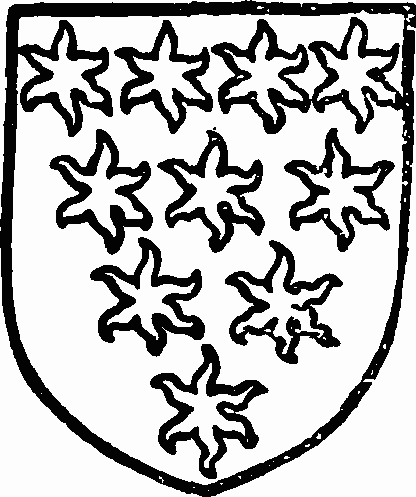
Alston, baronet. Azure ten stars or.
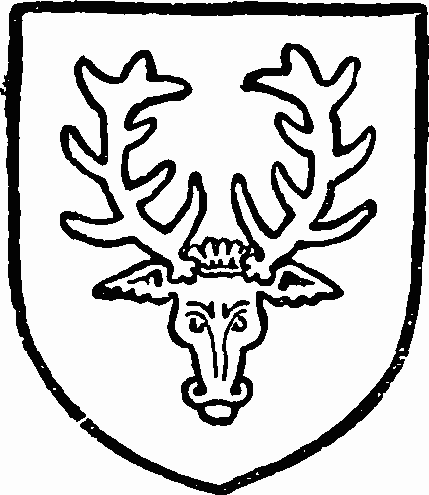
Legge, Earl of Dart-mouth. Azure a hart's head cabossed argent.
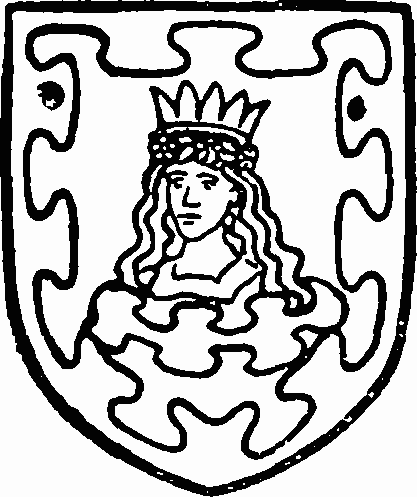
The Mercers. Gules a demi-virgin coming out of clouds proper clothed or with her hair loose crowned with an eastern crown and wreathed with roses, all in a border of clouds.
A free fishery was included among the appurtenances of Bradwell Manor in 1604 (fn. 129) and 1787. (fn. 130)
The rental of the priory manor of Bradwell of 1524–31 enumerates 'a pool called Westmar Hall with a little narrow pool going forth of the same,' and 'divers other pools now wasted and no fish.' (fn. 131) A fishery called the Fresh Fishings was granted with this manor to Arthur Longville in 1543. (fn. 132)
The Maide Milne, East Milne, and New Milne occur in a rental of the priory of Bradwell of the reign of Henry VI, (fn. 133) and the Maide Milne was included among the appurtenances of the priory manor in 1524–31. (fn. 134).
Church
The church of ST. LAWRENCE consists of a chancel measuring internally 19 ft. 6 in. by 12 ft., nave 30 ft. by 15 ft., south aisle 10 ft. 6 in. wide, north porch, and west tower 10 ft. 6 in. by 10 ft. It is built of rubble with stone dressings, and the roofs are covered with lead and tiles.
The nave, and probably the chancel, date from the early 13th century; the south aisle, though originally added at the same period, appears to have been rebuilt and widened during the second half of the century. The north porch was built in the 15th century, and the tower, added probably about 1380, was rebuilt in the 16th century, when the nave walls were heightened. The whole fabric was restored in 1867–8 and again in 1904.
The east window of the chancel is modern, but its internal label, which was found in the walling when the chancel arch was widened in 1868 and inserted here, dates from the 13th century and is enriched with nail-head ornament. There are two modern windows on the south, and on the north are two 14th-century trefoiled lights, the western a low-side window with an ogee head; the doorway between them is modern. The pointed chancel arch was rebuilt and widened in 1868, but the old stonework, dating from the 13th century, was re-used. It springs from chamfered abaci, upon which are the following inscriptions in Lombardic capitals, 'Viginti: dies: relaxac[i]onis: . . . .,' on the north, and 'H.: eccl[es]ia: dedicata e. in: honore[m] S[an]c[t]i: Lavrencii: xi . . . .,' on the south.
The nave opens to the aisle on the south by an early 13th-century arcade of three pointed arches with circular pillars having moulded bases and foliated capitals, and plain responds with chamfered abaci; the eastern capital is carved with plain water-leaf ornament, while the other is more richly foliated and has a carved head on the north side. On the north is a pointed 14th-century doorway between two modern windows, the eastern of which contains some fragments of old glass. In the west wall, opening to the ground stage of the tower, is a pointed arch with very thick stop-chamfered responds, which appears to have been rebuilt in the 16th century. There are three small clearstory windows on either side, all of which are modern. The north porch has been considerably restored.
The south-east window of the aisle, which is of two trefoiled lights with tracery, dates from the second half of the 13th century; immediately to the east of it is a pointed piscina with a circular bowl of the same period. The east window and the other window in the south wall are modern, though their internal jambs are old, while the four-light west window is entirely modern. The round-headed south doorway is of the early 13th century, having been reset when the aisle was rebuilt towards the end of the century.
The tower is of two stages surmounted by a saddleback roof, and has a modern west window in the ground stage, above which is a narrow trefoiled light of the 14th century. The bell-chamber is lighted by a 16th-century window of two transomed lights in a square head in each of the gabled walls and by single lights on the north and south.
The font has an old octagonal bowl, but the stem is modern. In the tower is a floor slab to Sir Joseph Alston of Bradwell Abbey, who died in 1688. The communion table dates from the 17th century.
The tower contains a ring of six bells: the treble and second both date from about 1300, and are inscribed 'Michael: de: Uuymbis: me fecit'; the third was inscribed 'Richard Chandler made me 1700,' but was recast in 1909; and the fourth, which is of the early 15th century and is inscribed 'Vox Augustini Sonet In Aure Dei,' is by John Walgrave; the fifth and tenor, by A. Bowell of Ipswich, were added in 1909. A piece of bell framework dated 1652 and four old clappers now lie in the ground stage.
The communion plate includes a stand paten and flagon of 1688. The registers begin in 1577.
Advowson
The advowson when first recorded was shared between William de Bayeux and Robert de Bradwell, by whom it was bestowed about the middle of the 12th century on Newport or Tickford Priory, this grant being confirmed by the Bishops of Lincoln in the 12th and 13th centuries. (fn. 135) At the ordination of the vicarage during the episcopate of Hugh of Wells, Bishop of Lincoln (1209–35), the church was described as the property of this monastery, (fn. 136) but in 1274 William de Bayeux claimed the right to present, against the prior, on the ground that his grandfather Hugh had presented Robert de Bradwell. (fn. 137) In the same year, however, he acknowledged the advowson to be the right of the prior. (fn. 138) The Priors of Tickford continued to hold the advowson, which in the 14th century was continually in the king's hands by reason of the war with France and its ownership by an alien priory. (fn. 139) After the suppression of Tickford Priory in 1525 (fn. 140) the advowson was granted by the king to Cardinal Wolsey for his college at Oxford, (fn. 141) Anne St. Leger, daughter and co-heir of Thomas, late Earl of Ormond, lord of Newport Pagnell, and George St. Leger, her son and heir, renouncing any claim they might have at the same time. (fn. 142) In September 1531 it was included with Bradwell Manor in the exchange with Sheen, (fn. 143) but a ratification of the arrangement in December of that year makes no mention of the advowson. (fn. 144) It was probably retained by the king, by whom it was granted in September 1532 to Henry the Eighth's College. (fn. 145) After the dissolution of the college in 1545 (fn. 146) the advowson reverted to the Crown, by which it has since been held, (fn. 147) save for a temporary grant to Samuel Jones in 1616. (fn. 148)
The Giffards bestowed the tithes of their demesnes in Bradwell on the priory of St. Faith, Longueville, in Normandy, this gift being confirmed by their descendant, William Marshal, Earl of Pembroke. (fn. 149) The rectory was included in the grant to Samuel Jones in 1616, and has since descended with the advowson.
The tithes were not commuted by the Inclosure Act of 1788, (fn. 150) but before the middle of the 19th century had been commuted for £250. (fn. 151)
The advowson of St. James's Church in New Bradwell, a vicarage annexed to that of Stantonbury, and which dates from 1860, is the property of Earl Spencer.
Charities
The charity of Rev. James Hume, founded by will, proved in the P.C.C. 20 March 1734, is regulated by a scheme of the Charity Commissioners of 5 December 1899. The property consists of 8 acres of land at Hockliffe, Bedfordshire, and £41 6s. 9d. consols with the official trustees, arising from the sale of timber, producing together an income of £15 yearly. By the scheme one-third of the net income is applicable in prizes to school children, under the title of the educational foundation of the Rev. James Hume, another third is distributed among poor deserving members of the Church of England, and the remaining third is applicable for the benefit of poor housekeepers and widows.
The Poor's Allotment.—By an Inclosure Award in 1789, 12 a. or. 35 p. of land in Furnace Corner and 3 a. 2 r. 17 p. on Seekley Hills were allotted in lieu of the rights of the poor of cutting furze for fuel, the income whereof, together with the rent of another piece of land, containing 2 a. 2 r. 26 p., amounting together to about £14 a year, is distributed in coal to about eighty recipients.
About half an acre of land is also let to the poor in allotments, producing £3 yearly, supposed to have been derived from a gift of Alden Fuller in or about 1719. A moiety of the income is applicable in the parish of Newton Longville.
The Public Footpaths Fund, which is regulated by a scheme of the Charity Commissioners of 11 October 1907, consists of £34 5s. 10d. consols, with the official trustees, arising from the sale of an allotment, made under the Inclosure Award of 1789, for a public stone and gravel-pit. The annual dividends of the stock produce 17s., which is applicable for the maintenance of the public footpaths, under the control of the Parish Council of Bradwell.