A History of the County of Buckingham: Volume 4. Originally published by Victoria County History, London, 1927.
This free content was digitised by double rekeying. All rights reserved.
'Parishes : Broughton', in A History of the County of Buckingham: Volume 4, ed. William Page (London, 1927), British History Online https://www.british-history.ac.uk/vch/bucks/vol4/pp303-308 [accessed 1 May 2025].
'Parishes : Broughton', in A History of the County of Buckingham: Volume 4. Edited by William Page (London, 1927), British History Online, accessed May 1, 2025, https://www.british-history.ac.uk/vch/bucks/vol4/pp303-308.
"Parishes : Broughton". A History of the County of Buckingham: Volume 4. Ed. William Page (London, 1927), British History Online. Web. 1 May 2025. https://www.british-history.ac.uk/vch/bucks/vol4/pp303-308.
In this section
BROUGHTON
Brotone (xi cent.); Bruchton, Bruhtone, Bruttone, Burwton (xiii cent.).
Broughton lies on the edge of the county, bordering Bedfordshire, and covers 936 acres, of which about three-quarters is grass land. (fn. 1) The south and west boundaries are formed by tributaries of the River Ouse. The land is about 200 ft. above the ordnance datum, and is liable to floods along the banks of the streams. The soil is mixed, the subsoil being gravel and clay. The chief crops grown are wheat, barley, oats and roots.
The road from Newport Pagnell to Woburn runs through the parish from north-west to south-east, and crosses two tributaries of the Ouse by Kingston Bridge and Broughton Bridge. The village lies at the northern end of this road, 3 miles south-east from Newport Pagnell terminal station on a branch from Wolverton of the London and North Western railway and 3½ miles north-west of Woburn Sands station on the London and North Western railway.
At the northern end of the village are the church, the rectory, and Broughton House, the residence of Lieut.-Col. Arthur William Hervey Good, the lord of the manor. The present house is modern, nothing now remaining of the former manor-house. (fn. 2) South of Broughton House is the school, built in 1864, and closed by the Education Department, the children now attending school at Milton Keynes. A messuage or farm-house called the 'Red Lion Inn' was mentioned in the will of Thomas Duncombe dated 13 October 1672. (fn. 3) In the north of the parish is Broughton Barn Farm, and in the east Broughton Field Barn Farm. Other farms are Brook Farm, south of the church, King's Head Farm, a little further south, and Broughton Lodge Farm in the extreme north-east.
The parish was inclosed by Act of Parliament in 1748. (fn. 4)
Among place-names have been found: the Layes, Wood Hall Holme, Little Fin Meadow, Little, Wat Grove, Long Lawrence, Barnard's Fen, Little Horcroft, Amedon's Close, heretofore the Bowling Green, (fn. 5) the Taplash, Hither Forge Furlong (fn. 6) (xviii cent.).
Manors
In the time of Edward the Confessor 4 hides at BROUGHTON were held as a manor by Oswi, a man of Alric son of Goding, and in 1086 this land was included in the possessions of Walter Giffard. (fn. 7) This manor, as that of Great Missenden (fn. 8) (q.v.), was appendant to that part of the honour of Giffard which descended in the earldoms of Gloucester, Stafford and Buckingham, (fn. 9) a counterclaim being made by Aymer de Valence, Earl of Pembroke, and by the Talbots in the 14th and 15th centuries respectively. At the attainder of the Duke of Buckingham in 1521 (fn. 10) the manor escheated to the Crown, which, however, had claimed it in 1508. (fn. 11) In 1623 the overlordship was unknown. (fn. 12)
Hugh de Bolebec, the Domesday tenant, (fn. 13) was succeeded here as in Whitchurch by the Earls of Oxford, but the manor was subinfeudated probably soon after the Survey, (fn. 14) and the mesne lordship thus created was vested in the earls as late as 1460. (fn. 15)
The ownership in fee was obtained by a family which took its name from the place, and a Robert de Broughton and William his son are mentioned as lords of Broughton in a confirmatory charter of 1151–4. (fn. 16) Reference to a later William, probably son of the last-named William, occurs in 1211. (fn. 17) He had been succeeded by 1245 by his son Robert, (fn. 18) whose son Matthew (fn. 19) was in possession in 1276. (fn. 20) By 1284 the property had passed to his son Ralf, (fn. 21) who was still alive in 1302. (fn. 22) In 1306 Ralf de Broughton the younger, probably his son, (fn. 23) and Joan his wife demised to Robert son of the late Ralf de Mangehoo of Marston Moretaine (Bedfordshire), (fn. 24) for 20 marks sterling and 2 marks yearly, a good and suitable chamber for him to live in in their court in the vill of Broughton, maintenance in food and drink, and the maintenance of a horse in hay and grass. (fn. 25) Ralf de Broughton died before 1316, when his widow Joan held alone in Broughton. (fn. 26) His son Robert levied a fine of lands in the neighbouring parish of Milton Keynes (fn. 27) and with his wife Paulina dealt with lands in Crawley in 1327. (fn. 28) He is mentioned in connexion with Broughton in 1331. (fn. 29) Three years later he conveyed the reversion of this property, now called BROUGHTON MANOR, after the death of Joan, at that time wife of William Passelewe of Wavendon, to Philip Aylesbury for life, and then to his son Thomas in tail-male. (fn. 30) In 1338 Philip Aylesbury acquired Joan Passelewe's life interest in return for a yearly rent of 10 silver marks. (fn. 31) He is therefore returned as the lord of Broughton in 1346, (fn. 32) and his grandson, Sir John Aylesbury, (fn. 33) died seised of the manor in 1409. (fn. 34) He was also lord of Drayton Beauchamp Manor (q.v.), with which Broughton descended until the death of Hugh Aylesbury in 1423, when, like Milton Keynes (q.v.), it must have been assigned to Eleanor wife of Sir Humphrey Stafford of Grafton (Northamptonshire), and sister and co-heir of Hugh's father John, (fn. 35) since Humphrey Stafford, lord of Milton Keynes, was also seised of Broughton at his death in 1545. (fn. 36) His grandson Humphrey sold Broughton in 1573 to Thomas Duncombe, (fn. 37) second son of William Duncombe of Great Brickhill. (fn. 38) Thomas Duncombe settled the manor on his second son Francis in 1590, (fn. 39) and confirmed the settlement by his will, dated 21 November 1595. (fn. 40) He died at Great Brickhill on 4 February 1595–6, (fn. 41) and was succeeded at Broughton by Francis, who was dealing with the manor in 1599. (fn. 42) On 23 November 1619 Francis settled it on his son and heir Thomas on his marriage with Sarah daughter of Thomas Draper, and died on 9 November 1622. (fn. 43) Thomas Duncombe, who had joined his father in a settlement of the manor in 1621, (fn. 44) settled it on his wife Sarah in 1623, (fn. 45) and by his will of 8 May 1632, dying four days later. (fn. 46) He was succeeded by his son Thomas, who was dealing with the manor in 1657 (fn. 47) and died in 1672, (fn. 48) leaving his manor-house to his wife Margaret for one year and the reversion to Francis, his son and heir by his first wife. (fn. 49) Francis suffered a recovery of the manor in 1675 (fn. 50) and died in 1720. (fn. 51) His only son Francis died unmarried on 14 March 1746–7. (fn. 52) His sister Anne had married John Robinson of Cransley, Northamptonshire, (fn. 53) by whom she had a son John, to whom his uncle left all his real and personal estate in trust to pay debts and legacies. (fn. 54) In 1748 John Robinson and his two sisters, Frances wife of Thomas Willis of Walton, and Susan wife of Philip Barton, rector of Sherington, legatees named under the will, with their husbands, conveyed the manor, the manor-house commonly known by the name of Broughton, and all other property of the late Francis Duncombe in Broughton, for £21,200 to Barnaby Backwell, banker, of London and of Tyringham. (fn. 55) From Barnaby Backwell the manor passed in 1754 to his only son Tyringham, (fn. 56) who in 1775 barred the entail on the manor (fn. 57) and died childless. Broughton then passed to his sister Elizabeth, who in 1778 married William Mackworth Praed of Trevethoe in Lelant, Cornwall. (fn. 58) The manor was inherited by her son James Backwell Praed, (fn. 59) who died on 13 January 1837, (fn. 60) and was succeeded by his son William Backwell Praed, J. P. and D. L. for Buckinghamshire and Cornwall, Sheriff of Buckinghamshire in 1860. On 6 August 1859 he assumed by royal licence the surname and arms of Tyringham in lieu of his patronymic. (fn. 61) He built the school in Broughton in 1864, and died on 29 November 1870. (fn. 62) His son Roger William Giffard Tyringham, born in the year of his father's death, sold the manor in 1909 to Lieut.-Col. A. W. H. Good, the present owner. (fn. 63)
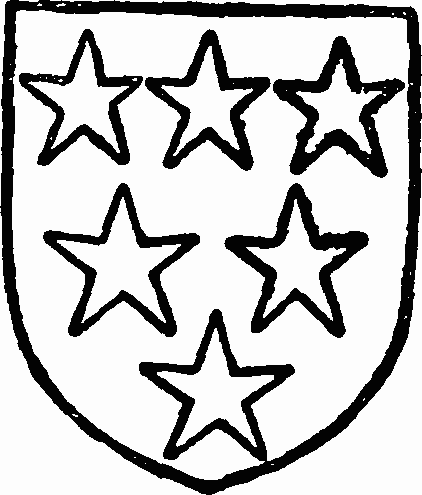
Praed. Azure six molets argent.
When Robert de Broughton alienated Broughton Manor to Philip Aylesbury in 1334 he appears to have retained certain lands there which united with the fee held of the honour of Huntingdon (see below) to form BROUGHTON MANOR, so called in the early 15th century. References, however, to members of the family in Broughton during the next 150 years are scanty, and chiefly occur in connexion with the advowson, which they retained. John, son of the above Robert, had succeeded his father by 1351, (fn. 64) and in 1393 put forward a claim to a messuage in Broughton settled by his great-grandfather Ralf on Simon de Mersheton (fn. 65) (? Water Eaton). He was buried in Broughton Church in 1403, his wife Agnes having predeceased him in 1399. (fn. 66) His son and heir John married Mary daughter and heir of Thomas Pever of Toddington (Bedfordshire), (fn. 67) and after his death, c. 1408, she became the wife of Richard Lord St. Maur, who held this manor in her right at his death early in the following year. (fn. 68) John Broughton, the son and heir of Mary Pever by her first husband, in 1410 brought an action to recover lands in the neighbouring parish of Crawley, but the suit was adjourned until 1427–8 on account of his minority. (fn. 69) He was twenty-two when he succeeded his maternal grandfather Thomas Pever in 1429, (fn. 70) and died in 1489, leaving Robert the son of his deceased son John as his heir. (fn. 71) Robert died in 1506, leaving a widow Katherine and a young son John, (fn. 72) who did not survive his father many years, and left Broughton at his death in January 1517–18 to his son John, then aged five. (fn. 73) The latter died in 1530, (fn. 74) and was succeeded by his sisters, Katherine wife of William Lord Howard of Effingham, (fn. 75) and Anne, afterwards wife of Sir Thomas Cheney of the Isle of Sheppey. (fn. 76) William Lord Howard of Effingham was holding half the manor, evidently in right of his wife, at his attainder in 1542, half the site being leased the next year for twenty-one years to Thomas Garrett at 26s. 8d. rent and 12d. increase. (fn. 77) The Howards' daughter Agnes or Ann married William Paulet, Lord St. John, (fn. 78) and acquired the Cheneys' interest before 1573, in which year the Paulets conveyed the whole of the manor to Thomas Duncombe. (fn. 79) He acquired at the same date the Staffords' manor of Broughton, and the two manors henceforward descend as one.
A hide in Broughton, held as a manor, was included in the Countess Judith's land at the date of the Domesday Survey. (fn. 80) Her lands afterwards formed the honour of Huntingdon, to which this hide in Broughton was attached, (fn. 81) and which descended in the families of Hastings, (fn. 82) Latimer, (fn. 83) and Nevill of Raby and Westmorland. (fn. 84) The last reference to the honour of Huntingdon in Broughton occurs in 1302, (fn. 85) but the connexion of the Nevills, Lords Latimer, continues until 1430. (fn. 86)
This manor was held in the time of Edward the Confessor by one Morcar, who could sell, and who was holding it under the Countess Judith at the date of the Domesday Survey. (fn. 87) In the 13th century it was held by Ralph Pincerna or Butler, (fn. 88) whose heirs were in possession in 1284–6 (fn. 89) and 1302–3. (fn. 90) It is probably they who are referred to under the names of Thomas de Eye, John Campion, and Thomas Quarel, holding in 1346. (fn. 91) Shortly after this date this holding appears to have been acquired by the Broughton family, and was joined to the lands retained by Robert de Broughton in 1334 to form the second Broughton Manor, as on the death of Richard Lord St. Maur in 1409 the overlordship of half that manor was ascribed to Lord Latimer. (fn. 92)
A mill was held with the principal manor at the date of the Domesday Survey, (fn. 93) and there was a watermill in 1623, (fn. 94) when a free fishery was also included in the appurtenances. (fn. 95)
Church
The church of ST. LAWRENCE consists of a chancel measuring internally 25 ft. 6 in. by 14 ft., nave 50 ft. 6 in. by 18 ft. 6 in., west tower 10 ft. 6 in. square, and a south porch.
No detail now remains of an earlier date than the first quarter of the 14th century, when the chancel and nave appear to have been remodelled. (fn. 96) Towards the end of the same century new windows were inserted in the nave, and in the early part of the 15th century the west tower was rebuilt, a turret containing a rood-stair being added about the same time at the north-east of the nave. In 1880–1 the church was drastically restored, the tracery of several of the windows being renewed. The walling is of limestone rubble with wrought dressings, and the nave and chancel are crowned by plain parapets.
The east window of the chancel is entirely modern, but the external label and mask-stops and the stringcourse below the still appear to be of original early 14th-century date. At the north-east is a recess with original jambs and a modern trefoiled head. At the west end of the north wall is a window with modern tracery in a 14th-century opening with an original rear-arch and an external label with mask-stops. To the east of the window is a modern doorway, the external label of which may be original. At the west end of the south wall is an original 14th-century opening with a labelled rear-arch; the tracery, which was probably of two lights, has been removed and a modern trefoiled head inserted. The early 14thcentury chancel arch is two-centred and of two chamfered orders, the outer order continuous and the inner order carried by moulded corbels supported by carved heads. A change in the character of the masonry to the east of the buttress in the centre of the south wall suggests that the present chancel is an extension of its predecessor.
At the east end of the north wall of the nave are the upper and lower doorways to the rood-turret, each of which has a two-centred head rebated continuously with the jambs. Of the three windows in this wall, the two eastern have late 14th-century twocentred heads and jambs with external casement moulds, but the three-light tracery is modern. The remaining window, which is placed at the west end of the wall, is of original early 14th-century date and is of three trefoiled ogee lights with reticulated tracery in a two-centred head. Between this and the second window is a blocked doorway of about the same date with a two-centred external head and label, and a segmental two-centred rear-arch. In the south wall are three similar windows, the two eastern of the late 14th century with modern tracery and external stonework and the westernmost of the early 14th century. The south doorway is like the blocked north doorway and occupies a corresponding position.
The tower is of three stages with an embattled parapet and diagonal buttresses of three offsets at the western angles, the junction with the nave being masked by buttresses of two offsets with gabled heads. The tower arch is two-centred and of two chamfered orders continuously moulded with the jambs towards the nave, while on the west face the outer order dies into the side walls of the tower. The west window of the ground stage is of two lights and has original early 15th-century jambs and a two-centred head, but the tracery is modern. At the north-west is a small doorway to the vice, which is only traceable externally by the small loops which light it. The intermediate stage has plain narrow loops on the north and south, and the bell-chamber is lighted from all four sides by restored windows of two lights with traceried two-centred heads. The only ancient detail of the south porch is an original 14th-century window of two trefoiled lights with tracery in a two-centred head in the west wall; there is a similar light, apparently modern, in the east wall. The low-pitched roof of the chancel is of the late 15th century, but that of the nave is modern.
The chief interest of the church lies in the remarkable series of paintings upon the walls of the nave. The earliest of these is the late 14th-century painting between the two eastern windows in the north wall which represents the dismemberment of the body of Christ. Perhaps the subject is intended to typify the dismemberment of the church by heretics and schismatics, with a possible reference to the Lollard propaganda of the time. The picture has a rectangular engrailed border of a reddish-brown colour, and the figures are drawn with brown outlines upon a plain ground. In the centre is the seated figure of the Virgin, with the mutilated body of our Lord upon her knees. Surrounding her are seven standing figures in the civil costume of the period; five carry dismembered portions of our Lord's body, while of the remaining figures one is apparently in the act of tearing out His eyes, and the other carries the Host. In the middle foreground are the figures of two men seated on either side of an object which it is difficult to identify. One holds a sword and appears to be threatening the other, who is about to hurl his dagger at him. Over the north doorway, filling the wall surface between the two adjacent windows, is a fine late 15th-century 'doom.' On the dexter side of the picture is represented God the Father seated in majesty, with two orb-crowned towers at His feet. The back of the throne is shown as an embattled wall with flanking turrets, and above the parapet is seen the Son. By the feet of the Father stands the Virgin extending her robe to shelter the saved, while with her left hand she gives a favouring touch to the beam of the balance in which a soul is being weighed. Round the beam is entwined string of beads, and immediately above the balance, which is held by an angel, a figure rising from an open tomb anxiously watches the result. In the centre of the composition is the Angel Gabriel blowing a trumpet, round which is entwined an inscribed scroll no longer decipherable. On the sinister side, represented in the usual manner, is hell mouth, and in the upper portion of this side of the picture is drawn the armed figure of St. Michael. Below the whole is a pattern of white flowers on a bluish ground. The paintings on the south wall of the nave are probably of the middle of the 15th century. Between the two eastern windows is a rectangular compartment with a repainted border, containing figures of St. Helena, and of a bishop, perhaps St. Eloy. St. Helena is represented in a green robe bordered with ermine and holds a tau cross with her right hand and a book in her left. Below this panel are painted a variety of smiths' implements and productions, such as hammers, pincers, horse-shoes, stirrups, keys and padlocks; these surround a representation of a man on horseback, which is almost entirely hidden by a modern memorial tablet. Over the south doorway is a magnificent painting of St. George and the Dragon, now unfortunately much damaged, the head and shoulders of the saint being quite obliterated. He is mounted on a boldly-drawn white horse and wears plate armour; in the bottom dexter corner is the dragon receiving the blow of his lance, while in the background is a female figure, the head of which is no longer visible. The ground is painted a dark green with light green lines upon it to represent grass. A border of red with a white scroll design upon it still remains on the east and west sides and over the head of the doorway. On both north and south walls traces remain of a dado pattern of broad red stripes with a cresting of red squares placed over the spaces between the stripes. On the west wall on either side of the tower arch, and at the west end of the north wall, are painted texts in black letter with circular strapwork borders, probably work of the late 16th century.
The pulpit is of the 18th century. The doors in the north and south doorways are of the 15th century, and both retain their original ironwork, the latter having ornamental strap-hinges and a closing ring with a circular scutcheon. In the chancel is a carved 17th-century chest, and in the tower is a bier bearing the date 1683. Copies of Bishop Jewell's Apology (1567) and Erasmus's Paraphrase (1632) are chained to desks on either side of the chancel arch. Some fragments of 14th-century glass are preserved in the north-west and south-west windows of the nave.
At the east end of the south wall of the chancel is fixed a brass to John de Broughton, inscribed, 'Hic jacet Joh[an]es de Broughtõn fili' Roðti de Broughtõn qui obiit xx°j°die me[n]sis decembris A°dñi M°cccc°iij° cui' a[n]i[ma]e p[ro]piciet' d[omi]ni amen.' Above it is placed a brass to his wife Agnes, inscribed, 'hie iacet Agnes qunondam ux' Joh[an]es de Broughton filii Roðti de Broughton que obiit xi die Mensis octobris A°dñi M°ccclxxxx°ix° cui' a[n]i[ma]e propiciet' deus Amen.' The figures of both have disappeared. On the north wall of the chancel is a monument commemorating Thomas Duncombe, who died in 1672. The inscription states that the he married first, Mary, eldest daughter of Charles Edmonds of Preston Deanery (Northamptonshire), by whom he had one son, Francis, and three daughters, and secondly, Margaret, only daughter of William Norton of Sherington, and relict of Thomas Wiseman of Mayland Hall, Essex, by whom he also had three daughters. His first wife Mary, who died in 1655, is commemorated by a brass at the east end of the chancel. There are also floor-slabs to Sarah, widow of Thomas Duncombe, who died in 1653, and to Mary, the wife of Francis Duncombe, who died in 1686.
There is a ring of four bells: the treble by Anthony Chandler, 1655; the second is inscribed in black letter, 'Sancte Cristine Ora Pro Nobis,' by Henry Jordan, c. 1460–70; the third by James Keene, 1622; and the fourth inscribed 'In Multis Annis Resonet Campana Johannis,' is by the same founder as the second. There is also a sanctus bell, probably by James Keene, bearing the date 1635, the last figure being reversed. (fn. 97)
The plate consists of a silver cup of 1720, and a paten and almsdish of the same year, all the gift of Mrs. Ann Bacon, and a flagon of 1721 inscribed 'F. D. to Broughton Church.'
The registers begin in 1720.
Advowson
The church of Broughton, which is a rectory, was originally bestowed on Tickford Priory by Robert de Broughton and William his son, and the gift confirmed by Robert, Bishop of Lincoln 1151–4. (fn. 98) For some reason unknown the Broughtons regained possession of the advowson, which was given to Caldwell Priory by William de Broughton, confirmation being made by his son Robert in 1245. (fn. 99) In 1318 it was conveyed by the priory to the Dean and Chapter of Lincoln, (fn. 100) against whom John de Broughton brought an action in 1380. The dean called the Prior of Caldwell to substantiate his claim to the advowson, and judgement was given against the plaintiff. (fn. 101) Some arrangement was evidently arrived at between the two parties, for eight years later the presentation was made by John Broughton. (fn. 102) From that date the advowson descended with the secondary manor until 1573, and afterwards with the amalgamated manor, (fn. 103) the present patron being Lieut.-Colonel A. W. H. Good.
Charities
The charity of Thomas Duncombe and Francis Duncombe, founded by wills dated respectively 1672 and 1716, is regulated by a scheme of the Charity Commissioners of 14 January 1870. The property consists of the public-house in Loughton called 'The Fountain,' and land containing 16 a. 3 r. 5 p., let at £46 15s. yearly. The official trustees also hold a sum of £27 4s. 3d. consols, producing 13s. 4d. yearly, representing residue of proceeds of sale of 2 roods of land, for the purpose of redeeming the land tax on all the property. By an order of the Charity Commissioners, dated 4 September 1903, it was determined that one-third of the income, after payment of £2 12s. to the parish clerk, was applicable to educational purposes. This third is paid to the school; another one-third of the income is applied for the benefit of the poor, chiefly in the distribution of coals, and the remaining one-third for the repair of the church. In 1912 each branch received the sum of £10 3s.