A History of the County of Buckingham: Volume 4. Originally published by Victoria County History, London, 1927.
This free content was digitised by double rekeying. All rights reserved.
'Parishes : Cold Brayfield', in A History of the County of Buckingham: Volume 4, ed. William Page (London, 1927), British History Online https://www.british-history.ac.uk/vch/bucks/vol4/pp323-327 [accessed 4 May 2025].
'Parishes : Cold Brayfield', in A History of the County of Buckingham: Volume 4. Edited by William Page (London, 1927), British History Online, accessed May 4, 2025, https://www.british-history.ac.uk/vch/bucks/vol4/pp323-327.
"Parishes : Cold Brayfield". A History of the County of Buckingham: Volume 4. Ed. William Page (London, 1927), British History Online. Web. 4 May 2025. https://www.british-history.ac.uk/vch/bucks/vol4/pp323-327.
In this section
COLD BRAYFIELD
Branefield, Braunfeld (xii cent.); Bramfeld, Braufend (xiii cent.); Braumfeld (xiv cent.); Brafeld, Britfeld (xv-xvi cent.).
This small parish, first mentioned as 'Cold' Brayfield towards the end of the 16th century, (fn. 1) was formerly included in Lavendon. The River Ouse is on two sides the parish boundary, and the road from Olney to Bedford, after passing through the parish, enters Bedfordshire by Turvey bridge. The area of Cold Brayfield is 744 acres, of which 254 are arable and 424 grass. (fn. 2) The soil is various and the subsoil belongs to the Great Oolite series. For the most part the land lies low and is liable to floods, but rises slightly to the north and west.
The small village is in a rather bleak and exposed situation. The church stands near the entrance to Brayfield House, the seat of Mr. Denis Herbert Farrer, which is situated on the hill-side and surrounded by a fine and well-stocked park of about 40 acres.
The common lands in the parishes of Lavendon and Cold Brayfield were inclosed under an Act of Parliament of 1800, the award being made 9 September 1802. (fn. 3)
Manors
No mention of COLD BRAYFIELD occurs in the Domesday Survey, and until the 13th century the two holdings here were assessed under Lavendon. (fn. 4) One of the three fees held there by the Countess Judith in 1086 was a manor assessed at 2 hides 1¼ virgates and held in demesne; twenty years earlier it had been held under Alli by Humman, his man. (fn. 5) The Countess Judith, niece of William the Conqueror, was the wife of Waltheof Earl of Huntingdon and Northampton. (fn. 6) Their daughter Maud married as her first husband Simon de St. Liz, who died before 1109, and secondly David of Scotland, he being recognized as Earl of Huntingdon in right of his marriage. (fn. 7) King David in or about 1136 resigned his earldom to his son Henry, who died in 1152 in his father's lifetime. (fn. 8) His son and heir Malcolm was under twelve years of age, and King Stephen gave the earldom to Simon de St. Liz, second Earl of Northampton, son of Simon and Maud. (fn. 9) Simon died in the following year, when also Malcolm succeeded to the throne of Scotland. (fn. 10) King Malcolm died unmarried in 1165, (fn. 11) and the earldom passed to William, his brother. Owing to the war between England and Scotland he was dispossessed in 1174, when Simon de St. Liz, son and heir of Earl Simon, obtained recognition of his claim. (fn. 12) On his death without issue in 1183–4 it was secured by David, younger brother of William the Lion. He died in 1219 and was succeeded by John, his son, who, however, died childless in 1237. (fn. 13) His lands were then divided among his four co-heirs, Christine, Devorgilla, Isabel, and Ada. (fn. 14) The Lavendon lands appear to have fallen to the share of the first and fourth, of whom Christine married William de Forz Earl of Albemarle. (fn. 15) A return made in the middle of the 13th century shows that two parts of half a knight's fee in Lavendon were then held under the earl as of the honour of Huntingdon. (fn. 16) Ada, the fourth sister of John Earl of Huntingdon, married Henry de Hastings, (fn. 17) whose name is given as overlord of part of Brayfield about 1235. (fn. 18) On his death in 1250 (fn. 19) he was succeeded by a son Henry, then a minor. (fn. 20) Henry took a leading part in the baronial wars as a follower of Simon de Montfort; he was taken prisoner at the battle of Evesham, (fn. 21) held Kenilworth Castle against the Crown, and in 1267 was the leader of the barons in the Isle of Ely. (fn. 22) By his wife Joan, sister and co-heir of George de Cauntelow, he had a son John, a minor in the king's wardship at his father's death in 1268. (fn. 23) Of this John, claimant to the Scottish throne, (fn. 24) half a knight's fee in Lavendon was held in 1284–6. (fn. 25) John de Hastings died in February 1312–13, when he was returned as having one quarter of a knight's fee here held by John Grey. (fn. 26) No further mention of this overlordship has, however, been found. In the first half of the 12th century a mesne lordship over this fee was held by Sampson le Fort, (fn. 27) founder of a priory in the adjoining parish of Harrold (Bedfordshire). (fn. 28) His rights descended to Robert son of Pain Brus (Breus, Braos) in the reign of King Malcolm. (fn. 29) At a later date Robert son of Nicholas quitclaimed all right in the advowson of Brayfield Church pertaining to the fee of Sampson, (fn. 30) but the connexion of the earlier lords with this manor is so far unexplained.
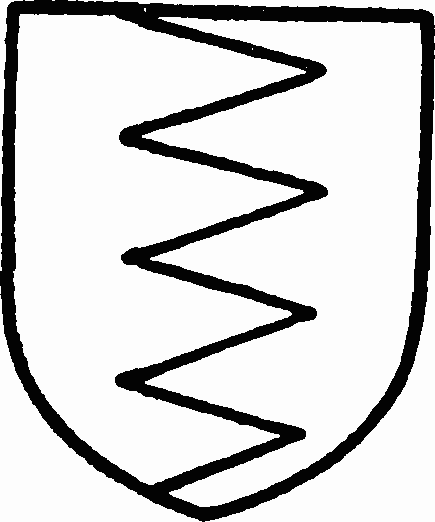
St. Liz. Party in dented argent and azure.
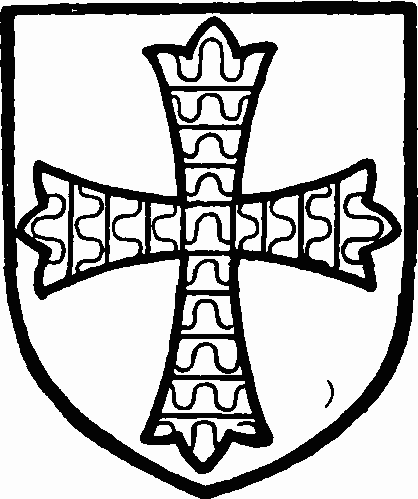
Forz. Gules a cross vair.
In the time of Sampson the tenancy in demesne seems to have been held by his tenant Robert de Blossomville, (fn. 31) lord of what was afterwards known as Newton Blossomville (q.v.) and probably also lord of Harrold. (fn. 32) Here, as at Harrold, a feoffment seems to have been made of the family of Moryn.
Ralph Moryn paid the Sheriff of Bedfordshire for half a fee in Harrold in 1194. (fn. 33) He was living in 1202, (fn. 34) but had probably been succeeded by another Ralph Moryn by 1235. (fn. 35) He was mesne lord of certain land of the honour in Brayfield, (fn. 36) and was still living in 1253. (fn. 37) Before 1262 he was succeeded by John, his son, (fn. 38) who was followed by Ralph Moryn, his son, before 1271–2, when he was accused of unjustly distraining some of his free tenants. (fn. 39) Ralph was unjustly imprisoned at Oxford about 1274 on suspicion of having stolen the king's gerfalcon, (fn. 40) and by 1280 was deeply in debt to the Jews. (fn. 41) Before this date he parted with his manor of Harrold to John Grey, (fn. 42) and as Moryn's name does not appear in the returns of landholders made for Lavendon and Brayfield in 1278, (fn. 43) it seems probable that the Greys acquired their rights in Brayfield with the Bedfordshire manor. John Grey seems to have enfeoffed Reynold, his son, in this land which Reynold was holding in 1278. (fn. 44)
The second fee in Cold Brayfield probably derived its origin from the half hide held by Chetel under the king both before and after the Conquest. (fn. 45) In the 13th century WATERHALL in this parish was held in chief for half a knight's fee by the family of Rycote, (fn. 46) but the intermediate history is obscure. Fulk de Rycote, lord of Rycote (Oxfordshire), (fn. 47) was among those on the king's side in 1215, (fn. 48) and acted on various commissions (fn. 49) before his death in or about 1233. (fn. 50) He was succeeded by Fulk son of William de Rycote, then a minor. (fn. 51) He came of age before 1247, (fn. 52) and about 1260 was coroner for Oxfordshire. (fn. 53) He acted as sheriff of that county in 1263, (fn. 54) and apparently took the baronial side in the Civil War. Possibly owing to political differences, Fulk was in continual contest with John and Reynold Grey, (fn. 55) the latter of whom was his tenant for Waterhall, (fn. 56) and lord of Snelston in Lavendon (q.v.). Finally in 1280 Fulk sold to Reynold a messuage and a carucate of land here, (fn. 57) apparently releasing to him all his rights, since from this time the Greys held Waterhall in chief (fn. 58) by the serjeanty of sending a man armed with hauberk and lance to the wars in Wales. (fn. 59)
The two fees in Brayfield were thus united in the hands of the Greys, and retained the name of Waterhall, the composite manor being evidently referred to under this name in 1308. (fn. 60) The manor followed the descent of that of Water Eaton in Bletchley (q.v.) until 1448, when it was granted by Reynold Grey to Robert Olney, Roger, Richard and John Heton. (fn. 61) It became the property of John Heton, (fn. 62) who died in January 1468–9, (fn. 63) and was probably sold, with his manor of Backenho in Thurleigh, Bedfordshire, about 1472 by his son William Heton to John Earl of Wiltshire, (fn. 64) whose son Edward (fn. 65) in 1497 alienated to John Mordaunt a fishery in the Ouse at Cold Brayfield. (fn. 66) The Earls of Wiltshire also held Newton Blossomville Manor (q.v.), with which Waterhall descended to John Lord Mordaunt, created Earl of Peterborough in March 1627–8, (fn. 67) by whom it was sold in 1638 to William Bodington, sen., of Turvey, Bedfordshire. (fn. 68) He was succeeded by John Bodington, who in 1653 made a settlement on his son John, (fn. 69) called lord of Cold Brayfield in 1674. (fn. 70) At his death two years later (fn. 71) the estate passed to his son John, who died in 1683, leaving two daughters. (fn. 72) Mary, the elder, died without issue, but Martha married Thomas Dymock of Newport Pagnell, who died in 1717. (fn. 73) At the beginning of the following year she conveyed Cold Brayfield to Uriah Ray of Carlton, Bedfordshire, in trust for William Farrer, who acquired possession in 1720. (fn. 74) He died before 9 December 1724, when his will was proved by his brother and heir Denis Farrer. (fn. 75) Browne Willis speaks of him as resident here in 1735, and as having greatly improved the house. (fn. 76) Denis died on 27 January 1746–7, leaving instructions in his will for burial in Cold Brayfield Church next to his late wife. (fn. 77) His son and heir William proved his age in that year, (fn. 78) and held Cold Brayfield until his death, which occurred between 19 July 1798 and 12 February 1799, the dates when his will was made and proved. (fn. 79) He left three daughters, of whom the eldest, Ann, married the Rev. John Grove Spurgeon, by whom she had a son Farrer Grove Spurgeon, who took the name of Farrer in 1799 according to the terms of his grandfather's will. (fn. 80) He inherited Cold Brayfield, but was still a minor in 1801. (fn. 81) He died in 1826, and his son William Frederick Farrer was returned as holder of the manor in 1831 (fn. 82) and later. (fn. 83) He was Sheriff of Buckinghamshire in 1856, and died in 1872. His son William Charles Love Farrer held till his death, unmarried, in 1879, (fn. 84) and was succeeded in turn by his two uncles, George Denis Farrer (d. 1901) and the Rev. Frederick Farrer. (fn. 85) The latter died in 1908, and his only surviving son, Denis Herbert Farrer, is the present holder of the manor.
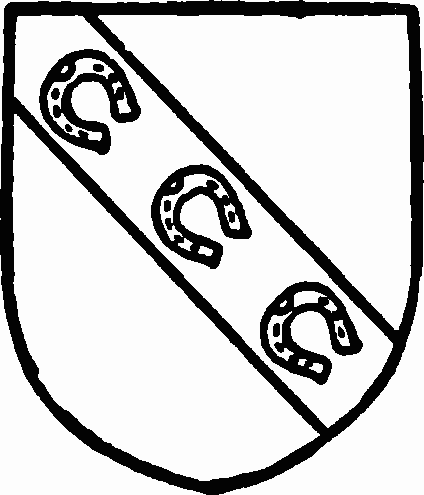
Farrer. Argent a bend sable with three horse-shoes or thereon.
The monastery of Lavendon held lands in Cold Brayfield, which were valued at the Dissolution at 35s. per annum. (fn. 86) This estate, sometimes called a manor, was granted with the site of the monastery, (fn. 87) and followed the descent of the abbey's manor in Lavendon, (fn. 88) to which it probably ultimately became attached.
A virgate of land in Cold Brayfield was given to the priory of Harrold at its foundation (temp. Stephen) by Robert de Blossomville and the gift was confirmed by Sampson le Fort and by William King of Scotland. (fn. 89) No lands in Cold Brayfield were included in the priory's possessions at the Dissolution, but it held lands in Lavendon valued at 24s. per annum. (fn. 90)
Church
The church of ST. MARY THE VIRGIN consists of a chancel measuring internally 25 ft. 6 in. by 16 ft., nave 31 ft. by 19 ft., west tower 7 ft. 6 in. by 6 ft. 6 in., and north porch; it is built of rubble with stone dressings and the roofs are covered with tiles.
The church appears to have been built shortly before it was granted to Harrold Priory a little before the middle of the 12th century. The western part of the chancel, and probably the nave, date from this time, but the only remaining details of this period in the nave are a small window in the north wall, now covered by the porch, and the reset doorway below it. The lengthening of the chancel about 1230 is clearly indicated on the north side by the larger stones used in the walling, though the distinction is not so apparent on the south. During the latter part of the 13th century the tower and porch were added and in the 15th century windows were inserted in the chancel and nave. The whole building was restored and reroofed during the latter part of the 19th century.
In the east wall of the chancel is a two-light window which probably dates from the 15th century, though much restored. At the east end of the north wall is a window of similar character, while another window of the same form in the south wall opposite has been entirely renewed. There are also in each lateral wall a 13th-century lancet and, near the west end, a pointed low-side window. A rough pointed piscina at the south-east does not retain sufficient detail to indicate its date. The responds of the chancel arch are of the 12th century, though the arch they support is modern; they have attached shafts with scalloped capitals and moulded abaci, and the southern shaft is enriched with cheveron ornament.
In the north wall of the nave are a 13th-century lancet and the small round-headed window mentioned above, both considerably repaired; below the latter is a reset 12th-century doorway with a pointed head of two orders, the outer supported by 13thcentury shafts with moulded capitals. On the south are two windows of two lights, the eastern window being of the 15th century with modern tracery and the other entirely modern. Between them there are indications of an early doorway, the defaced impost moulding of which is to be seen on the outside. The plain tower arch in the west wall dates from the 13th century. At the east end of the south wall is a restored piscina, doubtless for the nave altar. There are also two lockers in the east wall and one in the south wall, while at the north-east corner are two niches with conjoined segmental heads.
The porch is lighted by a plain loophole in the west wall and has an original pointed archway of two orders, the outer order supported by jamb shafts with moulded capitals and bases.
The low tower is of two stages, the ground stage lighted by plain loopholes and the bell-chamber by weather-worn lancets, all dating from the 13th century; it is strengthened by diagonal buttresses and surmounted by a modern parapet.
The font is octagonal, but preserves no detail to indicate its date. There are floor slabs in the chancel to Jane Farrer (d. 1678–9), Ann Farrer (d. 1690), and Ann Farrer (d. 1697); in the nave are floor slabs to Ann Bodington (d. 1696), and Edward Bodington (d. 16—). In a recess at the east end of the nave is a 17th-century chest.
The tower contains a ring of three bells: the treble by John Clark, 1607; the second by Alexander Rigby, 1688; while the tenor, dated 1828, is evidently by Taylor.
The communion plate includes a late 16th-century cup without any date letter.
The registers begin in 1693.
Advowson
The church of Cold Brayfield was built before 1140–50, when it was granted by Sampson le Fort to Gervase, Abbot of St. Nicholas of Arrouaise, for the foundation of Harrold Priory. (fn. 91) The grant was confirmed by Robert son of Pain Brus. (fn. 92) Gervase bestowed the church on the priory of Harrold, the appropriation taking place before 1168; the grant was confirmed by Robert, Bishop of Lincoln, (fn. 93) Robert son of Nicholas de Brayfield quitclaiming his right to the advowson. (fn. 94) Some disagreement seems to have arisen with the canons of Lavendon concerning the appropriation of the church, for Roger, Bishop of Worcester (1164–79), arbitrated in favour of Harrold. (fn. 95) A vicarage was ordained in the time of Bishop Hugh of Wells, (fn. 96) but Harrold Priory was probably not able to maintain the vicar and handed over the advowson to Lavendon Abbey, since the vicarage has always descended with that of Lavendon, (fn. 97) to which it is still annexed.
There are no references to this living in the Lincoln registers; it has always been considered a donative.
In 1496 it was returned that the chancel was in ruins, the fault of the impropriators, the Prioress and convent of Harrold, but that all the tithes were annexed to Lavendon and did not exceed £5 a year. (fn. 98) In return for the tithes Lavendon Abbey paid the priory of Harrold a pension of 24s. (fn. 99) For some time after the Dissolution the rectory followed the same descent as the site of Lavendon Abbey (fn. 100) (q.v.), but before 1615 it had been acquired by Thomas Farrer, (fn. 101) who made a settlement of it in 1636 on his son Thomas. (fn. 102) In 1663 a settlement was made on William son and heir of the younger Thomas Farrer on his marriage with Ann daughter of Henry Parker. (fn. 103) William died in February 1706–7, leaving a son William, (fn. 104) upon whom the rectory had been settled on his marriage with Elizabeth daughter of Matthew Dennis in 1692. (fn. 105) The younger William died in 1712 (fn. 106) and his son, another William, acquired Cold Brayfield Manor, with which the rectory descended until 1802, when an allotment of land was assigned in lieu of tithe. (fn. 107)
The church was endowed by Sampson le Fort with 5 acres of land. (fn. 108) John Lovent of Brayfield gave a rood of land and a rood of meadow for finding a lamp burning in the chancel of the church, the gift being confirmed by his son Thomas. (fn. 109) At the dissolution of the chantries this endowment was valued at 3s. 8d. a year. (fn. 110)
There do not appear to be any endowed charities subsisting in this parish.