A History of the County of Buckingham: Volume 4. Originally published by Victoria County History, London, 1927.
This free content was digitised by double rekeying. All rights reserved.
'Parishes : North Crawley', in A History of the County of Buckingham: Volume 4, ed. William Page (London, 1927), British History Online https://www.british-history.ac.uk/vch/bucks/vol4/pp327-338 [accessed 1 May 2025].
'Parishes : North Crawley', in A History of the County of Buckingham: Volume 4. Edited by William Page (London, 1927), British History Online, accessed May 1, 2025, https://www.british-history.ac.uk/vch/bucks/vol4/pp327-338.
"Parishes : North Crawley". A History of the County of Buckingham: Volume 4. Ed. William Page (London, 1927), British History Online. Web. 1 May 2025. https://www.british-history.ac.uk/vch/bucks/vol4/pp327-338.
In this section
NORTH CRAWLEY
Crawele, Craule, Crowle (xiii cent.); Great Craule, Croule juxta Newport Pagnel (xiv cent.); North Crolye (xv cent.).
This parish covers 3,366 acres, of which 1,130 acres are arable, 1,660 permanent grass and only 42 woods and plantations. (fn. 1) The soil is strong clay, the subsoil clay, and the chief crops wheat, oats and beans.
It has a general level of 300 ft. to 350 ft. above the ordnance datum, and its northern boundary as well as the western for a considerable distance is formed by the Chicheley Brook.
The division of the parish into Great and Little Crawley had been effected as early as 1197, (fn. 2) and the designation of North Crawley was not applied to the more important part until the 15th century. In the early 16th century an attempt was made by the parishioners of Chicheley to attach Little Crawley, just over the border, as a hamlet to their village. The claim may have been motived by the fact that the priory of Tickford had formerly held both Chicheley Church and Little Crawley chapel (see below). This attempt was stoutly resisted by the inhabitants of Little Crawley, who, in proof of their dependence on Great Crawley, instanced their large share in the repair of the church wall there, their right to seats in the church, their contribution towards the tithes, the gifts and bequests made by them, and the register of their burials in the church. (fn. 3)
The village of North Crawley, which is large and scattered, lies on a lofty ridge on a road crossing the centre of the parish. At the west end are the church and the rectory, a fine house, built in 1800. The former rectorial or mansion-house is mentioned in the will, dated 7 March 1767, of William Lowndes, who left £300 in trust to his eldest son William LowndesStone for its repair, should a younger son, Thomas Lowndes, then vicar of Astwood, succeed the rector. (fn. 4) The school, which was built in 1844 by the rector and the late Thomas A. Boswell, adjoins the churchyard. There is a Wesleyan chapel north of the church and east of it is a Congregational chapel.
There are some 17th-century cottages at Broadmead, about half a mile east of the church. A house and farm here belonged to Roger Tetlow, lord of Hollowes, who by his will, dated 23 December 1557, left 10s. for repairing the way from thence into the east fields. (fn. 5) Broadmead House passed with Hollowes to Ralph Smith, who made a settlement of it in 1631 on his marriage with Elizabeth Claver. (fn. 6)
Another half-mile beyond Broadmead is the Manor House at East End, a hamlet mentioned early in the 14th century. (fn. 7) The house, which is a 17th-century stone building with a tiled roof, and is surrounded by a moat, is now unoccupied and in a ruinous condition. It was probably the site of Hollowes Manor in Great Crawley. Moat Farm, an early 16th-century house at Little Crawley, a quarter of a mile north of the rectory, appears to have been originally the manorhouse of Pateshull or Little Crawley Manor. It is built of stone and half-timber and was originally of L-shaped plan, the wing projecting southwards. In the 17th century a new wing was added at the north west of the main block, and subsequent additions have been made on the west and south sides of the house. In the front wall of the 17th-century wing, which contains the entrance, is a stone bearing the inscription 'T. G 1661,' and the date 1660 appears on the wall of the entrance internally. On the ground floor of the main block is a hall with rough ceiling beams and doorways with carved spandrels. A third moat, the largest, inclosing four fish-ponds at Up End, a mile north-west of the church and south of Brandon's Wood, (fn. 8) probably marks the site of the manor-house of another of the numerous manors in this parish.
About a quarter of a mile north-east of the church, in a park of about 40 acres, is Crawley Grange, the residence of John Irvine Boswell, M.D. It is a muchrestored 16th-century building of brick with stone dressings and tiled roofs. The plan is H-shaped, with a porch on the south side of the main block connecting the wings. The stone-mullioned windows are nearly all original, and over the porch entrance are the arms of Boswell and a Latin inscription, both apparently modern. In the hall, which is in the main block, is a fireplace composed of pieces of carved wood of the 17th century and later, in the overmantel of which are the arms of Boswell. A visit of Queen Elizabeth in 1575 is doubtless recorded by the royal arms, with the Tudor rose above and the Plantagenet portcullis below, carved on one of the oak window shutters. In the dining room, situated in the east wing, is a carved fireplace bearing the date 1686. In the windows of both these rooms is some foreign heraldic and other glass of the 16th and 17th centuries. The house also contains some panelling of the same periods, and the principal staircase is a good example of Elizabethan design.
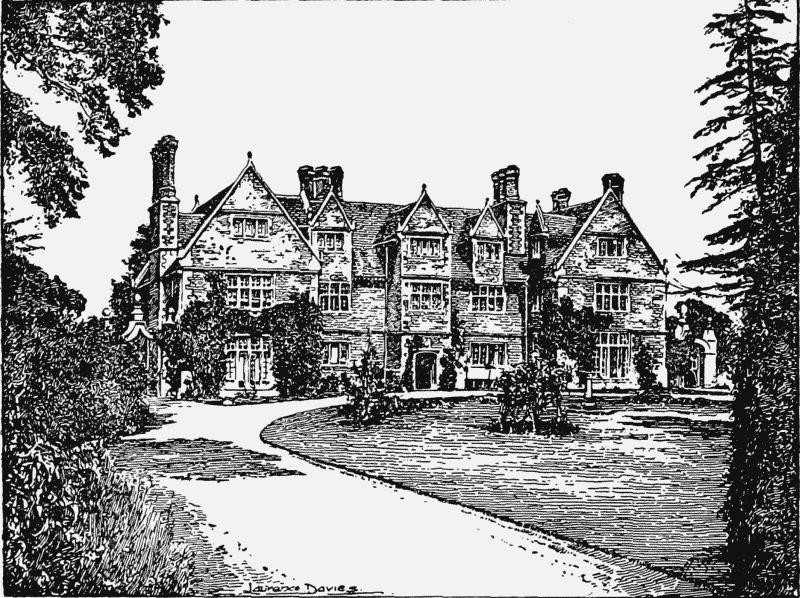
Crawley Grange, North Crawley
In the village are several old timber-framed houses and cottages with tiled or thatched roofs. About half a mile south of the church is Hurst End, with Hurst End Farm. Brook End lies south-west of the church. In the north-east of the parish are Dollarsgrove and Dollarsgrove Farm.
The parish was inclosed under an Act of Parliament of 1772, the award being dated 11 June 1773. (fn. 9)
Manors
Though Crawley is not mentioned by name among the numerous Buckinghamshire manors held by Walter Giffard in 1086, three of the more important manors in this parish, Hollowes, Broughtons and Filliols, together with the Crawley Grange estate, were afterwards attached as one fee, one half fee, and one half fee respectively to the honour of Giffard or Gloucester, and the right to hold courts leet and view of frankpledge in Crawley descended to the Clares (fn. 10) and Audleys, Earls of Gloucester, (fn. 11) and through the Earls of Stafford (fn. 12) and Dukes of Buckingham (fn. 13) to the Duke of Buckingham attainted in 1521. (fn. 14) The honour of Gloucesterescheated to the Crown, and the lands in Crawley were among those which went to form the honour of Ampthill in 1542, (fn. 15) the king being acknowledged as overlord until the abolition of feudal tenures in the 17th century. (fn. 16) The honour of Gloucester does not, however, appear to have merged completely into that of Ampthill, for part of Crawley was still referred to in 1628 as appertaining to the honour of Gloucester, (fn. 17) and in 1703 John Dormer claimed rights in Crawley as appendant to that honour. (fn. 18)
GREAT CRAWLEY MANOR (afterwards Hollowes) was obtained in fee by John Fitz Niel, (fn. 19) either the father, who died about 1289, (fn. 20) or the son, who died about ten years later, leaving as heir his daughter Joan, wife of John son of Richard Handlo. (fn. 21) This estate appears to have been settled on John Handlo's children by his second wife Maud, sister and heir of Edward Lord Burnell, (fn. 22) and was probably identical with the messuage and lands in Crawley which John and Maud Handlo claimed in 1316 as the gift of William Handlo, clerk, and Hugh le Despencer, sen. (fn. 23) In 1331 the Handlos made a settlement of Great Crawley and some Essex manors on themselves and their male issue, with contingent remainder as regards the Essex manors to Joan, Elizabeth, and Margaret, daughters of Maud, for life, with remainder in tail-male to John Lord Lovel, (fn. 24) son of Maud by her first husband John Lord Lovel of Titchmarsh (Northamptonshire). (fn. 25) Nicholas, John Handlo's son by Maud, having assumed the name of Burnell, was summoned to Parliament as Lord Burnell, (fn. 26) and his son Hugh Lord Burnell was returned as lord of Crawley during the closing years of the 14th century and the beginning of the 15th. (fn. 27) He was succeeded in 1420 by his three granddaughters, of whom the second, Catherine, married Sir John Ratcliff. (fn. 28) They conveyed their rights in Crawley Manor to William, seventh Lord Lovel of Titchmarsh, (fn. 29) and great-grandson of the John Lord Lovel upon whom the settlement of 1331 had been made. (fn. 30) At his death in 1455 William Lord Lovel was seised of the reversion of the manor, then held for life by Thomas Wake. (fn. 31) It did not descend to his eldest son, John Lovel, but to a younger son William Lovel, Lord Morley, who settled it on his son Henry Lovel in tail-male, with remainder successively to his own brother Henry Lovel in tail-male, and to the right heirs of his father, William Lord Lovel, (fn. 32) and died seised of it in 1476. (fn. 33) Henry Lord Morley died without issue in 1489 seised of the manor, his heir being his sister Alice, wife of Sir William Parker, (fn. 34) then twenty-two years old. Henry, uncle of Lord Morley, having died childless, the manor should have reverted, according to the terms of the settlement, to Francis Lord Lovel, son of John, the eldest son of William, seventh Lord Lovel, but it escheated to the Crown through the forfeiture of Francis Lovel's estates at his attainder in 1485. (fn. 35) It appears then to have been granted, as HOLLOWES MANOR, to Sir David Philip, at whose death without heirs male in 1504 it escheated to the king, (fn. 36) by whom it was given in 1511 to Sir John Nevill to hold during the king's good pleasure, (fn. 37) an exemplification of the patent being made in 1522. (fn. 38) It was granted in 1537 for thirty years to Robert Latimer (fn. 39) of North Crawley, (fn. 40) who seems to have obtained the fee simple of the manor before his death in 1548. (fn. 41) His daughter and heir Elizabeth became the wife of William Aprice or Aprees, (fn. 42) and their daughter Elizabeth married Roger Tetlow. (fn. 43) By his will, dated 23 December 1557, Roger Tetlow bequeathed the manor to his parents-inlaw, William and Elizabeth Aprice, during the life of Elizabeth Aprice, with remainder to his wife's brothers, Edmund and Lewis and John Aprice, who were to bring up and make provision for his daughters. (fn. 44) He died on 23 April 1558, (fn. 45) and on 27 April 1570 his daughters Elizabeth and Mary had livery of their thirds of the manor, (fn. 46) in which they were to release all right under the provisions of his will. Edmund Aprice, who with his brothers Robert and Lewis, and with Edmund Conquest, had dealt with the manor in 1565, (fn. 47) in 1586 with his wife Mary conveyed it to Anthony Tyringham. (fn. 48) A further renunciation of rights was made in 1597 to Anthony Tyringham by Edmund Aprice of Wollaston (Northamptonshire), Thomas his son and heir and Robert Aprice of Tansor (Northamptonshire), brother of Edmund. (fn. 49) In 1612 the manor was granted by Sir Anthony Tyringham to his second son Arthur in tail-male, (fn. 50) and it was sold by the latter in 1616 to Ralph Smith, clerk, (fn. 51) Sir Thomas Tyringham, his eldest brother, at the same time renouncing all claim. (fn. 52) Ralph Smith died seised of it at North Crawley in 1638, and was succeeded by his son Ralph, (fn. 53) who in 1673 conveyed it to George Sedley. (fn. 54) It must have passed to John Dormer of Rowsham, Oxfordshire, by whom it was sold in 1704 to Francis Duncombe, (fn. 55) and it was conveyed in 1719 by John Robinson and Anne his wife, Francis Duncombe, jun., and Thomas Kilpin to William Lowndes, sen., secretary to the treasury. (fn. 56) At his death in January 1723–4 Hollowes passed by will to William Lowndes of Astwood Bury, his son by his third wife. (fn. 57) His son William married in 1744 Catherine daughter of Francis Lowe and took the additional name of Stone. (fn. 58) He died in 1773, his son William LowndesStone succeeding his grandfather William Lowndes of Astwood Bury in 1775. (fn. 59) From William LowndesStone the manor passed to his great-granddaughter Catherine Charlotte Lowndes-Stone, who married Captain Robert Thomas Norton in 1862, (fn. 60) and held the manorial rights in 1869. By 1877 they had become the property of John Bosworth, and are now vested in his trustees.

Handlo. Argent a lion azure sprinkled with drops or.
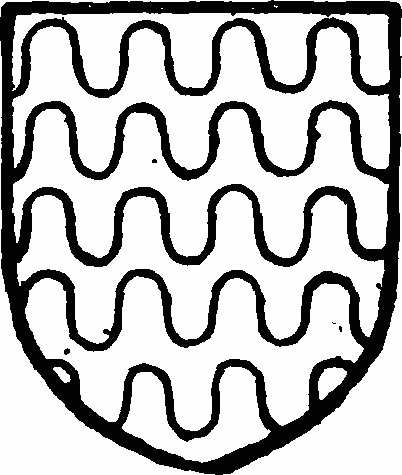
Lovel of Titchmarsh. Barry wavy or and gules.
A mesne lordship in those parts of Crawley known by the late 15th century as BROUGHTONS MANOR and FILLIOLS MANOR respectively (fn. 61) was held under the Giffard Honour by the Earls of Oxford. Record of their interest in Crawley dates from the early 13th century, (fn. 62) and continued until the abolition of feudal tenure in the 17th century, (fn. 63) a temporary grant of his prerogatives being made in 1584 by the Earl of Oxford to Peter Palmer. (fn. 64)
Broughtons Manor in Crawley was obtained in fee by the Broughton family, from whom it acquired its distinctive name. Their descent has been given under the manor in Broughton parish (q.v.), which, with Crawley, is mentioned as being in their possession in a confirmatory charter of 1151–4. (fn. 65) The two manors descended together, (fn. 66) and Philip Aylesbury was returned as lord of both in 1346. (fn. 67) The Crawley manor did not descend in the Aylesbury family, however, and was evidently retained by the Broughtons, for in 1351 John son of Robert de Broughton conveyed 60 acres of land, 1 acre of meadow, 2s. rent and ½ lb. of pepper to John Bohun of Midhurst and Cecily his wife. (fn. 68) Sixty years later John Broughton, grandson of the grantor, claimed this estate against the grantees' son John Bohun, and it was restored to him by order of the court in 1427–8. (fn. 69) This property, referred to in 1489 as the 'litell maner in More Craule called Broughtons,' (fn. 70) descended with the lands in Broughton parish likewise retained by the Broughton family to Agnes Howard, wife of William Paulet, Lord St. John, by whom it was alienated in 1573 to Richard Morton. (fn. 71) Richard Morton died seised of the site of this manor and of 300 acres of land, parcel thereof, in 1595. (fn. 72) His son Henry, (fn. 73) as Henry Morton, sen., with his wife Anne, in 1625 granted it to Robert Staunton, (fn. 74) by whom and his wife Mary it was conveyed in 1634 to William Knight and Brian Harrison. (fn. 75) It had passed before 1704 to John Dormer, (fn. 76) and was subsequently held with the manor of Hollowes, (fn. 77) the last reference to its distinct identity as Broughtons Manor occurring in 1775. (fn. 78)
The part of Crawley afterwards called Filliols Manor was known as such from the Filliol family, of whom William Filliol was fined 5 marks in 1175–6 for breach of the forest law. (fn. 79) He was succeeded by Baldwin Filliol, who in 1198 acquired 17 acres in Crawley from William Anketill, (fn. 80) and alienated 9 acres in 1202 to Bernard son of Hugh. (fn. 81) Baldwin was still alive in 1212, (fn. 82) but his heir Richard Filliol, (fn. 83) probably his son, (fn. 84) was in possession by 1249, (fn. 85) and held (fn. 86) until his death about 1260. (fn. 87) His son John, (fn. 88) who was presented by the hundered in 1275 for building a house on the highway, (fn. 89) exercised the manorial rights (fn. 90) until his death about 1317, when they vested in his nephew and heir John Filliol the elder. (fn. 91) He was sued by the Prior of Tickford in 1323, (fn. 92) and in 1324–5 settled the manor on himself and his wife Margery. (fn. 93) In 1327 the Filliols came to an arrangement with Robert and Paulina Broughton concerning a tenement in Great Crawley. (fn. 94) At John Filliol's death circa 1333 Richard, his son and heir, aged twelve, inherited some of the family property in Essex, but John, aged seven, his son by Margery (who survived), received the rest of the estate. (fn. 95) John Filliol the younger died without issue, (fn. 96) and at Margery's death in 1346 Cecily, then aged twenty-two, wife of John Bohun of Midhurst, was described as her only child and heir by John Filliol the elder. (fn. 97) Philip Aylesbury was returned in this year as lord of the part of Crawley formerly held by John Filliol, but there is doubtless confusion between this and Broughtons Manor. (fn. 98) The following year the Bohuns made a settlement on themselves in tail, with remainder to the heirs of Cecily, to Ralph Filliol for life, to William son of John de Sutton, chivaler, and to William's brothers Richard and John in tail-male successively. (fn. 99) Sir John Bohun, who in 1351 obtained a grant of the Broughtons' estate in Crawley, died seised of the manor in 1367, (fn. 100) leaving a son John, to whom the manor descended at the death of Cecily in 1381. (fn. 101) Sir John Bohun, who about 1393 leased his manor to John Burton, clerk, (fn. 102) and from whom in 1427–8 John Broughton recovered Broughtons Manor, made a settlement of his manor of Great Crawley on 6 January 1432–3, (fn. 103) and died on the last day of the same month. (fn. 104) He was succeeded by his son Sir Humphrey Bohun, (fn. 105) who died in 1468. (fn. 106) By him, or by his son Sir John Bohun, (fn. 107) the manorial rights appear to have been alienated, the Bohuns retaining some lands and the advowson. Filliols Manor, then so-called for the first time, was certainly in the possession of John Broughton at his death in 1489, (fn. 108) and, as there is no further reference to it, it probably coalesced with the larger Broughtons Manor.
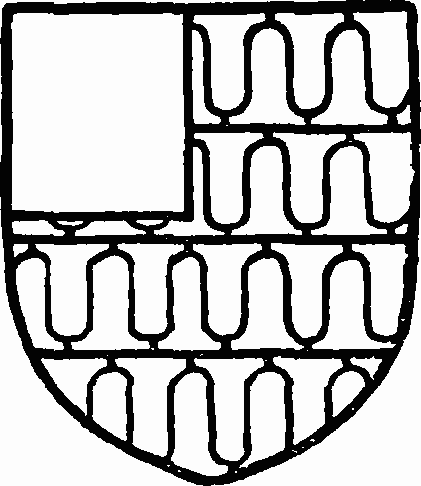
Filliol. Vair a quarter gules.
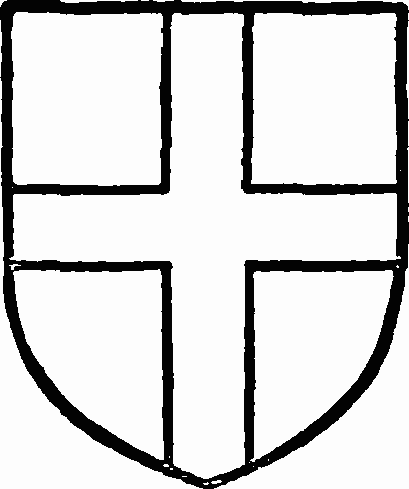
Bohun of Midhurst. Or a cross azure.
A manor in Great Crawley called MATHIAS was bequeathed by John Broughton to his heir by his will of 1489, (fn. 109) and was possibly identical with the manor of Broughtons granted with Hollowes by Sir Anthony Tyringham in tail-male to his second son Arthur in 1612. (fn. 110) At his death in 1614 Sir Anthony Tyringham was seised of the mansion-house within the manor of Broughtons and lands belonging to the same, and of the manor or farm within the manor of Broughtons called FRANKLYNS FARM. (fn. 111) This was included among lands in North Crawley sold in March 1615–16 by Sir Anthony's son and heir Sir Thomas Tyringham and by Arthur Tyringham to Roger Hackett, D.D., (fn. 112) rector of North Crawley since 1590, whose fame as a preacher was widespread. (fn. 113) Roger Hackett died in 1621 seised of the chief messuage called Franklyns Farm held of Henry Morton as of his manor of Great Crawley or Broughtons Manor by rent, fealty and suit of court, (fn. 114) and of considerable other property acquired by him in North Crawley, which later became known as the CRAWLEY GRANGE estate. According to Browne Willis, 'having bought in several Farms and Estates and laid them together,' he built himself 'the principal House in the whole Parish,' and made his the 'best and principal' property. (fn. 115) His son Roger (fn. 116) settled his mansion-house in Crawley on his son and heir Thomas at the marriage of the latter in 1650 with Elizabeth daughter and heir of Augustine Nicholls, (fn. 117) and died before 1658. (fn. 118) Thomas Hackett died in April 1689, (fn. 119) and was succeeded by his son Nicholls, (fn. 120) who had made a settlement of this property in the previous year. (fn. 121) There is a letter extant of Nicholls Hackett to the Earl of Bridgewater dated 28 January 1704–5, in which he excuses himself from acting as a deputy lieutenant on the ground of not having taken the oaths. (fn. 122)
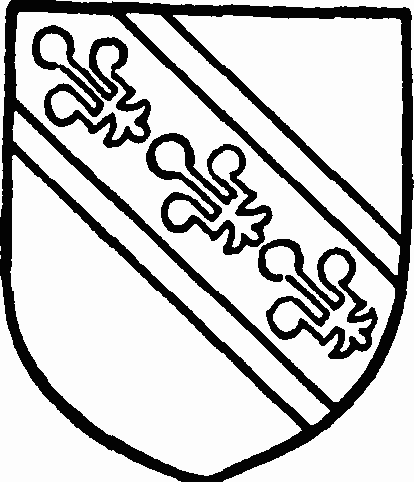
Hackett. Argent three fleurs de lis bend-wise between two bends gules.
Elizabeth, the only child of Nicholls Hackett, married in 1710 Nicholas, afterwards Sir Nicholas Carew, bart., of Beddington, Surrey, (fn. 123) from whom the estate passed to Sir Peter King as the result of successive mortgages. (fn. 124) In 1723 it was sold by Sir Peter King to William Lowndes, (fn. 125) who settled it on trustees for ninety-nine years with reversion in tailmale to Richard Lowndes, son of his eldest son Robert. (fn. 126) It descended with the Winslow and Whaddon estates (q.v.) until purchased in 1803 by Thomas David Boswell, younger brother of Johnson's biographer. (fn. 127) He died in 1826, (fn. 128) leaving a son Thomas Alexander Boswell, (fn. 129) upon whose death without issue in 1852 the Crawley Grange estate passed to Colonel Bruce Boswell, son of his cousin Elizabeth, wife of William Boswell and daughter of James Boswell the biographer. (fn. 130) Colonel Boswell died three years later, (fn. 131) leaving as heir his sister Elizabeth, widow of John Williams, who was still alive in 1874. (fn. 132) By 1883 her property was vested in trustees, but four years later Charles Ware of Crawley Grange, son of her daughter and heir Elizabeth by the Rev. Charles Cumberleye Ware, was said to be one of the principal landowners. The Crawley Grange estate, however, was settled on his sister Edith, (fn. 133) and she is apparently the Miss Cumberleye Ware who enjoyed the property during the closing years of the 19th century. It is now in the possession of John Irvine Boswell, M.D., son of the late John Alexander Corrie Boswell.
An estate in Crawley said in 1285 to comprise half the vill (fn. 134) was attached in the early 13th century as a quarter fee to that part of the honour of Huntingdon which came to Henry Hastings, under whom it was held in fee by Robert de Hersy (Hurst). (fn. 135) In 1197 a quarter virgate had been subinfeudated to him by Richard de Lindesey, (fn. 136) who is later returned as holding one quarter fee in Crawley of the fee of Say. (fn. 137) From Robert de Hersy the demesne rights passed through Ralf Butler to Robert Burnell, Bishop of Bath and Wells, (fn. 138) who in 1282 acquired a few acres of land in Crawley. (fn. 139) The estate was subinfeudated by him before 1285 to Philip Montgomery, (fn. 140) who claimed in that year to hold view of frankpledge here. (fn. 141) The intermediary lordship lapsed, for in 1302 Philip Montgomery held directly of the honour of Huntingdon, (fn. 142) and in 1328 Philip son of Philip Montgomery was sued for 14 acres of land, 8 acres of wood, and 6 marks rent in Great Crawley by John Handlo and his wife Maud Burnell, kinswoman and heir of the bishop, on the ground that the grant had not been in fee simple as Philip Montgomery asserted, but for a term which had expired. (fn. 143) The Handlos apparently lost the case, for in 1335 the heirs of Philip Montgomery, names unknown, were returned as lords of the fee. (fn. 144) They were then holding of William Lord Latimer, whose family had succeeded the house of Hastings as overlords, and to whom the manorial rights appear shortly afterwards to have reverted, for in 1346 William Latimer's widow Elizabeth was said to hold this fee, formerly Philip Montgomery's. (fn. 145) The Latimers held Isenhampstead Latimer in Chesham (q.v.), with which this manor descended to Richard Nevill, Lord Latimer, who was obliged to part with Isenhampstead Latimer to Sir Robert, Lord Willoughby de Broke. The Crawley manor, which he retained, was carried in marriage by his great-granddaughter Dorothy to Thomas Cecil, first Earl of Exeter, (fn. 146) who, towards the end of the 16th century, brought an action against the steward of the manor for detaining the records, court rolls, &c. (fn. 147) This estate, which by the early 17th century was called LATIMERS FEE, (fn. 148) and the importance of which lay in the rights of free fishing, free warren, view of frankpledge, and rights to hold courts leet and baron, only 15 acres of land being appurtenant thereto, (fn. 149) remained in the Cecils, Earls of Exeter, (fn. 150) and was accounted the paramount manor in Crawley at the inclosure of 1772, (fn. 151) the earl receiving rents on alienation or sale of lands. (fn. 152) The Marquess of Exeter still occasionally held a court for the manor at the Cock Inn circa 1860, (fn. 153) but since then these rights appear to have lapsed.
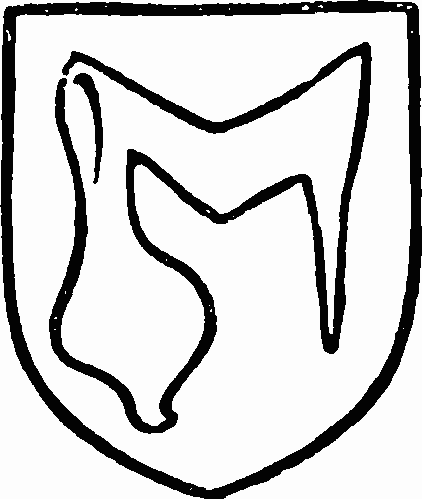
Hastings. Argent a sleeve sable.
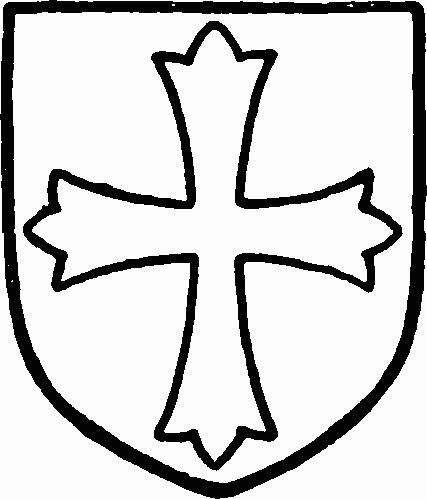
Latimer. Gules a cross paty or.
Four hides in Buckinghamshire which had been held in the time of Edward the Confessor by two thegns, Herald and Alwi, who could sell, were assessed in 1086 among the lands of William Fitz Ansculf, lord of Newport. (fn. 154) The locality is not specified, but is in all probability Crawley, (fn. 155) as the Paynels, successors of William Fitz Ansculf, gave the chapel of Little Crawley to Tickford Priory before 1150, (fn. 156) and by the early 13th century half a fee in Crawley was held of the honour of Dudley, (fn. 157) a constituent part of which was the honour of Newport. (fn. 158) Later in the century this half fee was divided, both manors continuing to be held of the Somerys, lords of Newport Pagnell, (fn. 159) who in 1285 claimed to hold view of frankpledge once a year without the intervention of the king's servant for the tenants of those lands in Crawley which were part of the honour of Dudley. (fn. 160) This overlordship is not again recorded in the quarter fee afterwards Tyringhams Manor, the tenure of which was said to be unknown in 1615. (fn. 161) Pateshull, the other manor, however, remained attached as a quarter fee to the honour of Newport, (fn. 162) and was held of the manor of Newport Pagnell (fn. 163) for 2s. a year, two barbed arrow heads, and suit at Newport every three weeks. (fn. 164) Court Rolls exist for 1544.–6 recording the attendance of the tenants at the view of frankpledge held at Newport Pagnell. (fn. 165) As chantry land escheating to the Crown it was bestowed upon Sir John Parot in 1559 to hold of the queen in chief for onetwentieth of a fee, (fn. 166) the same service being specified in the grant of 1623 (see below). (fn. 167)
No mention of any tenant of this holding occurs between Wibert in 1086 (fn. 168) and Geoffrey de Beauchamp in the early 13th century. (fn. 169) Shortly afterwards it was divided as above said and one moiety was obtained in fee by Simon de Pateshull (fn. 170) before 1260, in which year Ida, widow of William de Beauchamp, baron of Bedford, invaded the manor, pulled down the houses, cut down the trees, and committed other damage. (fn. 171) The reason for this conduct may perhaps be found in Simon de Pateshull's refusal to acknowledge her right to the manor and honour of Newport (q.v.). Simon de Pateshull, the supporter of Simon de Montfort and the baronial party, appropriated certain liberties in Crawley (fn. 172) before his death in 1274. (fn. 173) His son John had seisin of the manor by 1276, (fn. 174) and retained it (fn. 175) until his death in 1290. (fn. 176) His son Simon (fn. 177) was seised of Crawley, (fn. 178) which passed at his death in 1295 to his son John, then a minor, (fn. 179) who is described as the heir of Simon in the feudal aid for 1302–3. (fn. 180) A grant of free warren in the demesne lands of Little Crawley was made to him in 1306, (fn. 181) and in 1310 he complained that William le Butler of Hardmead and others had broken into his house here, and fished in his stews, &c. (fn. 182) This John de Pateshull was known as of Bletsoe, a manor belonging to the family in Bedfordshire, (fn. 183) to distinguish him from a relative of the same name to whom he gave a life interest in Crawley Manor, and who was known as of Crawley at his death circa 1329. (fn. 184) The manor then reverted to John de Pateshull of Bletsoe, (fn. 185) who made a settlement of it on himself and his wife Mabel in 1333, (fn. 186) and held it (fn. 187) until his death in 1349, when it passed to his son William. (fn. 188) Ten years later, at William de Pateshull's death, (fn. 189) Crawley Manor was assigned to his sister and co-heir, Alice wife of Thomas Wake of Blisworth (fn. 190) (Northamptonshire), though she does not appear to have received full seisin until 1368. (fn. 191) In 1373 the Wakes settled Crawley on their son Thomas Wake and his wife Maud. (fn. 192) Thomas Wake, the father, died before Michaelmas 1382, (fn. 193) and his widow Alice held Blisworth at the death of their son Thomas in the following year. (fn. 194) His son and heir John Wake, then aged nine, (fn. 195) must have died without issue, for at the death of Alice in 1398 the heir was said to be Thomas Wake, son of her deceased son Thomas, a youth of nineteen. (fn. 196) He died before his mother Maud, his son, another Thomas, succeeding her in 1425, (fn. 197) and settling Crawley on himself and his wife Agnes in the following year. (fn. 198) He was succeeded in 1458 by his son Thomas, (fn. 199) whose death occurred in 1476. (fn. 200) His son Roger, to whom Crawley then passed, (fn. 201) was attainted after the battle of Bosworth, and the manor was bestowed in 1486 on Sir John Fortescue and his heirs male. (fn. 202) It was restored to Roger Wake before his death in March 1503–4, when it was described as a messuage and 160 acres of land called Pateshull, (fn. 203) which he bequeathed for the foundation of a chantry in Blisworth. (fn. 204) The trustees founded the chantry about 1505, and endowed it with Crawley Manor ten years later. (fn. 205) After the suppression of the chantries it was granted in 1559 as the manor of Crawley Parva and Chicheley, concealed lands, (fn. 206) to Sir John Parot. (fn. 207) It was subsequently claimed that the manor had been bequeathed not only to support a chantry priest, but for the maintenance of a school at Blisworth, and by a decree in Chancery, 23 February 1562–3, the grant to Sir John Parot was repealed, (fn. 208) and an annual rent of £11 was assured to the school out of the premises. (fn. 209) These had been leased as the MANOR OF PATESHULL or LITTLE CRAWLEY on 18 January 1535–6 to William Johnson by the trustees of Roger Wake for a term of sixty years. (fn. 210) Robert Johnson, who succeeded in 1558 (fn. 211) to his father's interest in the manor, in 1569 sued George Annesley of Tickford, (fn. 212) to whom Parot had sold Pateshull for £330 in 1560, Annesley doing homage for the same in 1566. (fn. 213) In the earlier suits Annesley is referred to as undertenant of Johnson in part of the manor, (fn. 214) but he made good his claim to hold the whole in fee. George Annesley had seven sons, (fn. 215) upon three of whom, Matthew, Thomas, and Robert, he made settlements of the manor in 1604 and 1605. (fn. 216) Another son, James Annesley, jun., had received in 1600 a messuage, barn, stable and Smythe Wyke close, which descended at his death in January 1605–6 to his son Nicholas. (fn. 217) Somerayes Wykes, Pateshull Grove, and other lands amounting to one-fourth of the manor, were settled in 1601 on a son George. (fn. 218) Ralph, another son, obtained in 1604 the manor-house and closes called Starkers Croft, Le Motted Close, Wolfie Mead, Le Deane Leyes, &c. (fn. 219) The eldest son, James Annesley, sen., aged forty at his father's death in January 1607–8, inherited a fourth of the manor, then in the tenure of Anthony Chester, sen. (fn. 220) Some arrangement appears to have been arrived at between the various members of the family, for in 1623 a grant of the manor was made in fee to Anthony Chester, then a baronet, George Annesley of Crawley, and Nicholas Annesley of London. (fn. 221) The Chesters probably obtained eventually all the manorial rights, and Pateshull descended with the manor of Chicheley (fn. 222) (q.v.), into which it merged, the name of Charles Chester being among those of landowners in Crawley at the inclosure of 1772. (fn. 223)
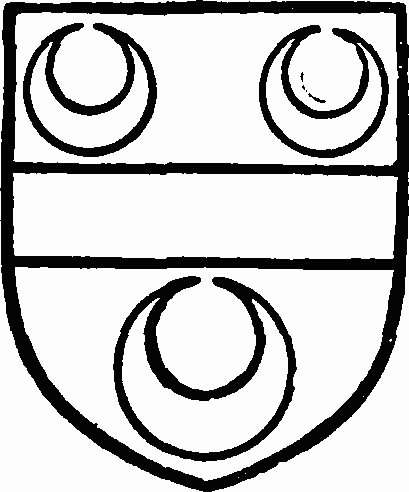
Pateshull. Argent a fesse sable between three crescents gules.
The other moiety of the original Dudley fee was acquired before 1272 by John Tyringham, (fn. 224) and his son Roger claimed in 1285 that his tenants in Crawley attended the view of frankpledge held once a year at Tyringham, for which he paid his overlord, Roger de Somery, half a mark. (fn. 225) The Tyringhams' chief seat was at Tyringham (q.v.), with which this manor descended (fn. 226) to Sir Anthony Tyringham, by whom it was granted in 1612 as TYRINGHAMS MANOR in North Crawley to his second son Arthur, who received Hollowes at the same time. (fn. 227) By him it appears to have been granted, probably in 1616 with Franklyns Farm or Manor, to Roger Hackett of North Crawley, who in 1621 died seised of lands in North Crawley held of Sir Thomas Tyringham as of his manor of Tyringham, (fn. 228) these lands doubtless forming part of the later Crawley Grange estate.
Lands in Crawley were held by the abbey of Woburn, (fn. 229) and the priories of Tickford, (fn. 230) Caldwell (fn. 231) and Harrold, (fn. 232) grants from which were later made to Lincoln College (fn. 233) and to Henry the Eighth's College, Oxford. (fn. 234)
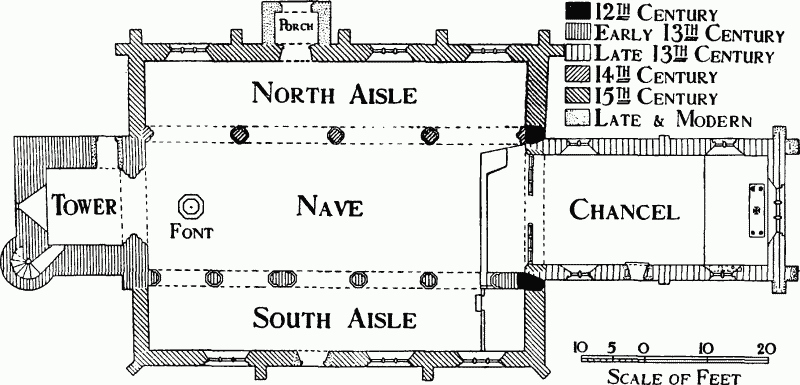
Plan of North Crawley Church
There was a mill worth 20s. on William Fitz Ansculf's holding in 1086, (fn. 235) and there is mention of a mill in North Crawley in 1202. (fn. 236) A windmill was held with the Hackett estates in 1650 (fn. 237) and 1688. (fn. 238)
Church
The church of ST. FIRMIN consists of a chancel measuring internally about 36 ft. by 17 ft. 6 in., nave 60 ft. 6 in. by 20 ft. 6 in., north aisle 10 ft. 4 in. wide, south aisle of the same width, west tower 12 ft. square, and a modern north porch.
The present building seems to have been developed from a 12th-century church consisting of a chancel and nave, the latter about 20 ft. shorter than the nave in its present form. The first stage in the enlargement of the church was the addition in the early years of the 13th century of a south aisle the length of the three eastern bays of the south arcade of the nave. A few years later the original nave was probably extended two bays westwards, the aisle being lengthened to correspond, and a west tower was added, probably at first only three stages in height, as the present bell-chamber appears to be an addition of the late 14th century. At the end of the 13th century the chancel was rebuilt. The date is fixed with fair certainty by an inscription cut in Lombardic capitals beneath the external sill of the east window. Though somewhat weatherworn it can still be clearly read, and runs as follows: '+ Petrus Cancellvm Tibi Dat Firmine Novellvm ut cvm Lavderis Deo Petri Memoreris.' This Peter is probably to be identified with Peter of Guildford who was presented to the living of North Crawley in 1294. (fn. 239) Early in the 14th century the north aisle was added, the still existing north arcade being pierced in the north wall of the nave. About 1460 both aisles seem to have been rebuilt, or at any rate, completely remodelled, and the clearstory was added to the nave, the church being reroofed throughout. At the same time the chancel arch was enlarged, the responds being cut back to the side walls of the chancel. The history of the fabric has been somewhat obscured by the coating of cement with which the walls were covered in the early 19th century. The removal of this would throw much light on the date of the walling of the aisles, which may be substantially that of the earlier aisles, repaired and given new windows in the 15th century.
The chancel is a very complete and interesting example of late 13th-century work; unfortunately the coating of cement hides all the original external wrought detail with the exception of the windows, with their labels, and the inscription on the east wall. A high plinth, extending to the sills of the windows, and stepped upwards at the east end to accommodate itself to the higher level of the east window, runs round the walls, and at the eastern angles are pairs of buttresses, substantially of original 13th-century date, while in the centre of each side wall is a small pilaster buttress resting on the plinth. The walls are crowned by an embattled parapet and cornice of the 15th century. The east window is of three uncusped lights, the central light being higher and wider than the side lights, and in the two-centred main head are three quatrefoiled circles with pierced cusping. The rear-arch, which is ribbed and hollowchamfered, and is inclosed by a label with mask stops, springs from small attached shafts at the angles of the jambs. On either side of the window is a semioctagonal image bracket with a supporting cluster of naturalistic foliage. At the east end of each side wall is a window of two uncusped lights with a quatrefoiled circle above in a two-centred head, and a rear-arch and jamb-shafts like those of the east window. A moulded string-course runs along the east wall beneath the sill of the window, and is continued for a short distance along the side walls, where it is dropped to pass beneath the sills of the north-east and south-east windows. The remaining two windows of the chancel are placed at the west ends of the side walls, and correspond exactly in design with the windows at the opposite end of the walls, except that their sills are brought down internally to a lower level. Immediately to the west of the pilaster buttress on the south wall is a small doorway, probably original, the jambs and head of which are covered with cement. Below the southeast window is a double piscina recess, with twocentred moulded heads springing from a central shaft with moulded capital and base, and received upon the jambs by attached shafts of the same design; the original circular basins still remain, but all the detail is coated with cement. To the west of this is a rectangular recess with moulded edges, probably intended for a credence shelf. Below the north-east window is a second rectangular recess with moulded edges. The chancel arch is of two hollow-chamfered orders, the outer continuous upon the nave side, and the inner order supported by ill-designed 15thcentury corbels upon the side walls.
The early 14th-century north arcade of the nave is of four bays with two-centred arches of two hollowchamfered orders, supported by piers of quatrefoil plan with moulded capitals and bases standing upon rough square sub-plinths. The arches are inclosed by labels with mask stops over each pier, and the inner orders are received upon each respond by semicircular attached shafts.
The early 13th-century south arcade is of five bays, the two western bays being separated from the eastern portion of the arcade by a pier measuring about 3 ft. 10 in. from west to east, against which each of the adjoining arches has an independent respond. The three eastern bays have two-centred arches of two chamfered orders supported by heavy octagonal piers. The capitals of the piers are carved with stiffleaved foliage, and their abaci are grooved and hollowchamfered with a small roll below the chamfer; the bases are of the attic type. The semi-octagonal responds repeat the design of the piers, except that the bell of the capital of the east respond is plain. The abacus of the west respond is continuous with that of the east respond of the western portion of the arcade, the two bays of which have arches of the same character springing from an octagonal pier and responds with foliated capitals and hollow-chamfered abaci of a slightly later type. The three eastern arches have grooved and chamfered labels on the nave face, and plain chamfered labels on the aisle face, while the western arches have labels of a more advanced section on the nave face only. The lofty 15thcentury clearstory has five windows on either side, each of three cinquefoiled lights under a fourcentred head. A moulded string-course runs round the walls at the level of the apex of the chancel arch. The nave is crowned externally by a cornice and embattled parapet.
In the north wall of the north aisle are three segmental-headed 15th-century windows, each of three cinquefoiled lights with vertical tracery in the head and casement-moulded external jambs. Between the two western windows is a contemporary doorway with a four-centred head within a square external order with traceried spandrels, the jambs of both orders being shafted. There are no windows in the east and west walls. The walls are crowned by a cornice with grotesque spouts, above which is an embattled parapet. The south aisle has three windows in the south wall like those of the north aisle; the south doorway, between the two western windows, has been restored with cement, so that the date is difficult to determine; it is possible, however, that it may be a renewal of a 13th-century doorway, but, as mentioned above, the cement which covers the walls makes it impossible to say whether the 15th-century details here are only insertions or the result of a complete rebuilding of the early aisle. To the west of the easternmost of the three-light windows is a small light with a trefoiled ogee head, placed high up in the wall. The east and west walls are blank, as in the case of the north aisle. The east end of the aisle was partitioned off in the early 19th century, to serve as a vestry. The parapet is embattled, and below the battlements is a cornice with grotesque spouts.
Externally the west tower is of four receding stages and is crowned by an embattled parapet. At the south-west angle is a circular stair turret lighted by small loops, and reaching to the set-off below the third stage, where it is crowned by a pyramidal roof. The tower arch, which is contemporary with the three lower stages, is of three continuously chamfered orders, and has a label with head-stops towards the nave. In the west wall of the ground stage is a tall narrow lancet with wide internal splays. At the east end of the north wall is a round-headed doorway, probably a late insertion. The doorway to the stairturret has a square head. The second stage is lighted by a 13th-century lancet in the north wall, while the third stage has lancets of the same type on the south and west, and below the clock face on the north are traces of a similar window. The bell-chamber is lighted from all four sides by late 14th-century windows of two cinquefoiled lights with quatrefoil tracery in two-centred heads.
The roofs are all of the 15th century. Those of the chancel and nave are low-pitched and are supported by solid trusses resting on wooden figures placed in the position of wall posts, and standing on corbels carved as birds, while the intermediate rafters have angels holding shields at their feet. The chalice held in the hand of one of the figures supporting the nave roof suggests that the twelve figures here represent the twelve apostles. The purlins, rafters and ridge-pieces are moulded and have carved bosses at their intersections. The aisle roofs are of the lean-to type, and have moulded timbers with carved bosses.
The font is of the 14th century. The bowl is octagonal and has a moulded rim and lower edge; it is supported by a central octagonal stem and four small clustered shafts with moulded bases but no capitals. The cover is a good example of 17thcentury joinery. It is octagonal, and each side has an arched panel with pilasters and carved spandrels; the whole is crowned by an embattled cresting, above which rises a panelled obelisk. Upon one of the sides of the lower portion is inscribed: 'Anno Domini: 1640: T.L.' The same workman seems to have been responsible for a seat at the west end of the south aisle bearing the inscription: 'Thomas Nash is at the charge of this seate anno domini 1635—T.L.' The communion table is of oak and dates from the late 17th century. The rood screen, which is complete but for the parapet of the loft, is an unusually interesting example of late 15th-century work. It is divided into eight main bays by uprights moulded on the west side with slender clustered shafts having crested capitals from which spring the ribs of the fan-vaulted cove beneath the loft. The upper part of the screen is open, each bay having a subfoliated trefoiled head with vertical tracery above rising into the space between the cones of the vaulting. The two middle bays are arranged to open as a double door, and a four-centred arch, inclosing the subfoliated trefoiled heads, separates the tracery from the doors. The lower portion of the screen is filled with close panels, each bay being subdivided into two panels, making sixteen in all, and in each panel on the west face is a contemporary painted figure with the name inscribed upon a painted corbel beneath. The figures, taken from north to south, are named as follows:—(1) Jeremy, (2) David, (3) Ysayas, (4) Daniell, (5) Osee, (6) Amos, (7) Sanctus Blas(ius), (8) Sanctus Martin', (9) Sanctus Edward', (10) Sanctus Edmund', (11) Sophanias, (12) Johell, (13) Michias, (14) Malachias, (15) Daniell, (16) Ezechias. With the exception of the figures of St. Blaise, St. Martin, St. Edmund, and St. Edward, each figure has a scroll round it, inscribed with a quotation from the Vulgate. These are now very indistinct, and appear in some cases to have been incorrectly repainted. Several late 15th-century seats remain at the west end of the nave with four desk fronts. The uprights are buttressed, and the panels are carved with the linen pattern. Some 16th-century panels are also worked into the modern seating at the west end of the south aisle. A good Elizabethan chest with enriched panels is preserved in the north aisle. A fragment of 15th-century glass, bearing the inscription 'Petrus' in black letter, remains in the centre light of the east window of the chancel.
At the east end of the south aisle is a brass commemorating Robert Latimer (d. 1548), Katherine his wife, who died in the preceding year, and their daughter and heir Elizabeth. The inscription is remarkable for its defective grammar. On the south wall of the chancel is a brass with a kneeling figure and a death's head and hour-glass, commemorating John Garbrand, a former rector, who died in 1589. The inscription, which is in black letter, is as follows: 'Here lyeth buried John Garbrand doctor | in divinity person of North Crawly and | benefactor to ye poor of the same parish | which departed ye 17 Novem. A° aetatis 47, / d[omi]ni 1589.' On the same wall are also brass inscriptions to Thomas Hackett (d. 1689), and to Elizabeth daughter of William Middleton and wife of Nicholls Hackett (d. 1690). On the opposite wall of the chancel is a marble tablet to Elizabeth daughter of Edmond Harding of Aspley (Guise), Bedfordshire, and wife of Thomas Giffard of North Crawley, 'by whom she had Francis Giffard, who was buried the 29th day of June 1638.' Her second husband was Thomas White of Caldecot in the parish of Newport Pagnell; she died in 1687, and the monument is stated to have been erected by her grandson, Lewis Atterbury, LL.D., of Highgate, Middlesex. On the south wall of the south aisle is an 18th-century inscription commemorating Robert Latimer, 'The last known lineal Descendant in the male Line from John, 2nd surviving son of William Latimer, 1st Lord Latimer, Baron of Danby, in the County of York: which Robert deceased Anno 1547 (sic), and lyes interred here near this Place; having left by Catherine, his Wife, who died before him, and also lyes here interred, one sole daughter and Heir, Elizabeth, who married William Ap-Reece, of Washingly, in the County of Huntingdon, Esqre.' On the south wall of the chancel is a tablet to Charles Cole, fifty-four years rector of the parish (d. 1771), his wife Mary (d. 1779), and their daughter Mary (d. 1782). At the east end of the nave is a much-decayed 13th-century tomb slab with an incised cross. In the north aisle is a slab with the matrices of four shields and two figures, an inscription below the figures, and a marginal inscription.
There is a ring of five bells: the treble is inscribed '+ God Save Our King 1638 IK' (for James Keene); the second is by T. Mears of London, 1813; the third, by Anthony Chandler, is inscribed 'Chandler ma de me'; the fourth is by T. Mears, 1824; and the tenor is inscribed 'Newcome of Leicester made me. A°. 1613.'
The plate consists of a large cup, apparently with the mark of 1669, inscribed 'Eclesiae N. Crawliensi sacravit Ro: Hackett S.T.P.'; a large paten with foot, having no marks, presented by Thomas Hackett in 1663; a flagon of 1710 presented in 1711 by Nicholls Hackett; and a flagon of 1715, presented in the succeeding year by the same Nicholls Hackett.
The registers begin in 1558.
Advowson
The church is referred to in 1086 as a minster (monasterium), and there may have been a small community of priests attached to it. (fn. 240) Half of it was bestowed by Robert de Broughton and William his son on Tickford Priory, and the grant was confirmed by Robert, Bishop of Lincoln, in 1151–4, (fn. 241) and by Hugh, Bishop of Lincoln, as to a quarter of the church, in 1186–1200. (fn. 242) The other moiety of the advowson was given by William de Broughton to Caldwell Priory, Bedfordshire, to which it was confirmed early in 1244–5 by William's son Robert. (fn. 243) In 1249 this moiety was granted by Eudo, Prior of Caldwell, to Richard Filliol, (fn. 244) to whom in 1252 the prior's successor Walter confirmed this grant, and conveyed the other half, of which he had then obtained possession. (fn. 245) The advowson then descended with the manor of Filliols, though the Bohuns' tenure in the 14th and 15th centuries was by no means secure. In 1351 John son of Robert de Broughton relinquished any right he might have in the advowson, probably as descendant of the original owners, to John and Cecily Bohun. (fn. 246) There was also trouble with Tickford, the prior definitely assuming, in a suit about tithes in 1323, that the patronage of Great Crawley Church was in his possession. (fn. 247) Moreover, in 1416 the king was said to be patron, the temporalities of the priory being then in his hands. (fn. 248) Finally, in 1430, Sir John Bohun was obliged to sue the Prior of Caldwell in order to establish his right to present to Crawley Church. (fn. 249) The Bohuns retained the advowson, together with some land, when they alienated Filliols Manor, and in a deed of Elizabeth's reign Sir John Bohun is referred to as patron in 1480. (fn. 250) The right to present to the church, which was an important benefice, assessed at £20 in 1291 (fn. 251) and at £28 in 1535, (fn. 252) devolved at the death of this Sir John Bohun before 26 April 1494 (fn. 253) on his daughters and co-heirs, Mary wife of Sir David Owen and Ursula wife of Sir Robert Southwell. (fn. 254) The presentation appears to have been made by both parties in 1495, (fn. 255) and by Sir Robert Southwell in 1505, (fn. 256) probably after the death of his wife without issue. (fn. 257) The whole interest eventually vested in Sir Henry Owen, (fn. 258) son and heir of Sir David and Mary Owen, (fn. 259) by whom it was conveyed, together with the land, to Sir Robert Dormer in 1537. (fn. 260) It remained in the Dormer family, and in 1566 Sir William Dormer presented to the church John Garbrand or Herks, (fn. 261) after whose death in 1589 (fn. 262) the presentation was made by his father, Garbrand Herks or Herks Garbrand, (fn. 263) another son of whom, Thomas Garbrand, (fn. 264) had obtained the rectory in 1570 from Sir William Dormer, (fn. 265) probably on behalf of his father. Garbrand Herks by his will bequeathed the advowson and rectory of North Crawley to his son Richard Herks and daughters Amy, Martha, Elizabeth, Anne and Judith. (fn. 266) Amy, then the wife of John Holloway, sold her interest for £40 in 1604 to Anne Herks, widow, probably the wife of her brother Richard (see later), (fn. 267) and in the same year Elizabeth and Anne, wives respectively of John Chippendale of Leicester, LL.D., and of William Paynter of Northampton, LL.B., sold their shares to Roger Hackett, D.D., who had been presented to the church by their father in 1590. (fn. 268) Richard Herks's share was left by him, in his will proved 19 May 1602, to his son Toby Garbrand. His free lands were to be sold by his executors five years after his death, (fn. 269) and, after a dispute between Anne, his widow and executrix, and his son, settled in 1605 in favour of the former, (fn. 270) these lands and the rectorial estate were doubtless acquired by Hackett, for the advowson and rectory descended with the Crawley Grange estate, (fn. 271) with which they were sold in 1723 to William Lowndes. (fn. 272) By a codicil to his will 4 January 1723–4 William Lowndes vested the advowson in trustees in perpetuity, they to present such of his sons or grandsons as were suitable. (fn. 273) On the death of the rector, Charles Cole, in 1771, Thomas son of William Lowndes of Astwood Bury was presented, but the living seems to have been afterwards held by members of the Winslow and Whaddon branch alone. (fn. 274)
The Lowndes connexion with the advowson was severed about 1895, when the rights were transferred to Mr. S. Smith Harvey, the present patron. (fn. 275)
The Priors of Tickford, who were also rectors of Chicheley, asserted that Crawley Church was dependent on Chicheley, and thereupon laid claim to tithes in Crawley (fn. 276) (see above). This claim was renewed by the Dean of Wolsey College, Oxford, to whom a grant of the possessions of the suppressed priory had been made. William Johnson, lessee of Crawley rectory, resisted this assumption of rights and was committed to the Fleet by Wolsey. (fn. 277)
A chapel of Little Crawley was granted to Tickford Priory by Fulk Paynel, Ralf his son, and Gervase son of Ralf, and this grant was confirmed by Robert, Bishop of Lincoln, circa 1150. (fn. 278) In the early 13th century the tithes of Little Crawley belonged to the vicarage of Great Woolstone, (fn. 279) and in the 14th and 15th centuries tithes from the hamlet of Little Crawley and from 12 virgates of land called Wakesfee in Crawley and Chicheley were in dispute between the rector of Great Crawley and Tickford Priory. (fn. 280) An arrangement was arrived at in 1480 by which the prior was to take the tithes of all places beyond Chicheley Brook on the west towards Tickford and Chicheley, and the rector should have the tithes, greater and less, of lambs, &c., of Little Crawley and places east of Chicheley Brook towards Great and Little Crawley, paying to the prior a pension of 10s., (fn. 281) which was duly recorded in the Valor. (fn. 282) This composition was cited in a dispute which arose in 1559 on the same subject between Walter Dormer, the rector, and Dorothy, widow of George Wright, receiver for Philip and Mary. (fn. 283)
A rent of 5s. 6d. from lands given for the maintenance of a lamp in Crawley Church was recorded at the suppression of the chantries. (fn. 284)
Charities
The Parochial Charities have by a scheme of the Charity Commissioners of 1 March 1907 been consolidated. They comprise the charities of:
(1) Hester Bryan for apprenticing, will 1688, trust fund, £312 16s. 9d. consols, arising from the sale of land in Marston Moretaine (Bedfordshire). The annual dividends, amounting to £7 16s. 4d., are applied in providing premiums for apprenticing.
(2) John Bryan, will 1655, trust fund, £250 10s. 3d. consols, arising from the sale of land in Marston Moretaine and producing £6 5s. 4d. yearly, which is applied in distributing shoes and gowns to poor widows.
(3) Roger Hackett, D.D., will 1621, being an annuity of £1 issuing out of a field known as Eastfields in North Crawley, one moiety being applicable for the poor and the other moiety towards the repair of the highways.
(4) John Cooper, will proved in the Archdeaconry Court of Buckingham, 11 March 1635, being an annuity of 2s. issuing out of the rectory glebe, applied with the income of the town lands.
(5) The town lands have been in the possession of the parish from time immemorial, the earliest deed extant being dated 1625. The property consists of 6 acres, known as the town lands, 2 a. 1 r. known as the East End Pightle, and 2 roods as the Broad Mead. The lands, which are also supposed to include land given by one Richard Kilpin, are let in allotments producing about £12 10s. yearly. The charity is also possessed of three cottages let at £8 2s. 6d. yearly and of a rent-charge of 2s. 6d.
The net income is applied in the distribution of bread and tea, and a small part in doles of money.
Nonconformist Charity. — In 1895 Tryphena Coales, by her will proved at Oxford 23 August, bequeathed £300, the interest to be applied for the benefit at Christmas time of necessitous persons worshipping at the Congregational chapel at North Crawley. The legacy was invested in £330 11s. 7d. consols, producing £8 5s. yearly. The charity is regulated by a scheme of the Charity Commissioners of 16 October 1906.
The several sums of stock above mentioned are held by the official trustees.