A History of the County of Buckingham: Volume 4. Originally published by Victoria County History, London, 1927.
This free content was digitised by double rekeying. All rights reserved.
'Parishes : Stantonbury', in A History of the County of Buckingham: Volume 4, ed. William Page (London, 1927), British History Online https://www.british-history.ac.uk/vch/bucks/vol4/pp462-466 [accessed 30 April 2025].
'Parishes : Stantonbury', in A History of the County of Buckingham: Volume 4. Edited by William Page (London, 1927), British History Online, accessed April 30, 2025, https://www.british-history.ac.uk/vch/bucks/vol4/pp462-466.
"Parishes : Stantonbury". A History of the County of Buckingham: Volume 4. Ed. William Page (London, 1927), British History Online. Web. 30 April 2025. https://www.british-history.ac.uk/vch/bucks/vol4/pp462-466.
In this section
STANTONBURY
Stantone (xi cent.); Stanton Barry (xiv cent.); Stanton Bury (xviii cent.) (fn. 1); Stantonbury with New Bradwell (xix cent.).
Stantonbury is a small parish of 806 acres, (fn. 2) of which 5 acres are arable land, 352 permanent grass, and 25 woods and plantations. (fn. 3) The soil is gravel and sand, the subsoil clay. The slope of the ground is from the south, where the highest point is 353 ft. above the ordnance datum, to the north where is the lowest point, 194 ft. above the ordnance datum. The parish is watered by the River Ouse, which forms its northern boundary.
The village of Stantonbury has long since been depopulated, there being only four houses here in 1736. (fn. 4) The old church of St. Peter occupies an isolated position near the Ouse in the north-west of the parish, though local tradition says houses formerly stood in the large field north of it. It was restored in 1910, and is now used regularly during the summer. (fn. 5) The plan of the house which Sir John Wittewronge built in the 17th century can still be traced near the church, between the river and an artificial mound, which formerly marked the garden boundary and has still hawthorn trees on it. (fn. 6) There are a few scattered farms and cottages in the parish, of which Stantonbury Farm in the east is the most important. In 1857 the district known as New Bradwell was added to the ecclesiastical parish of Stantonbury. (fn. 7)
In the general inclosure of lands made at the beginning of the 16th century Nicholas Vaux, lord of the manor, turned much of the land in Stantonbury from arable to pasture, and it was complained that at least forty people on his estate were thus deprived of work and home. (fn. 8)
Manors
In 1086 Miles Crispin owned the 5-hide manor of STANTON, later known as STANTON BARRY or STANTON BURY. (fn. 9) The overlordship passed from him to the honour of Wallingford, of which the manor was held until the 16th century by knight service. (fn. 10) After its escheat to the Crown it was subject to a yearly rent of £4 1s. 6½d., (fn. 11) of which mention is found as late as 1688–9. (fn. 12)
Bisi, one of the king's thegns, held Stanton Manor under Edward the Confessor, being succeeded before 1086 by Ralph. (fn. 13) Ralph de Stanton, who may be regarded as the successor of the Domesday Ralph, is mentioned in the Pipe Roll of 1166–7 (fn. 14) and also in that of the year following, when he paid a relief of 100s. for his lands in Stanton. (fn. 15) In January 1202–3 Amice daughter of Ralph quitclaimed 2 virgates of land here to Simon de Stanton, (fn. 16) in connexion with whom is first found the family surname of Barry or Barre, which has given its distinctive name to the parish. Simon Barry or Simon de Stanton is returned as holding a knight's fee of the honour of Wallingford between the years 1201 and 1212. (fn. 17) He died in or about the year 1221, at which date his son and heir Ralph Barry paid a relief of 10 marks for his father's fee. (fn. 18) Simon Barry had a second son Peter, who eventually became his brother's heir. (fn. 19) The names of both Ralph and Peter Barry are given in the Testa de Nevill, (fn. 20) and the latter had probably acquired Stanton before the middle of the 13th century. Early in 1280–1 Robert son of Peter Barry (fn. 21) confirmed the right of Hugh Barry to 3 acres of meadow in Stanton, which Ralph father of Hugh Barry had held of the fee of Robert Barry. (fn. 22) In 1284–6 Robert Barry rendered the feudal aid for Stanton, (fn. 23) and various other documentary references are found to his tenure, (fn. 24) including a settlement made in 1309 between himself and his son Thomas, by which he secured the manor to himself for life, paying the rent of a rose yearly to Thomas. (fn. 25) Robert represented the county in the Parliaments of 1297, 1307 and 1312 (fn. 26) and was still alive in February 1316–17, when he and his son Thomas obtained a grant of free warren in their demesne lands of Stanton. (fn. 27) Robert died some time before 26 May 1321; (fn. 28) his widow Maud survived him, and held one-third of the manor in dower till 1326. (fn. 29) Thomas Barry held the remaining two-thirds until his own death in 1324–5, when they passed to his son Robert, a minor, fifteen years of age, who also succeeded to his grandmother's third in 1326. (fn. 30) At this time the manor (which now begins to be called Stanton Barry) included a garden, a capital messuage, dovecote, a broken-down water-mill, 3 acres of wood, which provided no pannage because it was composed of ash trees, while rents in kind included ten cocks, six capons, 1 lb. of pepper, 1 lb. of cummin, and a pair of spurs. (fn. 31)
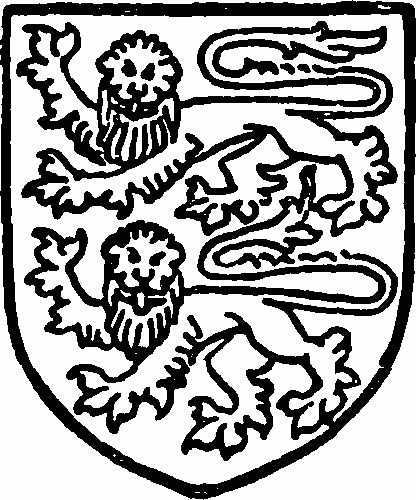
Barry. Azure two leopards or.
The wardship of Robert Barry was granted to Richard Blundel, (fn. 32) and in 1332, the year of his majority, an inquisition as to proof of his age was made, twelve witnesses coming forward with very varied evidence in his favour. (fn. 33) He married a wife Cecilia, (fn. 34) who survived him, dying in 1349. (fn. 35) Her heir was then their son William Barry, aged seven years. (fn. 36)
In 1377 William Barry and Margaret his wife made a settlement of the manor on themselves and William's issue, subject to a rent to John de Kyngesfold. (fn. 37) William Barry's name is given about this time as that of the tenant of the Wallingford Honour in Stanton Barry. (fn. 38) He was probably dead before 1399, (fn. 39) in which year Hugh Boveton of Yardley Gobion (co. Northampton) (who is said by some historians to have married the daughter and heir of William Barry) (fn. 40) and Parnel his wife made a settlement of the manor on Sir William Thirning on behalf of themselves and the heirs of Parnel. (fn. 41) Nine years later, in 1408, Sir William Thirning made a further settlement on John Fever and other trustees (including Reynold Boveton, chaplain) (fn. 42) probably preliminary to an alienation to William Vaux, who certainly obtained Harrowden (co. Northampton) from Sir William Thirning at this date, (fn. 43) and whose descendants are as certainly found in possession of Stanton Barry. William son of William Vaux was attainted in 1461, and this manor became forfeit to the Crown, (fn. 44) by whom it was granted to Ralph Hastings and later to Richard Fowler, who also received Preston Bissett (q.v.). (fn. 45) Nicholas Vaux obtained the reversal of his father's attainder in 1486, and the restoration of Stanton Barry and other of his father's lands. (fn. 46) He was created Lord Vaux of Harrowden on 27 April 1523 (fn. 47) and died within three weeks in possession of Stanton Barry Manor. (fn. 48) Thomas Lord Vaux, his son, made a settlement of Stanton Barry in 1535 (fn. 49) preliminary to a sale of much of his property, which took place about this date to Thomas Pope. (fn. 50) This sale was confirmed to Thomas Pope by statute of the realm in the same year, (fn. 51) but in 1536 there is mention of the purchase of Stantonbury from Thomas Pope by the Crown, (fn. 52) by whom it was granted eleven years later to Sir Thomas Carwardine. (fn. 53) He only retained the manor a few years, alienating it in February 1550–1 to John Coke, (fn. 54) and his son Robert Coke (fn. 55) in 1570 conveyed it to Edmund Ashfield, (fn. 56) whose leasehold rights under a grant from Lord Vaux had been specially respected in the sale of 1535. (fn. 57)
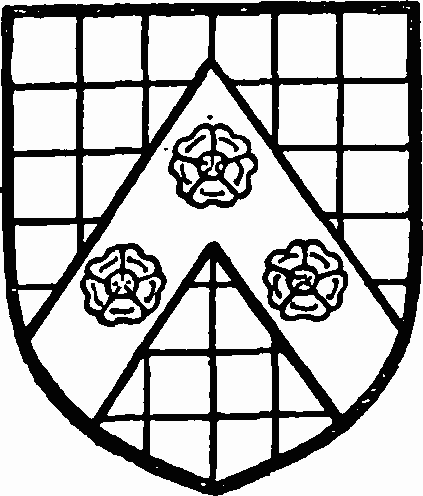
Vaux of Harrowden. Checky or and gules a cheveron azure with three roses or thereon.
Sir Edmund Ashfield died in January 1577–8 and Stanton Barry passed to his daughter and co-heir Avice wife of Edmund Lee. (fn. 58) Avice Lee survived her husband, dying in August 1599. (fn. 59) Her son and heir Edmund had died the previous March leaving two daughters, Dorothy and Mary, both minors. (fn. 60) Dorothy married before 1618 Sir John Temple, kt., bringing him in marriage half the manor of Stanton Barry. (fn. 61) Mary Lee and John Claver her husband conveyed her share of the manor in 1621 to Sir Thomas Temple, bart., of Stowe, father of Sir John Temple, kt., on whose behalf the transfer was made. (fn. 62) About this date the manor-house is said to have been rented by and in the occupation of Viscount Purbeck, who was then a lunatic under treatment by Dr. Napier, rector of the neighbouring parish of Great Linford. (fn. 63) Sir John Temple died in 1632, seised of Stanton Barry Manor, which then passed to his son and heir Peter Temple, aged nineteen. (fn. 64) In 1653 Sir Peter Temple made a settlement of his property in Stanton Bury on Sir John Wittewronge, kt., (fn. 65) which was confirmed by his son John Temple in 1658. (fn. 66) Four years later Sir John Wittewronge was raised to the title of baronet, being enrolled as of Stantonbury. (fn. 67) His family seat was at Rothamsted in co. Hertford, (fn. 68) but he is said to have built a house (which has now disappeared) in this parish for his eldest son John. (fn. 69) The first baronet died in 1693 and lies buried at Harpenden. (fn. 70) He was succeeded by the above-named son John, who together with his son John is found making a settlement of Stanton Bury Manor in 1695–6. (fn. 71) Sir John Wittewronge, bart., died and was buried at Stantonbury in 1697. (fn. 72) His son and successor, Sir John Wittewronge, bart., served in the war in Flanders, being colonel of a foot regiment known as 'Wittewronges' which was disbanded in 1717. (fn. 73) He sat as member for Aylesbury from 1705–13, and for Wycombe from 1713 until his death in January 1721–2. (fn. 74) A few months previous to his death he made a settlement of the manor in conjunction with his son John, (fn. 75) who about this date had to flee the country for the murder of Joseph Griffith, a mountebank, at the Saracen's Head in Newport Pagnell. (fn. 76) He returned to England some years after his father's death, and in or about the year 1727 sold his Stantonbury property to Sarah Duchess of Marlborough, (fn. 77) the sale being confirmed by Act of Parliament. (fn. 78) The Duchess of Marlborough died in possession of the manor in 1744, and under her will it passed under trust to her grandson John Spencer, (fn. 79) whose descendant Earl Spencer is now lord of the manor. (fn. 80)
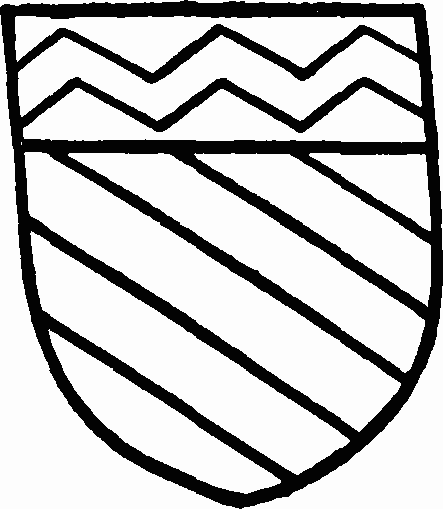
Wittewronge of Stantonbury, baronet. Bendy argent and gules a chief sable charged with a bar dancetty or.

Spencer, Earl Spencer. Argent quartered with gules fretty or and over all a bend sable charged with three scallops argent.
A view of frankpledge for the Wallingford Honour was held within this manor, (fn. 81) to which was also attached from the 14th to the 17th century the right of free warren and a free fishery. (fn. 82)
At Domesday there was a mill in this parish worth 10s. 8d. and fifty eels. (fn. 83) It is described as in decay in 1324. (fn. 84) There were said to be three water-corn-mills in the parish in 1653 (fn. 85) and 1695 (fn. 86) and four in 1721. (fn. 87)
Tickford Priory owned a small property in this parish. (fn. 88)
Church
The old church of ST. PETER consists of a chancel measuring internally 29 ft. 4 in. by 13 ft. 3 in., nave 25 ft. 6 in. by 18 ft. and north porch. It is built of rubble and the roofs are covered with tiles.
This small building has been subjected to so many alterations during the course of its history that it is difficult to determine the precise dates of some of its parts, but the chancel probably represents an early church to which a new nave, some 10 ft. longer than at present, was added during the first half of the 12th century. At some period an aisle, or chapel, since destroyed, was built on the south side of the chancel, and in the 13th century the north wall of the chancel was rebuilt and a north aisle added to the nave. The west wall of the nave was rebuilt in its present position in the 15th century. There is no evidence to indicate the date of the destruction of the north aisle and as yet no foundations have been disclosed, but it was probably completed in the 13th century and removed in the late 16th century, when the arcade was blocked and the north porch built.
The south wall of the chancel, which is unusually thick, is probably the oldest part of the building. It was pierced by two openings, now blocked, one a round-headed squint and the other, further west, a small archway, the head of which has been removed; both appear to have opened into a south chapel and probably date from the 12th century, though the material of the former may have been reset. A wide piscina, probably of the 14th century, with a plain pointed head and circular bowl, has been inserted at the east end of the wall. The east window, of three lights with interlacing tracery, dates from the 14th century, and over it is a circular light of the 13th century. On the north are two 13th-century windows, the eastern a single light with a modern external head, and the other of two lights with an external square head of the 16th century. There are two lockers at the east end of the north wall, both rebated for doors, one being square and having a small side recess and the other rectangular. The small chancel arch is a beautiful and fairly well preserved example of Norman work of about 1150. It is of two orders, the outer ornamented with cheveron moulding and the inner with a large roll with beak-head and grotesque ornament at intervals. Both orders are supported by detached shafts with carved capitals and moulded bases, the shafts being enriched with varieties of spiral zigzag and diaper ornament; one of the capitals is scalloped and the others have grotesque carvings of animals and birds. The arch itself has been strengthened by the insertion (probably in the 14th century) of a third order with a twocentred depressed head moulded in agreement with the original work.
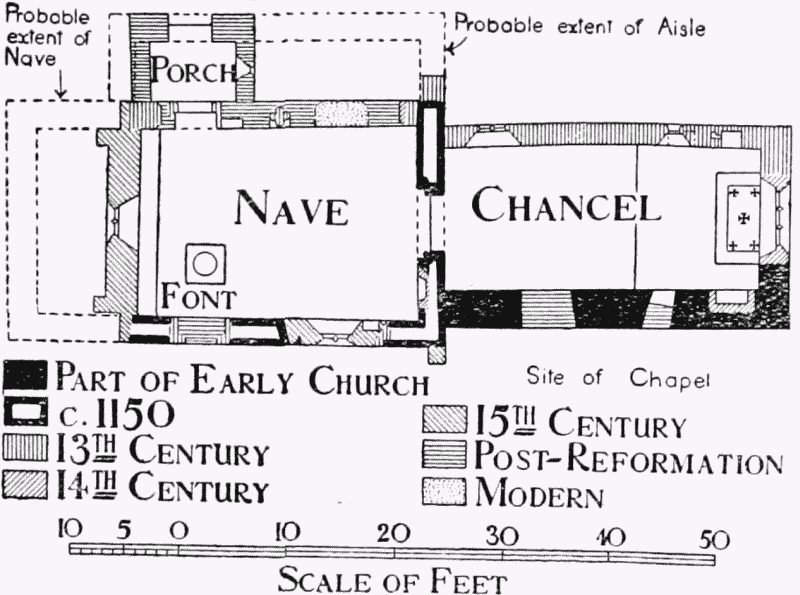
Plan of Stantonbury Church
The nave is lighted by two windows, one on the south and the other on the west, both of the 15th century and of two cinquefoiled lights with tracery under pointed heads. The walls of the nave and the roof having been lowered about 2 ft. 6 in., part of the head of the south window has been removed and the tracery blocked, but the west window, being in the gable, is intact, though the tie-beam passes in front of its rear arch. On the west side of the south window are the remains of a small 12th-century light, and on the east side are traces of a window of slightly later date, while near the west end of the wall is a pointed doorway of the 13th century with an indented label; all three are now blocked. At the east end of the south wall is a plain piscina with a mediaeval circular bowl, and in the east wall to the south of the chancel arch is a rough pointed image niche.
The north wall contains a mid-13th-century arcade, now built up, of two pointed arches supported by a quatrefoil pillar with moulded capital and base and responds with moulded corbels. The masonry blocking the eastern bay has been pierced by a wide window, now also blocked, and that of the western bay contains a reset pointed doorway, probably of the 13th century, and a stone fragment with two trefoiled panels which has also been reset and forms the west side of a wide recess near the doorway. High in the west gable is a small arched opening which contains a bell. A wide stone bench is carried along the west wall to the full width of the nave. The chancel has an open roof with collar-beam trusses incorporating some old timbers, and the nave an old roof of rough timbers with heavy tie-beams and a central queen-post truss. The porch is lighted by a small pointed window on the east and has a plain entrance with a depressed arch in a square head.
The font has a circular bowl developing below to an octagonal shape, somewhat in the form of a tumbler, an octagonal stem and square base. It probably dates from the 12th century, but the panels were recut in the 17th century. Two 13th-century coffin slabs, each with an incised cross, are now used as benches in the porch.
In the chancel are floor slabs to Clare Wittewronge (d. 1669); Sir John Temple (d. 1632) and Dorothy (Lee) his wife (d. 1625); Charle; Tyrell (d. 1694); and Eleanor (Tyrell) widow of Sir Peter Temple (d. 1671). A slab in the floor against the south wall appears to have supported on the three disengaged sides an iron railing which has been removed, together with everything else indicating the character of the monument inclosed. In the nave is a floor slab to the Rev. William Jenkins (d. 1783) and Ellen his wife (d. 1781). The carved oak pulpit dates from the 17th century, and on the wall near it are a funeral helm with the crest of a Saracen's head, gauntlets and sword, all of the 17th century, though the helm probably incorporates work of an earlier date. At the south-east of the nave is a table with rails and top of the 17th century, but the legs probably date from the 15th century. A 17th-century panelled oak chest has been removed to the new church.
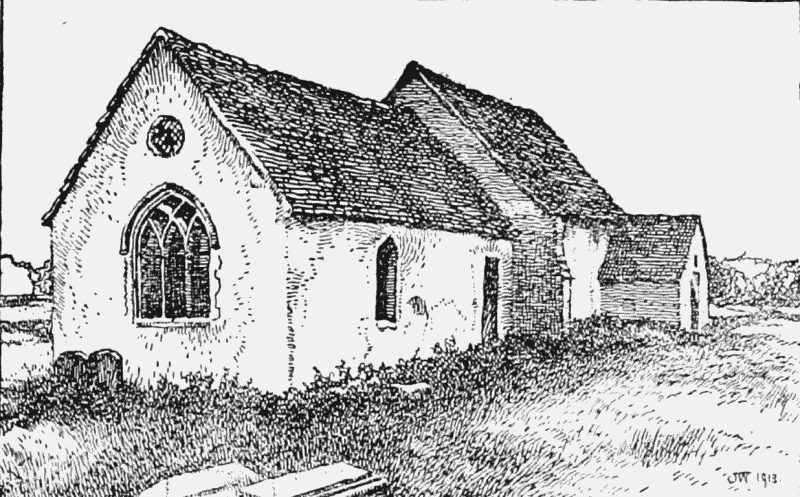
Stantonbury Church from the North-east
The small bell in the west gable has no inscription, but probably dates from the 16th or 17th century.
The communion plate includes a cup of about 1620, the date mark of which has been obliterated.
The registers begin in 1653.
Advowson
The church of Stantonbury formed part of the endowment of Goring Priory in Oxfordshire, as appears from a confirmation charter of 1181, when it was said to be the gift of William and Ralph Barry, brothers. (fn. 89) In 1220 the church was appropriated to the priory, (fn. 90) to which it continued to belong till the Dissolution, (fn. 91) when the vicarage was worth £7 6s. 8d., (fn. 92) the rectory being leased for a rent of 26s. 8d. yearly. (fn. 93) The rectory was granted by the Crown to Robert Newdigate of Haynes, Bedfordshire, and others in 1578, (fn. 94) and they immediately sold it to Edmund Lee. (fn. 95) He apparently also acquired the advowson, since it hereafter descends with the manor in his family. (fn. 96) Earl Spencer is the present patron. (fn. 97) In 1860 St. James's Church was erected at New Bradwell, and was henceforward used as the parish church, until in 1909 it was discovered that the instrument transferring the rights and privileges of a parish church from the old church of St. Peter to St. James had never been perfected. In consequence the vicar, the Rev. Allan Newman Guest, and the patron, Earl Spencer, obtained a special Act of Parliament for securing legal status for all marriages hitherto solemnized there.
John Mason (1646 ?–94), the enthusiast and poet, was vicar of Stantonbury from 1668 to 1674. (fn. 98)
There do not appear to be any endowed charities subsisting in this parish.