A History of the County of Buckingham: Volume 4. Originally published by Victoria County History, London, 1927.
This free content was digitised by double rekeying. All rights reserved.
'Parishes : Stony Stratford', in A History of the County of Buckingham: Volume 4, ed. William Page (London, 1927), British History Online https://www.british-history.ac.uk/vch/bucks/vol4/pp476-482 [accessed 30 April 2025].
'Parishes : Stony Stratford', in A History of the County of Buckingham: Volume 4. Edited by William Page (London, 1927), British History Online, accessed April 30, 2025, https://www.british-history.ac.uk/vch/bucks/vol4/pp476-482.
"Parishes : Stony Stratford". A History of the County of Buckingham: Volume 4. Ed. William Page (London, 1927), British History Online. Web. 30 April 2025. https://www.british-history.ac.uk/vch/bucks/vol4/pp476-482.
In this section
STONY STRATFORD
Straford, Stoni Strafford, Stani Stratford, StonyStretteford (xiii cent.).
The market town and ancient borough of Stony Stratford stands midway between Towcester and Fenny Stratford on Watling Street, which divides it into two portions corresponding to the ecclesiastical parishes of St. Giles and St. Mary Magdalen respectively. The West side was formerly in the parish of Calverton, and the common lands here, with the exception of Horse Fair Green, were inclosed under the Act dealing with Calverton in 1782. (fn. 1) The suburb of Calverton End is still included in that parish. The East side lay in Wolverton, which still contains the suburb of Wolverton End, formed into the ecclesiastical parish of Wolverton St. Mary in 1870. (fn. 2) These two portions were made independent parishes by Act of Parliament towards the end of the 18th century, and by a Local Government Board Order of 25 March 1883 a detached portion of Calverton called Stratford Bridge Meadows was amalgamated with Stratford St. Giles.
The area of the West side is 84 acres, of which 15 acres are grass land and 1 acre arable land. (fn. 3) The population in 1901 was 1,395. (fn. 4) The East side is smaller, having an area of 69 acres, 20 of it being grass, and a population of 958. The inhabitants were formerly chiefly engaged in the manufacture of lace, but that industry has now practically died out. Mr. Edward Hayes's engineering works employ a number of people.
Stony Stratford lies low, varying only from 220 ft. to 240 ft. above the ordnance datum; it is almost encircled by the River Ouse, which here forms the county boundary.
The town is small, consisting mainly of one narrow street, Watling Street, which here becomes the High Street for about three-quarters of a mile, crossed near the market-place by a road leading to Calverton and Wolverton respectively. From its position on Watling Street, Camden and many others suggested Stony Stratford as the site of the Roman station Lactodorum, (fn. 5) and numerous Roman remains have been found in the neighbourhood, (fn. 6) but later research has almost conclusively assigned the Roman station to Towcester. (fn. 7) North of the junction of Watling Street and Calverton Road lies the Market Square, near which is the church of St. Giles. Almost opposite, on the east side, are the remains of the church of St. Mary Magdalen. Though spared in a fire which swept the town in 1736, when fifty-three houses were destroyed, the church, together with 113 houses, was burnt six years later, when the damage was estimated at £10,000. (fn. 8) The tower is the only part now standing. Probably by reason of these fires few ancient houses survive. The 'King's Head' in the Market Square dates from the early part of the 17th century, and there are some other houses, mostly built of rubble with tiled roofs, of this date in the High Street. Two shops on the west side of this street, now numbered 95 and 97, may perhaps have been originally built in the 15th century, but have been much altered subsequently. To the north of the church is St. Paul's College, founded in 1863 as a middle class school, and used since 1900 as a home for orphan boys. There is incidental reference in the middle of the 14th century to a 'Scolhous' in Stony Stratford which was to be used for the chapel of St. Thomas the Martyr. (fn. 9) In this part of Stony Stratford, called Bridge End in the 16th century from its proximity to the bridge spanning the Ouse, (fn. 10) stood the leper hospital of St. John the Baptist without Stony Stratford. It was described in the 14th century as situated near 'le Shrob' and the causeway leading to the bridge. (fn. 11) It was in existence probably before about 1240, in which year William de Paveli bequeathed 12d. 'infirmis de Straford,' (fn. 12) and certainly before 1257. (fn. 13) In 1329, however, the master and brethren were found to be 'without the means of living unless others come to their aid,' (fn. 14) and in 1352 their chapel was 'for the most part in ruins.' (fn. 15)
The old bridge across the Ouse, which here separates Stony Stratford from Old Stratford in Northamptonshire, was partly destroyed in the Civil War and became very dilapidated, (fn. 16) so that in 1801 an Act was passed for repairing it. (fn. 17) In 1835 a new bridge was built under an Act of Parliament of 1834 (fn. 18); it is on an enlarged plan, and consists of three stone arches with a long raised causeway for carrying off floods. On the bank of the Ouse, not far from the Market Square, is a corn-mill, perhaps standing on the site of the one which with the capital messuage called Malletts, held of Henry Longville of Wolverton Manor, was bought by John Penn from Thomas Pigott in 1581. On his death in 1587 he bequeathed the mill to his son Thomas Penn, (fn. 19) who died in 1618. (fn. 20) At Calverton End on the West side, near the Stony Stratford Waterworks, is the cemetery with two mortuary chapels opened in 1856 at Galley Hill. To the south of the market square is a Methodist chapel built in 1844, and near it, on Horsefair Green, is the Baptist chapel on the site of the one founded in 1656. Some fittings of the 17th-century building remain, and also a wooden window frame, preserved in the vestry. There is another chapel, dating from 1823, on the Wolverton road.
Nonconfor mists were active here in the 17th century, and in 1661 John Crook, a Quaker minister, was arrested with seven others for attempting to hold an illegal meeting in the neighbourhood. (fn. 21) In 1672 the house of Edmund Carter was licensed for Presbyterian worship. (fn. 22) On the other hand Thomas Smith of Stony Stratford was apprehended in 1652 on suspicion of being a Jesuit, (fn. 23) and in 1666 the house of John Digby, son of Sir Kenelm Digby, a strong Papist, was searched and 300 arms found. 'They were not taken away, but he took it so ill that he went away in his coach and six horses.' (fn. 24)
Stony Stratford was once a place of considerable importance, owing to its position on Watling Street. Letters Patent were dated from here by King John in 1215 (fn. 25) and by Henry IV in 1409, (fn. 26) Letters Close and writs in 1309 (fn. 27) and 1329. (fn. 28) It was one of the resting-places of the body of Queen Eleanor, and the Cross stood until the Civil War, when it was destroyed. (fn. 29) From its proximity to the Northamptonshire Salcey Forest, Stocking Wood, near Stony Stratford, being deemed part of that forest in the 13th century, (fn. 30) it was a good hunting centre, and Edward IV hunted in Wychwood Forest in this neighbourhood in 1464. (fn. 31) Many references to the forester of Stony Stratford occur. (fn. 32) Edward V slept here with his half-brother Lord Richard Grey on his journey to London in 1483, when the latter, along with Lord Rivers and Sir Thomas Vaughan, was taken prisoner by Richard Duke of Gloucester. (fn. 33) Shakespeare alludes to this in Richard III,' (fn. 34) where the lines 'Last night I heard they lay at Stony Stratford' occur. Margaret of Scotland dated from here a letter in 1516 to Henry VIII, (fn. 35) who himself sent letters from Stony Stratford on 8 and 20 September 1525. (fn. 36) Hungarian ambassadors sent on an embassy to him were here in 1531, (fn. 37) and the king appears to have been at Stony Stratford again in 1540, as one of the tapsters, who vagrantly followed the court and enhanced the price of victuals, was condemned to sit in the pillory at Stony Stratford with a paper on his head. (fn. 38) The plague was virulent in this part of the country in 1537; the unemployment and discontent arising therefrom probably accounted for the affray which took place at that time between the shoemakers and organ player of the town, resulting in the appearance of six shoemakers at the assizes at Little Brickhill. (fn. 39)
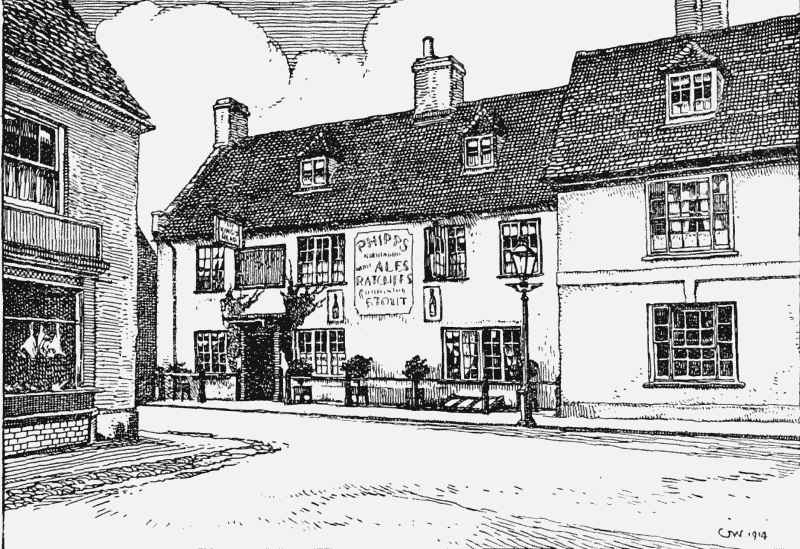
The 'King's Head,' Stony Stratford
The 16th and 17th centuries probably saw the height of prosperity of the town; its situation on the great road to Ireland by way of Chester was a cause of much enrichment. (fn. 40) It was a noted rendezvous for pack-horses and a baiting station for travellers, (fn. 41) whose accommodation was provided for by several good inns. The 'Cock,' the most celebrated, is mentioned in 1500–15 (fn. 42); it was left in 1520 by Thomas Pigott of Beachampton, serjeant-at-law, for the maintenance and repair of the bridges. (fn. 43) The 'Rose and Crown,' another important inn, was left by the will of Michael Hipwell in 1609 to found a grammar school, (fn. 44) and though it was at first used for that purpose the school later found another house, and the old building was let by the proprietors, the Church of England school managers, who devoted the rent to the upkeep of the school. The 'White Horse,' which belonged to the gild, was the subject of a dispute between the wardens and their lessees in the reign of Henry VIII. (fn. 45) It afterwards came into the possession of William Matthew, whose son and heir inherited it in March 1608–9. (fn. 46) The 'Swan,' a 15th-century inn, (fn. 47) appears perhaps as the 'Swan with Two Necks' in 1609, (fn. 48) the 'Three Swans' in 1667, (fn. 49) again as the 'Swan with Two Necks' in 1691, (fn. 50) and the 'Three Swans' the following year. (fn. 51) The 'Red Lion' was the cause of a quarrel between William Edy's heirs in 1529 (fn. 52); there is mention of the 'George' in 1609, (fn. 53) and of the 'White Hart' in 1625. (fn. 54) The innkeepers were not always above suspicion, Greathead, one of them, being accounted 'a notable bad fellow' in 1596, both he and Thomas Car, another innkeeper, being common receivers. (fn. 55) Troops were frequently in the neighbourhood of Stony Stratford in the Civil War, (fn. 56) and the Earl of Cleveland maintained a station here for the king, who himself passed through on his way to Woburn. (fn. 57) The town, however, appears to have suffered in no way and remained a 'populous and much frequented market town.' (fn. 58) The descriptions given by 17th and 18th-century travellers are by no means flattering. Baskerville, who was in Stony Stratford in May 1681, calls it 'a town of very ordinary building,' (fn. 59) while another writer nearly a century later is no kinder: 'a small straggling town, not remarkable in any shape.' (fn. 60) Hassell in 1819 complained that it was 'most vilely paved with stones of various dimensions,' (fn. 61) and that after an Act had been passed in 1801 for paving the streets. (fn. 62)
Theophilus Eaton, the first governor of New Haven, was born at Stony Stratford about 1590. (fn. 63) Benjamin Holloway, an 18th-century divine, was also born here about 1691. (fn. 64)
The following place-names occur: Le Shrob (fn. 65) (xiv cent.) and Bozardes (fn. 66) (xvii cent.).
Borough
There are no borough records extant for Stony Stratford, and the incidental references to the borough are few, but to a large extent it presents the same features as Fenny Stratford. Both towns occupy important positions on Watling Street and were interested in the maintenance of their bridges in a state of good repair, that of Stony Stratford spanning the important waterway of the Ouse. The organization of the burgesses of Stony Stratford appears to be in as elementary a state as that of the burgesses of the sister town. The towns were linked together by the traders passing along Watling Street, and both were centres of commerce, focussing the industrial and agricultural activities of thesurrounding country in their weekly markets and periodical fairs. It was therefore essential that the bridge which afforded access to the west and north of England should not be allowed to fall in decay, and Hugh de Vere Earl of Oxford paid half a mark for bridge vigil in 1254. (fn. 67) The bridge of Stratford mentioned in 1276 (fn. 68) probably refers to this one, for which pontage grants were made in 1349, (fn. 69) 1352 (fn. 70) and 1380. (fn. 71) The first of these grants was partly, and the second wholly, for repair of the causeway adjacent to the bridge, and in 1391 a grant of pavage for four years to repair the highway between the two Stratfords was made to John Lughton and John Haywood, 'ermyte.' (fn. 72) The ancient tolls taken at the bridge served as a model, among others, for those to be levied on Bow Bridge in the 17th century. (fn. 73)
These grants of pontage were generally made to individuals by name, but that of 1349 was to the bailiff and good men of Stony Stratford. (fn. 74) The order in September 1380 to lay in a store of provisions against the coming of the king's lieges on their way to the Parliament at Northampton was likewise addressed to the bailiff and true men of Stony Stratford. (fn. 75) At a court held there in 1420 by the steward one of the witnesses in a se about injury to horses was Thomas Brasyer, bailiff and burgess of Stony Stratford. (fn. 76) The bailiff and the constable of the place were together indicated in 1573 for stealing a horse from Robert Jonson. (fn. 77) These officers were probably appointed by the lord of the manor, and not elected by the commonalty. The chief corporate action of the burgesses appears to have been the regulation of the gild of St. Mary and St. Thomas the Martyr, a corporate body with a common seal with power of pleading and being impleaded. Licence to found this gild was given to John Edy and others in 1476. It was to consist of two wardens elected yearly, who could be removed and others appointed at pleasure, and a number of brothers and sisters who could dress themselves in one suit of gowns or hoods. They had power to acquire land to the value of 20 marks a year, in order to find two chaplains to celebrate divine service (in the chapel of St. Mary Magdalen and St. Giles) and for other works of piety. (fn. 78) In 1547 the gild was known as the fraternity of our Lady and was valued at £13 4s. (fn. 79) There were two priests, who had no other living and who doubtless officiated in the chapels of St. Mary Magdalen and St. Giles (see below). There must have been a flourishing business community in the 15th century, when references occur to the trades of ironmonger, (fn. 80) chapman, (fn. 81) woolman (fn. 82) and brewer, (fn. 83) and in the 16th century there were many shoemakers engaged in business here. (fn. 84) The Flemish refugees of the 15th century probably brought new industries to Stony Stratford, (fn. 85) though the only one specified when the oaths of fealty were taken was that of a wheelwright. (fn. 86)
An outlet for the goods produced by the townspeople was provided by the weekly market. No grant has been found conferring this privilege, nor is the day of the week on which it was held mentioned, but it was probably granted to Hugh de Vere Earl of Oxford about the time he obtained the fair, and was located on the west side of Stony Stratford, towards Calverton. It was given in dower to Anna wife of Aubrey de Vere, ratified to her in 1462, (fn. 87) and is mentioned regularly as an appurtenance of the manor of Calverton in the 16th and 17th centuries. (fn. 88) The town unsuccessfully petitioned for a market on the east side of Stony Stratford in 1657, (fn. 89) and the weekly Friday market granted in 1662 by Charles II to Simon Bennett and his heirs (fn. 90) was doubtless held as of old on the west side. By 1792 the market had ceased to be held, but had been revived in 1888. (fn. 91) There is still a corn market on Friday, and also a cattle market on the first Monday in every month.
An annual fair on the vigil, the feast and the morrow of St. Giles (1 September) was granted to Hugh de Vere in 1257. (fn. 92) In 1290 he had a grant of an additional fair on the vigil and feast of St. Mary Magdalen (fn. 93) (22 July). John de Vere in 1334 sued Simon Gobion and others for carrying away his goods at Stony Stratford and Calverton and for assaulting his servant John Dagenham while collecting toll and other profits belonging to his fair and market at Stony Stratford, as well as merchants and others offering their wares there, compelling them to withdraw. (fn. 94) The fair was held with the market in the 16th and 17th centuries. In 1662 Charles II granted four annual fairs in the west part of Stony Stratford, the first on Friday before the feast of St. Michael the Archangel (29 September), the second on the feast of All Saints (1 November), the third on 9 April and the fourth on Wednesday before the feast of Pentecost. (fn. 95)
In 1792 there were three annual fairs, 2 August, Friday before 10 October and 12 November. In 1888 there was only one fair, on 2 August, (fn. 96) which is still held on that day and the day following.
Manors
Neither of the manors in STONY STRATFORD is recorded in the Domesday Survey. The west side was then part of Calverton, with which it has always descended. It first occurs as a separate manor in 1257, (fn. 97) and was subinfeudated by the Earls of Oxford. It was held by Robert Broughton, who died seised of it in 1506. (fn. 98) His son John in 1516 made a settlement of the manor in view of the proposed marriage of his infant son John with Dorothy, one of the daughters of Thomas Earl of Norfolk, one of the trustees named being Thomas Wolsey, Archbishop of York. (fn. 99) John Broughton died in January 1517–18, and was succeeded by his son, (fn. 100) but the manor evidently reverted to the Earls of Oxford shortly afterwards.
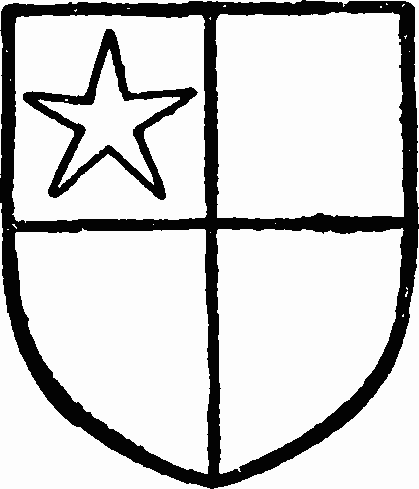
Vere. Quarterly gules and or with a molet argent in the quarter.
A fishery in the Ouse occurs as an appurtenance of this manor from the 16th century. (fn. 101)
The east side formed part of the manor of Wolverton, (fn. 102) with which it has always descended. It appears to have ranked as a separate manor in the 16th century. (fn. 103)
Churches
The church of ST. GILES, consisting of a chancel, nave, north and south aisles, vestries and west tower, was built originally in the late 15th century as a chantry chapel, but having become dilapidated (fn. 104) was, with the exception of the tower, entirely rebuilt in 1776. It is constructed in the Gothic style, as understood at that period, and has a lofty nave with north and south arcades and a groined plastered ceiling, the clustered pillars of the arcades being composed of iron encased in wood. The pointed tower arch in the west wall of the nave dates from the late 15th century, and is of two moulded orders with shafted responds.
The tower, which is built of squared stone, is of four stages with clasping buttresses and surmounted by an embattled parapet. In the west wall of the ground stage is a four-centred doorway with a modern window above, while the third stage has a square moulded panel and a narrow light on the west. The bellchamber is lighted from each side by a traceried window of two lights.
The font is modern. At the east end of the north aisle is a marble monument in memory of Barbara Ripington of Armington (d. 1775), and at the east end of the south aisle is a monument commemorating Leonard Sedgwick, vicar of the parish and Prebendary of Lincoln (d. 1747). There is a 15th-century traceried chest in the north aisle with a lid of later date, and in the vestry is an early 17th-century desk enriched with carved dragons and arabesque work.
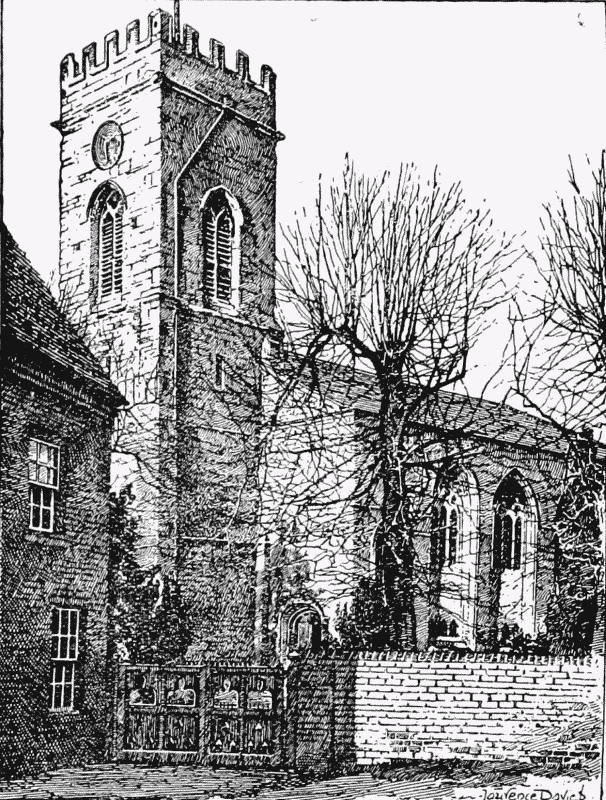
Church of St. Giles, Stony Stratford, From The South-West
The tower contains a ring of six bells, all by W. & J. Taylor of Oxford, 1837–8, and a small bell, uninscribed, but evidently by the same makers.
The communion plate includes two pewter plates, dated 1696, which originally belonged to the church of St. Mary Magdalen.
The registers begin in 1738.
The church of ST. MARY MAGDALEN has never been rebuilt since its destruction by fire in 1742, but by the efforts of Browne Willis the west tower was repaired and the arches of the ground stage built up soon after the disaster 'in order to preserve it, to have the Church rebuilt again to it.' (fn. 105) In the 19th century an elder tree grew out of the walls at the top of the tower and became a menace to that part of the fabric, (fn. 106) but in 1893 the tree was removed and the structure was again repaired. The tower is of three stages with clasping buttresses to the two lower stages and is surmounted by an embattled parapet with small gables on the north and south. It is built of limestone, and dates from about 1450. (fn. 107) On the east and south sides of the ground stage are pointed arches, now blocked, which opened to the nave and south aisle respectively, the aisle evidently having extended to the west wall of the tower, and on the west is a blocked two-light window. The second stage has on the west a square moulded panel and a narrow light, and the bell-chamber has on each side a transomed window of two lights with tracery under a pointed head. Boldly carved gargoyles occupy the angles of the string-course below the parapet.
Advowson
There was apparently a church at Stony Stratford before 1202 and 1203, in which years references are made to Richard the clerk, (fn. 108) Peter the clerk, (fn. 109) Roger the clerk (fn. 110) and William the priest. (fn. 111) There is no mention of either of the present churches by name till 1476, (fn. 112) in which year a chantry was founded 'in the chapel of St. Mary Magdalen and St. Giles.' (fn. 113) They were chapels of ease to the mother churches of Wolverton and Calverton respectively. (fn. 114) In the early 16th century there was trouble between the vicar of Wolverton and the parishioners of St. Mary Magdalen, who were supported by the Prior of Bradwell, patron of Wolverton. It was settled by an order of the Bishop of Lincoln that there was to be one chaplain for the said chapel, the vicar of Wolverton taking the mortuary fees, oblations and tithes of milk, &c. (fn. 115) At the dissolution of the chantries a few years later St. Mary Magdalen was referred to as a free chapel, half a mile distant from Wolverton Church, with two priests, to one of whom was allotted a portion of the tithes of belonging to Wolverton vicarage, while the other was maintained by the gild of Stony Stratford. (fn. 116) Shortly after 1641 the two chapels in Stony Stratford were united, and services were held in them alternately. (fn. 117) This arrangement proved inadequate for the needs of the people: 'the inhabitants were forced to build a great gallery in St. Giles, and many people were forced to remain at home for want of accommodation.' (fn. 118) Before 1648 two separate parishes were created, each with its own chapel, (fn. 119) the parishioners of St. Mary Magdalen complaining in 1651 that through neglect they were prevented from enjoying a grant of £50 a year from the rectory of Wolverton, sequestered for the Earl of Northampton's delinquency. (fn. 120) St. Mary's Church being burnt down in 1742, St. Giles became the only church, and as it was then 'too small and ancient and decayed building,' briefs were issued for its repair and enlargement in 1774–5 and 1779–80. (fn. 121) In 1852 the advowson was transferred from the Bishop of Lincoln to the Bishop of Oxford. (fn. 122)
By his will in 1534 William Bystocke desired to be buried on the south side of the Lady Chapel in St. Giles, and gave a legacy to the making of St. Catherine's vestry. (fn. 123)
In 1346 licence was granted to the good men of Stony Stratford to found a chapel in honour of St. Thomas the Martyr in a place called 'Scolhous' in Stony Stratford, and to endow it and ordain a chantry in it for a chaplain to celebrate divine service daily. (fn. 124) There is no further mention of this chapel, but its name suggests that it may have been connected with the chief gild of the town, licence to found or refound which, as the gild or fraternity of St. Mary and St. Thomas, was granted in 1476. (fn. 125)
Charities
The Grammar School, founded by Michael Hipwell.— The official trustees hold a sum of £416 19s. under the title of 'The Rose and Crown Charity,' representing sales of certain lands belonging to the school, producing £12 10s. yearly.
Sir Simon Bennett's Charity.— In 1911 the share of this parish for the poor amounted to £19 13s., which was applied in the distribution of clothing and coal, and the sum of £12 18s. was paid to the Stony Stratford and Wolverton Rural District Council for the repair of the highways. (See under parish of Calverton.)
Charity of Simon Bennett, or the Bradwell Estate Charity.— The share of this parish in 1911 amounted to £17 10s., which was applied in the distribution of clothing and coal among widows and aged persons. (See under parish of Calverton.)
Whitnell's bread charity is endowed with 14 a. in the hamlet of Denshanger in Passenham (Northants), purchased in 1692 with a legacy of £50, by the will of Silvester Whitnell, dated 2 February 1684–5, (fn. 126) and a gift of £40 by Mrs. Elizabeth Collins. The land is let at £14 a year, the net income of which is distributed in bread.
The bell-rope charity, formerly consisting of an acre of land in Calverton, is now represented by £180 16s. 10d. consols in the individual names of the church wardens, the annual dividends of which, amounting to £4 10s. 4d., are carried to the churchwardens' accounts for providing bell-ropes, &c.
The charity of John Whalley, founded by will, proved in the P.C.C. 15 February 1670–1, and comprised in an order of the High Court of Chancery, 1834, is endowed with a farm at Hartwell (co. Northampton), containing 179 a. 1 r. 29 p., let at £140 a year, and 2 a. or. 39 p. of land and four cottages at Cosgrove (co. Northampton), producing £22 11s. 8d. yearly. The charity is regulated by schemes of the Charity Commissioners of 1866, 1899 and 1904. The income is subject to the payment of £4 a year to the curate of Hartwell. In 1912 the sum of £25 was applied towards school expenses, £85 for apprenticing in Stony Stratford and Cosgrove generally, and £20 was applied specifically for apprenticing duly qualified boys at the railway carriage works at Wolverton in pursuance of the scheme of 1904. There was a balance at the bank of £322.
The charity of Edmund Arnold, or the Furthoe charity, founded in 1689.– In 1911 the sum of £52 18s. 9d. was apportioned by the trustees of Arnold's general charity for apprenticing and education in Stony Stratford, and the sum of £13 4s. 8d. was apportioned out of the same charity for the benefit of the poor, the recipients to be members of the Church of England. The sum of £20 is also paid annually to the vicar of Stony Stratford.
The bridge and street charities, originally founded by John Pigott, serjeant-at-law, who died in February 1519–20, (fn. 127) by John White in 1674, by John Mashe and other donors unknown, are endowed with a farm at Loughton, known as the Manor Farm, containing 144. a., let at £200 a year, purchased under an Act of 1801 (fn. 128) with the proceeds of sale of the original property belonging to the charities, and 1 a. 2 r. in Stony Stratford, known as the Town Close, let at £4 10s. a year, and manorial rights in Market Square and Horse Fair Green, the income therefrom being variable. In 1911 the sum of £17 9s. 6d. was received from tolls. The net income is applied in lighting and paving and cleaning. By an order of the Charity Commissioners of 8 July 1913 the trustees were authorized to borrow a sum of £1,400 at 4¼ per cent. for effecting improvements on the Manor Farm and for paying off certain existing debts, the sum to be repaid within thirty years.
John Oliver by his will, proved at London in 1862, bequeathed £500, now represented by £534 1s. consols, the annual dividends of which, amounting to £13 7s., are applicable in the payment of £3 3s. to the Northampton Hospital, and the surplus to be divided on Christmas Day amongst ten of the poorest of the parish.
A sum of £2 a year was formerly paid out of a cottage situate on the east side of the town and applied for the benefit of the poor under a codicil to the will of Thomas Oliver, proved at Westminster 7 April 1657.
William Parrott by deed dated 22 July 1881 declared the trusts of a sum of £297 14s. consols, the dividends of £7 8s. 8d. a year to be applied in January in the distribution of coats, cloaks and bonnets to widows and spinsters under sixty years of age. The two sums of stock above mentioned are held by the official trustees, who also hold a further sum of £151 10s. 4d. consols, producing £3 15s. 8d. yearly, which is payable under the will of Thomas Smith to the Baptist minister.
By an order of the Charity Commissioners of 10 September 1888 a residence for the Baptist minister, situate upon the Green, was purchased partly with the proceeds of the sale of the minister's residence, formerly held by the trustees, and partly from private sources.