
A History of the County of Buckingham: Volume 4. Originally published by Victoria County History, London, 1927.
This free content was digitised by double rekeying. All rights reserved.
'Parishes : Wavendon', in A History of the County of Buckingham: Volume 4, (London, 1927) pp. 489-496. British History Online https://www.british-history.ac.uk/vch/bucks/vol4/pp489-496 [accessed 18 April 2024]
In this section
WAVENDON
Wafanduninga (fn. 1) (x cent.); Wavendone (xi cent.); Wauenden (xii-xvi cent.); Wavyngdon, Warnden (xiv cent.); Wandon (xviii cent.).
The parish of Wavendon has an extent of 2,192 acres, and of these 1,285 are permanent grass, 682 arable land and 190 woods and plantations. (fn. 2) The soil is stiff loam and sand, the subsoil clay and gravel. The chief crops are wheat, oats, beans and barley. The parish is bordered on the north and east by Bedfordshire, the boundary on the north being formed by a tributary stream, flowing westward, of the Ouzel River. The land in this district is about 220 ft. above the ordnance datum; it rises steadily towards the south until the high ground and hilly district of Wavendon Heath is reached, the height here being from 400 ft. to 500 ft. This part of the parish, open heath and woodland, forms a great contrast to the thickly populated district on its eastern border. Further north, again, in Wavendon village, the land is fairly well built over; in the extreme north, save for a few farms, there is practically nothing but open fields. In the village are several 17th-century cottages of half-timber, many of them having thatched roofs. In 1740 the Rev. W. Cole mentioned the following districts or hamlets in Wavendon—Church End, Cross End, Duck End, In the Heath, Hogsty End, Longslade, East End and Green End, (fn. 3) and some of the names are still preserved.
The manor-house in Cross End is probably that acquired in 1653 by James Selby from the Worrall family. (fn. 4) It is an E-shaped Elizabethan house, built of timber framing with brick filling, now coated with rough-cast, and has tiled roofs. It underwent considerable alterations at the beginning of the 18th century, and many of the existing fittings were inserted at that date. James Selby's chief property here appears to have been the mansion at Green End, now Wavendon House. (fn. 5) This he partly rebuilt, and his son in the 18th century greatly enlarged it, making gardens, canals and fish-ponds and planting orchards and avenues of trees. (fn. 6) The Hoare family, subsequent possessors, again enlarged it. (fn. 7) At present it is owned by Sir H. H. A. Hoare, bart., and is the residence of Mr. Francis Edward Bond.
The Manor Farm, opposite the church, in the centre of the village, is thought to have been built on the site of the house belonging to the Passelewe family in the 14th century. (fn. 8) It was sold about 1907. (fn. 9) There are Wesleyan and Primitive Methodist chapels in Wavendon.
It is not evident when the fuller's earth pits in the south-east of the parish first began to be worked. What appears to be the earliest mention of these pits occurs in 1539, when they were leased to John Sheppard, who later held the Earl of Devonshire's manor, as a parcel of the lands called the 'Clay pits' in which the 'Fullers erthe' is. (fn. 10) A suit heard in January 1578–9 between Henry Charge, lord of Mordaunts Manor, and Thomas Wells, part owner of the Earl of Devonshire's manor, is interesting as throwing light on the conditions under which the pits were held. (fn. 11) Charge, as lessee of Richard Moreton, brother-in-law of Wells, claimed half the profits of those earth pits of which Moreton and Wells were tenants in common, stating that the earth sold out of the pits was 'very profitable and commodious for fulling.' Wells, not allowing the justice of Charge's plea, had claimed for himself alone the earth pit, which he would have opened by himself had he not been persuaded by the other owners and leaseholders to conform to the usual custom and to enjoy the joint advantages of co-operation. Their method of work was to open only one pit yearly out of the total five, whereby a £10 profit was assured to every owner. The final decision in the suit is not known. The pits were originally worked by removing the upper layers of sand, but in Lipscomb's time they were 'subjected to the usual operation of miners,' a shaft being driven into the hill. (fn. 12) Lysons, about 1813, stated that at that time only one pit was occasionally worked, as the sale of the earth had greatly diminished, owing to the practice of the dealers of procuring inferior earth from elsewhere and selling it as the product of this neighbourhood. (fn. 13)
Among place-names are Hardwick Wood and Maggott's Close in the 17th century. (fn. 14)
An Act for inclosing lands in the parish was passed in 1788, (fn. 15) the award bearing date 9 March 1791. (fn. 16) Wavendon at that time included in its bounds the district called Hogsty End, now known as Woburn Sands, which was formed into a civil parish in Bedfordshire in 1907. In the 17th and 18th centuries it was one of the most important (fn. 17) centres of the Society of Friends in Buckinghamshire. The Quakers had a meeting-house and a burial ground here. The earliest notice of them occurs in the parish register under 1658, when 'a child of George Cooper was born and not baptized he being a Quaker, died, & he buried where he pleased.' Soon after the wife of a Quaker died and was 'putte into the ground by him a Quaker'; another Quaker who died was 'buryed in his garden.' In 1659 there is a record that 'Friends riding to a meeting at Wandon had their horses confiscated as a punishment for Sunday travelling.' Frequent references to burials in the Hogsty End ground occur in the 18th century, it being often added that the dead were 'buried in woollen according to law.'
Manors
In the time of Edward the Confessor Golnil, a house carl of the king, held a manor here, assessed at 2 hides, which belonged to the Count of Mortain in 1086. (fn. 18) A second manor of 2 hides, which also belonged to the count, had been held by Brictuin, a man of Earl Harold, before the Conquest. (fn. 19) Chentis, a man of Leventot son of Osmund, had held 3 virgates which in 1086 formed the Count of Mortain's third holding in Wavendon. (fn. 20) The count's tenant in the last-named portion was Humfrey, (fn. 21) but the land was probably amalgamated with one of the larger portions.
It seems probable that the first of the two manors was the manor of Wavendon known in the 16th and 17th centuries as MORDAUNTS MANOR. The manor was afterwards attached to the honour of Berkhampstead, and was held of it as of the manor of Langley Chenduit, (fn. 22) the overlordship being last mentioned in 1640. (fn. 23) Ralf, the count's tenant in Wavendon in 1086, was therefore probably identical with the Ralf of Langley, the ancestor of the Chenduit family, who held the Hertfordshire manor afterwards. (fn. 24)
Paul Pever had obtained the manor of Wavendon before 1243, in which year he was granted free warren. (fn. 25) About the same date he also acquired Chilton (q.v.), with which manor, and with Marsworth (q.v.) later belonging to the Pever family, Wavendon descended until about the middle of the 14th century. (fn. 26)
The Pever holding in Wavendon was augmented in 1314 by the acquisition by that family of Passelewes manor, and the two estates were thenceforth held as 'the manor of Wavendon' until they were again separated in the 15th century. The overlordship rights are, however, always distinguished. The Pevers' original moiety consisted of a capital messuage and a carucate of land, while the other formerly held by the Passelewes comprised a carucate of land and the church. (fn. 27) In 1359 Wavendon was alienated by Nicholas Pever to Sir Henry Green, (fn. 28) afterwards of Drayton (co. Northampton), at whose death ten years later it passed by settlement to his second son Henry. (fn. 29) Henry died in 1399, [when Wavendon descended to his son and heir Ralph, (fn. 30) at whose death without issue in 1417 his brother John inherited. (fn. 31) Henry Green succeeded his father John in 1433, (fn. 32) and by his wife Constance (fn. 33) had a daughter and heir Constance, who inherited Wavendon at her father's death in 1468, when she was the wife of John Stafford, third son of the first Duke of Buckingham. (fn. 34) He was created Earl of Wiltshire in 1470, a title inherited in 1473 by Edward, his son by Constance. (fn. 35) Edward died without issue in 1499, (fn. 36) and Wavendon passed to his cousins the daughters of Henry Vere of Great Addington, Northamptonshire, who had died in 1493, (fn. 37) and to whom the reversion had descended from his mother Isabel Green, wife of Richard Vere and aunt of Constance Green. (fn. 38)
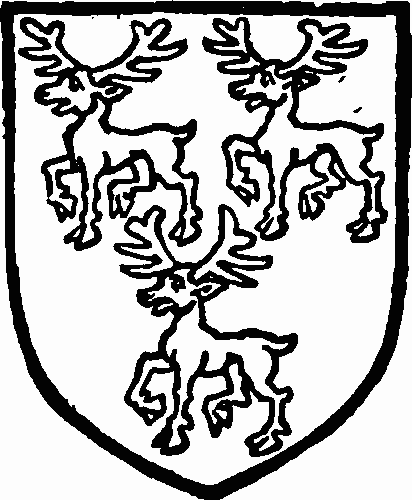
Green. Azure three harts tripping or.
These co-heirs, Elizabeth wife of Sir John Mordaunt, kt., afterwards first Lord Mordaunt, Anne wife of Sir Humphrey Browne, and Audrey, brought an action in 1505 to recover seisin of the manor. (fn. 39) Audrey afterwards married John Browne, a nephew of Sir Humphrey, (fn. 40) and their son and heir George Browne succeeded his father in 1550. (fn. 41) In 1557 George Browne conveyed the reversion of his third of the manor, after his mother's death, to John Lord Mordaunt, (fn. 42) who thus became seised of two-thirds. John, his son by Elizabeth Vere, succeeded to the title in 1562, (fn. 43) but the Wavendon estate passed by settlement to Lewis Mordaunt, son of the younger John, who proved his right to the acquired third in 1563 (fn. 44) and in 1571, when Lord Mordaunt, sold both portions to Henry Charge. (fn. 45) Meanwhile Sir Humphrey Browne made a settlement of his third in 1562 on George his son by Anne Vere and on Mary, Christine and Katherine his daughters by another wife, Agnes Richer, widow, and died the same year. (fn. 46) George, who was aged fifty at his father's death, seems to have died soon afterwards, (fn. 47) as in 1571 Mary and her husband Thomas Wilford conveyed a ninth part of the manor to Henry Charge, (fn. 48) and some five years later Christine wife of John Tufton and Katherine Browne (later Roper) conveyed their two-thirds of the third to the same person. (fn. 49) Henry Charge, thus seised of the whole manor, died towards the end of 1594 and his daughter Elizabeth and her husband Richard Saunders succeeded him. (fn. 50) Saunders died seised of Mordaunts Manor, now so called, in 1639, having settled it in 1621 on his second son William. (fn. 51) William Saunders was holding in 1650 (fn. 52) and was still alive in 1653. (fn. 53) The manor was sold by the Saunders family to John Cullen, (fn. 54) who obtained other property here in 1672 (see Passelewes Manor). He was sheriff in 1682. (fn. 55) Cullen's granddaughter and heir Mary married Robert Isaacson, (fn. 56) who was lord here in 1727 (fn. 57) and 1735. (fn. 58) At his death he left two daughters and co-heirs, Arabella, afterwards wife of the Rev. William Denison, Principal of Magdalen College, Oxford, (fn. 59) and Mary, who married Roger Altham in 1746. (fn. 60) A moiety of the manor was held by each of the heirs. (fn. 61) By the Denison marriage settlement of 1759 the children of the marriage were to hold the property as tenants in common, (fn. 62) and in 1794 Arabella, a widow since 1786, (fn. 63) with her children Anna Maria, Frances, the Rev. William, the Rev. Robert and Thomas, suffered a recovery of their moiety of the manor. (fn. 64) The other moiety was similarly settled, and after the death of Mary Altham in 1781 (fn. 65) and of her husband in 1788 (fn. 66) was held by their five daughters and heirs, Frances wife of James Heseltine, Arabella wife of John Graham Clarke, Mary wife of Aubone Surtees, Jane wife of Nathaniel Bishop and Charlotte wife of Thomas Lewis. (fn. 67) These heirs appear to have conveyed their share of the manor to the Denison family. Lysons states that Mrs. Denison held the manor about 1813, (fn. 68) and in 1862 William Henry Denison was lord of it. (fn. 69) Henry G. Denison held the estate in 1869, but after 1873 (fn. 70) it passed to Thomas Gadsden, who was returned as lord of the manor in 1877, and until after 1884. The manorial rights disappear after this date, but the greater part of the property was purchased by Messrs. Eastwood & Company, Limited.
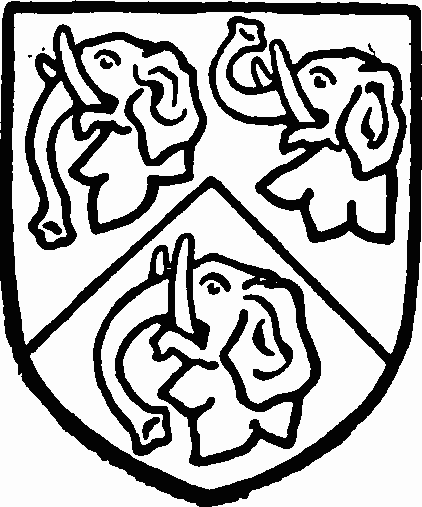
Saunders. Party cheveronwise sable and argent three elephants heads rezed and counter coloured
The origin of the manor afterwards known as PASSELEWES or PASLOWS MANOR is obscure. It was held in the 13th century and afterwards of the honour of Clare, which passed through the Earls of Gloucester and the Earls of Stafford (fn. 71) to the Duke of Buckingham, who died seised of the overlordship rights in 1460. (fn. 72) The last mention of this overlordship occurs in 1619. (fn. 73)
There is no Domesday entry for Wavendon to which this holding can be definitely traced.
In 1166 William Passelewe held three fees in the county of Walter Giffard. (fn. 74) William appears to have been succeeded by Gilbert Passelewe, who paid relief for three fees in 1170–1 (fn. 75) and was still alive in 1189–90. (fn. 76) Simon Passelewe in 1199 made a life grant to Nicholas Passelewe, his uncle, of a knight's fee in Wavendon with certain reservations, the grant to have effect after the death of Liveva, Simon's mother, who held in dower. (fn. 77) Simon was still lord in 1221. (fn. 78) Gilbert Passelewe held a fee here as heir to Simon in 1228. (fn. 79) Gilbert was succeeded after 1262 (fn. 80) by William Passelewe, who held this fee in 1314 (fn. 81); but he seems to have held only a mesne lordship, which is again mentioned as being held by William Passelewe, described as 'of Bromham' or 'of Holcutt' in 1316 (fn. 82) and in 1333. (fn. 83) Another branch of the same family appears to have been subinfeudated here before 1314 (fn. 84) and possibly as early as 1275–6. (fn. 85) In 1314 Peter Passelewe held the manor in demesne and conveyed it in that year to John Pever, (fn. 86) who already held another estate in Wavendon, with which, as has been already stated, the Passelewe manor then descended. They were held together as late as 1417, (fn. 87) but appear to have been separated before 1505. (fn. 88)
In 1560 the manor of Passelewes, first so-called, was held by William Fitz Hugh, who settled it in that year on Robert Fitz Hugh, (fn. 89) his son. (fn. 90) Robert died seised of the manor in February 1609–10, leaving as heirs his daughter Anne wife of Thomas Cranwell, his grandson Robert Saunders, son of another daughter Frances and of Richard Saunders, and a third daughter Mary wife of William Astrey. (fn. 91) Mary died without issue in January 1610–11 (fn. 92) and her husband died in 1615, leaving by will all his right in Passelewes Manor to his nephew Robert Saunders. (fn. 93) In 1622, after the death of Anne Cranwell, Robert Saunders agreed to sell his moiety to Thomas Cranwell and Fitzhugh his son for £625, payable in two instalments before Midsummer 1624. (fn. 94) Cranwell, however, was by that time so deeply in debt that he had for the past eighteen months concealed himself from his creditors and could not be found. (fn. 95) One of these, Robert Dixon, suing for a debt of £165, stated that Cranwell had conspired with Robert Saunders, John Hatch and Sir Arthur Wilmot, bart., to defraud him. (fn. 96) How the matter was settled is uncertain, but Fitzhugh Cranwell appears to have finally inherited the manor, which he sold to Giffard Beale, who held it in 1656. (fn. 97) From him it passed in 1672 to John Cullen, and descended to the Denisons and Althams, with the manor formerly Mordaunts, with which it probably became amalgamated, although it is mentioned by its distinctive name of Passelewes as late as 1801. (fn. 98)
In connexion with the Passelewe family in this parish it must be noted that in the 13th century Gilbert and Peter successively had another holding here belonging to the honour of Wahull. (fn. 99) In 1284–6 William Passelewe held 4 virgates of John Pever, who held of John de Wahull. (fn. 100) William held half a fee here in 1316, when he is distinguished by the name of 'William Passelewe of Wavendon' from the 'William Passelewe of Bromham' (fn. 101) who at that time was the mesne lord in the Passelewes' chief holding, as explained above.
William Passelewe of Wavendon and Jane his wife dealt with five messuages and 2 carucates of land here in 1325 (fn. 102) and he is mentioned in 1340 and 1341. (fn. 103) He received licence from the bishop to celebrate divine service in an oratory in his house at Wavendon in 1344. (fn. 104) In 1346 William Passelewe, jun., held part of a fee here which William Passelewe, sen., had previously held, (fn. 105) and which was still held by a William Passelewe in 1387. (fn. 106) In 1390 John Passelewe of Wavendon was pardoned for having killed two men and for having broken into a house at Milton Keynes. (fn. 107) He held this estate in 1392 (fn. 108) and in 1399, (fn. 109) while William Passelewe was holding in 1460. (fn. 110) There is no further trace of this holding, unless it may be identified with the otherwise unexplained manor of Wavendon which was held between 1485 and 1500 by Thomas Lucas, of Woburn, Bedfordshire, whose daughters Mary and Joan inherited it at his death. (fn. 111)
Suen, a man of Earl Harold, had a manor here before the Conquest. In 1086 it was held as 3 hides except 1 virgate of Hugh de Bolebec. (fn. 112) This was the manor afterwards known as THE EARL OF DEVONSHIRE'S FARM or MANOR. From Hugh de Bolebec the overlordship passed to the Earls of Oxford, who at one time held in chief (fn. 113); but a mesne lordship, vested in the holders of the honour of Clare, existed between the Earls of Oxford and the Crown in the 13th and 14th centuries. (fn. 114) These overlordships lapsed in the 15th century, (fn. 115) and in 1542 Wavendon was attached to the newly created honour of Ampthill. (fn. 116) It was stated to be held in chief as late as 1575. (fn. 117)
Ansel was tenant here at the time of the Survey. (fn. 118) In the latter part of the 13th century Isabel daughter of Hugh de Vere, Earl of Oxford, brought the manor in marriage to her husband John de Courtenay of Okehampton, who died in 1273. (fn. 119) The Courtenays, Earls of Devon, continued to hold this manor in demesne with those of Waddesdon and Hillesden (q.v.) until the attainder and forfeiture of Thomas Courtenay fifteenth Earl in 1461. (fn. 120) In 1462 a grant of the manor was made by the Crown to William Nevill, Earl of Kent, (fn. 121) and, after his death, to George Duke of Clarence and his issue, in 1463. (fn. 122) In 1468, after the duke's rebellion, the king granted Wavendon for life to Hugh Hernage, or Harnage, (fn. 123) who died in 1471. (fn. 124) In 1472 a life grant of it was made to John Hulcote, the manor being extended at the annual value of £7. (fn. 125) In January 1482–3 Hulcote's widow Alice received a life grant, (fn. 126) and on her marriage with Thomas Fowler a grant to both in survivorship was made. (fn. 127)
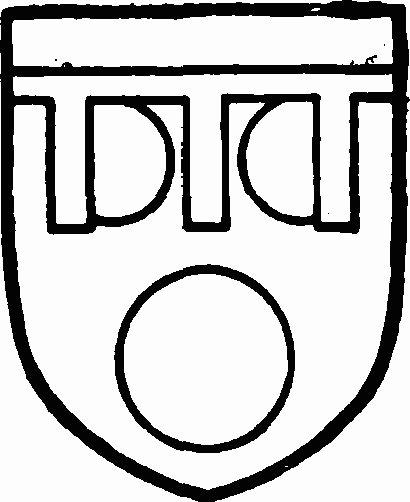
Courtenay. Or three roundels gules with a label azure.
Like Waddesdon and Hillesden, Wavendon was later restored to the Courtenays and likewise estreated to the Crown in 1539 on the attainder of the Marquess of Exeter. In that year John Sheppard obtained the site of the manor on a twenty-one years' lease, (fn. 128) which was renewed by Edward VI in 1552. (fn. 129) In the next year Edward Courtenay, son and heir of the Marquess of Exeter, was created Earl of Devon and restored to his estates by Queen Mary, to whom Wavendon again reverted on his death without issue in 1556. (fn. 130) In February 1557–8 a grant in fee was made to John Sheppard, the lessee of 1539. (fn. 131) He died in 1561, leaving a widow Joan, who survived him about sixteen months, and four daughters and co-heirs, Jane wife of Thomas Wells, Agries who afterwards married Richard Moreton, Sibyl wife of William Doggett, and Elizabeth wife of Bernard Turney. (fn. 132) Each of these heirs received a fourth of the manor, (fn. 133) but the shares of the Turney and Doggett families do not again appear. Agnes Moreton died seised of a third in 1568, leaving two daughters and heirs, Joan and Agnes, (fn. 134) who afterwards married Edward Basse and Thomas Fountayne respectively. (fn. 135) Agnes Fountayne died in 1592, three years before her father, Richard Moreton, leaving as heir a daughter Olive, (fn. 136) who with her husband John Vintner received livery of a moiety of a third of the manor in 1617, (fn. 137) a similar portion having been obtained by Joan Basse, widow, in 1611. (fn. 138) The main part of Sheppard's manor and the manor house, however, eventually came into the possession of George Wells, aged four at the death of his mother, Jane Wells, in 1564 (fn. 139); he received livery of this manor in 1590. (fn. 140) He was succeeded by his son John Wells, (fn. 141) whose house in Wavendon is referred to in a deed of 1653. (fn. 142) John was succeeded by his son George, who died in February 1713–4, leaving his house and lands in this parish to a brother, Lionel Wells, (fn. 143) from whom they passed four years later to his son John, (fn. 144) lord in 1735. (fn. 145) The property seems afterwards to have come to daughters and co-heirs of the Wells family, as in 1788 Dixie Gregory and his sister-in-law, Ellen Wells, spinster, together claimed manorial rights in Wavendon. (fn. 146) This was on the occasion of the passing of the Inclosure Act, but the commissioners appointed afterwards found that the Denison property was the only one in the parish to which manorial rights were still attached. (fn. 147)
Lysons states that Mr. Dixie (? Gregory) held this estate in the early 19th century. (fn. 148) Possibly it formed part of the lands bought here about this time from several different owners by Henry Hugh Hoare, (fn. 149) who succeeded his half-brother in the baronetcy in 1838 and died at Wavendon House in 1841. (fn. 150) His Wavendon estates did not pass with the title, as Henry Charles Hoare, his younger son, afterwards held them. He died in 1852. (fn. 151) Upon the succession to the baronetcy of his son Henry Ainslie Hoare in 1857, the Wavendon estate passed to Henry Ainslie's uncle, Henry Arthur Hoare, (fn. 152) youngest son of Sir Henry Hugh Hoare, who died in 1873. His son Sir Henry Hugh Arthur Hoare, bart., who succeeded his cousin in the title in 1894, is now one of the chief landowners in the parish.
Some of the Bolebec lands in WAVENDON became the property of Woburn Abbey before 1208 by grant of Aubrey de Vere, Earl of Oxford, and Isabel de Bolebec. (fn. 153) The abbots continued to hold here of the Earls of Oxford and of other overlords (see below) until the Dissolution. (fn. 154) In January 1559–60 the late abbey's manor of Wavendon was granted to Richard Champion and John Thompson and their heirs, (fn. 155) and descended with Great Linford (q.v.) in the Thompson family to Sir John Thompson, (fn. 156) by whom it was conveyed in 1641 to Henry Chester, William Stone, Arthur Claver and William Smyth. (fn. 157) The last-named appears to have been the William Smyth of Radclive who was created a baronet in 1661, and at whose death in 1696 the baronetcy and lands in Akeley (q.v.) descended to his son Thomas. (fn. 158) Wavendon Manor, however, was bequeathed by Sir William Smyth to his godson William, son of his brother John, (fn. 159) who appears to have assumed the title on the death without issue in 1732 of his cousin Sir Thomas Smyth, bart., as in his will of 1741 he is described as Sir William Smyth of Warden (co. Bedford), kt. and bart. (fn. 160) He left a niece, Martha Lane, and various cousins as heirs. (fn. 161) In 1775 one of the original devisees and the heirs of two others suffered a recovery of this manor with a view to barring the entail. (fn. 162) They were William Smyth King of Warden (co. Bedford), son of John, son of Margaret, wife of Peregrine King, and sister of Sir Thomas Smyth, bart.; George Pitt Hurst, son of John Hurst and Dorothy, sister of William Smyth King, and, in 1738, wife of Henry Longville; and William Howard of King's Cliffe (co. Northampton) son of Ann King by the Rev. Thomas Howard. (fn. 163) By this deed the manor was settled on Smyth King in tail-male with remainder in moieties to Hurst and Howard, (fn. 164) who were in possession in 1788. (fn. 165) There is no further evidence of this property, but it may have become parcel of the lands bought by H. H. Hoare, and still held by his descendant Sir H. H. A. Hoare, bart.
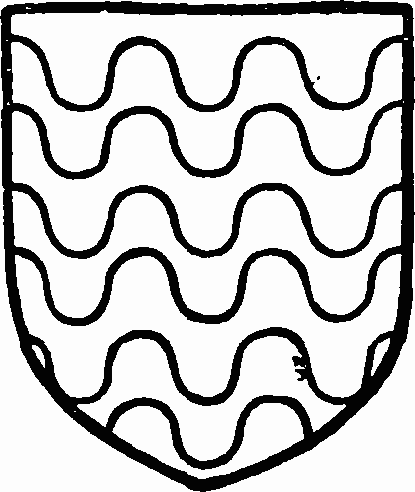
Woburn Abbey. Azure three bars wavy argent.
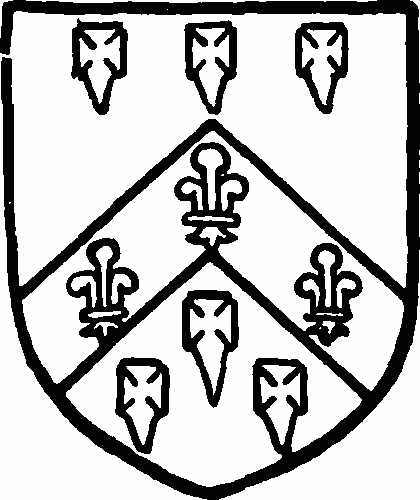
Smyth of Radclive. Sable a cheveron between six crosses formy fitchy argent with three fleurs de lis azure on the cheveron.
The grange at Wavendon, the site of the abbey's manor here, and some of the fuller's earth pits, were leased to Richard Hull in 1544 for twenty-one years at £6 5s. per annum. (fn. 166) This property was included in the grant to John Thompson, (fn. 167) but seems to have been conveyed by him or his heirs to the Worrall family. In 1653 John Style of Steppingley (co. Bedford) and Jane his wife, Jane Worrall of Steppingley, widow, and others sold to James Selby the 'Grange or manor house or messuage in Wavendon in a certain endshippe there called Crosse End.' (fn. 168)
James Selby also obtained other lands of this manor. (fn. 169) Possibly the third of a manor of Wavendon conveyed to Selby and others in 1660 by John Collins and Lidea his wife (fn. 170) represented part of this estate. He married Margaret daughter of John Wells of Wavendon, and was succeeded at his death in 1688 by his son James Selby, serjeant-at-law. (fn. 171) This second James died in 1724, leaving an only son Thomas James, who inherited the house and lands at Wavendon. (fn. 172) Thomas James Selby, who also held Whaddon (q.v.), died unmarried in 1772. Shortly before his death, in 1767, the Rev. William Cole, in writing of this neighbourhood, described him as a very shy and reserved man, given up to fox-hunting. (fn. 173) He added, in reference to his unmarried condition: 'No one can tell where his large Estate will descend. The Alstons are his nearest Relations, but they are half mad.' (fn. 174) Nevertheless, by his will, dated 1768, Selby left his Wavendon property, in reversion after the death of Elizabeth Vane, his mistress, to Temperance Bedford, his cousin, whose mother had been a Miss Alston. (fn. 175) Miss Bedford married the Rev. Daniel Shipton, rector of Wavendon, who alienated the estate, which passed successively to Robinson Shuttleworth, Lord Charles Fitzroy, and H. H. Hoare. (fn. 176)
A survey made in 1549 of the late abbey's property here includes, among the free tenants of the manor, the villagers of Wavendon who held freely a piece of land called 'garden grownde plot' with a messuage called the Townhouse by charter to them and their successors for ever for a rent of 4s. 4½d. (fn. 177)
In the 18th century it was stated that the abbey lands were held of the royalty of Brogborough, Bedfordshire, belonging about 1630 to members of the Stone family. They conveyed it about 1702 to the Duke of Bedford, whose family in consequence inherited a quit-rent of £3 per annum. (fn. 178) In the Inclosure Act of 1788 the duke claimed, as lord of Brogborough, to be entitled to certain parts of the heath in Wavendon, a claim also put forward by George Pitt Hurst and William Howard. (fn. 179)
In 1086 another small manor in a locality not named, consisting of I hide and I virgate, which Suenihc, a man of Earl Harold, had owned before the Conquest, was in possession of Walter the Fleming and held of him by Fulcuin. (fn. 180) The overlordship was afterwards vested in Walter's heirs, the Wahulls, who in their turn held of the Earls of Cornwall. (fn. 181)
The tenants in part of this fee were the Abbots of Woburn, (fn. 182) with whose other land in Wavendon this doubtless became amalgamated. The holding of the Passelewe family under the honour of Wahull has been already noticed.
A family called Bray also held of the Wahull honour in the 13th century, Thomas de Bray and William de Bray in the reign of Henry III, (fn. 183) and Nicholas de Bray under the heir of Hugh de Bray in 1284–6. (fn. 184)
Possibly the origin of the manor or reputed manor called WARDS in the 16th century may be found in the land, probably the glebeland (fn. 185) (see advowson), inherited at the death of Sir Henry Green in 1369 by his eldest son Thomas, called of Greens Norton (co. Northampton). (fn. 186) He also held Heyborne Manor (q.v.) in Lillingstone Dayrell with which this small property descended to the Thomas Green who succeeded in 1417. He died in 1462, leaving a son and heir Thomas, (fn. 187) by whom this land was conveyed in 1482 to Thomas Stafford of Tattenhoe (fn. 188) (q.v.). His illegitimate son William Stafford died in 1529 seised of a manor of Wavendon, which he left to his son Thomas. (fn. 189) The manor of Wards was held in 1578 by Thomas Stafford and Elizabeth his wife. (fn. 190) In 1645 Thomas Hopper and Rose his wife conveyed it to John and James Worrall. (fn. 191) James Worrall and Elizabeth his wife held in 1650. (fn. 192) There is no further trace of it, but it may be noted that other Worrall property in this parish passed about this time to the Selby family (see above).
Lewin Chava, the king's bailiff, before the Conquest held a hide of land in Wavendon, which he continued to hold of King William in 1086, and a virgate of land was held by Goduin the priest of Lewin of Nuneham. (fn. 193)
Church
The church of ST. MARY consists of a chancel 28 ft. 6 in. by 15 ft. 6 in., nave 53 ft. by 16 ft., north and south aisles, west tower 13 ft. by 12 ft. 6 in., south porch and north vestry. All these measurements are internal.
The nave and chancel show no detail earlier than the 13th century; the nave was extended westward and aisles thrown out towards the close of that century, and the west tower was built in the 15th century. In 1848–9 there was a complete restoration of the church, and much of the walling was refaced and in places possibly rebuilt; at the same time the porch and vestry were added.
The chancel has been much modernized. The east window is of four lights with tracery under a pointed head, and the windows and other details in the north and south walls are also modern. The only ancient feature is the chancel arch, which is of late 13th-century date, and is of two chamfered orders with a moulded label on the west side; the jambs are octagonal with moulded capitals and bases.
The nave arcades are each of four bays; the arches are pointed, and of two chamfered orders, and have moulded labels on the nave sides; the columns are of quatrefoil plan, and with the exception of the east respond of the south arcade, which is semi-octagonal, the responds repeat the half-plan of the piers. The two-light clearstory windows are modern. The roof is also modern, but is supported by stone corbels of the 15th century carved with angels holding shields and scrolls. The north and south aisles have modern two-light windows with tracery in pointed heads, and the other details exhibit no points of interest except some pieces of 15th-century glass in the westernmost windows of the north wall of the north aisle and of the south wall of the south aisle. The former is merely a floral design, but the latter has the head of a saint.
The tower is of four stages and has diagonal buttresses at the western angles and plain buttresses at the eastern angles and a staircase in the south-west angle. The tower arch is of three moulded orders, the innermost order resting on semicircular jambs with moulded capitals and bases. The west doorway and window over it belong to the 19th-century restoration. The bell-chamber has a window in each wall of two lights with tracery in a pointed head.
The font is modern. The fine oak pulpit is of late 17th-century date, and is said to have been brought from the church of St. Dunstan-in-the-West, London. It is hexagonal and has cherubs' heads and pendants of fruit and flowers carved at the angles, and the panels are inlaid. In the tower is a large plain oak chest of the 15th or 16th century, with three locks, the middle lock having a carved scutcheon. At the west end of the south aisle is a small oak table of the 17th century in a neglected condition, with legs carved as small Doric columns supporting an entablature.
On the west wall of the modern vestry is a rectangular brass plate with inscription to Richard Saunders (d. 1639), 'whose Ancestors are inter'd at Badleston and Potsgrave in ye County of Bedford,' who married four wives and had twenty-seven children. Above is a lozenge-shaped plate with an achievement of his arms and elephant's head crest. This brass was originally in the chancel. In the south aisle is a plain wall tablet to the memory of William Fisher, captain in the 10th Foot Regiment, who fell at Waterloo; there are also several memorials to members of the Hoare family, 1841–73.
There is a ring of five bells: the treble is by the Newcomes, 1616, the second by Edward Arnold of Leicester, 1799, the third is inscribed 'Chandler made me 1705,' and the tenor 'Richard Chandler made me 1705, ' (fn. 194) while the fourth is by John Briant of Hertford, 1815.
The plate was given by Anne Penelope Hoare in 1849, and consists of two chalices, two patens, two glass cruets, an offertory basin, and a small credence paten.
The registers before 1812 are as follows: (i) baptisms and burials 1567 to 1720, marriages 1569 to 1720; (ii) baptisms 1722 to 1811, burials 1722 to 1813, marriages 1722 to 1754; (iii) marriages 1754 to 1812. There is also a book of mixed entries of various dates from 1679 to 1753, which was apparently a rough note-book kept by the parish clerk.
Advowson
The advowson of the church is mentioned in 1199, when Simon Passelewe excepted it from a grant made to Nicholas his uncle. (fn. 195) The patronage remained in the lords of Passelewes Manor (fn. 196) until 1369, when it passed to Thomas Green with the glebeland afterwards Wards Manor. (fn. 197) With Wards it came into the possession of Thomas Stafford, (fn. 198) by whom it was conveyed in 1595 to William Stone, clerk. (fn. 199) He was patron in 1602, (fn. 200) but afterwards sold the advowson to Robert Norton, who held in 1608. (fn. 201) A daughter and heir of William Norton married John Deyos, whose heir sold it to — Gilpin, from whom it was conveyed to John Jeffreys, who became rector of the parish in 1647. (fn. 202) It was purchased in 1678 of Jeffrey's heirs by Thomas Stafford, with whose estate at Tattenhoe it passed to the Selby family. (fn. 203) Thomas James Selby bequeathed it with his other property here to Temperance Bedford, (fn. 204) by whom it appears to have been sold soon afterwards, as William Hampson claimed to be patron in 1788. (fn. 205) Robert Gatty and Mary his wife made a conveyance of the rectory in 1806 to John Fisher, (fn. 206) whom Gatty had presented the previous year. (fn. 207) The next incumbent was presented in 1847 by H. A. Hoare, (fn. 208) whose father had obtained the patronage some years before. (fn. 209) It is now the property of Sir H. H. A. Hoare.
A vicarage existed here in the early years of the 13th century. In 1221 William son of Robert was presented to it by Gilbert Passelewe 'persona' with the consent of Simon Passelewe, the patron. (fn. 210) He was allotted the vicarage-house which Gilbert son of Gilbert Passelewe confirmed to the church, and was to pay synodals, the 'parson' being, however, responsible for all other church expenses. (fn. 211) Seven years later another vicar was presented by Gilbert Passelewe, 'parson and patron.' (fn. 212) In 1230 Hamo de Stokton was presented by Gilbert Passelewe to the church, 'vacant by the resignation of the said Gilbert, who held it last.' (fn. 213) The new incumbent was enjoined to study and to attend schools. (fn. 214) Apparently, on the above resignation, the vicarial and rectorial tithes were amalgamated, as no further presentation to a vicarage is found. (fn. 215) The church was valued at £10 in 1291 (fn. 216) and at £26 17s. 4d. in 1535. (fn. 217)
In 1721 Peter Gally obtained a grant of the presentation from Selby and presented his son Henry Gally, a classical scholar of some note. (fn. 218) Henry Gally resigned, however, and the cure was served until 1742 by the father, Peter, described as 'an old miserable French refugee.' (fn. 219)
A quit-rent was paid for an obit here in the 16th century. (fn. 220)
Charities
The charity of George Wells, founded by will proved in the P.C.C. 28 April 1714, (fn. 221) is endowed with a house at Wavendon let at £9 a year, with two cottages occupied as a schoolmaster's residence, and with a farmhouse and 99 a. 2 r. 3 p. in the parish of Husborne Crawley (co. Bedford), let at £75 a year. The net income is applied in scholarships for children of Wavendon and Woburn Sands and in apprenticing the same. The official trustees also hold a sum of £183 1s. 5d. consols, which is being accumulated until a sum of £245 11s. 4d. consols shall have been attained. (See article on 'Schools.' (fn. 222) )
The town lands consist of about 10 a. and cottages comprised in a deed of 12 July 1646, producing £25 a year or thereabouts, the objects of the trust being the repairs of the church and highways, and otherwise the benefit of the poor.
The charity founded by will of John Farr consists of an annuity of £1 charged on 3 a. of land in Wavendon, distributable in bread.
James Anderson by his will, proved 4 September 1872, bequeathed £100, the interest to be given to the poor on Christmas Day. The legacy is represented by £107 13s. 5d. consols with the official trustees, producing £2 13s. 8d. yearly. These charities are administered together. In 1912 out of the net income £5 was paid to the church offertory, £5 to the District Council, and £8 was distributed in bread.
The Poor's Coal.—By articles of agreement, entered into by John Duke of Bedford, and carried into effect by an Act of Parliament in 1810, certain lands were vested in the said duke and his heirs, and charged perpetually with a certain quantity of coals of the value of £150, including the carriage, to be yearly placed at the disposal of the parish officers for the use of the poor. In 1911 167 tons of coal were distributed among 115 recipients.
Surveyor's Allotment.—By the Inclosure Act of 1788 two pieces of land containing together about 6 a. were awarded to the surveyor of the highways. In 1883 part of the allotment was sold to the London and North Western Railway Company and the proceeds invested in £136 9s. 4d. consols with the official trustees, producing £3 8s. a year. The remainder of the land, containing 2 a., is let at £8 a year.
The Ecclesiastical District of Woburn Sands, now transferred to Bedfordshire.—The Literary and Scientific Institution was founded by statutory grant, 4 February 1875, by the Rev. Hay Macdowall Erskine. By an order of the Charity Commissioners of 15 December 1891, trustees were appointed and the legal estate was vested in 'the official trustee of Charity Lands.'