A History of the County of Bedford: Volume 2. Originally published by Victoria County History, London, 1908.
This free content was digitised by double rekeying. All rights reserved.
'Biggleswade hundred: Introduction', in A History of the County of Bedford: Volume 2, ed. William Page (London, 1908), British History Online https://www.british-history.ac.uk/vch/beds/vol2/pp201-202 [accessed 30 April 2025].
'Biggleswade hundred: Introduction', in A History of the County of Bedford: Volume 2. Edited by William Page (London, 1908), British History Online, accessed April 30, 2025, https://www.british-history.ac.uk/vch/beds/vol2/pp201-202.
"Biggleswade hundred: Introduction". A History of the County of Bedford: Volume 2. Ed. William Page (London, 1908), British History Online. Web. 30 April 2025. https://www.british-history.ac.uk/vch/beds/vol2/pp201-202.
THE HUNDRED OF BIGGLESWADE
contains The Parishes Of Astwick; Little Barford; Biggleswade with Stratton and Holme; Cockayne Hatley; Dunton with Millo; Edworth; Everton; Eyworth; Langford; Potton; Sandy with Girtford; Sutton; Tempsford; Wrestlingworth (fn. 1)
The hundred of Biggleswade takes its name from the town of Biggleswade where the hundred court was held. (fn. 2) At the time of the Domesday Survey Astwick, Little Barford, Biggleswade (with Stratton and Holme), Dunton (with Millo), Edworth, Eyworth, Langford, and Tempsford are all given in this hundred. (fn. 3) Wrestlingworth is not mentioned at all, whilst Sandy, Sutton, Potton, Hatley, and Everton (the other parishes included in the returns of 1831) are to be found in the half-hundred of Weneslai. (fn. 4) Before Kirby's Quest (1284–6) this half-hundred had become absorbed in Biggleswade. (fn. 5)
'Chenemondewiche,' a considerable estate of 3¾ hides in Biggleswade, cannot be identified, but probably lay in the neighbourhood of Blunham or Sandy. (fn. 6) The parishes mentioned in the returns of 1831 have remained attached to this hundred from the thirteenth century to the present day without alteration. (fn. 7) Biggleswade was a royal hundred, and appears to have remained in the possession of the crown, with the exception of a lease by Charles I in 1630 to Sir Onslow Winch for forty years. (fn. 8)
There was a court leet held at Biggleswade half-yearly, and also a three weeks court at which the tenants performed their suit and service to the lord of the hundred. (fn. 9) In the early fifteenth century Biggleswade paid towards a general subsidy £66 11s. 10¾d. (fn. 10) In 1559 it was assessed at that sum, but only £12 11s. 7d. was raised, (fn. 11) and in 1624 there was the same deficit. (fn. 12)
A parliamentary survey of 1651 states that Onslow Winch (at that time holding the hundred under a lease) received in certainty money (or yieldable money due from the freeholders of the township) £11 15s. 5d., whilst the profits from the courts were estimated at another £3 per annum. The waifs, strays, deodands, goods of felons, suicides, fugitives, &c., happening and falling within the said hundred belonged to the lord, if the bailiff of the hundred seized them first; but if seized by the bailiff belonging to a lord of a manor having a leet in the hundred, then such lord had the prior claim. (fn. 13)
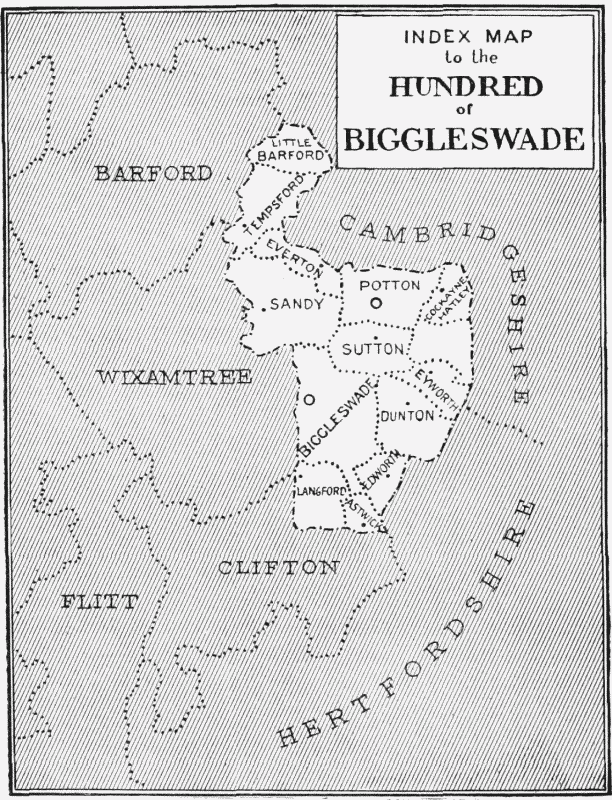
Index Map to the Hundred of Biggleswade