
A History of the County of Bedford: Volume 2. Originally published by Victoria County History, London, 1908.
This free content was digitised by double rekeying. All rights reserved.
'Parishes: Sandy with Girtford', in A History of the County of Bedford: Volume 2, (London, 1908) pp. 242-246. British History Online https://www.british-history.ac.uk/vch/beds/vol2/pp242-246 [accessed 20 April 2024]
In this section
SANDY with GIRTFORD
Sandeia (xi cent.); Saundeye, Sondeye (xiii to xvi cents.).
The parish of Sandy covers an area of 4,276 acres, of which 2,261 are arable, 781 permanent grass, and 552 woods and plantations. (fn. 1) It includes, besides the village of Sandy itself, the hamlets of Girtford and Beeston, the latter of which is in Wixamtree Hundred. Sandy has a station on the main line of the Great Northern Railway, which is here intersected by the Cambridge and Bedford Branch of the London and North Western Railway. The general slope of the land is from south-east to north-west. The road from Potton to Bedford on its way through Sandy rises to 220 ft. above the ordnance datum in the south, whilst the lowest point in the north is 72 ft. The River Ivel flows through the south-west of the Parish. The main road is that leading from Potton to Bedford; another road from Everton in the northeast passes through the parish, the centre of which is a thickly-wooded district known as Sandy Warren. The town lies in the west of the parish, and consists mainly of four streets radiating from the market-place, High Street, in a south-easterly direction, the Cambridge Road in an easterly, and the St. Neots and Bedford Roads respectively in a north-westerly and westerly direction.
There are a number of eighteenth-century brick houses in the town, but none of much interest, and a good many half timber and lath and plaster houses, some of which are thatched. The church stands in a large churchyard, bounded on the east by the High Street, and the rectory, south of the church, is a fine early eighteenth-century red-brick house—its date is given as 1729—with sash windows retaining for the most part the original heavy sashbars. It has a forecourt on the east, and a walled garden on the west, with excellent brickwork details. At some distance to the west of it is Sandy Place, a house of much the same period, though built on the site of an older house. It stands well, facing the south, on slightly rising ground, and belonged till recently to Sir Robert Pearce Edgcumbe, who sold it to its present holder, Mr. Walter Graves.
The hamlet of Girtford is situated at the junction of the St. Neots Road with the Great North Road, and other small hamlets are Seddington, on the Great North Road, two miles south of the town, and Stratford, about one mile to the south. That of Beeston is on the road to Biggleswade about one mile from Sandy; neither has any particular architectural interest, though there is a record of a 'chantry with Bell Turret and Chancel,' built at the latter about 1304; (fn. 2) of this there appear to be no remains.
There is a modern town hall, a national and a council school, a modern Baptist church, 1887, an older Baptist chapel of 1854, now used as a Sunday school, a mission church, 1866, and a Primitive Methodist chapel, 1868, at Girtford; and a Wesleyan chapel of 1865 at Beeston.
The Great Northern main line and the Cambridge and Bedford branch of the North Western Railway have stations here.
The eastern part of the parish includes the wooded sandy hills from which its name is derived, the town being separated from them by the railway, which cuts through their lower slopes. On the high ground stand 'The Lodge,' a modern house (1877), about a mile and a half south-east of the village, the seat of Viscount Peel; 'Caesar's Camp,' also modern, the seat of Captain C. Guy Pym; and 'The Hasells,' an old house, said to have been built about 1660, and enlarged in the time of George II, belonging to Mr. Francis Pym.
Sandy was inclosed by Act of Parliament in 1798, when the Stone Quarry was allotted to Sir Philip Monoux. (fn. 3)
Ancient British coins of gold, copper, and brass have been discovered at Girtford and Sandy, (fn. 4) and also neolithic remains. (fn. 5) An Anglo-Saxon cinerary urn of remarkable size and a bronze bowl of the same period have been found near Caesar's Camp, (fn. 6) which was a Roman site. (fn. 7) Galley Hill Camp, on a height covered with well-grown firs about three quarters of a mile south from Caesar's Camp in the grounds of Lord Peel, is another example of an ancient earthwork. (fn. 8) Sandy Place is an instance of a manorial hold with a mound, on which the house stands, and has remains of fishponds near the River Ivel. (fn. 9)
The following place-names have been found in Sandy: Hawes, Awstrettfield, Hynwickfield, Pression Balke, (fn. 10) in the seventeenth century, and Hyggons in the sixteenth. (fn. 11)
Manors
At the date of the Domesday Survey Eudo son of Hubert (also known as Eudo Dapifer) held a manor of 16 hides 1 virgate in Sandy, which, like others held by him, had belonged to Ulmar of Eaton. (fn. 12) On Eudo's death in 1120 his lands escheated to the crown, and were granted to one of the house of Beauchamp, (fn. 13) and this family continued to hold the manor of the king in chief till the middle of the fourteenth century. In 1201 Hugh de Beauchamp's claim to Sandy was disputed by William de Lanvaley, who claimed its revenues in right of his mother Gunnora, who held it by gift of Henry III. (fn. 14) Hugh appears to have been in debt to the king who had seized upon this manor as security and granted it to Gunnora, and some years later the dowry of Maud, wife of Roger de Beauchamp, was declared to be in the king's hands on account of the unpaid debt. (fn. 15)
In 1241 William de Beauchamp held property here, (fn. 16) and in 1276 one of the same name justified his right to free warren in Sandy. (fn. 17) Ralph de Beauchamp, son of William, rendered feudal service in 1284 for one and a half knight's fees in Sandy held of the king in chief, (fn. 18) and was followed by Roger de Beauchamp, who held the manor in 1316. (fn. 19)
Roger de Beauchamp, by alienating the manor in 1347 to John d'Engayne, severed the connexion of the Beauchamps with Sandy. The fine sets forth that the manor, worth ten marks per annum, is to remain to Roger for his life with reversion to the d'Engaynes. (fn. 20) John held the manor at his death in 1354, (fn. 21) and was followed by a son Thomas, who died in 1367 seised of Sandy manor, the value of which was at this time £ 10 per annum. (fn. 22) Thomas left three sisters as coheiresses: Joyce wife of John de Goldington, Elizabeth wife of Laurence de Pabenham, and Mary wife of William Barnacke. The manor was settled on Katherine wife of Thomas d'Engayne for her life, (fn. 23) and at her death in 1399, by a previous arrangement between the co-heirs, Sandy manor passed to Mary Barnacke, who had married a second husband, Thomas La Zouche. (fn. 24) Mary died in 1400, and was succeeded by her son John Barnacke, (fn. 25) who in 1409 was followed by a son John Barnacke, aged nine years. (fn. 26) He died a minor in 1421, and his brother Edmund, who survived him a few days only, left two sisters Joan and Mary as co-heirs. (fn. 27) The former of the two dying, Mary wife of Robert Stoneham was left as sole heir. In 1437 Robert and Mary Stoneham by fine with Laurence Cheyne and others secured the recognition of their right, and that of their daughter Elizabeth, wife of John Broughton, to Sandy manor, (fn. 28) which continued with the Broughtons till the sixteenth century, for Robert Broughton, grandson of the above John, was holding it at his death in 1508. (fn. 29) After the death of his son Sir John Broughton, his daughter Katherine succeeded to Sandy, and it passed before 1560 to William Powlett Lord St. John, (fn. 30) by his marriage with her daughter Agnes. He alienated the manor in 1572 to Sir Robert Catlin, (fn. 31) whose daughter Mary married Sir John Spencer, and her grandson William Spencer whose father was created Baron Spencer of Wormleighton in 1603, held the manor at the time of his death in 1638. (fn. 32) His son Henry Spencer was created earl of Sunderland, and was slain at Newbury in 1646, and Robert his son in 1670 sold Sandy manor to Sir Humphrey Monoux. (fn. 33) The manor was held by this family until 1809, when by the death of Sir Philip Monoux without male heirs his property passed to his four sisters. (fn. 34) Sandy manor passed to his second sister Frances wife of Samuel Ongley. (fn. 35) After her death the manor-house and park were purchased, about 1861, by the Brandreths, who in 1872 sold the property to the Fosters, and they in 1877 sold it again to Sir Robert Pearce Edgcumbe, who in 1905 sold it to Mr. Walter Graves, the present owner. (fn. 36)

Engayne. Gules a fesse dancetty between six crosslets or.
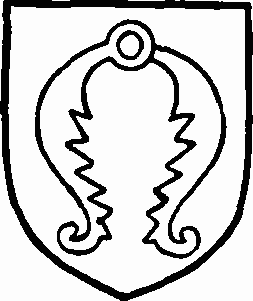
Barnacke. Argent a horse-barnacle sable.
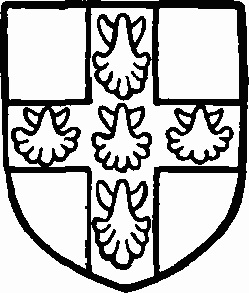
Stoneham. Argent a cross sable with five scallops thereon argent.

Broughton. Argent a cheveron between three molets gules.
The hill portion of the estate was bought by Sir William Peel, and at his death in 1858 passed to his mother, widow of Sir Robert Peel, who died in the following year, when the property passed to her youngest son, Viscount Peel, who owns it at the present day.
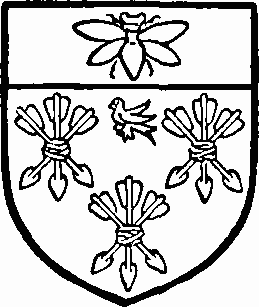
Peel, Viscount Peel. Argent three sheaves of arrows banded gules and a chief azure with a bee or flying therein with the difference of a martlet.
All manorial rights appear to be in abeyance. (fn. 37)
A second manor in Sandy, known after the Dissolution as HASELLS MANOR, belonged to the priory of Chicksands. In 1291 the prior of Chicksands owned the grange of 'Heyseles,' worth £115s., (fn. 38) and in 1316 the priory of Chicksands rendered feudal service for lands in Sandy. (fn. 39) The temporalities of Chicksands Priory in Sandy were worth £6 in 1537, (fn. 40) when they lapsed to the crown on the dissolution of the priory. In 1542 Henry VIII granted Hasells manor to Francis Pygott, (fn. 41) who in the same year alienated it to Robert Burgoyne, (fn. 42) and in 1635 John Burgoyne, probably a grandson, transferred it to William Britain. (fn. 43)
In 1712 Baron Britain, grandson of the above John, sold the manor to Heylock Kingsley, (fn. 44) whose daughter and heiress married William Pym in 1748, (fn. 45) and their direct descendant Francis Pym is at the present day lord of Hasells manor. (fn. 46)
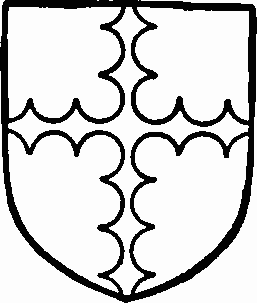
Kingsley. Vert a cross engrailed argent.
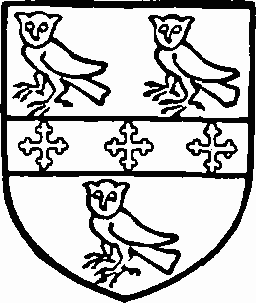
Pym. Sable a fesse between three owls or with three crosslets sable on the fesse.
The hamlet of GIRTFORD, of which no mention is made in Domesday, gives its name to a manor, which in the first instance belonged to Caldwell Priory. The original grant to the priory has not been found, but an early thirteenth-century grant exists made by Henry son of Hugh of Sandy to the priory. (fn. 47) In 1291 the prior of Caldwell owned lands and rents in Girtford and other places worth £3 11s. 10d., (fn. 48) and an exemplification of a certificate of the treasurer and barons of the Exchequer made in 1342 at the request of William de Souldrop, the prior, shows that the priory possessed lands and rents in Girtford. (fn. 49) At the dissolution of the priory it held lands to the value of 58s. in Girtford, (fn. 50) and in 1541 Henry VIII granted Girtford manor and grange to John Burgoyne, (fn. 51) who in 1562 received licence to alienate it to Edward Cosyn. (fn. 52) Between that year and 1614 the manor passed to William earl of Salisbury, who in the latter year sold it to Francis Lord Russell, (fn. 53) who in 1618 alienated Girtford to John Taylor and Alice his wife. (fn. 54) The latter, being left a widow, married Oliver Bromhall, who in addition to the manor thus acquired, also purchased further land in Girtford. (fn. 55) Oliver Bromhall, their son, sold the manor to Jasper Edwards, chief registrar in the High Court of Chancery, in 1657. (fn. 56) His son Richard Edwards transferred the property in 1695 to Robert Pulleyn of St. Neots, who sold it in 1741 to Heylock Kingsley. (fn. 57) Through the marriage of his daughter with William Pym it passed to that family, and has since followed the same descent as Hasells manor (q.v.). (fn. 58)
Two mills are mentioned in Sandy at the time of the Survey of 1086, their value was 50s., and they were both attached to the manor of Eudo Dapifer. (fn. 59) One of these, a water-mill, remained attached to the Sandy manor, and is mentioned in an extent of 1412, when its value was 13s. 4d., (fn. 60) and again in 1677. (fn. 61)
One reference only has been found to the other mill, when in 1218 Henry son of William granted 2 virgates of land and a mill in Sandy to Henry son of Hugh. (fn. 62)
To the lords of Sandy manor belonged the right to hold a view of frankpledge twice yearly within the manor. (fn. 63) William de Beauchamp also claimed a charter of free warren here in 1276, (fn. 64) and this right was claimed by later lords. (fn. 65) In 1670 the manor included a parcel of land called the Warren containing 1,300 acres, and the free warren and game of coneys within the manor. (fn. 66)
Church
The church of ST. SWITHUN has a chancel 46 ft. 8 in. by 18 ft., with north vestry and south chapel; north transept 25 ft. by 18 ft.; south transept, 24 ft. by 18 ft.; nave, 44 ft. by 23 ft. 2 in.; with north aisle 10 ft. wide and south aisle 9 ft. wide, both of the same length as the nave, and west tower 13 ft. 8 in. by 13 ft. 2 in.; all measurements being internal. The whole church has been so much rebuilt and enlarged in modern times that little of the old fabric remains. The transepts and chancel arch were rebuilt and the aisles enlarged in 1861, and the chancel has been refaced and the vestry and chapel added, so that little if any old work is now to be seen there except the triple sedilia and the piscina, which are of fifteenth-century date.
The nave has north and south arcades of one wide and two narrow bays, the former opening to the transepts; the arches are of two chamfered orders, and built of the dark ironstone common in the district, which on account of its coarse texture does not admit of much detail. They have unfortunately been pointed with white mortar, with a most unhappy effect.
The piers are octagonal, those of the north arcade being modern with capitals of fourteenth-century detail; while those of the south arcade are of the fifteenth century, except that of the eastern respond, which is a modern imitation. The capitals and pillars are of Totternhoe stone, but in the tower arch both shafts and capitals are of ironstone of fifteenthcentury detail, and like the nave arches have been pointed with white mortar within recent years. The north aisle has no old work from which its original date might be conjectured, and the south aisle is in much the same state, except that the respond of the arch opening to the transept is of the fifteenth century, the arch itself being modern. The windows of both aisles are modern and of fifteenth-century detail, and those of the transepts, equally modern, are of fourteenthcentury detail. There is a re-used sixteenth-century window in the modern north vestry. The roofs throughout are new except that of the tower, which is covered with lead bearing the dates of two repairs, one of 1692, with the initials of churchwardens, E. S., F.B.; and the second of 1756, with the name of one churchwarden, Wm. Randall. The tower itself has, like the rest of the church, suffered at the hands of the restorer. It is of fifteenth-century character and has a modern west window, and a south-east turret staircase. It has eight buttresses, two of which are on the east and project into the interior of the nave, but are of the same detail as the external ones.
The font has an interesting late fifteenth-century base of clunch and a very rough bowl, which is impossible to date. An extremely well preserved fragment of a panel of alabaster, representing Christ in the Garden of Gethsemane, is set in the south wall of the chancel in a glazed frame. (fn. 67) It is fifteenth-century work of the Nottingham school, the details of the colouring being unusually fresh and perfect, and was discovered during the restoration of 1861.
The bells are six in number—the treble by Mears & Stainbank, 1892; the second by John Eayre, 1769; the third by Thos. Russell of Wootton 1723, recast 1892; the fourth by Chapman & Mears, 1852; the fifth by Newcombe of Bedford, 1602, recast 1892; and the tenor by Thos. Russell of Wootton, 1733. The bell frame is modern, and the belfry generally in very good order. There is a chiming clock.
The plate consists of a silver chalice and paten, the former given by Francis Walsall, rector in 1661, and the latter having the London date letter for 1739; two modern silver-gilt chalices and cover patens, with a flagon, all of 1867, and a spoon of 1869; and a plated chalice and paten.
The registers are complete from 1538 (the earliest entry being one of a burial on 10 November in that year), with the exception of a couple of years. The early portions were found by the present rector in an old chest in loose sheets and carefully bound up.
Advowson
The earliest mention that has been found of the church of Sandy is in 1240, when it was granted by William de Beauchamp to the priory of Caldwell. (fn. 68) In 1291 the value of the church was £13 6s. 8d., (fn. 69) and in 1392 the prior obtained a licence to appropriate the church, which was then valued at 20 marks. (fn. 70) At the Dissolution Sandy Rectory, worth £22 13s. 4d., became crown property, (fn. 71) and was granted in 1541 by Henry VIII to John Burgoyne, (fn. 72) who in 1586 alienated it with the advowson to Richard Braithwayte and Thomas Spencer, (fn. 73) from whom they were purchased by John Spencer (fn. 74) who owned Sandy manor, and until the death of Sir Philip Monoux in 1809, they followed the same descent as that manor (fn. 75) (q.v.). From 1814 to 1829 George Cooke Yarborough was presenting; (fn. 76) since that date it has been held by the Pyms who own Hasells manor. (fn. 77)
The chantry of Sandy was founded by Roger de Beauchamp in 1332 to provide daily masses for the souls of himself and his ancestors in the chapel of St. Mary at the altar of St. Nicholas in the church of St. Swithun, and was endowed by him with 40 acres of land, 2 acres of meadow, and 16s. rent in Sandy. (fn. 78) The advowson of this chantry was transferred by him, together with Sandy manor, to John d'Engayne in 1347, (fn. 79) and appears to have remained attached to this manor, the last reference to it being in 1401 when it was worth 40s. (fn. 80) In 1547 the possessions of this chantry included a messuage called the Chantry House, with 48 acres of arable land, and 2 acres of meadow, let at a yearly rent of £15 0s. 2d., and stock worth 20s. in the hands of the churchwardens of Sandy for an obit. (fn. 81) In 1550 the Chantry House and land attached were granted by the crown to John Hulston and William Pendrid. (fn. 82)
Tempsford Chantry owned two messuages in Sandy in the tenure of the churchwardens which were valued at 30s., (fn. 83) and the fraternity of Blunham, founded by John Reynold, owned land in Sandy valued at 44s. 10d. (fn. 84)
There is a modern Baptist Chapel built in 1887, an older Baptist Chapel of 1854, now used as a Sunday school, and a mission church in Sandy; a Primitive Methodist Chapel of 1868 at Girtford, and a Wesleyan Chapel of 1865 at Beeston.
Charities
This parish is possessed of the following properties known as The Charity Lands, namely, 10 acres of land in Keysoe, purchased with £140 left by will of John Wynne, 1660, and 3 a. 3 r. allotted under the Keysoe Inclosure Act, producing £14 a year, which, together with a moiety of the rent of 2 a. 1 r. 16 p., mentioned below, in Down Field, Sandy, is applied in accordance with the terms of the will in the distribution of twelve penny loaves to twelve poor people every Lord's Day frequenting the church; 20s. for a sermon to be preached in rotation by the ministers of Sandy, Sutton, and Northill on the anniversary of testator's death (apparently 9 June) from St. John vi, 27, and the balance is distributed among the poor partly in money and partly in bread; 43 acres of land in Great Paxton, county of Huntingdon, purchased with £150 left by will of Thomas Bromsall, 1690, £25 by will of Rev. Francis Palmer, 1680, and with other monies, let at £25 a year, which together with a moiety of the rent of 2 a. 1 r. 16 p. in Down Field, purchased with proceeds of sale of timber, and let at £2 18s. 9d. a year, is applied in apprenticing, the premium being usually £15; 52s. a year as a charge on the estate is also distributed in bread every Lord's Day in respect of Palmer's Charity; 2 a. 2 r. 16 p. of land at Eaton Socon, allotted under the Inclosure Act of that parish in respect of land given by will of—Yarrow (date unknown), let at £7 10s. a year, is applied in apprenticing. The trustees also hold £100 consols, purchased with accumulations of income of Wynne's and Yarrow's Charities.
By an order of the Charity Commissioners of 10 October, 1895, made under the Local Government Act, 1894, the parish council appoint two representatives on the body of trustees.
This parish is also possessed of 26 a. 2 r. 14 p., known as the Town Lands, part of 33 a. O r. 9 p. (including a public drain crossing the same) allotted in 1804 to the lords of the manors of Sandy, Hasells, and Girtford, and to the rector and churchwardens of Sandy, in satisfaction of the right of cutting ling and fern upon Sandy Warren for fuel, upon trust to apply the rents and profits in purchasing wood, coals, and other fuel for distribution among the industrious poor of the parish of Sandy (except those of the hamlet of Beeston). In 1851 5 a. 0 r. 37 p. was sold to the Great Northern Railway Company, and invested in £614 11s. 4d. consols in the Court of Chancery. The land produces £30 a year or thereabouts, which together with the dividends on the stock, amounting to about £15 a year, is distributed in coals among the poor.
In 1891 George John Hooke Pearson, by deed, gave £100 consols upon trust that the rector and churchwardens should apply the dividends in subscriptions to the Hunstanton Convalescent Home to confer the right of nominating inhabitants of the parish of Sandy recovering from sickness as inmates thereof, the charity to be called 'The Frances Pearson Charity.'