A History of the County of Bedford: Volume 2. Originally published by Victoria County History, London, 1908.
This free content was digitised by double rekeying. All rights reserved.
'Parishes: Sutton', in A History of the County of Bedford: Volume 2, ed. William Page (London, 1908), British History Online https://www.british-history.ac.uk/vch/beds/vol2/pp246-251 [accessed 30 April 2025].
'Parishes: Sutton', in A History of the County of Bedford: Volume 2. Edited by William Page (London, 1908), British History Online, accessed April 30, 2025, https://www.british-history.ac.uk/vch/beds/vol2/pp246-251.
"Parishes: Sutton". A History of the County of Bedford: Volume 2. Ed. William Page (London, 1908), British History Online. Web. 30 April 2025. https://www.british-history.ac.uk/vch/beds/vol2/pp246-251.
In this section
SUTTON
Sudtone, Suttone (xi cent.).
Sutton is a parish covering an area of 2,233 acres, of which 1,335 are arable land, 593 permanent grass and 318 woods and plantations. (fn. 1) The soil is principally clay, the subsoil strong clay, and the principal crops wheat, barley, beans, and peas. The parish is well wooded in the north and west.
There is no railway station at Sutton, Potton, 1¼ miles off, on the Bletchley and Cambridge branch, and Biggleswade, 2½ miles to the north-east, on the main line of the London and North Western Railway being the nearest stations.
The high road from Biggleswade to Potton passes from south-west to north-east of the parish, forming, as it passes north, the western boundary of the Sutton Park Estate. Another road coming up from Eyworth in the south-east joins the Sandy and Potton main road as it issues from the north-western corner of the parish.
This road, shortly after entering the parish, rises from an elevation of 120 ft. to 184 ft. above the ordnance datum, but it falls again before entering the village of Sutton, which is situated about the centre of the parish.
The church stands at the south-east end of the park, with the vicarage immediately to the east of it, the fall of the ground being eastward. At the foot of the slope the road crosses by a ford one of the numerous small streams that feed the River Ivel. The footpath is carried over the stream by a narrow stone packhorse bridge, probably of fourteenth-century date, with two pointed arches. Beyond the stream is the greater part of the small village; its houses mostly built of timber and plaster with thatched roofs.
Sutton Park, the seat of Col. Sir John Montague Burgoyne, which is bounded on the west by the Potton Road, contains some good trees, firs and others; the present house is modern, but to the north of it is a large earthen mound, said to be the site of the original house, and undoubtedly of early date. It has been encircled by a ditch, and local tradition has it that the village was formerly near to it.
The vicarage house is of considerable interest, the oldest part belonging to an H-shaped building of timber and plaster, probably of sixteenth-century date, with a later wing on the north. It faces eastward.
The following place-names have been found in Sutton:—Longholm, in the fourteenth century; (fn. 2) Bendowes, and le Sande Ende, in the sixteenth. (fn. 3)
Manors
The principal holder in Sutton at the time of the Domesday Survey was the Countess Judith, who held altogether six hides which subsequently became SUTTON MANOR. (fn. 4) Her lands became part of the honour of Huntingdon, and the overlordship of Sutton followed the same descent as that of Potton manor (q.v.). (fn. 5) The last reference that has been found to the overlordship is in 1428, when it was held of this honour. (fn. 6)
In 1086 the Countess Judith had eight tenants under her whose holdings ranged from half a hide to two hides. (fn. 7) It is impossible to say to which of these holdings Sutton manor owes its origin, but it is probable that quite early, as often happened, the various portions became gradually concentrated in the hands of one person. Dugdale states that Robert Foliot (c. 1168) married the daughter and heiress of Richard de Reincourt, lord of Sutton in Bedfordshire, and that to him succeeded Richard Foliot his son, whose only child Margery married Wyschard Ledet about 1198, (fn. 8) and he held the manor in 1216. (fn. 9)
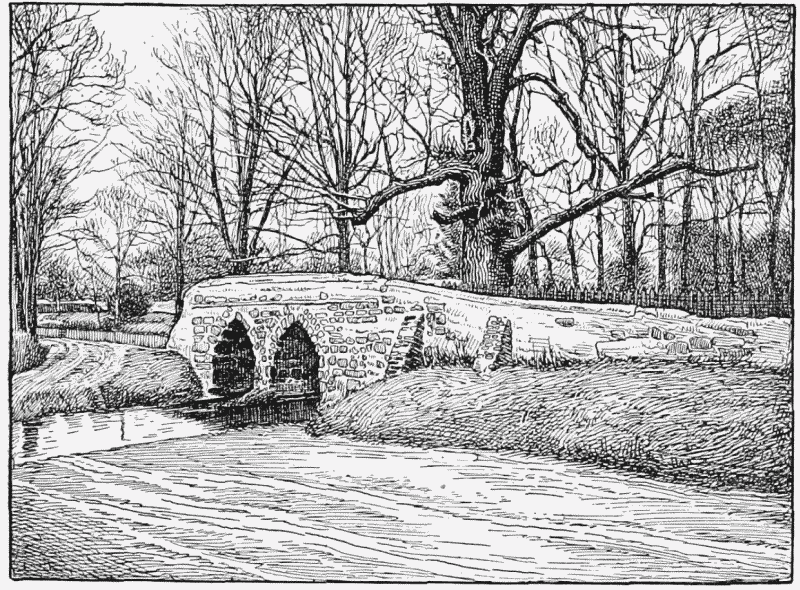
Sutton: The Packhorse Bridge
In 1222 his daughter Christina Ledet married Henry de Braybrooke, (fn. 10) who had already inherited from his father free tenements in Sutton. (fn. 11) Christina, who afterwards married Gerard de Furnival, (fn. 12) survived her second husband many years, and at her death, which occurred at some time previous to 1271, she left two granddaughters as co-heirs. (fn. 13) Of these Alice, who was married to William le Latimer, received Sutton manor as part of her share in Christina's estate. (fn. 14) In 1315 Alice le Latimer vested her right to the manor in John de Kinnardseye, who granted it back to her for life with remainder to Nicholas le Latimer and heirs of his body, and failing such to Thomas earl of Lancaster and his heirs. (fn. 15) Alice le Latimer died before 1317, in which year Nicholas acquired possession of Sutton manor, (fn. 16) which by 1327 had passed to William le Latimer, son of Alice. (fn. 17) His son William held Sutton at his death in 1336, (fn. 18) when the manor passed to his son, also William, who was under age at the time of his father's death. (fn. 19) He died in 1381 without male heirs, leaving a daughter Elizabeth, wife of John Neville of Raby, (fn. 20) who held this manor in right of his wife at the time of his death in 1389. (fn. 21) In 1392 Henry earl of Derby, son of John of Gaunt, duke of Lancaster, successfully claimed Sutton manor in accordance with the settlement made by Alice le Latimer in 1315; (fn. 22) and during the fifteenth century it is to be found as part of the duchy of Lancaster, and was the subject of various temporary grants. (fn. 23)
In 1402 Henry Longdon received the site of the manor of Sutton for life, (fn. 24) and in 1427 Elizabeth, daughter of William Beauchamp of Powyk and wife of Thomas Swinford, was granted this manor for her life. (fn. 25)
Finally, in 1544, Thomas Burgoyne received a perpetual grant of this manor for himself and his heirs, (fn. 26) and it has since remained with this family, whose representative, Sir John Burgoyne, is at present lord of Sutton manor. (fn. 27)
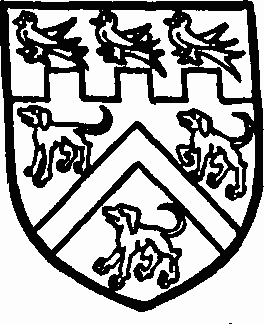
Burgoyne. Gules a cheveron or between three talbots argent and a battled chief argent with three martlets azure therein.
A second manor in Sutton, that of ENDERBIES, appears in the fifteenth century, and appears to have originated in a grant by the crown to the Enderbys after Sutton manor fell to the duchy of Lancaster. The first mention of it occurs in 1488, when Sir Richard Enderby died seised of a messuage and 24 acres of land in Sutton, held of the king as of the manor of Sutton, parcel of the duchy of Lancaster. (fn. 28) It appears to have continued to belong to the Enderbys (fn. 29) until in 1529 an exchange was effected between Francis Pygott (who had married Eleanor Enderby) and John Burgoyne, the former giving Enderbies manor (here first so called) in exchange for lands in Edworth, Stratton, Holme, and Astwick. (fn. 30) John Burgoyne left the manor to his son Thomas in 1541, (fn. 31) who acquired Sutton manor (q.v.) in 1544, and these two manors have since followed the same descent. The smaller manor did not immediately lose its separate identity, and as late as 1731 it is still distinguished by name from the more important manor. (fn. 32)

Enderby. Argent three bars dancetty sable with a pale ermine in the chief.
At the time of the Survey one of these 1½ virgates of land in Sutton belonging to the reeves and almsmen of the king was held by Alwin, in 1086, and had been assigned by Ralph Taillebois, as sheriff, to the king's service. (fn. 33) This holding probably reappears in the thirteenth century as the land which Henry de Costentin held of the king in chief for half a knight's fee. (fn. 34) On his death in 1255 Henry left a son Geoffrey, (fn. 35) who transferred this fee to Alexander de Somersham. (fn. 36) John de Somersham, who succeeded his father in 1291, (fn. 37) appears to have split up the fee by enfeoffing several persons with small portions of land; William Godwin, John Warison, Alice le Latimer, Nicholas and Geoffrey Power, were each so enfeoffed. (fn. 38) Thus by 1344 Alexander de Somersham, who had succeeded John, died seised of 14 acres of land only, which are described as poor and sandy, and were held of the king in chief by petty serjeanty. (fn. 39) He left a son John, and a later inquisition, bearing the date 1364, held on Alexander de Somersham, probably a grandson, for the same 14 acres, states that he left as heirs his daughters Margaret and Agnes, and with the consequent subdivision of the land further trace of this fee disappears. (fn. 40)
A third holder in Sutton at the time of the Survey was Eudo son of Hubert, of whom Alwin held 3 virgates. (fn. 41) The lands of Eudo were granted to the Beauchamps of Eaton in 1120, (fn. 42) and next reappear in the free tenements which Henry de Braybrooke claimed in Sutton in 1212, and which had come to his father by gift of Philippa Beauchamp. (fn. 43) This holding, of which no further separate mention has been found, thus became absorbed in Sutton manor.
The right of holding a view of frankpledge twice yearly, (fn. 44) and also of free warren (fn. 45) belonged to Sutton manor.
Camden, in his Magna Britannia, mentions a rhyming grant by which John of Gaunt gave Sutton to Roger Burgoyne. (fn. 46)
Lysons also makes mention of the tradition, (fn. 47) which
is without foundation (cf. history of Sutton manor).
The doggerel grant, which has been applied to many
other places, ran as follows:—
I, John of Gaunt
Do give and do graunt
Unto Roger Boyne
And the heir of his loine
Both Sutton and Potton
Until the world's rotten.
Church
The church of ALL SAINTS consists of a chancel 26 ft. by 16 ft. 6 in., nave 45 ft. by 18 ft. 6 in., with north aisle 17 ft. wide, and south aisle 9 ft. wide, south porch and western tower 11 ft. 9 in. by 11 ft. 3 in.
The angles of an aisleless nave, of twelfth or thirteenth-century date, remain at the north-east, southeast, and south-west of the present nave, but the chancel belonging to this church has been entirely rebuilt. In the thirteenth century the south aisle was added, and it is probable that somewhere about the same time the chancel was rebuilt. It was, however, entirely remodelled in the early years of the fourteenth century, a vestry being built at the north-east, and the chancel arch and north aisle with its arcade are approximately of the same date. The western tower is an addition of the fifteenth century, and the clearstory was added shortly after the building of the tower: the south porch, built in place of the earlier one which had a steeper gable, is also of the fifteenth century. There was once also a steep-gabled porch over the north doorway, as shown by the marks still seen on the wall above the door. The window in the south aisle between the porch and the east wall is evidently of much later date, probably the end of the sixteenth century. The east window of the chancel is of early fourteenth-century date, of three lights, with an unusual form of tracery, the two outer lights appearing to have had pointed heads without cusps, but half the head of each light seems to have been cut away (if it ever existed), the pointed form of the head being kept only by the glass. The middle light of the window is trefoiled with small flowing openings above it in the apex of the arch. In the south wall are contemporary segmental-headed windows, each of two trefoiled lights with cusped tracery in the head. Between these windows is a small fifteenthcentury doorway and part of the head of a blocked pointed doorway, which may be of thirteenth-century date.
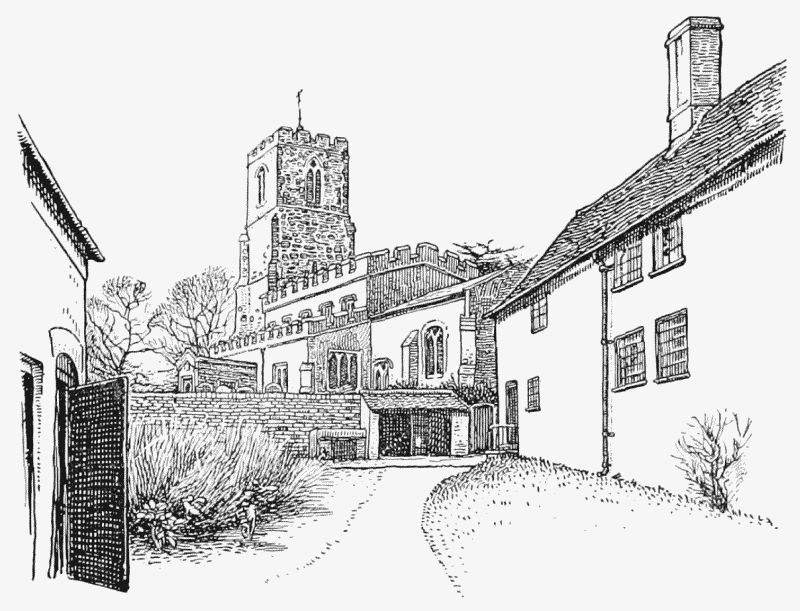
Sutton Church, from South-east
At the north-west of the chancel is a two-light window with fifteenth-century tracery. The vestry at the north-east is completely destroyed, but the door which led into it still remains, with a wide arched recess to the east of it in the north wall of the chancel.
In the south wall of the chancel are three sedilia with crocketed ogee heads and finials, and to the east of them a double piscina, all of early fourteenthcentury date and of very good detail.
The chancel arch of the same date is of two orders, wave-moulded, with a groove at the eastern angle of the inner order for the boarding which filled the arch behind the rood.
The nave has arcades of four bays, that on the north being c. 1330, with piers of four engaged shafts having moulded capitals and bases and arches of twomoulded orders.
The north chapel is unusually large, the eastern part of it being full of monuments of the Burgoyne family. The east window is of three cinquefoiled lights, the tracery being a fifteenth-century insertion in fourteenth-century jambs and heads. In the north wall are two sixteenth-century windows, each of three uncusped lights under a four-centred head, the eastern of the two being blocked by a Burgoyne monument. There is a plain north doorway with traces of a porch over it, and the west window is of three lights of fifteenth-century date. The walls have been raised and a parapet added in the fifteenth century, a lowpitched roof being put on at the same time, and the original fourteenth-century buttresses have been strengthened with additional masonry.
The south arcade has piers of four engaged shafts with keeled rolls in the angles, with moulded capitals and pointed arches of two hollow-chamfered orders. The south aisle has a modern three-light east window, and on the south a plain square-headed two-light window, probably of no great age. To the west of it is the south doorway, which has a deeply-moulded thirteenth-century arch of two orders and round moulded capitals, which formerly rested on detached shafts now cut away.
The porch is a fifteenth-century addition with small two-light windows on east and west and stone benches along the walls; the outer arch is two-centered under a square head with tracery in the spandrels. It replaces an older porch, the traces of whose steeppitched roof remain over the inner doorway. West of the porch is a three-light window contemporary with it, and in the west wall of the aisle is a modern copy of a two-light fifteenth-century window.
The tower appears to be a late fifteenth-century building much repaired in the seventeenth, the date 1686 being on its west face. The only belfrywindow which appears to be in its original condition is that on the east, with two cinquefoiled lights and a quatrefoil over. The west wall has been faced with ashlar in the seventeenth-century repairs; and the west window is of the same date, of two uncusped lights under a square head. The tower arch is of a type not uncommon in the district, its peculiarity being that it has in the jambs between the two orders a round moulding which stops awkwardly at the capital, and has no corresponding member in the arch.
The chancel has an arched plastered ceiling dated 1764. The only roof of interest is that of the north aisle which is of the fifteenth century, and has moulded timbers with carved bosses at the intersections; that on the eastern principal having the device of an eagle and hind. The stone corbels carrying this roof are also of interest, one showing a winged dragon, and another a cat playing a harp.
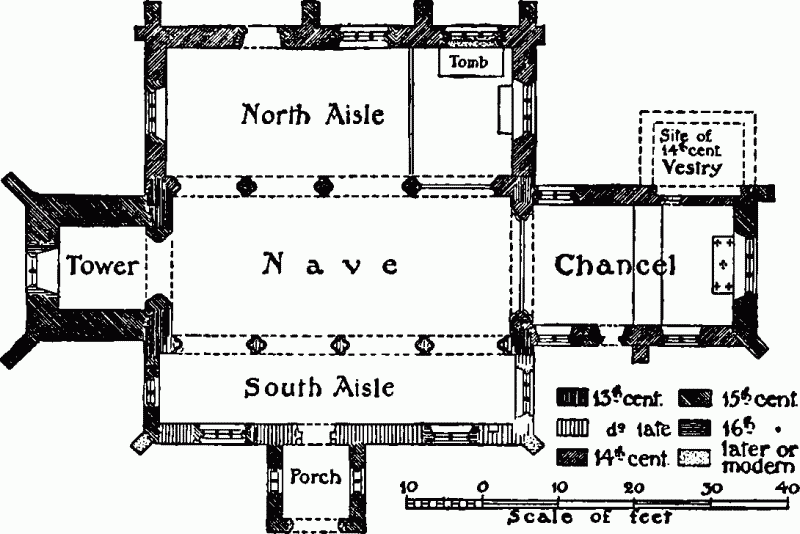
Plan of Sutton Church
There are a certain number of sixteenth-century benches in the nave and some seventeenth-century panelling in the pews of the north aisle. Across the chancel arch is a fifteenth-century screen with a modern cornice, said to have come from another church in the county. In the chancel is a very fine mediaeval chest with ornamental lock plates, and the pulpit dated 1628 is a good specimen. The monuments in the north aisle or Burgoyne chapel are fine of their kind, especially the large monument at the north-east to John Burgoyne, 1604, with a life-sized effigy under a canopy flanked by columns carrying a pediment with heraldry. There is also a monument against the east wall to Sir John Burgoyne, 1709, and in the floor is a slab with a brass cross, of which the base only appears to be ancient, and an inscription to Thomas Burgoyne, 1516, and his wife Elizabeth. Further west is the matrix of another brass, and over the north door is hung a Union Jack saved from the wreck of the 'Captain' lost in the Bay of Biscay, 1870.
The font at the west end of the north aisle is octagonal, with a quatrefoil stem, and approximately of the same date as the aisle.
There are four bells, the treble and third by C. & G. Mears, 1856, and the second and tenor by Christopher Graie, 1655.
The plate consists of a communion cup with cover paten of 1569, two plated dishes, and modern cruets. There are also two pewter dishes and a pewter flagon, the maker being H. Little, of London.
The registers are complete from 1538, the first book, the parchment copy of 1598, being continued to 1669. The second runs from 1665 to 1780, the third is the marriage register, 1755–1812, and the fourth the register of births and deaths, 1777–1812.
Advowson
The first mention that has been found of the church of Sutton is in 1311, when the right of presentation was settled on Alice widow of William le Latimer, granddaughter and coheir of Christina Ledet. (fn. 48) It continued to follow the same descent as Sutton manor, its value in 1381 being 100s., (fn. 49) and like that manor became parcel of the duchy of Lancaster in 1398. It was the subject of occasional grants, Walter Walshe received the right of presentation in 1532 to the church of Sutton, then worth £20 10s. 6d. (fn. 50) In 1544 a perpetual grant of the rectory and advowson was made to Thomas Burgoyne, (fn. 51) whose family retained it until, between the years 1731 and 1771, it was purchased from Sir Roger Burgoyne by St. John's College, Oxford, (fn. 52) who have since exercised the right of presentation. (fn. 53)
Charities
The Charity Estate now consists of 20a. in Marston Moretaine, allotted on the inclosure in that parish in lieu of lands in the open fields purchased in 1715, with £100 given by John Burgoyne (£60 for poor and £40 for the repair of church and bridge), and with £50 left by Dame Constance Burgoyne, 1711, for a charity school. The land is let for £20 a year. By an order of the Charity Commissioners under the Local Government Act, 1894, the charity was apportioned as to 2/15ths as an Ecclesiastical charity, of which the rector and churchwardens were appointed trustees, and as to 18/15ths as non-ecclesiastical, of which the parish council appoint four of their body as trustees. The net income, after payment of tithe and land tax, is applied as follows: £2 for church repairs, £2 for repair of bridge, £5 for education, and the balance is distributed among the poor.
In 1836 Montague Burgoyne by his will, proved in the P.C.C., left £100 consols, dividends to be applied as to one-half between three industrious old men, and as to the other half between three industrious old women recommended by the officiating minister from among those most constant in their attendance at divine worship in the parish church.
The same testator also left £100 consols, dividends to be expended in repairing the organ of the church. The latter legacy has been augmented by investment of unapplied income to £228 4s. 2d. consols, which is held by the official trustees together with the £100 consols left for the poor.