A History of the County of Bedford: Volume 2. Originally published by Victoria County History, London, 1908.
This free content was digitised by double rekeying. All rights reserved.
'Parishes: Pulloxhill', in A History of the County of Bedford: Volume 2, ed. William Page (London, 1908), British History Online https://www.british-history.ac.uk/vch/beds/vol2/pp376-381 [accessed 30 April 2025].
'Parishes: Pulloxhill', in A History of the County of Bedford: Volume 2. Edited by William Page (London, 1908), British History Online, accessed April 30, 2025, https://www.british-history.ac.uk/vch/beds/vol2/pp376-381.
"Parishes: Pulloxhill". A History of the County of Bedford: Volume 2. Ed. William Page (London, 1908), British History Online. Web. 30 April 2025. https://www.british-history.ac.uk/vch/beds/vol2/pp376-381.
In this section
PULLOXHILL
Polochessele (xi cent.); Pullokeshull (xii, xiii, xiv cents.).
The parish of Pulloxhill, which contains the village of the same name and part of the hamlet of Greenfield, has an area of 1,627 acres, of which 510¼ consist of arable land, 953 of permanent grass, and 14 of woods and plantations. (fn. 1) The soil, which is of strong clay with a subsoil of clay, produces wheat, barley, beans and peas; the country is divided into fields of moderate size, the hedgerows often including rows of fine elms.
The village, which is surrounded by small orchards and gardens, is grouped round the main street which follows the line of a broad ridge of land running in a south-westerly direction to a point about 342 ft. above sea-level, on which the church is placed. Several roads diverge from the village, connecting it with Greenfield in the west, Higham Bury in the south, and Kitchen End Farm in the east. The highest part of the parish is Higham Bury where it reaches 362 ft. above the ordnance datum, the lowest part being near Kitchen End which lies 187 ft. above the same datum. The village is placed on a slight elevation, with lower lying ground surrounding it, with a fall to the north where Upbury Moat is situated—the site of the former manor of Beeches and Upbury. At Greenfield is a mill, the successor probably of that held by Woburn Abbey of Dunstable. At present the village is lighted by electricity generated by a dynamo attached to the steam engine of the mill.
The inhabitants of Pulloxhill made complaint in 1636 that several assessments for ship-money had lately been laid upon them by the then late and present sheriffs of the county, and that it grieved them all the more sorely because they had paid their contribution with so much loyalty. The Privy Council, to whom the complaint was made, sent it to the sheriffs of Bedfordshire for redress. (fn. 2)
In 1680 gold quartz was discovered at Pulloxhill, which was at once taken into the king's hands as royal mine, but it was found on working it that the gold did not repay the cost of separation, as it consisted merely of flakes of mica in drifted stones; the mine was therefore abandoned, but a field called Gold Close, in which the mine was situated, still exists. (fn. 3)
Among the place-names found in this parish are lands called Goldston after their owner, Thomas Goldston mentioned in 1553; (fn. 4) Collis Close, Sampshill Croft, and Cadman Stockinge occur in 1601; (fn. 5) Halcroft, Burne Close, Baynard Meade, and Buniuns' Hill are mentioned in an inquisition of 1609; (fn. 6) the last probably denotes land which originally was included in the fee held by the Buniun family in the thirteenth century.
The Inclosure Act for this parish was passed in 1809 with that of Flitton cum Silsoe, (fn. 7) it is private and has not been printed, but a copy is kept at the West Park Estate office at Ampthill.
Manors
At the date of the Domesday Survey the manor of Pulloxhill was held under Nigel de Albini by Roger and Ruallon. It was assessed at 10 hides and had been held by eight sokemen in King Edward's time. (fn. 8) The overlordship remained vested in the barony of Cainhoe, but part of the lands were acquired by Dunstable Priory, and some by Woburn Abbey, the latter also holding land of Dunstable Priory. (fn. 9) There is no mention of the abbey's estate until the beginning of the thirteenth century when it possessed a small property in the parish of Pulloxhill, which was gradually enlarged by various grants and became known as the manors of PULLOXHILL and GREENFIELD. It was taken into the king's hand at the Dissolution and annexed to the Honor of Ampthill, and afterwards granted out to various people.
In 1227 Henry Buniun conveyed 8 acres of land to Woburn Abbey, (fn. 10) and in 1235, 33 acres more were confirmed to the Abbey by Godfrey de Luvholt and Mabel his wife, the heiress of Letitia, who had formerly given this land to the abbey. (fn. 11) These lands were probably acquired from Dunstable Priory, and the abbey of Woburn also held land under the priory, for it paid an annual rent of 26s. in 1234 to the priory for a mill in Greenfield, (fn. 12) and in 1286, after the death of Aimery of St. Amand, Woburn Abbey contributed 16s. towards the 32s. paid by Dunstable Priory to his executors. (fn. 13) In 1535 Dunstable Priory received from Woburn Abbey 25s. for lands which the latter held in Greenfield, (fn. 14) and 5s. for those it held in Pulloxhill, while the mill in Greenfield was rented at 20s. per annum. (fn. 15) In 1291 the value of the abbey's estates in Pulloxhill was £7 2s. 5d., (fn. 16) and it was again estimated at that figure in 1337. (fn. 17) In 1302 the abbey held two hides, (fn. 18) and the estate was no larger in 1346 (fn. 19) and 1428. (fn. 20) In 1330 the abbey claimed sac and soc in Pulloxhill. (fn. 21) At the time of the Dissolution the manors of Pulloxhill and Greenfield were jointly valued at £38 18s. 7d. (fn. 22)
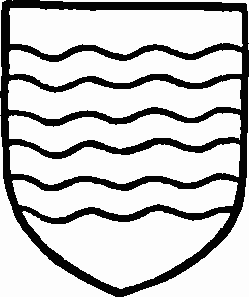
Woburn Abbey. Azure three bars wavy argent.
After the Dissolution the manors were taken into the king's hand and were leased out to Roger Lee in 1539. (fn. 23) In the same year Thomas Norton, by a false statement, acquired possession of the premises, (fn. 24) and the matter came up for settlement before the Privy Council, by whom Norton was fined for misrepresentation. (fn. 25) In 1547 Sir William Pagett was granted Pulloxhill Grange, (fn. 26) and in the following year, an agreement being come to with Sir Thomas Pamer, (fn. 27) who had a grant of the site of the manor, the latter entered into possession of the property. (fn. 28) On his attainder in 1553 for his adherence to Lady Jane Grey the grange was granted by Queen Mary to George Bredyman for life. (fn. 29) Queen Mary, however, died seised of the manor, which then passed to Queen Elizabeth, who in 1563 bestowed it on John Lee and Thomas Julyan, and the heirs of the former. (fn. 30) Thomas Julyan died soon after, and John Lee, becoming sole tenant, sold the grange of Pulloxhill to Sir Thomas Cheyney and Lady Jane his wife in 1566. (fn. 31) The latter were called upon by the queen to justify their title in 1567, and apparently made good their claim. (fn. 32) The manor was in the queen's hands, however, by 1595, (fn. 33) and in 1601 was granted to Peter Page and Edmund Pigeon. (fn. 34) Matthew Page, evidently a relation, in 1623 conveyed the reversion of the manors after the death of John Page to Richard Norton, (fn. 35) who alienated them in 1626 to Peter Duckett. (fn. 36) From him they probably passed to Noah Duckett, who may have been a brother, and through the latter's daughter Anne to her husband Sir William Briers, (fn. 37) who held them in 1643. (fn. 38) On his death in 1653 there was a division of the manors, a moiety being settled on Arabella his second wife as her dower, and the other moiety passing to Briers Crofts, his heiress. It is probable that the latter was his niece, and that her mother Anne Briers was his sister. (fn. 39) Briers Crofts' husband, Sir John Crofts of Westow, Suffolk, united with Arabella Briers in 1660 to convey the whole manor to Sir Henry Crofts, (fn. 40) probably as a trustee, for in 1665, after the death of her husband, Briers Crofts united with his relatives to convey the manors to Thomas Neale, (fn. 41) who in 1673 sold them to Sir John Norton and John Garrard. (fn. 42) From Sir John Norton they probably passed to his relatives, the Coppins of Markyate, who held the advowson between 1686 and 1710, and were conveyed, together with the advowson, to the duke of Kent by John Coppin between 1710 and 1716. The duke of Kent is mentioned as the chief landowner in Pulloxhill in 1736, (fn. 43) and from him the manors descended to his great-granddaughter Lady Amabel, baroness Lucas, (fn. 44) and have remained in the de Grey family since that date, the manorial rights now being vested in Lord Lucas and Dingwall. The manors appear to have been amalgamated in the process, and are now known as the manor of Pulloxhill and Greenfield.

Crofts. Quarterly fessewise indented azure and argent with a leopard or in the quarter.
The manor of BEECHES or UPBURY, which appears for the first time after the Dissolution, probably originated in the estate held by Dunstable Priory in Pulloxhill of the barony of Cainho. This estate can be traced back to the Domesday manor of Pulloxhill, (fn. 45) part of the lands of which were acquired by Woburn, part by Dunstable, the rest being held by William de Faldho, the Buniun family (fn. 46) and the prior of St. John of Jerusalem. The amount of the priory's holding was 5 hides in 1285, (fn. 47) and the land was apparently leased by the priory to the Pyrot family, for it became known as the Pyrot fee, (fn. 48) and c. 1240 William Pyrot was stated to be one of the lords of Pulloxhill, holding, with William de Faldho, one fee. (fn. 49) The priory's holding had diminished to 2¼ hides in 1302, (fn. 50) at which it remained in 1316, 1346, and in 1428. (fn. 51) The priory in 1323 was granted free warren in its demesne lands of Pulloxhill (fn. 52) and justified its claim in 1330 by a production of this charter. (fn. 53) The lands were worth £2 10s. 5d. in 1342, (fn. 54) but the value of the manor had risen to £4 6s. 8d. in 1535. (fn. 55) At the Dissolution the manor was taken into the king's hand and was by him probably granted to Simon Fitz, who died seised of the manor in 1543; (fn. 56) his eldest son William inherited the manor, but died in 1545 without issue, when it descended to his brother Simon, (fn. 57) who had already come into possession of the manor of Bilkemore. The descent of the manor from this date until the early years of the reign of Elizabeth is similar to that of the manor of Blundells in Silsoe in the parish of Flitton (q.v.). In 1552 mention is first made of the manor of Upbury in connexion with that of Beeches. (fn. 58) Its origin is not known, but it is invariably mentioned afterwards in conjunction with Beeches manor.

Dunstable Priory. Argent a pile sable with a horseshoe or affixed to it by a staple or.
Thomas Morgan, who acquired the manors of Bilkemore, Beeches, and Blundells in Silsoe (q.v.), settled the manors of Beeches and Upbury on George Fitz, alias Wharton, in 1567, (fn. 59) on the occasion of the latter's marriage with Ann, the eldest daughter of Peter Duckett. George Fitz died in 1608, (fn. 60) but before his death he made a settlement of the manors to his own use for life, and after his death to the use of his niece Ánn Briers, wife of Sir William Briers, and her heirs, and then to the use of George Wharton. The manors then followed the same descent as the manors of Pulloxhill and Greenfield (q.v.). The last mention of them occurs in 1700, when John Coppin was lord. (fn. 61) They were probably sold by him to the duke of Kent at the same time that the latter acquired the manors of Pulloxhill and Greenfield and the advowson of Pulloxhill Church, and as no separate mention of them again occurs they were probably merged in the larger manors of Pulloxhill and Greenfield. The name of Upbury, however, still survives in Upbury Moat, which marks the site where the manor-house formerly stood.
Another estate in Pulloxhill, which towards the end of the thirteenth century became known as the manor of KITCHEN, originated in the land held in 1284 by Richard Wiscard of the abbot of St. Albans. (fn. 62) At the Dissolution the overlordship passed to the crown, and was afterwards attached to the manor of the Rectory, of which the manor of Kitchen was held in 1608. (fn. 63)
In 1284, Richard Wiscard held 1 hide of the abbot, and this estate, which was of the same extent in 1362 and 1486, (fn. 64) was known in 1295 as the manor of Kitchen. (fn. 65) In that year it was alienated by Richard Wiscard to Master John de Lacy, from whom it passed to Robert de Hakeneye and Katherine his wife, who in 1329 conveyed it to Robert de Bilkemore and Anastasia his wife, (fn. 66) the manor subsequently being known by the name of Bilkemore or Kitchens. In 1348 Robert and Anastasia conveyed the manor to David son of Bartholomew de Flitwick to their own use for life, with remainder after their deaths to Sir John de Lylebone, Sibyl his wife, and their heirs. (fn. 67) Robert de Bilkemore was dead by 1361, (fn. 68) and the manor passed to Sir John de Lylebone, who settled it on Henry Pyres and his heirs in 1383. (fn. 69)
The claim of the Bilkemore family was renewed by William Snowe, grandson of Matilda sister of Robert de Bilkemore, in 1431, who on these grounds recovered the manor from William Ryman, who by some means had acquired possession of it. (fn. 70) Laurence Snowe, probably a son of William, sold the manor in 1541 to Simon Fitz, (fn. 71) who died seised of it in 1543. (fn. 72) From this date its descent is identical with that of the manor of Blundells in Silsoe in the parish of Flitton (q.v.). When in the early years of the reign of Elizabeth, Thomas Sterne and Susan his wife, one of the four daughters and heirs of Simon Fitz, brought an action in Chancery against the tenants of the manor on account of their failure to pay rent, it was stated that Roger Pott had occupied part of the manor, and that on his death it had descended to his son John, then aged six, and in the custody of his mother Katherine, who had married for the second time William Dodd. The latter had an interest in this part of the manor for a certain number of years, but the reversion belonged to John Pott, (fn. 73) who was holding in 1590, and who in that same year alienated his share of the manor to Thomas Johnson, (fn. 74) who married his daughter Mary. (fn. 75) Of this portion no further trace has been found. The other half of the manor, occupied by John Man when the proceedings were instituted, was in 1590 held by John Man and John Godfrey. (fn. 76) The latter's daughter Frances married William Newton, (fn. 77) and she and her husband in 1608 conveyed the half to Edmund Crouche and others, (fn. 78) probably a preliminary to selling it to George Fitz, who in that year made a settlement of the half manor purchased from William Newton and John Man to his own use for life, and then to the use of Anne Briers, wife of Sir William Briers and niece of George Fitz, and in default of issue to George Wharton. Shortly after in the same year George Fitz died seised of the half manor, (fn. 79) and there is no further mention of the manor of Bilkemore. It probably passed with the manors of Greenfield and Pulloxhill (q.v.), in which it was subsequently merged, to the Croft family, and was conveyed with them to Thomas Neale. The name still survives in Kitchen End Farm.
The manor of the RECTORY of Pulloxhill apparently belonged to Dunstable Priory before the Dissolution, and was taken into the hand of the king when the priory was dissolved. In 1550 the Rectory manor was the subject of a dispute between Thomas Kent and John Robbins, (fn. 80) the former alleging that the premises had been leased to his father, Thomas Kent, by the priory. A former dispute was mentioned which had been settled by the arrangement that John Robbins was to occupy the premises for the term of his life, paying the plaintiff £115. In the reign of Elizabeth the matter was again the cause of a quarrel. It was then said that Edward VI had granted the manor to Robert Brocas of Horton, and that Thomas Kent had conveyed his interest to John Robbins, the father of John Robbins now pleading. John Robbins was to purchase the reversion in fee of the lease of the manor from Robert Brocas for £260, which was paid, whereupon Bernard Brocas, son and heir of Robert, refused to assure the reversion to John Robbins. (fn. 81)
The manor is next found in the hands of Richard Page, who conveyed it to William Briers in 1623; (fn. 82) a moiety passed to Briers Crofts, heiress of Sir William Briers, on the death of the latter in 1653, (fn. 83) while the other moiety was retained by Arabella, widow of Sir William, as her dower. The manor then followed a descent identical with that of the manors of Pulloxhill and Greenfield, and was probably sold to the duke of Kent between 1710 and 1716 by John Coppin. The manorial rights are vested at the present day in Lord Lucas and Dingwall, a descendant of the duke of Kent.
In the thirteenth century William de Faldho held land in Pulloxhill under the lordship of Aimery of St. Amand, to whom the barony of Cainhoe had passed by intermarriage with the de Albinis. This holding is described as 1 hide when it is first mentioned in 1286, (fn. 84) and the same property was probably included in the knight's fee held by him jointly with William Pyrot c. 1240. (fn. 85) Matilda, one of the heirs of Faldho, married Walter de la Haye, who held the property until his death in 1295, when, in the absence of any claim on the part of his heirs, some unnamed heirs of William de Faldho entered into the property (fn. 86) and held it in 1302. (fn. 87) William son of William de Keynes of Faldho died seised of it in 1336, when it passed to his aunts, Christina, Emma, Margery, and Alice. (fn. 88) Robert de Wodemancote, the husband of Emma, and Simon Drye held in 1346 the hide which the heirs of William de Faldho formerly held. (fn. 89) After this date there is no further mention of the holding, which was probably absorbed in one of the manors in Pulloxhill.
The prior of the Hospital of St. John of Jerusalem also held land in Pulloxhill of Aimery of St. Amand. In 1284 William de Bray, Richard Wiscard, and Robert son of Sampson were holding 1 hide from the prior, (fn. 90) and in 1286 the prior claimed view of frankpledge over his nine tenants in Pulloxhill. (fn. 91) In 1302 and in 1346 the prior and his tenants were still holding 1 hide. (fn. 92) In 1540, when Sir Richard Longe was granted the lordship of Shyngay, he was also given the possession of the Knights Hospitallers in many places, and acquired their land in Pulloxhill; (fn. 93) after which no further trace of the holding can be found.
There was a capital messuage and farm in Pulloxhill which in the reign of Elizabeth was the subject of a dispute between Reginald Callopp and Henry Steven and Thomas Kinge. (fn. 94) The former claimed the capital messuage and farm called Pulloxhill in Flitton and Pulloxhill by royal grant; probably he gained his cause, as on his death in 1590 he left lands in Pulloxhill to his sons Reginald and Thomas. (fn. 95) The latter probably conveyed the land to John Page, who settled the capital messuage and farm on his son Richard on the occasion of his marriage with Frances, daughter of Robert Mudge, in 1594. (fn. 96) Richard in 1623 conveyed a messuage, dovecote, garden, and orchard, &c., to William Beamont; (fn. 97) and John Page, the father, died the next year seised of the capital messuage and farm in Pulloxhill in which Robert Beamont lately lived. (fn. 98) There is no further trace of this capital messuage and farm.
Church
The church of ST. JAMES has a chancel 30 ft. by 18 ft. 3 in., a nave 55 ft. by 25 ft. 4in. with a western gallery, and a western tower which is used as a porch. It is recorded that the church was dedicated in 1219 by Robert of Lismore, but as the greater part of the old building, after falling into a ruinous condition, was taken down in 1846 and rebuilt, it only remains to us to deplore the loss of what might have been a valuable dated example of thirteenth-century work. Previous to the rebuilding, the nave had entirely disappeared, the chancel and a ruined west tower alone remaining. The whole of the present nave is therefore modern, up to and including the chancel arch, and the same may be said of the tower, which was rebuilt at the same time, partly with the old materials; the old chancel also lost some ten feet of its west end at the time. As it stands to-day, the chancel has a three-light east window with tracery, of mid-fourteenth-century detail, flanked by two plain niches which have been partly filled up and appear to have been included in the 'restoration.' In the north wall is a fifteenth-century window of two trefoiled lights under a four-centred head, and in the south wall are two similar windows of three lights. The second of these has had its two western lights blocked by the shortening of the chancel, and from the inside appears as a single-light window.
There are also traces in the external masonry on both sides of the chancel of windows of an earlier date. The chancel arch is modern, of two chamfered orders with fourteenth-century detail. On either side of the nave are three two-light windows with flowing tracery of fourteenth-century style, and there are also two small square-headed single-light windows, one to the gallery and one to the vestry beneath, which appear to be sixteenth-century work re-used.
The tower is of three stages with an embattled parapet and angle buttresses, and has in the ground stage a circular west window of fourteenth-century detail, and below it a west doorway which is the main entrance to the church.
Against the north wall of the chancel is a monument to Sir William Briers, 1653, and his two wives Anne (Duckett) and Arabella (Crofts), set up by the last named; there is also a brass to Dame Anne Briers, 1631. On the south wall of the chancel is another brass to George Fitzroy, 1608, and Anne his wife. Partly covered by the organ is a third brass with the kneeling figure of an armed man of seventeenth-century style, the rest of the plate and the inscription being hidden. The font, on the south side of the nave, is modern.
There is one bell cast by William Mears in 1800.
The church plate consists of a communion cup and paten and chalice of 1700, a small salver of 1808, and a modern plated flagon.
The first book of the registers contains the baptisms from 1553, and marriages and burials from 1558, all entries running to 1653, from which date they are continued in the second book to 1685. The third book begins in 1706, and the fourth is the printed marriage register from 1754.
Advowson
Dunstable Priory held the advowson and rectory of Pulloxhill until the Dissolution, but shortly after that date the rectory became divided, part following a descent analagous to that of the advowson, while the other part had a different history, and finally lapsed among the many alienations of tithes which took place in the seventeenth century. Pulloxhill Church appears to have been given to Dunstable Priory in the twelfth century together with Harlington Church by John and William Pyrot, (fn. 99) from which date it continued in the possession of the priory, although its tenure was marked by a series of disputes, in all of which the priory was successful. The first of these took place in the twelfth century between the priory and Elstow Abbey, and it was settled by the bishop of Ely by the mandate of Alexander III. (fn. 100) In 1210 a moiety of the church was disputed with Henry Buniun. (fn. 101) In 1204 a vicarage was ordained in Pulloxhill Church by William bishop of Lincoln, (fn. 102) and the church was dedicated in honour of St. James in 1220 by Robert, bishop of Lismore. (fn. 103) The priory was not left long in undisturbed possession, for, in 1262, William Pyrot contested the claim of the abbot to the advowson. Ralf Pyrot had presented Henry de Borham to the church against the will of the priory, and William maintained that the abbey had no claim to the presentation except by the gift of John Pyrot his grandfather, who claimed it by right of his wife; (fn. 104) he was unable however to despoil the priory. In 1291, the church of Pulloxhill was assessed at £5 6s. 8d., (fn. 105) and in 1535 the vicarage was assessed at £9 10s. (fn. 106) At the Dissolution the church and rectory, which was then worth £21 6s. 8d., (fn. 107) were taken into the hand of the king, and were granted first to Thomas Wye, and afterwards, in 1549, to James Rogers and Richard Veale. (fn. 108) In the following year, 1550, a dispute between Thomas Kent and John Robbins, in which Thomas Kent declared that the parsonage had been leased to his father by Dunstable Priory, (fn. 109) was settled in favour of John Robbins, who was owner of the advowson in 1554. (fn. 110) About this date also the rectory was involved in a dispute between John Robbins, Christian Barber, and the master and fellows of Trinity Hall, Cambridge, the latter alleging that John Robbins had sold them the rectory and tithes, while Christian declared that they had been sold by John Robbins in 1553 to her late husband William Barber for fifteen years, and that the term had not then expired. (fn. 111) The matter was evidently settled by a compromise, for Christian obtained a moiety of the rectory, which remained in the Barber family for many years, following a descent distinct from that of the advowson. The other moiety, instead of remaining in the possession of Trinity Hall, passed by some means, together with the advowson, into the hands of John Page, who was holding them in 1605. (fn. 112) Richard Page, evidently his son, in 1612 made a settlement of the advowson and the moiety of the rectory, (fn. 113) and in 1623 conveyed the reversions to William, afterwards Sir William Briers, (fn. 114) who entered into possession on the death of John Page in the following year. (fn. 115) The advowson and this moiety of the rectory then followed the same descent as the manors of Pulloxhill and Greenfield (q.v.), passing from Sir John Norton to his relations, the Coppins of Markyate, Hertfordshire, who held them from 1686 to 1710; (fn. 116) between 1710 and 1716 they were probably sold by John Coppin to the duke of Kent, who was patron at the latter date. (fn. 117) They have since been vested in the family of the de Greys, the Hon. Philip Yorke, who married the duke's daughter, being patron in 1742 and 1786; (fn. 118) in 1792 Lady Grey presented to the church, and in 1799 Lady Amabel Grey, Baroness Lucas, her daughter. (fn. 119) The advowson has since then descended to Lord Lucas and Dingwall, the present patron. (fn. 120)
The other moiety of the rectory which was obtained by Christian Barber about the middle of the sixteenth century remained in the possession of the Barber family for over a hundred years. (fn. 121) In 1665 it was alienated to Thomas Neale by Thomas Barber and his wife Anne, (fn. 122) and was held by the former and his wife Elizabeth, with the other moiety, until 1673. At this date a part of the moiety was alienated to Nicholas Crouch, and another part to Edward Pennefather, the latter afterwards conveying his rights to Nicholas Crouch, (fn. 123) who thus came into possession of one moiety, which in 1687 he sold to Thomas Halfpenny. (fn. 124) The rectorial tithes were leased in the eighteenth century to various people, (fn. 125) and nothing further is heard of this moiety.
In the reign of Elizabeth there was a dispute between George Rotherham and Annand Isaac Rotherham, the former claiming by descent lands given for the maintenance of lights in sundry churches in the parish of Pulloxhill, granted by Queen Mary to George Rotherham, the plaintiff's grandfather. (fn. 126) John Rotherham, evidently an ancestor of George, above mentioned, and John Acworth founded the fraternity of Luton for two chaplains to sing daily in the parish church of Luton at the altar of the chapel of the Holy Trinity for the souls of Edward IV and his queen and the good estate of the brethren of the fraternity. They endowed the chantry with certain lands in Pulloxhill; one acre of meadow lying in Diversmeade in the tenure of the vicar of Pulloxhill, worth 10d. per annum, was given towards a bead roll. The fine of one acre called the Lampe Acre in the tenure of William King, worth 12d. per annum, was given for the maintenance of a lamp, and the fine of one other acre of land worth 12d. per annum for a light. (fn. 127) There is a Baptist chapel at Pulloxhill.
Charities
Unknown donor's charities formerly consisted of an annual payment of 10s. issuing out of a cottage and two acres situate in the parish, and another annuity of 10s. which was understood to have arisen out of an ancient donation of £10 by George Fitz. One annuity of 10s. only is now paid under the title of Gibbs's Charity, being received from Mr. Henry Tretheny, of Ampthill.