A History of the County of Berkshire: Volume 4. Originally published by Victoria County History, London, 1924.
This free content was digitised by double rekeying. All rights reserved.
'Parishes: Aldworth', in A History of the County of Berkshire: Volume 4, ed. William Page, P H Ditchfield (London, 1924), British History Online https://www.british-history.ac.uk/vch/berks/vol4/pp3-8 [accessed 5 May 2025].
'Parishes: Aldworth', in A History of the County of Berkshire: Volume 4. Edited by William Page, P H Ditchfield (London, 1924), British History Online, accessed May 5, 2025, https://www.british-history.ac.uk/vch/berks/vol4/pp3-8.
"Parishes: Aldworth". A History of the County of Berkshire: Volume 4. Ed. William Page, P H Ditchfield (London, 1924), British History Online. Web. 5 May 2025. https://www.british-history.ac.uk/vch/berks/vol4/pp3-8.
In this section
ALDWORTH
Elleorde (xi cent.); Aldeworthe, Aldeseworthe, Alderworth, Audewerth (xiii to xvi cent.); Vulgo Alder (xvii-xx cent.).
The parish of Aldworth has an area of 1,806 acres, of which 1,131 acres are arable land, 445 acres permanent grass, and 40 acres woods and plantations. (fn. 1) The chief crops are barley, wheat and oats. The soil is chalk and clay; there are a number of old chalkpits in the district. The parish lies high up on the Downs, the slope of the land being from north to south and rises to a height of from 460 ft. to 600 ft. A branch of the Ridgway or Icknield Street (fn. 2) runs through the parish from north-east to south-west. (fn. 3) There is a section of Grimsdyke, (fn. 4) formerly known here as Devil's Ditch, in excellent preservation near De la Beche Farm.
The village of Aldworth is situated about 3 miles south-west of Goring and 2 miles west of Compton. It is prettily wooded, and though small is scattered, the cottages being mostly built along two or three small by-roads; these are chiefly built of brick and roofed with slate or tiles, and are of no great antiquity. The church stands in a churchyard on the west side and above the level of a by-road running south from the upper end of the village. In the churchyard to the south-east of the church is an old yew of considerable girth. Near the church is a small Primitive Methodist chapel. There is no stream or spring in the neighbourhood, and the village is entirely dependent on a few wells, one of which penetrates the chalk to a depth of 372 ft. The house of the De la Beches stood on a small eminence about a quarter of a mile south of the church; De la Beche Farm now occupies its site, but the line of the moat may still be traced and is marked by one or two small ponds. A silver seal inscribed 'Isabella de la Beche' and two ancient hinges were found on the site. (fn. 5)
Among other finds in the parish are a coin of William Rufus, a number of encaustic tiles and two battle-axes of curious workmanship near Pibworth Farm. (fn. 6)
Place-names found in Aldworth are Faldeysland, (fn. 7) Bowres, (fn. 8) Aldenores (fn. 9) and Denehache. (fn. 10)
Manors
In the time of Edward the Confessor Edward held ALDWORTH as an alod from the king, and it was given by William the Conqueror to Theodoric the Goldsmith, who was holding it in 1086. (fn. 11) The manor continued to be held of the king in chief by knight service, (fn. 12) and is described as a member of the manor of Hampstead in the 13th century, (fn. 13) when William de Sifrewast was in possession.
William de Sifrewast held one fee in Aldworth, Hampstead (Norris) and Purley (in Chaddleworth), (fn. 14) which he inherited from his father Halenath. (fn. 15) In 1239 he leased Aldworth for twenty years to Ralph de Astin. (fn. 16) At his death in 1244 the wardship of his heir was given to Bartholomew Pecche. (fn. 17) This heir must have been the Nicholas de Sifrewast, afterwards Sheriff of Berks, and Oxford, who appears to have protected a highway robber who had stolen a mark from Roger the priest of Compton. (fn. 18) In 1270 he conveyed the manor to Thomas de Clare, the king's secretary, retaining a life interest in it, (fn. 19) but it remained only a very short time in Clare's hands, as in 1276 he exchanged it for other land with Robert de Mucegros, (fn. 20) to whom it was confirmed by the Crown in the same year. (fn. 21) Robert died in 1281, (fn. 22) when 'the manor of Hampstead with the members of Aldesworth and Compton' was assigned in dower to his widow Agnes de Mucegros. (fn. 23) Hawise, her daughter and heir, married John de Ferrers, (fn. 24) lord of Chartley, and after his death before 1336 (fn. 25) she married secondly John de Bures, (fn. 26) whom she predeceased, and who held the manor until his death in 1350. Aldworth then reverted to Hawise's grandson and heir John de Ferrers, (fn. 27) whose father Robert had fought at Crecy and died in 1350. (fn. 28) John came of age in 1353 (fn. 29) and married Elizabeth daughter of Hugh de Stafford, first Earl of Stafford, and widow of Lord Strange. (fn. 30) After his death in 1367 (fn. 31) his widow, who married Reginald de Cobham as her third husband, held the manor till her death in 1375, when she was succeeded by her son Robert de Ferrers, who afterwards married Margaret daughter of Edward le Despenser. (fn. 32) He died in 1413, (fn. 33) in which year his son Edmund granted the manor to his mother Margaret. (fn. 34) Edmund fifth Lord Ferrers dying in 1435 (fn. 35) was followed by his son William, (fn. 36) whose property passed on his death in 1450 to his only daughter and heiress Anne, then eleven years old, (fn. 37) but it is probable that the manor was included in a conveyance of Hampstead made by William Lord Ferrers in 1450 to Sir Edmund Hungerford, John Norreys and others. (fn. 38)
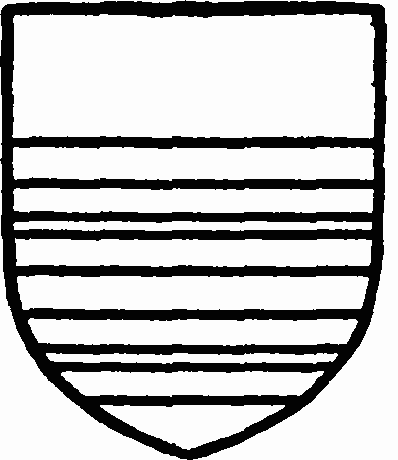
Sifrewast. Azure two gimel bars with a chief or.
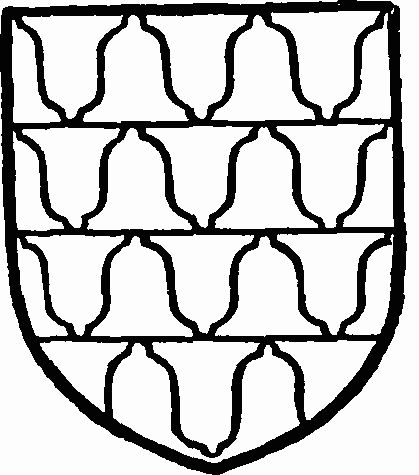
Ferrers of Chartley. Vairy or and gules.
The next definite reference to the manor is in 1542, when Sir John Norreys settled it upon Elizabeth his wife with certain remainders. (fn. 39) Sir John died in 1565 and was succeeded by his brother Henry, (fn. 40) who became Lord Norreys of Rycote. The latter was followed in 1601 by his grandson Francis, son of William, who had died in 1579. (fn. 41) Francis was created Earl of Berkshire in 1621 and died in 1623 from self-inflicted wounds consequent on a supposed slight from Lord Scrope. The manor had been settled upon an illegitimate son Francis Rose alias Norreys, afterwards knighted, with reversion to Elizabeth daughter and heir of Francis first Earl of Berkshire. (fn. 42) Francis Rose, however, does not seem to have entered into possession of the manor, as in 1624 it was in the hands of Elizabeth, Baroness Rycote in her own right, and her husband Edward Wray, (fn. 43) and apparently continued with their descendants. Their daughter Bridget married as her second husband Montague Bertie, and their son James (who was Lord Rycote in his mother's right) succeeded his father in 1666 (fn. 44) and was created Earl of Abingdon in 1682. (fn. 45) He died in 1699 and was succeeded by his son Montagu. On his death in 1743 without issue the title and estates went to his nephew Willoughby Bertie, who dealt with the manor of Aldworth in 1731 (fn. 46) and 1745 (fn. 47) and sold it in 1756 to Richard Palmer of Sonning, (fn. 48) whose son Richard was holding it in 1804. (fn. 49) In 1812 it was purchased (fn. 50) of the trustees of the will of Richard Palmer by John Berkeley Monck, who was succeeded by his son John Bligh Monck, and he again by his son William Berkeley Monck, the father of Mr. George Stanley Monck, the present owner.
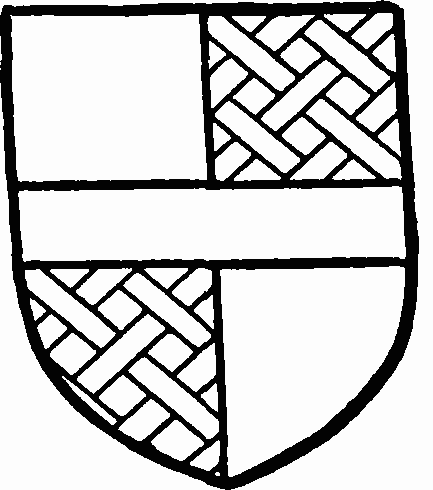
Norreys of Rycote. Argent quartered with gules fretty or with a fesse azure.

Bertie, Earl of Abingdon. Argent three battering rams barways in their proper colours with heads and rings azure.
A second manor of ALDWORTH is mentioned at the close of the 14th century, when it was held of Lord Ferrers as parcel of the manor of Hampstead Ferrers. (fn. 51) This so-called manor comprised a part of the property of the De la Beche family in this parish. In 1316 John de la Beche received a grant of free warren in all his demesne lands in Aldworth, (fn. 52) which was confirmed in the following year. (fn. 53) A similar grant was made in 1335 to Philip and Nicholas De la Beche. (fn. 54) This manor appears always to have followed the descent of the manor of La Beche, in which it seems to have become merged before the end of the 17th century.
The manor of LA BECHE took its name from the family of De la Beche, who came from Sussex (fn. 55) and apparently acquired lands in Aldworth about the middle of the 13th century. In 1261 Robert de la Beche conveyed a messuage and land in Aldworth to John de la Beche, probably his son, reserving a life interest for himself. (fn. 56) John was apparently succeeded by Philip de la Beche, (fn. 57) who in 1335 together with his son Nicholas (his two elder sons Philip and John having died in 1327 and 1328 (fn. 58) respectively) received a grant of free warren in La Beche and Aldworth. (fn. 59) In the same year licence was granted to Philip and Nicholas to impark their woods at La Beche. (fn. 60) This Nicholas, who succeeded his father before 1338, was the most distinguished member of his family. He superintended the education of Edward the Black Prince and went to Castile to arrange for the marriage of Joan, the king's daughter. (fn. 61) He was summoned to Parliament as a baron, and held many offices, including that of Constable of the Tower. He also served as Seneschal of Gascony. (fn. 62) He obtained licence in 1338 to crenellate his manor house here, (fn. 63) and died childless in 1345. (fn. 64) His widow married Sir Gerard Lisle as her third husband, and retired to Beaumys, near Shinfield, whence she was abducted and forcibly married by John de Dalton. (fn. 65)

De la Beche of Ald-worth. Vairy argent and gules with the difference of a martlet sable.
Nicholas de la Beche was succeeded by his brother Edmund, Archdeacon of Berkshire, keeper of the wardrobe and treasurer of the household to Edward III, (fn. 66) who inherited under a settlement in tail-male, (fn. 67) for the nieces of Nicholas—namely, Joan, Isabel and Alice, daughters of his brother John—were his heirs. (fn. 68) On the death of Edmund in 1364 (fn. 69) the manor of La Beche passed by settlement to Thomas Langford, (fn. 70) son of John Langford, who probably married a sister of Nicholas and Edmund de la Beche. (fn. 71) Thomas was holding in 1387–8, (fn. 72) and on his death in 1390 the manor devolved upon his son William de Langford, who had married Anne daughter of John de Beverley. (fn. 73) William died in 1411 (fn. 74) and was followed by his son Edward, who leased La Beche together with other manors in 1470, and died seised of it in 1474. (fn. 75) Thomas, his son and heir, was succeeded by John de Langford, who died in 1509 and left as his sole heiress a daughter Anne, (fn. 76) then aged nine, who married William Stafford of Bradfield (fn. 77) and was holding the manor in 1534. (fn. 78) Their son Thomas Stafford settled the manor in 1571 (fn. 79) and was succeeded by his son Reade in 1584. (fn. 80) Reade died seised of it in 1605. (fn. 81) As he died childless the manor descended to his nephew Edward, (fn. 82) who was holding in 1613. (fn. 83) It is not known how or when the manor passed from the Staffords, but it was probably sold by this Edward, who was a Royalist and parted with a good deal of his property during the Civil War. It is next heard of in 1675 in a fine between Richard Skinner, Thomas Hopkins and Mary his wife and William Allen of Streatley, (fn. 84) who is said to have purchased several manors in Berkshire in 1670. (fn. 85) Ten years later it was again the subject of a fine between William Hand and other members of the Hand family (who apparently had some interest) and Edward Whistler, (fn. 86) but the manor nevertheless seems to have remained with the Aliens, as in 1742 Richard Allen was party to a fine concerning it. (fn. 87) All manorial rights are now held by Mr. Monck. Dela Beche Farm still preserves the name of the manor.
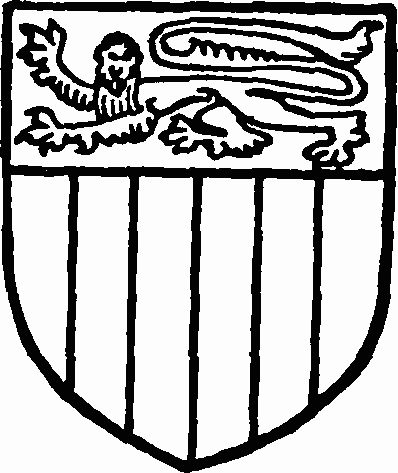
Langford. Paly argent and gules a chief azure with a leopard or therein.
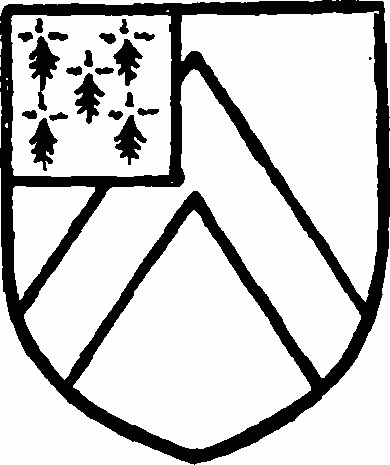
Stafford of Bradfield. Or a cheveron gules with the difference of a quarter ermine.
A small property in Aldworth known as PIBWORTH, and probably now represented by Pibworth Farm, is mentioned as a manor in 1451 when John Roger was its owner. (fn. 88) It belonged in the 16th and 17th centuries to the Stafford family, who held the manor of La Beche (fn. 89) (q.v.).
Several religious houses held land at various dates in Aldworth. In 1291 the Prioress of St. Mary, Kington, conveyed lands to Robert Burnell, Bishop of Bath and Wells. (fn. 90) The Prior of Sandleford obtained a messuage and carucate of land in 1339 (fn. 91) by exchange with Nicholas de la Beche for the advowson of the chapel of the manor of Haxton (co. Wilts.). (fn. 92)
Goring Priory also held 'lands in Aldeworth called Bowers and Aldenores,' valued in 1535 at £1 3s. (fn. 93) which were leased by Henry VIII to John Knappe. (fn. 94) In addition to these small estates the church of St. Peter and St. Paul at Brinkburn also owned a carucate of land, which had been granted to them in 1201 by William Bertram. (fn. 95)
Church
The church of ST. MARY consists of a continuous chancel and nave about 57 ft. 8 in. by 16 ft. 3 in., the chancel being about 17 ft. 7 in. in length, a modern north vestry, a south aisle 39 ft. by 18 ft. 3 in., a tower at the west end of the nave 8 ft. 9 in. by 13 ft. 11 in., and a modern south porch. These measurements are all internal.
The tower and nave are the oldest parts of the present building and belong to a small aisleless church consisting only of chancel, nave and tower erected about 1200. Early in the 14th century the chancel was rebuilt on a larger scale, the north and south walls being brought out to line with those of the nave, while about 1330 the south aisle was added.
The year 1315, (fn. 96) 'when the re-dedication of the high altar took place by commission from the Bishop of Salisbury granted at the instance of Sir Philip de la Beche and other inhabitants,' no doubt dates the completion of the rebuilding of the chancel. From the 14th century until modern times little appears to have been done to the church. From 1845 onwards the building has at intervals undergone many restorations, the east wall of the chancel having been rebuilt and both the vestry and the south porch added. (fn. 97)
The east window of the chancel is modern. In the east end of the north wall is an early 14thcentury pointed window of two cinquefoiled lights with a circular piscina basin, probably reset, in the east end of the sill. To the west of this is a modern doorway opening into the vestry. In the south wall are two early 14th-century windows, the easternmost being of two cinquefoiled lights with a quatrefoiled spandrel under a pointed head, the other a pointed window of two trefoiled lights with soffit cusping. The sill of the easternmost has been carried down internally to form two stepped sedilia. There is no structural division between the chancel and nave. Against the north wall of the nave at its eastern end are three large tomb recesses of circa 1340. Together with those against the south wall of the aisle, they were drastically restored in 1871 and much of the stonework is completely modern. They stand on a base and between them and at either end are projecting crocketed and pinnacled buttresses. Attached to the sides of these buttresses are small half-round shafts having moulded bases, which return round the buttresses, and carved capitals from which spring multifoiled crocketed and finialled ogee-headed canopies. On the cusping are small four-leaf flowers, and the spandrels of the cusping and the principal foils are carved with leaves. The necking and abaci to the capitals of the attached shafts are, like the bases, carried round the buttresses, which are panelled between their necking and their base. Under these canopies are the remains of a 14th-century carved figure. In the wall behind the easternmost recess is a two-light modern window of mid-14th-century design with old inner jambs. To the west of these monuments is a 14th-century pointed doorway. The south arcade of the nave is of three bays with pointed arches of two moulded orders carried on octagonal piers having moulded capitals and bases, and responds of the same design. Above the arches, on the south face only, is a moulded label which stops over the piers on carved grotesque beasts. On the west face of the east respond is a small semi-octagonal image bracket. A screen appears to have existed in the easternmost bay of the arcade, as may be seen by the preparations for it in the capitals and above them. The chancel and nave are both plastered internally and covered with rough-cast outside. At the corners of the east wall of the chancel are modern buttresses of flint with stone dressings.
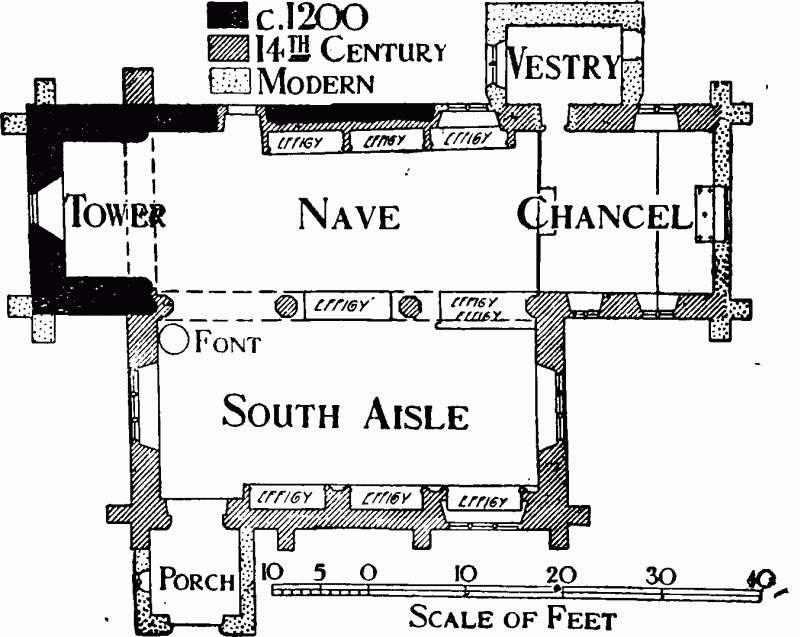
Plan of Aidworth Church
The east window of the aisle is of three trefoiled lights with geometric tracery under a pointed head. At the east end of the south wall are three bays of wall arcading, somewhat similar in design to the arcade on the north wall of the nave, with arched recesses behind them, but unfortunately they have been even more restored than those against the north wall. In the wall behind the easternmost arch is a three-light window of the same date and design as the one in the east wall, though set lower in the wall, while at the west end, opening into a modern porch, is a much-restored 14th-century pointed doorway. The aisle has an original threelight window in the west wall of the same design as the two others. The outside label is stopped by grotesque beasts' heads. The walls of the aisle are buttressed and have an external chamfered plinth; they are faced with flint with stone dressings. The buttresses are each of two stages and much restored, while the westernmost one on the south wall has been incorporated in the west wall of the porch. Low down between the two intermediate buttresses is a large semicircular stone arch, the wall behind which is recessed about 2 in. It is against this that the stone figure referred to by Mr. Symonds in 1644 (fn. 98) as kept in the churchyard is said to have stood.
The tower is undivided externally by string-courses, but the north and south walls are set back on the outside at the level of the ceiling to the ground stage. At the western angles are modern buttresses. The tower arch is the full width of the tower, and appears to be an insertion of the 14th century. It is of two chamfered orders, both springing on the east from the nave walls, and on the west off the side walls of the tower, which are splayed at their junction with the west wall of the nave; at the springing of the arch are restored moulded abaci. Lighting the ground stage from the west is a large lancet with wide internal splays and an external chamfer, while the bell-chamber is lighted from each side by small coupled lancets. Below these, in the north wall of the bell-chamber, is a narrow square-headed opening giving light to a low compartment between the lowest stage and the bell-chamber. The tower is built of flint with stone dressings, but has been considerably restored. It has a modern tiled pyramidal roof.
The roofs are all comparatively modern and covered with tiles.
The font is circular and of late 12th-century date; it tapers towards the foot, and stands on a moulded base. The pulpit was brought from St. Laurence's, Reading, in 1740; it stands on a stone base, and the semi-hexagonal oak front is of Jacobean date. A reading-desk just below the pulpit is also made up of Jacobean panelling. A panel similar to those round the pulpit has also been used to form the door to a cupboard in the vestry, at the bottom of which are two 15th-century cinquefoiled heads of pieces of tracery used in the former chancel screen. Another piece of the screen has been fixed to a beam of the modern lych-gate. Attached to some pews at the west end of the church are three 14th-century bench-ends with curiously shaped heads. The ends each have three long trefoil-headed panels, the heads of which are rounded, while the shaped heads of the bench-ends themselves are carved. Two of the heads are restored. In the head of the easternmost window in the south wall of the chancel are some fragments of 14th-century red and white glass designed in the form of a border.
In the vestry there is a green altar cover worked with the date 1703 and the churchwardens' initials. There is also the head of a figure, which may have belonged to the image bracket on the east respond of the nave arcade, or, perhaps, to the original reredos.
Of the nine celebrated effigies in the church, three are under the canopies along the north wall of the nave, three under those against the south wall of the aisle, one on a tomb under the centre arch of the nave arcade, and two on a tomb under the easternmost arch. They are all in stone, and may be assigned to the first half of the 14th century, but unfortunately all have been terribly mutilated and defaced. (fn. 99) They were identified by the late Rev. L. Lloyd as various members of the De la Beche family, but the evidence is by no means conclusive, as none of the tombs are inscribed or bear heraldic devices of any description.
The figure in the recess nearest the north door is probably the oldest and is certainly of earlier date than the canopy under which it is set. It may represent Robert de la Beche, the father of John, apparently founder of the Berkshire house. (fn. 100) The head of the figure, which is in a recumbent position, is inclined slightly to the south; the legs are crossed and the right hand rests on the hilt of his long sword which hangs along his left side, while with the left hand he holds his shield. Both legs are broken just below the knees, as is also the right arm from the shoulder to the wrist and the lower parts of the shield and sword. He wears a quilted gambeson, cyclas and camail, and plate armour on his legs with knee cops; his head rests on a pillow. The figure in the recess to the east may be that of John son of Robert de la Beche, who apparently died early in the 14th century, and is very similar to the foregoing. His right arm is folded across his breast and his left hand rests on the hilt of his sword. At his feet is a small but well-carved lion. As with the effigy on the west the right arm is broken from the elbow to the wrist, as is also the left leg below the knee (though the left foot remains) and also the crown of his head. He wears pointed sollerets with prick spurs and gadded gauntlets.
The easternmost effigy against the north wall has been identified as Sir Philip de la Beche, who died between 1335 and 1338. The figure is of a man of tall stature and is in a reclining position looking to the south. Both feet are broken off, the right arm has gone, and the left has been broken off just above the elbow. He is clad in armour similar to that of the other two figures. Round his waist is a narrow belt, apparently for keeping in position his cyclas, while below it is a broader one from which is hung his sheathed sword, both the hilt and end of which are broken. The arms and legs (which are crossed) are in armour elaborately embossed with rosettes and fleurs de lis, and upon his head he wears a bascinet, the front of which has been thrown back. Sitting cross-legged at his feet is a small dwarf surrounded with fleur de lis foliage. He originally supported the knight's feet, but his hands and head are now gone.
Under the centre canopy against the south wall is the recumbent effigy of a lady, probably Joan de la Zouch, wife of Philip. The figure is as beautifully carved and of the same stone as the one just described, and from its size and character appears to have been moved to its present position from some other part of the church. She wears the full and long loose flowing costume of the early 14th century with a cloak thrown over her shoulders and held together across her breast by cords, and she has the usual wimple head-dress. Her hands rested apart on her bosom, but both are now broken, while her head rests on a pillow supported by two angels, only fragments of which now remain.
The figure in the recess on the east is perhaps that of Philip de la Beche, eldest son of Philip and Joan, who died unmarried in 1327. He is represented as lying on his left side and appears to be fully armed, though the effigy is now much worn and mutilated; both legs are broken off at the thigh and the lower part of the left arm, which appears to have supported a shield, is gone. His right hand is clasped round the hilt of his sword, and the visor of his bascinet, which is encircled with fleurs de lis, is thrown back.
Under the easternmost arch of the nave arcade lie two effigies believed to be those of Sir John, second son of Philip de la Beche and his wife Joan, who died in 1328, and his wife Isabella (de Elmridge). The knight lies to the north of his lady, in a similar attitude to and clad in the same manner as his younger brother Sir Nicholas. His jupon is, however, kilted below his belt. Save for small pieces of his hands and a short piece of his left arm below the wrist both arms are gone; his feet and his face have also been broken. His legs rest on the backs of two small dogs, while at his feet was a larger one, but most of this has been broken. His rowel spurs may still be seen. The Lady Isabella is represented wearing a close-fitting underdress with loose flowing skirts which are caught up under her left arm, while the sleeves have long lappets. Over her shoulders is a cloak. Her left arm is folded across her breast and with her right she holds the folds of her skirt. At her feet is the mutilated figure of a small dog. Her head and right forearm are missing and the right hand is broken. It may be noted that the two figures are carved out of different kinds of stone.
The figure in the recess at the west end of the south wall is thought to be that of John second son of John de la Beche and Isabella de Elmridge his wife, who died unmarried in 1338 (see Ashden in Compton). It is the most mutilated of all the effigies, being without head, arms, or the lower parts of the legs. The feet rested on the back of a dog, though most of the animal is now destroyed. The effigy is badly worn, but appears to be wearing similar armour to the others.
Under the centre arch of the nave arcade is the effigy attributed to Sir Nicholas, third son of Philip de la Beche and his wife Joan. He was constable of the Tower of London, and died in 1345. He is represented with his hands clasped in prayer on his bosom. The elbows and finger-tips have been broken off, as have also the lower parts of both legs, the right one just below the knee, the left one just above it. The nose has also been broken, though the features are in a better state of preservation than those of any of the other effigies. The knight wears a bascinet and his head rests upon his helm. A short jupon covers the body, laced down the right side, while over the shoulder and neck is the camail. His arms are protected by plates hinged down the side and strapped to the arm. He wears a wide belt with a large buckle supporting a sword, both the hilt and lower part of which have been broken. The popular nomenclature of four of these figures is preserved in the following rhyme: 'John Long, John Strong, John Ever-afraid, John Never-afraid.'
There is a ring of three bells and a call bell. The treble and second are by Mears & Stainbank, London, 1868; the tenor is by 'Rt. & Is. Wells' of Aldbourne, 1793; while the call bell is inscribed '1635.'
The plate consists of a silver cup and cover paten of 1632, a silver jug given to the church in 1840, and a pewter flagon.
The registers previous to 1812 are as follows: (i) baptisms and burials 1556 to 1812, marriages 1556 to 1754; (ii) marriages 1755 to 1812.
Advowson
The church of ALDWORTH is first mentioned in 1267, when William de Ruthenwyke was rector. (fn. 101) In 1298 William de Burton was deprived of the living ob varias causas by the Bishop of Salisbury, and John de Wynklegh was inducted in his place. (fn. 102) In the 14th century the advowson belonged to the Benedictine nunnery at Bromhall, the prioress and nuns receiving a licence in 1308 'to appropriate the church of Aldworth which was of their own pationage.' (fn. 103) In 1327 the living was in the gift of the king, 'by reason of the voidance of the priory of Bromhall,' and was by him given to Simon de Asshe. (fn. 104) The Nonal Rolls state that the annual value of the king's ninths was 66s., and that the 3 virgates of land belonging to the church with the dues, oblations and small tithes were worth 24s. in 1340. (fn. 105) It seems probable that Edmund de la Beche, Archdeacon of Berkshire, who held the manor of La Beche in this parish from 1345 to 1364, intended to make the church collegiate. In 1351 he obtained licence to acquire the advowson of the church of Burton (fn. 106) and appropriate it to chaplains to celebrate divine service daily in the parish church of Aldworth, probably to pray for the souls of his relations whose tombs are in the church. As he was unable, however, to acquire the advowson his intention was frustrated. (fn. 107) The living was valued in the 13th century at £5, (fn. 108) and in 1535 at £8 15s. 11½d. (fn. 109)
Bromhall Priory with all its possessions passed (fn. 110) on its dissolution to St. John's College, Cambridge, in 1522, the royal grant being confirmed by a bull (fn. 111) of Pope Clement VII. In 1529 the Master and Fellows of St. John's, as rectors of Aldworth, were involved (fn. 112) in a case in the legatine court of Cardinal Campeggio, and as patrons (fn. 113) they presented to the vicarage in 1540 and on other occasions in the 16th century. The patronage has continued to be vested normally (fn. 114) in the college to the present day.
Thomas Langland, who was inducted vicar in 1658, 'gave up his living the next year in those troublesome times,' while Jonathan Davison, B.D., inducted in 1687, was ejected in 1691 for refusing to take the oath of allegiance to William III. Richard Graves, a Fellow of All Souls and a man of distinction in his own day as the author of The Spiritual Quixote and other works, was curate at Aldworth in 1744, but having fallen in love with the daughter of the farmer with whom he lodged he resigned his fellowship in order to marry her. This does not, however, appear to have hampered his career, as he had many preferments subsequently.
Since 1836 Aldworth has been in the diocese of Oxford, having previously been in that of Salisbury.
There are no endowed charities in this parish.