
A History of the County of Berkshire: Volume 4. Originally published by Victoria County History, London, 1924.
This free content was digitised by double rekeying. All rights reserved.
'Parishes: West Ilsley', in A History of the County of Berkshire: Volume 4, (London, 1924) pp. 32-37. British History Online https://www.british-history.ac.uk/vch/berks/vol4/pp32-37 [accessed 14 April 2024]
In this section
WEST ILSLEY
Hislelei (xi cent.); Westildesle (fn. 1) (xiii cent.).
The parish of West Ilsley has an area of 3,038 acres, of which rather more than half is arable land, over a third is permanent grass, and 188 acres woods and plantations. (fn. 2) The soil is chalk, and the subsoil is also mostly chalk, with pockets of clay. The chief crops are oats, wheat and barley. The land slopes downwards from west to east, from a height of 700 ft. to 400 ft. The Old Street bounds the parish on the west, while on the north a portion of Grimsdyke runs parallel to the Icknield Way. On the summit of the downs is the Ridgway, by the side of which is a continuous chain of barrows. (fn. 3) There are other barrows on a height south of Hodcutt, now becoming levelled by the plough. (fn. 4) In the neighbouring fields a number of Roman coins have been ploughed up, (fn. 5) and a deep pond near Parson's Copse (fn. 6) is said to be paved with ancient bricks.
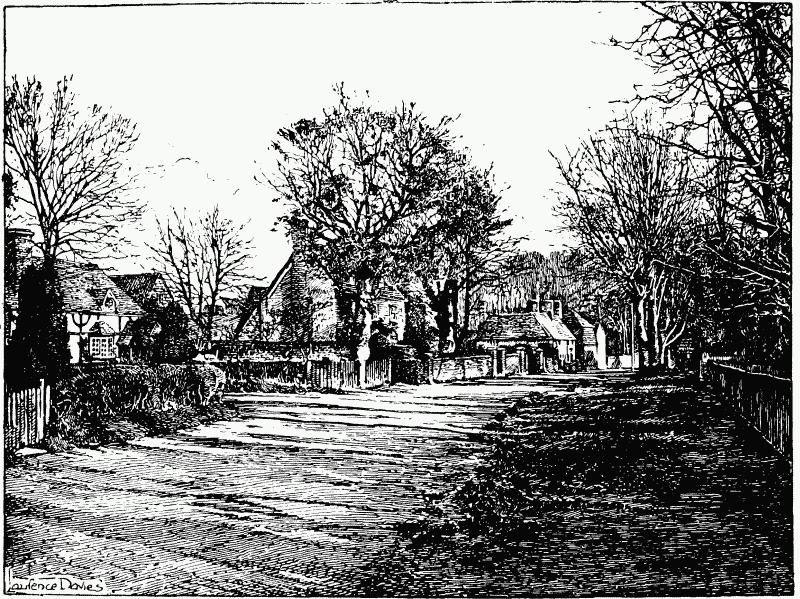
West Ilsley: The Village
About 1340 it was stated that a third of the arable land was so barren that the tenants were forced by poverty to relinquish their land. (fn. 7) The parish was inclosed in 1825. (fn. 8)
The village of West Ilsley stands nearly 2½ miles south-west of Chilton and about 1½ miles west of East Ilsley. It is built in a hollow in the middle of the downs, the ground rising sharply on the east and south. The general lie of the village is east and west, being built along the road running west from East Ilsley. It is prettily wooded, and on the northeast is a well-timbered plantation. The cottages are of little architectural interest, and are generally built of brick and roofed with tiles, though slate is also employed in some of the more modern buildings. The church stands on the south side of the road in the middle of the settlement. In the churchyard are two trees planted respectively by the Prince and Princess Christian of Schleswig-Holstein at the laying of the foundation stone of the chancel rebuilt in 1878. A little to the east of the church on the opposite side of the road is West Ilsley House, formerly held by the Morland family, and now the residence of Dr. Frank W. Humphery. There is a Baptist chapel in the village, erected in 1866.
Hodcutt House is the residence of Mr. Frank B. Barling. The old mansion of Hodcutt, which is said to have been built by Inigo Jones, was raised upon arches on account of its damp position, and was famed for its spiral staircase. When it was pulled down, about 1826, a human skull was discovered in the foundations, and by a curious coincidence, at the opening of a vault in West Ilsley Church in the following year, a headless skeleton was found. (fn. 9)
Harcourt Farm recalls the name given to the manor of West Ilsley when owned by the Harcourt family.
Manors
Although no connexion has been found between the 29 hides in Ilsley appurtenant to Sonning Manor which in 1086 were held by Aubrey de Coci (fn. 10) and any holding in West Ilsley, it seems probable that these hides lay in West Ilsley, for all the other holdings in Ilsley can be accounted for in East Ilsley. WEST ILSLEY, however, is found at a later date in the hands of the Beaumonts (see below). On the death of Robert de Beaumont Earl of Leicester in 1204 his lands were divided between his sisters Amice wife of Simon de Montfort and Margaret wife of Saer de Quincy Earl of Winchester. The overlordship of the different holdings in West Ilsley passed with the descendants of these two co-heirs, the Earls of Leicester and Lancaster (afterwards Dukes of Lancaster) and the Earls of Winchester and their heirs. (fn. 11)
Early in the 13th century Robert Fitz Niel held 10 librates of land in West Ilsley, in which he was succeeded by Simon de Steiland, who called himself his heir. (fn. 12) Simon de Steiland was holding in 1230–1, (fn. 13) but forfeited his lands in 1241, and his half-fee was then granted by the king to John de Mansel, provost of Beverley, who held this half-fee under Simon de Montfort of the king's bailiwick at the time of the Testa de Nevill. (fn. 14) Before 1248, however, it had been given by the king to the overlord, Simon de Montfort, John de Mansel receiving other lands in compensation. (fn. 15)
Probably rather later a feoffment was made by the overlord to one of the Fukeram family. In 1275 Richard Fukeram had return of writs and assize of bread and ale at West Ilsley. (fn. 16) In 1279 a fine was levied between Richard Fukeram, senior, and Richard Fukeram, junior, of land in Ilsley. (fn. 17) The manor was apparently conveyed before 1349 to Richard de Penley and Isabel his wife, against whom Joan widow of Richard Fukeram claimed a third in dower in that year. (fn. 18) In 1362 Richard de Penley granted the manor of West Ilsley to the priory of Edington, in Wiltshire, (fn. 19) which held it until the Dissolution.
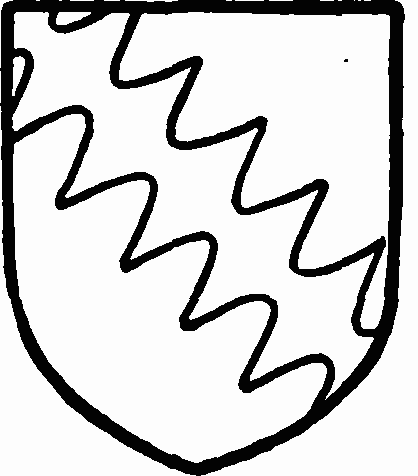
Fukeram. Or a bend indented azure.
In 1540 the chief 'messuage or grange of West Ilsley' was granted by Henry VIII to William Berners and others, (fn. 20) who conveyed it in the following year to William Pleydell and Agnes his wife. (fn. 21) They settled it in 1549 upon their son Gabriel, (fn. 22) who sold the reversion (fn. 23) in 1564 to John Barnes. (fn. 24) John Pleydell, brother of William, however, claimed that he had bought the reversion of the manor, and in 1565 the Crown delivered it to him, (fn. 25) and he died seised of it in 1591, leaving his son Anthony as his successor. (fn. 26) He was followed in 1593 by his brother Richard Pleydell, (fn. 27) who was holding in 1608. (fn. 28) The manor remained in the hands of the Pleydell family until the marriage of Charlotte Louisa daughter and heir of Robert Pleydell of Ampney Crucis (co. Glouc.) with John Dawnay son of Henry Viscount Downe. (fn. 29) Their son Henry Pleydell Dawnay Viscount Downe suffered a recovery of it in 1748. (fn. 30) In 1755 Lord Downe sold the manor to William Baker. (fn. 31) On 24 March 1857 it was conveyed by William Robert Baker to Lewis Loyd, and then the ownership followed the descent of the manor of East Compton (q.v.), Lady Wantage being the present owner. (fn. 32)
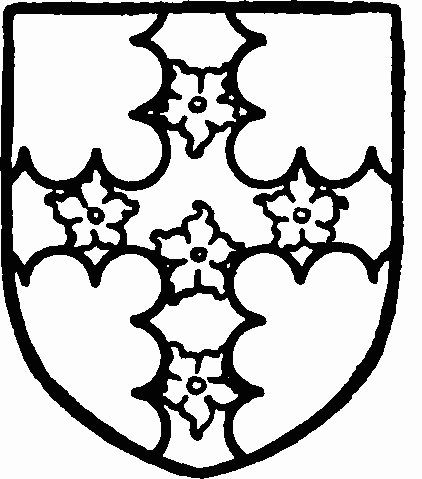
Edington Priory. Or a cross engrailed gules with five cinqfoils or thereon.
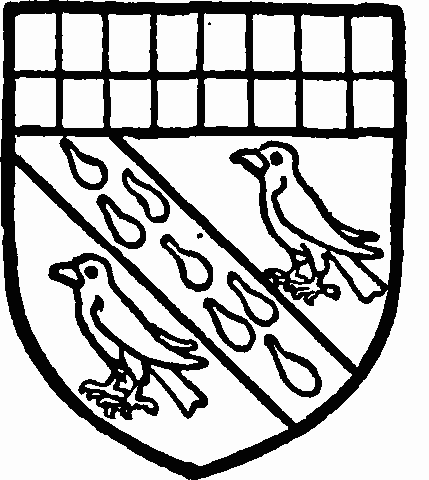
Pleydell. Argent a bend gules with drops argent between two Cornish choughs with a chief checky or and sable.
In the 13th century Agnes de Ponte Audomar, daughter of Henry de Ponte Audomar, (fn. 33) was holding a fee in Ilsley under the Earl of Winchester. (fn. 34) This probably represents an early feoffment by one of the Beaumonts, who were lords of Pontaudemer, to another branch of the family. Agnes, who married Ralph de Neirnut, (fn. 35) had an estate there as late as 1251–2. (fn. 36) Later she granted all her lands, rents and tenements in West Ilsley to the Prior of Sandleford, who is returned as tenant in 1270. (fn. 37) In 1313 the priory obtained a confirmation of the grant and of a further gift from William de Cherleton. (fn. 38) The Prior of Sandleford and Richard Fukeram were said to be holding the vill of West Ilsley in 1316. (fn. 39)
The later history of this fee has not been traced with any certainty. The priory of Sandleford was dissolved about 1480, (fn. 40) but there is no proof that the manor of West Ilsley was then in its possession. (fn. 41) In 1428 the lady of Ramsey was returned as holding half a fee which Richard de Penley formerly held. (fn. 42) As, however, there is no reason to think that the whole of Penley's property had not passed to Edington (see above), it is possible that a confusion in the succession of fees has been made here and that a Ramsey had been enfeoffed of the Sandleford manor. (fn. 43) Elizabeth's successor Thomas Ramsey died seised of the manor in 1499, leavng an annuity to his daughter Joan Court and the manor itself to his son Thomas, (fn. 44) who only survived him ten years. He was succeeded by his son Thomas, then six years of age. (fn. 45) Margaret mother of Thomas died in 1516. (fn. 46) Thomas, who had married Parnel Baldwin, had a posthumous daughter Elizabeth, born in 1524, two months after his death. (fn. 47) Elizabeth married Roger Alford, (fn. 48) who made a settlement of the manor in 1573. (fn. 49) His death took place before 1587, when Elizabeth and Edward Alford, her son, were dealing with it. (fn. 50) After 1631, when Edward Alford (apparently son of the lastmentioned Edward) was holding, (fn. 51) no further record of the manor by name has been found. The Morland family have held property in the parish, which may represent this estate, since 1711, when John Morland purchased it from William Smith. John Morland was succeeded in 1726 by his son Benjamin, who in 1761 made over the estate to his son William, who died in 1773. His son William died in 1838 and the latter's son in 1854. A cousin, Edward Henry, purchased the property and left it to his nephew Edward, who died in 1894. His son Walter Edward Thomson owns the reversion after the death of Mrs. Edward Morland. (fn. 52)
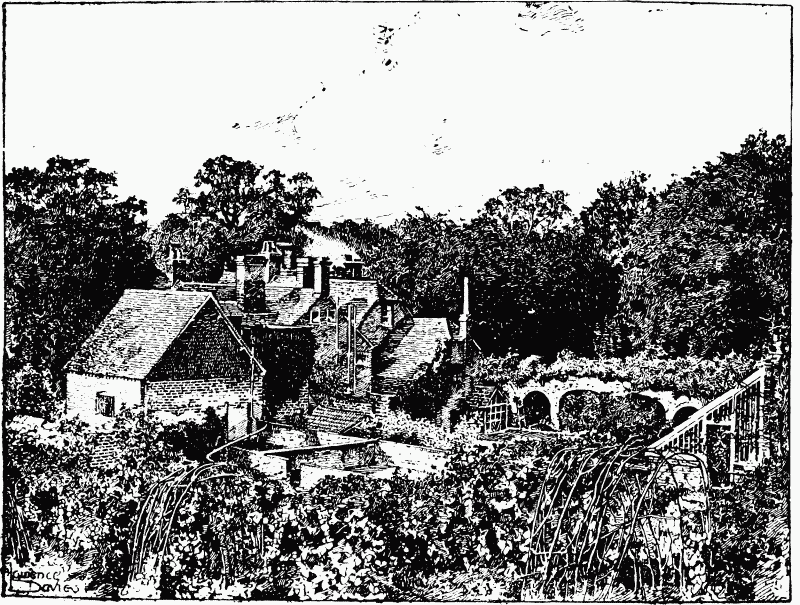
West Ilsley House
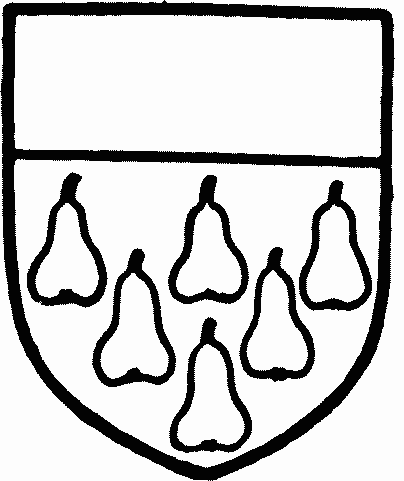
Alford. Gules six pears with a chief or.
Another portion of the Beaumont fee was held by Roger de Beauchamp (fn. 53) and had passed in 1361 to Miles de Beauchamp. (fn. 54)
A further portion of the same fee was held by William de Abingdon, (fn. 55) of which nothing is known, unless it is represented by the third of a fee under the same overlordship which in 1313 and 1315 is returned as in the hands of Maud daughter of Ralph de Bradfield. (fn. 56)
In 1086 the manor of HODCUTT or GREAT HODCUTT (Hodicote, Hedcote, Hudicott, Hoddecote) was held by Ralph de Mortimer, (fn. 57) with Oidelard as his under-tenant. (fn. 58) The overlordship remained with the Mortimers until the death of Edmund Mortimer Earl of March in 1425, (fn. 59) when it passed to his nephew Richard afterwards Duke of York, whose widow Cicely is returned as overlord in 1487. (fn. 60) On her death in 1497 it went to the Crown. (fn. 61)
In the 13th century Geoffrey Ridel is given as holding one fee in Hodcutt. (fn. 62) By 1360 (fn. 63) the manor had passed to Walter de la River. (fn. 64) Either he or his successor and namesake was holding in 1398, the estate being then described as one fee. (fn. 65) In 1428 Roger de la River is described as holding half a fee, 'which Walter and John his son had formerly held.' (fn. 66)
In 1481 John de la River died seised of the manor of Hodcutt, (fn. 67) of which he had been enfeoffed by Henry de la River, and left a daughter Clemence, then eight years old, (fn. 68) who eventually married John Sandes. (fn. 69) Clemence and her husband settled the manor in 1516 (fn. 70) and 1540. (fn. 71) In 1557 William Sandes conveyed it to Richard Stampe, (fn. 72) who died in 1558, leaving a widow Anne and a son John. (fn. 73) John grandson of Richard Stampe conveyed the manor in 1570 to William Forster. (fn. 74) In 1594 Sir Humphrey Forster conveyed it to Hugh Keate, (fn. 75) who died seised in 1616 (fn. 76) of the manor of Magna Hodcutt. Hugh Keate, junior, son and heir, (fn. 77) was party to a fine of the manor in 1618. (fn. 78) The manor, it is said, was purchased in 1662 by John Head, (fn. 79) who died in 1701 and was succeeded by a son John, who, dying in 1746, bequeathed the manor to his son John, (fn. 80) who was holding in 1778. (fn. 81) He died in 1803 without issue and was succeeded by his nephew Robert Southby of Appleton, who was holding in 1813 (fn. 82) and was party in 1818 to a fine of the manors (fn. 83) of Great and Little Hodcutt. His nephew Richard Southby had inherited the estate before 1844. (fn. 84)
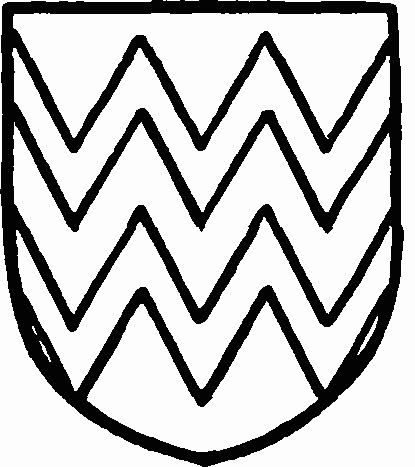
De La River. Azure two bars dancetty or.
The second manor of HODCUTT or LITTLE HODCUTT was held at the time of the Domesday Survey by William Fitz Ansculf and by Stephen under him, (fn. 85) and the overlordship followed the descent of the overlordship of Northbury in East Ilsley (q.v.).
In the 13th century John de Cormailles (successor of a Thomas Cormailles who was holding land in Hodcutt in 1201 (fn. 86) and Philip de Berwick each held half a fee in Hodcutt, (fn. 87) but in 1272 Walter de la Poyle was holding the manor, which at that time owed suit to Bradfield Court (held by the Somerys) every three weeks. (fn. 88) He is again returned as tenant in 1290 (fn. 89) and his widow Alice in 1322. (fn. 90) From this date there is no further trace of the manor until 1491, when Elizabeth de St. Amand died seised of it. (fn. 91) It then seems to have followed the descent of the manor of East Ilsley (q.v.) and to have come with that manor into the possession of Thomas Crompton and his co-grantees. They apparently conveyed it to Thomas Lighe, who sold it in 1595 to Hugh Keate. He died seised of the manor of Great Hodcutt (see above) and of the messuage called Little Hodcutt. (fn. 92) The two manors then descend together.
The Prioress of Kington (co. Wilts.) had lands in Hodcutt appurtenant to the manor of West Compton, which she conveyed in 1291 to Robert Burnell, Bishop of Bath and Wells, (fn. 93) and they seem to have become part of the lands of the see. (fn. 94)
Church
The church of ALL SAINTS consists of a chancel measuring internally 20 ft. 6 in. by 16 ft., with a north vestry and organ chamber, a nave 46 ft. 4 in. by 18 ft. 8 in., a north aisle, a north porch and a small bell-turret over the west wall of the nave.
The church has now the appearance of a modern building, the aisle, porch, vestry and organ chamber all having been added in the latter part of the last century, when new windows were inserted throughout the original structure and the chancel was partially rebuilt in the style of the 14th century. As no mediaeval detail of any description now remains, it is impossible to give the early history of the building, but the absence of ancient buttresses to the walls of the nave (the diagonal ones at the angles being additions) as well as the thickness of the original walls suggest work of considerable antiquity. The north aisle was added in 1876 and the chancel was partially rebuilt and reopened in 1878; the vestry and organ chamber were built in 1881, when the church underwent a complete restoration, while the chancel was again restored in 1894.
All the details of the chancel are modern. There is no structural division between the chancel and nave. The arcade between the north aisle and the nave is of four bays, with pointed arches carried on circular piers. It is designed in the 13th-century style, as is also the north aisle. In the south wall of the nave are three modern windows and in the west wall a large perpendicular window of four lights.
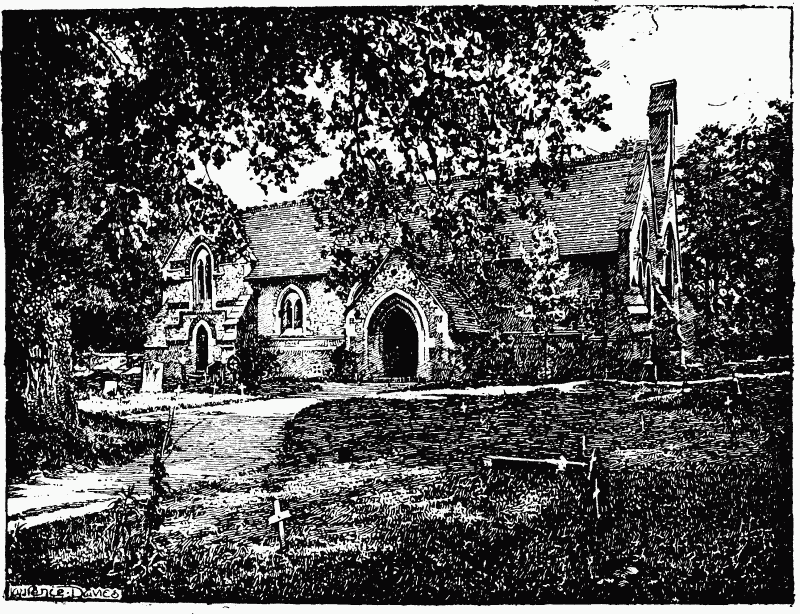
West Ilsley Church From The North-West
The chancel is of brick and flint with stone dressings to the windows, while the walls of the nave are covered with rough-cast; the north aisle and porch are built of flint with stone dressings. All the walls are plastered internally.
The chancel roof is modern, but one or two 17thcentury timbers have been re-used in its construction. The roof to the nave is, however, of much earlier date. It is divided into four bays by three trusses, with tie-beams and collars; there are two purlins on either side, the upper ones being strengthened by wind braces. The under side of the roof is plastered. The date 1652 carved on one of its timbers is probably the year of a restoration, though it is possible that the whole roof was re-erected at that date.
The font is modern. The octagonal pulpit is, however, made up of Jacobean panelling.
On the south wall of the chancel is a white marble tablet to Jane Head, who died 17 May 1695, aged fifty-two. Carved below a laudatory inscription is a shield: A cheveron ermine between three unicorns' heads impaling a cheveron between three luces.
There is one modern bell in the bell-turret.
The plate consists of a silver-gilt chalice and cover paten of 1897, made from the old plate which was melted down, and an Indian silver shell.
The registers previous to 1812 are as follows: (i) all entries 1558 to 1742; (ii) baptisms and burials 1743 to 1790, marriages 1743 to 1754; (iii) baptisms and burials 1791 to 1812; (iv) marriages 1754 to 1812.
Advowson
The advowson of the church of West Ilsley seems to have been vested in the tenants of certain of the fees held under the honour of Leicester in the 13th century, for it was conveyed to the priory of Sandleford before 1313 by Agnes de Ponte Audomar, Miles de Beauchamp and Maud de Abingdon. (fn. 95) In 1320 the priory received a licence to appropriate it. (fn. 96) In 1350 Richard de Penley, then lord of the other manor, sued the prior for permission to present. (fn. 97) The priory continued to hold the advowson until about 1480, when the priory was dispersed and Edward IV annexed it to the collegiate church of Windsor. (fn. 98) The living has remained ever since in the gift of the dean and chapter. (fn. 99) In 1690 the Bishop of Salisbury asserted, but unsuccessfully, his right to refuse the incumbent appointed by the dean and chapter. (fn. 100) According to a note in the parish registers there was some confusion as to the profits of the rectory at the time of the vacation of Sandleford, which again arose in the 16th century, for although the living since the acquisition by the Dean and Chapter of Windsor seems to have been a rectory, in 1543 the dean and chapter had leased the parsonage to William Barker, (fn. 101) while in 1554 Richard Stampe was holding a lease of it from Sir Robert Pound, who was then the incumbent. (fn. 102) William Barker sold his interest to John Stampe, (fn. 103) son of Richard, who parted with it to Edward Keate. (fn. 104) A descendant of Keate was holding it in the time of Dr. Goodman (1583–1656), who entered the fact in the church registers.
The parsonage farm, which adjoins the church, is called the Tithe Farm.
Among famous incumbents was Antonio Archbishop of Spalatro (1566–1624), who, upon becoming a Protestant, fled to England and was inducted into this living in 1616. (fn. 105) He afterwards recanted and returned to Rome, where he was imprisoned by order of the Inquisition. He was succeeded in 1619 by Geoffrey Goodman, chaplain to Queen Anne wife of James I, and afterwards Bishop of Gloucester. It was under his roof that King Charles slept in 1644 on his way to the relief of Castle Donnington, a fact which was noted in a rare tract, 'The Carolinum,' written by one of his attendants. (fn. 106)
There was a chapel at Hodcutt in the 13th century, the patronage of which belonged to the Prioress of Kington and was granted to the Bishop of Bath and Wells in 1291. (fn. 107)
Charities
The Poor's Money consists of a sum of £51 8s. 2d. consols, arising from the investment in 1879 of £50 received from the sale in 1862 of cottages formerly erected on the Gravel Pits allotment (see below) for a poor-house, with moneys derived from various bequests, recorded in the Parliamentary Returns of 1786.
In 1876 the Hon. and Rev. Edward George Moore, by his will proved in London 26 February, left £50 for distribution amongst the poor. The legacy is represented by £51 0s. 2d. consols. The sums of stock are held by the official trustees, producing together £2 10s. 8d. yearly, which is divided, in equal shares, among eight of the poorest persons in the parish.
The poor of this parish are also entitled to receive 10 loads of firewood, directed by the will of Erasmus Wood, dated in 1613, to be raised from a grove called 'Conne Grove,' in the parish of Farnborough. The land charged is now the property of Mrs. Morland, whose agent distributes the firewood at Christmas.
Gravel Allotments.—By the West Ilsley Inclosure Award, 1828, an allotment of 1 a. on the Shelves and another of 2 r. in the West Field were allotted for public gravel and rubble-pits for the repair of the highways. The first-mentioned allotment was sold at the same time as the cottages referred to above under the 'Poor's Money,' and the proceeds invested in £62 16s. 2d. consols, in the corporate name of the Wantage Rural District Council, producing £1 11s. 4d. yearly, which is applied in the relief of the parish rates.