A History of the County of Berkshire: Volume 4. Originally published by Victoria County History, London, 1924.
This free content was digitised by double rekeying. All rights reserved.
'Parishes: Boxford with Westbrook', in A History of the County of Berkshire: Volume 4, ed. William Page, P H Ditchfield (London, 1924), British History Online https://www.british-history.ac.uk/vch/berks/vol4/pp44-48 [accessed 30 April 2025].
'Parishes: Boxford with Westbrook', in A History of the County of Berkshire: Volume 4. Edited by William Page, P H Ditchfield (London, 1924), British History Online, accessed April 30, 2025, https://www.british-history.ac.uk/vch/berks/vol4/pp44-48.
"Parishes: Boxford with Westbrook". A History of the County of Berkshire: Volume 4. Ed. William Page, P H Ditchfield (London, 1924), British History Online. Web. 30 April 2025. https://www.british-history.ac.uk/vch/berks/vol4/pp44-48.
In this section
BOXFORD with WESTBROOK
Boxore (x-xix cent.); Bovsore, Bochesorne (Dom.); Boxhole (xii cent.); Boxforth (xvi cent.); Boxworth (xvi-xix cent.); Boxford (xvii-xx cent.).
The parish of Boxford, sometimes known as Boxford-cum-Westbrook, lies on either side of the Lambourn valley, the village of Boxford being on the east side of the river, while Westbrook lies opposite to it on the west. The land rises from the lowest point where the Lambourn leaves the parish at 290 ft. to 487 ft. above the ordnance datum at Borough Hill Camp.
The parish contains 2,819 acres, of which 2,070 are arable, 448 acres permanent grass and 232 acres woods and plantations. (fn. 1) The chief crops are wheat, barley and oats. The soil is principally chalk and clay with a chalk subsoil, but there are beds of clay and gravel on the hill-tops. The Lambourn Valley railway, opened in 1898 and since then taken over by the Great Western Railway Co., runs through the parish and has a station in the village. The high road from Newbury to Lambourn passes through the parish just outside the village.
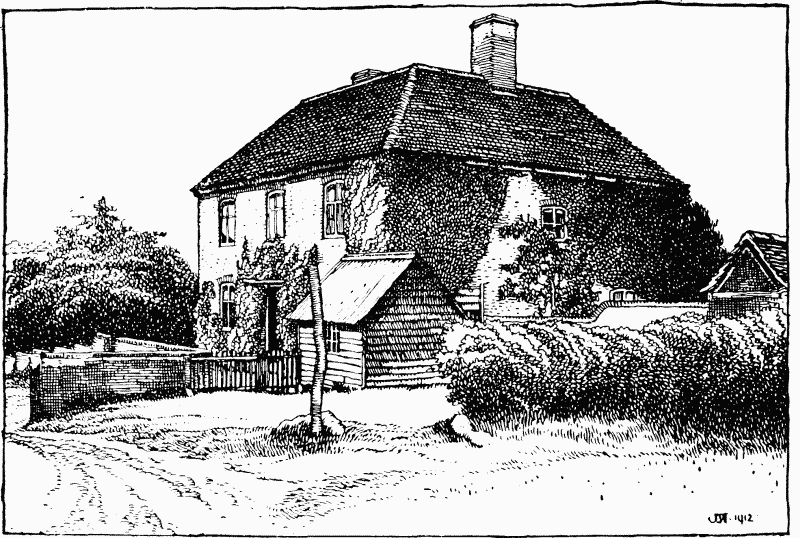
Knapp's Farm, Boxford
There are two tithings in the parish, Boxford and Westbrook, the bounds of which can be ascertained from the Commons Inclosure Award in the custody of the parish council; these tithings contain several small hamlets, Ownham in Westbrook, Hunt's Green in Boxford, and Wickham Heath, which grew up after the commons and waste were divided and allotted in 1819. The population is entirely agricultural. Besides the names already given, Coombesbury (Colmeresbere, xii cent.), Court Oak near Rowbury Hill, Iremonger's Hill and Basing's Farm are place-names which occur. The road from the village leading towards the Roman road on the south-west is known as High Street Lane. In Boxford there is an old tree, standing out in the road, known as the Clerk's Elm, and at the extreme northern point of the parish, where it meets the parishes of Welford and Leckhampstead, is a large stone standing by the roadside known as the Hangmanstone. There is a Wesleyan chapel at Westbrook and a Primitive Methodist chapel at Wickham Heath.
The church stands in the middle of the village, which contains many thatched cottages of half-timber and brick; some better class brick houses are of the 18th century. Near the church is an old farm-house, once the dwelling of Oliver Sanson, a Quaker, who lived there in the 17th century. In one of the rooms is a carved beam with guilloche ornament on the soffit and ovolo moulded edges. The house itself has been more or less altered externally and to some extent enlarged. Sanson kept up a constant feud with the rector with respect to tithes, which became more acute when, in or before 1667, the church tower collapsed and the debris fell into his garden. Tradition in the parish has it that he refused to allow the material to be removed, saying that, as God had sent it to him, no man should take it away, but this remark is not to be found in his book. The rector laid information against him for non-attendance at church and a distraint was levied upon his property. Sanson was sent to Reading gaol for contumacy, and in his book he relates the rector's painful death, which he regarded as a judgement. (fn. 2)
Westbrook House, built on land redeemed from the manor of Benham Valence early in the 18th century and recently enlarged, is the property of Mr. Harold J. E. Peake. Knapp's Farm, Westbrook, is also an 18th-century house, but has two oak doors of a much earlier period, probably of the 16th century, which doubtless belonged to a former building on the site; the staircase is also of earlier date.
Borough Hill Camp (fn. 3) is situated at the eastern extremity of the parish, and in the north-east is a barrow, known as Rowbury mound. At Wyfield Farm the foundations of what was described as a large Roman villa were discovered and excavated in 1871. Fragments of Roman pottery and coins have also been found elsewhere in the parish. (fn. 4)
Before the second battle of Newbury a detachment of the Parliamentary force passed through Boxford to take up a position on Speen Hill. (fn. 5) On approaching the ford over the Lambourn River they are said to have had a slight skirmish with a Royalist outpost. (fn. 6) During the Commonwealth some of the parishioners removed the altar rails from the church and carried them to Westbrook, where they were burnt by Edward Poke, a schoolmaster, and his pupils. (fn. 7)
Manors
The chroniclers of the abbey of Abingdon claimed that lands at Boxford and elsewhere in Berkshire had been granted to them by King Ceadwalla, and they cited a charter of Kenwulf, dated 821, in which he confirmed these gifts. This charter in the form that has come down to us is probably spurious, and if the abbey actually received a grant of lands here at that early date it must have lost them later. (fn. 8)
In 958 King Edred granted 10 mansac at BOXFORD to his servant Wulfric, (fn. 9) which, though forfeited shortly afterwards, were restored to him in 960. (fn. 10) These lands he conveyed to the abbey of Abingdon. Again in 968 King Edgar granted 10 mansae to another servant Elfwin, who also handed them on to the same abbey. (fn. 11) Thus at the date of the Domesday Survey the whole manor had come into the hands of the abbey, which held it as a member of their adjoining manor of Welford.
The Domesday Survey says that in the time of Edward the Confessor the manor was held of the abbey by a reeve of the abbot's, but afterwards by Berner, (fn. 12) and the Abbey Chronicle gives the name of Raimbald as the military tenant in the time of William Rufus. (fn. 13) Raimbald held also Sunningwell, and it may be that it was a descendant of his, Geoffrey of Sunningwell, who held 2 hides here of the abbey by military service a century later. (fn. 14) Between 1175 and 1190 only 1 hide 1 virgate and 1 cotsetland out of the 10 was held by the abbey in demesne, and there were twelve tenants, having holdings varying from 2 hides to 1 virgate, besides fifteen cottagers who performed services and fifty more who paid rent; twenty-six others occupied land outside the demesne and paid rent, and some of them services in August in addition. The customs regarding pannage and common pasture were the same as for the tenants of Welford. (fn. 15)
The 2 hides which were held by military service continued in the same family, for at the time of the Testa de Nevill Nicholas de Sunningwell was the tenant, (fn. 16) though according to a later entry the holding had passed into the hands of Robert de Wyleby. (fn. 17) In 1392 the abbey added to its holding by acquiring land here from Thomas Crook, parson of Milton, (fn. 18) and it is mentioned as holding this manor of the king by barony in 1401. (fn. 19) No further mention is made of military tenants holding land under the abbey in Boxford, but in 1517 Thomas Hill was seised in demesne as of fee of one messuage and 40 acres of arable land there, which he inclosed, pulling down the house and rendering six people homeless. (fn. 20)
At the dissolution of the abbey in 1538 Thomas the abbot surrendered the manor of Boxford. (fn. 21) The woods of the abbey in Boxford and Welford were surveyed in 1538. (fn. 22)
In 1590 the manor was granted to Thomas Parry, son of Sir Thomas Parry, who already held the manor of Welford, and since that date it has descended with the Welford estate (fn. 23) (q.v.).
Certain lands in Boxford were held in 1217 together with lands in Benham and Greenham by Ralph Musard, lord of one of the manors of Winterbourne, (fn. 24) which adjoins Boxford on the east. (fn. 25) In 1374 Bartholomew Blaket of the county of Oxford released to Aumary de St. Amand and others all right in these lands, then called the manor of Winterbourne Mayne, and in all lands which the said Aumary held in Chieveley and Boxford. (fn. 26)
In 1450 John Bovedon of Boxford died seised of ten messuages and 10 virgates of land, 40 acres of meadow and 100 acres of pasture in Boxford, called BOVEDON MANOR, and three messuages and 5 virgates of land in Greenham. The land in Boxford was held of the abbey of Abingdon for the service of one quarter of a knight's fee. John Bovedon's heir was his son John, then aged twelve, but no further reference to this reputed manor has been found. (fn. 27)
The tithing of WESTBROOK in this parish is in the hundred of Kintbury Eagle, having been at an early date attached to the manor of Benham in that hundred. Before the Conquest, under the name of Bochsorne, a variant of Boxford, it was held in alod of King Edward, but after 1066 it was granted to Humphrey Vis de Lou with the adjoining manor of Benham in the parish of Speen. One hide was held of him by Aluric and 2 by Alman. (fn. 28) It continued from that time a member of the manor of Benham (q.v.), and their subsequent history is identical. (fn. 29)
When the manor of Benham became divided into the two manors of Benham Valence and Benham Lovell, Westbrook was also divided, though the greater part of the land was added to the manor of Benham Lovell. In 1349 it was said that there had been six customary tenants in that part of the vill which belonged to the manor of Benham Valence, but they were all dead and their land uncultivated. Such were the ravages of the Black Death in this part. (fn. 30)
About the year 1820 William first Earl of Craven, lord of the manor of Benham Valence, seems to have allowed most, if not all, of his tenants to redeem their copyholds, (fn. 31) and at the time of the inclosure of the commons in 1819 the lord of this manor held no land in the township. It was then agreed that John Archer Houblon, lord of the manor of Benham Lovell, should be entitled to all manorial privileges in the tithing of Westbrook, while Lord Craven should possess all those which existed in the parish of Speen. (fn. 32)
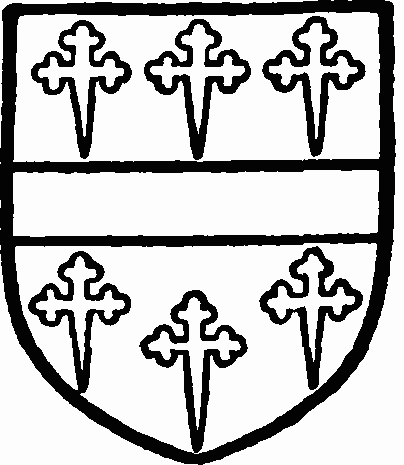
Craven, Earl of Craven. Argent a fesse between six crosslets fitchy gules.
There were two mills at Boxford in the 12th century, (fn. 33) but there is now only one, near the church and adjoining the bridge over the river, which is still used as a corn-mill. There was a mill at Westbrook in 1086, (fn. 34) which in the 15th century was known as Gosling's Mill, and was held by Robert Curteys as a fulling-mill. (fn. 35) It is now represented by the cottages beside the mill-stream below Westbrook Farm.
The fishing in the Lambourn River seems always to have belonged to the lords of the different manors in this parish, and when under the award of 1819 the Earl of Craven released such of his rights in the manor of Benham Valence as were situated in the parish of Boxford to John Archer Houblon, who was lord of the two other manors, he reserved the rights of fishing which had hitherto belonged to him.
Church
The church of ST. ANDREW consists of a chancel measuring internally 18 ft. 11 in. by 13 ft. 5 in., nave 36 ft. 2 in. by 18 ft. 9 in., north aisle 36 ft. 2 in. by 17 ft. 7 in., north-west vestry, south porch and west tower 10 ft. 4 in. by 11 ft. 10 in.
The chancel and nave are a rebuilding of the 15th century, but there is evidence of a 13th-century building in the south doorway and in the lancet window south of the chancel. A tower was added in the 15th century, but in 1667—from the record left by Oliver Sanson, the Quaker, who lived next the church—it fell. The present tower dates from about twenty-five years later. The west gallery was dated 1759 and the porch is of about the same date. The north aisle was added in 1841, when the present chancel arch was inserted. During the recent restoration of the building the gallery was removed.
The modern east window is of three lights under a traceried head. In the south wall are a single light with old jambs and a modern cinquefoiled head, and a small modern piscina, and on the other side modern credence recess. The chancel arch is modern. In the north wall next the chancel arch is a wide low arched recess (6 ft. 11 in. to the apex and 5 ft. 6 in. wide).
The first window in the south wall of the nave is a single light with old jambs and a modern cinquefoiled head. The second and third windows are of the 15th century, and are of two cinquefoiled lights under square heads with labels. The south doorway has a pointed head of a single hollow-chamfered order and a moulded label with a mask stop on its west side but only a square block on the east. The north arcade of the nave is modern and is of three bays of similar detail to the chancel arch. The aisle has an east and two north windows, each of two cinquefoiled lights under square heads. The east window is re-used work of the 15th century, and the southern halves of the heads having been shortened, the window has a lopsided appearance. A modern doorway at the end of the north wall of the nave opens to the vestry, which has windows in the north and west walls, and like the porch, which has a modern pointed outer arch, is built of brick; the aisle is of flint and brick, the rest of the main structure being covered with cement outside and plaster within. The tower is of flint with red brick courses, and is of three stages, with brick diagonal buttresses at the western angles. The tower arch is semicircular and has square imposts and a projecting keystone. The west window is of stone, and is of three square-headed lights with a transom; the second stage has a blocked rectangular light in its north face and a similar light boarded up on the south side. The bell-chamber has two round-headed lights under a plain square brick label in each face and the parapet is embattled.
The chancel roof had a plastered collar-beam ceiling, lately removed, on which were painted imitation rafters; the portion over the sanctuary is curved. The nave had a flat plaster ceiling, above which on the east wall can be seen the remains of 15th-century wall-painting, apparently parts of figures of angels, and the former roof-line. Both roofs are tiled. The aisle had also a plaster ceiling, now removed.
The font is modern. The hexagonal oak pulpit, with its sounding-board, is a good specimen of Jacobean work, and is dated 1618 with the initials VH, RH, GN, IN. The altar rails are of the late 17th century and have twisted balusters. Besides the organ in use, a small disused organ stands in the gallery.
In the tower lies the carved head of a 12th-century pillar piscina, with one smooth side and three with volutes. Here are also two oak chests; one has the date in nail-heads, 1683, while the other is evidently earlier.
In the chancel is a monument to James Anderton, rector, who died in 1672, and at the west of the aisle is a monument to John Rawlins, his wife and two daughters, who died in 1719, 1727, 1702 and 1719 respectively.
There is a ring of five bells: the treble is by John Stares, 1744; the second by Henry Knight, 1618; the third bears the date 1601, and is inscribed 'God be our gyd'; the fourth, 1639, is inscribed 'Love God'; and the tenor is by W. Taylor of Oxford, 1846. There is also a small bell dated 1640, inscribed 'Sam. Redclif Rectoris donum.'
The plate consists of a silver cup and cover paten of 1786, a standing paten of 1836, also of silver, a modern electro-plated flagon, a pewter bowl or saucer with the mark of a crowned rose, a flagon, and a pewter stand paten, given by one of the two James Andertons, who were former rectors; on it are the arms, four stirrups impaling a dolphin.
The registers before 1812 are in six books: (i) all entries 1558 to 1664, partly a parchment copy of 1598; (ii) baptisms 1648 to 1755, marriages 1648 to 1750, burials 1648 to 1773; (iii) baptisms 1755 to 1798; (iv) baptisms 1799 to 1812; (v) marriages 1755 to 1813; (vi) burials 1773 to 1813.
Advowson
It seems probable that a church was built here by the abbey of Abingdon before the Conquest, but the entry in the Domesday Survey on this point is obscure. (fn. 36) From early times the ecclesiastical dues both from Boxford and Westbrook seem to have belonged to the abbey, but during the reign of Henry I Walkelin Vis de Lou endeavoured to remove those of Westbrook, probably to give them to the church of Speen, in which parish most of his estates were situated. The abbey resisted, and Walkelin was compelled to agree that in future all such dues should belong to Boxford Church. (fn. 37) About the same time William de Watchfield agreed to give to the abbey the tithe from all his property here, which was 2 hides, excepting the tithes from I acre which adjoined the church. (fn. 38)
The abbey appears to have appropriated all, or at any rate part, of the rectorial tithes, for in 1278 the incumbent is referred to as a chaplain, (fn. 39) and in 1291 the church was valued at £4 13s. 4d., while the pension of the Abbot of Abingdon there with his portion of the tithes was worth £6. (fn. 40) A different arrangement seems to have been made shortly afterwards, for in 1340 we find mention of a rector of Boxford, (fn. 41) and again in 1369–70, when the pension only is spoken of as belonging to the abbey. (fn. 42) Sir Richard, the rector, is mentioned in 1376, (fn. 43) and in 1540 Alan Coke alias Bertyn, rector of the parish churches of Bygrave and Boxford, received licence to hold a third cure. (fn. 44) At the dissolution of the monastery in 1538 the abbot resigned to the king all his interest in Boxford, (fn. 45) which included the advowson and pension, which in 1541–2 was worth £6. (fn. 46)
In 1590 Queen Elizabeth granted the advowson of the rectory in tail-male to Thomas son of Sir Thomas Parry, kt. (fn. 47) He settled it the same year, (fn. 48) and died seised of it in 1616, when it passed to his heirs Thomas Knyvett and John Abrahall, (fn. 49) who sold it in 1618 to Sir Francis Jones, (fn. 50) who presented to the living in that year. (fn. 51) He died in 1623 seised of the church, vicarage and chapel of Boxford. (fn. 52) His son Abraham Jones settled it in 1626, (fn. 53) and died seised of it in 1629. (fn. 54) Though the advowson continued to pass with the manor, the presentation must have been sold sometimes, for John Anderton, son of the rector who died in 1672, (fn. 55) presented in that year his younger brother James. (fn. 56)
In 1713 William Archer, Eleanor his wife and others sold the advowson to Benjamin Tassell and three others. (fn. 57) This Benjamin was the head master of Newbury Grammar School from 1692 to 1723, (fn. 58) and it was possibly one of his trustees, Thomas Cowslad, who in 1719 presented the living (fn. 59) to Anthony Tassell, Benjamin's son. During the same year, 1721, his parishioners petitioned the Bishop of Salisbury to reprimand him for withholding the sum of £1 6s. 8d. which was to be paid in lieu of the church ales, formerly celebrated on Easter Day, and for failing to preach more than one sermon on a Sunday, and for having discontinued the services on Wednesdays and Fridays. (fn. 60) Anthony died intestate in 1751, and his widow Elizabeth presented to the living. (fn. 61) She continued to live at the rectory, and with her son enjoyed the profits from the glebe lands and tithes, while she kept a 'travelling rector' to do the duty. This rector was a Mr. G. Watts, who had been formerly preacher at Lincoln's Inn, and then spent his time 'galloping from one country church to another.' (fn. 62) On Anthony Tassell's death the advowson had descended to his only son Anthony, who was baptized 11 September 1733, (fn. 63) and was therefore an infant at the time of his father's death in 1751. This would account for the fact that his mother presented to the living that year, but would not explain why the Crown presented in 1772, (fn. 64) when Anthony must have been thirty-nine years of age. There is a tradition in the village that about this time a dispute arose between the two daughters of the elder Anthony, both of whom had married clergymen, each claiming that her husband should have the living, and that it was finally decided that each should present in turn. If this dispute had led to a law-suit the patronage of the Crown might be accounted for, but the evidence discovered so far does not support this view. It is true that in 1772 the Crown presented to the living the Rev. Joseph Wells, who is described as rector of the parish of Letcombe Bassett, who had married in 1764 Lucy daughter of the Rev. Anthony Tassell, (fn. 65) but in the deed of 1806, to which reference has already been made, no allusion is made to any dispute.
Anthony Tassell died intestate in 1776, and was buried at Boxford 8 January that year, (fn. 66) when the advowson passed to his sister Lucy. In 1805 her husband, being in ill-health, resigned the living, and jointly they presented the Rev. John Wells, their nephew. Joseph Wells died soon after his retirement, and in 1806 his widow Lucy, by the deed already cited, granted the advowson to her nephew the Rev. John Wells. At his death in 1842 it passed to his son the Rev. George Wells, who left it at his death in 1872 to his son the Rev. George Francis Wells. In 1892 he exchanged livings with the Rev. Charles Nattali Edgington, who purchased the advowson of Boxford the following year, and is the present patron. (fn. 67)
The pension formerly belonging to the abbey of Abingdon seems to have come into the hands of William Rankyn and Dorothy his wife, who sold it in 1597 to Thomas Nelson, gent. (fn. 68) This Thomas Nelson held the manor of Chaddleworth, and the pension seems to have passed with that manor to its present possessor, Mr. Philip M. N. Wroughton.
There was anciently a custom here for the parishioners to drink beer and eat bread and cheese in the church after Evening Prayer on Easter Day, but this custom was abolished by Laud in 1638, and it was then decreed that the incumbent and his successors should instead dispense each year 13s. 4d. towards the repair of the church and 13s. 4d. to the poor of the parish. There was a further custom for the incumbent to pay 2s. per annum for straw for the use of the church. (fn. 69)
Charities
The benefactions for the use of the poor, which were mentioned in an inscription on the gallery of the church, comprise the charities of:
1. Elizabeth Wayte, by will, annuity of 6s. 8d. charged on land in Ray Mead, Hampstead Marshall, now paid by the Earl of Craven.
2. Richard Willoughby, will 1610, annuity of 20s. on an estate at Ownham in this parish, now the property of Mr. William Heath.
3. Unknown donor, or the rector's Easter payment, annuity of 13s. 4d.
4. Gifts of Gregory Iremonger, £27, Richard Whare, £30, and Richard Shepherd, £20, for two poor widows. These sums were made up to £100 consols by a former rector, which in 1864 were transferred to the official trustees.
The income of the charities, amounting to £4 10s., after payment of 6s. to each of two widows, is usually applied in payments to a clothing club.