A History of the County of Berkshire: Volume 4. Originally published by Victoria County History, London, 1924.
This free content was digitised by double rekeying. All rights reserved.
'Parishes: Brightwalton', in A History of the County of Berkshire: Volume 4, ed. William Page, P H Ditchfield (London, 1924), British History Online https://www.british-history.ac.uk/vch/berks/vol4/pp48-51 [accessed 30 April 2025].
'Parishes: Brightwalton', in A History of the County of Berkshire: Volume 4. Edited by William Page, P H Ditchfield (London, 1924), British History Online, accessed April 30, 2025, https://www.british-history.ac.uk/vch/berks/vol4/pp48-51.
"Parishes: Brightwalton". A History of the County of Berkshire: Volume 4. Ed. William Page, P H Ditchfield (London, 1924), British History Online. Web. 30 April 2025. https://www.british-history.ac.uk/vch/berks/vol4/pp48-51.
In this section
BRIGHTWALTON
Bristoldestone (xi cent.); Brichtwaleston (xii cent.); Brithwalton (xiii cent.); Brightwaltham and Brightwalton pronounced by the natives Brickleton, and sometimes so spelt.
The parish of Brightwalton, situated on the southern slope of the Downs, comprises 2,054 acres. There are no streams in the parish, but nearly the whole area drains into the upper waters of the Winterbourne. The highest point attained is 665 ft. in the north-west corner of the parish, and the lowest at the south-east corner is 435 ft. above the ordnance datum.
The subsoil is chalk throughout. 1,561 acres of the land are arable, and, though some has been laid down in pasture of late and there is a little down land in the north-west corner, the total area of grass land is only 176 acres. (fn. 1) The nearest railway station is Shefford, on the Lambourn Valley branch of the Great Western railway, which is about 5 miles away. There are no main roads running through the parish, though the Hungerford and Wantage road touches the north-west corner. There are many lanes and byways, and a thoroughfare from Newbury to Wantage forms part of the eastern boundary and lies partly within the parish. The population is purely agricultural.
The village is scattered, and the church of All Saints lies at the northern end of it with the rectory, a modern building, not far off. The old church stood a few hundred yards to the west of the present building, close to the Manor House, and both were surrounded by a deep ditch or moat, part of which is still to be seen. The cottages near the church are mostly of brick, a few are half-timbered, and all have thatched roofs.
The common fields and some part of the common waste were inclosed by an agreement made 25 August 1721 between Lady Eyre, the lady of the manor, and the freeholders, copyholders and leaseholders. This document is in the custody of the rector. A further award, under the seal of the Inclosure Commissioners, made in 1862, is kept by the clerk of the peace, though the lord of the manor has an authorized copy. There is a Wesleyan chapel in the village.
In February 1887 about a dozen human skeletons, two of which were headless, were found in the garden of the Marquess of Granby Inn. (fn. 2)
Among the place-names found in this parish was the abbot's wood known as Hemele Wood, and Maitland suggests that this name can still be traced in Emblens Copse. (fn. 3) The villeins' wood was called Trendale, and La Rede Putte is another place-name. (fn. 4)
In a manuscript belonging to the lord of the manor is a very full description of the custom of beating the bounds of the parish, which was last performed in 1720. This account was written by William Savory, wheelwright and village leech, who died in 1772. (fn. 5)
Manor
In 939 King Athelstan granted to Eadulfu 15 hides at 'Beorhtwaldingtun' which she gave to the abbey of Abingdon. (fn. 6) Harold held BRIGHTWALTON in the time of the Confessor, and before him a thegn. Soon after the Conquest it was granted to Battle Abbey, (fn. 7) which held in 1086. It was confirmed to the abbey by Henry I, (fn. 8) and remained in its hands until the dissolution of the monastery in 1538. Many notices of this manor occur in the Custumals of Battle Abbey, (fn. 9) and a series of its court rolls have been published. (fn. 10)
In 1543 it was granted, in exchange for certain other manors, to Sir William Essex of Chipping Lambourn and his son Thomas. (fn. 11) Sir William died seised of it in 1548, when it passed to his son Thomas, then aged forty, (fn. 12) whose son Thomas Essex (fn. 13) mortgaged it in 1567 to Edward Longe. (fn. 14) In 1571 Essex and Longe assigned the mortgage to William Chapman, citizen and ironmonger of London. (fn. 15) Chapman apparently foreclosed and died seised of the manor in 1580. He was succeeded by his son William, then seven years of age, (fn. 16) who in 1630, together with his son and heir Charles, conveyed it to Richard Howse or Howlse. (fn. 17) This Richard (fn. 18) in 1653 conveyed it to John Mundy and Matthew Marne. (fn. 19)
The purchasers seem to have been trustees for Francis Lucy, for in 1660 he and his wife Elizabeth conveyed the manor to Sir William Playters, bart., and Robert Woolrich, again apparently in trust. (fn. 20) Francis Lucy was the sixth son of Sir Thomas Lucy of Charlecote (co. Warwick) and was M.P. for Warwick in 1624, 1625, 1626 and 1628. He died about 1686. (fn. 21) It is probable that the deed of settlement of 1660 was in favour of Francis Lucy's son Richard, who married Rebecca Chapman and died before his father. In that case the manor would have passed for her life to his widow Rebecca, who married as her second husband Sir Rowland Lytton, (fn. 22) as she appears about this time as patron of the living. (fn. 23) By 1690 the manor had passed to the daughters of Francis Lucy, for in that year Sir Philip Meadows and Constance his wife, Samuel Eyre and Martha his wife, Richard Atkins and others conveyed the manor to Francis Stamper and Benjamin Wyche. (fn. 24)
In 1690 the possessions of Francis Lucy seem to have been settled upon his daughters and this manor placed in trust for Samuel Eyre and Martha his wife. Sir Samuel Eyre was a judge of the King's Bench in 1694 and died suddenly in 1698 when on circuit. (fn. 25) In 1700 Martha Eyre, his widow, as lady of the manor held a court leet with court baron. (fn. 26) The parties to the Commons Inclosure Award in 1721 were Dame Martha Eyre, lady of the manor, and her son Sir Robert Eyre, chancellor of George, Prince of Wales, (fn. 27) and afterwards chief justice of the Common Pleas. Three years later they with Robert Eyre, heir of Sir Robert, signed the marriage settlement of Robert with Mary Fellowes. (fn. 28) Dame Martha died soon after and Brightwalton passed to Sir Robert, (fn. 29) who as solicitor-general was manager of Sacheverell's impeachment. At his death on 28 December 1735 the manor passed to his son Robert, who by will proved 8 January 1752–3 left the manor and advowson settled on himself and his wife Mary to Elizabeth Lee, his sister, and her issue with remainder to his uncle Henry Samuel Eyre and to Samuel Eyre, eldest son of his late uncle Kingsmill Eyre, deceased. (fn. 30) At the death of Mary about 1762 it appears to have passed to Samuel Eyre, who held a court leet there 28 April 1770. (fn. 31) In 1776 Brightwalton was held by his daughter and heir Susanna Harriet, (fn. 32) and in 1789 it was brought into the settlement on her marriage with William Purvis. (fn. 33) Three years later Samuel Eyre and his wife Margaret conveyed it to William Purvis, (fn. 34) who took the name of Eyre, and in 1796 as William Eyre, lately called William Purvis, with Susanna Harriet his wife he mortgaged the manor to James Harbert. (fn. 35) In 1800 he sold the manor to the Rev. Philip Wroughton of Woolley Park, (fn. 36) who held courts here in 1803 and 1810 (fn. 37) and died on 6 January 1812, when the manor passed to his son Bartholomew Wroughton, who died without issue on 21 May 1858. Brightwalton Manor passed to his brother Philip, at whose death 28 December 1862 it came to his son Philip, (fn. 38) who died 7 June 1910, when he was succeeded by his elder and only surviving son Mr. Philip Musgrave Neeld Wroughton, its present possessor.
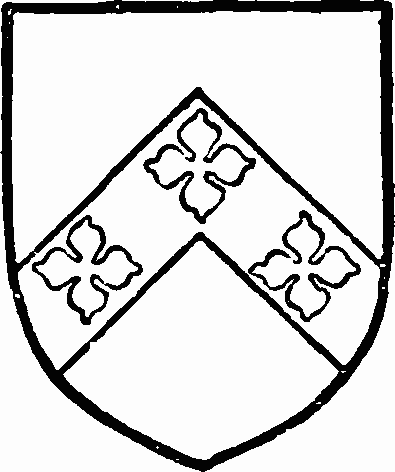
Eyre. Argent a cheveron sable with three quatrefoils or there on.
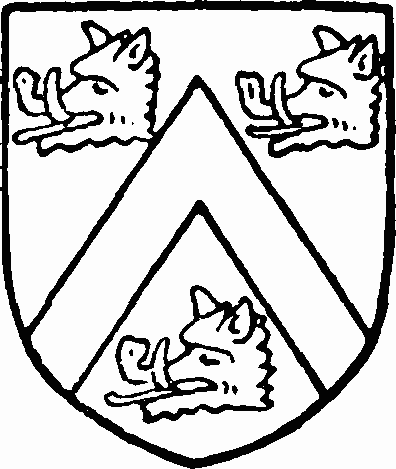
Wroughton. Argent a cheveron gules between three boars' heads sable with tusks or.
From 13th-century Court Rolls it appears that view of frankpledge was held at Brightwalton twice yearly. Tenants of the Abbot of Battle, living 15 miles away at Hartley and Conholt, owed suit and service to the manor of Brightwalton, and came there for view of frankpledge. The Court Rolls show also that a widow forfeited her land for unchastity, and that servile tenants were unable to obtain immunity from penance by paying fines of their chattels, as these were deemed the property of their lord.
The most interesting and significant information, however, to be derived from these rolls is, as the late Dr. F. W. Maitland (fn. 39) pointed out, that 'the villeins of Brightwaltham, men who were reckoned as personally unfree, nevertheless constituted a "communitas," which held land, which was capable of receiving a grant of land, which could contract with the lord, which could make exchange with the lord.'
Two early undated deeds are of interest. In one Richard Merewold grants to Lawrence Maysselyn and Isabella Richard's daughter burgages in Brightwalton, and in the second William Dodyng grants to Richard Maydus a burgage with curtilage there. (fn. 40) There appears to be no further evidence relating to burgages.
A survey of this manor made in 1284 gives interesting details of conditions of service, (fn. 41) some of which have been noticed in an earlier volume. (fn. 42) It appears, for instance, that the abbot's woodward could claim pig's fry, the shepherd a fleece, and so on, in addition to their ordinary wages and allowances. (fn. 43)
In granting the manor to the abbey the Conqueror gave also extensive privileges and immunities, and the hundred rolls admit also the rights of gallows (fn. 44) and the assizes of bread and beer and free warren. (fn. 45)
Courts and courts leet were held until the early part of the 18th century, (fn. 46) and in a fine made in 1796 the manor is described as possessing courts baron, view of frankpledge, goods and chattels of felons, suicides, fugitives, outlaws and proclaimed persons, deodands, waifs and estrays. (fn. 47)
Church
The church of ALL SAINTS consists of a chancel, north vestry and organ chamber, nave, south aisle, south porch and south-west tower. It was built in 1862 when the old church, which stood a little to the north-east, was pulled down. Such old work as was retained shows that the former church dated from the first half of the 13th century. A painting of the building from the south, preserved in the vestry, shows that the chancel had a square doorway with a roundheaded window over, and the nave three roundheaded lights and a south porch, while the west tower had a small pointed light in the first stage on the south and bell-chamber windows of two roundheaded lights, the roof being pyramidal. There are some fragments left of a frieze of cinquefoiled stone panels and a piece of a holy-water stoup.
The vestry has a two-light east window and a north doorway. The west doorway into the organ chamber is 13th-century work re-used, and has a pointed arch with moulded abaci and a moulded label. Next to it and also in places on the north wall of the nave, in the string-course below the windows, are lengths of a 13th-century moulded string. The rest of the fabric is modern. The font is said to be ancient, but, if so, has been very much retooled; it has a large cylindrical bowl with an interlacing arcade of round arches. Across the organ chamber archway is a low 18thcentury screen with turned balusters which must originally have formed an altar rail and was brought here from Compton Church. There were several brasses in the church before the rebuilding, but these have all been lost with the exception of two fragments now set on the west wall of the baptistery. One of these is a small figure of a man in 16thcentury civil costume and with his hands in prayer. A written note states that it is the effigy of John Newman, who died 8 April 1517, the effigy of Elyn his wife and Thomas their son with the inscription having disappeared. Above is the drawing of the complete brass with the inscription. The other fragment is a small shield with seven lozenges and two roses said to be the arms of James Braybrooke, (fn. 48) who died in 1590. These monuments are mentioned by Ashmole.
There are four bells, the treble bearing the inscription 'The rayne of the Quene 42 E R' and in the midst of the inscription four crowned shields of Braybrooke with the initials E B in ovals, and below the initials and date C. W. 1600; the second is an older one with the inscription 'Ave Maria' in black letter with crowned capitals and the lion's face, corn and square flower of Sanders; the third has the words only 'Prayes the Lord 1627'; the tenor is by James Wells of Aldbourne, 1816.
The plate now consists of a small silver-gilt cup of ornate design and of foreign workmanship (on the underside of the base is an inscription with the date 6 October 1610 in German, showing it to have been originally a birthday cup; the cover of the cup has been converted into a paten by a plate soldered to it bearing the hall mark of 1729), a silver-gilt paten of 1722 with the arms of Eyre, and a silver flagon of 1863.
The registers before 1812 are in three books, the first, which is in very good condition, containing baptisms 1559 to 1805, marriages 1559 to 1754, and burials 1561 to 1805; the second baptisms and burials 1805 to 1813, and the third marriages 1755 to 1812. There is also a fine volume of churchwardens' accounts from the year 1481; in this is entered the purchase of a communion cup and cover in 1588, which have now disappeared.
Advowson
The church is mentioned in the Domesday Survey (fn. 49); the advowson was probably granted with the manor, and was in the hands of Battle Abbey in 1258. (fn. 50) The abbey did not appropriate the tithes, but retained a pension, which in 1291 (fn. 51) and again in 1534 (fn. 52) is returned at the annual value of £3 6s. 8d.
After the Dissolution the advowson of the rectory passed with the manor (q.v.), though a few of the presentations were made by others than its lords. In 1622, when William Chapman held the manor, Richard Knight of Martin Morland presented to the living, (fn. 53) but Chapman presented in 1624 and again in 1626. (fn. 54) Again, after the sale of the manor and advowson to Francis Lucy, Edward Pocock presented in 1661 and Richard Howse, the former owner, in 1666. (fn. 55) William Hitchcock presented in 1722, (fn. 56) but he appears to have been the executor of Samuel Eyre, who had died some years previously. Elizabeth Plumptree, widow of Polydore Plumptree and sister of Samuel Eyre, presented in 1778. (fn. 57) Mr. James Cole is said to have been patron in 1813, (fn. 58) but since then the advowson has passed with the manor, (fn. 59) and the present patron is Mr. Philip Musgrave Neeld Wroughton of Woolley Park.
Charity
This parish was entitled to have two boys educated at the school at Chaddleworth, hundred of Kintbury Eagle, founded by will of William Saunders, 1719. (fn. 60)