A History of the County of Berkshire: Volume 4. Originally published by Victoria County History, London, 1924.
This free content was digitised by double rekeying. All rights reserved.
'The borough of Newbury', in A History of the County of Berkshire: Volume 4, ed. William Page, P H Ditchfield (London, 1924), British History Online https://www.british-history.ac.uk/vch/berks/vol4/pp130-155 [accessed 2 May 2025].
'The borough of Newbury', in A History of the County of Berkshire: Volume 4. Edited by William Page, P H Ditchfield (London, 1924), British History Online, accessed May 2, 2025, https://www.british-history.ac.uk/vch/berks/vol4/pp130-155.
"The borough of Newbury". A History of the County of Berkshire: Volume 4. Ed. William Page, P H Ditchfield (London, 1924), British History Online. Web. 2 May 2025. https://www.british-history.ac.uk/vch/berks/vol4/pp130-155.
In this section
THE BOROUGH OF NEWBURY
Nubir, Nywebir, Nowebery.
Newbury stands on the River Kennet; the road leading from London westwards runs through the northern part of the town. At the present date the area of the borough is 1,826 acres.
The main lines of the modern town of Newbury are formed by the three old streets, Cheap Street, Bartholomew Street (at one time known as West Street) and Northbrook Street, which take the form of a Y, cut through near the fork by the River Kennet. The main thoroughfare, or trunk of the Y, is Northbrook, which lies to the north of the river, whence it runs to join the great Bath Road at right angles in Speenhamland. Although it is lined with shops and is rapidly being modernized it presents a fairly picturesque appearance and retains several old buildings. Of these the house once occupied by John Winchcombe, the famous Jack of Newbury, on the west side towards the main road is wholly modernized, but retains its original late 16th-century north gabled front, which is hidden from view in a side court. It is of three stories, each overhanging that below it. The lower part of the ground story is of modern brick, but its upper half is of half-timber filled in with narrow old bricks, some laid horizontally and some herringbone-wise. The facia or sill of the overhanging first floor is well moulded and enriched with a diaper pattern and is supported on curved brackets. Below one of the brackets is a moulded capital to a shaft attached to one of the uprights; there was doubtless a row of these formerly. The first-floor wall has vertical uprights filled in with herring-bone brickwork, and is pierced by an oriel window with moulded mullions and transom. (fn. 1) The second floor is in the gabled roof and has a moulded sill and vertical uprights; a window in the gable has been filled in. A part of the original pierced barge-board still remains.
The other noteworthy house on the east side of Northbrook Street is one of three stories and an attic built of red brick. The ground floor is used as a draper's shop and has a modern glass front of the usual type. The two upper stages are separated by a cornice of moulded brick, and each is divided into four bays by pilasters standing on pedestals, those of the lower stage having capitals of a Doric or Tuscan type, while the upper pilasters have Ionic capitals, all in red brick. Over these is a moulded wood cornice with wood consoles, above which are the two gable ends of the third floor; these are tile hung and have moulded barge-boards. The building breaks forward from the present building line on the south, and on the return is another double pilaster, from which it would appear that the south side at least was more or less like the front originally; a gable end stands up above the roof of the next house. On the pendants of the gables is the date 1669. The oak staircase, which has turned balusters and a heavy handrail, is original and in a good state of preservation but that the newel heads have been sawn off. The ground-floor portion has been removed, but the remaining flights go to the top of the house, where the staircase had a fine painted ceiling, now closed in by a bath room, but formerly visible from below; this has a moulded cornice enriched with the egg and tongue and moulded ribs to the panels, in one of which is a small painted cherub holding a swag of fruit and flowers. One of the rooms contains some old plain panelling.
The Presbyterian chapel stands on the north bank of the river east of Northbrook Street; it bears the date 1697. It is a square building with a tiled roof of three hipped gables. There are two entrances on the south front, the lobby being below a gallery with an 18th-century front, which, with all the seats, faces north towards a 'threedecker' pulpit with a flat canopy; the pulpit is not of great age, but its door has some old 17th-century hinges. There are two disused communion tables, one dated 1699–1884, and the other also of 17th-century date. Under the gallery are some of the original box pews with raised corner seats for children. The north window is roundheaded, the others square.
Below the stream, which is crossed by a modern bridge of one arch, Northbrook Street, continued under the name of Bridge Street, is soon forked, the eastern branch being called Cheap Street and the west Bartholomew Street. At the junction stand the recently erected municipal offices. Upon the site stood the market hall, an 18th-century building of brick with an open arcade to the ground story. The old gildhall erected in 1611 (fn. 2) was pulled down in 1828. Adjoining in Cheap Street stand the municipal buildings erected in 1877, and opposite to them in the middle of the road is a statue of Queen Victoria. Standing back at the north-east of the market-place are the old Cloth Hall and the old Corn Stores.
The old Cloth Hall was erected in the early part of the 17th century and is now used as a museum; it was restored in 1829 and again in 1897. It consists of a long, narrow room on the ground floor 50 ft. 2 in. by 11 ft. 7 in. with an entrance lobby and staircase at one end. The first floor is similarly arranged, but is wider and overhangs the ground floor, and above again is an attic running the whole length of the building. The stairs and other internal fittings are modern. The north front is divided into six bays on the ground floor by semicircular wood pilasters on stone pedestals with moulded bases and capitals surmounted by carved brackets very much restored. Immediately above these brackets is a moulded wood cornice. All the windows have iron casements in moulded wood frames and mullions, one or two only being old. The entrance doorway is flanked by pilasters and brackets similar to those above described, but the door itself with the coved porch over is modern. An illustration of the hall before restoration shows a door in the same position, but with the pilasters wider apart and with the cornice breaking out over them. The walls are plastered and the tiled roof has a gable at each end and three other gables on the north side for the attic windows. Over the gable at the west end is a large wrought-iron vane.
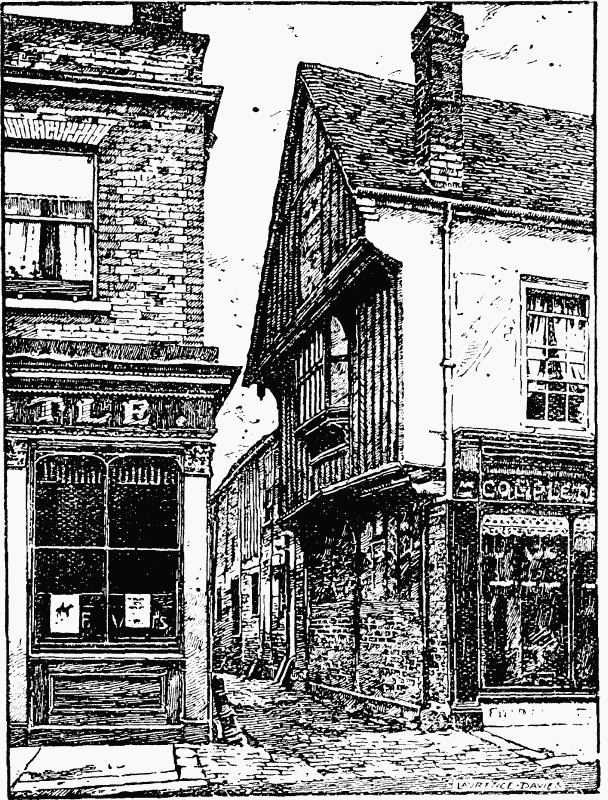
Jack of Newbury's House
Amongst other objects of local interest in the museum are the old stocks, which stood in the marketplace, and many relics of the Civil War.
To the east of the Cloth Hall Museum are the Corn Stores, a picturesque long range of low buildings built of brick and two stories in height with a gabled roof covered with tiles. Along the front at the first floor level is a covered wood gallery with two flights of stairs leading up to it from the ground outside, and from the gallery the various chambers of the upper floor are entered.
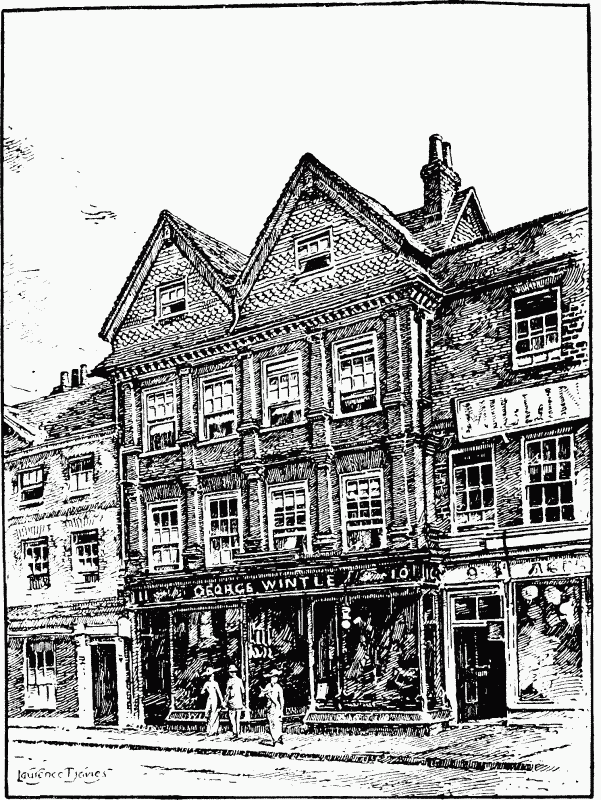
House in Northbrook Street, Newbury
None of the buildings in Cheap Street are of any age; Kimber's Almshouses are dated 1795 and St. Mary's Almshouses were rebuilt in 1864. In this street are also the free library, modern corn exchange, the chief post office, and many shops; about a quarter of a mile from the junction of the fork it crosses the railway by the station, whence it continues through a number of modern houses.
In the other branch of the Y, Bartholomew Street, stands the parish church, the only building of any interest until the street crosses the railway, at which point stand the Litten chapel of the old hospital of St. Bartholomew, now attached to an hotel and formerly used by the grammar school, the present St. Bartholomew's Hospital and Raymond's Buildings. The remains of the Litten chapel consist of a plain rectangular room measuring about 23 ft. by 17 ft. inside; it was shortened at its east end in modern times, when the Newtown Road was widened under the Newbury and Speenhamland Improvement Act of 1825 (fn. 3); its original length was probably about 26 ft. The chief point of interest in it is its elaborate roof, which is gabled and in which are two richly carved and moulded queen-post trusses, from which the tie-beams have been removed. The purlins are moulded and have curved wind braces. The moulded wall-plates set back almost on to the outside face of the walls, suggesting that the original walls were much thinner and of half-timber work; the present walls are about 2 ft. 3 in. thick, being splayed back inside at the top to the wall-plates. Each side wall is pierced by two windows, all apparently old but much restored. The two to the north are each of two cinquefoiled fourcentred lights under a square head with sunk spandrels; they have wood lintels, which appear to be parts of the former moulded wallplates. The two south windows are each of two plain four-centred lights in square heads. In the south wall is a modern doorway and in the west another from the house. The east wall is all modern and has a six-light window.
During some litigation (fn. 4) with respect to St. Bartholomew's Hospital or Priory shortly after the Dissolution a witness gave the following account of the buildings then existing:—
The scyte of the same priorye ys bylded after an old and auncyent buyldyng and that there ys a proper lytell churche thereunto adioynyng and that he knowe the chaunsell there to be seated with carrolles (fn. 5) and in the chauncell there ys a dore and a comonwey ledyng into a howse there stondyng on the south syde and yt ys buyldyd lyke the sam churche but whether the sam howse was comonly called the chapter howse thys deponent knowyth not. . . . there ys on the south syde of the seyd churche a howse standyng but what hall or chamber ys therein he knowyth not. Also thys deponent sayth that there ys a wey owt of the chauncell into the farmhowse which sometyme was close and that in the seyd chauncell there stode an hygh alter and over the bodye of the churche two chambers with a chymney in the same wherin one Sir John Magott late pryor dyd kepe hys howse. And further he sayth that there be thre dores in the sam churche one southward, one other northward and the thyrd a grett dore at the west end goyng into the churche-yard (fn. 6) ever accustomed for the processyon to go in and owt. . . . and vppon the same churche a steple and a fayre bell therin.
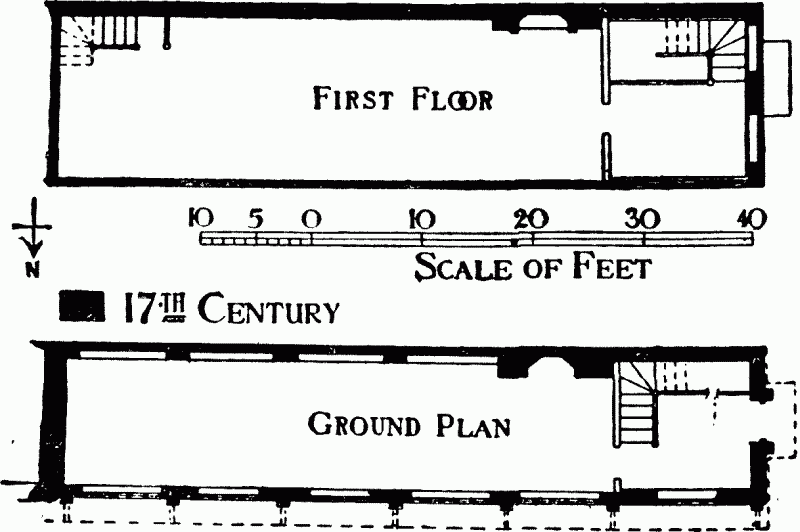
Plan of Cloth Hall
North of the Litten House is the St. Bartholomew's Hospital erected in 1698, a low range of brick buildings facing west with wings projecting westwards at each end and tiled gabled roofs. Over the archway in the middle of the main block are the royal arms quarterly: (1) England impaling France, (2) Scotland, (3) Ireland, (4) Hanover. On the back of the almshouses is the date 1839, evidently that of a restoration. On the opposite side of the road are the Raymond's Buildings almshouses erected by Alderman Jemmett of London in 1678. They are of the same plan as the St. Bartholomew's Almshouses, and are two stories in height, the lower of red brick, the upper plastered and having a gabled tiled roof; in the centre is a modern blue brick porch and on the building are the arms and crest of the Brewers' Company of London. After passing St. Bartholomew's Hospital the road divides and a more modern district is reached, now served by the parish church of St. John, but branching off the main streets are many courts, known as 'the city,' in some of which are still remains of halftimbered houses chiefly of the 17th century. Most of the modern extension of the town is to the south.
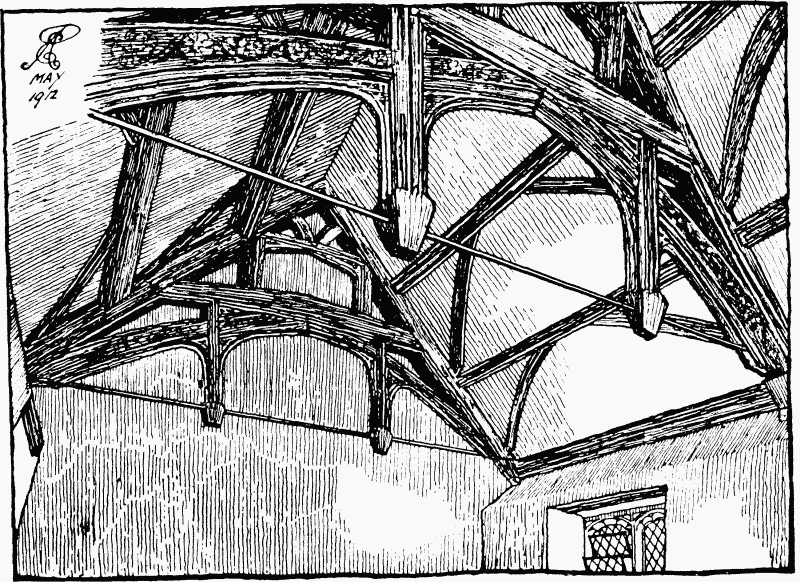
Roof of the Litten Chapel, Newbury
At West Mills by the river side to the west of the bridge is a row of two-storied 17th-century cottages of plastered brick and half-timber with a tiled roof. The gabled east end is tile hung, and from it projects on shaped brackets an oriel window with a gabled head having a moulded barge-board in the apex of which is a carved pendant.
The castle has entirely disappeared. As late, however, as the year 1626–7 some fragments of masonry still remained and these furnished materials for repairs at the church, as the contemporary wardens' accounts bear witness. There is sufficient evidence that the castle stood to the south of the Kennet near the wharf, but the formation of a basin or wet dock has destroyed all traces of the early fortress. (fn. 7) Newbury does not appear in the Middle Ages as a walled town with regular defences and the notices of gates (fn. 8) may refer to entrances to the common fields or bars where tolls were levied.
The modern race-course lies about a mile to the east of the town.
The ground, now covered with houses, which surrounded the three main streets (the letter Y already referred to) formed the waste and the common fields. The space between Bartholomew Street and Cheap Street was mostly in the West Field but partly in the East Field. The remainder of the West Field lay west of Bartholomew Street and that of the East Field east of Cheap Street. The West Field was far the larger of the two. (fn. 9) Besides these two fields the Wash Common lay to the south-west of Bartholomew Street, but of this little is heard till the 16th century. Northcroft to the north of the Kennet and the west of Northbrook Street was the town meadow. The name appears in an early 15th-century rent roll. (fn. 10) Another common pasture was the marsh, now known as Victoria Park, lying to the east of Northbrook Street. This pasture rose in importance as the northern end of the town increased. All these lands were inclosed in 1846 and are now built over.
Manor And Borough
From early times (fn. 11) the site of Newbury was destined to become a settlement of traders and wayfarers. At or near the easy ford over the Kennet converged even in the Roman period important roads, the great main ways from Gloucester and Bath to Silchester, an early track from the Thames at Streatley, and a very ancient route running north from Winchester and crossing the Enborne at Sandleford. To these we may perhaps add a road passing along from Newbury to Reading and known (fn. 12) at Aldermaston in 1550 as the Harrow Way.
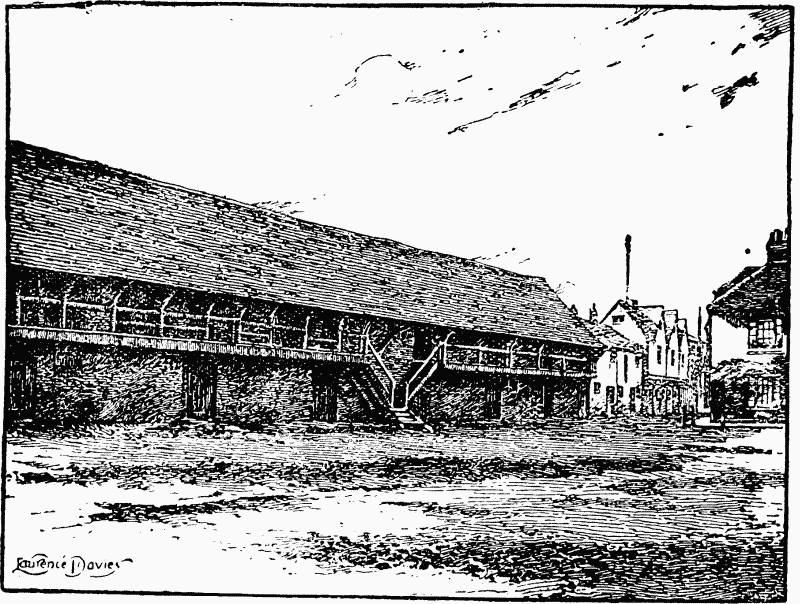
Corn Stores, Newbury
Already in the Roman period a settlement grew up at the ford possibly to the south of the Kennet, as the cemetery lay close to the present goods station of the Great Western railway. The position of the succeeding Saxon settlement cannot be certainly determined. If we may argue from the customary procedure of the invaders elsewhere, it was probably outside the Roman limits. But if this was the case—and there is no direct evidence—extensions soon followed and the Roman area was resettled. Indeed, in the latter years of the 11th century, while a part of Newbury almost certainly still lay to the north of the Kennet, the greatest extension with the church and the market-place was to the south, and here possibly in the anarchy of Stephen's reign a castle rose to protect or overawe the town.
We possess no direct evidence as to the formation of the manor and borough of Newbury, and it may be desirable to enumerate the scattered notices which connect it with the original and undivided parishes of Speen and Thatcham and identify the chief portion of it with the Domesday manor of Ulvritone. According to Ordericus Vitalis, (fn. 13) who is evidently citing deeds of which he had personal knowledge, Bernhard de Neufmarché gave to the religious house of Aufay in Normandy about 1079 the church of Speen, with the tithes thereof, 'et pro mutatione ecclesiarum Burchella et Bruneshopa 20 solidos de censu Neoburiae.' This certainly suggests that some small portion of Newbury was then or had been to the north of the Kennet in the parish of Speen. About the same time or a little later Ernulf de Hesding, (fn. 14) 'commanding in stature, supreme in energy and abounding with wealth,' as the Hyde Chronicles (fn. 15) describe him, granted to the abbey of St. Pierre de Préaux the church of St. Nicholas of Newbury with a tithe of all the revenues from the vill, that is of the mills, toll and everything tithable, a hide of land and the priest's house. This grant with other considerations derived from the mapping out of the Domesday manors enables us to identify the most important part of Newbury with the Ulvritone of the Great Survey, a manor held by Ulward or Wulfward the White, in the time of the Confessor and in 1086 by Ernulf. Here at the latter date there were 51 hagae and the value of the manor had risen from £9 at the time of the Confessor to £24 when the Survey was taken. (fn. 16) Behind this financial appreciation must lie the extension and organization of a trading community and probably the grant of burghal rights. But besides Speen and Ulvritone Thatcham probably contributed to the formation of Newbury, since we read in the Domesday that 12 hagae existed at Thatcham, farmed for 55s. As Mr. Horace Round has pointed out in an earlier volume (fn. 17) of this history, 'unless this royal manor possessed special trade privileges of which there is no mention in the Survey, one does not see why it should possess these houses, unless they were really situate in Newbury which the formula does not suggest.' But the result of an ecclesiastical law-suit (fn. 18) in the early years of the 13th century suggests that a close connexion existed between Newbury and Thatcham. In a case tried before papal delegates at Winchester the abbey of Reading claimed Newbury Church as a chapelry of Thatcham. It would seem that from time out of mind Newbury Church had paid 2s. annually to Thatcham Church, and on a compromise being arrived at the abbey of Preaux undertook further to pay to Reading a yearly rent of 4s. 8d., and this continued at least as late as 1475. It is therefore possible that part at least of Ulvritone had been carved like Greenham out of an older and larger parish of Thatcham than exists to-day. In short, it is likely that the borough of Newbury was formed by a settlement of traders on land taken from two ancient parishes, those of Thatcham and Speen.
The assessment of the manor of Ulvritone in the time of the Confessor had been 10 hides, but by 1086 this had been reduced to 2½. There was land in 1086 for twelve ploughs, but on the demesne there existed but one and elsewhere seven ploughs belonging to eleven villeins and eleven bordars. The two mills were worth 50s. The manor possessed 27 acres of meadow and sufficient woodland to render twenty-five swine; but, as already mentioned, the outstanding features were the existence of the 51 hagae paying 20s. 7d. and the great increase in the value of the manor between the death of King Edward and the Great Survey. A trading settlement is a possible explanation.
If Newbury was to a great extent identical with Ulvritone it soon changed hands. From Ernulf de Hesding it passed (conjecturally by the marriage of one of his daughters) (fn. 19) to the family of Chaworth alias Mundublel. Payne de Mundublel held Newbury in 1166, (fn. 20) but by 1189 it had fallen to the king. (fn. 21) Then it passed to the Count of Perche (fn. 22); it was resumed with other Norman lands by King John in 1205, (fn. 23) and at some subsequent period granted to the famous Fawkes de Breaute. (fn. 24) But the Count of Perche apparently resumed his claim to it before his death at the battle of 'Lincoln Fair' in 1217, (fn. 25) as his brother and heir the Bishop of Chalons afterwards ceded all rights in the town to William the Marshal and the Earl of Salisbury. (fn. 26) The manor was confirmed to Salisbury in 1217. (fn. 27) The borough passed to William the Marshal, (fn. 28) and soon the manor also passed to the same family. In 1231 the manor formed part of the dower of the Countess of Pembroke, the king's sister, who had married the second Earl Marshal. (fn. 29) In 1229 Salisbury received a grant of land in Newbury of 100s. (fn. 30)
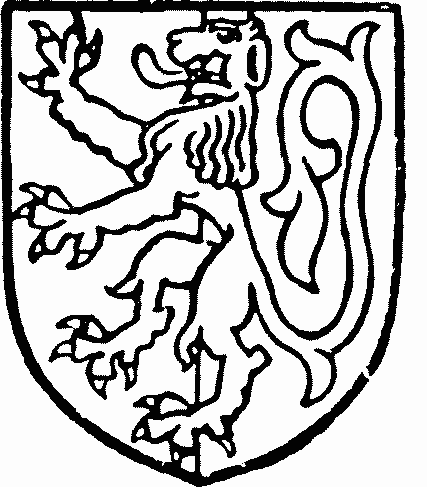
Marshal. Party or and vert a lion gules.
Newbury as part of the dower of the Countess of Pembroke passed to her second husband, Simon de Montfort, whom she married in 1238. At his death (1265) it was apparently claimed by Gilbert the Red, the eighth Earl of Gloucester, as the grandson of Isabel the sister of the second Earl Marshal. Gloucester was said to hold the borough and to have gallows and the assize of bread and ale from the time that the town was in the hands of the Count of Perche. (fn. 31) In 1274 the king took Newbury into his hands while the partition among the heirs of William the Marshal was being made. The most important representatives of the Marshals—the house of Mortimer—obtained the manorial rights and the lands were divided between this family and those of Hastings (in which the Pembroke title revived), Bigot, Bohun, Mohun, Vesey, Zouch and Rupe de Canardi, (fn. 32) while the houses of Ferrers and of Salisbury also claimed an interest in the estate. (fn. 33) Thus it is not remarkable that about 1314 Adomar de Archiaco, one of the representatives of the house of Ferrers, did not think it worth while to claim his portion of the Newbury lands; to wit, onequarter of one-twelfth of the Newbury Mills. (fn. 34)
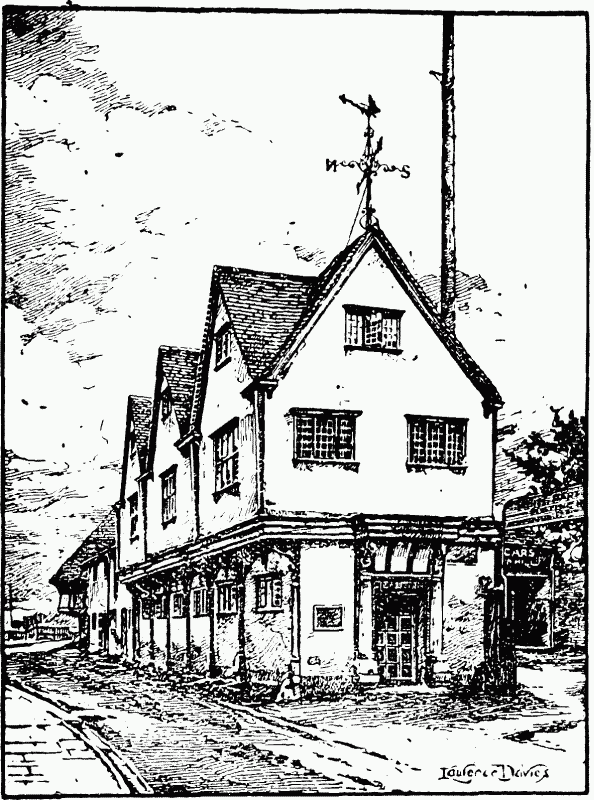
The Cloth Hall, Newbury, From The North-West
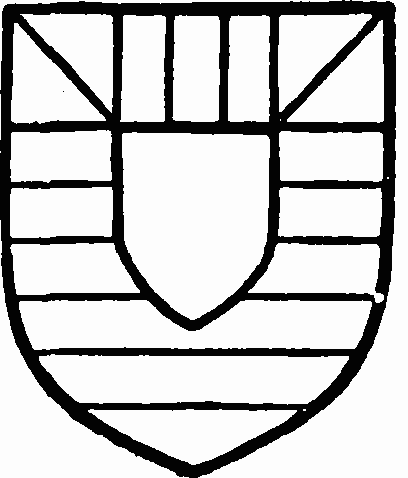
Mortimer. Barry or and azure a chief or with two pales between as many gyrons azure therein and a scutcheon argent over all.
This great subdivision of interests continued during the next hundred years. In 1292 a part of Newbury was included among the queen's lands, but the value was only about 4 marks. (fn. 35) In 1316 the holders in chief were reported to be Roger de Mortimer, in whom the manorial rights were chiefly vested, the Earl of Lancaster, who represented the house of Salisbury, John de Bury, John de Segrave and John le Rous. (fn. 36) As, however, later documents show that other families, such as those of Hastings, Zouch and Bohun, retained their interest in the town, the above list is probably not exhaustive.
With the 15th century a tendency appeared towards the accumulation of lands in fewer hands. The lands of Hastings and part of those of Zouch were granted to a certain John Roger. (fn. 37) The possessions of the house of Lancaster were of course vested in the king; those of Mortimer (i.e., the manorial rights) passed to the Duke of York and thence to Edward IV. Precisely how the other interests were dealt with is not clear; but in 1461 Edward IV bestowed manor, lordship and borough on his mother, Cecily Duchess of York, (fn. 38) and from this time till the grant of the second charter of incorporation the town was regarded as a royal appanage. It was granted to the queen of Henry VII (fn. 39); it was given in turn to Anne Boleyn and to Jane Seymour (fn. 40); in 1551 it passed to the Princess Elizabeth, (fn. 41) and was subsequently granted to Anne of Denmark. (fn. 42) At last in 1627 the lordship of the town and the manorial rights were granted to the corporation in return for a quit-rent payable to the Crown as lord of the manor. (fn. 43) Of late years the rent was bought by Mr. Richard Benyon. (fn. 44)
The first impulse towards the development of Newbury's industrial and commercial life may have been its position on the roads to London and Winchester. That the place was regarded as of some strategic importance appears from the siege of the castle by Stephen in 1153, (fn. 45) the only known event connected with this fortress. The place was defended by William the Marshal, and the siege is said to have occupied some months. (fn. 46) Finally the castle was taken and presumably dismantled. At any rate, no more was heard of it as an effective stronghold. The increasing importance of the town drew on it a demand to assist the king. In 1189 the Pipe Roll shows that the burgesses owed £6 18s. 'de dono,' (fn. 47) which is the earliest intimation that Newbury was considered as a borough.
On the foundation of Sandleford Priory by Geoffrey Count of Perche, about 1200, an annuity of 13 marks from the mills of Newbury was allocated for the support of that house. (fn. 48) The Count of Perche, however, shortly after this date forfeited his possessions in England as a Norman, and an account of his lands made about 1204 shows that Newbury was in a very prosperous condition. The total receipts from the town were £52 2s. 8½d., which was a considerable sum at that date. They included £20 0s. 6½d. from rents of assize and burgage rents, £1 6s. 8d. from a fulling-mill (indicative of a cloth industry at this early date), £16 from the mill and £8 from the market. The most interesting item, however, with regard to the constitutional history of the town is £1 10s. from the serjeants (servientes) for having or electing their own bailiffs. (fn. 49) These serjeants may have been the reeve and good men of the town whose names are entered in the margin of the account. This was a period of expansion of borough rights, and the right of election of the bailiffs implied probably a borough court, which would be a distinct advance in the autonomy of the town.
Possibly the growth of self-government may have been assisted by the establishment of St. Bartholomew's Hospital. The hospital consisted originally of a warden, popularly styled prior, and a number of poor brothers and sisters. The date of its foundation is unknown, but as the yearly fair of St. Bartholomew—afterwards so great a feature in the life of the town—was granted to it in 1215 (fn. 50) it must have been a well-established institution by that date. Its possessions in Newbury increased steadily during the next two hundred years. In the early 14th century and later the appointment of the prior was certainly in the hands of the town, (fn. 51) and if this was the case at an earlier time the hospital may perhaps have formed a centre round which communal feeling could gather. The fact of the existence of the custom, only recently dropped, of choosing a 'Mayor of Bartlemas' (fn. 52) may lend some confirmation to this opinion.
During the early part of the 13th century commerce and craftsmanship probably increased in Newbury. The establishment of St. Bartholomew's Fair implied a growth of trade. In 1228 the men of Andover obtained a grant of liberties in the Newbury markets. (fn. 53) There was a small settlement of Jews in the town, probably under the protection of the Countess of Pembroke, (fn. 54) who were expelled in 1244, (fn. 55) and some trade in wool must have been carried on, since complaint is made in the Hundred Roll that during the war with Flanders Newbury merchants had sent wool abroad from Southampton and Portsmouth without licence. (fn. 56)
It seems doubtful, however, if Newbury's progress lasted throughout the 13th century. The town's connexion with Simon de Montfort may have been injurious to it, or the rivalry of Reading (fn. 57) may have been too strong. At the partition of Newbury among the Marshal heirs in 1275 it was extended at no more than £60, (fn. 58) the amount of its farm seventy years earlier; and it is noteworthy that certain mills, usually the most valuable property in the town, were assessed in 1297 at only 2s., as being 'ruinous and broken.' (fn. 59) Certainly the development of the borough of Newbury seems to have been checked. In the Hundred Roll (fn. 60) it was definitely mentioned as a borough (fn. 61); it sent two members to Parliament in 1275, and also sent three representatives to attend the Council of Westminster in 1337. (fn. 62) But it had no representatives in the Model Parliament. In the inquisition of 1316 it was stated that there were only three boroughs in Berkshire—Reading, Wallingford and Windsor. (fn. 63) Still more striking was the fact that when in 1333 a tax of one-tenth was laid on boroughs and of one-fifteenth on 'vills' Newbury was only reckoned as a 'vill' and paid less accordingly. (fn. 64)
This decline in Newbury's importance suggests that the town's great source of wealth, the cloth trade, was still undeveloped, or perhaps had decayed to revive again later. Certainly the agricultural aspect of the town was the most prominent. In the Inquisitiones Nonarum the value of the ninth sheaf, fleece and lamb was given at £10, and forty-four men paid the tithe of hay, which formed a large part of the revenues of the church; but there was no mention of men 'living by merchandise' or otherwise than by agriculture. (fn. 65) Moreover, the Subsidy Rolls suggest a definite fall both in wealth and in population. In 1327–8 the tax of one-twentieth was paid by seventynine persons and produced £23 2s. 7½d. (fn. 66); five years later a tax of one-fifteenth was paid by only seventy persons and yielded no more than £23 13s. 10d. (fn. 67) The Black Death, too, probably inflicted great loss on Newbury; there is a signal instance of it in the case of a tanning-mill, one-third of which was worth 10s. in 1304, whereas in 1350 the whole mill was said to be worth nothing, because of the pestilence. (fn. 68)
Newbury, however, recovered fairly quickly. The cloth trade again revived; in 1355 twelve Newbury clothiers paid ulnage on sixty-seven and three-quarter cloths. (fn. 69) As in the cases of other towns at this period, an increase of prosperity apparently led to an increase in the number of large mediate landholders. There are several instances about this period of townsmen in Newbury who had accumulated considerable quantities of land, held in small parcels of different lords. Thus in 1377 a certain William held lands of Pembroke, Zouch, the Earl of March, the Prior of Sandleford and one or two other lords. (fn. 70) William de Warmington held lands, which he afterwards granted to a chantry, of the lords of Cantelupe, Valence and Zouch, (fn. 71) and Richard Abberbury gave to Donnington Chapel, among other endowments, four messuages in Newbury held of four different lords. (fn. 72)
Possibly this increase in prosperity may account for the fact that Newbury took little part in the social and religious movements in the reign of Richard II. Berkshire was a Lollard county and was affected by the rising of 1381; but the only hint of any connexion which Newbury might have had with public difficulties is the order for the arrest in 1402 of six Newbury men, who were to be brought before the Council. (fn. 73)
On the whole it seems as if the prosperity of Newbury was unchecked during the 15th century. There was possibly a slight fall in the value of land between 1377 and 1440, (fn. 74) but despite this the Ministers' Accounts for 1440 and subsequently suggest a growing community. Names of craftsmen frequently occur, such as John Benet, fuller, and Nicholas Spence, weaver, (fn. 75) while in 1441 there is mention of a kerseyweaver. (fn. 76) The town maintained a physician, too—John Baudewyn, 'leche,' who paid half a pound of pepper for a tenement on the east side of West Street (fn. 77); while the Patent Rolls show Newbury chapmen trading with London merchants. (fn. 78)
Such an increase in trade probably implied an increase in population. On the Pembroke lands alone, which were valued at about £4, there were over sixty tenants in 1440 (fn. 79); on the lands of Zouch the rental was probably higher and there was presumably a corresponding number of tenants; and besides these were the persons living on the lands of Mortimer. Obviously the population must have increased in the hundred years which had passed since 1333, when in the whole town seventy persons only paid the tax of one-fifteenth.
The market-place, the bridge and Northbrook Street apparently constituted the business centre of the town. On the bridge were the 'shoppes,' long noticed as a special item in the town accounts. In the market-place were stallages and shambles, (fn. 80) and vacant plots of ground, for which a high rent was paid on market and fair days. (fn. 81) All these various fragments of land were usually held by lease for various periods, for life, for forty years, for a hundred years. (fn. 82)
The Wars of the Roses seem to have affected Newbury but little, though the Duke of York's interest in the town necessarily involved it in the struggle. The Earl of Wiltshire took it in 1460 and hanged numerous Yorkists. (fn. 83) Like the rest of England Newbury revolted against Richard III; the town formed one of the gathering places in Buckingham's rising, (fn. 84) but no political disturbances checked the development of the great clothing industry.
The revival of this industry was perhaps stimulated by the existence of a little colony of aliens in the town in the middle of the 15th century. (fn. 85) The cloth trade reached its height fifty years later, in the days of the great clothier, Jack of Newbury, or John Winchcombe, alias Smallwood. Winchcombe seems in a lesser degree to have excited the same kind of interest which attaches to Dick Whittington. Nearly a hundred years after his death he was the hero of a romance by Thomas Deloney, entitled 'The Pleasant History of John Winchcombe.' This narrative, besides giving a long description of Jack's early life and his two marriages, contains many curious details concerning his business and the customs of the town. Winchcombe is said to have had two hundred looms worked by two hundred men, each with a boy making quills; he employed a hundred women in carding who sang as they worked; two hundred maidens were employed in spinning 'in peticoats of stammel red and milke-white kerchers on their head,' with white smock sleeves tied with silk at the wrist. Elsewhere there were eighty children of poor men picking wool and receiving a penny each day and their food. There were also fifty shearmen and eighty 'rowers,' and forty men in the dye-house dyeing the cloth with madder and woad.
There is a long account of Jack Winchcombe's entertainment of the king, when his house floor was covered with broad cloth 'of azure colour,' and of his remonstrances against the suspension of the cloth trade during the war with France in the earlier years of the reign of Henry VIII. (fn. 86)
Making all allowances for exaggeration and romance, Winchcombe must obviously have been a man of importance. A part of his house still standing on the east side of Northbrook Street has been described above. His factory presumably extended backward to the Marsh. His business descended to his son, another John Winchcombe, who with other Newbury clothiers had enough influence to secure the suspension of the statute (fn. 87) regulating the making of cloths till the whole subject had been investigated. (fn. 88) Kerseys were the Winchcombe specialty. In 1539 Thomas Cromwell ordered a thousand pieces of cloth from John Winchcombe, (fn. 89) and in 1544 it was declared that Winchcombe kerseys would make 'great heaps of money' at Antwerp. (fn. 90)
The Winchcombes, however, by no means had a monopoly of Newbury cloth-making. Another great clothing family was that of Dolman. Thomas Dolman, reputed to have been a foreman to Jack of Newbury, was an ancestor of the owners of Shaw House, and his fame stood almost as high as that of Winchcombe himself. (fn. 91)
Other great kersey makers were Philip Kystell, Humphrey Holmes and William Blandy. (fn. 92) If the Weavers' Guild was really founded in the reign of Henry VIII, as has been suggested, it came into existence at a time when the cloth trade in Newbury was at its zenith.
The increase of this industry must have affected the social life of the town. Its character was changing from that of an agricultural to that of a manufacturing centre. The first payment of the first subsidy of 1524 (fn. 93) shows between 350 and 400 persons paying; in rather less than 200 cases details are decipherable. In these cases over 100 paid on account of their wages, over seventy on account of their goods (personalty), but less than thirty on account of their land. So small a proportion suggests both that agriculture was declining and that land was again falling into the hands of a few.
Certainly the number of payments imply that the town was growing; the rentals and taxing rolls of the 16th and 17th centuries showed a tendency to describe Speenhamland as part of Newbury. (fn. 94) Moreover, within the real boundaries of the town itself inclosures of fragments of land and buildings thereon were increasing. (fn. 95) A rental of Crown lands in 1609 shows twenty-five persons paying rent for 'intrusiones' in Cheap Street, seventeen in Northbrook Street and six in Bartholomew Street. These 'intrusiones,' such as 'le shoppe,' 'le porche,' 'le rayles,' 'le pentyse,' were usually of small size (fn. 96) (e.g., 12 ft. by 4 ft. or 16 ft. by 2 ft.).
Owing to the dispersion and destruction of the early municipal archives of Newbury it is difficult to give a coherent account of the government of the town before the 16th century, but certain facts stand out clearly. There were bailiffs from the reign of John, if not before; there was a reeve or portreeve (prepositus porte ville), (fn. 97) who is sometimes reckoned (fn. 98) as one of the bailiffs; there was a commonalty (fn. 99) (communitas) led by these bailiffs and taking common action, as, for example, in the appointing of the warden of St. Bartholomew's Hospital. Whether the governing body was practically identical with the chief men of the merchant gild, acting in conjunction with the lord's officers, is not certain, but a merchant gild existed in the town, and, although through loss of Court Rolls we only hear of it eo nomine in the reign (fn. 100) of Henry VIII, it probably originated at a much earlier date. On the side of the lord there was the seneschal or steward. The communal life was centred in the Moothall, where was kept the weighing beam for the cloth and wool of stranger merchants. Here, too, may have been held the courts, the solemn half-yearly leets with view of frankpledge and somewhat under a score of intermediate courts of portmote. In 1450, when Geoffrey Bridde as bailiff and Thomas Hosier as reeve rendered their account, (fn. 101) the steward presided at both the leet and portmote. The perquisites of the two leets came to 79s. 3d., and his expenses were 19½d. Only one-third of the issues of the eighteen portmotes is returned in the borough accounts, and this amounted to 3s. 8d., but one-third of the necessary expenses of the steward was as much as 13d. The bailiff's fee was half a mark. In the 15th-century accounts which have survived we also hear of four men keeping the 'fines ville ibidem tempore nundinarum.' Apparently these were the gatesmen of the fairs, and their expenses were 12d., no exorbitant sum.
The appointment of the reeve may have been in the lord's hands; that of the bailiff lay in the hands of the court leet jury in conjunction with the lord's steward, if the account given in a Court Roll in the reign of Henry VIII represents the state of affairs during the previous century. (fn. 102) According to this document Newbury was divided into six tithings, two for each of the principal streets, with a tithingman at the head of each; their presentments were confirmed by a jury of twelve men. This jury, in conjunction with the seneschal or steward, chose the town officers. The jury chose four constables, out of whom the seneschal selected two; four bailiffs, from whom the seneschal chose two; twelve tithing-men, from whom the seneschal chose six, and six gatewards, from whom the seneschal chose three. (fn. 103)
The jurisdiction of the court leet extended as usual over matters of public health, industry and trade. Men were presented for obstructing the roads and placing garbage on the highway. There were the usual presentments of bakers and brewers. The common baker, who baked bad bread, and the common miller, who took too much toll (both fined 6d.), are ordinary figures in the manor courts. Less usual perhaps is the common 'candelator' presented for making candles 'insufficiently.'
It was, however, unlikely that a growing community could continue to live, even if it had hitherto lived, simply under the organization of a manor. The growth of capitalism in Newbury probably implied the growth of a class able and desirous of managing the affairs of the town. Their position may well have been strengthened by the dissolution of the religious houses and the destruction of the chantries, which increased the wealth both of the town itself and of individual townsmen.
On the whole, Newbury seems to have been fortunate in the distribution of its church lands; some part of them did, indeed, fall into the hands of private owners, such as John Knight, himself a Newbury man. To him and to Richard Bridges were granted the lands belonging to the Crutched Friars at Donnington (fn. 104) and to the foundation at Wherwell, (fn. 105) as well as certain chantry lands. The lands belonging to Bullock's chantry passed to one Thomas Adams, (fn. 106) but those belonging to Wormestall's chantry and to the 'Lady Priest's chantry' continued to be, as they already were, the endowment of the town school. (fn. 107)
The most important of the religious foundations in Newbury—the hospital—was not destroyed at the Reformation (fn. 108); it had been granted in 1555 by the last master and the brethren for sixty-one years to the clothier, Philip Kystell. Five or six other persons were associated with him in the government of the hospital. They or persons called the 'Masters of Newbury' were said to receive from two proctors chosen by the townsfolk a yearly account of the hospital revenues. (fn. 109) The administration was said to be unsatisfactory. In 1575 the hospital was reported to be worth £23 a year and only to give four poor men 20s. a year each. (fn. 110) These four men were presumably the occupants of the four almshouses into which the hospital had been by this time converted. (fn. 111) Despite complaints, however, the power of the town over the hospital was confirmed in 1599 shortly after Newbury's incorporation. (fn. 112) It is noticeable that all through the earlier history of Newbury acts concerning St. Bartholomew's Hospital were exercised by the 'commonalty' (fn. 113) or were in some way connected with the government of the town; but there is nothing to show what the word 'commonalty' implies or in whom the town government was vested. It seems, however, certain that during the 16th century the government of Newbury was falling into the hands of a small group of men, some of whom were probably among the master clothiers of the town.
Evidence of the concentration of power in a few hands is obtained from the grant in 1554 of a lease of the stallage, piccage, tolls and all other profits of the fairs and markets to Gabriel Cox, Humphrey Cox, Bartholomew Yate and John More for the use of the inhabitants of Newbury, (fn. 114) and it is confirmed by the tenor of the first extant charter of Newbury, that granted in 1596.
This charter was of a strictly oligarchic character. The government of the town was to be in the hands of thirty-one capital burgesses forming the common council, and including the mayor and six aldermen. The first mayor, the first aldermen and the remaining twenty-four capital burgesses were named in the charter. The mayor was to be elected annually, the other burgesses were to retain their offices for life. The first mayor was Bartholomew Yate; the first six aldermen were: Edward Holmes, Roger Sanderson, Henry Coxe, Gabriel Coxe, John Kystell and William Barkesdale. The list of the common council includes the names of at least four persons who were probably related to individual aldermen, increasing the impression that the government of the town was in the hands of a clique. There is absolutely no trace of popular election. The mayor was chosen annually by the aldermen and common council from among their own number. Vacancies among the aldermen and common council were to be filled by the promotion of the senior capital burgess to the vacant place and the capital burgesses filled up openings in their own ranks by co-opting fresh members from outside. Capital burgesses if guilty of misconduct could be removed by the mayor and aldermen, and aldermen by the capital burgesses. The 'commonalty' in any modern sense were quite unrepresented.
The powers of the mayor and the capital burgesses were considerable. It was their duty to hold a court of record weekly in the gildhall to decide all pleas of less than 20 marks in value concerning assaults, debts, frauds, agreements, seizures of goods within the town, and so forth; all actions were to be carried on by four attorneys appointed for life by the corporation. The council was to elect a steward, (fn. 115) who with the mayor and one alderman chosen by the burgesses were to act as justices for the execution of all statutes relating to vagabonds, labourers and weights and measures. There were to be four yearly fairs (one of them St. Bartholomew's), of which the control was to be in the hands of the corporation, and £3 a year was paid on this account to the queen. A pie-powder court was established for each of these fairs. All supervision of trade and industry belonged to the corporation, and it had powers to make what ordinances it thought fit. Further, all liberties, markets and profits belonging to the court leet, the view of frankpledge, lawdays and exemptions were to belong as fully to the mayor and the corporation as they had previously done to the inhabitants however incorporated. (fn. 116)
Whether this last phrase was merely a lawyer's saving clause or whether there really had been some previous incorporation is uncertain; at any rate, the rights possessed by the corporation did not include the lordship of the manor. They were, however, sufficiently extensive, and were at once put into operation. In 1597 the corporation issued a lengthy list of ordinances, the general effect of which was to increase the power of the mayor and aldermen. (fn. 117) The method of election of the mayor was to be defined; the outgoing mayor and aldermen were to nominate two capital burgesses for the office, of whom the burgesses were to elect one. (fn. 118) No matters could be discussed and settled without a quorum of burgesses, including the mayor and two aldermen. (fn. 119) Aldermen and burgesses betraying counsel were to be removed from office. (fn. 120) The desire to suppress any popular opposition is obvious. All persons of an inferior sort, freemen, journeymen and apprentices, were forbidden to make unlawful assemblies, brotherhoods or congregations. (fn. 121) Anyone rebelling or conspiring against the corporation or slandering it was to be fined, on proof of his guilt being made by two witnesses. (fn. 122) On the other hand, the mayor and corporation could, when they chose, summon the commonalty to the gildhall 'for the better government of the borough' (fn. 123); thus presumably securing a show of popular authority at critical moments.
The constitutional articles of these ordinances are, however, less striking than those concerning trade and industry. The latter are elaborate. There were to be five companies comprising all the trades in the borough. These were the companies of clothiers (i.e., makers of clothes), mercers, tanners, braziers and clothworkers (i.e., makers of cloth). Any person engaged in any lawful trade in the borough might be allotted by the corporation to one or other of these companies. (fn. 124) The result was that the companies included an odd assortment of trades. Scriveners and schoolmasters fell to the clothiers' company, apothecaries and all sorts of provision dealers and innkeepers were included among the mercers. 'Tanners' comprised barbers and surgeons, and 'braziers' all those engaged in the building trades. No person was to use any craft or set up any shop unless he was free of the company to which his special trade belonged, nor was he to employ any journeyman or apprentice not belonging to that company. (fn. 125) The government of each company was in the hands of a master and two wardens appointed by the mayor. (fn. 126) The general regulations for trade were strict: no one was to set up more than one shop on pain of a fine of £5 (fn. 127); the number of apprentices was limited—members of the corporation might take three, other persons two only (fn. 128); nor was anyone to take an additional apprentice if he could get a freeman or a journeyman to serve at reasonable rates. (fn. 129) Masters were to present their apprentices to the mayor and aldermen at the gildhall, who were to ascertain their conditions of birth, whether freemen or aliens, and 'the cleanness of their bodies.' The names of the apprentices were registered in the town book. (fn. 130) No master was to pay his apprentice wages after his term was out till the youth had been presented for one month to some 'honest workman,' appointed by the mayor and aldermen, who was to decide if the apprentice was fit for journeywork. (fn. 131) No journeyman could leave his place on account of disagreement with his master till the dispute had been laid before the corporation. (fn. 132) No person could set up a trade unless he had been apprenticed to it, or had exercised it for ten years before the issue of the ordinances, or unless he was one of the corporation. (fn. 133) The regulations for all persons concerned in clothmaking were full and elaborate. The use of the prescribed instruments, such as teasels instead of iron cards, the making of cloth with the workman's mark, the completion of the cloth within the borough, the use of the town stamp for cloth so made, were among the subjects included in the ordinances. (fn. 134)
Brewing was the other trade for which there were special rules; it was confined to the common brewers. (fn. 135) The general superintendence of trade and industry in the town was confided to the mayor. He had the right of entering the house of any craftsman or trader and of examining tools, wares, weights and measures, to see that the goods were well made, the tools and the measures lawful. Resistance to his search involved a fine of £5. (fn. 136) Nor were the ordinances entirely industrial and constitutional. There were also police regulations; unlawful games, dice, cards and table were prohibited to the journeymen and apprentices. Shooting with the long-bow was enjoined with the view of keeping the youth of the town 'honestly exercised' during the holidays. (fn. 137) Work on Sundays was forbidden, and every householder was to see that his journeymen and apprentices went to hear service at the parish church and took 'lawful exercise' afterwards. (fn. 138) If all these ordinances were enforced, Newbury must have been a much administered town; but unfortunately there is no account of how these rules were observed, though the companies long remained in existence.
The rule of the corporation does not seem at first to have been entirely satisfactory, nor were the mayor and corporation content with the extent of their powers. In 1605 a dispute arose concerning a petition by the mayor and twelve others. (fn. 139) Possibly there had been some attempt to curtail the power of the corporation, or possibly the mayor and aldermen objected to so large a common council. At any rate, in 1605 there was an indignant remonstrance addressed to the Privy Council against a project said to be put forth by thirteen inhabitants of Newbury, most of whom were nearly connected by blood or marriage. These persons were said to be trying to obtain further privileges without consulting the other inhabitants of Newbury. Their ambitions extended beyond Newbury and embraced the whole bailiwick of Faircross, which they desired to control. Their demands were said to comprise the whole profits of the town and manor now belonging to the king. The objectors to these demands declared that their concession would involve the ruin of the town, and especially of the poorer sort who depended on the clothing trade and on the market, since it was said that the object of the thirteen was to exclude 'foreigners,' by whose admission the market flourished.
The opposition apparently succeeded, for no further steps seem to have been taken at this time. But James I, in the seventeenth year of his reign, granted the town and manor of Newbury on a ninety-nine years' lease to five men, Thomas Murray, Sir Henry Hobart, John Walter, James Fullerton and Thomas Trevor, who afterwards granted it to Gabriel Coxe and Hugh Hawkins (each in their turn Mayor of Newbury). The town interests were not, however, so far injured as might have been feared, for a few years later a fresh patent was granted by Charles I in return for a payment of £500 from the corporation. By this new patent the reversion of the whole manor and town was handed over to the mayor and corporation, to be held in free burgage at a rent of £25 4s. 2½d. yearly, (fn. 140) and this arrangement, together with the powers granted by the Elizabethan charter, formed the permanent constitution of the town.
This period of constitutional development was also
one of social and economic change. An increasing
number of persons during Elizabeth's reign paid their
subsidy on account of their lands. (fn. 141) This may have
been in part due to the efforts of those paying for
personalty to avoid the burden, but it may also have
been the consequence of the adoption by the Newbury
capitalists of the custom of investing in land rather
than of extending industry. In 1564 many clothiers
were said to be giving up work and causing persons
'to live idly,' perhaps for lack of a market; and the
council desired that they should be seriously admonished and should be commanded to 'occupy.' (fn. 142)
The case of Thomas Dolman, who retired from
business and built the great house at Shaw, may have
been exceptional only from the large scale on which
his trade had been conducted. The well-known
distich,
'Lord have mercy upon us, miserable sinners,
Thomas Dolman has built a new house and turned
away all his spinners,' (fn. 143)
may point to a very real cause of distress.
Possibly, also, the ordinances prohibiting men from engaging in more than one trade or setting up more than one shop may have discouraged the industrial employment of capital.
The Clothweavers' Company, which still exists, received its patent of incorporation in 1601, (fn. 144) but it did little to stop the decline in the cloth trade, which was as marked in Newbury as in the rest of England. In 1623 the trade was said to have diminished. (fn. 145) In 1630 the Mayors of Reading and of Newbury sent up a complaint of the decay of the manufacture of mingled and coloured cloths, owing to the order prohibiting their export to Delft and Emden. The response was a declaration that though the order could not be withdrawn for reasons of State, yet the cloths might be sent to all towns where the merchant adventurers traded, without interference from that body (fn. 146); whereupon the adventurers promised to take as many dyed and dressed cloths from Newbury and Reading as formerly. These measures, however, failed to restore the trade. No number of regulations succeeded in keeping up the standard of clothmaking, partly, it was alleged, because of the introduction of Spanish cloth, which as a new invention came under no rule and was therefore considered liable to deteriorate. (fn. 147)
The natural result of this decline in Newbury's chief industry was an increase both in poverty and in efforts to relieve it. Besides collections from the poor-box, (fn. 148) there were at this time considerable funds in Newbury destined to charitable purposes and placed under the control of the corporation.
The revenue from the lands of St. Bartholomew's Hospital was devoted to the relief of the poor in 1599, and in 1624 John Kendrick left £4,000, part of which was to be invested in a house and garden and part to form a common stock for setting the poor to work. (fn. 149) The decay of the clothing trade, however, made the problem of setting the poor to work increasingly difficult. The distress was great. In 1630, when prices were very high, the corn carts going from Newbury to Reading were attacked by the hungry mob. (fn. 150) The Mayor of Newbury declared that the ringleaders were persons from Speen and Greenham; and eventually, of persons living in Newbury, only a few old women were punished: but the event so far alarmed the authorities at Newbury that a special watch was set to prevent such disturbances. (fn. 151)
The mayor's reports and petitions during the following years show the difficulty which the burgesses felt in dealing with the distress. They took the usual steps towards meeting the shortage of corn by closing no less than twenty-seven ale-houses. They punished drunkards and vagabonds, and they raised a weekly poor-rate. By means of this tax and of Kendrick's bequest they apprenticed fourteen boys and girls in six months, and resolved to continue in this course. They employed sixty persons in the clothing trade at Kendrick's workhouse, and gave work in spinning to fifty poor households in the town. They also clothed 105 poor children. (fn. 152) But clothmaking continued to decay. In 1630 3,586 cloths were made, but it was prophesied that not half the number would be produced in 1631. (fn. 153) Hence the corporation effected little permanent good, and in 1631 the burgesses petitioned to be allowed to take 'another way' for the relief of the poor. (fn. 154) The other way was unexplained; but in the following year there was a scheme for purchasing land with Kendrick's money, and with the profits subsidizing twelve cloth-workers to keep looms whereby the poor might be set to work. The cloth thus made was to be delivered to the workhouse to be made up by the inhabitants thereof. To this scheme it was objected that the subsidy would not suffice to enable the cloth-workers to extend their business, that the employment of the persons in the workhouse would throw others out of work, and that if the money was invested in land it could not be used for manufactures other than that of cloth, as was now possible. (fn. 155)
These objections seem weighty, yet the corporation had good cause to desire some better investment for the funds at its disposal. An account submitted by the burgesses to the council in 1637 showed that of the £4,000 left by Kendrick rather over £1,500 had been expended in purchasing the site of the workhouse, erecting the building and procuring the necessary tools for the making of cloth. £400 worth of cloth so made remained unsold, £700 had been used to subsidize three clothiers who employed poor persons, and over £500 had been lost in trading. (fn. 156)
Other smaller misfortunes also befell Newbury at this time. The Plague swept the town in 1603. (fn. 157) Twenty years later a less fatal but exceedingly inconvenient event occurred in the fall of the bridge. (fn. 158) As the mayor pointed out, it was not only the sole and direct means of communication between the northern and southern parts of the town, but its destruction meant a long detour for persons coming to the market from the north or west. The mayor appealed to the council for help in rebuilding the bridge, declaring that formerly the town would have received a grant of timber from the trees on the 'Wash,' which was then part of the royal manor of Newbury, but now there were no trees there. This was a contrast to the state of things sixty years previously, when in the terrier of 1561 it was stated that there were 350 timber trees, as well as saplings, lopped trees and pollards. (fn. 159)
Despite these various mishaps Newbury retained its position in the county. In 1636 its assessment for ship-money was £120; this was below that of Reading, but above that of the other towns in Berkshire.
A town lying, as Newbury did, close to the direct road between London and Oxford was certain to suffer during the Civil War. As is well known, two sharply-contested battles were fought in its neighbourhood, (fn. 160) and the townsmen suffered severely from the requisitions of both belligerents.
During the Commonwealth Newbury, like the rest of England, suffered from the consequences of the Dutch war. A number of Dutch prisoners were quartered there, and the mayor was directed to keep them safely, and to draw their allowance from the Navy treasurers—6d. a day for each prisoner. (fn. 161) Unhappily the treasurer did not apparently honour the mayor's draft, for some months later the mayor, John Birch, wrote a piteous letter praying that someone would receive his accounts and pay him, and also that he might be relieved from the support of the prisoners. (fn. 162) Whether he was repaid anything seems doubtful; the only reply on record, nearly two years later, merely states that there is no sufficient evidence for any expenditure beyond the State allowance. (fn. 163)
Newbury had to endure another visitation of Parliamentary soldiers during the Royalist rising of 1654–5, (fn. 164) but otherwise it remained fairly undisturbed till the Restoration. A heavy misfortune threatened it in 1653, when it was reported that the market toll had been entered at Worcester House as a 'discovery of Crown rent. (fn. 165) There was considerable probability of the toll being sold over the heads of the corporation. (fn. 166) This danger was apparently averted, but the sufferings of Newbury seem to have been sufficient to give some ground for the present local tradition that the town was ruined by the Civil War.
Another consequence of the war had very inconvenient results as far as the history of the town was concerned. Gabriel Coxe, the Royalist mayor, became town clerk, and was displaced for his politics during the Commonwealth. In a subsequent petition he accused his successor of carrying off and destroying the town-books. (fn. 167) If this accusation was true it accounts for the present dearth of town records, whence it arises that the part played by the corporation during this troubled period remains obscure. The records of the court leet are, however, still extant and are largely quoted by Mr. Money.
These records show that agricultural interests were still important in Newbury. The election of a hayward on the marsh, Northcroft, and market-place (fn. 168) may be simply the survivals of obsolete customs, and may not imply the continued existence of open land in the very heart of the town, but the existence of a strong agricultural element in the community is implied in such rules as those for the driving of the common fields and the infliction of fines on persons grazing more than the lawful number of sheep there. There are ordinances also for the use and protection of the commons of Northcroft and the marsh and for the scouring of Northbrook ditch and the 'Oulde Streame.' Also the court appointed officers as of old, such as bailiffs, tithing-men, weighers of bread and butter and tasters of fish, ale and flesh. (fn. 169) In 1644 there is a glimpse of the relations between the court leet and the corporation, when the court leet demanded that the mayor and burgesses should, instead of four, appoint six constables in consequence of the disturbances. (fn. 170) Another ordinance, inspired by the unsettled state of the country, was that of 1649 regulating the already existing office of bellman. This functionary was to walk the streets from nine at night to five in the morning, and to be paid by a quarterly rate levied on the inhabitants in proportion to the amount they contributed to the poor-rate; those who paid ½d. a week to the poor were to pay 1d. a quarter to the bellman, those who paid a 'weekly 1d.' were to pay a quarterly 2d., and so forth. (fn. 171) It was hoped that he would keep the town clear of 'all pilfring Rogues and suspitious persons.'
The court leet also punished trade offences, such as forestalling and selling above the fixed price, and in 1654 it forbade the issue of lead farthings containing less than a farthing's worth of metal. (fn. 172) It had an eye also to the town morals, and like the corporation it fined fathers and masters who allowed their children and servants to play in the streets on Sunday. (fn. 173) If, as seems possible from the case of Gabriel Coxe, the corporation was disorganized by the political disturbances of the period, the court leet may have been unusually important.
At first the Restoration seems to have had little effect in Newbury; a quiet and settled government was a welcome boon. But, whatever the political opinions of the citizens might be, their religious sympathies were strongly with the Puritans. At an earlier period Anabaptists were reported to increase fast at Newbury, (fn. 174) but at the time of the Restoration the most prominent religious body in the town were the Presbyterians. Dr. Twiss, the moderator of the Westminster Assembly, was succeeded as rector of Newbury by Mr. Benjamin Woodbridge, a preacher of similar views, who had great personal influence. (fn. 175) For the first year or two after the Restoration he retained his post, complying so far as to allow his curate to read the common prayer. (fn. 176) This concession, however, proved insufficient and in 1662 he was displaced and his place was taken by a Mr. Sayer. (fn. 177) Woodbridge, however, continued to teach in the neighbourhood of Newbury, and there is a tradition that Sayer made an ineffectual attempt to prove that he came within the scope of the Five Mile Act. (fn. 178).
All through the history of Newbury popular movements centred round ecclesiastical institutions. In the present instance the indignation aroused by the dismissal of Woodbridge was enhanced, it was said, by the repeal of the old Triennial Act, which destroyed all hopes of Parliamentary redress. Already in 1660 the postmaster, Humphrey Cantillon, who apparently was a Royalist spy, reported that there was considerable disaffection in the town, (fn. 179) and in 1664 the discontent broke out into riot on the question of the election of a churchwarden. This election, declared Dolman in reporting the matter, had always been the privilege of the corporation acting in conjunction with the minister. (fn. 180) But the populace, hotly opposed to the rector and 'quite madd since the repeal of the ould Triennial Act,' claimed the right for themselves. Under the leadership of William Milton, Thomas Stockwell and others a large crowd assembled outside the church and demanded entrance; nor were they quieted by the information that no one would serve on the vestry who had not renounced the covenant. They broke into the vestry, encouraged by one of the existing churchwardens, and named two men of their own choice for the office. They were, however, divided in opinion as to whom they actually wished to be electors. Some wished electoral rights to belong to the whole parish, others only wished that the minister should have no voice in the matter, while a third section declared that they had a right to displace the minister. A threat of calling out the train bands dispersed the crowd for the moment, but their excitement was by no means quieted. The special object of their hatred was Mr. Sayer, and Dolman attributed the outbreak to the rector's success in inducing an unusual number of people to become communicants. The feeling was evidently widespread. It is noteworthy that the account rendered to the government was given by an outsider, Dolman, who accused the mayor, Cowslade, of being 'forward to excuse the riot.' Cowslade evidently resented the interference of Dolman, who as a neighbouring landowner and justice of the peace may have been regarded with jealousy by the Newbury authorities. Dolman's distrust of the general feeling of the neighbourhood appears in his anxiety to get 'an honest grand jury and a good petty jury' in order that the disturbance might be 'found a riot.' He was anxious to get troops from Reading to arrest the ringleaders to remove them from the town for trial. If the mayor refused to give them up he proposed to carry them off by force. The presence of the Reading Horse would, he declared, ensure a large communion on the following Sunday. The affair, of course, ended in a triumph for the Royalists, though not without some further trouble. The leader of the populace, William Milton, a rigid Presbyterian, was the keeper of a coffee-house said to be haunted by all the malcontents in the place. While he was undergoing examination his friends drew together and attempted a rescue, but Dolman and his troops 'scoured the streets,' and the mayor, afraid lest a heavy fine should be laid upon the town, at last showed himself zealous against the Presbyterians. Milton and the other leaders were sent up to London; the new churchwardens were loyalists who would 'oppose this snivelling spiritt of presbytery'; and Dolman prophesied that the next mayor would be of the same temper and that the dominion of 'Mr. Woodbridge and his party' would be at an end. (fn. 181)
The accession of Charles II was followed by the issue of a new charter to Newbury, which must have strengthened the Royalist element in the town. Besides an increase in the number of town officers the chief differences between the charter of Charles II and that of Elizabeth which it confirms are, first, that by the later charter all town officers were to take the oath of allegiance, and second, that no authority should make any writ of Quo Warranto to any suit for anything done before the issue of this later patent. (fn. 182)
The town, thus secured from any punishment for past offences, led a fairly peaceful life during the reign of Charles II. Some uneasiness was felt at the proposed sale of the manor to Lord Craven, who became high steward of Newbury in 1690, and the townsmen begged to be allowed the first refusal (fn. 183); but, though the lordship of the manor was not at this time secured to them, no ill effects seem to have arisen from this disappointment. One curious disturbance occurred in 1676, when six burgesses were disfranchised and prohibited from trading; but they were shortly reinstated and no explanation is given of the affair. (fn. 184)
The records of the town at this time are chiefly concerned with the administration of the town revenues and the regulation of trade. The municipal funds consisted first of the interest on John Kendrick's money and second of the farm of the market tolls. There were also the revenues of certain smaller charities to administer. In 1675 the interest on Kendrick's money amounted to £56 and the farm of the tolls to £150, (fn. 185) but the amount of the latter varied greatly from year to year.
The administration of the poor law went on as of old. Money was lent for the apprenticing of poor children, (fn. 186) vagabonds were sent back to their old place of abode; but the activity of the corporation does not seem to have been great either in that direction or any other. It needed a mandate from the quarter sessions to induce the town to build a prison in 1683, (fn. 187) and a few years earlier the same authority directed the inhabitants to keep Cheap Street, Bartholomew Street and Northbrook Street paved and repaired. A noteworthy point in the order is that it applies 'as well to those who live backward as those who live forward. (fn. 188) This presumably refers to the method of building in vogue at Newbury, whereby one side of a street contained a double set of houses, one facing the street, the other behind and communicating with the street only by narrow passages. A considerable part of Northbrook Street is still built in this fashion, and it may have some relation to the continual 'encroachments.'
A description of Newbury at the beginning of the reign of Charles II suggests that despite misfortune and disturbances the town retained a considerable degree both of prosperity and of social gaiety. Its large market-place and fine church were noted; its principal industries were, of course, cloth and hats. The chief advantage accruing to it from its situation appeared to be that as it was on the road to Oxford it was well served with sea-fish. The companies mentioned in the Elizabethan ordinances still continued. 'For the increase of trade' they kept feasts, especially the companies of clothiers and hatters. After hearing a sermon, the company would go to the Globe Inn, with the town music playing before them; the men went first in their best clothes, and afterward the women, two and two, 'neatly trimmed . . . all in steeple-crowned hats.' (fn. 189)
Despite these methods of increasing trade Newbury probably suffered from the decline in cloth-making, of which complaints were made in 1674. There are various Newbury names, such as Barkesdale, Hoare and Waller, attached to the petition in that year against the export of raw materials for clothmaking. (fn. 190)
Throughout this period of quiet the defeated Presbyterians were slowly regaining their ground. In 1672 Benjamin Woodbridge was licensed to teach again in Newbury, this time at the town hall, (fn. 191) and another Presbyterian was allowed to teach at his own house. (fn. 192) It is curious that in 1676 out of a population of 3,000 there were said to be only forty Separatists (fn. 193); it seems hardly possible that more might not have been found by a stricter reckoning. There was a small body of Quakers in Newbury; eighteen were in trouble in 1683 for refusing to take the oath of allegiance. (fn. 194) Some revival of the hostilities between the parties of orthodoxy and of dissent seems to have occurred about 1684. One or two alehouses were closed on the ground that the keepers had not received the communion according to the Church of England, and there were several presentments for non-attendance at church. (fn. 195)
The same year saw a petition for the renewal of the town charter. (fn. 196) This charter was of a kind to give all possible power to any party which supported the king's government. By the charter of 1685 the capital burgesses were to be reduced to twenty-five, including twelve aldermen and a mayor, the whole twenty-five making the common council. The Crown, however, retained power to remove at will mayor, steward, recorder, alderman or burgesses. (fn. 197)
This royally appointed corporation was somewhat more active than its predecessors. It modified the arrangement of the Elizabethan companies, incorporating the tailors with the clothworkers instead of the clothiers. (fn. 198) It imposed a fine for opening shops and exacted a quit-rent as for encroachments for shops having projections over the unpaved footway. (fn. 199) It also ordained that the assessments of the court leet should be collected by an officer appointed by the mayor (fn. 200); in fact, the chief characteristic of the corporation at this period seems to have been a determination to look after revenue; not unnaturally, as it had been necessary to borrow £100 of Kendrick's money to pay for the new charter. (fn. 201)
The tenure of office by this particular corporation was brief. In 1687 James II exercised the power reserved to him by the new charter to dismiss the mayor and the whole body of the common council and to nominate others to fill their places. (fn. 202) The pretext was the removal by the corporation of St. Jude's Fair from its old station in the town to the Wash Common, but it is probable that the king's real motive was political, especially in the case of a town said to 'abound with Dissenters.' (fn. 203)
Certainly the alteration was unpopular. After the Revolution, in accordance with the proclamation in 1688 annulling the surrender of Charles and restoring the former charters, the old members of the corporation—that is those who were members before the surrender of the charter in 1684—met and unanimously elected a new mayor, Mr. Burchell, in place of Thomas Paradise, appointed by James II. (fn. 204) After this rearrangement the administration of Newbury continued as under the Elizabethan charter.
The affairs of the town seem, however, to have been in some confusion. The first corporation chosen under the charter of James II were charged with having embezzled a part of Kendrick's money, (fn. 205) and the amount of the arrears in the corporation rents in 1689 showed the disturbance caused by recent events. In the three principal streets out of eighty-eight persons who were in debt, fifty-three had not paid for three years, that is, during the period of Newbury's constitutional disturbances. (fn. 206) But the confusion seems to have subsided, and a period of moderate recovery set in. Celia Fiennes in 1693 comments on the good corn market and active trade of the town, and speaks of it as famous for whips, (fn. 207) a manufacture of which there is no other account.
During the next hundred years there was little sudden change in the life of Newbury. In 1699 it petitioned in vain for leave to return members to Parliament (fn. 208); failing this, Newbury is said to have exerted great, and by no means always legitimate, influence in the elections at Bedwyn. (fn. 209)
The town's reputation for the making of textiles continued till 'the industrial revolution.' It was especially noted for 'shalloons' (fn. 210); its trade in corn and malt also continued during the 18th century. This may have been facilitated by the improvement of the Kennet in 1714, whereby it was made navigable to Reading. (fn. 211) Water traffic was the more important from the difficulty and expense of land communication. Forty years later (1752) the 'Flying Coach' took twelve hours to get from Newbury to London, (fn. 212) and about 1808 much of Newbury's traffic with London was conducted by way of the Kennet to Reading in barges of 110 tons or thereabouts, which carried the Newbury produce down the Thames to the metropolis. (fn. 213)
The additional trade given by this improvement of the Kennet did not at first seem great. In 1675 the return of the market tolls was £150 (fn. 214) and in 1751 it amounted only to £171. (fn. 215) This lack of increase, however, may have been due to the growth of the custom of bringing in corn on other than market days. In 1751 the corporation decided to exact the toll on all corn whenever brought in, (fn. 216) and there is a marked increase of the toll during the next twenty years; the returns averaged over £200. (fn. 217) In 1791 the toll was again farmed for £208 a year, and this was increased to £265 in 1801. (fn. 218)
The increase of tolls implied a considerable increase of trade, as the rate of toll was one quart in every quarter of the corn, and the importance of the corn porters in Newbury showed the activity of the trade. (fn. 219) Trade was further developed by the opening of the Kennet and Avon Canal. This canal was authorized in 1794 and finished in 1810. It connected Newbury and Bath, as Newbury and Reading were already connected, (fn. 220) and thus enabled Newbury to do a considerable trade in other articles besides corn and malt. The list of rates for tonnage and wharfage includes payments for hay, straw, manure, peat, roadmaking and building materials, coal, iron, copper, lead and timber. (fn. 221) The rise of the barge-building industry is another indication of the development of Newbury's commerce, (fn. 222) while most striking of all was the increase in the cost of Newbury Wharf. In 1723 it was let to the Kennet Navigation Company at £106 on a ninety-nine years' lease, and it was calculated that when the lease ran out the annual value of the wharf had increased to £400. (fn. 223)
Besides the growth of trade in Newbury the most noteworthy development of the early 18th century was the increasing attention to education. This may perhaps have been a result of the strong religious interest which, as has been shown, marked the end of the 17th century. Already in 1690 Francis Coxhead had left a considerable quantity of land to be used in part for almshouses, in part for education. (fn. 224) This money was in later years applied to the education of children in private schools. The municipality also took up the question. In 1706 it was stated in the book of accounts (fn. 225) that, in consequence of the ignorance of religion, 'immorality and prophaneness' were increasing among the young, and though many persons desired to have their children taught better, they could not afford the expense. The corporation, therefore, resolved to appropriate the yearly rent of the hospital (£40 a year) to the endowment of a charity school for twenty poor boys. They were to be clothed, to be taught religion, and to read, write and to cast accounts. The room called the council chamber in the hospital was to be appropriated to the school, and the master was to receive £20 a year. The details of the commencement of the school are interesting. The master, Mr. Mason, was given a guinea that he might go to London to inform himself of the best way of teaching school. Fifteen shillings were expended in spelling-books and 6s. 10d. in copy-books. The school was to be known as Kendrick's School, and the mayor, the justice of the peace for Newbury and the rector were always to be three of the five trustees. (fn. 226)
The example of the corporation was followed by various individuals. In 1715 Richard Cowslade gave land to educate and clothe ten more boys, who were known as the 'Blue School.' (fn. 227) Hunt's Charity was founded in 1727, (fn. 228) and many years later, in 1793, John Kimber left money for the education, clothing and apprenticeship of ten more boys. (fn. 229)
This provision for education was the more necessary as the town seems to have increased in size during the 18th century. The court leet ordinances for 'haining up' (fn. 230) the East and West Fields and for the regulation of Northcroft, the Marsh and the Wash Common show that it retained much of its agricultural character; but the numerous encroachments on the common lands indicate the growth of building and a map of 1768 shows that between Newbury and Speenhamland the houses were continuous. (fn. 231) In the latter part of the 18th century, however, the growth was small; the population seems to have increased by only about 500, or a proportion of oneseventh between 1768 and 1801, while the number of houses had increased by only thirty-five. (fn. 232)
Possibly this slackening of the town's development was the consequence of the final decadence of clothmaking in Newbury, which resulted from the introduction of machinery. The increase of the poor rate suggests an increase of poverty. In 1751 the cost of the administration of the poor law was £727, the minimum amount reached during the century. In 1759 it had risen to £1,166, in 1767 to £2,128. (fn. 233) This last increase may have been in part due to an epidemic of small-pox, of which a hundred and twenty persons are said to have died out of a population of 3,732. (fn. 234) For the rest of the century the poor rate on the whole increased; it varied from a little over £1,600 to a little under £3,000. (fn. 235) In 1798 Newbury, following the example of Speenhamland, adopted a scale of allowances, which, though lower than the average in Berkshire (only 1s. per child was allowed), proved injurious. In 1813 the poor rates amounted to £5,500, while the population was about five thousand persons. (fn. 236) This, however, was the largest amount reached. The peace with France presumably brought relief to Newbury as to other places.
The cloth trade continued to decrease, in spite of numerous efforts to revive it; water-power was introduced, (fn. 237) but it did not enable the Newbury clothmakers to hold their own against the manufacturers of the north. To the early 19th century, however, belongs the story of the famous Newbury Coat. (fn. 238) Sir John Throckmorton of Buckland wagered 1,000 guineas that at eight o'clock on the evening of 25 June 1811 he would dine clad in a coat made from wool still on the backs of sheep at five o'clock the same morning. By the assistance of Mr. John Coxeter, the cloth manufacturer of Greenham Mills, and Mr. James White of Newbury the feat was accomplished. Wool from two fat Southdown sheep provided by Sir John Throckmorton was woven into dyed and dressed cloth by four o'clock in the afternoon. Mr. James White then cut the coat and put nine of his men on the work of making it up. It was finished by 6.20 and the wager won with over an hour and a half to spare. The sheep were killed, roasted whole and distributed to the populace with 120 gallons of strong beer provided by Mr. Coxeter.
In spite of the diminution in clothmaking industry revived in Newbury during the early years of the 19th century. Other manufactures sprang up. The report on Municipal Corporations (1834) spoke of silk and paper-mills at Newbury, (fn. 239) and in 1830 there were five iron-foundries in the town. (fn. 240) The corn-mills and malt-mills also continued to flourish. Trade also increased; Newbury sent away 7,000 tons of grain, flour and malt annually and received in return timber and groceries from London, iron, slates and sugar from Bristol. Thirty-four coaches plied daily along the London road. (fn. 241) The population was rapidly increasing; it had risen from 5,300 to nearly 6,000 between 1821 and 1831 and the number of houses had increased from 1,132 to 1,330. Rents were high and few houses were empty. (fn. 242) Another sign of the growing trade was the revival of the old court of record. This had been disused for forty years; but it was now again needed to facilitate the recovery of small debts, and in the municipal corporation's report it was stated that the traders of the town desired to extend its authority to Speen and Greenham. (fn. 243)
The revival of trade brought with it a revival of public activity. Early in the 19th century the part of the Bath road running to the north of Newbury was paved and lighted by a voluntary subscription from the townspeople. (fn. 244) In 1825 an Act was obtained which included Speenhamland and which provided for the watching, paving and lighting of the town. Commissioners, including the members of the corporation, were appointed for these purposes. They chose a superintendent and watchmen, and the corporation at the court leet chose two constables and a tithing-man for each street. (fn. 245)
An increase in luxury accompanied public activity and commercial prosperity. The Newbury races were established in 1815, (fn. 246) but they seem to have had very little effect on the town development. There were assembly rooms and a theatre at Speenhamland and various famous inns such as the 'Pelican.'
Despite the energy and prosperity of the townspeople, however, the corporation was involved in serious difficulties. The market and other tolls had formed a considerable part of the town revenue, but as a result of a trial in 1812 the corporation were forbidden to take toll on turnips, clover seed and other seeds and roots introduced in modern times, and were also forbidden to take toll at all except on market days. The taking of toll under any circumstances was therefore relinquished by the corporation, (fn. 247) and the town revenue fell in 1834 to about £111. This sum was in part made up of the proceeds of the fairs and in part of the rents paid to the corporation from the property granted to the town under the charters of Elizabeth and Charles I. The expenses of the corporation, on the other hand, including the fee-farm rent of the manor, the poor rate paid by the corporation for the town property, the land tax and the salaries of the town officers with other outgoings, amounted to £142 7s. 2¼d. Further, Newbury was involved in three Chancery suits concerning the numerous charities administered by the corporation, while to the attractive influence of these very charities was attributed the high poor rate. In addition, the legal status of the mayor and corporation was doubtful. Up to 1829 the town had been administered under the charter of Elizabeth; but an informal election of the mayor led to a trial under a writ of Quo Warranto. In consequence the constitution of the town was declared to be that established by the charter of James II, but the elections continued according to the Elizabethan arrangements. Altogether the confusion was such as to require a drastic remedy. (fn. 248)
The Municipal Corporations Act of 1835 revoked the old charters of Newbury as far as the government of the town was concerned. In Newbury, as elsewhere, the burgess roll was enlarged to include all male persons who had occupied a house in the town and had paid rates for the last three years. The burgesses under the Act elected a town council consisting of twelve members. The council in their turn chose four aldermen and a mayor. The noncharitable trusteeships, such as that for paving and lighting, formerly vested in the corporation, were now placed in the hands of the town council, which, as in other towns, controlled the police. The council could of course levy a rate for the town expenses. The court of record was continued and its powers extended. (fn. 249)
This reform of the constitution, though good in itself, did not extricate the corporation from its financial difficulties. At the time of the Act Newbury was practically insolvent. The charities, the main source of embarrassment, were placed in the hands of trustees appointed by the chancellor; ultimately various bodies of trustees were created to deal with the various funds and in some cases these trustees included representatives of the town council. But a close investigation into the administration of the charities preceded this arrangement. A considerable fusion of charitable funds was found to have taken place, and though there was no suspicion of corruption yet the money had been used for other charitable purposes than those designed by the testators. The upshot was a general reconstitution of the misapplied funds, which involved expenses so great that an order was made in Chancery for the sale of all property belonging to the corporation. (fn. 250) Happily, however, the borough recovered speedily, and by 1845 the town accounts showed a substantial balance in favour of the corporation. (fn. 251)
Meantime other enactments had diminished the powers of the township. In 1836 the Poor Law Commissioners incorporated Newbury with seventeen other parishes into a union area, thus removing the care of the poor from the jurisdiction of the parish. Newbury, however, was the head of the union and was represented by four guardians. (fn. 252) Some years later another limitation of Newbury's powers occurred in the abolition of the court of record, the jurisdiction of which was transferred to the county courts. (fn. 253)
As the powers of the town lessened the prosperity of the inhabitants seems to have increased. Probably the Municipal Corporations Act, by abrogating all commercial restrictions and privileges, facilitated trade.
For the twenty years between 1830 and 1850 the population increased steadily. In 1851 it was half as large again as it had been fifty years previously. (fn. 254) This growing population naturally required more room, and in 1846 the great inclosures of Newbury took place. About 214 acres were inclosed in the East and West Fields, which up to this period still lay open in their ancient furlongs. (fn. 255) Numerous fresh roads were made and the lands were allotted to about thirty-two owners. The largest quantity allotted to one owner reached about 37 acres, and there were several allotments of less than an acre. The inclosure of the East and West Fields was followed by that of the Wash. This was carried through in 1863 on the petition of the corporation, who alleged that since the inclosure of the East and West Fields it had been impossible to let the Wash either for building or for agriculture. (fn. 256)
With these inclosures the agricultural life, so long characteristic of Newbury, began to disappear. The East and West Fields are now to a large extent covered with houses and the Great Western railway runs through the middle of them. It was opened a little while before the inclosures and a certain portion of the fields was allotted to it. In 1847 the Berks and Hants Extension railway was opened which passed through Newbury, and in 1873 the Winchester, Didcot and Newbury line was opened. It is possible that these lines may at first have been injurious to the trade of Newbury by nullifying the peculiar advantages it derived formerly from its situation on the Kennet. At any rate, the second half of the 19th century seems to have been less active and prosperous than the first. The increase in population between 1851 and 1871 was less than a hundred, and, though there has been a slight increase since that date, it is probably due to the inclusion of Speenhamland in Newbury, which took place in 1878.
This extension of Newbury's boundaries had long been desired by the town. The building between borough and hamlet was continuous, the paving and lighting Act in the reign of George IV had applied to both Speenhamland and Newbury, (fn. 257) and in the Municipal Corporations Report the inconvenience of a divided magisterial jurisdiction for the two localities had been emphasized. In 1837 there was a proposal for incorporating Speenhamland and Newbury and cutting off the Wash Common from the lands of the latter (fn. 258); but the scheme fell through, and not till 1878 was the incorporation accomplished. By this Act Newbury retained its old boundaries to the south, but enlarged them to the north and east by the inclusion of Speenhamland and of part of the townships of Wood Speen, Church Speen and Greenham. The governing body of the enlarged town was to consist of the mayor, as before, six aldermen instead of four, and eighteen town councillors, instead of twelve. The town was to be divided into wards; the North Ward, to the north of the Kennet and Avon Canal and the South Ward to the south; each ward was to be represented by three aldermen and nine councillors. This extension of the municipal authority of Newbury was accompanied by an extension of its powers; by the same Act the corporation were enabled to buy out the gas company and become purveyors of gas to the borough. (fn. 259)
From this time onward Newbury has lived under the constitution granted by this Act. The last thirty years have been neither specially eventful nor specially active. The great days of Newbury seem over for the present, but it remains a quietly active and prosperous little community. Its trade continues; the weekly market is still in existence. A corn exchange has replaced the old corn market; a cattle market was built in 1873. (fn. 260) Thus, though the old fairs (St. Bartholomew's, St. Simon and St. Jude's, the fair of the Annunciation and St. John the Baptist's Fair) are falling into disuse, Newbury has by no means lost its commercial activity.
Churches
The church of ST. NICHOLAS is a large building consisting of a chancel 32 ft. 10 in. by 23 ft., north and south chapels, each 21 ft. by 14 ft., north vestry, nave 78 ft. 3 in. by 23 ft. 1 in., north aisle 13 ft. 3 in. longer than the nave and 21 ft. 10 in. wide, south aisle 7 ft. 1 in. longer than the nave and 20 ft. 3 in. wide, north and south porches and a half-inclosed western tower. These measurements are all internal.
The whole of the building, excepting the modern vestry, was built at the beginning of the 16th century. John Smallwood alias Winchcombe ('Jack of Newbury'), the clothier, whose brass is in the tower, is said by Fuller to have built the church west of the pulpit to the tower and to have died in 1520. (fn. 261) Where the pulpit stood then is not certain, but the easternmost pillars of the nave differ in size from the rest and may have been a year or two earlier than the others. The tower bears the date 1532 on a corbel, so that it was probably finished after Smallwood's death by his son. Evidence of the date, as pointed out by Mr. Walter Money, (fn. 262) is also supplied by the badges of the portcullis and pomegranate which appear in various parts of the church. The former was assumed in 1485, and the latter was in use from 1509 to 1533, so that between these two years the church may be assumed to have been rebuilt. Nothing remains of any earlier structure. Before 1857 the church had high box pews and the windows were blocked by wood galleries, constructed in 1710. In 1858 the chapels were opened out into the chancel by the insertion of the side arches, a new roof was put over the chancel, the walls were lined with the present Derbyshire alabaster in shallow trefoiled panels of stone, and a reredos was erected in place of a classic altar-piece of 1720. In 1866 the galleries and pews were removed, the north vestry was enlarged and a new one built, and some monuments were removed. These alterations, with much other restoration work, were carried out at a total cost of about £10,000. (fn. 263) The reredos of 1858 has recently been replaced by a new one.
The chancel has an east window of six cinquefoiled lights under a traceried four-centred head, and two high windows on either side, each of three similar lights under traceried two-centred heads. In the south wall are three modern sedilia with trefoiled and crocketed gables. A four-centred modern archway opens in either side wall to the chapel and organ chamber respectively. The original low four-centred chancel arch has been replaced by a modern twocentred arch with shafted jambs. Over the arch are traces of a former window. A low stone wall between the responds of the chancel arch separates the chancel from the nave, and is fitted with low iron gates, made in 1704 by a local workman; these, after having been removed to serve as outside gates, have recently been replaced in their old position.
The vestry at the east end of the north aisle is modern, but the east window of the north chapel has been moved eastward with the enlargement; it is of three cinquefoiled lights under a four-centred arch. A modern doorway opens from the vestry into the organ chamber, which has an old side window of three cinquefoiled lights, below which is a square-headed modern doorway. Another small modern doorway opens into the chancel. The west arch, into the aisle, is modern. It is closed by a stone wall, through which is a small doorway. The south chapel has two three-light windows, one in the east and one in the south wall; breaking the sill of the latter is a modern square-headed doorway. Its west arch is modern, like that on the north.
The nave arcades are each of five bays. The second pier on the north side differs from all the others in section and has wave-moulded angles and four engaged three-quarter shafts. The others have clusters of three engaged shafts on the faces towards the nave and aisles and single shafts on the east and west faces. The angles between are hollow chamfered and the bases and capitals are moulded and all more or less alike in section. The arches are four-centred and of two moulded orders with a hood mould over. Above the capitals are small blank shields. The responds are like the piers, but that at the northwest is buried by the projecting stair-turret of the tower. The clearstory windows, of which there are five on either side, are each of three cinquefoiled lights under four-centred heads.
The north aisle has five side windows, each of four cinquefoiled ogee-headed lights, under traceried fourcentred heads. The wall below the second and fourth windows is recessed down to the floor but has been filled in flush for a heating flue below the third. The fifth window has a raised sill, below which is a modern doorway with a four-centred arch within a square head. About 2 ft. beyond each jamb inside is a straight joint in the masonry, and between these the stonework is mostly modern. Probably these joints show that the wall was recessed below the window, like the others. The west window of the aisle is evidently some twenty or thirty years later, and was probably built with the tower in 1532. Its five lights have plain four-centred heads, and the arch, which is also four-centred, is filled with uncusped tracery.
The south aisle has six side windows, which differ somewhat from those in the opposite aisle, both in mouldings and tracery, and are evidently of slightly later date. They are of four cinquefoiled lights with tracery under four-centred heads. They are also recessed to the floor, excepting the third with its heating flue, and the fifth, below which is the south doorway. This is all of modern stonework and has a four-centred moulded arch in a square head. The west window of the aisle is later and resembles that of the north aisle.
The tower is heavy and of good proportions. It is of three stages and has octagonal turrets at the angles, the north-eastern containing the vice to the bell-chamber. The archway into it from the nave has moulded jambs and a four-centred arch. The west doorway has a depressed arch in a square head with traceried spandrels. Over it is a traceried window of five lights divided by a transom with trefoiled heads below and cinquefoiled heads above. The aisles overlap the sides to the tower for half its, width. The second stage has a three-light traceried window in each wall, and the bell-chamber is lighted on all four sides by pairs of windows of two cinquefoiled lights under plain traceried heads. Below the embattled parapet is a panelled frieze and the octagonal corner turrets are topped by tall pointed pinnacles; there are smaller intermediate pinnacles between them set diagonally in the parapet.
The walls are faced with ashlar inside and out. Between the windows of the aisles are buttresses which appear to have formerly had pinnacles rising above them. The embattled parapets are all modern.
The porches appear to be contemporary with the aisles. The northern has an outer doorway with moulded jambs and four-centred arch under a square head and the embattled parapet has corner and intermediate pinnacles. The doorway of the south porch, which is also four-centred and square-headed, has small jamb shafts with capitals and bases.
The low-pitched roof of the chancel is modern. The nave roof, which is also low pitched, is mostly original, and has moulded purlins and ridge-pieces supported by principals with moulded tie-beams strengthened by curved braces springing from wall posts which rest on modern corbels carved with figures of angels holding shields charged with the emblems of the Passion; the spandrels of the curved braces are filled with tracery. At the intersections of the principal timbers are carved bosses with the initials I.S., for John Smallwood alias Winchcombe, and other devices. The aisle roofs contain much old work, many of the bosses at the intersections being original, as are also some of the moulded timbers. The south chapel has a flat wooden ceiling which appears to be modern.
The octagonal stone font is modern and has panelled sides. Over it is an elaborate carved wooden tabernacle suspended from an iron bracket. The octagonal pulpit of rich Jacobean work, painted black and gold, inclosing in the panels shields charged with a star, was presented by Mrs. Margaret Cross in 1607. The churchwardens' accounts mention the sale of the old one in the previous year for £15s. 8d., when the sum of £2 19s. 8d. was 'Pd in chardges bestowed upon Mrs. Crosse & her children in respect she paid for the pulpitt in the churche.'
On the north wall of the tower are two brasses, formerly in one stone, one inscribed to Mr. Hugh Shepley, sometime rector, who was born at Prescot, Lancs., in 1526 and died 3 May 1596, the other bearing a verse inscription to the same, with the name of his son John, citizen and broderer of London, appended, and the motto 'Amore Veritate et Reverentia.'
Further west on a stone slab is the brass of 'Jack of Newberry,' the builder of the church; below the figures of a man and woman is the following inscription, 'Off yo charite pray for the soule of John Smalwode als Wynchcom & Alys hys wyfe which John dyed the xv day of february a d[o]m[ini] M°ccccc°xix.' He wears a furred cloak, belt and pouch and his hands are in prayer; while his wife is in the usual costume of the date. Below the inscription are the figures of their two sons and one daughter. At the corners are circular pieces, two containing the monogram IS (for John Smallwood) and the other figures of St. Anne and our Lady.
Next to this is a brass to Francis Trenchard of Normington, Wiltshire, who died in 1635, leaving a daughter Elizabeth as his sole issue. Below this is a brass to George Widley, 'Master of Arts and Minister of Gods word,' who died in 1641, aged seventy-five years. There are also many 18th-century and later monuments and gravestones.
Outside, against the south wall of the chancel (whence it was removed from the interior), is a large mural monument with two plain round arches supported by Ionic columns and crowned by a shallow cornice. Below it is inscribed 'Hic jacet Griffinus Curteyes Armiger Novē XXX MDLXXXVII.' Under the front arch is the kneeling figure of a man with a beard, wearing a ruff, half-armour and a short sword; under the second are the effigies of three ladies kneeling. Below are six boys and five girls kneeling. Over the cornice is a shield bearing the arms of Curteys—Ermine a cheveron between three fleurs de lis sable with the crest an arm erect in mail holding a sword in the hand. Other brasses and gravestones mentioned in Ashmole's History and Antiquities of Berkshire have now disappeared; one was to Henry Wynchcombe, gentleman, who died in 1562, and Anne his wife.
There is a peal of eight bells, all by James Wells, 1803. The tenor (recast with the rest) was given in 1729. There is also a small undated bell.
The communion plate all dates from the time of the restoration of the church, when it was remodelled. The former two cups, two patens, flagon and almsdish were dated 1732.
The registers previous to 1812 date from 1538: (i) baptisms, marriages and burials to 1634; (ii) 1634 to 1746; (iii) baptisms and burials 1743 to 1783, marriages 1746 to 1754 (this and the later books are indexed); (iv) marriages 1655 to 1659, baptisms 1692 to 1737; (v) marriages and banns 1754 to 1802; (vi) the same 1765 to 1798; (vii) marriages 1783 to 1799; (viii) baptisms 1783 to 1799 and burials to 1798; (ix) burials 1798 to 1812; (x) baptisms and (xi) marriages for the same period.
In the vestry is a portrait of Dr. Twisse, rector from 1620 to 1646; this is mentioned in the accounts, the painter, one Richard Jerom, receiving for it £115s. There are also portraits of Richard Cowslade and Mrs. Hannah Aldworth, benefactors of the parish, and a painted wooden figure of a charity school child of early 18th-century work.
There are also churchwardens' account-books dating from 1602. In 1643–4 and 5 are many items for burying soldiers killed in the battles of the time. The lead from the roofs was evidently all taken for making bullets, and in 1646 the sum of £42 was paid for new lead roofs. In 1680 Henry Knight, bellfounder, was paid £67 for 'casting the 6 bells into 8.' There are also many items of fees paid to the ringers for celebrating the coronation days, victories and other occasions.
The church of ST. JOHN THE EVANGELIST, situated on the Newtown Road (a continuation of St. Bartholomew Street), is a modern building of red brick and stone, consisting of a chancel, north chapel, nave of four bays and a north aisle. At the west end are porches and a bellcote with two bells. Some of the glass in the church is good.
The present Roman Catholic church of St. Joseph dates from 1864, but there was a mission in the town before this.
The Nonconformist interest has always been strong (fn. 264) in Newbury. Until the death of Mr. Woodbridge in 1684 the Presbyterians and Independents formed one congregation. Till 1697 they continued to meet beneath the same roof, but formed separate congregations. In 1697 the Presbyterians withdrew, and occupied Upper Meeting House near the river, elsewhere described. This congregation included some of Newbury's most influential townsmen. At present it is mainly Unitarian in opinion. The present Congregational church was built in 1822, but has been since enlarged. As early as 1669, and probably before, there was a very small Baptist congregation at Newbury, which soon afterwards met at the old house in Northbrook Street, now belonging to Mr. George Wintle. A new meeting-house in Northcroft Lane was licensed in 1702. The present Baptist church dates from 1859.
John Wesley, on his first visit to Newbury, preached in the parish church, but on a later occasion, in 1770, both church and meeting-house were closed to him, and when an attempt was made to hire the old play-house 'the good mayor (fn. 265) would not suffer it to be so profaned.' Ultimately a workshop gave him hospitality. The first Methodist chapel was in Wharf Road, with an entrance from No. 43 Cheap Street. The present Wesleyan chapel was built in 1838 and extensively restored in 1898. The Primitive Methodist church was built about 1887, but the cause in Newbury is more than half a century older. The Quaker meeting-house has been long discused, but the burial-ground still exists, and can be reached from Market Street by way of Mayor's Lane.
Advowson
The church of St. Nicholas, possibly in origin a chapelry of Thatcham, was granted (fn. 266) by Ernulf de Hesding to the abbey of St. Pierre de Préaux probably about 1080, with a tithe of all the revenue from the vill—that is, of mills, toll and everything tithable—and a hide of land and the priest's house free from all rent due or service. This hide of land was built over as early as the 14th century, if not before, and was then known by the name (fn. 267) of 'La Neulond.' Early in the 13th century the abbey of Reading, on the ground apparently that Newbury Church was in the parish of Thatcham, claimed (fn. 268) it as a chapel of Thatcham, and tried to remove Gervase (fn. 269) the clerk, doubtless the rector of Newbury. The case was taken into the ecclesiastical courts, and ultimately decided before the Abbot and Prior of Waverley and the Prior of Monk Sherborne, sitting as papal delegates at Winchester. As a compromise Thatcham Church was to receive 2s. every year from Newbury as before, and the abbey of Preaux was to pay yearly to Reading 4s. 8d. This payment was still being made at least as late as 1475. In the Taxation (fn. 270) of 1291 the value of the church of Newbury is returned at £13 6s. 8d., the Thatcham pension as above, and the pension of the Prior of Preaux at 13s. 4d., but he also drew from temporalities in Newbury £2 yearly.
Alien houses holding land in England often had an unquiet tenure, and early in the reign of Edward III the king's escheator (fn. 271) seized the 'Neulond,' which had been improved with buildings, on the pretext that the Abbot or Prior of Aston, attorney of the Abbot of Preaux, had acquired the hide from Robert de Ludham, late parson of Newbury, in contravention of the Statute of Mortmain. The abbot, however, soon recovered it, as the inquest jury found truly enough that his predecessors had held it peacefully time out of mind. Later in the century the difficulties of the aliens thickened upon them, and they often found it desirable to lease their English possessions to denizens. Thus Preaux granted a life estate of their English interests to Sir Lewis de Clifford in the reign of Richard II, and this was passed on in the next reign to Sir Thomas Erpingham, and finally, on the suppression of the alien houses, Witham Charterhouse or Priory in Somerset received inter alia the Berkshire possessions of Preaux and took over Erpingham's interest. (fn. 272) With Witham the advowson of Newbury Church remained to the Dissolution, though just before there is evidence of a grant of the advowson and presentation to Sir John Brydges, probably for one turn (fn. 273) only, as after the Dissolution the advowson is found vested in the Crown. In 1535 the annual value of Newbury Church is returned (fn. 274) at £38 16s. 9 ½d. From the Dissolution to the middle of the 19th century the advowson and rectory of Newbury were in the gift of the Crown, (fn. 275) except during the Commonwealth period. In 1655 the incumbent, Mr. Benjamin Woodbridge, was described as a 'godly able and paineful minister.' The Chancery Commissioners (fn. 276) at this time, regarding the large size of the town, recommended that a second church should be built, and that Speenhamland, parcel of Speen parish, the chapelry of Sandleford and the tithing or hamlet of Greenham in Thatcham parish should be annexed thereto. This plan, however, was not carried out. By Order in Council of 11 August 1854 the advowson and patronage were transferred from the Crown to the see of Oxford. The present ecclesiastical parish of St. John the Evangelist was created in 1859 from portions of Newbury and Greenham and the church consecrated in 1860. The patronage is in the hands of the Bishop of Oxford.
The most important mediaeval religious foundation in the town besides the parish church was the hospital or, as it was popularly styled, the priory of St. Bartholomew, elsewhere described. (fn. 277) The warden or prior was appointed by the commonalty of Newbury. The house was richly endowed by the liberality of the townsmen, and even as early as 1267 had obtained right of free sepulture. (fn. 278) The chapel of St. Bartholomew seems to have been a great centre of communal piety, and certain aged witnesses deposed (fn. 279) in 1577 'Yt was accustomably vsed in the tymes of the sayd priors, that the wyfes of the towne of Newberye should alwayes on the morrow after they were churched have come to the churche or chapell in the sayd Relegiouse house, and there did offer certen Oblationes to St. Leonard, as some of them monye, others waxe, others Syses and taxe and other kyndes of oblationes.' In a deed (fn. 280) of 1375 'a house of the Blessed Mary' is mentioned. It is just possible that this was the sisters' house attached to St. Bartholomew's Hospital, (fn. 281) and may be identical with the hospital of St. Mary Magdalen for leprous women mentioned (fn. 282) in 1232.
The chantries in the parish church were of considerable value. Bullock's chantry was founded (fn. 283) by Robert Bullock of Newbury about 1330 for a priest to celebrate at the Lady altar in the parish church, and endowed with a messuage in Newbury. By 1535 it had been appropriated (fn. 284) to the rectory, and was returned as of the clear annual value of £8 16s. 2d. Slightly different estimates of value are given by the chantry certificates. (fn. 285) Warmington's chantry was an augmentation of Bullock's, and founded about 1367–8 by William de Warmington, chaplain of the earlier chantry, (fn. 286) and other inhabitants. (fn. 287) In 1535 our Lady's chantry was returned as of the clear value of £9 10s. 9d. and in 1548 at a little less. The Lady chapel was in the south chancel aisle. Wormestall's chantry was founded by will 2 March 1466–7 of Henry Wormestall. (fn. 288) In 1535 it was returned (fn. 289) of the value of £6 0s. 4d., but in 1548 the estimate is over twice as much. The incumbent at that time also acted as schoolmaster. There were also several obits and other anniversary masses founded for fixed periods, as, for example, that of John Chelry (fn. 290) in 1438.
Besides the chantries which attracted the notice of the Edwardian spoilers there were certainly other foundations, but the dispersal and destruction of the mediaeval records of Newbury render it impossible to trace their history. We know, however, from the evidence of a 15th-century Minister's Account that there was a gild (fn. 291) (fraternitas) of St. George in the town which had a chapel of their own, probably in the old parish church. Amongst their corporate property were stallages in the market, managed by their proctors (procuratores), John Okeham and Roger Carpenter.
Charities
The municipal charities formerly under the administration of the corporation consist of:
1. St. Bartholomew's Hospital and Grammar School Foundation, including the loan charity and school charity of John Kendrick. (fn. 292) The endowments consist of the school buildings in Enborne Road erected in 1884 and 6½ a. in hand, houses, shops, cottages, and land containing 96 a. or thereabouts, producing about £900 a year, also of sums of stock with the official trustees, producing in annual dividends £228 0s. 6d. The official trustees also hold a sum of £2,207 5s. 6d. India 2½ per cent. stock, the dividends of which are accumulating for replacement of stock sold out for purposes connected with the trust estate. In pursuance of the schemes regulating this trust the almshouses and the ancient room or chapel and an annual sum of £490 12s. are reserved for eleemosynary purposes and are included under the next heading.
2. The consolidated municipal charities are regulated by a scheme of the Charity Commissioners of 22 June 1900, and comprise the following charities, namely:—
(a) St. Bartholomew's Charity:
Endowment, twenty-four almshouses (being ten at New Court and fourteen at King John's Court), the 'Litten Chapel' and the annual sum of £490 12s. above referred to.
(b) St. Mary's Hill Almshouses, or The Old Maids' Almshouses, being six almshouses in Cheap Street endowed with houses and shops, and about 6 a. of land of the annual rental value of £215, a rent-charge of £1 6s. issuing out of land at West Fields given by will of Thomas Houghton, 1627, a rent-charge of £3 issuing out of land in Northbrook Street, given by will of Joseph Parsons, 1718, and sums of stock with the official trustees, producing £152 8s. in annual dividends. (See also under Kimber's Almshouses below.)
(c) Raymond's Almshouses erected in or about 1676 by Philip Jemmett, and endowed in 1763 by his grandson, Jemmett Raymond, consisting of twentytwo almshouses. They are endowed with tithe rentcharges on farms at Kintbury amounting to £274 19s., 21½ a. at Woodspeen End, let at £55 a year, an allotment at Wash Common producing £1 a year, Raymond's cottages and garden ground producing £55 12s. a year, and £98 1s. 8d., being the dividend on £3,923 7s. 7d. consols, with the official trustees.
In 1910 the almspeople in connexion with (a) charity received £404 19s. in respect of weekly payments, fuel and clothing and £15 6s. 8d. for St. Thomas's Day gratuities, those in connexion with (b) charity £84 11s. and those in connexion with (c) charity £323 3s.
A sum of £50 5s. was also applied in out-pensions to poor women and £12 14s. 6d. for the services of a nurse.
The inmates of the almshouses known as King John's Almshouses are also entitled to the net tolls of the annual fair of St. Bartholomew.
Kendrick's Morning Prayer Charity, founded by will, 1624, is regulated by the said scheme of 22 June 1900, the endowments of which consist of two tenements and 23 a. 3r. 5 p., part of Warren Farm, purchased in 1639 with the original legacy of £250, also two allotments containing 1 a. 2 r. 36 p. awarded in 1858 on the inclosure of Wash Common. The land is let at £20 a year.
A sum of £500 consols is also held by the official trustees arising from accumulations of income during abeyance of the charity, producing £12 10s. in annual dividends, which with the net rents are paid to the rector for the performance of divine service at 9 a.m. on the weekdays and 11 a.m. on Sundays, in lieu of 6 a.m. originally prescribed.
Each of the fourteen inmates of King John's Almshouses also receives 17s. a year under the will of Joseph Hamblin, proved in the P.C.C. 6 May 1828, and the sum of £17 a year is also paid under the same will to the rector for reading prayers and the Litany. These payments are provided out of the dividends on £1,207 1s. 10d. consols, held by the official trustees, producing £30 3s. 4d. yearly, the balance of the income being retained by the borough accountant for keeping the accounts.
The almshouses founded by will of Thomas Pearce, proved in 1694, and the charity of Francis Coxedd, by will dated in 1690, were amalgamated by a scheme of 5 June 1883, under the provisions of which the old almshouses were sold and new almshouses for four inmates erected in Enborne Road, a preference to be given to decayed weavers.
The endowments now consist of a farm-house and 42½ a. in Boxford, 5 a. in Speen, 2 r. of land at Newtown Road, 1 r. 12 p. of garden land in Enborne Road, producing a gross rental of £88 a year; also £6,366 6s. 7d. consols with the official trustees, producing in annual dividends £159 3s., arising mainly from the sales of land from time to time.
Each of the four inmates receives 8s. a week, and the residue of the net income is by the scheme made applicable as to three-eighths in pensions to poor men and women, and as to five-eighths for the advancement of education of children attending, or who have attended, a public elementary school.
The inmates are also entitled to a share or the charity of Richard Dangerfield. (See also under Kimber's Almshouses below.)
The almshouses founded by will of Thomas Hunt, dated in 1727, consist of three tenements situated in West Mills Lane, occupied by three almswomen, endowed with a farm called Ashmore Green, in Cold Ash, containing 68 a., acquired in 1811, under the Thatcham Inclosure Act, in exchange for land at Greenham. The farm is let at £56 a year. Each of the inmates receives 4s. 6d. a week and an allowance for coals; 10s. a year is also paid for a sermon at the Independent chapel. (See also under Kimber's Almshouses below.)
The almshouses founded by will of John Kimber, proved 16 April 1793, consist of twelve almshouses abutting on the market-place, endowed with a sum of £13,342 2s. 7d. consols with the official trustees, producing £333 11s. yearly, and with an allotment containing 17 p. in Wash Common, let at 7s. 6d. a year. The charity is regulated by a scheme of the Charity Commissioners of 6 December 1907.
In 1910 the sum of £156 was paid as stipends to the almspeople, being at the minimum rate of 5s. per week, who also receive in alternate years great-coats for the men and blue gowns for the women. Each inmate also receives yearly 2 tons of coal and 120 lop faggots.
The trustees are also empowered by the scheme to pay pensions of not less than 5s. weekly to poor persons, not to exceed five in number, and to engage a matron to attend on the almspeople in illness, at a salary not to exceed £50 a year.
The sums of 6d. a week are also paid out of the income to each of the three inmates of Hunt's Almshouses, the four inmates of Coxedd's Almshouses and the twelve inmates of the Church Almshouses, and 1s. a week to six inmates of St. Mary's Almshouses, and 1s. a week to three inmates of Robinson's Almshouses. The last mentioned also receive 120 lop faggots.
A further sum of £2,000 consols, producing £50 a year, has likewise been set aside with the official trustees as the educational foundation of the said John Kimber for the education, clothing and apprenticing of ten poor boys who now attend the National school.
The church and almshouse charities and subsidiary gifts, formerly under the administration of the churchwardens, are regulated by schemes of the Charity Commissioners 1883 and 1898, and are divided thus:—
1. The Church Estate, the earliest records of which are set out in an Inquisition of Charitable Uses taken at Newbury on 18 April 1600.
The trust property now consists of houses and land containing about 10½ a., bringing in a gross rental of about £240 a year, £500 consols as a permanent repair fund, and £316 1s. 11d. consols, producing together £20 8s. yearly. The funds are held by the official trustees, who also hold £1,686 3s. 11d. consols on investment accounts for replacement of capital expended on the trust properties.
The trustees are to pay yearly out of the income £2 to the churchwardens of Wantage, £1 2s. 8d. to the rector of Newbury for sermons on certain days, and 2s. each to the clerk and sexton, and the net yearly income is to be applied primarily in the payment to the churchwardens of the parish church of any charges lawfully incurred by them in the maintenance and repair of the fabric of the church, and, subject thereto, in the maintenance of the services and furniture of the church.
2. Charity of John Childs, founded by will proved in the P.C.C. 6 March 1840, which came into full operation on the death, in 1863, of Martha Skinner, testator's niece. The endowment now consists of a house, spirit store and outbuildings in the marketplace, let at £100 a year, and £894 14s. 8d. consols with the official trustees, producing £22 7s. 4d. yearly.
By clause 30 of the principal scheme a sum of £7 a year is payable to the rector of Newbury for sermons or instruction in religion in the parish church. The trustees are also to pay out of the income from 5s. 6d. to 7s. 6d. weekly to three men members of the Church of England appointed to Child's Almshouses.
The inmates are also entitled to a share of the charity of Richard Dangerfield. (See below.)
3. The Church Almshouses and Gifts and Bread Charities, which include the gifts of Griffith Curteys, deed, 1583, and of John Hunt, deed, 1623; the gifts of John Howes, deed, 1676; Maurice Hore, will, 1523, and Hugh Hawkins; John Seeley, will, 1677; Anthony Cooke, will, 1717; John Giles, will proved in 1721; Hannah Aldworth, will, 1775; Richard Dixon, deed, 1607; Henry Hobbes, deed, 1625; John Cooke the elder, will, 1661; and gifts of unknown donors.
The endowments consist of fifteen almshouses (including three almshouses in respect of Child's Charity), erected at a cost of £2,500 on the east side of Newtown Road, in hand; houses and 20 a. of land or thereabouts, bringing in a gross rental of about £130 a year, and £77 11s. 8d. fixed payments out of real estate, also £1,246 9s. 6d. consols (including £104 stock, redemption in 1904 of a rent-charge of £2 12s. belonging to Henry Hobbes's Charity), and £40 2½ per cent. annuities, redemption in 1891 of a rent-charge of £1 charged upon Canal Wharf (John Cooke, junior's, Charity), producing £32 3s. yearly. By the scheme the trustees are entitled to pay from 5s. 6d. to 7s. 6d. to each of the almspeople and an allowance for coal, the surplus income (if any) being applicable for the general benefit of the necessitous poor.
The sums of stock are held by the official trustees, who also hold a further sum of £440 consols derived under the will of John James, proved in the P.C.C. 20 February 1769, the annual dividends of which, amounting to £11, are carried to the account of the Almshouse Charities and paid to the rector. (See also under Kimber's Almshouses, above.)
The charities administered by the Weavers' Company of Newbury, incorporated by a charter of 14 Elizabeth, include:—
1. Richard Dixon's Charity, founded by will dated in 1624, consisting of a house known as 24 Cheap Street, let at £14 a year, acquired on the opening of New Market Street, in 1872, by exchange for the messuage originally devised. The sum of 6s. 8d. is paid to the rector of Newbury for a sermon on the feast day and 6s. 8d. towards the feast of the Weavers' Company, £6 to the rector and churchwardens and £6 to the wardens of the company for distribution among old men and widows.
2. Charity of William Deale (date not stated), formerly consisting of the 'Weavers' Arms' in Cheap Street, which was sold in 1897 to the South Berks Brewery Company in consideration of the transfer of £800 4½ per cent. debenture stock of that company. The annual dividends, amounting to £36, are applied in the distribution of a great-coat of the value of £2 10s. and a Christmas gift of £1 15s. to each freeman, and the residue is applied for the general purposes of the company.
3. The almshouses founded by will of Benjamin Robinson, dated in 1754, for three poor weavers, with a preference to such as were related to the testator's family, now consist of three cottages in Northcroft Lane, held on lease from the governors of St. Bartholomew's Hospital, the almshouses in St. Bartholomew Street, originally devised, having been sold. The endowments consist of £600 Newbury Corporation 3½ per cent. mortgage held by the official trustees, who also hold £637 6s. 1d. consols, representing a legacy of £500, with accumulations, by will of John Childs, proved in the P.C.C. 6 March 1840, producing together £38 7s. in yearly dividends. A rent of £10 a year is paid for the almshouses.
There are now no 'poor' weavers in Newbury, and only one of the cottages is occupied by an almsman, the other two being let at 1s. 6d. a week each. At the close of 1909 there was a balance in hand of £70. (See also under Kimber's Almshouses, above.)
The charity of Margaret Cross, founded by deed in 1613, and others are now represented by £191 2s. consols with the official trustees, the annual dividends of which, amounting to £4 15s. 4d., are expended among poor widows in tickets for clothing of the value of 10s. each.
In 1736 Thomas Stockwell, by deed, granted an annuity of 30s. for distribution among the poor on St. Thomas's Day, charged upon certain premises which were demolished to make room for the present town hall. A sum of 30s. is distributed annually by the mayor in half-crowns.
Charities of Richard Cowslade, founded by deed (enrolled), dated respectively 13 May and 27 June 1715.
1. For the education and apprenticing of ten poor boys attending at the corporation school, then called the Blue School.
2. For the organist of the parish church.
The endowments of the two charities have been merged and now consist of 37 a., or thereabouts, at Greenham, let at £53 a year; two rent-charges of £40 and £20 issuing from Waterman's Farm at Holt in Kintbury; £596 os. 8d. consols with the official trustees and £150 on deposit at a bank. The gross yearly income, amounting to £130 18s., is subject to deductions of about £12 a year for rectorial and vicarial tithes and for land tax on the Greenham property.
The organist is paid £30 a year, and about £5 a year is expended on repairs of the organ and £5 a year to the mayor's feast, and the remainder of the net income is applied for schooling, clothing and apprenticing ten boys, who are educated at the National school.
Richard Dangerfield, by his will dated in 1826, bequeathed £400 sterling, the income to be divided equally among twelve almspeople in the Church Almshouses, also a further sum of £1,500 stock (subject to certain life interests) to be apportioned as to £300 stock between the almspeople in Coxedd's and Pearce's Almshouses, as to £600 stock for the relief of poor persons belonging to the Society of Protestant Dissenters called 'Independents,' as to £300 stock for poor of Methodist chapel, and to £300 residue of such stock for poor of Baptist chapel.
The above-mentioned legacies are now represented by £1,785 6s. 2d. consols, standing in the names of David Rogers Jones and two others, producing £44 12s. 8d. annually.
The sum of £3 is retained by the trustees for expenses of management, and in 1909 £8 14s. was distributed equally among twelve inmates of the Church and Child's Almshouses, £6 10s. 8d. among four inmates of Coxedd's Almshouses, and the remaining income among the poor of the Dissenting congregations. (See Nonconformist Charities below.)
In 1847 Mrs. Sarah Page, by her will proved in the P.C.C., bequeathed £333 6s. 8d. consols, the annual dividends of which, amounting to £8 6s. 8d., are carried to the general funds of the boys' and girls' Lancastrian schools in equal shares. In case of the discontinuance of either or both such schools, the stock undisposed of is directed to be carried to the endowment of St. Mary's Schools, Speenhamland. The stock is standing in the names of three of the managers of the schools.
In 1889 William Pollett Brown Chatteris, by his will proved at London, bequeathed to the rector and churchwardens £1,000, now represented by £1,007 9s. 9d. consols with the official trustees, the annual dividends, amounting to £25 3s. 8d., to be received by the rector as a compensation for the loss sustained by the endowment of the district church of St. John out of the income of the rectory.
The Literary and Scientific Institution, Northbrook Street, originally founded in 1861, was by a deed of 28 March 1905 demised by the corporation to the county council of Berks, at the yearly rent of £100. The premises are now used as a secondary school for girls.
Nonconformist Charities:—The Upper Meeting House (Unitarian), comprised in deed of 21 August 1839, is endowed with a sum of £1,273 1s. consols, held by the official trustees, arising from gifts and legacies by various donors, including a gift in 1771 of £300 stock by Mrs. Osgood, a legacy in 1783 of £100 stock by Mrs. Powers, of £100 by Mrs. Gosling and of £400 stock in 1811 by will of Mr. Brice Bunny; also with a rent-charge of £2 2s. issuing out of a house in Bartholomew Street, the gift of a William Archet or Orchard (date unknown). The income, amounting to £33 18s. 4d., is, subject to the repairs of the chapel, applied towards the minister's stipend.
In 1909 the sum of £13 1s. 6d. was distributed among the poor of the Independent church as their share of the charity of Richard Dangerfield (see above); also the sum of £6 10s. 9d. was likewise distributed among the poor members of the Wesleyan Methodists in respect of the same charity.
The Baptist chapel is possessed of £297 1s. 3d. consols, representing a legacy of £200 by will of Benjamin Tomkins, proved in the P.C.C. 15 March 1736, and a legacy in 1808 by will of Elizabeth Tomkins; also £139 8s. consols, arising under will of Joseph Tomkins, proved in the P.C.C. 1 March 1754. The sums of stock are standing in the names of four of the trustees; the annual dividends, amounting together to £10 18s., are paid towards the stipend of the minister. The minister also receives a further sum of £7 4s., being the dividends at 4 per cent. on a sum of £180 lent on mortgage, representing a legacy of £200 less duty, by will of Samuel Coxeter, proved at Oxford 21 October 1893.
The said Samuel Coxeter also bequeathed £100, the interest to be applied in augmentation of the salary of the colporteur employed by the Baptist church at Newbury. The legacy is secured by a bond of the corporation at 3½ per cent., the interest of £3 10s. being used in mission work in village chapels in connexion with the Baptist church.
In 1909 a sum of £6 10s. 9d. was distributed among the poor members of the Baptist church as their share of the charity of Richard Dangerfield (see above).
Charities for Public Uses.—An allotment for recreation ground, containing 4 a., now known as the City Playground, was acquired in 1849 under the East and West Fields Inclosure Award, and is vested in the corporation, by whom it is maintained. An allotment of 25 p., formerly called 'The Sandpits,' under the same inclosure, also vested in the corporation, is said to be the scene of the burning of the 'Newbury Martyrs' in 1556.
An allotment for labouring poor, acquired in 1857 under the Wash Common award, containing about 4 a., is let in allotments containing 40 p. each at 5s. a plot, making £3 15s. a year, which, subject to the payment of a rent-charge of £2, is deposited in the savings bank as a fund for the repair of the fences, &c.
A further allotment for a recreation ground was awarded under the same inclosure containing about 6 a. on the border of Enborne parish. There are several burial-mounds within its area marking the graves of soldiers who fell in the first battle of Newbury in 1643.
By a deed dated 5 March 1885 the land was vested in the corporation.
Ecclesiastical District of St. John.—The mission room, &c., comprised in deed of 14 August 1895 is endowed with two pieces of land at Greenham East Fields, with sheds thereon, let at £20 a year, which is applied towards the salary of the lay reader.
In 1889 William Pollett Brown Chatteris, by a codicil to his will proved at London, bequeathed £200, now represented by £202 4s. 11d. consols, the annual dividends whereof, amounting to £5 1s., are applicable for the benefit of the mission church at Wash Common.
In 1898 Miss Jane Deane, by her will proved at Oxford, bequeathed a moiety of her residuary estate, the income thereof to be applied for the benefit of poor, sick and needy persons.
Miss Anne Deane, sister of the said testatrix, by her will proved at the same date and place, likewise bequeathed a moiety of her residuary estate. The two bequests are represented by a sum of £411 11s. 10d. India 3 per cent. stock, producing £12 6s. 8d. yearly, which is carried to the parish sick and needy fund.
The sums of stock are held by the official trustees.
By a scheme of the Board of Education of 24 October 1911, made in the matter of Christ's Hospital, gifts of (1) John and Frances West and (2) Frances West, it was provided that there should always be on the foundation of Christ's Hospital not less than thirtysix children to be called the Newbury probationers, who should be entitled to receive education, maintenance and clothes free of charge, the same provision being also made for the borough of Reading.
The boroughs of Newbury and Reading likewise participate in the benefits of the charity by the same donors for poor blind persons. The charity is regulated by a scheme of the Charity Commissioners of 19 January 1911, and is under the administration of the Clothworkers' Company, London.