A History of the County of Berkshire: Volume 4. Originally published by Victoria County History, London, 1924.
This free content was digitised by double rekeying. All rights reserved.
'Parishes: Enborne', in A History of the County of Berkshire: Volume 4, ed. William Page, P H Ditchfield (London, 1924), British History Online https://www.british-history.ac.uk/vch/berks/vol4/pp168-174 [accessed 9 May 2025].
'Parishes: Enborne', in A History of the County of Berkshire: Volume 4. Edited by William Page, P H Ditchfield (London, 1924), British History Online, accessed May 9, 2025, https://www.british-history.ac.uk/vch/berks/vol4/pp168-174.
"Parishes: Enborne". A History of the County of Berkshire: Volume 4. Ed. William Page, P H Ditchfield (London, 1924), British History Online. Web. 9 May 2025. https://www.british-history.ac.uk/vch/berks/vol4/pp168-174.
In this section
ENBORNE
Taneburne, Aneborne (xi cent.); Eneburn (xiii cent.); Enedebourn (xiv cent.).
The parish of Enborne lies to the south of the River Kennet, to the west of the borough of Newbury, and is bounded on the south by the stream from which it takes its name and which rises just beyond. The parish contains 2,501 acres, of which 870 are arable, 1,101 permanent grass and 241 woods and plantations. (fn. 1) The soil is mostly a heavy clay, though there is sand in places and here and there beds of gravel; the chief crops are wheat, barley and oats. The village is scattered and the population, which is small, is purely agricultural. The highest points are in the south of the parish, where the land rises to about 400 ft. above the ordnance datum. In the north it falls to the valley of the Kennet. The Great Western railway from Reading to Hungerford and the line from Didcot to Southampton run through this parish, but there is no station here, the nearest being Newbury or East Woodhay on the Southampton line.
The Kennet and Avon Canal, opened early in 1811, runs across the northern part of the parish. No highways run through Enborne, but there are a number of by-roads and lanes leading from Newbury to the villages to the west. Part of the park of Hampstead Marshall lies within this parish. Enborne Lodge is the property of the Misses Valpy, and Cope Hall is at present unoccupied.
The Earl of Essex took up his position at Enborne before the battle of Newbury. (fn. 2)
The parish was inclosed under an Act of 1810, the award being dated 25 February 1815. (fn. 3)
Some fragments of Romano-British pottery are said to have been found within the limits of the parish. (fn. 4)
Manors
There were four manors in Enborne at the time of the Domesday Survey, and of these the most important was held by William son of Corbucion, and had been held of Edward the Confessor by Toti; it was assessed in 1086 at 8 hides and contained a mill worth 20s. (fn. 5) Like the majority of William's lands, ENBORNE, later known as WEST ENBORNE or ENBORNE CHENEY, afterwards passed to the Earl of Warwick, and Thomas de Newburgh Earl of Warwick died seised of half a knight's fee here in 1242. (fn. 6) There is, however, no further mention of it in the inquisitions on the Earls of Warwick, and early in the 14th century half a fee in Enborne and the mill there belonged to the Earl Marshal. (fn. 7) As early as 1228 the Marshals held some land in Enborne, (fn. 8) and Walter Marshal or his brother Anselm probably acquired the interest of the Earls of Warwick shortly after Thomas de Newburgh's death, (fn. 9) for the fee was subsequently divided between two of Anselm's heirs, represented later by the Earls Marshal and the Earls of Gloucester. (fn. 10) In 1306 Roger le Bigod, the grandson of Anselm Marshal's sister and co-heir Maud, died seised of this half fee in Enborne, (fn. 11) which subsequently followed the descent of Hampstead Marshall (fn. 12) (q.v.).
The Earl of Warwick's fee was held of him in the 13th century by Andrew de la Brech and John Belet. (fn. 13) The Belet family continued to hold lands in Enborne until 1408, (fn. 14) but they seem to have lost their interest in the Warwick fee, (fn. 15) which may have passed to the Crawleys as early as the reign of Henry III. Sir Alan de Crawley appears as a witness to several of the local deeds of this period, (fn. 16) and in one of the time of Edward I his name is followed by that of James his son. (fn. 17) This was probably the James de Crawley who held a quarter of a fee in Enborne of the Earl Marshal in 1306, (fn. 18) and obtained licence to grant it together with the advowson to Walter Wodelok in 1308. (fn. 19)
Walter Wodelok had a grant of free warren in all his demesne lands here on 2 April 1325. (fn. 20) At the time of his death in 1342 a park containing 30 acres was attached to the manor and a fishery and mill are also mentioned, together with a dovecot and a dairy which was worth nearly £8 10s. a year. (fn. 21) His heir was his son Nicholas, (fn. 22) who granted the manor in 1366 to his son Thomas and Eleanor the latter's wife and died on 20 November 1371. (fn. 23) Thomas died before 1401, leaving a son Thomas, whose wardship Eleanor and her second husband Aumary de St. Amand unsuccessfully disputed with the Bishop of Winchester in that year. (fn. 24) The child died before November 1406, when William Pureshute or Spersholt was returned as the heir of Nicholas (fn. 25); but Eleanor survived and was still holding the manor in 1416, when she complained that Sir Reynold Grey of Ruthyn and other evil-doers had broken the stank of her mill at Enborne and turned away the mill stream. (fn. 26) She died about 1426, (fn. 27) when the manor apparently passed to Sir Robert Shottesbrook, who was seised of it in 1428. (fn. 28) After this date it followed the descent of West Woodhay (q.v.) until 1542, (fn. 29) when John Cheney granted it to the king in exchange for the manor of Kintbury. (fn. 30)
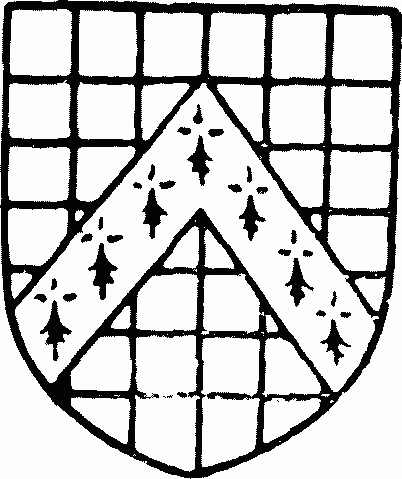
Newburgh. Checky or and Azure a cheveron ermine.
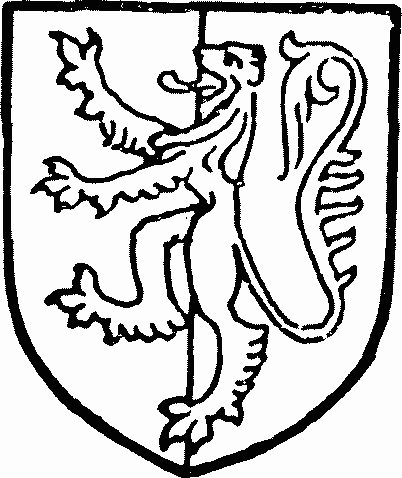
Marshal. Party or and vers a lion gules.
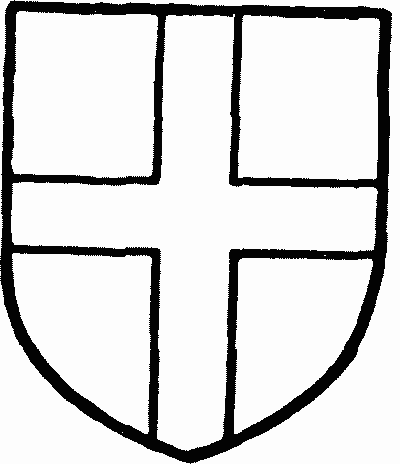
Bigod. Or a cross gules.
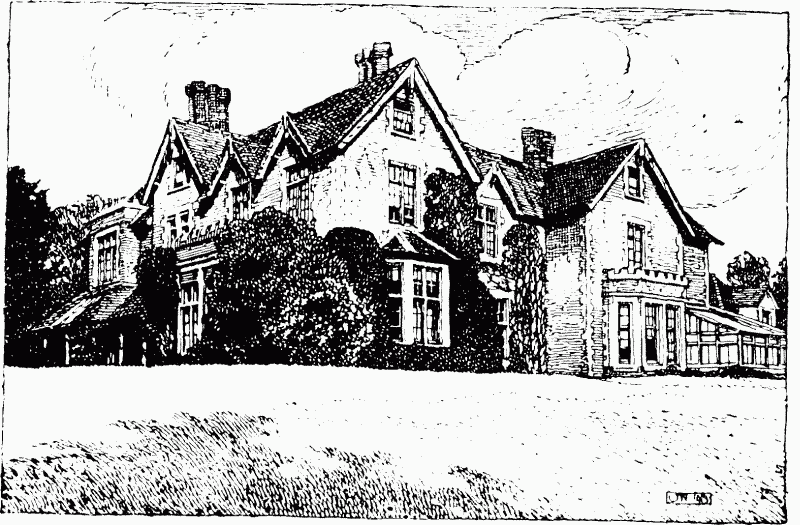
Enborne Lodge
Thomas Cawarden, a groom of the privy chamber, was made steward and bailiff of this and other adjoining manors, (fn. 31) and in 1543 obtained a lease of West Enborne for twenty-one years. (fn. 32) In 1556 the manor was granted for life to Anne Duchess of Somerset. (fn. 33) She was still holding it in 1573, but though she did not die until 1587, (fn. 34) the manor was granted in 1579–80 to Thomas Appleby and others, who had licence in the same year to alienate it to Sir Thomas Gawdy. (fn. 35) Sir Thomas Gawdy died seised of this manor on 5 November 1588, leaving as his heir his son Henry, (fn. 36) who with his wife Elizabeth sold it in 1590 to Thomas Parry. (fn. 37) Thomas was knighted in 1601 and in 1604 he and his wife Dorothy sold it to Uriah Babington. (fn. 38)
Uriah Babington died on 26 February 1606 seised of this manor, leaving by his wife Anne, who survived him, a son Uriah. (fn. 39) In 1619 Uriah the son, owing to the embezzlement of treasury money by his father, was forced to mortgage the manor, (fn. 40) which was sold by two of the mortgagees in 1629 to William Lord Craven of Hampstead Marshall. (fn. 41) The manor has since descended as part of the estate of Hampstead Marshall (fn. 42) (q.v.), and the Earl of Craven is the present lord of the manor.
Thomas Parry acquired from King Edward VI in 1552 the capital messuage and site of the manor of West Enborne, (fn. 43) which he seems to have sold to Walter Cupper, who died seised of it in 1556, when he was succeeded by his son Henry, then aged three years. (fn. 44) Henry had livery of the site on 1 June 1579, (fn. 45) placed it in settlement on 16 June 1580, on his marriage with Frances daughter of John Hunks of Preston, Gloucestershire, and died seised of twothirds of the site in 1599. (fn. 46) His son Thomas had livery of this estate on 15 February 1610. (fn. 47) The remaining third seems to have been held by Anne the wife of William Lichfield as dower from her former husband John Smyth, whose interest in the manor is not clear. (fn. 48) In 1624 Thomas Cupper sold the two-thirds to William Craven and two others, and this sale was confirmed in 1632 to William, then Lord Craven, by Thomas, his son Thomas and Henry Cupper. (fn. 49) Andrew de la Brech, who held part of the Warwick fee in the 13th century, obtained about 1237 a grant of other lands in Enborne from Gilbert Marshal Earl of Pembroke. (fn. 50) These lands had been granted to the earl by Eleanor Countess of Pembroke for the term of her life, and were possibly those which her husband William Marshal, Gilbert's elder brother, had claimed from William Malewayne in 1228. (fn. 51) In 1258 Andrew granted the lands which he first held in Enborne to Richard de Havering and Lucy his wife for the life of Lucy with reversion to Andrew and his heirs. (fn. 52) It is not clear whether this was the fee held of Warwick or of Pembroke, as the whole of Andrew's estate is afterwards returned as held of the Earl Marshal. (fn. 53) On the death of Anselm Marshal, however, the fee passed to his sister and co-heir Isabel, the wife of Gilbert de Clare, (fn. 54) and afterwards followed the descent of the earldom of Gloucester until its extinction on the death of Hugh Audley in 1347. Hugh's daughter Margaret married Ralph Earl of Stafford, and the fee descended with that earldom until the end of the 15th century. (fn. 55)
Possibly Lucy de Havering was a daughter of Andrew de la Brech, for the Haverings eventually succeeded to his lands in Enborne. John de Havering, the son of Richard, was knighted by Edward I and summoned to Parliament as a baron in 1299, (fn. 56) when he was justice of North Wales. (fn. 57) He seems to have died in 1305, (fn. 58) though still returned as holding Enborne in the following year, (fn. 59) when his widow Joan was actually in possession. (fn. 60) His heir was his son Richard de Havering, then Archbishop-elect of Dublin, (fn. 61) who was presumably succeeded either by his brother Nicholas (fn. 62) or Nicholas's son Richard. (fn. 63) This Sir Richard de Havering had two sons, John and Nicholas, (fn. 64) of whom the elder seems to have been holding Enborne in 1392. (fn. 65) After this date the history of the manor becomes obscure, but it seems possible that this was the estate held in 1421 by John Specheswyke and Christine his wife in right of Christine, (fn. 66) who may have been the daughter and heir of Havering. They conveyed it that year to trustees to the use of Walter Cotton and his heirs, (fn. 67) and in this way it probably became attached to the manor of East Enborne.
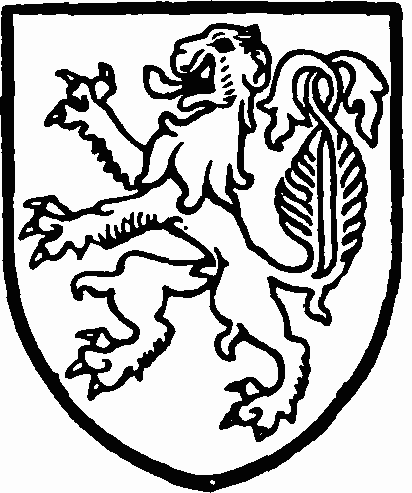
Havering. Argent a lion gules with a forked tail.
The second manor was held in alod of King Edward the Confessor by Edmund, and at the time of the Domesday Survey by Roger de Lacy. (fn. 68) He was banished in 1092, when his lands were forfeited and given by the king to his brother Hugh de Lacy. (fn. 69) The history of this manor is obscure until the 13th century, when the Abbess of Romsey had a holding in East Enborne, (fn. 70) which may perhaps have been the same estate. The land was held of her by Nicholas Pigun, (fn. 71) and in 1256 the king confirmed a grant of the rents here made by Constance Abbess of Romsey to John son of Walter of Romsey until he should be provided with a benefice of the value of £30 per annum. (fn. 72) Later the abbess appears to have enfeoffed Thomas de Abberbury of Donnington, who granted the lands for life to James de Crawley and Agnes his wife. (fn. 73) Thomas died in 1307, leaving as his heir his brother Walter, (fn. 74) who seems to have released his right in it either to the Crawleys or to Walter Wodelok. Wodelok died seised of it in 1342, (fn. 75) and since there seems to be no further mention of it as a separate manor, and land in East Enborne appears after this date among the appurtenances of West Enborne Manor, it presumably became a part of that estate. (fn. 76)
The manor of EAST ENBORNE was held of King Edward the Confessor in alod by Toti and by William Lovet at the time of the Domesday Survey. (fn. 77) In the 13th century the overlordship of this manor was in the hands of William de Forz Earl of Albemarle, (fn. 78) and passed by the surrender of the Countess Isabel in 1293 to the king, who seems to have granted it with the honour of Skipton in Craven to Robert Lord Clifford, (fn. 79) the descent of whose barony it followed until 1471, when the last mention of it occurs. (fn. 80)
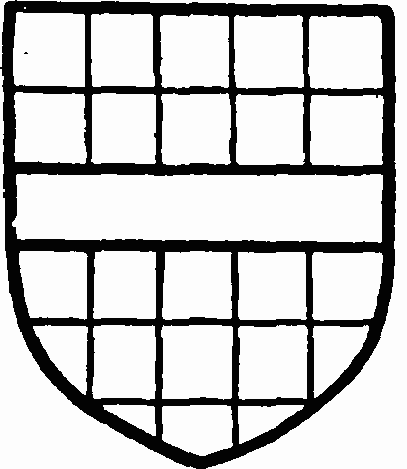
Clifford. Checky or and azure a fesse gules.
In the 13th century this estate was held by Philip de Sanderville (fn. 81) as one fee together with his manor in South Moreton (q.v.), the descent of which it followed until 1419, (fn. 82) when it was conveyed by Thomas Rothwell and Elizabeth his wife to Thomas Chaucer and other trustees. (fn. 83) Walter Cotton was in possession in 1428, (fn. 84) but it seems to have passed shortly afterwards to John Roger, for in 1429 he gave the manor of East Enborne called 'Saundervylys' to his son John and his wife Elizabeth daughter of John Shottesbrook. (fn. 85) John Roger the younger was holding the manor, then known as 'Enborne Roger,' in 1447, (fn. 86) and it passed to Thomas Roger, who died seised of it in 1471. His son Thomas died in 1488, leaving as his heir his daughter Elizabeth, who, though only thirteen years of age, was the wife of William Essex of Lambourn. (fn. 87) Under a settlement Thomas's widow Margaret, afterwards the wife of Sir Thomas Fettiplace, had a life interest in the manor, of which she died seised on 22 January 1518. (fn. 88) The estate then passed to Sir William Essex, who held it in right of his wife until 1543, (fn. 89) when he exchanged it with the king for the manor of Brightwalton. (fn. 90)
The site was leased by Edward VI in 1549–50 for twenty-one years to John Knight, (fn. 91) and the manor and reversion of the site were granted in 1556 to Anne Duchess of Somerset for life. (fn. 92) In 1579 Queen Elizabeth exchanged this manor for other lands with Henry Cary Lord Hunsdon, (fn. 93) whose trustees, Edward Downing and John Walker, sold it on 22 November that year to Sir Thomas Gawdy. (fn. 94) He attached it to the manor of West Enborne, with which it has passed to its present possessor, the Earl of Craven.
The fourth manor in Enborne was held of King Edward the Confessor by Saulf and at the time of the Domesday Survey by Ghilo the brother of Ansculf. (fn. 95) Ghilo usually known as Ghilo de Pinkney was the founder of Weedon Priory, co. Northants, and his estates passed from him to his son Ralph, who is said to have paid relief for his father's lands in 1139–40. (fn. 96) Ralph had been succeeded before 1166 by his son Gilbert de Pinkney. (fn. 97) Gilbert's son Henry de Pinkney died about 1209, leaving as his heir his son Robert de Pinkney, (fn. 98) who held the overlordship of this manor in Enborne early in the 13th century. (fn. 99) Robert was succeeded in 1232 (fn. 100) by his son Henry de Pinkney, who died in 1254, when the fee passed to his son Henry. (fn. 101) This Henry died in 1275, leaving two sons, Robert and Henry, (fn. 102) of whom the elder, Robert, died in 1296. (fn. 103) His brother Sir Henry, who succeeded him, was summoned to Parliament as a baron in 1299 by King Edward I, to whom he sold the reversion of most of his lands in 1301. (fn. 104)
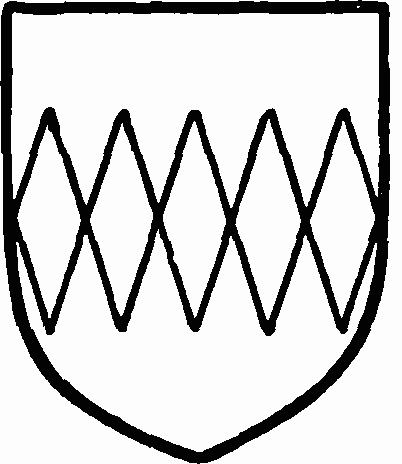
Pinkney. Or a fesse indented gules.
This manor was held in two parts by Nicholas de Aufryke and William de Clervaux (fn. 105) of Robert de Pinkney. William de Clervaux granted his share early in the 13th century to the Prior of Sandleford, who was holding it about the middle of that century (fn. 106) and afterwards acquired also the land held by Nicholas Aufryke. (fn. 107) The prior and convent obtained a grant of free warren in 1292, (fn. 108) and, though they are said to have granted certain lands here in 1458 to Thomas Roger for life, (fn. 109) they seem to have retained the manor, which passed with their other lands at Sandleford (q.v.) to the Dean and Canons of Windsor. In 1650 the trustees for the sale of church property sold these lands to Arthur Dewe, (fn. 110) but they were given back at the Restoration, and when the common fields were allotted under an Act of Parliament of 1810 the Dean and Canons of Windsor claimed to be entitled to the manor of East Enborne and Newbury with its members in the parish of Enborne. (fn. 111)
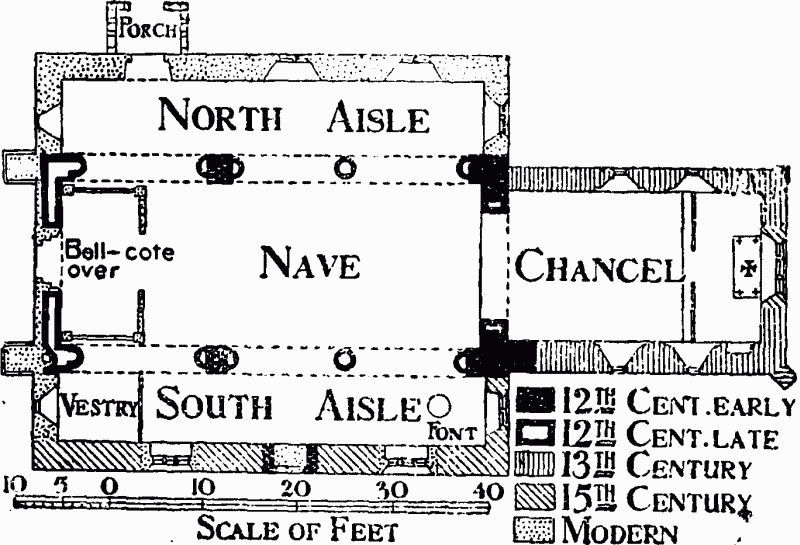
Plan of Enborne Church
The curious custom is said to have prevailed in East and West Enborne that if a widow of a copyholder was found guilty of incontinency she could recover her life interest in her husband's copyhold by riding into court on a black ram, repeating a petition in doggerel. (fn. 112)
Church
The church of ST. MICHAEL stands on high ground commanding a fine view over a wide expanse of country to the south and south-east, and consists of chancel 26 ft. 3 in. by 15ft. 6 in., nave 44 ft. 9 in. by 17 ft., north and south aisles each 7 ft. 6 in. wide, and north porch, all these measurements being internal. There is also a timber bell-turret at the west end containing two bells. The walling is of flint rubble with stone dressings patched in places with brick, and the roofs are eaved and covered with modern red tiles.
The nave with its north and south aisles dates from the 12th century and the chancel is of a century later. Since the latter date the plan has remained unaltered except that the north aisle was demolished at some period unknown and was not rebuilt till modern times; other portions of the fabric have been altered or restored. The original church appears to have consisted of an aisleless nave 26 ft. 6 in. long by 17 ft. wide with probably a small rectangular chancel and to have been built some time during the first half of the 12th century. Later, perhaps c. 1180–90, aisles were thrown out and an extra bay added at the west end, thus increasing the nave to its present length. The detail of the arcades generally may appear to be rather earlier than the date mentioned, but the presence of the nail-head ornament in the capitals of the piers points to a little later period than the plainer work of the responds would suggest. In this first alteration the north and south walls of the original nave were pierced by two arches on each side, but the masonry was left standing at the western angles, the extra bay being added beyond, and they now form the square part of the masonry piers. The chancel was rebuilt in the 13th century on its present lines and a new arch erected on the old jambs, but this has since disappeared. The existing jambs are apparently of the same date as the nave arcades. No evidence of the original chancel arch, if such existed, remains. It is, however, possible that the first structure was a plain rectangle, and that when the chancel was rebuilt in the 13th century the south wall was erected along the line of the old wall, thus giving it a greater thickness. (fn. 113) The south aisle wall seems to have been largely rebuilt in the 15th century, and its east window is still of that date, while the east window of the chancel may be an insertion of c. 1500 or later, the diagonal buttress being perhaps added at the same time. At what period the north aisle was demolished is not known, but on its removal the arcade was built up and a north porch added, the building remaining in this condition down to 1893, when a general restoration took place. (fn. 114) The chancel had been restored in 1878–9. Previous to 1893 the exterior of the building was covered with rough-cast, and the west wall and bell-turret were in so bad a condition as to necessitate their almost entire reconstruction. (fn. 115) The north arcade was opened out and the aisle rebuilt, a new porch erected, and the roof renewed. A doorway was inserted at the west end, and the nave, which is under one roof with the aisles, assumed externally a more or less modern appearance.
The chancel has two original lancets in the north and south walls, having internal angle shafts with moulded capitals and bases. The windows are close together and have a moulded string-course at the sill level inside, stopping against the end walls. The square-headed east window is of three plain lights with external hood mould and hollow-chamfered jambs and mullions. In the usual position in the south wall is a double piscina, with trefoil arches under moulded labels springing from shafts with moulded capitals and bases. The bowls are quatrefoils and in the wall behind is a small rectangular aumbry, the whole composition being a very good example of 13th-century work. On the east wall to the north of the altar is a square stone bracket. The modern boarded roof is of three bays and is lower than that of the nave. The chancel arch dates from 1893 and is semicircular in form. (fn. 116)
The nave consists of three bays with north and south arcades of semicircular arches of two square orders slightly chamfered on the edge, springing from half-round responds and from circular piers between the two eastern bays, all with moulded bases and shallow scalloped or carved capitals with square abaci. On the north side the capital of the east respond is scalloped, while that at the west end is fluted. The capital of the middle pier is carved with an antique ornament with leaves at the angles, a small nail head being introduced on the east face. The capitals of both responds of the western arch are fluted and have a square chamfered abacus. On the south side the capital of the pier is of the same type as that opposite, but the carving is coarser and the nail-head ornament is more lavishly used. The capitals of all the responds on the south side are fluted.
The south doorway has been built up, but is of 12th-century date, though probably reset in the later reconstruction of the aisle. It has a plain semicircular arch of a single order slightly chamfered on the edge. On two of the jamb stones on the east side are the marks of incised sundials and in the brick filling is built a stone which may be the head of a 12th-century piscina or aumbry. The south wall was rebuilt about 1885 with bands of 2-in. brickwork alternating with the flint and the windows are modern. The east window of the aisle is a square-headed opening of two trefoiled lights. The west window is modern. High up in the wall inside are built two carved heads, apparently terminations of a hood mould, and below is a stone on which is cut the name 'Nicholas Cvrteus.' (fn. 117) This was found in 1893, together with an inscription cut on the east respond of the south arcade—' Richard Elks 1609.' (fn. 118) The roof of the nave is of three bays and some of the old timber has been used in the principals. The lower part of the framing carrying the bellturret is filled with solid panelling forming a vestibule.
The font stands at the east end of the south aisle and consists of a 12th-century cylindrical unmounted bowl 19½ in. high on a modern base. It is enriched with an arcading of sixteen small semicircular 'arches' carried on shafts or pillars with capitals and moulded bases, above which in the spandrels is a series of small heads. The space inclosed by two of the arches is blank, but in the remaining cases is filled with various upright ornaments, the precise signification of which is difficult to determine. (fn. 119)
The pulpit and all the fittings including the seating date from 1893, but two old oak seats remain in the vestibule. At the east end of the north side of the chancel are the remains of a wall painting representing the Annunciation, brought to light on the removal of the whitewash in 1878. (fn. 120) Other paintings have also been found.
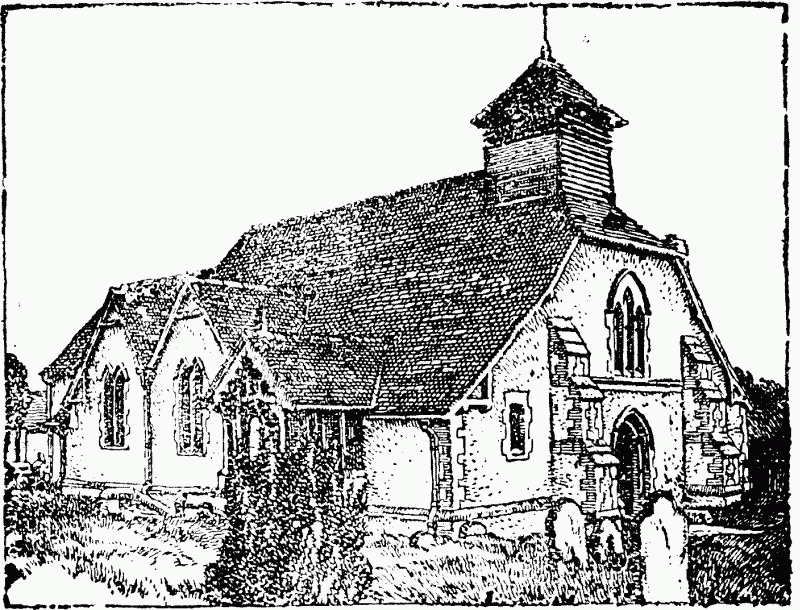
Enborne Church From The North-West
There are a few mural tablets of 18th and early 19th-century date, and in the chancel floor an inscribed blue stone with coat of arms to the Rev. Henry Craven, rector, who died in 1770. (fn. 121)
The older of the two bells is of pre-Reformation date and bears the inscription '+ Michael' in Lombardic characters. The other was cast by Samuel Knight of Reading in 1688 and bears his initials and the date. (fn. 122)
The plate consists of a cup of 1633, inscribed 'Enborne 1663,' a paten of 1679 and another of 1801 inscribed 'Enborne,' and an almsdish of 1856 given by R. H. Valpy.
The registers begin in 1666. (fn. 123)
Advowson
The advowson has followed throughout the descent of the manor of West Enborne (fn. 124) and belongs at the present time to Lord Craven. The first reference to the church occurs in 1291, when it was valued at £6 13s. 4d. (fn. 125) In 1340 the church was valued at 100s. and the glebe and tithes at 2½ marks a year. (fn. 126)
In 1607 the parishioners complained of the suspicious conduct of Robert Brooke, the parson, who not only neglected to read the book of canons, but defaced both that and the register book. (fn. 127)
Charities
The church lands, which were the subject of an inquisition of charitable uses, taken at Abingdon 5 October 1609, (fn. 128) now consist of a cottage and garden adjoining the churchyard and about 9 acres acquired under an inclosure award 25 February 1815, (fn. 129) producing £11 17s. yearly, which is applied towards the general church expenses.
By the same award 20 a. 1 r. 22 p. were allotted to the overseers, the rents to be distributed in fuel for the poor. Nine acres of the land are let at £9 a year and the remainder in allotments to the poor, producing £9 yearly. The net income is distributed among the cottagers in sums of 4s. to each recipient.