A History of the County of Berkshire: Volume 4. Originally published by Victoria County History, London, 1924.
This free content was digitised by double rekeying. All rights reserved.
'Parishes: West Hendred', in A History of the County of Berkshire: Volume 4, ed. William Page, P H Ditchfield (London, 1924), British History Online https://www.british-history.ac.uk/vch/berks/vol4/pp302-307 [accessed 30 April 2025].
'Parishes: West Hendred', in A History of the County of Berkshire: Volume 4. Edited by William Page, P H Ditchfield (London, 1924), British History Online, accessed April 30, 2025, https://www.british-history.ac.uk/vch/berks/vol4/pp302-307.
"Parishes: West Hendred". A History of the County of Berkshire: Volume 4. Ed. William Page, P H Ditchfield (London, 1924), British History Online. Web. 30 April 2025. https://www.british-history.ac.uk/vch/berks/vol4/pp302-307.
In this section
WEST HENDRED
Hennarithe (x cent.); Henret, Henreth (xi–xvi cent.).
West Hendred is a parish of 2,000 acres. It is about 5 miles in length, extending from a point on the downs half a mile south of the Icknield Way to the bottom of the Vale of the White Horse. Its breadth varies from half to three-quarters of a mile. The soil is Chalk and Loam on a subsoil varying from Chalk on the high land to Gault and Kimmeridge Clay in the north of the parish. Nearly two-thirds of the total acreage is arable land, (fn. 1) and various cereal and root crops are raised. Water-cress is grown in the streams.
As in the case of the neighbouring parishes which run parallel with this, the village stands half-way down the slope a little to the south of the Portway. It is built on the banks of a small stream, which flows through Lockinge, Ardington and both Hendreds, and bears the name of each in turn. The irregular village street, containing several half-timber cottages, some of them with thatched roofs, runs north and south and has at the south end the ancient church of the Holy Trinity with the vicarage near by. An old custom survives by which the church bell is rung every Sunday morning at eight so that the villagers may set their clocks to the church time. The only building of interest besides the church is a farm-house called Sparsholt's Court at the north end of the village. It was built in the early 18th century, when the old manor-house bearing that name was pulled down by Mr. Wiseman Clarke. A 'capital messuage' in the Sparsholt Court Manor existed before 1362, (fn. 2) and the house destroyed in 1721 was probably that home of the Sparsholt family. The descriptions which remain show that it was of considerable size. (fn. 3) A short lane connects the modern house, which is at some distance from the old site, (fn. 4) with the manorial mill (fn. 5) on the banks of the stream. The village contains a small Wesleyan chapel.
From the vicarage a road runs southward up the hill to the manor-house of East Ginge. This is perhaps on the site of the capital messuage which Alan Plukenet held here in 1299. (fn. 6) It was the residence in the 17th and 18th centuries of the Tubb family, (fn. 7) who added the Queen Anne wing. (fn. 8) There was in the early 17th century a second manor-house in East Ginge, which belonged to the family of Greenway. (fn. 9) It was pulled down before 1824. (fn. 10) A small stream rises near the hamlet and flows down to meet the Hendred Brook just outside the village. A water-mill on this stream was attached to the Greenway estate. (fn. 11) Ginge House, to the north of Ginge Manor, is a square red-brick building with a hipped roof of early 18th-century date. A newlyerected farm-house at East Ginge is mentioned in a deed of 1747. (fn. 12)
The parish was inclosed in 1877. (fn. 13)
Manors
The manor of WEST HENDRED is probably to be identified with the 10 hides at 'Hennarithe' which were granted to the thegn Brihtric by Edwy in 955 and by Edgar in 964 to Abingdon Abbey. (fn. 14) During the following century, however, the abbey lost its hold upon this land. In the reign of Edward the Confessor it was held by three thegns, who were at liberty to go to what lord they wished. (fn. 15) At the Conquest it became the property of Niel Daubeny, a Bedfordshire baron, who granted it before 1086 to the abbey of St. Albans. (fn. 16) At the Domesday Survey a freeman Ernuzon held 2 hides of the abbot. (fn. 17)
Paul, the Abbot of St. Albans who had received the grant, (fn. 18) founded before 1093 a cell of the abbey at Wallingford. (fn. 19) To this cell his successor Richard gave the manor of West Hendred, (fn. 20) and it remained the property of the house till its dissolution. (fn. 21) This took place in 1528, when the priory with its possessions, including this manor, was granted to Cardinal Wolsey for his new college at Oxford. (fn. 22) On his fall it was given to the President and scholars of Corpus Christi College, Oxford, in exchange for the manor of Molesey (Surrey). (fn. 23) They are still lords of the manor.
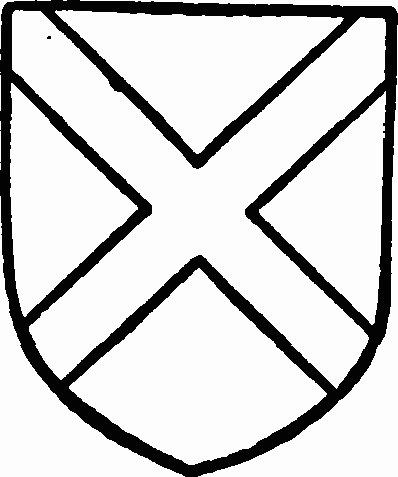
St. Albans Abbey. Azure a saltire or.
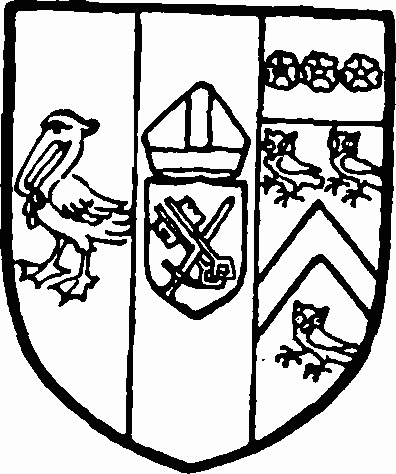
Corpus Christi College, Oxford. A pale argent charged with the arms and mitre of the See of Winchester between Azure a pelican or, for Bishop Fox, and Sable a cheveron or between three owls argent and a chief with three roses gules therein, for Bishop Oldham.
SPARSHOLT'S COURT, which consisted of 5 hides, a third of the vill of West Hendred, had its name from its owners of the 13th, 14th and 15th centuries. It was held in the reign of the Confessor by a freeman Achi, and in 1086 was in the hands of Grimbald. (fn. 24)
Unless Grimbald is identified with Grimbald the goldsmith elsewhere mentioned, (fn. 25) he may probably be regarded as the ancestor of the family of Hendred, which held this manor by the serjeanty of buying the king's beer. (fn. 26) A Richard de Hendred witnessed an Abingdon charter in the late 12th century. (fn. 27) William son of Richard de Hendred, who gave land to Poughley Priory, (fn. 28) must have been his successor and identical with the William de Hendred who held land in Berkshire in 1201 by a serjeanty of the buttery. (fn. 29) He had a son Richard, (fn. 30) who succeeded about 1213 to his lands here and at Barton, Northants. (fn. 31) Richard was living in 1235, (fn. 32) but died before 1242, when the custody of his lands and heirs was granted to Henry de Bathe. (fn. 33) The heir was another Richard de Hendred, who granted his manor here to William de Lisle. (fn. 34) In 1273 William de Lisle granted it to William de Sparsholt, (fn. 35) the head of a family which owned land in a neighbouring parish. He was to pay to William de Lisle and his heirs a penny at Michaelmas and do the service belonging to the manor. (fn. 36) In 1278, however, an order was given that Roger de Lisle, son of William, should do the serjeanty and that William de Sparsholt should do him homage. (fn. 37) The Lisle family still held their mesne lordship in 1362. (fn. 38)
William de Sparsholt was succeeded by John, evidently his son. (fn. 39) In 1316 Olimpia de Sparsholt, evidently John's widow, was holding West Hendred. (fn. 40) His son William (fn. 41) was in possession of his land elsewhere. (fn. 42) In 1331 William settled the manor on himself for life with remainder to his son John and Maud his wife and the heirs of their bodies. (fn. 43) After the death of John in 1360 (fn. 44) Maud held the estate for life and was succeeded by her son William. (fn. 45) The successor of William was Edmund de Sparsholt, who was Sheriff of Berkshire in 1395, (fn. 46) and a commissioner of the peace in 1413. (fn. 47) He died in 1416, leaving a daughter and heir Alice, who married Bernard Delamare (fn. 48) and had a daughter and heir also called Alice. (fn. 49) The latter became the wife of John Barker (fn. 50) and was succeeded by her daughter Margaret, who married Thomas Sankey. (fn. 51) A settlement of the manor on Margaret's heirs was executed in 1519. (fn. 52) Her son and heir Edward was the next lord of the manor. (fn. 53) He had a son Thomas, (fn. 54) who succeeded him and sold Sparsholt's Court in 1613 to Charles Wiseman. (fn. 55)
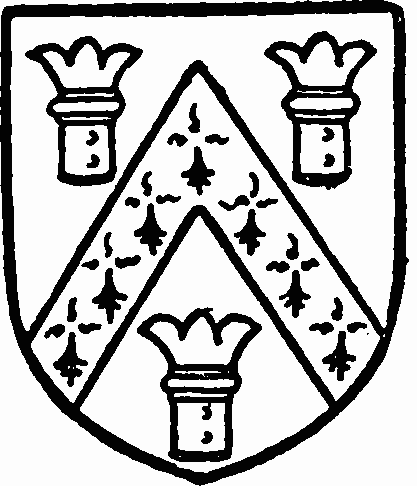
Wiseman. Sable a cheveron ermine between three coronels argent.
The Wisemans remained in possession for several generations. Charles was succeeded by his son Edmund (fn. 56) and Edmund by a son of the same name who died without issue. (fn. 57) His younger brother William inherited the estate (fn. 58) and had a daughter and heir Mary, who married Edward Clarke of Ardington. (fn. 59) William Wiseman Clarke, her son, sold the manor to William Towsey of Wantage, (fn. 60) who was in possession in 1802. (fn. 61) Before 1824 he had sold the estate in small parcels. (fn. 62) The manorial rights came into the hands of a Mr. Coventry who sold them in 1816 to Mr. Dearlove. (fn. 63) In 1881 the grandson of the latter sold them to Mr. Townsend of Abingdon, whose widow is the present owner. (fn. 64)
The virgate in West Hendred which was given by William de Hendred to Poughley Priory (fn. 65) was granted after the Dissolution to Westminster Abbey (fn. 66) and subsequently became the property of the dean and chapter. (fn. 67)
EAST GINGE (fn. 68) is not mentioned by name in the Domesday Survey. In the early 12th century it appears to have belonged to two Normans, Geoffrey son of Hamo Brito and Bertram son of Alantre. (fn. 69) It was seized into the king's hands during the wars in Normandy, and from 1157 onwards was granted out to various tenants to hold for fixed terms or at pleasure. Rollo de Dinan held it in 1158 (fn. 70) and till 1186. (fn. 71) In 1187 it was granted to Alan de Viteri. (fn. 72) In 1203 Richard Morin had a grant of half the vill, (fn. 73) the other half being granted in 1210 to Peter Bertram or son of Bertram. (fn. 74) Richard and Peter seem to have held the vill (fn. 75) till 1221, when the whole of it was granted to Bertram de Guarcli in order that he might maintain himself in the king's service till the time of the king's majority. (fn. 76) In 1233 the sheriff was ordered to allow Bertram to hold the manor peaceably till the king should command otherwise. (fn. 77) Two years later Bertram pledged it for three years to William de Waltham in aid of his journey to the Holy Land. (fn. 78) He was dead in 1236, when the custody of his lands and heirs was granted to his brother Peter. (fn. 79) East Ginge, however, was granted almost immediately to two new tenants. One half was given to Urian de St. Peter to hold for life 'unless the land of England and Normandy should become one.' (fn. 80) The second was granted in 1237 to William Gernun to hold for half a knight's fee 'until the king should restore it to the right heirs of his free will or by a peace.' (fn. 81)
From that date the two moieties of the manor were never reunited. Urian de St. Peter was succeeded in his share by Ralph le Visconte of Dynham, (fn. 82) who was holding it in 1275 (fn. 83) and 1285 (fn. 84) and had evidently received a grant in fee. Before 1300 he granted his estate in East Ginge to Alan Plukenet and his wife Joan in tail. (fn. 85) They had a son Alan, (fn. 86) who died without issue. (fn. 87) His sister and heir Joan Bohun (fn. 88) granted her land here to Godfrey Morice, first for life (fn. 89) and afterwards in fee. (fn. 90) In 1335 he had a further release of it from Richard de la Bere, (fn. 91) a kinsman of Alan Plukenet, who had succeeded to his estates. (fn. 92) Maud, widow of Godfrey Morice, who held jointly with him for life, died in 1360, (fn. 93) and the estate was inherited by William Morice, nephew of Godfrey. (fn. 94) He died fifteen years later, (fn. 95) leaving a daughter and heir Alice wife of Walter Frome. (fn. 96) She had seisin of East Ginge on her father's death, (fn. 97) but must have died without issue, for the estate reverted to members of the Morice family. In 1401–2 Walter Morice was in possession, (fn. 98) and William Morice had succeeded him in 1428. (fn. 99) Evidently the line ended in an heiress, for Alice wife of Walter Giffard was the next owner. (fn. 100) She died in 1431, leaving a son and heir William Giffard. (fn. 101) The Giffard family was seated at 'Rodenhurst,' Wilts., (fn. 102) and remained in possession of this moiety of the manor for a considerable time. William Giffard 'the elder' put it into settlement in 1454. (fn. 103) He was probably succeeded by the Walter Giffard who heads the heraldic pedigree of the family. (fn. 104) Walter had a son Edward and Edward a son Morris, who was in possession in 1521. (fn. 105) He was married three times, and by his first and third wives had sons both called Thomas. (fn. 106) The elder Thomas died without issue in 1539, (fn. 107) and was succeeded by his step-brother. The latter died in 1575, when his heir was his son John. (fn. 108) In 1588 John Giffard settled the manor in tail male on his son William. (fn. 109) The latter sold it in 1609 to Philip Allen, (fn. 110) who conveyed it twelve years later to William Eyston and others. (fn. 111) They conveyed it to Richard Tubb in 1626. (fn. 112)
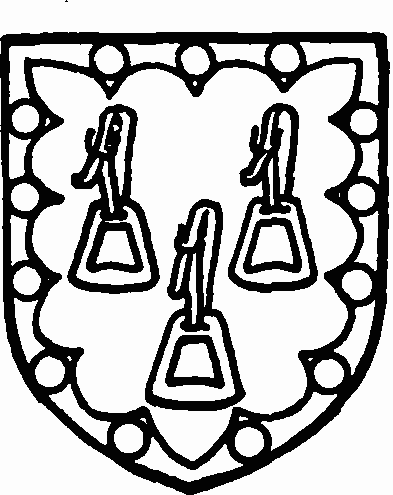
Giffard of Rodenhurst. Azure three stirrups or and a border engrailed argent with roundels sable thereon.
The Tubb family held the manor for a century. John Tubb was lord in 1684 (fn. 113) and another John in 1735. (fn. 114) In 1743 Mary widow of John Tubb and her son John Tubb, jun., conveyed the manor to Edward Towsey of Wantage. (fn. 115) The latter was still in possession in 1769, (fn. 116) but in 1774 it was settled on the marriage of Elizabeth daughter and heir of John Bishop of Wallingford with Charles Toovey of Wallingford. (fn. 117) Charles and Elizabeth Toovey sold it in 1789 to his brother-in-law William May, who by will in 1797 devised it to his son William. (fn. 118) On the death of the younger William's widow East Ginge passed to his nephew Mr. May-Ellis, whose widow Eliza Ellis died in 1864, leaving the manor in trust for sale. Her trustee having predeceased her, Ann wife of Stephen Hemsted, her only sister, inherited. (fn. 119) Ann died in 1876, and her son Stephen Hemsted sold the manor in the next year to John Allin. (fn. 120) His representatives conveyed it in 1897 to the late Lord Wantage, (fn. 121) on whose death without issue in 1901 it passed to his widow. Lady Wantage conveyed it in March 1912 to Mr. A. K. Loyd. (fn. 122)
The second moiety of the manor remained for some time in the Gernun family, (fn. 123) from whom it passed to the Benhams of Edmundsthorp Benham in Kingsclere, Hants. (fn. 124) In 1316 John Benham was returned as one of the landowners of the vill, (fn. 125) but he held at his death nothing in East Ginge but a rent of 6 marks from tenements held of Sir John Gernun, kt. (fn. 126) His son Richard, (fn. 127) however, held the whole of the Gernun estate here in fee. (fn. 128) It followed the descent of Edmundsthorp Benham till the death of Richard's great grandson William Benham in 1466. (fn. 129) He left five daughters and co-heirs, by his first wife Joan wife of William More, Alice wife of John Brown and Margaret wife of William Cooke, and by his second wife another Joan who married Ellis Gold, and Elizabeth who married an Edwardes. (fn. 130) The moiety of the manor was divided among the five co-heirs, (fn. 131) and not all of their shares can subsequently be traced. That of William More and Joan was inherited by their son John and sold by him to Thomas Halys, (fn. 132) who died in possession in 1520. (fn. 133) He had two daughters and co-heirs, Agnes wife of Clement Rede and Mary wife of James Halys. (fn. 134) Agnes, who subsequently became the wife of Thomas Gold, (fn. 135) had a release from her sister of her share in the estate, (fn. 136) which she granted in 1555 to Edward Mordaunt in trust for her son-in-law William Barnes and his son Thomas. (fn. 137) William Barnes died in 1561, (fn. 138) and Thomas granted his lands in East Ginge to William Greenway and Peter Greenway. (fn. 139) John Greenway, father of William and Peter, (fn. 140) had already purchased another of the five shares from Mary Hunsdon, the daughter of Joan Benham and Ellis Gold. (fn. 141) Twofifths of the estate thus became the possession of the Greenway family. It is possible that they purchased also the share of Alice wife of John Brown, which had been conveyed to Richard Fettiplace in 1503 and belonged to John Fettiplace in 1569. (fn. 142) Peter Greenway died in possession of a capital messuage, a water-mill and 8 virgates of land here in 1608. (fn. 143) His son and heir, also named Peter, was then eleven years old. (fn. 144) Another Peter Greenway died in 1630 seised of one messuage and one virgate in East Ginge. (fn. 145) The family was still living here in the reign of Queen Anne, when Sir Oliver Greenway was a churchwarden. (fn. 146) Their lands afterwards came into the possession of the Curzon family of Waterperry, Oxfordshire. (fn. 147) On the sale of the Curzon estates in the early 19th century East Ginge was purchased by a farmer named Belcher. (fn. 148) He subsequently sold it in small parcels. (fn. 149)
Church
The church of the HOLY TRINITY consists of a chancel 29 ft. 6 in. long, nave 39 ft. 4 in. by 18 ft. 9 in. with side aisles making a total width of 38 ft. 6 in., a west tower 9 ft. square and a south porch. All the measurements are internal.
The church appears to have been entirely rebuilt during the 14th century, the south aisle being probably the latest portion, and little alteration has been made in the structure since that date. It has been little restored, but there is a row of modern buttresses on the north of the nave.
The chancel has a pair of one-stage buttresses at each eastern angle, finished with very tall gables. The 14th-century east window is of three lights under a pointed head with net tracery and an internal hood. In the north wall is a two-light pointed window of the same date, and further west is a singlelight window with a trefoiled head. In the south wall is a two-light window like that in the north, and at the west end a square-headed 14th-century window also of two lights; between them is a pointed priest's doorway. All the larger windows have chamfered rear arches. The chancel arch is pointed and of two chamfered orders with semi-octagonal responds having moulded capitals and bases.
The nave has late 14th-century north and south arcades with octagonal piers and responds having moulded capitals and bases of the same detail as the chancel arch. The roof is of the trussed rafter type, ceiled and having three massive tie-beams. The north aisle has a late 14th-century east window of two lights under a square head. The east bay was screened off to form a chapel, and traces of cutting for the screen are visible on the east respond and pier of the arcade. In the north wall are two late 14thcentury windows of two lights and between them is a blocked north doorway, pointed and chamfered and having a pointed segmental rear arch. In the east wall is a stone bracket, and there is another at the east end of the north wall. The south aisle has a square-headed 15th-century east window of two lights, and flanking it are two semi-octagonal stone brackets. In the south wall are two pointed early 15th-century windows, both of two lights, and between them is the plain pointed south doorway. At the east end of this wall is a piscina with a shelf and a four-centred head.
The west tower is three stages high, of late 14thcentury date, and has diagonal western buttresses of ashlar rising to the base of the bell-chamber; it is finished with a plain ashlar parapet having a moulded string-course. The tower arch is pointed and of two hollow-chamfered orders dying into the side walls. The west window is of two lights under a pointed head. The second stage is lighted by loops in the south and west walls and the bell-chamber has a two-light pointed window in each face. The south porch has a four-centred outer archway with a wide hollow chamfer and has a two-light trefoil-headed window in each side. The gabled roof of stone slabs is supported by a chamfered rib forming a pointed arch. The exterior of the church is covered with cement, that on the tower bearing the initials and date 'W.T., I.G. 1744' on the south side; the south aisle, porch and tower have a deep moulded plinth, but the plinth of the remainder of the building is a plain chamfer. The nave roof is lead covered and that of the chancel tiled.
The good Jacobean communion table has turned legs and a carved rail; the rails are also of the 17th century and have turned balusters. The pulpit of the same date is hexagonal from the ground up and has panelled faces with good conventional flowers and foliage. The clerk's desk adjoining it is made up of similar panelling. In the nave are some bench fronts, probably of the 16th century, with four-centred panels in front with intersecting ribs. There is also one good bench end, possibly of the 14th century, with window tracery panelling and a wheel in the head. Other benches are plain and solid.
The font has a plain octagonal bowl and stem and an octagonal pyramidal cover capped with an acorn and having carved panels, one being inscribed 'A.D. 1630 I.P, TS.' At the west end of the north aisle is a vestry screened off by Jacobean panelling, including some carved frieze-work, but all much displaced. The east window contains a considerable amount of 14th-century grisaille glass with a head of Christ in the upper part. Some similar glass remains in the head of the first north window, and there is some old glazing in the south window opposite. Fragments of old glass also remain in the heads of the north aisle windows, and in one of them the crowned initials E.S. occur twice. The east window of the south aisle has old yellow glass in the head. Numerous ancient slip tiles of simple design remain in the chancel and many others, much worn, are set in the paving of the centre and south nave aisles.
There are six bells: the treble, second and fourth by Mears & Stainbank, 1886, 1887 and 1889; the third is inscribed, 'Love God 1610' (?); the fifth, 'Prayes ye the lord 1623, EK'; and the tenor, 'R. Wells Aldbourne fecit 1790,' with the churchwardens' names.
The plate includes a cup (London, 1787) apparently a copy of the 17th-century shape; a flagon (London, 1674) inscribed on the bottom, 'This flagon belongeth to ye parish church of West Hendreth Berks'; and a paten (London, 1662 or 1664) with a similar inscription.
The registers previous to 1812 are as follows: (i) mixed entries 1558 to 1604; (ii) mixed entries 1599 to 1727; (iii) all entries 1727 to 1812, marriages to 1754 only; (iv) marriages 1755 to 1812.
Advowson
There was a church in West Hendred at the time of the Norman Conquest. It was granted with the manor by Niel Daubeny to St. Albans Abbey, (fn. 150) and has followed the descent of the manor ever since. (fn. 151) The patrons at the present day are the President and scholars of Corpus Christi College, Oxford. The church was appropriated before 1291, (fn. 152) and probably a vicarage was already ordained at that date.
Charities
In 1818 Robert Hayward by will bequeathed £100 for the benefit of the poor. The legacy is now represented by £90 10s. 11d. consols with the official trustees, the annual dividends of which, amounting to £2 5s., are applied as a nucleus of a coal club fund for persons of the labouring class.
The Wesleyan Methodist chapel trust property, comprised in an indenture dated 21 July 1830, consists of the chapel and a cottage adjoining occupied by the caretaker.
By an order of the Charity Commissioners, 12 June 1885, the premises were vested in trustees upon the trusts of the Skircoat Wesleyan chapel model deed, 1832.