A History of the County of Berkshire: Volume 4. Originally published by Victoria County History, London, 1924.
This free content was digitised by double rekeying. All rights reserved.
'Parishes: Marcham', in A History of the County of Berkshire: Volume 4, ed. William Page, P H Ditchfield (London, 1924), British History Online https://www.british-history.ac.uk/vch/berks/vol4/pp354-360 [accessed 30 April 2025].
'Parishes: Marcham', in A History of the County of Berkshire: Volume 4. Edited by William Page, P H Ditchfield (London, 1924), British History Online, accessed April 30, 2025, https://www.british-history.ac.uk/vch/berks/vol4/pp354-360.
"Parishes: Marcham". A History of the County of Berkshire: Volume 4. Ed. William Page, P H Ditchfield (London, 1924), British History Online. Web. 30 April 2025. https://www.british-history.ac.uk/vch/berks/vol4/pp354-360.
In this section
MARCHAM
Mercham (ix–xvi cent.); Mercham (xi–xiii cent.); Mercheham (xii–xv cent.); Mericham (xiii cent.); Markham (xv cent.); Marcham (xiii–xx cent.).
Marcham covers 2,424 acres and contains the township of Frilford and chapelry of Garford and the hamlets of Cothill and Gosford, the two last-named having been united for ecclesiastical purposes to the parish of Dry Sandford in 1869. (fn. 1) There was a hamlet or pasture called 'Chaldewikes' in Garford in the 16th century. (fn. 2)
The ancient parish lies partly between the Ock on the south and west, and the Sandford Brook on the east. The land varies between 200 ft. and 300 ft. above the ordnance datum.
The ancient parish covers an area of 4,719 acres, (fn. 3) the greater proporation of the land being arable, though 1,748 acres are laid down to grass and there are 100 acres of woods and plantations. (fn. 4) Much barley is grown and also beans and roots. The first of the common fields to be inclosed were those of Garford (fn. 5) (1814–15), and in 1836 an Inclosure Award was made for Marcham. (fn. 6) A further Act for inclosure in Garford was obtained in 1825 (fn. 7) and this was followed by a similar Act for the common fields of Frilford in 1846, (fn. 8) the award being made in 1861. (fn. 9)
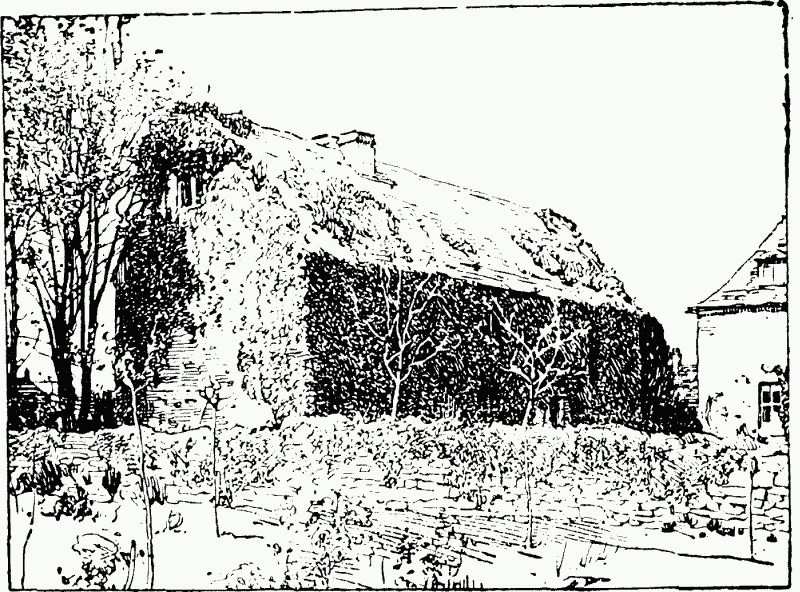
The Priory, Marcham
In the north-west corner of the parish is Upwood Farm in Upwood Park (fn. 10); to the north-east is the compact little hamlet of Cothill (properly Cotwell) by Sandford Brook, on a branch from the Abingdon and Faringdon high road. Cothill Lane runs south to the hamlet of Gosford, where the main road from Abingdon to Faringdon crosses Sandford Brook. To the west is Oakley House, the residence of Mr. Gore Brown, situated in a small park on the Abingdon and Faringdon road. A lane runs south from this main road to the village of Marcham, passing Sheepstead Park and House, the residence of Mrs. B. H. Morland; adjoining is Marcham Park, which is 40 acres in extent. Marcham House, at the south end of the park, is the property of Mr. C. T. Duffield and the residence of the Misses Anson.
The church stands on the north of the village which is of some size. Most of the cottages are of stone, several being covered with thatch. To the south of the main road is a farm-house with a circular stone pigeon-house. There are Baptist chapels in Cothill and Marcham. Immediately south of the church is the old vicarage, a picturesque and half-ruinous group of buildings approached by a stone and timber gateway. The house, south of this, is of late 16th-century date, one window at the back having stone mullions and transoms. The internal arrangement is of the usual type, with hall passage (or screens) and kitchen. The hall has early 18th-century panelling, and the kitchen has a large fireplace, now partly blocked. The internal framing is of oak and retains the old doorways with stopchamfered and beaded frames. The barn to the north of the gateway is said to have been the tithe barn.
The Priory, on the south of the main road, is a rectangular stone building of mid-16th-century date, now only used as an out-house. It lies north and south, and the windows on the west side are of stone, while those on the east have oak frames and mullions. The ground floor is divided into three rooms; the smaller southern room has a fireplace with a four-centred head and a pseudo-classic cornice over it; the fireplace of the larger room is also four-centred and has an ashlar relieving arch above it. Towards the north end of the building a passage is carried across with a door at each end and a screen on the north opening into the third room by two good doorways with four-centred heads and stop-chamfered jambs. The stone windows are of four lights with four-centred heads and moulded labels, and the doorway on the west has moulded stone jambs. The east door has an oak frame, as have the windows on this side, but opposite the chimney stack is a second door with a four-centred head of stone. The upper floor is approached by a semi-spiral staircase with oak steps adjoining the chimney stack. The floor is divided into two rooms, the larger with remains of a screen or partition with a four-centred oak doorway. On the west is a three-light transomed window. Both rooms have fireplaces with four-centred heads, and the chimney stack above the roof is ashlar faced, with a moulded capping.
Marcham Mill is on the River Ock, on the southern boundary of the parish. Part of this mill appears to be ancient, (fn. 11) and there was a mill here in the 11th century. (fn. 12) Between 1100 and 1135 Turstin son of Rainald de St. Helen obtained leave of Faritius, Abbot of Abingdon, to have his mill at Marcham, on condition that the abbot's mill at Marcham did not suffer. (fn. 13)
To the west is Frilford, where the ancient road from Oxford to Abingdon crosses a tributary of the Ock; the Congregational chapel was built in 1841.
Garford, to the south-west, is on the right bank of the Ock. It consists of stone-built houses and cottages, and contains little of interest. Abingdon Abbey had a capital messuage here which afterwards passed into the hands of the Aldworths. (fn. 14) By the 17th century (fn. 15) it seems to have fallen into disuse. A barn in a field is a relic of a manor-house formerly belonging to Magdalen College, Oxford. (fn. 16) Gang Bridge is presumably the Garan bridge which replaced Garan ford (fn. 17) at the River Ock. Alan 'atte Brugge' is mentioned about 1391, (fn. 18) and the bridge, which is approached by a raised causeway, is of some antiquity. There was a mill here in 1086, (fn. 19) and the water-mill, mentioned in the 16th century, (fn. 20) probably stood on the site of the present Ven Mill (fn. 21) on Childrey Brook, where the stream is crossed by the Oxford and Wantage high road.
These names occur in the 10th-century boundaries of Marcham: White Moor, Heafoces Hamme, Tubbaford, (fn. 22) Pyrtan Moor (fn. 23); and in those of Garford are found Cilia's Brook (fn. 24) and Winter's Hill. (fn. 25) The names Mudsale, Okefeld, le ham, Crowe Pits, Hudlode (all common fields), Bucklandes, Godinges and Mudders occur in Garford in the 16th century, (fn. 26) when there was at Frilford 'a hamme of mede called the meter's hamme. (fn. 27) Existing names of interest are Cuckoo Pen in Frilford and Blachington in Garford; mention may also be made of the Ham Field in Marcham, which, until the inclosure of 1836, was held in common by tenants of yard-lands, each about an acre in extent, all the tenants being required to sow the same crop in the same year in regular rotation, and Constable's Ham in Marcham, a field which formerly belonged to the constable for the time being and is now leased by the parish council. (fn. 28) Roman and Anglo-Saxon remains have been found. (fn. 29) There is a tumulus on Barrow Hill at Garford between two branches of the River Ock. (fn. 30)
A notable incumbent was the eccentric David Jones (1663–1724), (fn. 31) who appears to have been an extraordinarily violent preacher. (fn. 32)
Manors
According to a spurious charter King Egbert in 835 confirmed to Abingdon Abbey 50 manses in MARCHAM (fn. 33) granted to the abbey by a very wealthy man and his son. (fn. 34) The lands of Abingdon were actually derived from King Edgar, who in 965 granted 50 hides within stated boundaries to the abbey, (fn. 35) which still held Marcham in 1086, when its lands here were assessed at 10 hides. Anchil held of the abbot I hide previously held by Alvin. (fn. 36) Anchil forfeited in 1088, (fn. 37) but his son William, having married the daughter of Simon the king's steward, recovered his land at Marcham through his influence. (fn. 38) During the reign of William II Abbot Reynold granted the church, whatever the clerk Ælfric had held and a farm to William, a son born to him before he took the religious habit. (fn. 39) During the rule of Abbot Faritius, however, these premises were recovered for the convent, the son himself becoming a monk of the abbey, where he died. (fn. 40) Simon the king's steward, (fn. 41) as a relative of William, then claimed these premises—that is, the church, mill, a farm and 2 hides of land, besides a hide at Garford and other lands, but relinquished them to Abbot Vincent, who succeeded in 1117. (fn. 42) Turstin son of Simon represented to King Stephen in 1153 that these were hereditary possessions of which the abbot had disseised him, and obtained the king's writ for their restitution. (fn. 43) Immediately on the accession of Henry II the abbey obtained an investigation, and Turstin was ordered to pay 4 marks to make good the abbey's loss. (fn. 44)
Several of the officials of the abbey held lands appropriated to their offices: the cordwainer had 4 acres, the master cobbler 4; the cook received payments from Marcham for the expenses of carrying fish to the kitchen, and this place furnished the abbey table with 45s. 4d., 3,000 eggs, 136 cocks and a specified amount of vegetables. (fn. 45) The Serjeant (serviens) had his allowance of food in the abbey hall, ½d. at Christmas and ½d. at Easter. (fn. 46) In the time of Henry I Abbot Faritius charged 40s. on the tithe and 20s. on the customary payments of Marcham for supplying fuel. (fn. 47) By 1291 £2 of the issues of Marcham and Garford had been appropriated to the woodman of the abbey. (fn. 48)
The abbey held the manor until 1538, (fn. 49) when Abbot Thomas surrendered the manors of Marcham, Frilford and Garford and the advowson of the church to the Crown. (fn. 50) In 1546 Henry VIII granted Marcham in fee to William Boxe, citizen and grocer of London, and Anne his wife. (fn. 51) Their son William, an outlaw in 1576, (fn. 52) sold it in 1578 to Sir Henry Unton of Bruern, Oxfordshire, kt. (fn. 53) Sir Henry sold the Marcham estates early in 1589 to Bessel Fettiplace and Ellen his wife. (fn. 54) Bessel and his son Richard in 1602 and 1607 conveyed the site and demesnes to Giles Simpson and Christine his wife. (fn. 55) Giles Simpson in 1607 conveyed the site to Francis Searle and Francis his eldest son, (fn. 56) to whom in 1609 Richard Fettiplace, now a knight, conveyed the manor. (fn. 57) In 1646 it was said to be in the possession of the Pigot family, and Francis son of Alban Pigot was living here in 1662. He sold the manor (fn. 58) in 1691 to Felix Calvert, (fn. 59) a member of a Buckinghamshire family, who settled here. (fn. 60) Felix Calvert in 1717 (fn. 61) sold it to Robert Meggot, (fn. 62) a wealthy brewer of Southwark. Robert married Amy sister of Sir Hervey Elwes, bart., of Stoke, Suffolk, and had a son John, who in 1751 assumed the name Elwes and in 1763 succeeded to the estates of his uncle Sir Hervey, (fn. 63) a miser into whose favour he had ingratiated himself. (fn. 64) John Elwes inherited the Elwes' miserly traits to an extent that became proverbial. He was M.P. for Berkshire 1772–84, (fn. 65) and died unmarried in 1789, when, his personal estate being divided between two illegitimate sons, most of the real property descended to his great-nephew John Timms, who also assumed the name of Elwes (fn. 66); Marcham, however, passed by bequest to the illegitimate son then living there. George Elwes, (fn. 67) whose daughter and heir Emily Frances married Thomas Duffield, M.P. for Abingdon, son of Michael Duffield of Abingdon. Their eldest son George took the name Elwes; he died under age in 1833, and was succeeded by his brother Henry Duffield, and afterwards by another brother Charles Philip Duffield, who was Sheriff of Berkshire in 1859 and died in 1889. He left a son and their Charles John Edwin Duffield, (fn. 68) the present owner.

Elwes. Or a fesse azure with a bend gules over all.
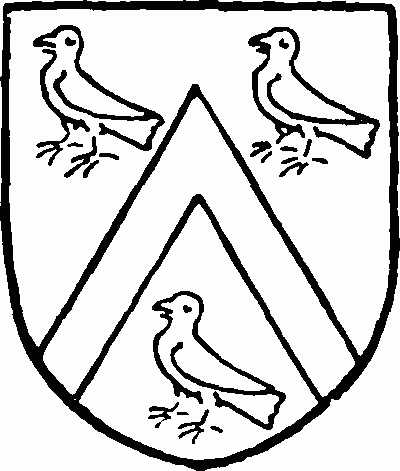
Duffield. Sable a cheveron between three doves argent.
At an early date the daughters of William Grim held one-fifth of a knight's fee in Marcham and Westwike of the Abbot of Abingdon. (fn. 69) Walter de Hendred was concerned with lands here in 1235, (fn. 70) and in 1236 Roger son of Walter de Marcham conveyed tenements here to John de Hendred, (fn. 71) tenant of a fifth of a knight's fee under Abingdon Abbey in 1240–1. (fn. 72) This part was afterwards held by 'the monk of the Wodefold' and Alice de Fyfield, and was subsequently appropriated to the sacristan of Abingdon Abbey. In 1428 it was stated to be at 'le Hyde.' (fn. 73) It is commemorated by Hyde Copse, north-east of Marcham village.
FRILFORD (Frileford, x–xv cent.; Frigeleford, Frieleford, Frielford, xi cent.) was a member of the manor of Marcham in 965, (fn. 74) and was presumably granted with Marcham to Abingdon Abbey, which was holding it in 1086. (fn. 75)
The abbey held part as a manor in demesne, and was overlord of the rest until the dissolution of the monasteries. (fn. 76) 'Custumary Landes' in Frilford were granted with Marcham Manor in 1546 to William Boxe, (fn. 77) who is mentioned later as lord of the manor. (fn. 78) The further descent has not been traced, and the estate may have become merged in Marcham Manor.
In 1086 Rainald de St. Helen held 4 hides of land here of the abbey. (fn. 79) The manor descended with that of St. Helen's (q.v.) to Maud daughter of William de St. Helen, (fn. 80) who sold it in 1383 to Isabel widow of John Golafre (fn. 81) of Fyfield. It has since passed with Fyfield (fn. 82) (q.v.), the present owner being St. John's College, Oxford.
Rainbald, tenant of Sunningwell and Kennington, held I hide of land here in 1086; it was said to have been given by Berner to Turstin de St. Helen. (fn. 83) Another hide was held by Salwi and was probably one of the two hides acquired later by Rainbald de Tubney. (fn. 84) These lands must have been the part of Frilford in the possession of Henry de Tubney in 1240–1, (fn. 85) and lands sometimes called a manor at Frilford descended with Tubney (q.v.) to Magdalen College, Oxford, (fn. 86) which still owns it.
Fifteen manses in GARFORD (Garanford, x cent.; Wareford, (fn. 87) xi cent.) were given by King Edmund in 940 to his thegn Wulfric, (fn. 88) and confirmed to him by King Edgar in 960. (fn. 89)
Abingdon Abbey held Garford at the time of the Conquest, (fn. 90) and continued to do so until the Dissolution. (fn. 91) Henry VIII alienated the site and capital messuage in 1544, (fn. 92) and in 1576 Queen Elizabeth granted the manor to Edward Earl of Lincoln and William Raven of Horsepool Grange, in the parish of Thornton, Leicestershire, in fee. (fn. 93) They conveyed it on the following day to John and Geoffrey Morley, (fn. 94) who in 1577 conveyed it to Edward Wilmott. (fn. 95) He in 1580 conveyed it to William Boxe, (fn. 96) who in 1588 conveyed it to Edward again. (fn. 97) He, in 1604, with Elizabeth his wife and Sir Charles Wilmott, kt., conveyed it to Thomas Goddard. (fn. 98) Thomas died seised of the site of the manor in 1610, leaving a son and heir Francis, (fn. 99) who, with Katherine his wife, conveyed the manor to Elizabeth Craven, widow, Sir William Whitmore, kt., and Thomas Craven in the spring of 1624. (fn. 100) The manor was among the possessions of William Lord Craven forfeited during the Commonwealth and bought from the treason trustees by Edmund Rolfe and Thomas Robinson. (fn. 101) Restored at the Restoration, it remained in the Craven family (fn. 102) until in 1821 William Earl of Craven conveyed it to Charles Thomas Johnson and John Dalrymple, (fn. 103) perhaps for a sale to the Duffield family, who purchased it at about this time. (fn. 104) Charles Philip Duffield sold it in 1869 to Samuel Jones (Loyd), Lord Overstone, (fn. 105) of Overstone Park, Northants, and Lockinge House, Wantage. His daughter, Lady Wantage, is the present owner.
Berner, tenant of Sunningwell (q.v.), held 2 hides of land at Garford under the abbey in 1086, (fn. 106) as Rainbald had done. (fn. 107) Geoffrey de Sunningwell was tenant about the middle of the 12th century, (fn. 108) and a later holder appears to have been Nicholas de Sunningwell. (fn. 109) In the early 13th century William Buffi and Warin Boystard held this fee jointly, (fn. 110) being subinfeoffed under the Sunningwells, and in 1223 the latter sued Lettice, widow of Richard de Chilswell (Cheueleswella), for her services, stating that William Richard's son exchanged his whole land at Chilswell with Warin for I hide in Garford and 10 marks, the land to be held of Warin and his heirs. (fn. 111) In the following year Warin sued William son of Lettice for Lettice's dower lands in Chilswell which Warin had obtained in exchange for one-third of the Garford property. (fn. 112) Warin died in 1226 and John Boystard was tenant of 1 hide in 1242. (fn. 113)
The family of Poer was also holding of this fee in the 13th century. In 1224–5 John le Poer had granted a hide of land here to his brother Roger and John was still tenant of 6 hides in 1242. (fn. 114) In 1255 Michael de Huchenden and Emma his wife and Robert de Chilswell and Katherine his wife arraigned an assize of novel disseisin against John le Poer and Richard his son concerning tenements in Garford, (fn. 115) and in 1259 Robert and Katharine conveyed a hide in Garford to Richard le Poer. (fn. 116) William le Poer had succeeded by 1306 (fn. 117) and was followed before 1328 by a son Richard, (fn. 118) and this family held lands here until in 1407 Thomas son of Sir Thomas Poer, kt, and a minor, died seised of half a carucate of land and 13s. rent, held of the Abbot of Abingdon, in Garford, leaving a sister and heir Agnes wife of William Winslow. (fn. 119) In 1428 John Golafre held the Poer lands in Garford of Abingdon Abbey, (fn. 120) and a 'manor' descended with the Golafre lands at Fyfield (q.v.) to St. John's College, Oxford. (fn. 121)
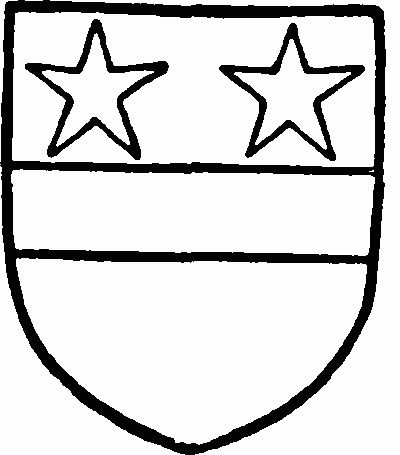
Poer. Gules a fesseer with two molets argent in the chief.
In March 1460–1 Sir William Vaux, kt., held a messuage and 100 acres of land in Marcham called HORSEPATH (Herspath, Horsepathes, (fn. 122) xv cent.). He was soon afterwards attainted, (fn. 123) and in 1462 and 1464 these possessions were granted by the Crown to Ralph Hastings, esquire of the body. (fn. 124) Richard Fowler, sometime Chancellor of the Exchequer to Edward IV and Chancellor of the Duchy of Lancaster, received a grant of the manor in 1467 to himself and his male issue. (fn. 125) He died in November 1477 leaving a son Richard age eleven; nevertheless as Katharine widow of Sir William Vaux had no means of support for herself and children, the king in March 1477–8 granted her these lands for life as 'the manor of Marcham.' (fn. 126) Perhaps this was the 'manor of Marcham' which Sir Nicholas Vaux, kt., and Elizabeth his wife sold in 1493 to Roger Bourchier and others. (fn. 127) Henry VII granted the 'manor of Horsepath' to Abingdon Abbey in February 1496–7, (fn. 128) and it was granted with Marcham Manor to William Boxe in 1546. (fn. 129) Robert Hawkins, yeoman, died seised of the capital messuage called 'Horsepath farm-house' in 1601 and was succeeded by Simon his son (fn. 130); later in the 17th century it had become an appurtenance of the main manor. (fn. 131)
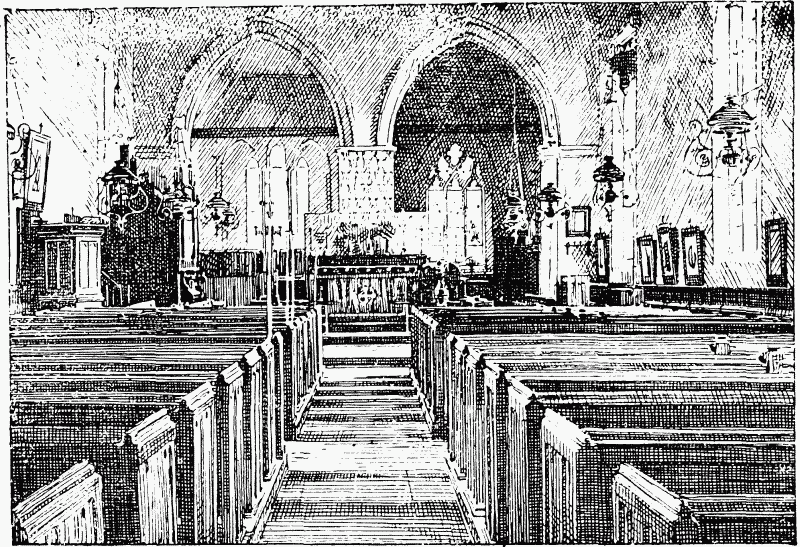
Marcham Church: The Nave Looking East
UPWOOD in Marcham is a reputed manor. The wood called Upwood was originally in Tubney, but was secured by Abingdon Abbey in January 1408–9. (fn. 132) It was parcel of the manor of Marcham, with which it was granted in 1546 to William Boxe. (fn. 133) In the spring of 1715 the farm was claimed to have been for many years past in the hands of the ancestor of William Lane, then tenant. (fn. 134) No evidence has been found to show whether his son William succeeded to the property which was in 1813 in possession of Sir Charles Saxton, bart. (fn. 135) It was purchased by Thomas Duffield and merged in the manor of Marcham, but the estate was again separated by sale in 1898 to the Rev. Constantine Arthur Dillon; it is now the property of Mr. John Peel. (fn. 136)
In 1815 the 'manor and inclosed farm of Upwood' was expressly excepted from the Inclosure Act. (fn. 137)
Churches
The church of ALL SAINTS (fn. 138) consists of a rectangular body with two chapels side by side at the east end, a west tower and a south porch. With the exception of the tower the church was rebuilt in 1837–8, but a certain amount of the old material appears to have been re-used. A sketch by Buckler of the old church in 1819 shows a high-pitched lead roof to the chancel, which had three square-headed 15th-century windows and a priest's doorway on the south side. The nave had a 15th-century clearstory, but no aisle on the south, and a south porch.
The style of the present building is 'Perpendicular' Gothic with tall transomed windows and a gallery at the west end. The two chapels open into the body of the church by two modern arches and are separated from each other by a late 12th or early 13th-century arch with semicircular responds having bell capitals carved with foliage in a series of knots. It is apparently much restored. The northern of the two chapels has a triple lancet in the east wall, with moulded rear arches resting on detached shafts having moulded capitals and bases and jamb shafts to correspond; the internal work is apparently of the 13th century and is covered with whitewash. The east window of the southern chapel is of three lights with tracery of 14th-century character and may also be ancient inside.
The west tower, of early 13th-century date, is three stages high and has a ring of six bells. The ground stage has a tall lancet in the west wall and is supported by two massive buttresses at each western angle with unusually long raking offsets. The second stage is lighted by loops and is approached by a projecting turret on the north-east. The latter has a rather elaborate capping finished with a stone gable with a quatrefoil panel. In the rake or offset below is a loop set in a small gablet, now lacking the top. The bell-chamber has a single-light pointed window in each face and the moulded parapet is plain. The modern south porch has an old canopied niche in the gable.
On the north wall of the body of the church is a carved marble tablet to Robert eldest son of Robert Leicester of Tabley (d. 1675), with a shield of Leicester of Tabley quartering a chief with three martlets (?) thereon. On the south wall is a brass to Edmund Fettiplace (d. 1540) and Margaret his wife, with kneeling figures, the man in armour and the lady in a pedimental head-dress, five sons and six daughters, and four shields, the first and fourth Fettiplace quartering Bessel and Leigh quarterly, the second a coat of sixteen quarters of Mordaunt, the third the first two shields impaled. There are four slabs to John Prince (d. 1674) and Mary his wife. In the nave is a large number of 16th-century bench ends with linen-pattern ornament. The plain circular font, with a chamfered base, is of doubtful date.
The plate consists of an Elizabethan cup of silver; two silver patens of 1847; and a silver chalice and paten presented by Mr. A. H. Anson in 1903. There is also an old pewter flagon.
The registers begin in 1658.
The chapel of ST. LUKE, Garford, consists of a chancel with north chapel, nave with north aisle, south porch and west bell-turret. The church was rebuilt in 1880, but portions of the old structure have been incorporated.
The east window consists of a pair of 13th-century lancets. On the south of the chancel is a large square-headed window of three plain lights, portions of which are of 16th or 17th-century date. The nave has a modern arcade of four bays with stone and marble columns. In the south wall is a two-light square-headed window of the 14th century. The other windows are modern, but the south doorway is largely of the 13th century and is moulded with an external hood. The oak door is also partly ancient. The west wall has a single lancet, partly modern. The lower courses of all the walls are built of old materials. The square timber bell-turret contains one bell.
Preserved in the nave is an oil painting of the old church, which was aisleless and had a timber south porch. The old windows appear to have occupied the same relative positions as at present, and the bellturret was weather-boarded. The oak chancel screen with a loft is partly ancient; the posts, base and loft are all modern, but the moulded cornice with traces of colouring is largely old, and above it a series of pierced traceried panels of the 15th century forms a rail to the front of the loft. Fixed on the wall by the reading-desk is a wrought-iron hour-glass stand with a wooden frame to the hour-glass. The rest of the fittings are modern.
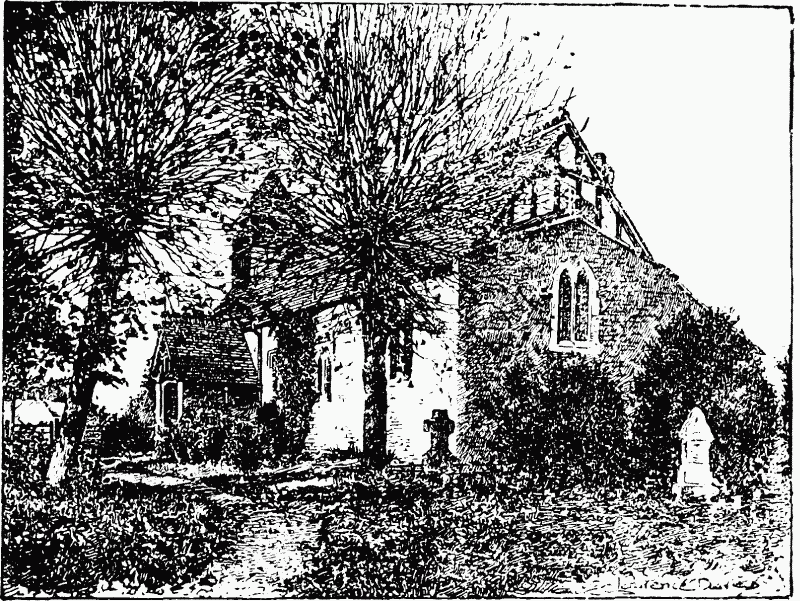
Garford Church From The South-East
Advowson
The church of Marcham belonged to Abingdon Abbey in 1086. (fn. 139) It was obtained by Simon and Turstin son of Simon by misrepresentations, but was recovered by Abbot Faritius, (fn. 140) and appropriated to the abbey in the time of Henry I. (fn. 141) After the Dissolution the rectory (and apparently the advowson) was granted in 1546 to the Dean and Chapter of Christ Church, Oxford, (fn. 142) who are the present patrons and impro priators.
The chapel of Garford was appurtenant to the parish church in 1291. (fn. 143) It is served by the vicar of Marcham.
Charities
Church Lands.—By inquisitions by commissioners for charitable uses taken at Abingdon (fn. 144) in 1617–18 it was found that certain lands and tenements in the township of Garford and certain meres had been given for the church and poor, but none of these is now in the possession of the churchwardens. The only properties now held by them consist of 30 perches in the Leys allotted under the Marcham Inclosure Act, let at 10s. a year, and 3 r. 24 p. in Upper Ham Field, allotted under the Garford Inclosure Act, let at £1 a year. The rents are applied in aid of the general funds of Marcham Church.
By an Award under the Marcham Inclosure Act above referred to 3 roods in Ham Croft and 2 acres in Gozzard Field were allotted for stone and gravel-pits for repairing the roads. The allotment first mentioned was sold in 1904 under an order of the Local Government Board for £20, which has been invested in £22 10s. 5d. consols, producing 11s. yearly. The remaining allotment is let at 10s. yearly. The income is applied in reduction of the rates.
By the same award 2 r. 10 p. in the Leys were allotted to the constable. The land is let at £3 10s. yearly, which is applied in relief of the poor rate.
Richard Wrigglesworth's charity (see under Abingdon). The parish is entitled to the sum of £24 yearly from the income of this charity, £15 being applicable towards the stipend of a curate, or to the poor in any year in which there is no curate, and £9 for the benefit of the poor, including those of the hamlets of Frilford and Garford.
The following charities were combined by a scheme of the Court of Chancery of 17 December 1864, namely, the charities of:—
John Parkins, under a deed of 24 August 1606, being an annuity of £4 for the poor issuing out of Rose's Close, in the parish of Kencott (Oxon.).
John Barnes, under his will dated in 1782–a legacy of £500, conditional on the testator being buried in the chancel; trust fund, £871 9s. 2d. consols.
George Elwes, who died in 1821, by his will bequeathed £1,500 consols, the dividends to be applied as to £10 for clothing poor boys, £10 for clothing poor girls, and the residue to be distributed among the industrious poor. The will became the subject of a Chancery suit, and the legacy not being charged upon the personal estate, became reduced to £773 5s. 5d. consols. The sums of stock, amounting together to £1,644 14s. 7d. consols, are held by the official trustees.
By an order of the Charity Commissioners of 1 July 1904 the sum of £800 consols (part thereof) was set aside as an educational foundation to provide £20 a year for clothing poor boys and girls attending the public elementary school. The remainder of the stock, amounting to £844 14s. 7d. consols, producing £21 2s. 4d. yearly, together with John Parkins's annuity of £4, constitutes the eleemosynary branch. The net income, with the share of Wrigglesworth's charity, is distributed in January in tickets for goods to about 100 recipients.
Nonconformist charities.—The Marcham Baptist chapel and minister's house are comprised in deeds dated respectively 20 May 1875 and 2 March 1893. The house is occupied by the minister, who pays yearly £14 by way of rent, which is applied for purposes connected with the chapel.
The Baptist chapel at Cothill.—The endowments consist of £2,000 consols given by John and Sarah Tomkins by deed 28 February 1840, the dividends, amounting to £50 a year, to be applied towards the support of the minister, and £200 consols given by John Tomkins by deed 21 October 1842, the dividends, amounting to £5 a year, to be applied in keeping the chapel in repair and in the maintenance of the services. The stock is registered in the names of Job Coxeter and three others.
Township of Frilford.—The eleemosynary charities are administered together, comprising the charities of:—
An unknown donor, being an annuity of 10s., mentioned in the Parliamentary Returns of 1786, issuing out of an estate at Appleton.
Robert Hayward, will dated in 1818, trust fund, £90 10s. 11d. consols.
William Hayward's and John and William Ald worth's charities; dates of gifts are uncertain. The trust fund consists of £455 consols.
Harriet Floyd, will proved in the P.C.C. 29 February 1856—trust fund, £100 consols.
Martha Floyd, under her will proved at Oxford, 12 August 1870—trust fund, £200 consols.
An allotment in Horse Common containing 5 acres awarded for the poor on the inclosure in 1861. The land is let in allotments, producing £2 5s. a year or thereabouts.
The several sums of stock are held by the official trustees; the annual dividends amounting to £21 2s. 4d., are together with the rents above mentioned and the share of Wrigglesworth's charity distributed at Christmas and Good Friday in gifts of money to the poor.
By the Inclosure Award above referred to 2 acres in Horse Common were allotted as a place of exercise and recreation, 2 acres of heath were assigned for repairing the roads and 2 r. 12 p. were allotted under the Marcham Inclosure Award to the constable of Frilford.
The two allotments last mentioned are let at 5s. each yearly.
Chapelry of Garford.—In 1721 Elizabeth Hayward, as appeared in the Parliamentary Returns of 1786, by her will left £10 for the poor, in respect of which 10s. a year was paid out of certain lands. The land was sold in 1897, and subsequently a sum of £20 12s. 5d. India 2½ per cent. stock was transferred to the official trustees in satisfaction of the charge. The annual dividends of 10s. 4d. are together with the share of Wrigglesworth's charity distributed in bread at Christmas time.
By an Inclosure Award dated 26 December 1826 2 roods in Upper Ham field were allotted for public stone, gravel and chalk-pits. It is understood that the allotment is exhausted and has been inclosed in the adjoining properties.