A History of the County of Berkshire: Volume 4. Originally published by Victoria County History, London, 1924.
This free content was digitised by double rekeying. All rights reserved.
'Parishes: Sutton Courtenay', in A History of the County of Berkshire: Volume 4, ed. William Page, P H Ditchfield (London, 1924), British History Online https://www.british-history.ac.uk/vch/berks/vol4/pp369-379 [accessed 30 April 2025].
'Parishes: Sutton Courtenay', in A History of the County of Berkshire: Volume 4. Edited by William Page, P H Ditchfield (London, 1924), British History Online, accessed April 30, 2025, https://www.british-history.ac.uk/vch/berks/vol4/pp369-379.
"Parishes: Sutton Courtenay". A History of the County of Berkshire: Volume 4. Ed. William Page, P H Ditchfield (London, 1924), British History Online. Web. 30 April 2025. https://www.british-history.ac.uk/vch/berks/vol4/pp369-379.
In this section
SUTTON COURTENAY
Suttone, Suthtune (ix–xii cent.); Sugtun (xi cent.); Sutton (xiii–xvi cent.); Sutton Courtney (xv. cent.)
This parish, which formerly gave its name to the hundred, contains the township of Sutton Wick and the chapelry of Appleford. (fn. 1) Sutton Wick (Wik, le Wyke, xiii cent.; Weeke, xvi–xvii cent.) includes the hamlets of Upper Wick, Lower Wick and Oday or Ody Hill (Odie, xvii cent.). Rowstock Farm was transferred to the parish of East Hendred by order of the Local Government Board in 1887. (fn. 2)
Sutton Wick is divided from Abingdon on the north-west by the River Ock, the Thames forming its eastern boundary and the northern boundary of Sutton Courtenay and Appleford, a small portion of the last, known as Motts Ait, lying to the north of the river.
The parish is a level tract of valley less than 200 ft. above the ordnance datum, except at Sutton Wick, where points of that height are reached.
The area of the whole parish is 4,263 acres, of which about two-thirds is arable land and one-third permanent grass. (fn. 3) An Inclosure Act for Sutton Courtenay and Sutton Wick was passed in 1800–1 and the Award was made in 1804. (fn. 4) The Award for Appleford is dated 17 September 1838, (fn. 5) and both are in the keeping of Mr. John Morland of Abingdon.
The subsoil is Gault, Lower Greensand and Kimmeridge Clay with Alluvium near the river; the soil is gravel, clay and loam, gravel being worked at Summerfed. The crops are wheat, barley, oats and roots.
In 1086 there were three water-mills in the royal demesnes at Sutton (fn. 6) and two mills in the Abbot of Abingdon's lands at Appleford. (fn. 7) Ock Mill (Henora, Einore, Hennover Mill, xii–xiii cent.), on the south side of that river, and close to Abingdon, was lost by the monks during the Danish invasions. (fn. 8) It was given to them by Henry I in 1100, at the abbot's request, as being injurious to the abbot's mill and meadows. It was then appropriated to the abbey almonry. (fn. 9) In the Courtenay lands were two windmills and a fulling-mill in 1419, (fn. 10) but one water-mill only is mentioned in 1458. (fn. 11) Later, however, there were on the Thames two mills and a fishery, (fn. 12) which were damaged by flood in 1608. (fn. 13) Sutton Mills came to the Crown in or about 1638 by failure of heirs to Peter Dubois. (fn. 14) Two water-mills at Wick, belonging to Thomas Fuller, were burned down in 1756; New Cut Mill, on the Ock, is just within the boundaries of Sutton Wick. (fn. 15) The occupations of the people are almost entirely agricultural, but a paper-mill in Sutton Courtenay village employed about twenty-five persons in 1840 (fn. 16); it was closed in or about 1880. Besides this mill there are Sutton Mill and Lower Mill, in the village, on Mill Brook.
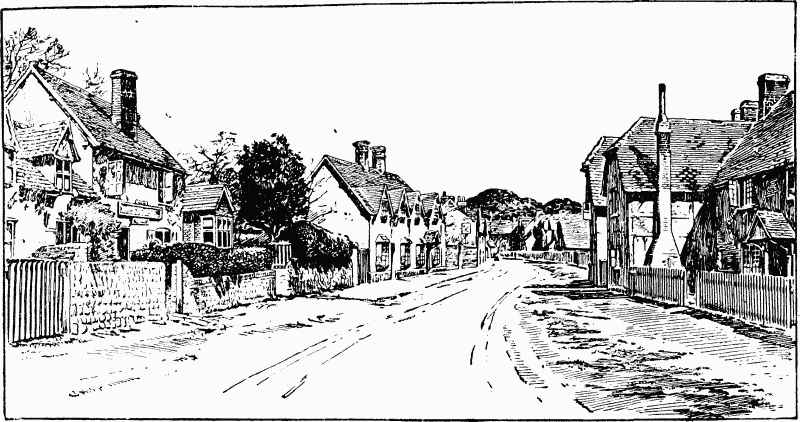
Sutton Courtenay: A View in the Village
The road from East Ilsley enters Abingdon over Ock Bridge, and at this point the hundred court was held (fn. 17) in the 12th century. The ancient bridge over the Thames between Sutton and Culham was rebuilt in 1807. (fn. 18) From an early date a wharf belonged to the Courtenay manor, and strangers in the 17th century paid toll for goods landed at the 'turnpike or lock.'Before this lock was made, it was stated, the Thames ran between places called the Mid Eight and the Laver, where stood the ancient wharf which was inaccessible in the late 17th century. The two wharves were used in 1667, and were not sufficient for the traffic. (fn. 19)
The village on the right bank of the Thames, has suffered much at different times from floods. (fn. 20) It is built on either side of a lane which leads south, rising gradually to the Downs. The village is exceedingly picturesque and contains numerous ancient timber-framed cottages of the 16th, 17th and 18th centuries, and also an unusual number of larger houses of various dates and styles grouped round a large green. At some distance south-west of the church is the Abbey, formerly known as the Rectory House, the residence of Colonel Henry Norton Good, at one time a grange of Abingdon Abbey, and afterwards the seat of the Justice family. It is a quadrangular building, of which the west, north and south wings date from the 14th century. The older parts are of stone rubble and timber-framed; the east wing was probably added in the 16th century. The west front has a gable at each end, the central part being occupied by the great hall with screens at the south end entered by pointed doorways; the east doorway has a moulded label of the 14th century. The hall, which measures 40 ft. by 24 ft., has an oak roof of two bays with curved and moulded principals forming a pointed arch. Formerly the windows of the hall had pointed heads carried above the wall head in the manner of dormers, but these have now been cut down to the level of their transoms. Under one of these windows is a small traceried window, which retains its original shutter-hooks. The solar at the north end of the hall has two-light windows of the 15th century in the north wall, of differing character. The room above is called the chapel, and has a pointed two-light west window of the 14th century with flowing tracery and a transom. In the north wall is another two-light window of the same date with a square head. The rear or east wing has a projecting upper story, and against the north side is a projecting stone chimney stack with an octagonal shaft. The walls are all covered with stucco. Numerous mediaeval sewers have been discovered in the grounds.
Near the river is Sutton Courtenay Manor, the residence of Capt. H. E. A. Lindsay; it is a two-storied building with attics of the 16th century and of half H-shaped plan. The ground-floor walls are of rubble and the upper floor is timber-framed. The east front has five gables with oak barge-boards carved with vine ornament. The hall has a four-centred fireplace of stone with an oak overmantel not in situ, inscribed 'R.H. 1643.' The staircase opens off the hall and has turned balusters, a string well carved with vine ornament, and square panelled newels with ball tops. The dining room has panelled walls and a fine fireplace with twisted columns at the sides and a landscape panel in the overmantel, all of about 1660. The drawing room contains a fireplace brought from the Priory, Stevention; it has three terminal figures, inlaid panels, and the inscription 'Judica Domine nocentes me expugna impugnantes me.' The south wing at the back has a barrel-vaulted cellar beneath it. The north wing has a modern addition on the south, resting on Jacobean columns and pilasters and forming an open loggia. The house is otherwise full of old panelling and woodwork brought from various places, and the end of the south wing is fitted up as a hall with a gallery at the east end having a rail of 15th-century woodwork. The handsome stone gate piers in front are ascribed to Inigo Jones; they are rusticated and finished with a cornice and ball.
The 'Norman hall' to the north of the manor is a rectangular stone building of late 12th-century date. It was transformed into a farm-house in 1638, and is now, with large additions, used as a private house. It is not improbable that this was once a chapel, as it is correctly orientated and has north and south doorways in the usual 12th-century positions. The 15th-century east window was originally of three lights under a square head, but the mullions have disappeared. In the north wall are two lancet windows, the westernmost being blocked. Further west are a large fireplace and a round-headed 12thcentury north doorway now opening into the modern house. In the south wall there were formerly four lancet windows, but only the easternmost is now open; the two western have been cut into by modern alterations. The late 12th-century south doorway has a round head of two moulded orders, each with a line of dog-tooth ornament; the jambs have each one engaged shaft and formerly a free shaft also, of which only the foliated capitals remain. In the east window is a glass shield with the arms of Edward III, and in the west window a shield of France and England quarterly, but neither is in situ. The roof is ancient, with tie-beams, queen-posts, wind-braces and curved braces to the collar beams.
The vicarage, north-west of the churchyard, is an early 18th-century house of red brick with later additions. It contains a small but good staircase with ramped handrail and turned balusters of about 1720. Further north is a good Queen Anne house now used as a school; it has a hipped roof, wooden eaves cornice and a handsome shell-shaped hood above the entrance doorway. In the southern part of the village is a gabled Jacobean house of two stories. It has three gables towards the front with enriched barge-boards and turned pendants; in the centre of each bay at the first-floor level is a semioctagonal bay window of timber, gabled and supported on carved brackets. The northernmost has been removed, but the other two bear the initials W.A. and F.A. and the date 1631. The entrance doorway has a carved oak frame and a modern hood. At the north end of the village is the Mill House, a good early 18th-century building of brick.
A house has recently been built in the village by the Rt. Hon. H. H. Asquith, M.P.
A School Board was formed in 1874, (fn. 21) and the National school, founded in 1849, was rebuilt in 1875. The Wesleyan chapel was built about the middle of the 19th century; the Baptist chapel, founded in about 1820 and closed for some years, is now used by the Congregationalists.
The village feast is held on Corpus Christi Day, the Thursday after Trinity Sunday.
The hamlet of Sutton Wick, noted for its walnut trees, is on the high road to Abingdon and almost forms one village with Drayton. Oday Hill, the traditional scene of a fight during the Civil War is to the north; cannon balls, possibly intercepted during the skirmish at Culham Bridge in 1644, (fn. 22) have been found here.
A lane runs eastward from Sutton Courtenay to the village of Appleford on the Thames. The Manor Farm, west of the church, is in part an ancient building and probably represents the grange of Abingdon Abbey. Before the church there is a small green with an elm tree, and there is also a recreation ground. To the south is an outlying group of cottages at Hill Farm. A station on the Oxford branch of the Great Western railway was closed early in 1849. (fn. 23) A free school founded in 1607 (fn. 24) for thirteen children from Sutton and seven from Appleford was enlarged in 1896. The village feast is held on the Sunday after St. Peter's Day.
Traces of early man, Romano-British fragments and skeletons have been found at Appleford (fn. 25) and at the cross-ways at the southern end of the village of Sutton Courtenay is a round barrow planted with five elms known as the Cross Trees, and there is a barrow in Sutton Wick near Barrow Road.
Thirteenth-century place names are Lateker and Herdegrave. (fn. 26) Some 15th-century names are Floddreys and Hickdons in Sutton Courtenay. (fn. 27) Sixteenthcentury names are Grenehodes, Miles Bordland, Moreman's, Dicheborowe, Elvyshe, Elves and Barnards (still known) in Appleford (fn. 28); Cheers, Lady, Uptown and Parishes Closes, Badwell Furlong, The Forty, Horn Down, Hulgrove, Lummisham, Mill Swathes, Tullis Meadow and Summerfed are now found in Sutton, and Goose Acre, Penn Corner, Pottles, Porters Furlong and Millers Bridge Piece in Appleford. A row of cottages at the back of Sutton Courtenay village street is known as Filchamstead, often called Filcham or Feltcham Street. Purgatory Farm is south of the village; Radcott Farm is in Appleford.
Manors
According to the 12th-century tradition of the house, the vill of SUTTON (fn. 29) was given to Abingdon Abbey by King Ini (fn. 30) (688–728). The story went on to relate how Abbot Hrethun in 801 gave 100 manentes of land here and £120 to Coenwulf, King of the Mercians, in exchange for Andersey Island. (fn. 31) Be this as it may, Sutton remained a royal vill (fn. 32) until the reign of Henry II, although the abbey retained a holding here. (fn. 33)
In 1086 the Conqueror held Sutton in demesne. (fn. 34) Certain land in the manor was seized by Henry de Ferrers as having belonged to his predecessor Godric the sheriff, but the hundred court stated that Godric had taken possession unlawfully. (fn. 35) Half a virgate which Leflet had held before the Conquest had passed to the king by 1086, when it was held by Robert in the farm of Sutton. (fn. 36)
Henry II seems to have granted it to Henry son of Gerald, afterwards called the chamberlain, (fn. 37) who perhaps exchanged it for Sparsholt. (fn. 38)
Reynold de Courtenay held lands here in 1160–1, (fn. 39) and received a grant of the manor from Henry II at some date between 1175 and 1184. (fn. 40) He died about 1191, (fn. 41) and his younger son Robert obtained the manor, paying 300 marks to the Crown, and 'saving the right of the heirs of his eldest brother (fn. 42) William when they have age.' (fn. 43) He held Sutton until 1209, (fn. 44) when he was succeeded by his nephew Robert. (fn. 45) Robert held Sutton until 1242, (fn. 46) when he was succeeded by his son John, (fn. 47) who died seised in 1273, leaving a son and heir Hugh. (fn. 48) He was followed in February 1291–2 by his son Hugh, (fn. 49) who succeeded in 1293 to the Redvers estates of his distant cousin Isabel Countess of Albemarle and Devon. (fn. 50) He was summoned to Parliament as Lord Courtenay from 1299 onwards, and his title to the earldom of Devon was confirmed in 1335. (fn. 51) In 1315 he and his mother Eleanor settled the remainder of this manor and lands in Devonshire and Hampshire on his sons Hugh, Robert and Thomas successively in feetail. (fn. 52) He died in 1340, when Hugh was his heir. (fn. 53) Hugh Earl of Devon settled the manor for her life in 1361 on Margaret daughter of Sir Guy de Brienne, wife of his grandson Hugh son of Hugh de Courtenay. (fn. 54) Margaret must have died soon afterwards, for in February 1364–5 the earl settled the manor with the advowson of the church on Hugh's second wife Maud, daughter of Thomas (Holand) Earl of Kent, and their issue for the payment of £44 16s. annually. (fn. 55) The younger Hugh died in February 1373–4, when the issues were delivered to Maud. (fn. 56) Hugh Earl of Devon died in 1377 when his grandson Edward succeeded to the earldom, (fn. 57) his grandmother Margaret having dower of this manor and advowson until her death in 1391. (fn. 58) His elder son Edward fought at Agincourt in 1415 and died a year or two later, (fn. 59) and in 1419 he was succeeded by his younger son Hugh. (fn. 60) Hugh Earl of Devon died in 1422, leaving a son and heir Thomas, aged eight, (fn. 61) but Sutton Courtenay formed part of the dower of Anne his mother, who held it until her death in January 1440–1. (fn. 62) Thomas died in February 1457–8, and was succeeded by his son Thomas, (fn. 63) beheaded at York in 1461. (fn. 64) His brother and heir Henry was not restored to his honours; in 1461 he received licence to enter into possession of this estate, (fn. 65) but by the attainder of November in this year the Courtenay lands were vested in the Crown, and in 1462 the manor and advowson were granted by Edward IV to Walter (Devereux) Lord Ferrers. (fn. 66)
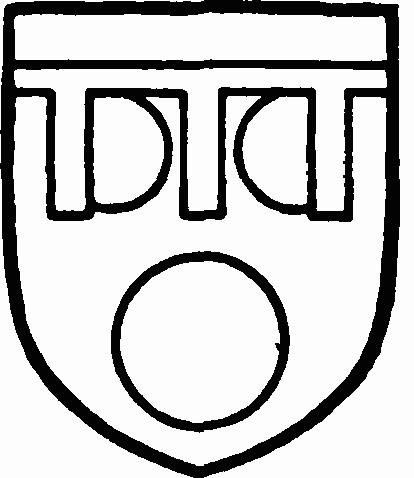
Courtenay. Or three roundels gules with a label azure:
Lord Ferrers was slain at Bosworth in 1485, fighting on the side of Richard III, (fn. 67) and his descendants lost the Courtenay possessions.
John Courtenay, youngest brother of Thomas Earl of Devon, had been restored to his honours in 1470, at the brief restoration of Henry VI, but died in battle at Tewkesbury in 1471 leaving no issue. Before the close of 1485 Henry VII restored the earldom to Edward Courtenay, son of Sir Hugh son of Sir Hugh younger brother of Edward twelfth Earl of Devon. (fn. 68) He received this manor in 1485, (fn. 69) but surrendered it with other lands in March 1489–90 in favour of Elizabeth wife of Sir Hugh Conway, sister of that Thomas Earl of Devon who had been attainted in 1461. (fn. 70)
On the death of Edward Earl of Devon, in 1509, the earldom was forfeited through the attainder in 1504 of his son and heir William, who, however, in 1511, a month before his death, was created earl; (fn. 71) in 1512 Henry VIII granted the reversion of this manor, then held by Sir Hugh Conway and Elizabeth, to William's widow Katharine, (fn. 72) sixth daughter of Edward IV. (fn. 73) When she died in 1527 (fn. 74) the manor passed to her son Henry, who had obtained in 1512 a reversal of his father's attainder and been created Marquess of Exeter in 1525. (fn. 75) On his attainder in 1539 it again came to the Crown. (fn. 76)
In 1550 Edward VI leased the manor to John Herle, servant to the Lady Mary, and in 1557 Philip and Mary granted the reversion to Sir John Mason, kt., and Elizabeth his wife in exchange for the manor of Timsbury (Hants). In the following year they resigned the grant in favour of their son and heir Thomas, on whom the manor was settled for life with successive remainders to Elizabeth daughter and heir of Sir John Gresham, kt., and his wife Frances and John's male issue. (fn. 77) Thomas and Elizabeth Gresham died, Sir John Mason died leaving no son, and the reversion came to the Crown. Queen Elizabeth granted Dame Elizabeth Mason, who survived, a lease of the demesnes and mills for twenty-one years from 1574, and in 1591 granted the remainder for sixty years to Richard Hyde and John Reade. (fn. 78)
The manor was retained by the Crown from Dame Elizabeth Mason's death (fn. 79) until 1628, (fn. 80) being in the possession of the Prince of Wales in 1620. (fn. 81) In 1628 Charles I sold it to Edward Ditchfield and others, citizens of London. (fn. 82) They sold it in 1630 to William first Lord Craven of Hampstead Marshall, Berkshire. (fn. 83)
This manor with Lord Craven's other estates was seized by Parliament and sold to Samuel Wightwick. (fn. 84) It was recovered at the Restoration and remained in the possession of the Earls of Craven (fn. 85) until William Earl of Craven sold it to Francis Elderfield, (fn. 86) probably in 1821. (fn. 87) It then came into the possession of William Monk, whose representatives sold it in 1886 to Lord Wantage. He died in 1901, having bequeathed it to the present owner, his kinsman Captain Henry Edith Arthur Lindsay. (fn. 88)
Court Rolls of the 14th century are extant. (fn. 89)
Richard de Corneville held lands here in 1225 (fn. 90); Walter de Corneville was living in 1261 and held onethirteenth of a knight's fee of John de Courtenay (fn. 91); and in February 1291–2 John de Corneville was said to hold one-tenth of a fee. (fn. 92) Roger Corneville is mentioned in 1353–4. (fn. 93) Land was also held by the family of Stanlake before and after 1366. (fn. 94)
John Brouns (fn. 95) received licence in 1341 to have an oratory in his house here. (fn. 96) His son William Brouns in 1377, made settlements of messuages and a carucate of land (fn. 97) and in this year and February 1391–2 appears as tenant of the part of a knight's fee under the Courtenays. (fn. 98) His son Richard was perhaps the Richard, father of Richard 'Brunse' of Sutton Courtenay, whose daughter and heir Rose married Richard Humfreston of Humfreston (co. Salop), and left a daughter and heir Agnes wife of William Hulse. (fn. 99) He settled at Sutton Courtenay, and his son Andrew was father of the Thomas Hulse, recusant, (fn. 100) who made a settlement of the manor of BRUNCES COURT here in the spring of 1593. (fn. 101) He died seised of a mansion or capital messuage and lands in 1613, leaving daughters and heirs Susan widow of Thomas Kerry. Mary who had married Edmund Wollascot, and Frances who had married John Mayhue. (fn. 102) Thomas Wollascot. son of Mary and Edmund or Edward. a recusant, was in possession of 'Brunts Court' before his death in about 1650, and it was leased in 1652 by his son Thomas who, however, was living here in 1664. (fn. 103) His son Martin (fn. 104) had lands here in 1691, (fn. 105) as had William Wollascot in 1717. (fn. 106)
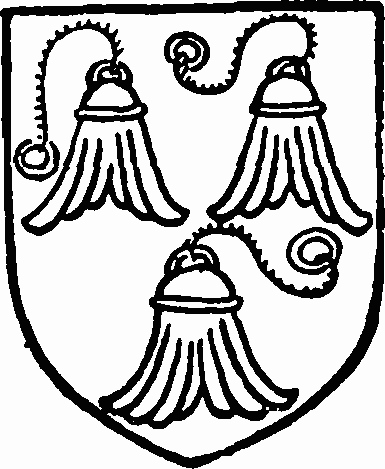
Brouns. Argenthree hawks' lures sable.
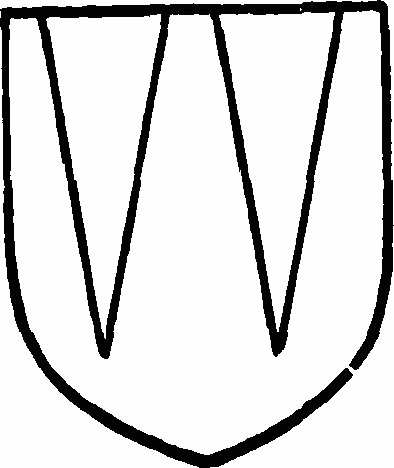
Hulse. Argen two piles sable.
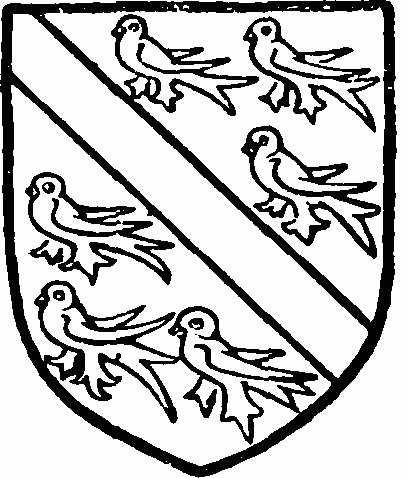
Wollascot. Argent a bend between six martlets sable.
In the spring of 1219 John de St. Helen (fn. 107) quitclaimed to Osbert son of Ralph a mill in Sutton which was to be held of himself and his heirs, (fn. 108) and in 1222 he received confirmation from Robert de Courtenay of half a hide of land which his father John de St. Helen had held of the Crown at the time Henry II granted Sutton to Reynold de Courtenay. (fn. 109) Tenements in Sutton subsequently descended with the manor of St. Helen. (fn. 110)
Ethelred II in 983 gave 1½ manses in Sutton to Wulfgar, (fn. 111) his butler, and in 1000 granted or confirmed 2 hides and a mill which Wulfgar held here to the abbey of Abingdon. (fn. 112) In 1086 Alwi the priest of the vill held of the abbot 1 hide of land which had belonged to his father before him, (fn. 113) and in 1146 Pope Eugenius III confirmed this hide to the abbey. (fn. 114) The abbey perhaps received lands here from Miles Crispin and Maud his wife, (fn. 115) Miles holding in 1086 at Sutton Courtenay an acre of land in which were six dwelling-houses worth 12d., 'appertaining to Oxfordshire and yet in Wallingford.' (fn. 116) The house obtained a hide of land here from Sybil daughter of Richard Hulloc in 1235. (fn. 117) Philip de St. Helen held the abbey fee in the early 13th century. (fn. 118)
In the spring of 1538 the abbey surrendered all its possessions, including Sutton, (fn. 119) which was granted in 1546 by Henry VIII to Lord Chancellor Wriothesley with Milton (fn. 120) (q.v.). Wriothesley disposed of it and Milton in the same year to Thomas Calton, (fn. 121) and it is mentioned in conveyances made by the Caltons (fn. 122) until 1638. (fn. 123) It is not called a manor after that date. It probably became merged in Milton Manor, Mr. Louis Arthur Barrett of Milton owning land in Sutton Courtenay at the present day.
APPLEFORD (Apleford, xi cent.; Apulford, xvi cent.) was evidently part of the royal demesne when King Alfred sold its 5 hides to his faithful Deormod for 50 mancuses of gold. From Deormod or his heirs it must have passed to Abingdon Abbey which held it in demesne in 1086, when it was assessed, as before the Conquest, at 5 hides; (fn. 124) the abbey continued to hold the manor until the dissolution of the monasteries. (fn. 125)
Robert held 1 hide of the abbey in 1086, (fn. 126) perhaps the hide restored after many disputes to Abingdon Abbey by Henry II. (fn. 127) Abbot Walkelin shortly afterwards granted it in fee to Pain de Appleford for the yearly payment of 20s. (fn. 128) The abbey in 1288 claimed free warren here, as in all its demesnes, by charter of Henry III. (fn. 129)
The manor was surrendered with that of Sutton early in 1538. (fn. 130) In 1551 the manor and advowson of the chapel were granted by the Crown to Sir John Mason, kt. (fn. 131) He and Elizabeth his wife made a settlement in 1558, (fn. 132) and in 1589 Anthony Mason alias Weekes (fn. 133) granted the reversion on the death of Elizabeth to Thomas Reade of Barton House, Abingdon, John his son and John's heirs. (fn. 134) Elizabeth died in 1594 (fn. 135); Thomas Reade died in December 1604; his son John died childless in January following, when his heir was his elder brother Sir Thomas Reade. (fn. 136) Appleford then descended with Barton (fn. 137) until Sir John Chandos Reade, bart., sold it in about 1820 to Charles Eyston of Hendred, whose grandson Mr. John Joseph Eyston is the present owner. (fn. 138)
In 1262 John de Turbervill and Meliora his wife, by right of Meliora, were in possession of at least one carucate in CALDECOTT. (fn. 139) Geoffrey de Turberville, who held land partly of the Abbot of Abingdon and partly of Hugh de Courtenay in Caldecott, Drayton Wick and Sutton Wick, (fn. 140) granted it in 1291 to Abingdon Abbey. (fn. 141) In 1428 the abbey cook held in Caldecott one-fourth of a knight's fee 'which William Wygan lately held.' (fn. 142) Eleanor Duchess of Somerset died in 1467 seised of a manor of 'Calecote,' held of the Abbot of Abingdon, (fn. 143) but at the Dissolution the estate was the property of the abbey and leased to William Bysley, and in 1553 it was granted to Edmund Cowper, clerk, and Valentine Fayrewether, haberdasher of London. (fn. 144) Richard Smith died in 1565 seised of the site of this manor, which passed to his son Richard, (fn. 145) who was succeeded in 1583 by another Richard. (fn. 146) Charles Tooker of Abingdon was in possession of the site of the manor in 1617 and died seised in 1627 when he bequeathed it to Charles, his younger son. (fn. 147) Its descent has been no further traced.
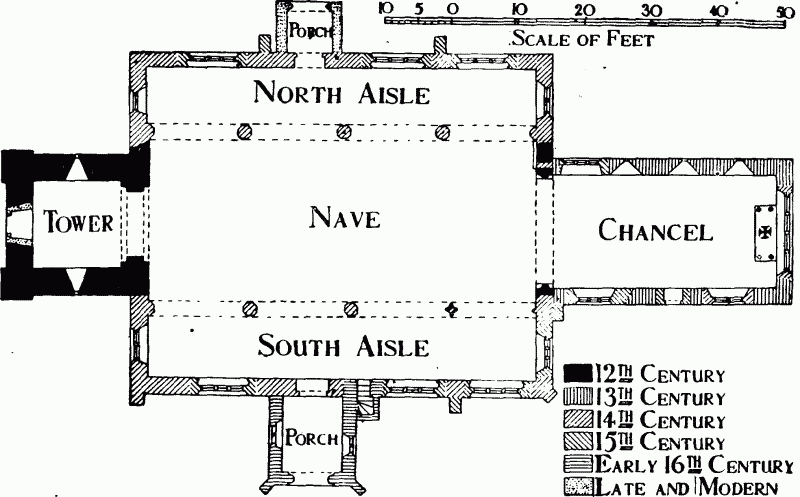
Plan of Sutton Courtenay Church
Churches
The church of ALL SAINTS consists of a chancel 36 ft. 6 in. by 17 ft. 6 in., nave 58 ft. by 24 ft. 3 in., north aisle 8 ft. 3 in. wide, south aisle 9 ft. wide, north and south porches, and west tower 13 ft. by 13 ft. 4 in. All these measurements are internal.
The west wall of the nave, the two lower stages of the tower and the responds of the chancel arch are of mid- or late 12th-century date. The presence of re-used 12th-century work in the south arcade indicates that an aisle existed at that period. The chancel was rebuilt in the first half of the 12th-century. In the following century the top stage was added to the tower, the south arcade and aisle were rebuilt and the north aisle added. About the same time the chancel arch was reconstructed and widened and the clearstory was perhaps added. During the 15th century various windows were inserted and the walls of the aisles were raised. The south clearstory is apparently also of this date, and it is possible that the earlier windows of the north clearstory may have been transferred from the aisles at this alteration. Early in the 16th century the south porch was added. The church has been restored in modern times, when the north porch was added.
The chancel has a four-light east window (fn. 148) originally of the 14th century, but with late tracery; the east gable was rebuilt in the 14th century. In the north wall are three original 13th-century lancet windows, and further west is a three-light window of the 15th century with a traceried pointed head. In the south wall are a pointed two-light window of the 14th century, a 15th-century priest's doorway with a four-centred head and a three-light window of the same date. Between the last two are remains of a 13th-century lancet, and further west a blocked doorway. In the same wall is a trefoil-headed piscina with two drains and a square-headed niche, and above the priest's doorway externally is a shallow trefoil-headed niche of the 14th century. The chancel arch has reset 12th-century responds, each with a large semicircular shaft having scalloped capitals and a smaller shaft on the west face with richly carved capital. The low arch of two orders is of the 14th century. The roof is of wagon form with a moulded cornice.
The nave has a 14th-century north arcade of four bays with pointed arches of two chamfered orders; the piers are octagonal with half piers as responds, all having moulded capitals and bases. The south arcade is also of four bays, of which the first arch is 12thcentury material re-used. This arch is of two pointed orders, the inner with cheveron and the outer with embattled ornament; the latter terminates on the west with a ball flower. The eastern respond has a single shaft with 14th-century moulded capital and base, and the first pier is square with an attached circular shaft on each face similar to the respond. The remaining bays on this side are similar to the north arcade. The clearstory has on the north five windows, all of two lights, and apparently of the 14th century, but of two types. On the south there are five 15th-century windows, square-headed and of two lights. The roof is low-pitched with heavy tie-beams, with curved braces resting on modern corbels and two uprights supporting the principals. The north aisle has a 14th-century east window of two lights under a pointed head. In the first, second and fourth bays of the north wall are three-light 15th-century windows with pointed and traceried heads. The 14thcentury north doorway in the third bay has a pointed head. In the west wall is a window of a single cusped light. The south aisle has a pointed 15th-century east window of three lights, and on either side of it is a stone bracket, the northern restored and the southern of octagonal form with a head corbel. In the south wall is a pointed piscina and three windows uniform with those opposite in the north aisle. The 14th-century south doorway in the third bay is pointed. The oak door is of the 15th century, panelled in five compartments with traceried heads above and below the middle rail.
The west tower is three stages high, the lower two being of the 12th and the upper of the 14th century. The lower part has clasping buttresses at the western angles. The tower arch is of two plain semicircular orders with a chamfered label and imposts continued along the wall as a string. The west doorway is modern, but the 12th-century window above it has side shafts with carved capitals and a head enriched with cheverons. In the north and south walls are simple windows of the same date. The second stage has two-light windows, apparently of late 12th-century date, in three faces; they are divided by shafts with capitals and bases, and on the west and south the arches interlace and the jambs have cheveron ornament. Above this stage is a corbel table with grotesque heads, &c. The bell-chamber has a plain parapet with gargoyles at the angles, and is lighted by a two-light window in each face. At the south-west angle is an old stone sundial with an iron gnomon.
The east ends of both aisles show traces of the lower line of the 14th-century roofs. The early 16th-century south porch is built of brick with stone dressings, and has a parvise over it approached by a brick staircase from a door in the south aisle. The outer archway has a four-centred arch and a square head with quatrefoils in the spandrels; above it is a panel with a carved object in the nature of a badge. On each side is a stone bench and a two-light window, and in the north-east angle of the porch is a pillar stoup of Purbeck marble with a broken bowl. The parvise has a two-light square-headed window in each wall and a square-headed stone fireplace on the west.
The 15th-century rood screen is of five bays, the side ones divided into three compartments with traceried heads at the top and below the middle rail. The double doors are similar. The east bay of the north aisle is screened off on the west by a 15thcentury screen with a doorway and four cinquefoilheaded compartments to the north of it. The cresting has been cut away. The east bay of the south aisle has a similar screen with traceried heads to the compartments. Against the east wall of this aisle is a stone altar with a panelled front, having quatrefoils in circles and a carved leaf in the centre of each; it is finished with a moulded cornice and base.
The early 13th-century font is ornamented with a series of pointed arches resting on shafts with foliage capitals and moulded bases. At the foot between each arch is a three-leaf flower and beneath the arches a further foliage ornament; the top has been cut down. The fine hexagonal Jacobean pulpit was given to the church in 1901; it springs from a centre post, and the sides have enriched and arcaded panels with carved consoles at the angles supporting the cornice. A panelled back with fluted pilasters supports the sounding-board, which has a dove in the centre of the soffit. At the west end of the nave is a richly carved and panelled 16th-century chest. Some of the nave benches are perhaps of 16th-century date, while one pew bears the date 1633. On the south of the chancel are some oak stalls with simply carved misericorde brackets, probably of early date.
Against the north chancel wall is an altar tomb with a plain slab and a front with two quatrefoil panels. Further west is a moulded 14th-century arched recess with a cusped head and a label. Under it has been placed a freestone recumbent effigy of a priest in mass vestments with excellent drapery, and restored feet, hands, and head. A floor slab in the chancel to George Hyde (d. 1661) bears the Hyde arms impaling a cheveron between three eagles' heads (?) razed. In the nave is a brass inscription to Richard Trulock of Appleford (d. 1705). Another brass inscription, now lying loose, commemorates Thomas Trulock the younger (d. 1615). South of the chancel, outside, is a weathered 15th-century tomb with panelled and cusped sides.
In the western pair of chancel windows are fragments of 15th-century glass. Other fragments of the 14th century remain in the east window of the north aisle, and in the second window of the north wall the 15th-century tracery glass is largely complete and has figures of the Evangelists. Other fragments of the same date remain in the south aisle windows. To the west of the second window in the north wall is a much-damaged 15th-century painting of St. George and the Dragon, and painted above the chancel arch are the royal (Stewart) arms and the commandments. On the west walls of the aisles are painted panels recording the benefactions of Edmund Scorier, with figures of poor men, on the north, and of William Andrews, with figures of poor widows, on the south. On the west wall is a painted table of benefactions. In the north aisle is a small library of old books.
There are six bells: the treble by Thomas Swaine, 1775; the second, inscribed 'Richard Keene cast this ring 1675, A Lough C. H. 1899'; the third, 1675; the fourth by R. Taylor, 1829; the fifth by T. Swaine, 1775, and the tenor, 1787.
The plate consists of a cup (London, 1584) and cover paten; a paten unmarked and inscribed 'William Androes, Edmund Martin, Peter Smith March 25 1624'; a small cup (London, 1812); and a large flagon (London, 1822). There is also a pewter flagon inscribed 'Sutton Courtney Iohn Poke vicar Iohn Tirrald Edward White Churchwardens 1682.'
The registers previous to 1812 are as follows: (i) baptisms 1539 to 1669, marriages 1538 to 1670, burials 1540 to 1670; (ii) all entries 1661 to 1696; (iii) 1696 to 1727; (iv) 1728 to 1775, marriages to 1754 only; (v) marriages 1754 to 1786; (vi) baptisms and burials 1775 to 1812; (vii) marriages 1786 to 1812.
The church of ST. PETER AND ST. PAUL, Appleford, consists of a chancel 24 ft. 9 in. by 11 ft. 4 in., nave 42 ft. by 16 ft. 6 in., north vestry, south porch and a west tower. These measurements are all internal.
The nave appears to have been built in the 12th century, and the chancel was rebuilt early in the 13th century. The building has been much restored in modern times, when the nave was rebuilt and lengthened towards the west and the west tower, north vestry and south porch were added.
The chancel has a single lancet in the east wall, partly restored. In the north wall is an arch to the modern vestry, and west of it is a small original lancet. In the south wall is a pointed piscina with a pillar and a broken foliated capital. Further west is an early 16th-century window, square-headed and of two rounded lights. The blocked priest's doorway is pointed and perhaps of 13th-century date. Further west is a single-light square-headed window with a blocked 'low-side' window below it. The chancel arch is modern, except the corbels to the inner order, which are moulded and of the 14th century. The axis of the chancel inclines to the north of that of the nave.
The nave has at the east end a pair of windows almost entirely modern, and at this end of the north wall is a blocked doorway. The north doorway is of the 12th century, reset, with a round head, and is blocked. The south doorway is similar and has chamfered imposts. West of these doors are four modern windows, two on each side. The modern tower is three stages high and finished with a square pyramidal stone spire. In the chancel are a number of 18thcentury monuments to the Justice family of Abingdon and Appleford. The communion rails have turned balusters of about 1730. The 13th-century font is octagonal above and circular below and has four moulded brackets.
There is one bell.
The registers previous to 1812 are as follows: (i) mixed entries 1563–4 to 1760, marriages to 1754 only; (ii) marriages 1755 to 1801; (iii) baptisms and burials 1761 to 1812.
Advowson
William II, in or about 1090, gave to Abbot Reynold and the convent of Abingdon the church of Sutton, its lands, tithes and customs, the abbey paying £20 (fn. 149) and agreeing that the priest, Alwi, who was highly skilled in the law, should retain for life the church and its hide of land, which he had held of the abbey in previous reigns, and that his son should succeed him in it. (fn. 150) King Stephen about 1146, Richard I in 1190, and Pope Eugenius in 1146 and 1152 confirmed the church to the abbey. (fn. 151)
Hugh de Courtenay sued the abbey for the advowson in 1278 (fn. 152) and 1290, bribing the justice, it was said, and bribing John de St. Helen, Seneschal of the abbey, with land afterwards called 'Ye Vorswhorenelande,' to bribe the jury, who pronounced in his favour. (fn. 153) The abbey vicarage here had been consolidated with the church by 1291, when the abbey, instead of holding the advowson to its own uses, (fn. 154) had only a pension of 13s. 4d., (fn. 155) and in future the advowson descended with the Courtenay manor (fn. 156) until in 1481 Walter Lord Ferrers received licence to grant it to St. George's Chapel, Windsor. (fn. 157)
The advowson was not restored with the manor to the Courtenays, (fn. 158) and has ever since been held by the Dean and Canons of Windsor. (fn. 159)
The dean and canons received licence from the Crown to appropriate the church in 1481, (fn. 160) and in 1496 the Bishop of Salisbury approved, on certain conditions, (fn. 161) ordering a new vicarage to be built and a salary of 28 marks yearly to be assigned to the vicar, who was also to serve Appleford. (fn. 162) The present living is a vicarage with Appleford annexed. Milton Church was originally a dependent chapel. (fn. 163)
The church of Appleford belonged to Abingdon Abbey in 1291, (fn. 164) but became subsequently a chapel of ease to Sutton Courtenay. (fn. 165) The chapel yard was made a burial-place in 1749. (fn. 166)
In 1511 the advowson of the free chapel of St. Mary Magdalene, which stood at the south end of the bridge over the Thames, was said to have been forfeited by Thomas Earl of Devon in 1461. (fn. 167) It was found at the Dissolution that the chapel had been dissolved by Henry Hogge without licence. (fn. 168)
There were two oratories in the parish, one granted to John Brouns in 1341 (fn. 169) and a second granted by Richard Mitford, Bishop of Salisbury (1395–1407). (fn. 170)
Charities
The parochial charities are administered under a scheme of the Charity Commissioners of 17 May 1889. They comprise the charities of:—
(1) Edmund Bradstock, for the poor; will, 1607—consisting of 4 acres at Appleford, allotted in 1838 under the Appleford Inclosure Act, in lieu of lands in the common fields, and 2 a. 3 r. at Moreton, of the aggregate rental value of £12 10s. yearly, purchased with the proceeds of the sale of 2 roods to the Great Western Railway Company, in 1843.
Also £628 0s. 9d. consols, producing £15 14s. yearly arising from the sale in 1891 of 2 a. 2 r. at Appleford. Two-thirds of the net income is applicable for the poor of Sutton Courtenay and one-third for the poor of Appleford.
(2) The poor's property, arising from gifts of sundry donors, now consists of 3 roods, known as Knapp's Close, comprised in deeds of lease and release, 1771, and a cottage (producing together £6 5s. yearly), and £20 8s. 2d. consols, representing the proceeds of the sale in 1892 of a cottage and land.
(3) Edmund Scorier, will, 1609—consisting of 3 a. 1 r. 17 p. in Badwell Furlong, acquired in 1804 under an Inclosure Award, in exchange for land originally devised and other land belonging to the poor. The land is let in allotments, producing about £8 15s. yearly.
(4) William Andrews, will, 1641—trust fund, £67 2s. 2d. consols.
(5) William Keep, will, 1813—trust fund, £87 17s. 6d. consols.
(6) The Ascension Day alms charity, being an annuity of 20s. formerly received from the Dean and Canons of Windsor, out of their tithes, and now from the Ecclesiastical Commissioners.
(7) Francis Elderfield, by his will dated in 1818, devised 16 poles of land and a rent-charge of £60 to be accumulated until sufficient to build six almshouses for six poor widows. The devise was found to be void in mortmain; the almshouses, however, were erected at the cost of the testator's daughters.
In 1824 Mrs. Priscilla West, by her will, bequeathed £100 consols for the repair of the almshouses; and in 1863 Elizabeth Barrett, by her will proved at London 22 January, bequeathed £200 consols for the benefit of the inmates.
(8) James Katcheside, will proved in the archdeaconry of Berkshire 4 August 1722–an annuity of £1 10s. issuing out of a house called Buckeridge, otherwise The Gables.
(9) James Katcheside, will proved in the archdeaconry of Berkshire 13 December 1727—an annuity of £4 6s. 8d. issuing out of Bean Meadow in Milton.
(10) William Tyrrell, will proved at Oxford 4 March 1875—trust fund, £572 3s. 9d. consols.
The several sums of stock are held by the official trustees, producing in annual dividends £41 17s., of which £14 6s. is applicable in respect of Tyrrell's charity towards the support of six poor aged men, £2 10s. for the insurance and repairs of the almshouses and £5 for the inmates or in pensions. The balance of the dividends, together with the net income from the real estate, is applied (subject to the payment of £1 4s. for sermons) as to £5 in gratuities at Christmas of 10s. each to ten aged widows, and the remaining income in tickets for coal, clothing or boots of the value of 5s. each to poor householders earning less than 15s. a week.
The church lands consist of 6 a. 2 r. 10 p. acquired on the inclosure of the parish, in exchange for lands found upon an inquisition of 1612–13 to belong to the church. The land produces £12 4s. yearly, which under the scheme above referred to is applicable towards the repair and maintenance of the church and of the furniture and services.
The clerk's land, also acquired on the inclosure, was sold in 1904 and the proceeds invested in £68 5s. 6d. consols, with the official trustees, producing £1 14s. yearly.
The sexton's land, also acquired on the inclosure, was sold in 1909 and the proceeds invested in £46 19s. 7d. India 3 per cent. stock, with the official trustees, producing £I 13s. yearly.
Under the same Inclosure Award certain allotments, containing together about 3 acres, were made for public pits of stone, gravel, &c.; the rents, of about £2 a year, are carried to the district accounts.
The Educational Foundation of the above-mentioned Edmund Bradstock consists of the schoolhouse and premises, 39 a. 1 r. 16 p. at Appleford, and 3 a. 0 r. 21 p. at Moreton of the rental value of £70 or thereabouts. The official trustees also hold a sum of £332 12s. 1d. consols, producing £8 6s. 4d. yearly, arising in part from the sale of timber and in part from the sale in 1885 of the School Croft, containing 1 a. 2 r., with a garden adjoining.
The net income (subject to the payment of 10s. to the vicar for a sermon on Whit Sunday) is divided between the two schools of Sutton Courtenay and Appleford in the proportion of two-thirds to the former and one-third to the latter, for their general purposes.
Chapelry of Appleford.—Edmund Justice by his will, date unknown, gave 5s. yearly for the poor, the money issuing out of an orchard containing 1 a. 2 r.
Thomas Justice—as recorded in the Parliamentary Returns of 1786—gave £15 for the poor, which was invested in 1862 in £15 19s. 8d. consols, with the official trustees, producing 8s. yearly.
The Dean and Canons of Windsor formerly paid out of their tithes 10s. a year to the poor of Appleford; this is now payable by the Ecclesiastical Commissioners.
In 1859 Robert Skinner by his will, proved at Exeter, 30 March, bequeathed £2 a year for the poor. The trust fund consists of £66 13s. 4d. consols with the official trustees, now producing £I 13s. 4d. yearly.
The income of these charities together with onethird share of Edmund Bradstock's charity for the poor is distributed among the poor in money to about twenty-five recipients.
The Appleford school is also entitled to one-third share of the net income of Edmund Bradstock's educational charity (see above).
Under the Appleford Inclosure Act, 1838, 3 r. 30 p. in Honey Lands were allotted for providing sand, gravel, &c., for repairing the roads. The allotment is let at 15s. yearly, which sum is carried to the district accounts.
By an Inclosure Award, 24 July 1846, an acre of land was allotted as a recreation ground, which is now let in plots, and the proceeds applied in the maintenance of the fences and gates.
Township of Sutton Wick.—Thomas Justice in or about 1785 gave to the poor of Sutton Wick £15, which sum increased by subscriptions to £25, which was invested in 1862 in £26 11s. 9d. consols with the official trustees. The trust fund has been further augmented by accumulations and now amounts to £68 6s. 9d. consols, producing £1 14s. yearly, which is distributed in gifts of money to the poor.
A sum of £40 7s. 6d. consols is held by the district council, representing the proceeds of the sale in 1906 of an allotment of 2 acres near Stonehill Farm, under the Sutton Courtenay Act; in respect of this the sum of £1 is carried to the district accounts.
The Dean and Canons of Windsor formerly paid out of their tithes the sum of 10s. yearly to the poor of Sutton Wick, which is now payable by the Ecclesiastical Commissioners.