A History of the County of Berkshire: Volume 4. Originally published by Victoria County History, London, 1924.
This free content was digitised by double rekeying. All rights reserved.
'Parishes: Seacourt', in A History of the County of Berkshire: Volume 4, ed. William Page, P H Ditchfield (London, 1924), British History Online https://www.british-history.ac.uk/vch/berks/vol4/pp421-423 [accessed 1 May 2025].
'Parishes: Seacourt', in A History of the County of Berkshire: Volume 4. Edited by William Page, P H Ditchfield (London, 1924), British History Online, accessed May 1, 2025, https://www.british-history.ac.uk/vch/berks/vol4/pp421-423.
"Parishes: Seacourt". A History of the County of Berkshire: Volume 4. Ed. William Page, P H Ditchfield (London, 1924), British History Online. Web. 1 May 2025. https://www.british-history.ac.uk/vch/berks/vol4/pp421-423.
In this section
SEACOURT
Seofecanwyrthe, Seovecurt (x cent.); Sevacoorde, Sevecurt (xi cent.); Sewkeworth, Seuekwrth (xii cent.); Sevecheworda, Sevecowrthe (xiii cent.); Sekworth, Sewecourte (xvi cent.).
In 1831 Seacourt was an extra-parochial area of 900 acres. Its eastern boundary was the arm of the Thames which divides Oxfordshire from Berkshire, while on its other sides it adjoined the parishes of Wytham and Cumnor. At the present day there is a civil parish of Seacourt within the county borough of Oxford and including part of this area. The remainder is included in the civil parish of Wytham. For ecclesiastical purposes Seacourt is joined to Wytham, though the inhabitants attend the church of North Hinksey.
At present Seacourt is merely a piece of open land sloping down to the river from Wytham Wood, with two farms which house its entire population, but at one time there was an important village here. In 1291 there was a church at Seacourt independent of the church of Wytham, (fn. 1) and the manor was of considerable value. (fn. 2) The fact that in the 12th century William de Seacourt granted the tithes of his two cornmills here to Godstow Nunnery, (fn. 3) and that at the beginning of the next century his son Robert granted to the same house the tithes of his two fulling-mills, (fn. 4) show that the vill was of some size.
The traditions of the ancient importance of Seacourt connect it with the existence on the opposite side of the river of the sacred well of St. Margaret at Binsey. The old highway from Eynsham to Binsey passed through Seacourt instead of Botley and crossed the river by a bridge, remains of which were still visible in the time of Anthony à Wood. (fn. 5) In the next century Hearne said that there was a 'hardway' still to be seen. (fn. 6) The village stood a little to the south-west of Binsey, and according to tradition had twenty-four inns to accommodate the pilgrims who flocked there. (fn. 7) As the importance of the well decreased, Seacourt must have dwindled. In 1439 all the houses in the parish except two were ruined and uninhabited. (fn. 8) In 1722 Hearne described it as no more than 'an old pleasant Farmhouse, that is in Windsor parish, though thirty miles from it; and so are two or three houses near it, and all the ground almost quite to Wightham.' (fn. 9) The supposed connexion with Windsor can only be explained by the fact that the lords of the manor of Seacourt owed castle ward at Windsor. (fn. 10) There is now no building on the old site of the village. The farms that exist are to the south of it.
The soil of Seacourt is stonebrash, sand and loam, on a subsoil of Oxford Clay. Various grain crops are raised.
Manor
King Edwy gave to Abingdon Abbey in 955 Hinksey, Seacourt and Wytham, amounting altogether to 20 hides. (fn. 11) In the 10th century SEACOURT was a member of Cumnor, (fn. 12) and it was still treated as a manor within that manor at the time of the Domesday Survey. (fn. 13) Before 1086 it was granted out to a military tenant, (fn. 14) and it was always subsequently held by a lay lord, the abbot retaining the overlordship. (fn. 15)
The tenant in the reign of Edward the Confessor was a certain Norman, who held 5 hides here of the abbey, and 'could not go with it to what lord he wished.'In 1086 the manor was held by Anskil. (fn. 16) In 1088 his men of Seacourt destroyed the watercourse of Botley and Anskil paid a fine of 10s. (fn. 17) Later he excited the displeasure of William II, and was thrown into prison, where he died. (fn. 18) His estates were seized by the Crown, but the Abbot of Abingdon managed to get them back into his own hands by making a heavy payment. (fn. 19) William, the son and heir of Anskil, seemed unlikely to recover any share in them, but he made a fortunate marriage; his wife was the sister of the king's steward and the niece of the Abbot of Abingdon. By means of this alliance and the influence of his mother Ansfrida with Henry I he was able to obtain his estate in Seacourt. (fn. 20)
William de Seacourt was in possession of the manor during the early part of the 12th century. (fn. 21) Robert, who succeeded him, (fn. 22) was probably his son. William son and heir of Robert (fn. 23) was in possession about 1165, when he made a grant to Godstow. (fn. 24) He was succeeded by his son, another Robert, who made a further grant to Godstow (fn. 25) and gave the church of Seacourt to Studley Priory. (fn. 26) His son William was called 'Sir William, lord of Seacourt,' (fn. 27) and was also a benefactor to Studley. (fn. 28) He had a daughter Denise, and a son William who succeeded him. (fn. 29) To the younger William Roger Mulent, Bishop of Lichfield, who was his uncle, leased an inn in Oxford about 1272 (fn. 30); he was living in 1297. (fn. 31)
With this William the history of the Seacourt family comes to an end. Walter le Poer of Tackley (co. Oxon.), whose interest is uncertain, was the next owner of the manor. (fn. 32) In 1313 he granted it to Sir William de Bereford and his son for their lives; they were to pay yearly one halfpenny to him, £10 to Roger le Croudere, and 20s. to Richard de Rycote. (fn. 33) The reversion of the manor was subsequently granted to Isabel de Vesci and her brother Henry de Beaumont, Lord Beaumont. (fn. 34) It accounted for one knight's fee (fn. 35) of the two for which the Seacourts had held their lands (fn. 36); 20s. was due for castle ward at the castle of Windsor. (fn. 37)
After the deaths of the younger Bereford and Isabel de Vesci Henry Lord Beaumont became lord of the manor, in which he had a grant of free warren in 1337. (fn. 38) He granted it for life to his son John and Eleanor his wife, with reversion to their son Henry. (fn. 39) Eleanor survived her husband and married Richard Earl of Arundel, but released her right in Seacourt to Henry Beaumont the younger before she died. (fn. 40)
In 1383 John Beaumont, son of Henry, (fn. 41) was in possession of the manor. (fn. 42) His son Henry (fn. 43) sold it in 1409 to William Wilcotes of Northleigh, Oxfordshire. (fn. 44) William Wilcotes died three years later, and his wife Elizabeth, who had a life interest in the manor, married as her second husband John Blaket. (fn. 45) Blaket was holding one and a half knights' fees in Seacourt in 1428. (fn. 46) Roger le Poer, the heir of an earlier lord of the manor, released all his right in it to Elizabeth and Sir Robert Conyers in 1438. (fn. 47) In 1445 she died and Seacourt was inherited by the representatives of her five daughters by William Wilcotes. They were William Wykeham, son of Elizabeth, the first daughter; Elizabeth Palmer and Philippa Catesby, daughters of Philippa, the second daughter; Richard Beaufoy, son of Margaret, the third; Isabel Barton, herself the fourth daughter; and Thomas Conyers, son and heir of Anne, the fifth. (fn. 48) Two of these heirs must have died before 1469, when Thomas Conyers was holding a quarter of the manor. (fn. 49) This he sold to Sir Richard Harcourt (fn. 50); the other shares must have been purchased shortly afterwards by Sir Richard from William Brown, to whom they had been conveyed between 1453 and 1455. (fn. 51) In 1486 Sir Richard Harcourt died in possession of this manor and also of the manor of Wytham (fn. 52) (q.v.). From this date the two manors followed the same descent. (fn. 53) In 1546 Seacourt was included in the manor of Wytham. (fn. 54)
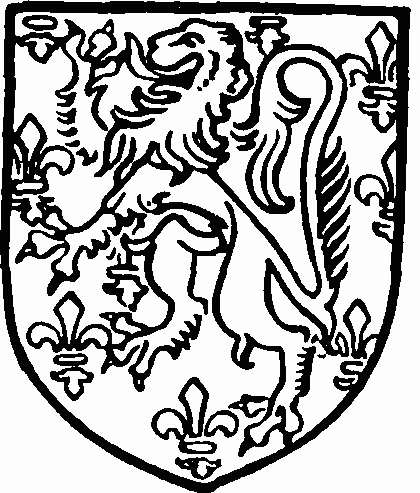
Beaumont. Azure powdered with fleurs de lis or a lion or.
The land in Seacourt which belonged to Studley Priory was conveyed in 1540 with the chapel to Sir John Williams, (fn. 55) and was so joined to the manor.
Church and Advowson
The church of Seacourt was in existence in the year 1200, when it was granted by Robert de Seacourt to the Prioress of Studley in Oxford shire. (fn. 56) His descendant Sir William de Seacourt, in a grant of land there to the priory, covenanted that if any other land should fall into his hands by right of villeinage it should be subject to tithe. (fn. 57)
In 1218 an agreement was made between the Prioress of Studley and the Abbot of Abingdon with regard to the tithes of Seacourt. (fn. 58) Its purport is not very clear, (fn. 59) but no doubt it explains the pension of 3s. which was due from this church to the abbot in 1291, (fn. 60) and appears again in the sacristan's accounts of 1396–7. (fn. 61) At some time before 1396 the church must have been appropriated to the priory and a vicarage ordained. (fn. 62) In 1439 the vicarage was pronounced to be 'without cure' on the ground that the church had collapsed and that there were only two inhabited houses. (fn. 63) In 1535 the church was called 'a free chapel of the foundation of the lady of Studley.' (fn. 64)
After the Dissolution the priory of Studley with all its possessions in Seacourt was granted to John Croke. (fn. 65) He had licence in 1540 to alienate the chapel, with the tithes belonging to it, to Sir John Williams. (fn. 66) At this date Seacourt had probably dwindled to something near its present size, and there was no more need for a church. At all events, when the chantries were surveyed in 1546, the 'chapel' was stated to have been dissolved by Sir John Williams. (fn. 67) It was described as a free chapel founded within the manor to find a priest to sing there for the ease of the inhabitants. The salary of the incumbent was provided out of the tithes. (fn. 68)
It appears from the endorsement of a 13th-century charter of William de Seacourt that the church was dedicated to St. Mary. (fn. 69)
There do not appear to be any endowed charities in this parish.