A History of the County of Buckingham: Volume 2. Originally published by Victoria County History, London, 1908.
This free content was digitised by double rekeying. All rights reserved.
'The parishes of Risborough hundred: Bledlow', in A History of the County of Buckingham: Volume 2, ed. William Page (London, 1908), British History Online https://www.british-history.ac.uk/vch/bucks/vol2/pp247-253 [accessed 1 May 2025].
'The parishes of Risborough hundred: Bledlow', in A History of the County of Buckingham: Volume 2. Edited by William Page (London, 1908), British History Online, accessed May 1, 2025, https://www.british-history.ac.uk/vch/bucks/vol2/pp247-253.
"The parishes of Risborough hundred: Bledlow". A History of the County of Buckingham: Volume 2. Ed. William Page (London, 1908), British History Online. Web. 1 May 2025. https://www.british-history.ac.uk/vch/bucks/vol2/pp247-253.
In this section
HUNDRED OF RISBOROUGH
BLEDLOW
Bledelai (xi cent.); Bledelaw (xiii cent.).
Bledlow parish lies on the western boundary of
Buckinghamshire. It is nearly separated from the
other parishes in the Three Hundreds of Aylesbury by
a piece of Desborough Hundred, which lies between
the parishes of Bledlow and Horsenden. The southern
end of the parish lies on the Chiltern Hills, and is
called Bledlow Ridge, being between 600 ft. and
800 ft. (fn. 1) above the Ordnance datum. The lower
Icknield Way runs parallel to the line of the high
ground from north-east to south-west, along the north
and west sides of the parish, and the village and
church stand back from it about half a mile on the
lower slopes of the hills. Close to the east end of
the church is a steep wooded combe called the Lyde,
in which several springs break out from the chalk and
form a small pool. The nearness of the church to
the steep banks of the combe has suggested a local
rhyme—
They that live and do abide
Shall see the church fall in the Lyde,
but fortunately this disaster does not seem very
imminent. The brook running from the pool is
called the Lyde Brook, and is used for two papermills, Bledlow Mill and North Mill. The western
boundary of the parish is formed by Cuttle Brook,
which runs south to the River Thame.
The higher slopes of the hills are in parts well wooded, and in one of the open spaces, on the north slope of Wain Hill, is the Bledlow Cross, cut in the turf, and visible for miles as a landmark. (fn. 2)
The village is picturesque, its small houses, surrounded by gardens, lying for the most part along the side of the hill, but there are outlying houses in the lower ground on the side roads which join the Icknield Way.
The subsoil on the hills is chalk, and in the northern part of the parish Upper Greensand and Gault. (fn. 3) The surface soil is partly chalk loam, and partly stiff clay. The inhabitants are mainly engaged in arable farming, the parish containing 2,694¼ acres of arable land, and 963 acres of permanent grass. (fn. 4) There are several popultry farms, and in the Lyde there are watercress beds. The paper-mills of Mr. A. H. James provide occupation for part of the population. Both the Upper and Lower Icknield Ways pass across the parish, and the Wycombe branch of the Great Western Railway runs through it, with a station one mile to the north of Bledlow village. There are six hamlets in the parish. Of these Bledlow Ridge has been formed into a separate ecclesiastical parish since 1868. The other hamlets are Pitch Green, Rout's Green, Forty Green, Skittle Green, Holly Green. The whole civil parish contains 4,168½ acres. (fn. 5)
Amongst the vicars of Bledlow the name of Timothy Hall (1637?–90) occurs. He held the livings of Horsenden, Princes Risborough, and Bledlow in succession, being presented to the last named in 1674. Three years later he became rector of Allhallows Barking. He published the Royal Declaration for Liberty of Conscience in 1687, and the next year became titular Bishop of Oxford. He was consecrated, but the canons of Christ Church refused to install him. On the accession of William of Orange he refused to take the oaths, but yielding at the last moment retained his titular bishopric until his death. (fn. 6)
Manors
In the time of King Edward the Confessor, Edmer Atule, one of the royal thegns, held the manor of BLEDLOW, and could sell it at will. (fn. 7) William the Conqueror, however, granted it to his half-brother, Robert, Count of Mortain, who held it in 1086. (fn. 8) William the son of Count Robert joined the rebellion of Robert of Bellesme against Henry I, and in consequence forfeited his lands in 1104. (fn. 9) The honour of Mortain was known in Buckinghamshire and the neighbouring counties as the honour of Berkhampstead, (fn. 10) but it seems probable that Bledlow was separated from the honour, since it was held, at least from the time of Henry II, from the king in chief, (fn. 11) and not from the various grantees of Berkhampstead. (fn. 12)
The privileges attaching to the honour of Mortain however still continued in Bledlow. (fn. 13) Henry II appears to have granted the manor to Hugh de Gurnay before 1177, (fn. 14) but in 1198 Hugh made an exchange (fn. 15) with the monks of Bec Hellouin in Normandy, by which the manor passed to that alien abbey, and was held in frankalmoign (fn. 16) in chief of the king. (fn. 17)
The priory of Ogbourne was an English cell of the abbey of Bec, and the prior seems to have answered for its English lands, and at times was described as lord of the manor. (fn. 18)
During the French wars of the 14th and 15th centuries the lands of the alien priories were seized by the king, and Ogbourne was ultimately dissolved by Henry V. He granted the manor of Bledlow to his brother John, Duke of Bedford, (fn. 19) who died in 1435, (fn. 20) when it passed to Henry VI as his nephew and heir. In 1462 the king granted it to his new foundation, the College of St. Mary, Eton, (fn. 21) the provost and fellows of which college are at the present day the lords of the manor.
In the 15th century the Hampdens, of Great Hampden, held CORHAMS MANOR in Bledlow under the provost and fellows of Eton College. (fn. 22) Thomas Hampden died seised of the manor in 1485. (fn. 23) His grandson John Hampden settled it on his younger daughter and co-heiress Barbara, the wife of Sir George Paulet, (fn. 24) who obtained various confirmations of the grant from the members of the Hampden family. (fn. 25)
In 1585 Hampden Paulet (fn. 26) sold this manor to Roger Corham, and in 1624. it was held by William Corham and his wife Jane. (fn. 27) They sold it in the same year to Alban Pigott and Ralph Pigott of Colwich, (fn. 28) in the parish of Waddesdon. Alban Pigott apparently left three daughters, (fn. 29) but which of them inherited Corham's manor does not appear. Daniel Cox, jun., held the manor in 1703, (fn. 30) but some years later he sold it to Richard Badcock. (fn. 31) The last mention of the Badcocks is in 1823, when John Lovell Badcock, with Anne and Susannah, probably his sisters, made a settlement of the manor. (fn. 32) The family of Spiers also seems to have had some interest at this time in Corham's manor. William Spiers, lessee of the manor, (fn. 33) subscribed to the building fund of the chapel at Bledlow Ridge. In 1823 Thomas Spiers was a party to the settlement made by the Badcocks. (fn. 34) It seems probable, however, that he was only a lessee under the Badcocks, though he may have owned other land in the parish. About 1826 the manor was sold, possibly by the Badcocks, to Captain Wood, who seems to have held it for more than thirty years. (fn. 35) The present owner of the manor is Mr. Robert White, of Chinnor, Oxon, but the land is for the most part enfranchised. (fn. 36)
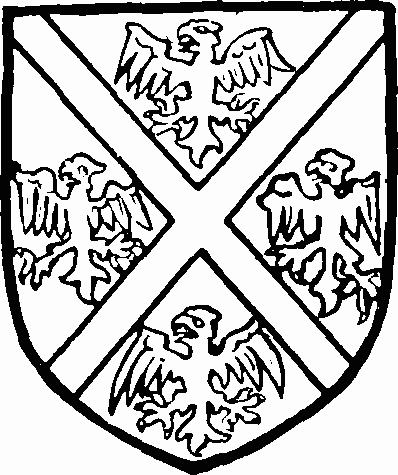
Hampden. Argent a saltire gules between four eagles azure.
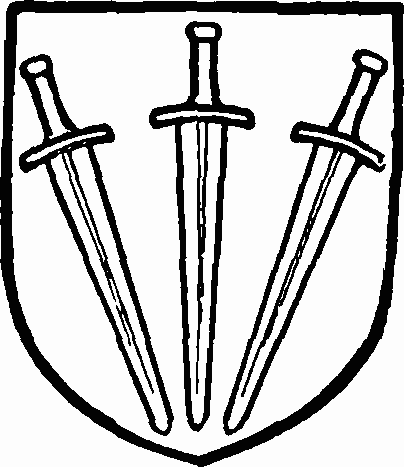
Paulet. Sable three swords set pilewise with their hilts or.
Hugh de Gurnay appears to have kept certain tenements in Bledlow after the exchange made with the Abbot of Bec, since Juliana, the heiress of the Gurnays, was summoned, when still a minor, to give warranty for certain lands in the parish. (fn. 37) She married William Bardolf, and in 1285–6 she and her husband attempted to recover the manor from the Abbot of Bec. (fn. 38) She claimed all the manor with its appurtenances except 5 messuages, 1 mill, and 2 carucates of land, which presumably she already held. Finally the abbot obtained a quit-claim from Juliana and William Bardolf for 200 marks sterling. Her descendants held rents in Bledlow without interruption till the beginning of the 15th century, when Sir Thomas Bardolf held the tenements above alluded to. (fn. 39) The lands retained by Hugh de Gurnay were the fees of Odo of Bramoster and of John de Turri, who presumably were military tenants. (fn. 40) In 1180, before the grant to Bec, John de Turri paid 10 marks for confirmation of his land in Bledlow. (fn. 41) In 1228 Richard de Turri, together with the Prior of Ogbourne, brought an action with regard to common rights over their lands in Bledlow. (fn. 42)
The whole manor of Bledlow, which was granted to the Count of Mortain by the Conqueror, does not seem to have been included in the grant to Hugh de Gurnay. (fn. 43) The family of de Rual or Druel held certain land, afterwards known as MESLES or DRUELS, in Bledlow, of the honour of Mortain in the 13th century. Simon de Rual paid scutage for land in Bledlow in 1236. (fn. 44) This tenement seems to have been the hamlet of Mosleye or Mesle, which John Druel held in 1284–6 (fn. 45) and in 1302–3. (fn. 46) His son John Druel made a settlement in 1333 of the messuage and rents in Bledlow, (fn. 47) by which there were remainders to Giles son of John Druel, and his wife Amabel daughter of Thomas de Reynes and their issue, and in default to William brother of Giles and his wife, another daughter of Thomas de Reynes. It is not clear whether Giles and William were the sons or brothers of John son of John Druel. In 1346 this John and Roger Puttenham held the fee formerly held by John Druel, (fn. 48) but after this date the name of Druel disappears. Like the manor of Horsenden, (fn. 49) this land has a complicated history during the Wars of the Roses. The manor of Mesles or Druels, as it was called in the 15th century, appears to have come into the possession of Edmund Hampden and John Brekenoke. (fn. 50) They demised it in 1458–9 to Sir John Fray and William Brown, (fn. 51) who in turn granted it to John Leynham or Plomer and his wife Margaret. (fn. 52) Various releases and sales were afterwards made, (fn. 53) and in 1528 the manor had passed into the possession of Sir Edward Don. (fn. 54) He left an only daughter and heiress who married Sir Thomas Jones, (fn. 55) and his lands descended to his two granddaughters Frances and Anne. In the division of their shares of their property the manor of Druels came to Frances, the wife of Ralph Lee. (fn. 56) Together with their son and heir Edward Donne Lee they settled the manor on Thomas Lee, (fn. 57) who died seised in 1572. (fn. 58) It then reverted to Edward Donne Lee, who sold it to William Quarendon. (fn. 59) In 1583 Quarendon and his wife Margaret held the manor. (fn. 60) Afterwards it was divided, presumably between two heiresses, since John Franklyn in 1640 died seised of half the manor or farm of Mesles or Druels. (fn. 61) The only trace of this manor to be found in recent times was a wood named Druels Wood, near Bledlow Ridge, which has now been grubbed up.
In the 14th century the family of Fresel held an estate known as FRAYSELLES in Bledlow. James Fresel in 1316–17 made a settlement, by which he settled this on himself for life, with remainder to James his son and his issue; in default with remainder to another son, Thomas. (fn. 62) This James Fresel was a man of some importance in the county, being a knight of the shire in 1329. (fn. 63)
He also obtained an indult from Pope John XXII, that his confessor should give him plenary remission at the hour of death, (fn. 64) and by his will left valuable bequests to the church of Bledlow. (fn. 65) His father's name was Robert, but he does not appear as tenant of land in Bledlow. (fn. 66) In his will dated 1341 James Fresel named only two sons, Edmund and James, (fn. 67) but Thomas appears in the settlement mentioned before, and was probably his father's heir, since he succeeded to the greater part of the estates before 1343. (fn. 68)
Elizabeth daughter of Thomas Fresel claimed various tenements that her father had held in neighbouring parishes in 1364 or 1365, and presumably was his heiress. (fn. 69) Some years later Richard ap Yenan held lands and tenements called 'Freselles,' in Bledlow, (fn. 70) but it does not appear how he obtained them. In 1524 Walter Curzon died seised of the manor of Frayselles, (fn. 71) which afterwards came into the possession of George, Earl of Huntingdon, who sold it to Sir Michael Dormer and John Goodwyn in 1537. (fn. 72) The Dormers held the manor (fn. 73) till 1584–5, when a sale took place of the site of the manor of Frayselles, which came into the hands of Edward East. (fn. 74) This sale probably included the whole manor, which was held from this time by the lord of the Rectory Manor (q.v.), and was apparently united with it. (fn. 75) In the 15th century the manor was held of the Rector of Bledlow, (fn. 76) at that time the Dean and Chapter of the Free Chapel of St. Stephen, Westminster. (fn. 77) After the Dissolution, however, it was apparently separated from the rectory, and held, in Queen Elizabeth's reign, of the honour of Ewelme by fealty and rent. (fn. 78)
There seems to have been a RECTORY MANOR of considerable size in Bledlow. There is no specific mention of it until after the Restoration, though the Fresels' property was said to be held of the rector in the 15th and 16th centuries. (fn. 79) It evidently belonged first to the abbey of Grestein, and subsequently to the Free Chapel of St. Stephen, Westminster. (fn. 80) After the Dissolution the Rectory was granted to Thomas East and Henry Hoblethorne, who, however, surrendered their lease in 1552. (fn. 81)
Edward VI then gave a lease for twenty-one years to Thomas Forster, (fn. 82) but in 1562 or 1563 Queen Elizabeth granted the Rectory to William Revett and Thomas Bright and their heirs to hold in chief. (fn. 83) The following year, however, they had licence to alienate it to Edward East. (fn. 84) He made a settlement in 1609, (fn. 85) by which it was held by him for his own life, then to the use of Cecilia his wife for her life, then to the use of the executors of his will for one year, and then to the use of Edward Fitz Herbert. (fn. 86) Fitz Herbert predeceased Edward East and Brigit Fitz Herbert, (fn. 87) probably his widow. She seems to have married Sir Edmund Windsor, and to have held the Rectory in 1630. (fn. 88) William Fitz Herbert is mentioned at the same date, (fn. 89) and he and his wife Anne held it afterwards. He was sequestered during the Civil War as a recusant, and compounded for Bledlow Parsonage for £200 in 1647. (fn. 90) He seems, however, to have sold it to William Brereton and James Blanks. (fn. 91) The former was one of the trustees of Sir John Fitz Herbert, father of William Fitz Herbert. (fn. 92) Great efforts seem to have been made by William Fitz Herbert to preserve his lands by various sales, (fn. 93) but William Starbuck, minister of Bledlow and his parishioners made complaints against him for compounding for his estates in the parish at an undervaluation. (fn. 94)
Their object seems to have been to obtain possession themselves, for they offered to pay £300 for the Rectory. (fn. 95) After many inquiries Brereton and Blanks succeeded in establishing their claim, and their lease was judged good by Chief Justice St. John at the Assizes. They were, therefore, discharged by the Committee for Compounding. (fn. 96) John Blanks retained possession of the Rectory after the Restoration, (fn. 97) when the estate was called 'the manor of the Rectory of Bledlowe.' (fn. 98) His granddaughter and heiress married Johnshall Crosse. (fn. 99) She was succeeded by her son Henry, (fn. 100) who married Elizabeth Jodrell, (fn. 101) and their fourth son Thomas held the manor in 1745. (fn. 102) He died without children, his heir being his sister, the wife of William Hayton. (fn. 103) Her daughter married Samuel Whitbread, who succeeded to the estate on the death of his mother-in-law. (fn. 104) Their son, another Samuel, sold the manor in 1801 to Lord Carrington, (fn. 105) whose successor holds it at the present day.
At the time of the Domesday Survey there was one mill in the parish, which yearly yielded to the lord of the manor twenty-four loads of malt. (fn. 106) It was presumably the same mill that Hugh de Gurnay excepted from the grant of the manor to the abbey of Bec, and which at that date, 1198, was held by Simon Hochede. (fn. 107) In 1240–1 Alice, widow of Simon, sued William Neirnuit for the third part of certain tenements, a mill with its appurtenances being specified. (fn. 108) A second Simon, the heir, was in wardship and Juliana de Gurnay, also a minor, was the overlord of the tenements in question. (fn. 109) Some years later Nicholas Hochedee appears in a suit as to land in Bledlow, but the mill is not mentioned; (fn. 110) in 1304, at the death of Hugh Bardolf, the rent of a water-mill was held by Christiana, daughter of Reginald de Hampden. (fn. 111)
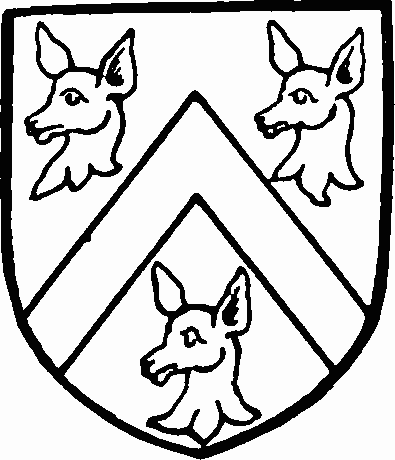
Whitbread. Argent a cheveron between three hinds' heads razed gules.
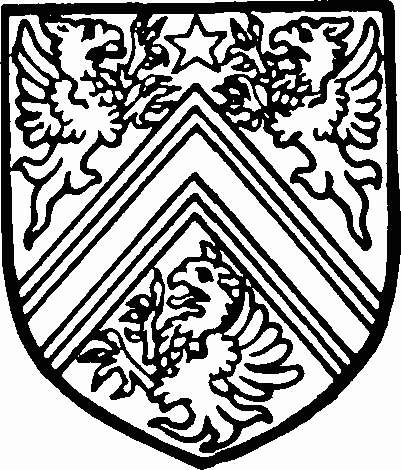
Carrington. Or a cheveron coupleclosed sable between three demigriffons sable, the two in the chief face to face, with a molet gules for difference.
In the 13th century the Abbot of Bec claimed to hold view of frankpledge, gallows, waifs, and other regalia in the manor of Bledlow, basing his right on the grant of Hugh de Gurnay, his feoffor, and its confirmation by Henry II. (fn. 112)
Churches
The church of THE HOLY TRINITY consists of a chancel 31 ft. by 16 ft. 6 in., a nave 44 ft. 11 in. by 15ft. 11 in., north and south aisles respectively 8 ft. 9½ in. and 10 ft. 10 in. wide, a western tower 13 ft. 6 in. by 13 ft. 4 in., and a south porch.
There is evidence of the existence at the east end of the present north aisle of a late 12thcentury transept, parts of its north and east walls remaining; to the east of it there seems to have been a chapel, entered through an archway, the south respond of which is still in position. At this time the church was probably cruciform in plan, consisting of a chancel, central tower, transepts, and a nave about thirty feet by fourteen feet, the western wall of which coincided with the position of the east wall of the present tower. During the course of the 13th century almost the whole structure was rebuilt, the first work undertaken being the north arcade and aisle of the nave. The south arcade and aisle were probably added immediately afterwards, the central tower being destroyed and a new tower begun at the west. Towards the end of the 13th century the chancel was rebuilt and enlarged to its present size, and the present tower was completed, the aisles being extended to its western wall. After this there were no further additions to the plan except that of a south porch in the 14th century, but windows were inserted at various points. The old high-pitched roof was removed, probably at a late date, and the existing roof substituted for it. The present clearstory windows appear to be completely modern, but the walls in which they are inserted belong to the 13th century, and the windows themselves may have had prototypes of that date.
The east window of the chancel is of 13thcentury date, and consists of three shafted lancets with an internal reveal, the shafts having moulded circular capitals and bases. The lancets are of two chamfered orders, and stilted. In the north and south walls are small niches, with trefoiled heads, of 15th-century date, though much restored. That to the south is a piscina, and the other now contains the brass of William Herne, priest, 1525. Of the three windows in this wall, the eastern is a single trefoiled light and the second of two trefoiled lights with a sixfoil over, both probably of the date of the wall. That to the west is continued as a recess below its sill, and pierced for a low side window. A scroll-moulded string runs along the wall, and is broken downwards just west of the middle window, at which point is inserted a crocketed and finialled pinnacle of later date. The westernmost window of the south wall is of the same general design and date as the middle window of the north, but differs in having a moulded rear arch and shafted jambs to its inner reveal, with circular moulded capitals and bases. Further to the east is a window of two trefoiled lights with a quatrefoil over, of somewhat earlier type than the others, and between the windows is a blocked priest's door, which is hidden by the organ, but externally is of 18th-century date, with white marble shafted jambs and moulded two-centred head of poor imitation Gothic detail. Below the window there is the same string-course as on the north, with an inserted pinnacle opposite to that in the north wall. Their intention is not clear, as they are so near to the west of the chancel.
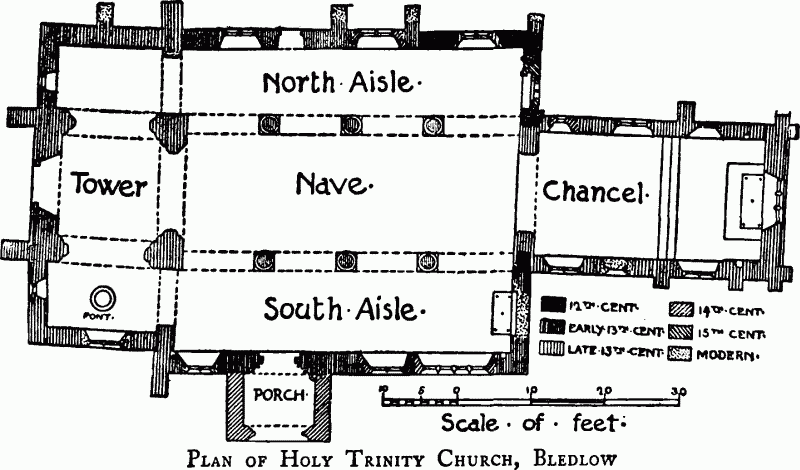
Plan of Holy Trinity Church, Bledlow
The chancel arch is of mid-13th-century date, of rather blunt two-centred form and two square orders, with a plain roll label on the west side. Just above the haunches of the arch are two early 15th-century head corbels as supports to a rood beam which ran across the top of the arch, the label being cut away to allow for this. At the spring the label is also cut away to allow for the rood loft, here supported upon plainer corbels. The jambs of the arch are plain, with a stopped chamfer, and the inner order is supported on moulded half-octagonal capitals with corbels under, carved into a face.
The nave is of four bays, and though the south arcade is a trifle later than the north, the detail throughout is the same. The arches are two-centred, of two square orders, with a plain roll label towards the nave. The columns are round, with circular moulded bases on square plinths, and bell-shaped capitals enriched with beautiful cinquefoiled and trefoiled leaves in relief, and with octagonal abaci square edged above. The capitals are all of the same general style, but in some the leaves lie close to the bell and in others are undercut. There are no responds, but the arches at the ends of the arcades spring from corbels with semi-octagonal capitals. The corbels on the north are plain, but on the south are foliated in the same way as the capitals.
The clearstory windows are modern, of three trefoiled lights under a flat lintel, but the openings are old. They are six in number, three on either side of the nave.
In the external angle between the north aisle and chancel is the south respond of a 12th-century opening to a chapel east of the transept of the earlier church, with a chamfered and beaded abacus. The arch has completely disappeared, but a straight joint in the east wall of the aisle on the outside suggests the line of the north wall of this chapel, while a partly built-up recess on the inside is evidently the opening from the transept to the chapel. In this recess has been inserted a late 14th-century window of two trefoiled lights, with a square head and trefoiled spandrels. To the north of this window is a rich but mutilated canopied niche of early 15th-century date. In the north wall are three two-light windows. The first and last are of similar design and date to the south-east window in the chancel. Between them is a mid-14th-century window of two trefoiled lights with flowing tracery and a quatrefoil over. A little west of this is a small north doorway of early 13th-century date, with a semicircular head of one square order and rather roughly-moulded abaci. At the west end of the aisle is a half-arch buttressing the east tower arch, so much restored as to appear modern.
The south aisle has a blocked east window, which was apparently a late insertion; externally the wall has been refaced. At the east end of the south wall is a piscina with a plain two-centred chamfered head, and in the same wall are three windows. The first from the east is a very fine example of early-14thcentury date. It is of four lancet lights, with trefoiled subheads and oval quatrefoils in the lancets, the jambs, head, mullions, and tracery being moulded internally and externally, and there is an external label. Partly under it is a mid-14th-century tomb recess with jambs and a low pointed arch of two wave-moulded orders. The second window is of the same design and date as the window opposite to it in the north aisle. The south door, immediately west of this window, is of the same date as the arcade, with a two-centred head of three moulded orders, the inner being continuous and the outer pair resting upon detached circular shafts with moulded capitals and bases. The third window is of two uncusped lights, much restored, and is a 13th-century opening. At the west end of the original aisle is a half-arch similar to that on the north, but all of late-13th-century date. It is of two chamfered orders, and springs from a carved corbel capital.
The tower is of three stages, with a plain coped parapet resting on a fine corbel table with grotesque and mask corbels. The belfry openings, four in number, are of two uncusped lancet lights with a quatrefoil over, set in a moulded reveal with a two-centred head and a scroll label. In the second stage are three small lancets of two chamfered orders, and on the east face appears the steep weathering of the 13thcentury roof, the ridge of which reaches to the sill of the belfry openings. In the north, south, and east walls of the ground stage of the tower are arches opening respectively into prolongations of the aisles and to the nave. These arches are of two chamfered orders, the outer continuous and the inner resting upon half-octagonal pilasters with moulded capitals and bases. The west window in this stage is of two cinquefoiled lights, with cusped tracery over; the cusping has been mutilated, but the window is apparently of 14th-century date. The west door, of somewhat later date, has continuous wave-mouldings of two orders, with an external label.
The part of the north aisle flanking the tower is lit by a small 14th-century trefoiled light in the west wall. The corresponding space on the south of the tower is used as a baptistery, and is lit on the south by a modern window of two trefoiled lights, and on the west by a small, much-restored round-headed window of doubtful date.
The south porch has a wide outer arch of two moulded orders, of good 14th-century detail, and the porch has stone benches on the east and west, and at the north-east a small square holy water stone.
The font is of late 12th-century date, of local type, with a circular scalloped bowl on a square base formed like an inverted cushion capital and ornamented with foliage in lunette panels, and the short stem is circular, with cable mouldings. The roofs throughout are very plain, of low pitch, covered with lead, and may possibly be of 15th-century date. There are no pews, the nave and aisles being filled with chairs, and the chancel stalls, rood screen, and pulpit are modern. At the east end of the south aisle is a 17th-century altar table and a late carved wood eagle lectern. In the same place is preserved a curious 18th-century carved wooden candle and candlestick. The candle is painted, and the candlestick with its clawed foot and the candle-flame are gilt. (fn. 113)
The brass already referred to in the chancel bears the figure of a priest in mass vestments and the inscription: 'Hic jacet dñs Willm Herñ in artibus baculari' nuper vicarius istius ecclie qui obiit anno dni millmo quingetesimo xxv. cuius aĩe propicietur deus amen.'
There are considerable traces of painting throughout the church. Over the chancel arch was a painting of the Doom, and on the walls of the nave are traces of an early vine design and a masonry pattern. On the north wall of the north aisle is a large figure of St. Christopher. There is very little painted glass, but the quatrefoil in the head of the window to the south-west in the chancel is complete in 14thcentury glass of conventional design.
The tower contains five bells, the treble dated 1636, and the second, third, and fourth 1683, the last bearing the inscription 'Richard Keene cast this ring.' The fifth was cast by W. & J. Taylor in 1842.
The church plate comprises an Elizabethan cup of 1569; a salver, the gift of John Cross in 1693, hallmarked for 1689; a small standing paten of which the date letter is almost illegible, but appears to be that for 1668; a flagon inscribed as the gift of John Blankes in 1672, and hall-marked for the same date; and a plated cup.
The first book of the registers contains all entries between 1592 and 1706 except in the case of burials, which run to 1705. The second contains all entries between 1707 and 1755 excepting marriages, which run to 1752. A third book has marriages between 1754 and 1787; a fourth baptisms and burials between 1756 and 1812, and a fifth marriages between 1787 and 1812.
The church of St Paul, Bledlow Ridge, is built of flint with Bath stone dressings in the 13th-century style. It consists of chancel and nave with south porch and western bell-turret containing one bell. It was consecrated in 1868, but the register dates from 1861.
Advowson
The church of the Holy Spirit is mentioned in 1284, (fn. 114) and the same invocation appears in James Fresel's will in 1341, (fn. 115) but at the present day it has been changed to the church of the Holy Trinity. It was granted to the abbey of Grestein in Normandy in the time of Robert Count of Mortain. (fn. 116) As lord of the manor of Bledlow he granted certain tithes from his demesne lands to the abbey, then the patron of the church. The English possessions of this house were held by the Prior of Wilmington, and were seized by Edward III as part of the temporalities of an alien house before 1338 during the French War. (fn. 117) The Abbot of Grestein, however, in 1358 or 1359 granted to John Taleworth, burgess of Wycombe, and his heirs an annuity of £50 and the advowson of Bledlow Church. (fn. 118) This grant can only have been enjoyed for a short time, if indeed at all, since in 1361 Edward III granted the church to the Free Chapel of St. Stephen, Westminster. The vicarage was ordained in 1405 under Bishop Repingdon, and appropriated to St. Stephen's. (fn. 119)
After the dissolution of the Free Chapel the rectory and advowson of the church were granted to Thomas East and Henry Hoblethorne, (fn. 120) since which time the advowson has always been held by the lay rectors.
James Fresel in 1341 bequeathed £20 for covering the chapel of St. Margaret at Bledlow with lead, and various smaller sums for the maintenance of lights there in the church of Bledlow. (fn. 121) No further mention of this chapel is found, but in 1590 a chapel at Bledlow Ridge, with a close called the 'chappel yard,' was granted to 'fishing grantees,' so that apparently it had fallen into disuse before that date. (fn. 122) No mention of it occurs in the Buckinghamshire Chantry Certificates, so that it was apparently not merely a chantry chapel. A chapel was built in 1834 for the inhabitants of the hamlet of Bledlow Ridge. It was formed into the separate ecclesiastical parish of St. Paul's, and was endowed out of the Common Fund in 1868 and 1870. (fn. 123) The living is a vicarage in the gift of the Peache trustees.
There are two Wesleyan chapels in the parish, one at Bledlow and the other at Bledlow Ridge.
Charities
In 1618 Henry East by his will, proved in the Archdeaconry Court of Buckingham, charged his tenement and close, called Picked Close, with an annuity of 20s. for four poor widows at Lady Day and Michaelmas. The annuity is paid by Mrs. Saunders of Maidenhead, the owner of the property charged, and 5s. a year is given to each of four poor widows.
This parish is entitled to share in Henry Smith's General Charity. In 1906 the sum of £9 was allotted from the Thurlaston estate, Leicestershire, and applied in the distribution of seventeen pairs of blankets.
In 1671 John Blanks by will demised certain lands in the parish, the rents after payment of 10s. to the vicar for a sermon on 27 December yearly, and 2s. 6d. to the parish clerk, to be distributed in bread. The property now consists of 3 a. or. 38 p., known as Ford's Close, let at £4 10s. a year, and 2 a. 1 r. 17 p. adjoining the workhouse school gardens, known as the Poor's Piece, let to twenty-two allotment holders, producing £7 3s. a year. The distribution in bread is made in conjunction with the income of Edmund Slaughter's Charity mentioned below.
In 1672 Margaret Babham by will directed that £100 should be laid out in land, and that out of the profits 40s. a year should be applied in providing two poor men and two poor women with coats to be marked with her initials M. and B., and 10s. to the vicar for a sermon on the anniversary of her burial, 30 April 1672 (old style) and 2s. to the parish clerk for keeping her tomb clean. The principal sum became a charge on a farm in the parish known as Sand-pit Farm, now belonging to Mr. R. White, who pays the fixed sum of £2 12s. a year. By an order of the Charity Commissioners made under the Local Government Act, 1894, the endowments of this and the preceding charity for ecclesiastical purposes were separated from the charities for the poor, and trustees appointed for their respective administration. In 1905 the sum of 40s. was applied in the distribution of flannel to twelve poor people, chiefly women.
In 1831 Edmund Slaughter by his will, proved in the P.C.C. on the 26 July, directed his executors to invest £100 in the public funds, the income to be applied in the distribution of bread. The trust fund consists of £119 6s. 8d. consols, with the official trustees, and the annual dividends, amounting to £2 19s. 8d., were in 1906 applied, with the net income of John Blanks' Charity mentioned above, in the distribution of 639 loaves.
Charity of Elizabeth Eustace.—See under Princes Risborough. The sum of £1 3s. is received yearly from the trustees, of which £1 is applied in the distribution of four sheets at 5s. each, and 1s. is retained by each of the three local trustees in pursuance of the directions in the deed.
The Coal Charity, otherwise the Poor's Land, consists of about 26 acres, including five cottages known as the Colony Cottages, awarded to the poor in 1812 under the Bledlow Inclosure Act, producing about £30 a year. In 1906 a distribution of 30 tons of coal was made.