A History of the County of Buckingham: Volume 2. Originally published by Victoria County History, London, 1908.
This free content was digitised by double rekeying. All rights reserved.
'Parishes: Great Hampden', in A History of the County of Buckingham: Volume 2, ed. William Page (London, 1908), British History Online https://www.british-history.ac.uk/vch/bucks/vol2/pp287-291 [accessed 30 April 2025].
'Parishes: Great Hampden', in A History of the County of Buckingham: Volume 2. Edited by William Page (London, 1908), British History Online, accessed April 30, 2025, https://www.british-history.ac.uk/vch/bucks/vol2/pp287-291.
"Parishes: Great Hampden". A History of the County of Buckingham: Volume 2. Ed. William Page (London, 1908), British History Online. Web. 30 April 2025. https://www.british-history.ac.uk/vch/bucks/vol2/pp287-291.
In this section
GREAT HAMPDEN
Ha(m)dena (xi cent.); Magna Hamden (xiv cent.).
The parish of Hampden lies on the slopes of the Chiltern Hills, the greatest height being 711½ ft. above the ordnance datum at Hampden House. The subsoil is chalk, (fn. 1) and the surface clay and gravel. The inhabitants are chiefly occupied in farming, 1,128¼ acres being arable land and 470¼ permanent pasture. There are 408¼ acres of wood in the parish. (fn. 2) A road from Aylesbury to Amersham passes through the parish. There is practically no village, the people living in scattered farms and cottages. The nearest stations are at Princes Risborough and Great Missenden. There is a common in the southern part of the parish, lying near Blakemore Farm, and various springs give an excellent supply of water, but there are, however, no brooks of any kind. The earthwork known as Grim's Dyke can be traced for some distance not far from Hampden House. In 1885 portions of Little Hampden and Stoke Mandeville parishes were formed into the civil parish called Great and Little Hampden by Local Government order, dated 25 March of that year.
The principal house in the parish is Hampden House, situated high on the Chiltern Hills in a breezy and open park-like country. Though rich in associations and possessing many traces of old work, successive additions, particularly those of the 18th century, have left only fragments of the earlier plans. As it stands to-day, it is an E-shaped building facing south, with a large east wing running north and south. The principal entrance to the house is on the north side of the main building. The oldest part is the central projection of the E; it is at least as old as the first half of the 14th century, and according to local tradition was originally a tower, though the walls, some three feet thick, do not confirm the idea. It is of two stories, with a modern embattled parapet projecting on corbels, below which is a flat band of trefoiled arches, probably an 18th-century addition, which runs round the whole house at this level. In the south face of this building is a wide 15th-century entrance doorway, but the inner doorway, which leads to the body of the house, is of mid-14th-century date with the characteristic wave-mould and hollow. The rear arches of the windows of this room are also of the same date. The body of the house dates, as far as can be seen, from the beginning of the 17th century, and is separated from the older portion by a space of some eighteen inches or more. It is of two stories and an attic, with wooden-mullioned windows, and fine stacks of brick chimneys with octagonal shafts, and contains in its eastern half the hall and the great staircase, both of 17th-century date, but greatly altered and 'embellished' in the 18th century, and again later in comparatively modern times. The hall runs through two stories, having balustraded galleries on all sides on the first-floor level; its walls are panelled and hung with portraits, and it has a coved plaster ceiling. The kitchens and offices lie to the west of the hall. The large east wing of the house was completely altered in character by Robert, afterwards first Viscount Hampden, about 1760, at which time, or possibly later, almost the whole of the exterior of the house was coated with cement. This wing contains the present dining-room, with a bedroom beyond it to the north, a large drawing-room in the middle of the wing, with smaller rooms north and south of it, and at the south end the old dining-room, now a billiard room. A passage runs along the west side of the wing, being made at the expense of the series of rooms, which were arranged after the fashion of the day, to open one to another. They contain some fine plaster ceilings and interesting examples of Chinese wall papers, the bills for which were recently discovered amongst some old documents, and are dated 1740. In the bedroom at the north end of the wing is a fine Chippendale bed, in which tradition says that Queen Elizabeth once slept; the claim has probably been transferred from some older bed formerly here. Hampden House contains many interesting portraits of the Hampdens and Hobarts, and also of many great people from the 16th century on. There are full-length portraits of Queen Elizabeth and Queen Henrietta Maria, of Oliver Cromwell, Bishop Bonner, Sir Kenelm Digby, and others. Of John Hampden 'the patriot,' with whose name the chief interest of the house must ever be associated, there are several relics. A silver cup, dated 1568, is preserved as that from which he received the Holy Sacrament before his death in June 1643; a long room in the attic story is called John Hampden's Library, and the room in the angle between the hall and the east wing is said to be the scene of his arrest for refusal to pay the ship-money tax. There are two portraits of him in the house, one by Jansen coming from Strawberry Hill, but it seems doubtful whether they, or a small bust also here, are really what they claim to be.
The surroundings of the house are very picturesque, a splendid avenue of beech trees running eastwards down the slopes from the east wing, and close by to the south is the church of Great Hampden, approached from the road by another avenue.
Manor
There is only one mention of HAMPDEN in Domesday Book, and this in all probability refers to Great Hampden only. (fn. 3) Before the Conquest Baldwin, a man of Archbishop Stigand, held and could sell the manor of Hampden, but afterwards it formed part of the lands of William son of Ansculf. (fn. 4) With the rest of his lands it passed to the Somery family, and formed part of the honour of Dudley. (fn. 5) In 1302–3 it was held of John de Bernak of the honour of Dudley, (fn. 6) and in 1346 of Galfrid Bernak. (fn. 7) William son of Ansculf granted the manor to Otbert, or Osbert, who held it at the time of the Domesday Survey. (fn. 8) In a 17th-century pedigree of the Hampden family, Osbert is said to have been the son of Baldwin, the tenant in the time of Edward the Confessor, and the descent of the Hampden family is traced from him. (fn. 9) One name, however, in the pedigree does not coincide with the descent obtained from a lawsuit of the reign of Henry III. In the pedigree Osbert was succeeded in direct succession by Baldwin, Robert, and Bartholomew. In the lawsuit, Alexander appears instead of Bartholomew, his mother being Alice, the daughter and heiress of 'Remerus le Loherer.' (fn. 10) Alexander was followed by Reginald (fn. 11) and another Alexander, who held the manor, as one knight's fee, early in the reign of Henry III. (fn. 12) He was Sheriff of Bedfordshire and Buckinghamshire in 1249 and 1259. (fn. 13) He died between 1272–3 (fn. 14) and 1302–3, when he had been succeeded by his second son Reginald. (fn. 15) John de Hampden, the son of Reginald, held the manor in 1346, (fn. 16) and was a knight of the shire in two Parliaments of Edward III in 1351–2, and again in 1363. (fn. 17) He died in 1375, and his son Edmund inherited the manor, (fn. 18) and, like his father, represented the county in Parliament. (fn. 19) He was also sheriff of the two counties five times during the reigns of Richard II, Henry IV, and Henry V. (fn. 20) John Hampden, his son, succeeded him, (fn. 21) and obtained, in 1446–7, a charter of liberties within his manor of Great Hampden, granting him a view of frankpledge twice a year, with the assize of bread, wine, and ale, and other privileges. He also had a grant of free warren in his demesne lands, and licence to inclose and impark 500 acres of land and 100 acres of wood in the manor. (fn. 22) He was sheriff in 1456. (fn. 23) Thomas Hampden succeeded him in 1457–8, (fn. 24) and held the manor till his death, shortly after the accession of Henry VII. (fn. 25) His heir was his son John Hampden, (fn. 26) but the manor seems to have been in the hands of trustees or feoffees till 1495, when they demised it to John Hampden. (fn. 27) He died the next year, (fn. 28) and Great Hampden passed to his son John. (fn. 29) The second John Hampden was knighted before 1513, and in that year was with the royal fleet in command of The Saviour. (fn. 30) He also may be identified with the Sir John Hampden 'of the Hill' who followed Henry VIII to the Field of the Cloth of Gold, (fn. 31) and attended him at his meeting with the Emperor Charles V. (fn. 32) On his death in 1553 (fn. 33) he left two daughters as his heiresses, but he left Great Hampden by will to his cousin John Hampden, (fn. 34) the son of William Hampden of Dunton, and of Audrey one of the daughters and heiresses of Richard Hampden of Great Kimble. (fn. 35) John Hampden left the manor to his son Griffith in tail male, and the latter succeeded to it on his father's death in 1558. (fn. 36) He died in 1591, and it passed to his son William Hampden, (fn. 37) who married Elizabeth daughter of Sir Henry Cromwell and aunt of the Lord Protector. (fn. 38) He did not survive his father many years, dying in 1597, (fn. 39) and naturally had not taken so much part in the public life of the county as some of his predecessors. His will is interesting, and suggests that his life was mainly occupied with country pursuits, his horses being carefully described and generally bequeathed by name. (fn. 40) His son and heir John was a minor at the time of his father's death. (fn. 41) He afterwards became the most famous member of his family, earning the name of the 'Patriot' (fn. 42) by his refusal to pay the illegal tax of ship-money. He was born in London, but probably lived as a boy at Great Hampden. (fn. 43) He was sent for three years to the grammar school at Thame, and in 1609 became a commoner of Magdalen College, Oxford. (fn. 44) In 1613 he was admitted a student of the Inner Temple, (fn. 45) and six years later he married his first wife Elizabeth Symeon. The next year he was returned to Parliament for the first time, (fn. 46) and from 1625 to 1628 he represented the borough of Wendover without interruption. (fn. 47) In these years he mainly lived in London, and though sitting on many committees, did not take a leading part in Parliamentary affairs. Before the dissolution of 1629 he retired to the country and lived at Great Hampden. (fn. 48) There are, however, practically no records of his life there, his private letters that have been preserved being very few in number. He is said to have been fond of making improvements in his estates and house, and parts of the present house may have been built by him in 1629 and the succeeding years.
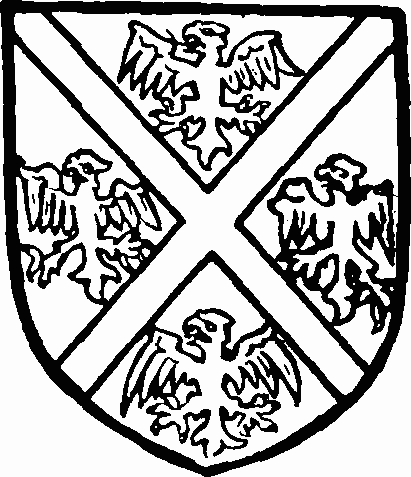
Hampden Argent a saltire glues between four eagles azure.
To Great Hampden the sons of Sir John Eliot frequently went during their father's imprisonment in the Tower. (fn. 49) Eliot himself received provisions from Great Hampden, one such present being sent with the following letter: 'This bearer is appointed to present you with a buck out of my paddock, which must be a small one to hold proportion with the place and soyle it was bred in.' (fn. 50) In the county he was active as a justice of the peace for the Three Hundreds of Aylesbury. (fn. 51) In 1634 he was presented at a special ecclesiastical visitation for not always attending his own parish church. His opposition to the Church of England and the bishops had not at this time become so pronounced as it did later, and he made his peace with Sir Nathaniel Brent, the vicar-general, promising his willing obedience to the laws of the Church in the future. (fn. 52)
Clarendon describes him at this time as being 'of ancient family, and a fair estate in the county Buckingham, where he was esteemed very much, which his carriage and behaviour to all men deserved very well. But there was scarcely a gentleman in England of so good a fortune (for he was the owner of above £ 1,500 land yearly) less known out of the county in which he lived than he was, until he appeared in the Exchequer chamber to support the right of the people in the case of ship-money.' (fn. 53) The determination, reached in 1636, to oppose the levy of ship-money severed the close connexion between John Hampden and his own parish. From that date he was rarely at Great Hampden, and after 1640 never lived there again. (fn. 54) On the outbreak of war he raised a regiment of Buckinghamshire infantry, and commanded it until his death. (fn. 55) At the battle of Chalgrove Field, where he was mortally wounded, he would not wait for his own regiment, but went as a volunteer with the troops that had already come up. (fn. 56) He died shortly after the engagement, and is supposed to have been buried in Great Hampden Church, but the places of his death and burial have been much disputed.
Richard Hampden, (fn. 57) the son of the patriot, succeeded his father in the family estates, (fn. 58) and shared his political opinions. He was, however, an ardent supporter of Oliver Cromwell and voted for his accepting the crown in 1656. (fn. 59) He was nominated in the same year a member of the Other House, and so incurred the satire of a republican pamphleteer, who ascribed his nomination to the desire 'to settle and secure him to the interest of the new Court and wholly take him off from the thoughts of ever following his father's steps or inheriting his noble virtues. . . .' (fn. 60) He sat in Parliament, either for Wendover or for Buckinghamshire, in many of the Parliaments after the Restoration. (fn. 61) He was a Presbyterian and a great advocate of the Exclusion Bill. (fn. 62) He did not, however, take part in any of the plots of the time, though his son John was implicated in the Rye House Plot in 1683, and two years later joined Monmouth's Rebellion. (fn. 63) Richard Hampden sat in the Convention Parliament in 1689, and on the accession of William III obtained office, being appointed Commissioner of the Treasury and Chancellor of the Exchequer. (fn. 64) He died in 1695 (fn. 65) and was succeeded by his son, who had obtained a pardon for his share in Monmouth's rising. (fn. 66) John sat with his father for Wendover in the Convention Parliament, (fn. 67) but suffered from depression from the time of his trial for high treason and finally committed suicide in 1696. (fn. 68) He was succeeded by his son Richard, (fn. 69) who also represented Wendover or the county in several Parliaments. (fn. 70) He was appointed Treasurer of the Navy in 1717–18, (fn. 71) but in 1720 a deficiency of £73,706 odd appeared in his accounts, said to be due to speculations in the South Sea scheme. (fn. 72) His estates were liable to sequestration, and a bill was brought in to enable the Treasury to compound with him. The affair created great excitement, and is mentioned in a news letter of the time—'Hampden's petition and the Wycombe election, both scandalous, are the only subject of talk. I know not what is done on the first, I believe what Sir Robert hinted, but would not propose, will be followed, to take half the estate to the public, and to settle the remainder on his wife and brother.' (fn. 73) This was practically the procedure followed, and Great Hampden, which was preserved, passed to John Hampden, the half-brother and heir of Richard, who died in 1728. (fn. 74) John Hampden was the last member of the family in the male line to hold Great Hampden, which, on his death in 1753, passed under his will to the descendants of Ruth, the second daughter of John Hampden the patriot. (fn. 75) She had married Sir John Trevor, and the Hampden estates came to her grandson Robert Trevor. (fn. 76) By royal licence he took the name of Hampden for himself and his heirs male in lieu of his patronymic of Trevor. (fn. 77) He succeeded his brother as fourth Baron Trevor of Bromham in 1764, and in 1776 was created Viscount Hampden of Great and Little Hampden. (fn. 78) His two sons succeeded him at Great Hampden, (fn. 79) but on the death in 1824 of John, the younger son, without children, the estate passed under the will of the John Hampden of 1753 to the descendants of Mary, John Hampden the patriot. John Hobart, bart., and her descendant, George Robert Hobart, fifth Earl of Buckinghamshire, succeeded to the Hampden possessions. (fn. 80) In 1824 by royal licence he took the name of Hampden only, but died in 1849 without direct heirs. He was succeeded by his brother, who took the name of HobartHampden, (fn. 81) and his estates are now held by the present Earl of Buckinghamshire, his great-grandson. The manor of Great Hampden has been enfranchised, but the earl remains the sole landowner in the parish.
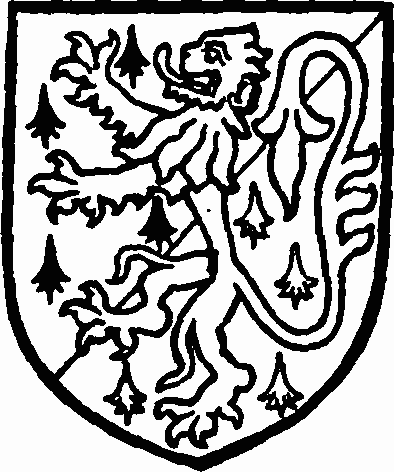
Trevor. Party bend sinisterwise ermine and erminees a lion or.
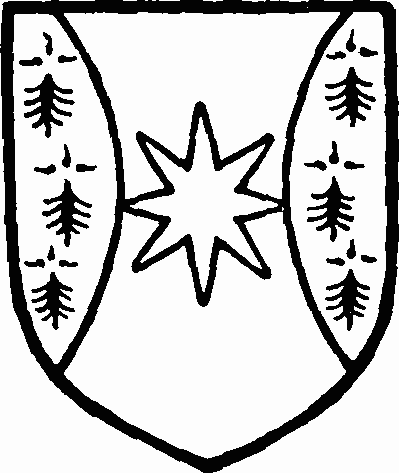
Hobart. Sable a star or between two flaunches ermine.
Church
The church of ST. MARY MAGDALEN consists of a chancel 27 ft. 7 in. by 15 ft. 10 in.; a nave with clearstory 42 ft. 6 in. by 19 ft. 3 in.; north and south aisles 9 ft. 3 in. and 8 ft. wide respectively; a south-west tower 7 ft. 3 in. square, and a south porch, all measurements being internal. Previous to the 14th century the church appears to have consisted of an aiseless nave and a chancel of the same size as at present, or nearly so. Aisles were added to the nave in the 14th century, between 1325 and 1350, the north aisle being probably the first to be built. If they had predecessors no trace of them is now visible. The lower part of the tower, which carries on the lines of the south aisle and practically forms its western bay, belongs to the same period. The upper stages are of later date, and it may be that the work here was interrupted by the Black Death. The chancel arch was inserted towards the end of the 14th century, and at the beginning of the 15th century another scheme of enlargement was taken in hand. The tower was completed, a clearstory added to the nave, and the north wall of the north aisle was taken down and the aisle widened, the junction of the 14th and 15th-century work being still clearly visible at both ends of the aisle. Up to this time the aisles were probably roofed by an extension of the high-pitched nave roof, the line of which is to be seen on the east wall of the tower; but at the date of the widening of the north aisle, the new north wall of which was built higher than the old one, a low-pitched roof was put on the aisle, and at the same time the south aisle walls were raised and a similar roof constructed on this side of the church. The chancel seems to have been rebuilt or remodelled about the same time, and its windows and those of the aisles belong to this date. In modern times the tower has been largely restored and an outer steep-pitched roof put on the nave, but traces of both the older gables are to be seen on the west wall of the nave and less clearly on the east wall.
The chancel is lit by five three-light 15th-century windows, one to the east and two in the north and south walls. On either side of the east window is a modern canopied image niche designed from fragments found here and now preserved in a glass case in the north aisle. At the east end of the south wall is a small 15th-century piscina, and in the western jambs of the north-west and south-west windows are the openings of squints from both aisles. The chancel arch is of two orders, continuously moulded with a hollow chamfer and a double ogee and irregular halfoctagonal moulded capitals.
The nave is of four bays. The north arcade, earlier in date than the other, has piers of four halfround shafts with hollow chamfers between and moulded capitals and bases. The arches are twocentred and of two moulded orders, with labels having grotesque drips over the piers, while at a considerable height above the crown of each arch is a two-light clearstory window of 15th-century date with a segmental head, trefoiled lights, and a deep external splay, the glass line being nearly in the middle of the wall. The south arcade is of the same detail, except in regard to the capitals, which are deeper and of a somewhat later section. This arcade is of three bays only, on account of the position of the tower at the west end of the south aisle, and there are also only three south clearstory windows. The west window of the nave is of 14th-century date, with three trefoiled lights and flowing tracery of late and rather clumsy design.
The north aisle has a three-light 15th-century east window, of the same design as those of the chancel, and two similar windows in the north wall, between which is the north door. This is of 14th-century detail, and must have been moved outwards when the aisle was widened. There is no west window to this aisle.
The south aisle has an east and a south window like those of the north aisle. At the east end of the south wall is a 14th-century piscina with a cinquefoiled head of two orders and a shelf. The south door is of the same date, with plain chamfered jambs and two-centred head, and opens to a contemporary south porch with a moulded outer arch, small squareheaded windows on east and west, and stone benches.
In the western bay of the south aisle stands the tower, its eastern arch being of two wave-moulded orders which die into widely chamfered responds. The tower has, in its lowest stage, two small lancets very much modernized, and is of three stages with an embattled parapet, its external masonry being in great measure modern. The two-light belfry windows are very small, and have above them two quatrefoiled openings on each face, which are entirely in modern stonework.
The woodwork of the church is of no special interest. The nave roof, resting on stone corbels carved with shield-bearing angels, is of 15th-century style, with moulded tie-beams and carved brackets beneath them, and in the south porch is a good roof with 15th-century detail, ornamented with roses and a shield of the Hampden arms.
There is also a 17th-century Communion table, and within the altar rails two handsome carved oak chairs of about the same date. The font, in the north aisle, is circular and of 13th-century date with a circular moulded stem and cup-shaped fluted bowl, with a band of ornament round the upper edge. It belongs to a type developed from the local 12th-century form.
On the south wall of the chancel is a Purbeck slab to Elizabeth wife of John Hampden, 1634, daughter and sole heiress of Edmund Symeon of Pyrton in Oxfordshire. In the south aisle is a wall monument to Richard Hampden, 1662, and his wife Anne Lane, 1674, with a shield bearing the Hampden arms, impaling Party azure and gules three saltires argent, which are the arms of Lane.
In the chancel floor are the following brasses:—
The figures of John Hampden, esq., 1496, and his wife Elizabeth Sidney, with four sons and six daughters. On the slab are five shields: (1) Quarterly, 1st Hampden, 2nd and 3rd, Argent a chief gules and therein two harts' heads caboshed or, for Popham, 4th, Six lions; (2) Hampden impaling Or a pheon azure, for Sidney; (3) and (4) Sidney; and (5) Hampden.
Griffith Hampden, 1591, and Anne Cave his second wife, 1594. An inscription plate without figures. On a shield are the following coats: Quarterly, 1st, Hampden; 2nd, Popham; 3rd, Six lions; 4th, Hampden with a border azure for Hampden of Great Kimble; impaling: Quarterly, 1st and 4th Azure fretty argent, for Cave; 2nd and 3rd Ermine a bend with three boars' heads razed thereon.
William Hampden, 1597, son of Griffith Hampden, and Anne his wife; no figures. On a shield of twelve quarters: 1st, Hampden; 2nd, Popham; 3rd, Six lions; 4th, A lion; 5th, Three spear-heads; 6th, A cheveron between three fleurs-de-lis; 7th, Sidney; 8th, Cave; 9th, Ermine on a bend three boars' heads razed; 10th, Three cheverons; 11th, A lion; 12th, A lion.
The figures of live sons and three daughters, with no inscription, but a shield with Azure three horses' heads cut off at the neck with their bridles or impaling Hampden, which shield commemorates the match of Sir Jerome Horsey, kt., with Elizabeth, eldest daughter of John Hampden and Anne Cave.
The figures of Sir John Hampden, kt., 20 December, 1553, Elizabeth Savage his first wife, Philippa Wilford his second wife, and three daughters. There are three shields: (1) Quarterly, 1st, Hampden; 2nd, Sidney; 3rd, Popham; 4th, Six lions; impaling: Argent a pale indented sable, for Savage; (2) The quartered coat as above; (3) The same, impaling Gules a cheveron between three leopards' heads or with a ring on the cheveron, for Wilford.
An inscription plate to William Hampden, Lord of Emmington, Oxfordshire, 1612.
On the north wall of the chancel is a large monument set up by Robert, afterwards first Viscount Hampden, in 1754, bearing a relief of the battle of Chalgrove Field, at which John Hampden was mortally wounded. Above is a tree hung with sixteen shields showing the alliances of the Hampden family.
The grave which is said to be that of John Hampden was opened in 1828 in order to test the accuracy of the accounts of his death, but the results were not conclusive.
There are three bells, the treble by Taylor, 1906, and the other two of 1625 by Ellis Knight.
The plate consists of a chalice of 1805, a paten of 1804, and a plated flagon and second paten.
The only old book of registers contains baptisms from 1537 to 1812, burials 1557 to 1812, and marriages 1557 to 1752. The marriage register for 1752 to 1812 seems to be missing.
Advowson
The church of St. Mary Magdalen (fn. 82) is a rectory, the advowson of which was held by the Hampdens, and under the will of John Hampden passed to the Trevors in 1754 and to the Hobarts in 1824. (fn. 83) The Earl of Buckinghamshire is the patron of the living at the present day.