A History of the County of Buckingham: Volume 2. Originally published by Victoria County History, London, 1908.
This free content was digitised by double rekeying. All rights reserved.
'Parishes: Hulcott', in A History of the County of Buckingham: Volume 2, ed. William Page (London, 1908), British History Online https://www.british-history.ac.uk/vch/bucks/vol2/pp342-344 [accessed 9 May 2025].
'Parishes: Hulcott', in A History of the County of Buckingham: Volume 2. Edited by William Page (London, 1908), British History Online, accessed May 9, 2025, https://www.british-history.ac.uk/vch/bucks/vol2/pp342-344.
"Parishes: Hulcott". A History of the County of Buckingham: Volume 2. Ed. William Page (London, 1908), British History Online. Web. 9 May 2025. https://www.british-history.ac.uk/vch/bucks/vol2/pp342-344.
In this section
HULCOTT
Hulcott is a small parish in the Vale of Aylesbury, lying on the Hertfordshire border, and containing 740¾ acres of land, (fn. 1) of which 36 acres are arable land, 595 acres permanent grass, and no woods. (fn. 2) The population is almost entirely occupied in agriculture, and as might be expected from the large proportion of pasture to arable land, the farms are chiefly grazed by dairy stock. The land lies between 200 ft. and 300 ft. above the Ordnance datum; (fn. 3) the subsoil is Kimmeridge Clay and Portland Beds, (fn. 4) and the surface is clay. The parish is well watered by the Thistle Brook, and there is water in the village of Hulcott. No main road passes through the parish, two branch roads from the Aylesbury to Tring road being the most important. The Aylesbury branch of the London and North-Western Railway passes through the parish, and the nearest station is Marston Gate, on the same line, 2 miles away. An Act of Parliament was obtained for the inclosure of the two parishes of Bierton and Hulcott, and the award was given on 15 July 1780. (fn. 5)
The village stands round a wide green, the church being on the east side, and the manor house near it on the south. There is a moated site to the east of the church, with water in some parts of the moat. The vicarage stands on the south of the village green, the schools on the west, and scattered cottages on the north-west. The manor house has been modernized, but the staircase is of early 17th-century date, and in the panels of its timber partitions are some wellpreserved contemporary paintings, with the stories of Phaedra and Hercules.
Manor
There appears to be no record of the manor of HULCOTT before the 13th century. In 1254, however, it was held of the honour of Wormegay, (fn. 6) which at that time was held by William Bardolf, through his mother, Beatrix, the heiress of William de Warenne, of Wormegay. (fn. 7) His descendants in the direct line held the overlordship of Hulcott till the reign of Henry IV, (fn. 8) when Thomas, Lord Bardolf, was attainted and forfeited his lands. (fn. 9) His two daughters and heiresses recovered many of his possessions, (fn. 10) but the overlordship of Hulcott appears to have lapsed.
The manor was held by the family of Graunt under the Bardolfs in the 13th century. In 1254 and 1284. William Graunt was lord of Hulcott, which he held by charter of the king. (fn. 11) He lived till after the year 1290, and was succeeded by his son Walter Graunt. (fn. 12) In 1322 Walter made a settlement of the manor, excepting certain tenements which had already been dealt with, (fn. 13) by which he was to hold it for life, with remainder to his son William and Clarice wife of the latter. (fn. 14) William succeeded his father in the manor, (fn. 15) and died presumably towards the close of the reign of Edward III, leaving a daughter Joan as his heir. (fn. 16) In 1369 (fn. 17) William Brys or Bryd and his wife Joan made a settlement of half the manor, to be held by William and Joan and their heirs, or by default by the heirs of Joan. Hence it appears to have been held in her right, and probably this Joan was the daughter and heiress of William le Graunt. Two years later, however, (fn. 18) William Bryd and his wife sold the manor to William Brancingham, with the homage and services of their tenants. In 1307 (fn. 19) the son and heir of Joan daughter of William le Graunt was called John de Bury. There may have been a confusion in the names of Bury and Bryd, or Joan may have been married twice. The manor must have been conveyed very shortly by Brancingham to James Butler, Earl of Ormond, who was holding certainly as early as 1396, and died seised of it in 1405. (fn. 20) His successor, the fourth earl, together with John Neel, clerk, granted the manor of Hulcott to James Butler, Earl of Wiltshire, son and heir of the earl, and others, and to the heirs of the body of the Earl of Wiltshire. (fn. 21) The Earl of Ormond died in 1452, (fn. 22) and his son obtained licence to alienate the manor in mortmain to the hospital of St. Thomas of Acon, (fn. 23) of which John Neel was then master. The hospital was founded (fn. 24) by the sister of Thomas Becket, and the Butlers were her descendants. The master of the hospital (fn. 25) and his successors were to find two priests to pray daily for the souls of the king and queen, and many of the ancestors of the Earl of Wiltshire and Ormond. Of these, his father and mother were both buried at the hospital. A confirmation of this grant of the manor was obtained from Parliament in 1472. (fn. 26) In 1535 (fn. 27) the hospital held the manor of Hulcott, which was then in lease to Benedict Lee for sixty-one years. (fn. 28) After the Dissolution Henry VIII granted the reversion, and the rents reserved on the lease, namely £14 13s, 4d., to Richard Greenway, gentleman usher of the king's Chamber. (fn. 29) He held the manor at his death in 1551–2, leaving his son Anthony, a minor, as his heir. (fn. 30) Anthony Greenway sold the manor in 1571 to John Fountain and his son Thomas. (fn. 31) They held jointly till the death of John, from which time Thomas held it alone. (fn. 32) On his death in 1623 he was succeeded by his nephew, another Thomas Fountain. (fn. 33) The manor was again sold in 1639 (fn. 34) to William Elmes, Thomas Elmes, and Thomas Wyan; the last-named seems to have obtained seisin of the manor, and a quitclaim was made in 1652 to him by Thomas and Mary Fountain and Alice Fountain, widow. (fn. 35) Twenty years later (fn. 36) Thomas Westerne and George Wyan sold the manor to Timothy Neale and his wife Anne. The Neales held the manor till 1741, when John Neale and his wife, together with Thomas Hanbury and William Neale, sold it to Sir John Fortescue Aland, justice of Common Pleas. (fn. 37) In 1746, on retiring from the bench, he was created Baron Fortescue of Credan in the peerage of Ireland. (fn. 38) He died in the same year, and his son Dormer Fortescue Aland, the second baron, inherited the manor, but died unmarried in 1781. (fn. 39) By his will, dated 27 March 1779, he left it to Dame Anne Tynte to hold for life, then to John George Parkhurst in fee-tail male, and then in default to John George Parkhurst, also in fee-tail male, with certain remainders and limitations. (fn. 40) Dame Anne Tynte was the widow of Sir Charles Kemys Tynte, the grandson of Grace Fortescue, a cousin of the first Lord Fortescue of Credan. (fn. 41) Dormer Parkhurst was one of the executors of the first baron's will, (fn. 42) and the devisees in remainder in the second Lord Fortescue's will were probably his heirs. John Parkhurst died during the lifetime of Dame Anne, (fn. 43) and on her death in 1798 the manor of Hulcott came into possession of John George Parkhurst. (fn. 44) The latter had to pay an annuity of £300 to one John Purling, (fn. 45) and he had already granted away his reversionary interest in Hulcott to Robert Walpole to secure the better payment of the annuity. (fn. 46) In 1794 the annuity was £1,350 in arrears, (fn. 47) and Parkhurst had other debts. (fn. 48) Various arrangements were made, and Walpole agreed to convey the manor to John Purling. (fn. 49) Finally it was put up for sale by public auction, (fn. 50) and was bought by John Baker, (fn. 51) who was lord of the manor in 1813. (fn. 52) Hulcott was purchased in the middle of the 19th century by Baron Lionel de Rothschild, (fn. 53) and Mr. Leopold de Rothschild is now lord of the manor.
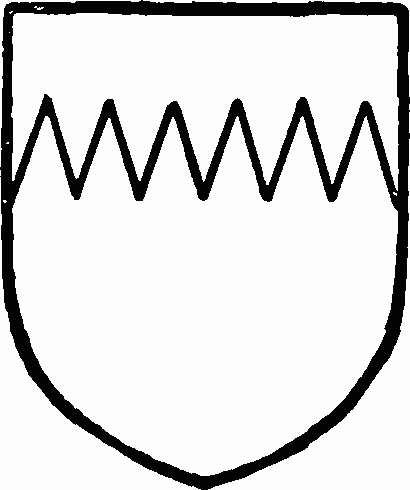
Butler. Or a chief indented azure.
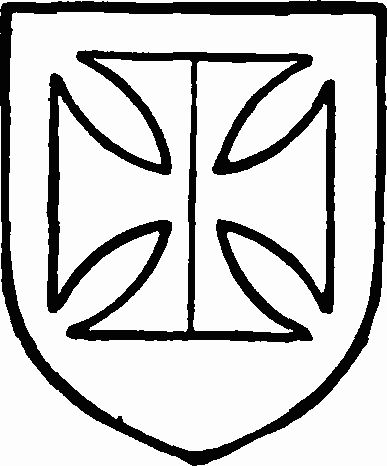
Hospital of St. Thomas of Acon. Azure a cross formy party gules and argent.
A mill is first mentioned at Hulcott in 1322. (fn. 54) The Fountains in the reign of Queen Elizabeth held a water-mill, (fn. 55) which is again mentioned while the Neales held the manor. (fn. 56) In 1652 a windmill is mentioned as well as the water-mill, and was quitclaimed with the manor to Thomas Wyan. (fn. 57)
William le Graunt claimed to hold the view of frankpledge and the assize of bread and ale before the justices in 1276, but it is not clear whether he made his claim for Hulcott or only for land in Aylesbury. (fn. 58) He held a free fishery in 1281, which is again mentioned in a document of 1672. (fn. 59)
Church
The church of ALL SAINTS has a chancel 22 ft. 9 in. by 12 ft. 6 in., nave 32 ft. 6 in. by 14 ft. 3 in. with north porch, and south aisle 14 ft. wide. Over the west end of the nave is a wooden belfry.
There are no details earlier than the 14th century, but the wailing of the nave is probably older than this date. The chancel has a marked deviation to the north, and seems to have been rebuilt in the first half of the 14th century, its north wall being set outside the line of that of an older chancel, while its south wall is in part on the older foundations. A south transept chapel was added to the nave about 1330, and this was thrown into a south aisle early in the 16th century, its east and south walls being apparently rebuilt in the process. A second bay was added to the south arcade, but the western part of the south wall of the nave was left in position, with a window in it as it now appears.
The bell-turret is difficult to date, its timbers being for the most part rough; it may be 15th-century work, and is set rather irregularly across the west end of the nave, resting on four large posts.
The east window has a 14th-century rear-arch and jambs, with shafts and roughly cut heads serving as capitals; the tracery, of two cinquefoiled lights with a sexfoil over, is an insertion of c. 1420. On either side are plain image brackets, half-octagonal in plan. The eastern part of the north wall is blank, but near the west end is a narrow doorway with chamfered jambs and segmental head, having a lable with large dripstones carved as grotesque beasts' heads. West of it is a small square-headed light, perhaps coeval with it. In the south wall is a piscina with a roughly trefoiled head, and to the west of it a window of two cinquefoiled lights with a quatrefoil over, good work of c. 1330, with moulded inner and outer jambs and head. The rest of the south wall is blank.
The chancel arch is of two orders chamfered on the east with double ogee moulds on the west; the responds are half-octagonal with moulded capitals and bases c. 1340.
The nave has a large north window of late 15thcentury date, of three cinquefoiled lights, and a 14thcentury north doorway with a moulded label under a plain stone porch which may be of 15th-century date. It has a plain chamfered outer arch and a squareheaded window on the west.
The east bay of the south arcade has an obtusely pointed arch of three chamfered orders and halfoctagonal responds with moulded capitals and bases, while the second bay has plain splayed jambs without capital or base and an arch of two chamfered orders. It is roughly worked and of 16th-century date, the eastern arch being of much better detail, c. 1330. To the west of it a 14th-century window remains in the wall, unglazed, and having lost its central mullion; its tracery is a 15th-century insertion, of two cinquefoiled lights with a quatrefoil over. The west window of the nave is of three cinquefoiled lights, contemporary with the north window. The south aisle has an east window of three trefoiled lights under a straight-lined four-centred head, and south of it is a small image bracket. To the north in the angle of the aisle is a blocked square-headed recess which seems to have been a squint to the chancel. The south and west windows of the aisle are of the same character as the east window, and all are of the 16th century, as is the rather clumsy trefoiled piscina recess at the south-east. The south doorway seems to be 14th-century work of the first half of the century, and has a continuous casement moulding between two sunk chamfers with a label, much patched with Roman cement.
The bell-turret is covered with modern weather boarding and has a short spire; in the belfry stage the beams have a double hollow chamfer. All the wood fittings of the church are modern, but in the south aisle is a 17th-century altar table; the corbel for the south end of the rood-loft remains. The altar is modern with a white marble front elaborately carved in relief with the journey to Calvary.
In the south aisle is an altar tomb against the south wall with a chamfered marble slab, evidently not in its original position, and having indents of the brasses of a man and his wife and one child, with four shields and a marginal inscription.
The font at the west end of the south aisle is modern, octagonal with quatrefoiled panels on the bowl.
There are three bells, the treble blank, the second apparently an alphabet bell with a blundered inscription, and the third of 1621 by James Keene of Woodstock.
The plate consists of a chalice, paten, flagon, and almsdish, of plated ware and modern date.
The first book of the registers contains entries from 1539 to 1805, the second being the marriage register 1754–1810, and the third the baptisms and burials for 1806–12.
Advowson
In the 14th century the advowson of the church of Hulcott belonged to the Graunts, (fn. 60) and from the heirs of William Graunt it probably passed with the manor to James Butler, Earl of Ormond. His grandson James, Earl of Wiltshire, granted it to the Hospital of St. Thomas of Acon, (fn. 61) in whose hands it remained till the dissolution of the hospital in 1538. (fn. 62) In that year Benedict Lee presented to the rectory, by reason of a grant from the Hospital of St. Thomas of Acon, (fn. 63) but in the recital of two leases of the manor to Lee the advowson is expressly excepted. (fn. 64) Still he may have obtained a separate lease from the hospital. Henry VIII granted the advowson of the rectory to Richard Greenway, subject to the lease to Lee. (fn. 65) After Lee's death (fn. 66) his widow Joan held the advowson, she and her second husband, Michael Harcourt, presenting to the rectory in 1557. (fn. 67) The advowson was sold, together with the manor, to John Fountain, (fn. 68) and was held by the lords of the manor till 1741. In 1666 (fn. 69) George Wyatt presented, presumably having acquired the right for one time. Timothy Neale presented in 1679, (fn. 70) and John Neale owned the advowson in 1719. (fn. 71) It was not sold to Sir John Fortescue Aland with the manor, but continued with the Neales, who, however, did not hold it for long, since in 1755 John Marriot presented. (fn. 72) In 1768 the name of Edward Bangham occurs as patron, (fn. 73) but he probably held the presentation for one time only. In 1776 (fn. 74) Thomas Marriot and his wife Jane sold the advowson to Stephen Langston, who presented to the rectory in 1779 and 1790. (fn. 75) The Rev. Stephen Langston appears as the next patron in 1803. (fn. 76) Rebecca Langston, presumably his widow, presented in 1817, (fn. 77) and in 1819 John Brereton appears to have become possessed of the advowson, and was holding it about 1847, (fn. 78) but before 1862 it had passed to Dr. Kenny. (fn. 79) It was shortly afterwards purchased by the Rothchilds, and Mr. Leopold de Rothschild is now the patron of the living.
There are no endowed charities in this parish.