A History of the County of Oxford: Volume 6. Originally published by Victoria County History, London, 1959.
This free content was digitised by double rekeying. All rights reserved.
'Parishes: Bletchingdon', in A History of the County of Oxford: Volume 6, ed. Mary D Lobel (London, 1959), British History Online https://www.british-history.ac.uk/vch/oxon/vol6/pp56-71 [accessed 30 April 2025].
'Parishes: Bletchingdon', in A History of the County of Oxford: Volume 6. Edited by Mary D Lobel (London, 1959), British History Online, accessed April 30, 2025, https://www.british-history.ac.uk/vch/oxon/vol6/pp56-71.
"Parishes: Bletchingdon". A History of the County of Oxford: Volume 6. Ed. Mary D Lobel (London, 1959), British History Online. Web. 30 April 2025. https://www.british-history.ac.uk/vch/oxon/vol6/pp56-71.
In this section
BLETCHINGDON
This parish of 2,654 acres lies roughly mid-way between Oxford and Bicester. (fn. 1) Its long and narrow shape, twice as long as it is broad, has been dictated by the need to divide the frontage of the River Cherwell with its neighbours and to obtain a variety of soils. There have been no recorded changes of boundary. (fn. 2)
The ground rises from about 220 feet at river level to 328 feet on the central plateau; it drops again to 212 feet on the eastern and south-eastern boundary. The plateau is capped with Hanborough terrace gravel, but save for the alluvial valleys most of the south and east of the parish lies on the Oxford Clay. To the west the clay is bordered successively by Cornbrash, Forest Marble, and Great Oolite, (fn. 3) which can be clearly seen where quarrying and the railway cuttings have laid bare the lower strata. (fn. 4) Until the early 19th century much of the eastern part of the parish was uncultivated heathland. The high-quality meadowland lay along the banks of the Cherwell and other meadows bordered the brooks in the north (fn. 5) and east. (fn. 6) At the end of the 18th century Davis's map shows two largish woods, one west of the Brackley road and Blackleys, the only modern survivor. (fn. 7)
The principal road is that from Chipping Norton to London, which enters by Enslow Bridge over the Cherwell (fn. 8) and used to leave the parish by Islip Gate. Locally it was important as the way to the nearest market town at Islip, but it was also the chief route for traffic from Worcester to London and in the 17th century at least was regularly called London Way. (fn. 9) It was made a turnpike in 1718. (fn. 10) In the Middle Ages the present by-road, which runs north to join the Brackley road and was known as Brackley Way, (fn. 11) was important locally on account of the trade between the Oxford region and the midland and eastern regions of England. The present by-road to Weston-on-the-Green, once no more than a field path, was the 'New Road' constructed in 1789. (fn. 12)
The completion of the Oxford canal in 1790 brought cheap coal to the village, but ruined some of the best meadowland, as the engineers failed to provide an adequate drainage system to prevent flooding. (fn. 13) Communications were still further improved in the 19th century: Enslow Bridge was largely rebuilt and nearly doubled in width in 1814 at a cost of £1,900, (fn. 14) and the section of the G.W.R. line from Oxford to Banbury, with a station at Enslow, was completed in 1850. (fn. 15)
The village, unlike Kirtlington and the Hamptons, lies on high land nearly a couple of miles from the river-bridge and at the junction of the London road with three by-roads. It was built originally round a green, but the houses on the north side were pulled down when Bletchingdon park was extended in the 16th century. (fn. 16) The parish church is inclosed within the park, now covering some 70 acres, (fn. 17) and can only be approached by a footpath, which after a struggle in 1795 was declared a right of way. The parishioners still retain this right. (fn. 18)
The village buildings skirting the park wall and near the church are still predominantly 17th- or 18th-century in character. Many are built of coursed rubble and have roofs of stone slates.
On the south side of the green there was a row of thirteen rubble-stone cottages with slate roofs, built in 1794, (fn. 19) and condemned in 1952 by the local housing authority. In 1954 this row, an interesting survival of an 18th-century housing scheme, was reconditioned and converted into seven cottages at a cost of £9,000, after a public appeal and donations of £2,000 each from the Pilgrim and Dulverton Trusts. (fn. 20) Near by is 'The Black's Head', a late 18thcentury house of two stories, (fn. 21) which probably took its original name of 'The Blackamoor Head' from the Dashwoods' black man-servant. (fn. 22) The 'Red Lion', which lost its licence in 1951, lies on the opposite side of the green and is probably of a rather earlier date, along with the adjoining cottages. It was recorded in 1793 as one of three village inns—the other two being the 'Green Man' and the 'Swan'. (fn. 23) The earliest known reference to an ale-house occurs in 1616; (fn. 24) in the 1670's there was one called the 'Angel and Crown'. (fn. 25)
Between 1918 and 1939 the village spread out along the Oxford Road, and between 1945 and 1954 58 council houses were built, including a new estate of 40 houses—Valentia Close—on the Chipping Norton road. (fn. 26)
Bletchingdon Park is a Georgian mansion built of stone with a pedimented portico projecting from the south front. It was rebuilt by Arthur Annesley (fn. 27) in 1783–5 to the designs of the architect James Lewis, who published engravings of it in the second volume of his Original Designs in Architecture (1797). It is notable for its fine views and well-timbered park. The latter is recorded as early as 1322, (fn. 28) but it was greatly enlarged in the 16th century. (fn. 29) The history of the earlier house which Annesley's house replaced is obscure. The medieval manor-house of the Poures seems to have been on or near its site. When Francis Poure (fn. 30) lived there at the end of the 16th century it was described as lying on the village street. It was lived in by Sir John Lenthall in the 1620's, (fn. 31) and was presumably the 'house and lodge in the park', which Sir Thomas Coghill rebuilt in about 1630 after obtaining the manor from Lenthall. The cost no doubt contributed to the financial difficulties which later compelled him to sell his 'new house' to William Lewes. (fn. 32) It was clearly on a large scale, for during the Civil War it was fortified and garrisoned by 200 men. It is said to have been partly destroyed in 1644, but as its defenders surrendered without making any resistance, it is doubtful if the damage was extensive. (fn. 33) In any case, when the Earl of Anglesey occupied it in 1665 it was one of the largest houses in the county: he returned 30 hearths for the hearth tax. (fn. 34) Robert Plot, writing in 1676, commented on the rare and ingenious style of the staircase, leading to a gallery overlooking the entrance hall, by which all the rooms were approached. (fn. 35)
There were other gentlemen's houses in Bletchingdon in the 17th century, but it is difficult to identify them now with certainty. In 1623 a 'mansion house called Old House' was part of Lady Lenthall's jointure (fn. 36) and may have been the house to which Sir Thomas Coghill and his wife retired after selling the 'Great House'. (fn. 37) Their new home stood near the church, had once been occupied by a yeoman farmer, and was a substantial building for which Lady Coghill returned ten hearths in 1665. (fn. 38)
Another 17th-century house was Adderbury's manor-house, which had been rebuilt by Richard Poure before 1623. It stood opposite Sir Thomas Coghill's 'new mansion' in the 1630's. (fn. 39) It was later occupied by Thomas Edgerley, who returned seven hearths for the tax of 1665. (fn. 40)
Among the 17th-century houses which certainly survive is the Rectory. In 1634 it consisted of hall, parlour and buttery with chambers above, kitchen, larder, and dairy. (fn. 41) It was repaired in 1637 and 1681, (fn. 42) and the present south-west front with its casement windows and slate roof was added in 1752. (fn. 43) Extensive repairs were carried out in 1788; these were perhaps mainly internal improvements, as the rector's bill of £146 was mostly for the carpenter's work. (fn. 44) The Laurels, on the fringe of the village, is an L-shaped 17th-century house of two stories. Although much modernized it still retains some of its original stone-mullioned windows. Manor and Home Farms are other houses of the same period. Manor Farm has two stories and its eastern front is decorated with a medallion with a bust, which is traditionally supposed to represent Cromwell. In the 18th century Home Farm was a posting-house on the London road called the 'Swan'. (fn. 45)
Owing to the early inclosure of the open fields (fn. 46) the parish has an unusual number of outlying 17thcentury farm-houses, such as Stonehouse Farm, Grove Farm, and Diamond Farm. They are all twostoried houses with attics, are built of coursed rubble and retain many of their original features. Stonehouse, for example, has a stone spiral staircase, while Grove House has early casement windows. Underdowns Farm, rebuilt in the 19th century, was originally built at least by the 1680's. (fn. 47) Staplehurst Farm, College Farm, Dolly's Barn, Greenhill Farm, and Frogsnest Farm (fn. 48) seem to be 18th-century houses, and Heathfield was built in 1814 by the Oxford banker Richard Walker. The last was bought by Viscount Valentia in 1889 for a dower house. (fn. 49)
The hamlet of Enslow grew up as a result of the construction of the canal and the railway. In 1788 a wharf and wharfinger's house were built and early in the next century the 'Rock of Gibraltar' public house. (fn. 50) The mill and the mill house at Enslow, however, have a much longer history. A mill was recorded in Domesday; (fn. 51) by 1340 (fn. 52) it seems to have been already a double mill as it was in the 17th and 18th centuries. (fn. 53)
Both in the 16th and 17th centuries the parish figured in events of national importance—in the projected agrarian rising of 1596 (fn. 54) and during the Civil War. The king's forces lay in and around the village in July 1643, and in October Sir Samuel Luke reported that '200 hurt men lie at Bletchingdon and Islip'. (fn. 55) In 1644 the strategically important point, Bletchingdon House, was surrendered to Cromwell without a fight by Colonel Windebank, who was court-martialled and shot. The house was then garrisoned for the Parliament. From here, no doubt, Cromwell wrote his dispatch of 25 April 1644, reporting his success. (fn. 56)
In the 14th century Bletchingdon manor-house was the chief seat of Roger Damory and his wife Elizabeth de Clare (d. 1360), the foundress of Clare College, Cambridge. (fn. 57) Later, the village was the birthplace of the Puritan John Nixon (1589–1662), son of a Bletchingdon husbandman, three times mayor of Oxford and founder of Nixon's school. (fn. 58) It has also been associated with an unusual number of other well-known men. Many of its rectors, notably Henry Airay (? 1560–1616), Christopher Potter (1591–1646), and John Mill (1645–1707), were distinguished scholars and divines, (fn. 59) and one, Dr. William Holder (1616–98), was the inventor of a method to teach deaf mutes to speak. (fn. 60) As Holder married Sir Christopher Wren's sister, the future architect was much at Bletchingdon Rectory as a young man, was grounded in mathematics by the rector, and later married the daughter of the squire, Sir Thomas Coghill. (fn. 61) From 1682 until his death in 1686 the Earl of Anglesey, at one time President of the Council of State, Vice-Treasurer for Ireland, and Lord Privy Seal, lived at his Bletchingdon house, where he collected a magnificent library, and was much visited by his London friends. (fn. 62) Later, the house was well known as the home of Arthur Annesley (d. 1841), one of the four celebrated fourin-hand gentleman whips of the county, and famed for his victory at the Oxford election of 1796. (fn. 63) He resided more than half a century, 'distributing bountifully to the comfort and necessities of his poorer brethren'. His son Arthur, who became the 10th Viscount Valentia in 1844, was born at Bletchingdon Park in 1785, and until 1948 his descendants, the Lords Valentia, were generous and influential residents.
Manors.
In 1086 an estate assessed at 8 hides in Bletchingdon, later known as POURE'S MANOR, was held by Gilbert of Robert d'Oilly. (fn. 64) Robert is said to have 'bought back' (redemit) the estate from the king. The overlordship followed the same descent as that of Bucknell, (fn. 65) for Gilbert appears to have been the ancestor of the Damory family, tenants of that manor. Bletchingdon manor was held by Robert Damory in 1139, (fn. 66) and passed to his son Roger, (fn. 67) and his grandson Ralph. (fn. 68) Ralph's eldest son Robert succeeded him about 1187 (fn. 69) and died about 1205. Robert's son Robert died in 1236, (fn. 70) and in 1243 his son Roger Damory held Bletchingdon as 1 knight's fee. (fn. 71) In 1279, however, the manor was held as ½ fee of Roger by his son Robert, who succeeded him about 1281 (fn. 72) and died in 1285. In 1312 Robert's son Sir Richard granted the manor to his younger brother Roger for life. (fn. 73) Roger Damory had married Elizabeth de Burgh, Edward II's niece, (fn. 74) and later actively opposed the king's favourite, Sir Hugh Despenser. Although he was pardoned in 1321, his estates were seized and he himself died in prison in 1322. (fn. 75) Sir Richard Damory recovered Bletchingdon manor in accordance with the terms of his grant to his brother, (fn. 76) and held it at his death in 1330. (fn. 77) It appears, however, that his sister-in-law Elizabeth held the manor as his tenant: she was certainly in possession in 1346 and 1349. (fn. 78) It is uncertain whether she retained Bletchingdon at her death in 1360, (fn. 79) and whether it passed to Sir Richard's son, Sir Richard the younger. It was not listed among the latter's Oxfordshire lands in 1375 (fn. 80) and so may have already passed to the Poure family.
In 1376 Hugh Poure was described as 'of Bletchingdon'. (fn. 81) Since his grandfather Walter Poure of Oddington had married Katherine, a sister of Sir Richard Damory the elder, (fn. 82) it is possible that Hugh had obtained Bletchingdon by inheritance. But he had an elder brother, who had inherited Oddington, (fn. 83) and in view of the financial straits of the younger Sir Richard Damory (fn. 84) it is equally possible that Hugh had obtained Bletchingdon by purchase from his needy kinsman. Hugh was dead by 1385 (fn. 85) and by 1395 his son Roger had inherited the manor from an elder brother Ralph. (fn. 86) Roger had been succeeded by 1408 (fn. 87) by his son Roger, who appears to have acquired Adderbury's manor in Bletchingdon. (fn. 88) Roger was still alive in 1478. (fn. 89) His son Thomas died in 1482 (fn. 90) and Thomas's son John either predeceased him, or died shortly after, since in 1483 John Poure, son of John and grandson of Thomas Poure, was described as a minor. (fn. 91) He married Mary, daughter of Walter Curson of Waterperry, and died in 1526. (fn. 92)
Vincent Poure, who succeeded his father, married Dorothy, daughter of Sir John Brome of Holton. (fn. 93) He died in 1558, having settled a third of his estates on his wife during the minority of his son Francis, then aged fourteen. (fn. 94) About 1566 she married her second husband Alexander Horden and a few years later Francis Poure contested their right to Bletchingdon. (fn. 95) Francis married firstly Prudence, daughter of Sir George Gifford of Middle Claydon (Bucks.), and secondly Ann, daughter of Julius Ferrers of Margetsell (Herts.), whose daughter Margaret married Edward Ewer of Bucknell. (fn. 96)
About 1596 Francis (fn. 97) settled Bletchingdon and Oddington (fn. 98) on Richard, his son by his first wife, reserving a life interest for himself, and in 1610 conveyed them to trustees for Richard, to secure the estate against his children by his second wife. (fn. 99) In 1612 Richard mortgaged the manors to Sir Michael Dormer and others, (fn. 100) who in 1613 sold their interest to Sir John Lenthall. (fn. 101) Francis Poure then settled Bletchingdon on the children of his second marriage, but left Oddington to Richard so that he might redeem the mortgage. (fn. 102) In 1614 Richard's brother-inlaw Edward Ewer lent him £3,000 to redeem the manors from Lenthall. (fn. 103) It was later alleged that Richard was forced to sell Bletchingdon to Lenthall for £14,000, which the latter did not pay, (fn. 104) and it is possible that Lenthall obtained possession through Richard's failure to redeem the mortgage despite Ewer's loan.
Sir John, son of William Lenthall of Lachford (Great Haseley), belonged to an old Oxfordshire family and was an elder brother of the Speaker, William Lenthall. Although in 1623 Lenthall settled his Bletchingdon estates on his wife Bridget, (fn. 105) in 1624 he conveyed his right to the manor to Thomas Coghill, (fn. 106) and in 1627 granted him an 80—year lease of the estate. (fn. 107) Richard Poure finally surrendered his rights to Coghill in 1639. (fn. 108) Coghill, younger son of a London merchant, John Coghill, married Elizabeth Sutton (fn. 109) of Aldenham (Herts.), was knighted in 1633 and was Sheriff of Oxfordshire in 1632. (fn. 110) In 1656 he sold a large part of his Bletchingdon estates to William Lewes of Boarstall (Bucks.) for £10,000. (fn. 111) By his will dated 1659 Coghill left his property to his wife for life, with reversion of Bletchingdon manor to his second son John, and of lands in Bletchingdon to his son Sutton. (fn. 112) Nevertheless, after his death in the same year the manor passed to his eldest son Thomas. (fn. 113) Thomas and John died in 1694 and 1695, (fn. 114) after Thomas had settled the manor in 1692 on his nephew Thomas, (fn. 115) third son of Sutton. (fn. 116) The younger Thomas died in 1706 (fn. 117) and the manor passed to his eldest brother Sutton, (fn. 118) who died in 1708 leaving it to his younger brother John. (fn. 119) During the following years John got into debt and mortgaged the estate. In 1716 he sold the manor to Arthur, the 7th Earl of Anglesey, for £7,000, receiving for himself an annuity of £200, which was never paid as he died within a year. (fn. 120)
The Angleseys had been the chief landowners in the parish since 1666 when Arthur, the 3rd Earl of Anglesey, had bought Bletchingdon House and estate for £3,864 from Charles, Duke of Richmond. (fn. 121) The latter had acquired them in 1661 through a marriage settlement with his wife Margaret, the widow of William Lewes. (fn. 122) Lord Anglesey had been created earl in 1661 and had held many important political posts before his death in 1686. (fn. 123) A marriage settlement between the earl's son James and Elizabeth, daughter of the Earl of Rutland, settled the Bletchingdon estates on James, and after his death on his wife for her lifetime. (fn. 124) Elizabeth took possession of these lands after her husband's death in 1690, and probably lived there until her own death in 1700. (fn. 125) In 1694 the architect Sir Christopher Wren brought a lawsuit laying claim to the Anglesey estates in Bletchingdon on the pretence that they had been mortgaged to him by the third earl; his claim was, however, dismissed as an invention. (fn. 126)
James, the 4th Earl of Anglesey, left three sons, James (d. 1702), John (d. 1710), and Arthur (d. 1737), who all died without male issue. In 1737 the title passed to Richard, (fn. 127) a cousin of the 7th earl, and Bletchingdon manor was sold by him for £6,000 to Francis Annesley, M.P., of the Inner Temple and of Thorganby (Yorks.), (fn. 128) to whom the estate had previously been mortgaged. He belonged to a younger branch of the Annesley family, and his son the Revd. Francis Annesley, Rector of Winwick (Lancs.), was related to the earls of Anglesey through his marriage in 1728 (fn. 129) to Anne Gayer, whose mother Elizabeth was the daughter and eventual heiress of James, 2nd Earl of Anglesey. Francis Annesley the elder died in 1750 and was succeeded by his grandson Arthur, the Revd. Francis Annesley having died in 1740. (fn. 130)
In 1765 Arthur Annesley was High Sheriff of Oxfordshire. He died in 1773 and was followed by his son Arthur, who was elected in 1796 M.P. for Oxford. (fn. 131) In 1785, at the time of Arthur's marriage to Catherine Hardy, the estate was settled on her. The trustees under this settlement applied sums derived from the sale in 1786 of the Annesleys' Irish estates to the purchase of freehold land in Bletchingdon. (fn. 132) Arthur Annesley was succeeded in 1841 by his son Arthur, who inherited the title of Lord Valentia from a cousin, who was a great-grandson of Richard Annesley (d. 1761). (fn. 133) Bletchingdon continued to be owned by this family until 1948, when Lord Valentia sold it to the Hon. William Astor, who resold it in 1953 to the Hon. Robin Cayzer.
In 1086 Alwi the sheriff, perhaps the same Alwi who held lands in one of the Wortons in North Oxfordshire, held 2½ hides in Bletchingdon of the king, which he had, however, sold to a certain Manasses without the king's licence. (fn. 134) The son of Manasses had a house in Oxford attached to this estate. (fn. 135) The property must have reverted to the Crown or been forfeited, for by the 12th century it was divided into a sergeanty held of the king and ½ kingt's fee held of the barony of Stafford. (fn. 136) The two were reunited in the 15th century to form what was thereafter called ADDERBURY'S MANOR and the distinction between them was lost. The sergeanty (fn. 137) seems to have consisted originally of the service of providing a spit for roasting the king's dinner when he hunted in Cornbury Forest. (fn. 138) In some 13th-and 14th-century records the service was interpreted as the provision of a roast dinner. (fn. 139) Later evidence makes it clear that the Richard Fitzneil, who granted land in Bletchingdon to the Templars before 1151, (fn. 140) must have then been holding the sergeanty. In about 1190 Robert Fitzniel of Tackley seems to have been in possession, for he then granted land in Bletchingdon to Godstow Nunnery. (fn. 141) In about 1210 his gift was confirmed by William Poure, Walter Prescote, and William Grenevile. (fn. 142) As William Poure married Alice, one of the four daughters and coheiresses of Robert Fitzniel, (fn. 143) it is likely that Walter Prescote and William Grenevile, both members of local families, may have been other sonsin-law. One Grenevile family is found in close association with the Fitzniels of Boarstall (Bucks.), and the Prescotes had ties with the Poures. (fn. 144) At all events, the heirs of a Richard Grenevile were holding the sergeanty in 1219. (fn. 145) In 1238, however, Richard Prescote was in possession, (fn. 146) and it appears that the sergeanty had escheated to Henry III because Richard Grenevile had alienated it to his brother William without licence. (fn. 147) The inquisition on the death of Richard Prescote was not held until 1251, (fn. 148) but his brother and heir Walter had succeeded him by 1247. (fn. 149) Walter had perhaps died without a known heir by 1256, when Henry III granted the sergeanty, with the reservations 'quantum ad eum pertinet. . . salvo jure cujuslibet', to Master John of Gloucester, the king's mason. (fn. 150) After John's death in 1260 (fn. 151) it was granted to Henry Wade, the king's cook, who held another sergeanty at Stanton Harcourt. He was holding the Bletchingdon sergeanty in 1279 (fn. 152) and died in 1287, (fn. 153) to be succeeded by his son John, who died in 1309, leaving his brother Henry as his heir. (fn. 154) In 1320 Henry sold the estate to Thomas de Musgrave and his wife Joan, (fn. 155) who survived her husband and died in possession in 1339, when her heir was her son Thomas. (fn. 156) By 1345 Thomas had conveyed the estate to his son William and his wife Elizabeth. (fn. 157) In 1354 Elizabeth, by then a widow, conveyed what was called the 'manor of Bletchingdon' to Sir Roger de Cotesford: this may have been a confirmation of a previous sale, for Sir Roger had demesne lands in Bletchingdon in 1349. (fn. 158) Sir Roger was sheriff of the county from 1363 to 1365 and again in 1369, and died in 1375 in possession of the Bletchingdon sergeanty. (fn. 159) The subsequent history of the estate is not clear. It eventually formed part of the Poures' estates, and may have passed to that family in about 1430 by the marriage of Roger Poure to Juliana, said to be the daughter and heiress of a Robert de Cotesford. (fn. 160)
It is not clear when the Stafford family acquired the Stafford fee in Bletchingdon. It has been wrongly stated (fn. 161) that Robert de Stafford held a fee there in 1086, a fee assumed to have been included in that held by the undertenant Henry d'Oilly in 1166. (fn. 162) Later evidence shows that this Bletchingdon ½ knight's fee was one of the small fees of Mortain held by the barony of Stafford—fees which owed only 2/3 of the knight service of an ordinary fee. (fn. 163) If the barony of Stafford acquired the privileges of the honor of Mortain when King Stephen was Count of Mortain and lord of the honor of Lancaster, (fn. 164) the Bletchingdon fee was possibly granted to the Staffords in that period, but it was first specifically included in the honor of Hervey de Stafford in 1211–12. (fn. 165) Hervey died about 1214; his son Hervey about 1237; and his grandson Hervey in 1241. The latter was succeeded by his brother Robert, who died before 1261, (fn. 166) and Robert's son Nicholas was overlord of the Stafford fee in Bletchingdon in 1279. (fn. 167) Nicholas died about 1287.
The tenant of the Staffords in 1235 and 1243 (fn. 168) was Richard Prescote, who had land at Whitehill and who held the Bletchingdon sergeanty. Richard Grenevile (see above) was mesne lord between Richard Prescote and Robert de Stafford. (fn. 169) In 1279 the fee was held by Hugh de Musgrave and his wife Maud. (fn. 170) The latter was in possession in 1311, but her son Thomas had succeeded her by 1316, (fn. 171) and in 1320 he purchased the Bletchingdon sergeanty. (fn. 172) His grandson William held the Stafford fee in 1346, (fn. 173) and in 1349 William's wife Elizabeth was given judgement in a suit against Roger de Stafford, (fn. 174) which may have been concerned with the overlordship, although there was no Roger in the direct line of the barony. (fn. 175) By 1387 the fee appears to have been acquired by Sir Richard Abberbury or Adderbury, (fn. 176) who in 1390 received a grant of free warren in his Bletchingdon lands. (fn. 177) Sir Richard was dead by 1401, (fn. 178) but he seems previously to have conveyed his Bletchingdon estate to Thomas Chaucer and other feoffees. (fn. 179) In 1428 the Stafford fee was held by Walter Cotton, (fn. 180) second husband of Joan Poure, whose first husband Roger Poure had died by 1408. (fn. 181) It is not clear who had purchased the estate, but it was subsequently held by Joan's son Roger (fn. 182) and followed the same descent as Poure's manor (see above).
Lesser Estates.
About 1139 Robert Damory and his son Roger gave some 50 acres, and Walter Pery gave a yardland and 10 acres in Bletchingdon to Godstow Abbey. Roger's gift was confirmed by his son Ralph about 1150. (fn. 183) Robert Fitzniel gave a yardland about 1190, possibly as the dower of his mother Anneys and his daughter Margery, who may have become nuns. (fn. 184) His tenant Geoffrey Bodyn was to receive a rent of 4s. a year from the abbey. Geoffrey's successor Martin Bodyn, and Robert's successors William Poure, Walter Prescote, and William Grenevile, confirmed the grant about 1210. (fn. 185) About 1250 Godstow acquired more lands and rents, partly in Bletchingdon and partly in Hampton Gay, by purchase from small freeholders, of whom one was obliged to sell on account of his debts to Oxford Jews. (fn. 186) By 1279 its possessions were probably greater than the 3 virgates recorded in the Hundred Rolls. (fn. 187) Godstow retained its estate until the Dissolution. (fn. 188)
Before 1151 Richard Fitzniel and his mother Agnes gave ½ hide in Bletchingdon to the Templars of Cowley (later of Sandford). (fn. 189) In 1194 the Templars' tenant was Richard, younger brother of Robert Damory. (fn. 190) The Hospitallers held the ½ hide in 1513 as an appurtenance of their manor of Merton. (fn. 191) Oseney Abbey was granted 2 virgates in Bletchingdon by Ralph Damory before 1187, (fn. 192) and about 1240 it received lands from John Pileth, clerk of Oxford, with the consent of his lord Robert de Marny. (fn. 193) Further gifts of lands and rents were added later in the century. (fn. 194) In 1291 Oseney's possessions were assessed as part of its Hampton Gay estate. (fn. 195) The abbey retained its Bletchingdon lands until the Dissolution, (fn. 196) and in 1543 they, together with the Godstow and Hospital lands, were granted to Arthur Longfield of Wolverton (Bucks.). (fn. 197) In 1279 Cirencester Abbey and Littlemore Priory held 2 virgates and 1 virgate respectively of the Damory fee, (fn. 198) but the subsequent history of these lands is unknown.
Economic and Social History.
At the time of Domesday and for many centuries after a large part of the parish was rough pasture. But the pre-Conquest plough-land was fully cultivated: on Gilbert Damory's 6 plough-lands there were 2 teams at work on the demesne and 4 on the villeins' land; the other small estate belonging to Alwi the sheriff was all demesne and had 1½ plough-team working on it. Fourteen acres of meadow are recorded and there is an unusual reference to pasture land—6 by 3 furlongs. There had been some increase in prosperity: although the value of the small estate remained £2 as before, the other had risen in value from £4 in 1065 to £5. (fn. 199)
As for the inhabitants, the demesne land of both estates was cultivated by serfs—Gilbert's by five and Alwi's by two. In addition there were 9 villeins (villani) and 7 bordars and presumably a miller, since a watermill worth 7s. 6d. was already in existence. (fn. 200) Thus, the community consisted of at least 17 peasant families with the addition of serfs. By 1279 the Hundred Rolls record some degree of economic development and considerable changes in the tenurial pattern. (fn. 201) Instead of the demesne serfs, one manor now had 3 villein virgaters paying rents of 8s. each and 2 half-virgaters paying 4s. and 4s. 6d. respectively. These tenants also owed works and tallage, and had to pay fines if their sons left the manor (redimere pueros). The other manor had 5 virgaters and 10 half-virgaters. But the most striking change was the growth in the number of free tenants: the Damory manor now held 6, of whom 4 had other tenants holding of them. Richard de Henred, for example, occupied no land himself, but had 3 tenants, each holding a virgate; of William Rolf's 4 virgates, a virgate and 12 acres were held by 2 tenants, while the Prioress of Littlemore had enfeoffed Adam the Clerk with a virgate. The Stafford fee had a similarly complex tenurial pattern; 4 free tenants held 7 virgates of Hugh de Musgrave and 2 held a ½-virgate and ½ a messuage of Master Henry Wade. (fn. 202) As on so many other Oxfordshire estates the religious houses were outstanding among the free tenants: there were Cirencester Abbey, the Templars of Sandford, Godstow Abbey, and Oseney Abbey. (fn. 203)
The tax assessments of the early 14th century (fn. 204) indicate that Bletchingdon was still not a particularly prosperous village. Of the 35 inhabitants who contributed in 1316 none was outstandingly rich, and the village's total tax was a good deal less than that paid by its neighbours Weston and Kirtlington. Two of the largest contributors were Robert the Shepherd and William le Schepman, and in view of the parish's wide stretches of heathland, it is not unlikely that Walter of Bicester, who paid nearly half the village's total tax in 1327, also owed his wealth to sheep. Bletchingdon's later material progress cannot be accurately judged from the increased tax paid after the reassessment of 1334 as it was combined with Hampton Gay for the purposes of taxation. Both together, however, were relatively highly taxed for Ploughley hundred, and in 1377 the 100 persons listed for the poll tax suggests that at least there had been no decline in population since the early 14th century. (fn. 205) An increase in sheep-grazing during the 15th century and the high profits accruing from it probably account for the village's high contribution of £9 4s. 6d. compared with Weston's £1 18s. 6d. to the subsidy of 1523. (fn. 206) Of the 37 contributors, there were three substantial men besides the lord, John Poure, whose contribution was outstanding, and a number of men of moderate wealth.
The arable land of the parish in the 13th and 14th centuries lay in the West and East Fields, on either side of the village. (fn. 207) At some unrecorded date before 1539 a third field, the South Field, was made. (fn. 208) This seems to have been done by bringing Breadcroft, (fn. 209) which was certainly arable land in the early 17th century, into cultivation, and by the division of the old East Field. The detailed terrier of the whole parish made in 1539 shows that with some notable exceptions the land was still divided up in accordance with the traditional strip system. Godstow, for example, had mostly acre and ½-acre strips in 63 furlongs, divided between the three fields. Similarly the parson's glebe of 71½ acres was held in acre and ½-acre strips in 42 different furlongs. (fn. 210)
The mead. . . owland lay along the banks of the Cherwell and is minutely described in the 'Meadow Book made . . . by lords and tenants' in 1544. (fn. 211) It amounted to 99 acres and except for a 7-acre close belonging to the Lady Denham, the parson's 2-acre close, and some demesne closes, the meadow was still mostly distributed by lot. The lost were commonly divided into 12-acre fields and the normal 'lot' was an acre. Freeholders and copyholders of the manor were as a rule alone entitled to lots: the men of Kirtlington and Weston who held acres in the fields had no meadow and no common, (fn. 212) but the church of Weston was an exception. It held a ½-acre of mead. The meadowland's value was very high compared with the poor-quality arable: Poure's demesne arable and leys were valued at 2d. an acre and the mead at 3s. 4d. an acre. (fn. 213)
The extensive heathland encouraged sheep breeding in the 15th and 16th centuries. The normal stint was 50 sheep and 15 other animals for each yardland; the farmer of the 8 yardlands of Adderbury manor in 1544 could thus keep 400 sheep and 92 other animals on the common, and Vincent Poure could keep 700 sheep and 168 other animals for his 14 yardlands. (fn. 214)
Although the tenants' land was still held in small parcels in 1539, (fn. 215) there are signs of considerable consolidation of the lord's demesne. In the East and South Fields Poure had acquired blocks of 22, 20, 19½, and 15 acres and several others of from 12 to 10 acres, as well as smaller accumulations, while in Long Marsh Furlong he held all its 54 acres. (fn. 216) In West Field, except for 12 acres, the whole of Mill Furlong (126 a.) belonged to Adderbury's farm, while in the other fields it had blocks of 22, 20, and 17½ acres. Mill Furlong (fn. 217) and some other open-field land (fn. 218) had been inclosed and converted to pasture, but it is impossible to say with certainty whether all the extensive demesne closes which existed in 1544 (fn. 219) had been inclosed from the arable or whether some had been inclosed from the waste. A survey made for the year 1543–4 shows that apart from the 42 closes attached to the tenants' holdings, which were no more than the hay closes normally found in most villages, Poure's demesne had a number of closes of exceptional size and value. The total acreage of the demesne arable and leys, for instance, was valued at £4 4s. 10d. a year, but the park and other closes in its area were valued at £34 9s. (fn. 220)
There is no evidence to show how far inclosure had gone in the 15th century, but it is clear that much of the pre—1544 inclosure may be attributed to Vincent Poure, who succeeded to the manor in 1526 and took advantage of the favourable conditions of the time to increase his demesne lands, alter the conditions of tenancy in his own favour, and convert from arable to pasture farming. The beginnings of the process are indicated in the 1544 survey. Besides his demesne land he is said to hold 45 acres, once the holding of certain 'decayed' cottages. (fn. 221) Copyholders, it may be noted, were benefiting too. One Bailley had increased his holding by ¼-yardland, once the land of a 'decayed' cottage. (fn. 222) References in the 1544 survey to Mate tenants' show how much land was coming into the market, mainly as a result of the dissolution of the monasteries. Godstow, for instance, had held about 214 acres and Oseney about 77, besides closes, while another freehold of over 48 acres was also vacant. The evidence collected for the rector's tithe suit in 1555 also shows that much of the inclosed land, if not all the land for which a rate had been substituted instead of tithe in kind, had been inclosed by 1544. (fn. 223)
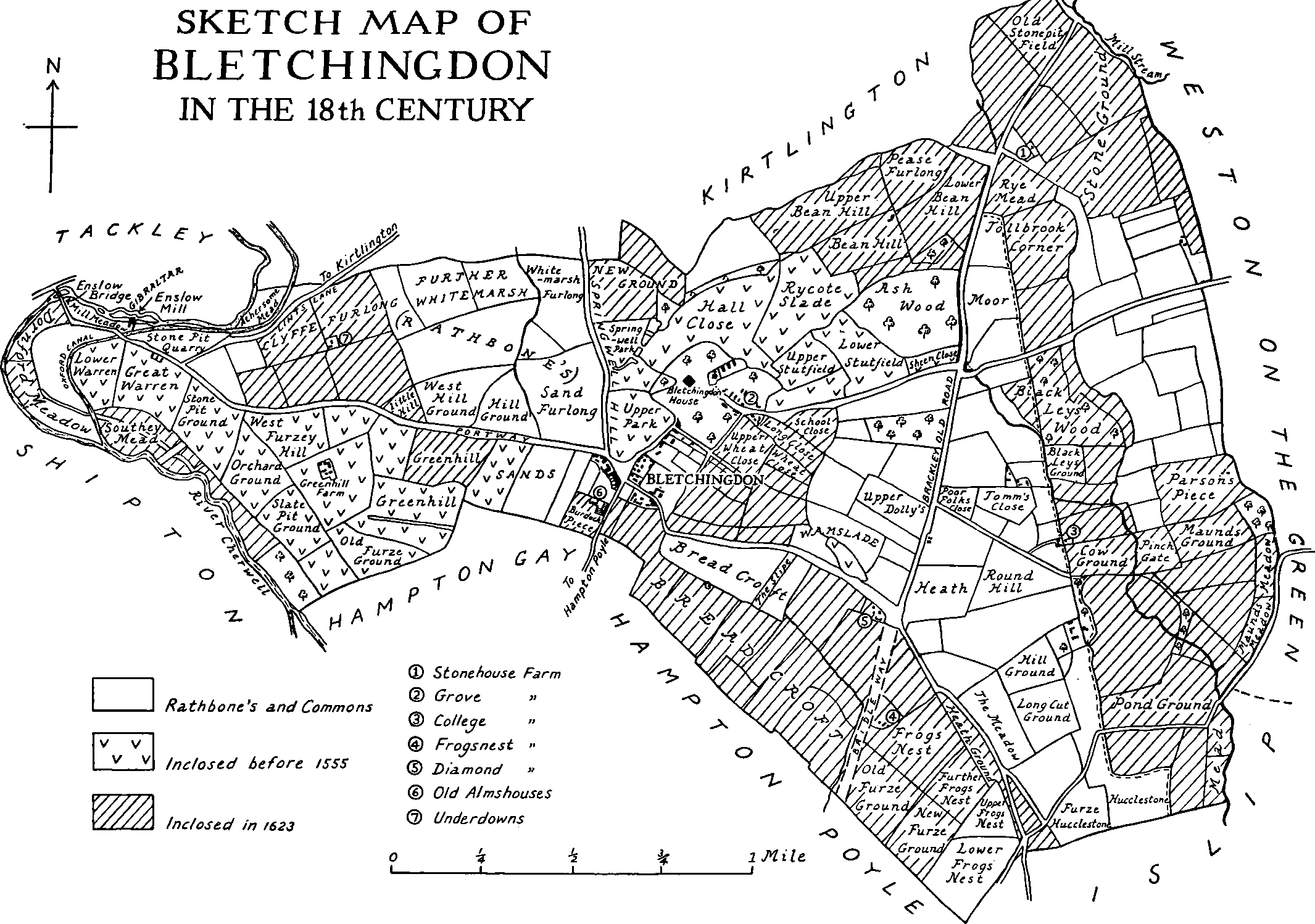
SKETCH MAP OF BLETCHINGDON IN THE 18th CENTURY
The above map shows the probable areas inclosed before 1555 and in 1623. The sources are the 1th- and 17th-century documents cited in the text and the tithe award map of 1839
Vincent Poure evidently continued to increase the amount of inclosed land until his death in 1558. By 1552 Bailley's copyhold and another had come into his hands; (fn. 224) their closes, the sites of their houses, and gardens had been added to the park, which was inclosed pasture ground. (fn. 225) Some idea of the extent of his inclosures can be obtained from an examination of the documents relating to the tithe disputes. (fn. 226) Later evidence shows that he attempted to substitute the payment of a fixed rent in lieu of tithes in the case of certain meadow and pasture lands, (fn. 227) and their extent can be gauged from the tithe map of 1839, (fn. 228) where the lands still paying the fixed rate or modus amounted to 377 acres. These acres can be identified for the most part with those closes from which the tithe was in dispute in the 17th century, and there can be little doubt that the modus lands of 1839 represent fairly exactly the lands which Poure had inclosed before 1555, when the trouble over tithes first began. (fn. 229) It is true that 17th-century rectors alleged that there had been a tendency for the 'rateable to encroach on the titheable', but their vigilance and that of the law courts probably saw to it that there was little real alteration in the area.
Dorothy Poure, Vincent's widow, and her second husband Alexander Horden, and later her son Francis Poure, continued the process of piecemeal inclosure. There are no terriers to give an exact picture of the rate of progress but there is evidence to show that it was continuous. A particularly big inclosure was made by Francis Poure soon after 1596, when he secured Thomas Rathbone's large freehold of 96 acres. (fn. 230) The total amount of land inclosed in the second half of the 16th century can be estimated from a lost terrier of 1596–7, cited in 17th-century notes. (fn. 231) The land in the three fields, both arable and leys, was then reckoned as over 1,123 acres, whereas in 1539 it had been about 1,905 acres. (fn. 232) Thus, over 780 acres had been taken out of the fields. The common heath and meadow were not included in this figure, although the meadow was all inclosed when the lot system was abolished by 'a composition' with the tenants. The exact date of their inclosure is uncertain, but a witness in 1610 said that there had been lot meadows within living memory. (fn. 233) Lea Furlong, comprising about 360 acres, was also excluded. It was divided severally among the tenants, who could take their fuel there 'on their own ground'. (fn. 234)
The social upheaval naturally resulting from these changes is substantiated by documentary evidence. The 'decayed' cottages point to rural depopulation and the enforced abandonment of holdings; statements by the rectors stress the evil effects of the dispossession of the yeoman farmer. Provost Dennyson, for instance, stated that Vincent Poure turned out tenants as soon as the lease expired and let the tenements at rack rents to new tenants; and that by allowing to the houses which had formerly kept good plough-teams only 3 acres of land apiece he had depopulated the town. Worst of all, as the yeoman farmer had been dispossessed, the town now consisted of 'nothing but poor people'. (fn. 235)
The rector, though not an unprejudiced witness, was probably right in his view that Alexander Horden was more ruthless; he described him as 'a covetous, greedy and insatiable worldling' seeking his private profit, and declared that, as 'a stranger to the county and without pity for the losses of his tenants, he practised against them the extremity and rigour of law'. (fn. 236) On one occasion Horden was accused of trying to evict seven tenants, including Francis Poure, as a result of an alleged agreement to give up the interest in that part of their holdings which was 'fallow, mead, and sheep common'. Horden's defence was that they had seemed pleased with the arrangement. (fn. 237) The pace of the inclosure, together with the fact that the men who were being forced to sell were substantial men with much to lose, was no doubt the reason for Bletchingdon's playing a leading part in the abortive agrarian revolt of 1596. (fn. 238) It is significant of the strength of local discontent that Enslow Hill (i.e. the high ground east of the bridge) was to be the meeting-place for 300 or more men of the neighbourhood. They threatened to sack Francis Poure's house and to 'throw his hedges and those that made them into the ditches'. (fn. 239)
Inclosure was completed early in the next century. In spite of opposition from the Queen's College, Sir John Lenthall persuaded the rector and the fifteen tenants of the manor, who had land in the fields, to agree to the tripartite indenture of 1623, which completed the inclosure of the open fields and the heathland. (fn. 240) The total acreage then inclosed was 785½ acres. The only uninclosed part of the parish left was a few acres of grazing along the verges of the roads— the Cow Common of the tenants and a few acres of the lord. By the award Lenthall received 478 acres, the rector 192 acres, two tenants 60 and 56 acres each, and the other thirteen tenants smaller awards, five of them under 10 acres.
There is contemorary evidence that the land was surveyed and measured; this is reinforced by the fact that the 43 acres allotted to the rector for tithe of the heath was an exact tenth of the acreage of the heath in the early 19th century. (fn. 241) The economic advantages of inclosure were indisputable. In 1544 the rents of the pasture closes were already one of the most valuable parts of the manor: demesne rents, pasture and the mills brought in altogether £477s. 6d., but of this one close (Greenhill) alone produced £13 6s. 8d. rent, while the park and Hall Close produced £10 together. The rents of customary tenants and Adderbury's farm brought in the comparatively small sum of £21 odd, and freeholders' quitrents only 4s. 6d. (fn. 242) Owing to the spectacular rise in land values in the 16th century, the park and Hall Close were worth £30 each by the early 17th century; Ricott's slade, Stutfolds, and others near the park were worth £63, while Greenhill in the old West Field was worth £90, whereas the two corn mills with the fishing rights, always a valuable part of a manor, were valued at £30. (fn. 243)
The changes in the pattern of landholding are also of interest. In 1544 there were 17 copyholds comprising about 704 acres and 21 freehold tenements, including the four which had been held by Godstow and Oseney, comprising about 645 acres. There were over 646 acres in the hands of the Poures, more or less equally divided between Adderbury's farm and Poure's manor. Most holdings were about a yardland in extent, although some consisted only of a few acres and some, notably Rathbone's freehold and those of four copyholders, were much larger. The four last had accumulated holdings of 60 to over 100 acres. (fn. 244) By the time of the 1623 (fn. 245) inclosure the freeholders had been reduced to fifteen. When a list of the annual value of the lands in Bletchingdon was drawn up in 1684 (fn. 246) there were six large estates together valued at £1,153 and 21 small ones worth about £480. Seven of the latter were no more than smallholdings, each valued at under £20. The large estates belonged to the gentry—the largest, valued at £375 10s., to the Earl of Anglesey, the next largest, valued at £231 11s., to Thomas Coghill, the lord of the manor. The remaining four, valued respectively at £150, £104, £75 18s., and £63, belonged to the rector, a Mr. Barber, and to John and Sutton Coghill. Thus, the misfortunes of the Coghill family had led to a temporary splitting up of the large property accumulated by the Poures, while at the same time the number of resident freeholders was being reduced by death and other causes. Of the fifteen there in 1623 only five were left and one was a widow, and some 60 years later there was only one more. By the end of the 18th century more than half the land of the parish belonged to Arthur Annesley; of the 24 other owners the parson, assessed for the land tax at a fifth of the squire's rate, and Sir John Arundell were the only ones with substantial properties. Most of the land was occupied by tenant farmers. (fn. 247) By 1839 the Annesleys had still further increased the extent of their property by buying up some of the smaller estates. (fn. 248)
The tithe disputes provide some interesting scraps of evidence for farming practice in the late 16th and 17th centuries. There was a clear falling off of sheepgrazing. In 1611, for example, the rector claimed tithe from Francis Poure on only 200 ewes, (fn. 249) and in 1634 another rector claimed more tithes from the squire's closes because now 'much tilled'. (fn. 250) To take one case, Underdown was usually worth in tithe £3 10s., but in 1635 the rector claimed that being sown it was worth at least £14 or £15. (fn. 251)
Rye, oats, wheat, barley, peas and beans were grown, and some changes in cropping practice before the inclosure of 1623 may perhaps be indicated by the division of the Heath Field into quarters. (fn. 252) Excessive cropping, however, might lead to impoverishment of the soil, and in the late 17th century leases frequently contain the clause that land was not to be ploughed up. (fn. 253) The rector complained in 1681 that land which he had leased was so out of heart that when the lease terminated the living was likely to be worth £40 less a year. (fn. 254) Rather earlier in the 1630's some land was sown three times in the year, and some twice with oats. (fn. 255) At the end of the century, in 1683, in an effort to restore fertility a new crop, sainfoin, was introduced. (fn. 256) Turnips are first recorded in 1719. (fn. 257)
In the 1770's on the manor estate rather more than half the land was still being used for pasture, (fn. 258) but a change took place in the 19th century. In 1839 there were still only about 836 acres of arable in the whole parish compared with about 1,350 acres of meadow and pasture, (fn. 259) but by the middle of the century, when agricultural prices were booming, the proportion of arable to pasture had risen to as much as two to one. Farms were larger than elsewhere: in 1851 there were ten farms of over 100 acres, of which six were between 200 and 400 acres. (fn. 260) Although some advance had been made in reclaiming the heathland by drainage, particularly on the Heathfield estate, (fn. 261) the general standard of farming does not appear to have been high. Arthur Young found nothing of note to record in the opening years of the century, and later at least one small farm (40 a.), although said to have some excellent dairy land, was reported to be disgracefully cultivated and without a four-course rotation. (fn. 262) But in the 1870's the parish boasted a prize-winning breed of long-woolled sheep. (fn. 263) In the 1950's sheep, mostly South Down or Clun Forest, were still kept on four farms; there were pedigree herds of cattle on two, and mechanized farming was generally practised. Out of fourteen farms mostly devoted to mixed farming, four had 300 acres or more and the rest were under 150 acres. (fn. 264)
Information about local trades is scarce: among the 17th-century tradesmen recorded were the miller, a master stone-mason, Robert Springhall, (fn. 265) a tailor, carpenters, and blacksmiths. It is noteworthy, however, that when the Rectory was repaired in 1633, the rector had to get a second carpenter from Oxford, a plasterer from Shipton, and a mason from Hampton Gay. (fn. 266) There must have been quarrymen, for both marble and stone quarries were well known at this period. (fn. 267) The quarries were perhaps one of the chief reasons for the increasing population in the first half of the 18th century. The Compton Census of 1676 had recorded 160 adults; by 1750 the estimated population was 355, (fn. 268) and the settlement papers suggest that there had been some immigration from the neighbouring villages. (fn. 269) There was a certain measure of prosperity, for out of 75 families eleven were well-to-do enough to keep one or more servants. In 1795 the reputed population of 524 included four masons, two each of carpenters, shoemakers, blacksmiths, butchers, bakers, and millers. There were also a tailor and nine farmers. (fn. 270)
The steep rise in the cost of poor relief at the end of the 18th century reflects the poverty and unrest of the period. The surviving overseers' accounts (1787–99) (fn. 271) show that in 1787 the total expenditure was £174 3s. 3d.; in 1797 it rose to £350 3s. and in 1803 was £496 10s. 5d. (fn. 272) with a rate of 6s. in the £ the second highest in the hundred. In 1794 the roundsmen system, as a means of dealing with the unemployed, was introduced, and in the following year, when as many as 67 families were receiving some kind of relief, bread payments began. The account books show that the administration of the poor law was entrusted to two overseers, who were locally elected and confirmed by the justices. The usual entries for clothes, funeral expenses, and faggots occur; no parish doctor was employed but the poor received occasional medical assistance at home in the way of extra delicacies such as tea, sugar, or mutton, or were sent to the new infirmary at Oxford; in 1790 the apothecary's bill was £38 8s, 9d. Poor-law expenditure continued to rise in the early 19th century and by 1832–5 the average annual expenditure was £802. (fn. 273) In 1835 Bletchingdon became part of the Bicester poor-law union, returning one guardian. (fn. 274)
At the end of the 18th century, in 1789, monthly parish meetings were held at the two local inns, absentees being fined 6d. In 1872 there were said to be two Friendly Societies. One established in Bletchingdon over a century had 94 members and a capital of £300. It had been converted into a sevenyears club about ten years previously. The school club had a capital of over £300 and about 107 members. (fn. 275)
Population continued to rise in the 19th century. In 1801, at the first official census, there were 503 inhabitants, and this figure rose, with some fluctuations, to a peak of 693 in 1871. It had declined to 549 by 1901, a trend which continued in the 20th century. In 1951 the population was 478. (fn. 276)
Church.
The earliest evidence for the existence of a church at Bletchingdon is the grant of tithes made by Robert d'Oilly in 1074 (see below). In the 11th century, however, the church apparently belonged to the estate of Alwi the sheriff and not to the D'Oilly manor, for in the 13th century the patronage is known to have been divided between the two fees into which Alwi's estate had been divided, the royal sergeanty and the fee of the honor of Stafford. (fn. 277) When these two fees were in different hands, the holders should have presented alternately, but confusion arose, particularly as there were periods when the two fees were united and the question of alternate presentation did not arise. Richard Prescote, for example, held both sergeanty and fee in the early 13th century after the Grenevile moiety of the advowson had been forfeited to the Crown and regranted. (fn. 278) Richard presented in 1231 and 1234, (fn. 279) and it was stated at his death that the advowson belonged to the sergeanty and the fee. (fn. 280) But in 1279, when sergeanty and fee were in different hands, the king presented a chancery clerk, Thomas de Capella. (fn. 281) In 1289 it was stated that the king held half the advowson and Hugh de Musgrave, lord of the Stafford fee, the other half, as they each held a half of the manor. (fn. 282) Thus, it appears that the king, at least on occasions, did not grant the moiety of the advowson with the sergeanty.
The division caused great confusion: in 1298 when Hugh de Musgrave exercised his right of alternate presentation, his right was disputed on unknown grounds by Nicholas Trimenal and his wife; (fn. 283) and again in 1311 the king's presentation was opposed by both Henry Wade and Maud de Musgrave. (fn. 284) The court, however, recognized the king's right for this turn and his nominee was admitted as rector. (fn. 285)
In 1337 no opposition was made to the king's presentation (fn. 286) and in 1343, at the request of Queen Philippa, the royal moiety was granted to the Queen's College at Oxford. (fn. 287) The college presented for the first time in 1395. (fn. 288) In 1343 it had also been granted the right to acquire the other half of the advowson and to appropriate the church. No steps were taken about appropriation and the moiety of the advowson was not acquired until 1621.
In 1355 Elizabeth, widow of William de Musgrave, had sold her moiety to Sir Roger de Cotesford (fn. 289) and it had passed with the manor successively to the Abberburys and Poures, (fn. 290) and finally to Sir John Lenthall. He sold it to the college in 1621, (fn. 291) which was still patron in 1955.
The rectory was moderately well endowed; in 1254 it was valued at £4 13s. 4d.; in 1291 at £10; in 1535 at £12 9s. 4d. (fn. 292) The rectors alleged in the 16th century and later that its value had been diminished by the inclosure of the open fields and by the acceptance of a modus in lieu of a part of the tithes. (fn. 293) Nevertheless, in 1803 it was still a comfortable living worth £492. (fn. 294) It was one of the churches in the hundred to be transferred from Bicester deanery to the new Islip deanery by 1854. (fn. 295)
In the Middle Ages the rector enjoyed a fair-sized glebe. The earliest description of it, dated 1539, shows that it consisted of 67 acres and 6 butts of arable strips scattered in the open fields. A good proportion of the strips were in the West Field where the best-quality land lay. (fn. 296) Besides the arable the rector had 5½ acres of meadow, a close, and the right to keep 100 sheep and 23 cattle and horses on the common land. He also had the great and small tithes from the whole parish apart from 2/3 of the demesne tithes of the Damory manor, which had been given at an early date to the church of St. George in Oxford castle and passed in 1149 to Oseney Abbey. (fn. 297) In 1535 Oseney's share of the tithes was valued at 6s. 8d. (fn. 298)
After the Dissolution the rector received all the tithes until 1555 when Vincent Poure, lord of the two manors, (fn. 299) withheld payment. Provost Denysson, who was then rector, began a suit for their recovery. (fn. 300) The outcome of this dispute appears to have been the indenture of 1568, by which the incumbent of the day accepted a modus of 58s. 4d. on certain lands for 81 years—an arrangement which Provost Airay later described as 'sacriligious'. (fn. 301) However, no objection was made during the rest of the century, probably because, so long as the land for which the modus was paid remained pasture, the arrangement was equitable. It was only in the 17th century when the land was improved by tillage (fn. 302) that the parsons found how bad a bargain they had made.
Dr. Aglionby (rector 1601–10) seems to have been the first to attempt to abolish the modus, but he was 'quietened' by Francis Poure, who compensated him for his losses from tithes with the gift of two advowsons and other favours. (fn. 303) His two successors both went to law, (fn. 304) but it was Dr. Potter who finally obtained a decision in the Exchequer court in the church's favour in 1638. (fn. 305) His previous offer to close the dispute, if Sir Thomas Coghill would set out and hedge for the church a piece of land worth £50, (fn. 306) had been rejected.
The depositions in all these cases throw light on the difficulties of tithe-owners arising from changes of landownership and piecemeal inclosure. The case of the rectors may be summed up as follows: the modus or the 'rate' as it was called had no support in custom or equity; it was an 'evil, growing and infinite', for where there were no hedges or boundary marks tithable land could easily be confused with the rateable land, especially as the names of ancient furlongs were changed after inclosure. Furthermore, temporary compositions made by the parsons tended to be regarded by the villagers as permanent 'rates', and thus made the possibility of future loss to the rectory likely. The confusion arising from inclosure is demonstrated by the fact that one of the main points of dispute was whether the modus had ever applied to land belonging to Adderbury's manor or not. The rectors contended that it only applied to Poure's manor and that before the final inclosure of 1623 Adderbury's manor as well as Rathbone's freehold had always paid tithes. (fn. 307)
Apart from the question of the modus, the rectors further complained that tithes from those grounds which were admitted to be tithable were adversely affected. Corn-tithes were lost, as the greatest portion of corn was grown on the 'rateable' land. Tithe lambs and calves were lost: in 1634, for instance, the rector had one tithe lamb out of two or three hundred lambs, because although Coghill's sheep were fed on the tithable land care was taken to see that lambs were born on the 'rateable'. It was similarly the case with cattle which were pastured on both kinds of land. Furthermore, small tithes of fruit, pigeons, and so on were lost when Adderbury's manor-house was allowed to fall into decay. (fn. 308) Potter, indeed, maintained that the value of the rectory had been reduced from £400 to at least £340 and that tithe on the 'rateable' land should be £40 instead of under £3, the amount received from the modus. (fn. 309)
The quarrel flared up again in Dr. Mill's time, 1682 to 1707. In the 'bad times' of the Civil War the 'rate' had been accepted out of fear, (fn. 310) and had become customary. Moreover, Mill had an additional grievance about the state of the glebe. As a result of inclosure in 1622 his glebe lay in inclosed fields. He made no complaint about the quality or quantity of land allotted in lieu of the ancient glebe, but complained of insufficient compensation for the loss of tithes on the land inclosed. (fn. 311) An early 19th-century rector, however, considered that the rectory had been damaged by being allotted land which lay as far as two miles away from the parsonage, and could only be approached by a lane which was often impassable. (fn. 312)
Though Mill made exhaustive transcripts of the evidence in the Potter case with a view to bringing a new action, he finally had to content himself with advising his successors never to make any compositions for tithes as they were always prejudicial to the rectory.
At the first inclosure of 1623 the rector was allotted 60 acres of arable for his glebe and 43 acres in lieu of tithe plus 89 acres of heath. (fn. 313) At the date of the tithe award in 1839 out of 2,654 acres in the parish 1,032 acres still paid a tithe and 356 acres a modus of £2 18s. 4d. These were both commuted for £332 8s. 4d., including tithe on the glebe which then amounted to 209 acres. (fn. 314) Of this, part was ancient glebe and part was the rector's allotment of 1623. The glebe was sold to the Ecclesiastical Commissioners in 1935 and the annual interest derived from the investment of the proceeds of the sale amounted thereafter to £89 15s. (fn. 315)
The 13th-century incumbents were all in minor orders. (fn. 316) The earliest recorded was a subdeacon, admitted in 1231 on condition that he attended the schools of Oxford. (fn. 317) Another incumbent was a Chancery clerk and a pluralist, presented by the king. (fn. 318) In the 14th century two parsons were priests and in 1395 the first graduate was instituted. This precedent was followed in 1409 and henceforth, whenever the Queen's College exercised its alternate right of presentation, graduates were the rule. Members of the college were presented in 1421, 1443, 1457, and 1493. (fn. 319)
As a result of this connexion the parish got a number of distinguished rectors. Edward Rigge (1493–1507), for example, resigned in 1507 to become provost. (fn. 320) William Denysson, who began the hundred-year struggle over tithes, was another provost. (fn. 321) The learned John Aglionby, Principal of St. Edmund Hall, held the cure from 1604 to 1610, but for part of his incumbency had a curate at Bletchingdon. (fn. 322) Provost Airay, a constant preacher and opponent of 'scurril jesting, carousing and dancing about the maypole', was rector in 1615. (fn. 323) The Laudian Provost Potter (rector 1631–42), a believer in order and discipline, immediately saw to the restoration of the chancel and parsonage, which had been much neglected, and was active in defence of the church's rights. (fn. 324) Another equally vigorous rector was John Mill (1682–1707), Principal of St. Edmund Hall and a scholar of repute. (fn. 325)
During the 18th century the rectors, all fellows of Queen's, were resident for much of the year and after 1759 were assisted by a curate. (fn. 326) They held the normal number of Sunday services and attracted an unusually large number of communicants—between 50 and 60—at the four communion services. They claimed that attendance at church was on the whole good, though in 1759 it was complained that 40 parishioners, mostly farmers or day labourers, were constantly absentees from an 'unconcernedness about religion'. (fn. 327) But at this date the rector was old and too blind to read the services, and his curate was unlicensed, resident in Oxford, and paid only £25 a year. As elsewhere there was a great falling off in the second half of the century. In 1803 only 26 communicants were reported. (fn. 328) A new spirit in the early 19th century is shown in the setting up of a Sunday school, in the fair congregation of 200 reported in 1851, and the 36 monthly communicants recorded in 1866. (fn. 329) By 1875, however, the number of communicants had dropped to twenty. (fn. 330)
The church of ST. GILES comprises a chancel, nave with south door and porch, a western tower and north aisle. (fn. 331) It is in the main a 15th-century building, but it has been much restored. Traces of earlier work can be seen in a blocked window on the north side of the chancel, and in a fragment of Romanesque carving (probably the lintel of a former south doorway) built into the south wall of the nave. The lower stage of the tower probably dates from the 13th century. The belfry is surmounted by a small square 15th-century turret with a pyramidal roof and a weather-vane.
Two special rates were levied in 1630 (fn. 332) for church repairs and by 1634 the restoration of the chancel had been completed at a cost of over £33. (fn. 333) The south porch is thought to date from 1695, the date above the sundial over the doorway. When visited by Rawlinson some years later the church was in good condition and the chancel 'very neat'. (fn. 334) Two galleries were erected in the 18th century, one at the western end for the children (fn. 335) and the other near the chancel. The last, the Annesleys' pew, built in 1761 and approached by an external staircase leading through a window, was later described as 'a hideous square gallery pew with battlements'. (fn. 336) In the same year the church was 'rufcasted' (fn. 337) and the tower repaired.
In 1814 a vestry meeting ordered the nave and porch to be 'new slated and ceiled and otherwise repaired' at a cost of £295. (fn. 338) In 1870 the dilapidated chancel was reroofed, (fn. 339) and an estimate of £1, 015 was obtained for a thorough restoration of the whole church by the architect Charles Buckeridge. (fn. 340) Financial difficulties prevented the work being undertaken until 1878, although the building was in a 'most discreditable condition' with crumbling walls and rotten beams. (fn. 341) The north aisle was then added, the square-headed east window of two lights in the chancel was replaced by one in the 14thcentury style, (fn. 342) the galleries and the plaster ceiling of the nave were removed, and other minor repairs were carried out. Lord Valentia bore a large part of the cost.
In 1928 electric light was installed by Lord Valentia's son; in 1946 the church was reroofed with Stonesfield slates as before, and in 1948 an electric organ was installed. (fn. 343)
The pulpit and the pews in the north aisle are Jacobean. It is recorded that in 1630 the pulpit and reading-desk were moved to the south side of the church, an unusual position, so as to make way for the installation of new pews in the chancel. This was the result of a dispute between Sir John Lenthall and Sir Thomas Coghill, in which each claimed precedence and refused to sit one behind the other. (fn. 344) More family pews were erected in 1671 by Sutton Coghill, but in 1682 Dr. Mill (fn. 345) declared these unusable. He also said that the reading-desk and the parson's seat were decayed, the pulpit in danger of collapse and the floor-boards of nave and chancel uneven; that the communion table had no railings and was 'mean', that the font was broken and the belfry loft 'much decayed'. Mill himself did something to restore decency. In 1701 he put up new wainscoting (now gone) in the chancel, set up two new pews, and perhaps installed the octagonal font of grey marble, which appears to belong to this period. (fn. 346)
Rawlinson noted some armorial glass in the chancel, including an inscription to 'Roger Cotesford Miles'; (fn. 347) but by 1955 there was only modern stained glass. It included memorial windows to members of the Annesley family and to Thomas Dand, rector (d. 1868). The painting of St. Peter and the cock (school of Ribera) was given by the rector, the Revd. D. G. Davies, in 1946. The medieval church had a number of brasses which had been torn up before Rawlinson visited it, but he noted four, which have since been lost. The first was to Roger Poure (d. 1479 ?) and his wife, the second to Thomas Poure (d. 1481/2) and his wife, the third to John Poure (d. 1526) and his two wives, on which was the figure of God seated with the Child Christ between his knees, and the fourth was to the rector, Edward Hilton, a Fellow of the Queen's College. (fn. 348)
There is a fine monument in the chancel to Elizabeth Collins, only daughter of Sutton Coghill (d. 1713), and her brother John (d. 1716), and an elaborate monument to the four children of Henry and Thomas Coghill, who died in 1628 and 1630. A cartouche ornamented with swags of fruit, cherubs' heads, and shields of arms (signed by J. Piddington, Oxon.) commemorates Sir Thomas Coghill (d. 1659) and his family, which included the following: Thomas (d. 1694), John (d. 1694/5), Sutton (d. 1707), and his sons Thomas (d. 1706), and Sutton (d. 1708). (fn. 349) There are inscriptions to Elizabeth Brown (d. 1631), to John Knapp, gent. (d. 1727), and to a number of rectors: the 'pious and laborious minister' George Birkhead (d. 1631); John Hooke (d. 1673/4); John Mill (d. 1707) and his wife Priscilla (d. 1685); William Scott (d. 1742); and James Coward (d. 1807).
There are many 19th-and 20th-century memorials to the Annesley family. The war memorial (1939–45) was designed by T. Rayson of Oxford.
In the 16th century, the church was comparatively rich in goods: besides a chalice of silver-gilt it had two copes of crimson velvet and '9 paires of sutes of vestments'. (fn. 350) In the 17th century John Mill gave an altar cloth and a crimson cushion. (fn. 351) In 1955 the church owned two silver chalices, one dated 1786 with a plate-paten of 1782 and the other a 19thcentury one. (fn. 352) There was a ring of five bells, of which one was partly the gift of the squire John Coghill. Three were cast in the 18th century: one in 1738 and another about 1776 by Matthew Bagley, who was paid £18 5s. in that year for his work. (fn. 353) The 18thcentury oak frame is of an unusual and ingenious design.
The registers begin in 1559 and are complete.
Nonconformity.
In the late 16th century Ralph Coxe, a member of a well-known yeoman family, was a recusant, (fn. 354) and in the early 17th century there was a comparatively large Roman Catholic community, including five members of the Poure family, (fn. 355) and several people of the yeoman class. (fn. 356) No papists were reported in 1676 (fn. 357) or in any 18th-century episcopal visitations, except for one woman in 1738 and a poor widow in 1767. (fn. 358) In 1854 there were two Roman Catholics. (fn. 359)
The influence of near by Bicester may once have encouraged dissent: (fn. 360) in 1676 the Compton Census recorded seven dissenters. (fn. 361) But apart from a Presbyterian mentioned in 1738, (fn. 362) there is no further mention of dissent until the 19th century, when Methodism became important. There seem to have been two groups at the beginning, for in 1830 two places, one a shop, were licensed for worship. (fn. 363) In the 1830's Bletchingdon was on the Oxford Methodist Circuit, (fn. 364) but later the Bletchingdon Methodists became primitive Methodists. In 1851 a granary was licensed for meetings; (fn. 365) it was bought in 1855 for £70 and converted into a chapel. (fn. 366) The group was an active one, for in the 1870's there were said to be between 50 and 100 dissenters in the parish. (fn. 367) Later a new chapel was built, (fn. 368) which continued in use until the winter of 1946–7. It was demolished in 1954. (fn. 369)
Schools.
Leonard Poure left money in 1621 for the maintenance of almshouses and a school, (fn. 370) but although the house which he had erected (fn. 371) was known as a 'schole-house' it always seems to have been used as an almshouse. When Rawlinson visited Bletchingdon in about 1719 there was talk of using part of the charity money for a free school, (fn. 372) but there was no school in 1738 or in 1759. (fn. 373). In 1769 a charity school supported by the Annesleys and other subscribers was opened for 10 boys and girls. (fn. 374) In the early 19th century 15 to 30 children were being taught reading, writing, and the catechism in a house lent by Arthur Annesley (d. 1841). (fn. 375) The official report of 1818 records a total of 70 pupils, of whom 10 were charity-school children, being taught in 4 schools. (fn. 376) By 1833 there were 75 fee-paying pupils and 10 who were paid for out of an allowance of £10 made by Annesley. (fn. 377) Two schools survived in 1864, one supported by Lord Valentia and one by the rector. (fn. 378)
Bletchingdon Parochial school was built in 1870 on land conveyed to the united charities, and was partly supported by the charity funds. (fn. 379) In 1871 there were two teachers, two departments, mixed and infants, and 103 pupils. (fn. 380) By 1906 the average attendance was 120. (fn. 381) In 1928 the school was reorganized for juniors, and senior pupils were transferred to Kirtlington. In 1954 the school was controlled and had 63 pupils, compared with an average attendance of 28 in 1937. (fn. 382)
Charities.
By his will, proved in 1621 (fn. 383), Leonard Poure bequeathed £200 for the maintenance of four almshouses and a school (see above), which he had built in Bletchingdon, provided that the owners of Constable's Close (4 a.) and Painter's Hill Close (6 a.) endowed his foundation with these lands. (fn. 384) The almshouses or 'Hospitall Houses', as they were called in 1687, (fn. 385) consisted of four ground-floor rooms in one building; a room above them, called the 'school room', was approached by an outside staircase. (fn. 386) The legacy was confirmed by the inclosure agreement of 1623, (fn. 387) and in 1631 the building and the closes were conveyed by Sir William Temple and other feoffees to trustees for the benefit of four almspeople, who were to be appointed by Sir John Lenthall or his heirs. (fn. 388) In 1685 William Lenthall, grandson and heir of Sir John, was found to have failed either to appoint almspeople, or to employ the income of the charity or to appoint new feoffees. Accordingly in 1686 a commission for charitable uses ordered Lenthall to convey the premises to James, Earl of Anglesey, and six others, including the rector, who in future was always to be a feoffee. (fn. 389)
In the same year it was ordered that a trust should be formed to administer the Poor's land, which then consisted of Burdock Piece (bequeathed in 1619 by a parishioner of that name), Poor Folk's Close, Heath Close, the Poor's Eight Acres, and a tenement and close (c. 22 a. in all) and the sum of £105, then put out at interest by the overseers. The income from the Poor's Land had previously been distributed by the overseers, but had been recently misapplied. (fn. 390) In 1738 the incumbent knew nothing of the £105, (fn. 391) but it had possibly been used to purchase land in Kidlington which was included with the Poor's Land by 1724. The yearly income of the Poor's Land with Constable's Close and School (formerly Painter's Hill) Close, was £29 17s. (fn. 392) During the 18th century the charity money was distributed regularly, part being paid to the overseers, and the remainder—£10 in 1738, £12 10s. in 1742 (fn. 393) —being divided among the four almswomen.
In 1792 four new almshouses were built on part of the Poor's Land to the south of the village green at a cost of £200, and the old ones were pulled down. Each new almshouse had a living-room, a pantry and two bedrooms above. (fn. 394) The income from rents had risen to £44 by 1808 (fn. 395) and was about £45 in 1824. It was then found that although pensions of 14s. a month were being paid to four widows, only two of them lived in the almshouses, three of which were entirely occupied by families of paupers. Each almshouse received an allowance of about half a ton of coal every year. The Charity Commissioners recommended that each almshouse should be assigned to one poor person or family, and that part of the income of the Poor's Land might be used to assist other poor people.
In 1793 the charity land in Kidlington had been sold and the money invested. In 1817, because of the shortage of houses, the money (£188 1s. 6d.) was spent on building two houses in Burdock's Piece. These were later subdivided and inhabited by six families of paupers put in by the overseers. In 1824 the latter agreed to pay £10 rent to the charity trustees. (fn. 396)
The income of the charity was about £50 in 1852, (fn. 397) and in 1870, when there were 12 cottages as well as 33 acres of land, it was £79 19s. Of this £17 19s. was used to support the Parochial school, £33 4s. was paid to the almspeople, and £27 16s. was spent on fuel for the poor. (fn. 398) Under a scheme of the Charity Commission made in 1934 the income was to be used to keep 4 cottages in repair, and to pay 3s. 6d. a week to 4 almspeople. In 1955 the income was £75. (fn. 399)