A History of the County of Oxford: Volume 7, Dorchester and Thame Hundreds. Originally published by Victoria County History, London, 1962.
This free content was digitised by double rekeying. All rights reserved.
'Parishes: South Stoke', in A History of the County of Oxford: Volume 7, Dorchester and Thame Hundreds, ed. Mary Lobel (London, 1962), British History Online https://www.british-history.ac.uk/vch/oxon/vol7/pp93-112 [accessed 30 April 2025].
'Parishes: South Stoke', in A History of the County of Oxford: Volume 7, Dorchester and Thame Hundreds. Edited by Mary Lobel (London, 1962), British History Online, accessed April 30, 2025, https://www.british-history.ac.uk/vch/oxon/vol7/pp93-112.
"Parishes: South Stoke". A History of the County of Oxford: Volume 7, Dorchester and Thame Hundreds. Ed. Mary Lobel (London, 1962), British History Online. Web. 30 April 2025. https://www.british-history.ac.uk/vch/oxon/vol7/pp93-112.
In this section
SOUTH STOKE
Although in Dorchester hundred, South Stoke formed an enclave in Langtree hundred in the south of the county. (fn. 1)
Like so many of the Chiltern parishes South Stoke is long and narrow, stretching from its short river frontage on the Thames up into the hill land round its hamlet at Woodcote. The ancient parish covers 3,370 acres and is about 5 miles long and a mile wide, except in the south-east corner, where it is as little as half a mile across. (fn. 2) The Thames separates it from Berkshire and the Berkshire village of Moulsford; its only other boundary of any importance is the Wallingford-Reading road where it divides Stoke from Checkendon. There have been no recorded changes of boundary until 1952, when Woodcote was made into a separate civil parish and its area was slightly increased at the expense of Goring Heath. The present acreage of South Stoke and Woodcote is 1,898 and 2,167 acres respectively. (fn. 3)
The parish lies in the chalk area, but has one small area just south of Woodcote of Reading Beds, which is a mixture of sand and plastic clay. (fn. 4) Since Saxon times there have probably been two townships: Stoke to the west, known at times as Below Hill, and Woodcote to the east, known as Above Hill. (fn. 5) The latter included Woodcote village and the hamlets of Exlade Street and Greenmoor Hill. The western end of the parish is fairly flat, lying at about 150 ft. above sea level around the Thames, but gradually rises towards the centre to 300 ft. at White Hill and Catsbrain, as these hills have been called since the Middle Ages. (fn. 6) The large fields to the east of the village, formerly open fields, and still known as South Stoke Fields, are characterized by an absence of hedges and trees and have a typical downland aspect. The eastern end of the parish reaches 600 ft, at Greenmoor Hill, but drops again near the southeastern boundary to about 400 ft. It is characterized by its beech woods, part of a large wooded area stretching into both Checkendon and Goring, and its heath land of scrub and bracken, where rare flowers were found by John Sibthorp at the end of the 18th century. As in the Middle Ages it is still a district of isolated farms.
The pre-Roman Icknield Way crosses the parish and forms part of the boundary between Stoke and Woodcote; a parallel road connecting Goring with the Wallingford-Henley road is shown on Davis's map of 1797 and is the Tuddingway of the early 13th century, (fn. 7) and the road joining the main road that crosses the eastern end of the parish is yet another medieval road. It was described in 1330 as the high road from Wallingford to Reading crossing Woodcote Heath, and in 1366 as the royal road to Exlade. (fn. 8) It probably became less important after 1763–4 when the road from Wallingford to Reading, running down the Berkshire side of the river, was made into a turnpike. The road joining Stoke to Woodcote is also of great antiquity: it is the 'Barwe' of 1366 and the Barway of 1685 and 1819. (fn. 9) A second road running the whole length of the parish was closed when the open fields were inclosed. There is still a footpath running close to the Thames through Cleeve in Goring, where South Stoke's nearest mill used to be in the 19th century, to Little Stoke or Stoke Marmion, where at one time there was also a mill. (fn. 10) This path is probably to be identified with the Goringspath of 1366. (fn. 11) The nearest bridges across the Thames are at Wallingford and Goring, but in summer there is a small passenger ferry from Stoke to the 'Beetle and Wedge' in Moulsford.
The main railway-line (formerly the G.W.R.) from London to Birmingham and to Bristol crosses the western end of the parish, but the nearest stations are at Goring or across the river at Cholsey. This section of the line, running from Reading to Steventon (Berks.), was built in 1838–40. The bridge over the Thames, known as Moulsford Bridge but locally called 'the Four Arches', consists of four 62-ft. arches of red brick, with Bath stone facings. It was designed by I. K. Brunel. (fn. 12)
The ancient village of South Stoke lies on rather marshy meadow bordering the river. The name Stoke means a place, and it was first called Bishopstoke, as it belonged to the Bishop of Lincoln. (fn. 13) After it had been transferred to Eynsham Abbey it came to be called Stoke Abbatis or Stoke Abbas. Early in the 14th century the name 'South Abbotestok' is found and South Stoke came to be commonly used to distinguish the village from the nearby North Stoke and Little Stoke. (fn. 14) In the 19th century the village expanded towards the Goring road, with which Stoke is connected by three short crossroads running through brick tunnels under the railway line. (fn. 15) On the northern cross-road there is a group of houses known by the late 19th century as Newtown. (fn. 16) Later a row of twelve houses built about 1900 on the Goring road was added, and more recently houses have been built on the middle cross road. Farther to the south are 22 council houses, twelve of them built since the Second World War.
In the old village, which once consisted of one wide street running parallel to the river, are the church and a number of ancient farmhouses and cottages. All are well preserved and give this part of Stoke great charm. The oldest is Manor Farm on the site of Eynsham Abbey's manor-house (manerium) that once stood next to the churchyard, (fn. 17) and contained in 1366 a hall, kitchen, and chambers. (fn. 18) It stood in over 2 acres of ground and had a grange, houses for the various workmen (officiorii) and, according to local tradition, fishponds across the street. In the post-Reformation period the house was the home of the lessees of the manor, of the Bartons and Palmers in the late 16th century. When William Palmer died in 1598 he provided in his will for the continuation of the old custom 'of freekeeping' in the hall at Christmas. (fn. 19) In the 17th century the Wollascotts and the Hannes family lived there, and perhaps Richard Hannes's son-in-law, who was assessed on ten hearths for the hearth tax of 1665. (fn. 20) Soon after the house may have been partly pulled down for by 1742 it contained only about four bays of building, and two barns and three stables besides. (fn. 21) It was still called the Manor House in 1819 (fn. 22) and today (1958) is the home of Mr. Bullock, the principal farmer in the village. It is an irregular building of brick, constructed mainly in the 17th and 18th centuries, but inside it retains some oak panelling, moulded beams, and a moulded stone fireplace of an earlier date. In the farmyard its picturesque outbuildings include a square four-gabled dove-cot of brick. It dates from the 16th century, has 1,000 nests and is the largest in the county.
The one-time farmhouse opposite has some modern alterations, but is still mainly a 16th- to 17thcentury building. It is roughly H-shaped, is partly timber framed on a brick base and has filling of vitreous brick. Its near neighbour Fulbrooke House, named after a local family, (fn. 23) also dates from the 16th century: a brick house of two stories, it stands back from the road behind a small garden with a mulberry tree. Nearby are two timber-framed cottages with brick filling and the 'Perch and Pike', which is mainly a 17th-century house. Its gable-end fronts the street and it is built of flint and has quoins and window surrounds of brick. At the north end of the village there were once three more farmhouses: one, Panters, so called after a farming family, (fn. 24) though considerably altered and modernized is substantially a Queen Anne house and has some contemporary panelling; another, College House (formerly College Farm), is an 18th-century building of vitreous brick; the third, now called the Corner House, is perhaps the oldest and least altered of any as far as its exterior goes. It is L-shaped: a two-story 16thcentury wing is timber framed and partly encased in rather later brickwork; its overhanging timberframed gable-end fronts the road. The main wing has two stories of brick; a moulded and bracketed wood cornice, a roof of old tiles, and five 17th-century windows that retain their original wooden window frames with wooden mullions and transoms. Standing well back behind a garden on the east side of the road is a well-preserved late 17th-century house of brick, once called the Warren, but now known as Stoke Abbas House. Like many other houses in the village it has cellars. In the 18th century it was a shop kept by a dealer in coffee, tea, sugar, and rice. (fn. 25)
It has not been possible to discover which of the more substantial houses was occupied by the Higgs family. Nicholas Higgs, originally from Gloucestershire, married Mary Barton, the daughter of a lessee of the manor, and the family were for long the principal residents. In 1589 their distinguished grandson Griffith Higgs was born in South Stoke. He became chaplain to Elizabeth, Queen of Bohemia, and Dean of Lichfield. His loyalty to King Charles lost him his benefices and from 1647 until his death in 1659 he lived at South Stoke. He was a considerable benefactor to the parish and is commemorated in the church by a handsome monument. (fn. 26)
The chief 18th-century building in the village is the Malthouse, a house of three bays, which in the early 19th century belonged to the Panters. (fn. 27) There have been some 19th- and 20th-century additions at the southern end of the street, but most of the modern building has taken place outside the old village. The chief 19th-century buildings are the Congregational chapel, the red brick school, and the Old Vicarage. The brick chapel was built in 1820 for the Countess of Huntingdon's Connexion, and with its two tall sash windows at the side is not without distinction. (fn. 28) The Old Vicarage, a large mansion, was built of stone in 1869 on the site of an older vicarage by the architect Charles Buckeridge; (fn. 29) it is set well back from the street behind a brick garden wall built in the mid-18th century by the vicar, Coventry Lichfield. (fn. 30) A new and smaller vicarage of glass and wood was built next to it in 1956. (fn. 31) Another 19th-century building is the parish hall, built in 1885 on a different site (fn. 32) as a temperance hall.
Woodcote hamlet lies about 540 ft. up in a fairly central position in the ancient township. (fn. 33) Before the common was inclosed the hamlet used to lie on the western edge of Woodcote Common or Heath and must once, as its name indicates, have been even more closely surrounded by woodland than it is now. The heath is mentioned in the 13th century (fn. 34) and until the 19th century played an important part in the life of the parish. Common rights came to an end at the inclosure of 1853 and the common was divided up. The centre of the ancient settlement was around its 11th-century church. James's Farm abuts on the churchyard; Red Lane Farm (now two cottages), and Church or Woodcote Farm are within sight; and the Red Lion Inn, which has been there since at least 1851. (fn. 35) is not far distant. They stood at the edge of the heath where the Wallingford-Reading road (known as Red Lane) entered the heath, and it is likely that the road determined their site. Red Lane Farm was originally a rectangular house of three bays, built of brick on a stone base, and probably all timber-framed. The timber-framing can still be seen at the gable-end. The roof is so steeply pitched that it is likely that it was once thatched. Picturesque weather-boarded and thatched barns adjoin it. Woodcote Farm, although it has been recently modernized both inside and out, still retains traces of the original 16th- to 17th-century timber-framed and brick house. A brick barn, which forms a continuation of the house, still retains its timber framing. Another ancient and thatched barn in the farmyard is constructed partly of weather-boarding and is partly timber framed with brick and flint filling. James's Farm is a 17th-century house, built of flint with facings of red brick, and it has a hipped roof with two dormer windows in it. Opposite the church is the Folly, a Regency house set back behind a low wall and a grass verge. Some way down the hill on the South Stoke road is the old forge and its cottage, dating from the late 17th century. The chief 19thand 20th-century additions to the old village are the 19th-century school of red brick (recently modernized), the new primary school built in 1957, (fn. 36) and the village hall, a well-designed building built on common land and given by the Hon. Algernon Borthwick of Woodcote House as a war memorial after the First World War. (fn. 37) The rest of the modern development, which has been considerable, has been mainly in the direction of Greenmoor Hill. (fn. 38)
This hamlet lies 600 ft. up near the Goring boundary, and took its name from the pool or 'mere' by which it lay. It was once separated from Woodcote by Woodcote Heath, but because of recent building it is now virtually a part of it. (fn. 39) Greenmoor Hill Farm is recorded in the early 17th century, when it was a gentleman's residence, (fn. 40) but it is now a modern building. Apart from Upper Shaw Cottage, a 16th-century building of timber, brick, and thatch, and the 'Black Lion', which dates from the early 19th century at least, there is little or nothing left of the ancient hamlet. It now consists of the South Oxfordshire Water Summit Reservoir and Gas Co.'s works, erected in 1906, of new bungalows, red brick villas, a shop, and a garage.
A third hamlet, called Exlade Street, lies on the Reading road towards the eastern boundary of the parish. (fn. 41) The second element is slaed (valley), and if the first element is derived from the personal name Ecgi, as is though, then the settlement is likely to have been far older than the 13th century, when the hamlet is first recorded. (fn. 42) It probably later took its second name, first found in the 18th century, from its position on the main road. (fn. 43) It now consists of the Greyhound Inn, said to date from 1625 and recorded in 1787, (fn. 44) and a few cottages and houses. The oldest of these is Carter's cottage, a one-story building which probably dates from the 15th century. The centre part of the present cottage is built of three crucks with the main tie beams about 7 ft. above floor level, and with secondary ties near the apex with later vertical struts between the lower and upper struts. There is a 17th-century addition of timber frame and brick filling.
Above the hamlet to the east is Woodcote House, the parish's only large mansion. It is said to have been built in 1733 on the site of an older house, perhaps the manor-house of the lordship of Rawlins. (fn. 45) The barn to the south-west of the house, now the school chapel, and the walled garden are much earlier, possibly early Jacobean. The entrance to the big house used to be on the south side at the back of the present building, the house being approached by a long drive lined with elms entered from gates on the Exlade-Reading road. The two lodges and the gates have disappeared, but the foundations could be seen as recently as 1942. (fn. 46) The house was completely redesigned by the architect Detmar Blow in the early 20th century: (fn. 47) the present north entrance was constructed; the fine library was made by knocking two floors into one; and the kitchen quarters were switched from one side to the other. The north facade now consists of three stories; it has a central projecting pediment and there are projecting symmetrical side wings of colour-washed brick. The roof is of slate. The chief interest of the interior is the room in the style of the brothers Adam that is said to have been decorated in preparation for a visit of George III and his queen, who are believed to have visited the house on their way to Nuneham. A description of the house in 1800 says that the 'parlor story' had a library; 'a spacious eating room (30 ft. square) with a screen of columns, forming a recess for a sideboard; and an elegant drawing room (30 ft. × 27 ft.) with a modern enriched ceiling, a valuable marble chimney piece of beautiful statuary marble, … and a mahogany sympathetic folding door'. (fn. 48)
Henry Paget, Earl of Uxbridge, was living in the house in 1759, and later Admiral Sir Charles Hardy, who played a prominent part in the Seven Years War, made it his home until his death in 1780. (fn. 49) At the end of the century the Cotton family lived there. Sir Sidney Cotton (1792–1874) of the Indian Army, and Richard Cotton (1794–1880), Provost of Worcester College, and a distinguished Vice-Chancellor of Oxford, were brought up in the house; and in 1827, just after his marriage, Edward Lytton Bulwer rented it and there wrote much of 'Pelham' and 'The Disowned'. (fn. 50) Afterwards Woodcote was used as a private preparatory school until 1912. On the outbreak of the First World War it was handed over by the Borthwick family, the then owners, for use as a hospital. Since 1942 it has been again converted into a school for boys. The Oratory School, founded in 1859 by Cardinal Newman, bought the house and grounds from the Borthwicks, moved there from Caversham, and built a new detached wing.
Besides its hamlets Stoke has always had a number of isolated farms. Until the inclosure award of 1853 all the farms at the west end of the parish were in Stoke village, but after the inclosure of the open fields Icknield Farm and Lower Cadley's, both near the Icknield Way, were built. Woodcote, on the other hand, has probably always been characterized by its many outlying farmsteads. Before inclosure there were nine such farms: Broad Street Farms lay on the road between South Stoke and Woodcote, and to the north on the old Wallingford-Reading road, now a woodland track, lay Dean Farm. Payables, Copyhold, Horn's, and New Barn Farms used to lie on the western edge of the common; Greenmoor Hill Farm lay on the eastern edge, and Corker's and College Wood Farms were outposts on the north-eastern and south-eastern boundaries. (fn. 51)
The history of some of these farms goes back to the 13th century. Nicholas Paiable, Mayor of Wallingford in 1366, was the first recorded owner of Payables. (fn. 52) The history of Horn's and Dean's may be even older, for the Horne family were in the parish before 1220 and William de la Dene was recorded as a free tenant in Woodcote in 1279. (fn. 53) Dean's Farm is mentioned in 1597 and appears on Davis's map of 1797. (fn. 54) The Corkers were in the parish by the 1660's. (fn. 55) Upper Cadley's, Quelch's, and Ward's, which appear as farms in the later 19th century, are on the site of buildings in existence in 1819. (fn. 56)
The present Payables House (no longer a farmhouse), dates from the 16th to 17th century, but has later additions; Dean's Farm (also no longer a farmhouse) is a long rectangular building dating from the 17th century; it has two stories and cellars. It was originally a flint building, but was refronted with chequer brick on a flint base. Its steeply pitched roof indicates that it was once thatched. The date 1669 on one of the beams may record the year of building. It has two fine barns of weather-boarding, both of exceptional length.
Few persons of distinction, apart from the many eminent residents of Woodcote House, appear to have lived in the parish: the most notable, perhaps, was the 17th-century Dr. Griffith Higgs at Stoke. (fn. 57)
Manors.
The pre-Conquest history of SOUTH STOKE is not known, but it is likely that it was given to the Bishop of Dorchester before the 10th century. (fn. 58) By 1086 the see had been moved to Lincoln and Stoke was temporarily retained by the bishop, (fn. 59) but soon afterwards was granted in free alms to Eynsham Abbey under the overlordship of the bishops. During a vacancy of the abbey Stoke came into the hands of the bishop, as patron, and at other times the abbot owed suit to the bishop's hundred court of Dorchester and made an annual payment of 3s. 4d. (fn. 60) The actual date of the grant is uncertain, but it may have been in 1094, which is probably the year in which William II ordered Robert Bluet, Bishop of Lincoln, to compensate the abbey for having robbed it of its early endowments. (fn. 61) In 1109 Henry I, finding the abbey still desolata et dissipata, confirmed its possessions, including Stoke and Woodcote. (fn. 62) Eynsham Abbey held the manor until its dissolution in 1539, and in 1546 the king granted the manor and rectory to the new cathedral of Christ Church. (fn. 63) The dean and chapter were still lords of the manor in 1958. (fn. 64)
In the 15th century Eynsham began leasing the manor and Christ Church continued this policy until the 19th century, (fn. 65) for as in the case of other distant manors the bad state of the roads made direct administration difficult. (fn. 66) The lessees played a more important part than the college in the history of the parish: they were known as lords of the manor, (fn. 67) they held the manorial courts, and in the 16th and 17th centuries, and again in the 19th, they lived in Stoke.
Henry Doget and John Felowe, officials of the abbot, were the first lessees in 1460, (fn. 68) and in 1476 Geoffrey and Morgan Kydewelly, two of the many Welshmen to hold office in the county, received £5 from the rent of the manor and the white robes of a gentleman's livery. (fn. 69) In 1536 the Barton family acquired the lease. (fn. 70) Walter Barton, who came from Barton in Weobley (Herefs.), also held property in Berkshire, and his brass may be seen in the church of St. Lawrence in Reading. (fn. 71) He left his interest in the manor and rectory to his nephew Griffith Barton, the son of Henry Barton of Streatley (d. 1548) (fn. 72) and the first member of the family to live in the parish. (fn. 73) Griffith was buried in the chancel of Stoke church in 1579. (fn. 74) The lease of the manor descended to Margaret, one of his six daughters, and her husband William Palmer, auditor of Christ Church, on whom the manor had been settled at their marriage. (fn. 75) Palmer died in 1598, leaving the lease of the manor to one of his sons, Barton Palmer of Cassington. (fn. 76) The latter had no sons, and so before his death in about 1605 'for the advancement and maintenance' of his wife Mary and his two daughters, he granted the lease of Stoke for a term of years to Hugh Keate of Hagbourne (Berks.), a relative. (fn. 77) But in 1610 the lease seems to have been assigned for 40 years to Henry Arden of Kirtlington, Mary Palmer's second husband. (fn. 78) He died in 1622, and was probably followed at Stoke by Edward Wollascott, a younger son of William Wollascott of Shinfield (Berks.), and the husband of Barton Palmer's daughter Anne. (fn. 79) He appears as lord of the manor in 1625 and at the visitation of 1634 his was the only armigerous family in Stoke. (fn. 80)
By 1642 the manor was in the hands of Richard Hannes, the son of an Oxford brewer and alderman. (fn. 81) Although Hannes lived until 1678, the manorial courts were being held by 1655 by his son-in-law William Barber of Adderbury, (fn. 82) and by 1689 by the latter's son Robert Barber, on whose wife the lease of Stoke had been settled on her marriage. (fn. 83) Robert died in 1714 and his son Edward succeeded as lessee. (fn. 84) Kemp Harward, M.D., was lessee from 1719 to 1740, and after him his daughter Lucy, the wife of John Head, lord of Hodcott manor in West Ilsley (Berks.). In 1803 Head was succeeded as lessee of Stoke by another non-resident lord, Thomas Williams, Vicar of Stoke. (fn. 85) In 1831 the lease was taken over by Isaac King, a freeholder in the parish, who since 1819 at least had been living in Stoke manor-house and renting Manor farm. (fn. 86) He was the last lessee of the manor, for in about 1860 Christ Church ceased leasing it. (fn. 87)
In the 18th and 19th centuries about two-thirds of the land in the parish belonged to the manor. (fn. 88) At different times there were three smaller estates, which probably originated from medieval freeholdings, and were called manors, although it is doubtful if they had manorial rights.
WOODCOTE or RAWLINS manor as it was called in 1550 may have originated in the free holding of the 12th-century family which took its name from Woodcote. (fn. 89) In the 13th and 14th centuries the family had a house on Woodcote Heath and held in socage 4 and later 5 virgates of the Abbot of Eynsham. (fn. 90) The names of different members of the family often appear in local charters, but the last of the family seems to have been Master Henry de Woodcote, who held the property in 1366. (fn. 91) In 1443 his 5 virgates were said to belong to the lady of Elvington manor, a small manor in Goring. (fn. 92) In 1475 Joan Ralegh, widow of Simon Ralegh of Elvington, died in possession of it. (fn. 93)
In the mid-16th century Woodcote manor was stated to have land in the eastern part of the parish, near the present Woodcote House, but it also had lands in Goring and Checkendon. (fn. 94) In the 17th century the manor also included land in Rotherfield Peppard and Ipsden. (fn. 95)
John Knapp, a yeoman of Whitchurch, held the manor at his death in 1549, and left it to his son Augustine, a minor, whose elder brother Henry probably held it in trust for him. (fn. 96) Augustine Knapp, the founder of Henley school, and of various charities, lived until 1602. (fn. 97) He left Woodcote to his brother Henry's son Richard Knapp, (fn. 98) a gentleman, who during the late 16th century had already been farming the manor, and was probably the first member of the family to live at Woodcote and be buried in the parish. (fn. 99)
He was succeeded in 1611 by his son Henry, who was lord of Woodcote for over 60 years. (fn. 100) He was a lawyer, a scholar, and a man of wealth, for in 1665 besides his fair-sized house in Woodcote he had largish houses in Oxford and Wallingford. (fn. 101) He died in 1674 leaving Woodcote and half Wyfold Manor in Checkendon to Mary, his daughter by his second wife Hester, the daughter of Sir Edward Clarke of Ardington (Berks.). (fn. 102) In 1677 Mary and her husband, Sir Richard Temple of Stowe (Bucks.), held the manor, (fn. 103) which passed not to her son but to her nephew Temple Stanyan, the son of Dorothy Knapp and her husband Lawrence Stanyan of Hadley (Mdx.). (fn. 104) Temple Stanyan was Under-Secretary of State. (fn. 105) On his death in 1752 his widow Grace probably held the manor until her death in 1768, (fn. 106) and it then passed to his daughter Catherine, who married Sir Charles Hardy (d. 1780), a distinguished naval officer and a member of a distinguished family. (fn. 107)
The Hardys had a son and a granddaughter, Catherine, but in 1787 Woodcote, together with half Wyfold and Checkendon manors, was sold. (fn. 108) When it was resold in 1800 the land was split up and during the 19th century only about 50 acres of land belonged to Woodcote House. (fn. 109) Henry C. Cotton owned the house in 1801; (fn. 110) Adam Duff, a member of a Scottish family, from 1830 until his death in 1870; (fn. 111) and in 1912 his grandson, R. Fraser Duff, sold it. (fn. 112) He was still called lord of Woodcote or Rawlins manor.
In the Middle Ages there was another freehold in the parish which was later known as PAIABLES manor and in the 20th century as Payables Farm. In 1366, the year in which he was Mayor of Wallingford, Nicholas Paiable held 2 virgates in Woodcote. (fn. 113) He was still a free tenant in 1390, (fn. 114) but later his estate came into the possession of the Passlew family, another free family which had been in the parish since the 12th century, when the Abbot of Eynsham had granted William Passlew 1 virgate and 21 acres, (fn. 115) 20 of them in Goring. The family continued to hold this land throughout the 13th and 14th centuries, and by 1500 had also acquired the house called Payables. (fn. 116)
In the 16th century Payables belonged to the Wilders, a prominent yeoman family of Stoke. In about 1530 it was held with 5 yardlands by Thomas Wilder; later in the century William Wilder (d. 1582) who also held 5 yardlands, lived there, (fn. 117) as did John Wilder (d. 1657), sometimes called yeoman and sometimes gentleman, in the next century. (fn. 118)
The estate seems first to have been called a manor in the late 17th century, (fn. 119) and in the 19th century it was known as Payables manor 'within the general manor', attached to which was Payables farm of about 200 acres. (fn. 120) By 1688, when it was conveyed to two members of the Justice family, it evidently no longer belonged to the Wilders, and by 1754 it may have been bought by the Claxsons, for John Claxson was returned as a 40-shilling freeholder in that year. (fn. 121) It was owned and farmed by members of this family, some of whom were also Reading drapers, until the 1850's. (fn. 122)
HYDE manor, which appears in the 16th century, consisted of some 200 acres in Stoke, Woodcote, and Goring. (fn. 123) There was a house called Hyde House, and it gave its name to Hyde Lease and Hyde Sheephouse, but the manor cannot be located. (fn. 124) It originated in the medieval freehold of the de la Hyde family. The greater part of the estate was not held, like the rest of the parish, of Eynsham Abbey, but belonged to the 2 fees in Burcot, Clifton Hampden, Toot Baldon, and Stoke held of the Bishop of Lincoln in 1279 by William de Baldon or de Baldinton, who was lord of Little Baldon manor. (fn. 125) The descent of the overlordship has not been traced, but in about 1545 over three-quarters of the manor was held of the Earl of Derby, who was probably lord of Goring manor. (fn. 126) In 1279 a croft and in 1366 a virgate belonged to Eynsham's manor of South Stoke, (fn. 127) and in the 16th century 42 acres were held of Christ Church, Eynsham's successor. (fn. 128)
By 1227 Roger de la Hyde held land in Stoke. (fn. 129) He was probably the same as the Sir Roger de la Hyde who held there and who also had land in Goring in the early 1250's. (fn. 130) In 1279 Sir Richard de la Hyde, Sir Roger's son, had an estate of more than 4 virgates in Stoke, (fn. 131) as well as land in Burcot and Adwell. (fn. 132) He was a prominent local knight, and was still alive in 1305. (fn. 133) The De la Hydes were an important Berkshire family, but it has not been possible to trace this branch. (fn. 134) Isabella de la Hyde may have been holding the estate in 1366, and at some time in the 15th century it belonged to John Hyde. (fn. 135) His grandson Thomas held it until 1503, (fn. 136) and it then came into the possession of Sir Bartholomew Rede (d. 1505), goldsmith and lord mayor of London. (fn. 137)
Sir Bartholomew's heir was his nephew William, also a London goldsmith, who lived at Oatlands manor in Weybridge (Surr.). (fn. 138) He died in 1534 (fn. 139) and was succeeded by his son John, a minor who died in 1545, leaving a young son likewise named John, who was a ward of the king. (fn. 140) The first John Rede and his son had to uphold their claim to Hyde manor against Thomas Hyde, apparently the son of the Thomas Hyde who had parted with it in 1503. The outcome of the two suits brought by Hyde in the 1540's, one in Chancery and one in the Court of Requests, claiming that the Redes had no valid title, has not been found. (fn. 141) John Rede sold his Berkshire manors in about 1580, and by the late 16th century Hyde manor belonged to William Palmer (d. 1598), the lessee of the principal Stoke manor. (fn. 142) In his will he left Hyde to his son Thomas, to whom he also left his Wigginton manor (Herts.). (fn. 143) It is not clear whether or not Thomas Palmer held Hyde at his death in 1608. (fn. 144) The last reference to the manor which has been found is in a recovery of 1609. (fn. 145)
Economic History.
Domesday provides the first information about the settlement at South Stoke, which was probably an early one as both the form of the name and the position of the village on the river indicate. (fn. 146) The village appears to have prospered in the years after the Conquest under the administration of Bishop Remigius: in 1086 the value of the estate—£12 and 12 sticks of eels—was double its pre-Conquest one of £6. The Bishop of Lincoln's estate there was assessed at 17 hides and 1 virgate of land, of which 8 hides were in demesne. Of the 10 ploughs in the parish, only 2 were in demesne, while 8 were shared between 25 peasants. (fn. 147)
Neither the hamlet of Woodcote (the name means 'cottage in the wood') or the woods which undoubtedly covered much of the eastern part of the parish are recorded in Domesday, but when Stoke was confirmed to Eynsham by Henry I in 1109 Woodcote with the wood belonging to it was also confirmed to it. (fn. 148) Later evidence shows that the boundary between the two townships followed the Icknield Way for the most part and that each township had its own field system, an arrangement which is likely to have come into existence long before the grant to Eynsham. By the mid-13th century Woodcote was large enough to be called villa and another settlement at Exlade (the name means 'a clearing in the wood') is recorded. (fn. 149) The western half of the parish was commonly called 'below hill' or 'low hill' and the eastern half 'above hill' or 'up hill'. They formed separate tithings. (fn. 150)
Eynsham Abbey acquired South Stoke in about 1094, and throughout the Middle Ages the manor was one of its most valuable possessions. In 1269 it was valued at £31 19s. 2d., and in 1291 at £42 6s. 11d. (fn. 151) In 1366 the annual value of Stoke and Woodcote was estimated at about £61 10s. This was made up of receipts from rents, works, and tithes from the demesne farm, the fishery, the mill, and the wood. (fn. 152) This was not a net figure, for from it had to be paid wages, farm equipment, and the upkeep of the abbey's household in the parish. Accounts of the second half of the 14th century show that total receipts from the manor varied from between about £70 and £90 a year. (fn. 153)
Eynsham carried on demesne farming at Stoke until the late 14th or early 15th century. The abbey's demesne in 1269 was said to consist of 12 virgates; in 1279 of 8 or 9 virgates. (fn. 154) Since the virgate consisted of 15 field acres, the abbey's demesne of 325 acres of arable land in 1366 seems to have been larger than in the 13th century. (fn. 155)
The abbey had a manor-house and other offices in grounds of nearly 2½ acres, and in 1366 these were valued at 6s. 8d. a year. (fn. 156) Its regular staff numbered nine or ten. There were slight variations in its composition. In 1396–7 it consisted of a carter, a shepherd, three ploughmen (2 fugatores and 1 tentator), a woodward, a cowherd, a swineherd, a dairymaid, and an accountant. Wages, totalling £3 9s. 4d., ranged from 12s. for the carter to 4s. for the cowherd and swineherd. (fn. 157) Since 1356–7 wages had risen; at that time they amounted to £2 2s. and in 1372–3 to £2 17s. 4d. The wages of a ploughman, for example, had increased from 5s. to 7s., and then to 8s.; the wages of a carter, 6s. in 1356, had doubled; the woodward, however, still received 5s. (fn. 158)
From the extent of the abbey's demesne something can be learned of the topography of the medieval parish. In the early 13th century there was probably a two-field system, (fn. 159) but a change to a threefield system seems to have been in progress in 1240 when the abbot was accused by a freeholder of depriving him of his common pasture in Stoke and Woodcote by dividing into three parts land which had always been in two parts. (fn. 160) In 1366 there was undoubtedly a three-course rotation in Stoke Field, two fields being sown every year while the third lay fallow. The three fields were the South Field, the Middle Field, to which, because it was the smallest, had been added the Small North Field, and the North Field. (fn. 161) The abbey's arable demesne, all of which lay in Stoke and none in Woodcote Field, was divided in the proportion of 136 acres (South Field), 74 acres (Middle Field) and 64½ acres (North Field). (fn. 162) There had been some amalgamation of strips, for much of the land lay in holdings of 2 or 3 acres. The value of the arable varied greatly, the land in some places being worth 4d. an acre, and in others as little as 1d. There is no evidence for the arrangement of the fields at Woodcote, but it is unlikely that the common field can have been as extensive as that of Stoke, for much of the upland part of the township probably always consisted of inclosed crofts made on land cleared piecemeal from the scrub or woods. (fn. 163) In the south of the parish, along the Goring boundary, the abbey had an arable field of 51 acres called 'Childeslonde', which did not form part of the ordinary field system. In fact, although part of Stoke manor, it was in the parish of Goring. (fn. 164) It was poor land, worth only 1d. an acre, but in virtue of this property the abbey had valuable rights of pasture in Goring. (fn. 165) This right was disputed in 1345, but it was finally agreed that the abbey's beasts at 'Childeslonde' might pasture in the common fields there, and the monks were allowed to build a house on their estate. (fn. 166) In 1366 they had rights of common for 500 sheep in 500 acres of the fields of Goring. (fn. 167) In Stoke parish, the abbey's most important pasture land may have been the 60 acres it held in Woodcote Heath. (fn. 168) Part of it was inclosed by the mid-13th century. (fn. 169) In 1366, however, no part of Woodcote Heath was included among the abbey's separate demesne pasture, which consisted of about 10 acres, and with the meadow after mowing was able to feed 14 cart horses, a bull, and 8 cows and their calves. (fn. 170)
There was some meadow in Woodcote, but most of the meadow lay along the Thames. Here, no doubt, were the 24 acres recorded in Domesday Book. (fn. 171) In 1366 the abbey had 17 acres which were separate for the whole year: at the first mowing the acre was valued at 4s. and at 1s. 8d. at the second except in years when there were floods. (fn. 172) The total value of meadow and pasture was estimated at £6 8s. 10d., as compared with the £2 9s. 87/8d. at which the arable land was valued. (fn. 173)
The windmill was out of repair at the time of the survey, but when repaired it was worth 30s. a year, and all the abbey's villein tenants of Stoke and Woodcote were bound to grind their corn at it. It is first recorded in 1220–7 and in 1269 was said to be worth 13s. 6d. (fn. 174)
The abbey's most valuable source of income was its tenants, who paid money rents and on whose labour the manor was largely dependent. In 1269, of the manor's total value of £31 19s. 2d., £28 came from rents. (fn. 175) At the more detailed estimate of 1366, rents amounted to £36 3s. 3d., of which £20 10s. 7d., came from Woodcote, or more than half the total value of the manor (about £61 10s.), while the services of the tenants were valued at another £10 19s. 9d. (fn. 176) A small income was also derived from the three-weekly manorial courts, probably held in the hall of South Stoke manor-house, (fn. 177) which all tenants from Stoke and Woodcote, free and customary, had to attend. The abbey also held view of frankpledge once a year in June. (fn. 178)
In 1279 Stoke, with some 30 landowners, was the larger of the two villages. There were 21 villein virgaters who paid 5s. 9d. rent and owed well-defined labour services for their house and land. In addition 2 villeins held 2 virgates each; 4 cottagers held a few acres for varying rents; and 5 free tenants held in all 3 virgates and 6½ acres, and 20 acres in Goring. In Woodcote in contrast with Stoke, where most of the land was held in villeinage, over half was held freely. Of the 18 free virgates, 4 did not belong to Eynsham and were held by military service by a tenant of William de Baldon. Six tenants held in socage of the abbey, paying rents varying from 3s. 6d. to 14s. a virgate and 1s. for a croft. Twelve villeins held a virgate each and two a ½-virgate. The Woodcote virgater had formerly owed the same services as the Stoke one, but much of his work had been commuted for money. He paid a rent of 13s. 4d., more than double the rent for a Stoke virgate. He still owed certain services, however, principally a ploughservice and a boon-work. (fn. 179)
In 1279 in the two villages there was a total of about 50 landholders. The population was thus relatively large, as is also shown by early-14th-century tax assessments. In 1306 there were 34 contributors (21 in Stoke and 13 in Woodcote in which Exlade was probably included) and 40 in 1327 in all the parish, a few more than in Watlington or Dorchester. (fn. 180) In 1366, when a complete survey of the manor was made, the total number of tenants recorded was higher than in 1279. In Stoke there were 45 recorded tenants: 2 freeholders with a virgate each, 20 villein virgaters, 8 villeins with holdings, larger than a virgate (the largest being of 3 virgates), and 15 villeins (mostly cottagers) with holdings smaller than a virgate. (fn. 181) In Woodcote, on the other hand, there were fewer landholders recorded than in 1279, 15 in all. Instead of the 12 villein virgaters of 1279 there were now five. There were 5 other villeins, one of them with 2 virgates, the rest with less than one. The other 5 tenants, with estates of between 2 and 5 virgates, were free. (fn. 182)
From this survey it seems clear that the population and the area of cultivation, particularly at Woodcote, had increased after 1279 and subsequently declined: in 1279 some 60 virgates, excluding the demesne, were listed, and in 1366 between 80 and 85, but of these some 15 were vacant at Woodcote; indeed, nearly two-thirds of the virgate holdings there were in the abbey's hands, a consequence perhaps of the Black Death.
All the inhabitants were under obligations to the abbey. Free tenants usually had to do homage and suit of court; the abbey was entitled to wardship, marriage, relief on entry, and a heriot from them. Most tenants had to come in Lent with their ploughs to the spring ploughing (magna precaria) if required, and with their households and families to take part in the harvest (metbedrep). (fn. 183) The villein obligations were much heavier. A villein's son might not enter the church or his daughter marry without the abbey's consent, nor could he sell a horse or ox without licence; on taking up a holding he had to pay a fine (40s. was common for a virgage); and on his death his best beast was taken as a heriot. (fn. 184) Labour services were heavy and varied according to the amount of land held. The virgate holder in Stoke had to take part in the major farming activities: ploughing, hoeing, moving the meadow, making and carrying hay, and with his household gathering and carrying away the harvest. He owed various other dues and services: pannage (1d. for a pig); a chicken at Christmas and ten eggs at Easter; Peter's Pence; (fn. 185) 'tolcestr' if he brewed at the abbey's inn (2d. or 2 gallons of able); 'Lodpenny', the payment for carrying a cartload of wood from the abbot's wood at Exlade to the manor-house in Stoke; in November 1d. 'heryngsilver' for carrying herrings from either Stoke or Henley to Eynsham, and in Lent 4s. with his neighbours for 'heryngsilver'; and he also owed an aid each year. (fn. 186) The Woodcote virgater was under the same personal obligations as the Stoke one, but his services were much lighter. (fn. 187) The value of rents in Stoke amounted to about £15, while services and other dues were valued at £10 6s. 3d. In Woodcote rents were worth £20 10s. 7d. and services only 13s. 6d. (fn. 188)
Accounts for the year 1396–7 suggest that the demesne farm was predominantly an arable one: the sale of wool realized £4 9s. compared with £12 5s. 4d. for grain and £12 16s. 4d. for pigs, hay, &c. (fn. 189) In the 13th century the crops sown were wheat, mixtillia (a mixture of wheat and rye), barley, corn cut green (tramasium), and oats. (fn. 190) The concentration on arable farming, which still prevailed in the 20th century, was likely to have been common at all times owing to the lack of a good water-supply for Stoke Field. There was, however, a sheep fair at Woodcote, which was still being held in 1852. It is first recorded by Rawlinson, but as it was held on the Monday after St. Leonard's Day, the patron saint of Woodcote, it is likely to have been of medieval origin. (fn. 191)
The main developments in the 15th century were the end of demesne farming; a continuing decline in the number of tenants; and an increase in the size of farms. In the 1390's Eynsham was still managing its demesne farm through a resident bailiff, but by 1425 the manor-house and land was let for £8 a year, though the bailiff continued to collect dues and rents and hold the courts. (fn. 192) In 1460 the abbey leased the entire manor and rectory for 30 years at £34 a year. Some years later the monks claimed that the abbot had charged too low a rent to the lessees, who were his officers, from the 'affection and favour' he felt towards them and that the lessees had broken their contract by selling wood to the yearly value of £10, all of which caused the abbey's 'decay and poverty'. (fn. 193) Leasing ceased for some years in the 16th century, but in 1536 Eynsham granted an 80-year lease at £53 6s. 8d., (fn. 194) a sum not far from the manor's 1535 valuation. (fn. 195) From this lease the woods were specifically excluded.
The decline in the number of tenants is indicated by the fact that in 1396–7 about 10 virgates were vacant, while by 1424–5 there were more than 13 vacant. Again, in 1396–7 33 customary tenants owed 'Lodpence', while in 1424–5 only 24 did so. In the same period the value of Peter's Pence (1d. per household) declined from 3s. 7d. to 2s. 2s. 9d. (fn. 196) By about 1530 the pattern of landholding, especially in Stoke, had radically changed. The amount of land under cultivation was approximately the same, but instead of the 45 tenants of 1366, there were now only 17 or 18 tenants. Instead of a virgate being the average holding, there were only 6 farms of a yardland; the rest were larger and 6 of these were of at least 4 yardlands. At Woodcote farms remained small, the largest being of 3 yardlands, while the number of customary tenants was about the same as in 1366. In Stoke rents had gone up, the rent for a yardland now being 8s. or 9s., while services were probably no longer rendered; in Woodcote, on the other hand, where services had been light, rents had slightly decreased. (fn. 197)
In the 16th and 17th centuries there were many prosperous yeoman families. Fifteen people were taxed for the subsidy of 1577, mostly on goods worth between £3 and £5. (fn. 198) Thirty-three houses, about half with more than one hearth, were assessed for the 1665 hearth tax, although four of these were discharged by poverty. (fn. 199) The principal family which survived from the 16th to the 19th century was the Higgs family: 'the name of Higgs most noted family here', Rawlinson wrote in the early 18th century. (fn. 200) By 1819, however, the family had disappeared as landowners, although they continued in the parish as labourers, carters, and carpenters. (fn. 201) Other yeoman families which survived from the 16th to the 18th or 19th centuries were those of Wilder and Crutchfield. (fn. 202) The Crutchfields seem to have died out by the 19th century, but the Wilders, one branch of which had been freeholders and lived at Payables, (fn. 203) were smiths in the early 19th century. (fn. 204)
In the 17th and 18th centuries the parish continued to consist largely of small and medium-sized farms, the Manor farm excepted. In 1669–70, for example, there were about 50 copyhold tenants on the manor, with holdings varying from a few acres to 6 yardlands. There were probably about 26 farms of 1 yardland or more; of these 6 were fairly large with 4 or more yardlands. (fn. 205) These copyhold estates were usually held for three lives, the rent for a yardland averaging about 10s. Fines were payable on admission, and heriots continued; a £3 or £4 heriot, for example, might be paid for a yardland in the early 18th century. Occasionally the copy was held by someone in another parish, in which case permission to sublet was given. (fn. 206)
The manor itself was leased on seven-year leases. These were introduced in about 1660. The rent of the manor and rectory, excluding the woods, was then £35 11s. 1½d. and a specified amount of grain. Fines on the renewal of a lease during the late 17th century, starting in 1669/70, were £200. In the early 18th century they varied between £280 and £350. From 1747, when the fine was £437 10s., they rose to £770 in 1775, £959 in 1796, and £1,323 in 1831. (fn. 207) In about 1860 the practice of leasing the manor came to an end; Christ Church took over the land and let it at rack rents. (fn. 208) A condition of the lease was that the lessee was to hold a court leet and court baron every year. (fn. 209) These courts were held until the 1920's. The later ones dealt only with surrenders and admissions, but at an earlier period the parish officers were chosen. In the early 18th century these consisted of the constable and three tithing men, one each for Stoke, Woodcote, and Exlade Street. (fn. 210) In the early 19th century there were two tithing men, two constables, and a hayward. (fn. 211)
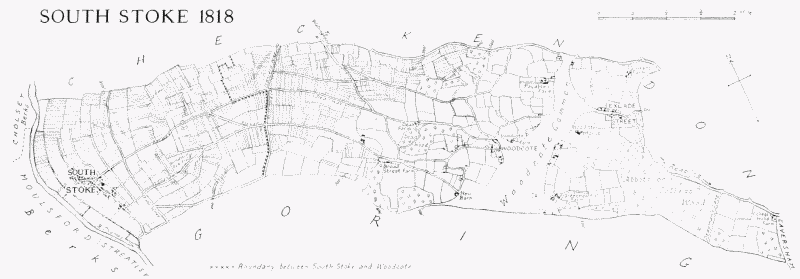
SOUTH STOKE 1818
Map showing early inclosure in the upland part of yhr South Stroke. Based a map of 1818 by Frederic Young in the possession of Christ Church, Oxford.
The lessees of the manor held Manor farm or 'the farm'; it was Eynsham Abbey's old demesne farm and the largest in the parish. In about 1740 it consisted of between 350 and 400 acres of open-field land; (fn. 212) in 1819 there were 314 acres. (fn. 213) By then its arable strips in each open-field furlong had been consolidated; few were smaller than an acre and many were of several acres.
In the 19th century Stoke was still a parish of small farms. In 1819 Christ Church owned 16 holdings, not counting the Manor farm, compared with 17 in 1740. Of these 6 were of between 50 and 100 acres and 5 of over 100 acres. Outside the manor there were 11 farms of 20 or more acres, and only 4 of them were over 50 acres. (fn. 214) These numbers had changed little by the time of inclosure in 1853, when there were still some 15 farms of which 6 were between 100 and 150 acres, and the rest were under 100 acres except for Manor farm (660 a.) in Stoke and Christ Church's Woodcote farm (300 a.). (fn. 215)
Before 1853, Stoke was largely an open-field parish. In the 17th century, as in the 14th, Stoke itself had three fields of about 1,000 field acres in all, the Great South Field, the Great North Field, and the Little North Field. The last, which was in the north-west corner of the township, was much smaller than the others. The vicar held 5 strips there, as compared with 31 in the Great North Field and 23 in the Great South Field. (fn. 216) Holdings of only a few acres were divided fairly evenly between the two large fields. (fn. 217) By 1819 there had been little consolidation, apart from the strips of Manor farm. The vicar's glebe (29½ a.), which had consisted of 59 strips in 1685, was divided into nearly as many in 1819, scattered among some 30 furlongs. (fn. 218)
At this time Woodcote had five fields (400 acres in all) of varying sizes—Leasedown, Coombe, Round, and Durley Fields and the Furlong—among which all the Woodcote open-field properties were divided. (fn. 219) It is likely that part of its arable may never have belonged to a field system: the presence of isolated farmhouses, some of which go back to the Middle Ages, is an indication of early inclosure. In addition there is a record of 42 acres of closes in the manor of Hyde in 1545, of 95 acres of old inclosures at Payables, and of 70 acres of inclosed arable at Dean farm in 1817. (fn. 220) By 1819 at any rate the land on both sides of Woodcote Heath was inclosed. Woodcote Heath (c. 250 a.) itself was uninclosed. It was waste land of the manor and an attempt by Christ Church in the 1650's to inclose it had been either partly or entirely unsuccessful, because the freeholders, including Reading Corporation, had joined in resisting it. (fn. 221)
While the parish's common pasture lay in Woodcote, its meadow was mostly along the Thames in Stoke. By the 19th century Woodcote Meadow, still a lot meadow in the 17th century, had gone, and only Great Common and Little Common Meadows remained. (fn. 222) Farmers whose lands lay in Woodcote had to cross the parish to reach their meadow. (fn. 223) As in the Middle Ages, an acre of meadow went with each yardland of arable. (fn. 224)
By the award of 1853 about 1,750 acres was inclosed. (fn. 225) The largest allotment (c. 260 a.) went to Christ Church and the lessee of Manor farm, Isaac King, who also received another allotment of 145 acres. There were about 50 other allotments of which 11 were between 50 and 150 acres and all but 3 of the rest were of less than 20 acres, some being of no more than a few perches. Christ Church was awarded 7½ acres for rights on the waste, and the churchwardens and overseers about 14 acres. (fn. 226)
Throughout its history the woods have played an important part in the economy of Stoke. Woodcote's wood was confirmed to Eynsham Abbey with the vill in 1109 by Henry I. (fn. 227) In 1366 the abbey had at Exlade 348½ acres of wood, which stretched along the road from Reading to Wallingford and was therefore considerably larger than the present College Wood (77 a.). The tenants of Stoke and Woodcote had rights of common there, as did Notley Abbey's grange of Caversham. For this privilege the canons paid two pounds of wax a year to Eynsham. (fn. 228) The value of the wood was estimated at £3 13s. 4d. a year, which included housebote and haybote for the manor-house and the rector. (fn. 229)
When Eynsham leased the manor in 1460, it provided that no sale of wood was to be made, but the lessees were later accused of selling £10 worth of wood a year, thereby causing the destruction of the woods. (fn. 230) At the visitation of 1520 the abbot himself was said to have sold an excessive amount of wood in Stoke and other places, and was commanded not to sell wood without the consent of the monks. (fn. 231) When the manor was again leased in 1536, Abbot's Wood and all the other woods 'now being inclosed and copsed' were excepted from the lease of the manor. The lessee was to receive 30 loads of hardwood for fuel, and the woodward was to assign him wood for hedgebote, cartbote, and ploughbote. The customary tenants were to have enough wood to keep their houses in repair. (fn. 232) Christ Church continued the policy of keeping the woods in its own hands, but allowing the lessee of the manor and the tenants the same amount as the abbey had allowed. (fn. 233) The vicar also was entitled to 8 loads a year and pannage for his swine. (fn. 234) In the 18th century all tenants, both freeholders and copyholders, had rights of common in the college woods, but only the copyholders were allowed timber for the repair of their houses. (fn. 235) In the late 18th or early 19th century tenants may have lost some if not all of their rights in the woods, for by 1819 College Wood farm, in the south-eastern corner of the parish, had been formed, and its tenant was leasing College Wood (142 a.). (fn. 236)
In the hundred years after inclosure, except for its woods, of which there were over 350 acres in 1878, (fn. 237) Stoke remained largely an arable parish. In 1914, 70 per cent, of its agricultural land was arable and 29 per cent, pasture. (fn. 238) By 1958 arable still predominated, but many farms had been amalgamated. The tenant of Christ Church at Manor farm farmed about 1,000 acres: his farm was mostly arable and was highly mechanized. (fn. 239) At Woodcote the largest farm was Woodcote or Church farm (c. 350 a.), which Christ Church had recently sold to the tenant. The land of several of the old farms had been sold off, and some Woodcote land was farmed from Checkendon and Goring. Mixed farming was the general practice in this part of the parish. Pedigree Frisians and Ayrshires were kept on two farms in Woodcote. Reading was the local market, but milk went to Slough and the Milk Marketing Board. (fn. 240)
The population of the parish (excluding recent additions) has probably doubled since the 17th century, for Woodcote has developed in the 20th century as a residential area and has grown larger than the mother village of Stoke. In 1676 the adult population of the parish was 232. (fn. 241) In about 1718 there were said to be round about 80 houses; (fn. 242) in 1759 there were between 90 and 100; (fn. 243) from 1768 until 1790 the vicars reported about 100; (fn. 244) and by 1811 there were 125, inhabited by 142 families. (fn. 245) The population rose from 645 in 1811 to 907 in 1841; it declined to 717 in 1891, but has risen since to 1,025 in 1951. (fn. 246)
Stoke and its hamlets were until the 20th century purely agricultural villages. In 1811 out of 142 families 120 were employed in agriculture and 18 in some rural craft. (fn. 247) By 1851 the rise in population had led to an increase in both groups of workers. There were the usual village shops, a grocery, at least one smithy, and the post office in Stoke; (fn. 248) two smiths and two or three food-shops in Woodcote and Exlade; and three public houses in the parish. Woodcote and its hamlets had more craftsmen and tradesmen than Stoke; they included 2 sawyers, 2 wheelwrights, a cordwainer, a hurdlemaker, 2 lathrenders, a carrier, and a dealer in china and earthenware. (fn. 249) The three brickmakers recorded worked no doubt at the Greenmoor Hill brickworks, which had been there since at least 1742. (fn. 250) Among the more unusual occupations followed at Stoke were those of a straw-drawer, and a twine-spinner. There were also three dressmakers and a laundress in the village, and many Stoke women worked as agricultural labourers. (fn. 251)
By the 20th century the old craftsmen had gone. Stoke still had three small shops (one containing the post office), and Woodcote, which was no longer a rural village, had a few shops, a restaurant or two, and two garages. There were five public houses in the parish. (fn. 252) A large proportion of Woodcote people in 1920 worked outside the parish, at the R.A.F. station in Goring Heath or in Reading.
Church.
The church, with its chapel of Woodcote, is the only one in Dorchester hundred which is in Henley rural deanery. About 1190 it was confirmed to Eynsham Abbey, along with two other churches on the abbey's demesne manors, by Bishop Hugh of Lincoln. (fn. 253) It had evidently long been in existence, for ab antiquo it was free from all episcopal dues (ab omni onere episcopali), (fn. 254) and may well have been granted with the manor to Eynsham by the Bishop of Lincoln in about 1094. (fn. 255) It remained a rectory in the abbey's patronage until 1399, when the abbey appropriated it. In 1397 Boniface IX sanctioned the appropriation of three churches, including Stoke, giving Eynsham permission to serve them with chaplains and to farm all its property, including churches, without the bishop's permission. (fn. 256) Royal consent followed on condition that a new altar was set up in the abbey church at which masses would be said for the souls of Richard II and his late queen, Anne of Bohemia, and that vicarages were ordained and distributions made to the poor. (fn. 257) In 1399 Bishop Beaufort, who was patron of the abbey, gave his consent, (fn. 258) and it was again agreed that vicarages be ordained in order that divine services should be regularly held, the piety of the parishioners encouraged, and the cure of souls not neglected. (fn. 259) The church remained in the abbey's possession until its dissolution in 1539. In the 1530's, however, the abbey four times sold the right of presentation. (fn. 260) The rectory and advowson were granted with the manor in 1546 to Christ Church, which retained the advowson when it leased the manor. (fn. 261) The presentation of 1556 was sold, (fn. 262) but the college presented thereafter and was still patron in 1957.
Even before Eynsham appropriated the church, it was receiving a pension of a pound of pepper from it which was valued at 13d. in 1399. (fn. 263) Much more valuable were the tithes which the abbey collected in the parish. (fn. 264) These, when they were carefully listed in 1270, consisted principally of half the tithes of grain (garbarum) in almost the whole parish, and all the tithes on the demesne of Eynsham's Stoke manor. (fn. 265) The last at least by 1366 went to the support of the almonry and were collected by the almoner. (fn. 266) In 1239 the abbey also had the right to half of some of the small tithes, but it was later agreed that the rector should pay an annual pension of 5s. in place of these. (fn. 267) In 1291 Eynsham's share of the tithes was valued at £5 6s. 8d., or nearly half the value of the church (£11 6s. 8d.), and in 1390 they were worth £7 11s. (fn. 268)
According to the ordination of the vicarage in 1399, the abbey was to collect all the tithes of grain, hay, and coppice wood in the parish; all mortuaries were to go to it; and it was to have a part of the rector's house and all but 10 acres of the glebe of over 2 virgates. In return it was to be mainly responsible for the church's upkeep. (fn. 269) In 1535 the net value of the rectory to Eynsham, after the distribution of £2 in charity, was £13 10s. 8d. a year. (fn. 270)
When Eynsham leased the manor in the 15th and 16th centuries, the rectory but not the advowson was included, and this was also true of Christ Church's post-Reformation leases. (fn. 271) The lessee undertook to keep the chancel of the church in repair, and as lay rector he kept a bull and a boar for the use of the parishioners. (fn. 272) The rectory lands did not form a separate estate. Rectorial tithes in about 1740 were worth £200 and in 1853 were commuted for £765. (fn. 273)
As Eynsham took so great a proportion of the tithes, South Stoke, before its appropriation, was rather a poor living: it was valued at £5 in 1254 and £6 in 1291. (fn. 274) Part of the rector's income came from his glebe, which in 1366 consisted of 2 virgates and a close of 4 acres. He no doubt had rights of common for this like the other landholders, but he could also keep two cows and a carthorse (affrus) in the abbey's pasture, and had the right of housebote and haybote from the abbey's wood. (fn. 275)
When in 1399 the living became a vicarage, the incumbent was only allowed a part of the glebe house, a hall and some rooms, and garden, (fn. 276) and lost part of the income. He was allowed the small tithes only and the tithes of flax and hemp; his glebe was to consist of 8 acres of arable, including 2 'Lampeacres', and 2 of meadow; and he was to get eight loads of firewood from the abbey's wood, the trees and grass growing in the churchyard, and the offerings of the altar. His responsibilities included keeping a lamp burning in the chancel, and providing bread, wine, and light for church services (on Sundays the parishioners gave a candle) and two processional tapers. (fn. 277)
In 1535 the vicarage, valued at £12 16s., was a fairly prosperous one, but by the late 17th century the living had become a poor one: its net value in 1675 was £32 and was about the same in the early 18th century. (fn. 278) In the next 100 years it was several times augmented. Christ Church gave £10 a year from Dr. Robert South's benefaction; in 1765 Queen Anne's Bounty and Dr. Stratford's Trustees each gave £200; soon after 1800 Christ Church augmented the living by another £25 on condition that the curate's stipend be increased to £45 and that more frequent services be held; and in 1822 Queen Anne's Bounty gave another £600 to meet benefactions, including one from Christ Church and one from the vicar, John Williams. (fn. 279) The value of the living rose from £69 in 1778 to £136 in 1831. (fn. 280) In 1853 the vicar's tithes were commuted for £127 15s. (fn. 281)
In addition to his tithes, the vicar had eight loads of wood a year from the college's woods, and his glebe. The glebe consisted of about 30 acres, three times as much as in 1399, and was still owned by the vicar in 1853. (fn. 282) At the inclosure he was awarded 40 acres.
Because Eynsham had the special privilege of collecting Peter's Pence (a contribution of 1d. from every household) in five parishes, something is known about the collection of medieval church dues in the parish. Eynsham paid the archdeacon, who normally received Peter's Pence, 8s. a year and was allowed to keep any surplus for itself. (fn. 283) By the 14th century it was making a profit. In Stoke only those with cattle worth 2s. 6d. were obliged to pay. (fn. 284) In 1366 these amounted to about 45 people, (fn. 285) and in the 14th century the abbey's bailiff normally collected about 3s. 6d. a year for Peter's Pence. (fn. 286) In the 13th century the abbey also collected churchscot, worth 8d. a year, a payment normally made to the parish priest. (fn. 287)
The first recorded Rector of Stoke, who appears soon before 1200, was named Ralph. He had a chaplain and lived in the parish, for he witnessed local deeds, and his parsonage is mentioned about this time. (fn. 288) Two of the 13th-century rectors—Master Osbert de Wycombe (1220–7) and Master Bartholomew de Newenton (1250–?)—were university graduates, and one, Jordan de la Pomeraye (?–1291), resigned the living in order to become a Cistercian. (fn. 289) In the 14th and 15th centuries the incumbents were not graduates. After the church was appropriated in 1399 the vicars in accordance with canon law resided, but in the early 16th century Nicholas Asheley (c. 1509–31), who was also Vicar of Aston Rowant, seems to have served Stoke church with a curate. (fn. 290)
After Christ Church became the patron, it usually presented its own graduates, and until the 18th century they seem to have lived in the parish. Robert Abbott (vicar 1556–77), for example, was buried in the chancel and left a benefaction to his curate. (fn. 291) His successor Hilary Fishwick, a Christ Church graduate, was clearly constantly in residence. The parish register is all written in the same hand until 1614, the year before his death. His name, moreover, is frequently found as a witness to local wills. (fn. 292) It was in his time that there was said to have been dancing in the churchyard at Whitsuntide, a charge denied by the churchwardens. (fn. 293) No record has been found of disturbances in the parish during the religious changes of the 16th and 17th centuries. The vicar of the Commonwealth period, William Snow (by 1651–63) may have had royalist sympathies, for his son was a godchild of the royalist Griffith Higgs. (fn. 294)
In the second half of the 17th century two features of interest in the church life of the period are recorded. There was a church house, probably something like a parish hall, next to the churchyard, (fn. 295) and the vicar began the custom, as part of Henry Parslow's charity, (fn. 296) of preaching a sermon in Stoke church on the Monday before All Saints' Day (1 Nov.) and in Woodcote chapel on the following Monday. For each sermon he received 10s. and the parish clerk 1s. (fn. 297) At this time the parish still had a resident vicar, David Thomas (1663–1701), who was comfortably provided for with a house, which was assessed on four hearths in 1665 and had 'five spaces of good fair building'. (fn. 298) He was succeeded by two members of a prominent local family, the Stopeses of Britwell Salome. James Stopes junior was vicar from 1701 to 1706 and his father James Stopes senior from 1706 until 1720. (fn. 299)
In the 18th century pluralism and non-residence, caused by the poverty of the living and the smallness and ruinous condition of the vicarage house, were generally the rule. Robert Hughes (1721–43) was the last vicar to live in the vicarage. In 1724 £15 a year was sequestrated from the income of the living for its repair, (fn. 300) but his successors had to have much done to it to keep it in a fit state for a tenant. Coventry Lichfield (1743–85) lived at Goring Heath, where he acted as chaplain to Allnut's Hospital in order to supplement his income which, as he complained, was small though his 'flock' was great. (fn. 301) However, he tended it conscientiously, for he served Stoke church himself and held two services on Sundays, except on the days when there was a service at Woodcote, catechized the children regularly, and administered communion six times a year to between 20 and 30 communicants. (fn. 302)
After 1790 the vicars no longer lived near the parish. Thomas Ellis Owen (1790–5), an opponent of Methodism, lived in Wales, (fn. 303) and John Williams (1795–1844), although he held the living for nearly 50 years, during many of which he also leased the manor, was never resident on account of the small value of the living. In order to let the vicarage he spent over £100 on repairs. (fn. 304) In the early 19th century the church was served by a curate, who also served Goring. (fn. 305) Efforts to see that he resided were unavailing because the house was unsuitable and the farmers refused to give him lodgings. (fn. 306) Only one Sunday service could be held, communicants were said to be few, (fn. 307) and dissent throve. In order to keep the children and adults from going to dissenting meetings the curate opened an evening Sunday school, and preached an evening sermon. (fn. 308)
When P. H. Nind became vicar in 1844 he lived in Woodcote and served its chapel himself, while hiring a curate for Stoke. The Vicarage was enlarged for the latter in 1845 at a cost of £400, but it was still considered only a 'mere cottage' in 1860. Nind moved to Stoke in 1869 when the new Vicarage was built, but he considered Stoke a difficult place because it had many dissenters and Christ Church, the patron, was not interested in the spiritual state of the parish and let the manor to a 'violent opposer of the church', Isaac King. Beer houses were open on Sundays, (fn. 309) and most of the parishioners were of the poorest classes, who left home and went to work at a very young age. (fn. 310) Evening schools were held in winter for them, but in 1878, out of a total population of 762, there were 25 communicants, and it was even difficult to find people to act as churchwardens. (fn. 311) In the 20th century there was no parochial church council. (fn. 312)
Architectural evidence shows that Woodcote, which was a separate tithing, had a chapel in the 12th century. (fn. 313) It is probably to be identified with the chapel of St. Leonard at Exlade, mentioned in 1406 when Eynsham Abbey paid a carpenter 4d. for repairs, (fn. 314) but the first direct reference to it occurs in 1467, when a licence to celebrate services was issued by Bishop John Chedworth. (fn. 315) In 1666 the bishop's court decided that the vicar or the inhabitants must keep it in repair and not the lessee of the manor and rectory, who paid for the upkeep of Stoke chancel. (fn. 316)
By the mid-16th century the chapel had its own churchwardens, (fn. 317) and was probably already licensed for marriages and communion. (fn. 318)
In 1597 the Vicar of Stoke was said to be holding services there at Christmas, Easter Day, and on some working days for 'thanksgiving of women and marriages'. (fn. 319) As the inhabitants of Woodcote and Exlade were unable to pay someone to serve the chapel regularly they had been accustomed to go to Checkendon church, when convenient, as well as to their parish church at Stoke, until attempts were made to prevent this by the new rector of Checkendon, Owen Thomas. The chief residents petitioned the Archbishop of Canterbury in 1597 for permission to continue to attend Checkendon as their predecessors had done time out of mind. They stated that Stoke was 2 to 3 miles distant from their dwellings, whereas Checkendon was a ¼- to a ½-mile distant, and that the journey to Stoke twice a day (i.e. 12 miles), particularly in winter, was most burdensome to the strongest of them and intolerable to the impotent, the aged, and to most women and children. For the past two years the Rector of Checkendon had instituted prosecutions in the archdeacon's court against the Stoke parishioners coming to his church. This had involved them 'in great trouble and hindrance from their work' and 'intolerable expenses' for journeys to and lodgings in Oxford and in fees of the court. They added that there were no recusants among them, and that they were anxious not to be compelled to break the laws about church attendance lest their children should lack 'good education and instruction'. They were still willing to communicate at their own parish church and to go there as often as it was convenient, and indeed were supported in their petition by their vicar, Hilary Fishwick, who also made no objection to the parishioners of Checkendon attending his church, if they lived 3 miles or more from their parish church but within ½-mile of Stoke. (fn. 320) The archbishop granted the petition as 'the request was reasonable', provided the inhabitants of Woodcote and Exlade attended the parish church at least four times a year. (fn. 321)
In 1653 the inhabitants of the hamlets petitioned to have their chapel made into a parish church, licensed for all sacraments, and with a minister of its own. (fn. 322) The petition was evidently unsuccessful, for the Vicar of Stoke continued to be responsible for services at Woodcote. By the mid-17th century the chapel no longer had its own churchwardens, though it appears to have become customary for one of the Stoke wardens to be chosen from Woodcote. (fn. 323)
During the 18th century there were eight services a year in the chapel, and in the early 19th century one a month. (fn. 324) But Woodcote people mostly went to Checkendon until the 19th century and there the owners of Woodcote House had their family vault. (fn. 325)
When P. H. Nind became vicar in 1844, he at once rebuilt the chapel, held two Sunday services there, and attempted to get Woodcote made into a separate living. (fn. 326) His son H. G. Nind, who succeeded his father in 1887 and who had already been acting as curate of Stoke, left Woodcote to live in Stoke. (fn. 327)
The church of ST. ANDREW is an ancient building of flint rubble, covered with roughcast, with stone dressings, comprising a chancel, nave, north and south aisles, south porch, and western tower. (fn. 328) The original church was evidently rebuilt in the early 13th century, and much of the present building dates from then. The two lancet windows in the north wall of the chancel are from this period. Narrow aisles were probably added on to the original nave at the same time, for there is a restored lancet window at both ends of the north aisle and the south aisle, although partly rebuilt in the 19th century, retains an original lancet window, containing potmetal glass representing the Virgin and Child, at the east end. The lancet at the west end is 19th-century work. The roof included both aisles under its span. (fn. 329) The north aisle is separated from the nave by three Early English arches of two chamfered orders set on heavy round chalk pillars with octagonal abaci. The pillars (now rebuilt) separating the south aisle from the nave were apparently later; with one exception they were octagonal and made of wood, and the arches over them were also wooden, but chamfered and painted. (fn. 330)
Much work was done to the church during the 14th century. A Decorated east window of three lights was inserted, also the two windows, with a priest's door between them, in the south wall of the chancel. A new window (the easternmost one) was inserted in the south wall of the south aisle; the south door was rebuilt, and a porch was added. The porch had a pointed roof and a small rectangular window in its east wall. (fn. 331) Two Decorated windows and a doorway were inserted in the wall of the north aisle.
It may have been in the late 14th century that a canopied niche was placed in the east wall of the south aisle. It was once painted and traces of colour remained until recently. (fn. 332) Of slightly later date is the canopied niche in the north wall of the north aisle. The small piscina which was until recently next to it shows that there was once an altar here. (fn. 333)
The battlemented tower was probably built early in the 15th century. Two windows in the south aisle are also Perpendicular work. The two dormer windows, once in the roof over the south aisle, were later additions. (fn. 334)
Some work seems to have been done in 1711 and 1712, for Rawlinson noted these dates, with the names of the churchwardens, on the chancel walls. (fn. 335) In 1759 a number of minor repairs were ordered: a new north door was to be provided, the chancel door was to be renewed or else walled up, and parts of the floor were to be relaid. Also, the banks of rubbish were to be moved from the walls and specially from the porch. (fn. 336) Further repairs were ordered in 1803 and 1822. (fn. 337)
In 1857 and 1858 the church was restored at the cost of about £1,000. The architect was J. B. Clacy of Reading. (fn. 338) Details of the restoration have not been found, but it was certainly then that the southern arcade separating the nave from the aisle was rebuilt in the Early English style and the south aisle widened, so that now it is nearly 3 feet wider than the north one. The old southern wall, with its windows and doorway was retained, but the ancient clinker-built door was renewed. The south porch, which had been much mutilated, was rebuilt, and the stonework in several of the windows was renewed. The small vestry at the end of the south aisle, joined to the chancel by a new archway, was probably also constructed then.
The plaster ceilings of the nave and chancel were removed, and the roofs of the nave, aisles, and chancel largely renewed. Some of the old roof remains, including a wall plate in the north aisle. (fn. 339) The floor of both nave and chancel were tiled and a new pulpit was installed. The buttresses which support both the nave and chancel walls were probably added at this time. (fn. 340)
In the 20th century, in 1952, major repairs to the tower, including the replacing of the lead roof with a copper one, were executed. (fn. 341)
Other changes and repairs have included the insertion of the clock in the tower after the First World War as a war memorial; the replacing of the small harmonium by an organ (1927); and the installation of electric lighting (1933). (fn. 342)
The plain octagonal font is medieval. In 1849 it stood at the western end of the northern arcade, (fn. 343) but in 1958 it stood near the south door. Other medieval features are the tiles, assembled at the east end of the north aisle. (fn. 344)
The 'ancient, solid, square-ended' seating was retained at the 19th-century restoration and the two seats with 'good plain bold Perpendicular tracery' were placed in the chancel. (fn. 345)
The church is noted for the fine 17th-century monument on the north wall of the chancel to the memory of Griffith Higgs, Dean of Lichfield. (fn. 346) The figure of the dean is represented in his clerical robes holding a book in his right hand and with his left hand on a skull. (fn. 347) There is also a marble tablet in the chancel to James Higgs, gent. (d. 1742), who became Mayor of Wallingford, and to his brother Barton (d. 1722), great nephews of Dr. Higgs. Over the entrance to the south porch is a tablet to Griffith Higgs (d. 1692/3), Dr. Higgs's nephew, with an inscription in which he asks to be buried at the church door. (fn. 348) In the tower hangs a large painted pedigree of the Higgs family with heraldic quarterings. There are three monuments in the chancel to lessees of the manor: one to Richard Hannes (or Hanney) (d. 1678) and his wife Jane; (fn. 349) and a similar one to his daughter Elizabeth (d. 1657), the wife of William Barber; (fn. 350) and one to Lucy Harward (d. 1718/19), wife of Kemp Harward, and to her mother Lucy (d. 1728), the wife of Altham Smith of Grays Inn. This monument, which is surmounted by three gilded cherubs' heads in a roundel, was erected by Lucy Harward's daughter Lucy, who later married John Head. Other monuments in the chancel are to Henry Hervey of Ipsden (d. 1764); and to Moses Allen, gent. (d. 1770) and his wife Mary.
On the floor of the centre aisle of the nave are four tombstones of members of the Claxson family, who may have lived at Payables: (fn. 351) of John (d. 1701); of another John, called John Claxson, senior (d. 1739); of Elizabeth (d. 1743), wife of John; and of William (d. 1748).
Later tablets in the nave are to Sir John Charles Fox (d. 1943) and his wife Mary Louisa; to Lt. David Gordon Dill (killed 1944); and to Thomas Geo. Pither (died as prisoner of war, 1945). There is also a memorial window to Hubert D. Nind (1809–74). The brass noted by Rawlinson to Thomas Walles, his two wives, and eleven children has disappeared. (fn. 352)
In the churchyard is the large table tomb of Isaac King (d. 1865), for many years lessee of the manor.
In 1552 the church owned a silver and gilt chalice and paten; a copper and gilt pyx and chrismatory; two brass candlesticks, and two crosses. By the next year only a chalice without a paten remained. (fn. 353) The church now owns a very fine silver chalice and paten of 1660, inscribed as being the gift of Griffith Higgs, and bought with the £5 which he left to the church. (fn. 354) Both pieces are also inscribed with his arms. There is also a silver flagon of 1869, given by Arthur J. Nind. (fn. 355)
In 1552 there were four bells in the church; there should also have been a sanctus bell, but its fate was unknown. (fn. 356) Later a fifth bell was added to the ring, for Rawlinson noted a 'ring of 5 good bells'. (fn. 357) In the early 17th century four new bells were acquired, three of them the work of Henry Knight I and one of Ellis Knight I. They are dated 1609, 1616, 1622, and 1633. In 1716 another new bell was obtained, and all were recast in 1857. The last was replaced in 1881. In 1920 a sixth bell was added to the ring. It was given by Alfred D'Oily Nind in memory of parishioners who fell in the First World War. (fn. 358)
Additions were made to the churchyard in 1884, 1926, and 1941. (fn. 359) In 1937 the lych gate was erected. In 1955 the unmarked and untended grave mounds in the west and south-west of the churchyard were levelled. (fn. 360) In the churchyard is a stone cross erected as a memorial to the parishioners who fell in both World Wars.
The registers, which also cover Woodcote until 1846, begin in 1557. There are churchwardens' accounts from 1856.
The chapel of ST. LEONARD at Woodcote was almost entirely rebuilt in 1845–6. The first documentary evidence for the existence of this chapel dates from the 15th century, (fn. 361) but drawings of the old chapel suggest that it was of 12th-century origin. (fn. 362) It consisted of nave, apsidal chancel, south porch, and western wooden bell-cot.
Little was probably done to the church in the post-Reformation period. In 1666 the chancel was evidently in need of repair; (fn. 363) the date 1692 and the name of the churchwarden once painted on the wall probably indicated some work on the church; (fn. 364) and in 1759 the archdeacon ordered several things to be done, including mending the porch door, repairing the reading desk and pulpit, buying a new Bible, and having the Ten Commandments and 'chosen sentences' written. (fn. 365)
In 1845–6 the Vicar of South Stoke, Philip H. Nind, who lived at Woodcote, had the chapel almost completely rebuilt in the Norman style at a cost of £1,300. (fn. 366) The architect was H. J. Underwood of Oxford. The new building, which is 20 feet longer than the old one, consists, as did the latter, of chancel, nave, south porch, and stone western bellcot, with the addition of a north vestry. The outside walls of the chancel were retained; the ancient flintwork in its walls is clearly to be distinguished from the new work in those of the body of the church. The old window was blocked up and four new windows and a priest's door inserted. The interior of the church was completely renewed. A gallery was built. Above the communion table the Lord's Prayer, the Creed, and the Ten Commandments were inscribed, and texts were painted elsewhere by Mr. Margetts of Oxford. (fn. 367) The gallery remains but the church is now plastered over inside. In 1937 a new communion table, given in memory of H. G. Nind, the vicar, was dedicated. (fn. 368) In 1953 about £230 was spent on repairs. (fn. 369)
There are three stained glass windows in the chancel by Powell & Sons of Whitefriars in memory of Emily Nind (d. 1902), the vicar's wife, (fn. 370) and in the aisle there are memorial windows to Emma Nind (d. 1850) and members of the Ferguson family. In 1872 glazed doors were put in the porch by W. H. Ferguson, a churchwarden. In 1953 they were reglazed to commemorate the coronation of Queen Elizabeth II. (fn. 371)
Rawlinson noted in 1718 that the chapel contained neither 'monument nor grave stone'. (fn. 372) When Grace Stanyan of Woodcote House died in 1768 she was buried in the chancel, but two years later her body was moved to the family vault at Checkendon. (fn. 373) There are now brass inscriptions to two vicars: Philip H. Nind (d. 1886) and his wife Agnes; and Hubert G. Nind (d. 1936).
The old font (14½ in. in diameter), which is no longer used, is outside the porch door.
In 1552 the chapel owned a silver chalice and paten. In 1958 the plate consisted of a silver chalice, paten, and almsplate, all of 1845. (fn. 374) There were two bells in 1552, but the present turret has room only for one. It was made by James Wells of Aldbourne in 1801. (fn. 375)
The registers date from 1846. Until then Woodcote was included in the South Stoke registers.
Nonconformity.
In 1625 a number of persons, almost certainly papists, were listed as recusants. They included Richard Braybrooke and his wife Christian, one of the daughters of Barton Palmer, a lessee of the manor. (fn. 376) There were also several yeomen, including John Prince, a member of a Roman Catholic family that was widely spread in South Oxfordshire. (fn. 377) No papists were reported in the Compton Census of 1676, (fn. 378) but a husbandman and his wife were returned as such from 1697 to 1720 (fn. 379) and in the first 20 years of the 18th century there are references to about six others. (fn. 380) In 1738 there was one Roman Catholic woman 'of low rank'. (fn. 381)
In 1676 there were two Protestant nonconformists (fn. 382) and 18th-century visitations mention a few Presbyterians 'of the lower rank'. (fn. 383) Dissent evidently increased towards the end of the century, for in 1802 six families of dissenters were being visited every month by a preacher (fn. 384) and by 1815 the people were said to be 'generally' dissenters. (fn. 385) They went to a chapel of the Countess of Huntingdon's Connexion at Goring, and James Howes, who was minister there from 1814 to 1856, 'founded the cause at South Stoke'. (fn. 386) In 1820 the Congregational chapel at South Stoke, which also belonged to the Countess of Huntingdon's Connexion, was built at a cost of nearly £332. (fn. 387)
The promoters of the foundation were several of the leading farmers in the parish, (fn. 388) and during the 19th century the farmers continued to be largely dissenters. Although in 1851 the Congregationalist congregation was said to number only 35, (fn. 389) the vicar reported in 1854 that the whole of Stoke, except for about 20 people, were dissenters, and that Isaac King, the lessee of the manor, was 'a violent opposer of the church'. When King died in 1865 he left £500 to be invested for the benefit of the minister, as long as the chapel should continue in connexion with the chapel at Goring. (fn. 390) The vicar had accused Christ Church, the lord of the manor, in 1854 of 'entire want of co-operation and assistance', (fn. 391) but it continued to lease to dissenters and in 1866 most of the farms were still rented to them. (fn. 392) In 1881 Benjamin Woodward Panter, a member of one of the chapel's founding families, settled £100 on the chapel, and Richard Pocock King of Reading, who had been the tenant of Manor farm, (fn. 393) by will proved 1882, left it £500. (fn. 394) The chapel has continued as an out-station of Goring, which is still part of the Countess of Huntingdon's Connexion. In 1958 together they had 26 members. (fn. 395)
Closely connected with nonconformity was the village hall. In 1880 Isaac King began collecting money by public subscription for a hall for temperance, religious, and social purposes. By 1885 it had been built on his land; the trust deed of that date describes it as a building of wood and iron called South Stoke Temperance Hall, intended for promoting 'Gospel temperance and religious truth'. Controversy soon developed: King insisted that the hall's use was limited to religious and temperance meetings, while there was local agitation in favour of using it in a less restricted way. (fn. 396)
There had been a Primitive Methodist preaching house at Woodcote in the mid-19th century, (fn. 397) but no later record of it has been found. The Woodcote Primitive Methodist chapel on the road from Woodcote to Goring Heath is in Goring parish.
Schools.
In 1659 Dr. Griffith Higgs left £600 to buy land to maintain a charity school for 8 poor children. Records show that throughout the 18th century the school had an endowment of £5 a year. (fn. 398) By 1808 the endowment had increased to £15 a year and 7 poor children were being taught to read at the school. (fn. 399) By 1815 there were 30 pupils. (fn. 400) Details of the endowment were given in 1818 when the £15 was said to come from the rent of 22 acres of common field, but the surviving trustee knew nothing of the £600 endowment; the school was also said to have had right of common for 300 sheep, 25 bullocks, and 30 swine on Goring Heath, but the trustees were unable to prove this at the time of the inclosure of the open fields. The school income was paid to a schoolmaster to teach reading to 10 boys and numbers might be made up with girls. The children went to school at an early age and left as soon as they could work. (fn. 401) New buildings were erected in 1831 (fn. 402) and there were 51 daily scholars in 1854. (fn. 403) It was a Church school, but in 1877 it was transferred to a School Board of seven members which was formed in 1875, (fn. 404) probably as a consequence of the strong dissenting body in the parish. The average attendance at the Board School was 55 in 1890 and 84 in 1903. (fn. 405) In 1954 there were only 21 pupils at South Stoke County School, as it was then called, but that was because it had been a Junior school since 1929. Seniors attended Langtree Secondary School, Woodcote. (fn. 406)
There were other schools in South Stoke in the early 19th century. In 1808 there were three small dame schools, one of them kept by a dissenter, and in 1821 Robert Morrell supported the setting up of a school for 30 girls. (fn. 407) In 1854 there were flourishing evening schools during the winter months for adults and boys who had left the day school; (fn. 408) there is no later mention of these schools. There was also a Sunday school with 70 scholars in 1854. (fn. 409)
Woodcote hamlet had a Sunday school from 1708 (fn. 410) and a day school endowed by Susannah Newman of Woodcote House in 1715, who gave land worth £10 a year to build a charity school for 10 poor children, 6 from South Stoke parish and 4 from Checkendon. A cottage was also provided for a schoolmaster or mistress, who should teach reading, writing, and accounts. (fn. 411) The school was held at Woodcote from 1759 or earlier and in 1768 the vicar said that the revenues and the master's house were being carefully preserved and employed. (fn. 412) The report in 1808, however, was not good: the house was in disrepair and the master had no scholars and was ill considered. (fn. 413) By 1815 the school was again flourishing with 20 boys and 12 girls, (fn. 414) and the vicar renovated the school-house shortly before 1818. (fn. 415) In 1833 there were 10 free scholars and a further 22 boys and girls were being educated at their parents' expense. New school buildings were erected in 1834. (fn. 416) In 1878 the school became a Board school; (fn. 417) it was closed in 1899 and a new school was built to hold 120 children. (fn. 418) In 1903, however, the average attendance was only 25 boys and girls and 21 infants. (fn. 419) It existed up to 1957 as a mixed County School, but was then reorganized as Langtree Secondary School. A new primary school was opened at the same time. (fn. 420)
In the 19th century Woodcote House became a high-class preparatory school for boys kept by the Nind family. It was probably opened in 1841 when the vicar, P. H. Nind, leased the house. (fn. 421) Of its 44 pupils in 1851, one was a peer and three were members of peers' families. (fn. 422) When Nind moved to the new Vicarage at South Stoke in about 1870, his son Hubert Nind kept on the school until he became vicar in 1887. The school was closed before the First World War. (fn. 423)
In 1942 the Oratory School, a Roman Catholic public school founded in 1859 at Edgbaston by Cardinal Newman, moved to Woodcote House. In 1959 it had 200 boarders. A new wing was then being built so that numbers could be increased. (fn. 424)
Charities.
By will dated 1598 William Palmer, the lessee of Stoke manor, left £200 to buy an annuity of £14 for the poor of seven parishes; £2 was for the poor of Stoke, Woodcote and Exlade, to be distributed by the lessee of the manor and the vicar. No land was bought, and in 1610 distributions were not being made. (fn. 425) In 1668 William Barber, the lessee, was paying the £2 to the poor, but had bought no endowment. Although ordered to do so, (fn. 426) he never did, and by 1786 the charity had lapsed. (fn. 427)
In 1602 lands in Rotherfield Grays and Gyldon Dean were charged by the will of Augustine Knapp with the payment of 20s. yearly towards the clothing of 'poor, lame, impotent and needy people' in South Stoke parish. The rent was paid on the eve of All Saints' and was at one time known as 'Waistcoat Money'. (fn. 428) In 1877 it was distributed in clothing every three years. (fn. 429) In 1881 the rent charge was redeemed for £34 stock, (fn. 430) which has since yielded 16s. 8d. (fn. 431) In 1926 this was spent on rugs, 3 for Stoke and 3 for Woodcote, but in 1954 in 2 clothing vouchers, each worth 10s., one for each place. The distribution takes place at Christmas. (fn. 432)
In 1659 Dr. Griffith Higgs directed his executors to lay out £100 in land and to charge the land with the payment of £5 yearly, £3 to be distributed among 6 poor families of Stoke and £2 among as many from Woodcote and Exlade. Each family at Stoke and Woodcote was to be given 5s. or 3s. 4d. apiece at Christmas and at Easter after morning service. An island in the Thames (c. 1¼ a.), later called 'The Doctor's Gift', was bought for the purpose. Its sale was authorized in 1948, and the proceeds invested in about £334 stock. (fn. 433) The income between 1954 and 1956 was about £10 yearly and was distributed at Christmas and Easter in sums of 7s. 6d. to aged, infirm, or sick widows and occasionally to widowers. (fn. 434)
Henry Knapp, who died in 1674, left to the poor of Woodcote and Exlade 40s. yearly issuing out of the manor and farm at Rawlins in Woodcote. (fn. 435) This charity appears to have been lost before 1820. (fn. 436)
Before c. 1820 the owners of an estate in Stoke habitually gave 3 poor women of the parish and 2 of Checkendon blue cloth to make gowns. The charity, if such it was, seems to have been lost thereafter. (fn. 437)
Henry Parslow, Paslow, or Pasler, by will proved 1675, charged an estate in Checkendon with the payment of £5 to provide 5 coats for 5 poor men, 1 at Stoke, 2 at Woodcote, and 2 at Checkendon; and he directed that the Vicar of Stoke should have 10s. for preaching a sermon on the Monday before All Saints' and the clerk 1s.; and that each man receiving a coat should have 1s. and the two churchwardens who should buy the coats 1s. each. (fn. 438) In 1937 the rent charge was redeemed for £260 stock. (fn. 439) In 1872 only three coats were provided. (fn. 440) In 1954 the vicar was still receiving 10s. for preaching. Since 1943 the men from Stoke, Woodcote, and Checkendon have been entitled to 30s. apiece for clothing and 1s. for attending the service. If five recipients are not forthcoming, the value of the vouchers is increased proportionately. In 1957 the value had risen to £3. (fn. 441)
Before 1786 an unknown donor had given £40 to the poor of South Stoke. By about 1820 the usual practice was for the interest to be allowed to accumulate for two or three years and then to be distributed in small sums to poor families according to their size. (fn. 442) In 1877 the distribution was in coals and both Stoke and Woodcote benefited. (fn. 443) Some time before 1877 another unknown donor had given two cottages to the poor. These were burnt down in 1905. (fn. 444) The second of these charities and possibly the first also, was regulated by Scheme of 1908 which provided that the interest or rents arising from the land on which the cottages stood and a sum of £183 should be distributed in coal to necessitous residents. (fn. 445) Between 1954 and 1956 the income amounted to £6 and was distributed at Christmas in coal to between 8 and 9 recipients. (fn. 446)
Mrs. Jane Williams, of Bourton-on-the-Hill (Glos.), by will proved 1831, left £100 stock in trust for the relief of the poor of Stoke parish, together with a like sum for the poor of Chastleton. (fn. 447) In 1877 and 1926 the income was spent in blankets. (fn. 448) Between 1954 and 1956 the income was £2 10s. yearly, and was usually distributed at Christmas in clothing vouchers of the value of 10s. (fn. 449)
William Claxson, of Reading, by will proved 1860, left money, represented by £291 stock, to buy clothing for the benefit of the poor of Woodcote. The legacy was subject to the life interest of his wife, who died in 1873. (fn. 450) The charity was first distributed in 1876, (fn. 451) and twelve persons were still receiving 12s. each in clothing vouchers in 1954. (fn. 452)
By the South Stoke and Woodcote inclosure award of 1853 2 acres were allotted to the surveyors of the highways as a stone and gravel quarry, and a smaller area as a source of chalk and rubble, in each case for the repair of the parish roads. (fn. 453) By the same award two plots (5 a.) were allotted to the church wardens and overseers as recreation grounds, (fn. 454) two other plots (9 a.) as allotments, (fn. 455) and a very small plot as a pound. (fn. 456) It was stated in 1896 that the allotment land in Stoke was found useless for cultivation and was subsequently converted into a recreation ground, for which, owing to its swampy character, it was equally useless. It was then let for grazing. The rent arising was first used inaid of the highway rate and later spent on fuel for the poor. The allotment and recreation grounds in Woodcote seem to have been used for their proper purposes. (fn. 457) By 1904 these various grounds were being administered by the Parish Council. (fn. 458)
The parishioners of Stoke have the right to send an almsman to Allnutt's almshouse in Goring. (fn. 459)