A History of the County of Oxford: Volume 10, Banbury Hundred. Originally published by Victoria County History, London, 1972.
This free content was digitised by double rekeying. All rights reserved.
Christina Colvin, Janet Cooper, N H Cooper, P D A Harvey, Marjory Hollings, Judith Hook, Mary Jessup, Mary D Lobel, J F A Mason, B S Trinder, Hilary Turner, 'Banbury: Buildings', in A History of the County of Oxford: Volume 10, Banbury Hundred, ed. Alan Crossley (London, 1972), British History Online https://www.british-history.ac.uk/vch/oxon/vol10/pp29-42 [accessed 30 April 2025].
Christina Colvin, Janet Cooper, N H Cooper, P D A Harvey, Marjory Hollings, Judith Hook, Mary Jessup, Mary D Lobel, J F A Mason, B S Trinder, Hilary Turner, 'Banbury: Buildings', in A History of the County of Oxford: Volume 10, Banbury Hundred. Edited by Alan Crossley (London, 1972), British History Online, accessed April 30, 2025, https://www.british-history.ac.uk/vch/oxon/vol10/pp29-42.
Christina Colvin, Janet Cooper, N H Cooper, P D A Harvey, Marjory Hollings, Judith Hook, Mary Jessup, Mary D Lobel, J F A Mason, B S Trinder, Hilary Turner. "Banbury: Buildings". A History of the County of Oxford: Volume 10, Banbury Hundred. Ed. Alan Crossley (London, 1972), British History Online. Web. 30 April 2025. https://www.british-history.ac.uk/vch/oxon/vol10/pp29-42.
In this section
Buildings.
The castle, manor-house, vicarages, gaol, and other public buildings, as well as the domestic buildings in the hamlets, are described elsewhere in this volume.
The Hospital of St. John the Baptist, founded early in the 13th century, (fn. 1) stood just outside South Bar or St. John's Bar. The only record of its buildings, which were presumably not extensive, is the grant made to the prior in 1229 of the timber from Warwick gaol with which to build himself a house. (fn. 2) The shell of a building on the site was used as a barn until 1834 when it was converted into a private house. At that date part of the east end was taken down and the filling removed from the windows. (fn. 3) In 1851 it was acquired by the Sisters of Charity of St. Paul for use as a school. (fn. 4) The buildings occupied by St. John's Priory School in Priory Road are reputed to include the last remnant of the hospital. The oldest part, fronting the road, is a simple, stone-built range of two stories, heavily embellished with imitation or obviously re-used medieval detail. A short stretch of moulded plinth may be original medieval work, and the roof-structure (mostly concealed by wall-paper) with its two tiers of windbraces, is probably 16th-century or earlier, but none of this establishes that the building was ever more than a barn.
Pre-1700 Buildings. Very little medieval building remains. One range of Calthorpe House is probably 15th- or early-16th-century and there is a 15thcentury window in a cottage at Neithrop but apart perhaps from St. John's Priory School (discussed above) that is all that can be found. In a town which has had several subsequent periods of considerable prosperity, any surviving medieval buildings might be well hidden by later accretions, as in Oxford, (fn. 5) but a reasonably thorough investigation in the old town centre has produced no such remains. It is known that many buildings were destroyed during the great fire of 1628 and the Civil War siege, (fn. 6) but not all, for 16th-century timberframed buildings have survived at the Reindeer Inn and No. 16 Market Place. The growth of the town in the 19th century naturally caused much rebuilding, but it is, nevertheless, remarkable that Alfred Beesley, writing in 1841, knew of only two other medieval buildings, the Red Lion and White Horse inns, both since demolished. (fn. 7) It is difficult to resist the conclusion that the buildings of medieval Banbury have vanished so completely because they were generally poor in quality compared with, for example, those of the smaller town of Burford where 26 medieval buildings or parts of buildings have survived. (fn. 8) Most of the early surviving buildings in Banbury belong stylistically to the late 16th and the 17th centuries, and those that are dated suggest the late 1640s and early 1650s as the main building period, immediately after the Civil War. (fn. 9) In the Banbury region the 'great rebuilding' did not get under way properly until the 1650s, and it may be that Banbury itself set a fashion. (fn. 10)
The 16th- and 17th-century houses are built mainly of the local ironstone, but in the area near Market Place there are several that are either wholly timber-framed or have timber-framed fronts. This practice, which is common in towns well supplied with building stone, seems to have developed from the townsmen's love of ornate facades and the need to display their wealth in the constricted conditions of a town. Large areas of carved stone-work seem to have been within the means of only the richest townsmen, (fn. 11) and hence carved woodwork, patterned framing, or even framing covered with decorative plasterwork, were commonly used. Roof-structures are difficult to examine in Banbury, because the roof-spaces have usually been designed as, or converted into, garrets, and the structural detail has been concealed by plaster and wallpaper. There are upper crucks at Nos. 35–36 North Bar and No. 44 Parsons Street (the 'Flying Horse'); and No. 12 Parsons Street (demolished in 1968) also had them in an early-18th-century rear wing, although they had clearly been re-used. Elsewhere roofs are of the type most common in the region, with roof-trusses composed of principal rafters, tie-beams, and collar-beams. Two of the 16th-century examples, No. 16 Market Place and the front range of the Reindeer Inn, have curved, well-shaped windbraces, and the former also has raking struts from principal rafter to tie-beam. The mid-17th-century roofs, such as at No. 11 Market Place and Nos. 85–87 High Street, have vertical struts and no windbraces.
The stone buildings, including the backs of those built with timber fronts, are designed in the vernacular style of the Banbury region. The elevations are plain in character, the windows stone-mullioned with square-headed lights and drip-moulds, the doorways lightly moulded and with flattened fourcentred arches, the roof-lines broken by dormer gables of stone. Apart from this there is little decoration, except for stone copings to the gable-ends and sometimes kneelers to the dormer gables. The doorway of No. 1 Parsons Street is exceptional in having a drip-mould with diamond-shaped terminations. This house (despite a rebuilt elevation to Market Place) is probably the best example of the regional style in Banbury itself. Other examples, some of them much altered, are Nos. 35–36 North Bar, the Whateley Hotel (rear elevation), and No. 18 High Street (rear wing); the Old Gaol (largely rebuilt) and No. 61 High Street (demolished), which was latterly disguised by a coating of roughcast and imitation timber-framing, were formerly of the same type. Occasional use is made of bay windows, gabled and rising the full height of the building. Sometimes a single bay is used, as at No. 21 Horse Fair and at a house which formerly stood on the north-west corner of Marlborough Road and High Street, (fn. 12) sometimes a pair of bays flanking a central doorway, as at two other houses, No. 27 High Street (fn. 13) and No. 3 South Bar (the 'Swan'). All the bays are rectangular on plan, except for No. 3 South Bar, in which the sides are canted; they probably date, to judge from the evidence of examples elsewhere, from the 1640s to the 1670s. (fn. 14)
The wholly or partly timber-framed houses for which evidence exists range in date from the Red Lion Inn (now demolished) of the late 15th or early 16th century, (fn. 15) to the building erected c. 1653 (rebuilt in 1905) on the north-east corner of Parsons Street and Market Place. (fn. 16) The earlier examples, to judge from the two 16th-century houses that survive, relied mainly on patterned framing for their visual effect. Thus No. 16 Market Place has herringbone pattern combined with close-studding, while the east front range of the Reindeer Inn has 'star' pattern. By the mid 17th century a kind of vernacular version of the Baroque had developed. The framing invariably seems to have been covered with ornamental plasterwork, or pargetting, and much use was made of bow windows, multiple oriels, and jetties, the exposed timberwork being heavily carved and garnished with pendants. Dormer gables were used as in the stone houses, but with more dramatic effect. At Nos. 17–19 Market Place, for example, the eaves of the roof are deeply projected, so that the gables appear to hang almost in mid air, while at No. 12 Market Place and Nos. 85–87 High Street a similar effect is obtained by making the gables rise from a jettied half-story. No. 12 Market Place is especially dramatic in having two-storied gables, and similar gables were used in the former No. 84 High Street. (fn. 17) The pargetting, of which no less than 10 examples are known to have existed, is a remarkable feature. It is a technique rarely used outside south-east England, where it is relatively common on both rural and urban buildings. In other parts of the country only occasional examples are found, and then almost always in towns: an interesting piece of evidence, seemingly, of a building style spreading through the medium of towns. Banbury pargetting, however, is not remarkable for its quality, for it hardly ever rises above simple recessed patterns of hearts, fleurs-de-lys, and chains of semi-circles. The one exception is some lowrelief arcading on the south front of No. 16 Market Place. (fn. 18)
Classical detail seems to have made little headway in Banbury architecture before the 18th century, and it is noticeable that such as does appear in domestic building in the 17th century is associated with the timber-framing alien to the region rather than the local stone building, which belongs to the medieval tradition. Nos. 85–87 High Street (1650) have triangular pediments to the oriel windows of the return front, and so had Nos. 83–84 High Street (probably c. 1650: since rebuilt). (fn. 19) The former also contain a stone chimney-piece with flanking pilasters and an entablature, while No. 11 Market Place (probably c. 1650) has an eaves-cornice. Otherwise the only early classical detail known to have existed in Banbury was at the Old Gaol (c. 1610), which had classical columns and an entablature on its centre gable, and at the Reindeer Inn, where the Globe Room (1637) formerly had panelling with attached columns and pilasters, and pediments over the doorcases and on the chimneypiece. (fn. 20) Both buildings were of stone, but they were public buildings of an architectural quality well above the vernacular level and their designer may have been more susceptible to outside influences.
Banbury, though constricted for space like most towns, was not a really closely packed place like Oxford in which the tenements in the central area were so narrow that the houses had to be built at right-angles to the street. The surviving 16th- and 17th-century houses lie parallel to the street, though sometimes with a rear wing at right-angles to the front range. Most are of only two stories, although the mid-17th-century houses were usually designed with a garret in the roof which might even contain two floors. No. 11 Market Place alone has three full stories, and probably it was always exceptional, for George Herbert, in his recollections of early-19thcentury Banbury regarded it as a unique example. (fn. 21) Five distinct types of layout can be discerned among these older buildings. The first is simply the house consisting of one range lying along the frontage of its tenement. In the broader tenements, such as No. 16 Market Place, No. 12 Parsons Street (demolished), and Nos. 35–36 North Bar, the width of the frontage permitted a two- or three-unit plan, while in the narrower ones, such as No. 61 High Street (demolished), there was space for only one unit. The second type is a development from the first, formed by adding a rear wing to make an Lshaped house. The best examples are at Nos. 1 and 51–52 Parsons Street (although the front range of the latter has been rebuilt), Nos. 18 and 27 High Street, and No. 3 South Bar (the 'Swan'); in none of these, however, has it been possible to trace the original plan in full. (fn. 22) The third type is really a larger example of the first, but unusual for a town in being free-standing. Castle House, Cornhill (refronted), appears to be of this type, but more important, perhaps, are Nos. 49–50, 52–53, and 55 South Bar, all three of which originally seem to have been detached houses, apparently with others, Nos. 51 and 54, inserted between them at a later date. The fourth type is the house built on a closely constricted site, and whose plan is therefore likely to be idiosyncratic. The group comprising Nos. 11 and 12 Market Place and Nos. 85–87 High Street is an exceptionally fine example of this kind of development. The fifth type is the house with a large courtyard enclosed by buildings, of which the only examples in the town are the Reindeer and Unicorn inns.
The former No. 12 Parsons Street was perhaps the best example of the first type of layout. It was a wholly timber-framed building of two stories, and its original plan (revealed during demolition in 1968) was a three-unit one similar to that of many local farm-houses. (fn. 23) On the ground floor a crosspassage separated the two westernmost rooms, and the chimney-stack of the middle room was placed so that it backed on the passage. Behind the middle room, which was probably called the hall, was a large rectangular projection containing the staircase. The staircase projection was the one feature which raised the plan above the social level of the farm-houses, for the only rural parallel to it below manor-house status in the area seems to be Orchard House in Neithrop. On its street front the house had simple pargetting consisting of plain rectangular panels, probably late-17th- or early-18th-century since it was arranged to fit tall mullioned-andtransomed windows. The fabric of the building may have been older, although the character of the timber-framing suggests that the front was always plastered. (fn. 24) In later years the house achieved distinction as 'The Original (Banbury) Cakeshop'. Edward Welchman, who bought the building or its precursor from Richard Busby in 1638, is the first baker known to have lived there, but the development of the premises as a bakery was probably the work of Welchman's successor, John Gibberd. He bought the tenement in 1726, and when it was next sold in 1768 the deed described it as 'sometime heretofore called or known by the name or sign of the Unicorn and since that time hath been converted into a bakehouse'. (fn. 25) Certainly a rear wing of red brick had been built on to the house in the early 18th century, and at the end of that was a stone stack containing an oven.
No. 16 Market Place seems to have been a timberframed house of similar type, before the north end of it was demolished, although it could conceivably have been a pair of houses built in one range. An old drawing (fn. 26) suggests that it differed from No. 12 Parsons Street in having a central stack, presumably dividing the house into two rooms on each floor. There was an old door at the northern end, and originally (as appeared during alterations in 1963) there had been a corresponding door at the southern end. There is no evidence of the original position of the staircase.
No. 1 Parsons Street is stone-built, and the best preserved of the L-shaped houses, although it is a special case in being a corner house with a frontage to Market Place as well as to Parsons Street. It may have been the house at the south-east end of Parsons Lane, described by Thomas Robins of Banbury, mercer, in his will of 1665 as lately built and in the occupation of James West, mercer. (fn. 27) It was certainly in the hands of the Robins family by 1676, for in that year Thomas Robins of London, mercer, conveyed to John Allington of Leamington Hastings (Warws.), clerk, a corner house with yard, stable, and garden, situated in Market Place next to the Unicorn Inn. The tenant was then, or had lately been, John Allington, apothecary, or his assigns. (fn. 28) The front range to Market Place was refronted in the late 18th or early 19th century, and the internal arrangements were altered about the same time. The rear wing along Parsons Street, however, retains more or less its original arrangement on the ground floor. A cross-passage separates two equal-sized rooms, each of which has a chimneystack in the wall opposite the passage. Originally there was a staircase beside each stack, that in the western room now identifiable only by a window set between-stories. The stair in the former eastern room is a single framed flight with flat shaped balusters of the early 18th century, but a mullioned window placed between-stories in the south wall again shows that their was a stair in this position from the first.
No. 18 High Street is another large L-shaped stone house, thoroughly remodelled at the beginning of the 18th century and superficially altered again in the 19th century when the front was stuccoed. The front range has been converted into a shop at ground-floor level, but the basic plan, which may well be original, consists of two rooms divided by a cross-passage. The eastern room is much the smaller and has the staircase behind it; this is of 19th-century date, but is probably in the original position, since the original stone steps to the cellar lie immediately below it. The rear wing, also on the east side of the site, was divided into two rooms in the 18th century by inserting an additional chimneystack. Whatever the original plan was, the wing certainly included the kitchen, for the wide fireplace with chamfered wood lintel remains in the rear gable with indications of a former newel staircase on the east side of the chimney-breast. The facade of the wing is an impressive piece of vernacular architecture, with a six-light mullioned window, complete with king-mullion, on the ground floor, and two five-light mullioned windows on the first floor. There were formerly two stone dormer gables in the roof. (fn. 29) The plan has been altered, probably in the 18th century, by the insertion into the angle of the L of an extra room with a timber-framed rear wall.
Nos. 49 and 50 South Bar, though much altered, were almost certainly built as a single, three-unit house, which, as suggested above, may have originally been detached. The two houses share a single roof, and inside there are inter-connecting doors, now blocked. Moreover, the ground-floor front room and the entrance hall of No. 50 formerly shared a single ceiling with broad decorated ribs of early- or mid-17th-century type, indicating that this was one room of a larger house, perhaps the parlour. (fn. 30) The entrance passage of No. 49, centrally placed between two rooms, is perhaps the original cross-passage, with the former hall to the north of it and the service-room or kitchen to the south. Between the 'hall' and the 'parlour' is an old axial chimney-stack, containing at first-floor level in No. 50 a stone chimney-piece with a four-centered arch. Behind the 'hall', in an added lean-to building, is a fine wooden staircase of the late 17th or very early 18th century, with closed moulded strings, fat turned balusters, and square panelled newels with flat moulded caps; with it goes a dado of bolectionmoulded panelling.
Nos. 11 and 12 Market Place and Nos. 85–87 High Street (fn. 31) are built on a site that probably represents an encroachment on the original market place. They are very grand houses for such an awkward site, and presumably their central position outweighed the disadvantages of having no space for stables and warehouses. Nos. 85–87 High Street, originally a single house, have a two-storied front range with additional half-story surmounted by three dormer gables. At the back are two wings flanking a narrow courtyard, the east wing extending to the back wall of No. 11 Market Place, while the west wing abuts part of the back of No. 12. The walls to the courtyard are of stone, plain but well detailed, but the walls to the High Street and the Tchure are of timber-framing, with bow windows and oriels, all carved and pargetted. Carved on the bressummer over the first-floor front windows is the date 1650, almost certainly that of building, and the initials of, apparently, Edward Vivers (1622–85), the woollen draper and leading local Quaker, and his wife Mary. Formerly the side door in the Tchure had over it the initials of, apparently, Edward's brother Richard (d. 1657) and his wife Anne. (fn. 32) The original plan of the house is very difficult to reconstruct, but a small newel staircase survives in the angle of the east wing and the front range, and to judge from the placing of the windows there was once another staircase, centrally placed at the back of the front range. Probably this was the 'fine oak staircase' described in 1841 as having newels 'beautifully carved and enriched with pierced finials and pendants'. (fn. 33) The fine pilastered chimney-piece that was mentioned earlier evidently heated a first-floor front room taking up two of the bow windows, and there is a simpler chimney-piece in what was the smaller east front room. The building was restored in 1847. (fn. 34) No. 11 Market Place is a long rectangular building, apparently without any access to the yard behind it. There is no evidence that it had any civic function or that it was 'the Bishop's Palace', as it is sometimes called. The interior is completely altered and its stone back wall entirely plain. The interest of the house lies in the fine timber-framed front with its two rows of five oriel windows. No. 12 Market Place is a wholly timber-framed house built against the west gable of No. 11. It has a simple rectangular plan with a staircase in the south-east corner, probably the original position, to judge from its chamfered door-frame. The first floor is divided into two rooms by a 17th-century panelled partition which has, however, been moved from its original position.
The Reindeer Inn (Nos. 47–48 Parsons Street) is a remarkable courtyard building of the 16th and 17th centuries, (fn. 35) though much of the rear part of it has been demolished and one side (No. 48) has been converted into a separate house. Its gates are carved with the names of John and Joan Knight and David Horn, and the date 1570. John Knight was probably the Banbury baker who seems to have founded the Knight family's fortunes, and Joan was his wife. Members of the family certainly owned the property in 1706 and had probably held it continuously since 1590, possibly since 1564 or earlier. Although the style of the building and the scanty documentary evidence strongly suggest that it was an inn from 1570, it cannot be proved to have been the Reindeer Inn, or an inn at all, before 1706. In 1664, however, a Mr. William Knight paid chief rent for the 'Reindeer' (not necessarily an inn), and in the late 17th century Thomas Sutton (d. 1685) was certainly landlord of a Reindeer Inn in Banbury. Probably trade was declining by the early 18th century, for William Howes, who had bought the 'Reindeer' from the Knight family in 1706, promptly divided off the eastern part as a dwelling-house, and it was finally sold off as a separate property in 1795. Parsons Street may have been too narrow for the expanding coach traffic of the 18th century. In 1706 the inn possessed two closes at the back called the Bowling Green and the 'Hopp Yard', and in 1795 there was mention of a skittle-alley, and a well and pump in the yard. The nucleus of the buildings seems to have been an early- or mid-16th-century L-shaped house of mixed stone and timber construction, which occupies the western half of the street frontage. At some later date, possibly 1564, the adjoining tenement to the east was acquired, and a further, L-shaped range erected (perhaps in 1570), again of mixed construction with fine starpatterned timber-framing. This is the part comprising the great panelled carriage-gates and No. 48 Parsons Street. In the angle of the original L-shaped building was added a stone-built block (dated 1624), and at the north end of the west wing a still later addition, called the Globe Room (dated 1637), of which only the mutilated carcase survives. The room had a great mullioned and transomed window of stone (later rebuilt in wood) and consisted internally of one great room with a garret over, the former containing the fine panelling already mentioned and a plaster ceiling having broad enriched ribs and much other decoration. It was well above the quality of the other local domestic architecture, and may have been designed to attract prosperous travellers to the inn. It is not known why it was called the Globe Room. The courtyard was formerly completed by other 16th- or 17th-century buildings on its north and east sides, and in the north range was a pair of gates looking rather like those at the front. Beyond them to the north lay the stables and the rear exit to Castle Street. (fn. 36)
The other courtyard building, the Unicorn Inn, (fn. 37) appears to be a purpose-built structure mainly of the mid 17th century, and probably of 1648, the date carved on the arch over its gates. The first positive evidence of the Unicorn Inn on this site was in 1676, (fn. 38) and by 1678 it belonged to the Stoakes family of Banbury, who in that year sold it to John Tryst of Culworth (Northants.). Thereafter ownership passed out of Banbury until in 1727 it was sold to Blagrave Gregory, a Banbury draper. Among the vendors in 1678 was Daniel Styles of Banbury, who kept the inn from 1685 until his death in 1705. From 1738 to 1792 the 'Unicorn' was owned by John Newman, another Banbury draper, and his descendants. They were followed by Joseph Wyatt, innholder, who was probably the vendor in 1807 to Thomas Hunt. (fn. 39) The deed of 1807 lists the buildings in the 'Unicorn' courtyard. On the north side were the 'parlour, kitchen, bar, larder, cellar, brewhouse, warehouse or dining-room, and a two-stalled stable with the several chambers and rooms over the same'. On the south side, opposite the kitchen, were 'two vaults with the two little parlours or rooms and also the chambers and garrets over the same', and in some unspecified position was a 'lately erected building … called … the double stable and the printing office or cheese room'. A deed of 1792 described the stables as 'new erected', and a deed of 1780 similarly described the printing office, then occupied by John Cheney, founder of Cheney & Sons, the Banbury printers. The inn's trade was clearly in decline by the late 18th century, although it seems to have remained an important centre for carriers. (fn. 40) The fine two-storied front range (Nos. 17–19 Market Place) (fn. 41) with its three bow-windows surmounted by dormer gables was only partly included among the inn buildings in 1792, but the structural evidence suggests that the upper story was part of the inn originally, even if, perhaps, the ground floor was used as shops. There is evidence of a gallery that formerly ran along the rear of the first floor, probably serving three chambers corresponding to the bow-windows on the facade; the two southernmost rooms are still separated by a panelled 17th-century partition. The staircase was probably at the southern end, where there is a large timber-framed projection at the back with an ovolo-moulded window-frame set between-stories. The entrance to the courtyard is through a carriage-way under the north end of the range, closed by an extremely fine pair of panelled gates. The building now known as the 'Unicorn' (No. 20 Market Place) lies on the north side of the courtyard, tucked away behind the frontage of the adjoining house. It is also one of the original buildings, of mixed construction, containing two stories and a garret, the latter lit by a large dormer gable. It probably had no more than one room to a floor originally; in its north-west corner is a newel staircase lit at the top by a stone dormer. To the west of this building lies a long, two-storied stone range, probably built in the 18th century. On the south side of the courtyard is a twin-gabled, early-18th-century building of brick (now covered with rough-cast) adjoining the front range, probably the 'vaults' of the 1807 deed. At the west end of the yard, at right-angles to the front range, is a threestoried brick building, which contains a good deal of stonework and is probably an earlier building enlarged. It is almost certainly the printing office and double stable of 1807.
Later Buildings. The use of timber as a material for framing buildings seems to have ceased in Banbury by the end of the 17th century. The shortage of adequate timbers or the weakening in Banbury of a building tradition unsupported by the practice of a larger area may have been reasons. The almost universal building material in the 18th century was the soft, brown, Lias ironstone quarried locally and of a quality that varied because, presumably, of the number of small pits worked. (fn. 42) Roofs were of stone slates, or more rarely and on the edge of town, of thatch. The earliest examples of the use of brick are probably the late-18th-century No. 22 Cornhill, the former town hall, and Lloyd's (formerly Cobb's) Bank in High Street. There is also an 18th-century brick cottage in West Bar whose material resembles that of the Cornhill building; it is difficult to understand the use of an expensive material for so humble a building, particularly since the cottage is one of a pair, the second of which is of rubble.
The early brick buildings are of closer-textured and more uniform brick than was used later, which may not be local; the contract for the demolished Methodist chapel of 1812 in Church Passage called for the use of brick from Bloxham kilns. (fn. 43) The use of brick was increasing fast in the early 19th century, and by 1835 the costs of building in brick and in freestone were clearly similar, for it was agreed that the workhouse was to be built of stone unless the clay on the site was suitable for brickmaking. (fn. 44) In the event the workhouse was built in brick, and the last major building in the local freestone until c. 1900 was the tower of the parish church. Rubble walling, however, remained in use until c. 1850 for the unseen rear walls of houses and other buildings such as the first Mechanics' Institute (1836). Nos. 30 and 31 Broad Street (c. 1845) represent the transition from a mixed to an all-brick construction: of identical façades and probably similar plans, one has a rear elevation of rubble, the other of brick.
From the early 19th century brick was worked locally in a number of pits. There are substantial remains of brick workings off Green Lane, and in 1845 there were five brickmakers with premises in Newland. Other pits were off Broughton Road, and probably at the northern end of Hightown Road. (fn. 45) The greatest number of individual brickmakers in Banbury was reached in 1848 when there were twelve, including all the principal contractors. By 1874 there were only five, and not all the leading builders were among them: an increasing specialization is indicated, and there was also a widening use by 1870 of ornamental brick, and later of terracotta, that was certainly not of local manufacture. The local brick varied considerably in colour and texture: as in the case of the local ironstone, brick pits reached a number of different strata of the Middle and Upper Lias. Bonding in the early 19th century was often highly irregular, suggesting that early bricklayers were more familiar with masons' work in rubble.
During the 19th century public building was frequently in stone, but almost always of a Jurassic limestone that was not local; the reason may have been the unreliable quality of the ironstone, or that a stone associated with more monumental building was preferred. Not until the end of the 19th century did the local stone reappear, probably because of local association rather than on account of its qualities as a material. The former Union Offices on the Green (1902) and Church House (1904) are examples of its revival.
Banbury's Georgian houses are not large, and for the most part show little awareness of sophisticated architectural fashion. Of humbler houses of the period little survives; until the 19th century there was a substantial artisan and pauper population living in courts and alleyways behind the principal streets of the town, but much of the accommodation was presumably provided by older buildings that had been subdivided, and have since been pulled down. Behind Nos. 24–30 Warwick Road, however, are the remains of cottages that may have become outhouses when the surviving frontages, themselves probably housing for tradesmen, were built in the early 19th century. They seem to have been stone cottages, of one or two rooms about 10 ft. or 12 ft. square, with wooden casements and simple internal shutters, and wooden lintels to comparatively small fireplaces. They were probably single-storied, and one retains what is probably an 18th- or early-19thcentury roof of crude construction, with no wallplate, the ends of the principal rafters roughly morticed into the ties within the line of the walls, the common rafters untrimmed branches. Such construction may be typical of building of its class and period in the town.
For the most part, even in the centre of the town, building in the 18th century was evidently not of a high standard, and enough examples remain to indicate its poverty—two-story, low-built, originally thatched structures, with wooden lintels to windows and doors; those were the prevalent types of building by the early 19th century. (fn. 46) Representative survivors in 1969 were the Wheatsheaf Inn in George Street and No. 102 High Street, both much altered but with their frontages relatively intact, and No. 19a Bridge Street, which has been incorporated into a later building. It may be that a recession in Banbury after the prosperity of the 17th century permitted quite humble new buildings to take up frontages along some of the principal streets. Only in the Green, in South Bar, and to a lesser extent in Cowfair and North Bar do 18th-century houses of any distinction remain, and the survival of medieval practices well into the 18th century even in the grander houses can be seen in Castle House and in Ark House, the Leys, where cellar windows have stone mullions.
Some light is thrown on the larger houses by a building contract of 1734 (fn. 47) between John Bloxham, joiner, of Banbury (fn. 48) and James West, identifiable as James West, M.P. and antiquary of Alscot, (fn. 49) whose grandfather lived in Banbury. (fn. 50) West presumably commissioned these fairly unassuming houses from the local builder as a speculation; it is notable that in the building of his own house in 1750 he employed two London master-builders rather than a leading architect. (fn. 51) The contract called for the erection on the site of existing buildings of two double-fronted houses of 2½ stories on the Green, and two of 1½ story on West Bar. Roofs of the larger pair were to be of stone slates, the others of thatch. Those on the Green were to be of 'such and as good stone' as a house nearby. Re-use of old materials, including windows in West Bar, was frequently specified, and the contract called for the incorporation of certain existing walls. The houses existed in 1969 in a much altered form as No. 55 South Bar and the building extending up West Bar. The southern of the two on the Green retains a doorcase with Gibbs surround that is similar to that in an elevation attached to the contract; the only similar door in Banbury is to No. 37 Bridge Street, but end pilasters supporting a modillion cornice, specified in the contract, occur also in Parson's Street. A more widespread type of doorcase and one that may be regarded as the standard form in 18th-century Banbury has Tuscan three-quarter columns beneath a plain architrave and shallow cornice. A doorcase of that kind, though larger than most domestic examples, was added at some later date to the Friends' meeting-house of 1751 on Horse Fair. The contract's specification of the decorative use of stone of two different colours, the local ironstone and Jurassic limestone, does not seem to have been carried out. The combination is a Baroque but also a vernacular motif, occurring in villages both east and south of the town.
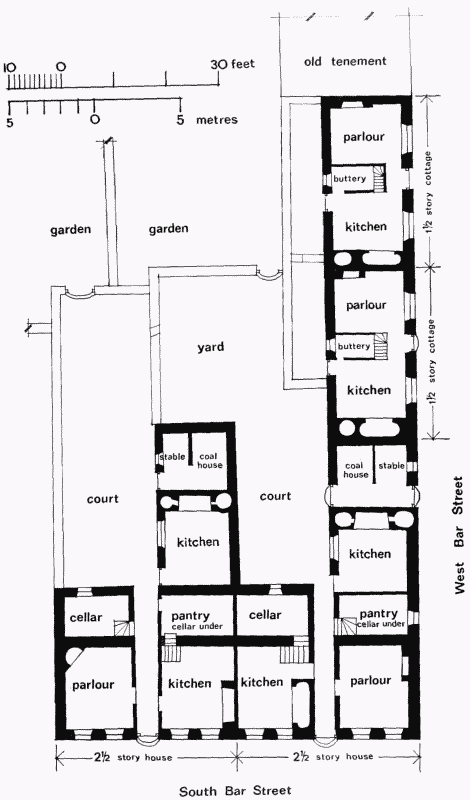
Houses On The Green (South Bar Street), Banbury From the builder's plan of 1734
The finest 18th-century building is No. 40 South Bar, of which the front, dated 1784 on rain-water heads, is of ashlar with a central arched doorway of alternating quoins of artificial stone and with a bearded mask to the key. To the north the facade is extended with a Venetian window above a blocked carriage entrance. The interior has fine wooden chimney-pieces of the mid 18th century, and a room on the ground floor has a plaster ceiling and overmantle of Adam type, probably of the same date as the refronting. (fn. 52) There are remains of earlier work at the rear. The house is far grander than any of its surviving contemporaries, the more so in that it contains elaborate work of two periods only a generation apart. The plasterwork and wood carving must be by craftsmen from Oxford or London; there is no surviving parallel to the interior in the Banbury area, and no reason to suppose Banbury craftsmen capable of such work in the 18th century.
The other 18th-century buildings of importance are public and commercial, many of the latter perhaps a result of the town's commercial growth after the completion of the Oxford Canal. Of the commercial buildings No. 22 Market Place (Cornhill) is of three stories, of brick with stone window surrounds and a modillion cornice; No. 15 Market Place is somewhat similar but earlier, with a front apparently of rendered stone. Lloyd's (formerly Cobb's) Bank in High Street is also of brick, the ground floor remodelled early in the 19th century. Of 18th-century industrial building little survives apart from Banbury Mill and a large three-story, six-bay stone structure behind No. 30 Horse Fair, which has crude chinoiserie glazing in the upper windows and large segmental lunettes in the gableends. The decorative treatment of the upper floor may have been due either to its use as a showroom or to its being a tall building on a constricted site: only the upper floor could have been seen above the surrounding roofs.
Almost all the ecclesiastical and public buildings date from the 19th century, and the residential and commercial buildings are predominantly from that period. In the 1830s the most favoured residential area was still Horse Fair and the Green, (fn. 53) where some of the 18th-century houses have survived. There was need, however, for new middle-class residential areas and Banbury, like other towns in the 19th century, saw the beginnings of the middleclass suburb. The break-up of the Calthorpe estate after 1833, together with the unattractiveness of the lower-class suburb of Neithrop and of the commercial development already taking place near the canal on the east, directed attention to the southern edge of the town as the most suitable area for middleclass development. The effects were seen on both sides of South Bar and at the northern end of Oxford Road. A number of the houses there show an inventive, if clumsy, reflection of metropolitan taste, the first time that comparatively modest houses in Banbury show any real awareness of contemporary architectural fashion.
Nos. 28–34 South Bar form a terrace of c. 1835, three-stories and stuccoed, with a giant order of coupled Ionic pilasters standing on the lintel of a shallow door surround. No. 34 Crouch Street is an awkward attempt at a picturesquely assymetrical composition in a classical manner; it has a recessed balcony to the first floor flanked by widely spaced Greek Doric columns in antis. No. 31 Crouch Street has crude Tower-of-the-Winds columns in antis to the doorway; No. 17 Boxhedge Road, a villa of c. 1840 some distance from the Crouch Street development, has a similar porch but with the plaster acanthus omitted from the masonry cores of the capitals. The peculiar form of the original portico of the Baptist chapel may associate it with these buildings. Their designers were not known, but were probably not local men: the quality of the Mechanics' Institute of 1836, designed locally, suggests that the town had no architect of distinction; at least one of the Gothic buildings in Crouch Street, the British schools (1840), was built by Derrick of Oxford, and Derrick may have been responsible for other work in the town. (fn. 54) Nos. 21–22 Crouch Street, also Gothic, are a stuccoed, semidetached pair with porches placed at 45° to an internal angle, and have plaster terminals to the window hoods in the form of heads. (fn. 55) Similar terminals occur at Neithrop House (c. 1835), where they are associated with Gothic windows not unlike those of the British school. They occur also at Nos. 3–9 Crouch Street, a short, Gothic terrace. A room, formerly the drawing room, in Calthorpe House has a flat plaster vault with a polygonal end bay and a chimney-piece whose jambs are clustered columns; its character links it to the other Gothic building on the southern fringes of the town.
Another, less remarkable, but quite distinctive architectural style of the 1830s and 1840s can be seen in both domestic and commercial buildings. St. John's Place, Nos. 36–38 High Street, Nos. 52–54 High Street, the Mechanics' Institute of 1836, and a number of buildings elsewhere are typically of brick, of three stories, with rusticated voussoirs of freestone to door and window heads, and with narrow strip pilasters flanking facades in freestone, brick, or a combination of the two. There is too great a variety in the application of such features for it to be likely that all the buildings are the work of one contractor. The style provided a homegrown formula more satisfactory for terraced development than the more pretentious architecture of the Crouch Street area.
In Calthorpe Road and in St. John's Terrace at the bottom of Oxford Road are substantial stuccoed villas of c. 1845 not paralleled elsewhere in Banbury. Their similarity and their correct but solid classical detail suggests that they were built by a local contractor following a current architectural patternbook. They show none of the crude originality of the Crouch Street group.
Prosperous development in the 1850s and 1860s occurred on a small scale in a number of areas. The Calthorpe estate was built up only slowly, and Dashwood Road contains Dashwood Terrace, a polychrome, Italianate terrace of c. 1870 and several villas of between c. 1860 and 1910; there remained enough undeveloped land for that area to retain its attraction for more than a century. The major development of the 1860s and 1870s was in West Bar, and was Gothic.
Initiating fifteen years of Gothic was a pair of houses (fn. 56) of 1866 in Cornhill, Nos. 23 and 24, which presumably attracted considerable attention at the time. (fn. 57) They are built on narrow frontages with a passage between them; No. 24 to the north was built as a house, No. 23 to the south as a house and office for a spirit-merchant with a shop in front and a large store at the rear. The architect was William Wilkinson of Oxford, and they are among his most opulent designs, intensely polychromatic with decoration in red, black, white, and blue brick and dressings of two different stones, with heavy carving to the capitals of the shafts that stand in front of the mullions to the ground-floor windows. The roofs are crowned with ornamental ironwork. The houses were built for W. J. Douglas, owner of Castle House, and were designed to present an attractive appearance when viewed from his grounds. No. 23 was built by Claridge of Banbury; No. 24 by Douglas himself with direct labour.
The Gothic houses of West Bar consist of both detached and terraced villas, built of polychrome brick with stone dressings. Detail such as the tympana to the ground-floor door and window of No. 3 West Bar, carved with foliage in low relief, is in many cases closely similar to that of contemporary villas in Oxford, and in view of the number of Banbury buildings known to have been designed in the 1850s and 1860s by Oxford architects it is possible that the West Bar villas were by one or more Oxford designers. No. 15 West Bar is of 1867, Cedar Villa in Bath Road is of 1872, and there are others of similar character in what was to be the 'smart' development of the following decades, the southern fringe of the Calthorpe estate and Hightown Road, where the earliest development was at the end of the 1870s.
The majority of the houses in Hightown Road are of the 1880s and 1890s, in the manner then described as Queen Anne. Architects and builders are unknown, though certain of the houses are of considerable quality. Their location marks an accelerated suburban drift, a sign of which had already been seen in the building of the two largest suburban houses in Banbury for the senior partners in Gillett's Bank; Jonathan Gillett moved in 1863 to The Elms, Oxford Road, the only house of any size in the Italianate style, and Charles moved in 1864 to Wood Green, Broughton Road, a Gothic house.
In the earlier 20th century private development continued to be mainly on the southern side of the town, along the Oxford and Broughton Roads, and to a lesser extent on Warwick Road. Nos. 14 and 16 Bloxham Road are a pair of c. 1910 which, like the Crouch Street development of 1840, show current concern with stylistic problems reflected at a local level. Front doorways are set at an angle to projecting bays and between heavily battered buttresses; fronts are thickly pebble-dashed, and in the entrance bays are balconies inset beneath projecting gables to attics; the openings above the balconies are irregular polygons. There are minute dormers in the roof. The houses represent an attempt, almost certainly by a local architect, to escape from stylistic precedent—an attempt being made by provincial architects elsewhere at the time.
The development of speculative terraced housing in Banbury (fn. 58) probably began soon after 1800, though slum-clearance schemes of the 1960s have left little from before c. 1845. It is likely that No. 40 Warwick Road was typical of much lower-class housing of the early 19th century; it is of three floors with the stair giving directly into the single room on each floor. There is a single-story wash-house at the rear. The staircase set between front and back rooms was a feature common to terraced houses of before c. 1850. The status of housing is indicated by the presence or absence of a side passage, and even when there was a side passage it was still associated with a lateral stair. (fn. 59)
The main area of commercial growth before the coming of the railways was between the canal and the Market Place, where in spite of much clearance there remained in 1969 a certain amount of simple warehouse development of the early 19th century. Associated with it was the working-class housing in the streets gradually laid out during the course of the 19th century south of Bridge Street. External features of the terraced housing of before c. 1860 (houses with the lateral stair plan) are 6- and 9-pane sashes, window- and door-heads of brick with false voussoirs of Roman cement, and small casement windows to the backs. The false voussoirs show clearly in Upper Windsor Street (c. 1845), where brick soldier arches are incised for voussoirs of a greater splay than those actually applied. The typical plan was that of Spring Cottages. (fn. 60) Such building was undertaken speculatively. Constitution Row on the Broughton Road, for example, was built in 1847 by Claridge (fn. 61) either on behalf of himself, as one of the largest contractors in the town, or for a client; he was employed on a number of projects by the Gillett family. By 1849 Constitution Row was the address of no less than seven laundresses, presumably because of the good water-supply on the rising ground at the edge of the town.
Terraced housing of the later 19th century differed little in its basic forms from that of the earlier years. The introduction of a side passage almost universally, the placing of the stair parallel to the party wall, and the provision of a wash-house at the rear are changes that occur at Banbury, as elsewhere, after c. 1860. In external treatment there was a change from sashes with small panes to 2- or 3pane sashes with vertical glazing bars, and a greater variety of treatment in window surrounds. Polychromy appears on the fronts of otherwise standard houses of c. 1865 and later, and the adoption of canted bays to the ground floors of terraced houses seems to date from c. 1880 in Queen Street and Marlborough Road. Ornament of terracotta appears in Prospect Road (c. 1895) and in Queen Street, where Nos. 74–75, which have yellow terracotta dressings, are dated 1908. Pressed brick ornament occurs in Marlborough Road, and in Newland Road on houses dated 1904. Traces of a retarded arts-and-crafts influence can be seen in the lead skirts to the bays of Nos. 38–62 Beargarden Road and of houses in Fairview Road, terraces of c. 1920. Until well into the 20th century speculative housing in Banbury lagged behind private development in its awareness of progressive architectural style, probably because such housing was generally designed by contractors rather than by trained architects.

Nineteenth-Century Terraced Houses In Banbury
Nineteenth-century business premises in the centre of the town are for the most part domestic in scale and detail, though certain of the earlier examples attained a modest distinction, for example Nos. 51 and 52 Parsons Street which date from c. 1840. They were built as a pair of double-fronted offices with accommodation above. No. 51 has windows to the ground floor that flank a central doorway; No. 52 has doors and windows identical with those of No. 51 but has doors flanking a central window. At the centre of the composition is a fourth, similar door, leading into a passage between the two offices. The variation creates an interesting facade.
The only noteworthy later-19th-century office building is the Westminster Bank, No. 66 High Street, built in 1864. It is of three stories, of brick with composition detail, all painted. Windows have heavy keystones and there is a heavy console entablature below a parapet with flame finials. The bank was built as a branch office of the London and County Bank, (fn. 62) the architect was Lowe, and J. & T. Davies of Banbury were the contractors. (fn. 63) It was perhaps the first building in Banbury to be erected for a metropolitan firm employing a metropolitan architect, a development more typical of the 20th century than of the 19th when most Banbury businesses were still locally based.
The most pretentious of the industrial buildings (as so frequently) were those for the breweries. Austin's malt-house, in St. John's Street (c. 1830), is of brick and has a pedimented central bay and slightly projecting pavilions with rendered angles at each end of the facade. Behind the facade is only a simple shed. Hunt Edmunds's malt-house behind Bridge Street (1866), built by Kimberley of Banbury, (fn. 64) is a large building of banded polychrome brick with numerous small, round-headed windows, creating a striking effect. Some purely functional buildings in the town were well designed, for example the original building of Cobb's girth factory on the east side of the canal, a three-storied brick building of semi-fireproof construction, dated 1838; windows are set into recessed bays running the height of the building. Similar in their combination of large castiron window frames with plain, undifferentiated brickwork are Nos. 6–8 Market Place; from an extremely simple three-storied, four-bay front two central bays break forward a few inches to provide a minimal accentuation to an otherwise uniform facade. Banbury's industrial buildings provide examples of the ingenious use of uncut brick in reproducing detail, a practice which derived ultimately from a classical vernacular but was increasingly divergent from it; this development was common to much industrial building in the 19th century. Barrett's malt-house in Newland and the earliest part of the Britannia works in Britannia Road are good examples. The practice continued to the end of the century with the earlier part of Stone's factory in Britannia Road (c. 1885) and a building in Gatteridge Street, where the brickwork is almost identical with that of the Neithrop Mission Hall of 1887.
Two commercial buildings reflect the arts-andcrafts movement of the turn of the century. The original building in Britannia Road for the Banbury Linen Co., later Spencer Corsets, is of 1896, fourstoried with gables to the fourth-floor windows, a pitched roof, and elliptical arched windows. It has affinities with certain buildings of the period in Birmingham. The Red Lion Tap in George Street, at the angle of Pepper Alley, was built in 1907, with pebble-dashed walls, heavy eaves, and external detail of early-18th-century derivation. Both buildings are good examples of the more advanced architecture of their time, but their isolation suggests that Banbury did not itself supply the designers.
Castle.
Banbury castle was built by Alexander, Bishop of Lincoln (1123–48), on a site to the north of the later market-place, in the area afterwards covered by Castle Street and the Wharf. (fn. 65) The building was demolished after the Civil War in the 17th century. Until 1547, with some interruption, the castle remained in the hands of the bishops of Lincoln. In 1139 King Stephen attempted to seize the Bishop of Lincoln's castles; Bishop Alexander was imprisoned, surrendered his castles, but retained Banbury after his release. (fn. 66) During vacancies in the see, in 1166–73, 1182–3, 1184–6, 1200–3, 1206–18, and 1319, the castle was in royal hands; (fn. 67) in the reign of Edward II the right to hold the see's possessions during vacancies was purchased by the Dean and Chapter of Lincoln. (fn. 68) In 1321 the castle was delivered into the custody of Robert Arden after Henry Burghersh, Bishop of Lincoln, had given his support to the revolt of Thomas, Earl of Lancaster. (fn. 69) In 1547 the Duke of Somerset purchased the castle and probably the small estate which went with it. From him it passed to the Duke of Northumberland, who sold it to the Crown in 1551. (fn. 70) In 1552 the lordship of the castle included the castle itself, comprising houses, yards, courts, garden, orchard, a fish stew, and the ditch outside the castle walls; two water-mills under one roof, a meadow adjoining, and fisheries; and the toll of the market and the firma draperia, as well as a tenement and garden by the castle gate. (fn. 71) Later the castle and hundred were leased together, in 1563 to Richard Fiennes, and in 1595 to Sir Richard Fiennes and his three children, for terms of lives. (fn. 72) In 1629 Charles I renewed the grant of the castle and lands to William Fiennes, Lord Saye and Sele and the Crown's ownership was again referred to in 1651. (fn. 73) Thereafter no trace has been found of the Crown's interest, and the property remained in the hands of the Fienneses until sold in 1792 to the Golby family. (fn. 74)
The duty of castle guard at Banbury fell on the bishop's military tenants in Banbury hundred and possibly Chacombe (Northants.); references to the duty are made in 1279, 1369, and 1441. (fn. 75) The service owed was 40 days for each knight's fee in time of war. The administration of the castle was in the hands of the constable, who also played an important part in the administration of the bishop's estate as a whole. (fn. 76) In 1260, as in 1510, the constable's allowance was 4d. a day. (fn. 77) Many of the constables were great office-holders and their duties at Banbury were probably carried out by lesser men. An under-constable appointed in 1340 was presumably responsible to and paid by the constable, but a door-keeper and other officers paid by the bishop are also recorded. (fn. 78) In 1167–8 the porter of the castle was paid 17s. 8d., which may not have been for a full year, since in 1201 he was paid 24s. In that year the watchman received 15s. and 2½d. for his discharge, and the castle guard 10 marks. (fn. 79) In 1510 Robert Cutt combined the office of doorkeeper with those of reeve of the castle and reeve of the borough. (fn. 80) The earliest constables whose names are recorded were, between c. 1210 and c. 1220, Robert Hawethirn (? Hawten), Rector of Eastwell (Leics.), and, in 1222, Simon of Cropredy. (fn. 81) One constable, John of Seagrave (d. 1325), held Chacombe manor of the Bishop of Lincoln for the service of ½ fee and for serving as constable for 40 days in time of war, which suggests confusion with castle-guard and certainly not a permanent appointment as constable. (fn. 82) A notable constable was Thomas Chaucer, possibly the son of the poet, appointed in 1411; he was also constable of Wallingford castle, a member of the king's council, and several times Speaker of the House of Commons. (fn. 83)
The castle contained a chapel; the chaplain of Banbury recorded in 1166–7 and 1167–8 almost certainly served not the parish church but the castle chapel, for he was named with other castle officials. (fn. 84) Roger, chaplain of Banbury castle, was mentioned in the time of Bishop Hugh of Wells (1209–35). (fn. 85) The Bishop of Lincoln's chapel at Banbury, where he gave judgement in a tithe dispute of 1240, was probably the castle chapel; (fn. 86) it was there that in 1298 the Master of the Order of Sempringham appeared before the bishop and subscribed his profession of obedience. (fn. 87) There is no later reference to the castle chapel, and it had probably fallen into complete disuse by 1340 when the constable had his daughter baptized not in that chapel but in the parish church. (fn. 88)
From at least the 13th century until the 16th the Bishop of Lincoln kept a prison in Banbury. It is to be supposed that it was there that two blasphemers, sentenced by the council of Canterbury province in 1222, were sent. At all events they were shut up (immurati) in Banbury. (fn. 89) By 1259 probably (fn. 90) and by 1276 certainly prisoners were being kept in the castle itself (fn. 91) and it is a fair presumption that the prison, even if it was not previously in the castle, remained there thenceforth. In the 13th century the prisoners presumably included both clerks and laymen. That there were laymen among them is shown by the fact that during the period 1270–82 the prison was ordered to be delivered ten times. (fn. 92) After this there were no more deliveries, but the prison continued to hold clerks convict. (fn. 93) In 1415 it was used for the confinement of Lollards. (fn. 94) In 1510 when 19 clerks were imprisoned, 10 of them for the whole year, the cost of maintenance was ¼d. a day. The prison was cleaned once a year on Maundy Thursday; during the cleaning the prisoners were allowed to go into the town, under guard, to collect alms in wallets provided by the bailiff. (fn. 95) At that time there were 5 warders who received a bonus of 20d. 'for greater security'; another man received 13s. 4d. a year for 'serving … and cleansing nature of said convicts'. (fn. 96)
There were prisoners in the 'castle or gaol' in 1534, (fn. 97) 1539, (fn. 98) and 1544. (fn. 99) They were not described as clerks convict, but it is most likely that technically that was what they were. A 'terrible' prison in the outer ward of the castle 'for convict men' was still conspicuous at the time of Leland's visit, (fn. 100) but it did not last long after that. It was evidently reduced in size in 1556, when a wooden cage was moved from the castle precincts to the town hall, (fn. 101) and by 1564 nothing remained but 'a little old ruinous house' near the gatehouse. (fn. 102)
This seems to mark the end of the prison properly so called, but by 1589 the castle was again being used as a place of detention. (fn. 103) The inmates, as in other castles at the time, (fn. 104) were recusants, who during the last decade of the century were periodically released on parole and recalled to custody according to the shifting attitudes of tolerance or hostility displayed by the government. (fn. 105) The last mention of such recusants is in 1612 when the tenant of certain rooms in the castle was turned out to make room for Lady Stonor and five other women. (fn. 106)
In the Middle Ages Banbury castle was visited frequently by the bishops of Lincoln and members of their household; (fn. 107) it was also included in the itineraries of medieval kings. (fn. 108) In 1501 a royal council was held there. (fn. 109) The last monarch to visit it was Charles I, who dined there on 5 November 1645 before continuing on his way to Oxford. (fn. 110) The castle was not involved in military action until the Civil War sieges of Banbury, in which it played an important part. (fn. 111)
The original castle was probably of the motte and bailey type. (fn. 112) The motte was later surrounded by an inner and an outer wall, both protected by a ditch. (fn. 113) The Cuttle Brook supplied water to the moats and, in 1510, to the castle fish-pond. (fn. 114) A plan of the castle made in 1685 records an area of ¾ a. within the inner wall, the whole castle occupying c. 7 a. (fn. 115) Within the inner inclosure there was probably a keep on the mound, (fn. 116) and against the wall on the north side of the inclosure were various apartments, described by Leland as 'a fair piece of new building of stone'. (fn. 117) In 1606 a 'mansion house' within the inner inclosure comprised 23 bays covered with lead. (fn. 118) The fortification included at least one tower, named 'Eynsham', (fn. 119) together with a gatehouse of six bays, roofed with slate, and a barbican referred to as 'the Half Moon'. (fn. 120)
In 1564 repairs were needed, especially to the outer gatehouse, and had been effected by 1580 when the condition of the building was said to be good. (fn. 121) After the siege of Banbury in 1644, 100 men were reported to be digging the works, making a new moat. By early 1645 two new bulwarks and two sally ports had been added. Buildings in the market-place and elsewhere near the castle were pulled down at that time, either to make way for the third moat, or merely to leave a clear space between the castle and the town. During the extensions a great length of castle wall fell down and c. 300 men were reported to be at work on it. (fn. 122) Joshua Sprigge, writing immediately after the second siege of Banbury in 1646, said that the castle was 'revived by art and industry unto an incredible strength much beyond many places of greater name and reputation'. (fn. 123) In 1646, after the fall of the castle to the Parliamentary forces, the interests of Lord Saye and Sele, its owner, were considered, and it was decided to destroy only the earth defences. (fn. 124) In 1648, however, that decision was reconsidered after a petition of Banbury inhabitants sought the demolition of the castle and the use of its materials in the repair of the town. The castle was purchased for £2,000, and demolished forthwith. (fn. 125) Two small buildings recently erected by Lord Saye and Sele, to accommodate his hundred court, were left standing. (fn. 126) In 1712 there were 'the remains of four bastions, a brook running without them'. (fn. 127) The cottage in which the courts were held was later leased by the parish as a pest-house, and the other building, a stable or barn, was used as an airing house in connexion with the pest-house. In the mid 19th century 'Castle cottage' was divided into two tenements, and the stable situated on Castle Wharf was used as a warehouse. (fn. 128)