A History of the County of Oxford: Volume 10, Banbury Hundred. Originally published by Victoria County History, London, 1972.
This free content was digitised by double rekeying. All rights reserved.
Christina Colvin, Janet Cooper, N H Cooper, P D A Harvey, Marjory Hollings, Judith Hook, Mary Jessup, Mary D Lobel, J F A Mason, B S Trinder, Hilary Turner, 'Banbury: Economic history', in A History of the County of Oxford: Volume 10, Banbury Hundred, ed. Alan Crossley (London, 1972), British History Online https://www.british-history.ac.uk/vch/oxon/vol10/pp49-71 [accessed 30 April 2025].
Christina Colvin, Janet Cooper, N H Cooper, P D A Harvey, Marjory Hollings, Judith Hook, Mary Jessup, Mary D Lobel, J F A Mason, B S Trinder, Hilary Turner, 'Banbury: Economic history', in A History of the County of Oxford: Volume 10, Banbury Hundred. Edited by Alan Crossley (London, 1972), British History Online, accessed April 30, 2025, https://www.british-history.ac.uk/vch/oxon/vol10/pp49-71.
Christina Colvin, Janet Cooper, N H Cooper, P D A Harvey, Marjory Hollings, Judith Hook, Mary Jessup, Mary D Lobel, J F A Mason, B S Trinder, Hilary Turner. "Banbury: Economic history". A History of the County of Oxford: Volume 10, Banbury Hundred. Ed. Alan Crossley (London, 1972), British History Online. Web. 30 April 2025. https://www.british-history.ac.uk/vch/oxon/vol10/pp49-71.
Economic History.
Agriculture. The Oxfordshire portion of Banbury parish was anciently divided between at least three, perhaps four, distinct field systems. In the south, mostly beyond the Saltway, were the fields of Wickham (962 a.) and in the north the fields of Hardwick (572 a.). The rest of the area possibly contained two field systems: that of Neithrop (1,398 a.) north of the town and the Broughton road, and that of Calthorpe (584 a.) to the south. (fn. 1) Because of subsequent changes in the fields' organization and ownership the boundaries of the hamlets became less clear; in a deed of 1653, for instance, a precisely located holding was said to lie in the fields of Wickham, Neithrop, and Calthorpe 'or in some or one of them'. (fn. 2) The name Hardwick seems to have undergone no change in its application, although there were doubts in the early 16th century whether certain meadows were part of Neithrop or of Hardwick. (fn. 3) The Neithrop fields were sometimes called Neithrop and Calthorpe, probably because from the 14th century they contained lands held by the Calthorpe customary tenants; thus a 1575 terrier of the lands 'within the lordship Neithrop and Calthorpe' covered only Neithrop's fields and indeed stated that one furlong adjoined Calthorpe fields. (fn. 4) Within the fields of Calthorpe the name of Easington was applied from the 13th century to the Bishop of Lincoln's demesne lands. From the 16th century the lands in Calthorpe fields outside the demesne seem to have been often known as the fields of Calthorpe and Wickham either because of the rights of common that Wickham tenants had there, or because some tenements included lands in Wickham as well as Calthorpe, or else because certain small areas in Calthorpe had been acquired by the lord of Wickham. (fn. 5) In the early 17th century the former demesne and tenant lands of Calthorpe field were redivided; the name Easington was then given to the lands of the owner of Easington farm (which did not wholly correspond to the former demesne), while those dependent on Calthorpe House were known particularly as the Calthorpe estate, although the name Calthorpe was still applied to the area as a whole. It was presumably from the locations of the two houses that a map of 1832 named the area east of the Oxford road Calthorpe, and the remainder Easington; some other 19th-century records refer to the entire area of the ancient Calthorpe fields as Easington. (fn. 6)
Although the fields of Calthorpe and Neithrop adjoined the town they were scarcely ever referred to as the fields of Banbury, a fact that perhaps gave rise to a phrase, quoted in 1841, that 'all the crows that fly over Banbury fields are white'. (fn. 7) In the later Middle Ages all the customary holdings in those fields were attached to tenements in Calthorpe and Neithrop. (fn. 8) There may have been a major reorganization of holdings after Banbury became a town; an alternative explanation is discussed elsewhere. (fn. 9) Of the process of clearance and settlement of the fields there is no direct evidence. (fn. 10) The crest of Crouch Hill, south-west of the town, was never cleared, but the rest of the area seems to have been cleared for agriculture by the time of the earliest records. Domesday Book mentions no woodland in Banbury, and an area of pasture only three by two furlongs. (fn. 11)
In Domesday Book under the headings of Banbury and Cropredy are entered the Bishop of Lincoln's estates throughout the hundred, and he Banbury entry probably included not only all hamlets of Banbury (of which only Wickham is mentioned by name) but also the more distant Shutford and Swalcliffe and the property around Charlbury. (fn. 12) Some of the bishop's demesne is distinguished as inland, probably ancient demesne, the remainder, 3 hides, being either newly assarted land or land acquired from the tenants. (fn. 13) There were 7 ploughs in demesne, and 33 held by the villani, and there was said to be land for 10 and 33½ ploughs respectively. It is not known what proportions of the demesne and tenants' land lay in Neithrop and Calthorpe in 1086. By the mid 14th century about half the land there was in demesne. A dispute in the time of Bishop Alexander (1123–48) whether or not certain land at Banbury had been in demesne under Bishop Bloet suggests that changes in the demesne occurred in the late 11th or early 12th century. (fn. 14) In 1348–9 the demesne probably lay in a single block covering practically the whole of the area south and east of the road to Broughton; some of the furlong names suggest that, and the total acreage (c. 506 statute acres) (fn. 15) corresponds approximately with the area (562 a.) of which John Barber held the tithes in 1811. (fn. 16) The tenants' lands in 1348–9 as in 1575 evidently occupied the whole of the area north and west of the Broughton road and the town, with a few patches in the area where the demesne lay; in 1441, for instance, 3 a. of one tenant's half-yardland lay 'below Crouch'. (fn. 17)
Originally Neithrop and Calthorpe may have had separate fields, Calthorpe later being taken over entirely by the demesne, and Calthorpe tenants being given lands in Neithrop field. Elsewhere in north Oxfordshire in similar pairs of closely neighbouring vills each had its own field system. (fn. 18) Some reorganization of the fields probably occurred in the late 12th or early 13th century: of five free holdings of yardlands to which the succession can be traced from the 13th to the 15th century, one was definitely formed in 1220–1, (fn. 19) and another was held by the charter of Bishop Hugh of Avalon (1186–1200); (fn. 20) and in 1215 the king gave the bishop permission to impark Crouch spinney (spinetum de Cruche). (fn. 21) Certainly in 1279 Neithrop contained only tenants' lands, while the 3 recorded plough-lands of demesne lay in Calthorpe and Easington. (fn. 22) There were 8 ploughmen on the demesne in 1299–1300. (fn. 23) In 1329 Henry Burghersh, Bishop of Lincoln, was granted free warren throughout his Banbury demesne and in 1330 was licensed to impark the wood of Crouch and 300 a. adjoining. (fn. 24) Whereas the earlier imparkment of 1215 may have meant simply the creation of a small preserve around Crouch hill, the 1330 licence led to the extinguishing of pasture rights over a considerable area. No wholesale conversion of arable to grassland was involved, for in 1348–9 the only substantial area of pasture was c. 74 statute acres in Crouch itself; (fn. 25) but in 1333 the bishop complained of men poaching from his warrens at Banbury and pasturing their beasts in his park at Neithrop. (fn. 26) Those trespassers were probably trying to assert their former rights.
Easington, the name under which the demesne lands were subsequently leased, was first mentioned in 1279. (fn. 27) Not until 1602 is there an indisputable reference to the buildings of Easington Farm, lying on the west of the Oxford road at the top of the hill leading out of the town, (fn. 28) but it seems likely that the demesne of the medieval bishops was managed from that site. The estate's description as part of Banbury manor or Easington grange (fn. 29) probably preserves a memory of that function and suggests that what was there was not a manor-house but a barn and other farm buildings subsidiary to the central administration at the castle. A terrier of 1348–9 lists the demesne arable furlongs in two groups: four furlongs which probably lay between the Oxford and Bloxham roads, described as a single field (seisona) and totalling c. 90 statute acres, and the furlongs east of the Oxford road and west of the Bloxham road, totalling c. 243 statute acres, which are placed in a single list but are described as fields in the plural. (fn. 30) Because the demesne lay in a large block it would have been possible to vary from year to year the acres devoted to particular crops, and probably the division into fields revealed by the terrier is not significant. The terrier also lists c. 82 statute acres of meadows of which those that can be identified with later names lay to the west of the Cherwell, mostly just south of Banbury bridge; the c. 89 statute acres of pasture included c. 74 statute acres in the Crouch Hill area, c. 9 statute acres in the same area as the meadows, and c. 5 statute acres described as Derdene cum cuniculare, identifiable with the later Durdens, (fn. 31) which probably likewise lay between the Cherwell and the Oxford road but further south, as well as c. 1 statute acre in an unidentified place. In 1278–9 the bishop had rights of warren in Derdene as well as at Crouch. (fn. 32)
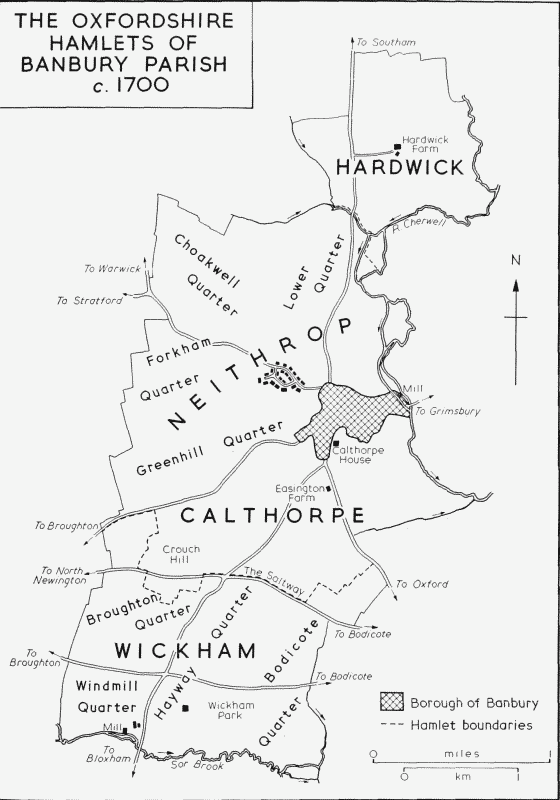
THE OXFORDSHIRE HAMLETS OF BANBURY PARISH C. 1700
Compiled from the Neithrop inclosure map, the tithe maps of Banbury and Wickham, a map of 1688 at Wickham Park, and other documentary evidence
When the demesne was leased in 1435 (fn. 33) the labour-services of the tenants of Neithrop and Calthorpe were included, probably a relic of earlier times and perhaps an indication that the demesne had already been leased for many years. (fn. 34) The labour-services formed the last historical link between the fields of Calthorpe and Neithrop, and with their decay the two areas reverted to the mutual independence which may have been their original condition.
The twenty-year lease of 1435 was evidently of the entire area of demesne described in 1348–9, for a rental of the bishop's estate in 1441 includes no other rents deriving from the ancient Calthorpe fields. (fn. 35) In the later 15th century the property was divided. The nucleus of the Easington demesne was leased in 1505, (fn. 36) and remained unchanged until 1606, when it contained only 179½ a. in all, viz. 100 a. of arable, 24½ a. of meadow, and 55 a. of pasture. (fn. 37) Evidently the remainder of the former demesne (nearly 330 a.) had been leased separately and is to be identified with a number of 16th-century holdings described as lying in the fields of Calthorpe, or of Calthorpe and Wickham. (fn. 38) The holdings are called yardlands, but there was no regularity in the size or distribution of holdings: some land was held in scattered strips (fn. 39) but the arable of Easington Farm, described in 1637 as 8 yardlands, was alternatively described in 1638 as 130 a. adjoining the farm. (fn. 40) Little of the land was inclosed; in 1606, of the leased arable of Easington farm, 30 a. lay in Windmill field, an inclosure, but the remaining 70 a. lay in the common fields called Easington fields. (fn. 41) Tenants elsewhere in Calthorpe were claiming rights of common in Easington farm in 1550 and 1552, and in 1617 Wickham tenants held common rights in Calthorpe fields. (fn. 42) As late as the 19th century some parts of the fields were described as furlongs, not closes, and some holdings were still made up of scattered strips. (fn. 43)
By the 16th century parts of the former arable in Calthorpe had been laid down to grass. A deed of 1557 mentions an acre of meadow and sideling at Andrewes Pits and five selions of leys at Berrymoor—both areas lying between the Broughton and Bloxham roads. (fn. 44) In 1674 reference was made to the clearance and ploughing up of part of the land round the Crouch some 40 years earlier, and to the laying down to pasture, about the same time, of Lodge Close (east of the Oxford road), which had been since ploughed up again. (fn. 45) Much of the Calthorpe House estate was inclosed by the early 17th century, particularly the area between the Oxford road and the River Cherwell, (fn. 46) and it is likely that inclosure had been accompanied by conversion to sheep pasture.
Some fragmentation of holdings took place in the later 16th century, only to be reversed during the 17th century. Seven yardlands in Calthorpe field, held in 1555 by George Danvers, whose family had in 1435 been lessees of the whole demesne, were by 1596 split into 7 holdings. (fn. 47) Similarly a yardland acquired in 1595 by William Halhead was described as one of two formerly held by another man, and previously part of a four-yardland estate. (fn. 48) By contrast the Hawten family, lessees of the Easington Farm property since at least 1606, (fn. 49) began to build up a large estate in Calthorpe. Deeds of 1602 exemplify the consolidation of the property by the acquisition of two small parcels of land near Easington Farm in exchange for scattered strips beyond the Bloxham road. (fn. 50) By 1614 Henry Hawten held Calthorpe House, together with its adjacent closes, and lands elsewhere in Calthorpe acquired from five different owners. (fn. 51) In 1638 the estate was divided into two portions, the Easington and Calthorpe estates, which followed separate descents. (fn. 52)
Although some two-thirds of Calthorpe fields had been formed into two large holdings by the mid 17th century, large-scale farming did not result at first. The Barber family let out their Easington lands, sometimes in small parts: thus Little Wood close was leased to one man in 1690, the adjacent lands in Berrymoor to another in 1692, and some 16 a. in Farm field to another in 1691; (fn. 53) in 1728, the Berrymoor lands were leased, and some 30 a. and ½ yardland in Farm field. (fn. 54) On the other hand in 1734 a large portion of the estate (including Easington Farm and 93 a. of arable) was leased to one man. (fn. 55) In 1760 a further 30 a. were included in the lease of Easington Farm, and in 1787 the whole 147 a. of the adjacent Farm field and several closes were included; from 1799 (fn. 56) the Barber property in Easington was farmed as a whole by successive tenants. (fn. 57) Similarly the Calthorpe estate was divided between several tenants in 1710, (fn. 58) but by 1785 there were only two, of whom one, Thomas Cobb, subsequently acquired the entire property as owner-occupier. (fn. 59) In 1852 a relic of the estate survived, an 80-acre holding near the Crouch; otherwise there was only one holder of more than 35 a. (fn. 60)
Between 1810 and 1852 similar fragmentation had occurred in the smaller properties in Calthorpe and Easington. There was also a decrease in the area farmed by owner-occupiers, from over 50 a. (excluding Thomas Cobb's estate) to 25 a. Most strikingly, only about a quarter of the area (some 135 a.), mostly in the former Farm field, was under arable; the rest was nearly all grassland. (fn. 61)
It seems certain that the yardland tenements said to be held in Calthorpe in the Middle Ages in fact consisted of lands mostly lying in Neithrop fields but attached to homesteads in Calthorpe: the Bishop of Lincoln's demesne in 1348–9 seems to have occupied all but some 80 a. of Calthorpe fields, and there is close correspondence between the total number of yardlands described as lying in Calthorpe and Neithrop together in the Middle Ages and the number of yardlands known, from later evidence, to have lain in Neithrop alone. Thus in 1760 there were 60¼ yardlands in Neithrop, (fn. 62) and in 1575 the same number; (fn. 63) in 1441 Neithrop was said to contain 43½ yardlands, and Calthorpe 16½, a total of 60; (fn. 64) in 1279 the proportions were 47½ and 17½, a total of 65; (fn. 65) and c. 1225 the proportion was 39 and 14, with a further 8½ yardlands described as in Banbury, a total of 61½. (fn. 66)
The yardland holdings in Neithrop described as in Calthorpe may have replaced lands formerly held in Calthorpe field, and were probably formed from the bishop's demesne lands in Neithrop: in 1441 some holdings in Neithrop were described as pennyland, (fn. 67) and there, as elsewhere, the word almost certainly denoted former demesne. (fn. 68) If so the transfer had probably occurred by 1279 when only tenant land in Neithrop was mentioned. (fn. 69) The tenant land in Neithrop with the demesne in Calthorpe formed a single estate; thus a lease of the demesne in 1435 included the labour services of the tenants described as of Neithrop and Calthorpe, and although then only vestigial services were due it was presumably on the Calthorpe demesne that the services were rendered when they were exacted in full. (fn. 70) In c. 1225 the holder of a yardland had either to provide a man for daily week-work throughout the year, or to pay 5s. rent and perform a variety of boon-works for which 1s. allowance was made. (fn. 71) By 1279 the latter alternative apparently prevailed, for the rent of a yardland was 4s. with unspecified services worth 3s. 10d. (fn. 72) By 1441 the only labour-services due from every yardlander were one-half day's mowing, one day's carrying hay, and one day's reaping rye, though some further works were also due from the free tenants of 3 yardlands held by charter. Apart from the latter all the tenants paid rents, mostly of 10s. or 13s. 4d. a yardland. (fn. 73)
In c. 1225 there were in Neithrop 46 tenants (average holding 1.3 yardlands) whose holdings ranged from ½ yardland to 3 yardlands, but of whom the majority (27) held one yardland. (fn. 74) By 1441 considerable amalgamation had occurred: there were 21 tenants (average holding 2.9 yardlands); the range of holding was from ½ to 6½ yardlands, but most of the tenants (15) held from 2 to 4 yardlands. Some at least of the amalgamation was recent enough to be traceable; thus a different former owner was named for each of 4 yardlands held by W. Tewe. (fn. 75) By 1575 amalgamation had been carried further, and there were only 17 tenants (average holding 3½ yardlands); their holdings were rather more uniform, and apart from one of 1 yardland and one of 5 all were between 2½ and 4 yardlands. On the other hand, as in Calthorpe, the opposite process of fragmentation had begun; three holdings of 8 yardlands or more belonging to the families of Long, Southam, and Bull seem to have been divided amongst two or three heirs. (fn. 76) By 1760, when parliamentary inclosure took place, the pattern of land-holding had reverted almost to that of the early 13th century: there were 30 tenants (average holding 2 yardlands); there was far less uniformity than in 1575, and the tenements ranged from ¼ to 6 yardlands, but 22 of the tenants held 1½ yardland or less. (fn. 77)
Long before inclosure the tenants had become freeholders, a process recorded in two groups of deeds. In the first, dating from 1583 to 1608, Sir Anthony Cope admitted the tenants of yardland holdings in Neithrop as lessees for terms of lives, on payment of a lump sum of £37 10s.–£60, and an annual rent of 11s. to 15s. a yardland; (fn. 78) by the second group of deeds, all dated 1614, Sir William Cope made four of his tenants in Neithrop owners of their holdings for payments of £90–£95 a yardland. (fn. 79) Two of the four tenants were already lessees under deeds in the earlier group; the two groups together covered 27 of the township's 60½ yardlands, and it seems likely that the tenure of the remainder was converted to freehold at the same period. The Cope family held only 6 yardlands in 1760. (fn. 80)
In 1575 Neithrop fields contained about 100 furlongs, consisting of strips not only of arable but of permanent grass. The grass lay in particular furlongs, in some of which it formed blocks, as in Costowe furlong, of which the west half was wholly grass, the rest wholly arable, while in others it intermingled with the arable strips. About onefifth of the whole area was under grass (besides headlands and balks), but the proportion of grass in each tenant's holding varied from about oneeighth to over one-third. (fn. 81) In addition each tenant held a share in the manor's ancient meadows, for in the early 16th century a tenant of 4 yardlands in Neithrop held areas described as 2 hides divided between three different meadows and reapportioned by lot every year. (fn. 82) In 1571 Anthony Cope leased to 14 of the copy-holders jointly a piece of waste ground to build a house for the herdsman and hayward, confirming that communal pasturing was practised. (fn. 83) In 1650 the stint for a yardland was two cows, 25 sheep, and 1½ horse. (fn. 84) There is no evidence that Neithrop tenants held common rights in any of the other townships, but on inclosure in 1760 an allocation of land in Neithrop was made to the two principal proprietors in Calthorpe fields in place of rights of common—rights that had evidently passed to the lessees of the bishop's demesne. The terrier of 1575 does not apportion the furlongs between fields on which cropping was based, but in 1650 there were four divisions, Blindpits, Throstpits, Long Hartford side, and Chalkwell side. (fn. 85) In 1698 there is a reference to Forkham side, almost certainly identifiable with the earlier Throstpits, since the other sides, Chalkwell, Blindpits, and Longheyford survived into the 18th century. (fn. 86) Blindpits and Longheyford later became Greenhill quarter and Lower quarter respectively, which together with Chalkwell and Forkham made up the four divisions of the field at inclosure in 1760. (fn. 87) Within the open field little or no consolidation seems to have taken place: in 1650 three yardlands of rectorial glebe were divided into c. 95 scattered pieces of arable and ley, and in 1734 a single yardland was divided into 39 pieces of arable and 16 of greensward. (fn. 88)
In 1760, besides the lands in the four open fields, several pasture closes, probably containing c. 100 a., were included in the inclosure award. The largest allotments were made to Catherine Barber for rectorial tithes and glebe (129½ a.), Mary and Francis Hobart and the trustees of Hannah Burton (106 a.), Thomas Rols (76½ a.), Sir Monnoux Cope (68 a.), Richard and Susan Southam (68 a.), William Gunn (67 a.), Richard Gunn the elder (66½ a.), and Mary Wardle (60 a.). At the other extreme allotments were made to ten holders of single yardlands and 8 holders of ¼ and ½ yardlands. In all 1,038 a. were inclosed, and there were 174 a. of old inclosures which surrounded the hamlet and lay to the east of the Banbury–Southam road. (fn. 89) In 1785 there were almost no owner occupiers, and no tenant held large amounts of land from more than one owner. The tenurial pattern had changed little by 1852 when, apart from the rectory estate, held by Paynton Pigott Stainsby Conant, and Colonel North's estate, built up from the Hobart estate of 1760, the land remained divided between a number of small proprietors. (fn. 90)
A terrier of the bishop's demesne in 1348–9 lists furlongs in Hardwick lying in two distinct, though unnamed, fields (seisone); in one there were 108 a. of arable, in the other 111 a. With meadow and pasture the total area of demesne in Hardwick was 364 a. (300½ statute acres). (fn. 91) The area of Hardwick township in 1852 was given as 572 a., (fn. 92) which would imply that in the 14th century nearly half the township was in the lands of tenants; other sources do not confirm that and it may be that in the Middle Ages a smaller area formed the township.
Hardwick was closely associated with the adjoining chapelry of Great and Little Bourton. In 1224 the Bishop of Lincoln was party to a conveyance of 1½ yardland in Bourton with a house in Hardwick; (fn. 93) c. 1225 28½ villein yardlands, and possibly also 4 free yardlands, described as in Bourton, evidently lay partly in Hardwick; (fn. 94) and in 1279, under Hardwick, are listed 22½ villein yardlands held 'in the same hamlet and in the two Bourtons', besides 2 free yardlands and a mill specifically in Hardwick. (fn. 95) A rental of 1441 does, however, distinguish from the 23½ customary and 2 free yardlands in Great and Little Bourton 3 customary yardlands, with other smaller properties, held in Hardwick; (fn. 96) the survival of the 3 yardlands is confirmed by a reference in 1509–10 to payment for 3 works due from the bishop's Hardwick tenants, (fn. 97) and by the evidence given at an inquiry in Henry VIII's reign that before 1496 there were in Hardwick three houses and a cottage, occupied by the customary tenants of 3½ yardlands. (fn. 98) No references have been found to bishop's demesne in Bourton, and it seems that Great and Little Bourton and Hardwick together formed a unit of the bishop's estate like Neithrop and Calthorpe, the tenants from all three vills rendering their customary services on the demesne which was centred on, and probably lay wholly in, Hardwick. (fn. 99) Here, as in the medieval Calthorpe and Neithrop, the site of a messuage rather than the location of its lands probably determined whether a particular yardland was said to be in Hardwick or in Bourton.
The pattern of the yardland-holder's obligations at Hardwick and Bourton was substantially the same as at Neithrop and Calthorpe. In c. 1225 he had either to provide daily week-work throughout the year or to pay 5s. annual rent, and had also to perform a number of boon-works for which he was paid 1s.; (fn. 100) in 1279 he had to pay 4s. rent and do works valued at 3s. 10d.; (fn. 101) and in 1441 his rent was 10s. for a house and yardland, and a single boonwork worth 3d. was the only vestige of the other services. (fn. 102) By 1441 the bishops may have been leasing the Hardwick demesne. Certainly before 1496 the demesne was all leased out for money rents to the customary tenants of Hardwick and other tenants of the bishop in Bourton and Neithrop, but only the Bourton (and presumably the Hardwick) tenants had rights of common there. (fn. 103)
Soon after acquiring the lease of Hardwick manor in 1496 (fn. 104) William Cope turned the estate into a compact inclosed farm, evicting the four customary tenants. (fn. 105) He bought and assimilated the other small holdings in the township, so that at his death in 1513 the boundary between his freehold and leasehold land was obscure. (fn. 106) Inclosure probably began soon after 1496, and apparently was not completed all at once. (fn. 107) When Bishop John Longland in 1539 mentioned a dispute with Anthony Cope over inclosure (fn. 108) he may have been referring to Hardwick.
In the late 18th century Hardwick was still a single inclosed estate owned by the Cope family, and there is no evidence of any substantial changes in the meantime. There is no record of the date when Hardwick was first leased to outside farmers, but from at least 1785 most of the township was leased as a single farm. (fn. 109) In 1787 the tenant of Hardwick, John Salmon, was apparently the largest arable farmer in Banbury. (fn. 110) In 1799 Hardwick farm contained 465 a. inclosed by a ring fence, and in 1852 520 a., all but some 50 a. of the township's total area. (fn. 111)
In Wickham in 1086 the Bishop of Lincoln's military tenant held 2 hides of the bishop's inland, or old demesne, where there was land for 3 ploughs; on the tenant's demesne there were 2 ploughs, while 5 villani held 1½ plough. (fn. 112) By 1279 the area of the demesne had been reduced to 1 ploughland, and there were 3½ villein yardlands and 1 hide and 4½ yardlands let to free tenants. (fn. 113) In 1441 Wickham was still held by a military tenant, but by that date 7¼ yardlands and 2 houses there owed rents of from 10s. to 14s. a yardland to the reeve of Banbury forinsec; the six tenants held from ½ to 2¼ yardlands each. (fn. 114) How and when those holdings came to be in the bishop's hands is not known, but it may be that it was those that were combined with former demesne lands in Calthorpe to make the yardlands, described as lying in the fields of Calthorpe and Wickham, that appear in the 16th and 17th centuries. The only other record of Wickham's fields in the Middle Ages is a fragmentary lease of c. 1400, naming furlongs of which most are mentioned in later records. (fn. 115)
By 1653 there were four open fields: Furzen Close quarter (called Broughton quarter in 1688), bounded by the Saltway, the Bloxham road, and the Bodicote–Broughton road; Windmill quarter lying further south but also including the lands of Wickham between Crouch Hill and the Saltway; the Hayway quarter consisting of the western half of the lands east of the Bloxham road; and Saltway quarter (Bodicote quarter in 1688) adjoining the township's earlier boundary, and including the outlying portion of Wickham (the furlongs called Shuckmasters) which lay between the Saltway and the Oxford road. Within these fields the lords of the manor (the Chamberlayne family) kept most of the land in their own hands: in a terrier of 2 yardlands held by another landowner in 1653 all but 2 of the 50 parcels described were bounded on both sides by lands of Thomas Chamberlayne. (fn. 116) In 1617 the Chamberlaynes owned 36 yardlands in Wickham, (fn. 117) and although their own tenants and others held yardland holdings there they were few in number, and there is no evidence that any of the tenants lived at Wickham. Certainly on the earliest extant map of Wickham, drafted in 1688, the only houses besides the lord's mansion, Wickham Park, were Wickham Mill and what was later called Wickham Mill Farm. (fn. 118) Presumably the park had been formed from some 80 a. of Hayway and Saltway quarters many years before. (fn. 119)
Despite the predominance of the lords of Wickham in the township's fields, they had not by the 17th century inclosed more of their lands than lay immediately around their mansion. In 1617 four freeholders who owned yardlands in Calthorpe kept their grass plots there inclosed; but because some of their lands lay in Wickham they claimed rights of common there, which Sir Thomas Chamberlayne thought unfair. The freeholders were supported by William, Lord Saye and Sele, and after a bitter dispute local arbitrators forbade further inclosure, limited the freeholders' stint in Wickham to 20 sheep for every yardland if they had inclosed their own grasslands, otherwise 30, and limited Chamberlayne, despite his 36 yardlands, to only 500 sheep. (fn. 120) The dispute demonstrates the importance of sheep in Banbury's agrarian economy, shows that yardlands existed which contained lands in both Calthorpe fields and in Wickham, and that Calthorpe tenants' rights in Wickham depended on holding lands there, whereas the reverse was apparently not always so.
Although it is not known when rights of common pasture in Wickham were extinguished, the open fields were inclosed between 1688 and 1746. (fn. 121) The Stone Pit field of 1688 was replaced by four closes, all of less than 30a.; the two areas named Bodicote quarter in 1688 were subdivided and three of the new closes in 1746 bore the names of people with the same surnames as tenants at Wickham in 1785. (fn. 122) Perhaps the closes represent the consolidation of scattered holdings under a private inclosure agreement. It is not clear how much of the land at Wickham the lords of the manor kept in hand in 1746, but Crouch Farm and the two farm buildings near the boundary with Bodicote had apparently been built since 1688; certainly by 1785 the entire estate was divided between six tenant farmers. (fn. 123) In 1851 Wickham was divided between two chief proprietors, and there were four major tenants, Hawtin Checkley of Park farm (274 a.), the executors of Henry Pratt of Wickham farm (225½ a.), Philip Bradshaw of Wickham Mill farm (181 a.), and Edward Bayliss of Crouch farm (143 a.). (fn. 124)
Of the four free tenants in Neithrop and Calthorpe in the c. 1225 rental, three also held burgages in the town: two held two each, the third held eight. It may be significant that the free tenants' lands were said to lie 'in Banbury', without specifying the hamlet; their owners probably lived in the town. Of the 40 villeins in the two hamlets, the tenant of one yardland in Neithrop also held 4½ burgages, another who held 2 yardlands in Neithrop and 2 in Calthorpe held 7 burgages; these men may have been either husbandmen who had acquired an interest in the town, or townsmen who had taken to agriculture. The further 12 villeins who each held a burgage in Banbury probably treated it as ancillary to their yardland holdings; it is not impossible that they themselves lived in the town, the buildings attached to their holdings in the hamlets being occupied by their servants or vice versa. (fn. 125) That form of combined holding had disappeared by 1441, when labour was scarce and copyholders were more likely to work their tenements unaided. One tenant in Hardwick held a burgage tenement, and two in Neithrop held two each; otherwise the only tenants of the bishop holding in both town and country were four whose holdings were on a relatively large scale. One was John Danvers, who held 9 free yardlands and other properties in the hamlets and Bourton, and 22 tenements (3 ruinous) and a stall in the town, besides the manors held of the bishop by knight service. Another was a distant landlord, John Olney of Weston Underwood (Bucks.) (fn. 126) whose 2 free yardlands in Neithrop and 13 tenements in Banbury were evidently part of a large estate. Of the other two, Thomas Mason, described as 'of Neithrop' in contemporary deeds, held 3 free yardlands together with 10 tenements in the town and 2 stalls while the other held more than 20 tenements in the town with one free and 3 customary yardlands and other lands in Neithrop. (fn. 127)
The latter tenant may have been an early example of the successful trader or manufacturer who invested his profits in land as well as in town properties. The first clear case of such investment in Banbury, however, dates from the late 15th century, in the lands acquired by William Saunders, wool merchant; (fn. 128) he devised in 1478 lands in Grimsbury and Fenny Compton (Warws.) and a holding in Neithrop which was occupied by a tenant. (fn. 129) A century later the Halheads, Banbury mercers, were acquiring lands in the neighbouring townships, which they too probably sub-let; (fn. 130) certainly the lands in Calthorpe, Neithrop, and Wickham that were involved in a family marriage settlement in 1661 were in the hands of a tenant, and the two Halheads, father and son, still called themselves woollen-drapers. (fn. 131) The Vivers family, however, also woollen-drapers of the early 17th century, may actually have engaged in husbandry, since they were lessees of some 44 a. of the Hawten estate and of the rectory glebe. (fn. 132) In 1637 some inhabitants of Banbury owned lands and carts two or three miles from the town, (fn. 133) but they were exceptional. From the mid 16th to the mid 18th century, although the townsmen might own a few cows or pigs, it was only the inhabitants of the hamlets who relied chiefly on husbandry. (fn. 134)
Between the 17th and 19th centuries Neithrop and Calthorpe became less predominantly agricultural: of 30 testators in the period 1581–1640 25 were engaged in agriculture and 5 in other occupations, whereas of 24 in the period 1641–1700 there were 10 agriculturists and 14 others, and in the period 1701–60 there were 15 agriculturists and 25 others. (fn. 135)
Of the crop-rotation practised in Banbury in the Middle Ages the only indication is the record of two fields at Hardwick in the 14th century and four fields at Neithrop and Wickham in the 17th century, implying two- and four-course rotations respectively. About 1225 one of the villeins' duties was to thresh 24 sheaves of wheat or 30 sheaves of oats whenever the bishop came to Banbury, (fn. 136) and in 1278 2 qr. of oats were seized at Banbury for Queen Eleanor's use; (fn. 137) but rye or maslin and barley or dredge were the more usual crops there. During four months of 1299–1300 the tollcorn from the bishop's mills included 6 qr. of wheat and 8 qr. 7 bu. of maslin; (fn. 138) and from November 1346 to August 1347 the corn received by the prebendal estate, which all came from the tenants' tithes, consisted of 32 qr. 7 bu. of maslin, 73 qr. of dredge, and 32 qr. 4 bu. of peas, together with, apparently, a further 12 qr. of maslin and 46 qr. of dredge which were carried off by the claimant to the prebend. (fn. 139)
Banbury's association with wool and cloth production in the late Middle Ages suggests that sheep played an important part in its agrarian economy. In 1181–2 300 sheep and 15 cows were missing from the bishop's demesne at Banbury; (fn. 140) and in the spring of 1347 97 lambs from tenants' flocks were delivered to the prebendal estate as tithe, pointing to a total of about 1,000 ewes. (fn. 141) About 1225 the villeins of Calthorpe (but not, apparently, those of Neithrop) were required to keep their sheep and pigs in the bishop's fold from Hokeday to Lammas. (fn. 142) It was probably for sheep that so much of the arable at Neithrop had been turned over to grass leys by the late 16th century, and the dispute over rights of common at Wickham in 1617 points to the importance of sheep there too. But sheep-farming by then seems to have been in decline; in 1672, for example, it was claimed that an area of probably c. 100 a. around Crouch Hill had been converted from rough pasture to arable about 40 years before. (fn. 143) Of 22 sample inventories of testators' goods from Calthorpe, Neithrop, and Wickham between 1550 and 1750 only two mention sheep, and in each case only a small number. (fn. 144) Significantly perhaps, the inventories of a Calthorpe husbandman and his widow in 1594 and 1595 mention old sheep-racks but no sheep. (fn. 145) On the other hand the inventory of a Hardwick husbandman (d. 1631) includes sheep valued at £20, and inventories from Grimsbury and Nethercote include flocks of up to 100 sheep. (fn. 146) Reference in 1697 to a grazier, Thomas Davis, the highest assessed person for land tax in the Oxfordshire hamlets, (fn. 147) and the inventory of a Hardwick farmer (d. 1648) which included 26 milk beasts and no arable crops (fn. 148) suggests that there was an occasional departure from the mixed farming general in the parish.
The same sample inventories provide some evidence of the crops then grown. Thomas Harris (d. 1594) left £5 worth of peas and £40 of barley and maslin; following his widow's death after the next harvest there was also wheat in the barns. (fn. 149) A husbandman of Easington, whose goods were listed in June 1716, left four bays of vetches in his barn and ricks of peas and wheat outside. (fn. 150) In March 1623 the types of corn of which the corporation reported the local prices to the Privy Council were wheat, barley, beans, peas, and oats; (fn. 151) evidently rye or maslin was no longer of prime importance. Likewise in 1662 the joint lessee of part of Easington farm was expected to sow wheat, barley, and peas. (fn. 152) A small area beside Wickham Park was named Sanfine Close in 1688. (fn. 153) Of the introduction of new agricultural methods and crop-rotations at Banbury in the 18th century there is no evidence until Arthur Young's account of 1809 of the course followed by John Salmon at Hardwick: (1) turnips, (2) barley or spring wheat, (3) clover, (4) wheat, (5) barley, and sometimes, (6) oats. (fn. 154) The 254 a. of Easington farm in a single year in the early 19th century, perhaps in 1810, seem to have comprised 59 a. of pasture, 50½ a. of turnips, 49 a. of wheat, 23½ a. of beans, 20 a. of oats, 17 a. of barley, and 10 a. of grass leys. (fn. 155) In 1820 Samuel Gist's tenants at Wickham grew chiefly wheat, barley, turnips, and beans, and clover was used in the rotation. (fn. 156) In the 19th century there was some development of market gardening around the town. Roses and rhubarb were grown for medicinal purposes and one brewer grew hops. There were nursery gardens at Neithrop and elsewhere; (fn. 157) the most prominent was established in part of Windmill field east of the Oxford road after 1833 (fn. 158) and by the middle of the century covered 13 a. and employed 19 persons. (fn. 159)
By the late 18th century grassland predominated over arable, although there was apparently a large stretch of arable to the north, south, and east of Crouch Hill, much of it attached to Easington farm. (fn. 160) In 1801 the Oxfordshire hamlets contained 2,112¼ a. of permanent grass, 959¼ a. of arable, and 13½ a. of woodland and plantation. (fn. 161) In 1852, when the tithes of 1,633 a. in Banbury tithing were commuted, over 1,000 a. were meadow or pasture although in Wickham just over half the acreage was arable. (fn. 162) In 1914 73 per cent. of the total cultivated area in the parish was pasture, and there was an average of 55 sheep and 18 cattle to each 100 a. The arable was devoted chiefly to wheat (24 per cent.), barley (20 per cent.), and oats (10 per cent.), and swedes, turnips, mangolds, and potatoes were also commonly grown. (fn. 163) Grassland continued to predominate over arable in the 20th century. (fn. 164)
In 1834 it was reported that, largely because of the burden of the rates, agricultural capital in the parish was 'exceedingly diminished', farms were understocked with cattle, and the land was dilapidated. The labourers in the hamlets earned an average of about £29 a year and few of them owned their own cottages; apparently their wages had increased since the riots of 1830 and 1831, but there was little employment for their wives and children because of the decline of spinning in the villages. (fn. 165) As the century progressed the families directly dependent on agriculture were fewer: in 1831 30 families in Banbury and 102 in Neithrop were employed in agriculture, while in 1851 only about 140 persons out of a population of over 8,000 were so employed. (fn. 166) In 1851 there were ten farmers and one grazier in the Oxfordshire part of the parish, of whom four, at Easington, Crouch, Wickham Park, and Hardwick farms, farmed over 150 a. (fn. 167) Between 1870 and 1880 the number of farms in the parish dropped from 14 to 9, (fn. 168) and the urban expansion of Banbury in the 20th century has steadily reduced the cultivated area of the parish.
Markets and Fairs. In 1138–9 Alexander, Bishop of Lincoln, granted Godstow Abbey £5 a year from the market tolls of Banbury; that sum was still being paid on the abbey's dissolution four hundred years later, and was then described as coming from the toll, markets, and fairs. (fn. 169) Between 1151 and 1160 Robert Chesney, Bishop of Lincoln, granted to the Templars freedom from market tolls at Banbury. (fn. 170) It is clear therefore that the market was flourishing before 1155 when Henry II granted the bishop the right of holding a market at Banbury every Thursday. (fn. 171) An annual fair throughout Whit week, subsequently confirmed by royal charter, was first held in 1154; to publicize it, Eynsham Abbey allowed the Pentecostal procession from three neighbouring rural deaneries to go that year to Banbury instead of to Eynsham. (fn. 172)
The Thursday market apparently continued uninterrupted (fn. 173) until 1554, when it was confirmed in the borough's charter of incorporation. (fn. 174) In 1238 the Bishop of Lincoln obtained royal letters revoking a grant of a market at Chipping Warden (Northants.) because it would draw trade from Banbury, six miles away; there had been a similar revocation of an earlier grant and the new revocation too was soon superseded by a fresh grant. (fn. 175) In the four months' vacancy of the see of Lincoln in 1299–1300 the market tolls amounted to £3 16s. (fn. 176) The bishop's fair at Banbury seems still to have been held in Whit week in 1279, (fn. 177) but to have been changed by 1329 to two fairs of two days each, one on the eve and feast of Ascension and the other a fortnight later on Thursday and Friday of Whit week. In 1329, following a petition from the bishop, each of the fairs was extended to eight days, (fn. 178) which may have meant that the two were merged to form a single fair lasting two weeks. Five years later the bishop complained of 26 named persons who took away his goods at Banbury and assaulted his bailiff and clerk while they were holding the court of the annual fair, forcing them and his other officers to take refuge in the castle. (fn. 179) The borough charter of 1554 granted two fairs a year, with court of pie powder, on the feasts of St. Peter ad Vincula and St. Luke and the eve and morrow of each; (fn. 180) it is not clear whether the grant represented a new departure or whether the fairs' dates had been changed since 1329.
Street-names suggest the division of the Thursday market into sections: Ox Market (forum bovinum) and Sheep Market (forum ovium) were first recorded as street-names in 1319 and 1441 respectively; (fn. 181) and receipts from each were separately recorded in the corporation accounts for 1557–8. (fn. 182) Horse Market was recorded in 1525, (fn. 183) Flax Chipping in 1549, (fn. 184) Swine Market in 1552 (presumably the Hogmarket Street of 1606 onwards), (fn. 185) and Cornmarket Street in 1606. (fn. 186) The names indicate the products for which Banbury was a trading centre; to them must be added wool, for which a weekly market was granted in the charter of 1608, (fn. 187) following a parliamentary bill drafted for the same purpose in 1592. (fn. 188) Although sections of the market were held in different parts of the town, the general market was probably always held in the Market Place. (fn. 189) Journeymen, unless they were also freemen, were allowed to put up stalls only in a certain part of the market. (fn. 190) Leland's description of the open area where the market was held is clearly referring to the present Market Place. (fn. 191)
The inhabitants of the Sheep Market (i.e. Sheep Street, part of the High Street) (fn. 192) were entitled to put up the pens for the sheep and charge for their use; bye-laws of 1564 limited the charge to 1d. for a hurdle's length of pen (4d. on Corpus Christi Day) and ruled that all strangers coming to Banbury must put their sheep in the pens. (fn. 193) In the accounting year 1554–5 sheep market pennies yielded 7s. (fn. 194) In 1656 the corporation ordered that the sheep market be moved to a new site, probably the Horse Fair where it was being held in the late 19th century; it was observed that on the old site there was insufficient passage-way when the pens were set up, and that the charges for pens on the new site would be cheaper. The inhabitants of Sheep Street, in defiance of the order, continued to set up pens and a fortnight after the publication of the order two of them, armed with swords, told the mayor and aldermen that they would not be deprived of their rights; the dispute was carried to Oxford Assizes and then to the Exchequer. (fn. 195)
There was considerable variation in the corporation's weekly receipts from market dues. In 1554–5 total market receipts were £13 17s. 9d., which included the profits of the fairs and payments for stalls, as well as tolls; weekly market receipts were rarely as high as those of the fairs, which were c. 16s. (St. Luke's) and 12s. (St. Peter ad Vincula). (fn. 196) In 1568–9 total receipts were over £26, in 1571–2 c. £28 15s., and by 1594–5 over £41. (fn. 197)
Certain market days came to be associated with particular products and those specialised markets came to be known as fairs. In 1555 Thursday 28 February was referred to as 'the fish fair day', and in 1558 there was reference to a leather fair, almost certainly held on Thursday 3 January. (fn. 198) For the same reason the street-name Horse Market became Horse Fair, first recorded in 1606. (fn. 199) The change in usage explains why various sources naming Banbury's fair days appear contradictory. The charter of 1608, like that of 1554, granted the corporation two fairs a year, although the dates were changed to the eve, feast, and morrow of the Annunciation and of the Thursday before St. Nicholas's Day, and the same days were named in the charter of 1718. (fn. 200) The short-lived charter of 1683 (revoked in 1688) spoke of seven fairs in the year, as granted by the previous charter, which it now increased to two days each. (fn. 201) That agrees with a deposition of 1657–8 which stated that seven fairs a year had been held in Banbury for many years, and that since the grant of the previous charter they had been increased to nine. (fn. 202) In 1675 John Ogilby listed five fair days at Banbury: Thursday after Twelfth Day (a four-day fair, starting the previous Monday), the first Thursday in Lent, Holy Thursday, Corpus Christi Day, and Lammas Day; there were, he added, two others then fallen into disuse. (fn. 203) Richard Rawlinson, in the early 18th century, gave the same list, describing the first two as great horse fairs, but added two other fair days, on Thursday after Michaelmas and on St. Luke's Day; (fn. 204) of those seven fairs two were those named in the charter of 1554 (marking, curiously, a reversion from those of the charters of 1608 and 1718) while the others, all on Thursdays, clearly originated as specialized market days: certainly the first two listed by Ogilby and Rawlinson are identifiable as the leather fair of 1558 and the fish fair of 1555. (fn. 205) By 1677 at least one of the fairs, known as the Mop (presumably the fair on Thursday after Michaelmas) was noted as a hiring fair at which prospective employees would wear badges corresponding to their trades. (fn. 206) In 1760 the fairs were held outside the town at Weeping Cross because of a smallpox epidemic. (fn. 207)
By 1795 fairs were still being held on the days listed by Rawlinson with two extra fairs. The first was at Ascension, and had probably been held for many years; there was a reference in 1739 to the purchase of a mare at Banbury fair on Ascension Day. (fn. 208) The second was on the second Thursday before Christmas, though both that day and Holy Thursday were described not as fair days but as large markets. (fn. 209) In 1796 the first large market was held on the second Thursday before Easter instead of Holy Thursday, and in 1797 both days were kept as fair days and a fair on Trinity Thursday took the place of those held on Ascension and Corpus Christi Days. From 1797 until 1836 the fair days were fixed as the first Thursday after Twelfth Day, the first Thursday in Lent, the second Thursday before Easter, Holy Thursday, Trinity Thursday, Lammas Day, the Thursday after Michaelmas, St. Luke's Day, and the second Thursday before Christmas; to these were added 'great markets' on the second Thursday in September (from 1806) and July (from 1823). The saints' days—Twelfth Day, Lammas, Michaelmas, and St. Luke's Day—were reckoned by the old calendar, not the new. If Lammas or St. Luke's Day fell on a Sunday the fair was held the next day. (fn. 210) In 1835 the court of pie powder had not been held within living memory. (fn. 211)
In 1836 the newly reformed corporation abolished the tolls it had charged at the fairs. (fn. 212) The tolls had been difficult to collect and by 1833 amounted only to £48 a year. (fn. 213) At the same time the fair days were changed to the first Thursday after Old Twelfth Day, the third Thursdays in February, March, and April, Holy Thursday, the third Thursdays in June, July, August, and September, the first and third Thursdays after Old Michaelmas, the third Thursday in November, and the second Thursday before Christmas. In the 1830s the special character of certain fair days can first be definitely established although some were evidently of long standing. The January fair was the principal horse fair and, as in 1675, it was a four-day fair, starting on the previous Monday. The hiring fairs were the fairdays in March and, particularly, the two following Old Michaelmas; the last of these was the runaway fair. The first Thursday after Old Michaelmas was also noted as a cheese fair, and was important for livestock as well. The fairs in July and December were the principal cattle fairs, and the third Thursday in July was also the wool fair until in 1846 a new fair-day was created for wool; in 1846 it was the second Tuesday in July, but from 1847 it was the first Wednesday. The Holy Thursday fair was a pleasure fair; it was in one of its side-shows that smallpox was brought to the town in 1829. As in earlier centuries the fairs occupied various parts of the town. Sheep as well as horses were sold in the Horse Fair, where the setting up of the pens was the responsibility or perquisite of one of the inhabitants. (fn. 214)
In 1865 the pattern of fairs again changed. The days set were the first and third Thursday of each month, except that in place of the third Thursday in January, October, and December were the traditional fairs of the first Thursdays after Old Twelfth Day and Old Michaelmas and the second Thursday before Christmas. The last three remained distinct fairs even after 1884, when every alternate Thursday throughout the year, being a cattle market, was known as a fair day. (fn. 215) In effect the late 19th century saw the special fair days once more merging into the weekly markets from which they had developed three hundred years earlier. By the end of the century the January horse fair, another horse fair on the third Thursday in September, and the October hiring fair were the only specialized fair days. (fn. 216) The January horse fair still extended over four days; the best horses were sold on the first two days, second-class horses on the third day, and donkeys and the cheapest horses on the fourth, known as Gipsy Day. Some horses were auctioned, but most were sold by private treaty. At the hiring fair badges of trades were still worn by those looking for work, who assembled mostly in Parsons Street; maidservants sat in rooms indoors, however, whereas in 1677 they had stood with the labourers in the street. (fn. 217) The hiring fair attracted the army as a source of recruits and farmers from the north of England looking for labourers, who seldom, however, stayed long away from their native Oxfordshire. (fn. 218) In the late 19th century it was already partly a pleasure fair, 'a rather rough fair consisting of shows and whirligigs, and shooting galleries'. It was not approved of by all, and the mayor felt that bank holidays and cricket matches had done away with the need for pleasure fairs. (fn. 219)
In addition to the Thursday market by 1888 there was also a Saturday market, which has survived, important for fish and vegetables as well as other general commodities. (fn. 220) The fortnightly Thursday cattle market continued and fortnightly sales were said to average 1,000 sheep and 1,200 cattle. In 1887 the corporation had taken over the tolls of the general market, having previously farmed them; (fn. 221) on the other hand the sheep market and a small pig market (fn. 222) were let, corn was sold in a privately owned exchange, and no tolls were charged on cattle or horses, for which no provision was made. In 1887–8 receipts for the general market were c. £212 10s., from the pig market lessee £6 12s., and from the sheep market lessee £80; expenses, which included the payment of a veterinary surgeon (£25) and the fee farm rent (£6 13s. 4d.), but not the presumably considerable expense of scavenging and street repair, amounted to £70. The corporation's lack of close control seems to have had little serious effect, and privately owned slaughter-houses and the Oxford Canal Company's weighbridge made up for obvious deficiencies. There was a general desire for suitable covered space in which to sell butter and eggs, once sold beneath the former Town Hall, but although in 1879 the corporation had provided the former Corn Exchange in Cornhill for such purposes at only £20 a year it was not popular and was closed in the mid 1880s. Of the two rival Corn Exchanges opened in 1857 (fn. 223) that in the Market Place was officially recognized and in 1888 contained about 40 corn stands let to dealers at £1 a year. Although Banbury was described as a good centre for corn the Corn Exchange was not a financial success, presumably because dealing in practice continued, as before, in the yard of the Red Lion Inn in High Street and subsequently at the Crown Hotel in Bridge Street.
In the 20th century the weekly market underwent important changes. The inconvenience of marketing stock in the streets of the town increased with the growth of motor traffic after 1918 and a demand arose for a covered market. The corporation first acquired land for the purpose at the junction of the Warwick and Southam roads, but because of its distance from the railway it was abandoned in favour of a site at Grimsbury, which was purchased by a syndicate of stock traders. To that syndicate, as Midland Marts Ltd., the corporation transferred sales of cattle by auction in 1925 and by private treaty in 1931. (fn. 224) Full use was made of the town's good rail communications as well as of its position as a meeting-place of road routes, then regaining their former importance with the increase of motor traffic. Stock was collected from the whole of southern England; occasional or seasonal consignments included Scottish sheep and Irish cattle. Distribution was principally to London and to towns in the Midlands and north as far as Leeds. By the 1960s Banbury was the largest stock-market in England, sales having risen from 9,700 in 1924 to between 400,000 and 500,000 in the 1960s. (fn. 225) After 1931 the weekly market run by the corporation was one of household retailers only, fully contained in the Market Place.
Trade and Industry. The earliest evidence that Banbury was a trading centre is a reference to market tolls in 1138–9, and there is evidence that a market-place was created in the mid 12th century. (fn. 226) There was further development in the late 12th century. Two of the shops (selde) and probably all of the 24½ stalls (scamella) listed in a rental of c. 1225 of the Bishop of Lincoln's Banbury property had been granted by Hugh of Avalon, Bishop of Lincoln (1186–1200). So too had 12½ burgage tenements, of which most were listed in the rental immediately after the stalls, and thus may well have adjoined them. (fn. 227) The stalls were presumably the forerunners of those listed in a rental of 1441; there were 19 in the northern row and 7 (formerly 17) in the southern, and they probably represent the development of Butchers Row, the south-west corner of the Market Place, and the east end of High Street. The description of a tenement in 1441 as standing in the middle of the street next to the stalls suggests that they already (and perhaps had also by c. 1225) protruded into the Market Place itself. The stalls of c. 1225 may have been merely sites for temporary structures for fairs and markets; but certainly they had become permanent by 1441, when one tenant paid rent for 'those stalls which have now been turned into a small house'. (fn. 228)
There is little direct evidence of the direction and range of the town's trading contacts in the Middle Ages. That they were far-flung at an early date is suggested by the appearance of Geoffrey and Robert of Banbury at Dublin in the late 12th century, probably as members of the Dublin guild merchant. (fn. 229) Indirect evidence is provided by place-names that occur as surnames of 13th- and 14th-century Banbury inhabitants. (fn. 230) Places within 10 miles of the town that are represented in surnames are fairly evenly distributed over the area, but most of the places beyond that limit fall into distinct groups: those between 10 and 20 miles from the town lie mostly to the north-east, in Northamptonshire, most of those between 20 and 50 miles away lie to the west, in Gloucestershire, Worcestershire, and Warwickshire, while those more than 50 miles away nearly all lie further east than Banbury. Some of the more distant places lay in the diocese of Lincoln, such as Louth (Lincs.) (1305–6 and 1377–81) and Kesteven (Lincs.) (1327), and their appearance as surnames at Banbury may have been due to the episcopal estates there, but others did not and from such names as Dunwich (Suff.) (c. 1225) and Kersey (Suff.) (1377–81) it seems likely that in its farthest trading connexions Banbury looked eastward. Some confirmation of that is provided by places where persons with the surname Banbury occur in miscellaneous 13th- and 14th-century records: for places farthest from Banbury a very similar pattern emerges. (fn. 231) Two Banbury merchants were at Boston fair in 1246–7. (fn. 232) In the later 14th century there are signs of numerous contacts westward. In 1355 two Welshmen killed a man in a quarrel at Banbury, (fn. 233) and in 1377 a pardon was given to another Welshman who after killing a fellow-countryman had taken sanctuary in Banbury church. (fn. 234) In Ireland 'John Toky called Banbury' was shipping hides from Limerick to Flanders in 1381, (fn. 235) and conversely William Barton, described as of Banbury in 1394, had been born in Ireland. (fn. 236) In 1425 Elizabeth, Lady Bergavenny, and a Herefordshire man were among the creditors of a Banbury spicer. (fn. 237) Taken together such chance references perhaps suggest the expansion of Banbury's trade and trading contacts in a new direction. Essentially, however, Banbury was a marketing centre for the neighbouring countryside, and payments by Thomas Hervyes of Banbury to the Grocer's Company between 1428 and 1452 are evidence only of the increasing influence of London merchants in local markets in the 15th century. (fn. 238)
Until the mid 19th century Banbury's trade and industry were based almost entirely on the products of agriculture and stock raising, and it was not until the 1930s that its economy ceased to be closely linked with that of the surrounding countryside. In 1246 corn for the Bishop of Worcester's manor of Tredington (Warws.) was bought at Banbury, (fn. 239) and in the same year, mill-stones were bought there for the royal manor of Bladon. (fn. 240) Complaints in 1352 of the abduction of some 33 horses at Banbury suggest that there was already a trade in horses there. (fn. 241) In 1235 and 1257 the king ordered the bailiff of Banbury to supply cattle and sheep for his household, (fn. 242) and in 1238 Merevale Abbey was licensed to buy oxhides there, presumably free from toll. (fn. 243) The double line of stalls which, as suggested above, were the forerunners of Butchers Row were probably always butchers' stalls; certainly in 1438 one of them was described as 'one butcher's stall situated in the south row of stalls of the Banbury butchers', (fn. 244) and they were probably the Flesh Shambles (Fleshamels) referred to in 1492, 1549, and 1586. (fn. 245)
Among the more substantial inhabitants assessed for the poll tax of 1379–81 (fn. 246) were 11 merchants, 6 dyers, 8 tailors, 11 tawyers (alutores), 5 skinners (pellivarii), 6 butchers, 6 victuallers (hostilarii), 3 smiths, and 6 bakers; although only 62 of the 325 names on the list, they accounted for well over one-third of the town's total assessment. (fn. 247) The remaining inhabitants were described as 'workers there paying together with employees of the foregoing', but presumably included artisans and small traders. Early-15th-century records mention, in addition to the occupations above, shoemakers (1401 and 1415), (fn. 248) a mercer (1441), (fn. 249) spicers (1425, 1436, and 1439), (fn. 250) and a fishmonger (1436), (fn. 251) and this corresponds to the variety of occupational surnames c. 1225, which included baker, carter (2), cordwainer, cooper (2), draper (2), dyer, farrier (marescallus), fisher, gardener, lorimer, butcher (macekrer), mercer, merchant, miller, potter, smith (3), tailor (2), vintner, and weaver (3). (fn. 252) At least 3 Jews lived in Banbury in the first half of the 13th century; they were probably tradesmen and craftsmen rather than financiers. (fn. 253)
The merchants c. 1380 were the highest taxed group in the town. John Diestere (Deyster) was assessed at 13s. 4d. and four were assessed at 2s. each. The other six were each assessed at 1s., an amount equalled by only a few of the other inhabitants. (fn. 254) Only in the mid 15th century can one of Banbury's chief merchants be associated definitely with the wool trade, but wool was probably of importance in the local economy much earlier. It is shown elsewhere that there were large flocks of sheep in the hamlets around the town in the late 12th and mid 14th centuries; (fn. 255) Banbury tithes were one of Eynsham Abbey's sources of wool in the mid 13th century. (fn. 256) In 1276 the jurors of Bloxham hundred reported five men, of whom at least one was from Banbury, for selling wool to merchants from overseas. (fn. 257) A late-15th-century Chancery suit (fn. 258) involving nearly 5 tons of wool suggests that the vendor was probably a collector of wool from other sheepfarmers, and shows the scale of the wool trade centred on Banbury. London and thence Calais were markets for Banbury's wool at that date, (fn. 259) and another early connexion with Calais is shown by a licence granted to Thomas Wright of Banbury in 1485 to ship there 200 sheep and 100 mares. (fn. 260) London, however, was not the only outlet; in 1443–4 three consignments of woad, madder, and alum were brought to Banbury from Southampton by men who had gone from Banbury with wool, (fn. 261) and in 1483 a Banbury merchant sold 6 sacks of wool at Southampton. (fn. 262)
The wealth of a number of large-scale Banbury traders in the mid 15th century came from wool. William Saunders the elder (d. 1478) and younger (d. 1493) were each called merchant in their wills, (fn. 263) but the father was described elsewhere as a woolman, (fn. 264) and significantly the son married a daughter of John Spencer of Hodnell (Warws.), the founder of a great sheep-farming family of south Warwickshire. (fn. 265) The Saunders family had trading connexions with London: in 1460–5 William Saunders the elder was attempting to recover 100 marks' debt from a London grocer who had brought actions against him in the Poultry Counter, (fn. 266) and in 1483 his son and executor, Richard, granted quittance of all debts owed them by Gerard Caniziani, merchant of Florence and mercer of London, and his wife. (fn. 267)
There is evidence that the wool trade continued throughout the 16th century. In 1530 one merchant of the Calais Staple (formerly a citizen and draper of London) appeared as the grantor of ten houses and other properties in Banbury; (fn. 268) and in 1592 a Bill was drafted to allow wool and yarn to be sold in Banbury's markets and fairs, (fn. 269) and thus to provide employment for the poor in Banbury, where poverty had greatly increased. Banbury's new charter in 1608 allowed its freemen to buy and sell wool and woollen or linen thread at the weekly market; the wool was to be worked within the borough, again with the aim of providing local employment, but any surplus of up to 2,000 tons a year might be sold elsewhere in England. (fn. 270) Two years later money was being raised for a house for the wool hall, which was probably the building later used as the gaol. (fn. 271) A 'cottage called Woolhouse' mentioned in 1586 was probably the Wool House in Sheep Street referred to in 1549 and 1551; it can hardly have been an earlier wool market but may have been a store or warehouse. (fn. 272) In 1611–12 the corporation made a profit on the wool manufactory, spending £131 and receiving £144. The task of weighing the wool was farmed for small sums in that period. (fn. 273)
The terms in which the wool market was granted show that by 1608 there was an established cloth industry at Banbury, but for the manner and chronology of its growth the evidence is fragmentary. Three Banbury tenants were named textor or textrix c. 1225, (fn. 274) and in 1246–7 cloth was bought for the king from two merchants of Banbury at Boston fair. (fn. 275) The industry may have declined, for there are no further references to cloth or weavers at Banbury until the mid 15th century. Miscellaneous references to a draper and weavers then occur, (fn. 276) and tolls on cloth (firma draperia) were among the rights leased to the farmer of the market tolls both in 1441 and 1552. (fn. 277) A drapery (draperia) in Banbury mentioned in 1441 and 1510 was probably a row of workshops for clothworkers as five shops (selde) there paid rent to the bishop. (fn. 278) While William Saunders in the late 15th century was described as a woolman, those members of the Halhead, Hawten, and Vivers families who were prominent in the town a hundred years later were all called mercer or woollendraper; (fn. 279) in the course of the century one description became more frequent and the other less so in formal documents concerning Banbury traders. The predominance of the cloth trade is evident in 1600, when out of 27 men assessed for subsidy (fn. 280) the occupations of 17 are known, of whom 6 were mercers and 5 were woollendrapers.
Even so the town's most distinctive products at that date were held to be cheese, cakes, and ale. (fn. 281) Banbury ale was widely known in the Middle Ages; in 1265 Eleanor, Countess of Leicester arranged for a Banbury ale-wife to brew at Odiham (Hants) and an early-14th-century list referred to drink (beverie) as the town's distinctive product. (fn. 282) Rhymes recorded in 1609 and 1658 (fn. 283) refer to Banbury ale but no other evidence has been found for its sale outside Banbury in the 16th and 17th centuries. Accounts of Banbury's cheese and cake are given elsewhere, (fn. 284) but two points concerning the cheese should be mentioned here. The first is the antiquity and fame of this product. As early as 1430 14 Banbury cheeses were among the provisions sent to France for the Duke of Bedford's household; (fn. 285) subsequent recipients of gifts of Banbury cheese, as a particular delicacy, included Thomas Cromwell, who was given two sorts, soft and hard (1533 and 1538), (fn. 286) Sir Joseph Williamson (1677), (fn. 287) and Horace Walpole (1768). (fn. 288) The second point is that the centre of Banbury's cheese-making seems to have been the Northamptonshire hamlets, Grimsbury and Nethercote, although some cheese was made in the town and the Oxfordshire hamlets. (fn. 289) The decline of the industry appears to have been astonishingly rapid: Richard Pococke spoke of the town's 'great trade in cheese' in 1756, yet by 1841 it had almost passed from local memory. (fn. 290)
From its creation in 1554 the corporation regulated the town's economic life by issuing by-laws, by controlling the market, and by having the power to grant or withdraw the freedom of the borough. Freedom of the borough could be claimed after serving an apprenticeship, which in the mid 16th century was always for a period of at least seven years: (fn. 291) strangers obtaining freedom were required by a regulation of 1573 to pay £10 into the chamber as well as compounding with the company which they were joining. (fn. 292) In 1554 10 trade companies, contributed to the town's pageant, namely butchers, shoemakers, carpenters, weavers, glovers, mercers, smiths, bakers, barkers and saddlers, and tailors and drapers. (fn. 293) By 1619, however, the butchers, carpenters, weavers, and barkers and saddlers were clearly no longer expected to make the annual contributions ranging from 5s. to 10s. paid by other companies, and they may have lost their corporate existence. (fn. 294) The corporation required each company to elect two wardens, and to submit for approval any orders that they might make. (fn. 295) Among regulations of 1564 relating to trade were restrictions on the selling of eggs and ale except by victuallers or other licensed persons, limitations on the price of certain goods in the market, and the confinement of outside traders to certain, probably unfavourable, locations in the market. (fn. 296) In 1612 the corporation required all unemployed men to go every working day before 6 a.m. to the Leather Hall and to wait for one hour, unless hired; no handicraftsman, however, was to be hired, except at harvest, out of his own trade or occupation if he had work in it. (fn. 297) That the corporation was creative as well as restrictive is shown by its provision of a Wool Hall and Leather Hall. In trade, as in its other activities, however, the energy of the corporation seems to have been greatest in the first century of its existence and thereafter its intervention was probably largely restricted to the market regulations.
The six most frequently recorded occupations of Banbury testators whose wills were proved in the Peculiar Court between 1551 and 1820 (fn. 298) were innkeepers (80), shoemakers and cordwainers (42), bakers (26), tailors (24), maltsters (22), and butchers (21). Other occupations included mercers, drapers, and woollendrapers (18), weavers, including garter, jersey, worsted, and shagweavers (16), and tanners, whittawyers, curriers, and skinners (15). (fn. 299) The limitations of the source (fn. 300) probably explain why so few testators were weavers, although weavers were probably the largest and most significant class of artisans in the latter part of the period covered. Of particular interest is the number of shoemakers: between 1550 and 1610 they were the most numerous single group of artisans among the testators, and between 1610 and 1640 the 17 recorded shoemakers far outnumbered any other occupation. Then their numbers suddenly dropped and the total recorded between 1641 and 1820 is less than half that of the previous 90 years. The decline corresponds exactly to the rise in Northampton of a shoemaking industry which served more than the immediate neighbourhood; (fn. 301) Banbury shoemakers had presumably been meeting more than local needs, and this wider market was captured by the rival town. There is no evidence of a migration of Banbury shoemakers to Northampton, but shoemakers formerly of Banbury were recorded at London in 1638 (fn. 302) and Chipping Norton in 1645. (fn. 303) It is uncertain how far the Banbury shoemakers had relied on, or indeed owed their development to, the local livestock market and tanners. The number of butchers and of workers in skins that appear as testators from 1581 to 1640, though less remarkable than the shoemakers, might suggest a connexion, but in the previous 30 years no testator of those trades is recorded. There was, however, an annual leather fair in Banbury from the mid 16th century and by 1600 there was a Leather Hall, apparently an upper room with stalls below it, which the corporation was leasing out. (fn. 304)
The Civil War and the two sieges temporarily reduced the town's prosperity. Two members of the Vivers family and two others petitioned Parliament for redress in 1646 and 1647, claiming that their houses had been burnt and their goods plundered to their total loss of £20,000, principally through a captain in the king's garrison. (fn. 305) Another sufferer was Edward Russell, mercer, who after nearly being executed for trying to persuade the Royalist officers to turn Parliamentarian, was imprisoned in the castle for three months in 1644; meanwhile his shop and house were plundered and his stock in trade was taken for the garrison's use. (fn. 306) To one industry, however, the war gave impetus: the Royalist garrison was at work early in 1645 digging saltpetre in King's Sutton (Northants.) and making gunpowder at Banbury in a house specially built near the town. (fn. 307) Earlier, probably just before 1635, a government saltpetreman had operated at Banbury for a year, having moved there from Coventry, and moving on afterwards to Hook Norton. (fn. 308)
The most striking development in Banbury's industries in the 18th century was the change from making only ordinary woollen cloth to making two specialized products, the cloth used in horses' harness and trappings, and the cloths called plush or shag. Until the middle of the 18th century the Banbury weavers were mostly part-time workers, combining weaving with agricultural work; there was no large-scale organization of their work, and in a single family there were frequent changes in the breadth of cloth woven. (fn. 309) Cobb's factory for weaving, webbing, and horsecloths was founded c. 1700 (fn. 310) and continued in production until 1870; (fn. 311) it probably never employed more than 50 workers, but was on a larger scale than most of the textile factories in the district in the 18th century. (fn. 312) A contemporary or slightly later development was the manufacture of fine quality plush or shag, a material made either of worsted with hair or silk, or wholly of one of those fibres, and having a long velvet nap on one side; cheaper varieties used cotton. The industry was first recorded at Banbury in 1756. (fn. 313) In 1787 one of its manufacturers considered Banbury an unsatisfactory place for such work, 'the masters being so much under the control of the workmen'; (fn. 314) in fact the industry had probably spread rapidly through the district from the mid 18th century, and in 1785 it was said to be the town's most noteworthy manufacture. (fn. 315) As early as the 1790s the plush-weavers had a trade society. (fn. 316)
The weaving industry may have been helped by the completion of the canal from Coventry to Banbury in 1778, since Coventry was a source of supply of raw material for the plush-weavers, (fn. 317) and Birmingham and Walsall as well as Bristol and Glasgow were among the centres from which the finished webbing and horsecloths were distributed. (fn. 318) Some at least of the finished plush was taken to London for sale; one manufacturer, William Gillett, maintained a stock in London where his son worked as the firm's agent. (fn. 319) By 1835 the same firm employed at least one traveller, who visited the chief towns in East Anglia, the Midlands, Lancashire, and Yorkshire once or twice a year; the firm's customers were mostly tailors and drapers. (fn. 320) In the 19th century and earlier, although Banbury was the centre of the industry, much of the weaving was carried out in the surrounding countryside. In 1831 there were 125 plush and girth weavers in the town itself, but about 550 men, besides women and children, wove for Banbury employers in the town and surrounding villages. (fn. 321) In 1834 many women and children were employed in doubling (i.e. twisting worsted for plush, stockings, and other products). (fn. 322) In 1838 one Banbury firm employed 20 girls at Brailes (Warws.) to warp and wind, (fn. 323) but dyeing was done in the town itself, mostly after the cloth had been woven. (fn. 324) The plush-weaving industry was organized by a small number of family firms which in the 19th century at least were frequently formed and reformed into changing amalgamations and partnerships. (fn. 325) In 1832 there were five such firms, and in 1838 the three principal firms controlled about 430 looms; the looms were of primitive construction, the shuttle being passed by hand. The fact that it was common for a family to have two narrow looms, and the part-time nature of most of the weaving, explains why in 1841 the number of men in the Banbury district recorded as plushweavers by trade was only about 170; even so, that was two-thirds of the total so described throughout the whole country. (fn. 326)
It is significant that there were few young men among the weavers in 1841. (fn. 327) Even in 1809 Arthur Young had spoken of the difficulties of the plushweavers around Banbury who were faced with competition from the north, (fn. 328) and by the mid 19th century the industry was clearly declining; the home hand-looms on which the industry was based could not compete with the power-loom manufacture that developed at Coventry in the 1850s, and a few weavers, from Adderbury at least, actually moved to Coventry. (fn. 329) One firm, C. and T. Harris, made plush both in Coventry and Banbury, but shut down the Banbury business in 1843 or 1844. (fn. 330) The decline was greatest at first in the villages; reorganization, which meant that more of the weaving was done in factories, led to some immigration to Banbury from the surrounding countryside. (fn. 331) In 1837 the Banbury firm of Gillett, Lees & Co. used for the first time machinery for embossing patterns on plush, an invention of Henry Bessemer; (fn. 332) the process was successful, but it did not save the firm. In 1842 Gilletts made a loss of £500, and in June of that year J. A. Gillett's house was surrounded by a crowd of a hundred distressed weavers. (fn. 333) The last year in which the firm made a profit was 1845, and in 1850 the Gilletts withdrew from the business, although the family continued in Banbury as bankers. (fn. 334) There were then two plush-weaving firms in Banbury; the successor of one stopped manufacture in 1900, and of the other, the Banbury Cross Works, in 1909, although the industry survived at Shutford until 1948. (fn. 335) In the mid 19th century attempts were made to replace the specialized weaving industry by general woollen manufactures. About 1850 Thomas Baughen built a steam-powered factory for worsted and mohair spinning, employing 50 workers, but an explosion in 1859 led to his bankruptcy. In 1861, however, of 129 full-time textile workers in the borough over half worked on woollens, and when in 1870 T. R. Cobb sold his web-girth mill to a tweed-making business (later the Banbury Tweed Co.) the industry enjoyed a brief revival. (fn. 336) In 1883 there were 200 full-time textile workers in Banbury, but by 1894 little over one hundred. The tweed manufactory failed at Banbury and its closure in 1932 (fn. 337) marked the end of the weaving industry which, with varying fortunes, had existed there since at least the 13th century.
Printing, for which Banbury became noted in the 19th century, began there in the mid 18th century. The first printer in Banbury was John Cheney, who in 1765 was innkeeper of the 'Unicorn'; (fn. 338) probably within the next year he started selling paper as a sideline and certainly by 1767 he had set up as a jobbing-printer. (fn. 339) After prosecution at the instigation of the Oxford printers in 1771 he served seven years' nominal apprenticeship, but continued in business with work that included broadsides and pamphlets. In 1788 he gave up the inn and moved to new premises as a printer, bookseller, and stationer, and on his death in 1808 left a flourishing business. His productions included a 240-page book (John Tomes, Twelve Sermons, 1800), but more significant were the chapbooks and broadsides which he printed and distributed; a list drawn up probably c. 1812 shows that the firm held wholesale quantities of 75 titles of that sort and at least 40 such works were definitely printed by Cheney. (fn. 340) After the death of Cheney's son Thomas in 1820 the firm declined, (fn. 341) but the market for cheap popular and juvenile literature that it had opened up was taken over and expanded by John Golby Rusher (1784–1877). About 1808 he added printing to the stationery business that his father, William Rusher, had run in Banbury since at least 1784, (fn. 342) and he had great success both with cheap reading primers and alphabets (including horn-books) and with chapbooks and broadsides; his productions, which included halfpenny and penny series, are among the commonest of all surviving chapbooks. (fn. 343) Like the Cheneys' popular publications, Rusher's were mostly abridgments or reprints of those first published elsewhere (especially by John Newbery of London), and the illustrations included blocks previously used by printers at York and Bristol; (fn. 344) in many cases, however, Rusher adapted rhymes and stories to suit the locality, and the fact that many nursery pieces still current mention Banbury is a testimony to the extent of his sales. (fn. 345)
From the late 18th century other printers worked at Banbury. One named Turner is mentioned in 1785, (fn. 346) and John Cheney's successor as innholder at the 'Unicorn', Matthew Savage, printed there from 1789 to at least 1791. (fn. 347) In the 19th century others appeared, but their work seems to have been of only local significance; they included William Potts who in 1838 produced Banbury's first newspaper, The Guardian. (fn. 348) Of wider significance, though unsuccessful, was the work of Philip Rusher (manager of the Old Bank and brother of William Rusher, the stationer) who in 1802 patented a type face which eliminated descenders to save space and improve the appearance of the page. (fn. 349) John Cheney printed Rasselas in that type in 1804, and, probably, The Deserted Village soon after; (fn. 350) in 1817 Philip Rusher used it to print a pamphlet, (fn. 351) and finally in 1852 John Golby Rusher used the type for a book on bee-keeping. (fn. 352)
In the late 19th century Banbury printing again began to serve more than a purely local market. The brothers John Cheney and George Gardner Cheney put new life into the family business of which they took control c. 1878; moving into successively larger premises first at 5 Butchers Row (1884) then in Calthorpe Street (1895; burnt down and rebuilt in 1923), they first expanded their local business, then in the 1890s began to print extensively for London customers, especially for theatres and music publishers. (fn. 353) After 1918 the firm worked particularly in colour printing for commercial advertising and publicity, (fn. 354) and from c. 1925 to c. 1942 maintained a London office; (fn. 355) it acquired its first Monotype installation in 1921. (fn. 356) Another important firm was founded by Henry Stone, a Banbury bookseller, who in 1871 started to manufacture a patent letter-filing box invented by his brother-in-law, John Cash of Coventry; first the business developed into general cabinet-making and cardboard-box manufacture, then into high-grade colour printing, and finally into fine-art reproduction. The expansion of the firm occurred particularly under Lewis Stone, the founder's son, who took over its management about 1882; a factory at Gatteridge Street, for the cabinet-making, was opened in 1883 and that at Swan Close, for the printing, before 1915. The firm, which in 1899 became a limited company named Henry Stone & Son Ltd., still operated both branches of the business in 1969. (fn. 357)
In the early 19th century Banbury was not an industrial town. Its only sizeable manufacture, plushweaving, was declining, and although some concentration in factories was occurring, it was still primarily a home-industry of which the town was merely the centre for organization and collection. Its printing trade differed from that in other markettowns of the same size rather in the nature and distribution of its output than in its scale. More significant for the future was the iron foundry established by James Gardner for the manufacture of machines of his own invention: a hay- and straw-cutter (patented 1815), a fat-cutter for use in making soap and candles (1821), and his greatest success, a turnip-cutter (1834; improvements patented 1837, 1838). (fn. 358) A chaff-cutter made by a member of the Riley family of Banbury attracted great attention at an agricultural exhibition in 1838, (fn. 359) and in 1840 Richard Edmunds was awarded the silver medal of the Royal Scottish Agricultural Society for his invention of a turnip-cutter. (fn. 360) Thus machine-making was fairly well established but when Gardner died in 1846 his foundry was still a small concern; his successor, Bernhard Samuelson, started work with 27 employees. (fn. 361) Other manufactures, which included basket-making, strawbonnet weaving, and lace-making, (fn. 362) were on an even smaller scale. A boat-building yard was opened in 1790 at the end of Factory Street, on the canal; boats were built there until the canal ceased to be used for commercial traffic. (fn. 363) A blacking factory was opened by 1832, and in 1851 had 5 employees, but closed c. 1872. (fn. 364) Brewing was an expanding trade. In 1832 Austin's brewery was assessed at nearly twice the rateable value of any other trading premises in the town, and some of the beer was exported. (fn. 365) T. H. Wyatt built a new brewery in Bridge Street in the late 1830s, and the brewery that later became Hunt, Edmunds & Co. began when Thomas Hunt, a former Cropredy farmer, moved into premises at the 'Unicorn' in 1807. (fn. 366) Even so in 1851 those three largest concerns employed only 12, 8, and 8 respectively. Shoemaking, however, was numerically important and served more than purely local needs. The number of shoemakers listed in the local directory increased from 17 in 1832 to 29 in 1850, of whom 16 were marked as manufacturers; in 1851 there were over 100 inhabitants of the town and its Oxfordshire hamlets engaged in shoemaking. (fn. 367) Otherwise the occupational pattern in Banbury in 1851 was typical of a country town: after shoemakers and weavers the most common occupations were carpenters, tailors, blacksmiths, whitesmiths, bakers, butchers, and plumbers. (fn. 368) The town's prosperity in the early 19th century rested primarily on its position as the centre and market town of a rich agricultural district. Banbury's Old Bank was founded in 1783 by the Cobb family as a sideline of their girthweaving business, and in 1822 the New Bank (founded by Richard Heydon in 1784) was bought by Joseph Ashby Gillett, whose family were primarily plush-manufacturers both at Banbury and at Brailes (Warws.). (fn. 369) Of the 211 accounts in the New Bank when Gillett bought it 47 were of farmers and only 60 were of customers who lived in the town; (fn. 370) by 1840 the number of customers with accounts had risen to 600, and the number of farmers among them to 180. (fn. 371)
The villages served by carriers' carts from Banbury were distributed fairly evenly around the town, mostly within seven miles. Country butchers attending Banbury market between 1797 and 1835 came not only from the immediate neighbourhood but also from Warwickshire parishes up to 13 miles from Banbury. The pattern of distribution was unaffected by the closure of Deddington market in 1830. (fn. 372) Banbury's commercial contacts were not restricted to its immediate neighbourhood. One firm of carriers used to collect butter in the country round Banbury and send it to a London agent, and another carrier took butter and meat to London by way of Brackley. (fn. 373) In its banking activities the Gillett family had distant contacts; Joseph Ashby Gillett was at first partnered and later assisted financially by his brother-in-law Joseph Gibbins of a Birmingham banking family, while one of his former partners of the New Bank had been Richard Tawney, owner of a brewery at Oxford. (fn. 374) It is noteworthy that nearly all the town's more distant contacts lay either to the north and north-west, as Birmingham and Coventry, or to the south, and south-east, as Oxford and London; there is no trace of those contacts to the east, north-east, and west which were evident in the Middle Ages, and they had probably disappeared long before. The Oxford Canal (1790) and the Great Western Railway (1850–2) both followed the axis from south-east to north-west and apart from the Buckinghamshire Railway to Verney Junction (1850) Banbury's other east-west rail connexions were later developments. (fn. 375)
The railway enhanced Banbury's position as a market and regional centre, a fact illustrated by the expansion of the New Bank under Joseph Ashby Gillett and his successors. Before the railway came a branch at Woodstock and agencies at Lower Heyford and Steeple Aston had been opened in 1841. Subsequently places where branches or offices were opened included Witney (late 1850s), Oxford (1877), Abingdon (1880), Chipping Norton (1880), Deddington (1885), and Bampton (1888). (fn. 376) The railway made possible the expansion of the agricultural implement manufactures in Banbury. The development of the Britannia Works by Sir Bernard Samuelson from the foundry established by James Gardner is described more fully elsewhere. (fn. 377) Samuelson was assisted from 1848 to 1854 by his brother Alexander Samuelson, a trained engineer, (fn. 378) and from 1862 to 1874 by Daniel Pidgeon, who was taken into partnership in 1865. (fn. 379) In 1851 Samuelson obtained a licence to make McCormick reapers, (fn. 380) and by 1859 the firm was producing numerous agricultural machines, including turnip cutters, a patent digging and forking machine, a patent reaping machine, and lawn mowers. (fn. 381) The firm also built the railway viaduct at Hook Norton. (fn. 382) By 1881 manufacture was carried out at two separate works in south-east Banbury, which were linked by a tramway with a depot beside the railway, south of the G.W.R. station. (fn. 383) The Vulcan Foundry, which produced agricultural implements and milling equipment, was started in 1837 by the firm of Lampitt and Co., established two years earlier. (fn. 384) Charles Lampitt produced a mobile steam-engine in 1847, and John Lampitt invented systems of two- and three-speed gearing for traction engines. Among the products of the works was a steamengine which supplied the power for the Hunt Edmunds Brewery for 90 years. (fn. 385) Other engineering firms included Barrows and Carmichael, and the Cherwell Works; a Mr. Humphris built traction engines in a workshop in North Bar. (fn. 386) At the Great Exhibition of 1851 exhibits by firms and individuals from Banbury included a horse-seed-driller (by Charles Lampitt), agricultural machinery (by the Britannia Works), and an anti-attrition threshing machine, as well as pharmaceutical preparations, a demonstration of the action of phosphate of lime and magnesia on the soil, inflated saddles, plushes and mohair, hemp and sackcloth, blacking, mangles with mahogany tables, and an ornate lady's walnut worktable. (fn. 387)
By 1861 the industrial aspect of Banbury was beginning to emerge strongly; the Britannia Works was by far the largest single enterprise, employing 380 men and boys, while Charles Lampitt at the Vulcan Foundry employed 40–50. (fn. 388) A builder, John Davis, (fn. 389) employed as many as 96 men, and Charles Cave, described as a coal-merchant and road surveyor, employed 36 persons at Castle Wharf. Other important employers included James Everitt, linen-draper and cordwainer (11 men and 14 women), John Hart, hatter and cordwainer (10 men and 10 boys), a rope-maker (5 men and 12 others), and two builders employing 12–14 apiece. There was still a large number of small shoe-manufacturers, and the size of some of the ironmongers' businesses is noteworthy, for instance those of J. P. Barford and James Gardner, both of whom employed 10 men. (fn. 390)
Of the breweries prominent in the early 19th century the most successful was Thomas Hunt's, which moved into new premises at Bridge Street before 1847; an earlier malt-house there, previously owned by John Hunt, can be identified with part of the later brewery towards the George Street end. William Edmunds became a partner in 1850 and between then and 1866 the brewery was enlarged, and the water-supply improved by the acquisition of a property on a hill to the south of the brewery. Capital brought into the firm in 1872 when T. W. Holland became a partner was used to purchase tied houses; between 1874 and 1876, 64 houses in the Banbury area were bought. (fn. 391) In 1879 Hunt Edmunds purchased the Banbury Brewery Company in Bridge Street; the buildings were those erected in the 1830s by Thomas H. Wyatt, who owned the brewery until 1861. (fn. 392) In 1884 another brewery, the Sun (or Barrett's), started c. 1863 in Old Parr Road, was taken over. (fn. 393) In the next decade, despite declining profits, the firm was able to purchase over 50 further houses, develop wine and spirit sales, and take over Hudson's Witney brewery and Hunt's of Burford. In 1918 the only other surviving Banbury brewery, Messrs. Dunnell & Co., which owned 35 houses, was taken over. The Dunnell brewery was in North Bar, where, at the beginning of the 19th century, James Barnes had owned a small brewing business; his son-in-law Richard Austin became a partner in 1808 and took over complete control in 1818. By 1840 the brewery was exporting to India. (fn. 394) The brewery was purchased by Messrs. Harman c. 1850 after Richard Austin's son Barnes had squandered much of his inheritance. William Bryden became a partner c. 1857 and in 1875 Harman & Bryden was taken over by Robert Dunnell. (fn. 395) When Hunt Edmunds purchased the brewery they sold the premises immediately. The Bridge Street brewery was modernized between 1921 and 1923. An amalgamation of interests with Messrs. Hitchman & Co. of Chipping Norton took place in 1924 and for a time the company was known as Hunt Edmunds Hitchman Co. In 1967 Hunt Edmunds & Co. Ltd. ceased brewing: the Bridge Street brewery was taken over as a distribution depot by Mitchells & Butlers Ltd., and Hunt Edmunds Hotels Ltd. by the Bass Charrington group. (fn. 396)
In the later 19th century Banbury's prosperity was probably as closely linked with that of the agricultural community as before. The weaving industry was dying, and the implements manufactures that had taken its place were dependent on sales to English farmers, despite some exports. Thus the town suffered severely in the agricultural depression of the 1870s and 1880s; the profits of the New Bank dropped by two-thirds between 1878 and 1884 and did not improve until after 1887. (fn. 397) In fact the sixty years from 1870 to 1930 were a period of stagnation and relative poverty at Banbury. The previous sixty years' growth of population stopped abruptly, (fn. 398) and clearly emigration from the town was occurring throughout the period. Banbury was still a marketing centre for the district, but only 9,700 animals were sold there throughout 1924, compared with 6,300 at the Michaelmas Fair alone in 1832. (fn. 399) Its existing industries were mostly unsuccessful; the Banbury Tweed Co. closed its factory in 1932, and the Britannia Works, the principal agricultural machinery factory, in 1933. (fn. 400) Prosperous concerns, such as printing, were small-scale employers and scarcely affected the prosperity of the town.
In the late 1920s, however, several developments revolutionized Banbury's economy. In the first place the removal of the market to the site run by Midland Marts Ltd. at Grimsbury, as described elsewhere, (fn. 401) led to an immense expansion of Banbury's traditional activity as a market centre; and at the same time, Banbury's position as an agricultural centre was being expanded in other ways. An early development was that of the United Dairies (Wholesale) Ltd. which about 1921 set up in Banbury a collecting centre for milk; (fn. 402) delivery, after a few years at least, was mostly made to London by road. Even more significant to the town was the successful establishment of several new industries, particularly the factory of the Northern Aluminium Co. Ltd. (Alcan Industries Ltd. from 1960; one of the companies held by Aluminium Ltd., a Canadian organization). The factory was opened in 1931 on land in Hardwick hamlet, east of the Southam road, bought in 1929; the corporation had intervened to secure the purchase when negotiations had seemed in danger of breaking down. (fn. 403) The factory, which opened with a staff of 200, was designed to remelt, alloy, and roll into sheet form pig aluminium imported from Canada at the rate of 250 tons a month (310 tons from 1932). Considerable extensions were made, first in the building of a plant for manufacturing aluminium paste pigment for paint and printing ink in 1935, and second in the transfer from West Bromwich of the Company's extrusion department, which was expanded at Banbury, in 1935–6; a tube-drawing department was also added in 1936. During the Second World War sheet production for the aircraft industry became the company's chief product and after the war continued to be one of the factory's principal products. (fn. 404) A development related to the aluminium factory was the establishment in 1936 of a branch of Aluminium Laboratories Ltd., another company of Aluminium Ltd., founded to carry out research for companies in the group. Its buildings, opposite the factory on the west side of the Southam road, were scarcely completed when they were taken over in 1939 by the Ministry of Air, which used them for the Light Metals Control Department. After the 1939–45 war they were brought into use as research laboratories and in 1954 they were enlarged to three times their original size. By 1965 the branch employed 60 graduates and 200 other staff. (fn. 405)
One result of the opening of the aluminium factory was the immigration to Banbury of persons from all parts of the country who found employment there. The social effects of those changes in the town are discussed elsewhere; (fn. 406) economically they meant a complete change in the basis of Banbury's trade. Despite the great expansion of the livestock market, by the early 1950s it was on aluminium production that the town's economy depended, and its prosperity was closely and sensitively linked with that of the factory; (fn. 407) 24 per cent, of the town's working inhabitants were employed on aluminium processing, compared with 13 per cent, in distribu- tive trade, 12 per cent. in transport, and 7 per cent. in the clothing industry. (fn. 408)
Other industries established in Banbury c. 1930 included the manufacture of corsets and surgical supports by Spencer Corsets Ltd., called Spencer (Banbury) Ltd. from c. 1941, which opened in 1927 in a disused clothing factory in Britannia Road, (fn. 409) and the manufacture of electrical equipment by Switchgear and Equipment Ltd., a firm founded in 1932, which first used part of the disused Britannia Works and c. 1939 moved to a newly built factory on the Southam road. New industries continued to be attached to Banbury after the Second World War, and in the 1950s the council established the Southam Road Industrial Estate. The estate was successful in bringing a wide range of industrial to the town.
The most important newcomer was General Foods Ltd., formerly Alfred Bird & Sons, which produced convenience' foods; the company moved to Banbury from Birmingham in 1965 and received active co- operation from the council. Other food industries in 1969 included United Dairies, mentioned above, an egg-packing station, and a number of other distributors benefiting from Banbury's good com- munications. Several firms dealing in agricultural implements and other agricultural supplies recalled Banbury's traditional links with the farming com- munity. Another traditional industry retaining a strong hold in the town was printing, and several new firms joined the long established Cheney & Sons, Henry Stone & Son, the Banbury Guardian Ltd., and the Banbury Advertiser Press Ltd. Banbury became something of a building centre and the Southam Road Industrial Estate also attracted a number of manufacturers of electrical goods, as well as miscellaneous enterprises such as Banbury Tea Warehouses Ltd., General Celluloid Co. Ltd., National Rejectors Ltd., and Avondale Laboratories Ltd.; a new factory of 80,000 square feet was being constructed in 1969 for Encase Ltd., a subsidiary of a prominent Canadian packaging company. In the field of engineering and the metal industry were Ciometals Ltd., who moved to Banbury in 1946 to manufacture hydraulic and pneumatic control gear and other machinery; Automotive Products Co. Ltd., who in 1962 established a service and spares factory later employing over 1,700 people; and Cramic Engineering Co. Ltd., who from 1968 made special-purpose machines for industries in many parts of the world. In 1969 a factory was being constructed for Demag Hoists and Cranes Ltd., a subsidiary of Demag Zug, one of the world's largest manufacturers of lifting equipment; and the H.J. Mugdan group of companies pursued a number of interests, particularly the supply of equipment to launderettes. (fn. 410)
Mills. In 1086 there were three mills, in all worth 45s. a year, on the Bishop of Lincoln's demesne, and a fourth which was leased to Robert son of Waukelin for 5s. 3d. (fn. 411) One or more of the mills may have been in the parish of Banbury. There are a few other general references to the bishop's mills at Banbury in the Middle Ages. In 1259 two yardlands were leased which had once pertained to the mills there. (fn. 412) The custodian of the see's property for four months in 1299–1300 accounted for repairing water-mills and windmills and for some 54 qr. of corn and malt received from them, (fn. 413) and the income of the prebendal estate during nine months of 1348–9 included tithes of mills. (fn. 414) Keeping mill-ponds in good condition was an obligation of the tenants of Neithrop, Calthorpe, and other neighbouring town- ships in the 14th century. (fn. 415)
Among Banbury's medieval mills was probably a forerunner of Banbury Mill, first so named in 1695, (fn. 416) situated between the castle and the bridge on a mill-stream taken from the Cherwell. The mill- stream is first definitely recorded in 1441, (fn. 417) but arches over it in the surviving medieval stone bridge probably date from the 13th century, and the mill may therefore be the one referred to in a grant of 1219 of half a toft belonging to the bishop's mill 'on the Cherwell in Banbury'. (fn. 418) The Milneham (6 a. 11. 30 p.) listed among the bishop's demesne meadows in 1348–9 (fn. 419) is presumably identical with the Mill hams (6 a. 3 r. 6 p.) shown on a map of 1694, between the river, the mill-stream, and the bridge. (fn. 420) The bishop's big water-mill probably stood there; it was mentioned in 1407 in a quitclaim of an adjacent property in Mullestrete, (fn. 421) presumably Mill Lane, first so called in 1441. (fn. 422)
The bishop's mills were leased to John Singaliday for terms of years in 1438–9 and to Robert Rede in 1498–9; the lessees in 1509–10 were Robert Cutt and Henry Baker. One of the mills on lease in 1509–10 was the Cuttle Mill, described below, but the other, both then and earlier, was presumably the later Banbury Mill. (fn. 423) By 1552 it had passed to the Crown, evidently as part of the castle property, and was let to William Richardson. (fn. 424) It was later let to Edward Glover (1557) (fn. 425) and to John Hartley, draper (1566). (fn. 426) In 1587 it was granted for 41 years to Sir Anthony Cope, who settled it on his son Richard in 1604. (fn. 427) By 1639 Robert Vivers, woollen draper, who was also lessee of the prebendal estate, owned the mill. In 1648 he sold it to Edward Darnelly, apothecary, and Thomas Brightwell, bowyer, both of London, (fn. 428) and in 1671 Darnelly leased it to Samuel Bradford, of Moor Mill, Oxford, together with a windmill in Easington, for £44 a year. (fn. 429)
From 1552 to 1656 the mill was described as two water-mills under one roof by Banbury castle, but by 1671 a third mill had been added; in 1695 it was described as three corn water-mills and one hemp mill under one roof. (fn. 430) A crude thumb-nail sketch of the mill in 1694 shows a two-storied building with two doors. (fn. 431) By then it had come into the possession of the Barber family of Adderbury; it was among the properties which William Barber settled on the marriage of his son Robert in 1686, (fn. 432) and in 1695 Robert leased it, again with the windmill, for £27 a year to Thomas Wills of Brookhampton (in Kineton, Warws.). (fn. 433) The lease required the miller to keep enough water in the mill-dam to flood the nearby pastures called the Moors and pastures near the windmill, and to provide 14 days' water for cattle grazing there in dry seasons; in 1728 the miller had still to flood the Moors twice a year if required. (fn. 434)
By 1780 the mill was owned by James Simson whose wife Martha leased it to John Matthews in 1785. It was still owned by Martha in 1806 when it was worked by William Judge. By 1821 it was in the tenure of John and James Staley (fn. 435) and from 1830 the millers recorded there were successively John and Thomas Staley (to 1845), Staley and Co. (1846–77), Edmunds and Kench (1878–99), and Edmunds and Kench Ltd. (1903–61). Steam had been introduced to supplement the water-power by 1821 and both were replaced by electricity between 1928 and 1931. (fn. 436) In 1969 the building was used as a warehouse.
The reference in 1407 to the Bishop of Lincoln's big water-mill at Banbury may imply a second, smaller mill, presumably the Cuttle Mill, first recorded in 1441; (fn. 437) it probably stood between Banbury Mill and the castle's inner moat, a little north of Mill Lane, and its mill-pond was fed by the Cuttle Brook, which flowed from the North Bar along the south side of Castle Street and the north side of the Market Place and, beyond Cuttle Mill, into the main mill-stream. (fn. 438) The Cuttle Mill was certainly one of the bishop's mills on lease to Robert Cutt and Henry Baker in 1509–10, (fn. 439) and was probably included in earlier leases mentioned above. Shortly before 1509 the stream had been diverted from the Cuttle Mill to the castle moat and fishpond. (fn. 440) The mill was not mentioned in a survey of the Crown's property in the borough in 1552, and in 1606 the site where it had stood was named as one of the bounds of the borough. (fn. 441) The site was still of value, however, since in the same year a rent of 10s. 'for the mill there' was due from the tenant of a neighbouring cottage. (fn. 442)
An oat-flour mill and biscuit bakery belonging to Leonard Gunn was destroyed by fire in 1886; it stood near the L.N.W.R. station, and had been in operation for less than five years. (fn. 443) The only other mills recorded within the town were those of Clarks (Banbury) Ltd. (called Station Mills at least by 1935) which opened between 1911 and 1915 and were still in operation in 1962, and of Lamprey & Son in Bridge Street, recorded between 1931 and 1939. (fn. 444)
The Windmill field and Windmill furlong recorded in 1348–9 (fn. 445) may well have occupied the same position as the later Windmill field, mentioned in 1521 among the lands of Easington manor, (fn. 446) on the east side of the Oxford road, just north of the Horton Infirmary. If so, a windmill mentioned in 1299–1300 may have been the forerunner of a mill, recorded in 1656, which stood at the top of the hill there overlooking the town. (fn. 447) For much of the 17th century it was owned and let together with Banbury Mill. It appeared as a landmark on a road map of 1675, (fn. 448) and was shown clearly as a postmill on an engraving of 1724. (fn. 449) It was evidently demolished between 1730 (fn. 450) and 1767, (fn. 451) though the name Windmill field survived in 1811. (fn. 452)
A windmill stood about 150 yards south-east of the Broughton road, half a mile from the Horse Fair, in 1793–4 and 1811. (fn. 453) It was a post-mill and by the end of the 19th century few people could remember it. (fn. 454) It may have been demolished by 1823, when another windmill, Berrymoor Mill, stood between the Broughton and Bloxham roads, nearer the latter. (fn. 455) Berrymoor Mill was probably the windmill recorded in 1832, (fn. 456) and was evidently the round, brick building, put up by Charles Lampitt, Banbury mill-wright, probably about 1820. After being worked by a Mr. Sansbury, then by John Weaver of Neithrop, it fell into disuse, probably shortly before 1832. (fn. 457)
In 1279 Laurence of Hardwick was paying the Bishop of Lincoln 3 marks a year for a mill in Hardwick. (fn. 458) Nothing more is known of the mill, unless it was the mill which, together with half a yardland and meadows and other properties in Bourton and Hardwick, John Danvers was leasing from the Bishop of Lincoln in 1441 for £5 a year. (fn. 459)
A mill or mills worth 30s. a year belonged to the two hides in Wickham held in 1086 by Robert, possibly Robert son of Waukelin. (fn. 460) The same annual rent of 30s. was paid for a mill in Wickham which Avice, widow of Robert de Wykeham, and her son Ralph leased to John son of Alice in 1218, and which Henry of the mill held of Robert de Wykeham in 1279. (fn. 461) Possibly Henry acquired the mill in perpetuity, for in 1303 Walter son of Henry the miller granted a house, a mill, and a yardland in Wickham to St. John's Hospital at Banbury. (fn. 462) There is no further record of mills at Wickham until 1617, when John Gill claimed to have purchased a house, two yardlands, and two water-mills there from William Hampden many years before; (fn. 463) only a single mill was mentioned in another description of the property at about that time, (fn. 464) and there were probably two mills under one roof. Wickham mill stood on a mill-stream cut north of the Sor Brook just west of the Bloxham road. (fn. 465) Its name first appears in the wills of Josias Gordson (1680) and Joseph Walter (1700), both described as millers, of Wickham mill. (fn. 466) Later millers were John Coles (1833), Philip Bradshaw (1839–76 and 1899–1907), and Bradshaw & Son (1911). The mill used waterpower alone, and it seems to have ceased operation by 1915. (fn. 467)
A windmill in Wickham stood between the site of Broughton Grange and the Bloxham road in 1675 and 1688. (fn. 468) It was presumably the mill that had given the name Windmill quarter to that part of Wickham's fields by 1653. (fn. 469) The mill had apparently gone by 1746, but two adjacent closes were named Windmill grounds. (fn. 470)