A History of the County of Oxford: Volume 10, Banbury Hundred. Originally published by Victoria County History, London, 1972.
This free content was digitised by double rekeying. All rights reserved.
Christina Colvin, Janet Cooper, N H Cooper, P D A Harvey, Marjory Hollings, Judith Hook, Mary Jessup, Mary D Lobel, J F A Mason, B S Trinder, Hilary Turner, 'Banbury: Local government', in A History of the County of Oxford: Volume 10, Banbury Hundred, ed. Alan Crossley (London, 1972), British History Online https://www.british-history.ac.uk/vch/oxon/vol10/pp71-89 [accessed 30 April 2025].
Christina Colvin, Janet Cooper, N H Cooper, P D A Harvey, Marjory Hollings, Judith Hook, Mary Jessup, Mary D Lobel, J F A Mason, B S Trinder, Hilary Turner, 'Banbury: Local government', in A History of the County of Oxford: Volume 10, Banbury Hundred. Edited by Alan Crossley (London, 1972), British History Online, accessed April 30, 2025, https://www.british-history.ac.uk/vch/oxon/vol10/pp71-89.
Christina Colvin, Janet Cooper, N H Cooper, P D A Harvey, Marjory Hollings, Judith Hook, Mary Jessup, Mary D Lobel, J F A Mason, B S Trinder, Hilary Turner. "Banbury: Local government". A History of the County of Oxford: Volume 10, Banbury Hundred. Ed. Alan Crossley (London, 1972), British History Online. Web. 30 April 2025. https://www.british-history.ac.uk/vch/oxon/vol10/pp71-89.
Local Government.
Seignorial AdminisTration. The government of Banbury in the Middle Ages was closely linked with the administration of the bishop's estate, of which Banbury was the centre. By 1279 the estate's organization was in general outline that which continued for the next two hundred and fifty years, until the break-up of the estate in the 15th and 16th centuries. (fn. 1) The bishop governed the estate through four channels, namely the hundred, in which he exercised extensive regalian rights over all his feudal tenants, the castle, to which military tenants throughout his estates owed castleguard, the borough, with its three-weekly portmoot and also a manorial court, and finally a number of estates worked by his own officials or by his free and villein tenants; those estates included the demesne and tenant lands which may originally have been the fields of Banbury but which were later associated with Neithrop and Calthorpe, the demesne and tenant lands which formed a single estate at Hardwick and Bourton, and similar estates at Cropredy and Wardington. The parish of Banbury did not correspond to any unit within the bishop's organization, but included the ancient borough, the whole of one demesne estate (Neithrop and Calthorpe), part of another (Hardwick), and one estate let out for military service (Wickham).
A further organizational complication was introduced by the creation before 1441 of the bailiwick of Banbury forinsec, of which the reeve was answerable to the bishop for rents in Neithrop, Calthorpe, and the Bourtons, while a different reeve answered for Cropredy (including Wardington). The properties administered by the reeve of Banbury forinsec were probably the truncated remains of two estates of which the demesne lands (properties at Easington and Hardwick) had been leased to farmers: (fn. 2) the farmers paid their rents to the reeve of Banbury castle, which suggests that the latter had administered all the estates before Hardwick and Easington were leased. The bailiwick of Banbury forinsec, which may have had its own court, was short-lived, for the reeve was not mentioned among the bishop's officials in 1510, and in 1535 rents formerly paid to him were paid to separate reeves of Bourton and Neithrop.
In 1510 the accounting officials on the bishop's estate were the reeve of the castle, the bailiff of the hundred, and the reeve of the borough. The latter, known as the penny reeve, (fn. 3) had to account for the rents of many tenements within the borough, and for the profits of two types of court, the threeweekly portmoot and a manorial court held probably once or twice a year. He paid his profits not to the bishop's receiver-general but to the castle reeve, and may therefore have been regarded as a subordinate. In 1510 the offices of castle and borough reeve were held by the same man, as they were also in 1535. In other ways, too, the responsibilities of the accounting officials were integrated, for while the borough reeve and the bailiff of the hundred accounted for the profits of their respective courts, the reeve of the castle paid the steward's fee and the other expenses of holding the courts. The steward, described in 1529 as seneschal of the hundred, castle, and town of Banbury, (fn. 4) was not an accounting official and by the 16th century, as on many other estates, the office and fees were granted to a prominent outsider who appointed a deputy to perform the duties, which in 1510 seem to have been no more than holding courts once a year. The constable of the castle, like the steward, was not an accounting official, and his fee was paid through the castle reeve. As well as his duties at the castle he seems to have been in charge of the bishop's hundredal jurisdiction by 1363, (fn. 5) a fact which may explain his description as 'keeper of the manor of Banbury' in 1323. (fn. 6) Although there is no later evidence it is likely that the association of the hundred and the castle in the person of the constable continued until the break-up of the episcopal estate, after which the hundred and castle were regarded as a single property.
Of the detailed working of the bishop's courts there is no evidence before the 15th century. Three 13th-century references to a court in Banbury (fn. 7) may all have been to the same court, for in the 15th century the judicial organization of the bishop's estate seems to have been less complex than its financial administration. Meetings of the bishop's halimote court of Banbury are recorded from 1413 to 1547. (fn. 8) The surviving extracts and references to it all relate to admission to copyhold and leases of free tenements which lay in Calthorpe, Cropredy, Wardington, Coton, and within the borough itself; probably the halimote court administered all of the bishop's Banbury estate that was not in the hands of military tenants or long-term farmers. It is possible that by the 16th century, if not earlier, the distinction between the bishop's halimote and the hundred court, in which he exercised regalian jurisdiction, was not observed since in estate accounts of 1509–10 the only courts, other than the specifically town courts described below, were answered for by the bailiff of the hundred; (fn. 9) and an extract from one halimote concerning a Cropredy tenant's admission to copyhold in 1528 was headed not Banbury but Hundred of Banbury; (fn. 10) that court was specifically held at the castle, known to be the meeting-place of the hundred court, and probably all meetings of the halimote were held there. The bishops' immediate successors after the estate was sold in 1547 held similar courts. Those recorded are courts baron in August 1548 and June 1549, a 'court of recognizance' (curia recogn') in August 1550, and a court called view of frankpledge for Banbury hundred, but also referred to as a court baron, in October 1551; (fn. 11) at all those courts tenants were admitted in Cropredy, and it is likely that they were the only ones at which that particular type of business was done, although there may have been other courts held in the same period.
Within the borough of Banbury entry of tenants into properties was recorded at halimotes in 1461 and, possibly, in 1426–7, but entry into another property in 1476 was made at a portmoot. (fn. 12) Apart from a single uninformative reference in the mid 13th century (fn. 13) that is the earliest mention of the portmoot court, but there survives a full record of its proceedings from October 1483 to September 1484. During that year it met 18 times at irregular intervals of from two to six weeks and amercements totalled 16s. 6d.; cases of debt were among those recorded, but also included were breaches of the peace, selling light-weight candles and bad meat, and, by far the largest class of offence, baking lightweight bread; it seems that within the borough the portmoot replaced the hundred court as the channel of the bishop's regalian jurisdiction. (fn. 14) In 1532–3, and presumably earlier, the portmoot was held by the bishop's borough reeve or bailiff in person. (fn. 15) In 1509–10 18 portmoots were held, and the reeve accounted for 13s. 11d. in perquisites, with a further 21s. 9d. in payments for release from suit of court. In the same year the bailiff accounted for one other borough court, namely a view of frankpledge held on Monday in Whit week, the day before the view for the hundred, which produced 44s. in common fines and 37s. in other perquisites. (fn. 16) Presumably that court was the predecessor of the 'law-days' twice a year granted by the charter of 1554, just as the portmoot was the predecessor of the three-weekly court of record. (fn. 17)
A court of pie powder held at the fair was mentioned in 1334, (fn. 18) and again in 1509–10, when its perquisites amounted to 9s. (fn. 19) Accounts for the prebendal estate in 1346–7 include the profits (18s. 11d.) and the expenses (14s. 4d.) of chapters and courts held presumably for the prebend's tenants in Banbury. (fn. 20) Probably the bishop's military tenants at Wickham, and in the 15th century, the lessees of Hardwick also held courts for their undertenants, but the only reference to such courts is an obligation, mentioned in 1279, of under-tenants at Wickham to do suit at the court of their lord. (fn. 21) A court which in 1294 met at the end of Banbury Bridge, where it heard a case of novel disseisin, was not a local court, but that of the itinerant royal justices in Northamptonshire. (fn. 22)
Of the law and customs administered in the courts of medieval Banbury the only direct evidence is a case heard in the king's court in 1230. A widow claimed the whole of her dead husband's tenement as dower by his gift according to the custom of the town of Banbury, but she produced no support for her claim and the court found that local custom in fact allowed her only the more usual widow's dower of one-third of the property. (fn. 23)
Of other aspects of local government besides the structure of the courts even less is recorded. Bequests for the repair of roads and bridges occur from the late 15th century, but the wills do not state how they were to be administered. (fn. 24) A possible hint of a division of the borough for some purposes into four quarters is found in the names of the four nearest townships which provided the jurors for coroners' inquests on deaths in Banbury in 1351 and 1355: in one case they were North Bar, East Bar, West Bar, and South Bar, in the other North Bar, East Bar, West Bar, and Banbury. This was not the consistent practice; in a similar inquest in 1358 the townships named were Neithrop, Calthorpe, Hardwick, and Banbury, and the earlier cases may also have been referring not to the parts of the borough near the four gates or bars, but to the neighbouring hamlets. (fn. 25)
The Borough Corporation. Banbury, to which burgage tenure, markets and fairs, and a separate portmoot gave the character of a borough, was not incorporated until 1554 and remained a seignorial borough controlled by officers appointed by the lord. (fn. 26) It was only occasionally referred to as a borough, or its tenements as burgages: in a survey of 1441, for example, no holdings in the town were called burgages, (fn. 27) and for medieval taxes Banbury was not assessed as a borough. (fn. 28) The grant of pavage in 1328 to the good men (probi homines) of Banbury, and a number of other instances of the king dealing directly with the town's leading men (fn. 29) suggest that there was some self-government, perhaps through the portmoot. The establishment in the 15th century of the wealthy guild of St. Mary, although it was in origin a purely religious body, provided a form of corporate life and it is noteworthy that when the borough was incorporated shortly after the guild's dissolution it may have adopted the guild's device and motto. (fn. 30)
Banbury sought incorporation at the beginning of Mary's reign, sponsored by Henry, Lord Stafford, and Thomas Denton of Hillesden (Bucks.). A royal charter of January 1554 granted the borough corporate status and the privilege of electing a member of Parliament, in recognition of loyalty to the queen during the Duke of Northumberland's rebellion. (fn. 31) The granting of the charter was followed, after some delay, (fn. 32) by festivities which included a pageant, a play, and an elaborate dinner to mark the holding of the first court. Local landowners, among them Edward Cope of Hardwick and Hanwell, Richard Fiennes of Broughton, and Fulk Woodhull of Mollington, made gestures of goodwill, and other prominent men, including the Chíef Justice, visited the town during the first year of the corporation's life. (fn. 33) There are hints of close connexions with neighbouring towns at that time and Thomas Fisher and John Throckmorton, M.P.s for Warwick and Coventry respectively, were entertained in Banbury in 1554–5. (fn. 34)
Under the charter Banbury was to be governed by a common council made up of a bailiff, 12 aldermen, and 12 chief burgesses, with the corporate title of the bailiff, aldermen, and burgesses of the borough and parish of Banbury; in fact the borough boundaries do not seem to have extended beyond those of the old manorial borough, and there is no evidence that the corporation exercised defined powers over the rest of the parish. The corporation's chief functions were taken over from the lord of the manorial borough, a transfer of authority symbolized by the removal of punitive instruments, including a cage, from the castle to the court hall, and by the repaving of the Market Place. (fn. 35) The corporation was granted the right to hold the market and fairs, a court of pie powder, the assize of bread, wine, and ale, felons' and fugitives' goods, waifs and strays, a three-weekly court of record, a twice-yearly view of frankpledge, the right to appoint its own justice of the peace, to acquire land to the value of £20, to make by-laws, and to use a common seal. The corporation was to pay to the Crown a fee-farm rent of £6 13s. 4d. a year. (fn. 36)
The first bailiff was William Barnesley and the first members of the common council, named in the charter, were all resident. The bailiff was to be elected annually in the common council from among the aldermen, themselves to be recruited by co-optation from the burgesses, who were to be chosen by the council from 'the better and more honest and discreet inhabitants'. All might serve for life but could be removed for misbehaviour. (fn. 37) The charter decreed that the council should elect annually a serjeant-at-mace, constables, (fn. 38) and other necessary officers; the latter included two auditors, two chamberlains, two town wardens, (fn. 39) bridgemasters, (fn. 40) tasters, sealers of leather, toll-gatherers of the beast and sheep markets, a town crier, and a clerk of the beam. The office of town clerk was probably not intended to be an annual appointment, and it is clear that it was held by some for long periods. (fn. 41) Members of the common council were to reside in the town for most of the year, (fn. 42) to attend all council meetings and other corporate acts, to wear gowns faced with silk or fur on those occasions, to serve a two-year term in minor offices, (fn. 43) to accept offices when elected, to keep the peace and to report all breaches of the peace, and to preserve the secrecy of council business at all times.
The bailiff's office in particular was hedged about with penalties ranging from small fines for failing, when on official business, to wear a gown or be accompanied by the serjeant-at-mace, to dismissal and forfeiture of freedom for impairing the liberties and franchises of the borough. The bailiff was to behave towards the inhabitants as 'a lanthorn in good usage and order'. (fn. 44) Men may have begun to avoid the bailiff's office by 1573 when the fine for refusal to serve was increased from £20 to £40. (fn. 45) Later evidence, however, suggests that the bailiff's office was profitable: in 1603 it was alleged in the Star Chamber that it was being monopolized by a small group of inter-related puritans, namely William Knight, John Gill, Henry Shewell, and Richard and Thomas Whateley, and that it was worth £30 a year to the holder. It was also alleged that in order to conceal the profits William Knight, when bailiff in 1595, had secured the council's agreement to a scheme whereby the bailiff paid to the corporation £10 and the fee-farm rent of £6 13s. 4d., the fees of the steward, the town clerk, and the serjeant, and the cost of two leet dinners, receiving in return for 'his own proper use' the tolls of the beast and sheep markets, piccage and stallage, waifs, strays, and forfeited goods. (fn. 46) It is unlikely that the scheme was intended to do more than simplify the bailiff's accounting and at the same time guarantee to the corporation a minimum return from those sources of income which by 1570, and probably earlier, had become the bailiff's special responsibility; (fn. 47) the 1595 scheme survived the reconstitution of the corporation by the 1608 charter, the mayor paying the £10 fee 'as the old bailiff did', but in 1620 the fee was reduced to £5. (fn. 48) Although after 1595 the bailiffs and mayors continued to submit annual accounts fewer details were recorded, the chamberlains having emerged as the chief accounting officials. (fn. 49)
It is possible that the activities of leading inhabitants like Knight, Shewell, and Gill, the destruction of Banbury cross, and other disturbances in some way influenced the grant of the town's second charter in 1608. (fn. 50) Certainly one of the charter's chief effects was to stabilize and control recruitment to the common council for some years ahead by nominating a body of 30 assistants from whom the chief burgesses were to be chosen and who, with the burgesses and aldermen, were to elect, in place of the bailiff, a mayor. (fn. 51) The number of aldermen remained the same but the number of chief burgesses was reduced to six. It is noteworthy that Gill, Shewell, and Thomas Whateley of the Puritan group were nominated aldermen and that William Knight became sole chamberlain. Sir William Knollys, (fn. 52) a prominent courtier and Lord Lieutenant of Oxfordshire and Berkshire, was named High Steward, and local landowners for the first time became constitutionally associated with the government of the town. Although the charter laid down that assistants should be recruited from men of the borough, those nominated in 1608 included probably six of the neighbouring gentry, among them Calcott Chambre of Williamscot, William Fiennes of Broughton, son of Richard, Lord Saye and Sele (d. 1613), and Richard Cope, probably third son of Sir Anthony Cope, M.P. for the county, and brother of Sir William Cope, M.P. for Banbury. Similarly the nominated J.P.s included five neighbouring peers and landowners. The town's independence was greatly increased by the appointment of 12 justices with wide powers in place of a single justice, and the extension of the jurisdiction of the court of record. (fn. 53) Other important additions to the town's privileges were the right to build and use a gallows, the appointment of a recorder, the power to appoint a coroner, and the stipulation that the High Steward should in future be a man of high rank. (fn. 54)
Although there were later charters the constitution of the borough as set out in 1608 remained substantially unchanged until municipal reform in 1835. During the Civil War, however, the town's government was severely disrupted; Organ Nicholls, mayor in 1641–2, did not render his account until the end of 1647, (fn. 55) and when Nathaniel Wheatley, elected in 1643, accounted in 1649 it was found that there had been neither receipts nor disbursements during his mayoralty 'because of the distractions of the times'. (fn. 56) The mayor in 1644–5, Aholiab West, and most of the aldermen and burgesses were 'constrained to fly out to the said town and borough to save their lives', and returned only after the fall of the castle in 1646. (fn. 57) In 1645 no mayor was elected and a parliamentary order of June 1646 gave authority to Aholiab West until the following September. (fn. 58) By the time of the king's execution the town was putting its affairs in order by bringing the accounts up to date and in 1652 was planning the purchase of a new mace and the repair of the old one. (fn. 59) Despite the town's parliamentary sympathies during the Civil War and the continuing strength of Presbyterianism in the town the corporation accepted the Restoration without difficulty. In 1662 all six chief burgesses and ten of the aldermen took the Oaths of Allegiance and Supremacy. (fn. 60) Of the two aldermen who abstained one took the oaths later as he was mayor in 1669. (fn. 61)
In 1683 Banbury, like many other towns, surrendered its charters and received a new charter with very similar terms, except that the boundaries of the borough were extended to cover all the Oxfordshire part of the parish. (fn. 62) The king reserved a right to remove at will members of the corporation. Most of the aldermen and chief burgesses serving in 1682 can be identified (fn. 63) and of them none was displaced in 1683, but in November 1687 the Privy Council ordered the removal of six aldermen (three of them justices), three chief burgesses, the town clerk, and one of the assistants. (fn. 64) In the following February the mayor, John West, four aldermen, two chief burgesses, another assistant, and the chamberlain were also turned out. (fn. 65) It is probable that Sir Dudley North, then M.P. for the town, (fn. 66) was concerned in the expulsions.
The surrender of the charters of 1554 and 1608 was never enrolled and under James II's proclamation of 1688 Banbury resumed its ancient charters. During the reigns of William III and Anne there was a continuous struggle between the Whig and Tory interests in the borough, exemplified in the contest over parliamentary elections, (fn. 67) but after 1701 the Tories, supported by the Dashwoods and the Norths, evidently had a majority on the council since they consistently secured the election of their candidate.
After the accession of George I the rivalry between the two parties came to a head when the council and assistants rejected four mayoral candidates put forward by the nominating committee of the senior and junior aldermen and the senior and junior chief burgesses, and the day appointed under the charter passed without any election being made. The charter was therefore held to be void and the late mayor and others petitioned for another, apparently backed by Sir Francis Page of Middle Aston, a Court Whig. (fn. 68) A charter granted in 1718 (fn. 69) made provisions to avoid trouble over mayoral elections but otherwise altered little. No list of the corporation in 1717 has been found but it is probable that some changes were made in 1718. The new council was mainly composed of residents, but five local gentry were nominated to serve with the mayor, the recorder, and three elected aldermen.
Until the 18th century the corporation controlled most aspects of the town's life: a list of objects handed down from bailiff to bailiff in 1592, which included marking irons, measures, toll books, a cucking stool, a pillory, and a tumbrell, (fn. 70) exemplifies the corporation's function as a market authority and administrator of justice; and the corporation influenced trade in the town not only by restrictive legislation, such as the limitation of trading to freemen of the borough, but by building the Wool and Leather Halls (fn. 71) and supervising the wool market through a clerk of the beam. The corporation took some responsibility for the maintenance of the streets and for poor relief and in those areas was aided by charitable endowments of which it was the trustee; (fn. 72) by the early 18th century, however, the vestry had largely taken over poor relief and highway maintenance and the corporation simply administered the charities. The corporation also paid for warning the watch, (fn. 73) for a muster master, and for the upkeep of a small stock of armour of little practical value. (fn. 74) Miscellaneous expenditure included sizeable payments for litigation on behalf of the town, for negotiations over the town's charters, for the upkeep of corporation property and regalia, and for entertainments provided for the town, the common council, and for visitors. (fn. 75)
The corporation's income was not brought together in a single account, and not only the bailiff and chamberlains but also the wardens of town houses and later the bridgemasters rendered separate accounts. The bailiff's and mayor's accounts, later limited to receipts from tolls, piccage, stallage, waifs, strays, and forfeiture, at first contained estreats of court, payments for freedom, contributions from trade companies, and receipts arising from the administration of charities. (fn. 76) The chamberlains' receipts (fn. 77) increased in the early 17th century when the chamberlains had probably taken over some of the responsibilities of the former wardens of town houses. At that date the greater part of the corporation's property, apart from the charity property which it administered, was made up of tenements and lands within the town. (fn. 78) In 1613 William Knight, appointed sole chamberlain in the 1608 charter, accounted for total receipts of £112, and in 1619 £82; receipts then fell to £20–£30 in the mid 1620s and did not recover significantly before the Civil War. (fn. 79) The bridgemasters were appointed annually, to administer properties given for the repair of the town's bridge and highways (fn. 80) formerly administered, probably with other town properties, by the town wardens. In 1603 the properties comprised four tenements, worth £1 16s. 10d. annually. (fn. 81) Further properties had been added by 1616. (fn. 82) The bridgemasters regularly accounted before the auditors, and in 1618 their receipts were c. £10 of which they spent c. £5 on the bridge, the 'Bull', and the North Bar street. (fn. 83) In 1640 the receipts were c. £20 and by 1687 c. £36. (fn. 84) That further property was added is suggested by a reference in 1684–5 to the Bridge house in the Shambles. (fn. 85) By the early 19th century the rent was c. £70 and there was a balance of £256 in the bridgemaster's account; in 1823 c. £100 was spent on building repairs and provision of street lamps. (fn. 86) In 1842–3 the bridge was repaired at great expense, leaving the charity with a large debt which was not discharged until 1856. In 1845 the Oxford and Rugby Railway Act rendered the railway company liable for all future repairs to the bridge. In 1859 the Charity Commissioners authorized a donation of £50 out of accumulated income towards the erection of Banbury Cross. By an Act of 1866 the property of the Bridge Estate was to be held by the borough council, and to provide part of the borough funds. During the second half of the century income continued to accumulate but between 1890 and 1910 much of this was spent on improvements, widening the railway bridge and some roads, asphalting them, rebuilding four derelict cottages belonging to the estate, and purchasing land for an open space. In 1960 the property of the charity consisted of 5 houses, 16 cottages, 2 warehouses, and c. £6,000 stock. (fn. 87)
It is clear that the town's income from ordinary sources was quite inadequate to meet the cost involved in developing and maintaining active corporate government. After, if not before, the 1608 charter the common council had the power to raise taxes for such purposes as poor relief, highway maintenance, the keeping of prisoners, and the entertainment of the royal family, (fn. 88) but there is very little evidence that taxes were levied. (fn. 89) To deal with large expenditure the corporation raised loans from its members and from freemen. About 1597 46 men promised sums of between 5s. and £1 to form a stock for employing the poor. (fn. 90) In 1612 loans amounting to c. £210, raised to cover the expenses of the 1608 charter, a lawsuit over the cross, the expenses of the king's visit in 1605, the building of the Wool Hall, and other corporation expenditure, were apparently causing concern, and it was resolved to repay each contributor in proportion to his loan as money came in: repayments were still being made in 1629. (fn. 91) A similar loan, raised in the 1680s to meet the costs of renewing the charter and for a lawsuit over the parish poor, was still being repaid in 1700. (fn. 92) The corporation's financial methods were sometimes informal, as in 1624 when money owing to a former mayor was raised by a small contribution from each member of the common council, and in 1656 when the corporation settled a longstanding debt to Nathaniel Wheatley by giving him a horse which it had acquired as a forfeit. (fn. 93) In 1558 the chamber was reported to have been 'brought low by several disbursements' and in 1660 a scheme was approved (similar to a scheme of 1595 described above) whereby the mayor should pay £20 out of the market tolls to the chamberlain, retaining the rest for his own use: the scheme failed and in 1664 the mayors of 1660–4 were reimbursed. (fn. 94)
Financial problems probably became less acute as the 18th century progressed and the corporation shed many of its former responsibilities. Even so the corporation had to sell its maces and plate in 1835 to pay its debts. (fn. 95) By the 1820s income varied between £150 and £250 (fn. 96) and in 1833 the parliamentary commissioners reported a total net income of less than £125, made up of tolls (c. £30 net), piccage and stallage (£32), chief rents and encroachments on the waste (c. £28), the rent of the corporation's property (c. £25 from four tenements), and sundry fines and payments (£10 14s.). The chief items of expenditure were the mayor's expenses (£21), the town clerk's salary and professional bill (£25 and c. £7), the wages of the serjeant and town crier (£12 8s.), court leet expenses (£12 15s. 6d.), and expenses of corporation meetings (c. £10). (fn. 97) Except for the administration of justice, the appointment of J.P.s, and the management of the market, government of the town had passed from the corporation to the Paving Commissioners and to the vestry. (fn. 98) The corporation's chief preoccupation was its own perpetuation as a political body responsible for returning a member of parliament. Minor matters recorded in corporation minutes were the slowly diminishing business of market administration and the quit-rents due to the corporation, and from 1824 there was discussion over encroachments, (fn. 99) a fruitful source of disagreement with the Paving Commissioners, and with prominent dissenting residents, so long excluded from the council for their religious and political views.
In 1833 parliamentary commissioners visited Banbury and reported unfavourably on the town gaol, (fn. 100) criticised the dismissal for political reasons of a deputy recorder, and commented on the unpopularity of the corporation among the townspeople. The basis of the unpopularity was the corporation's subservience to the political patron of the borough. There was apparently no corruption and little maladministration, (fn. 101) and although the aldermen and burgesses still held a dignity envied by their critics, their effective power was negligible.
Parish Government and Poor Relief. Parish officers were mentioned in the early 17th century. (fn. 102) In 1812 there were four churchwardens, four overseers of the poor, and four surveyors and an overseer of roads. (fn. 103) In 1612 the parish officers were mentioned in the borough by-laws, and although they were probably appointed in the vestry the corporation clearly exercised some control over them. (fn. 104) In its first hundred years the corporation's administration of charities for the poor and for highway maintenance, its capacity to attract loans for setting the poor on work, and its administration of a house of correction required constant cooperation with parish officers, and in the early 17th century at least the corporation's expenditure on the poor and highways probably left little for the vestry to do. In 1609 the mayor was reimbursed by the overseers for money spent on the poor: (fn. 105) in 1638 the corporation was spending money, presumably on lawyers' fees, 'to cause the parish to join in contribution to the poor'; (fn. 106) and in 1673 the chamberlain was ordered to pay the surveyor of highways towards the repair of the Market Place. (fn. 107) By the 1680s Neithrop, including all the Oxfordshire part of the parish outside the town, had become a separate township with its own officers, (fn. 108) an arrangement presumably necessitated by the growing pressure of the vestry's work in the town.
Although the functions of vestry and corporation continued to overlap in the 18th century (fn. 109) the problems that arose were often solved amicably. In 1771 it was agreed that the constables' account should be settled by the overseers, who thereafter paid the constables and the gaoler directly, but at least from 1825 the borough treasurer paid those officers from a levy collected for him by the overseers. (fn. 110) During the 18th century membership of the vestry became increasingly distinct from that of the council, and in the 19th century nobody from the corporation attended vestry meetings. (fn. 111) Friction between the two bodies arose with the growth of radicalism, (fn. 112) and it was probably the radicals in the vestry who in 1822 opposed payment for the rebuilding of the town gaol out of the poor rate. (fn. 113)
In 1612 Banbury borough was divided into six poor wards each with an overseer, but by the early 18th century there were only four overseers. (fn. 114) In 1788 a vestry clerk and assistant to the overseers was appointed at 12 gns. a year, and in 1784 there was also a committee to help the overseers, especially over the workhouse. As the pressure of work increased new administrative arrangements were made: in 1817 another committee was set up to assist the overseers, the vestry resolved to pay a clerk £30 a year, and in 1820 a select vestry was appointed and a permanent assistant overseer. (fn. 115) Poor-relief costs, as elsewhere, rose steadily during the 18th century, and dramatically between 1760 and 1834: thus expenditure in 1680 was c. £58, in 1708 £166, in 1776 £579, and in 1803 £1,336. (fn. 116) The peak figure, £4,387, was reached in 1818. (fn. 117) In 1803 Banbury's rate was exceptionally high (£1 12s. 6d. in the pound) but expenditure per head of population was under 10s., a figure which compares very favourably with rural parishes in the hundred. (fn. 118) In 1821 poor relief cost inhabitants nearly 25s. a head, but thereafter, despite economic distress in 1828 and in the years before the new Poor Law, expenditure fell. (fn. 119)
The vestry was not prodigal and in 1719 ordered that no churchwarden or overseer should pay money to anyone without a justice's order and in the 1740s closely supervised individual cases of relief, threatening to withhold it from those who would not wear a pauper's badge. (fn. 120) In 1750 28 people were on weekly pay; by 1803 94 adults, 185 children, and 50 inmates of the workhouse were in receipt of regular relief, and in that year 91 received occasional relief. (fn. 121) In 1795 parish allowances were being paid to the families of employed labourers, a practice later dropped; even so Banbury's poor were 'very miserable', living on a poor diet because fuel costs made cooking difficult, and tied to the baker. (fn. 122) House-rents for the poor were being paid in 1720 but in 1749 the vestry condemned such payment. In 1776 Banbury spent only £3 on rents and in 1833 it was reported that the practice was 'much objected to'. (fn. 123) The parish owned a few cottages, some acquired through charitable bequests; two ruinous ones were sold in 1765 and the money used to repair others, and in 1774 several houses were built and let. In 1773 ruinous houses in Newland were granted to a builder in return for erecting two new poor houses in Broad Lane at a cost of £30. (fn. 124)
In the 16th and 17th centuries the corporation was keen to set the poor to work: in 1597 there was a reference to a stock for that purpose, and there were several later stocks, but it often seems to have been impossible to find persons to employ the poor in return for the loan of such money. (fn. 125) The 1608 charter granted a weekly wool market chiefly to provide work for the benefit of the poor; whether the Wool House built c. 1610 fulfilled the charter's intention, or for how long it did so, is not known. (fn. 126) In 1643 £50 received from Samuel Hall's executors was used to finish a house at the east end of Scalding Lane which had probably been purchased by the council in 1641. The house was to be used for setting the poor to work, (fn. 127) and in 1662 the master was given a stock of £60 for the purpose, (fn. 128) but by 1684 was probably being used only to house them, for in that year Joshua Sprigge left money for building a workhouse. The money was not paid over until 1707 when a workhouse, a group of buildings on the east side of South Bar, was acquired. (fn. 129) The workhouse was leased for several years to Richard Burrowes, who seems to have received the interest on the residue of Sprigge's legacy to buy materials to set the poor between the ages of 8 and 60 to work in worsted manufacture. He was to employ up to 50 paupers and provide them with some wages, clothes, and diet sufficient to keep them from becoming chargeable to the borough. He was also to provide materials, though not tools, to employ in their own houses any poor recommended by two J.P.s, and to pay them wages. He had no responsibility for the sick poor, whom the corporation undertook to remove. He was expected to pay the corporation £5 a year to increase the stock. (fn. 130)
The vestry tried many alternative schemes for running the workhouse, but was unable to run it profitably. In 1740 the governor was paid a year's allowance, in 1743 a weekly capitation payment, in 1756 a weekly payment plus the profit of the inmates' labour, and in 1780 simply a salary of £25 a year and his keep (strictly defined), the vestry paying the costs of maintaining the workhouse. The yearly allowance, varying from £120 before 1731 to £600 in 1787, and the weekly capitation rate, varying from 1s. in 1743 to 2s. in 1783, were the most common schemes. The governors were expected to pay for food, clothes, normal medical and burial expenses, and usually to teach workhouse children reading and the catechism. An unsatisfactory governess was got rid of in 1750 and in 1765 a governor who was also clerk of the market was discharged for providing bad food. For most of the period 1766–9 the overseers had to manage the workhouse themselves as no one wanted to be governor. (fn. 131) In 1795 the inmates were getting meat six days a week, probably a better diet than the paupers on out-relief. They were chiefly employed in spinning and twisting for the town manufacturers and their work earned about £40 a year. (fn. 132) In 1803 the cost of materials for their work was £5 and they earned £52. (fn. 133) In 1820 the problem of employment in the workhouse was acute and the select vestry considered buying a mill (? treadmill); in 1825 they negotiated with a silk merchant of Henley over the establishment of a silk factory in a warehouse in the churchyard: 200 children were to have been employed, some of them from the workhouse, but there is no evidence that the project developed. (fn. 134) The workhouse was closed down when the 1834 Poor Law came into operation and a new Union workhouse on the model plan provided by the Poor Law Commissioners was built in Warwick Road, Neithrop. (fn. 135)
In 1708 Neithrop had two overseers, and in 1812 the other parish officers were a constable, a high constable, two surveyors, and a churchwarden; from 1821 there was a permanent assistant overseer, and a third surveyor was appointed c. 1826. (fn. 136) Poor relief costs were £52 in 1708, £243 in 1776, and as much as £1,016 in 1803, (fn. 137) a vast increase probably caused partly by the spread of urban poor over the town's boundaries. In 1803 Neithrop's poor were farmed, and with a rate of only 9s. the township was spending nearly £1 per head on poor relief, more than twice as much as Banbury. (fn. 138) At the peak of its total expenditure on the poor, however, Neithrop's expenditure per head (17s. in 1821) was less than Banbury's; (fn. 139) as in Banbury the cost of poor relief fell thereafter. (fn. 140) In 1708 20 people were receiving regular relief, and in 1803 16 adults and 98 children were receiving regular out-relief, 53 occasional relief, and 50 were in the workhouse. (fn. 141) In 1776 the township spent nearly £30 on rents of houses for the poor, the highest figure in the hundred. (fn. 142) In the 1830s it was reported that no relief was given without the consent of a magistrate, and that, as in Banbury, wages were not supplemented, nor was relief given to the families of able-bodied labourers. (fn. 143) Neithrop's workhouse, first mentioned in 1803, stood in Gould's Square; in 1803 there were no earnings, but £5 was spent on materials to employ the inmates. (fn. 144) It was closed when the new Union workhouse was built. Since the Paving Commissioners of 1825 did not have powers outside the borough Neithrop's vestry retained many of its local government functions until 1852 when the Local Board of Health took some of them over.
The Paving Commissioners and the Board of Health. Following a public meeting in November 1824 an Act of Parliament for paving, cleansing, lighting, watching, and generally improving the borough (fn. 145) became law in June 1825; 40 commissioners were named. There was no provision for the representation of the borough council, but four members of the council and the town clerk were appointed commissioners, and the council supported the setting-up of the Commission. The council members rarely attended the commissioners' meetings, however, and the more prominent radicals in the town, such as the Cobbs and J. W. Golby, took the lead in proceedings. The commissioners were empowered to look after all pavements, foot-, and carriage-ways, to remove obstructions, to cleanse the town, to purchase land on which to erect a gasworks, and to appoint watchmen. (fn. 146) The watching of the town, however, was taken over in 1836 by the town council and the right to erect gas-works was relinquished in 1833 to the Banbury Gas Light and Coke Company. (fn. 147) The commissioners were authorized to levy a rate not exceeding 4s. 6d. in the pound in any one year. In 1834 a rate of 4s. raised £1,196 18s. (fn. 148)
The commissioners' work was impeded by the attitude of the borough council. In 1827 the council claimed the right to grant parts of the streets and ways of the borough for building and other purposes without the commissioners' consent. A building was erected in Pepper Alley which the commissioners considered a nuisance. It took a year to settle the matter and the commissioners indicted the council. (fn. 149) In 1844 the council on the grounds that they were owners of the soil claimed the right to refuse consent for excavations beneath the streets. (fn. 150) Opposition was shown by some inhabitants to the commissioners' attempts to improve the look of the town. The council objected to the planting of trees in Horse Fair, (fn. 151) and in 1826 John Walford was accused of injuring trees planted by the commissioners which he considered a waste of money. The commissioners were hissed and hooted and all the trees and their fences were destroyed in a riot. (fn. 152)
The commissioners' sanitary powers were small and they and the council agreed that the Public Health Act, 1848, should be applied to Banbury. The commissioners' functions passed to the Local Board of Health for Banbury and District in 1852. (fn. 153) The District comprised Banbury borough, Neithrop, and Grimsbury. The board had 12 members, 6 of whom were chosen by the town council and 6 by Neithrop and Grimsbury; the Mayor of Banbury was a member ex officio. (fn. 154) The board was constituted a Burial Board in 1857. (fn. 155) A surveyor and inspector of nuisances was appointed in 1852 and a medical officer in 1873. (fn. 156)
Apart from assuming the functions of the Paving Commissioners, the board was responsible for sewage and sewerage, health, and all sanitary matters connected therewith, and the provision of certain public services and amenities. (fn. 157) The board was unable to finance a supply of water, for which responsibility was taken over by the Banbury Water Co. in 1854. (fn. 158) In 1888 the Local Board was disbanded and its duties were taken over by the town council. (fn. 159)
The Reformed Borough. Under the Municipal Corporations Act, 1835, the corporation continued to be styled the mayor, aldermen, and burgesses of Banbury, the borough boundaries remained unchanged, and indeed, technically, its ancient charters remained in force and governed a few functions not provided for by the Act. (fn. 160) Although in 1835 the borough temporarily lost its Quarter Sessions, and the use of its court of record, (fn. 161) and soon afterwards released its control of town charities, (fn. 162) the importance of reform lay in the beginnings of democratic control over its membership, a control which became increasingly important as the council acquired wider powers. Under the Act the council was to consist of four aldermen and twelve councillors, the latter elected by ratepayers of three years' standing. (fn. 163) In 1889 the borough was extended to include Neithrop and Grimsbury and the council was increased to six aldermen and eighteen councillors. (fn. 164) Since that date Banbury has had the status of a noncounty borough. When the borough was further extended in 1932 to include parts of the parishes of Bourton, Bodicote, and Drayton the size of the council remained unchanged. (fn. 165) The borough was divided into 6 wards for municipal elections in 1958, each ward returning 3 councillors. (fn. 166) Since the end of the Second World War the Conservative party has held a majority on the council with the exception of 1945, 1956, and 1965 when no one party had over-all control, and 1957 when the Labour party was in the majority. (fn. 167)
Until 1889 the council's activities were limited to the administration of justice, the gaol and police, markets and fairs, and the upkeep of municipal property. (fn. 168) In 1889 its functions were extended to include the repairing, cleansing, and lighting of the streets, which had been the responsibility of the Paving Commissioners from 1825 until 1852 and of the Local Board of Health from 1852 until 1889, and sewerage, all sanitary matters, hospitals, the cemetery, baths, recreation grounds, and fire brigade for which the Local Board had been responsible. (fn. 169) Responsibility for elementary education passed to the council under the Education Act of 1902. (fn. 170) The supply of gas, electricity, and water was in the hands of private companies, but in 1947 the council purchased the water company. In 1967 the water undertaking was absorbed into the Oxford and District Water Board. (fn. 171) The council lost control to the county council of the police in 1925, elementary education in 1944, (fn. 172) and the fire brigade in 1947. (fn. 173) The hospitals were nationalized in 1946. (fn. 174)
The first committee established by the reformed council was the watch committee in 1836 followed a year later by the finance committee. (fn. 175) In 1889 the number of committees greatly increased, (fn. 176) but in 1906 'in the interests of economy and the more speedy dispatch of council business' it was reduced to six. (fn. 177) The number fluctuated during the first half of the 20th century and in 1968 there were seven. (fn. 178)
The reformed council appointed William Walford as part-time town clerk in 1836 paying him 50 gns. a year and expenses. (fn. 179) During the 19th and early 20th centuries the post was held by a number of local solicitors. (fn. 180) A full-time town clerk was appointed in 1932. (fn. 181) The post of borough treasurer was also a part-time one. It became full-time in 1942. (fn. 182)
The reformed borough raised its first rate in 1836. (fn. 183) In 1856 a rate of 1s. 3d. yielded £777 while a rate of 10d. in 1883 yielded £732. (fn. 184) In the period 1889–1925 the council levied a general district rate, to meet expenditure under the Public Health Act, as well as the borough rate. In 1909–10 the borough rate yielded £5,138 and the district rate £7,105. (fn. 185) After 1925 the borough and district rates were amalgamated into a single general rate. In 1929–30 the rate was 7s. 2d., part of which went to the county council, part to the Banbury Board of Guardians, and part to the town council. (fn. 186) In 1932 differential rating was introduced for those parts of the parishes of Bodicote, Bourton, and Drayton added to the borough in that year. (fn. 187) In the period 1944–67 the rates increased from 12s. in 1944 (fn. 188) to 25s. 8d. in 1952–3. (fn. 189) In 1968 the rate on a new valuation (fn. 190) was 14s. 10d. of which 4s. was for the borough and 10s. 10d. for the county precept. (fn. 191)
The council's sources of income, besides county grants, were rents from council property and encroachments which amounted to £53 in 1850; the corporation pew was let for £10 a year by 1845; the sheep market was rented out for £17 a year, and piccage and stallage for £5 5s. in 1855. (fn. 192) By the mid 20th century the council's income from sources other than the rate was vastly increased, the chief items being property rents, particularly from council houses and from factories on the Southam Road Industrial Estate, income from car parks, recreational areas and other amenities, sewage disposal, and the slaughter-house; in 1969 the income from such sources was £587,920. (fn. 193)
The Administration of Justice. The charter of 1554 gave Banbury corporation the right to hold law days and views of frankpledge twice a year at which the bailiff, two aldermen, two capital burgesses, and the high steward or his deputy had to be present. (fn. 194) The day was traditionally celebrated by a leet dinner. Officials of the court such as constables, tithingmen, tasters, and signers and sealers of leather were regularly chosen each year at Michaelmas. (fn. 195) In 1835 a court leet was being held once a year to swear them in. (fn. 196) From 1836 to 1886 the court was held only 16 times at intervals of three to five years. The court's first business in that period was to elect officers. (fn. 197) Presentments included dangerous chimneys, dirty yards, and public nuisances, and action on such matters was recommended in 1846 to the Paving Commissioners and in 1853 to the Local Board of Health; encroachments were noted. The jurors and others perambulated the borough boundaries and saw that boundary stones were maintained. (fn. 198)
The court of record established by the 1554 charter was originally held before the bailiff, two aldermen, two chief burgesses, and the high steward on every third Monday. Procedure was the same as at Coventry (Warws.) and the court heard cases of debt or damage arising in the borough up to the value of £5. In 1608 the limit was raised to £40 and actions were heard before the mayor or his deputy and at least two others from a group comprising the newly appointed recorder or his deputy, an alderman, and two chief burgesses. (fn. 199) The court, confirmed in 1718, (fn. 200) fell into disuse in the 18th century. On a petition from the inhabitants it was revived c. 1831 by Serjeant Talfourd, the deputy recorder, (fn. 201) who prepared an improved system of practice. The revival was much appreciated in the town. (fn. 202) After some doubt as to who should be judge, following Municipal Reform, an Act of 1836 constituted as sole judge the recorder or his deputy. (fn. 203) The council's request for the extension of the court's jurisdiction to the limits of the parliamentary borough was refused. (fn. 204) By 1852 the court of record had been virtually superseded by the county court but it was still thought to exist in 1896. (fn. 205)
A recorder was first appointed in the charter of 1608 and thereafter was elected by the council. (fn. 206) He almost always belonged to the local landed gentry and was from 1751 to 1835 a friend or relation of the Earls of Guilford. (fn. 207) Under the charter of 1718 the recorder became senior alderman, having previously not been a member of the council, but by the late 18th century he rarely attended council meetings or courts. The office was held for life and was unpaid but in the early 19th century the deputy recorder received a fee of 10 gns. from the high steward for holding the sessions. Lord Bute ceased to pay the fee after the passing of the Reform Bill. (fn. 208) In 1835 the recordership became a Crown appointment and in 1837 the council was paying a salary of £52 10s. a year. (fn. 209)
The first charter gave the common council the right to chose annually from among the aldermen one justice who was to have the same powers within the borough as a county justice in the county. Thus Banbury was not independent of the county Quarter Sessions until 1608, when the second charter specifically granted the borough its own Quarter Sessions. (fn. 210) The charter appointed 12 J.P.s, namely the mayor, the recorder, (fn. 211) three elected aldermen, (fn. 212) and seven others, including Lord Knollys (the high steward), William Knight (the borough chamberlain), (fn. 213) and a number of local landowners. The third charter of 1718 provided for the same five J.P.s from the council, two ex officio and three elected, and nominated a further five from the neighbouring gentry. The appointment of J.P.s who lived in the county and in neighbouring parts of Warwickshire and Northamptonshire (fn. 214) probably reduced, at any rate temporarily, the inconvenience of Banbury's narrow jurisdictional boundaries. (fn. 215) Among the powers conferred on the borough justices (fn. 216) the most surprising was the right to erect and use a gallows. (fn. 217)
Although in the mid 19th century it was asserted (fn. 218) that for the previous century Banbury Quarter Sessions had dealt with only larcenies and misdemeanors, in 1774 and in the 1830s the Banbury sessions were dealing with cases (e.g. horse-thieving) which resulted in transportation, and there was some doubt as to the mayor's right to transfer cases to Oxford without the consent of the prosecutor. Some members of the council asserted the need of trying all offenders within the borough. (fn. 219) An Act of 1820 finally removed capital offences to assizes. (fn. 220) In 1833 a general sessions of the peace was being held twice a year, which was found to be too infrequent; in the two previous years, possibly exceptional because of political and agricultural unrest, there had been 88 cases, more than three quarters of them felonies. The corporation was willing to hold additional sessions, but fear of increased costs (fn. 221) and hostility to the 'self-elected magistracy' and to the corporation prevented anything being done. (fn. 222) Under the Municipal Corporations Act the borough lost its court of Quarter Sessions, but on an undertaking to put the gaol in order the court was shortly afterwards restored and was still in existence in 1969. After 1835 the mayor remained ex officio on the bench; the other justices were appointed by the Crown. (fn. 223)
The town's common gaol was first mentioned in 1573 but presumably existed by 1558 when by-laws punished some offences by imprisonment; (fn. 224) charters of 1608 and 1718 made the mayor the keeper. (fn. 225) The justices, the recorder, the common council, and the mayor could commit to the gaol; (fn. 226) but it is unlikely that it was used for long-term prisoners. In the early 17th century the carrying of prisoners to Oxford (fn. 227) may have been for the assizes. In 1830–6 the borough treasurer made payments for sending prisoners to Woolwich, presumably for transportation, and in 1832–3 a convict was sent to Millbank Penitentiary. (fn. 228) In 1826 the gaoler held a number of other jobs (constable, bread and ale taster, and inspector of weights and measures); the expenses of the gaol were just over £40, and in the following year half as much again. At that time prisoners were allowed 6d. each a day for food and a few shillings were usually handed to discharged prisoners. (fn. 229) Gaol expenditure rose to nearly £100 at the time of the rioting over parliamentary reform but thereafter the total slowly fell. (fn. 230)
About 1820 the gaol consisted of two rooms only with accommodation for 12 prisoners, (fn. 231) but when the Blue Coat school vacated the top two floors of the gaol building, which it had occupied since its foundation in 1705, the corporation took them over for the enlargement and improvement of the prison. (fn. 232) In 1833 the town council considered it to be sufficient for the needs of the borough, although there were no arrangements for segregation of the sexes; a treadmill was bought in that year. From 1836 convicted prisoners were taken to the county gaol at Oxford and the council paid 1s. 4d. a day for each. (fn. 233) In 1838 the town gaol was tolerably neat and clean, but insecure and too small. (fn. 234) In 1844 the council purchased land in Parr's Piece for a new prison, but could not afford to build. (fn. 235) In 1851 the inspector of prisons described the gaol as the worst he had ever been in. (fn. 236) Plans for a new gaol for 16 men and 8 women were not carried out. (fn. 237) The gaol was closed in 1852 and thereafter the corporation paid for all its prisoners to be sent to the county gaol. (fn. 238)
The gaol was evidently in the building put up c. 1610 by the corporation as a wool market, (fn. 239) of which part survives as Nos. 2 and 3 Market Place. The Wool Hall apparently had an open ground story (fn. 240) which may have been walled up c. 1646, when money was spent on rebuilding the gaol. (fn. 241) The building is likely to have become the gaol at that time, for the Wool Hall is not recorded after 1642, and prisoners were kept elsewhere during the Civil War. (fn. 242) A drawing of 1823 (fn. 243) shows a stone building of two stories with a roof-garret lit by three tall gabled dormers. The ground story was entirely blind with only a central doorway, but the second story contained three windows, each of four lights with four-centred three heads. The dormer gables had similar windows of two-lights, the window in the centre gable surmounted by a blank panel with flanking classical columns and an entablature; two finials stood on the entablature, and three more on the apex and kneelers of the gable. The building has since been greatly altered, and only the western gable and one first-floor window remain. The style of the windows suggests the early 16th century rather than c. 1610, but this may be an archaism or the result of re-using old materials. The doorway of the vicarage-house presents a similar problem. (fn. 244)
There was a house of correction in the town by 1612, probably set up in response to the statute of 1610. (fn. 245) In 1662 the house of correction and the workhouse had a single master. The subsequent fate of the house of correction is not known. The gallows authorized by the 1608 charter stood in 1730 on a triangular piece of land known as Gallows Ley, between the River Cherwell and the mill stream, (fn. 246) but the last known hanging in Banbury (in 1747) took place in Horse Fair. (fn. 247) The town also had a cage inherited from the manorial lords, (fn. 248) which was still in use in 1829, and stocks, a pillory, and a cucking stool, mentioned in 1554–5; the stocks were originally in Newland, but were later in front of the gaol or under the town hall, while in the 18th century they stood near the horse pool in the lower part of the Market Place. (fn. 249)
Public Health and Public Services. Until the mid 19th century there were many epidemics, among which may be noted 'plagues' in the 1540s and 1623, (fn. 250) serious smallpox epidemics in 1669–70, 1718–19, 1731–3, 1760, and 1827, (fn. 251) and cholera outbreaks in 1831–2 and the 1840s. (fn. 252) The corporation made by-laws in 1564 for cleansing the streets, the shambles, and the Cuttle brook, for the use of official rubbish heaps, and for the burial of sewage. Pollution of the Cuttle brook and the River Cherwell was forbidden. (fn. 253) At an unknown date a conduit in Newland was built to augment water-supply from wells. (fn. 254) By-laws of 1612 laid down a tax for streetcleaning on all persons attending the markets and fairs. A scavenger was appointed in 1733. (fn. 255)
The vestry in its efforts to deal with epidemics was aided in 1733 by large donations from Lord Guilford and others, (fn. 256) and in 1760 offered free inoculation, which 120 people accepted: later it raised money to prosecute townsfolk who had taken non-residents into their houses to take advantage of free inoculation. (fn. 257) There was a pest-house and airing-house in 1743 on the site of the castle, but the building was in decay by 1789; in 1794 a new pest-house was proposed. (fn. 258)
In 1825 the newly appointed Paving Commissioners required all householders to sweep the pavements around their property before 9 a.m. three days a week, to provide gutters and watershoots, to drain their yards, to empty privies at night, and to leave no dung in the street. (fn. 259) The commissioners' surveyor was to enforce the regulations and to employ men to sweep the crossings. (fn. 260) The streets were watered in summer, but poor water-supply often made the work difficult. (fn. 261) In 1832 the commissioners claimed to have been collecting rubbish weekly for some time. (fn. 262)
Additional measures were taken during the cholera outbreaks of 1831–2 and the 1840s; but the Paving Commissioners solved few of the major problems. There were no public water-pumps in 1836, (fn. 263) and among shortcomings in 1848 were the use of canal water for household chores, inadequate pumps, and contaminated wells and cisterns. (fn. 264) The commissioners built some culverts to drain surface water but sewers were defective and ill-designed, some of them emptying into open ditches and flowing into the river. It was not unusual to have only one privy serving forty or more people. (fn. 265) During the 1840s the parish officers of Banbury and Neithrop and the Poor Law Guardians were discussing the provision of a pest-house, (fn. 266) and a cottage in Constitution Row called the Pest House (fn. 267) was probably the outcome. The town council was also beginning to take an interest in public health, and in 1846 set up a sanitary committee, and appointed two medical officers and an inspector of nuisances. (fn. 268)
The Local Board of Health created in 1852 had by 1857 completed a modified drainage and sewerage scheme, which included the drainage of Grimsbury, and had properly drained 550 objectionable prives. (fn. 269) The sewerage scheme's chief defect, the introduction of crude sewage into the river, was rectified by a filtration scheme agreed in 1859; and in the period 1866–70 further alterations made possible the reception of sewage from Grimsbury. After purification the sewage was used for manure, and the board acquired Spital farm as a sewage farm. (fn. 270) In 1913, after further complaints about crude sewage in the river, the sewage works was improved by the addition of a new pumping station and some bacteria beds. (fn. 271) By 1925 new sewers had been constructed, the old being adapted to take surface water. From 1934–5 all sewage was treated bacteriologically, Spital farm being used for the new sewage works. (fn. 272) The Cherwell was once more being polluted in the early 1950s, in 1953 the council inserted a new pumping station and plant, (fn. 273) and a number of subsequent additions have been made to treat the increased pollution load. In 1969 a new pumping station was being constructed to allow the effluent to be pumped onto grassland. (fn. 274)
Banbury Water Co. was formed in 1854 to take water from the river near Grimsbury, purify it by artificial filtration, and pump it to a covered storage reservoir on the Oxford Road, (fn. 275) but the works were not in operation until 1858. (fn. 276) Opposition to a rate increase prevented the Local Board from purchasing the water company in 1863. In 1870 the medical officer urged that use of the company's water should be made obligatory. (fn. 277) By 1900 the company was supplying nearly the whole town with water. (fn. 278) By 1914 a service reservoir with a capacity of 250,000 gallons had been constructed on the west side of the Oxford Road. In 1937 the company purchased the Bloxham and District Water Co., constructed new works, and augmented its supply from the Sor Brook. A reservoir was erected in Woodgreen. (fn. 279) In 1947 the council purchased the Banbury Water Co. Between that date and 1967, when the supply of water to Banbury was taken over by the Oxford and District Water Board, the statutory area was increased to 104 square miles. To provide for this and the overspill population from London and Birmingham the Grimsbury Treatment Works were reconstructed in 1964. Water was taken from the Sor Brook at Bodicote and from the Cherwell; the first of a number of raw storage reservoirs was opened in 1965 at Grimsbury with a capacity of 60 million gallons. At that time the Banbury water undertaking was serving 40,000 people. (fn. 280)
In 1849 the inspector of the General Board of Health condemned the four existing cemeteries in Banbury, at St. Mary's church, the Bridge Street Baptist chapel, the Friends' meeting-house, and the Roman Catholic chapel, as a danger to public health. (fn. 281) In 1852 the vestry purchased land for a burial ground on the Southam Road, and in 1854 the condemned burial grounds were closed. (fn. 282) The Dissenters refused to use the land set aside for them for fear of desecration, (fn. 283) and the Anglicans could not pay for the land since the church rate in Banbury had been effectively abolished in 1853 by a group of militant Dissenters. (fn. 284) An attempt to levy a special cemetery rate in 1855 divided the town: some Dissenters refused to pay, and the Nonconformist newspaper, the Banbury Advertiser, was sued by the town council for libel in accusing the bench of partiality. (fn. 285) In 1857 the Local Board of Health was constituted the Burial Board, the land was purchased by the board in 1858, and in 1860 two mortuary chapels were erected, one for Anglicans and one for Dissenters. They were designed by C. H. Edwards of London and built by Orchard of Banbury; they are of stone, the walls in random ashlar, the style Early English. (fn. 286) By 1968 the cemetery had been extended to 6½ a. (fn. 287)
In the 1860s the Local Board provided each house with a receptacle for rubbish, and organized collections. (fn. 288) In 1883 the board introduced twiceweekly collections during August and September, and by 1889 twice-weekly collections were made all the year round. (fn. 289) The scavenging of the streets was contracted out from the 1850s onwards. (fn. 290) In 1870 a report claimed that nuisance from dust-heaps and pigs was worse than in 1866, that some of the smaller streets and courts were unsatisfactory, that the board's regulation that there should be at least one privy to every two houses was ignored, and that contaminated wells were responsible for an outbreak of enteric fever two years earlier. (fn. 291) In 1873 the board appointed a medical officer. (fn. 292) Arrangements for health visiting were made in 1910, (fn. 293) and in 1912 a qualified nurse was appointed as a fulltime health visitor. (fn. 294) By 1927 a second health visitor had been appointed, and in 1929 Neithrop House was converted into a children's clinic. (fn. 295)
When smallpox broke out in Banbury in 1871 a house on the Daventry Road was rented as a fever hospital: a married couple acted as caretakers and nursed anyone sent to them. (fn. 296) The house was used until 1886 when a hospital for infectious diseases was built on the north side of the Warwick Road, near the Union workhouse. (fn. 297) In the period 1900–4 there was a scarlet fever epidemic and 474 cases were admitted to the hospital: a hospital tent was erected to accommodate some of the patients. (fn. 298) The Local Government Board expressed doubts about sending smallpox cases to this hospital, because of its proximity to the workhouse, but as there was no alternative the hospital took all fever cases until a separate smallpox hospital was built in 1903; (fn. 299) in 1907 the need for the separate smallpox hospital was questioned, and it seems to have closed by 1909. (fn. 300) In 1932 the Banbury Isolation Hospital contained 10 beds, (fn. 301) and as the Pines Wing of the Neithrop Hospital it continued as an isolation unit until 1948. From 1949 to 1962 it was used as a Chest Unit; in 1968 it had 28 pre-convalescent beds, and in 1969 it became part of the Neithrop Geriatric Unit. (fn. 302)
In 1870, in accordance with the wishes of Mary Horton of Middleton Cheyney (Northants.) (d. 1869), her nephew John Henry Horton conveyed lands and buildings to trustees, and a hospital for general diseases, the Horton Infirmary, was built. It was designed by Charles Driver of London and built by Franklin of Deddington. (fn. 303) The original building, the nucleus of the hospital existing in 1969, is Gothic, of red brick with polychrome brick and Box Stone dressings. It was of one story except for a two-storied central block containing rooms for a resident surgeon and a matron, an operating theatre, and staff accommodation. Wards, for six men and six women, were at either end of a lateral corridor off which opened other small rooms. Kitchens were beneath the women's ward at the north end. The building cost over £9,000. Patients could be recommended by subscribing parishes, by other subscribers, and by donors; between 1875 and 1886 11 persons contributed about £2,000. (fn. 304) When the hospital was opened in 1872, it included a Provident Dispensary to enable the working class to obtain medical treatment by paying a small weekly sum. A children's ward built in 1897 was the gift of Mr. and Mrs. Mewburn of Wickham Park. (fn. 305) After the First World War a Peace Memorial Fund raised £20,000 and a nurses' hostel, children's ward, domestic quarters, and other buildings were erected. In 1925–6 the male ward was extended and an electro-therapeutic department was built. (fn. 306) In 1933 there were 60 beds, 4 private wards, and 5 huts for tuberculosis patients. (fn. 307) Since 1906 the number of in-patients had increased from 285 to over 1,000. (fn. 308) By a Charity Commission Scheme the infirmary was renamed the Horton General Hospital; at that date the charity stock was c. £25,800. (fn. 309) Substantial gifts and legacies continued to come in and the hospital was greatly aided financially by the Working People's Association formed in 1909; between that date and 1940 the association contributed c. £49,000 towards new equipment. (fn. 310) A new out-patients' department was opened in 1955. In 1967 the hospital was dealing with acute cases and had 168 beds. The Horton Maternity Hospital was opened in 1961 and in 1968 it had 37 beds and 15 special-care cots. It replaced the Neithrop Maternity Hospital, formerly part of the workhouse, with 24 beds, and the Elms Clinic with 15 beds. The Neithrop Hospital became a geriatric unit with 94 beds and included the Banbury Day Hospital and Rehabilitation Unit. Much of the old hospital building was demolished in 1969. The Elms Clinic reopened as a 15-bed psychiatric unit. (fn. 311)
The great improvement in public health brought about by the Local Board and the town council is reflected in a fall in the death-rate from 18.4 per thousand in 1856 to 13.5 per thousand in 1895 and 106 in 1904. (fn. 312)
In 1891 the medical officer found 62 cottages were filthy, 63 had defective drains, and 21 no supply of water. (fn. 313) In 1911 after he had found that many people were living in houses unfit for human habitation, and that there was no alternative accommodation, the council set up a housing committee. (fn. 314) Land was purchased between Paradise Road and Bath Terrace, and some houses were constructed in Kings Road. Banbury Co-operative Society completed the first new working men's houses, 12 of which were ready for occupation in 1913 in Hightown Road. They contained only 2 bedrooms, which the medical officer considered unsatisfactory. (fn. 315) The 1919 Housing Act was followed by the building of the Easington housing estate of 361 council houses, and the council carried out one of the first slum clearance schemes in the country. (fn. 316) In 1930 the medical officer reported 131 houses unfit for habitation. (fn. 317) In 1933 the council opened the Ruscote housing estate of 160 houses. A total of 770 council houses were built between 1919 and 1940, (fn. 318) and 2,545 in the period 1945–67. Development was mainly in the western parts of the town between the Warwick and Broughton road. (fn. 319) In 1961 of a total of 6,504 households in Banbury, 231 had no water closet, 1,325 had no fixed bath, 1,643 had no hot water tap, and 98 had no cold water tap. (fn. 320)
One of the first acts of the Paving Commissioners in 1825 was to appoint a committee to report on the condition of the streets. (fn. 321) A surveyor of the highways was appointed at 16s. a week plus the value of the scrapings from the roads, (fn. 322) and he was assisted by a street-keeper who watched for nuisances and infringements of regulations. (fn. 323) In 1826 the streets were paved with Yorkshire flagging at a cost of over £3,000, (fn. 324) but in 1840 it was reported that because poor quality stone had been used the kerb was worthless. (fn. 325) Even so the commissioners had greatly improved the streets and pavements; before their work mud and puddles could only be avoided with difficulty. (fn. 326) In the period 1852–88 the Local Board of Health continued the supervision of streets, laying out several new roads, and numbering the houses. (fn. 327) In 1901 the offices of surveyor and inspector of nuisances were separated, and the surveyor's work was confined to the repair and construction of roads, pavements, and sewers, and the supervision of all works which necessitated digging up the streets. (fn. 328)
In the 17th century there were 2 and later 4 constables and 4 tithingmen, (fn. 329) and the division of the town into quarters suggested by evidence from the Middle Ages (fn. 330) may thus have survived into the 17th century. After 1677 no tithingmen were appointed and the number of constables was usually six. (fn. 331) In the early 16th century the inhabitants of certain property in the borough were expected to provide a watchman, and in 1564 the corporation ruled that those who had provided a watchman in the previous 40 years should continue to do so. (fn. 332) In the 16th and 17th centuries the corporation paid out small sums for warning the watch, and in 1628 a man was paid an extra sum for warning the watch when soldiers were billeted. (fn. 333) In 1785 the vestry appointed four watchmen. In 1825 the Paving Commissioners set up a watch committee and appointed 4 watchmen in summer and 6 in winter with powers of arrest. The town was later divided into three districts with a watchman to each. A superintendent or street-keeper, who patrolled the streets by day, was appointed to supervise the watchmen, but in 1833 the streetkeeper was fulfilling additional duties as night watchman, crier, and beadle, besides carrying on his own trade, which took him frequently out of the town. (fn. 334)
A municipal police force was formed in 1836. It consisted of the 6 watchmen previously employed by the Paving and Lighting Commission, the 4 petty constables, and 2 newly appointed police constables with a superintendent. The superintendent and the constables were paid £1 a week, the others 8s. A police station was set up in hired rooms in Church Lane. In 1840 2 constables replaced the 6 watchmen. (fn. 335) Discipline in the force was poor and a report by the Inspector of Police in 1858 led to reorganization. The superintendent, who had been allowed to work at his trade, was employed full time and moved into the town hall where the police station had been since 1854. In 1864 there were three men patrolling the streets and one at the station. (fn. 336) Several attempts were made to amalgamate Banbury police with neighbouring forces (fn. 337) and a merger with the Oxfordshire Constabulary after the Local Government Act of 1888 was prevented only by the extension of the borough boundaries the following year. The force was then increased from 5 to 12, (fn. 338) and in 1914 it comprised a head constable, 4 sergeants, and 11 constables. (fn. 339) Amalgamation with the county police finally took place in 1925. A new county police station was built in Warwick Road in 1935. (fn. 340)
Corporation regulations of 1564 for the storage of fuel, straw, and corn were an attempt to reduce the risk of fire. (fn. 341) The disasterous fire of 1628 made such an impression that as late as 1754, on the anniversary of the fire, the inhabitants placed tubs of water outside their houses. (fn. 342) In 1825 the Paving Commissioners forbade the use of thatch on new houses. (fn. 343) The provision of fire-fighting equipment, however, was not their concern but that of the vestry. Two fire-engines were kept in the north-west entrance to St. Mary's church underneath the gallery, together with a leather hose and buckets, and large hooks for pulling down beams and thatch. The church bells were rung to give the alarm and to call out the people to assist. (fn. 344) By 1852 two fire-engines were kept in an engine house in Calthorpe Street. In 1854 one was moved to the new town hall and the other was kept at the church. (fn. 345) The churchwardens of Neithrop and Banbury refused to hand over their engines to the Local Board, which became responsible for fire-fighting in 1852, and the board acquired one of its own. (fn. 346) In 1857, however, the churchwardens offered their engines to the board and £21 was spent on repairs. These engines were kept at Neithrop under a superintendent who was paid 2 gns. a year. (fn. 347) In 1862 only one of the three engines was efficient. (fn. 348) In 1870 the Banbury Volunteer Fire Brigade was formed. Three firemen were given the direction and control of the brigade, engine, and equipment, while the board agreed to pay for repairs and reserve the engine-house for the brigade's exclusive use. No charge was made for the use of the engine at fires within the district affecting property insured with the County Fire Office. (fn. 349) In 1891 the brigade's equipment included an engine, hose reel, and fire escape, which were kept at the town hall. (fn. 350) In 1899 there were 14 firemen and the brigade was financed partly out of the rates. (fn. 351) After 1870 the Neithrop engine continued to be under the control of a paid superintendent, but it was little used. In 1885 the engine-house was in Box Hedge and c. 1895 it ceased to be maintained. (fn. 352) In 1901 the Banbury Volunteer Fire Brigade was disbanded and the town council took control. The brigade numbered 15 at that time, (fn. 353) and in 1908 was increased to 18 men. (fn. 354) In 1917 a new fire station was opened in Corporation Yard. (fn. 355) In 1933 the council purchased a Leyland motor fire-engine for £1,225. (fn. 356) Control of the fire brigade passed to the National Fire Service in 1941 and then to the Oxfordshire County Council under the Fire Services Act, 1947. (fn. 357)
Before 1825 there were very few public lamps. There were none in North Bar Street. (fn. 358) In 1825 the Paving Commissioners considered that 70 to 100 lamps would be needed in the future if the streets were to be properly lit (fn. 359) and in 1826 they announced that 20 to 30 additional lamps were to be provided. (fn. 360) Until 1833 the lamps were lit with oil. (fn. 361)
Gas street-lighting was introduced in 1834 by the Banbury Gas Light and Coke Co., which charged £152 10s. for the first year's lighting of between 70 and 80 lamps. (fn. 362) In 1852 gas streetlighting was extended to Neithrop and Grimsbury. (fn. 363) By 1865 there were 96 lamps in Banbury, 54 in Neithrop, and 9 in Grimsbury. (fn. 364) As an experiment the electric company agreed in 1904 to light for £60 two lamps in Cow Fair and Market Place and three round the Cross every night for a year. Nineteen gas lamps were removed, but in 1906 gas lighting was restored to these places. (fn. 365) Electric lights replaced gas lights around the cross in 1930, and by 1945 the whole town was lighted with electricity. (fn. 366)
In 1833 the Banbury Gas Light and Coke Co. was formed. It raised a capital of £3,000 in shares of £25 each and gas-works were built beside the Oxford Canal. Some gas was available by October 1833 only a month after the gas company had been formed. It is possible that some mains were laid in 1825 and that these were used. (fn. 367) The undertaking was profitable and by 1852 the shares had doubled in value. (fn. 368) In 1850 a brick gas-holder with a capacity of 12,000 cu. ft. replaced a zinc-topped wooden one in anticipation of the increase in demand expected with the opening that year of the railway stations. In 1854 a larger site of 1½a. between the two railway lines was acquired. The new works had two gas-holders. (fn. 369) In 1866 the company obtained further powers for lighting Banbury and neighbouring places and enlarged the gas-works. (fn. 370) In 1892 a new holder with a capacity of 100,000 cu. ft. was erected. (fn. 371) In 1883 the company produced c. 37 million cu. ft. of gas; in 1921 there were 2,400 consumers and c. 86 million cu. ft. of gas were made. In 1932 production reached c. 132 million cu. ft. and there were 3,890 consumers. In that year the demand for gas rose sharply with the opening in Banbury of the aluminium works, and a fourth gasholder to store 400,000 cu. ft. of gas was built in 1933. The South Midland Gas Co. obtained control of the Banbury Company after 1933. (fn. 372) A fifth holder was built in 1942 to replace one bombed in 1940. (fn. 373) The company was nationalized in 1948 and Banbury came within the Southern Gas Board area. (fn. 374) Approximately 150 million cu. ft. of gas were produced during the company's last year of operation. Since October 1958 no gas has been produced in Banbury, the works being used only to store gas. In 1958 one gas holder remained, that built in 1942, the others having been demolished. North Sea Gas was in use in Banbury in 1969. (fn. 375)
In 1899 the town council delegated the right to supply electricity to the Electrical Power Distribution Co., and a subsidiary company, the Banbury and District Supply Co., was formed. (fn. 376) A generating station was opened in Lower Cherwell Street in 1901 and by 1903 there were 19 consumers. In 1928 the company was taken over by the Shropshire, Worcestershire, and Staffordshire Electric Power Co. (fn. 377) The Banbury electricity station was the first in the country to become completely turbinedriven, and when it ceased generating in 1935 it was consuming 5,000 tons of coal a year. By the 1947 Electricity Act (fn. 378) Banbury became part of the Worcester sub-area of the Midlands Electricity Board. By 1953 Banbury electricity station was distributing to an area of 150 square miles. (fn. 379) The original power-station was still used by the Midlands Electricity Board in 1969 as a sub-station, stores, and office. (fn. 380)
Carriers, and from 1919 the Midland Red Omnibus Co., provided regular services between Banbury and neighbouring villages and towns, but there was no demand for an internal bus service until the town expanded in the 1930s. One was then provided by the Midland Red company. (fn. 381) In 1968 there were regular bus services to all parts of the town. (fn. 382)
There was a post office in Banbury in 1677. (fn. 383) From 1688 until 1694 the post was in the hands of Thomas Welford who was paid a salary of £20 a year. Between 1717 and 1742 the postmaster received £70 a year. (fn. 384) In 1770 the post office was at the Three Tuns Inn, (fn. 385) and in 1801 the postmaster was Joseph Wyatt, innkeeper of the 'White Lion'. (fn. 386) Wyatt, 'a respectable man' without fault 'except his remittances', was constantly in arrears and was finally replaced in 1821. (fn. 387) Subsequent postmasters were William Judd in Sheep Street (1821–4), (fn. 388) John Churchill of the 'Red Lion' (1824–36), and William Braine, currier, whose office was in Parsons Street in 1836, and was removed to High Street in 1849. (fn. 389) In 1877 the post office was purchased by the Postmaster General and a Crown office was provided in the same premises. (fn. 390) The post office was rebuilt on the same site in 1936. (fn. 391)
The electric telegraph was established in Banbury in 1857 with offices at the railway stations and the Central Corn Exchange. (fn. 392) It later became part of the post office. The National Telephone Co. introduced a telephone service in 1899 with offices at 23 Bridge Street. It was taken over by the Post Office in 1912. (fn. 393) An automatic telephone exchange was built in 1933 and in 1957 a new exchange was constructed behind the post office in the High Street. (fn. 394)
The first public swimming baths in Banbury, opened in 1855, for men and boys only, were in Bath Road (later Swan Close Road), and were built by Thomas Draper of Banbury. They were annular in shape, an idea derived from The Builder. The boy's pool was in the middle, theirs and the men's dressing-boxes were arranged around it, the latter opening on to the men's bath which encircled the whole. There were private cold and warm baths. Some 900 bathers a week used the baths during the warm weather. They closed in 1861, probably because a boy was drowned there. (fn. 395) About the time of the closure, other baths constructed by Thomas and Henry Brayne were in operation, but owing to the coldness of the water, which came from a stream, they were seldom used. (fn. 396)
In 1867 the Local Board could not afford to buy for bathing and recreation a field known as the Cricket field which fronted the canal, (fn. 397) and later that year it was purchased by the Banbury Recreation Ground and Bathing Co. Baths were opened there in 1869 and the rest of the ground was used for recreation. The company was dissolved in 1887, (fn. 398) and in 1889 the town council assumed control of the baths and ground. The baths were closed in 1925, (fn. 399) but the recreation ground continued in use. An open-air swimming pool was opened by the council in 1939 in Park Road on land given by J. A. Gillett. (fn. 400)
George Ball, a Banbury chemist, left a deferred legacy to the council for a park to be named the People's Park. The money was not obtained until 1917 and meanwhile a syndicate purchased the Neithrop House estate in 1912 and ran it as a park with public subscriptions. The council opened the park officially in 1919 as part of the peace celebrations. (fn. 401) The Moors recreation ground was obtained for the Grimsbury district in 1933 with money largely provided by the G.W.R. as compensation for the removal of a foot bridge connecting Grimsbury to the recreation ground on the banks of the Cherwell. (fn. 402) After the Second World War a recreation ground was opened in Warwick Road, Neithrop. (fn. 403) In 1968 the council controlled 35 a. of public parks. (fn. 404)
Seals and Insignia of the Borough. The charter
of 1554 granted the corporation the right to a common seal. (fn. 405) At least three seals are known to have
been used in the 16th century. One was 15/8 in. in
diameter and bore the device of a three branched
rose or vine, with flowers on a stand, and below it
the letters B.A., (fn. 406) and the legend,
Thys Ys The Seale Of The Towne
Of Banburey
The seal was in use in 1566 and 1574. (fn. 407) In 1584
another seal, of which the matrix survives, (fn. 408) was
adopted. It is 1½ in. in diameter, bears the device of
a carved ornamental shield of arms, with a sun in
splendour, beneath it the date 1584, and the legend,
Sigillum Burgi De Banburi
Dominus Nobis Sol & Scutum
A smaller seal, 7/8 in. in diameter, bore the same
device and the legend,
Sigillum Maioris De Banburi
A fourth seal, bearing the device of a silver lily above the letters B.A. may have preceded the three above. (fn. 409) It has been suggested (fn. 410) that the device of the lily derived from the seal of the guild of St. Mary, (fn. 411) and that the motto on the 1584 seal, which is taken from the eighty-fourth psalm, one of the psalms allotted by Lincoln Cathedral statutes to the prebendary of Banbury to read daily, (fn. 412) may also have been taken over from the guild, of which the prebendary was a leading member.
The town did not begin its corporate life with a new mace, for in 1554–5 a mace was mended and regiled. William Knight, mayor, was said to have purchased a large silver and gilt mace in the late 16th century; the corporation raised a subscription c. 1652 for mending the mace and purchasing a new one. (fn. 413) It is not certain that a new one was bought: (fn. 414) in 1660 a mace referred to as 'the new mace' was altered, presumably changing from a Commonwealth to a Restoration mace. (fn. 415) The surviving pre-18th-century mace is 3 feet long, of silver, chased throughout, and divided into three sections by gadrooned bands; on the foot knob are three cartouches bearing respectively the cross of St. George, a harp, and the device of the sun in splendour. On the head are the royal badges between the letters C.R. and on the flat top are the arms of the Stuart family and above an open arched crown carrying the orb and cross. In 1715 the corporation acquired another silver mace, 3 feet 1¼ inch long; the head bears the arms of George I and an open crown with orb and cross; on the foot knob are the letters G.R. and the device of the sun in splendour. (fn. 416) In 1835 the two maces and other valuable objects were sold to the North family to raise money to pay the corporation's debts. (fn. 417) The older mace was presented to the corporation in 1875 by Col. John North and his family. (fn. 418) In 1923 the other mace was put up for sale and was bought by subscription for the corporation. (fn. 419)
In 1932 the retiring town clerk, Col. Stockton, presented the corporation with a large circular disc engraved with the borough arms: it may have been among the objects sold by the corporation in 1835 since it dates from the late 18th or early 19th century. (fn. 420) Among the objects sold to the Norths in 1835 and put up for sale in 1923 were two silver punch bowls with ladles, but the syndicate that bought the mace could not afford them. (fn. 421) In 1871 Bernhard Samuelson presented the corporation with a silver loving cup, and in 1875 J. Phillips Barford, then mayor, and Alderman W. Rusher presented a mayoral chain and badge. In 1935 Councillor Sidney Ellis donated a badge and ribbon for use by mayors on semi-official occasions. (fn. 422)
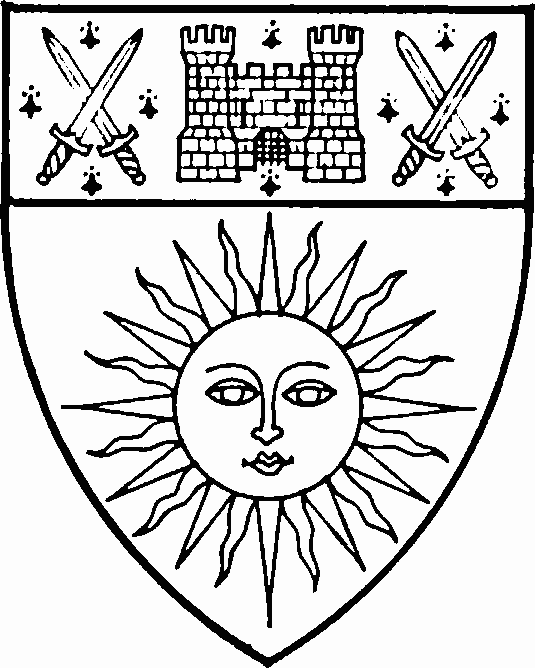
Borough Of Banbury. Azure a sun in his splendour or, on a chief ermine a castle of two towers between two pairs of swords points upwards in saltire gules
Banbury received a grant of arms in 1951, in which the sun in splendour represents the device formerly used by the town; other charges recall the town's royal charters, the Civil War sieges, and the castle, while the crest and supporters allude to the 'fine lady' of the nursery rhyme, to Mary Tudor, and the County of Oxford. (fn. 423)