A History of the County of Oxford: Volume 10, Banbury Hundred. Originally published by Victoria County History, London, 1972.
This free content was digitised by double rekeying. All rights reserved.
Christina Colvin, Janet Cooper, N H Cooper, P D A Harvey, Marjory Hollings, Judith Hook, Mary Jessup, Mary D Lobel, J F A Mason, B S Trinder, Hilary Turner, 'Banbury: Churches', in A History of the County of Oxford: Volume 10, Banbury Hundred, ed. Alan Crossley (London, 1972), British History Online https://www.british-history.ac.uk/vch/oxon/vol10/pp95-120 [accessed 30 April 2025].
Christina Colvin, Janet Cooper, N H Cooper, P D A Harvey, Marjory Hollings, Judith Hook, Mary Jessup, Mary D Lobel, J F A Mason, B S Trinder, Hilary Turner, 'Banbury: Churches', in A History of the County of Oxford: Volume 10, Banbury Hundred. Edited by Alan Crossley (London, 1972), British History Online, accessed April 30, 2025, https://www.british-history.ac.uk/vch/oxon/vol10/pp95-120.
Christina Colvin, Janet Cooper, N H Cooper, P D A Harvey, Marjory Hollings, Judith Hook, Mary Jessup, Mary D Lobel, J F A Mason, B S Trinder, Hilary Turner. "Banbury: Churches". A History of the County of Oxford: Volume 10, Banbury Hundred. Ed. Alan Crossley (London, 1972), British History Online. Web. 30 April 2025. https://www.british-history.ac.uk/vch/oxon/vol10/pp95-120.
In this section
Churches.
Banbury church probably originated in the Anglo-Saxon period as the mother church of a large area: the parish boundary crossed the county boundary, and was probably established before it. (fn. 1) The first certain evidence of the existence of the church is a reference in 1185–6 to the profits of the rectory, although in the late 11th or early 12th century Wulfric the priest may have been connected with Banbury. (fn. 2) Before 1185 the Bishop of Lincoln had granted Banbury church to the Dean and Chapter of Lincoln (fn. 3) and it became a prebendal church. Prebendaries held the rectory until the 16th century and probably appointed curates or vicars from the first. The advowson followed the descent of the prebendal estate except that between 1551, when it passed to the Crown, and 1589 when it passed to the Bishop of Oxford, the advowson was not leased out but was retained by the Crown. (fn. 4) Since 1589 the living has remained in the gift of the Bishop of Oxford.
In 1185–6, when the rectory or prebend was in the king's hands during a vacancy, it yielded £6 11s. 10d. (fn. 5) In 1254 and 1291 it was valued at £25 and £30 net respectively; (fn. 6) between November 1346 and August 1347 it yielded £51 16s., the bulk of which (£48) came from sale of tithe produce. (fn. 7) In 1535 the gross value was £50, of which £5 was due to the Bishop of Lincoln as quit-rent and £2 13s. 4d. to the Archdeacon of Oxford for procurations and synodals. (fn. 8) From the 16th to the 19th century it was leased by the Bishop of Oxford for £49 18s. 9d., with additional payments of £6 13s. 4d. to the Vicar of Banbury, 6s. 8d. to Banbury castle, and £5 14s. 7d. to Lincoln cathedral. (fn. 9) Considerable fines were paid on entry to the property and its value was far greater than the rent suggests: in 1650, for example, the estate was valued at c. £342 a year. (fn. 10)
In 1235–6 the Dean and Chapter of Lincoln confirmed a grant by the rector of an oxgang of land for 4s. a year rent; (fn. 11) reference in 1238–9 to the rector tilling 8 a. of his estate himself suggests that the rest of the glebe was leased. (fn. 12) In 1279 the rector held c. 19 'acres' of the 'old feoffment' in free alms, (fn. 13) but probably held other land as well. In nine months in 1346–7 the glebe yielded c. 41s. rent. (fn. 14) In 1589 the rectorial glebe amounted to 4 yardlands, each valued at 13s. 4d., in the fields of Neithrop, Calthorpe, and Wickham. (fn. 15) In 1606 the glebe was described as 65 a., with a meadow, two houses, and gardens. (fn. 16) In 1650 the glebe in the built-up area of Banbury comprised a rood next to the Talbot Inn in Church Street and a two-acre inclosure bounded by the churchyard, Church Lane, and Parson's Street, and containing a great barn and several other properties, one of which (St. Sunday's) (fn. 17) was said to be formerly the site of the rectory-house; the openfield glebe comprised 5 yardlands and commons in Neithrop, Calthorpe, and Wickham and the first crop of Parson's meadow. The whole was valued at c. £72. (fn. 18) In the 17th century and as late as 1740 the glebe contained inter alia a mansion-house (not identified), which is not mentioned in later leases, and a tithe barn, (fn. 19) presumably the barn of eight bays mentioned in 1606. (fn. 20) In 1760, when Neithrop was inclosed, the lessee of the prebendal estate was allotted 49½ a. in lieu of 3 yardlands of glebe. (fn. 21)
The great tithes granted to Eynsham Abbey by Robert Bloet, Bishop of Lincoln, and Robert, son of Waukelin, lord of Wickham, (fn. 22) were probably those defined in a note in the Eynsham Cartulary, namely the demesne tithes of the bishop and the lord of Wickham, the tithes of any free or villein tenements formed from the demesne, and also of 10 a. attached to Banbury mill. (fn. 23) Presumably the great tithes of other land belonged to the rector or prebendary: between 1123 and 1148, for example, there was a dispute between Eynsham Abbey and William Grammatica (sic) as to whether certain land had or had not been in demesne at the time of Robert Bloet's grant. (fn. 24) Further arbitrations were required in 1238 and 1293: in the first the abbey was awarded the great tithes of all demesne lands in Banbury (i.e. Calthorpe and Neithrop), Hardwick, and Wickham excluding 9 a. tilled by the rector; the abbey was also confirmed in its right to tithe wool from the bishop's house (a phrase which presumably excluded the demesne of the military tenant at Wickham). (fn. 25) In 1293 the abbey was awarded all tithes, great and small, arising from the episcopal demesne in Banbury parish, while the rector was to have all other tithes. (fn. 26) The prebendal tithes were always more valuable than the Eynsham tithes: the standard annual rent for the lease of the Eynsham estate, which can be traced back to 1522, was only £4 13s. 4d., (fn. 27) compared with £49 18s. 9d. for the prebendal estate, and in 1650 the tithes were valued at c. £35 and £270 respectively. (fn. 28) At the inclosure of Neithrop in 1760 80 a. were allotted in lieu of the prebendal tithes, and the remainder of the prebendal tithes in the parish were commuted in 1851–2 for rent-charges amounting to £452. The Eynsham tithes were commuted for £213 6s. 8d. At the same time the owners of Hardwick successfully claimed the right to pay a prescriptive modus for great tithes of only £1 6s. 8d. (fn. 29)
No early ordination of the vicarage has been found, but by 1470 the vicar had an established right to oblations, personal tithes rendered at the altar for oblations forgotten, and trees in the churchyard; after a complaint by the vicar the bishop, with the prebendary's consent, assigned to the vicarage all small tithes except from the prebendal estate, all mortuaries, and all oblations in the chapel of the Resurrection. (fn. 30) The vicarage was valued at £6 13s. 4d. in 1291, £20 in 1347 and 1526, and £22 6s. 8d. in 1535. (fn. 31) In 1647 the Committee for Plundered Ministers ordered £50 a year to be paid to the vicar out of the rectories of Banbury (£48) and Cropredy (£2), and in 1654 payment of a further £30 a year was ordered. (fn. 32) In 1718 the living was valued at £80, plus £29 in dues. (fn. 33) The living was augmented by grants from Queen Anne's Bounty to meet private benefactions in 1736, 1804, 1821, and 1826. (fn. 34) In 1838 the gross income from lands, tithes, and private subscriptions was £240, an amount considered by parishioners so inadequate that they were accustomed to collect a special biennial subscription 'for the afternoon lecture'. (fn. 35) In 1851 the gross income was c. £307. (fn. 36) Further grants were made in 1867 and 1878 out of the Common Fund. (fn. 37) By 1915 the vicarage was valued at £403 gross, and in 1965 the net benefice was £1,081. (fn. 38)
Apart from the vicarage-house and a property given in 1392 for an obit (fn. 39) the vicars held no glebe. In 1650 the vicarage comprised certain small tithes (worth £55) by 'ancient composition with the impropriator'; (fn. 40) the payment of £6 13s. 4d. out of the rectory continued into the 19th century. (fn. 41) In 1760 the vicar was awarded a corn-rent of £5 14s. 6d. for his tithes in Neithrop, (fn. 42) and in 1852 £53 5s. 7d. for his remaining tithes in Banbury tithing; his right to a prescriptive modus of £1 for the small tithes of Hardwick was also established in 1852, and he was awarded a corn-rent of £38 1s. for the tithes of Wickham. Of the corn-rents awarded in 1852 c. £62 were set aside for the Vicar of South Banbury. (fn. 43)
From the 12th century, when Robert Chesney, Bishop of Lincoln (1148–55), freed prebendal parishes from the jurisdiction of the bishop and archdeacon, (fn. 44) Banbury formed an ecclesiastical peculiar: archidiaconal jurisdiction was henceforth exercised by the prebendary, while the Dean of Lincoln, on behalf of the chapter, had the right of triennial visitation. (fn. 45) The Bishop of Lincoln instituted to the living, and the dean and chapter inducted. With the formation of the see of Oxford in 1542 and the extinction of the Banbury prebend c. 1548 (fn. 46) the status of Banbury peculiar jurisdiction, in common with a number of other similar Oxfordshire jurisdictions, became uncertain, for although the Dean and Chapter of Lincoln continued to exercise extensive jurisdiction over them it was no longer clear to which diocese they belonged. (fn. 47) In 1637 Archbishop Laud considered that Banbury lay outside the Bishop of Oxford's jurisdiction but did not mention the rights of the Bishop of Lincoln. (fn. 48) Although there were disputes over the respective rights of Lincoln and Oxford in the early 17th century, (fn. 49) the problem became most acute in the 18th century, especially when Thomas Secker, Bishop of Oxford, insisted that the Vicar of Banbury should answer his visitation inquiries in 1738: the vicar submitted, but not without a struggle, and the bishops of Oxford and Lincoln began to look to their rights. (fn. 50) Since neither could muster evidence of previous visitation much was made by both sides of evidence of other episcopal acts, for example institutions and confirmations. (fn. 51) The Dean and Chapter of Lincoln supported their bishop's claim to institute, since when he instituted they inducted, whereas when the Bishop of Oxford instituted the Archdeacon of Oxford inducted. (fn. 52) In 1745 the Bishop of Salisbury adjudicated the dispute over the Oxfordshire peculiars and decided for the Bishop of Oxford. (fn. 53) Even so Banbury was not visited by the Bishop of Oxford between 1739 and 1808; in 1805 the curate of Banbury, on the advice of his vicar, enlisted the support of the Bishop of Lincoln in refusing to attend the Bishop of Oxford's visitation. (fn. 54) Thereafter the Bishop of Oxford visited regularly. (fn. 55) The dean and chapter's jurisdiction over the Oxfordshire peculiars, not seriously questioned until the late 18th century, continued to be exercised until the mid 19th century. (fn. 56)
Although a number of the prebendaries were eminent clerics (fn. 57) they probably made little impact as individuals on the church life of Banbury in the Middle Ages; nor did the fact that the appointment of prebendaries in the 14th century became a subject of bitter conflict between king and pope (fn. 58) affect the vicarage. Banbury church's status as a prebendal church, however, as well as its position as the religious centre of a flourishing town, was reflected in the scale and quality of its medieval architecture. (fn. 59) Within it were chapels dedicated in honour of the Trinity, the Resurrection, and St. Mary the Virgin, and chapels or altars in honour of St. Peter and St. Nicholas. (fn. 60) A chantry in the chapel of St. Mary, founded in 1413, was subsequently maintained by a guild. (fn. 61) Of the pre-Reformation vicars little is known beyond their names; (fn. 62) two at least, Richard Brancaster (d. 1301) and John Diestere (fl. 1402), were members of Banbury landowning families. (fn. 63) Banbury was one of the towns supplying men for the Lollard uprising of 1413, (fn. 64) and a further hint of the unorthodoxy in religious attitudes which later characterized Banbury is the use of a phrase 'Banbury glosses' by Hugh Latimer in 1530; (fn. 65) the phrase meant twisting of the truth, perhaps with specific reference to false expositions of Scripture, but its origin is lost. Equally obscure was a dispute in 1540 between the vicar, John Pitt, and Anthony Cope of Hanwell; the matter came before the Privy Council, which commended Cope and found a 'lack of discretion' in the vicar. (fn. 66)
Between 1554 and 1558 John Lovett of Adderbury, steward of Banbury, alleged in the Star Chamber that his attempts to restore Roman Catholicism in the town had met with insults from three members of the Weston family (William, William, and John), 'new learned men in the scripture'; they had called him 'popish and mass monger villain' and had attempted to have him removed from the stewardship, claiming that he was ignorant of the law. (fn. 67) In 1555 a Protestant martyr, William Dighel, not necessarily a local man, was burned at Banbury. (fn. 68)
Religious controversy in the town became general during the incumbency of Thomas Bracebridge (1581–90), a local man who in 1575, when almost 40 years old, vacated a fellowship at Magdalen College, Oxford, to take charge of a school near Banbury. (fn. 69) He was a puritan writer (fn. 70) and preacher, and in 1586 it was reported that he preached in Banbury every Sunday. (fn. 71) The noted puritan John Dod of Hanwell was among those who delivered weekly lectures in Banbury at that time. (fn. 72) John Danvers of Calthorpe, Sheriff of Oxfordshire in 1589, was the most prominent of Bracebridge's opponents. Early in 1589 Danvers and others were accused of recusancy and of indulging in 'dancing or some other like pastime' instead of attending church. (fn. 73) Later in 1589 (fn. 74) Danvers warned all justices of the county to put down riots that might be started on pretext of carrying out the Deputy Lieutenant's instructions to remove maypoles and stop Whitsun ales, May-games, and morris dances, and reported to the Privy Council that Anthony Cope and others of Banbury were trying to abolish most customary pastimes on religious grounds. There were disorders in Banbury over the maypole both in 1588 and 1589. (fn. 75)
In 1590 the anti-puritan party gained a notable victory in the deprivation of Bracebridge on the grounds of 'some matters of ceremonies'. Ninetyfive of his parishioners signed a petition to Lord Burghley on his behalf; (fn. 76) Bracebridge himself wrote to him asking at least to be allowed to continue to preach at Banbury, promising not to touch in his sermons on controversial matters, only on 'papistry' and such matters 'as are condemned by public authority in the Church of England'. (fn. 77) It is not known whether his request was allowed; certainly he continued to live at Banbury, although deprived, and he died there in 1593. (fn. 78) The signatories to the 1590 petition supporting Bracebridge included most of the prominent inhabitants, although the Hawten and Vivers families were conspicuously absent. Among the signatories were at least 18 of the 28 persons assessed for subsidy within the borough in 1600. (fn. 79) Of the local landowners Sir Anthony Cope was a leading puritan, (fn. 80) and probably the Fiennes family of Broughton was already of the same party. It may have been the destruction of the crosses (fn. 81) that first gave Banbury a widespread reputation for puritanism: (fn. 82) in 1632 the incident was still sufficiently remembered to be made the subject of a casual allusion in court by the Attorney-General. (fn. 83) In 1604 it was alleged that the religious controversies in Banbury and the town's discouragement of merrymaking had led the people from the country around to go to other markets. (fn. 84) In 1606 the church was called the 'lawless church' because of the irregular manner in which the Sacrament was administered and the number of marriages which took place without banns or at prohibited times. (fn. 85) In c. 1610 the Puritan leanings of a group of Banbury residents led them to destroy a number of statues adorning the walls of the church. (fn. 86) In 1613, on the rumour of the murder of Henry, Earl of Huntingdon, by papists, the people of Banbury made barricades and 'all other manner of provision', in anticipation of assault. (fn. 87)
William Whateley (1583–1639), the most notable of Banbury's vicars, (fn. 88) was instituted in 1610, but had already been a 'lecturer' there for some years. (fn. 89) His father was several times bailiff or mayor of Banbury, and in a sermon in 1628 he told his parishioners that he had been absent from them for only seven years, 'for learning's sake'. (fn. 90) Like Bracebridge he was a puritan and a writer, and a man of original and advanced views. While at Cambridge he attended the lectures of William Perkins, 'the key figure in the systematization of English puritanism', (fn. 91) and his father-in-law, George Hunt, had connexions with Dr. Humfrey of Magdalen College, Oxford: (fn. 92) Whateley was thus in contact with the most rigorous puritans of both universities and his high seriousness and emphasis on preaching and prayer showed that he carried their principles into his pastoral work. Among a number of publications the most famous was The Bride-Bush (1619), which asserted that adultery or long desertion dissolved a marriage, a view which he withdrew when challenged in the High Commission Court. (fn. 93)
Whateley's churchmanship did not pass without criticism in Banbury. He was presented in 1607, before he became vicar, for failing to pray for the bishops, to read divine service or administer baptism, for preaching 'against the ceremonies', and for giving communion to those who would not kneel. (fn. 94) One of Whateley's curates, Ralph Taylor, who also taught in the free school, was charged in the Peculiar court with a wide range of typically puritan offences, such as refusal to wear vestments or to use the Prayer Book at all services. (fn. 95) About 1613 Whateley refused to take any part against those presented by his churchwardens for sitting; (fn. 96) in 1621 a further ten people were presented for not kneeling for communion; (fn. 97) and in 1626 Whateley refused communion to his own brother, who had been presented for incontinence. (fn. 98) He was, however, tolerant of the religious beliefs of others and from the town's reputation and political attitude during his ministry it is clear that in general most of his parishioners were thoroughly in sympathy with him. 'Our minister liveth orderly and conformably amongst us' reported the churchwardens in 1619, adding that he preached twice every Sunday and as a result could not catechize the children of so large a parish. (fn. 99) His voice and preaching style earned him the title of 'the roaring boy of Banbury' and his long-winded delivery was satirized by the poet Richard Corbet. (fn. 100) Whateley died in 1639, but Anthony Wood's judgement that he 'laid such a foundation of faction in that place, that it will never be easily removed' (fn. 101) was probably correct. In 1640 the town's recorder, Edward Bagshaw, called in question the bishops' temporal authority in a series of readings at the Middle Temple which the government prevented him from finishing; (fn. 102) and until the late 17th century, at least, the town was frequently divided on religious matters.
Although one of the men considered as successor to Whateley was locally acceptable (fn. 103) he was not instituted, and the vicar appointed, John Howes, became in 1640 the subject of a petition to Parliament by the inhabitants 'touching a wicked vicar at Banbury that put down preaching and vexed those that were godly and sought it elsewhere'. (fn. 104) The specific charges brought against him were his refusal to read the Act for a Public Thanksgiving on 5 November and his slander of certain peers, and he was in fact imprisoned for a few days for slandering William, Lord Saye and Sele. (fn. 105)
In 1641 Banbury was described as 'a place always too much encumbered with Brownists and Separatists', (fn. 106) but although an account survives of one conventicle which was distinguished by violent dislike of learning and of the church hierarchy (fn. 107) it is impossible to judge the strength of the movement. In 1648 the House of Lords ordered the induction of Samuel Wells, a Presbyterian, who in 1641 had been a chaplain in Colonel Essex's regiment in the Parliamentary army. (fn. 108) Wells was not an extremist and protested against the execution of Charles I; (fn. 109) even so he was acceptable to the Commonwealth government and was ejected from his living in 1662. (fn. 110) He was intolerant of the Quakers, but evidently allowed other preachers in the parish since a Quaker admitted attending the 'godliest reformed ministers in the town'. (fn. 111)
After his ejection Wells became the leader of a congregation which seceded from the parish church and became the Presbyterian 'Old Meeting'. (fn. 112) Succeeding vicars were favourably disposed to the Presbyterians (fn. 113) and in 1672 the Banbury churchwardens presented the clergy for failing to wear surplice and hood at baptism and communion, failure to use the catechism, to say prayers of absolution and for Holy Days, or to hold the Wednesday and Friday services required in town churches. School teachers were also criticized for failing to teach the catechism, and parishioners were said to take care 'not to fall on their knees before their Lord and Maker or at the name of God to seem to bow or stand', and to have no more esteem for the church 'than if it were a barn'. (fn. 114)
By 1685, however, a change had occurred, due perhaps partly to the disappearance of the generation that had known the issues and conflicts of the Civil War and Interregnum, partly to the retreat of rebellious elements from the Established Church to nonconformity. In 1685 the churchwardens reported that their vicar, John Knight, took great pains in reading divine service on Sundays, festival days, Wednesdays, and Fridays; they declared that most parishioners resorted to his ministry not only to hear sermons, but divine service also. (fn. 115) When Jonathan Swift in 1710 mentioned the town's continuing zeal he may well have been referring to its High-Church enthusiasm, manifested earlier in that year in its reception of Dr. Sacheverell. (fn. 116) As Sacheverell journeyed northwards in 1710 to take up a Shropshire living he was fêted by his supporters in towns and villages: at Banbury on 3 June he was met by the mayor and corporation on horseback, and accompanied into the town by a large crowd. (fn. 117) Further evidence of a High Church, Tory, party in Banbury was given in the struggles within the corporation which led to the forfeiture of the town's charter in 1717. (fn. 118)
In the 18th century vicars held the living for long periods and were usually resident. Benjamin Loveling, vicar from 1698–1717, was resident, and notable chiefly for his opposition to the Quakers, against whom he wrote several pamphlets. (fn. 119) His successor William Asplin was a noted theologian and antiquary. (fn. 120) John Wardle (vicar 1738–58) had served as curate to two earlier vicars, (fn. 121) and Matthew Lamb (1758–80) and his successor John Lamb (1781–1815) (fn. 122) were both chief burgesses and aldermen of the borough. (fn. 123) The latter approved the decision to replace the medieval church. In later life he held an additional cure in Northamptonshire, where he resided, paying Banbury's curate £40 with additional fees of about £98 in 1814. (fn. 124) In the early 19th century divine service was held twice on Sundays and Holy Communion was administered 10 times a year to about 50 people; prayers were said on Wednesdays and Fridays each week. (fn. 125) In 1814 the curate, Thomas Lancaster, reported that too many people were absenting themselves from public worship. (fn. 126)
Lancaster was vicar from 1815 to 1849, the longest incumbency in the history of the parish. Although an outstanding exponent of rigid 'high and dry' views, much of his published work being devoted to attacks on contemporary liberal theology, his interests were primarily academic and he regarded the cure chiefly as a source of income. After about 1823 he lived much of the time in Oxford and seems to have interfered little in Banbury church affairs; as a member of the corporation he is remembered chiefly for a ludicrous mishap during the election riots of 1820. (fn. 127) His absenteeism, and perhaps his unpopularity, caused Bishop Wilberforce to intervene, and persuade Lancaster to exchange livings with the Rector of Over Worton in 1849. (fn. 128) Lancaster's curate J. R. Rushton (1831–41) was allowed complete control, and played an active part not only in societies related to the church, but in most of the town's activities; the estimated attendance at Holy Communion was 220–40 and at other services 800–1,000. (fn. 129) A later curate Charles Forbes (appointed 1845) was largely responsible for the creation in 1846 of South Banbury parish, of which he became first incumbent. (fn. 130)
William Wilson, who became vicar in 1849, was highly thought of by Bishop Wilberforce, and in Banbury he brought about a great revival of church work. Aided by two assistant curates he tried to bring the church to the poor, introducing a litany and sermon for them in the parish church at 9.30 a.m. (fn. 131) He was an enthusiastic supporter of schemes to build Christ Church, South Banbury, and St. Paul's, Neithrop, and for the latter he himself gave the land. (fn. 132) When Bishop Wilberforce held a Lenten mission in Banbury in 1850 the church was full for nearly all the services. Wilson considered himself a failure with the poor even though the estimated average attendance figures from the reduced parish in 1851 were 1,300 at both morning and evening services. By the mid 1850s a ragged Sunday school had been started at Neithrop and adult classes were being held twice a week in the vicarage hall. As well as giving religious instruction in the church schools Wilson taught in two girls' private schools. When he died in 1860 he was widely mourned, and even one of his most vigorous opponents admitted that he had been universally 'respected and beloved'. (fn. 133)
His successor, Henry Back (1860–81) continued the improvement. By 1866 there were as many as 60 voluntary Sunday school teachers, and because the congregation was increasing 'as much as the very singular tenure of pews allows', the vicar asked for more curates. (fn. 134) Back was responsible for the rebuilding of the chancel (fn. 135) and for some of the additions to the vicarage-house. In Banbury, as elsewhere in the mid 19th century, it became the practice to hold three services each Sunday and to lay greater emphasis on Holy Communion; by 1860 the Sacrament was administered twice monthly and on the great festivals, and the number of communicants rose from c. 80 in 1860 to c. 155 in 1872. Morning and evening prayers were held daily, and on Wednesday there was a sermon. Congregations for the Sunday services were large, usually estimated to average 1,000. (fn. 136)
In 1967 the ecclesiastical parish was enlarged when South Banbury parish was reunited (although without Grimsbury) with the parish from which it had been taken in 1846. (fn. 137)
The first clear reference to a vicarage-house was in 1441; at that time the house may well have occupied the site of the present vicarage, for it was separated from the churchyard by a garden of which the vicars had recently become lessees, paying a quit-rent first of 12d., later (in 1535–52) 18d. a year to the bishops of Lincoln and their successors in their Banbury property. (fn. 138) It is possible that an earlier reference to the vicarage-house was made in 1392 when licence was given for a house and garden in Banbury to be given in mortmain to the vicar and his successors for keeping an aniversary for Sir John Brancaster and his wife Margaret. (fn. 139) The Vicarage was badly damaged during the Civil War and in July 1646 Parliament granted timber for rebuilding it. (fn. 140) The present house (No. 24 Horse Fair) (fn. 141) outwardly retains its 17th-century appearance, although in fact the rear part and the interior were entirely remodelled in the 19th century. The porch bears the initials S.W. (presumably for the vicar, Samuel Wells) and the date 1649, which probably refers to the rebuilding of the house, although the late Gothic doorway is a curious anachronism, which may be due to the re-use of medieval materials. The ironstone front range is of two stories with a semi-basement and a roofgarret lit by two large dormer gables. On the south side is an entrance porch with a room over it in the gabled roof, and on the north side a two-storied bay window with a battlemented parapet. An engraving of 1841 (fn. 142) indicates that the building was either a double pile or had a rear wing, but the rear part has been replaced by a long rear wing in Victorian Gothic containing a grandiose open hall. The wing bears the date 1860 and an inscription on the stable range suggests that it was the work of Henry Back, who became vicar in 1860. (fn. 143) Some of the 17th-century masonry has been re-used at the east end of the house.
In 1413 five leading townsmen of Banbury were licensed to grant in mortmain to the prebendary certain properties to maintain two chaplains to celebrate in the chapel of St. Mary in Banbury parish church for the king, the bishops of Lincoln and Winchester, the prebendary, the grantors, and their nominees. The properties named were twelve houses, rents of 40s. a year, and ½ yardland lying in Banbury, Wickham, and Neithrop; (fn. 144) by 1441 20 tenements and plots of land in Banbury and free lands in the hamlets were held by the warden (custos) of the chantry of the Blessed Mary of Banbury. (fn. 145)
The chantry seems to have been reorganized and extended as the guild of the Blessed Virgin Mary, and after the guild's foundation there are no further references to the separate existence of the chantry or its properties. (fn. 146) The guild was incorporated in 1448. It was to be governed by a master or warden elected annually, and could acquire in mortmain property not held in chief worth 100 marks a year or more to maintain eight poor men in the almshouse at Banbury and three chaplains who would celebrate at the altars of St. Mary in the parish church. (fn. 147) The guild had a common seal depicting the Annunciation, with a fleur-de-lis. (fn. 148)
The guild's endowment was augmented by various bequests, (fn. 149) and in 1535 its gross income was £58 a year; (fn. 150) by 1548 this had risen to £62 17s. 4d. (fn. 151) The guild's stipendiaries in 1535 were the master, who was also the guild's chaplain (two separate payments of £5 16s. 8d. and £1 6s. 8d.), three other chaplains (£5 16s. 8d. each), two parish clerks (£2 13s. 4d. between them), an organ player (£6 10s. 0d.), the eight almsmen (£6 18s. 8d. between them, i.e. 4d. a week each), the clerk of the guild (£2 6s. 8d.), and the auditor (£1 6s. 8d.). (fn. 152) Houses for the chantry priests stood in the churchyard. (fn. 153) In 1548 the stipendiaries named were the three chaplains, the organist, twelve almsmen and almswomen, and a sexton (13s. 4d.) whose duty was to care for the Lady Chapel. (fn. 154) The auditor in 1535 was one of the Cope family. (fn. 155)
The guild was dissolved in 1548. Pensions of £5 a year were allocated to the three chaplains and a pension of £4 a year to the organist; the senior chaplain was then appointed assistant curate to the parish at a stipend of £6 6s. 8d. a year (presumably instead of a pension), and provision was made to continue the alms to the twelve recipients as before. (fn. 156) From 1572 the money for the assistant curate and for the almsmen was paid to the corporation of Banbury by the Crown's receiver-general for Oxfordshire. (fn. 157) The sum of £5 17s. 4d. (the £6 6s. 8d. less fees) was still being paid by the receiver-general of the land revenues of the Crown in Oxfordshire in the 19th century. (fn. 158) The guild's property, taken over by the Crown in 1548, was sold in four portions to different groups of grantees in 1549 and 1550. (fn. 159) In 1552 the grantees of two portions—George Owen with William Martin, and John Peryent with Thomas Reeve—were still responsible for paying their shares of the quit-rents due to the Crown as the successor of the bishops of Lincoln in their properties in Banbury. (fn. 160) Quit-rents formerly due from the guild's properties were still entered as a single item on royal accounts in 1586, (fn. 161) but do not reappear in a survey of 1606, (fn. 162) by which date the properties had probably been completely broken up. (fn. 163)
The present church of ST. MARY THE VIRGIN replaced an earlier building of the same dedication in 1797. (fn. 164) The old church of Banbury was a large, cruciform building (192 ft. long, 102 ft. across the transepts), (fn. 165) comprising a chancel and nave, north and south aisles, north and south transepts, and a central tower. A porch gave access to the south aisle and there was a vestry projecting from the north side of the chancel. Each transept opened into a chapel. (fn. 166)
The earliest part of the church was the nave, which contained plain, circular piers and rounded arches of the 12th century. The 13th-century north aisle, which contained narrow lancet windows, set in four groups of three, was apparently a double aisle. (fn. 167) The south aisle dated from c. 1300, (fn. 168) with geometrical tracery in the west and south windows; the parapet was pierced by quatrefoils, and at the south-west angle was an octagonal turret, with an arcade above the string course.
The porch was built in the 14th century. The south transept, probably built at a much earlier date, was extended south and east in the 14th century to accommodate a chapel, notable for its large windows with reticulated tracery, and for the prominent buttresses containing niches with crocketed canopies; the south-east buttress rose high above the level of the roof and was topped by a crocketed pinnacle. The parapet was of flowing tracery pierced. (fn. 169) The north transept, though much plainer, was similar in plan to the south transept and was probably extended during the same period. The twin west windows of the north aisle and the great west window of the nave appear also to have been 14th-century work, though the latter had lost its original tracery by 1790. A door mentioned in 1706 (fn. 170) was blocked during the 18th century.
The chancel probably dated from the early 15th century. It was uniformly built with an east window of nine lights and six lateral windows of five lights each. The nave clerestory is of uncertain date, although the windows on the south side were of early-15th-century character. The clerestory over the south transept probably dated from the late 15th century, and carried a battlemented parapet. The mid-15th-century tower was of two stages, with buttresses set square at the angles, and was topped by a battlemented parapet and eight crocketed pinnacles. Probably in the early 16th century a clerestory was built on the east side of the tower over the space between the tower's eastern piers and the entrance to the chancel proper. Except for the vestry, the date of which is uncertain, (fn. 171) that clerestory appears to have been the last major addition to the church.
In 1610 and 1611 Richard, Lord Saye and Sele was presented by the churchwardens for failure to maintain the chancel, (fn. 172) but repairs had not been carried out by 1623. Moreover many of the monuments on the church had been removed or defaced. (fn. 173) In August 1644 the church was used as a vantage point from which to attack the castle, and the steeple was reported to have been destroyed when the royalists returned the fire. (fn. 174) The chancel was damaged also, and the cost of repairs was estimated at £200. (fn. 175) Some parts of the church and tower were apparently pulled down at that time, (fn. 176) and although considerable effort was made to obtain materials for repairs, much still remained to be done in 1684. (fn. 177) In 1686 it was claimed that unless the parishioners contributed to a rate the church was likely to become a heap of rubbish; a church rate was ordered to raise £400 for the repair of the church, which was expended c. 1700; (fn. 178) perhaps it was then that two ungainly flying buttresses were added at the west end of the nave, and a similar one on the north side of the church.
As the 18th century progressed it became clear that major structural alterations were necessary and that the weight of the tower was making the crossing unsafe; in 1724 the pillars of the church were described as being 'of too slender a manner, which makes them all lean awry and different ways'. (fn. 179) Minor repairs were carried out to the west face of the tower c. 1760, but it was not until 1773 that the vestry decided to take professional advice about the condition of the building. Two London surveyors reported that the chancel, tower, and transepts were 'fit to stand for ages', but that the whole of the church to the west of the tower should be taken down and rebuilt. That advice was not taken, and in 1784 another surveyor, named Dalton, advised the rebuilding of the north-west pier of the tower and the filling in of the southern arches; when the work was done Dalton pronounced the church 'as safe as St. Paul's Cathedral'. In 1789, however, he and a Mr. Burton reported that the roof of the south aisle was dangerous and that as the tower 'continues to press downward and injure the adjacent piers', it would be advisable to take it down and build a new tower at the west end of the nave. (fn. 180) Further advice was taken from the architects James Wyatt and S. P. Cockerell, as a result of which it was decided to obtain an Act of Parliament to build an entirely new church. (fn. 181) By 1793 the whole church had been demolished, although some of the masonry could only be brought down with the help of gunpowder.
Richard Rawlinson noted in 1718 that there was a brazen altar in the little aisle between the belfry and the chancel. (fn. 182) There was a gallery over the east end of the nave in 1723; (fn. 183) in 1691 a 'boys' gallery' stood in the body of the nave to the west, beyond which was an area free of pews known as 'the great space'. (fn. 184) The pulpit stood on the south side, and well into the body, of the nave. (fn. 185) Apparently many of the medieval pews survived into the 18th century, their square-headed ends enriched with a variety of ornamental panels. (fn. 186) John Byng in 1785 wrote that the church was 'crowded with ugly pews'. (fn. 187) There was a chancel screen of carved wood, and miscellaneous articles sold off after the demolition included an altar-piece of oak with four marble tablets (bearing the Lord's Prayer, the Commandments, and the Creed), an oil-painting of the royal arms, and a communion table and altar-rails, which had recently been restored. (fn. 188)
The font was octagonal, of the early 14th century, and stood in the south aisle until in 1721 it was removed to the west end of the church, 'near the door there, between the boys' galleries'. (fn. 189) After the demolition of the church it passed into private hands until it was restored to the church in 1895. It now stands in the churchyard. An organ was set up in a gallery at the west end in 1769 (fn. 190) and was later transferred to the new church.
In the windows were 60 coats of arms, copied in 1574; in 1640, however, Dugdale recorded only 19 coats, and when Anthony Wood revisited the church in 1659 only about a dozen remained: Wood may have been wrong to attribute their destruction to the war, in view of the evidence for iconoclasm in Banbury in the early 17th century. (fn. 191) The windows of the south chapel were given by William Cope (d. 1513); (fn. 192) presumably he gave the glass only since the tracery was 14th-century.
Almost all the monuments in the old church were removed or destroyed in 1790. Rawlinson recorded that there was an ancient raised tomb in the chancel, thought to have belonged to a judge, with the figures of a man and woman thrown from it by Parliamentary soldiers. There were monuments to John Knight, three times bailiff of the town (d. 1587), (fn. 193) and to William Knight, sometime J.P. in Banbury (d. 1631). An elaborate monument in the chancel was believed to belong to the Chamberlayne family. William Cope, cofferer of Henry VII's household, was buried in the south chapel. Three members of the Appletree family, Russell (d. 1699), Thomas (d. 1700), and his son Thomas (d. 1701) were buried in 'Sir Robert Dashwood's chancel'. (fn. 194) Other worthies of the town included Robert Bentley (d. 1628) and Jacob West (d. 1684), both reeves, and Richard Hill, merchant (d. 1658). Seven dissenters are known to have been buried in the church, including four ministers, namely James Sutton (d. 1674), his son-in-law Samuel Statham (d. 1685), Robert Stogden (d. 1696), and Nathaniel Lawrence (d. 1708). Also commemorated was Captain William Danvers, son of John Danvers of Culworth (Northants.), who was killed in 1643 in the king's service. A recumbent figure of an ecclesiastic lay in the chancel. On the destruction of the church the figure was purchased by William Arne, parish clerk, and later placed on his grave. It is preserved, in mutilated condition, in the churchyard. (fn. 195)
The Church of St. Mary the Virgin, Banbury
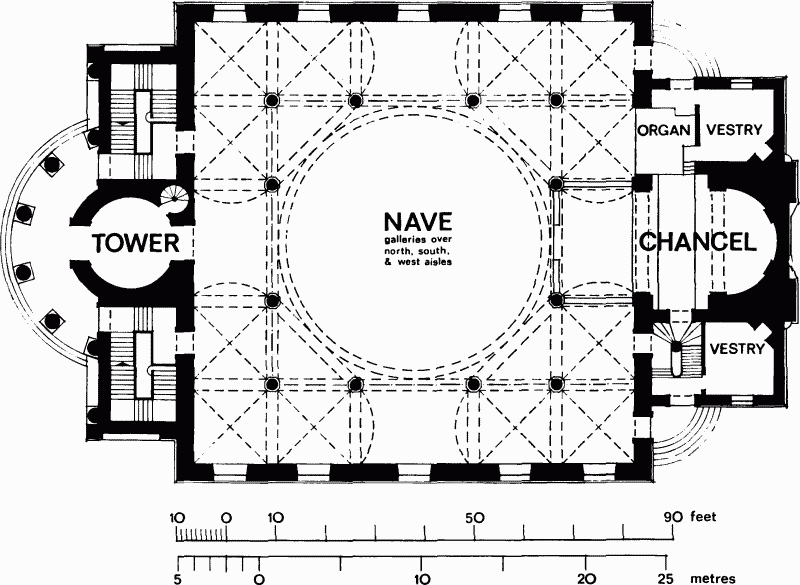
The present church was built on the site of the old church and opened for divine service on 6 September 1797. (fn. 196) The architect, Samuel Pepys Cockerell, designed a classical building, comprising a large nave (90 ft. square) with twelve Ionic columns, eight of which formed an octagon supporting a shallow domed roof. Galleries surrounded the nave on all four sides, the eastern gallery carrying an organ which towered above the entrance to a small, rectangular chancel. At the west end was a columned portico above which rose a circular tower. (fn. 197) The foundations of the new church were built with selected stones from the old church and most of the masonry was Lias Marlstone, known locally as Hornton stone. (fn. 198) The whole of the work was supervised closely by trustees appointed by an Act of 1790, and despite unexpectedly high costs and many difficulties with contractors the church was completed by 1822.
S. P. Cockerell's design was not carried out in its entirety: at the time of the opening service work on the portico and tower had been brought to a halt, and the tower was given a temporary thatch, which gave constant trouble, until work on both portico and tower was resumed in 1818 under the supervision of C. R. Cockerell. The fractured architrave of the great western door was also repaired at this time. (fn. 199)
The church contained two survivals of the old church, the organ, which had been remodelled by Messrs. Byfield and Co., and an oil-painting of the Dead Christ, which formed the altar-piece of the new church. (fn. 200) The original plan for the new church had provided for 2,000 seats but by 1841 there were seats for a further 300. (fn. 201) The walls were whitewashed and the columns of red Warwickshire sandstone were covered with oil-paint. (fn. 202) In 1841 the church was lighted by gas. (fn. 203)
In 1858, at the instigation of the vicar, the eastern gallery was pulled down and the organ divided and placed on either side of the chancel arch. (fn. 204) During the incumbency of Revd. Henry Back (1860–81) further alterations costing more than £8,000 were carried out. In 1864, under the direction of Arthur Blomfield and at the expense of Miss Wyatt of Banbury, the nave was richly painted by Messrs. Heaton, Butler & Bayne of London. With the consent of the owners the original high box pews of Norway oak were lowered; the three-decker pulpit, which had stood on the south side of the chancel arch, was replaced by a temporary one on the north. The rest of Blomfield's plan was delayed, through lack of funds, until 1873, when a faculty was granted for the reconstruction of the chancel. (fn. 205) The old chancel arch was removed, and a new and higher roof built connecting with that of the nave; an apse was created at the east end within the existing walls, and more space provided in the chancel by bringing the choir out into the nave, inside a low, stone enclosure. New altar-rails and choir stalls in carved oak were provided, and the organ was once more enlarged and placed in its present position in a chamber on the north side of the chancel. (fn. 206) The new chancel was opened in October 1874, and later the chancel floor was raised and the present tessellated pavement put down; the decorations were completed by Messrs. Heaton, Butler & Bayne in 1876. The upper section of the apse represents, on a gold ground, the Lord Enthroned in Majesty, surrounded by the four and twenty elders. In the three lower sections of the apse are life-size paintings of the twelve Apostles, also on a gold ground, and on the ceiling is the Sacred Name in Greek characters, encircled with rays of gold.
Before 1881 the original white-frosted glass had been replaced by stained glass in all the windows. (fn. 207) Extensive restoration of the stone-work and rooftimbers was carried out in 1907, and at the same time the interior of the nave was cleaned and recoloured, strictly following the original scheme. (fn. 208) The chancel decorations were restored in 1932. In 1948 a chapel on the south side of the church, designed by Messrs. Rogers & Surman of Oxford, was dedicated in honour of the Resurrection, thus perpetuating the name of one of the chapels of the old church. There is a Lady Chapel on the north side of the church. (fn. 209) In 1960 the whole interior was again redecorated, and the previous colour scheme was considerably altered. (fn. 210)
The carved oak pulpit designed by Blomfield, was presented by 1885 by Arthur Field in memory of his father. The square white font, inlaid with marble, was given by the Revd. H. Back's sister, and the brass eagle lectern by Messrs. Davis, the builders of the reconstructed chancel. Other gifts included a pair of iron candelabra designed by Sir A. Blomfield in memory of the Revd. Henry Back (1892), (fn. 211) an electro-gilt altar cross (1894), and wrought-iron choir gates (1902).
Two marble monuments to members of the Pigott family were removed from the chancel at the time of its reconstruction and placed in the nave. One of them commemorates Ann Dolly, daughter of Paynton Pigott and wife of Bernard Brocas (d. 1824), the other, Francis Pigott, impropriator of Banbury (d. 1790), and others. There are memorials to Revd. Henry Back (d. 1891) and Revd. Charles Fleetwood Porter (d. 1914), and to two considerable benefactors of the parish, Stephen Cooke (d. 1885) and John Brownsill (d. 1848). On the west wall is a tablet in memory of 17 men killed in the Boer War, and the dead of the two World Wars are commemorated on tablets in the chapel of the Resurrection.
The oldest piece among the church plate is an Elizabethan chalice and paten, dated 1575. There is a pair of silver chalices of 1614, and a chalice of 1618. Two fine silver tankards dated 1723 were given by Sir Monnoux Cope, M.P. for Banbury, and there is a silver paten of 1737. (fn. 212) There is some modern plate.
The date of the installation of the first bells at Banbury is not known, although money for bells was given in 1478, (fn. 213) and a great bell, or tenor, was recast in 1594, implying that a ring existed at that time. According to Richard Rawlinson Bishop Fell (d. 1686) gave six bells to the church, and at its demolition the old tower contained six bells, four of which dated from the 1660s and two from the 18th century; all had been cast by members of the Bagley family. These were rehung in the new tower in 1820 with two smaller bells made by John Briant. In 1897 a new clock, with three new bells for its chimes was placed in the tower in commemoration of the Diamond Jubilee of Queen Victoria, and at the same time the bells were retuned and overhauled. In 1929 all the bells were recast into the present ring of ten and two additional semi-tone bells; the original inscriptions were preserved. (fn. 214)
Until the 19th century a house given for the repair of the church (fn. 215) and known as the church house stood in the churchyard. Whether or not it was used for parochial purposes is not known; it was at one time used as a school (fn. 216) and in 1825 was being used as a plush factory. (fn. 217) It was possibly the building shown beyond the church in south views of both churches, (fn. 218) and may have been the same building referred to by Leland c. 1540 as 'houses for the chantry priests', and in 1554 as the 'church house'. (fn. 219) On the initiative of Canon Porter, Vicar of Banbury (1881–1905), and with the help of a bequest of £3,000 by Mrs. Back, widow of the former vicar, a new church house was built in 1904; it was designed by W. E. Mills and opened in 1905. (fn. 220) It is of Hornton Stone, late gothic in style, with a large south-facing oriel lighting the first floor. Until it was built the Church of England lacked a public hall such as was provided by a number of the dissenting congregations.
By 1603 several other properties had been given for the repair of the church: one parcel of land in Neithrop fields, three parcels of arable land, and one of meadow in Calthorpe fields, and nine burgages in Banbury (excluding the church house). The Banbury Church-building Act of 1790 authorized the corporation to sell the property given for the repair of the church which at that date consisted of the Flying Horse Inn, 11 other tenements, 2 pieces of land in Wickham, one piece of land in Neithrop, and rights of common belonging to the 12 tenements. The church house was not sold at that time as it was not known whether it had been given for the repair of the church or for a school. (fn. 221)
In 1852 a chapel of ease 'for the spiritual good of the poor of Neithrop', (fn. 222) was begun at Neithrop. The vicar, who purchased the land for the building, felt that the shortage of free seats in the parish church was keeping the Neithrop parishioners from services. Free accommodation for the poor throughout the nave and aisle of the new chapel was the condition of a grant of £230 from the Incorporated Church Building Society. (fn. 223) In 1860 the estimated congregation at the ordinary services was c. 300; there were two services with sermons on Sundays, and evening prayers with sermon on Fridays. The Sacrament was administered once a month. (fn. 224)
The chapel of ST. PAUL, Neithrop was designed by Benjamin Ferrey and built by Claridge of Banbury; it was opened in 1853. (fn. 225) It comprises nave, chancel, north aisle, and south porch. There is a turret with one bell over the western entrance. The detail is Early English.
A chapel in Banbury dedicated to the Holy Trinity was in use in 1298, when it was reported to be unconsecrated. (fn. 226) It may have belonged to the order of Trinitarian friars, which had recently founded a house in Oxford. (fn. 227) In 1312 an indulgence was granted for repairs or construction at the chapel, and in 1320 an indulgence was granted to all those contributing to the chapel's fabric or light. (fn. 228) Leland describes it as being 'in the middle of the town', (fn. 229) and it probably stood on the north side either of Butcher Row or of High Street near its east end. In 1441 tenements and waste ground in Cookrow or Shoprow were described as next to 'the chapel', (fn. 230) and in 1556 a shop in High Street was adjoined by Trinity chapel to the south and another property to the east, suggesting that the chapel occupied a corner or projecting site. (fn. 231) Alfred Beesley, writing in 1841, suggested that Trinity Chapel occupied the site of the White Horse inn, also on the north side of High Street but further west. (fn. 232) References to the chapel are few and many are open to doubt since by at least the late 15th century there was an altar or chapel of the Trinity in Banbury church. (fn. 233) A bequest of 6s. 8d. in 1506 'for making of the chapel of the Holy Trinity' probably refers to the separate chapel and probably to its repair. (fn. 234) By 1549 it was held by the Crown, presumably because it was classed as a free chapel under the Act dissolving such chapels in 1545, (fn. 235) and was granted with other Banbury property to Thomas Hawkins alias Fisher of Warwick. (fn. 236)
Another chapel, of unknown origin, and dedicated to St. Sunday, stood in Church Passage. (fn. 237) There were also private chapels at the castle and Wickham Park. (fn. 238)
The ecclesiastical parish of South Banbury was constituted out of the parish of Banbury in 1846 under provisions laid down by Parliament for the better spiritual care of populous parishes. It was claimed that the provisions for public worship and pastoral superintendence in the large and populous parish of Banbury had been insufficient for some time. Moreover the parish church was failing with poorer people because nearly all the pews were private property and let at a very high rent; the nonconformist chapels, where sittings were more easily obtained, were considered 'great temptations to keep many away from the church'. (fn. 239) The new parish was in the diocese of Oxford and included land both in Oxfordshire and Northamptonshire. The patronage was vested in the Bishop of Oxford; the living, at first a perpetual curacy, was decreed a vicarage in 1866. (fn. 240) There was no church until 1853.
The incumbent was granted all tithes arising within the new parish which had previously belonged to the Vicar of Banbury, and 4 a. of glebe, called Upper White Hill. In 1853 a vicarage-house was provided. The Ecclesiastical Commissioners agreed to pay the incumbent £100 a year and when a church had been built a further £50. In 1888 James Cadbury granted a small piece of land called Little Piece in the parish to form part of the endowment. Further small benefactions for the vicarage were made to the Ecclesiastical Commissioners in 1895 and 1932. (fn. 241) In 1937 c. ¼ a. of glebe was sold to the Oxfordshire County Council, (fn. 242) and in 1947 the vicar requested permission to sell a further 2 a. (fn. 243) The value of the living in 1940 was £389. After 1947 the stipend was increased by £50 a year under various schemes. (fn. 244) The net benefice in 1963 was £899. (fn. 245) In 1961 a new parsonage was purchased. (fn. 246)
In 1852 the parish was said to be very poor and the parishioners mostly operatives in factories, foundries, and breweries, and small tradesmen. In 1939 it was said to be 'extremely poor and very exacting', (fn. 247) and even in more recent times the congregation of South Banbury remained mainly artisan, those in the parish of a higher occupational status preferring to go to St. Mary's, Banbury. (fn. 248)
Charles Forbes, M.A. (1846–69), the first incumbent, resided, and was provided with an assistant curate; by 1860, there were two curates, one of whom was master at a school in Banbury. (fn. 249) Forbes worked very hard for the erection of the parish church, (fn. 250) of which the foundation stone was laid in 1851. The size of congregations increased steadily and Sunday schools were founded. (fn. 251) Forbes stressed the debt he owed to his 'excellent and most conscientious churchwardens'. (fn. 252)
In 1857 the average size of the congregation was 500, and in 1860 600. Forbes did not consider this to be a fair proportion of the parish and was worried by the large number of dissenters; (fn. 253) many parishioners continued to go to St. Mary's church and others did not come in from the outlying parts. (fn. 254) The number of people attending Holy Communion in 1857 was 60 for the great festivals, 50 on other occasions; (fn. 255) in 1869 the figures were 80–90 and 60–70. (fn. 256) When the church was first opened the Sacrament was administered once a month and on the great festivals. There were two services with sermons on Sunday and morning prayers on Wednesday and Friday. The children were catechized in school except during Lent and then in church. (fn. 257) There was an adult evening school in 1866 but this had ceased by 1869. (fn. 258) Robert Guinness, M.A. (1869–74) increased the number of services to three full ones on Sundays and weekly communion. There were 172 communicants on Easter Day 1871. Guinness not only held Sunday school classes but held a class for about 12 people in his own house on Sunday afternoons. (fn. 259) His successor John Spitall (1874–83) gave two cottage lectures, three Bible classes a week, and confirmation classes. (fn. 260) By 1917 the number of Communion services had increased to two each Sunday, and there were 182 communicants on Easter Day. (fn. 261) In 1945, however, the vicar complained of the poor attendance at the parish Communion (fn. 262) and the number of communicants fell steadily in the 1950s.
The vicars were assisted by curates throughout the 19th and early 20th century. In 1952 'Church Cottage' next-door to the church was bought by the parish under the terms of the former owner's will, as a house for a retired assistant priest. After about 1957, however, no priest could be found to accept it and the house was sold in 1962. (fn. 263)
The chief problem for the vicars of South Banbury in the late 19th century was the service of the rapidly increasing population of Grimsbury, but this was solved in 1890 by the opening of a chapel of ease there. In 1921 the parish was reduced in size by the creation of Grimsbury parish (fn. 264) and, as congregations decreased, the necessity for maintaining two churches so close together as South Banbury and St. Mary's was questioned. In 1967 the parish of South Banbury was amalgamated once more with Banbury, and the church was closed. (fn. 265)
CHRIST CHURCH, South Banbury, erected in 1853, was designed by Benjamin Ferrey and built by Joseph Hope of Oxford. It is built in the Decorated style in Bletchingdon stone with freestone dressings. It comprises a chancel, nave of four bays, aisles, a sacristy, a Lady Chapel at the east end of the south aisle, and a south porch; a tower on the north side was built in 1880, to Ferrey's original design, by Franklin of Deddington. (fn. 266) Small galleries run across the west end. Originally there were seats for c. 950 people; (fn. 267) by 1953 this had been reduced to 700. (fn. 268)
Extensive renovation (fn. 269) was carried out in 1888, including the erection of a Caen stone reredos, the gift of the vicar, Charles Graham-Jones (1883–96), the retiling of the floor, and the addition of an oak chancel screen and stained-glass windows. The next vicar, F. M. Burton (1896–1915), was largely responsible for the furnishing of the Lady Chapel. (fn. 270)
The stained-glass east window was erected in memory of the Prince Consort. There are also memorial windows to Charles Forbes (vicar, 1846–69), and to a curate, J. D. Fisher. Another window was designed by Martin Dunn of West Bromwich in 1931.
In 1913 a new clergy vestry designed by Talbot Brown of Wellingborough, and new oak choir and clergy stalls were added. A sacrist bell was placed in the chancel in 1938 as a memorial to Humphrey Mead, vicar 1921–38. The memorial chapel under the gallery in the north-west corner of the church was made in 1948. (fn. 271) Electric light replaced the earlier gas lighting in 1903. In 1952 overhead gas heaters were installed in place of the earlier Gurney stoves and electric heating. (fn. 272)
The first organ, built by Jones of Kensington, was paid for by public subscription to commemorate Queen Victoria's jubilee. In 1918 a new American organ was given to the church. (fn. 273)
In 1884 a large Sunday school and parish room was built opposite the church. (fn. 274) A calvary was erected outside the church in 1917 as a war memorial. (fn. 275)
Roman Catholicism.
Although in 1590 the Puritan Thomas Bracebridge expressed exaggerated fears about the strength of the papists in Banbury only one recusant is recorded as having been presented in the 16th and 17th centuries, and he was 'a notorious drunkard'. (fn. 276) None of the recusants imprisoned in the castle from time to time after 1589 appears to have been an inhabitant of Banbury. (fn. 277) In 1739 there were said to be 9 or 10 papist families in Banbury, all very poor, (fn. 278) and only 7 Catholics were returned in 1767. (fn. 279) Until 1806 Banbury Catholics attended services at the chapel of Warkworth Castle (Northants.), (fn. 280) whose priest occasionally visited Banbury. (fn. 281) When the castle was demolished in 1806, a chapel was opened at Overthorpe (Northants.). The priest there, the French émigré Father Peter Hersent, who had lived in Banbury for about a year in 1803–4, conceived the idea of a Roman Catholic church in Banbury itself. The idea was taken up with enthusiasm by Father Joseph Fox who became Hersent's assistant in 1830. In 1830 land was bought in South Bar Street, and in 1838 St. John's church was opened there. (fn. 282)
There was, however, a tradition of anti-Catholicism in Banbury; the opening of St. John's was greeted by the publication of a pamphlet entitled The Abominations of Popery Displayed (fn. 283) and the first priest, Dr. William Tandy (1836–64), was soon involved in an acrimonious dispute with George Harris, a Wesleyan, about Catholic doctrine, particularly the veneration of the saints. (fn. 284) In 1856 feelings were further aroused by the visit, at the invitation of the Independent minister, of the 'furious fanatic' Alessandro Gavazzi, a lapsed Catholic. (fn. 285) The number of Roman Catholics rose steadily: (fn. 286) in 1851 250 people attended Mass on census day, (fn. 287) and in 1864 the priest, Dr. J. H. Souter, estimated the average attendance as 353. (fn. 288) By c. 1950, the Roman Catholic church was the third largest Christian body in Banbury in terms of adherents, the second largest in terms of active church members. (fn. 289)
The church of ST. JOHN (fn. 290) was designed and erected by Messrs. Derrick and Hickman of Oxford in 1835–8. (fn. 291) Freestone was provided by John, Earl of Shrewsbury, from the Heyford Park quarries. (fn. 292) The church consists of an embattled chancel with decorated windows, an aisleless nave, and a west tower above a porch; inside there is a western gallery, a short sanctuary, and a plaster vault. The west front is decorated with three canopied niches, containing statues carved by George Atree in 1881. The tower originally had somewhat oversized pinnacles which were removed because they were thought to rock in high winds. The church contains seats for 350 people and in 1851 more than half of them were free. (fn. 293) In 1921 the sanctuary was enlarged and later the organ was moved there from the gallery at the west end of the nave. In 1926 the crypt was transformed into a men's club room. The original church clock, made by W. Allam of London in 1762, the gift of John, Earl of Shrewsbury, was replaced in 1933. Electric light was installed in the 1920s. The Bath stone altar dates from the 1930s; its central support is a Crucifixion, which may have come from the old parish church. In the sanctuary is a monumental brass to Father Peter Hersent (d. 1833), depicting a priest holding a chalice. The architect Augustus Pugin, a friend of Dr. Tandy, is thought to have designed the adjoining presbytery (built in 1839) and the first Catholic schools: no contemporary evidence has been found but the tradition is plausible on grounds of style.
The church of ST. JOSEPH THE WORKER in Edmunds Road, was opened as a chapel of ease for St. John's in 1965; in 1968 it became the centre of a separate parish. The church was designed by a local architect, Mr. P. Lucas. (fn. 294)
In 1847 Dr. Tandy founded in Banbury a community of the Sisters of Charity of St. Paul to help in the parish, teaching the children (fn. 295) and visiting the sick and poor. The new community grew rapidly, and in 1849 the old Priory of St. John was purchased as a home for it. Here the mother house of the community remained until it moved to Selly Park, Birmingham, in 1864. Some sisters, however, stayed in the Priory to run the school there and help in the work of the parish. (fn. 296)
Protestant Nonconformity.
Separatist tendencies were to be found in the town even before the Civil War (fn. 297) and they were not quelled by the installation of the Presbyterian Samuel Wells as vicar in 1648. Quaker missionaries established the Banbury Meeting in the 1650s and attracted a number of prominent Banburians, some of them at least coming from strongly puritan backgrounds.
Wells, ejected from his vicarage in 1662, subsequently became pastor of a Presbyterian congregation which enjoyed considerable support. Relations between this congregation and the parish church were apparently quite cordial in the late 17th century and during the whole of the 18th. In the early 18th century the Presbyterians seem mostly to have been people of substance, and the Cobb family, prominent in the local weaving industry from about 1688, were closely connected with the congregation from its earliest days. In 1738 the vicar thought that there were about 60 families of dissenters, (fn. 298) but this was certainly an underestimate, for between 1700 and 1740 40 families of Quakers alone appear in the registers. Links with dissenting congregations in the surrounding countryside were strong, and probably the 600 hearers recorded at the Presbyterian meeting in 1715 (fn. 299) included many from outside Banbury. Baptists and possibly some Independents from Banbury in the 18th century attended meetings outside the town at such places as Middleton Cheney (Northants.) and Hook Norton.
All available evidence suggests that the Evangelical Revival was late in affecting Banbury. It was not until 1784 that John Wesley first preached in the town, and his visit was probably occasioned by the settlement in Banbury of a member of the Foundery society from London. In 1791 the first Wesley an society in Banbury was formed, and in 1793 it was made the centre of a circuit.
In 1787, three years after Wesley's visit, a group of dissenters began to meet in the cock loft of the Star Inn. Their relations with the Wesleyans were stormy, and they disdained both the Established Church and the Presbyterians. The congregation was prone to secessions, and from it evolved no less than four of Banbury's 19th-century dissenting churches: the Independent (or Congregationalist) congregation which met in Church Passage and later in South Bar, the Bridge Street Particular Baptists, and the Calvinistic Baptists of West Bar (and later of the Ebenezer Chapel) and South Bar. Signs of revival were also to be found among the existing denominations, which had both been somewhat quiescent in the mid 18th century. There was a marked quickening of activity among the Quakers in the 1790s, and the Presbyterian congregation, by then gradually adopting Unitarian views, rapidly gained in influence and prestige in the early 19th century.
By 1851 the dissenting churches in Banbury taken together attracted rather more people than the parish church. The Wesleyans were by far the strongest of the individual denominations, though the Bridge Street Baptists and the Unitarians both had congregations of over 200 adults. (fn. 300) It was the period when dissenting influence was at its height in Banbury. Dissenters usually had a majority on the borough council, they possessed their own charitable and educational organizations, and won victories over the Established Church on such matters as church rates. In politics Dissenters were by no means united. Many prominent Wesleyans were Conservatives, the Unitarians were closely identified with the Liberal élite which was predominant in the town from the 1830s until 1860, and the radicals of the late 1850s drew much of their strength from the Bridge Street Baptist congregation. (fn. 301)
It appears that only the Wesleyans had any considerable following among the poorest classes, (fn. 302) and certainly the leaders of all of the nonconformist denominations, including the Wesleyans, came from among the wealthiest shopkeepers and tradesmen. Of the town's chief manufacturers and bankers, the Gilletts were Quakers, the Cobbs Unitarians, the Cubitts Baptists, the Baughens Independents, the Samuelsons Unitarians, and William Edmunds of Hunt Edmunds Brewery a Wesleyan. The wealth of the congregations was reflected in the number and the style of the chapels and schools built in the 1850s and 1860s. Of the denominations represented in the 1851 census only the Primitive Methodists retained a reputation as a working class church, and they were always one of the town's weakest denominations. The founding of a number of missions in the poorest parts of Banbury in the late 19th century, some of them interdenominational, some of them sponsored by particular churches, indicates a growing awareness among Nonconformists of their failure to attract members of the working class.
The various Methodist secessionist movements had little effect in Banbury. Alexander Kilham's Methodist New Connexion had some initial support in the town, but no separate society was established. When the Primitive Methodists came to Banbury in 1836 they appeared as a separate denomination, and there was no split among the local Wesleyans. The Wesleyan Reformers had some following in the 1850s, but Deddington not Banbury became the centre of the local Wesleyan Reform Union circuit, and the small Banbury society had only a short life.
As elsewhere, congregations declined in the 20th century, though in many cases church membership remained at a relatively high level. Most of the more important denominations established in Britain since 1851 have secured some adherents in Banbury. In addition to the denominations specified below, Pentecostalists and Mormons met in the town in the 20th century. Although some of the newer denominations gained congregations larger than those of the established denominations they have not for the most part secured the recognition in local society which is generally accorded the older churches. The Nonconformist churches in general and the Methodists in particular have remained important in the network of voluntary associations in Banbury. (fn. 303) A religious census in 1968 suggested that since 1851 the strength of the older denominations relative to that of the Church of England has diminished, but the proliferation of smaller sects has made the relative strength of Nonconformity as a whole almost the same as in 1851. (fn. 304)
Quakers. Banbury was the first town in Oxfordshire, after Oxford itself, to be affected by Quaker ideas and it soon became the Quakers' most important centre in the county. In 1654 two pioneer Quakers from Westmorland, John Camm and John Audland, who later became famous for their ministry in the north and west of England, passed through the town on their way from London to Bristol. They held meetings at 'a place called the Castle adjoining Banbury' and at Hardwick House. (fn. 305) They were entertained by Edward Vivers, a cloth merchant, (fn. 306) who later, with his wife, led the Quaker group in the town. He was descended from Richard Vivers, twice mayor of Banbury, a rebel against church discipline under James I. (fn. 307)
In 1655 Anne Audland and Mabel Camm, the wives of the previous visitors, accompanied by Thomas Robinson, stayed at the 'Lion', were welcomed by Edward Vivers, and apparently made many converts. (fn. 308) Anne Audland, who heads the record of 'Sufferings of the Friends in Oxfordshire', was soon after imprisoned for interrupting a service at the parish church. The Camms' servant, Jane Waugh, was also imprisoned after she had 'preached against deceit' in the market-place. (fn. 309) The women's example inspired Nathaniel Weston, a Banbury man, and Sarah Tims of Mollington: Weston was imprisoned for refusing to take an oath, and Sarah Tims for publicly admonishing the vicar to fear the Lord. (fn. 310) Numbers of Friends from many parts of England (fn. 311) were in Banbury and feeling ran high; when Margaret Vivers 'spoke' in church after the vicar's sermon she was dragged to the gaoler's house by a jeering crowd, on the vicar's orders. When two other Banbury women reproved the vices of the mayor and magistrates they were at once imprisoned. (fn. 312)
Richard Farnsworth, the most important Quaker leader in the north of England after Fox himself, was imprisoned in Banbury for his activities; so anxious were the magistrates to be rid of him, that they offered him his freedom if he would pay his gaol fees and leave at once, but he refused to do so and preached from gaol through a grating. (fn. 313) Other visitors published a series of polemical pamphlets, mostly written in Banbury and printed in 1655, which attacked not only the magistrates and judge, but the puritan vicar, Samuel Wells, for inciting violent persecution. (fn. 314)
Throughout 1655 Quakers in the town under the leadership of Edward Vivers and James Wagstaffe met regularly in private houses. (fn. 315) Quakers from neighbouring villages, including influential men such as Bray Doyley of Adderbury, also attended, despite the efforts of the borough officers to prevent them by confiscating their horses. (fn. 316) In 1656 a number of Friends had their goods distrained on or were imprisoned for refusing to pay rates for the repair of the parish church. Imprisonments for refusing to take oaths continued, and so did the visits of Friends to 'speak' to the vicar or to his congregation. (fn. 317) A bitter attack by William, Lord Saye and Sele, in a pamphlet in which he singled out 'that prating woman Anne Audland', produced a reply by Bray Doyley which may have been written by Banbury Friends. (fn. 318)
The Restoration at first brought a stricter lawenforcement against Quakers. In 1661 the Council asked the Lord Lieutenant to clamp down especially on 'a numerous conventicle of insolent fanatics', who usually assembled in Banbury and refused to disperse. (fn. 319) Heavier distraints and longer imprisonments were in any case occasionally imposed, particularly for refusing to take the oath of allegiance and to promise to cease meeting together. Once the mayor arrested 28 people (many of them Banbury people) at a meeting on the former charge and they were imprisoned for about two months. On other occasions 12 were given short sentences in Banbury gaol and 14 (five from surrounding villages) were arrested, of whom four were imprisoned in Oxford gaol for three months. (fn. 320) In 1661 a Banbury meeting was roughly broken up by soldiers. Jane Waugh was again imprisoned for three months. (fn. 321) Captain Henry Phillips, later one of the foremost Banbury Quakers, had already been fined in 1662, and in 1663 he was arrested and imprisoned because he would not take the oath or agree to attend church; he remained in prison until the pardon of 1672. (fn. 322) Edward Vivers's arrest was ordered by the Lord Chancellor in 1665; he appeared at the Oxford assizes and was recommitted to prison though nothing had been proved against him; he was later brought before James Fiennes, Lord Saye and Sele, and was accused of having the Banbury burial place walled and the meeting-house built. He was released after spending 2½ years in prison. (fn. 323) Five other men were fined in 1662, eight in 1663 for failing to pay church rates, and ten were imprisoned in 1664 for attending meetings. (fn. 324)
After the renewal of the Conventicle Act in 1670, which imposed milder penalties, there were no further imprisonments for going to meetings; although wealthy men might be heavily fined for attendance at meetings or absence from common prayer, and although non-payment of church rates was presented, there is no record of defaulters being excommunicated as in 1663. (fn. 325) In 1683 the first Banbury man was imprisoned for withholding tithes. He was John Long, a Neithrop farmer, who continued to be fined regularly for non-payment throughout the 1690s. (fn. 326) Persecution, however, had largely ceased by 1685, and change in public opinion in the town was already apparent in 1683 when Long was released after ten weeks' imprisonment through the efforts of the vicar and one of the town's bailiffs. (fn. 327) In 1685 the town constable, levying a distress on a Quaker, could get no assistance from the bystanders. (fn. 328) Nevertheless Quaker meetings continued to attract interrupters and it was sometimes necessary (as in 1698 and 1699) to appoint doorkeepers to hinder 'rude people from troubling the meetings'. (fn. 329)
During the 18th century relations with the public authorities and the church became easier. In 1723 the Banbury Friends were evidently trying to persuade J.P.s to accept their affirmations instead of oaths, under the recent Affirmation Act. (fn. 330) Some of the richer Friends, such as Benjamin Kidd, still continued to refuse payment of tithes and were fined, (fn. 331) but others evidently compromised.
The Banbury Meeting played an important part in Quaker affairs generally. The town headed the Banbury Division, the most important of the three divisions into which the county was divided, and Banbury men were prominent in the county organization. (fn. 332) In 1673 Henry Phillips was commissioned to record the sufferings of Friends throughout the county, in 1671 John Long was appointed to keep the minutes of the Quarterly business meeting, and in 1683 Edward Vivers was given charge of money collected in the county for suffering Friends. (fn. 333)
At this period the Quaker Registers contain about 40 different surnames of inhabitants of Banbury without counting members from North Newington, who regularly attended meetings. (fn. 334) So active a community naturally attracted visitors and encouragement from outside. In the year 1677–8 there were twenty visits by about thirty different Friends on horseback, of whom one was George Fox who stayed for three nights. (fn. 335) Many others presumably came on foot. By the beginning of the 18th century the Banbury Meeting held so prominent a position among English Quaker bodies that Francis Bugg, a lapsed Friend and anti-Quaker propagandist, came there in 1702 intent on a public confrontation with the society's leaders. When they refused to meet him, he argued his case in the parish church. Richard Vivers circulated some remarks on Bugg's challenge which provoked a reply from Benjamin Loveling, the vicar. The resultant controversy lasted at least until 1708. (fn. 336)
The Banbury meeting continued to flourish in the earlier 18th century. The celebrated preacher, Benjamin Kidd (d. 1751), was prominent in the society's affairs and often represented the Banbury Division in London. (fn. 337) In 1709 Banbury's contribution to the National Stock was nearly twice that of Witney, (fn. 338) and by 1780 the society possessed sufficient books to justify the making of a catalogue. (fn. 339) The meeting not only supported a school, but led the county in the regular provision it made for its poor. (fn. 340) Throughout the century, as later, the society maintained close relations with Quakers from overseas, particularly Americans. (fn. 341) In the later 18th century Thomas Wagstaffe (b. 1724) brought distinction to the meeting as author of two parts of Piety Promoted, a collection of biographical studies of early Quakers. (fn. 342) During the period, however, there were signs of a decline in enthusiasm in both Banbury Division and Banbury itself. The money collected by Banbury for the National Stock dropped from over £7 in 1745 to under £2 in 1781 and lower still in 1803. (fn. 343)
The Banbury Women's Meeting, established by 1681, also seems to have declined in numbers during the 18th century, though it had recovered some of its old strength by the end. In 1791 there were eleven members compared with seventeen in 1714, four in 1730 and five in 1770, who regularly contributed to the meeting's charitable fund; the small sums of money collected fell sharply between 1714 and 1730, but reached a new high figure in 1791. (fn. 344)
In 1741 the Monthly Meeting announced that it would not be bound to give relief or other benefits to those who indulged in such disorderly practices as mixed marriages, marriages by priests, and intemperate drinking. (fn. 345) Such matters of discipline occupied the Monthly Meetings less in the 19th century, as much perhaps because of generally higher standards of behaviour as because of conscious policy. Indebtedness was strongly condemned. When in 1773 a member became insolvent 'through indolence' the meeting decided not to 'have unity' with him until his creditors were satisfied. (fn. 346) Friends were likewise disowned in the 19th century for business failures, though usually they appear to have been reinstated quite soon. (fn. 347)
In the early 18th century, when distress was prevalent, regular payments were made out of the common fund to poor Friends. In 1739 a system was begun of giving occasional payments, tokens, as they were called, to those who needed such help. (fn. 348) There were also a number of Quaker charities. In 1725 John Grafton, by will, left rents from his property in North Newington to poor Friends of the Banbury Meeting. (fn. 349) A further gift of property by a Friend in 1858 brought the total rents in 1862 to £67 10s., and in 1964 this charity was valued at between £25 and £50. (fn. 350) Other gifts for the same object included £20 by Anne Hopkins, £80 by Richard Haynes, both at unknown dates, £30 by Mary Trafford in 1775, and £30 by Mary Granthorn of Adderbury in 1816. (fn. 351)
In the 19th century the Banbury Quakers continued to help the poor, both inside and outside their community. In 1846 Martha Gillett was given permission to visit families in the district with her father and in 1849 she and Phoebe Atkins had further permission to visit 'lodging houses and beer houses' and 'the more forlorn and desolate poor'. (fn. 352) In 1877 Quakers were supporting the Banbury Town Mission to the poor and for many years individual Friends were responsible for the work of the Warwick Road Mission Hall. (fn. 353)
Compared with the other chief denominations the meeting in the 19th century was small; 60 members attended the morning meeting on the census day in 1851. (fn. 354) Quaker influence in the town was considerably greater than the number suggests. Among them were influential members like the banker J. A. Gillett. (fn. 355) He became clerk of the Monthly Meeting in 1830 and was a minister in 1841. (fn. 356) In 1851 his daughter Martha married J. B. Braithwaite, who later achieved national prominence. (fn. 357) Their son W. C. Braithwaite, the poet and Quaker historian, lived in Banbury from 1896 until his death in 1922. (fn. 358) The Beesley family was prominent in the movement at least from 1775 when Elizabeth Beesley was overseer of the Women's Quarterly Meeting. (fn. 359) Alfred Beesley, Banbury's historian, was a member of the meeting until he resigned in 1825. (fn. 360) James Cadbury, who had married Lucelia Sturge and set up as a grocer and fruiterer in 1840, (fn. 361) was the son of Richard and Elizabeth Cadbury of Birmingham. Thus the meeting was connected with some of the leading Quaker families in England. Friends were officers in the AntiSlavery Society in the early 1830s and the meeting contributed to the Campaign for the Abolition of Slavery; and from 1852 the Female Anti-Slavery Society was active with Mrs. James Cadbury as its secretary. James Cadbury, about the same time, was secretary of the Banbury branch of the London Peace Society. (fn. 362) Cadbury and other Quakers were very active in the Banbury Temperance Society from 1835. (fn. 363) Friends were often officers of the British Schools Society and the Infants' School. W. C. Braithwaite was notable in work of this kind in the 20th century. (fn. 364)
At the beginning of the 20th century the Banbury meeting had 85 members but numbers slowly declined; in 1965 there was a possibility that the meeting-house might close but it was still open in 1969. (fn. 365)
The first Quaker meeting-house, in the rear of the premises of James Wagstaffe, keeper of the Flower de Luce Inn, was opened in 1657. (fn. 366) It seems that Wagstaffe had entertained the Friends regularly even before its erection. (fn. 367) The site of the present main meeting-house, with the land directly in front of it bordering the Horse Fair, was bought in 1664, (fn. 368) and the original meeting-house was re-erected on that site. An extension of the site was purchased in 1681 to provide a meeting-place for women Friends. (fn. 369) A graveyard attached to the meeting-house was enlarged in 1706. (fn. 370) In 1705 the building, at that time a thatched structure, was said to be dilapidated. It was registered, however, and in 1714 a room was built on to the end. (fn. 371) The meeting-house was rebuilt between 1748 and 1750 at a cost of £144. It is a plain structure of Hornton stone, (fn. 372) with a fine doorcase added later in the 18th century. A garden was added to the premises in 1815. (fn. 373) In 1854 the burial ground was closed and Friends were given leave to use the Quaker graveyards at Sibford and Adderbury. (fn. 374)
Presbyterians and Unitarians. The 'Old Meeting' grew out of the congregation which seceded from the parish church when the vicar Samuel Wells was ejected in 1662. Compelled to leave the town by the Five Mile Act of 1665, Wells retired to Deddington; he was welcomed by the vicar and from there wrote weekly letters to his former congregation. (fn. 375) During 1669 he preached at conventicles at Adderbury, Bicester, and elsewhere, (fn. 376) but was back in Banbury by 1672 when he was licensed to preach in his own house and in three other private houses, (fn. 377) of which one belonged to James Sutton, a licensed preacher, of Sheep Street, and one to Mrs. Hanna, a schoolmistress. Despite their licences Wells and Sutton were presented by the churchwardens in 1672; Mrs. Hanna was presented for preventing her pupils from going to church. (fn. 378) Wells remained on friendly relations with, and often attended, the parish church. The vicar, who appears to have sometimes listened in private to Wells's preaching, once remarked 'I pray God bless your labours in private and mine in public'. (fn. 379) It is noteworthy that James Sutton and Wells's successors Robert Stogden (d. 1696) and Nathaniel Lawrence (d. 1708) were buried in Banbury church. (fn. 380) Moreover, the congregation probably had the support of Banbury's M.P., Sir John Holman (1661–79), whose own house in Herefordshire was licensed as a meeting-house. (fn. 381)
After Wells's death in 1678 the congregation continued to flourish. The ordination of Stephen Davis in 1708 was attended by four prominent Presbyterian ministers. (fn. 382) According to local tradition the congregation met at Calthorpe House up to the beginning of the 18th century (fn. 383) but in 1710 a maltster's house was licensed. (fn. 384) In 1715 Davis's congregation 'made one church' with Nathaniel Kinch's Baptist congregations at Horley and at a number of Northamptonshire villages. (fn. 385) This amalgamation may explain the large size of the congregation, estimated in 1715 as 600 hearers, '35 of them gentlemen, the rest tradesmen and farmers'; (fn. 386) in 1716 a larger meeting-house was acquired. (fn. 387) In 1738 the vicar reckoned that the congregation consisted of about 50 Presbyterian families 'generally of the meaner sort'. (fn. 388) During the long ministry of George Hampton (1739–96), Davis's son-in-law, the Presbyterian interest remained considerable. (fn. 389) The theological views of the congregation were beginning to move from Calvinism towards Unitarianism, though there was some reluctance to accept the extreme views of Priestley. (fn. 390) By 1787, some years before Hampton's death, the meeting was already 'tainted with Arianism', and the Cobb family were certainly moderate Unitarians by the turn of the century. (fn. 391) Hampton himself was a learned man and held liberal views; (fn. 392) he wrote two treatises on the doctrine of the Atonement, and in 1784 allowed John Wesley to preach in the meeting-house. (fn. 393) Methodism took away some of Hampton's congregation, so that in 1792 a minister actually refused to take over the church because 'many of the common people were inclined to Methodism'. (fn. 394) Hampton was on excellent terms with the parish church; together with other Presbyterians, he was a trustee named in the act for rebuilding Banbury church; the meeting-house was used by the congregation of the parish church between 1790 and 1797 during the rebuilding; and the Anglican clergy attended Hampton's funeral in 1796. (fn. 395) When a Unitarian minister twice came to Banbury in 1792 as a prospective successor to Hampton he administered Holy Communion to members of the Established Church. (fn. 396) From 1797 to 1814 Peter Usher was in charge of the congregation but since he was never ordained the sacraments were administered by Dr. Joseph Jevans, the Unitarian minister of Bloxham and Milton. (fn. 397) The next minister, C. B. Hubbard, was 'fixed in Arianism' when he came to Banbury, but acknowledged his indebtedness to Jevans and other members of his new congregation for the progressive advance of his religious opinions. In 1824 he said that he shared the opinions expressed in Dr. Price's sermons, and in the following year was described as 'the Unitarian minister'. (fn. 398) Nevertheless in 1837 he described his congregation as 'Protestant Dissenters, denominated English Presbyterians' and it was not until 1845 that the description of the church in the local directory was changed from 'Presbyterian' to 'Unitarian-English Presbyterian'; (fn. 399) as late as 1851 the minister called it the 'Presbyterian Chapel', although he described the congregation as 'Unitarian'. (fn. 400) In Banbury the change from Presbyterianism to Unitarianism came about rather through the conversion of the views of members of the congregation than through the imposition of new doctrines by ministers.
During the earlier 18th century the leading members of the congregation came increasingly from the trading classes: in 1716 there were three yeomen among the trustees of the meeting-house, but only one in a new trust created in 1765. (fn. 401) Of the ten members of that trust, five were shopkeepers and two manufacturers; by 1835 the social status of the congregation had risen higher, for the trust then comprised two gentlemen, three bankers, and four shopkeepers. (fn. 402) Most of these men were connected with local government and three of them were members of the Cobb family, which seems to have been dominant in the affairs of the church in the mid 19th century. (fn. 403) In 1851, on the day of the census, there were 124 adults and 79 children at the morning service, and 214 adults at the evening service. (fn. 404)
The church was well endowed. In 1723 Hannah Hans left £40, the interest on which was to supply £1 a year towards the support of the minister. (fn. 405) In 1766 John Newman conveyed property at the junction of North Bar and Castle Street to trustees. (fn. 406) The property, known as Tanyard in the 19th century, was for annuities and other charitable purposes connected with this church. In 1827 £32 net was received from 11 cottages, out of which £16 was distributed to the poor and sick. (fn. 407) Presumably the other half was used, as intended, to buy religious books for young members of the congregation and to pay the minister for a Christmas sermon for the young. After 1840 the cottages were leased for £30 a year, out of which c. £12 was given to the poor. (fn. 408) As the financial position of the chapel became weaker the charitable funds were devoted to general church expenses. In 1892 the only alms were £2 to 'poor relations'. (fn. 409) In 1808 Joseph Hawkins of Banbury left £150 for a bread charity and other suitable purposes; by 1897 it was incorporated with the general church income. (fn. 410) The books purchased out of this charity went to form a chapel library. (fn. 411) Two bequests, one of £20 by Mary Conner in 1835, the other of £300 by Ann Golby in 1852 were for the benefit of the minister of the chapel. The income of the second bequest was to be used for the poor should the chapel be discontinued. (fn. 412)
Henry Hunt Piper, father-in-law of Edward Cobb, became minister in 1843; (fn. 413) he had published, amongst other works, Letters on Unitarianism (1839), a defence of Unitarian doctrines. (fn. 414) His uncompromising Unitarianism is reflected in the titles of the sermons which he preached in Banbury in 1843–4, but he was also a lover of church music and liturgy and traditional church architecture. (fn. 415) His most lasting achievement was the erection of Christ Church chapel, which was opened in 1850, and the presence of ten other ministers marked the importance of the occasion. (fn. 416) Nevertheless, a sharp decline in the church's fortunes followed almost immediately, and by 1884, when a new trust was formed, only one member was resident in Banbury, the rest living in London. (fn. 417) The Early English design of the new church had deeply offended some of the congregation, but it was Piper's introduction of a liturgy in 1852 which aroused most resentment. (fn. 418) At Piper's wish William Potts proposed that there should be one liturgical service each Sunday, and the motion was carried with the majority abstaining. (fn. 419) The litany was described as 'a beautiful combination of strict Unitarian theology with the exquisite devotional forms of the Book of Common Prayer'. Some members stayed away from the early part of the service as a protest, 39 members protested that the liturgy was a violation of the 'right of private judgment', and others complained that the liturgy bound them 'hand and foot to Established Conformity which in Substance and spirit is making its way rapidly to Rome' and that 'the idea of a liturgical service and Episcopal conformity rose with the Gothic structure' of the new church. The supporters of the liturgy were called 'pseudo dissenters' who met the Anglican church half way for the sake of political respectability. (fn. 420) Piper was eventually asked to leave before the end of 1853, and Edward Cobb and his wife left the town with him; (fn. 421) by 1862 the annual income of the church had dropped to £110 and the debts were such that the Tanyard Trustees henceforth had to make an annual grant to the current account. (fn. 422) By Christmas 1865, however, the debts were paid off (fn. 423) and a new minister, C. C. Nutter, a skilled mechanic and amateur scientist, had taken up office; he was to stay until 1884 and so be the last minister to hold office for more than ten years. (fn. 424) That the church survived was probably due to its endowments and to such wealthy supporters as the Cobbs, William Potts, and Sir Bernhard Samuelson. (fn. 425)
Among Nutter's many successors the most notable was the socialist, Grace Mewport (1925–32), who in the late 1920s attracted a number of local leaders of the General Strike. (fn. 426) A Fellow of Manchester College, Oxford, was serving the church in 1969. The Unitarians, who probably ranked second among the dissenting groups in 1851, had less than 1 per cent of the nonconformist church attenders in 1965. (fn. 427)
The meeting-house in use from 1716 to 1850 was situated in a yard off Horse Fair between the present church and the street line. (fn. 428) The original building was a converted barn, but was reconstructed before 1743 when new trusts were declared. (fn. 429) It was a large austere building with a double roof, containing a gallery. (fn. 430) There was no organ, but music was provided by an orchestra. (fn. 431) Shortly before 1850 it was found to be dilapidated and was demolished. (fn. 432)
Christ Church chapel, opened in 1850, was designed by H. J. Underwood of Oxford in the Early English style and was built by Chesterman of Abingdon; (fn. 433) it comprises a chancel, nave, north aisle of three bays, and south aisle of one bay. There is a gallery, and in 1851 there was said to be accommodation for 325 people. (fn. 434) The exterior is of Bletchingdon stone. The original organ, which had at first stood in the gallery, was replaced in 1951. (fn. 435) The congregation ceased to use the chapel in 1969 and it was demolished in 1970.
Independents: Congregationalists. The Congregational church originated in 1787 when a group dissatisfied with the Presbyterian Old Meeting, which they thought 'tainted with Arianism and lifeless', began to meet in the cock-loft of the Star Inn. (fn. 436) In 1792 they built a chapel in Church Passage. (fn. 437) Baptists were notable among the founders of the group; the land was given by Joseph Gardner who belonged to the Baptist chapel at Middleton Cheney (Northants.); and several were present at the ordination of the second minister in 1797. (fn. 438) In 1794 an Independent Society was formally constituted with 18 members, (fn. 439) but it is evident that there was little cohesion. The Baptist element continued to be strong: the church shared in a legacy from Charles Hughes (d. 1799), an Oxford Baptist, (fn. 440) and of the 28 new members admitted in 1797 some were Baptists, though some had been influenced by Wesley's followers, others were attracted from the Old Meeting and the Church of England, and one was a Continental Protestant. (fn. 441) There was continual disagreement between the 'Antinomians' and those who rejected the doctrine of 'election' and were more evangelical in outlook. The first Independent minister, Charles Buck of Hoxton Academy, author of the Theological Dictionary, soon left, in part because of the antinomian element in his congregation. (fn. 442) There are indications also of considerable bitterness on the part of other denominations because of competition for adherents. The Wesleyans were alleged to consider the doctrines preached at the Independent chapel 'grievous and horrid'. (fn. 443)
For four years (1802–6) Ingram Cobbin, the biblical commentator, was minister of the congregation; (fn. 444) he was followed by a number of extreme Calvinists and then from 1810 to 1812 by ministers of the Countess of Huntingdon's connexion. (fn. 445) It was at this time that the more extreme Calvinists, who eventually founded the three Baptist chapels, formed a number of separate groups, (fn. 446) though they continued also to attend the Independent church. In the mid 1830s 'withdrawn to the Baptist church' or 'gone to the Antinomians' appears frequently against names in the membership book. (fn. 447) Independent membership, nevertheless, rose gradually from 11 full members in 1816, when a reorganization took place and a number of members were excluded, to 57 in 1844. (fn. 448) Besides full members there were 'hearers' and members of other churches who attended. (fn. 449) On the day of the 1851 census 120 attended the evening service. (fn. 450) A startling rise in membership from just over 50 to 145 (fn. 451) occurred during the ministry of the zealot, Joseph Parker (1853–8), who was appointed at the age of 23. (fn. 452) He preached extra sermons on Sunday afternoons either in the Corn Exchange or, in summer, in the Beargarden; he held mid-week services in poor parts of the town, and an evening school where he taught Latin, grammar, and history. (fn. 453) In 1854 he attended lectures on secularism by the radical G. J. Holyoake and so shone in the discussions that Holyoake advised his followers to listen to his preaching. (fn. 454) and his abuse of Sunday excursionists (1855–6) (fn. 455) and his rigid Sabbatarianism led to a bitter exchange of tracts and pamphlets and even a rebuke from a London newspaper. (fn. 456) A Banbury bookseller, William Bunton, announced his intention of forming a branch of the National Sunday League to bring about 'a free Sunday for a free people'. (fn. 457) A second attack by Parker on the excursionists led to his mock trial at the Wheatsheaf Inn, (fn. 458) and he was threatened with personal violence by the mob. (fn. 459) He believed, and it seems correctly, that the mob was supported by many respectable men. (fn. 460) It was alleged that the 'Parson's Street Infidels' (i.e. the Unitarian followers of Theodore Parker) had been present at the mock trial. (fn. 461)
The Sabbatarian controversy was followed by another over the visit to Banbury of Alessandro Gavazzi, one time monk, who had become head of the Italian Protestant church in London (fn. 462) and was invited by Parker to speak at two meetings in Banbury in 1856 in aid of the Independent school. (fn. 463) William Potts and J. B. Austen intervened to get the meeting billed as one on behalf of the British and National schools and disabused Gavazzi of his idea that Independent meant non-sectarian. (fn. 464) Roman Catholic demonstrations against Gavazzi, (fn. 465) however, temporarily united Unitarians and Independents. (fn. 466)
Meanwhile the Independent church throve. In 1856 the foundation stone of a new chapel, with schoolrooms attached, (fn. 467) was laid in the presence of the great Dr. R. W. Dale of Birmingham. (fn. 468) The chapel, opened in 1857, was designed to give full effect to Parker's rhetorical gifts, but in 1858 Parker left to become minister of the wealthy Cavendish Street church in Manchester. A condition of his acceptance was that a debt of £610 on the chapel should be paid by the Manchester church. (fn. 469) This was done in 1859, through a further debt of £600 on the premises was not cleared off until 1875. (fn. 470)
Disagreements between some members of the congregation and Parker's successors (fn. 471) continued until 1869, (fn. 472) and membership declined, with some fluctuations, to 107 in 1889. (fn. 473) Nevertheless there were many signs of vitality in the movement. During Joseph Parker's ministry the church had taken over the care of the Independent community at North Newington and agreed to supply preachers; in 1876 it was decided to open a new chapel there. (fn. 474) In 1873 the connexion between the Banbury church and the Congregational Union was revived; it had already been reunited with the North Buckinghamshire Congregational Association in 1857. (fn. 475) In 1874 the Independent congregation at Adderbury, always closely connected with the Banbury church, was incorporated; in 1877 an evangelist was appointed for the two village chapels. (fn. 476) In 1879 there was even talk of enlarging the chapel. (fn. 477) By this time the church had a Young Men's Mutual Improvement Society (fn. 478) and an Evangelist Committee, originally formed in 1859 as the Domestic Missionary Society to take the gospel 'to non-worshippers'; (fn. 479) a charitable Visiting Society was formed by the ladies of the congregation in 1871. (fn. 480) By the 1890s the church was sponsoring the Dorcas Society, a ladies' charitable body founded in 1842. (fn. 481) There was a library in the church in 1852. (fn. 482)
In the 20th century the church had two notable ministers: A. D. Belden (1908–12), the biographer of George Whitefield, and in 1954–5 Dr. Wesley Soper of Beloit College, Wisconsin. (fn. 483) Membership recovered from its decline during the Second World War to 68 in c. 1950; the congregation then included Presbyterians living in Banbury. (fn. 484)
The first meeting-house, opened in 1792, was on the south side of Church Passage. It was galleried on two sides, and the ceiling was domed. (fn. 485) It seated 420, but was enlarged in 1829; gas light was added in 1834. (fn. 486) After the new chapel was opened in 1857 the old chapel was used successively by the Disciples of Christ and the Brethren. (fn. 487) It subsequently became a warehouse and was demolished in 1960. (fn. 488)
The new chapel in South Bar, built in 1856–7 in the Doric style, was designed by W. M. Eyles of London. (fn. 489) The facade is in Combe Down Bath stone, the remainder in brick. Two doorways stand on either side of a tall, central window bay facing west. Inside are continuous galleries, an organ dating from 1869, (fn. 490) and a central pulpit behind the communion table. Lighting, partly on account of the constricted site, is through lights in a coffered ceiling, which is carried on four massive columns independent of the gallery. The adoption of Greek Doric at a somewhat unusual date may have been prompted by the choice, by several other denominations, of gothic. The chapel seats 500. In 1956 it was extensively redecorated for its centenary. (fn. 491)
Baptists. One family of Anabaptists was recorded in 1738, probably that of a Banbury man who in 1728 belonged to the Hook Norton congregation, (fn. 492) and between 1782 and 1789 seven Banbury people were admitted to membership of Middleton Cheney chapel. (fn. 493) Firm progress towards the formation of Baptist congregations came only when small groups broke away from the Independent church. Baptists were attending that church from at least 1797 (fn. 494) and were probably the 'antinominian leaven' of which early Independent ministers complained. (fn. 495) When the antinomian conflict among members of the Independent church reached its height between 1810 and 1816 (fn. 496) a series of meetings were started in private premises, led by men who, though recorded in the membership list of the Independent church (sometimes as 'members of other churches', sometimes as 'hearers only'), were later associated with Baptist chapels. (fn. 497) Even after Baptist meetings were established the links of individual members with the Independents were not broken. Calvinistic Baptists were mentioned in Independent records until the 1820s, and Particular Baptists until the 1830s. (fn. 498)
In 1813 a group led by Ralph Wardle, minister of the Independent congregation about that time, was meeting in his house; one member of the group, William Osborne, was an Independent excluded in 1816. (fn. 499) In the same year a warehouse in Parson's Street occupied by Richard Thorne, shag manufacturer and dyer, was registered. (fn. 500) He was among the Independents listed in 1816 as an 'attender' though a member of another church. (fn. 501) In 1815 Matthew Henderson, who had registered his own house in Neithrop in 1810 as a dissenting meetingplace, witnessed a certificate licensing the use of a room at 'The Case is Altered'. (fn. 502) Later in 1815 that congregation moved to a meeting-house set up in premises on the Green, probably the 'room on the Green' converted into a chapel by Richard Austin, the wealthy brewer. (fn. 503) In 1834 the meeting probably moved to a chapel nearby erected by Austin. (fn. 504) J. Bloodsworth, the popular Baptist minister of Bodicote, looked after it for the first year; later there seem to have been resident ministers. (fn. 505) Richard Austin died in 1840; the declining fortunes of his chapel seem to have coincided with the decline of the family business under his son Barnes. (fn. 506) In 1851 the chapel had a congregation of 77 on the evening of the census day, but it was closed by 1853. (fn. 507) The minister, David Lodge, had registered a room in Neithrop 'for use by Calvinistic Baptists' in 1851 and left the same year, which suggests some quarrel among the congregation. (fn. 508) The chapel, which stands on the east side of South Bar, remained the private property of Richard Austin and passed to his son Barnes. (fn. 509) After the chapel was closed the premises were subsequently used as a school and as a nursery, (fn. 510) and were later divided into offices, although the name Austin House is retained.
In 1829 another well-to-do tradesman erected a chapel. (fn. 511) He was Joseph Gardner, a member of the Middleton Cheney Baptist chapel, who had supplied the site for the original Independent chapel. (fn. 512) Gardner's chapel was registered by Isaac Lewin, earlier an Independent. (fn. 513) The first minister, Robert Radford, who had come to Banbury in 1824, (fn. 514) may have been minister of Austin's South Bar congregation before heading a splinter group which became the nucleus of Gardner's West Bar congregation, which was later known as Strict Baptist. Radford ceased to serve the church c. 1843. (fn. 515)
In 1851 there was a congregation of 70 on the morning of the census. (fn. 516) Although there was no full-time minister after that time there was enough support for the chapel in 1877 for more Sunday school accommodation to be required. (fn. 517) Alderman Joseph Osborne, son of William Osborne, one of the members of an early Baptist meeting in 1813, (fn. 518) supplied a new Ebenezer chapel in Dashwood Road (fn. 519) and by will proved in 1883 left £1,000 as an endowment for the minister, and other money for the Sunday school. (fn. 520) The congregation declined during the 20th century (fn. 521) and in 1955 the chapel was closed for public worship; the income from the minister's fund (c. £36) was applied to augmenting the stipend of the minister of the Strict Baptist chapel in Albert Street, Oxford. (fn. 522) The chapel used from 1829 to 1877 was in the upper story of the building next to Joseph Gardner's own house, No. 36 West Bar. It was approached by an outside flight of steps and held c. 90 people; it was pulled down in 1969. (fn. 523) The chapel in Dashwood Road is built of brick, with a slate roof. Osborne's endowment for the Sunday school was used for repairs after c. 1904 when the schoolrooms were closed. (fn. 524) In 1957 the chapel was sold. (fn. 525)
The Particular Baptists, afterwards the strongest Baptist group in the town, worshipped with the Independents before the building of their own church. (fn. 526) The impetus towards a separate meeting came largely from Caleb Clarke, the son of the Baptist minister of Weston-by-Weedon (Northants.). He moved from Northampton about 1831 and began to hold meetings in his premises in the Market Place soon after his arrival; (fn. 527) besides managing a hosiery business he also practised medicine and mesmerism, for which he had 'almost supernatural gifts', and was a moving preacher. (fn. 528) In 1838 a Banbury branch of the Baptist Missionary Society was formed (fn. 529) and in 1840 Richard Goffe and Jabez Stutterd, two prominent town councillors, signed a certificate for a meeting-house on Caleb Clarke's premises. (fn. 530) By 1841 the Bridge Street South chapel was in use. (fn. 531) Its trustees included not only Evangelicals from Northampton, but also six trustees from the Chipping Norton area with its long established Baptist tradition; some substantial Banbury business men were also included. It appears from the trust deed that although the church was for the use of Particular Baptists believing in adult baptism by immersion communion was to be open to both antipaedobaptists and paedobaptists. (fn. 532)
Clarke was not made minister, through the chapel was built mainly through his efforts. (fn. 533) The first minister, T. F. Jordan, aroused controversy (fn. 534) and Clarke continued to hold religious meetings in his own house and in 1846 registered his new premises in Bridge Street North for worship by Particular Baptists. (fn. 535) Until his early death in 1851 he preached at this 'lecture room' and many flocked to hear him, among them the Quaker, James Cadbury. (fn. 536) Jordan's successor at Bridge Street South was W. T. Henderson (1851–64), a radical: he led the fight in the 1850s against church rates and his congregation supported him in the anti-State Church movement and other radical movements. He buried unbaptized children with full rites in defiance of the Church of England; and he lent the chapel for use by the Wesleyan Reformers. (fn. 537) Henderson was followed between 1864 and 1899 by at least six other ministers. (fn. 538)
During the century the congregation grew in strength and influence. It numbered among its congregation well-to-do families like those of Goffe, Stutterd, and Cubitt. There were no labourers or even craftsmen among the deacons of Bridge Street. Banbury Baptists came mainly from among the shopkeepers and small manufacturers. In the whole of the working-class area of Neithrop in 1851 there were no more than 17 Baptists. (fn. 539) The Bridge Street congregation played a prominent part in local government and politics. (fn. 540)
In 1851 there was an attendance of 150 on the morning of the census and of 200 in the evening; (fn. 541) numbers declined in the 20th century, but in 1953 the Bridge Street congregation was active enough to take over the Mission Hall in Warwick Road, (fn. 542) and both buildings were still in use in 1969.
Bridge Street chapel was built on the site of the Altarstone Inn which closed in 1768. (fn. 543) Originally the chapel (fn. 544) had a hexastyle Ionic portico fronting Bridge Street, with coupled columns. Entrance was through doorways in flanking bays set back behind the line of projection of the portico. In 1903 the columns were rearranged and the central pair removed to provide a central entrance. Considerations of convenience rather than of architectural propriety presumably prompted the destruction of an architectural curiosity which represented a provincial, but original, interpretation of contemporary forms: the present arrangement is no less clumsy. In the interior, which was also remodelled in 1903 there are galleries at each end. There was seating for 500 in 1851. (fn. 545) The chapel had a graveyard until schoolrooms were built on it in 1858. A new vestry was built in 1959. (fn. 546)
Wesleyan Methodists. John Wesley first preached at Banbury in 1784 at the age of 81. He was welcomed by a Mr. George, formerly a member of a London Methodist society, and he preached twice in the Presbyterian meeting-house to a crowded congregation. He recorded that he had never seen 'a people who appeared more ready prepared for the Lord'. (fn. 547) It is possible that Banbury's Methodist society dates from this visit. (fn. 548) When Wesley again visited the town in 1790 he stayed with a Mr. Ward, (fn. 549) presumably James Ward, dyer, who with Leonard Ledbrook, grazier, built the first meetinghouse in Calthorpe Lane, which was opened in 1791. (fn. 550) The society at first was a part of the Northampton circuit, but in 1793 became the centre of a new circuit comprising the western part of the Northampton circuit. (fn. 551) In 1792 a Presbyterian minister wrote that 'many of the common people are inclined to Methodism'. (fn. 552) In 1793 there were 45 members. (fn. 553) Internal divisions may have accounted for the temporary loss of the chapel's position as circuit chapel between 1797 and 1803, (fn. 554) for Banbury was among the places where Alexander Kilham, leader of the Methodist New Connexion, had support though it was apparently short-lived. (fn. 555) Membership increased in the early 19th century and in 1810 the Banbury circuit extended as far as Warwick and Kenilworth. (fn. 556) This wide area was covered by two ministers, of whom one was based on Banbury, and by numerous lay local preachers. The sacrament was administered regularly (four times in six months) and there were three Sunday services at the Calthorpe Street chapel, (fn. 557) an indication that all connexion with the Church of England was severed. A Love Feast was held twice a year, a practice which continued until the late 1870s. (fn. 558)
The Calthorpe Street chapel soon proved too small and negotiations for a new site had begun by 1808. (fn. 559) The expense of the new Church Lane chapel was a heavy burden for a congregation then consisting mainly of working men: well over a third of the congregation at that time lived in the workingclass area of Neithrop. (fn. 560)
Despite financial difficulties the Wesleyans opened other small meetings: in 1812 services were being held in Grimsbury; (fn. 561) in 1837 the local preachers of the circuit agreed to supply a preacher for Sunday evenings and in 1858 a small chapel was opened in North Street, to provide for the needs of the growing suburb. (fn. 562) Classes were also held in Nethercote between 1826 and 1845, (fn. 563) and in Overthorpe in the 1890s. (fn. 564) A branch church was established in Windsor Terrace in October 1851, but was closed in 1854. (fn. 565)
The Wesleyan Reform Movement of the 1850s appears to have had little effect in Banbury, though from 1854 a small congregation of Wesleyan reformers met in the Temperance Rooms at 38 Parson's Street; in 1855 they moved to rooms in South Bar, (fn. 566) but a chapel was never built and their numbers and influence remained insignificant. It may be that there was little enthusiasm among Banbury's Wesleyans for temperance: William Edmunds, one of the partners in Hunt Edmunds brewery, was elected circuit steward in 1855. (fn. 567) Meanwhile the congregation at Church Lane chapel grew in numbers and prosperity. At the census of 1851 there were 470 adults at the evening service. (fn. 568) In 1862 there was a membership of 262, and presumably a congregation of many more. In 1863 debts were finally cleared, and it was at once proposed to build a new chapel. (fn. 569) The Marlborough Road chapel was expensive, and the ease with which money was raised indicates the wealth of the Methodist community. (fn. 570) The size and design symbolized the community's changed social status, for it was now largely composed of shopkeepers. (fn. 571) Its opening marked a period of affluence and influence for the congregation which lasted until 1914. Membership increased, particularly after 1870, and reached 294 in 1902. (fn. 572) The Marlborough Road congregations were probably the largest in the town and those of the Grimsbury chapel grew so rapidly that in 1871 a larger chapel was built in West Street. (fn. 573)
The period was remarkable too for the successful work done in Wesleyan Sunday schools. The strength of the movement may be judged from the procession of 2,250 Wesleyan children at the Jubilee celebrations on 27 July 1897. (fn. 574) The Wesleyans supported day schools as well. The first school in the circuit opened at Grimsbury in 1881; in Banbury itself support was given to the British school and in 1901 to the foundation of the Dashwood Road school. (fn. 575)
The strong support given to the Wesleyan movement by William Mewburn, a self-made Yorkshire business man, who came to live at Wickham Park in 1865, (fn. 576) was undoubtedly an important factor in its growth. He became circuit steward in 1867; (fn. 577) he helped to pay off the debts on the new chapel, paid half the cost of the new Grimsbury chapel in 1871, offered £2,000 in 1899 towards the school eventually built in Dashwood Road, and built the two South Bar manses. (fn. 578) He gave a tenth of a very large income to charity, and much of this went to Wesleyan causes; he was generous in opening Wickham Park and its grounds for Wesleyan social occasions. (fn. 579) A large proportion of Banbury's business and professional men were also members of the congregation. Among them were John Vanner, a London business man, William Edmunds, the brewer, Banbury's borough accountant, a solicitor, a woollendraper, a pork-butcher, and the two partners in a large High Street grocery business. (fn. 580) Of the new trust formed in 1897, no less than five of the twenty described themselves as gentlemen and the only manual worker was a prosperous self-employed carpenter. (fn. 581) In the second half of the century the movement took more interest in politics than before: in the decade after 1889 there were six Wesleyan mayors.
The Banbury Wesleyans made great efforts to bring the gospel to the working classes and to reach the 'harlots, publicans, and thieves' for whom Wesley showed such concern. The Banbury Town Mission, of which Mewburn was President, employed Kenrick Kench (d. 1874), a Primitive Methodist, to visit and preach to those 'whom no one cared for'. (fn. 582) A legacy of £150 from Mrs. A. Kirby was to be used for the spread of the Gospel amongst Wesleyan Methodists in the Banbury circuit. (fn. 583) In 1873 the Wesleyans co-operated with other denominations to build the Neithrop Mission Hall, and in 1888 they opened their own Mission Hall in the slum quarter of Boxhedge, where Kench had worked so strenuously. (fn. 584) In 1904 the Calthorpe Street Mission Hall was opened on a site where Mission services had been held since 1880. (fn. 585) The Mission was led by members of the congregation from Marlborough Road, and attempted to attract working-class people since 'they would not go' to Marlborough Road church, less than a hundred yards away. (fn. 586) The Mission was closed in 1931. (fn. 587) In the 1890s a Wesleyan band was also helpful in the society's missionary work. (fn. 588)
Total membership was halved between 1926 and 1939, increased slightly during the Second World War, and reached the high figure of 278 in 1965, having more than doubled itself in 20 years. (fn. 589) A chapel was opened at Easington in 1937, and in 1957 another to serve the Ruscote Estate was opened in the Fairway. (fn. 590) In 1932 the Primitive Methodists and Wesleyans united in the Methodist Union, though the Primitive Methodist chapel in Church Lane went on being used until 1947. (fn. 591)
The Wesleyan meeting-house built near the top of Calthorpe Street in 1791 (fn. 592) and sold in 1811, was used as a warehouse and a lodging house, (fn. 593) and was demolished in 1905. (fn. 594) A meeting-house in Church Lane, designed by Samuel Benwell of London, (fn. 595) was built in brick in 1811–12 at a cost of over £2,000. (fn. 596) In 1865 the Church Lane premises were bought by the Primitive Methodists for £1,300. (fn. 597)
The Marlborough Road Wesleyan chapel which cost £6,800 was opened in 1865. (fn. 598) Designed by George Woodhouse of Bolton (Lancs.), (fn. 599) it is a large structure in the Early English style. The inclusion of a spire in the design aroused some opposition. (fn. 600) Materials used were Brackley stone, with dressings of Bath stone; the exterior is ornamented with carved figures. There are seats for 1,100, with galleries on three sides.
Primitive Methodisits. A small Primitive Methodist meeting-house in Broad Street was opened in 1839. (fn. 601) When the Primitive Methodist Banbury circuit was formed in 1842, (fn. 602) the Banbury chapel had a membership of only eleven, surpassed by several other places in the circuit. (fn. 603) By 1844 there were 47 members and by 1851, when there was also a society at Nethercote, there were 64; (fn. 604) on the day of the census in 1851 72 adults and 87 children attended morning service, and 144 adults evening service. (fn. 605) During the 1840s three women were among the ministers who served the chapel. (fn. 606) In 1865 the congregation moved to the Church Lane chapel bought from the Wesleyans. In 1871 there were 94 members, and in 1895 only 53. (fn. 607) Primitive Methodist meetings were being held in Neithrop in 1873, but had ceased by 1881. (fn. 608) Membership of the Banbury congregation increased to 70 during the 1920s. (fn. 609) After 1932, when the Primitive Methodists and the Wesleyans came together in the Methodist Union, the Church Lane chapel continued in use until 1947. Presumably the class difference between the Wesleyan and Primitive Methodists, remembered even after the Second World War, contributed to the survival of the Church Lane chapel. (fn. 610)
The Broad Street chapel was situated behind two cottages, which were demolished between 1845 and 1847 when the chapel was extended to seat 221. (fn. 611) After 1865 the premises were used as a shop, and were demolished in 1933. (fn. 612) At the Church Lane chapel the Primitive Methodists made extensive alterations in 1876. (fn. 613) In 1969 the building was occupied by a firm of drapers.
Dispciples of Christ: Campbellites. This sect was established in Banbury by 1854. (fn. 614) In 1861 they were holding services in the Church Passage chapel recently vacated by the Independents. (fn. 615) By 1867 they had a chapel in Gatteridge Street. (fn. 616) In 1898 one of the two Sunday services was discontinued, and by c. 1911 the Plymouth Brethren had taken over the chapel. (fn. 617)
Plymouth Brethren. Brethren were meeting in 1857 at the Temperance Rooms, Parson's Street, but by 1862 had moved to the former Independent chapel in Church Passage. (fn. 618) In 1894 they moved to the Bridge Street Temperance Hall, where they had been holding mission services since 1887. (fn. 619) About 1911 they obtained the chapel formerly owned by the Disciples of Christ in Gatteridge Street, which they occupied until about 1921. After a few months of meeting in the Cadbury Memorial Hall, they moved to a Gospel Room in the Leys, next to the entrance to the People's Park. In 1936 they opened the meeting-house called Crouch Hall, which stands at the junction of Broughton Road and Beargarden Road. The architect was Llewellyn Hannan, a member of the congregation. In the 1960s the Brethren also held open-air meetings in Bridge Street on Sunday evenings in the summer. (fn. 620)
Southam Hall. Towards the end of the First World War W. Daffurn and several railway men met to 'break bread' at the Railway Mission on Sunday mornings. (fn. 621) In 1918 they began regular meetings in the former Windmill Adult school at the rear of No. 56 North Bar and so the church was sometimes known as the Windmill Gospel Hall. (fn. 622) It was non-denominational. In 1938 a new meetinghouse, Southam Hall, to seat 200 was opened. It was designed by the firm of Sir John Laing. A new classroom and a kitchen have since been added. (fn. 623)
Salvation Army. Members of the Army first met in Banbury in the mid 1880s and apparently encountered considerable opposition in the town. In 1889 it was decided to build a 'fortress' in Fish Street (later George Street) and Eva Booth addressed a meeting at the Town Hall on the day of the stone laying. (fn. 624) The 'fortress', costing £1,400, was opened in 1890. (fn. 625) The Army assisted with services at the Railway Mission, a group of Salvationists formed the Free Mission in Banbury, (fn. 626) and during the Depression of the 1930s the Army was active among the unemployed. Its organization brought to Banbury several groups of workers from northern England after the aluminium factory opened in 1932, and c. 1950 the strength of the corps (72) owed much to the immigrants. (fn. 627)
Full Gospel Testimony Church. In January 1938 members of the church began to meet in part of the former police station in Newland. (fn. 628) In 1954 the church applied for membership of the Elim Four Square Gospel Alliance, which formerly met in Merton Street, and was amalgamated with it. (fn. 629)
Elim Church. A church affiliated to the Elim Four Square Gospel Alliance began to meet in the premises previously used by the Railway Mission in Merton Street in 1942, and was amalgamated with the Full Gospel Testimony Church in Newland in 1954, after which the Merton Street building was no longer in use. (fn. 630)
Jehovah's Witnesses. A congregation of six associated members of the group began to meet in Banbury in 1939 and soon acquired 'Kingdom Hall' at No. 32a Southam Road. In 1961 there were 30 members, with an additional meeting place at 109 Cromwell Road. (fn. 631)
Christian Scientists. That group was in existence c. 1950. In 1961 it met in a schoolroom attached to Christ Church chapel. (fn. 632)
Spiritualist Church of Great Britain. Members of that church have held meetings and seances at the Friends' Meeting House in Banbury since 1961. (fn. 633)
Missions. The Mission Hall at the junction of Neithrop Avenue and Warwick Road was opened in 1873 through the efforts of the Banbury Sunday School Union and was managed by voluntary workers of all denominations. (fn. 634) In 1902 some members of the Society of Friends assumed responsibility for the services, (fn. 635) and until 1953 the hall was known as the Friends' Neithrop Mission Room. In 1953 the building was dedicated as the Warwick Road Baptist Church. (fn. 636)
The Free Mission which began to hold meetings in the Cadbury Memorial Hall about 1904 seems to have been the outcome of a schism within the local branch of the Salvation Army, and for a time it maintained its own band. (fn. 637) The mission was still active in 1942 but ceased soon afterwards. (fn. 638)
The Railway Mission opened a small hall near Merton Street station in the early 20th century. (fn. 639) Men who later founded Southam Hall met there in 1918, and during the inter-war period the Salvation Army held services there. (fn. 640) The premises were taken over by the Elim Church in 1942. (fn. 641)