
A History of the County of Oxford: Volume 8, Lewknor and Pyrton Hundreds. Originally published by Victoria County History, London, 1964.
This free content was digitised by double rekeying. All rights reserved.
'Parishes: Chinnor', in A History of the County of Oxford: Volume 8, Lewknor and Pyrton Hundreds, (London, 1964) pp. 55-80. British History Online https://www.british-history.ac.uk/vch/oxon/vol8/pp55-80 [accessed 26 April 2024]
In this section
CHINNOR
The modern civil parish of Chinnor was formed in 1932 when the ancient parishes of Chinnor and Emmington were united. (fn. 1) The ancient parish of Chinnor covered 2,712 acres and like other Chiltern parishes was narrow and elongated in shape. (fn. 2) It lay mostly in the plain at the foot of the hills, but its southern end extended on to the ridge. (fn. 3) Besides the main village of Chinnor, there were hamlets in the plain at Oakley, Henton, and Wainhill by the early Middle Ages, and others on the ridge at 'Up Hill', Red Lane, and Spriggs Alley by the 18th century at least. Wainhill has become Hempton Wainhill; 'Up Hill' and Red Lane, which may never have had more than few houses each, no longer exist. (fn. 4) Almost the last of Red Lane's dwellings, the 'Pheasant', was closed in 1955. (fn. 5)
The only natural boundaries were the small brook which used to form part of the parish's northern boundary with Emmington and the Cuttle Brook, a feeder of the River Thame, which has always formed part of the eastern boundary. As the Cuttle was also the county boundary with Buckinghamshire, Chinnor's relations with the Buckinghamshire markettown of Princes Risborough to the east have been as close as with the Oxfordshire town of Thame to the north-west, and possibly closer.
The greater part of Chinnor lies in the Lower Chalk belt at a height of between about 300 feet to 400 feet and is good arable land. At the southern end, where the ground rises steeply from 500 feet to 800 feet, there is a belt of Middle Chalk and of poorer soil. (fn. 6) The ridge is mostly covered in beech woods, which have always formed a valuable part of the parish's economy. The modern Venus Wood, for instance, was Vernice in 1840 and Fernor Wood in 1408, while Benell's was recorded in 1521. (fn. 7)
The hill part of the parish has few wells, but there are plenty of springs at the foot of the hills and in the plain there is the Cuttle Brook and its small feeder, flowing across the centre of the parish, besides another stream, which flows northwards near the Sydenham boundary and then along the Emmington boundary.
The oldest road is the pre-Roman trackway, the Icknield Way (or Upper Icknield Way), which runs at the foot of the Chilterns. (fn. 8) Throughout the Middle Ages 'Acklin Street' was a much-used, though dangerous road, where robbery, rape, and murder were not uncommon. (fn. 9) It was used by sheep drovers up to the 19th century and by local farmers and woodmen. The parish was traversed from medieval times by three other roads, two running parallel to the Icknield Way, and a third running from north to south. The more southerly of the two east-west roads is the modern secondary road which connects Chinnor with its hamlet Oakley and the six other villages lying at the foot of the Chilterns on the way to Watlington. The other one, the so-called Lower Icknield Way, used to run from near Watlington to Princes Risborough and crossed the north end of Chinnor High Street. It declined in importance during the 19th century and today, though it is still the only way to Princes Risborough, its western end terminates at Chinnor mill just west of the village. (fn. 10) The third chief road was the High Wycombe to Thame road, which approached the village by Reading Way and continued straight on to the Emmington boundary. Part of this road as well as a minor road from Chinnor to Thame, Burgidge Way, which ran east of Emmington and through Towersey, was closed at the inclosure of 1854, when the present Thame road was constructed. (fn. 11) Two minor roads of local importance were continuations of the village High Street, which traversed the common field and went up into the hills. One of these was closed in 1854; the other, Kidmore Way, was continued as a bridleway. Another was the present road branching off to the west at the 'Gooseneck' from the High Wycombe road, and skirting the woodland and inclosures on the plateau. It is shown on Davis's map of 1797 lined by a few houses on the hill. (fn. 12) In 1876 it was stated that the parish's roads made of local flint were excellent. (fn. 13)
In modern times communications were improved by the building of the Princes Risborough to Watlington line in 1872, which was taken over by the G.W.R. in 1884. (fn. 14) There was a halt a ¼-mile south of Chinnor village and another at Wainhill. In 1957 British Railways closed the line to passengers. (fn. 15)
Davis's map of Chinnor shows the village in 1797 built round the four sides of a rectangle about a mile in circuit. There were cottages and houses along Lower Icknield Way and the Thame road, the church occupied a commanding position above the village on the Oakley road (the modern Church Street), and the main concentration of houses lay in High Street, the eastern side of the rectangle. The gardens and orchards inclosed in the rectangle may once have been a part of the burgage plots laid out in the early Middle Ages, when an attempt was made to found a town at Chinnor. (fn. 16) Records from the 17th century onwards show that the land was freehold and attached to individual houses. As late as 1881, though there were a number of scattered buildings on all sides of the rectangle, the High Street was still the most built-up street. At its southern end were Hill Farm, the pound, and the stocks. Farther north lay Upper Farm, the post office, a red-brick Reading Room (1878), an Independent chapel (now the Congregational church), and numerous tradesmen's houses and cottages. Where the street ran into the Lower Icknield Way were Lower Farm, the 'Red Lion', the Royal Oak Inn, a smithy, and a cluster of houses. There were few other buildings on the Lower Icknield Way apart from the new school at the west end. In the Thame road the main buildings were the smithy, the 'Black Boy', the Methodist chapel, and another school. Two more of Chinnor's many inns, the 'Crown' and the 'King's Head', lay south of the village on the road to the new station. (fn. 17)
The present (1959) village has expanded considerably and there are many new 19th-and 20th-century villas and bungalows, particularly along the Lower Icknield Way and the road to Oakley. (fn. 18) Many of the older houses, however, still remain. Although Chinnor was sacked and burnt in 1643, and badly damaged by fire in about 1685, when 108 persons received money from the churchwardens on account of their losses, (fn. 19) some of the old houses date from the early 17th century and even from the 16th century. (fn. 20) 'Home Hatch', for example, formerly the 'Chairmakers' Arms', is of late-16th-century date. It is a timberframed house of two stories which was refronted in vitreous and red brick in the 18th century. At the south end its roof is hipped and tiled. It backs upon a courtyard formed by flanking out-buildings of brick and flint, the roofs of which are tiled, weatherboarded, or thatched. The shop adjoining no. 28 High Street is another example of a partly timberframed building. It has brick filling; its north gableend is tile-hung, and it has two gabled dormer windows on the road front, but it was considerably altered in the early 19th century. A small tradesman's house at the south end of High Street, though refronted in the 18th century, also retains a timberframed wing with brick filling at the back. The gable-ends of the house are tile-hung and it has square central chimney-stacks. A group of early buildings has survived near Hill Farm, at the south end of the High Street. There is a small L-shaped house to the south and a couple of cottages to the north: all have their upper part of timber-framing with brick filling and a ground floor of brick. There are also a number of other cottages still standing which have been built of timber, plaster, and brick: two thatched ones at the south end of High Street and two south-east of the 'Red Lion' are well-preserved examples.
There was much building in the 18th century as a consequence of increasing population and much modernization of old houses: a fair number of these houses and cottages survive. Chequer brick or brick and flint were the materials chiefly used. A group of attractive houses mainly of this period forms no. 20 to no. 28 High Street: two date from the early 18th century and have a ragstone plinth and a cornice of moulded wood, and two (nos. 26 and 28) are late-18th-century tradesmen's houses of good proportions. 'Shop House' nearby has a north front of two bays with wide flanking angular brick bays. Lower Farm, another two-storied brick house of this period, has a central doorway and fan-light above. 'Russell's Close' dates from the late 18th century. It is built of chequered brick, has a hipped roof covered in old tiles, and off-set eaves. The central bay of its three-bay front projects slightly, and its central doorway has an arched and radiating fanlight under a lattice porch of cast iron with a convex roof. The four flint cottages opposite are of the same period and so is Upper Farm with its stone Doric porch of two columns and entablature. The panels of its tall six-panelled central door have elaborate double mouldings and the rectangular fanlight has a glazing pattern of interlaced curves and diamonds. Two of the public houses, the 'Red Lion' at the north end of the High Street and the 'Crown' at the southern end of the village on the Thame road, are 18th-century houses built of brick. The manorial courts used to be held at the 'Crown' in the mid-18th century. (fn. 21)
By the end of the Napoleonic war the population had outgrown the village and there was considerable building activity. The Congregational church, a good example, dates from this period. It is stonefaced, has wide eaves, round-headed windows, and a grave-yard separated from the street by low iron railings. A new Rectory was also built. The old one had been a distinguished building and was memorable for having housed for many years Isaac Newton's library, which had been bought by John Huggins, and sent to his son, then Rector of Chinnor. (fn. 22) The house had been built by Nathaniel Giles (rector 1628–c. 1644) with the advice, Hearne says, of his friend John Hampden. (fn. 23) In the late 17th century it comprised 22 rooms, outhouses, a brickwalled garden, a kitchen garden, orchard, barns, two stables, and a large courtyard with a building on the south called the 'banqueting house'. (fn. 24) Plot listed it among the great houses of Oxfordshire and described it as little inferior to the 'structures of the minor nobility' in 'greatness, commodiousness, or elegance of building'. (fn. 25) On the other hand, in the early 18th century the Rector of Waterstock declared that, notwithstanding its 'strange largeness', it was the 'most ill-contrived parsonage house in England'. (fn. 26) It suffered during the Civil War, and in spite of over £100 worth of repairs was still in a dilapidated condition in 1670. (fn. 27) By 1688, however, the rector considered it suitable for the bishop's residence. (fn. 28) In 1811, after years of non-residence by the rectors, some £1,200 were spent on repairs, but in 1815 it was demolished. (fn. 29) The new Rectory was built by Richard Pace of Lechlade. (fn. 30) It is a twostoried house with a hipped slate roof and flat eaves. The south-west front and entrance were altered in the 19th century.
The expansion of the village was probably at its greatest about 1851, when there were 274 houses, and there was contraction in the second half of the century. Neat groups of 19th-century tradesmen's houses survive: they are built in Gothic style of red brick with yellow brick dressings and have gabled attics and slate roofs. The establishment of the Chinnor Cement Works led to renewed expansion in the 20th century and by 1957 houses had been built along the Icknield Way, Thame Road, and Church Street, and outside the original rectangle, particularly on the Oakley road, where an almost continuous ribbon of bungalows and detached villas now connects Chinnor with its hamlet. There are council houses at Chinnor Grove. (fn. 31)
Of the hamlets Oakley has now become almost an extension of Chinnor, and its large modern store gives it a suburban appearance. A group of 16thand 17th-century houses, however, remains near the 19th-century 'Wheatsheaf'. The lower part of one is constructed of flint with brick dressings, while the second story is timber-framed with brick filling. The roof is thatched and the north-west front has a large spreading chimney with steps. Another rather earlier cottage is built of similar materials, but is of one story and has hipped dormer windows. The oldest cottage, a 16th-century one of two stories, is all timber-framed with brick filling and its thatched roof is half-hipped. It has a central chimney with squared shafts.
Hempton, lying about a mile from Chinnor, still retains its rural character, its large Green, and a number of picturesque old houses. 'The Eagle' is a 16thor early-17th-century house constructed of brick and flint: its roof is thatched and it has a large spreading chimney to the west; at the back there is a weather-boarded, thatched wing. On the east side of the Green lies the manor-house, rebuilt in the 19th century but surrounded by its original medieval moat. Batchelor Farm is a two-storied 16th-century house built of timber and brick, and Allnutt's Farm, long the home of a leading yeoman family of that name, (fn. 32) is a 17th-century house of two stories. It was enlarged in the 18th century by the addition of a brick and flint wing. Some early cottages near Manor Farm, of which one is timber-framed, have also survived. The Mission Room, of galvanized iron, was a late-19th-century addition of spiritual rather than architectural value.
In the Middle Ages and later the hamlet was always called Henton, but it appeared on Camden's map in 1607 as 'Hempton' and in the 19th century Hempton became the more usual form. (fn. 33)
Sprigg's Alley, 750 feet up on the southern boundary, is a hill settlement. It is more often called Sprigg's Holly locally from the many ancient holly trees, well over a hundred years old. (fn. 34) It has a public house, the 'Charles Napier', and an iron mission hall of 1889. In recent years the hamlet's wide views of the plain have attracted a small residential population.
Just south of Hempton on the Upper Icknield Way and the Cuttle Brook was the ancient hamlet of Wainhill, commonly spelt in early documents and still pronounced Wynnal, and now called Hempton Wainhill. (fn. 35) It had a mill in the Middle Ages and seems to have had an uninterrupted existence, though it has diminished in size. (fn. 36) Its public house, the 'Leather Bottle', was closed about 1925. (fn. 37) The Ordnance Survey map of 1919 marks a Lower Wainhill on the site of Wynnal Closes, a little to the north, and it may be that there was once a second small settlement here. There is now one house.
Chinnor suffered much from the Civil War. In 1642 Essex had 500 mounted musketeers and some troops of horse stationed there, preparatory to launching an attack on the royalist forces either at Brill or Oxford. (fn. 38) In 1643 when Sir Samuel Luke's troops were in the village they were disastrously defeated by one of Prince Rupert's sudden sallies from Oxford in the early morning of 18 June. (fn. 39) The royalists set fire to the village and later in the same year a royal emissary was sent to Chinnor to collect taxes. According to Luke he took the 'clothes and linen' of those who did not contribute. (fn. 40) Some of these incidents have been treated in two minor historical novels, Fairleigh Hall (1883) by the Revd. Augustus David Crake and To Right the Wrong (1892) by Ada Ellen Bayly ('Edna Lyall').
The parish has been associated with some noteworthy men. In the Middle Ages the knightly families of Malyns and Sapey were residents and the Rectory was often occupied by men of more than average ability. (fn. 41) One of them, Nathaniel Giles, was the royalist friend of John Hampden, whom he attended at his death bed after the Battle of Chalgrove Field. (fn. 42)
Manors.
In 1086 CHINNOR, (fn. 43) assessed at 13 hides, was held of the king by Lewin, an English royal servant who had been in possession both here and at Cowley in the Confessor's day. (fn. 44) Soon after the manor was probably held by Hugh de Vernon, whose son Richard paid £40 in 1130 to have his father's Oxfordshire lands. (fn. 45) The family also held Croxton (Cambs.). Chinnor, however, appears to have been their chief seat, for the Cambridgeshire lands were described as belonging to 'the honor of Chinnor'. (fn. 46) Richard de Vernon is also known as a benefactor of Thame Abbey: he gave a hide of his land at Sydenham, a member of Chinnor manor, before 1146, and another hide some time later, before 1155. (fn. 47) The date of his death is uncertain, but it was probably before 1186, when his son Walter had succeeded him at Sydenham and confirmed his father's gifts to Thame. (fn. 48) Walter forfeited his lands, however, for refusing to help John against the French, (fn. 49) and from 1194 to 1198 Chinnor was in the king's hands and appears on the pipe rolls among other escheated lands. (fn. 50) Part of the rents for 1198 were given to the Count of Aumale, and there are no further receipts on the pipe rolls. (fn. 51) In 1203 Chinnor and Sydenham were granted to the powerful Saer de Quincy, who later became Earl of Winchester, and his heirs to be held by service of a knight's fee. (fn. 52) Despite this grant Saer became one of the leaders of the baronial revolt against the king, and his lands were forfeited. (fn. 53) Walter de Vernon's grandson Hugh de la Mare, also called Hugh Sans Aver, a member of a Sussex family and the son of Ralph Sans Aver and Isabel, a daughter of Walter de Vernon, (fn. 54) took the opportunity to recover his mother's lands. In 1216 he offered two palfreys to the king to be put in possession of them. (fn. 55) Although Saer de Quincy made submission in October 1216 and all his lands were said to have been restored, (fn. 56) it is doubtful whether Chinnor was among them. The sheriff was ordered to give Hugh de la Mare possession, after taking security for the gift of the palfreys and for a term's service at Wallingford castle. (fn. 57) Moreover, in a suit in the king's court in 1235 Saer's son claimed that his father had the manor by purchase or inheritance from Hugh de la Mare. (fn. 58) In later records, however, reference is always made to King John's original grant. Saer died in 1219. His second son Roger succeeded and had livery of his lands in 1220, (fn. 59) Robert the elder son being already dead. (fn. 60) An entry in the pipe roll (1229–30) indicates that Roger was then in possession of Chinnor and at the inquests of 1235 and 1255 it was recorded that he held Chinnor and Sydenham. (fn. 61) Between this date and his death in 1264 he gave Sydenham manor to Thame Abbey. (fn. 62) In 1266 Chinnor was given to Roger's widow Eleanor, Countess of Winchester, saving the rights of the heirs, until she had her dowry assigned to her. (fn. 63) On her marriage in 1267 to Roger de Leyburne, she and her husband continued to hold Chinnor, but presumably on her death it went to Roger de Quincy's heirs. (fn. 64) These were his three daughters by his first wife Helen; they were Margaret, the widow of William de Ferrers, Earl of Derby (d. 1254); Elizabeth, the wife of Alexander Comyn, Earl of Buchan; and Helen, the wife of Alan la Zouche. (fn. 65) By 1279 Chinnor was divided between the descendants of the families of Ferrers and Zouche, Elizabeth Comyn's third evidently having been transferred to the Ferrers family. (fn. 66) The Ferrers portion of Chinnor came to be known by the 16th century as OVERCOURT manor, but the family name was preserved as the designation of one of Chinnor's two tithings, Ferrers's fee and Popham's fee. (fn. 67)
In 1266 Robert de Ferrers, Earl of Derby, the son of Roger de Quincy's daughter Margaret and William de Ferrers, forfeited his lands and title because of his adherence to Simon de Montfort. (fn. 68) Although in 1279 Robert de Musgros was said to hold two-thirds of Chinnor in chief (see below), it appears from a case of 1284–5 that the family held of Robert de Ferrers's young son John, (fn. 69) who in 1299 became 1st Lord Ferrers of Chartley (Staffs.). The overlordship of the Ferrers portion descended in the main line of the Ferrers of Chartley. (fn. 70)
Sir Robert de Musgros, lord of many manors in Berkshire, Gloucestershire, and Somerset, held the Ferrers two-thirds of Chinnor in 1279 in right of his wife Agnes, the daughter of William and Margaret de Ferrers. (fn. 71) Sir Robert died in 1280 (fn. 72) and his widow continued to hold Chinnor in her own right. In 1284–5 she claimed free warren in Chinnor and its member Sydenham as Roger de Quincy had had it, although at that time the manor was farmed to the Abbot of Thame for £22. (fn. 73) One of her charters in which she is described as lady of Chinnor has survived. (fn. 74) She lived at least until about 1313, when she sold the manor to Robert de Sapey and his wife Aline. In that year the Sapeys were pardoned for acquiring from her two-thirds of Chinnor without royal licence. (fn. 75)
Robert de Sapey, a member of a Herefordshire family, was a prominent royal servant. (fn. 76) He held Huntley (Gloucs.) and in 1316 he was returned as holding Chinnor, (fn. 77) Where he lived for at least part of the year. (fn. 78) The Sapey coat of arms in Chinnor church bears witness to the family's close connexion with Chinnor. (fn. 79) In 1334 the overlord, Robert de Ferrers, 3rd Lord Ferrers, agreed with the Sapeys that the Ferrers part of Chinnor should be held by them for the term of their lives with reversion to Robert de Ferrers and his heirs. (fn. 80) Robert de Sapey died in 1336, leaving his nephew William as his heir. (fn. 81) His widow, however, evidently held his Chinnor manor for her life. In 1339 she obtained a licence to have an oratory there for a year. (fn. 82) She died some time after 1346, when she was returned as holding a third of the fee. (fn. 83) The succession has not been established, but it is clear that the Ferrers twothirds remained divided for some time. In 1428 Thomas Stonor of Stonor was holding half the Sapey portion (i.e. ⅓ of Chinnor) in chief, and the heir of a Maud Sapey the other third. (fn. 84)
These tenancies were probably temporary ones, for, although Chinnor is not listed among the Ferrers possessions in the later 14th century, (fn. 85) Sir Robert de Ferrers held Chinnor at his death in 1413, as did his son Sir Edmund (d. 1435). (fn. 86) Sir William Ferrers, who died in 1450, had granted the manor for life for £4 a year to Richard Bedford, (fn. 87) whose arms were once in Chinnor church. (fn. 88) The heir of William Ferrers was his daughter Anne, a minor married to Walter Devereux of Weobley (Herefs.), who gained possession in 1453. (fn. 89) In 1459 Devereux's lands were forfeited for his adherence to the Duke of York, but were restored in the next year. In 1461, after the battle of Towton, he was created Lord Ferrers for his great services against Henry VI, and although his lands were forfeited after his death on Bosworth Field, his son John succeeded in 1486 to the Ferrers lands, including Chinnor, which were the inheritance of his mother. (fn. 90) On his death in 1501 he was succeeded by his son Walter, Lord Ferrers of Chartley, later Viscount Hereford (d. 1558), who in 1517 pledged the manor to Sir Stephen Jennings, an alderman and tailor of London, as security for a bond for £500 for merchandise bought from him. (fn. 91) Later, when Lord Ferrers was preparing to accompany Henry VIII to France, he sold the manor to Jennings, who immediately resold it to Richard Fermor, citizen and grocer of London, for £500. (fn. 92) In 1521 the Devereuxes were pardoned for alienating the manor without royal licence. (fn. 93)
Richard Fermor was the son of Thomas Fermor of Witney, a wealthy wool merchant, and of Emmote, the widow of Henry Wenman, another Oxfordshire woolman; his seat was at Easton Neston (Northants.) (fn. 94) By 1540 Chinnor was in the hands of the Crown on the grounds of Richard Fermor's attainder. The manor was then valued at £22 13s. 4d. a year and since 1528 most of it had been leased to Robert Stevens, (fn. 95) a member of a prominent Chinnor yeoman family. Later Fermor recovered his lands, and in 1544 the Crown not only returned to him Chinnor manor, now called Overcourt manor, but also granted him the advowson of Chinnor. The grant was to him and his wife Anne, a daughter and coheir of William Browne (or Brome), Lord Mayor of London, and to their son John and his wife Maud, but with reversion to the Crown. (fn. 96)
Richard Fermor died in 1551 and his son Sir John in 1571. In 1600 the latter's son Sir George bought from the Crown for £362 13s. 4d. the reversion of Overcourt manor, (fn. 97) and in 1607 he and his son Sir Hatton Fermor sold it to Sir John Dormer, M.P. for Aylesbury, and a landowner in both Oxfordshire and Buckinghamshire. (fn. 98) Sir John died and was buried in Long Crendon church in 1627, as his monument there testifies. Chinnor went to his son and heir Sir Robert Dormer of Ascot in Great Milton (d. 1649). (fn. 99) Although in 1632 Dormer settled it on himself for life and then on a younger son Michael, (fn. 100) Michael died young, and while Sir Robert's younger son William inherited Ascot, Chinnor went to his eldest son Robert, who also inherited Dorton and Long Crendon. (fn. 101) In 1667 he acquired the remaining manorial rights in Chinnor when he bought the former Zouche manor (see below). It was after this that Anthony a Wood visited Chinnor and recorded him as sole lord. (fn. 102) Robert Dormer, who lived at Rousham, (fn. 103) married twice: his first wife was Lady Catherine Bertie, the well-endowed daughter of the 2nd Earl of Lindsey, whose family held many neighbouring manors; (fn. 104) his second wife Anne was the daughter of Sir Charles Cotterel. Robert Dormer, the son of the first marriage, succeeded his father in 1689, but died in 1695 and was followed successively by three sons of the second marriage. John the eldest died childless in 1719; the fourth son Robert died in 1737, also childless; and was succeeded by the sixth son, Lt.-Gen. James Dormer, a member of the Kit Cat Club. (fn. 105) In 1739 he sold the manor for £4,000 to William Huggins, the translator of Horace. (fn. 106) The living had already been purchased by William's father, John Huggins, Keeper of the Fleet Prison. In 1747 William Huggins mortgaged the manor and various other Chinnor property for £6,000. On his death in 1761 his daughter Jane and her husband the Revd. James Musgrave succeeded. (fn. 107) Musgrave was Rector of Chinnor and grandson of Sir Richard Musgrave, 2nd Bt., of Hayton Castle (Cumb.). He was succeeded by his son James, who in 1812 succeeded to the baronetcy and died in 1814. Chinnor passed to his younger son William Augustus, who in 1816 became rector and in 1858 inherited the title from his elder brother, Sir James. (fn. 108) Although by the 19th century very little land belonged to the manor, manorial rights still existed, and quit rents were still being paid in 1852. (fn. 109) On Musgrave's death in 1875 the husband of his sister Georgina, Aubrey Wenman Wykeham, inherited the Musgrave property. He took the name of Wykeham-Musgrave. (fn. 110) In 1879 his son Wenman Aubrey Wykeham-Musgrave succeeded not only to his parents' property but to Thame Park. (fn. 111) Both estates were broken up in 1917. (fn. 112)
When Chinnor was divided after the death of Eleanor, widow of Roger de Quincy, Earl of Winchester, his daughter Helen (or Ellen), the wife of Alan la Zouche (d. 1270) of Ashby-de-la-Zouch (Leics.), received a third, later known as BULKLEY'S manor or POPHAM'S fee. (fn. 113) She subinfeudated this (see below), but apparently held the overlordship until her death in 1296. (fn. 114) Her heir was her grandson Alan, Lord Zouche, who at his death in 1314 held a third of Chinnor, (fn. 115) which passed to his daughter and coheir Maud and her husband Robert, Lord Holand. In 1328 he was beheaded by Lancastrian supporters, and was succeeded by his son Robert de Holand (d. 1373) and then by his granddaughter Maud de Holand, a great heiress, and her husband Sir John Lovel, 5th Lord Lovel of Titchmarsh. (fn. 116) Maud died in 1423, having outlived her husband (d. 1408) and her son John (d. 1414). (fn. 117) The Zouche manor of Chinnor passed to her grandson William, who held it at his death in 1455. (fn. 118) No further record of Chinnor's connexion with this branch of the family has been found.
In 1279 the tenant of the Zouche third of Chinnor was Oliver la Zouche, (fn. 119) almost certainly a younger son of Helen and Alan la Zouche. His mother had probably enfeoffed him with Chinnor as she had with Eynesbury (Hunts.), (fn. 120) and he also held South Charford (Hants). (fn. 121) Oliver la Zouche was still lord of Chinnor in 1316, (fn. 122) but his son John was living there. (fn. 123) The latter was still alive in 1359, when he leased land in Chinnor. (fn. 124) He had a son named Oliver, (fn. 125) who may have died before his father. The arms of the family are depicted in the glass of a window of Chinnor church. (fn. 126)
Oliver's heir appears to have been his daughter, who had married Sir John Popham, member of a family which took its name from the Hampshire village of Popham. (fn. 127) Thereafter the Zouche manor was known as Popham's fee until as late as the 19th century. (fn. 128) The first record, however, that has been found of the Pophams acting as lords of Chinnor occurs in 1459. Sir John Popham, great grandson of the first Sir John, and a prominent military commander, was then lord of Chinnor as well as of Oliver la Zouche's Hampshire and Huntingdonshire manors. (fn. 129) He was unmarried and in 1459 he settled Chinnor on Alice, daughter of John Malyns and wife of William Hertshorn, with remainder to her daughter Elizabeth, the wife of Charles Bulkley of Nether Burgate (Hants). (fn. 130) Alice Hertshorn died in 1469 holding Chinnor, (fn. 131) which then passed to the Bulkleys.
Charles Bulkley died in 1483 (fn. 132) and his son Robert, before his death in 1514, settled it for life on his wife Anne with remainder to their son Robert, (fn. 133) who got possession in 1536. (fn. 134) On the second Robert's death in 1550 the manor descended to his son William (d. 1581) and to his grandson John, (fn. 135) who sold it in 1591 for £450 to Henry Stevens, yeoman, of Bledlow (Bucks.). (fn. 136) The manor-house was excluded from the sale and the lands of the manor were evidently being split up, for at the same time Bulkley sold £300 worth of land separately, (fn. 137) and more land was also sold by Stevens. (fn. 138) In his will, dated 1609/10, Henry Stevens left the manor to his brother Edward, Vicar of Bledlow, with reservation of a third to his own widow; (fn. 139) Edward left it by will dated 1616 to his eldest son James. (fn. 140) In 1667 James Stevens, gent., of Towersey (Bucks.) sold the manor, excepting Oliver's wood, for £300 to Robert Dormer, who was already lord of the other Chinnor manor. (fn. 141) Thus the two portions of the original manor were reunited after about 400 years.
In the late 15th century an estate in CHINNOR, called a manor, with land in Henton, Oakley, and Crowell, made its appearance. It was held by Thomas Knoyle, of Chinnor, a junior member of a family which held land in Dorset and Somerset. (fn. 142) Thomas Knoyle was dead by 1504, when the manor was divided between his two daughters, Alice, the wife of Thomas Vavasour of Fisherton de la Mere (Wilts.), and Elizabeth, the wife of John Popham of Huntworth in North Petherton (Som.), (fn. 143) who came of a branch of the family only distantly related to the Pophams who held Popham's fee in Chinnor. (fn. 144) In 1504 the Vavasours, being in 'extreme necessities', mortgaged their half of the manor, valued at £5 13s. 4d., to Edmund Hall of Swerford, for £40, half to be paid at once and half in 1509, but on condition, it was said, that if the £20 was redeemed by 1509 the property would be returned. (fn. 145) Either Edmund Hall or his son Anthony later claimed that the transaction was a sale rather than a mortgage and refused to give back the estate on payment of the money; consequently Alice and her second husband Thomas Butler and John Popham sued Anthony Hall in Chancery for the property. (fn. 146) The outcome of the action has not been found nor the later descent of the manor traced.
In 1086 Miles Crispin held HENTON (fn. 147) assessed at 8¼ hides (fn. 148) in Chinnor, and so the manor with Crispin's other lands became a member of the honor of Wallingford, which escheated to the Crown in 1300 on the death of Edmund, Earl of Cornwall, and subsequently of the honor of Ewelme, in which the honor of Wallingford was later merged. (fn. 149)
Crispin's tenant here as in several other Oxfordshire estates was William, who appears to have been the ancestor of the De Sulham family, which for two centuries held 7 fees of the honor of Wallingford. (fn. 150) Henton was held for 1 fee and until about 1300 its descent with that of the neighbouring Adwell and Britwell Salome followed that of Sulham (Berks.). These manors were held by the senior branch of the family, which had 4 of the 7 fees. (fn. 151) In the 13th century Aumary (III) Fitz Robert, who in 1211 was at law with Saer de Quincy, Earl of Winchester and lord of Chinnor manor, over a hide of land, (fn. 152) made his mark on Henton's history by granting his demesne tithes there in 1239 to Chinnor church. (fn. 153) He died soon afterwards and his widow Euphemia received Henton as her dower. She was holding the manor in 1275. (fn. 154) In 1279 Henton was again a widow's dower, being held by Joan, the widow of Euphemia's grandson John de Sulham. She and her second husband Hugh de Plescy were holding it as Euphemia had done as 1 knight's fee, but the jurors said that it used to be held as ½-fee. (fn. 155) The De Plescys were still holding the manor in 1285, when they claimed free warren there, (fn. 156) but by 1300 Henton, like Adwell, had reverted to the heirs of John de Sulham, Sir Richard de la Hyde, and Sir Hugh de St. Philibert. (fn. 157)
About this time John, the son of Richard de la Hyde, released the rights inherited from his mother in the moiety of the manor to Henry de Malyns. (fn. 158) Malyns certainly had an interest in the manor by 1303, when he and Sir Hugh de St. Philibert made a joint lease of the mill. (fn. 159) Soon after the St. Philiberts appear to have sold their moiety to Malyns, for in 1315 Henry de Malyns, who lived until 1323, (fn. 160) granted 'Henton manor' to his son Edmund and his heirs, and the grant was licensed by the Crown. (fn. 161) No St. Philibert appeared on the taxation lists of 1306, 1316, or 1327, and the Malyns family in each case paid the highest contributions. (fn. 162) Nor is there any indication at a later date that the manor was subdivided.
Edmund de Malyns, who was Sheriff of Oxfordshire in 1341, resided at Henton, where he had a chapel. (fn. 163) He was still living in 1364, (fn. 164) but had been succeeded by 1368 by his son Sir Reynold. In the latter year Reynold, who was about to go overseas, put his lands in trust for five years until his son came of age, if he himself did not return. (fn. 165) He was back, however, in 1370 and in 1372 the trustees released their rights in Henton to him. (fn. 166) He died in 1384, (fn. 167) and his son Sir Edmund died in the following year after having settled his Henton, Wainhill, and Britwell lands on his wife Isabel if she survived him, with remainder to their younger son Edmund, and then to Thomas Barantyne and his wife and their male issue. (fn. 168) In 1387 Isabel, by then evidently married to Adam Ramsay, was in possession of Henton and Britwell. (fn. 169) In a document of 1389 quit claiming burgages at Thame to him and three citizens of London, he is styled lord of Henton (fn. 170) and he was living there in 1401. (fn. 171) Isabel lived until at least 1421. (fn. 172) On her death the two manors reverted to Reynold Malyns, the eldest son and heir of her first husband. (fn. 173) Reynold had married Alice Sackville and in 1424 he conveyed Henton and Britwell to his father-in-law, Sir Thomas Sackville, and other trustees. (fn. 174) A series of conveyances and reconveyances followed between the trustees and Reynold Malyns with the object presumably of breaking the entail. (fn. 175) Malyns died in 1431 (fn. 176) without issue. His younger brother Edmund was already dead (fn. 177) and in 1433 the trustees conveyed to Reynold Barantyne the lands originally given by Henry Malyns to his son Edmund 'by name of Henton manor'. (fn. 178) They also conveyed the reversion of lands in Henton and Wainhill held by Reynold Malyns's widow, Alice. (fn. 179)
Reynold Barantyne was the nephew of Reynold Malyns, the son of his sister Elizabeth and Thomas Barantyne (1368–99) of Chalgrove, where the family had been settled since the early 13th century. (fn. 180) Reynold died in 1441 (fn. 181) and was succeeded by his son Drew, on whose death in 1453 Henton manor again became a widow's dower. (fn. 182) Joan Barantyne, later married to Sir John Marny, (fn. 183) held the manor until at least 1469, when the feoffees granted the reversion to John Barantyne for £400. (fn. 184) He and others were in fact already leasing it for 19 marks a year. (fn. 185) He died in 1474. (fn. 186) His son John took possession in 1482, (fn. 187) but in the following year sold all his property in Henton and Wainhill to Thomas Danvers. (fn. 188)
After the Conquest William FitzOsbern, Earl of Hereford, held an estate assessed at 2½ hides at WAINHILL. (fn. 189) On his death in 1071 his English estates passed to his son Roger de Breteuil, who probably died in prison after the rebellion of 1075. (fn. 190) The De Riviers, Earls of Devon, later acquired a large part of his lands, but a part of Wainhill with Fritwell, Noke, and Albury appears to have been given to Roger de Chesney, the founder of a notable Oxfordshire family. The descent of the overlordship of these manors was through the FitzGerolds, who were related to the Chesneys, to the earls of Devon, to Isabel, Countess of Aumale, Devon and the Isle (d. 1293). and to her descendants the De Lisles of Rougement. The De Lisles were overlords of Wainhill until 1368, when Robert de Lisle surrendered all his fees to Edward III, including 19 fees in Oxfordshire, of which the ½-fee in Wainhill was a part. (fn. 191) The overlordship may have been granted to the Earl of Salisbury, for in 1397 his widow was assigned, as dower, many of the former De Lisle fees, including Wainhill. (fn. 192) This is the last record found of the overlordship.
In 1086 the tenant of the FitzOsbern manor was Rainald, son of Croc, the Conqueror's huntsman and an ancestor of the Foliots of Chilton Foliot (Wilts.). (fn. 193) He also held 15½ hides of the FitzOsberns in Albury, Fritwell, and Noke. (fn. 194) There were several branches of the Foliot family in Oxfordshire and their genealogy is confused, particularly as at Wainhill and elsewhere one branch held of another. Wainhill, which was held for a ½-fee, formed with Fritwell, Noke, and Albury 3 fees, (fn. 195) and the mesne tenancy of Wainhill followed the mesne tenancies of Albury and Fritwell (fn. 196) and the demesne tenancy of Noke. (fn. 197) Samson Foliot, who was the mesne tenant by 1236, (fn. 198) died about 1280, and the mesne tenancy passed from him to the Tyeys family, and in 1322 to the De Lisles of Kingston Lisle. In 1368, when the overlord Robert de Lisle of Rougemont surrendered to the Crown, Warin de Lisle held the 3 fees of Robert, (fn. 199) but after this the De Lisle interest in Wainhill disappears.
By the 13th century Wainhill had been further subinfeudated. A hide was claimed in 1208 by Robert Foliot, (fn. 200) and it is likely that he was the grandfather of the knight, Sir Geoffrey Foliot, son of Walter Foliot, (fn. 201) who was demesne tenant in Wainhill in 1243 and 1255. (fn. 202) About this time, with the consent of his son and heir Robert, Geoffrey granted to his son Roger all his land in Wainhill. (fn. 203) Geoffrey's sons apparently predeceased him, for when he died in 1274, leaving a widow Alice, (fn. 204) his heirs were his four daughters. (fn. 205) The marriage of three of them was bought by Adam Foliot, whose place in the family has not been established, and Nicholas de Cottelegh, who was already the husband of the eldest daughter Joan. (fn. 206) Wainhill (described then as 6 bovates or a ¼-fee) passed to the De Cotteleghs, who came from Coltley in South Mapperton (Dors.). (fn. 207) Nicholas was recorded in 1279 as lord of Wainhill, holding by the courtesy of England. (fn. 208) In 1295 Geoffrey de Cottelegh, a son presumably, was lord. (fn. 209) He was alive in 1319, when he leased to Henry de Malyns and his son Edmund his lands in Wainhill and Henton for life for £10 a year. (fn. 210) In 1325 Geoffrey's son Nicholas confirmed this arrangement, (fn. 211) and in 1347 Nicholas's son John de Cottelegh made a similar grant to Edmund de Malyns, (fn. 212) who was returned in 1346 as holding ¼-fee there. (fn. 213) In 1348 John de Cottelegh released all his rights to Edmund and granted the reversion of his lands to Reynold de Malyns. (fn. 214)
Thus the Malyns family, who had early in the 14th century acquired Henton manor, apparently became lords of Wainhill manor also, although their deeds usually refer to land in Wainhill rather than to the manor. (fn. 215) Wainhill followed the descent of Henton from the Malynses to the Barantynes, John Barantyne, when he took possession in 1482, claiming the fee as the inheritance of his grandfather Drew Barantyne. (fn. 216) Thomas Danvers at the same time claimed it as the heir of the Foliots. (fn. 217) Through his mother Joan Bruley he had inherited Waterstock manor, which in the 13th century had been held by one branch of the Foliot family and had passed from Sir William Foliot to his daughter Catherine and her husband Henry Bruley. (fn. 218) Danvers claimed that Peter de Montfort had in 1266 enfeoffed his ancestor Henry Bruley with half of Henton. Since there was no record of Montforts, Foliots, or Bruleys at Henton, the claim was clearly fictitious, although Danvers may possibly have had some hereditary claim to Wainhill. John Barantyne was probably in financial difficulties and willing to come to an agreement with Danvers, for in spite of the protests of his wife Mary, the sister of Sir William Stonor, who wished to keep the family estate intact for the benefit of their 'fair issue', (fn. 219) he and his mother Elizabeth sold Wainhill manor and in 1483 mortgaged Henton manor and other lands to Danvers for £135. (fn. 220) Later in the same year they released all rights in both manors to Danvers. (fn. 221) In 1485 after a series of leases and releases Sir Thomas sold the manors with the advowson of Henton chapel and with other lands in Chinnor, Towersey, and Wainhill for £740 to William of Waynflete, Bishop of Winchester. (fn. 222) In the following year the bishop granted them to Magdalen College, which he had founded. (fn. 223)
In the early 19th century the two manors of Henton and Wainhill were known as HEMPTON WINNALL manor. (fn. 224) Magdalen College remained lord until 1953. (fn. 225)
Lesser Estates.
A hide of land in Henton, which in the 12th century formed part of Chinnor manor, is probably to be identified with the hide in 'Hentone' valued at 20s. in 1086 and held by Edward of Salisbury, who was tenant in chief at North Aston. The high proportion of meadow belonging to this hide supports the identification, for meadowland in Henton is plentiful. (fn. 226) Richard de Vernon, the lord of Chinnor in the reign of Henry II, gave a hide in Henton with a mill to his daughter Alice as her marriage portion. The grant was made with the consent of Richard's son and heir Walter de Vernon, to whom Alice did service while he held Chinnor manor; she afterwards did service to Saer de Quincy, Earl of Winchester, the Vernons' successor as lord of Chinnor. On Alice's death without heirs the earl's servant (serviens) seized the land as an escheat. Although Aumary Fitz Ralph, the lord of Henton manor, had quitclaimed the land to Walter de Vernon in the king's court, the sheriff ejected the earl's servant on the ground that Henton belonged to Aumary Fitz Robert, the king's ward. Consequently in 1211 the earl brought a suit against Aumary in the king's court claiming a hide in Henton as his right and as part of Chinnor manor, which the king had granted him. (fn. 227) The dispute with the earl continued until 1214, when Aumary was convicted of unjustly disseising the earl of his common pasture in Henton. (fn. 228)
This hide in 1279 owed suit to the honor of Wallingford and consisted of 12½ virgates. (fn. 229) Its overlordship became separated from that of Chinnor manor, and by about 1240 had passed to Stephen de Segrave (d. 1241). (fn. 230) It was inherited by his son Gilbert, (fn. 231) and by his grandson Nicholas, who in 1279 held a hide and a mill in Henton. (fn. 232) The Segraves also held an estate in Moreton in Thame, and the descent of the hide in Henton followed the descent of Morton from the Segraves to the Mowbrays, who became Dukes of Norfolk, (fn. 233) although it was held at any rate in the 14th century not in chief but for 1d. a year of the Hampdens of Great Hampden (Bucks.), (fn. 234) who had certain rights in Attington, which had once formed one fee with Morton. (fn. 235) In 1469 this 4 marks rent in Henton was sold by the Duke of Norfolk to a number of men, among them Richard Fowler, (fn. 236) who also acquired the duke's manor of Morton.
The hide in Henton was rented by the overlords for 4 marks a year to the lords of Henton manor. Thus in the late 13th century the De Sulham family was in possession, (fn. 237) as were the Malyns in the 14th century and the Barantynes in the 15th. (fn. 238)
The only religious house which held land in Chinnor was Wallingford Priory, the patron of the church. The origin of the priory's estate, or fee, (fn. 239) which consisted of land in Chinnor. Henton. and Wainhill. is not known. By 1208 it held 30s. rent (fn. 240) and this is the sum it continued to receive throughout the Middle Ages. (fn. 241) In the 13th century the priory's tenants were apparently Simon de Chinnor, Herbert de Wainhall, and William de Hempton, (fn. 242) members of freeholding families. In 1360 it rented its lands in the parish, and view of frankpledge, with Chalford manor in Aston Rowant, to Dame Eleanor Rohant, (fn. 243) but later it rented its Chinnor estate for 30s. a year to the lord of Henton manor: in 1378 Reynold de Malyns was the tenant and in the 16th century Magdalen College. (fn. 244) This rent represented the 30s. income from Chinnor which the priory had in 1522–3. (fn. 245)
Mills.
No mill is recorded in Domesday, but Chinnor manor had a mill, which had been transferred to Henton manor by 1279 (fn. 246) and in 1336 a windmill belonging to the Ferrers manor was recorded. (fn. 247) By 1289 Henton also had a windmill and so had Wainhill. (fn. 248) The Wainhill mill is first recorded in the early 13th century when Master Adam de Chinnor owned it. (fn. 249) About 1270 the millers were William and his son Henry, and by 1295 Henry was miller and in a position to make a grant of two messuages. (fn. 250) Competition from this mill or the Henton windmill may have led to the decay of the Henton water-mill, for although half a water-mill was conveyed with half the Henton manor in about 1290, by 1303 there was no mill. (fn. 251) In that year the lord leased the void plot of ground on which it had stood to the miller John le Romayn. He was to rebuild the mill and house at his own expense, timber being provided, and after the first two years he was to pay a rent of 20s. a year. The mill was probably working in 1425, but by 1468 it was described as a ruin. (fn. 252)
Economic and Social History.
The Chinnor area was occupied at an early date, perhaps in the 4th century B.C.: excavation has shown that there was an Iron-Age settlement on the chalk of the Chiltern ridge at the south end of the parish. (fn. 253) Traces of later Romano-British occupation, which include a Roman villa, have been found at the foot of the hills on the Icknield Way and at Sprigg's Alley on the plateau. (fn. 254) A twin barrow containing the weapons of an Anglo-Saxon warrior found on the line of the Icknield Way suggests that the Anglo-Saxons may have settled here at least by the 6th century. (fn. 255) They called the village, which lies at the highest point where water is to be found below the Chilterns, the 'slope (ora) of Ceonna'. (fn. 256)
By 1086 there were five estates in Chinnor and its hamlets of Henton and Wainhill, and another at the village of Sydenham, which was reckoned a member of Chinnor manor throughout the Middle Ages though it became a separate parish at an early date. (fn. 257) It is possible that Oakley, which is not mentioned in Domesday and was first recorded in 1215, was settled later when the wood on the lower slopes of the Chilterns was cleared. (fn. 258) The total hidage of this large estate, excluding the 15 hides of Sydenham, was 24¾ hides. (fn. 259) Lewin's manor of Chinnor itself was the largest estate: it does not appear to have been fully cultivated for although it had land for 11 ploughs, only 10 ploughs were in use. The demesne on which there were 2 ploughs worked by 4 serfs was small. Eight ploughs belonged to 26 villani and 2 bordars. This estate had risen steeply in value since the Conquest, from £6 to £10, (fn. 260) as a result perhaps of the clearance of woodland. After Chinnor Henton was evidently the largest settlement. On one holding there was land for 6 ploughs and only 4 were in use. Two of these were on the demesne where 5 serfs were recorded and 8 villani and 2 bordars had the other 2 ploughs. The place appears to have been devastated for the estate, worth £8 before the Conquest, had fallen in value to £2 in 1066. It has been suggested that the ravages of the armies of Harold and the northern insurgents were responsible. (fn. 261) The value of the estate had recovered somewhat by 1086 when it was worth £5. (fn. 262) On the small 1-hide estate at Henton Edward of Salisbury had a plough-land in demesne with one serf and 4 acres of meadow. Its value of 20s. remained unchanged. (fn. 263) At Wainhill there were two small estates held by Rainald, one with land for 1 plough and the other with land for 1½ plough. They were valued at 10s. and 40s. respectively and neither had changed in value since the Confessor's day. Rainald had a plough in demesne on each and on the larger estate there were 2 bordars. (fn. 264) Meadow is recorded at all three villages: 20 acres at Chinnor, 46 at Henton, and 7 at Wainhill. Woodland was also recorded and it continued throughout the history of the parish to be an important part of the economy. (fn. 265)
Towards the end of the 12th century Chinnor and Sydenham were forfeited to the king, (fn. 266) and entries in the pipe rolls throw some light on the economy of the manors, which were sometimes treated as one estate, at the end of the 12th century. In 1195 to 1196, for instance, out of a farm of £12 4s. 6d. it was recorded that £10 10s. 6d. had been paid into the treasury and 35s. had been paid for stocking the manor. Stock included 16 oxen bought for 64s. in the preceding year and 50 sheep and 2 cows. In 1199 the sheriff rendered account of 58s. 1d. from the fixed rents of Chinnor for half a year. Sydenham rents amounted to 65s. 6d. for the same period. (fn. 267) Some years later in 1219 Chinnor was valued at £9 and Sydenham at £ 11. (fn. 268) Henton and Wainhill were separate manors and were not included in the valuation, but Oakley, always a part of Chinnor manor, certainly was. In the next year Chinnor and Sydenham were rated at 35½ carucates for the carucage returns, Oakley at 10½, Henton at 8, and Wainhill at 1½. (fn. 269) In valuations of 1237 and 1255 Chinnor and Sydenham together were worth £27 and £30 respectively and in 1264 the manor was extended at £55 8s. 11d. (fn. 270)
After 1255 the main Chinnor manor was split up: Sydenham was given to Thame Abbey before 1264 and by 1279 the remainder of Chinnor had been divided into two, two-thirds forming the Ferrers manor and one-third the Zouche manor. (fn. 271)
The account in the hundred rolls of 1279 gives a clearer picture of the changes which had taken place. On the Ferrers manor the tenant Robert de Musgros had a carucate (i.e. 80 acres) (fn. 272) of arable in demesne, 8 acres of meadow and 32 acres of wood and a warren. His 18 villein and 4 cottar tenants held 16½ virgates and 4 acres, but more than half the land was held by free tenants, of which some held land in Sydenham. Nine of them with holdings of from ½ to 6½ virgates, together held 29½ virgates and 4½ acres of meadow. The largest holding of 6½ virgates held by Littlemore Nunnery was certainly in Sydenham and so probably were those of the families of Savage, De la Pole, Grimbaud, and Bussard, although their land may well have spread into both townships. One free tenant, Robert of Oakley, with 5 virgates, was probably settled at Oakley.
On the Zouche manor three free tenants held 6 virgates between them and a fourth, John Lovel, held 8 virgates for 1/20-knight's fee and suit at Oliver la Zouche's court. The demesne consisted of 3½ virgates (70 acres), 4 acres of meadow and 16 acres of wood, and 7 villein tenants held 6 virgates. There were also 3 cottars with a cottage and an acre of land apiece, paying a rent of 11d. and performing works. (fn. 273)
At Henton, now described as a vill, 9 virgaters and 7 half-virgaters held 12½ virgates in all and 2 cottars each held a cottage and 2 acres with appurtenant meadow. (fn. 274) The large demesne consisted of 16 virgates, 4 of which had once been part of the Chinnor demesne. There was a warren, the gift of Henry III, and a mill. The 7 free tenants with 8½ virgates between them had noticeably small holdings and were perhaps the descendants of pioneers who had made clearings in the woodland for themselves. Here too a religious house had benefited from past piety, for Wallingford Priory received a rent of 4s. from one of the free tenants. (fn. 275)
The villein services on the Chinnor manors generally consisted of hoeing for 2 days with one man, reaping for 2 days in autumn with 2 men, and ploughing for 3 days. Two villeins and the cottars owed slightly different services: they hoed, lifted hay, cocked hay, and ploughed for a day respectively as well as reaping with 1 man for 2 days. All the villein tenants had to scythe the lord's manor for a common payment of 40d. and all had to cart hay. On this last occasion they were provided with food (jentaculum), on others they had to provide their own. It is of interest that the services on both manors were for the most part the same.
At Henton, however, which was a member of the honor of Wallingford, the villein services were heavier. Nine of them had to work on alternate days with 1 man at the lord's will from Midsummer to Lammas (1 Aug.) and from Lammas to Michaelmas every day except Saturdays and Sundays with 1 man. They and the ½-virgaters owed 2 bedrips at harvest time with 1 man. They were burdened with a tax for brewing ale and might not marry a daughter without the lord's licence. The ½-virgaters besides their bedrips owed 2 days' work a week with 1 man at the lord's will during the hay season and 3 days' work a week with 1 man during harvest. All the villeins scythed the lord's meadow for a common payment of 3s. They provided their own food on all occasions.
The hundred rolls record one free tenant, Robert Foliot, compared with the two tenants of Domesday Book and state that there was 1 carucate of arable and 5 acres of meadow in the demesne of Nicholas de Cotteley, but give no further details. (fn. 276) There can be little doubt, however, that at this time a small hamlet existed at Wainhill. One charter of about 1270 describes land in Wainhill field (the manor had its own field system) as lying west of the village, (fn. 277) and messuages with gardens and orchards are mentioned in other charters of the late 13th or early 14th century. There was a mill and the substantial house with its gatehouse of the Romayns, who were the leading family there for some generations. (fn. 278) This family, originally from Bledlow, appears to have settled in Wainhill after John le Romayn of Bledlow had been granted Wallingford Priory's holding in Wainhill. (fn. 279) He or his son obtained in about 1290 a plot of land with a house on it; in 1292 John and Isabel le Romayn bought for 5 marks a part of the holding with a garden of another free tenant, Robert Wlfriche of Wainhill, who is not mentioned in the hundred rolls, and in the following year they bought his chief messuage with a garden and other appurtenances for £5. (fn. 280) From Henry the Miller they obtained more acres and houses, and 14 acres for 28 marks from Henry de Schenholte. (fn. 281) A charter of 1303 shows John le Romayn making an exchange of land in order to consolidate his holding in the open fields. (fn. 282)
It is clear from the hundred rolls that the tenurial structure on all the manors had increased in complexity by 1279. On the Chinnor manors, for instance, Nicholas Bussard held of John de Bekeswelle, who held of Robert de Musgros, the demesne tenant of the Ferrers manor. On the Zouche manor, Ralph Grimbaud held of John de Bekeswelle, who held of the lord; and two tenants held a virgate each for rents of ½ d. and 5s. of Peter de la Pole, who held 4 virgates of John Lovel for a rent of 6s. 8d. to the Abbot of Thame, and John Lovel held 8 virgates of the lord for 1/20-knight's fee. There was also considerable variation in rents. Those of the villeins varied from 5s. 8d. to 7s. 4d. a virgate, while the 7 cottars at Chinnor each paid 11d. for their 1 acre of land. At Henton one of the 2 cottars paid 5s. for his 2 acres of land and 1 rood of meadow. The rent of the free tenants ranged from 8d. to as much as 13s. 4d. a virgate. (fn. 283)
The surviving medieval deeds of Henton and Wainhill give other details about tenure. There are some early leases for a term of years. A messuage and a ½-acre, for example, were leased for 10 years for 7s. 8d. in 1298 and in 1334 there was a nine-year lease of a ½-acre in return for its being manured. (fn. 284) Leases for one, two, or three lives occur in the early 14th century. (fn. 285) A lease for life of 1350 granted a messuage, land, and a robe or ½-mark a year in return for the services of a husband and wife. (fn. 286) Another lease of interest at this period was made by John le Romayn of Henton: he leased his farm for life to the Rector of Ewelme in return for 40s. a year; sufficient and suitable food for himself and his wife and son; and for the upkeep of their houses and the payment of church dues to Chinnor. (fn. 287) No medieval conveyances for the main properties in Chinnor have survived, but an Oakley conveyance of 1338 reveals that there was burgage tenure at Chinnor. (fn. 288) In it burgage land with a cottage built on it, lying between two other tenements of which one was John the Tailor's, was granted for 2s. a year and suit of court once a year at Chinnor. It is tempting to attribute the laying out of burgages at Chinnor to the influence of the 11thcentury Gilbert de Breteuil, who held Sydenham, a member of Chinnor manor. (fn. 289) The only evidence for the stage of development reached by Oakley in the following century comes from an extent of Elizabeth Ferrers's dower lands made in 1451. Apart from some woodland in Chinnor and a few rents from tenants in Sydenham and Chinnor her third of the Ferrers manor in Chinnor consisted of the rents of nine tenants at will, who held land in Oakley. It is probable that she was assigned the whole township. (fn. 290)
The number of recorded tenants in 1279 was 70, but the deeds indicate that the account in the hundred rolls is far from complete. There were certainly, for instance, more tenants at Wainhill than the 16 recorded. Further light on the number of inhabitants in the villages is thrown by a document of about 1300, which lists 36 persons at Henton from whom wool was collected, (fn. 291) and by the early-14th-century tax lists. The Henton lists contain 27 different families of which only nine can be identified with families listed on the hundred rolls as members of Henton manor. William Osborn, however, is probably the son of John Osborn, who was free tenant of a virgate held of Chinnor manor. (fn. 292)
The tax lists give some indication of the relative wealth of the villages and hamlets and indirectly of their size, although evasion may have distorted the picture. In 1306 there were at least 25 contributors at Chinnor (the list is incomplete), 19 at Henton, 9 at Oakley, which was by now sufficiently important to have a separate list, and 3 at Wainhill. (fn. 293) In later assessments, for tenurial reasons, Sydenham, Chinnor, Oakley, and Wainhill were grouped together and Henton was grouped with Britwell Salome so that little can be learned about the assessments of the individual villages. (fn. 294) The poll tax of 1377 provides the first information of any value about population. At Chinnor, which probably included Oakley and Wainhill, there were 122 adults over 14 and 79 at Henton. (fn. 295) These comparatively high figures were in spite of the economic set-back which the parish was suffering at this time through pestilence. It is known that rents were in arrear in 1378 on land once held of the Prior of Wallingford by Simon de Chinnor, Herbert of Wainhill, and William of Henton. (fn. 296) The Tudor subsidy of 1525 appears to indicate that Henton was on the decline and that the population of the parish was beginning to centre mainly in Chinnor and Oakley. There were 20 contributors to the subsidy of that year at Chinnor, 4 at Oakley, and 13 at Henton. (fn. 297) The Elizabethan subsidy of 1577 reveals clearly the disintegration of the peasant community, and the emergence of a few yeoman families. At Chinnor the members of the Stevens family paid more than half the total tax, and only ten farmers in all were taxed. At Henton the Bygge family also paid nearly half the tax. (fn. 298)
The parish had three different sets of open fields in the Middle Ages: Chinnor Field, Henton Field, and Wainhill Field. There is no medieval evidence for the arrangement of the fields at Chinnor, but later field names and a study of the map suggest that there may have originally been two fields, Upper and Lower, and that a third field, Littlemore, was created later. In 1598 the three main fields were named Upper, Littlemore, and 'Rainhill', but later evidence shows that the part of Rannall Field lying north of the Lower Icknield Way was known as Lower Field. (fn. 299) The small Breach Field, which lay between the village and the Wainhill boundary, must date from early times, but its name first occurs in 1645. (fn. 300) At Henton there were three fields at least by the early 14th century, West Field, which is frequently mentioned in 13th-century charters, North Field, and Marsh Field; East Field is also mentioned in 1323. (fn. 301) In a conveyance of 1357 14 acres of arable were divided more or less equally between these first three fields and Henton 'Hull'. (fn. 302) At Wainhill there is evidence for a two-field system in the late 13th century and for its continuance into the 14th century. The hamlet had an East and a West Field, and in 1334 land in Wainhill was described as lying fallow in alternate years. (fn. 303) Meadow land was valued highly: in 1336 it was worth 2s. an acre compared with 6d. for arable. (fn. 304) Indeed there are indications that meadow was unusually important at Henton. Of the 77 acres recorded in the parish in 1086 50 acres were at Henton, and in 1279 the villeins' hay services were almost as arduous as at harvest. (fn. 305) In the surviving charters of the 13th and 14th centuries single roods of meadow were normally exchanged, and exchanges of larger parcels were rare before the 15th century. At least some of the meadow was distributed by lot: there was meadow land called 'Brodidole' at Wainhill; 'Lotmead' and 'Long Dole' in Henton. (fn. 306) At Chinnor, even into the 19th century, tenants were holding 'swarths' of meadow in Littlemore Lot Mead. (fn. 307)
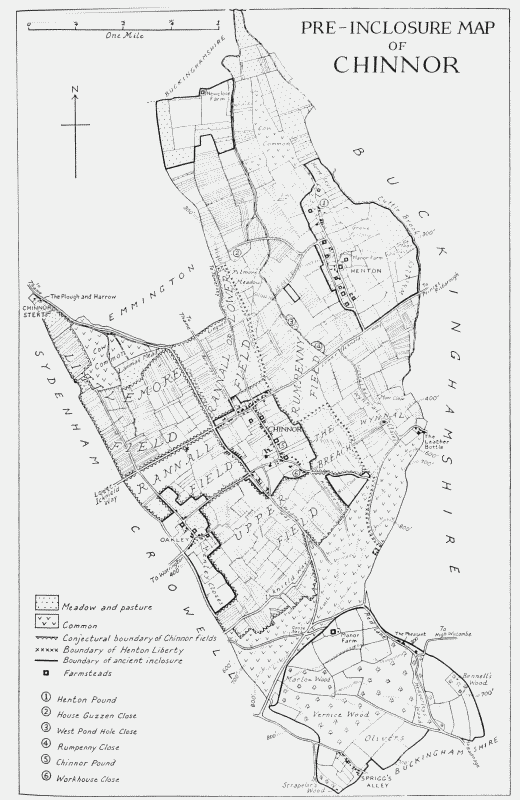
PRE-INCLOSURE MAP OF CHINNOR
The above map is based on the tithe award map (1841), the inclosure award map (1854), and land leases in the Oxfordshire Record Office.
Since Domesday the woodland on the Chilterns undoubtedly formed an important part of the economy of the parish. In 1086 a wood (5 x 3 furlongs) was recorded on the Chinnor estate, and at Henton there was a coppice (1 furlong square); woodland (48 a.) was also mentioned in the survey of 1279, (fn. 308) and medieval valuations of the Ferrers manor included underwood and rent for wood. (fn. 309) Moreover, names of woods such as Ash Hanger, occur frequently in the records. (fn. 310) Scattered references indicate the value set on the woodland; Andrew le Blount of Kingston in 1241 claimed in the king's court 6 cartloads of wood weekly from a wood in Chinnor; in about 1254 part of Maud of Chinnor's dower was 2 loads of firewood, (fn. 311) and in 1407–8 Kingston Manor was granted 3 cartloads of wood a week in the Chinnor Wood called 'Fernor', perhaps the later Vernice. (fn. 312) Inclosure of certain woods at the end of the 16th century by Sir George Fermor led to a dispute in 1623 with Sir John Dormer, the Fermors' successor. The tenants then objected to the inclosures although according to Sir John the majority of the tenants had been agreeable at a court of survey 30 years earlier. (fn. 313)
The inhabitants of Chinnor and the neighbouring village of Kingston Blount had rights of common in certain or perhaps in all the woods. The local word for this was 'hillwork'. As early as 1388 ⅓-rod of wood in 'le hilwerk' was conveyed. (fn. 314) and a lease of 1579 includes a grant of a 'lode of wood in the common of hylwarkes when it is felled'. (fn. 315) In the 18th century the word was still being used both for common rights and for the wood itself: (fn. 316) in a court of 1717 orders were laid down that no one was to 'cut or take away any of our common wood or hillwork belonging to Chinnor… except it be for repairing of the highways of Chinnor'; (fn. 317) in 1740, 1761, and 1817 there were again orders against 'cutting hillwork in our hillwork' during the spring. (fn. 318) The Revd. James Musgrave enjoined his tenant of Manor farm in 1777 to remember that 'the hillock is common to all and any person may cut wood therein, but it is chiefly understood to belong to the poor'. He thought it encouraged the poor not to 'meddle' in the other woods 'where they have not a right to set a foot'. (fn. 319) The safeguarding of his woods was, in fact, his chief preoccupation in his leases, and in 1777 the tenant had to promise to dismiss at once any farm manager 'who shall maim, steal or cut the wood'. (fn. 320)
Although Chinnor township's open fields remained intact until the 19th century, there was much early inclosure at Henton and Wainhill, on the hill and near the boundaries of the parish. The earliest evidence for inclosed land comes from the 15thcentury records of Henton: three closes called Astfeld (Eastfield), Vytle, and the Breach are mentioned in 1432, the Grove Closes in 1450, Grove Furlong Close in 1487, and the Great Close called Whyttleys in 1500. (fn. 321) Some of these can be located on the map as lying east of Henton where the old inclosures are marked, (fn. 322) and it is therefore likely that the whole of this 'old inclosed' land may have been already inclosed by the later 15th century.
The large 'New Close' (now New Close farm), containing 120 acres of pasture, was first recorded in 1481, when it was sold by Dame Elizabeth Botiller to Thomas Danvers. (fn. 323) Even today New Close land is marshy and this large inclosure on the northern boundary of Henton probably denotes the cultivation of the lord's waste. The depositions in about 1500 of two of the oldest men in Chinnor also point to there having been some other inclosure at this date. They said that they knew when the 'Moor' was taken out of the 'Great Close' called 'Whyttleys' and that 'Contyle Close' was also taken out of the 'Great Close'. (fn. 324) The closes on the western boundary of Oakley called Menley and listed as ancient inclosure in the award of 1854 may also date from this period or even earlier. The family after which they were named flourished in the 13th century. (fn. 325) How early the wood on the northern slopes and on the ridge was cleared is not known, but clearance is likely to have been going on at least by the 13th century. The earliest evidence comes from an extent of 1451, which states that Thomas Stephens, a tenant of the Ferrers manor, had a toft and land called 'Shayllor on the Hill', (fn. 326) and it may be that the land round the hamlet now called Sprigg's Alley was already cultivated in the 15th century. References to clearings in the wood are frequent in the 16th century. A lease of 1591, for example, mentions Hilltop, Bald Field, and Waterpit Closes on Chinnor Hill, and in 1600 the 8 yardlands of Overcourt's farm (the former Ferrers manor) included three parcels of land 'above the hill'. (fn. 327) Seventeenth-century leases record other arable closes in the extreme south of the parish. Goldsmith's close, for instance, was in the neighbourhood of Scrapelor's wood, (fn. 328) and it may be that the Goldsmith family were pioneers in the settlement of this part. (fn. 329) The Goldsmiths were leading free tenants of Henton manor in the 13th and 14th centuries, and in 1451 John Goldsmith was the only free tenant in Chinnor assigned to Elizabeth Ferrers as a part of her widow's third of the manor. (fn. 330) By the early 18th century 'Sprigg's Ally' was noted as a hamlet by Rawlinson and in the 1770s it had eight houses. (fn. 331) The first reference so far found to the place occurs in 1704, when it was called Alliver's Alley, presumably after the Oliver family which owned several adjoining closes, which can be located on the inclosure map. (fn. 332)
Little is known of the crops grown or the stock kept in the Middle Ages. Flax was evidently cultivated, since Flaxland is mentioned in a grant of c. 1225, and beans were grown. (fn. 333) Sheep played an important part in crop production. In 1334, for example, a ½-acre in Wainhill Field was leased for nine years on condition that it was manured with sheep every fallow year or ploughed in alternate years when it lay fallow. (fn. 334) Horses, judging from the field names, were an important part of the economy. Special pastures for them such as Horse Leys Mead are frequently mentioned in the charters. (fn. 335)
Although the division of one of the main fields into Rannal and Lower Field, and the existence of the Breach Field may denote that experiments in rotations were being conducted, it seems that a three-course rotation was generally practised until at least the 1770s. (fn. 336) The lord of the manor, the Revd. James Musgrave, insisted that his tenants at Manor farm on Chinnor Hill used 'the regular course of husbandry in Chiltern lands', i.e. wheat, gratten, or lent corn, then fallow, in a three-year rotation. They were not to cross-sow or cross-plough. By 1791 he was experimenting in rotations, for a lease of Manor farm (140 a.), which included Brown's, Bennell's, and Dormer's farms in 1799, said that the tenant should not take two crops of corn and grain in successive years without summer fallowing or planting the same with grass, sainfoin, clover seeds, or turnips. (fn. 337)
What little evidence there is for the 17th and 18th centuries indicates that crop yields were heavy. This was to be expected, as the richness of the soil, even on the hill, was frequently commented on: in 1699 a witness stated that lands in the common fields of Chinnor usually sold for 25 or 30 years' purchase, and that good lands sold for 40 years' purchase; (fn. 338) a few years later Rawlinson commented favourably on the 'short gravelly' nature of the soil; Richard Davis stated in 1793 that it was 'deep and good in the plain', and Arthur Young at the end of the century noted that the great number of flints found in the top soil on the high land, which to a stranger gave the appearance of miserably poor land, were in fact found in some of the very best dry loams. He described the land below the Chilterns as exceedingly good and yielding great crops of wheat. (fn. 339) What other evidence there is for the 17th and 18th centuries supports this account. The land was strong enough to grow wheat as its predominant crop and unusually large quantities of beans as well as barley, oats, and peas. In 1685 the rector had a barn each for wheat, barley, beans, and peas as well as for oats and hay, (fn. 340) and in the next century the accounts kept by the Revd. James Musgrave of his tithe receipts for the years 1755 to 1759 also give an idea of the relative amounts of each crop grown. The average annual receipts were 100 qrs. of wheat, 60 qrs, each of barley and beans, and 15 qrs. each of oats and peas. (fn. 341) Early in the 19th century Arthur Young remarked on the suitability of the hill slopes for turnips and sainfoin, which were much grown. (fn. 342)
Although sheep must have been commonly kept, as in the 19th century, little evidence of this has survived. It is known that in 1664 one capital messuage and an arable holding of 148 acres had common pasture for 13 beasts and 510 sheep, (fn. 343) and courts baron held in 1740 and 1761 laid down that no one was to pasture on the commons more than 25 sheep for each of his yardlands, or turn out sheep on certain fields until four days after the harvest had been carried. Musgrave received between 1756 and 1759 an average of 160 lb. of tithe wool a year from the leading farmers. (fn. 344) Richard Davis, writing in 1793, noted that the poorer soils on the hill slopes, consisting of a 'poor white manon, being a mixture of white earth and chalk', were largely used as sheep pasture. (fn. 345) Pig-keeping was probably also common practice: Musgrave's accounts contain numerous entries for foods for fattening hogs; the court records of this period frequently mention fines for unringed hogs on the common and lord's waste; and in 1817 Chinnor men were presented for erecting fourteen pig-sties there. (fn. 346)
The parish was remarkable in the 18th and early 19th century for its unusually large number of small farms and small-holdings, many of them owned by their occupiers, who were in many cases tradesmen. This was perhaps the result in part of the selling off of the land of Bulkeley's manor in the late 16th and early 17th century. (fn. 347) When Robert Dormer (d. 1689) was lord of Chinnor, the tenants were all said to be enfranchised. (fn. 348) In 1817 there were 48 quitrents paid to Chinnor manor, most of them being under a shilling and bringing in a total of only £2 12s. 1½d. (fn. 349) Twenty-four 40s. freeholders lived in the parish in 1754, but many owners of small freehold properties were absentees. (fn. 350) In 1786 in Chinnor village itself there were 24 owner-occupiers, 13 of them little more than cottagers and the rest having land assessed at under £5. Of the 28 other landowners only one, the rector and squire, James Musgrave, farmed any himself, and the four chief farmers in Chinnor were tenant-farmers. (fn. 351) With the growth of population small owner-occupiers increased in number: there were 40 in 1816, but by 1832 they were on the decline. There were then 38 landowners leasing small properties and only 2 fairly large tenant farmers. (fn. 352) An analysis of the 1841 tithe award confirms this picture: there were 38 people owning under 25 acres of land, and 45 with cottages, gardens, and orchards; and 5 who had 50 to 100 acres. The only substantial landowners were the rector, W. A. Musgrave, with 336 acres of land and wood, and Samuel Turner of Grays Inn with 381 acres of land and wood. (fn. 353)
At Henton the pattern of landholding was rather different. By 1786 the land was already divided into 8 medium-sized farms and 2 small holdings. By 1841 Magdalen College, owner of only a small property in 1786, owned 555 of Henton's 987 acres of agricultural land. (fn. 354) There were 7 tenant-farmers with from 50 to 200 acres each, one of them owning also 143 acres, and 14 small holders of which 13 held 15 acres and under. These men mostly already had land in Chinnor. (fn. 355) Magdalen's predominant position made inclosure comparatively easy to bring about and in 1846 the college was awarded 351 acres out of Henton's 735 acres of open arable. Four other allottees received a total of 311 acres and 12 smallholders were allotted up to 10 acres each. (fn. 356)
Inclosure at Chinnor came later. Attempts to inclose common land there had been made early in the century. Two persons were presented in 1761 and twelve at the court baron in 1817 for inclosing and all were ordered to throw the inclosures open. (fn. 357) A bill was obtained in 1847, but the award was not made until 1854. (fn. 358) The prime mover in the campaign for inclosure appears to have been Samuel Turner. He inherited an estate in Chinnor in 1830 and before 1854 he had purchased a number of other holdings in the parish. (fn. 359) The award gives the names of 28 persons who had recently sold their smallholdings of under 30 acres, and all but 7 of them had sold to Turner. He also bought while the award was being transacted three fair-sized farms totalling 283 acres. In addition, he had acquired 42 of the 64 Chinnor cow-commons and 13 of the 105 estovers. It is of interest that 21 persons with common rights, 9 of them landless, had disposed of their 36 estovers and 45 cow-commons before the award was made. Turner appears never to have lived in the parish and to have acted solely as a speculator in land values. (fn. 360) The other chief landowner, the Revd. William Musgrave, already had 121½ acres of ancient inclosure on the hill north of Sprigg's Alley and most of the rest of his estate consisted of 183 acres of wood.
By the award Turner was allotted 472 acres, three others, Ann and Charles Greenwood and the Revd. Edward Arnold, received 90, 60, and 56 acres respectively. Of the 49 other allottees 28 received between 1 acre and 21 acres each. In all 940 acres including 160 acres of common were inclosed. (fn. 361) The meadow and the cow-commons were all allotted, but the hill common and the green at Henton remained uninclosed. Common rights, 105 estovers, in the woodland were extinguished and land was allotted in compensation. (fn. 362)
Inclosure undoubtedly encouraged the amalgamation of holdings and by 1873 Samuel Turner held 700 acres as well as many cottages. (fn. 363) But enough small farmers remained to make the small holding a distinctive feature of Chinnor's economy as compared with surrounding villages, even into the 20th century. In 1890 there were 16 small holdings under 5 acres and another 10 under 50 acres in the parish. (fn. 364) The break-up of the larger estates brought further changes: in 1925 the largest farm was 386 acres in Oakley and Chinnor; there were three other farms of 90 to 140 acres, and 18 small holdings of 50 acres and under. (fn. 365) In 1939 of 8 farmers listed in Chinnor and Oakley only 2 had farms over 150 acres. (fn. 366) At Henton the 19th-century pattern of landholding remained intact. Magdalen College, which had 7 farms of 100 to 200 acres in 1925, (fn. 367) sold New Close farm in 1952 to the tenant and the rest of its farms in 1953, mostly to the tenants. (fn. 368)
Inclosure made no striking change in the use of the land. There was a reduction of waste and common from 6.1 per cent. to 2.4 per cent., but the traditional devotion of the area to the production of corn, sheep, and cattle continued, although the emphasis on arable farming, except on Turner's farms, was slightly decreased. (fn. 369) Towards the end of the century both arable farming and sheep breeding began to give way to cattle rearing and the production of milk. (fn. 370) This trend continued in the 20th century in between the wars, but after the end of the Second World War beef production was encouraged by the government. (fn. 371)
Watercress was cultivated in the Henton and Chinnor brooks as early as 1897 at least, and this sideline has been greatly developed in the 20th century. (fn. 372)
Although the main industry of the parish has always been farming its comparatively large population has meant that there were always many craftsmen. There is little direct medieval evidence about them. A family of prominent free tenants in the 13th century was named Goldsmith and may have followed that craft; (fn. 373) the name of an early-13th-century vintner in Henton and those of two 14th-century tailors have been preserved; (fn. 374) and there were millers in the parish from early times. (fn. 375) In the 17th century a painter, William Goldfinch, was important enough to have a trade-token. (fn. 376) In the 18th century there is record of a tallow-dealer, a lace-merchant, a mercer, and at the turn of the century of a gingerbread-baker, whose son later set up in London. (fn. 377) Women, as in the neighbouring Buckinghamshire villages, were largely engaged in lacemaking. There were three schools in Chinnor where the craft was taught (fn. 378) and by the mid-19th century it had become an organized home-industry. A lace-feast was held every fortnight and was attended by lacemakers from the adjoining villages and by purchasers from different parts of the country. (fn. 379) The full importance of Chinnor's crafts and industries is first revealed by the 1851 census; it enumerates 101 men engaged in trade in Chinnor itself as against 141 engaged in agriculture. (fn. 380) At Oakley occupations were almost equally divided, 19 being employed in trade and 18 in agriculture. At Henton, on the other hand, 57 out of 62 were on the land. Professional people included a lawyer and 6 schoolmasters and schoolmistresses. There were 24 blacksmiths, shoemakers, cordwainers, tailors, and carpenters in the parish, 8 carriers, 5 bricklayers, 4 each of wheelwrights, butchers, bakers, and grocers, 2 millers, 2 saddlers, 2 straw-bonnet makers, a handweaver, a basket-maker, a plumber, a painter, and a watchmaker. There were 3 general dealers as well as a tea-dealer, a lace-dealer, a wood-dealer, a corn-dealer, a victualler, a draper, and a road contractor. Apart from lacemaking, which was mainly a part-time occupation, Chinnor's most important craft at this time was chair-turning: 43 men were engaged in it, and the craft gave its name to a public house, the 'Chairmakers' Arms'. (fn. 381) High Wycombe was the centre of the industry and Chinnor's products were taken there by carrier in the 19th century. Mass production, however, and the cost of transport later ruined the trade. No legturners were left in Chinnor by 1957. (fn. 382) Besides its beech wood, which was the raw material of the chairmaker, Chinnor had other products used in local industries. The fine straw grown in the plain attracted the hatmakers from Luton. Straw-drawers lodged in Chinnor for several days a year to select the best straw for this purpose; it is recorded that in 1854 they paid £8 to £10 a ton for it. (fn. 383) Local wheat and barley were naturally used by the millers and maltsters, but these men have left singularly little record. In 1828 and later Benjamin Britnell was working the windmill, which still (1958) exists to the west of the village; and in 1851 2 millers were recorded in the census. (fn. 384) By 1841 there were 5 publicans and 8 beer-retailers, but perhaps none of these brewed. There were 7 publicans and 10 retailers in 1864 and in 1957 there were 7 publicans. (fn. 385)
Towards the end of the 19th century businesses were opened which provided a comparatively large amount of non-agricultural employment. Spencer Jackson, engineer and iron and brass founder, was operating before 1887, (fn. 386) and Siareys, builders and contractors, by 1903. This last firm was still thriving in 1957. (fn. 387) A jam factory had been established by 1920. (fn. 388) Modern technical developments led to new enterprises such as the three motor-engineering works and an electrical engineer's shop. Another business, S. T. Good & Co., joiners, was established by 1939, (fn. 389) but the most important industrial undertaking in the parish has been the Chinnor Cement and Lime Co. Ltd. It was founded by W. E. Benton in 1908, became a public company in 1936, and in 1949 a parent company, Chinnor Industries Ltd., with three subsidiary companies. In 1957 it employed about 160 men, but the works were being extended with the object of doubling its capacity and bringing it to a still higher degree of efficiency. Its market was a comparatively localized one, the majority of its customers being in the seven counties which were closest to the works. (fn. 390)
These businesses have been largely responsible for the rise in Chinnor's population in recent times. An analysis of the registers indicates that a definite increase had begun as early as the second half of the 17th century, and the 262 adults recorded in the Compton Census of 1676 suggest that Chinnor may already have been an overpopulated parish and so suffering from a scarcity of land. (fn. 391) On the other hand, for the 1662 hearth tax only 42 householders were listed for Chinnor and 16 for Henton, a total of 58, and in 1665 this figure had dropped to 32 including 2 discharged on grounds of poverty in Chinnor and 12 in Henton. (fn. 392) It is difficult to reconcile these figures with those of the Compton Census unless either tax evasion on a large scale, perhaps because of real inability to meet the tax, or the existence of many householders who were so poor that they did not come within the scope of the tax, is postulated. Both conditions, of course, may have been present. The 18th-century returns by the rectors record a great increase in the number of houses and families: there were said to be 80 in 1738 and 160 in 1768. (fn. 393) The first figure, owing to the scattered nature of the settlements in the parish, is probably inaccurate, but unusually careful returns were made by James Musgrave. He noted in his account book (1751–9) that there were 159 families: 94 at Chinnor, 22 at Henton, 18 at Oakley, 6 at Wainhill, and 19 'upon the Hill', at Redland End, Sunley Bank, and Sprigg's Alley. (fn. 394) In 1771 he reported a further increase to 174, of which 111 were at Chinnor. His figures for the outlying houses on the ridge seem incomplete: he specifies 6 'upon the hill' and 8 at Sprigg's Alley, a total of 14 and omits Redland End and Sunley Bank mentioned in his previous estimate. (fn. 395) By 1801 the official census figure was 862. (fn. 396)
The parish experienced the usual 19th-century rapid increase: population rose from 862 in 1801 to 1,308 in 1841, and the rise is reflected in an increase in house-building. (fn. 397) There was a temporary drop in the next decade, for which the outbreak of pestilential fever in 1840 to 1841 was in part responsible. After the peak figure of 1,379 had been reached in 1871 there was a fall to 1,002 but the addition of Emmington to the parish caused an increase to 1,162 in 1931, and numbers have been rising since. At the last census of 1951 there were 1,467 persons. (fn. 398)
Parish Government.
In the absence of parish records little can be said about this subject. Manorial courts met down to the 18th century, though infrequently; in 1740 and 1761, for example, only two meetings were recorded. (fn. 399)
Some miscellaneous information has survived which illustrates the growing problem of poor relief. The rectors in their visitation returns occasionally made definite reference to poverty and overcrowding: from 1759 to 1811 they reported fewer houses than families. (fn. 400) Houses were consequently divided into tenements or cottages, and several people, contrary to the regulations of the manor, built 'hovels' on the waste. (fn. 401) The poor rate rose rapidly after 1756: the rector's contribution for a half-year in 1756 was £13 6s. 2d.; in 1759 it was £18 10s. 6d. (fn. 402) The high cost of poor relief and the increasing population perhaps accounted for some decrease in private charity: Charles Huggins had given 60 poor people a sixpenny loaf every St. Thomas's Day, but Musgrave ceased to do so. The old custom, however, that every poor family could have a sheaf of wheat at the harvest if it asked the tithingman for it on the field was allowed to go on. (fn. 403) A petition, signed by the rector (1750–78), the parish officers, and 13 leading husbandmen, asking that the licence of the Chequers alehouse should not be renewed illustrates another aspect of the problem: it stated not only that the house was one of illfame, but that it served the purpose of introducing strangers to the parish; the strangers were charged such exorbitant rents that they were likely to become a burden on the rates; and parish rates were so enlarged that unless they were reduced 'many industrious and regular husbandmen with large families must necessarily sink under their weight'. The 'multitude' of existing alehouses was in any case 'a check to industry and good order'. (fn. 404) By 1776 the problem of the poor had become all-important. The parish spent £461 on relief in that year-double the sum paid by Aston Rowant. In the following years the Chinnor poor rate continued abnormally high. (fn. 405) Arthur Young gave the country average rate as 4s. to 4s. 6d. in the £, round about 1800, while the Chinnor rate was normally 7s. to 9s. and reached as high as 12s. to 14s. (fn. 406) In 1803 there were 63 'poor' adults and 57 'poor' children in the parish. (fn. 407) It was also reported that 54 children were learning lacemaking and sewing, (fn. 408) the first always an indication of poverty as their labour was exploited to supplement the family's earnings. Low agricultural wages and unemployment accounted for the continuance of the industry though on a decreasing scale into the 20th century. Labourers' wives and 86 children were among the 268 lacemakers recorded in 1851. (fn. 409)
Churches.
Besides the mother church of Chinnor the parish had a private chapel dedicated to St. James at Henton from at least the early 13th century until the end of the Middle Ages. (fn. 410)
The earliest documentary evidence for the parish church is the record in about 1160 of a priest named Robert, (fn. 411) and of another called Master Adam de Chinnor who was apparently his successor. (fn. 412) It is uncertain who was patron at this time. In a suit in the king's court in 1235 about the right to present a new parson it was claimed by Roger de Quincy, then lord of the manor, that a former lord, Walter de Vernon (fl. 1155), had been patron. On the other hand one Simon de Chinnor said his ancestor Adam de Chinnor, uncle of Adam the parson, had presented, while the Prior of Wallingford claimed that his predecessor Prior Sampson had done so. It appears that Simon's family may once have had the patronage for the prior produced a grant from Simon in which he recognized the prior's right, but Simon said he made it under duress in war-time and had omitted to make any complaint about it in peacetime. However, the jury decided in favour of Wallingford Priory, although it said that there was no great certainty about the matter as the parson had held the living 'for a hundred years'. (fn. 413) The case is still further complicated by the fact that Bishop Hugh de Welles collated in about 1219 'on the authority of the Council'. (fn. 414)
In 1235 the king presented because of a vacancy at St. Alban's Abbey, of which Wallingford was a cell, but agreed that in future the priory should be allowed to present even when the abbey was vacant. (fn. 415) The priory successfully maintained its claim later in the century (fn. 416) and thereafter always presented, so far as is known, until 1450, when it granted the presentation to John Goldsmith of Chinnor. (fn. 417) Later, in 1479, the right to present was granted to Sir Edmund Rede of Boarstall, who presented his son Thomas. (fn. 418) Perhaps it was worth more to the priory to sell the presentation than to appropriate the church, for although in 1445 royal permission to appropriate was given, so that the priory might increase its numbers, the priory never did so. (fn. 419)
After the dissolution of Wallingford the advowson of Chinnor was granted in 1528, with the rest of the priory's possessions, to Cardinal Wolsey for his Oxford college. (fn. 420) On Wolsey's fall the advowson reverted to the Crown and in 1544 was granted to Richard Fermor, the lord of the manor. (fn. 421) The Crown's right to grant the advowson was disputed in 1545, when John Fermor presented, on the grounds that Wallingford had sold the presentation before its dissolution. (fn. 422) The Fermors, however, established their right, but sold the next presentation to William Wynlowe, who presented in 1560. (fn. 423) Wynlowe probably also presented in 1586, when Richard Wynlowe, no doubt a relative, became rector. (fn. 424) The Fermors sold the advowson with the manor to Sir John Dormer in 1607 and he sold it in 1621 without the manor for £500 to Nathaniel Giles, a future rector, and his wife Ann. (fn. 425) Giles left it by his will of 1654 to his second wife Elizabeth, who in 1657 sold it to Richard Braham of New Windsor for £200. (fn. 426) In 1659 Braham sold it to the rector Henry Edes, whom he had just presented to the living. (fn. 427) Shortly afterwards, in 1662, Edes presented William Paul, but Paul became Bishop of Oxford in the same year. (fn. 428) He was allowed to hold Chinnor as well, but his promotion seems to have given rise to the Crown's claim to presentation on his death in 1665, for presentation to cures void by promotion belonged to the Crown. (fn. 429) Edes disputed the claim, but seems to have lost his turn and the Crown presented the next Bishop of Oxford, Walter Blandford. (fn. 430) After presenting once again in 1668 Edes sold the advowson in 1671 for £612 to the then rector Stephen Jay. (fn. 431) In 1688 Jay offered to sell the living and advowson to the Bishop of Oxford in exchange for a London living, the advowson of Cuddesdon, and an Eton fellowship for his son. (fn. 432) It was alleged that another condition was Jay's promotion to the bishopric. (fn. 433) Although the exchange was never made, the proposals well illustrate the value of the Chinnor living, estimated to be worth £300 a year, with its large rectory house, which had cost £2,000 or £2,500 to build. (fn. 434) The advowson descended to Jay's son Charles, who became rector in 1691 on the presentation of Richard Thompson, clerk. (fn. 435) It would appear that this must have been done by arrangement, it being illegal for Charles Jay to present himself. In 1692 Jay married Elizabeth, daughter of William Nelson of Chaddleworth (Berks.), and made a settlement of the rectory. He reserved the next turn in the patronage to his widowed mother-in-law, Dorothy Nelson, and arranged for trustees to sell the advowson for the benefit of his wife. (fn. 436) On Jay's death in 1698 Dorothy Nelson presented to the rectory John Pocock, one of the parties to the settlement. (fn. 437) The presentation appears to have been irregular, for Pocock was temporarily deprived for simony, and in 1707 replaced by Samuel Dunster, on a royal presentation. (fn. 438)
In 1718 the advowson was sold by Jay's widow Elizabeth and her second husband Edward Thorneycroft, a London goldsmith, after a Chancery suit in which Thorneycroft, from whom she had separated, claimed that his marriage had given him the right to the proceeds of the sale of the advowson. (fn. 439) The purchaser, Robert Gardner, sold it again for £2,000 to John Huggins, Keeper of the Fleet prison, and Christopher Tilson. (fn. 440) On Huggins's death the advowson passed to his brother William, who about this time became lord of the manor. (fn. 441) Since then the advowson has descended with the manor, except for a short period after the death of Sir James Musgrave in 1814, when the advowson passed to his elder son, Sir James, (fn. 442) and the manor went to the younger, William Augustus. The last, however, eventually became his brother's heir.
Chinnor in the Middle Ages was a well-endowed rectory, valued at £10 13s. 4d. in 1254, and at £13 6s. 8d, in 1291, together with two pensions. (fn. 443) In 1535 its value had risen to £260s. 4½d. net. (fn. 444) The living remained a rich one after the Reformation. By the second half of the 17th century it was leased for about £300 a year and by the early 18th century, when the rector was collecting his own tithes, it was said to be worth over £500. (fn. 445) In 1811 its net value, after the curate's stipend had been paid, was £596, and in 1831, when it was valued at £509, it was the richest living in Aston deanery. (fn. 446) In 1844, when the tithes were commuted, the rector was given a rent charge of £707 6s. (fn. 447)
For such a large parish the glebe was unusually small. In 1635 it consisted of 10 strips in the three open fields, and in 1685 of 8 strips, together with 13 acres of pasture and meadow. (fn. 448) This was much the same as the 16 acres, partly in Chinnor and partly in Henton, which the rector held in 1844. (fn. 449) In 1939 the rector still had II acres of glebe. (fn. 450)
The rector received most of the tithes from his large parish, but in about 1087 Miles Crispin, the lord of Henton, gave part of the tithes on his Henton demesne to the abbey of Bec. (fn. 451) In the late 13th century, when these tithes were valued at 13s. 4d., they were being collected by the keeper of Bec's Bledlow manor (Bucks.). (fn. 452) When Bec lost its English possessions in the early 15th century, some of them, including the tithes from Chinnor, were granted to the Duke of Bedford, who held them at his death in 1435. (fn. 453) They were granted to Windsor College, which continued to collect them. They were known as 'Beckharlewins', 'Beckharvest', or 'Berkharvest' tithes, and in 1844 were commuted for a tithe rent charge of £50, (fn. 454) Windsor also acquired in 1532 (fn. 455) a pension, which had been paid throughout the Middle Ages to the Prior of Wallingford, (fn. 456) an arrangement which probably began when Wallingford became the patron. The pension was originally 7s. but had been increased to 9s. by 1535. (fn. 457)
It was not until 1240 that the Rector of Chinnor was granted the remaining demesne tithes of Henton. Aumary de Sulham gave these to the rector, William de London, in return for certain concessions to his chaplain. (fn. 458) In the late 17th century the parish was divided for the payment of tithes into three districts or tithings, Chinnor, Oakley, and Henton, but at the time the tithes were commuted there were only two tithings, Chinnor and Henton. (fn. 459)
Because of its wealth Chinnor had a number of distinguished medieval rectors of whom many, particularly in the 14th century, were graduates. Master Adam de Chinnor, for instance, who became rector in the late 12th century, (fn. 460) was a man of property with land in the parish and in Oxford. He was related to the De Chinnors of Henton. (fn. 461) In his later years he served as official to the Archdeacon of Oxford. (fn. 462) Some later rectors were non-resident, especially those in the royal service, like William de London, the queen's chaplain (1235–c. 1283), who was presented by the king and was allowed to have a vicar in the parish, (fn. 463) and William de Leicester (1314–c. 1338), who was 'always attendant in the king's service'. (fn. 464) It may be noted here that William de London's influential position probably helped in the new arrangement, which was made over the tithes of Henton and the position of the chapel at Henton. Aumary de Sulham, lord of Henton, agreed that the tithes of his demesne should be paid to Chinnor in future, and that the chaplain of his chapel should agree before admission not to administer the sacraments to any of the Henton tenants. In return, the rector permitted him to take the offerings from Aumary's family, his guests, and his free servants and to retain the land which he had for his support. Aumary's serfs and cottagers, on the other hand, were to attend at Chinnor with their offerings. (fn. 465) It seems that what had begun as a private chapel was being turned into a public one and that this agreement successfully safeguarded the rights of the Rector of Chinnor. At the archiepiscopal visitation of 1320 the Henton chapel was treated as the private oratory of the lord, and was exempted from visitation. (fn. 466) The building had recently been put in order, for in 1308, probably when the Malyns family came to Henton, twenty days' indulgence was granted to those helping in its repair. (fn. 467) The important position held by William de Leicester was also reflected in the parish, for it was his wealth which enabled him to build the 14th-century chancel of the church. William's successor, an even more influential man, was resident for a part of the year and for the rest was within easy riding distance of his parish. He was Master John de Hotham, Provost of The Queen's College and Chancellor of Oxford University. (fn. 468) It is significant that he chose to be buried in his parish church where his brass still is. A 15th-century successor, Master Thomas Nash, may have been nonresident for at least part of the year, as in 1437 he was given permission to hold a second benefice, (fn. 469) and in the first half of the 16th century Master John Incent (1520–45), though later distinguished as Dean of St. Paul's and an educationalist, appears to have been both non-resident and neglectful. (fn. 470) It was reported in his time that the rectory was farmed to a layman, no distributions were made to the poor, and the ceiling over the altar was in a ruinous state. (fn. 471)
After the Reformation residence was generally the rule and the rectors were men of wealth and some social standing, who often also held the advowson and on two occasions were bishops of Oxford. Nathaniel Giles (rector 1628–44), for instance, was the son of the composer and organist at Windsor chapel and was himself a Canon of Windsor. (fn. 472) The state he kept at Chinnor may be illustrated by the great size of the new Rectory he built there, with the help of his friend the parliamentarian John Hampden. (fn. 473) The 'banqueting house' which formed a part of it may have been used for the Easter Monday entertainments which the rectors were accustomed to give to all their parishioners. (fn. 474) The Civil War brought to an end Giles's life at Chinnor. In 1643, according to Sir Samuel Luke, he joined the king's forces and in 1644 he was sequestered from his living by the parliamentary visitors. (fn. 475) His rectory house was 'impaired and defaced', and robbed of its lead by the parliamentary soldiers. (fn. 476) Men more in sympathy with Puritan ideas were instituted to the living. One, whose name is unknown but who may have been Henry Edes, (fn. 477) was a friend of Thomas Ellwood, the Quaker of Crowell. Ellwood relates how, though he found Quakers hard to understand, he 'civilly abstained from casting any unhandsome reflections on them', (fn. 478) After the Restoration, William Paul, another strong royalist, who had been chaplain to Charles I and had been deprived of his livings, was instituted to Chinnor, and after becoming Bishop of Oxford (fn. 479) was allowed to retain Chinnor and his other rectory at the neighbouring Brightwell Baldwin in commendam, so as to assist him in the repair of Cuddesdon Palace, which had been severely damaged during the Civil War. (fn. 480) Paul had a curate at Chinnor and spent £100 on repairing the Rectory. (fn. 481) The curate, who returned four hearths for the hearth tax in 1665, was probably living in a part of it. (fn. 482)
When Stephen Jay became rector in 1668 the village once more had a resident parson. He found the Rectory in a dilapidated state and evidently spent a good deal of money on its repair. (fn. 483) Jay was followed as rector by his son Charles (1690–8), and in the earlier 18th century Charles Huggins (1728–50), son of the Keeper of the Fleet prison, was resident for a long period. (fn. 484) These men, however, perhaps because of their wealth and social status, were unsuccessful in combating the nonconformity which had been strong in the district from early in the 17th century. (fn. 485) Jay's interests, moreover, seem to have lain more in fighting popery in the country at large than in checking the growth of the sectarians at Chinnor, for he wrote a pamphlet in defence of Shaftesbury's policy. (fn. 486) Thus in 1738, when Huggins reported to the bishop, he had to admit that though great numbers came to the Sacrament which he administered five times a year, no candidates had presented themselves for confirmation in his large parish. (fn. 487) In fact, Methodism had transformed the religious life of the village and by 1759, when James Musgrave (1750–78), son-in-law of the patron and also lord of the manor, was rector, a third of the parish attended Methodist meetings. (fn. 488) The rector attributed the increasing dissent to 'love of novelty'. It certainly does not appear to have been due to gross neglect on his part, (fn. 489) for he held two services with sermons on Sunday in order 'to render inexcusable all dissenters and absenters from the church'; he had prayers on all holy days and in Passion Week; and administered the Sacrament six times a year. (fn. 490) Nevertheless, he could only report a small number of communicants, between 30 and 70 in 1771 and as few as 20 in 1774. (fn. 491) He attributed absence from church to 'a bad example set by the higher rank of people' and to 'irreligion among all ranks'. (fn. 492) The fact that he only catechized twice a year and had abandoned the old practice of entertaining his parishioners on Easter Monday at the Rectory may have been contributory factors. When he became rector it was still customary for the parishioners on this occasion to be given bread made from 3 bushels of wheat, ¾ cwt. of cheese, ale brewed from a sack of malt, and half a gross of pipes and a pound of tobacco, the share of the farmers and young men being in the proportion of three to five to that of the women and poor men. Dr. Musgrave transferred the feast to the 'Crown' and distributed a double quantity of liquor in compensation, but by so doing he broke the personal link with his parishioners. (fn. 493)
His successor, William Friend (1778–1804), left the care of his 'populous parish' for at least ten years to the curate of Crowell, to whom he paid £40, and refused to reside on account of his 'other avocations'. (fn. 494) Throughout most of the 19th century the spiritual care of the parish continued to be neglected. The patrons, the Musgraves, appointed members of their own family, who mostly proved indifferent pastors. (fn. 495) Typical of the times was the request in 1809 to the bishop that the rector might be permitted to be non-resident as he was holding the living for the patron's second son who was still at Christ Church. (fn. 496) Typical, too, was the expenditure by the patron of £2,600 on rebuilding the parsonage. (fn. 497) The long incumbency of William Augustus Musgrave (1816–75) was little short of disastrous. He succeeded to the baronetcy and the manor, and was more of a landed gentleman than a parish priest. (fn. 498) Indeed, Bishop Wilberforce declared that he was 'wholly irreligious' and attributed the evil state of the church to his inactivity: even on Sundays he worked in his garden and on his farm. (fn. 499) The parishioners complained of spiritual neglect and Wilberforce obliged him to employ a curate. In 1854 the latter reported that he was holding two services with sermons on Sundays, was holding a monthly celebration of the Sacrament, and was catechizing the children weekly. Even so congregations remained very small, 90 in the morning and 200 in the afternoon compared with the 700 of the dissenters. (fn. 500) When Wilberforce visited the church in 1855 he found it 'sadly empty', though the congregation was larger than usual. (fn. 501)
The arrival of the able Francis Buttanshaw as curate in 1855 brought about a change, and the restoration of the church building was undertaken in 1863 under his inspiration, despite the fact that the church was 'poor and dissenting' and the church rate was constantly opposed. (fn. 502) On Musgrave's death in 1875 the energetic and popular E. J. Howman became rector. He improved the church building still further, enlarged the school, and erected a readingroom. (fn. 503) At Hempton Wainhill and Sprigg's Alley two mission rooms were built in 1886 and 1889. (fn. 504) He was a man of means and was generous to the poor.
The church of ST. ANDREW is a large building of flint with stone dressings comprising a chancel, nave, north and south aisles, south porch and western tower. (fn. 505) Although the present structure appears externally to be of the 14th century, there are in fact considerable remains of an earlier church. It is evident that the nave was rebuilt early in the 13th century, for its north and south arcades have cylindrical columns and bases of that period. The mouldings of the arches of the northern arcade are, however, earlier in character than those on the south side. Whether or not there was a west tower in the early 13th century is difficult to determine, as the existing tower appears to have been begun towards the end of the century. Its west window dates from that period, and straight joints in its west wall show that it was built before the aisles assumed their present form.
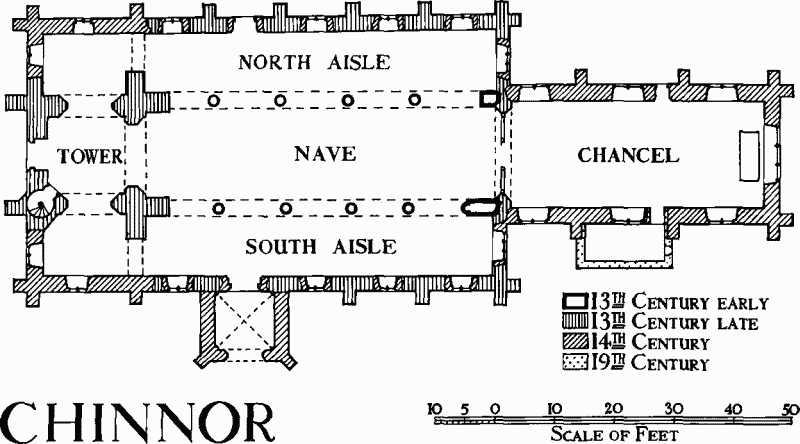
CHINNOR
Early in the 14th century the whole church was enlarged and remodelled in the style of the period. The chancel was entirely rebuilt and furnished with a piscina and triple sedilia; the aisles were widened and rewindowed; the tower was heightened; and a vaulted south porch was added. The recorded dedication of the high altar and chancel in 1326 probably marks the completion of the work. (fn. 506) It was probably some time later in the century that a clerestory was formed over the nave and a lowpitched roof with parapets took the place of the highpitched 13th-century roof whose weathering on the east face of the tower can be seen in Buckler's view of 1822. (fn. 507)
No further structural changes appear to have taken place until the 17th century, when the roof of the chancel was lowered. The inscription '1633 Natha. Gy Pastor et Patronus' was carved on one of the beams. (fn. 508) The nave roof was renewed in 1658–9, when a special rate was raised for the purpose. (fn. 509) In the next century growing population led to the erection of a gallery in the tower arch in 1729. (fn. 510) Compared with many neighbouring churches the building seems to have been in fairly good order in 1759, for only minor repairs were ordered by the archdeacon. (fn. 511) The north door was to be mended, the belfry door renewed or thoroughly repaired, the floor was to be levelled, and the seats repaired. Some minor repairs were carried out in the south aisle in 1809, in the chancel in 1832, and in the north aisle in 1854, (fn. 512) but in general the fabric was neglected until 1863. The cumulative effect of this neglect was described by the curate, Francis Buttanshaw, in a detailed account of the state of the fabric before the restoration of 1863. (fn. 513) The exterior was covered with rough-cast, rubble blocked several windows; parts of the tower were repaired with red brick; a slightly embattled brick parapet surrounded the top of the tower, the chancel, and the aisles; the stone mullions of the clerestory windows on the south side had been replaced by wooden frames. The appearance of the inside of the church was spoilt as the upper parts of the east window and the chancel arch were cut off by the flat ceilings. The labels of many windows were mutilated; the pews were in 'every degree of dirt and dilapidation'; pillars and arches were thickly white washed and the walls decorated with painted texts. Some years later the church was reported to have been for the last twenty years in worse repair than any in the diocese.
In 1858 the rector, the Revd. Sir William Musgrave, agreed to pay for the proposed repairs to the chancel, having long refused to do so, (fn. 514) and funds were obtained for a general restoration from the principal landowners, (fn. 515) and from the Diocesan Building Society. The architect was E. Banks of Wolverhampton, but his plans were modified by G. E. Street and J. H. Parker. (fn. 516) The builder was Cooper of Aylesbury. Work was begun in 1863 and was completed in 1866 at a total cost of £3,000. (fn. 517) It included enlarging and raising the level of the chancel above that of the nave and restoring the high-pitched roof of the nave. The chancel was relaid with Minton tiles and new stalls were erected. The body of the church was reseated, and such medieval tiles as were not too worn were assembled and relaid. They can now be seen in the nave. The ancient painted glass was so skilfully restored by Clayton & Bell that it is difficult to tell what is medieval and what is 19thcentury. A new east window of painted glass by Clayton & Bell was inserted at the expense of J. S. Turner and the Revd. Sir William Musgrave. The 14th-century font and the oak-panelled pulpit and sounding board were replaced by a new font and pulpit of Caen stone. The 18th-century oil paintings of Christ, the four Evangelists, and the Disciples, that adorned the chancel, were cleaned and rebacked and removed to the nave. These were said at the end of the 19th century to be the work of Sir John Thornhill, (fn. 518) and may have been presented by James Musgrave.
The chancel was refurnished. The altar cloth by Jones & Willis, and other furniture for the sanctuary were the gifts of the rector and several friends of the church. (fn. 519) An organ seems to have been installed about 1859 and was not replaced until 1909. (fn. 520) Two years later oak panelling, designed by H. Read of Exeter, was installed in the chancel at the cost of Miss Howman in memory of her father, late rector. (fn. 521) In the north and south aisles windows of painted glass by William Aiken have been erected to Leonard Baldwyn (rector 1902–34); to W. E. Benton (d. 1940); to three airmen killed in 1941; to Capt. C. G. P. Cuthbert, killed in Tunisia, 1943, and to Elizabeth Anne Benton (d. 1947).
In 1930 a faculty was obtained to fit up the side chapel of the south aisle; between 1934 and 1937 a new vestry and choir stalls were installed at the expense of W. E. Benton, and the 14th-century font was dug up and restored to the church. (fn. 522) In 1940 a clock was placed in the tower. (fn. 523) In 1951 and again in 1957 extensive repairs to the woodwork were carried out after the ravages of the death-watch beetle. In 1957 the walls were also lime-washed and much of the 19th-century pitch-pine furniture was removed. (fn. 524)
The church is notable for the early-14th-century rood-screen which separates the chancel from the nave. It is pierced with Geometrical tracery springing from turned wooden shafts on moulded bases. Though it has lost its loft, and was reduced in height in 1866, it retains its original wrought-iron hinges. (fn. 525) A piscina in the wall of the nave on the south side of the screen probably marks the position of a former altar beneath the rood-loft. In 1660 the Restoration was marked by the erection above the chancel screen of the royal arms of Charles II, painted by William Goldfinch of Chinnor for £2 15s.; and of a partition to separate the chancel from the nave. (fn. 526) The screen was made by a local carpenter and was no doubt the 'Jacobean' one that was removed in 1863. In 1661 the communion table was provided with a carpet at a cost of £3 17s. (fn. 527) The carved Jacobean panelling, apparently brought from some demolished house, which was in the church in 1874, may also have been installed at this time. (fn. 528) Some early-15th-century glass survives in the chancel. At some time it had been used to glaze the east window, but in 1866 it was replaced in the north and south windows to which it evidently belonged. It includes figures of St. Laurence, St. Alban, a bishop, and an archbishop. The east window of the north aisle contains fragments of medieval glass depicting Christ in Majesty and two angels censing. (fn. 529) Some heraldic glass, including the arms of Zouche, Sapey, and Malyns, was seen by Anthony Wood in the 17th century. (fn. 530) Only the shield of Zouche remains. (fn. 531)
There is one medieval monument, the recumbent effigy of a cross-legged knight, clad in mail and jupon, and dating from about 1270. It stood originally at the west end of the south aisle, but is now at the east end of the aisle. (fn. 532)
There are some medieval brasses which were removed from their slabs in 1866 and subsequently fixed to the walls of the chancel. The earliest bears the head of a priest within a foliated cross; it commemorates William de Leicester (rector 1314–c. 1338), who rebuilt the chancel. Others are to two rectors, Master John de Hotham (d. 1351), represented in academic dress, and Alexander Chelseye (d. 1388). All were originally laid in the chancel. At the east end of the nave were the late-14th-century brasses of the Malyns family: effigies of Reynald de Malyns (undated) in armour, and his two wives; demi-effigies of Sir Esmond de Malyns (undated) and his wife Isabel; an inscription to Adam Ramsey (c. 1400), the second husband of Isabel de Malyns; and the figure in armour with arms to John Cray (d. 1392), esquire to Richard II, who was perhaps related. There are 15th-century brasses to Robert atte Heelde and his wife Katherine; to their son Nicholas atte Heelde; and a third to Reynald Malyns (d. 1430/1). There is also an inscription, now undated, to John Cristemas (c. 1400). (fn. 533) There is one 16th-century brass to Folke Poffe (d. 1514) and one of his wives, which was moved from the vestry in 1935. (fn. 534) A wall tablet to William Turner (d. 1797) is the only post-Reformation memorial before the end of the 19th century apart from a number of ledger stones. Later brasses are to Henry Douglas (d. 1899), churchwarden, and his wife Ann; to Lt. Donald Coker Beck (killed 1916); and to Gunner G. T. North (killed 1917).
Both the chancel and the nave were once paved with medieval figured tiles. Many of these were destroyed at the restoration of 1863, but some were relaid. (fn. 535) Others of late-15th-century date were discovered in the nave in 1957.
Only one silver chalice, four bells, and a sanctus bell were recorded in 1558. (fn. 536) A large silver paten, dated 1761, and engraved with the arms of Musgrave and Huggins, was later given by the rector James Musgrave and his wife, a daughter of a former lord of the manor, William Huggins. (fn. 537) In 1958 there was a ring of six bells and a sanctus bell. Two of these were recast in 1864 from the former tenor bell of 1651; the present tenor is a comparatively rare specimen of the work of William Knight of about 1586; and three others, dated 1620, 1635, and 1663, were made by other members of the Knight family. (fn. 538)
The registers begin in 1581 for baptisms (with a gap 1609–21) and in 1622 for marriages and burials. (fn. 539) There are some 17th-century churchwardens' accounts.
Roman Catholicism.
In the late 16th and early 17th centuries the Harper family was outstanding for its recusancy, four women members being returned as recusants between 1577 and 1604. (fn. 540) In 1604 a Chinnor gentleman and a yeoman were also listed. (fn. 541) In 1717 Roboaldo Fieschi, a Roman Catholic of London, and his step-sisters held a small estate in Chinnor, which he may have visited. (fn. 542) In 1759 the rector reported one papist, (fn. 543) and some years later Chinnor was among the villages served from the Roman Catholic centre at Britwell Prior. (fn. 544) In 1780, however, the parson said that popery was unknown in the parish. (fn. 545)
Protestant Nonconformity.
Early records of Protestant nonconformity in Chinnor are meagre. Thomas Ellwood of Crowell, the Quaker, relates how a Buckinghamshire Quaker testified after a service in Chinnor church and was brought before Ellwood's father, who was a magistrate. He was dismissed because he had behaved himself 'peaceably and quietly' and 'without passion or ill language'. (fn. 546) Soon after, the son of Dr. Dove of Chinnor was sufficiently curious about the Quakers to attend a London Quaker meeting in 1662. (fn. 547) In 1676 the Compton Census recorded two nonconformists and at Bishop Fell's visitation in about 1685 two Quakers were reported. (fn. 548)
Eighteenth-century visitation returns mention a number of Anabaptists: in 1732 Richard King's house was licensed for Baptist worship (fn. 549) and there were six Anabaptists in 1759 and 1768, who were attending a meeting-house at Princes Risborough. (fn. 550) More important was the growth of what later became Congregationalism: large meetings were held in the bakehouse in the village which were visited by travelling preachers, including John Cennick 'the apostle of Wiltshire', and George Whitefield. (fn. 551) In 1759 the rector also reported that a third of the parish was 'Methodist' and that there were services at two meeting-houses. (fn. 552) One was in the house of Harrington Eustace, and was licensed in 1753, (fn. 553) Eustace was a schoolmaster in the village, and originally a persecutor of the nonconformists, but later one of their most ardent leaders. (fn. 554) The other meeting was served by one Bidwell, a preacher from High Wycombe. (fn. 555) In 1778 the rector reported that Methodists were very numerous and were increasing; they had a meeting which they pretended was licensed; their preacher, named Oates, pretended to be in orders and 'wears the habit'. (fn. 556) Although there was some decline in numbers in the later part of the century nonconformists still made up a quarter of the parish in 1784. (fn. 557)
The Congregationalists failed to acquire a permanent site for their meeting until 1805 when through the exertions of Joseph Paul, a private schoolmaster, a 'small neat' chapel was built. (fn. 558) Paul acted as minister and 'laboured' both in Chinnor and other villages with such success that in 1811 Chinnor chapel had to be enlarged. (fn. 559) It was apparently not licensed until 1823. (fn. 560) Towards the end of Paul's pastorate differences arose with some influential members of his congregation, including William Allnutt and Thomas Keen, (fn. 561) both farmers, and William Wiffen, Paul's assistant in the Chinnor school and from 1821 minister at Thame. A rival chapel was opened in 1826. (fn. 562) The schism was probably healed under Paul's popular successor Samuel Allen, who was at Chinnor from 1828 until 1833, and as a youth had unsuccessfully applied for admission to the Countess of Huntingdon's College. (fn. 563) In the time of James Rutherford, who followed him in 1839, the second chapel became the manse. The signatures to the deed recording the reassignment of the lease throw light on the composition of the congregation: they include two Allnutts, one a farmer and the other a grocer, a blacksmith, a shopkeeper, and a farmer from Henton, a basket-maker, and a chair-turner. (fn. 564) Rutherford found his flock had been greatly diminished by the departure of many influential families and the death of many members from an outbreak of 'pestilential fever'. He wrote in 1841 that 'calamity followed calamity and we trembled for the ark of God'; nevertheless his congregation numbered 166 with 200 children in the Sunday school. (fn. 565) The chapel was licensed for marriages in 1837 and was an original member church of the Association of Independent Churches in Oxfordshire and Berkshire, formed in 1840. (fn. 566) Rutherford's successor, Joseph Mason (1844–62), also had a 'memorable' ministry, and in 1855 one of the chief tenant farmers reported to Bishop Wilberforce that all the religious poor were dissenters. (fn. 567) By that time besides the Congregational chapel there was a Primitive Methodist one, and dissent was strong in Chinnor's hamlets, especially Henton. Between 1814 and 1840 five houses were licensed there for dissenting worship. (fn. 568) In 1828 a house had been licensed in the Crowell part of Sprigg's Alley, which Chinnor people also no doubt used, and in 1840 one was licensed at Oakley. (fn. 569) This was probably the small Wesleyan chapel mentioned in 1854. (fn. 570)
In the second half of the century dissent continued to flourish. In 1864 during the pastorate of Edwin Green (1862–8) there was a project to build a new Congregational chapel, but there was difficulty in securing land and the old chapel was restored instead at a cost of £500. (fn. 571) In 1879 out-stations were formally set up at Henton and Oakley; in 1884 a schoolroom was built on land adjoining Chinnor chapel and in 1888 the chapel itself was reseated and restored. (fn. 572) This was a very prosperous period for Chinnor Congregationalists: three years later they reported that there were nearly 100 persons on the church roll and an attendance of from 225 to 318 persons, with nine lay preachers. They had a Mutual Improvement Society, a Band of Hope, and Dorcas and Samaritan Societies, together with a growing Sunday school. Their influence in the parish moreover was out of proportion to their numbers; in 1895 out of twelve parish councillors eleven were nonconformists, although they claimed to have congregations amounting at most to just over a quarter of the population. In 1903 numbers were reported to be decreasing owing to 'deaths and removals, the influence of public houses, Sunday desecration and want of greater spiritual life'. (fn. 573) Encouragement was given in 1932 by Thomas Bishop Allnutt of Basingstoke, who left £1,000 to the Berks., S. Oxon., and S. Bucks. Congregational Union. Ten pounds of the income from this was for the use of Chinnor Congregational Sunday school and the residue was to augment the minister's stipend. (fn. 574) In 1953 the chapel, schoolroom, and manse were vested in the Union. (fn. 575)
Methodism made no headway until the mid-19th century. In 1854 the rector reported the existence of a Primitive Methodist chapel; it had probably been built in the 1840's. (fn. 576) In 1871 the trustees, who included a Chinnor grocer and three chair-turners, three Stokenchurch chair-turners, and a carpenter and a labourer from Aston Rowant, bought land for a new chapel. (fn. 577) This had been built by 1874, when it was registered for worship. (fn. 578) It was served by a resident minister from at least 1887 until 1920, but the manse has since been sold. (fn. 579) In 1931 it was registered for marriages. (fn. 580) In 1958 the chapel had an active membership of nine and was visited by the minister from Watlington. (fn. 581)
Schools.
Information about education at Chinnor at an early date is scarce, but a schoolmaster, Christopher Chapman, is mentioned in 1700. (fn. 582) Later in the century, in 1738, the rector was paying for children to be taught reading and the catechism, (fn. 583) and by the second half of the century the nonconformists had become active in the parish: the Methodist preacher Eustace had opened a small school by 1768, (fn. 584) and here in 1808 30 to 40 boys were taught reading, writing, and accounts, each boy paying 6d. a week. (fn. 585) The private schoolmaster, Joseph Paul, who built the Congregational chapel in 1805, may have taught here. (fn. 586) The rector reported in 1808 that every child in the parish was sent to school and paid for his own schooling. He added that he had had to close the two Sunday schools started in 1794; the parents did not wish their children to attend, because they were confined to school all the rest of the week. (fn. 587) However, a Church of England Sunday school was established in 1811 and it continued for over 40 years. (fn. 588)
In 1815 there were four nonconformist schools, one of which was a boarding school; and there were three lacemaking schools for girls, where a few young boys also were taught to read. There had been as early as 1803 a school of industry where 41 children were taught lacemaking and sewing. (fn. 589) In spite of these numerous small fee-paying schools, there was no adequate provision for the education of poor children and the incumbent was pessimistic about his chances of establishing a Church school; the farmers, who were all rack-renters, would not pay for one, and the poor were unwilling to send their children to school and forgo the money earned by them. (fn. 590)
In 1818 two boys' schools were officially recorded (fn. 591) and a third was opened in 1830. By 1833 there were 50 pupils in this last school, and there were two other schools for 56 girls. All the children were paid for by their parents. (fn. 592) Mrs. Rebecca Mason is known to have had a 'Ladies Seminary' in 1854, (fn. 593) but no record has been found of any other private school.
By 1841 a British school had been opened by James Rutherford, the Congregational minister (1841–4). (fn. 594) In 1885 a new building was erected next to the chapel (fn. 595) and 115 children were attending this school in 1890. (fn. 596) In 1893 £62 was raised for adding classrooms for infants, (fn. 597) but the school was closed at the end of the year. (fn. 598)
Work on a Church of England school was eventually begun in 1857. (fn. 599) Magdalen College had voted £100 for a building in 1848 and it voted another £115 in 1859. (fn. 600) The new school was built at a cost of £800 from designs by G. E. Street; funds were also provided by John Fletcher, landlord of the Crown Inn. The school was opened in 1860, (fn. 601) it had 115 pupils in 1887, (fn. 602) and was enlarged to hold 260 in 1892, Magdalen College contributing £100 towards the cost. (fn. 603)
The school became controlled in 1948 and in 1954 it had 264 pupils, many children coming by bus from other villages. It was attended by children of all ages until the new secondary modern school should be completed at Thame. (fn. 604)
Charities.
In 1665 Bishop Paul, Rector of Chinnor, left £10 for land to benefit eight poor persons chosen by the rector at the feast of the Conversion of St. Paul. (fn. 605) By will proved in 1672 Mary Swaine of Chinnor left £5, the income from which was to be distributed every year in sixpences to twelve of the poorest people at the font of Chinnor church; she also left £5 towards the upkeep of the church. (fn. 606) Several years later the £10 was spent on church plate, but the churchwardens promised to continue to distribute the charity on Lady Day. (fn. 607) A third charity was founded by Richard Munday the elder, a yeoman of Henton, who in his will made in 1683 left £100 to the parish officers, especially for use in binding poor children out as apprentices. (fn. 608)
No later record has been found of the first charity, but the other two were distributed during the 18th century until at least 1771. (fn. 609) No later mention has been found of them, and in 1811 it was stated that some benefactions, presumably the above, had been expended many years ago on cottages for the poor. (fn. 610)
By an award of 1850 of the Inclosure Commissioners 9 acres were assigned to the churchwardens as allotments for the poor. A rent charge of £13 10s. issuing out of this was purchased in 1927 by the War Memorial Committee. (fn. 611)