A History of the County of Oxford: Volume 8, Lewknor and Pyrton Hundreds. Originally published by Victoria County History, London, 1964.
This free content was digitised by double rekeying. All rights reserved.
'Parishes: Pyrton', in A History of the County of Oxford: Volume 8, Lewknor and Pyrton Hundreds, ed. Mary D Lobel (London, 1964), British History Online https://www.british-history.ac.uk/vch/oxon/vol8/pp138-178 [accessed 30 April 2025].
'Parishes: Pyrton', in A History of the County of Oxford: Volume 8, Lewknor and Pyrton Hundreds. Edited by Mary D Lobel (London, 1964), British History Online, accessed April 30, 2025, https://www.british-history.ac.uk/vch/oxon/vol8/pp138-178.
"Parishes: Pyrton". A History of the County of Oxford: Volume 8, Lewknor and Pyrton Hundreds. Ed. Mary D Lobel (London, 1964), British History Online. Web. 30 April 2025. https://www.british-history.ac.uk/vch/oxon/vol8/pp138-178.
In this section
PYRTON
The ancient parish of Pyrton stretched for about 12 miles diagonally between the Chilterns in the southeast and the adjoining clay-lands to the north-west, varying in breadth from ½-mile to 1½-miles. (fn. 1) Until 1896 the parish consisted of two detached portions, the northerly running from Haseley Brook southwards as far as, but not including, Christmas Common, and the southerly running from just south of Christmas Common to the south end of Stonor Park and the county boundary, some 3½ miles north of Henley. The total area of the ancient parish, at least since the 12th century, was 4,847 acres, (fn. 2) and included the tithings and hamlets of Standhill, Clare, and Goldor in the northern section and of Upper Assendon (now known as Stonor) in the south. Portways was never a tithing and was settled in comparatively recent times, perhaps not before the 16th century. In 1896 the detached southern portion of the parish, covering 1,541 acres, was formed into the separate parish of Stonor and in 1922 was united with Pishill parish to form the parish of Pishill-with-Stonor. (fn. 3) In 1932 the united parish lost 211 acres to Watlington and so came to cover 3,292 acres. (fn. 4)
The greater part of the ancient parish lies within the 250–350-ft. contours, rising in the north to a small ridge, on which lie what is left of the hamlets of Goldor and Clare, and then descending towards Haseley Brook and the site of Standhill hamlet. Farther south, the Chiltern escarpment bisected the ancient parish, and from about a mile south of Pyrton village the ground rises steeply to Pyrton Hill and Christmas Common (785 ft.). Farther south still, the hills descend again through a belt of woods, to about 325 feet at Stonor, and 250 feet at the southern tip of the parish. (fn. 5) It is possible that the parish originally included Easington and Warpsgrove, (fn. 6) in which case its northern half would not have been so markedly narrow as it is now, and it almost certainly included part of Pishill at its southern end until shortly after Domesday. (fn. 7) All that is certain, however, is that Pyrton had its origins in a Saxon estate of 40 hides. The boundaries of this estate are given in a charter of 774, (fn. 8) preserved in Hemming's Cartulary, of which the relevant parts were written in the first half of the 11th century. Two sets of boundaries are given for what are evidently adjacent parts of the same estate, and the identification of certain landmarks makes it possible to suppose that one set of boundaries may still be approximately represented by the modern parish boundary of Pyrton, and the other in part by the modern parish of Pishill-with-Stonor. (fn. 9) Identifications are difficult in the Chiltern end of the parish, but in the northern half they include Pyrton Heath (on pone haep), Haseley Brook (roppan broc), Cripshill, surviving into modern times as a field name at the north-east corner of the parish, and Knightsbridge (cnihta bricce), surviving as Knightsbridge Lane. (fn. 10) When once the parish boundaries had been established annual perambulations preserved them unaltered for centuries, although tithe cases show that there might often be some doubt about a parish's claim to particular pieces of land. Such a doubt existed in 1617 about Lewknor Mead on the boundaries of Pyrton and three other parishes. (fn. 11) Boundaries were marked by boundary crosses cut in the soil which were preserved as late as the 18th century. (fn. 12)
Pyrton's most ancient road, Knightsbridge Lane or 'Ruggeway' (Ridgeway), as it was called in the Middle Ages, (fn. 13) is no longer used as a through road, though it is still the only road to Hollandridge Farm. The Saxon name and its position in relation to the parish boundaries suggest that it might be far older than the early 13th century, when references to it first occur. (fn. 14) It runs north to south right through the parish from Haseley Brook, where as late as the 18th century there was a 'well-known ford and foot passage called Standelf Bridge', (fn. 15) to Stonor, where it joins the road to Henley. For a short part of its course it forms the parish boundary, but in the main it lies centrally between the boundaries and parallel to them. Its significance in Saxon times remains a matter for speculation, although the military value for those who would pass from the Oxfordshire plain to the Thames at Henley without forcing the Goring Gap must have been as obvious then as it was in later times. In the Middle Ages it might have been a route from the Thames valley at Henley through to the old road to Worcester via Islip. Henley was of great local importance as a market, particularly for corn and so was its river traffic. Every sort of supply for the great house at Stonor, for instance, came by barge to Henley from London. (fn. 16) This Knightsbridge route, combined with the nearness of the royal roads by Henley and Wallingford to Oxford and Woodstock, must have continually exposed Pyrton to the mixed blessing of royal purveyances. (fn. 17)
Knightsbridge Lane in 1960 was, at the northern end, no more than a gated cart-track through remote pastures, though as late as 1910 it was described as a 'high road'. (fn. 18) Below Pyrton Hill, it is crossed at right angles by the Icknield Way. Two roads shown on the map of c. 1720 have now vanished: a road from Clare to Shirburn and one from Wallingford to South Weston. (fn. 19) The basic pattern of roads, however, remains medieval and none of modern importance traverses the parish.
A minor road coming from the main London road crosses from east to west, linking Tetsworth and Chalgrove, and the Lewknor-Watlington road crosses the parish at its narrowest point, near Pyrton village, and still proves a useful route for motorists travelling from the upper and middle Thames area towards East Anglia. The branch railway line from Princes Risborough to Watlington, constructed in 1872, crossed the parish just south of this road, with Watlington station on the Pyrton boundary. Plans were made, though not fulfilled, to link this line with Wallingford. (fn. 20) In 1957 the line was closed for passenger traffic. (fn. 21)
The villages of Pyrton and Stonor (or Assendon), lie along the old Knightsbridge road, but though it may have influenced the choice of site the availability of water was clearly the deciding factor in the case of Pyrton and all its subsidiary hamlets. (fn. 22) Pyrton itself was a fair-sized village for this part of the county and a map of 1730 depicts 21 dwellings besides the manorhouse and parsonage. Four of the farmhouses are bigger than the rest of the villagers' houses and this agrees with the picture given in the hearth-tax lists of 1665 where four farmhouses had three or four hearths. (fn. 23) There is evidence suggesting that the plan of the village may have been altered in the course of centuries. When Richard Symeon took a cottage with 3 acres of land and a holding of 3 virgates in 1571 he was allowed to move the cottage to land beside his own house. (fn. 24)
The secluded position of Pyrton village and single ownership has enabled it to preserve its ancient character. There has been no 20th-century development and many picturesque houses of 17th- and 18th-century date, built of local materials and in the traditional style, survive. A row of them (Magpie Lane) was burnt down in 1934. (fn. 25) The Rectory, Vicarage, farmhouses, and cottages are clustered round the church and its churchyard, which is beautified by fine trees, among them many elms dating from 1805, when 40 were planted. (fn. 26) The manor-house lies in its park to the south-west of the church and is approached by a drive from Manor Lodge, a picturesque 17th-century cottage of brick and flint with a thatched roof. It is a typical Elizabethan E-shaped building of red brick with stone dressings and dates in all probability from the time of Edmund Symeon, farmer of the manor from about 1605. It was here that John Hampden courted Elizabeth Symeon whom he married in 1619. (fn. 27) The medieval predecessor of this house is likely to have been built on a slightly different site, that where the moat now is. There is a record in 1422 of the vicar's leasing the fishing in the pools and ditches round it. (fn. 28) The Elizabethan house was a fair-sized gentleman's residence as the return of fourteen hearths for the hearth tax of 1665 indicates. The house and its grounds are depicted by Burgess on an estate map of 1738 made for the tenant William Perry, Esq. The house is shown with four chimneys, and a formal courtyard on the east side, a grove, pond, and orchard to the south-west, a dove-house and small pond to the north. (fn. 29) In 1781 it was bought by Hugh Hamersley and in 1786 'heavy' repairs were carried out to the mansion-house as well as to the farms and buildings on the estate which were 'very numerous and crazy'. (fn. 30) Part of the drawing-room chimney had fallen down, the front wall of the wings over the two Venetian windows was 'much bulged' and part of the front wall had parted from the party walls, as the foundations had given way. The roof of the servants' hall had fallen in; the tiling of the roof needed immediate repair; and most of the wainscotting needed to be renewed. (fn. 31)
The windows of the south-east front of five bays and of the flanking gabled wings of one bay are now all sashed, dating from the 18th century and later. A view of the house in 1820 shows two Venetian windows at first-floor level, one in each wing. (fn. 32) These were replaced by sashes when the house was modernized in 1939. (fn. 33) Two flanking chimneystacks, each with three diamond shafts of brick, are original features. The house is entered through a two-story porch with battlements and a fourcentred doorway with carved spandrels. The northwest front has not been modernized: it is irregular and has four gabled dormer windows, chimneystacks with clustered diamond shafts, and the original windows with stone mullions and dripstones. Inside, the original newel staircase with double bannisters remains and much of the early panelling.
At some date between 1738 and 1792 the grounds were landscaped in accordance with the fashion of the period. (fn. 34) The dove-house and small pond to the north of the house were replaced by a large ornamental lake edged with trees; an avenue was planted along the approach to the house from the village street; and to the south-west the pond of 1738 had given way to a large lake with two islands in the middle.
In addition to the manor-house there were two other gentlemen's houses in the village, the Rectory and the Vicarage. In 1635 the Rectory was described as handsome and in 1665 was occupied by Thomas Eustace, gent. and rated on six hearths for the hearth tax. (fn. 35) This house, which has since been replaced, was evidently of a comfortable size; in addition to a number of offices and outbuildings it had a hall, two parlours, and two chambers, and a men's and a maid's chamber. (fn. 36) The building was divided into two after the Eustace family died out in the early 18th century and was partly a ruin by 1777. (fn. 37) Paul Blackall, the lessee of the rectory, built himself at the end of the 18th century a new brick and tiled house, 'a very comfortable and modern erection', on the site of the old Rectory. (fn. 38) It is a three-storied building and lies behind a dwarf wall with railings and gateways, flanked by red-brick piers with moulded stone caps. The house was bought by Lord Macclesfield in the late 19th century and from about 1885, until the livings of Shirburn and Pyrton were united in 1943, the vicars of Shirburn lived there, (fn. 39) facing the vicars of Pyrton across the street. It is now used as a farmhouse.
Pyrton Vicarage is a 17th-century house, which was altered in the 18th century, when the present south front of stucco with sash windows and central doorway under a projecting porch were added. The older part of the house is of lath and plaster, but brick has been used in the newer part. The house is separated from the village street by 19th-century railings of cast-iron. When described in 1637 the Vicarage consisted of a hall, kitchen, and two parlours and chambers above, (fn. 40) but was probably enlarged shortly after, for in 1665 it was rated at eight hearths for the hearth tax and came third in size in the parish after Stonor Park and Pyrton manor-house. (fn. 41) In 1682 it had a study and three more chambers. (fn. 42) Additions were also made in the late 18th century, probably by William Buckle (vicar 1787–1832), at the cost of £1,000, and by later 19th-century vicars. (fn. 43) The existing house is therefore a building of many dates, composed of brick, stone, and lath and plaster. A visitor in 1807 described the 'tasteful adornment' of the pleasure grounds surrounding the Vicarage, and declared the house 'one of the prettiest abodes'. (fn. 44)
Apart from these gentlemen's houses, Court House, once a farmhouse, is worthy of note. Originally a timber-framed house of 17th-century date, the south front of eight bays has been refronted in vitreous brick. The roof is hipped and a 17th-century timber-framed gable remains at the back. 'The Plough' also dates from the 17th century and retains part of a timber-framed building, though the centre part of the house is an 18th-century addition of flint with brick.
The chief 19th-century additions to the village are Shirburn Lodge, built early in the century, and the school of 1895. The Lodge, the west lodge of Shirburn Park which lies to the north-east of the village, is a two-storied building in the form of a six-sided stucco tower.
Clare hamlet, once Pyrton's largest hamlet and a township of 517 acres, now consists of ten cottages and one farmhouse. South Farm, or Manor Farm as it used to be called, is in the main an 18th-century building of two stories with attics and is approached by an elm avenue, (fn. 45) but it incorporates part of an older house, known to have been leased by Thomas Quatremain in the reign of James I. Clare lies in a cul-de-sac on the western edge of the ridge, some 350 feet up on the Clay near its junction with the Greensand and where there are a couple of springs. Its name means 'clay slope'. (fn. 46) Ancient roads, one to Thame and the other to Henley, intersected near by. The hamlet is an example of a medieval village, of which the population shrank in the late Middle Ages, probably as a result of plague in the first place and later of inclosure. (fn. 47) There are banks near the Cuxham-Stoke Talmage road that perhaps indicate the sites of earlier buildings. The layout of the ancient hamlet can be seen in early-18th-century maps: there are four farmhouses, a bowling green, and village green with its oak or elm tree in the middle. Hedged closes lie around it and to the south and south-west the remains of the township's three open fields. The most substantial house, depicted by the cartographer as L-shaped and with three chimneys, was Franklin's. (fn. 48) His ancestor had been rated on five hearths in 1665. These four farmhouses still comprised the hamlet in 1811, (fn. 49) but in the 19th century increases in population and changes in agricultural practice led to the building of more cottages and the use of farmhouses as labourers' cottages. North Farm ceased to be a farmhouse only after 1945. (fn. 50)
Goldor, a medieval township of 659 acres, now consists of six cottages and the manor-house. It was never as populated as either Clare or Standhill and is an instance of a hamlet which was depopulated before the 17th century and then made some recovery in the 19th century.
Various 13th-century references to 'Old Goldor' may indicate that the hamlet suffered some disaster in the early Middle Ages and was refounded on another site, but it is more probable that 'Old Goldor' was actually another hamlet and was in fact Clare itself. (fn. 51) At the end of the Middle Ages inclosure may have led to some reduction in Goldor's population. (fn. 52) In 1738 an estate map shows only 'Goldor Farm' to the south and a smaller farmhouse to the north; (fn. 53) and by 1811 there were but two cottages and the manor-house; (fn. 54) two cottages were built in 1812 and two more have been built since. (fn. 55)
The present manor-house stands on the site of a medieval moated homestead and it is approached by a sunken road, now lined with elms, where other medieval dwellings probably once lay. There appear to be clear indications on air photographs of abandoned sites. (fn. 56) The manor-house, a substantial farmhouse of two stories dates mainly from the 17th century, but it was modernized in the 18th century and faced with vitreous brick with red dressings. The barns and outbuildings are partly weather-boarded and partly built of brick and stone.
Some of the early tenants were men from wellknown Oxfordshire families of the lesser gentry. Rudolph Warcup was lessee in 1640, Francis Duffield, gent., in 1665, when the house was rated on four hearths; (fn. 57) and Thomas Tipping in 1688. (fn. 58) In Tipping's lease Magdalen College stipulated that he was to inhabit the place four months yearly, have an honest servant there all the year round, and entertain the President, when viewing repairs, for a day and a night. (fn. 59)
Standhill, another of Pyrton's lowland hamlets, is a case of an almost completely deserted site of a medieval hamlet: only some farm sheds at Upper Standhill and Lower Standhill farmhouse remain, but traces of old habitations and the line of the hamlet's street can be clearly seen on the ground and in air photographs. (fn. 60) There are records of its 13thcentury manor-house where courts were held, and of its chapel. (fn. 61) The hamlet was prosperous in the early Middle Ages, but was seriously depopulated by plague. (fn. 62) In 1745 the chapel was said to have been long used as a cowshed and was a ruin. (fn. 63) Only a part of the walls and a small tower used as a pigeon loft were then standing. Delafield, the incumbent of Great Haseley, sketched these and cited White Kennett's earlier comment that they were in danger of falling into ruin and 'being forgot'. (fn. 64) The chapel's site just south of the farmsheds at Upper Standhill is marked on Davis's map of 1797 and on the Ordnance Survey map of 1881. (fn. 65)
The fourth hamlet of Pyrton is Stonor. Its name dates from 1896, (fn. 66) for before that date it was known as Assendon or Upper Assendon. By the 16th century and possibly much earlier there were two Assendons, Over or Upper Assendon, and Nether Assendon. (fn. 67) Upper Assendon was sometimes also called Stonor with Assendon. (fn. 68) The other Assendon was just over the hundred boundary and was in Bix. The township covered 1,534 acres of agricultural land and woodland on the Chiltern hills. (fn. 69) The village itself lies in an ideally sheltered combe on either side of the road that runs from Pishill to the main Oxford to Henley road. It is unexpectedly far from the manor-house, but a Stonor estate map of 1725 shows it in its present position and there is no evidence for any change of site. Thomas Stonor built an almshouse in Assendon before 1421 (fn. 70) and there are indications that there was a smithy in the village both in the 14th and 15th centuries. (fn. 71) The 16th-century subsidy lists indicate that it was a sizeable hamlet with 15 taxpayers and in 1811 there were 32 houses. (fn. 72) In 1960 the hamlet consisted of the 'Stonor Arms', mainly an 18th-century building of chequer brick though there are leases of Assendon Inn, as it was then called, going back to before 1668; (fn. 73) of the ruins of five 18th-century almshouses that were damaged by a German bomb in 1941, of a 19th-century school, post-office, and several farmhouses and cottages, mostly of 16th-, 17th-, or 18thcentury date. The ancient cottages are of brick and timber or of flint with red-brick dressings. Upper Assendon Farm, the oldest of the farmhouses, dates from the 17th century and is built of brick, timber, and flint.
Stonor Park, a house of great historic interest, lies off the village street in the middle of its park, which is itself of some antiquity: there are references to a John Parker, who was keeper of the fishery and warren there in 1395, and to 'le pale' surrounding the park, and in the 16th century Leland wrote of the fair park and woods. (fn. 74) Its deer have long been a feature: in the 15th century the Stonor Letters record that venison was sent to London for the Stonor family; in the early 19th century Neale in his Gentlemen's Seats speaks of the celebrated venison and of the park being 3 miles in circumference, and today deer roam freely in the woods round the house. (fn. 75)
The chapel and the core of the present house were probably built after 1280 when Sir Richard Stonor married Margaret Harnhull, a daughter of a Gloucestershire knight. (fn. 76) It is likely that Sir John Stonor, Chief Justice and royal adviser, whose tomb may still be seen in Dorchester Abbey, considerably enlarged the house and rebuilt the chapel about 1349, when he obtained a licence to build a dwelling for six chantry priests. (fn. 77) A second rebuilding and enlargement was undertaken, as Leland records, by Sir Walter Stonor, who recovered his 'poore house' with the help of Cromwell in 1535 after a long lawsuit. (fn. 78) Leland noted that it was built of timber, brick, and flint, and though the modern house appears at first sight to be of brick, much of the old building still remains concealed behind the later façade. (fn. 79) In the early 17th century Sir Francis Stonor, who had conformed and was Sheriff of Oxfordshire and Buckinghamshire in 1592 and 1622, remodelled the medieval house in the style of the period, introducing among other things a central porch with allegorical figures, large mullioned windows, to lighten all the rooms, and the beautiful room with a barrel ceiling that is now the library. Heavy recusancy fines probably prevented further rebuilding before the 18th century and it is substantially the Elizabethan house that is depicted in a picture at Stonor that was probably painted in the late 17th century. (fn. 80) This oil painting shows the gabled south front of the house with its central porch and with wings on either side, each with two gables. A walled forecourt with a central gateway, flanked by battlemented lodges, lies in front of the house. When Rawlinson wrote about 1718 he said, 'there has been two lodges or gates, which bear the figures of grapes crusted thick on the walls in a sort of plaster'. (fn. 81) Traces of plaster ornamentation remain on the front of the house, but the lodges and forecourt have gone and the house is now approached by a drive from the side. Rawlinson also describes the porch and gives its Latin inscription: 'Omnibus aeque judicio tamen memet cognosco sine fraude.' By this time seven out of the thirteen windows in the front of the house had been replaced by sash windows. In the middle of the century Thomas Stonor VI completed the modernization of the house, and Gothicized the hall. The exterior today is in the main as he left it in 1760. A considerable amount of work seems to have been completed by 1754 when bills amounting to over £12,000 were paid and in 1758–59 at least £18,000 was expended. (fn. 82) The architect was John Aitkins, but the work seems to have been carried out by local workmen such as the Heaths and Coopers. Bricks were supplied by Catherine Shurfield, kilnwoman, whose descendants still work on the Stonor estate; Catherine Meway supplied glass for the fan over the hall doorway, for the 'new parlour', and for the 'new built wing', and a Mrs. Alloway received £166 for unspecified work. (fn. 83) Another craftsman was William Slemaker, a stonecutter of Henley. (fn. 84) He made among other things two new marble chimney-pieces, which are probably the Georgian ones still in the bedrooms. A letter of 1759 from Thomas Stonor's son says that the hall chimney will be 'built high in the Gothick manner to agree with the rest'. It was made in London by Joseph Pickford and William Atkinson for £37 and was coloured black and gold. Stonor also wrote that the floor was to be of Portland stone and that the upper end of the hall, where the high table was, was to be boarded and separated by 'a colonnade which will be made to agree with the hall and look as if they were there to support the roof'. (fn. 85) The remodelled hall was beautified in 1771 by stained glass brought through Augustus Mann from Ypres. (fn. 86) Two of the windows in the hall have late-16th-century figures of St. Anne and Charlemagne with borders made by Francis Edginton of Birmingham, but most of the glass is armorial. It was Aitkin, presumably, who designed the Gothic lantern and the crocketed frame for a painting of Lady Vaux and her stepdaughter, which was hung over the fireplace at the east end of the hall before the fireplace was moved to the south wall.
Rather later, in the time of Thomas Stonor VII, the main staircase seems to have been made, for the iron balusters are of the same design as the altar rails in the chapel which was Gothicized at the end of the century. (fn. 87) Thomas Stonor also obtained mahogany doors and dining-tables from Robert Gillow of Lancaster and probably added the battlemented turrets to the exterior of the house and made the vista at the back. (fn. 88) Pope once wrote of the 'gloomy verdure' of Stonor and an estate map of 1725 shows that the woods then formed an unbroken horseshoe round the house.
In 1834 Thomas Stonor VIII, later Lord Camoys, carried out a major reconstruction. His architect was George Masters, but he proved too costly and the contract was terminated before the completion of the work which was finished by John Cooper & Son. (fn. 89)
There are a number of family portraits, including ones by Mary Beale and Nathaniel Dance, and many modern paintings and drawings by Osbert Lancaster and John Piper. Since the Second World War two fine paintings by Stubbs and some furniture and other Evelyn heirlooms from Wotton (Surr.) have been housed at Stonor. Among the Stonor muniments is a collection of 18th-century letters relating to the family in England and abroad. (fn. 90)
The interest of this house is more than architectural: since the 13th century at least it has been associated with the Stonor family. In the 14th and 15th centuries they were important civil servants and judges with interests in several counties and allied by marriage both to the mercantile wealth of London and to the royal house. After the Reformation and until the present day the family has distinguished itself by its devotion to the Roman Catholic church, and by its loyalty to the reigning monarchs, many of whom it has served in a personal capacity.
Apart from the many distinguished inhabitants of Pyrton manor-house and Stonor Park, Pyrton has had some notable vicars and has produced one worthy, the Revd. Henry Rose, a Fellow of Lincoln College, Oxford. 'A good preacher and an ingenious man', he wrote A Philosophical Essay for the Reunion of Languages (Oxf. 1674). (fn. 91)
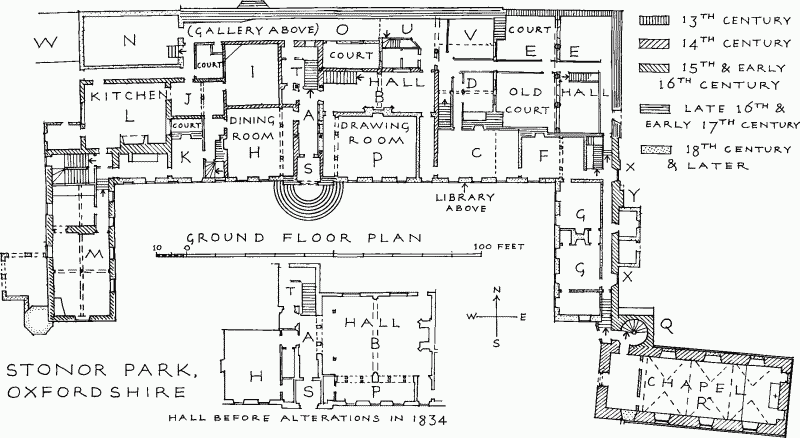
STONOR PARK. OXFORDSHIRE
Stonor: Conjectural stages of architectural history (fn. 92)
1. c. 1280–1300. The house consisted of a stone twoaisled hall, running north and south (EE on plan), the north end running into the hillside, and at the south end a two-storied wing (F) containing service rooms (buttery, &c.) on the ground floor and a solar above; a detached chapel (R) to the south-east was probably added c. 1300–31.
2. c. 1349 (at the end of Sir John Stonor's time)
(a) Foundation of chantry priests: the chapel (R) was perhaps rebuilt or enlarged; and perhaps the old hall (EE) and solar (F) allotted to use of chaplains, and perhaps east wing (G) added to connect with chapel. If, as suggested above (p. 142, n. 77), the chantry foundation did not come into effect until after 1431, then the east wing (G) was probably not built until the 15th century; this wing is therefore shown in dotted lines in the diagram of the house c. 1350 (see p. 146).
(b) The main house moved farther west
(i) A timber-framed hall (B) of two bays built with a screens passage (A) divided from hall by a 'spere truss', a projecting two-storied porch (S) (porch chamber mentioned in 1478); and perhaps another porch at the back (T).
(ii) A solar wing (CD) at the east end of the hall, running north and south; on the ground floor there was probably a parlour (C) at the south end; and on the first floor a solar (CD), present library as far as dotted line (V); though this range has been much altered, there survives apparently the original scissors-truss roof.
(iii) A service wing (HI) at the west end of the hall, running north and south; on the ground floor, probably buttery (H) and pantry (I) with passage between leading to kitchen; the first floor divided into three chambers, to judge from the trace of partitions surviving in the original scissors-truss roof.
(iv) Beyond to the west: a detached kitchen probably on the site of the present kitchen (L); other offices such as bakehouse, brewhouse, &c., probably to the west (W).
The general effect would have been that of a series of straggling, disjointed buildings, with an irregular frontage (as was usual in large houses of this period).
3. 15th and early 16th centuries. Additions, improvements, and alterations at various dates from c. 1400 to c. 1540:
(a) 1416–17. Large quantities of bricks used; probably for building chapel tower (Q); and perhaps the east wall (XX) of the east wing, including chimney-stack (Y), was rebuilt: perhaps the whole of the eastern parts (E, F, G,) rebuilt now, or in early 16th century.
(b) c. 1478–9. Some rebuilding in stone (where?) and new garden made.
(c) c. 1534–40. Probably important additions and improvements made by Sir Walter Stonor. Leland says he 'augmented and strengthened the house'; his work may have included:
(i) The building of the west wing (M), the east wall of which was probably at first timber-framed with a projecting first floor.
(ii) The room (J), with timber post and beams, connecting the passage between buttery and pantry (HI) and the kitchen (L); possibly the kitchen was rebuilt now.
(iii) A projection at the north-east corner of hall (U), of which the gable is traceable internally at roof level, may have been added now; this may have served as a large bay, or as a staircase leading up to the solar (CD).
(iv) The posts and beams in (D), supporting the floor of the solar, may be part of a reconstruction of the solar wing at this date; and possibly also the chimney-stack (Y), if it is not earlier.
(v) Leland's phrase 'strengthened the house may perhaps mean built a wall enclosing the front courtyard between the east and west wings. Leland also says that the house had 'two courts builded with timber, brick and flint' (i.e. the 1349 buildings—hall, solar wing, and service wing=timber-framed; the 15th- to early16th-century work = brick; the old hall and chapel = flint and stone) Leland's 'two courts' probably mean (1) the front courtyard now newly enclosed; and (2) either an irregular court behind the hall, service wing, and kitchen, or a court west of the kitchen, containing bakehouse, &c.
The rooms enumerated in the 1474 inventory may be conjecturally identified as follows: hall = B; little chamber annexed to the parlour = part of D? or F?; 5 chambers = F or G?; chamber at the nether end of the hall = chamber over H; parlour chamber = solar = over CD; buttery = H; kitchen = L; bakehouse = W.
4. c. 1590–1600: remodelling by Sir Francis Stonor
(a) The front and east and west wings regularized, a straight facade being formed by filling the hitherto irregular front; this included adding a kind of two-story gallery (P) in front of the hall, and a building (K) between the service wing (H) and the kitchen (L). At the same time typical Elizabethan gables were added and large mullioned windows were inserted throughout; two very wide windows let light through the gallery (P) into the hall; and two specially large windows lit the south end of the parlour (C) and of the solar above.
(b) Probably at the same time the long gallery (O) was formed at the back at the first-floor level, having large mullioned windows and one or more bay windows. Then or later the gallery cut into the north-east extension of the hall (U).
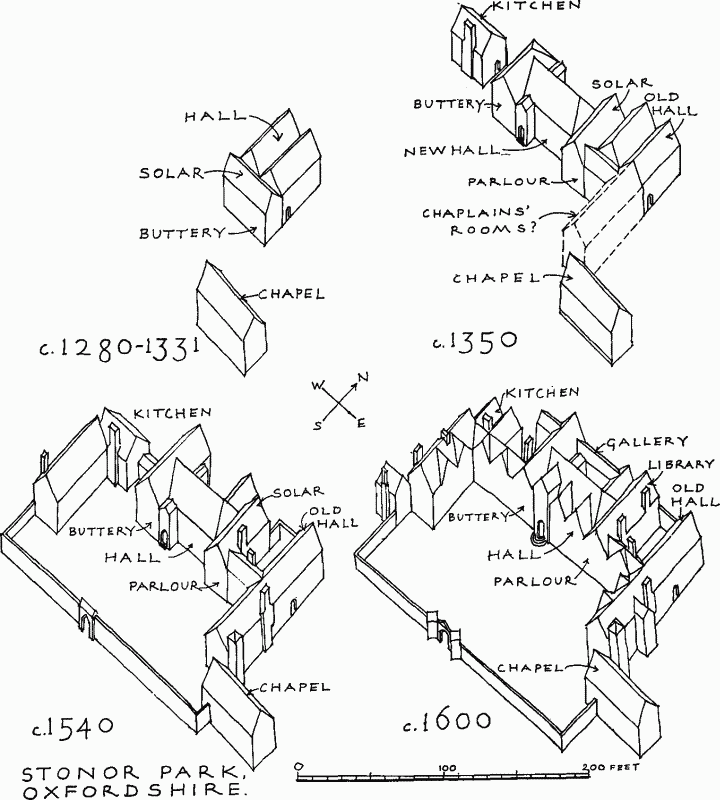
STONOR PARK. OXFORDSHIRE.
(c) By this time (if not earlier) the old hall was dismantled and the western half turned into a courtyard, as is shown by the (blocked) windows in the east wall of the library.
5. c. 1750–60: modernization by Thomas Stonor VI
(a) The Elizabethan gables removed and the large mullioned windows, of which some had been replaced by c. 1720, replaced throughout by sash windows.
(b) The hall still occupied its old extent, but was remodelled in the 'Gothick' style, including the fireplace (in the east wall) and the ogee arches in the screens passage, and the arched windows above the porch.
(c) The long gallery at the back was given new windows, and the wall raised to conceal the irregular roof line; perhaps it was at this time that the sloping ground was filled up to the first-floor level, i.e. to the gallery level.
(d) The north-west wing (N) was built.
(e) The east wing (G) was probably rebuilt entirely, except for the east wall.
(f) A little later, in 1790, a new staircase was built at the back of the screens passage (T).
(g) c. 1796–1800: the chapel was redecorated.
6. 1834: drastic alterations to the hall: the present drawing-room (at first used as a dining-room ?) built on the site of the gallery (P) and the southern half of the hall; and the open hall reduced to the northern half, and the 'Gothick' fireplace moved to the south wall.
Manors.
Pyrton (fn. 93) was a royal estate in 774 when Offa, King of Mercia, gave 40 hides there to Worcester Cathedral. (fn. 94) At some unknown date the church lost or alienated the property, for in 1066 Stigand, the schismatic Archbishop of Canterbury, heldit. (fn. 95) After the Conquest, this large estate passed to Hugh d'Avranches, Earl of Chester, one of the most important landowners in Oxfordshire. (fn. 96) PYRTON manor, as it is described in 1279, (fn. 97) consisted of most of this ancient estate, and included Pyrton itself and parts of the dependent hamlets of Clare, Goldor, Assendon (i.e. the modern Stonor), and Standhill in the parish of Pyrton, and Pishill Venables in Pishill parish. (fn. 98) Tenants from these hamlets and the sub-manors attended Pyrton manor courts until well into the 18th century. (fn. 99)
Pyrton manor was said to be held in 1242 for 4½ fees and in 1279 for 5 fees and by service of being in the advance-guard in going towards Wales and in the rear-guard in returning, a reflection of the marcher origin of the fief. (fn. 100) Several of the 5 fees listed in 1279 cut across the boundaries of the various hamlets: there was a ½-fee called Clermond in Goldor and Pyrton vills, which seems later to have disappeared; Bruys's ½-fee in Clare and Goldor; Pyron's fee, principally in Clare and Goldor, but with a ½-virgate in Pishill; Derneden's fee in Goldor, which seems also to have had land in Clare; Pishill Venables fee and Standhill fee. (fn. 101) Several of these fees were the basis of the later manors. In 1282 there were also six co-parcenors of a ⅓- and 1/10-fee under Pyrton (fn. 102) and from their names—Richard of Stonor, Adam of Assendon, John de la Dene, Emma de Herlinggerugge (i.e. the modern Hollandridge) and John de Hweresdene—it may be deduced that their holdings lay in the Assendon and Pishill area, a supposition reinforced by the fact that the holdings of the sixth co-parcenor, the Abbot of Dorchester, were in Pishill. (fn. 103) In 1380 and later, Stonor manor was said to be held for 1 fee, (fn. 104) but this was probably because it was then held with Pishill.
In 1346 and 1428 there were said to be 4 fees in Pyrton, Clare, Goldor, Pishill, and Standhill, but a 15th-century rental (c. 1438) gave a different distribution with 5½ fees: Stonor was 1 fee, Clare 1 fee, and Goldor 3½ fees. Standhill's service was said to be unknown and Pishill was not mentioned. (fn. 105) By this time, however, the original disposition of fees must have altered with the engrossment of holdings and changes in tenure, and they were perhaps reckoned on a financial basis according to the amount of land held.
The early tenants of the fees reflect strongly the connexion between Pyrton and the honor of Chester. They were often Cheshire and Lancashire tenants of the honor and members of the households of the earls and constables of Chester. It is probable, for example, that the Venables from whom Pishill Venables took its name was one of the Cheshire Venables, who frequently witnessed 12th-century charters of the earls, (fn. 106) and the later 12th-century tenants of Pishill, Roger Fitz Alured of Cumbray and the Duttons, were prominent Cheshire landowners and dependants of the earl. (fn. 107) The Pyron fee, likewise, was connected with the Hugh Pirun, who witnessed (c. 1115) the constable's foundation charter and grant of Pyrton church to Runcorn (later Norton) Priory. (fn. 108) The tenants of Standhill came from Coleby (Lincs.), another estate of the honor, where they were neighbours of the Duttons. (fn. 109) The Chaucumbes, who were connected with 12th-century Clare, were also Lincolnshire tenants of the earl. (fn. 110)
The earls of Chester were the overlords of Pyrton manor until the 13th century. After the death in 1237 of John le Scot, Earl of Chester, the earldom was annexed by the Crown, (fn. 111) and later returns usually said that Pyrton and its dependent estates were held directly of the king. (fn. 112) On occasions, however, the earldom was in the hands of the heir to the throne, (fn. 113) and this accounts for the return in 1360 of Pyrton as 4 fees of Wallingford honor, for at that time the Black Prince was both Earl of Chester and, as Earl of Cornwall, lord of Wallingford honor. (fn. 114) In 1414 Henry V annexed his Bohun inheritance to the Duchy of Lancaster, a fact which accounts for the 15th-century connexion of Pyrton with the duchy. (fn. 115)
The mesne tenant in 1086 was William Fitz Nigel (d. c. 1130), Constable of Chester and lord of Halton barony, Cheshire. (fn. 116) His son William Fitz William died without direct heirs c. 1150 and the estates went to his sisters Agnes and Maud, (fn. 117) between whom Pyrton seems to have been divided. Agnes granted land there about 1157–8, to Hurley Priory for the soul of her first husband Eustace Fitz John (d. 1157), (fn. 118) who succeeded her brother as constable. (fn. 119) In 1242 Pyrton was said to be held under her heirs, the constables of Chester, (fn. 120) although the whole manor had, in fact, passed to the De Grelles, the heirs of her sister Maud, who held in chief in the 14th century. (fn. 121)
Maud had married Albert (II) de Grelle, lord of Manchester, (fn. 122) and after his death c. 1162 Geoffrey de Valoignes appears to have had custody of his lands. (fn. 123) Albert (III) de Grelle, son of Maud and Albert, was in possession by about 1165. (fn. 124) He died in 1181, leaving a son Robert in the ward of his mother's brother, Gilbert Basset of Headington. (fn. 125) Robert de Grelle later sided with the baronial party in the quarrel with John (fn. 126) and in 1215 his lands in Pyrton were confiscated. (fn. 127) They were restored in 1217 (fn. 128) and Robert henceforth followed Henry III faithfully. (fn. 129) He accompanied the king to Poitou in 1230, but died in England before the end of the year. (fn. 130) His son Thomas, who did homage for his lands in 1231, (fn. 131) was reported to be holding the 4½ fees in 1242. (fn. 132) Thomas's eldest son Robert predeceased him and when he died in 1262, (fn. 133) he was succeeded by a minor, his grandson Robert de Grelle. (fn. 134) The king granted the wardship of the heir and his lands to his own son Edmund Crouchback, Earl of Lancaster, (fn. 135) and in 1272 Robert de Grelle complained that Edmund had distributed the lands among his friends, neglecting to provide for him as the heir, and prayed for restitution. (fn. 136) Lancaster had granted Pyrton to Philip Basset (d. 1271) of Wootton Bassett and in 1272 it was in the hands of Basset's executors. (fn. 137) Robert came of age in 1275, (fn. 138) and died in 1282, leaving a two-yearold son Thomas. (fn. 139) Dower in 2 fees in Standhill and Clare was given to Robert's widow Hawise de Burgh (d. 1299); (fn. 140) and Pyrton manor was given to farm to the Abbot of Westminster, who was to pay the rent to Amadeo of Savoy, the custodian of the heir. (fn. 141) Thomas de Grelle came of age in 1300; (fn. 142) and in 1308 he granted the manor to John Gyse, retaining a life interest, (fn. 143) which he granted in 1309 for £70 a year to Hugh Despenser the elder, whose family (the Bassets) had had an interest in Pyrton earlier. (fn. 144) When De Grelle died in 1311, although all his other lands went to his sister, (fn. 145) Pyrton remained in the possession of Despenser, who was returned as joint lord in 1316 and later in the same year obtained all rights in it. (fn. 146) On Despenser's death in the revolution of 1326, Pyrton with his other lands was forfeited to the Crown. (fn. 147) In the next year Thomas Brotherton, Earl of Norfolk (d. 1338), was given it with other manors; (fn. 148) in 1332 he arranged a life settlement of it with reversion to William de Bohun, Earl of Northampton. (fn. 149) In 1346 Northampton was, therefore, returned as holding 4 fees (fn. 150) in Pyrton and Pishill and still did so on his death in 1360. (fn. 151) He was succeeded in his titles and lands by his son Humphrey, Earl of Essex, Hereford, and Northampton, the last male of his line. Because of his minority the manor was at first in the custody of his overlord, the Black Prince. (fn. 152)
On Humphrey de Bohun's death in 1373 the vast Bohun inheritance fell to his two daughters, Mary and Eleanor, both under age, (fn. 153) and his widow Joan held Pyrton for them until they came of age in about 1384. (fn. 154) Eleanor de Bohun married Thomas of Woodstock, Duke of Buckingham and later of Gloucester, and her share of Pyrton, the manor valued at £16 13s. 4d. and Stonor fee valued at £5, with other of her possessions was given to him in 1380. (fn. 155) After his murder at Calais in 1397 his widow received these lands with the rest of her inheritance. (fn. 156) On her own death in 1399, her moiety of Pyrton descended to her elder daughter Anne, whose husband Edmund, Earl of Stafford, was holding it at his death in 1403. (fn. 157) Anne did not die until 1438, (fn. 158) but in 1421 a new and final partition of the Bohun inheritance was made with Henry V, son of Mary de Bohun (d. 1394), and it was at this time that Anne's share of Pyrton, valued at £16 13s. 4d., was granted to him. (fn. 159) As his mother's heir, Henry V was already in possession of part of the Bohun inheritance, which presumably included some of Pyrton, since Pyrton was later connected with the Duchy of Lancaster to which Henry annexed his Bohun inheritance in 1414. (fn. 160) A record of Mary de Bohun's inheritance in Pyrton was probably drawn up about 1421, since a later rental (c. 1438) based on it certainly described the united manor and fees. (fn. 161) The rental gives details of the 'manor site'. (fn. 162)
In 1422 Pyrton was given as dower to Katherine de Valois, Henry V's widow, (fn. 163) who held it with 4 fees in Clare, Standhill, Goldor, and Pishill in 1428. (fn. 164) Katherine de Valois, now the wife of Owen Tudor, died in 1437 and the manor reverted to the Crown. (fn. 165) It is said to have been given as part of her dowry to the consort of Henry VI, Margaret of Anjou; it was confiscated in 1460; (fn. 166) given to Elizabeth Woodville who married Edward IV in 1464; and surrendered by her in 1468. (fn. 167) In 1480 Edward IV gave the manor to the Dean and Chapter of St. George's Chapel, Windsor. (fn. 168) They remained lords until the 19th century, (fn. 169) but their connexion in later times was slight, since from 1582 they leased their manorial rights, 'the residue' as they were called in contradistinction to the manorial estate 'the site', to the lessees of the estate, who were termed 'lord farmers' of Pyrton manor until 1869. (fn. 170) Rights over the subordinate manors seem to have lapsed in the 19th century, but it is not clear whether it was before or after the lessees finally bought the estate in about 1870. (fn. 171) In 1910, for example, it was maintained that the quitrent for Standhill manor had not been paid for many years and that it was not certain to whom it should be paid, if at all. (fn. 172)
The manorial estate of the Dean and Chapter of St. George's Chapel was called in the 16th century PYRTON MANOR SITE. This manor was clearly derived from the demesne manor of the De Grelles in Pyrton and Goldor townships. (fn. 173) From 1482 it was leased by the chapter to various local families: firstly to Robert Rolles (Rolfe, Ralfe) of Pyrton (d. 1507); (fn. 174) and then to Thomas Symeon (d. 1522), whose brass in Pyrton church describes him as 'sometyme fermor of Purton'. (fn. 175) His son Edmund succeeded him as farmer and he also leased 'the residue', i.e. the manorial rights over the dependent manors of Pyrton. In 1538 his lease of the manor was renewed for 50 years (fn. 176) and was left at his death in 1567 to Francis, one of his younger sons. (fn. 177) On Francis's death in 1580 his elder brother John Symeon (d. 1617) of Pyrton, yeoman, took over the leases. (fn. 178) John Symeon's younger son Edmund, who had risen into the ranks of the gentry, evidently took over the lease of the manor, for in 1605 he held the court baron as 'farmer' of Pyrton. (fn. 179) After Edmund's death in 1622 (fn. 180) the family appears to have been in financial difficulties, for from 1627 to 1649 the manorial rights were held by a group which included an Edmund Symeon (d. 1651) and Knightley Duffield of Medmenham (Bucks.) (fn. 181) In 1650 the trustees under the Act for the abolition of deans and chapters and the sale of their land, sold Symeon's land in Pyrton for £1,796 to Richard Knightley of Fawsley, who was presumably acting for his kinsman Knightley Duffield, 'farmer' in 1652. (fn. 182) In 1663 and 1667 William, Lord Paget, and Sir Francis Gerard were the farmers. (fn. 183) They were followed by Richard Hampden, son-in-law of William, Lord Paget and son of the parliamentarian John Hampden, who had married Elizabeth, the daughter of Edmund Symeon. (fn. 184) Richard farmed the manor from 1669 until 1695, (fn. 185) when he left it with the 'residue' to his widow Letitia to pay his debts. (fn. 186) On her own death in 1707 she left her estate to pay heavy debts, the remainder to go to her grandson Richard Hampden. (fn. 187) In 1717 the Pyrton leases were sold to Weedon Perry of Turville Heath (Bucks.); (fn. 188) his family sold them in 1751 to George Parker, Earl of Macclesfield (d. 1764) and lord of Shirburn; (fn. 189) and in 1781 Hugh Hamersley (d. 1789) of Old Windsor, a trustee for the earl's widow, bought the property for £7,550. (fn. 190) After the death of Hugh Hamersley's widow Ann in 1801, the manor went to her husband's nephew, another Hugh Hamersley. (fn. 191) He was succeeded by his son Hugh (III) Hamersley in 1825, who obtained the enfranchisement of the manor in 1870. (fn. 192) It seems very likely that it was about this time that Hamersley purchased the manor from the Dean and Chapter. (fn. 193) Hamersley's younger son Edward Samuel inherited Pyrton in 1884 and after his death in 1909, his widow gave the manor to the son of her husband's sister, Major Hugh C. C. Ducat, who took the name Ducat Hamersley; he died in 1945 and his son, Colonel Hugh Ducat Hamersley, inherited. (fn. 194)
CLARE manor, which extended into Goldor township, (fn. 195) derived from the ½-fee held under Pyrton manor of which the descent can probably be traced back to the mid-12th century, when the Grelles first obtained Pyrton. A William de Beaumont was a tenant of Albert de Grelle in 1186, (fn. 196) and at the end of the 12th century a Thomas de Beaumont held 9 hides in Goldor and Clare, which he gave to his kinswoman Maud as her marriage portion, when she married Hugh Druval (d. 1195) of Goring. (fn. 197) Philip de Beaumont, son of Thomas, succeeded his father as mesne lord of the ½-fee and in 1211 was called to warrant the estate to Maud and her third husband William de Sutton, (fn. 198) against a certain Robert de Chaucumbe. (fn. 199) As Beaumont was a minor, the case was not settled until 1224, when he agreed that Maud and William de Sutton were to hold the 9 hides from him as a ½-fee. Robert de Druval, Maud's son, was to succeed to 2 hides, as previously arranged, but the other 7 were to revert to Beaumont after the deaths of Maud and William de Sutton. (fn. 200) Nevertheless, when Maud died in 1231 her grandson, Hugh Druval, made a forcible entry into the estate, but the agreement with Beaumont was upheld by the king's court. (fn. 201) On William's death, therefore, the 7 hides and ½-fee reverted to Philip de Beaumont and in 1236 Philip was sued by Thomas de Grelle for services owing to him. (fn. 202) Beaumont was still alive in 1242, (fn. 203) but there is no further mention of him in connexion with Clare. The Druvals, however, maintained a connexion with Clare and Goldor: (fn. 204) a Thomas Druval still held 3 virgates in Goldor in 1279, apparently as mesne lord under the De Grelles, and another hide in Clare under Beaumont's successors, the family of De Bruys, perhaps in virtue of the agreement made with Robert Druval in 1224. (fn. 205)
The ½-fee in Clare had already passed to an Essex landholder, Robert de Bruys (Briwes), who was called chief lord of a Goldor fee c. 1260. (fn. 206) Bruys died in 1276 (fn. 207) and in 1279 his widow Margery held the ½-fee in dower under their son John de Bruys. (fn. 208) She appears to have married Sir Henry Grapinel, for in 1281 John de Bruys granted his rights in Clare and land in Essex to Sir Henry and Margery Grapinel. (fn. 209) Grapinel, an Essex knight who acted as commissioner of array in Essex and Sheriff of Essex and Hertfordshire, (fn. 210) was returned as holding the ½-fee in 1282. (fn. 211) He died in 1297, leaving four daughters as coheiresses. (fn. 212) Clare was the portion of his daughter Margaret (or Margery), who married William Inge, Chief Justice of the King's Bench and lord of a Great Milton manor. (fn. 213) Inge continued to hold the estate after his first wife's death (d. c. 1311–13), (fn. 214) but on his own death in 1321 it descended to their daughter Joan, wife of Eudo de la Zouche, son of the 1st Baron Zouche of Haryngworth (Northants.). (fn. 215) Joan claimed the estate as her inheritance on the death of her first husband in 1326. (fn. 216) Within a year she married Sir William Moton of Peckleton (Leics.), Sheriff of Bedfordshire and Buckinghamshire in 1336. (fn. 217) She was dead by 1356, (fn. 218) but the manor remained in the Moton family and presumably passed from William Moton (d. c. 1356–62) to his son Robert Moton (d. 1367), and to his grandson William (d. 1391). (fn. 219) It is not known whether or no the dispute with the Zouches over Joan Moton's lands extended to Clare, (fn. 220) but William's widow Agnes seems to have held this manor in dower, and in 1414 their son and heir Robert Moton was listed among the free tenants of Pyrton manor. (fn. 221) In a rental of c. 1439, he was said to hold Clare manor by service of 1 knight's fee and rent of 5d. a year. (fn. 222) There was a dispute over his lands on his death in 1456, for he had tried unsuccessfully to entail them on William, his son by his second wife Elizabeth Mulsho, to the exclusion of the daughters and heiresses of Reginald (d. 1445), the son of his first wife Margaret Malory. (fn. 223) This dispute evidently extended to Clare, since the court rolls of 1460 do not name the tenant, but merely refer to the 'lord of Clare'. (fn. 224) The manor eventually came to Reginald's two coheiresses, Elizabeth who married Ralph Pole of Radbourne (Derb.) and Anne who married Henry Grimbsy. (fn. 225) Ralph Pole of Radbourne held his wife's moiety up to his death in 1492 (fn. 226) and after him it was apparently held by a son or kinsman of the same name, who appeared as tenant until 1303. (fn. 227) Elizabeth Pole died in that year (fn. 228) and there is no further mention of the family in connexion with Clare.
The other moiety was held in 1479 by Anne Grimsby's son Henry Grimsby and it passed to his sister and heiress Anne, wife of Richard Vincent. (fn. 229) In 1505 she and her husband conveyed their moiety to Robert Brudenell of Deene (Northants.), one of the king's justices, (fn. 230) who sold the estate to William Councer of Bloxham. The latter did homage for it in Pyrton court in 1509 and was still in possession in 1534. (fn. 231) In 1535 Edward Councer, son of William Councer, conveyed the manor to Edward and Peter Dormer, sons of Geoffrey Dormer of Thame. (fn. 232) Their brother Sir Michael Dormer possessed onethird of the manor on his death in 1545, and his son Ambrose died in possession of 'Clare manor' in 1566. (fn. 233) He was said to have held 'Counsells farm' by military service and a rent of 14s. 10d. as well as 'Druvals'. (fn. 234) The property went to his son Sir Michael Dormer, who in 1583 consolidated the Clare lands by purchasing land belonging to the Barentines of Little Haseley. (fn. 235)
The Barentines had held land in Clare called 'Clare manor' since 1410 at least, when it was leased by Drew Barentine (d. 1417), citizen and goldsmith of London. (fn. 236) Drew's heir was his nephew Reginald Barentine (d. 1441), lord of Goldor manor, and although Clare was not mentioned among his holdings it may have been included with Goldor manor. (fn. 237) Sir Drew Barentine (d. 1453), Reginald's son, and his own son John (d. 1474) and grandson John (d. 1485) held a Clare manor descending with Goldor manor. (fn. 238) John Barentine's son Sir William Barentine (d. 1550), (fn. 239) and then his grandson Francis (d. 1559) also held this manor. From Francis it passed to his daughter Mary, wife of Simon Perrot. (fn. 240) In 1583 Perrot granted the Clare property to Sir Michael Dormer, (fn. 241) who sold it for £5,800 in 1586 to Robert Chamberlain, lord of Shirburn, with which manor Clare has since descended. (fn. 242) On Robert Chamberlain's death in 1600, a relief of £5 was claimed and Clare manor was held as 1 knight's fee of Pyrton. (fn. 243) This was clearly the fixed rate, for it was again claimed from the heirs of John Chamberlain (d. 1650). (fn. 244) The manor was sold with Shirburn in 1716 to Thomas Parker, later Earl of Macclesfield, (fn. 245) whose descendants were still lords of the manor in 1960. (fn. 246)
Later evidence indicates that the land of GOLDOR township was included in the 40 hides in Pyrton granted by Offa to the Cathedral Church of Worcester at the end of the 8th century. (fn. 247) A Goldor estate is first specifically mentioned when Bishop Oswald of Worcester granted 5 hides in Goldor to his servant Leofward for himself and his heir. Leofward gave £10 to hold it freely. (fn. 248) The cathedral evidently lost the overlordship of Goldor with the rest of its Pyrton lands and in 1086, though Goldor is not specifically mentioned, the township was included in Pyrton manor, assessed at 40 hides, and held by the constables of Chester under the Earl of Chester. (fn. 249) By 1279 a Ralph de Derneden held a manor in Goldor as a knight's fee, owing scutage and suit to Pyrton manor. (fn. 250) He also held in 1282 and in 1297 was excused suit at Pyrton hundred court, presumably for this fee. (fn. 251) His son was Ralph of Goldor, who occurs in charters of about 1310 to 1325. (fn. 252)
The descent of this fee in the next century and a half is not certain, but by 1404 Reginald son of Thomas Barentine, lord of Chalgrove, was lord of Goldor manor. (fn. 253) Barentine had married Joan, daughter of John James of Wallingford, the lord of many neighbouring manors. (fn. 254) In 1439 he was said to hold the manor by service of 3½ fees and 9s. 3d. rent a year. (fn. 255) One of these fees may represent the 13thcentury Pyron fee, which was mainly in Clare. (fn. 256) A fraction can certainly be traced back to the hide and the fishery given, according to the Evesham chroniclers, by Nigel the Constable (? fl. 1066) to Evesham Abbey. (fn. 257) A William Silvanus farmed the property for 10s. a year. (fn. 258) Later, Abbot Adam (fl. 1160–1191) is said to have lost this land. (fn. 259) It was apparently claimed by Ralph de Halton, the son (perhaps illegitimate) of William the Constable, for in 1200 Robert Fitz Pain maintained that Ralph de Halton had enfeoffed him with the hide of land in Goldor, previously held by Osmund Fitz Ernulf. (fn. 260) The enfeoffment was for 1/5-fee and the holding can be traced in the 13th century, when its overlordship was claimed by the De Grelles, descendants of one of the two sisters of William the Constable, who had inherited the Constable's Pyrton lands. In 1236 Thomas de Grelle sued William of Goldor for customs and services due to him from his free tenement in Goldor, and in 1241 he brought a grand assize against the Abbot of Evesham for the holding. (fn. 261) William of Goldor held for 1/5-knight's fee and by the service of ploughing an acre for winter sowing and reaping the corn of the De Grelles for 1 day. (fn. 262) The family does not appear in the account of Goldor in 1279, but its holding is likely to have been the 1-hide estate held for scutage by Hugh Clermond and Thomas Openor by right of their wives. (fn. 263)
Barentine died in 1441 and Goldor was inherited by his son Sir Drew (d. 1453) and grandson John (d. 1474). (fn. 264) John's widow Elizabeth, who married as her second husband Sir John Botiller, was in possession of the manor in 1482, (fn. 265) but in 1485 her son John Barentine released his rights in Goldor manor to Thomas Danvers of Waterstock, one of the most prominent landowners in Oxfordshire. (fn. 266) Danvers granted it in 1487 to Magdalen College, Oxford, and in 1489 the college was pardoned for obtaining these lands in mortmain without licence. (fn. 267) In 1493 Danvers also granted the college other lands and tenements in Goldor, Clare, and Easington. (fn. 268) By 1548 the college had acquired several more freeholds, (fn. 269) and paid a total rent of £1 10s. 11½d., very close to the customary rent of £1 11s. 1d. that was later paid for the manor. (fn. 270) The college owned the largest part of Goldor in 1718 (fn. 271) and was still lord in 1960. (fn. 272)
The college farmed the manor out: until 1498 the Pyrton court rolls enter the heirs of John Barentine as tenants; (fn. 273) in 1497 Thomas Danvers of Waterstock (d. 1502) was 'farmer'; (fn. 274) and among the later lessees of the manor was Rudolph Warcup of English, who had held land in Goldor since at least 1611. (fn. 275) His heir Cuthbert Warcup granted his lease to Sir Thomas Tipping of Wheatfield who died in 1694. (fn. 276) His son Sir Thomas Tipping succeeded, but his property was heavily mortgaged and in 1717 he sold his lease to Edward Horne of Watlington. (fn. 277) Horne was still alive in 1753; by 1772 John Horne was in possession; (fn. 278) Edward Horne held in 1813, and was succeeded by Edward Horne Hulton, who was lord in 1847. (fn. 279)
As a sub-manor of Pyrton the overlordship and mesne tenure of STANDHILL followed that of the principal manor. (fn. 280) Standhill manor was reckoned in 1279 as 1 knight's fee and was then in the possession of the Colebys, Lincolnshire tenants of the De Grelles, the mesne lords. They held land under West Halton manor at Coleby (Lincs.), (fn. 281) which is likely to have been their principal seat. (fn. 282) They were probably enfeoffed with Standhill in the mid-12th century when the Grelles first succeeded to Pyrton: a Roger de Coleby witnessed a charter relating to the Pyrton fee granted by Albert de Grelle about 1165. (fn. 283) The first recorded tenant, however, was Ralph de Coleby who had a chapel at Standhill about 1180. (fn. 284) A Ralph de Coleby held land there in 1204 and was a Lincolnshire juror about 1206–7; (fn. 285) but there is no further reference to the family in Standhill until about 1250 when William son of Ralph de Coleby granted land there. (fn. 286) He is almost certainly to be identified with the William de Coleby who held in Coleby in 1257 and who was still alive about 1265, (fn. 287) but had died before 1279 when his son John de Coleby was a minor and Standhill manor was in the custody of John d'Esseby, lord of Clare. (fn. 288) D'Esseby still held Standhill 'of the heir', John de Coleby, in 1282, (fn. 289) but in 1297 a Ralph de Coleby, who was excused suit at Pyrton hundred court, may have been tenant of Standhill. (fn. 290) John de Coleby was assessed with the village in 1327 and in 1340 John de Coleby, Isabel his wife, and their son Richard were granted land in Standhill. (fn. 291) Richard de Coleby seems to have died before his father and to have left no heirs, for John de Coleby's three daughters, all married to Lincolnshire tenants, succeeded. They were Elizabeth wife of Peter Beauchamp; Katherine, married first to Hugh Fitz Giles and by 1380 to Geoffrey de Walton of Winterton (Lincs.); and Alice wife of Stephen de Frodingham (Lincs.). (fn. 292) In 1392 all three heiresses released their rights to John Rede of Checkendon, and in 1397 and 1398 Rede also bought out other rights in the manor for 100 marks. (fn. 293)
John Rede, the founder of the fortunes of the family, appears to have risen from the ranks to a position of considerable local importance. He had married Cecilia Harlyngrugge, daughter of William Harlyngrugge, a family that held a free tenement in Assendon under Pyrton manor (i.e. the modern Hollandridge farm), and were related to the Marmions of Checkendon. (fn. 294) She brought her husband one quarter of Checkendon manor. (fn. 295) John Rede (d. 1404) (fn. 296) was followed by his son Edmund who married Christina, the heiress of Robert James of Boarstall (Bucks.). (fn. 297) Edmund died in 1430, but his wife (d. 1435) had a life interest in Standhill manor and in 1434 she settled it on their son Edmund when he married Agnes, daughter of John Cottesmore of Brightwell Baldwin, the Lord Chief Justice. (fn. 298) Sir Edmund Rede (d. 1489) left Standhill to his second wife Katherine, widow of John Gaynesford of Crowhurst (Surr.), with reversion to his heir after the proceeds of the manor had been used for ten years for Masses and in 'charitable dedes'. (fn. 299) Their son William died during his father's lifetime, leaving a son William who came into possession of Standhill on his grandmother's death in 1499. (fn. 300) William Rede died in 1527 (fn. 301) and Standhill descended to his son Leonard who held it in 1548. (fn. 302) By 1552 Leonard Rede had been succeeded at Boarstall by his daughter Katharine and her husband Thomas Dynham of Piddington. (fn. 303) They were presumably responsible for the sale of Standhill manor and chapel to a William Byrte who held it in 1555. In that year Byrte sold it to William Dunch, lord of Little Wittenham (Berks.), who was auditor of the mint of Henry VIII and Edward VI, and one of the successful new men of the day. (fn. 304) Thereafter, Standhill followed the descent of Little Wittenham. Dunch died in 1597 and was followed by his son Edmund (d. 1623), by Edmund's grandson, Edmund, Lord Burnell, of East Wittenham (d. 1678), and by the second Edmund's son Hungerford (d. 1680) and by Hungerford's two-year-old son Edmund. (fn. 305) This last Edmund Dunch became master of the household to Queen Anne and George I. He married Elizabeth, sister of John Churchill, 1st Duke of Marlborough, and in 1716 sold Standhill manor to his brother-in-law. (fn. 306)
The manor descended, like Tetsworth and Wheatfield, to a junior branch of the Marlboroughs and was held in 1785 by Lord Charles Spencer (d. 1820) of Wheatfield. (fn. 307) After the death of Lord Charles's son John in 1831, Standhill went to his infant grandson Charles Vere Spencer as part of a heavily mortgaged estate and was sold about 1835. (fn. 308) When the farms were for sale in 1910, 'Standhill manor or reputed manor' was also offered, but it was said that the quitrent of 10s. 5d. to Pyrton manor was believed to have lapsed. (fn. 309)
Little is known about under-tenants of the manor: in the late 14th century Katherine Rede gave a life interest in the manor to William Gaynesford, the son of her first marriage, who had married Anne Rede, the widow of her stepson William Rede. (fn. 310) In 1507 a John Mundy held the manor and in 1682 a Joan Stone was tenant of Hungerford Dunch and paid 10s. 5d. quitrent in Pyrton manor court. (fn. 311)
STONOR manor (fn. 312) seems to have originated in the free tenement held by the Stonors under Pyrton manor in the 13th century and in acquisitions of land in the parish and outside made in the early 14th century. As Stonor manor formed a sub-manor of Pyrton its overlordship and mesne tenure were the same as those of the principal manor. The Stonors did suit at Pyrton. (fn. 313)
The Oxfordshire branch of the Stonor family, owners of Stonor from at least the early 13th century to the present day, first appears clearly with Richard 'de Stanora'. (fn. 314) Throughout the century this name recurs: there appear to be three generations. In 1241 a Richard Stonor established his right to land in the neighbouring parish of Bix, where the family's main Oxfordshire property then lay. (fn. 315) In 1279 Richard Stonor was one of the jurors sworn for Pyrton hundred (fn. 316) and was returned as a free tenant in Pyrton, (fn. 317) where he held 1 virgate under Pyrton manor for a rent of 8s. and 4 quarters of oats, a holding which was later administered with the manor. (fn. 318) In 1282 the same or another Richard Stonor was returned as one of the six co-parceners of ⅓ and 1/10-knight's fees within Pyrton manor. (fn. 319) These fractions, however, probably represented Stonor's Pishill lands as well as his Assendon lands, for part of Pishill was in Pyrton manor and the records relating to it are often imprecise. (fn. 320)
This Richard Stonor, perhaps the third, had married shortly before 1280 Margaret, the daughter of Sir John de Harnhull, (fn. 321) and was still living in 1297. (fn. 322) He had been succeeded by 1315 by his son Sir John Stonor, the Chief Justice and the principal architect of the family's fortunes in Oxfordshire and elsewhere. (fn. 323) Stonor manor was among the demesne lands for which Sir John received a grant of free warren in 1315, (fn. 324) and in 1316 and 1317 this estate was greatly increased by an exchange of land made with Dorchester Abbey. (fn. 325) It was doubtless because of these grants that the abbey was regarded as a mesne lord of Stonor manor in 1354 and 1361. (fn. 326)
Sir John (d. 1354) was followed by his son Sir John (II) Stonor (d. 1361), and his grandson Edmund. (fn. 327) Edmund's wardship was granted to the king's daughter Isabella, Countess of Bedford, who held the Stonor inheritance until 1363, when Edmund was allowed to hold it. (fn. 328) Edmund died in 1382 and his eldest son John in the next year, and the manor, therefore, descended to another son Ralph, who came of age in 1390. (fn. 329) In 1394 Ralph, by now a knight, accompanied Richard II on his expedition to Ireland and died two months later, leaving the succession to 24 manors in seven different counties to his son Gilbert, an infant who died in 1396. (fn. 330) A younger son Thomas succeeded and had seisin of the lands on coming of age in 1415. (fn. 331) His guardian had been Thomas Chaucer of Ewelme and it was perhaps Chaucer's, influence which enabled the young man to represent the county in Parliament six times and twice serve as sheriff before his early death in 1431. (fn. 332) By his will the profits of Stonor and other manors were to be used during the minority of his heir Thomas (II) as the marriage portions for his five daughters. (fn. 333) Thomas was of age by 1438 (fn. 334) and died in 1474. (fn. 335) His eldest son and heir Sir William Stonor is memorable as a knight of the shire for Oxfordshire and for his advancement of the family fortunes by his three profitable matches, the first with Elizabeth Croke, a wealthy widow; the second with Agnes Winnard, another wealthy widow; and the third with Anne Neville, niece of Richard Neville, the king-maker. (fn. 336) Stonor (d. 1494) was attainted in 1483 because of his share in Buckingham's rebellion. His lands were in the king's hands in 1484 and Stonor manor was granted to Francis Lovell. The estates, however, were restored on the accession of Henry VII and Stonor regained his position in the county. (fn. 337) His son and successor John Stonor, a minor, died in 1498 a few years after his father's death in 1494, (fn. 338) and his sister Anne, wife of Sir Adrian Fortescue, succeeded, but their claim was not admitted immediately. Until 1509 Pyrton manor courts were held in the name of the heirs of William Stonor and thereafter in the name of Fortescue. (fn. 339) Even so there was considerable litigation for many more years between Fortescue and his wife on the one hand and her uncle Thomas (III) Stonor (d. 1512) and cousin Sir Walter Stonor on the other. (fn. 340) Eventually an agreement was made by which the succession to the lands, including Stonor, Pishill Venables, and Pishill Napper, was granted to Sir Walter Stonor, and in 1536 an Act of Parliament entailed them on the heirs male of Thomas (I) Stonor, his grandfather. (fn. 341) On Sir Walter's death in 1550, (fn. 342) because of the entail, Stonor went, not to his daughter Elizabeth, but to Sir Francis Stonor, son of Sir Walter's brother John Stonor of North Stoke. (fn. 343)
The Stonors at this time were one of the chief Roman Catholic families in the county. Sir Francis died in 1564, settling a life interest in the manor of Stonor and other manors on his widow Cecily, the daughter of Leonard Chamberlain of Shirburn, with remainder to their son Francis. (fn. 344) In 1585 Lady Stonor was cited as a recusant and her manors were taken into the queen's hands until the fine was paid; the Crown leased the manors to Sir Francis Stonor, then a conformist, and in 1590 Lady Cecily Stonor, who was living at Stonor, complained to Lord Burghley that her son had dispossessed her of all her personal estates, and petitioned for the restoration of the manors, though Francis maintained that he had her letters of attorney to sell the property. (fn. 345) Sir Francis (d. 1625) left Stonor to his third son William, (fn. 346) who died in 1650 as did his eldest son Francis two years later. (fn. 347) Sir William had had to sell nearly all the family estates outside Oxfordshire to pay the fines for recusancy, and just before his death Francis Stonor was obliged to lease Stonor for eight years to Sir George Simeon of Britwell in an attempt to meet his father's creditors. Francis was succeeded in 1653 by his brother Thomas, who in the same year married Elizabeth Neville, daughter of the 9th Lord Abergavenny of Shirburn, a marriage which helped to restore the Stonor fortunes. He lived at Watlington, but on his death in 1683 he was succeeded by his eldest son John who had occupied Stonor during his father's lifetime. John died young in 1687, leaving as heir a boy Thomas (V) Stonor, who died in 1724 and was succeeded by his son another Thomas (d. 1772). (fn. 348) This sixth Thomas married Mary Biddulph of Biddulph Hall (Staffs.), who was senior coheiress of the barony of Camoys and Vaux. (fn. 349) His son Charles (d. 1781) married Mary Blount of Mapledurham, a member of another ancient Oxfordshire family of Roman Catholics. (fn. 350) Charles's son Thomas (d. 1831), and grandson Thomas (IX) succeeded him. In 1838 Thomas Stonor laid claim to the Camoys barony, by right of descent from his great-grandmother, and in 1839 he was summoned to Parliament as the 3rd Baron Camoys. (fn. 351) His son Francis died in his lifetime and in 1881 his grandson Francis Robert inherited as 4th Baron Camoys. Ralph Francis Julian, the 5th Baron succeeded in 1897. He married Mildred Sherman of Newport, Rhode Island (U.S.A.), a member of an old American family. (fn. 352) Since 1937 Stonor has been the property of his son, Major the Hon. Sherman Stonor. (fn. 353)
Lesser Estates.
Most of the land belonging to Pyrton church was given to Runcorn, later Norton, Priory in Cheshire at the priory's foundation in about 1115. (fn. 354) Early in the 13th century this estate, later known as the rectory estate, consisted of 5½ virgates; (fn. 355) by 1279 it was 9 virgates, of which 4 may have originally belonged to Hurley Priory (Berks.). (fn. 356) The property was held in part under Pyrton manor, and the Priory of Norton and later its successor, the Dean and Chapter of Christ Church, Oxford, attended the manorial court as freeholders. (fn. 357) After the Reformation the rectory estate formed one farm. According to a terrier of 1635 it consisted of a house with farm buildings and about 125 acres of land, 104 of them in Pyrton field. (fn. 358) It was sold in the late 19th century to the Earl of Macclesfield. (fn. 359)
The first known farmer of the rectory was Sir William Stonor in the 1480's. (fn. 360) After the Reformation the lessees continued to be prominent local people. In 1568 Christ Church leased the rectory for 99 years to Joel and Abel Barnard, the sons of the vicar Thomas Barnard. (fn. 361) Joel married Agnes, the daughter of Thomas Eustace, a Watlington yeoman, (fn. 362) and in the 17th century the lease was taken over by the Eustaces, who were already established in Pyrton. (fn. 363) By 1611 a Thomas Eustace held half the lease, (fn. 364) and in 1659 Thomas Eustace of Pyrton, gent., and John Eustace of New Thame, gent., took a 21-year lease. (fn. 365) This Thomas Eustace died in 1687, leaving his share of the rectory to his grandson Thomas; (fn. 366) the Thomas Eustace and Mrs. Joan Eustace who are recorded in a late-17th-century list of ratepayers as paying on 40 yardlands for the parsonage were probably his grandson and his widow. (fn. 367) The Thomas Eustace who was buried in the church in 1713 (fn. 368) and was also perhaps this grandson, seems to have been the last of that branch of the family.
In the late 18th century one-fifth of the rectory, consisting of the tithes of Assendon, was farmed to the lord of Stonor manor, (fn. 369) as it had in fact been throughout the 18th century; the other four-fifths, consisting of the rectory estate and the rest of the tithes, were divided between the Earl of Macclesfield and Paul Blackall. (fn. 370) By 1850 Lord Macclesfield leased the whole four-fifths. (fn. 371) The lessee kept the rectory buildings in repair, but was allowed timber for this from the college wood; (fn. 372) Christ Church, on the other hand, seems to have been responsible for the repair of the church chancel, and for keeping a bull and a boar for the use of the parishioners. (fn. 373) The rent remained constant until the 19th century, but heavy fines, based on current prices, were paid. In the late 18th century the property was surveyed and the amount of the fine determined every seven years. (fn. 374) An example of a quick change in values is shown by the fine of 1813, which was three times that of 1806. (fn. 375)
Besides Norton Priory, two other religious houses and also the Knights Templars benefited from the gifts of pious knights and free tenants. Before 1101 the Constable William Fitz Nigel, lord of Pyrton, granted land in Pyrton to Hurley Priory (Berks.), a cell of Westminster Abbey. (fn. 376) After his death in c. 1127 Henry I ordered that the priory should have undisputed possession of this land, and in c. 1135–40 William Fitz Nigel confirmed his father's gift, then said to be 1 hide in Pyrton and 1 in Clare. (fn. 377) His sister Agnes also confirmed it in c. 1158 and added 4 solidates of woodland and a grant of pannage. (fn. 378) By 1279, however, the priory held only 1 hide in Clare, said to be of the gift of John of Clare (fn. 379) and in 1292 it had 16s. rent in Pyrton. (fn. 380) Little further is known of the priory's tenure, but it still had property there in 1515. (fn. 381)
In 1292 Notley Abbey (Bucks.) had lands worth 10s. in Pyrton. (fn. 382) There is no other record of the property until the 15th century when from about 1466 until the Dissolution Notley Abbey held 3 virgates in Pyrton fields. (fn. 383) In 1548 the tenants of the dissolved abbey's land were said to hold by military service and to pay 4 quarters of oats to Pyrton manor. (fn. 384)
In about 1225 the Templars of the Sandford Preceptory were granted 1 virgate and services from i messuage and 13½ acres in Clare and Goldor by Richard Foliot, lord of Warpsgrove. (fn. 385) Robert Fitz Ascelin, a free tenant of Pyrton, confirmed these grants and Foliot's grant of a meadow in the moor of Standhill and also added 9 acres of his own land in Goldor. (fn. 386) The Templars acquired a further 10½ acres of land in Goldor about 1230 and 1260 as well as other small grants of land. (fn. 387) In 1279 the Master of the Templars held the Foliots' virgate in Goldor, said to be the gift of Richard Foliot, and the Preceptor of Cowley was mesne lord of 1 virgate in Clare. (fn. 388) It is very likely that the property went to the Hospitallers and was included with the Hospitallers' land in Warspgrove, which in 1335 was farmed by Sir John Stonor. (fn. 389) In 1544 Henry VIII granted a messuage in Goldor, formerly of St. John of Jerusalem and Sandford Preceptory, to Edmund Powell of Sandford (fn. 390) and in 1557 Magdalen College bought it. (fn. 391)
The Pyron family was also lord of a fee in Goldor and Clare in the mid-13th century. The name of this family (Pyron, Piron, Pirun), which may be identified with the Pyron family whose name is constantly mentioned in 13th-century charters relating to burgages in New Thame, (fn. 392) frequently occurs in charters relating to Pyrton. In about 1115 Hugh Pyron witnessed the grant of Pyrton church and other property to Norton Priory by the Constable, William Fitz Nigel, (fn. 393) and it is likely that the family was introduced into Pyrton by the Constables. In 1187 a Richard Pyron was a tenant of the De Grelles; (fn. 394) a Richard Pyron flourished in the early 13th century and witnessed Easington charters; (fn. 395) and a Hugh Pyron of Clare and of Goldor and a John Pyron of Warpsgrove, witnessed Clare and Goldor grants between 1220 and 1230. (fn. 396) A later Richard Pyron (fl. c. 1250) was lord of this fee and was succeeded by his son Sir Hugh Pyron of Clare (fl. 1260). (fn. 397) Sir Hugh married a certain Maud and their eldest son was Robert. (fn. 398) In c. 1277 Richard Pyron of Clare gave up all his rights in Clare, Goldor, Assendon, and Pishill to Robert de Grelle, his lord, in return for an annuity. (fn. 399) In 1279 a Laurence Pyron held a few acres in Clare, but the fee had by then passed out of the hands of the family and was held in 1279 and 1282 by John d'Esseby. (fn. 400) D'Esseby owed suit to Pyrton hundred court in 1297, presumably for this fee as well as for his Standhill fee. (fn. 401) Two virgates were in Goldor, but the greater part of the fee was in Clare. (fn. 402) Nothing further is heard of the D'Esseby family and no single estate appears to have developed out of the various holdings.
Economic and Social History.
The good water-supply and the suitability of much of the soil for cultivation encouraged early settlement. The northern part of the parish lies on the Gault Clay, the middle part, including the village of Pyrton itself, on the Upper Greensand and Middle Chalk, where the springs are plentiful, and the southern part on the Middle and Upper Chalk, while immediately to the north of Pyrton there is a patch of valley gravel. (fn. 403) There are various indications of early settlers such as a round barrow, (fn. 404) Iron Age sherds found at Stonor, (fn. 405) and the ridgeway traversing the parish. Roman pottery has been found near Pyrton village and at Stonor both Roman pottery and coins of the period A.D. 37 to A.D. 568. (fn. 406) The heathen burial-place at Christmas Common, on the boundaries of Upper and Lower Pyrton, suggests that there may have been 5th- and 6th-century Saxon settlement in the district, (fn. 407) and there is little doubt that by the end of the 8th century the parish was already in existence. (fn. 408)
The elongated shape of Pyrton would naturally seem to be dictated by the desire to include different soils and natural resources, and is matched by the shape of other parishes in the Chiltern area and in other counties where the geological conditions are similar. Pyrton, stretching between chalk and clay, included woodland on the chalk hills, pasture for sheep on their lower slopes and a belt of fertile Greensand. The original name of the place was Readnora, 'red slope', (fn. 409) which well describes the colour of the Chiltern hill-slopes in autumn and winter when the bracken has turned colour and the beech leaves have fallen. By the 11th century Pyrton, meaning 'Pear Tree Farm,' had superseded Readnora. (fn. 410)
Although Pyrton's hamlets are not mentioned in Domesday there are indications that some, if not all, were already settled. The names Assendon and Stonor occur in a 10th-century record of boundaries: Assendon (O.E. Assa's valley) certainly suggests a settlement, though Stonor, meaning the 'slope of the stones', may have been used simply as a landmark. Goldor, interpreted as 'the slope where golden flowers grow', and its inhabitants are mentioned in the late 10th century and Standhill occurs soon after. Standhill took its name from its stone quarries. (fn. 411) The surface soil is stony and though Upper Standhill lies on Gault clay it is near to Portland Stone that was quarried at one time. (fn. 412) Clare, situated on clay near its junction with the greensand, means 'clay slope' (fn. 413), and though not found in documents until c. 1130 is unlikely to have been colonized much later than Goldor and may in fact possibly have preceded it and be the 'Old Goldor' mentioned in early-13thcentury charters. (fn. 414)
By 1086 the ownership of the estate had passed from the Bishop of Worcester by way of Archbishop Stigand to the earls of Chester. (fn. 415) There were 6 ploughs in demesne and 20 belonging to the tenants, who consisted of 8 bondmen, 42 villani, 4 freemen, and 2 bordars—in all 56 persons. There was also a large extent of meadow (200 a.) and of wood (18 furl, × ½ league). The estate, worth £ 30 in 1086, had nearly doubled in value since King Edward's time. (fn. 416) This development may have been in part the consequence of a natural recovery from devastation at the time of an insurgent raid in 1065 along the road from Wallingford to Bledlow, (fn. 417) and in part of extended cultivation.
The group of freemen recorded in Domesday Book is of particular interest. Such a group is unusual in the county: it occurs at neighbouring Aston Rowant and at Church Enstone and not elsewhere. (fn. 418) They may have been the descendants of the cnihts, those exceptional men who gave their name to Knightsbridge, the bridge over Weston Brook. (fn. 419) Possibly they had to fulfil 'the law of riding' (fn. 420) or of escorting the bishop or his supplies, and possibly they owed military duties on the Welsh border. The only surviving evidence makes no mention of such services, but it relates to hereditary land only. By his charter of 987 Oswald, Bishop of Worcester and Archbishop of York, granted the land of 5 manentes (i.e. 5 hides) at Goldor to Leofward, his man, and his heirs. Leofward's tenure was subject only to certain dues to the church of Pyrton and to the ploughing and mowing of one field a year on the bishop's estate. (fn. 421)
The number of free tenants was considerably increased in the course of the 200 years after Domesday and free tenure remained a characteristic of Pyrton's later medieval history. Although the survey of 1279 is incomplete it gives a fairly comprehensive picture of the complicated tenurial organization of this ancient estate with its many sub-manors. (fn. 422) In Pyrton itself there were 2 free tenants, a layman holding 3 virgates, and the Prior of Norton, the rector of the parish, with 9 virgates. (fn. 423)
In Clare, the most important village after the mother village, the principal estate was the ½-fee of Margery de Bruys who held 7 hides. Her 6 free tenants held 14 virgates in all: Thomas Druval, a descendant of the 12th-century Hugh Druval of Goring, held a hide; (fn. 424) John de Clare, once the holder of 7 virgates, had given 4 to the Prior of Hurley and held one of his remaining 3 virgates from the Templars. There were also 9 free tenants of John D'Esseby's Pyron fee, who held over 5 virgates in parcels of a ½-virgate to 2 virgates at rents ranging from 1d. to 2s. 6d. for a ½-virgate. Over 3½ virgates were held of mesne lords by 3 other tenants. All owed hidage, wardsilver, suit to the manor and hundred courts of Pyrton, and most owed scutage as well. There were 6 tenants for life paying rents of 1s. an acre for their 18-acre and 9-acre holdings. Finally a ½-virgate was held in pure alms by the Abbot of Dorchester, whose main holding was in Pishill. In Goldor township the manor of 11 virgates was held by Ralph de Derneden and 14 free tenants of which only 5 held of him. One held of the lady of Clare, 3 held of one of her free tenants, 3 of the lord of Pyrton, and 1 held 2 virgates of the D'Esseby fee in Clare, while 48 acres were held by the lord of Pyrton of Laurence de Scaccario, the lord of Chequers in Stokenchurch. (fn. 425) In Standhill D'Esseby had 4 free tenants holding 4½ virgates.
As for the agrarian organization of these estates the information given in the hundred rolls combined with that given in extents and other sources shows that Pyrton below-the-hill was divided into open fields and that the lord's demesne was mainly cultivated by his villein tenants. In 1279 the demesne of the principal manor, the De Grelle manor, consisted of 4 carucates and 40 acres of pasture and meadow. An extent of 1272 records that the carucates were valued at £8 each and the mead and pasture at £6 3s. 4d.; there was common pasture for 300 sheep worth 18s. and rents of assize amounted to 61s. 2½d. (fn. 426) The crops grown were wheat, barley, drage, beans, and peas. (fn. 427) There were 20 villein virgaters, the works and services of each villein virgater being worth 12s. 4d. each. (fn. 428) The labour services of the villeins were supplemented at the busy seasons by the boon-works of the free tenants, a survival very possibly of the terms of their tenure in Anglo-Saxon times: the Pishill tenants owed reaping and ploughing services; the lord of Clare owed a day's service at the 'drinking' of the lord with all his customary tenants and also a day's reaping service; (fn. 429) and John de Clare, a free tenant of Clare fee, owed harvest service for 4 days with 1 man.
These services might be strictly exacted: in 1241, for example, William of Goldor was sued in the king's court by the lord of Pyrton for not ploughing an acre in winter, or sowing and reaping with 1 man for 1 day; (fn. 430) and yet by the end of the century, if not before, there was evidently an excess of labour at harvest time. Instead of commuting the service of 1 day's boon-work for a money payment, however, men and sometimes women were hired to Merton College, lord of the neighbouring Cuxham manor. Between 1289 and 1319 1 to 4 men were hired each year and in 1320 2 women. (fn. 431) Besides this co-operation over labour there was a long tradition of intercommoning between the two manors. The agreement made in 1241–2 between Thomas de Grelle and Ralph Chenduit, then lord of Cuxham, looks like a restatement of an ancient custom: the lord of Cuxham might pasture 4 horses, 12 Oxen, 10 cows, and a bull on any of the fields of Pyrton from harvest to Martinmas, and on the field nearest Cuxham, he might keep them and 200 sheep until the seed was sown; in return the lord of Pyrton might pasture his animals in the fields of Cuxham from harvest to Martinmas. (fn. 432) It seems that the college was not satisfied with its legal rights for the bailiff's accounts of 1296–1334 record gifts each year to the hayward of Pyrton for 'special favour' in the common of Pyrton for the lord's animals, and sometimes gifts were made for leave to pasture in the meadows. (fn. 433)
Cuxham was accustomed to buy hay and wood from Pyrton, which had plentiful rough pasture and timber in the upland parts of the parish. (fn. 434) The last must have contributed substantially to the value of the manor, which was worth £57 in 1272. This sum included the profits of the mill, produce of the garden, and of two dovehouses, inclosed pasture and wood, and various customary payments, including salt-silver. (fn. 435)
The Prior of Norton's 9-virgate holding, of which 2 virgates were held by the lord of Goldor, was also organized on manorial lines: he had a small demesne farm of 2 virgates, 6 villein tenants holding 5 virgates in all; and 4 tenants of whom 3 were women, who had 5 cottages. The villeins paid rents of 6s. 8d. to 8s. and owed light services; the cottagers paid rents of about 2s. and varying services. One cottager owed 3 days' work with 1 man in autumn at the lord's cost and to carry hay from the lord's meadow at his own cost. Another was to reap for 4 days with 1 man, carry hay in the meadow, hoe and collect stubble for 1 day, and help make a hay rick; two were to reap on one boon day. All these services were done at the lord's cost. (fn. 436)
On Margery de Bruys's manor at Clare there were 10 virgates in demesne and 7 villein virgaters and 3 coterelli; on Ralph de Derneden's at Goldor there were 9 virgates in demesne and 2 villein virgaters owing 5s. rent and light services; and in Standhill John D'Esseby had 3 virgates, 5 acres of arable, meadow, and pasture in demesne, besides his 12 acres in Clare. D'Esseby's 14 villein tenants held 12 virgates, each virgater paying 6s. rent and working 4 days a week with 2 men. He also owed other occasional services, some of which seem by their nature to be survivals from an earlier and simpler society. He was to carry for 2 days in the autumn at the lord's cost; to reap for 2 days with 1 man, bringing a cart, at the lord's request and to collect the stubble for 1 day, all at the lord's cost; he was to fetch the lord's dinner from the market and help roof the houses of the court. There were four cottagers. The rich meadow-land and pastures, which later practically replaced the arable, already formed a very valuable part of the economy. (fn. 437)
In the lowland half of Pyrton there were at least 56 virgates held by free tenants, 43 by villeins and over 40 virgates in demesne. How much of the southern part of the parish—the detached upland area of Assendon—was cultivated at this date is uncertain, but though it largely consisted of wood and rough grazing there were certainly many crofts and some open-field land.
Apart from two holdings recorded in 1279 which were probably in Assendon, the survey gives no account of this area under Assendon. Its omission may be accounted for perhaps by the inclusion of its land in the account of Bix parish which is now missing, and in the account of Dorchester's Pishill estate, under the heading 'fee of Pishill hamlet'. (fn. 438) Dorchester certainly held land in Pyrton parish in 1316, at least 100 acres of land and 60 acres of wood, but there is no mention of it in the 1279 survey of Pyrton. (fn. 439) The two holdings recorded in 1279 were firstly the virgate held by Richard de Stonor for 8s. and 4 qrs. of oats. (fn. 440) The later history of this holding and the fact that Stonor is said to hold 'in parochia de Pyriton', whereas other holdings are described as 'in villa de Pyriton', strongly suggest that the holding was in Assendon. Secondly the holding of 4½ acres held by (Adam) de Pishill is also said to be 'in the parish' (fn. 441) and may very likely have been in Assendon near the Pishill boundary. When Sir John Stonor died in 1361 Stonor manor included a park (160 a.), wood (60 a.), 200 acres held of Pyrton manor and 100 acres of Dorchester Abbey, most of which, judging from the later history of the property, was in Assendon. (fn. 442)
The fields of Assendon and the crops grown on the demesne land are first recorded in an account of Stonor manor for 1387–8. (fn. 443) The account is for the whole manor and covers land both inside and outside the parish, but the fields mentioned can be identified as Assendon fields by reference to an estate map of 1725. (fn. 444) A total of over 84 acres was sown: 42 in Parkfeld, 3 in Makkefeld, 9 in Stomparys-feld, 21 in Milfeld (fn. 445) and Bykkele, and 9 in Nether Bykkele. The crops grown here and elsewhere on the Stonor estate were barley, wheat, oats, pulse, and mixtum in this order of importance. The woods of Assendon were almost certainly mainly beechwood as now. (fn. 446) That numerous pigs were kept in the upland parts of the parish can hardly be doubted, but documentary references are rare. One grant made in the mid-12th century to Hurley Priory allowed feed for 20 pigs in Breton-heth near Assendon. (fn. 447)
Of the hamlet at this date nothing is known. No tax list for Assendon hamlet has been found before 1523, when 14 persons besides the lord of Stonor, Sir Adrian Fortescue, were taxed. Most of these were labourers or small farmers with 40s. worth of goods and under. (fn. 448)
War and pestilence appear to have caused a catastrophic decline in the value of Pyrton manor in the 14th century and it is unlikely that the other hamlets escaped their effects. The unexpectedly small number of fourteen contributors from Pyrton to the tax of 1327 may be accounted for by the disorders of the times. (fn. 449) For instance, in 1322 it was alleged that 21 trespassers had entered the manor and removed stock when it was in the king's hands. (fn. 450) That there is something quite abnormal about the number of contributors in 1327 can be proved by a comparison with Clare's 22 contributors and the fact that the hamlet actually paid a larger tax than the mother village. When the assessment was revised in 1334 Pyrton was assessed at £5 18s. 6d. compared with Clare's £4 14s. 10d., Standhill's £4 6s. 9d., and Goldor's £1 0s. 11d. (fn. 451)
There is evidence that the Black Death raged at Watlington, the adjoining parish and Pyrton's nearest market, and the depopulation at Standhill was attributed a hundred years later to plague. (fn. 452) It would appear that Pyrton was also seriously afflicted: in 1360 the manor was valued at £15 13s., only a third as valuable as twenty years earlier. The shortage of labour was so great that only half the demesne of 400 acres could be tilled. If sown it was worth 100s. or 6d. an acre; if not sown nothing because it lay in common. Sixteen acres of meadow were valued at 12d. an acre; the messuage and two pigeon houses at 2s.; the underwood of the beechwoods at nothing, because the wood was held in common. There was separate pasture for 24 oxen, valued at 13s. 4d., and common pasture for 300 sheep. The rent of free tenants brought in 24s. and the rent and works of the nativi £7 10s. The mill was in ruins and therefore only worth 6s. 8d., instead of the normal 66s. 8d. (fn. 453)
Though there was some recovery the evidence of the poll tax figures of 99 contributors, which is smaller than might be expected, (fn. 454) and 15th-century accounts indicate that generally there was no return to the prosperity of the late 13th century.
By the first quarter of the 15th century the system of demesne farming at Pyrton with a resident bailiff was no longer the rule and the manor was leased for six years from 1421, for example, and for seven years from 1438. (fn. 455) Surviving account rolls for 1421–2 and 1438–9 show that in both years the farm of the demesne arable realized the highest sums: in 1422, with 46 autumn works and 5 spring ploughings, it brought in £30 6s. 8d.; another 46 boon-works at 4d. each brought in 15s. 4d. In 1439 the sum obtained for the lease of the house and buildings, the demesne lands, and the customary works was no more than £20, and this though there were said to be 48 more autumn works than in the earlier account. The discrepancy is accounted for by the new item of £12 5s. 8d. from leases for life. There were 14 holdings of which 6 consisted of a virgate of land and 6 consisted of 2 to 3 virgates. One of them was a villein holding. Rents of assize from free tenants amounted to £4 in both years. (fn. 456) (According to a contemporary survey there were 23 free tenants holding 32 separate parcels of land.) (fn. 457) In 1421–2 it was noted that a rent called stalerpennies, owed by some tenants, had not been paid for many years. In both accounts the mill was let for the normal rent of 66s. 8d., but the pigeon house, though leased in 1422 for 6s. 8d. brought in nothing in 1439 because the house was in ruins and the pigeons destroyed by crows and other vermin. The herbage sold from various meadows and pastures amounted to £4 3s. 8d. and the agistment of great beasts in the Marsh, the Oxlese, and the Cowlese to 38s. 8d. Underwood in 1439 was sold for £4 14s.
These two accounts are supplemented by a survey of the manor, made probably in 1421 or 1438. All the buildings seem to have been in a bad state of repair: the manor-house, oxhouse, sheephouse, granary, gatehouse, two great granges, and the pigeon houses. The piggery was almost totally destroyed. It was estimated that £17 6s. 8d. would be needed for repairs. The extent of the demesne arable, which lay entirely in the open fields, is given as 380 acres, but the addition of the separate items amounts to 425 acres, which is nearer the 400 acres given in the 1360 extent. As only the furlong names are given it is not clear what course the manor used. Inclosed pasture and three meadows amounted to 30 and 52 acres respectively. (fn. 458)
After 1478, when the Chapel of St. George's, Windsor, acquired the manor, leasing became the regular system of managing the estate. Robert Rolfe, husbandman, who obtained a ten-year lease in 1482 was the first lessee of the canons, at an annual rent of £20 6s. 8d. (fn. 459) The importance of his position in the village may be gauged from the fact that he once had a memorial brass in Pyrton church. (fn. 460) His successors were Thomas Symeon (d. 1522), a member of a local family that had acted as bailiffs for the Stonors in the late 14th century, and Edmund Symeon. (fn. 461) A list of copyholders of 1548 illustrates another change—the increasing amalgamation of holdings. John Yates held 8 virgates, William Devon 4 virgates, and five others 3 to 1 virgate at a rent of 10s. 6¾d. the virgate. (fn. 462) Erleys and Hollandridge on the hill, once two separate tenements, were now both held as a combined holding by Walter Stonor, brother of Sir Francis Stonor. (fn. 463) The number of free tenants had also decreased; there were 10 in 1548 compared with 13 apparently in 1499, (fn. 464) 23 in 1438, and over 40 at the end of the 13th century. (fn. 465)
This process of accumulation can be seen at work in several instances—the Redes, for instance, acquired their extensive property partly by the purchase of small freeholds: William Harlyngrugge left his Pyrton land (i.e. Hollandridge farm) on his death to William Rede by an agreement of 1389, (fn. 466) and between 1433 and 1440 Edmund Rede, Esq., obtained four freeholds comprising at least 46½ acres of arable and meadow. (fn. 467) The Symeons were similarly accumulating holdings, and were accused of this by the inclosure commissioners in 1515, when Robert Symeon had two holdings of over 90 acres valued at 70s. (fn. 468) Thirty acres on five closes in Goldor are stated to belong to Francis Symeon in a rental of 1606. (fn. 469)
There is evidence that much of this engrossing was accompanied by a conversion from arable into pasture, and it is likely that a considerable amount of the 'old inclosure' found in the 18th century originated in the 15th and early 16th century when wool prices were high. For instance, in 1501 the Chapter of Merton College agreed that their farmer of Cuxham should break down inclosures in Pyrton, which prevented the college's tenants from having the rights of common to which they were entitled; (fn. 470) in 1515 the inclosure commissioners accused William Yates of converting over 100 acres; (fn. 471) in 1519 Magdalen College was asked to account for half the profits of 3 messuages and 200 acres held of the Crown, and for the conversion of arable into pasture in Goldor contrary to the statute; (fn. 472) and in 1523 a jury was ordered to inquire into the value of 3 messuages and 50 acres, which were held of the honor of Wallingford and had been destroyed and the land converted. (fn. 473) The fact that Magdalen had had surplus pasture in Goldor to lease in 1497 to Sybil Danvers of Waterstock is also significant. (fn. 474) The same process was at work in Clare fields where it was stated in 1517 that between 1501 and 1517 three men (two yeomen and one of the lesser gentry class) had converted 215 acres to pasture, thus depriving more than six husbandmen of their livelihood. (fn. 475) Sir William Barentine of Great Haseley was another promoter of the movement: he converted land he had on lease in Clare to pasture and refused to give it up to a new lessee. (fn. 476) There can be little doubt that most of Standhill was inclosed by this time as a direct consequence of the shortage of labour after the Black Death and that it was used for pasture. (fn. 477)
In spite of the large number of surviving medieval accounts and rentals of the Stonor estates, little information has been found definitely relating to Assendon or Pishill. A late-15th-century letter from Thomas Stonor's chaplain complains that Stonor's 'husbandry' was 'not well guided' by the bailiff, and that with the four or five hinds employed he ought to have two ploughs instead of one at work on the demesne farm, (fn. 478) but throws no light on the question of inclosure. Dorchester Abbey's land, 'Harrys land' near the Watlington boundary, was certainly inclosed as early as 1506, but this possibly was an early assart from the woodland and had never been in the open fields. (fn. 479) Thomas Stonor, however, is known to have been inclosing at Rotherfield round 1500, (fn. 480) and it is likely that the small fields of Assendon and Pishill were inclosed during this period. From a deed of 1584 it appears that most if not all Stonor's land on the hills at Pishill was inclosed. (fn. 481) It was perhaps a consequence of the change over to sheep-farming that Sir Walter's younger brother Edmund became the tenant of Hollandridge farm and incurred the enmity in 1535 of a Welsh tenant farmer who assaulted him and was himself killed in the subsequent fight. (fn. 482)
The court rolls (fn. 483) of the late 15th and early 16th century contain many complaints about the infringement of common rights and suggest that flocks had been increased not only on Pyrton manor, but also by neighbouring farmers outside the parish. Sheep had always played some part in the economy of the manor: in 1360 it had common for 300 sheep, (fn. 484) but the decline in arable farming and the increase in the flocks indicated by the preceding evidence for inclosure would have increased the importance of common rights. In 1499 there were complaints against John Messenger for depasturing 160 sheep on the common of the lord of Pyrton. (fn. 485) In 1501 all the tenants of Watlington were accused of depasturing their cattle and sheep on the lord's common on the hill. (fn. 486) In 1504 Alice Sallet had 600 sheep in Townfield. (fn. 487) The stint in 1505–6 was 20 sheep to the virgate. It was agreed between the farmer and the tenants in this year that the farmer should have 'Nether Mede' separate all the year and the tenants 'Le Over Mede', from, the carrying of the hay until Lady Day. The farmer was to have no common in the Town Mead and Rolve's More from All Saints' to the Annunciation and no common in the rector's meadow. No tenant was to have more than 1½ beast for each virgate in separate time. (fn. 488)
An aspect of parish life which is usually undocumented is the extent of the interchange of goods between neighbouring parishes. Some light is thrown on this question by the Stonor letters which show how much a fair-sized medieval household depended on outside supplies for its necessities as well as its luxuries. Cloth, for instance, was bought from a Wallingford tailor, shoes, candles, and eggs from Watlington, lime from Nettlebed, bricks from Marlow, ale from Reading fair, and food-supplies from Wallingford, Abingdon, and Oxford. With London there was constant business: in 1482 the quarterly account of Robert Southwood, mercer of London, for goods supplied to Sir William Stonor came to £4 3s.; very fine sarsenet which will last 'your lyff and your chyldes after you' came from thence; also red wine, salt fish, stock fish, salt, glass, and wax. Barges from London took four to five days to reach Henley, but messengers and sometimes Mistress Stonor herself would ride the 50 miles to London in a day. Stock for the farms was also bought at Wallingford, Oxford, and Abingdon markets. (fn. 489) The traffic is not likely to have been all one way and Pyrton surplus produce presumably went to all these local markets. A speciality of Stonor, wild boar and venison, was sent to the Stonor household in London. (fn. 490)
The suppression of the monasteries and the price revolution of the 16th century hastened the trend towards the concentration of ownership that has already been observed. A rental of 1548 shows that Norton Priory's 5 virgates had gone to Christ Church; Notley's land seems to have gone partly to Christ Church and partly to the Canons of St. George's Chapel, Windsor; the Stonors had obtained Dorchester Abbey's land called 'Haries'; while Magdalen College had obtained a number of freeholds and so held an additional 20 virgates. (fn. 491) Another illustration of the trend may be seen in the growth of the Chamberlain property towards the end of the century. Sir Robert Chamberlain, lord of Shirburn, who had acquired Clare manor in 1586, had added Belson's and Wentworth's freeholds by 1592, and by 1618 the family had also got the former Barentine holding. (fn. 492) Druval's freehold, dating from at least 1279, was also absorbed into a large estate: it was part of the Dormer property at the death of Ambrose Dormer in 1566. (fn. 493) The new landlords continued with the process of inclosure, but progress was more rapid in some parts of the parish than in others: on the hill and in Goldor and Clare advance was rapid. An estate map of 1725 shows that all Assendon and Pishill fields were inclosed, much of it being woodland cleared by the Stonors, (fn. 494) but the final inclosure of Pyrton's open fields (i.e. Pyrton below-the-hill) did not come until 1851. (fn. 495)
It is likely that at Goldor and Clare the greater part of the old inclosures had been made before the mid-17th century. At Goldor there is evidence for attempted inclosure in the reign of Philip and Mary: two tenants agreed to inclose 27 acres of Goldor Lees and pay jointly for the hedging and ditching. One party, however, broke the agreement on the grounds that it had been badly drawn up and would have resulted in the forfeiture of the land to Magdalen. He encouraged seven inhabitants of Goldor and Clare armed with 'bylles . . . sherehokes, dagyers, and other warlike weapons' to break down the hedges of the inclosed land. (fn. 496) References to inclosure occur more frequently in 17th-century records. John Chamberlain both at Shirburn and at Clare was an active promoter of the movement: a deed of before 1630 mentions 35 acres of inclosed pasture and 120 acres of arable in several fields of Clare as it was 'lately plotted forth and staked out' for Thomas Quartremain. It was laid down that Thomas and Alice Quartremain should inclose any part of the premises which lay in the common fields, losing such common rights as belonged to the acres inclosed, provided that they did not interfere with the lawful rights of the other tenants. The other tenants were granted a similar right to inclose their land. A rush plot by Knightsbridge was excepted from the agreement as it was to be inclosed by Chamberlain himself 'at his pleasure'. (fn. 497) Leases of 1634 and 1641 suggest that at least part of the common pasture and meadow had also been inclosed: a tenant was to maintain the gates, hedges, and fences of a close of pasture called 'the Cowlease'; and another was granted the third part of so much of Cripshill Mead as 'lieth now together'. (fn. 498) There was inclosure too of part of Pyrton township, but as the land of Pyrton manor extended into Clare and Goldor its amount cannot be gauged exactly. Inclosure there was clearly not on the same scale as in the hamlets and probably the greater part of the 367 acres of arable, pasture, and meadow closes that belonged to the manor in 1650 lay in the hamlets. (fn. 499) The court rolls of the manor bear out the impression that much inclosing was going on at this period: (fn. 500) there are frequent charges of lanes being blocked with pales, and of ditches being made and planted with quickset hedges. Ralph Warcup, armiger, was one of those presented for these offences, but lesser men like the yeoman John Yates were doing likewise. In October 1648 Yates was ordered 'to set forth' land he had inclosed and two years later he was again presented for not having done so. (fn. 501)
No 17th-century maps have survived, but there are maps of c. 1720 and 1735 for the Clare end of the parish. These show all the land between the village and the Haseley Brook as inclosed, (fn. 502) and though there are still four farmhouses in the village two lie isolated in the middle of their inclosed fields. One near the Haseley Brook was Spiers's Farm, then Franklin's and later Cornwall's; the other was by Poppet's Hill and was the Quartremain's Farm in c. 1720. (fn. 503) There were 234 acres in the open fields out of a total of 823 acres of cultivated land, the strips being concentrated on the higher ground towards Shirburn and Pyrton. (fn. 504) The earliest estate map of Goldor is dated 1792, but as there is no known evidence for 18th-century inclosure it may be that it represents conditions much as they were in the 17th century. It shows all the land between Goldor Field and the hamlet of Pyrton as inclosed; what was left of the township's open fields lies on the south-east side of the village in the narrow neck of land between Watlington and Shirburn fields. (fn. 505) Of the seven tenant farmers of the manor some had no common arable at all. (fn. 506)
The greater part of this inclosed land seems to have been used for pasturing sheep and cattle, though a few inclosures were certainly used for growing crops. A lease of 1682, for example, mentions a close of arable (4 a.) inclosed from the common field. (fn. 507) Four of the Chamberlain farms in Clare with the highest rentals in 1646 were all pasture farms and in 1650 Pyrton manor had 28 acres of inclosed arable, 67 acres of meadow, and 180 acres of former arable, 'now divided into several furlongs with sheep leyes there'. (fn. 508) At Clare the comparatively small amount of arable, whether inclosed or not, diminished in the course of the century. The Quartremain farm had 120 acres in c. 1625, but by 1735 out of 329½ acres only 8¾ were used as arable. (fn. 509) Magdalen College's large Goldor farm was also largely inclosed pasture: when it was leased to Thomas Tipping in 1688 the college laid down that at least 20 acres were to be tilled. (fn. 510) An early-18th-century notebook kept by the vicar also throws some light on the position at Goldor: the decay of husbandry there is implied by the statement that a homestall, the 'great house and orchard' that had once occupied 2 or 3 acres of Great Mead, had disappeared. The vicar also states that there were once houses in two closes from which he had had tithe. (fn. 511)
Although 'progressive' husbandry was practised by many of Pyrton's farmers there was also much conservatism. A terrier of the lands of customary tenants in 1606, for instance, reveals little consolidation of their open-field holding. One copyholder's virgate was scattered in the furlongs in 29 ½-acre strips. Others sometimes held a few acre-strips, or parcels of strips described as 'yards.' (fn. 512) Meadowland was still allotted: each copyholder had an allotment every other year in the proportion of a ½-acre to a virgate, (fn. 513) and the courts kept a careful watch on its use. In 1703 it was laid down that no one was to let any part of the meadow to any 'out parishioner'. (fn. 514)
Open-field husbandry led to the usual disputes over the ploughing up of balks and to breaches of the customary rotation. Margery Eustace, for instance, a member of a leading yeoman family, ploughed up and sowed 10 acres of wheat in the East Field, when it should have been fallow. She also ploughed up a balk of about 5 furrows. (fn. 515) In another case the balk ploughed was 2 furrows wide. (fn. 516) In 1636 arbitrators settled a dispute between the tenants of John Chamberlain of Shirburn and Edmund Symeon of Pyrton. It was decided that a disputed 'balk of bushes' between Goldor and Clare Fields should remain, that stakes should be driven in, and a foot of unploughed ground left on either side. (fn. 517) Other common offences were encroachments on the waste: a woman was presented for making pits to make bricks and tiles, another offender made a pond and garden, and a third built a house. (fn. 518)
Special arrangements were often made in late17th-century leases for ploughing and sowing the fallow land at the termination of a lease. To take one case: in a lease of 1682 the lords were to have two rooms in the west part of the farmhouse for their servants, who were to plough and sow; half the stables for standing and feeding a team of horses; and four rooms in the east part of the house until 1 May, as well as a stable and barns, 'so as to thresh the corn and consume the hay'. (fn. 519) In another lease of the same year the landlords were to be allowed to enter on 28 acres of arable or whatever amount was fallow in the last year of the lease, but the tenants might sow 3 acres of it with tares or vetches to be cleared off before 15 August. (fn. 520) Leases also often contained the provision that the tenants should leave all dung, silage, and compost of the preceding year, and once when the vicarage glebe was let the lessee was ordered to replace the 24 loads of dung he had taken off the premises. (fn. 521) The use of all manure on the farm itself is commonly insisted on. A lease of 1682 states that the tenants must 'stack all the corn, hay or mowed grass in the barns and hefts . . . and there thresh out the same and employ the hay, straw, chaffer soil and compost on the land'. (fn. 522) Other leases contain provisions about paying extra rent for ploughed up land. In one case 40s. a year was to be paid for every acre converted into tillage or garden ground which had not been usually broken up. The tenant was allowed to convert to tillage a close adjoining her orchard for the first ten years of her tenure. (fn. 523) The vicar also records cases of various persons ploughing up land and keeping it as arable. On the other hand Mr. Franklin, the vicar wrote, 'plows up and lays down often'. (fn. 524)
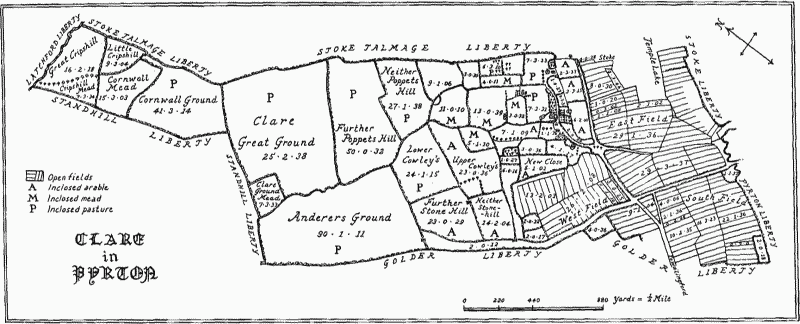
CLARE in PYRTON
Clare village, early inclosures, and open fields, reproduced with modifications from William Burgess's map of Pyrton (1735).
The chief crops grown were wheat and barley. In the case of John Eustace, gent., who left goods valued at over £821, well over a quarter of the value of his goods came from these two crops. Pease, vetches, oats amounted to about half the value of his barley. (fn. 525) A much poorer man, the vicar John Barnard, with £43 worth of goods in 1637 had a little more pulses than barley and in addition to his wheat he had maslin in store. (fn. 526)
Sheep flocks normally up to 140 or so in number continued to be kept, and besides cattle and pigs the records indicate that there were a fair number of horses. (fn. 527) John Eustace, for example, had 84 sheep, 60 beasts, and 50 horses, (fn. 528) and a Waterperry yeoman, who had a lease of pasture land, was sued by the vicar in 1667 for tithe from 300 sheep and lambs, and from milch cows and calves, oxen and dry cows, horses and young pigs. (fn. 529) Pasture at Pyrton was now plentiful, and it was customary to allow 'foreign sheep' to use the commons. In 1711 a 'groat a score a month' was the usual charge. (fn. 530)
As for tenure, it is known from the court rolls of Pyrton manor that leasehold and copyhold were both common forms of tenure from the 16th to the 19th century, when copyhold died out. In 1606 there were ten copyholders in Pyrton manor, one more than in 1548. (fn. 531) Copyholds in the 16th century were usually held for two or three lives and could not be granted for more than three lives. It was also the custom that no copy was 'good in reversion'; and that if the person first named in the copy wished to surrender it he could 'barr all the rest though the others named in the copie doe not consent'. (fn. 532) Fines are not usually entered on the 16th-century rolls, but one entry in 1571 shows Richard Symeon paying £2 for taking up a holding of 3 virgates and a cottage with 3 acres of land. (fn. 533) Seventeenth-century fines show the great rise in the value of the copyholds; in 1655 the fine taken for a messuage and 4 yardlands was £300. This copy gave the holder licence to sub-let the farm for a term of 21 years. (fn. 534)
At the turn of the 18th century and again in the mid-19th century Pyrton could boast farmers who were among the best in the county. Mr. Cozins, who farmed his Goldor property himself, was much admired by Arthur Young: he found him extremely intelligent, except on the matter of crop rotations. In this, although he had 'enough to manage as he pleased', he was so great a believer in the value of frequent fallows that he fallowed every third year after peas, clover, and vetches. Young regarded this as 'a system of barbarism', which ought to be 'exploded'. It could only be justified if the 'shackles of an open field forced these courses'. He equally deplored Cozins's habit of putting barley seed in on summer fallow and his objection to spring sowing without spring ploughing. In fallowing for wheat Cozins ploughed the land five times to let the sun in and Young gives a detailed account of his method of casting down and gathering up the ridge again; he preferred horses to oxen for ploughing, and kept six horses to every 100 arable acres; he experimented in crops, favouring Dantzig White and Red Chaff rather than White American. He kept 100 cows, Long Horns and occasionally Herefords, and sold calves to the London market at 12 or 13 weeks old. His sheep were Berkshires. Young admired his 180guinea granary of two stories, one of the best he had seen, and described his three farm-yards, nearly surrounded with stables, cowhouses, and movable barns. The yards were used for keeping in at night horse-teams, barren cows, and milch cows. Cozins used fermented dung on his land and peat ashes, which he found particularly beneficial for clover and natural grasses. (fn. 535)
Fifty years later another agricultural expert, Sewell Read, wrote in the same admiring vein of Stonor's Assendon farm: 'It would be difficult to find a hill farm more advantageously cultivated.' The swedes were grown with superphosphates and ashes plus farm-yard manure; the turnips were preceded by vetches or rye; a portion of the turnip crop was removed to the wheat-stubble, or sheep were folded before the ground was ploughed for the next crop. A few early turnips were fed off in time for wheat which might be followed either by barley or clover. There was a good extent of sainfoin on the hills and in some parts wheat was sown after a raked fallow; beans were planted instead of clover, while oats were grown after the seeds. (fn. 536) It is interesting to compare the crops grown with the details of cultivation given in 1799 for Stonor's rectory property. The following were the crops and their acreages: turnips (90 a.), barley (100 a.), mown clover (80 a.), fed clover (70 a.) wheat (110 a.), oats (120 a.), mown sainfoin (50 a.), and fed sainfoin (20 a.). (fn. 537)
Total inclosure finally came in 1851: in favour of inclosure it was argued that the waste would be cultivated, that owners would hold compact farms and cultivation would be consequently improved; that there would be useful employment of labour, and an allotment of land for the poor in lieu of their customary right to cut furze on part of the waste. By the award 637 acres were allotted for former common field land, 28 cow commons, and 528 sheep commons. Since the total acreage of Clare, Goldor, and Pyrton was 2,709 acres, there must have been well over 2,000 acres of old inclosures in Pyrton below-the-hill. All Assendon (1,534 a.) had long been inclosed. The chief allottees were the Dean and Canons of St. George's Chapel, Windsor, and Christ Church, Oxford, who received 391 acres and 119 acres apiece. Hugh Hamersley, Windsor's tenant, received 26½ acres for his former holding of 21 acres in the open fields with its appurtenant cow and sheep commons. Five others, including the vicar and the churchwardens, received allotments of under 13 acres and about 50 acres were 'sale allotments'. (fn. 538) Most of the smaller tenants were bought out. The poor obtained an allotment on Pyrton Hill and a recreation ground, but the village suffered socially by the closure of the footpath to Shirburn. This was done in the interest of the farmers, who feared that if the footpath were left trespassers would be encouraged. (fn. 539)
As so little land was involved inclosure made no marked difference to the size of farms in Pyrton. Some farms had long been well above the average size of farms in the east and south of Oxfordshire. As early as c. 1720 two pasture farms in Clare comprised 258 and 187 acres. (fn. 540) In Pyrton in 1738 there was one farm of 244 acres and two of over 150 acres each. (fn. 541) During the next century or so, although the average size of farms in the parish increased, some large farms were broken up: in 1792 Manor farm at Pyrton comprised 344 acres and 6 other tenant farms had between 40 and 144 acres, but by 1835 there were 5 farms of 101 to 288 acres. (fn. 542) Magdalen College's Goldor farm, however, remained exceptionally large with 590 acres. (fn. 543) The hill farms were naturally smaller: of Assendon's five farms in 1725 White Pond farm, of which the land spread into Pishill and Watlington, and Hollandridge were the largest and both were under 200 acres. (fn. 544)
These hill farms were more given over to arable than those below the hill. In 1851 at Standhill there were only 50 acres of arable between the two farms; at Clare on three farms, together covering nearly 500 acres, there were only 42 acres of arable, but on two others totalling 285 acres, although they were mixed farms, there was rather more grass than arable. The five Pyrton farms on Hamersley's estate as well as the rectory farm, on the other hand, put the emphasis more on arable than on pasture. (fn. 545) The use of the land had in fact changed little since 1792: out of 900 acres then in the Hamersley estate about 640 were inclosed or open-field arable, 220 mead and pasture, and over 70 acres lammas and commonable meadow. (fn. 546) The figures were roughly the same in 1835. Pyrton Hill remained an extensive sheep common of 170 acres and cow common of 22 acres. (fn. 547) The value of this rough grazing, however, was probably small. As early as 1729 a terrier of Pyrton parsonage stated that there was common for 5 cows and 200 sheep on the waste, but that the tenants had not kept any sheep there for many years because of the unhealthy pasturage, the sheep 'often dying suddenly'. (fn. 548)
In the mid-19th century most of the parish was divided into farms of between 100 and 600 acres. The many small holders that appear in the rate books were mostly no more than cottagers. In the Pyrton division (i.e. the land below the hill) in 1853 there were 13 farms and 31 cottage or very small holdings: in the Assendon division there were 5 farms of 100 to 185 acres, Stonor Park (211 a.), 525 acres of beech wood, and 43 cottage holdings, including one with 21 acres. Many of these farms had been recently amalgamated. (fn. 549)
The last half of the century saw the farming community involved in increasing difficulties. There had been discontent earlier in the century, for 'vile incendiaries' set fire to one of Stonor's farms at Pishill. (fn. 550) The cattle plague of the 1860s and low prices for agricultural products were accompanied by unemployment, low wages, and consequent labour troubles. Joseph Arch's movement to organize labouring discontent was replied to by the Bucks., Oxon, Wilts. and Glos. Farmers' Defence Association. Its objects were to 'frustrate exorbitant demands of the unions', prosecute cases of intimidation, and resist 'tyrannical contributions'. Hamersley was reluctant to join such an association, and wrote that he regretted that the good feelings which had existed until 1872 between farmers and labourers should be 'so thoroughly swept away by outside agitators'. He was opposed to the idea of a general rate of wages, which should be agreed on by farmers, and wished to continue making individual bargains over wages and to have as much piece work as possible. (fn. 551)
Between 1885 and 1895 Edward Hamersley, Hugh Hamersley's son, was obliged to farm over 1,000 acres through foremen owing to the impossibility of finding suitable tenants during the depression. (fn. 552)
In the 20th century farms have increased in size; mixed farming is generally practised; and the district is noted for the fine quality of malting barley grown. Sheep flocks are increasing in number. (fn. 553)
In the Chiltern area the woodlands formed a large part of each parish, but the Domesday account of Pyrton omits any reference to woods which undoubtedly existed. (fn. 554) They may have been omitted because they were all in the hands of free tenants and none was held in demesne. There are, however, frequent indirect references in the Middle Ages to the woodland from the 12th century onwards—to pannage rights, for example, and to woodmen. (fn. 555) In the later Middle Ages the names and extents of some of the chief woods are recorded: in 1387 there is a statement that 'Harlyngrugge wode', in the neighbourhood of the modern Hollandridge farm, had hedges and hays in it, indicating that parts at least were inclosed; (fn. 556) in 1439 the extent of Kilridge Wood, which adjoined Stonor House, was said to be 3 leagues, and that of Home wood 1 league, and the pasture of both was stated to be separate all the year round. (fn. 557) In 1421 the woodward's receipts, together with pannage, came to £2 10s. 8d.; in addition, underwood in Kilridge (Culrug) was sold for 23s., and acorns in Home and Kilridge woods for 13s. 4d.; (fn. 558) in 1439 underwood was sold for £4 14s. (fn. 559)
From the late 15th century these woods and others (fn. 560) were owned by the Dean and Chapter of Windsor and were usually leased. A lease of part of Kilridge Wood in 1525 mentions beech, ash, witchelms, maple, aspen, and whitebeam. (fn. 561) About 1538 the dean and chapter leased them with the 'site' of the manor to Edmund Symeon of Pyrton, yeoman, whose family granted rights in Queenwood and Homewood to William Chamberlain of Shirburn in 1586, and rights in Kilridge to Adrian Scrope of Wormsley in 1595. (fn. 562) In 1593 Sir Francis Stonor obtained rights in Queen Wood, and soon after his successor Thomas Stonor recovered Kilridge Wood. (fn. 563) The interest of the Stonor family in forestry at this period is well illustrated by Sir Francis's offer to rent all the king's woods in England and to pay £10,000 a year more than they were bringing in. (fn. 564)
Here as in other parts of the Chilterns there appears to have been much disafforestation in the 17th century: in 1693 Thomas Stonor (d. 1724) leased Hollandridge farm with 'parcels of wood ground that was lately grubbed and converted into tillage' in various closes, and part of 'Ballasdree' coppice, which had similarly been grubbed up and converted. (fn. 565) On the other hand the lease contained provisions for the planting of oak, ash, elm, beech, and maple. (fn. 566) A late-18th-century account of the Stonors' woodland listed about 430 acres in Pyrton, excluding part of Stonor Park, but including Kilridge Wood (244 a.), Lower Queen Wood (37 a.), Blind Hill (71 a.), Darkwood Coppice (5 a.), Earls Coppice (8 a.), Earls Hanging (26 a.), Fire Wood (6 a.), Great Wood (31 a.), and various other coppices. Stonor Park covered 150 acres, and 67 acres of the estate had been grubbed or sold. (fn. 567)
The number of coppices named suggests that there had been much afforestation in the 18th century, and evidence of this comes from a map of 1811 which shows that woodland had been planted in Parker's moor to the north-west of the village since 1735. (fn. 568)
In the mid-19th century the woodland covered 513 acres and ownership was divided between the Dean and Chapter of Windsor, Lord Camoys of Stonor Park, and Christ Church. (fn. 569) The greater part of the beech woods (329 a.) belonged to Lord Camoys; Christ Church had 20 acres. (fn. 570)
Parish Government.
The affairs of Pyrton and its dependent hamlets were regulated in several courts in the Middle Ages. All the tithings owed suit to Pyrton hundred, which was attached in the 13th century to the honor of Wallingford, and afterwards to the honor of Ewelme. (fn. 571)
The most important of the manorial courts was the court of the lord of Pyrton manor, which was attended not only by his tenants in Pyrton itself, but also by the lords of the dependent manors in the hamlets of Clare, Goldor, Standhill, Assendon, and Pishill Venables. It is recorded in 1279 and was last held in about 1867. (fn. 572) Records of this court survive, with some gaps, from 1381 to 1768. (fn. 573) Courts were being held twice-yearly by the early 15th century, when there was usually one court about Easter time and another after Michaelmas. (fn. 574) There are usually records for only one court a year for the late 16th century and after, and it may then have been customary to hold only one court. (fn. 575) The main business of the court was with matters of tenure and the administration of the manor. There are instances of the election of the reeve, the hayward, the Pyrton tithingman, and of men to dip the king's sheep. (fn. 576) Attachments by the messor and the woodward were distinct items in the business of the court. (fn. 577) In 1416 the reeve received allowances for money paid for writs to prosecute a tenant in the king's court, in the lord's name, for non-payment of rent and assault. (fn. 578)
The Stonors also held a court for tenants of their property, for which records survive for the late 14th and 15th centuries. (fn. 579) It was held at Stonor and dealt with purely manorial business, i.e. land transactions, trespasses in the lord's fields, and collection of pannage. Attachments by the bailiff and by the parker were also dealt with. (fn. 580)
In 1279 the hundred rolls show that other undertenants of the Pyrton manor held courts. John d'Esseby, lord of Standhill and Clare, was said to have his own court, and the De Bruys, lords of another Clare manor, also had a court. (fn. 581) Tenants of Dorchester Abbey and of the Templars owed suit to the courts of their respective lords. (fn. 582)
From the 16th century the vestry and its elected officers took a prominent part in parish government, since it was the only body empowered to deal with the problem of poverty and vagrancy. (fn. 583) In the 18th century vestry meetings were held either at the parish church or at the 'White-Hart' and in the early 19th century at the 'Hare and Hounds'. (fn. 584) The Easter vestry, when the accounts were audited and the churchwardens and overseers nominated, was usually well attended: besides the officers there were often as many as ten other signatories to the minutes. (fn. 585) This was sometimes the only vestry meeting recorded for the year, but frequently other meetings were called to discuss particular points. (fn. 586) Apart from supervising the accounts, the vestry's chief function was to determine the parish policy not only towards the upkeep of the church, but in particular towards the relief of the poor. It was responsible for seeing that rates were paid and in several years at the turn of the 19th century, when expenditure on poor relief was high, it ordered revaluations of the parish. (fn. 587) Late-18th-century vestry minutes show the vestry exercising strict supervision over weekly rates of relief and allowances for rent, and surveying in detail the clothing issued to the poor. (fn. 588) There are no minutes after 1816, but a record by the overseers in 1824 of payment for a select vestry shows that the parish had taken advantage of its power, given by the Sturges Bourne Act of 1819, to establish an annual committee to deal with poor relief. (fn. 589)
The chief officers of the vestry were the churchwardens and the overseers of the poor. There were two churchwardens and their chief responsibility was to the church, although in early accounts they are also found making payments to the poor. (fn. 590) A similar mixture of functions is seen in the overseers' accounts, where occasional payments for the church fabric are found. (fn. 591) The church rate varied according to the amount of work carried out on the church fabric; in the late 18th and early 19th centuries it was usually levied once a year and was between 1d. and 3d. in the pound. (fn. 592)
Poor relief was the special responsibility of the overseers. There were usually two overseers for Pyrton, save from 1807 to 1817 when there was one, and a third for Assendon. (fn. 593) They were appointed yearly on the nomination of the parish and were prominent parishioners. In 1805, for example, the Roman Catholic Thomas Stonor was removed as overseer of Assendon by the justices, but against the unanimous wish of the inhabitants, and was later reinstated. (fn. 594) A woman, Mrs. Susannah Woodbridge, was appointed overseer for Pyrton in 1797. (fn. 595) From 1820 payments to one of the overseers of a salary of about £20 are recorded; he was often called the deputy overseer and the post was served in several years by the vestry clerk. (fn. 596) By order of the vestry in 1778, the overseers met once a month to close and audit the accounts and to hear the complaints of the poor. (fn. 597) The Pyrton overseers levied the rates for Pyrton, Clare, Goldor, and Standhill and dealt with the day-to-day administration of their poor relief. From 1792 to 1811 the Assendon overseer's account was kept separately until the final audit, but from 1815 it was entered monthly in the Pyrton accounts as a separate item. (fn. 598) Between 1797 and 1804 Standhill also accounted separately for large sums in the final audit, but this practice was not continued in later audits, probably because the problem of poor administration had ceased to be so pressing. At the final audit the constables for Clare, Goldor, Pyrton, and Standhill also presented their bills, which were entered in the overseers' accounts. (fn. 599)
The administration of poor relief was a heavy burden on the parish in the last 50 years of the old poor-law system. There had been almshouses at Assendon since the 15th century, and the overseers' accounts of the 19th century record the carriage of wood to them. (fn. 600) Pyrton itself had no provision for its aged or infirm poor until after 1794. In that year the vestry discussed the building of a workhouse, but finally decided to put up six cottages for the poor instead at an estimated cost of £120. (fn. 601) Rent was paid for these by the tenants and appeared among the overseers' receipts. (fn. 602) The needs of the poor continued to grow and in 1803 the parish was relieving 57 people regularly and 506 occasionally, the largest return for the whole of Oxfordshire. (fn. 603) Poor rates and expenditure had consequently become increasingly heavy: in 1771, for example, there were three sixpenny rates and in 1801 there were ten shilling-rates. As late as 1835, the last year of the old poor-law system and after several revaluations of the parish, there were seven shilling-rates and one at 1s. 6d. (fn. 604) Expenditure rose from between £400 to £500 in the 1770s and 1780s to £1,866 in 1801–2, one of the worst years. (fn. 605) In the years immediately after the Napoleonic wars it was again over £1,300 a year, and down to 1835 it seldom fell to under £1,200. (fn. 606) The problem was reflected also in the large number of removal certificates, notably in the post-war period, when a greater number of families moved into the parish than left it. (fn. 607) Relief measures ranged from the provision of clothing, medical care, payment of schooling, and occasional distribution of food to the maintenance of families. (fn. 608) In 1783 the vestry decided to appoint a special retailer, from whom the overseers should buy all clothing issued to the poor. (fn. 609) An apothecary and surgeon was also appointed: in 1779 he was a Mr. Metcalfe who, for a salary of £12 12s. a year, was to attend to the poor in all cases of illness, except smallpox, and to act as midwife in cases where a woman midwife was not sufficient. (fn. 610) A Mr. Stringer of Watlington, who was appointed a fortnight later, perhaps because of some rivalry in the parish, was described as 'skilful in his profession, humane in his disposition, and very moderate in his bills'. (fn. 611) In 1788 two apothecaries from Watlington were again appointed for £20 a year. (fn. 612) The overseers also paid for treatment at the Radcliffe Infirmary, (fn. 613) and over some 20 years for the upkeep of a lunatic in Bethlem and St. Luke's hospital. (fn. 614) Outbreaks of smallpox and cholera imposed further expense: there were cases of smallpox at Assendon in 1797 and at Pyrton in 1804; in 1806 the doctor was paid £10 for innoculating the village with smallpox vaccine, and in 1818 £48 5s. was paid for vaccinating 73 people. (fn. 615) There was cholera marbus in 1832, when the overseers paid £2 17s. 9d. for spirits and wine for the poor suffering from it. (fn. 616)
Weekly payments to the aged, widows, and mothers were already being made in the first surviving overseers' account of 1787. (fn. 617) The 1794 account shows that there were 19 people receiving weekly payments in Pyrton, 8 in Pyrton Uphill, 9 in Standhill, 19 in Assendon, and 11 living outside the parish in Watlington. (fn. 618) Numbers rose over the period until in 1835 there were 55 receiving payments in Pyrton, 15 in Clare, Goldor, and Standhill, and 23 in Assendon. (fn. 619) Payments towards rents were also large: the parish authorities tried on several occasions to reduce them, and in both 1804 and 1815 the vestry decided that no more such payments would be paid, (fn. 620) but the decision was apparently impossible to enforce and rent payments were still being made in the late 1820s. (fn. 621)
Like other Oxfordshire parishes Pyrton eventually adopted the roundsman system, but there is no evidence of it until 1815. (fn. 622) In 1816 the vestry resolved that no single man should be allowed board ('a billet') when he went on the rounds. (fn. 623) About twelve local farmers, including Lord Macclesfield, co-operated in the scheme in the 1820s, and in 1830, for example, the overseers paid £173 for their roundsmen. (fn. 624) At the same period work was provided on the roads and by stone-digging on Pyrton hill, and women were trained in lace-making, (fn. 625) but in 1834 the overseers were paying out about £10 a month 'in lieu of labour' to men and boys. (fn. 626) After 1835, when outdoor relief was abolished, the care of Pyrton's poor was transferred to the Henley Poor Law Union. (fn. 627) In 1848 the poor rates were said to be 'very moderate' compared with rates under the old law. This was attributed partly to the unwillingness of landowners to build cottages. The surplus population lived in Watlington, and, as under the new law of settlement it was difficult to know who was chargeable to the parish, Pyrton's rates were kept down. (fn. 628) Some labourers emigrated at the expense of the parish, but it was said that others were of a 'cast off description' and were rejected by the Emigration Commissioners. (fn. 629) In 1851 the waste grounds where the poor had the right to cut furze were inclosed, and 4 acres were allotted in compensation. At the same time an allotment for recreation was made at Pyrton Hill. (fn. 630) In 1852 the poor rate was 2s. 11½d. and £780 was spent on poor relief. (fn. 631)
A rate was levied also for the use of the road surveyors, but in 1848 it was said that, although it was moderate, so little was done that it would be better to pay more and have more done. (fn. 632)
Church.
The parish of Pyrton, a vicarage in Aston deanery, once included the chapelries of Standhill (fn. 633) and Easington. In the early 13th century the latter became a separate parish (fn. 634) and from that time Pyrton parish consisted of five tithings: Pyrton, Clare, Goldor, Standhill, and Assendon. (fn. 635) The latter, a detached upland area which included Stonor Park and the hamlet of Upper Assendon, was united in 1854 to the ecclesiastical parish of Pishill. (fn. 636) In 1943, when Shirburn and Pyrton were united, the so-called hamlets of Upper and Lower Standhill were transferred to the ecclesiastical parish of Great Haseley and a close near Love Lane to that of Watlington. (fn. 637)
The church was in existence by 987, when according to the terms of a grant by Oswald, Archbishop of York, 5 hides in Goldor were to pay church scot to Pyrton, and Leofward, to whom the land was granted, and his heirs were to have true friendship with the dominus ecclesie. (fn. 638) In about 1115 William Fitz Nigel, the lord of Pyrton, granted the church to his foundation of Augustinian canons at Runcorn (Ches.), a priory which was moved in 1134 to Norton (Ches.). (fn. 639) The church was probably at once appropriated, and certainly had been so by about 1200, when the priory was receiving a part of the tithes. (fn. 640) A vicarage was not ordained until about 1220. (fn. 641) Norton Priory, which in the late 14th century became an abbey, kept the church until its dissolution in 1536. (fn. 642)
In 1546 the rectory and advowson were granted to Christ Church, Oxford, in whose hands they still remain. (fn. 643) In 1943 the living was united to that of Shirburn, and Christ Church and the Earl of Macclesfield have since presented in turn. (fn. 644)
According to the early-13th-century ordination of the vicarage, Norton Priory was to receive almost all of the great tithes except for those in Standhill, and a certain amount of land. (fn. 645) At the valuation of 1254 the rectory was valued at £16 13s. 4d.; in 1291 at £21 6s. 8d., and in 1535 at £22, less a payment of £2 to the bailiff. (fn. 646)
The post-Reformation rectory remained a valuable piece of property. By a valuation of 1799 four-fifths of it was worth £454. (fn. 647) In 1850 the tithes of Pyrton, Goldor, and Clare were commuted for £670 and those of Assendon for £200. (fn. 648) Some 540 acres, mostly woodland, were tithe free. (fn. 649) Since 1546 Christ Church had followed the policy of leasing the rectory, except for the advowson and timber. (fn. 650)
There were two ordinations of the vicarage, the second being rather different and more detailed. (fn. 651) From later evidence it is clear that the second ordination superseded the first. By it the vicar was to have all church offerings and all small tithes throughout the parish, and also the great tithes from Standhill and from 5½ virgates belonging to the rectory estate. There was an elaborate arrangement about the tithe of homesteads, which sometimes were to go to the rector, sometimes to the vicar. The vicar was to have two houses, one at Pyrton with a ½-hide of the canons' demesne, meadow, and housebote and heybote in their wood, and one at Standhill with a ½virgate of land with adjoining meadow at Standhill; he and his chaplain were to say daily services at Pyrton and Standhill. (fn. 652)
This vicarage was valued at £2 13s. 4d. in 1254; at £4 6s. 8d. in 1291; and by 1535 at £17 9s. 4½d., more than triple the earlier value. (fn. 653) Post-Reformation valuations showed a similar tendency to rise in value: by the late 17th century the vicarage was valued at £100, twice the early-17th-century value, and in 1831 it was worth £238. (fn. 654) Most of the income came from tithes. In 1683 the vicar was said to have in Pyrton tithes of 77 arable acres of the parsonage glebe and of part of the parsonage meadows. (fn. 655) Later accounts of the tithes explained that the vicar was entitled to the tithes of homestalls, whether they bore hay or corn, and to both great and small tithes at Standhill, but that in Pyrton, Clare, Goldor, and Assendon the tithes of pasture, which had been converted into arable or meadow, went to the impropriator. In the early 18th century the vicar said that he made a bargain with the Standhill tenants whereby they paid 1s. 6d. per pound rent for meadow and pasture and 2s. 6d. over and above for every acre they ploughed up. (fn. 656) In 1827 the upper part of the parsonage land (i.e. the hill part), said in 1799 to be 1/5 was leased to Thomas Stonor and the lower part to the Earl of Macclesfield and Paul Blackall. (fn. 657) The tithes of Standhill were commuted in 1840 for £128 13s.: when those of the rest of the parish were commuted the vicar received £200 for the small tithes and £27 for the tithes on the rectorial gleve. (fn. 658) In 1870 the living was augmented by £20 a year from Christ Church. (fn. 659) In 1954 the value of the combined living of Pyrton and Shirburn was £550. (fn. 660)
The vicar usually managed the tithes of Standhill as a separate unit: for much of the 15th century they were farmed to Sir Edmund Rede, who owned the land. When the Abbot of Oseney, who was vicar, gave the farm to Sir William Stonor in 1479 for his chaplain, Rede wrote to Stonor complaining. (fn. 661) In the 1660's they were being farmed to John Leach, a yeoman of Waterperry. (fn. 662)
The vicar's glebe was always small, only about 5 statute acres. (fn. 663) In the early 17th century he had 14 'lands' in two fields, 2 cow commons, and 3 acres of meadow. (fn. 664) In 1799 the arable glebe was sold for £245, part of the money being used to redeem the land tax. (fn. 665)
Except for Edmund, 'priest of Pyrton', (fn. 666) no names of priests are known until the early 13th century. Thereafter the list is fairly complete until the early 15th century. (fn. 667) One of them, Robert Patteshulle, had his living sequestrated in 1385 as his parishioners had complained that he lived far away, and that they were deprived of the sacraments and their rights of divine worship. The bishop decreed that the vicar should be allowed maintenance, and if what remained from the vicarage was not sufficient to pay a chaplain then the parishioners and the abbey were to contribute. (fn. 668) In 1399 Norton Abbey was given papal permission to serve its appropriated churches, including Pyrton, with such of its own canons as were priests. (fn. 669) A canon of Norton was presented in 1417, (fn. 670) but after this there is a gap of 60 years in the presentations. There are several records of a later vicar, Henry Terfoot (1436–47), who was also canon of Norton. (fn. 671) It was he who made an agreement with the lord of Standhill reintroducing the services at the chapel there, and who was fined by a Pyrton court for digging chalk and carrying it away from Watlington Hill. (fn. 672) In 1477 another Augustinian canon, Robert Leicester, Abbot of Oseney, served as vicar for five years. (fn. 673) The name of his predecessor is not known, but he presumably attended the elaborate funeral of Thomas Stonor (d. 1474), when the whole parish was feasted, (fn. 674) and may have been the John, Vicar of Pyrton, who attended another Stonor funeral at about this time. (fn. 675) It is probable that abbot Robert Leicester only lived in the parish occasionally and his successor, Lawrence Orrell (c. 1485–1550), may also have been mainly non-resident, certainly so at the end of his ministry. There are several references to him in the court rolls of Pyrton: his horse and pigs got into the wheat-fields; he disputed with the bailiff of the manor over rights of common; and his servant is occasionally mentioned. (fn. 676) He is likely to have been present at the lavish funeral at the parish church of Lady Anne Stonor in 1518 and at Stonor chapel (fn. 677) where 42 priests and six chaplains offered Masses. (fn. 678) Nevertheless, at the visitation of c. 1520 it was reported that the vicar was non-resident and that his house, the nave of the church, and the walls of the churchyard were ruinous. (fn. 679) The church was served by a curate at a stipend of £5, (fn. 680) who was not altogether satisfactory: it was complained that he refused to bury a person on Passion Thursday. Various parishioners at this date, including Sir Adrian Fortescue, were in debt to the church. (fn. 681) A few years later the churchyard bounds were still in disrepair, the churchwardens and parishioners were quarrelling, and the church lacked books. (fn. 682)
The Reformation was a troubled period in Pyrton church. Thomas Barnard, a canon of Christ Church who became vicar in 1548, (fn. 683) was a Protestant: he had been chaplain to Archbishop Cranmer (fn. 684) and was probably married when he came to Pyrton, for he had two sons old enough to be farming the rectory in 1568. In 1554 he was deprived and replaced by Richard Martiall, the intruded Dean of Christ Church, who was considered by some a man 'of drunken habits and fanatical temper'. (fn. 685) On the accession of Queen Elizabeth he suffered for his religious views, was deprived and replaced by Barnard. (fn. 686) Barnard died in 1582 and was succeeded as vicar in 1583 by his son John. (fn. 687) An entry of 1603 in the parish register throws an interesting light on the latter's relations with the Roman Catholic Stonors and their priest. The vicar noted that at Mr. Shepheard's entreaty he wrote down the names of the Stonor children in the register at the time when they were christened, though he did not know where they were christened. (fn. 688)
The religious changes of the times are also reflected in the churchwardens' accounts. (fn. 689) In 1548 the king's injuctions and homilies were set up, in 1549 a quire book was bought, in 1550 the church was whitewashed and a new 'Lord's table' made, and in 1553 a book of Common Prayer was bought. In the following year, however, with the accession of Mary to the throne, the return to the old religion necessitated the making of a 'new Seuper table' and the purchase of a Mass book, a manual, a processional, wax for the Paschal candle, new vestments—the latter at a cost of 40s.—and a new paten for a chalice for 14s. 9d. The chalice was later sold under Elizabeth for 31s. 4d. In 1556 the rood and other images were set up again and in 1557 the churchwardens paid for the painting of the high altar and for a doom over the chancel arch. Two years later, however, in 1559 and 1560 the altar was pulled down, another book of Common Prayer was bought, the wardens paid for the 'wiping out of the images', and in 1561 for 'making clene the church when the rood loft was pulled down'.
These early accounts show the importance of the two churchwardens, who were usually chosen in May; (fn. 690) they were responsible for money belonging to the church, for keeping the building in repair, and for buying books and ornaments; they attended the visitations, usually at Henley or Watlington, but occasionally at Ewelme, Dorchester, or Oxford; they rented the church acre and the church flock of 20 sheep. (fn. 691) When a rate was necessary, however, as it was in 1587, it was imposed by the parishioners. (fn. 692)
Part of the 17th century was also a troubled time at Pyrton. After the death of John Morris (vicar 1635–49), Regius Professor of Hebrew at Oxford and a benefactor of Christ Church and of Pyrton, (fn. 693) Jasper Mayne (1604–72), a Student of Christ Church, a dramatist, and a 'quaint preacher and noted poet', became vicar, in spite of a parliamentary presentation at the same time. (fn. 694) Mayne was a royalist who had preached before Charles I. (fn. 695) He spent part of his time in Pyrton until ejected from the living in 1656; during that time he held a public debate in the neighbouring church of Watlington with John Pendarves, a noted Puritan. (fn. 696) In 1654 the register records that a certain John Pophley took the oath to perform the office of 'register' in the parish, and thus deprived the vicar of part of his duties. (fn. 697) In 1660 Mayne was restored, and although he held other benefices, he seems to have been living in 1665 in his comfortable Pyrton vicarage, the largest house in the parish after the Rectory, and he left, on his death in 1672, £100 to the parish. (fn. 698)
Soon after this, in the time of Timothy Halton (archdeacon of Oxford 1675–1704), the churchwardens were ordered to remove the communion table from the middle of the chancel, where the communicants could not 'with such decency and order as is meet' receive communion, to the upper end of the chancel under the (east) window. (fn. 699)
Later vicars were also almost all connected with Christ Church: one, Roger Puleston (1672–82), left £15 to the Pyrton poor; (fn. 700) another, Thomas Ackworth (1682–1702), was one of the few Oxfordshire clergymen who resigned their livings rather than take the oath of loyalty to William III, but his successor William Howell (1702–14), also curate and schoolmaster of Ewelme, is said to have allowed him part of the income from Pyrton. (fn. 701) From 1735, for nearly 100 years, the living was held by two vicars: Ralph Church (1735–87) and William Buckle (1787–1832). Although Church was accused in 1741 of being nonresident and having no regular curate, so that those who were dangerously ill had no minister to pray for them and the dead were buried several days before the funeral service could be held, Church claimed to live in his vicarage and to hold two services with one sermon on Sundays. (fn. 702) When he later became Vicar of Shirburn, his time was divided between the two parishes, (fn. 703) as was that of his successor. At the end of the century there were between 30 and 40 communicants, and the sacrament was given four times a year. (fn. 704) Early in the 19th century the number of communicants fell, (fn. 705) and although later two Sunday services were held and the sacrament given monthly the number of communicants was never more than about 35, and congregations averaged about 100. The early age at which children left school and were put in charge of cattle feeding on Sundays was considered a hindrance to a good church attendance. (fn. 706)
Because of its size the parish was a difficult one. The vicar complained that the children of people in Assendon, 7 miles distant from the church, were being brought up as Roman Catholics by the Stonors' chaplain (fn. 707) or went to the nearer church of Pishill which was a mile away, while the people of Clare often went to church at Stoke Talmage. (fn. 708) Standhill was also several miles from the church.
Towards the end of the century Henry H. Coxe (vicar 1880–90), the historian of the parish, by starting services in the Chilterns, was partly responsible for the building of the chapel on Christmas Common in Watlington parish. (fn. 709)
The medieval chapel of Standhill was first mentioned in about 1180, when Norton Priory, the appropriators of the parish church, promised Ralph de Coleby (fn. 710) to supply a chaplain in return for a grant of a ½-virgate of land and a toft. The parishioners living in the village were to go to Pyrton church three times a year with alms and oblations. (fn. 711) When the vicarage of Pyrton was ordained a little before 1220, daily services at Standhill became the responsibility of the vicar or his chaplain, and the vicar was given a house there. (fn. 712) There are scattered references to the chapel in the records. In 1317 a free tenant of Standhill gave land to endow the light of the Blessed Virgin in it, (fn. 713) and by 1424 the village had evidently become so depopulated that daily services were no longer held. When the Vicar of Pyrton was summoned for neglecting the chapel it was stated that only three services a week were required. (fn. 714) In 1447, when it was definitely said that the hamlet had been depopulated by pestilence, it was agreed, with the consent of Edmund Rede, the lord of the manor, that only one service a week was necessary. The vicar was to be responsible for the chancel of the chapel, and the parishioners, if there were any, for the nave and for providing a clerk for the vicar. If the hamlet was again inhabited, services were to be held three times a week. (fn. 715)
It is not clear how long the chapel continued in use. It had had its own chaplain as late as 1394; (fn. 716) but in 1489 it appears not to have been in use. Edmund Rede had in his keeping the breviary belonging to the chapel, and his will contained the wish that it was to be returned to it if it was ever needed. (fn. 717)
In 1526 the curate of Pyrton had the large stipend of £6 and his duties may have included services at Standhill. (fn. 718) As late as 1555 the 'free chapel' was included in a conveyance of land. (fn. 719) It is likely, however, that services ceased soon after the Reformation. In the early 18th century the chapel was described as capella destructa, (fn. 720) and in 1745, when Thomas Delafield wrote his account of it, the chapel was in ruins and had served for many years as a calves' house. Delafield carefully noted its position between Standhill farmhouse and the Haseley Brook. (fn. 721) Its site is marked on Davis's map of 1797 and by the surviving field-name Chapel Close. (fn. 722)
Stonor chapel was always a private chapel of the Stonor family: it dates from the end of the 13th century and was licensed for marriages in 1331 when the two daughters of Sir John Stonor were married by the Vicar of Pyrton, and again in 1482 when Alice Stonor, widow of Sir Thomas Stonor, married Sir Richard Drayton. (fn. 723) From 1349 the chapel was served by six chaplains, for in that year Sir John Stonor obtained a licence to establish a dwelling for them. (fn. 724) The name of many of the medieval chaplains are known. (fn. 725) After the Reformation the Stonors were recusants and the chapel has continued in use as a private chapel until the present day. (fn. 726)
The church of ST. MARY is built of flint and brick with stone dressings. The building comprises a chancel, nave, south porch, a triple bell-cot at the west end, and a small vestry. Though rebuilt in 1855, the church retains a number of features from the original 12th-century building. There is a Romanesque chancel arch, with three orders of chevron mouldings, jamb shafts, and sculptured capitals. The single-light window in the north wall of the chancel is Romanesque. The window in the south wall is a modern copy in the same style. The Romanesque south doorway has jamb shafts and scalloped capitals; the arch is of three orders with chevron mouldings. The south porch was merely repaired in 1855, and retains its 14th-century arch and gable.
When Parker visited the church in 1850 he found 'some Decorated windows and parts of late Perpendicular work', in addition to the Norman south doorway, chancel arch, and one Norman window. (fn. 727) This report on the windows is confirmed by Buckler's drawing of the church, viewed from the south-east and dated 1822, which shows an early Perpendicular east window and two Decorated windows in the south wall of the chancel and the south wall of the nave, and one late Perpendicular window, also in the south wall of the nave, adjoining the porch. The drawing also shows a small wooden turret with a pyramidal roof, surmounted by a cross. (fn. 728)
Various minor repairs were done during the 18th and early 19th centuries. They included work on the roof in 1720, carpenter's work amounting to over £43 in 1745, a new gallery in 1803, roughcasting and whitewashing the church in 1828, and roughcasting and colouring the chancel in 1831. (fn. 729) A drawing of 1838, the year in which the wooden tower was damaged by high winds and had to be repaired, shows the church with its roof off. (fn. 730) But all this was merely remedial and Bishop Wilberforce's visitation in 1854 probably prompted drastic action. Application was made to the bishop for a grant towards the cost of rebuilding the nave, (fn. 731) and the Dean and Chapter of Christ Church, the lay rectors, were called upon to assist in the rebuilding of the chancel. In 1848 the dean had complained of the expense of repairs and stated that 'the north part of the east wall would have fallen down before now were it not for the cross bars of late put in'. (fn. 732) In a letter in 1854 to Lord Macclesfield, (fn. 733) Dr. Bull of Christ Church stated that it was the practice of the dean and chapter to divide the expense of rebuilding with the lessee. He also stated that the dean and chapter did not contribute to expensive ornamentation. In a letter to Dr. Bull, dated 20 November 1854, (fn. 734) the Revd. C. Conybeare, the vicar, reported that the north wall had begun to give out, and was already more than a foot out of perpendicular, and cracks were appearing in the east and north walls of the nave and widening rapidly. The ends of the beams were rotten and the roof was suspended on the corbels. It was decided that the whole church should be rebuilt, but that 'features of interest were to be carefully preserved or copied'. (fn. 735) The Norman chancel arch, the old porch and south doorway were to be retained, and the old Decorated window to be reinserted, and the others made to match it. (fn. 736) This plan was not fully adhered to. Instead, the old Romanesque window seems to have been reinserted in the chancel, and the window on the south side made to match it. There is no trace of an original Decorated window now, and the east end and nave windows are all 19th-century Decorated.
The nave was lengthened by 6 feet at the west end, and 120 additional seatings provided, (fn. 737) the church being no longer adequate for the rising population of the mid-19th century. As early as 1818 it was said to be able to seat only 300 out of a population of 545. (fn. 738) The small additional seats provided for the children in 1856 are still in position at the rear of the church. The cost of rebuilding the nave was estimated at £1,300 and the chancel at £300. (fn. 739) Old materials provided £200 towards the expenses of rebuilding. (fn. 740) The architect was J. H. Buckler, and the builder G. Wyatt of Oxford. The church was consecrated by Bishop Wilberforce in May 1856. (fn. 741)
The only major work since the restoration has been the installation of new heating in the church in 1929 and of electric light in 1939. (fn. 742) A marble tablet in the chancel records that the last was given by their children in memory of J. W. Bussey Bell, Vicar of Pyrton (1890–1914), and his wife Susan.
Though the pews, lectern, and stained glass are Victorian, the church still retains some of its earlier fittings. There is a medieval tub font, lead lined, standing on a modern base. (fn. 743) In the south porch there are some medieval tiles of six different designs, all of which can be paralleled by other Oxfordshire medieval tiles. (fn. 744) The oak pulpit, decorated with panels carved in relief, dates from 1636 and the churchwardens' accounts give many details about it: 'for 7 daies work to ye Joyner about ye Pulpit—10s.'; 'for making ye Pulpit—£5 15s.'; 'for bringing home the Pulpit—1s. 6d.', are among the entries, which also include the costs of the various materials, such as nails, glue, and joints for the pulpit door. (fn. 745)
The plain wooden chest, bound with iron bars and now in the vestry, was acquired in 1638. 'The 3 lockes of the Chest' cost 10s., and 15s. was 'paid to Embris' for it. (fn. 746) The organ replaced the earlier harmonium in 1953. (fn. 747)
The oldest surviving memorial in the church is an incised Purbeck marble slab to a priest, dated c. 1340, lying in front of the altar. There was formerly a marginal inscription in brass letters, of which only one brass stop remains. The few matrices which are still decipherable show that the lettering was Lombardic. (fn. 748) Wood recorded the stone, but Rawlinson inaccurately records 'a very ancient stone bearing in brass the figure of a priest on it'. (fn. 749)
Both Wood and Rawlinson mention a memorial inscription, now vanished, to Robert Rolles (d. 1507), who was the farmer of the demesne lands held by the Dean and Chapter of St. George's Chapel, Windsor. (fn. 750) A brass, now on the south side of the chancel, but once 'in the body of the church', depicts Thomas Symeon (d. 1522), 'sumtyme fermar of Purtton courte', and Margaret his wife. The figures are full length, in civilian dress, and below are the matrices of their children. (fn. 751) This is the only monument to the Symeon family, which was of importance in Pyrton in the 16th and 17th centuries. The Barnards are commemorated by monuments now on the west wall of the vestry, but formerly on the south wall. An alabaster cartouche, with strapwork decoration, frames an inscription to Thomas Barnard of Yorkshire, Prebend of Christ Church and Vicar of Pyrton (d. 1582) and his wife Edith (d. 1607). Below it is another memorial in stone, now much defaced. This is the inscription described by Rawlinson as 'on a rough free stone in capitals', the text of which he gives in full. (fn. 752) It was erected by the six sons of the Barnards, to commemorate their mother. There are memorials in the chancel to Susanna Acworth, wife of Thomas Acworth, vicar, who died in childbirth in 1685; Clifford Middleton (d. 1697), a lessee of the rectory; Elizabeth Hill (d. 1715); George Hutchins, pastor of the church (d. 1735); Paul Blackall (d. 1811), co-lessee with Lord Macclesfield of the rectory from 1801; Ann Blackall, wife of the above (d. 1801), and to two of their children who both died in 1802.
Rawlinson records a black marble gravestone near the altar (fn. 753) to Thomas Eustace of Pyrton (d. 1701). This is now in the south porch, together with black marble monumental slabs to Thomas Eustace, gent. (d. 1713), and his wife Mary (d. 1712/13). Other memorials are to Elizabeth, wife of Thomas Eustace (d. 1659/60); Jane, wife of Richard Wiggins (d. 1801); Moses Wiggins (d. 1808); Mary, wife of Moses Wiggins (d. 1812); Moses Wiggins (d. 1807).
The monuments in the nave are mostly to members of the Hamersley family: there is a stained glass window, made by Clayton and Bell and erected in 1893, on the south side to Hugh Hamersley (d. 1884), and his wife Mary (d. 1887); (fn. 754) brass tablets to Lt. John Ducat Hamersley (d. 1892); Edward Samuel Hamersley of Pyrton Manor (d. 1909); Lt.Col. John Henry Hamersley (d. 1928); a brass tablet, designed by Eric Gill, (fn. 755) to Col. Alfred St. George Hamersley, M.P. (d. 1929). Another member of the same family is Commander Gerald Ducat (d. 1955), grandson of Hugh Hamersley. Others commemorated are Emily Clara Hale (d. 1903) and her son 2nd Lieut. W. A. L. Hale (d. 1898); two local men, Sergeant Eborn, killed in action in South Africa in 1902, and G. W. Taylor, R.M., torpedoed in 1914; and a father and son, Charles Hopkins Morris (d. 1953) and C. A. Morris (d. 1924).
There are some 18th-century carved headstones in the churchyard. The lych-gate, designed by Boulton & Paul of Norwich, was put up in 1919 as a memorial to the thirteen parishioners killed in the First World War. (fn. 756) A tablet has been added, containing four names, commemorating those who fell in the Second World War. There is a teak garden seat in the churchyard, given in memory of Alfred St. George and I. M. Hamersley.
The church had three bells in 1552, but these medieval bells have since been replaced. (fn. 757) The present treble and the tenor were cast by Henry Knight I of Reading. (fn. 758) The inscription on the treble reads 'Henri Knight Made this Bell 1606' and on the tenor 'Henri Knight made Mee 1605'. The bell cast in 1548 for £5 6s. 8d. at Buckingham has gone. (fn. 759) The small bell was given by Mr. Ives in 1953 to replace the saunce bell, which was made by Henry Knight in 1593. (fn. 760) This last bell, which must have been the one referred to in the churchwardens' accounts for 1652, is now preserved in the church; 'The saints bell of this church was borrowed by Mr. Thomas Eustace, with a promise to be restored again whenever the parishioners should seek for it. Sept. 13th, 1652.' (fn. 761) This incident occurred during the Commonwealth period when the bells were silent. In 1571 the churchwardens paid £3 6s. 8d. 'for casting of our bell' and 13s. 6d. for 'expenses when we were at Reading', (fn. 762) but this bell does not seem to have survived.
In 1552 the church had two silver chalices, a copper cross, two copes, and various other vestments and articles. (fn. 763) One of the vestments had been given by Sir Adrian Fortescue before his execution in 1539. (fn. 764) The church sold a chalice in 1573 for 30s. 4d. (fn. 765) It still owns a chalice of 1589, a flagon of the same date and a paten of 1637. (fn. 766) An entry in the churchwardens' accounts for 1638 states that £1 9s. 6d. was paid for a communion plate. (fn. 767)
The registers date from 1568. (fn. 768) There are churchwardens' accounts for the years 1548–1882. (fn. 769)
Roman Catholicism.
The history of the survival of Roman Catholicism in the Chiltern area is centred round the Stonor family, whose staunch adherence to the old faith made Stonor Park one of the chief centres of resistance to the reformed religion in the south of England. It has continued as a Catholic centre until modern times. The 13th-century chapel of the Holy Trinity, a private chapel attached to the house, is one of the few medieval chapels to have remained in Roman Catholic hands since its foundation. The Stonor family has produced since the 18th century a succession of priests and members of religious orders and the alias 'Mr. Stonor' used by the Young Pretender indicates their influence in Catholic and Jacobite circles in the early 18th century. (fn. 770)
The lords of Stonor were from the beginning opposed to Henry VIII's ecclesiastical policy; Sir Adrian Fortescue, who had married the daughter of Sir William Stonor and had held the manor and the house at Stonor since 1498, was executed in 1539 for his part in the 'Pole' conspiracy and for denying the king's supremacy over the English Church. (fn. 771) His relative Sir Walter Stonor (d. 1550), who regained possession of the manor in 1536 with the help of the king's minister Thomas Cromwell, managed to steer clear of any direct conflict on the religious issue. (fn. 772) His successor Sir Francis Stonor was knighted by Queen Mary in 1553 and his marriage with Cecily a daughter of a co-religionist, Sir Leonard Chamberlain of Shirburn, strengthened the attachment of the family to the Roman Catholic Church. He died in 1564 before the Elizabethan persecution of recusants, but his widow, described by a contemporary as 'generally noted for her rare devotion and marvellous abstinence', later suffered imprisonment for her faith. (fn. 773) In 1574 Roman Catholicism was so strong in the neighbourhood that there were no resident justices of the peace in Pyrton hundred, because all the gentry were papists, and in 1580 of six gentlemen in command of the musters for the Chiltern Hundreds three were members of Roman Catholic families, one being Francis Stonor and another his relation, Robert Chamberlain of Shirburn. (fn. 774)
When the Jesuit Mission was launched in 1580, it was Stonor Park, then empty, that was visited by both Father Edmund Campion and Father Robert Persons, and in April 1581, because of its secluded position, a private printing press was moved there from London. It was at Stonor that Edmund Campion's famous pamphlet the Decem Rationes was printed. Persons and Campion left the house on 11 July 1581, a few days before Campion was arrested at Lyford in Berkshire. (fn. 775) Stonor Park was searched on 4 August and William Hartley, a priest afterwards hanged for his religious connexions, was taken prisoner together with John Stonor, Lady Cecily's younger son, the printers, Stephen Brinkley, a gentleman, and four servants. Lady Cecily, who was then living in the village at Stonor's Lodge, was allowed on account of her great age to remain in the custody of her elder son Francis, who had conformed and was living nearby at Blount's Court. (fn. 776) In 1585 she was cited as a recusant and her manors were forfeited to the Crown. (fn. 777) Later, Lady Cecily returned to Stonor and entertained a priest there between 1586 and 1590 who said Mass 'many times'. Lady Cecily, in spite of her eldest son's friendship with Sir Robert Cecil, was imprisoned in 1592, and although the Privy Council ordered a priest to be sent to persuade her to conform she remained unmoved. (fn. 778) Francis Stonor moved to Stonor and evidently returned to the old faith for he was fined as a recusant in 1592, (fn. 779) but he remained a friend of Cecil and was knighted in 1601. The Stonor family continued to suffer heavily from recusant fines throughout the 17th century and were obliged to let or sell much of their land. (fn. 780) In 1612 Lady Martha Stonor, the wife of Sir Francis Stonor, his daughter and sister, and other women then living at Stonor refused to take the oath of allegiance and were arrested and imprisoned in Banbury castle. (fn. 781) They still maintained the chapel and a resident priest at Stonor, and records of the names of members of the congregation and its numbers have survived. Between 1604 and 1626 two yeoman farmers, Richard Clarke and John Higges, were fined as recusants, (fn. 782) and in 1625 Elizabeth Stonor was fined and was later several times imprisoned. (fn. 783) William Stonor, described as a convicted recusant, was given licence to travel at the end of 1626, (fn. 784) and he again appears as a recusant in 1641–2. (fn. 785) From 1663 to 1678 three men and women of yeoman families were regularly returned as recusants, (fn. 786) and in 1676 two papists in Pishill and ten in Pyrton were listed in the Compton Census. In 1680 a 'Mr. Simons' of Pyrton, evidently a member of the Symeon family who leased the manor, appears with Thomas Stonor in a list of papists in the county. (fn. 787) In 1700 an investigation was ordered into the allegation that in 1687 John Stonor, among other Oxfordshire Roman Catholics, had made over a part of his estates to the Jesuits of Douai. (fn. 788)
In the early 18th century the Stonors continued to head the lists of recusants: in 1706 Thomas, Winifred, and Anne Stonor with ten servants and two members of the Kemble family were fined. (fn. 789) In 1707 Thomas and Winifred Stonor with four Kembles and three other men were presented at Quarter Sessions. (fn. 790) Ten years later Matthew Haskey, Stonor's steward, was listed and his son and grandson after him. (fn. 791) In 1738 the vicar reported that there were 25 papists in Pyrton, and though his successor said in 1759 that there were few reputed papists in the parish this seems improbable as 83 adults were returned in 1767 with four in Pishill. (fn. 792) Besides the Stonor household the list included 3 farmers, a shopkeeper, and labourers. It is of interest that at this time 3 papists from the parish were members of the Britwell congregation, (fn. 793) In 1790 and 1808 Stonor and about 50 others in Assendon were returned as Roman Catholics. (fn. 794) The comparative strength of Roman Catholicism in this area was clearly owing to the economic influence of the Stonor family in the district as well as to its pious example. Bishop Potter of Oxford went so far as to accuse the young Thomas Stonor in 1731 of bestowing charity in order to 'gain proselytes to the Church of Rome', a charge which Stonor denied and declared himself determined to continue with his charities. (fn. 795)
During the first half of the century Stonor acquired a special importance in the history of Roman Catholicism in England, since it was the normal headquarters of Dr. John Talbot Stonor, who was consecrated Vicar Apostolic of the Midland District in 1716. During a period when his co-religionists were strongly Jacobite and many lived in exile he preached loyalty to the civil government. His force of character and his unceasing labours helped to bring about a radical change in Roman Catholic views regarding the Hanoverian succession. Talbot made Stonor Park his headquarters, although he probably often visited Watlington Park, another Stonor house, and he died at Stonor in 1756. In 1752 he had consecrated Dr. Hornyold as his coadjutor bishop in Stonor chapel: this was the only consecration of a Catholic bishop to take place in England under the penal laws. (fn. 796) In his lifetime and since Stonor never seems to have been without a chaplain. From 1758 until 1790 Dr. Joseph Strickland, another relative of the family and a secular priest, held the office and in 1795 Father John Baptist Mortoire, an émigré French priest. The latter's lack of English made him a poor parish priest and may have contributed to the decline in the number of Roman Catholics in the district. (fn. 797) The confirmation figures give some idea of the varying size of the Catholic community during this period: in 1770 there were 32 confirmations and 52 and 20 in 1786 and in 1810. (fn. 798)
During the mid-19th century there was a sharp rise in the number of Roman Catholics in the Pyrton and Pishill locality. In the Census of 1851 for Pyrton 120 adult Roman Catholics and 50 children were listed. (fn. 799) In 1853 it was the Protestant view that nine-tenths of the population of Assendon lived 'perilously near the park palings of the Romanist Peer, Lord Camoys', who bestowed his charities almost wholly on those who attended his chapel. Converts were consequently called locally 'kitchen catholics'. As the only school in Assendon was a Roman Catholic one all the Protestant children were 'being trained up as Romanists' and it was stated that 60 out of a population of 190 were papists, more than half having been converted in the last ten years. (fn. 800) In 1878 the incumbent of Pishill reported to the same effect about Pishill, where one-third of the population, about 200 people, were papists. (fn. 801) In the next 25 years numbers declined, very possibly because there were nine changes of chaplain at Stonor, until there were no Roman Catholics left in the village of Assendon or Stonor, as it had come to be called, except the Messengers. (fn. 802) Even families like the Heaths and Shurfields, who had remained faithful during the period of persecution and were still employed on the Stonor estate, had ceased to belong to the Roman Church. (fn. 803) In 1931 Father André Seyres of the Priests of the Sacred Heart built the priest's house in the village so as to be more accessible to his parishioners, but in 1956 his successor moved to Watlington whence the Roman Catholic parish is now administered. (fn. 804) The congregation of the Stonor chapel numbered about 45 in 1960 and was mainly drawn from Buckinghamshire villages. (fn. 805)
The chapel of the HOLY TRINITY at Stonor may date from c. 1300, but it is first recorded in 1331. (fn. 806) The 13th-century walls are of local flint and it is of interest that a massive boulder has been incorporated in the south-east corner, which appears to be one of a collection of similar stones now placed in a circle a little to the east of the chapel. In 1349 Sir John Stonor obtained a licence to establish a dwelling for six chaplains to celebrate in his chapel, which was then apparently rebuilt or enlarged. (fn. 807) The existing brick tower was almost certainly added by the first Thomas Stonor: bricks (200,000) were obtained in 1416–17 from Michael Warwick of Crockernend and in the same year 'Les Flamynges' were paid over £13 for their work at Stonor. (fn. 808) It is presumed that they were responsible for building the tower. This use of English brick is one of the earliest examples so far recorded in the Thames valley. (fn. 809) A lead roof was also made at this time by Thomas Plomer of Oxford. (fn. 810)
An inventory, perhaps made on the death of Sir Thomas in 1474, indicates how richly furnished with vestments, hangings, and ornaments this family chapel was. (fn. 811) Its possessions included a retable of alabaster depicting the story of the passion, given by Jane Stonor who was the mother of Sir Thomas Stonor, an alabaster figure of the Trinity, crucifixes, silver plate, two Mass books (of which one was at Pyrton), and a psalter, which was stated to be in the possession of Jane Stonor. (fn. 812) Sir Thomas Stonor (d. 1512) was buried in the family vault and a marble tomb was erected on which were the recumbent effigies of Thomas and his wife. Figures of his seven children were carved on the sides together with shields of arms with the quarterings of Stonor, De Ros, Winnard, Kirby, Brecknock, and the four quarterings to which the Brecknock family was entitled. This tomb 'already very ill used and mangled' was seen and described by Rawlinson about 1718, but was probably destroyed at the restoration of the chapel after 1796. It is known only from a description by Rawlinson, who conjectured from the variety of pieces of wrought marble that the chapel had once been 'well adorned'. (fn. 813) The chapel may have been put in order soon after, but there is no record of its restoration until the end of the century. In 1790 the place of worship of the Roman Catholics is described simply as Mr. Stonor's house. (fn. 814)
Between 1796 and 1800 Thomas (VII) Stonor completely remodelled the interior of the chapel in the Gothic manner, in accordance with the plan of James Thorp of Prince's St., Leicester Square, London. (fn. 815) Thorp introduced a vaulted ceiling of plaster, executed by Samuel Kerrod of Friars Street. (fn. 816) An altar of precious marble of mingled green, purple, and black was given by Henry Blundell of Ince, a collector of marbles and the father-in-law of Thomas Stonor. Altar rails and stained glass windows by Francis Edginton(1737–1805) were added. This glass was also given by Henry Blundell, who had himself recommended Eginton. (fn. 817) The Salvator Mundi in the east window, signed and dated 1799, is after a painting by Carlo Dolci at Burghley House. It was damaged by a German bomb in 1941, but has since been repaired. (fn. 818) In the other windows were four Fathers of the church, of which three remain, which were copied from pictures at Ince Blundell. (fn. 819)
In 1959–60 the chapel was thoroughly restored. The architects were Mr. O. S. Chesterton and J. A. Hannay of Messrs. Chesterton & Sons of London. The work was executed by Messrs. A. Brown & Sons of Nettlebed. Part of the fabric was rebuilt; a main timber was replaced with steel; a new concrete floor, covered with imitation marble, was laid; and all the woodwork was removed from behind the plaster because of dry rot and replaced by steel. New central heating and electric wiring were installed. The plaster was renewed and the whole interior of the chapel was redecorated. Considerable care was taken by the Hon. Mrs. Stonor, advised by John Piper and Osbert Lancaster, in this redecoration, which now reproduces as far as possible the original colours of the 18th-century chapel. Repairs were carried out to the altar, and the pews, last restored in 1799, were repainted. (fn. 820)
During the work the floor of 1349 was uncovered and some medieval tiles were found still in position. The removal of the coved ceiling of 1799 revealed a rafter roof of about 1500.
The cost of about £4,500 was raised by private subscription and by opening Stonor Park to the public. (fn. 821)
Protestant Nonconformity.
All the chief nonconformist sects except the Quakers have been represented in Pyrton. Some of the first dissenters were Baptists, for in 1653 Pyrton was a member of the Berkshire Baptist Association. (fn. 822) In 1676 there were three nonconformists and in 1719 the house of Sarah Lewinton, widow, was registered for meetings. (fn. 823) In 1738 there were reputed to be two or three Anabaptists in the village. (fn. 824) There are no further references to nonconformity until 1833 when a dissenting meeting-house was licensed. (fn. 825) In the following year there were both Wesleyans and Baptists in the parish, and Independent meetings were held in a labourer's house at Clare. (fn. 826) A group of Primitive Methodists was in existence at Clare by 1851 with an average attendance of 30 at its meetings. (fn. 827) Many of this large congregation must have come from outside the parish. In 1854 at Bishop Wilberforces's Visitation, two 'decidedly dissenting' families were reported, but no dissenting place of worship. (fn. 828)
Schools.
Sunday schools were started in the parish long before any day schools were founded: in 1768 the children were taught to say their catechism every Sunday in Lent and in about 1788 a Sunday school was established which continued for 50 years. (fn. 829) The parish was allowing 5 guineas for its support in 1805. (fn. 830) Three years later the vicar reported that there were two Sunday schools, where the children read the psalms, and repeated by memory the collects and gospels or some portion of the liturgy. (fn. 831) In 1815 the Sunday school, now only one, had an attendance of over 50; the parish still paid 5 guineas and the vicar the rest of the expenses. (fn. 832) Village education was fraught with many difficulties: the vicar complained in 1834 that he was unable to provide the poor with books or tracts and that many children went to the Methodist Sunday school at Watlington; (fn. 833) in 1854 it was said that the Sunday classes for boys, which the vicar had started in his own house, had failed because the children were kept away both from school and church for cattlefeeding. (fn. 834)
The Stonors were strong supporters of Roman Catholic education in the 18th and 19th centuries and the first day-school in the parish was founded before 1790 with their support by the Roman Catholics of Assendon. (fn. 835) By 1808 this school had 30 pupils, including some Protestant children that were allowed to be taught the Church catechism, and some children from Pishill. (fn. 836) By this time there were two Church of England schools in the parish, one at Pyrton itself and one at Assendon; both were supported partly by subscription and partly by fees. In these schools the children were taught the Church catechism and the articles and to repeat by memory the collects and gospels. The vicar said that there were about 50 children in each, but it is likely that he included the Sunday school attendance in this figure. (fn. 837)
In his report in 1815 the vicar mentioned only one of these schools, presumably the Pyrton school. It then had an attendance of 15 children and was conducted on the National Society plan. His hope was that the children would go on to the National school at Watlington, but his plans were thwarted by the early employment of the children, the boys on the farms and the girls at lace-making. (fn. 838) In 1818 the Pyrton school had 20 pupils, and in 1834 3 dayschools with a total attendance of 35 children between the ages of 3 and 12, besides the Roman Catholic school with about 30, were recorded for the parish. They were all fee-paying schools. (fn. 839) The third school may have been the one which existed in 1854 at Portways, a hamlet of Pyrton. It was mainly supported by the lay rector. (fn. 840)
A school building costing £200 was built at Pyrton about 1850, and it had 40 pupils. (fn. 841) Despite the existence of this school and the Roman Catholic school at Assendon, education was quite inadequate. In 1854 an observer commented that the distance of church and school from the hill part of the parish was 'plainly manifested in the half savage manners and wretched appearance of the Uphill poor'. (fn. 842) The school report of 1867 records only that a night school, attended by six villagers, had been started at Pyrton, and that the National school was receiving a parliamentary grant. (fn. 843) The premises of the latter were improved in 1871. (fn. 844) In 1891 the average attendance at Pyrton school was only 34 while it was 39 at Assendon school. (fn. 845)
A new elementary school was built in 1895 with accommodation for 73 children, but the attendance does not appear to have increased. Children at Assendon, who did not go to the Roman Catholic school, went to the elementary school at Pishill. (fn. 846) In 1939 the Roman Catholic school was recognized as a junior school and in 1954 the roll had 34 names. (fn. 847) The Pyrton Church of England school was closed in 1933 and since then the children have gone to school in Watlington. (fn. 848)
Charities.
Before November 1420 Thomas Stonor (d. 1421) had built an almshouse at Assendon. By his will, made in that month, he required his executors to house nine blind and feeble men in the house and to pay to each out of his estate 1½d. a day during the minority of his heirs. (fn. 849) The fate of the building is unknown.
In 1620 Thomas's descendant, Sir Francis Stonor, settled in trust another almshouse, also in Assendon, which he had built. There is no established connexion between this building and its predecessor, but it may be imagined that the knowledge that the village had once contained an almshouse inspired the benevolence of Francis. The second house was to accommodate four poor men and six poor women, from the parishes of Pyrton, Pishill, Pishill Napper, Bix, Rotherfield Peppard, Nettlebed, and Watlington. The beneficiaries were to be normally under 60 and should have no living spouse, and were to be chosen by the owners of the capital messuages of Stonor, Blount's Court, Shirburn, North Stoke, Waterperry, Latchford (in Great Haseley), Harpsden, Shiplake, and Bolney (in Harpsden), and Stowell (Glos.). Prayers, chosen by the owner of Stonor House, were to be read to them twice daily by an inmate who was to receive in return an additional 10s. yearly. The almshouse consisted of five tenements, each with a room upstairs and down and a small garden, and was endowed with a rent of £61 19s. 8d. charged upon the lands once belonging to Bisham Priory (Berks.). Out of this rent the buildings were to be repaired, the inmates clothed, and a weekly dole of 2s. a head paid to each inmate. (fn. 850) The trust appears to have been observed with reasonable fidelity. In 1710 ten almspeople, and a reader as well, were being supported, 500 bavins of wood were being annually distributed, and enough cloth for four coats and gowns for one woman every second year was being supplied. The allowance to the reader, however, seems to have lapsed. (fn. 851) In 1739 the almspeople consisted of a reader, three other men, and six women. Of these, two men, including the reader, and two women were non-resident. Prayers had not been read for the preceding eight years. One man and four women were Roman Catholics. The founder's dole was paid, firewood was allowed at the 1710 rate, wheat distributed at Christmas, and cloth for men and women supplied in alternate years. (fn. 852) In 1788, when there were still five Roman Catholic almspeople, the distributions in kind were much the same. (fn. 853) By 1768 the house was under the sole direction of the Stonor family (fn. 854) and so remained until 1955. (fn. 855) About 1837 each inmate still received the founder's weekly dole, 5s. each Christmas for a dinner, 6s. in alternate years for clothing, and 50 bavins of wood from Stonor's estate. Although Stonor had himself repaired the building, expenses then exceeded income by £6 or £7 yearly. (fn. 856) In 1931 expenditure amounted to £35 and there was a balance in hand. (fn. 857) Under a Scheme of 1955 the building and the yearly rent charge of £61 19s. 8d. charged upon the Bisham estate, were vested in the Official Trustee of Charity Lands. Since 1947 the almshouse has been empty and in a dilapidated condition. Schemes for its modernization or sale were still under discussion in 1961. (fn. 858)
Dr. John Morris (d. 1648), Dr. Jasper Mayne (d. 1672), and Roger Puleston (d. 1682), all vicars and the first two also canons of Christ Church, Oxford, respectively left £10, £100, and £15 to the poor. (fn. 859) This money, with £35 from an unknown source, was used to buy land in Watlington open fields, (fn. 860) later called Pyrton Poor's Land or Piece and considered to have lain in Pyrton itself. (fn. 861) By 1808 and therefore before inclosure, which took place in 1810, the lands were let at £11 9s. net yearly. (fn. 862) About 1822 this rent was being distributed each February in sums of about 8d. a head to the poor of the parish, except those of the hamlet of Assendon. (fn. 863) A sum of £13 12s. was distributed to 136 persons at Easter 1931. (fn. 864)