A History of the County of Oxford: Volume 8, Lewknor and Pyrton Hundreds. Originally published by Victoria County History, London, 1964.
This free content was digitised by double rekeying. All rights reserved.
'Parishes: Watlington', in A History of the County of Oxford: Volume 8, Lewknor and Pyrton Hundreds, ed. Mary D Lobel (London, 1964), British History Online https://www.british-history.ac.uk/vch/oxon/vol8/pp210-252 [accessed 30 April 2025].
'Parishes: Watlington', in A History of the County of Oxford: Volume 8, Lewknor and Pyrton Hundreds. Edited by Mary D Lobel (London, 1964), British History Online, accessed April 30, 2025, https://www.british-history.ac.uk/vch/oxon/vol8/pp210-252.
"Parishes: Watlington". A History of the County of Oxford: Volume 8, Lewknor and Pyrton Hundreds. Ed. Mary D Lobel (London, 1964), British History Online. Web. 30 April 2025. https://www.british-history.ac.uk/vch/oxon/vol8/pp210-252.
In this section
WATLINGTON
Like other Chiltern parishes the ancient parish of Watlington was long and narrow, being nowhere more than a mile wide and about 5 miles long, excluding Warmscombe, which was separated from the main body of the parish by a part of Pishill parish. (fn. 1) Watlington ran, as it does now, from the Cuxham boundary in the north in a south-easterly direction across a shallow chalk basin and up into the Chilterns. At the highest point on Christmas Common it divided into two, a northern finger cutting through Pyrton parish and stretching as far as Launders Farm, while the other finger stretched south to Whitelands Farm. The two fingers were separated by Pyrton parish. Before the boundaries were altered in 1931 Watlington covered 3,690 acres; of this, 278 acres were in Warmscombe. By the boundary changes Watlington gave Warmscombe to Pishill with Stonor parish and acquired 175 acres from Britwell and 10 from Pyrton, and so came to cover 3,597 acres. (fn. 2)
In late Saxon times part of Pishill appears to have been included in Watlington, (fn. 3) and was no doubt the area which later separated Warmscombe from Watlington parish, but by the 12th century Pishill had become a separate parish, and the boundaries of Watlington probably remained largely unaltered until modern times. The boundaries mostly ran along valley bottoms, and in the 18th century they were said to extend upwards of 20 miles. (fn. 4) 'Processioning' or beating the bounds still took place once every three years in the early 19th century, and the 'rights and customs' involved were set out in detail in 1816 by John Badcock, a local antiquarian. (fn. 5) In such wooded country the exact line of the boundary must always have been difficult to determine and at least one dispute has been recorded. (fn. 6)
The low-lying clay part of the parish lies below the 300 foot contour line. At the highest point round Watlington Park and Christmas Common the ground rises to 770 and 788 feet. (fn. 7) Much of the high chalk land is covered with juniper trees and beech woods such as Greenfield Wood, Greenfield Copse, and Howe Wood, of which the last has recently become the property of the National Trust. On the slope of Watlington Hill, which is also a National Trust property, being the gift of Lord and Lady Esher, there is an 18th-century 'folly', 270 ft. long and 36 ft. wide, and originally intended to represent an obelisk. It was cut on the orders of Edward Horne of Greenfield in 1764. (fn. 8)
The Icknield Way, a pre-Roman track called by Henry of Huntingdon one of the principal roads of Britain, (fn. 9) was one of the parish's chief roads. Today the Watlington portion of it is partly a grass track which can be followed by walkers and partly a side road to Dame Lys (formerly Dame Alice Farm). The chief modern road is the road from Cuxham which divides in Watlington, the northern branch going past the obelisk up Watlington Hill to Christmas Common and the southern by Howe Farm to Pishill. These two roads link Watlington with High Wycombe, Henley, and Oxford, and their course is the same as it was in the 18th century. An estate map of 1780 names the northern branch Hill Way and the other 'How' Way. (fn. 10)
The Watlington and Princes Risborough Railway Co. was formed in 1859 by the Earl of Macclesfield and others. It built this line with stations at Watlington, Aston Rowant, and Chinnor and ran as a small private company until 1884 when it was taken over by the G.W.R. The rolling stock and so on had to be altered and only the station buildings remain of the original design. Watlington had its own stationmaster. (fn. 11)
The town of Watlington lies in the north of the parish on a slight hill about 350 feet up. Its site on the southern slopes was determined by a small rivulet and the settlement is at least as old as the 6th century. (fn. 12) Its name probably means the 'ton of the people of Waecal'. (fn. 13) The early medieval town may once have been concentrated nearer the church, which now stands in a rather isolated position on the northern outskirts, but Hearne was probably right in supposing that the great foundations of old buildings there in his time were those of the 'castle' rather than the town. (fn. 14) Brewer, writing in 1819, noted that the older buildings lay in the north part of Watlington and that the last of them had been recently taken down. They were all built of wattle and mud in the method common in the district, mortar or mud being thrown on to wattle or flake hurdles so as to obtain the right thickness. (fn. 15)
The principal manor-house and Oseney Abbey's grange were certainly in this area. The earliest reference to the manor-house occurs in c. 1250 when a pit in the curia of Richard, Earl of Cornwall, is mentioned. (fn. 16) Nicholas de la Beche was given licence to crenellate in 1338 (fn. 17) and may have fortified or rebuilt the house. Some years later in 1349 and 1350 the king's sons were staying there. (fn. 18) When the site of the manor was granted for 40s. a year to the king's sergeant Richard Lyllyng in 1442 all the houses built on it, two crofts, two meadows, and the water called a 'mote' round the site were mentioned. (fn. 19) This moat was partly in the present churchyard and is still met with in digging graves, and partly beyond the end of Church Street where it is still visible. The manorhouse was not kept up and in the early 17th century the king's bailiff was accused of giving away the timber and stone instead of using it for the repair of the king's tenements in Watlington. (fn. 20) In 1660 the vicar said that its 24 acres of meadow had been divided up. (fn. 21)
East of the manor-house and Court Meadow, as it is still called, was the 20-acre croft given to Oseney by Halinad de Bidun in the 12th century and in 2 acres here, also given by him, their curia was built. (fn. 22) A small stream ran into the pit in Earl Richard's court and also into that in the canons' court. (fn. 23) The canons' garden is also mentioned: it reached the arable fields which lay along the boundary with Pyrton. (fn. 24) From their croft a lane led into the High Street of Watlington. It was called Munchen Lane (i.e. Monks' Lane) but had been renamed Hogg Lane by the early 16th century, (fn. 25) and later it became Chapel Street when the Wesleyans had built a chapel there.
Medieval documents indicate that much of the modern street plan was in existence in the 14th century if not much earlier. Cochynes-lane (Couching Street) and Brook Street are recorded (fn. 26) and the High Street must have had houses.
An Elizabethan or early-17th-century rental and an assessment for the poor rate of 1688 give an idea of where the better-off townsman then lived. (fn. 27) Thomas Nash of a well-known family paid rent for a tenement in Goldwell Lane and Thomas Eustace for one in Brook Street, where the Swan Inn was. In 1688 there were 35 ratepayers living in 'Cowchin Lane', 29 in High Street, 22 in Church Lane and Hogg Lane, 16 in an unspecified part of the parish, and 11 in Shirburn Street. Some of the unspecified properties may have been in Goldwell, as Gorville Street was called, or in the modern Brook Street, but some may have been outside the town. 'Cowchin Lane' was evidently already a superior street, for two leading families, those of Eustace and Hester, resided there, while the Nash family, for long leading tradesmen, were strongly established in High Street. Mr. Thomas Nash, gentleman, had the best house there, and three other members of the family, two of them grocers, had the next best.
Today Watlington's three main streets—High Street, Couching Street, and Shirburn Street—form a T, with the 17th-century town hall at the junction of the three. (fn. 28) Like another Chiltern town, Chinnor, Watlington is also built round a central green, High Street, Couching Street, Brook Street, and Gorville Street, where there are comparatively few houses, forming the four sides of a parallelogram. Church Street leading to St. Leonard's Church on the northern outskirts is a quiet backwater. The prevailing building material is brick, which superseded the wattle and daub of earlier buildings.
Among the many 16th- and 17th-century cottages and houses to survive in the modern town some have been little altered, but many have been refaced in the 18th century or later, and their real age can only be observed from the rear or the inside. (fn. 29) Many of these houses preserve their medieval plan: they have a narrow frontage on the street with rear buildings running back a considerable way and approached by a side passage. Among the most interesting is the 'Barley Mow' in High Street: its timber-framed upper story has plaster filling and oversails the lower story which is built of flint, brick, and ragstone. Its gableend faces the street. For a nearby timber-framed house of 16th- to 17th-century date herring-bone brick and not plaster is used as a filling. The 'Pineapple', though it has an 18th-century facade, is another timber-built house of some size. In Brook Street and Couching Street there are more good examples of the period. 'The Lilacs', built of timber and plaster, has two stories and attics, and its double-gabled front faces the road. Its gables have moulded barge-boards, and its large central chimney-stack has two flues in a rectangle flanked by a diamond shaft on either side. 'Pilgrim Cottage' has plain brick and herring-bonebrick filling, and a plinth of flint. A similar cottage adjoining the 'Black Horse' in Chapel Street is thatched as were most of the cottages until the end of the 19th century, (fn. 30) and another one in the same street is built partly of flint and partly of clunch, a material commonly used for the older and smaller dwellings. A timber-framed cottage in Couching Street has an oversailing upper story; no. 3 Church Street is partly timber-framed and partly built of rubble stone; and the 'Old Thatch', once two cottages, has timber framing and brick filling.
The finest survival of 17th-century architecture is the town hall, a two-storied building of brick with stone windows. The roof is hipped and tiled and has a small weather-boarded turret at the junction of the ridges. The hall was erected at the expense of Thomas Stonor in 1664–5 on ground belonging to the lords of the manor. He undertook that he and his heirs would be responsible for repairs. (fn. 31) The original plan was T-shaped: its symmetry was somewhat spoilt by the annex containing the staircase on the south-east side which was evidently erected at a later date, the bricks used being of a larger size. It is conjectured that it was substituted in the late 18th century for the original circular staircase leading only to the schoolroom, the clock and bell (fn. 32) being reached by a ladder. An early-19th-century print by F. Mackenzie shows the ground floor still open at the south-east angle. (fn. 33) The open archways were first closed by wooden doors and later by iron grilles. Until the 1870s the upper part of the building was in constant use as a schoolroom and on occasions it was used for courts leet and baron, and for the County ball. (fn. 34) In 1895 the building was described as 'falling to pieces' and in 1907 an appeal was made for its restoration and £800 was raised. (fn. 35) The owner, F. Symonds-Jeune of Watlington Park, conveyed it to four trustees and in 1907, when the work of restoration was completed, it was conveyed to the parish council. (fn. 36)
For the 18th-century houses coursed flint or vitreous brick with red-brick dressings were commonly used, but there are also many surviving examples of chequer brick and plain brick. Most of the houses are modest two-storied dwellings and have little or no ornamentation beyond brick dentilled eaves and red-brick surrounds to the windows and redbrick quoins. Some of the larger houses, like 'The Old House' in Shirburn Street, which was possibly 'the large and handsome house' belonging to Richard Wiggins in 1763, (fn. 37) stand back from the road behind a low wall with a screen of railings, but most face directly onto the street. Of the more imposing houses the Old Bank House (now an antique shop) in Couching Street is outstanding. This street, long favoured by the town's better-class residents, was much modernized in the 18th century and has preserved the character of the period more than most. The 17th-century ratepayers, whose names are listed in the overseers' accounts, (fn. 38) lived in such houses as 'Cherry Pie' and the two adjoining ones, which are all older than their 18th-century fronts suggest. These three are built of brick: one has an elaborate cornice of moulded wood, another brick dentilled eaves. Until recently, when they were converted into the Co-operative Stores, there were two adjoining 18th-century houses of vitreous brick, also of three stories and with wooden frieze and hipped roofs; and there is still a contemporary threestoried house to the north-east.
The 'Hare and Hounds' is of some antiquity. (fn. 39) It was rebuilt in the 18th century, apparently next door to the earlier inn which was probably the eight bays of building forming the left-hand portion of the present Hotel. It was the host of this inn, one Thomas Robinson, a supporter of Lord Parker and the New Interest, who is alleged to have drunk on his knees on 17 September 1758 'damnation to all friends of the Old Interest in general'. (fn. 40) The tradi tion that Robert Parslowe was its innkeeper cannot be substantiated: his will says that he was a yeoman. (fn. 41) The 'Hare and Hounds' was the principal inn throughout the 19th century as it still was in 1960. (fn. 42)
The High Street also has some houses of merit, notably High Street House and an adjoining shop. The 'House' of three stories is built of vitreous brick with red-brick dressings. It has a moulded string at second floor level, a heavily moulded brick cornice, and a parapet with moulded stone coping. There is a deeply moulded cove of plaster over the ground floor windows. The ground floor windows have moulded sills and aprons, the upper ones are segmental headed. The doorcase has fluted pilasters and a segmental pediment. Two other houses, 'Stanshead' and 'Weycroft', built of vitreous and red brick, also have well-executed details.
There has been comparatively little 19th-century building. The Methodist chapel of chequer brick with cast-iron Grecian details in Shirburn Street was erected in 1812; the 'Hostel' in Brook Street is an early-19th-century stucco house with a wrought-iron balcony; a few older houses have early-19th-century fronts and so do some shops, notably a former tallowchandler's shop in Couching Street dated 'S.Q. 1833'. The old Vicarage off Brook Street, built by the vicar in about 1841 (fn. 43) and now known as Ingham House, and the police station of 1860, are other 19thcentury buildings.
There has been some development on the outskirts of the town in the 20th century: between the two World Wars 34 houses were built in Spring Lane, Britwell Road, and Love Lane; and in and since 1951 Chiltern Gardens (22 houses) and 46 others. All are of a traditional pattern and are constructed of brick and tile. (fn. 44)
Beside the main settlement at Watlington there were a number of other small offshoots lying mostly in the wooded upland parts of the parish: several still survive though in some cases they have been so greatly reduced in size that only a single farmhouse remains; others have so totally disappeared that even their sites are uncertain. In the first group there are Christmas Common, Greenfield, Seymour Green, and Warmscombe on the hill and the Howe at the foot-hills. In the second group are Anthills, Ingham, Syresfield, and Watcombe. Two isolated farmhouses, those of Glebe and Lamp Farms, are not the nuclei of ancient hamlets, but comparatively modern creations resulting from the early-19thcentury inclosure Act. (fn. 45) Similarly the two 17thcentury mill-houses, Mill Farm and Hoo Mill, appear always to have been isolated buildings, though their history goes back to Domesday. (fn. 46)
Today the most interesting of the hamlets is Christmas Common on account of its park and great house, and attractive smaller houses. Nothing is known of its early history apart from that of the medieval park. It has been suggested that the hamlet took its name from the holly trees that abound on the chalk hills and are commonly associated with Christmas. (fn. 47) The second name of Common derives from the fact that one of the parish's four principal pieces of common land lay at Christmas. (fn. 48) In the census of 1811, when it had six inhabited houses, it was described as the liberty of Christmas Common. For administrative purposes it was then in the liberty of Greenfield, but there was undoubtedly some historical justification for this description, for it lies in the medieval park or warren created in the early 13th century by Richard, Earl of Cornwall, and was therefore specially privileged and protected. (fn. 49)
In 1632 William Stonor bought the freehold of the park from Charles I, (fn. 50) who was selling Crown property to finance his personal government. In 1718 Rawlinson, who was unusually knowledgeable about Watlington, as his informant was the local schoolmaster, reported this fact and added that 'from a warren' the land 'was converted into a park and a large house built here by the Stonors in which family it has continued ever since'. (fn. 51) The fact that before his death in 1651 William Stonor was obliged to borrow 'much money' (fn. 52) may perhaps be attributed to the cost of the building and landscaping part of the park as well as to heavy recusancy fines. In 1654 the park was let for 21 years to John Dew of Didcot by Thomas Stonor, (fn. 53) but after the lease had fallen in he himself went to live there until 1681. (fn. 54) The house, which old maps show as built on an H-plan, (fn. 55) was one of some pretensions for it was assessed at twenty hearths for the hearth tax of 1665, and it may be noted here that Thomas Stonor was at this time affluent enough to build a new market-house and schoolroom for Watlington. (fn. 56)
After Thomas Stonor's death in 1683 Watlington Park may have been occupied by younger sons of the Stonor family, but mostly it seems to have been let to Roman Catholic tenants of importance. This was certainly so in the 1730s and early 1740s when Sir Redmond Everard from Co. Tipperary, the Marquess of Caernarvon, Samuel Foot, and possibly Lady Nassau were tenants. (fn. 57) In 1753 negotiations were begun for the sale of the house for £1,500 to John Tilson, the son of the Under-Secretary of State, though the actual conveyance was not signed until 1758. (fn. 58)
Tilson evidently built the present mansion in the fashionable Palladian style in the mid-1750s and used the old Stonor house or part of it as kitchen quarters. Tradition ascribes the building to Abraham Swan, a leading carpenter, but it cannot be substantiated. He was never a plasterer so in any case cannot be responsible for one of the outstanding features of the house, the elegant rococo ceiling of the drawing-room. The house appears to have remained virtually unaltered until the late 19th century when it was bought and enlarged by J. F. SymondsJeune. Arthur Rensham and the Hon. Oliver Brett, later Lord Esher, the respective purchasers in 1920 and 1921, continued the work of enlargement and modernization. In 1921 the architect Philip Tilden designed a columned loggia and painted monochrome wall paintings in the Palladian style in the entrance hall. In 1928 the Victorian north side was remodelled to the designs of Lord Gerald Wellesley. (fn. 59)
In 1954 Major the Hon. Lionel Brett, the then owner, and himself an architect, decided to reduce the house to its Georgian dimensions. This involved the demolition of the recent 19th- and 20th-century work and the kitchen range, which was the nucleus of the original Stonor house. The Tilson building now stands free. The main east front of brick is of two stories crowned by a pediment. The house has a modillioned cornice of wood, a parapet, and flattopped slate roof, with flat-topped dormers. There is a central doorway with a Doric porch of stone. The reduced house has been most successfully related to its environment by Major Brett. The entrance front has been extended by a pair of brick pavilions to fit the avenue of limes aligned on it and which was a principal part of the original Stonor plan. A new rear-court of turf, flagstones, and flint has also been made. (fn. 60)
In the village, Christmas Farm, once tenanted by the Christmas family, is now a substantial house of five bays, built of coursed flint with brick quoins and dressings. It has two gabled dormers, flanking chimneys with brick shafts, and an 18th-century doorway, though parts of the house are earlier. The Stonors used to pay quit rents for it to Watlington manor and it provided the endowment for the grammar school. (fn. 61) The gabled 'Fox and Hounds' close by also dates from the 17th and 18th centuries. It is partly constructed of flint and partly of brick, and the cottage at the back is timber-framed. They stand behind a pond and form a picturesque group.
Greenfield, though probably never a nucleated village like those commonly found in the lowlands of Oxfordshire, has been settled since the early Middle Ages. A Roger at Greenfield occurs as a witness in 1327 and the township almost certainly had common fields on the hill in the Middle Ages. (fn. 62) In the 16th century its name was used alternatively for Watcombe in bailiffs' accounts of the ancient Watcombe fee and by the 18th century its name had entirely superseded Watcombe and the upland part of Watlington parish was called Greenfield Liberty. (fn. 63) Rawlinson noted that the village had 'a pleasant green', (fn. 64) but in 1960 there were only the two farmhouses of Upper and Lower Greenfield and some scattered cottages left.
Upper Greenfield Farm was once called Ovey's and later Lambourn's, for John Ovey, an overseer of the poor in 1667, was the chief landowner in Greenfield in the 17th century, and was succeeded by Richard Lambourn, probably his son-in-law. (fn. 65) The house lies about 760 feet up and is now mainly an 18th-century building of brick and flint. It was rated on six hearths for the hearth tax of 1665. (fn. 66) Lower Greenfield Farm dates from the 17th century, when it was known as the manor-house and belonged to the Weld family. (fn. 67) It now has an early-18th-century right wing and a 19th-century left wing. Both houses have ancient weather-boarded barns, of which some are thatched, and there is a three-bay granary standing on straddle stones.
To the south-west of Lower Greenfield is Seymour Green. The early form of its name seems to have been Syresmerefield, (fn. 68) which was sometimes described as 'next Greenfield'. Tenements, which were once part of Préaux Abbey's estate and later went to the Stonors, are mentioned there from the 14th to the 16th century. (fn. 69) There were still a few cottages there in 1960, but most of them were just on the Swyncombe side of the parish boundary.
Descending from the Chilterns to Watlington by Howe Hill the road runs between the two farmhouses of Howe hamlet, so named from the Old English hōh, meaning a ridge. (fn. 70) Here probably was the medieval manor-house of Hoo manor, and also possibly of Watcombe manor too. In 1960 Howe consisted of a few houses and cottages. Howe Combe Farm, formerly called Howe Farm, lies at an altitude of 470 feet and was built c. 1620, added to in 1728, and altered in 1904. Its Jacobean staircase was removed during the last alterations, but it still retains one 17th-century open fireplace. The house is constructed of flint and brick and makes a striking group with its weather-boarded outbuildings and pair of timber-framed and brick cottages. The cottages date from the 16th century or possibly earlier and may once have been the original farmhouse. (fn. 71) The flint and brick house opposite, called 'The Howe', was occupied by the Tooveys, a widespread family in this part of the Chilterns, and about 1728 they enlarged it, so that it now has a five-bay front. Some of its windows are mullioned and transomed and date from the 17th century. The village, according to Rawlinson, had for 'ages past been the habitation of the Tooveys'. (fn. 72) The 12th-century knightly family of Hatcombe may have lived on or near the site of this house, close to the family of William de la Hoo, for there are still Atcomb Closes just above the Howe. (fn. 73)
The three hamlets of Ingham, Syresfield, and Watcombe cannot now be located with any certainty, and indeed the early-18th-century schoolmaster of Watlington grammar school, Mr. Fairfax, who collected information with such 'great assiduity' for Rawlinson could not then tell where these hamlets lay. (fn. 74) They were almost certainly deserted in the Middle Ages, as a result possibly of either pestilence or inclosure or both combined. (fn. 75)
In the early Middle Ages Watcombe was the most important of all the hamlets: it gave its name to Watcombe fee; it was the centre of préaux Abbey's large estate, and for a short while it had a chapel of its own, (fn. 76) but its site is now a puzzle. The problem of locating the village is complicated by the existence of Watcombe fee which had land in all parts of the parish. Nevertheless there is enough evidence to indicate that the hamlet was identical with the modern Howe or lay fairly near it. The name, meaning Wheat coombe, suggests that it lay at the foothills, (fn. 77) and there is evidence that a garden in Watcombe lay near the Icknield Way; (fn. 78) in the 17th century 'chapel close', which presumably took its name from the medieval chapel, was on the hill just above Howe, (fn. 79) and in the reign of James I half Watcombe manor was described as six tenements in Howe. (fn. 80)
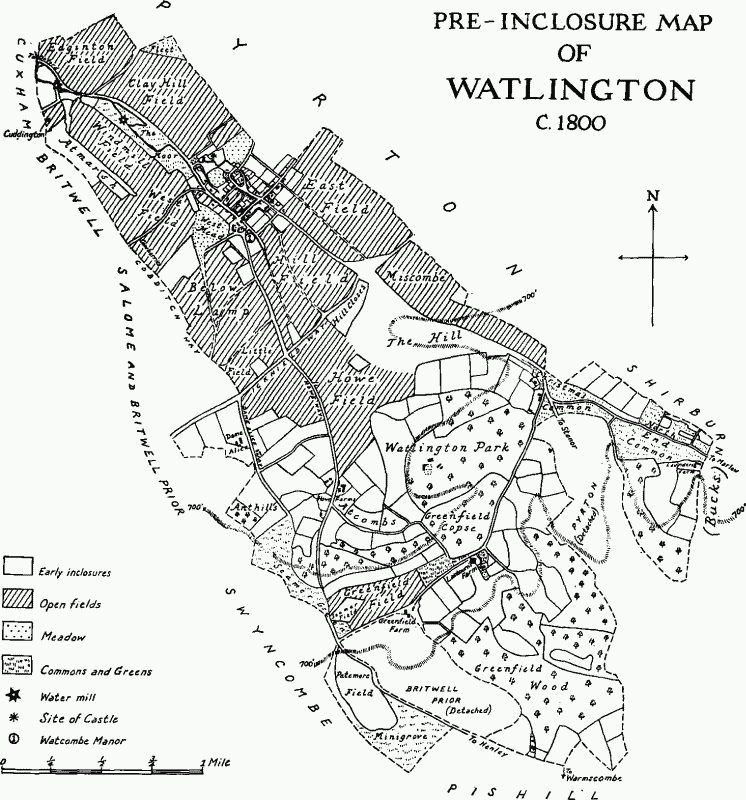
PRE-INCLOSURE MAP OF WATLINGTON C. 1800
The above map is based on an estate map of Watlington below the Hill (1780), the inclosure award and map (1815), and Davis's map (1794).
Ingham is mentioned in two Anglo-Saxon charters. (fn. 81) From one it is clear that its territory lay on the Britwell boundary and so it must have been sited somewhere in the west of the parish. An estate at Ingham (Adingeham) is recorded in Domesday Book, (fn. 82) and the name frequently occurs in medieval and later documents. (fn. 83) An estate map of 1780 shows Ingham Lane south of Watlington and it is not unlikely that Ingham was sited where Watcombe Manor now is. (fn. 84) Local tradition supports this hypothesis: in 1816 John Badcock wrote that Ingham manor-house was by tradition in the rick-yard of Watcombe Manor Farm. (fn. 85) Common ownership of Ingham and Watcombe manors in the 18th century might well have led to Ingham manor-house being renamed Watcombe, which was the more important property. (fn. 86)
Syresfield was a medieval tithing and its tithingman is mentioned as attending Watlington courts as late as the 15th century, (fn. 87) but thereafter the name of the hamlet disappears from the records. There were 13th-century lords of Syresfield, (fn. 88) and in the 14th century there are records of dwellings there. (fn. 89) It was certainly a part of Watcombe fee.
It is possible that there was another small settlement at Anthills near Dame Alice Farm. (fn. 90) The name of the land is derived from its 13th- and 14th-century owners William and Adam Anketil, who paid a fairly high tax in the tax assessments of 1306 and 1327. (fn. 91)
In the Middle Ages Watlington was distinguished from its rural neighbours by being a market-town and consequently a more populous place. As its manor belonged to the honor of Wallingford it had also some importance as an administrative centre of the honor, and the park created by Richard, Earl of Cornwall, in the 13th century often brought the earl and his son to the town. (fn. 92) They stayed presumably at the manor-house near the church, though there may have been a hunting lodge in the park. Watlington's second largest manor belonged to the Norman abbey of Préaux, and the abbot or his representative stayed at Watcombe when they came to collect their rents. (fn. 93) Later the influential family of Stonor, the successors of Préaux Abbey, were closely connected with the parish. In the post-Reformation period, apart from the Roman Catholic Stonors and in the mid-18th century the Tilsons at Watlington Park, the chief local families were members of the lesser gentry, yeoman, or trading class. Such were the Tooveys of Howe and Greenfield and the Hornes of Watlington. The parish was noted for its nonconformity. In addition to the Roman Catholic Stonors and Simeons there were the humbler families of Protestant nonconformists, the Quaker Whites and the Baptist Oveys. (fn. 94)
During the Civil Wars Watlington was in the middle of the fighting area for several years. Royalist forces were quartered at Watlington and Brightwell in April 1642, and straggling companies were plundering in the neighbourhood. (fn. 95) In August 1642 Colonel Hampden led a force from Aylesbury toward Watlington, but they were turned back by the royalist forces. (fn. 96) It was in this year too that the House of Commons, hearing that the Earl of Berkshire and others intended to execute the king's commission of array at Watlington, commanded General Whitelock to prevent it and ordered troops under Colonels Goodwyn and Hampden to assist him. The commissioners fled to Sir Robert Dormer's house at Dorton (Bucks.) and were pursued there, where several of them, including a 'gentleman of quality' from Watlington, were taken prisoner. (fn. 97) In May 1643 seven troops of royalist horse were reported in the town on their way to Wallingford and later, troops from Wallingford were collecting hay and other provisions at Watlington and Goldor in Pyrton. In June 200 Parliament men in Watlington Park chased off some of the king's horse approaching the town. In the following year royalist forces from Towcester came to Watlington in January and began fortifying it. It was reported that the king intended to keep a garrison there under the command of Sir John Wake and Sir Lewis Dives, but in February the royalists left to quarter nearer Oxford. (fn. 98)
Some 150 years later Watlington prepared to meet a French invasion by raising a volunteer troop of cavalry. It was called the Watlington Division of the Oxfordshire Yeomanry Cavalry and Lord Macclesfield was the Captain. Sixty privates 'of respectability', a trumpeter and a farrier were hired. (fn. 99) Earlier in the century the town had been the centre of another kind of fight when the 2nd Lord Macclesfield feasted 300 freeholders of Watlington during the 'Great Election' campaign of 1754. (fn. 100)
The local antiquarian Badcock has left a noteworthy description of the town in the early 19th century. He says that the inconveniences of bad roads in winter, ill paved and dirty streets, and bad drainage were gradually disappearing; that the principal inhabitants were well informed, social as well as industrious; that a 'proper sense of superior rank and talent, and the various orders and gradations which so much tend not only to the well being, but even to the existence of a community, was entertained and acknowledged; the minor and nice distinctions of situation which are too often the bane of society in larger market towns was not so scrupulously observed here'. In fact the inhabitants of Watlington were very neighbourly and very hospitable. (fn. 101)
Manors.
In 1068 the estate, later known as WATLINGTON manor, was held for 8 hides by Robert d'Oilly, Constable of Oxford castle. (fn. 102) He died without male heirs and most of his land went to his brother Nigel d'Oilly, (fn. 103) but Watlington may have been granted earlier to his daughter Maud, who married firstly Miles Crispin, custodian of Walling ford castle, and secondly Brian FitzCount, who became Constable of the castle and lord of Wallingford honor on the death of Miles Crispin. (fn. 104) Watlington was later held as a fee of Wallingford honor and in 1297 was regarded as being in the bailiwick of the honor. (fn. 105) Its independent status, however, is shown by the fact that when grants were made of the honor, specific grants were usually made of Watlington. This situation may have arisen because of the early history of Watlington manor. Maud's possession was evidently disputed by Nigel d'Oilly (d. c. 1115) and, according to a statement in a lawsuit of 1225, his son Robert (II) d'Oilly came to an agreement with Maud, the lady of Wallingford honor, by which Watlington and Ipsden were to revert to Robert and his heirs if she died without heirs. (fn. 106) Robert certainly included in 1129 the advowson of Watlington among the foundation properties of Oseney Abbey, and his grant was confirmed by Henry I between 1129 and 1133. (fn. 107) The family supported the Empress Maud in the civil wars of Stephen's reign and seems to have lost Watlington after the rout of Winchester in 1141. (fn. 108) Robert (II) d'Oilly died in 1142 and although his son Henry (I) d'Oilly confirmed the grant of the advowson to Oseney, it is doubtful if he ever obtained possession of Watlington manor; the estate was forfeited to King Stephen, who gave it to William de Chesney. (fn. 109) Later the king gave it to Halinad de Bidun, a Norfolk baron and one of the knights of Hugh Bigod, Earl of Norfolk, who had changed his allegiance to Stephen. (fn. 110) Bidun granted the advowson and part of his demesne land to Oseney between about 1154 and 1162. (fn. 111) He is listed in 1166 as holding Watlington fee of Wallingford honor, which was then in the king's hands. (fn. 112) He died about 1186 and his daughter Sarah, wife of William Paynell, was his heir. (fn. 113) The D'Oilly family, however, had not relinquished its claim and Oseney was careful to get confirmation of its rights in Watlington from all parties concerned. Henry (II) d'Oilly, described in the cartulary's heading to his charter of confirmation as chief lord, confirmed grants by the tenants between 1185 and 1200. (fn. 114) In 1208 he began a suit against the Paynells, (fn. 115) and in 1220 he claimed that a final concord had been made by which William Paynell recognized his claim to the manor and that Henry had granted him a life interest in it, provided it reverted to Henry and his heirs on William's death. (fn. 116) From the pipe roll it appears that Watlington and other lands were taken into the king's hands on the death of Sarah before Michaelmas 1211, when William Paynell paid £100 and a palfrey for keeping his wife's inheritance for life. (fn. 117) William Paynell died about 1215, (fn. 118) and King John seized the land and committed it to the custody of the Constable of Wallingford, but in 1216 gave it to Peter FitzHerbert. (fn. 119) When peace was restored Henry d'Oilly renewed his claims and obtained a writ against FitzHerbert, who 'to avoid labour and expense' agreed to acknowledge D'Oilly's rights. (fn. 120) Nevertheless, in 1219 Peter FitzHerbert was recorded as holding by the king's gift an escheated fee in Watlington, worth £24. (fn. 121) Both FitzHerbert and D'Oilly were summoned before the king's court in 1220 for having made an agreement over Watlington, which the king maintained was held only in custody (de ballio suo) and not by gift (de dono). (fn. 122) This agreement was annulled in 1223, when the king was adjudged seisin, and both FitzHerbert and D'Oilly lost all right. (fn. 123) In Edward I's reign it was asserted that the manor had escheated to Henry III on the death of Sarah de Bidun, a tenant in chief, and that he had given it to his brother. (fn. 124)
Henry III, despite the claims of D'Oilly and FitzHerbert, had granted a lease of Watlington in 1217 to Nicholas de Molis; and after the judgement of 1220 various other leases were made: in 1225 to the Archbishop of Dublin for 50 marks a year in part payment of a debt; in 1227 to Philip d'Aubigny to hold as long as he was keeper of Wallingford castle; (fn. 125) in 1229 to Richard, Earl of Cornwall, along with the castle and honor of Wallingford, during pleasure, to sustain the earl in the king's service; in 1231 to Godfrey de Crowcombe with the castle, but later in that year Henry III made a perpetual grant of Watlington manor with Wallingford honor and castle to the Earl of Cornwall to be held by the service of 3 knight's fees. (fn. 126) Watlington itself was held for 1 fee. (fn. 127) On the death of Richard's son and heir Edmund in 1300 the freemen and villeins of Watlington were said to be holding the fee of the honor, which later in the year reverted to the Crown. (fn. 128)
In 1302 Watlington was among the estates granted by Edward I to Roger Bigod, Earl of Norfolk. (fn. 129) After Bigod's death in 1306, Edward II granted the manor in 1307 to Piers Gaveston, who was given also the Earldom of Cornwall and Wallingford honor. (fn. 130) Gaveston's estates reverted to the Crown on his death in 1312 and in 1316 Edward II leased Watlington for life for £42 a year to John Knockyn, king's yeoman, who already held it during pleasure. (fn. 131) In 1318, however, Queen Isabella, who had been granted dower of Wallingford honor, exchanged one of her other manors with John Knockyn for Watlington, which was valued at £60. (fn. 132) It reverted to the Crown after her disgrace in 1329 and the downfall of Mortimer, and was committed in 1331 to the keeping of Sir John de Stonor. (fn. 133) Edward III granted it later in 1331 to his brother, John of Eltham, who had already been given the earldom of Cornwall and Wallingford honor, thus reaffirming the close connexion between Watlington and these honors. (fn. 134) After the death of John of Eltham in 1336 Watlington was granted in 1337 to Nicholas de la Beche, a devoted servant of Edward III, who superintended the education of the Black Prince and was at one time Constable of the Tower of London and Seneschal of Gascony. (fn. 135) On his death in 1345 the manor reverted to the prince, presumably because it was a member of Wallingford honor, which had been granted to him and his successors. (fn. 136) In 1350 the prince granted Watlington manor for life to Sir Roger Cottesford 'in support of his estate as a knight'. (fn. 137) Sir Roger, lord of Bletchingdon and later Sheriff of Oxfordshire and Keeper of Oxford castle, died in 1375. (fn. 138) On the death of the Black Prince in 1376 the manor and park, valued at £40, formed part of the dower of his widow Joan of Kent (d. 1385). (fn. 139) They then reverted to Richard II, who immediately granted them for life to one of his knights, Baldwin de Bereford. (fn. 140) This grant was not revoked until 1404, when Henry, Prince of Wales and Duke of Cornwall (later king Henry V), successfully claimed the manor as part and parcel of Wallingford honor. (fn. 141) It was assigned after his death as dower to his widow Katherine de Valois, who was returned as holding lands and tenements in Watlington for 1 fee in 1428. (fn. 142) The Crown retained the manor in its own hands after her death in 1437, (fn. 143) until Henry VIII left it in his will to his daughter the Lady Elizabeth. (fn. 144) She retained the manor in her own hands, but James I granted it to his son Charles in 1616. (fn. 145) James I had already, however, leased it in 1613 to a group of London merchants for £54 11s. 1d. a year, and in 1617, despite the grant to Prince Charles, he sold the lordship to Sir Francis Bacon and others. (fn. 146) They sold off the demesne land in small lots, leaving the manor only its rights and privileges. (fn. 147) A fine in 1629 enabled the lease and reversion of the manor to be acquired by a single person, who would thereby become virtually the lord of the manor. (fn. 148) These rights were acquired in 1630 by Thomas Dean of Chalgrove and Edmund Symeon of Pyrton, and passed from them through two or three other groups to Thomas Allen of Henley, Robert Dobson of Aston Rowant, and Thomas Wiggins of Clare, who held the manor in 1664. (fn. 149) In 1664 55 freemen of Watlington, paying a pound each, purchased the manor, preparatory to the building of the Town Hall on the waste of the manor. (fn. 150) By 1780 the shares in the manor had reached 64 in number. (fn. 151) The fee farm rent of £54 11s. 1d. was still due to the Crown and was paid until the middle of the reign of George III, when the rent was sold to a certain Naphthali Franks, whose descendants were receiving it in 1921. (fn. 152)
The manor does not seem to have been leased to under-tenants in the Middle Ages after the grant to Baldwin de Bereford, and it was administered by stewards; a John Harpenden, for example, in Queen Katherine's time; in 1437 William Phellip, Chamberlain of the Household; and in 1438 William de la Pole, Earl of Suffolk, who headed a commission of inquiry to discover whether Watlington and certain other manors, parcels of Wallingford honor, were let at farm or in the king's hands. (fn. 153) In 1447 Richard Lyllyng, king's sergeant, who already held the 'site', was granted the 'keeping of the manor' for life. (fn. 154) There are no later grants to stewards recorded and it may be that the bailiff of the manor, who in the 14th century had held under the steward, took over his position. (fn. 155) Among the appointments in the second half of the 15th century were two king's yeomen, and a later bailiff was Henry Norreys, an intimate of Henry VIII, who was appointed in 1523 and held until his death in 1537. (fn. 156) In 1592 the bailiff was the Treasurer of the Queen's Household, the Oxfordshire magnate, Sir Francis Knollys, who also held Wallingford castle. (fn. 157)
About 1080 William I gave Préaux Abbey (Lisieux, Normandy) an estate in Watlington assessed at 5 hides, which had belonged to two English freemen, Aelfhelm and Wulfric. (fn. 158) Préaux Abbey was returned as lord in 1086. (fn. 159) In a lawsuit of 1221 this estate, then said to be 4 hides, was described as Watcombe manor. (fn. 160) The abbey was still overlord of the estate in 1361 (fn. 161) and probably retained rights over it until the dissolution of alien priories by Henry V. During the French wars of the 14th century the abbey's property was constantly in the king's hands (fn. 162) and it seems to have sold early in Edward III's reign all real interest in the estate to its under-tenant, John de Stonor, and to have retained only a nominal overlordship. (fn. 163)
The earliest known under-tenants seem to have been members of a Buckinghamshire family from Hambleden (Bucks.): a Sir William of Hambleden was in possession in 1184, Jordan of Hambleden in 1192, and Osbert of Hambleden in 1217. (fn. 164) Osbert of 'Cocham' (? Cookham, Berks.), who held the manor in 1221, was probably the same man as Osbert of Hambleden. (fn. 165) By 1238 a William of Watcombe was tenant: he agreed to pay an increased rent of £8 and to find lodging for the abbot, his prior, or his steward when they came to the manor. He undertook to provide this entertainment three or four times annually and also to find food for eight horses at his own cost. (fn. 166) The abbot had before received a rent of 11 marks (£7 6s. 8d.) and hospitality, and had the right to tallage William's men each year, a burden which was remitted in the new agreement. (fn. 167) In 1252 the tenant was William de la Ho, (fn. 168) who seems to have taken his name from Howe hamlet. He may have been a son of William of Watcombe and a member of the original Hambleden family, since he owned land in both Hambleden and Watcombe. (fn. 169) He settled the property in 1252 on his son William on his marriage to Maud, daughter of Robert de Swynebrook, and it is no doubt this son who was holding Préaux Abbey's manor in 1279. (fn. 170) In 1291 the abbey was receiving the same rent of £8, and the obligation to entertain the officers of the abbey was valued at £1. (fn. 171)
Sir John Stonor, the notable judge, evidently purchased the tenancy of this manor in 1313 for 10 marks from two sisters, Alice and Maud, wife of William of the Chamber, who were perhaps the daughters of William and Maud de la Ho. (fn. 172) In 1315 Sir John was granted free warren in his demesne lands in Watcombe. (fn. 173) Later he settled the manor on himself and his wife, and in 1346 he seems to have bought the manor from the overlord, Préaux Abbey, for he was released from payment of the old rent and henceforth paid a nominal rent of 2s. (fn. 174) On his death in 1354 he held Watcombe manor of the Abbot of Préaux for 2s. a year, as well as a messuage and carucate of Watlington manor for 10s. a year. (fn. 175) The Black Prince's steward tried to treat Watcombe as part of Wallingford honor, but Sir John (II) Stonor, the judge's son, successfully maintained his claim that it was held of Préaux at fee farm. (fn. 176) When Stonor died in 1361 he held a messuage and 80 acres of Préaux Abbey for 2s. yearly with 5 acres of meadow, a ruined horse-mill, pasture at Watcombe and in Watlington for 2 horses, 6 oxen, and 100 sheep, 62s. rent of free tenants, and pleas of court worth 2s. yearly. (fn. 177) Like other Stonor property, Watcombe manor was held in custody during the minority of the heir, Edmund Stonor, by Isabella, the king's daughter, but in 1363, although still a minor, Edmund was allowed to hold it and the other manors at farm. (fn. 178) On Sir Edmund Stonor's death in 1382 the heir was another minor and Sir Robert Belknap had his custody and held courts for both Watcombe and Watlington lands. (fn. 179) Watcombe was not mentioned among the properties held on the death of Sir John Stonor in 1390, (fn. 180) nor among those of his brother Sir Ralph Stonor in 1394. Sir Ralph, however, had made a settlement of it in 1393, (fn. 181) and so Watcombe may have been included in 'Hoo' manor, another Stonor property in Watlington, and like 'Hoo' have been held by his widow Joan and her second husband Edmund Hampden, who received rents from 'Hoo' and Watcombe from 1396 to about 1407. (fn. 182) Watcombe must then have reverted to the Stonors, for in 1417 Thomas Stonor's receiver accounted for similar rents and for a clerical tenth paid to the king for 'La Hoo', which must in fact have been for Préaux Abbey's property in Watcombe. (fn. 183) Watcombe or Watcombe fee manor, as it was sometimes called, followed the descent of Stonor manor until the execution of Sir Adrian Fortescue in 1539, when it descended to his daughter Margaret, wife of Thomas, Lord Wentworth (d. 1551), as her share of her mother's inheritance. (fn. 184) Her son Thomas, Lord Wentworth (d. 1584), sold the manor in 1562 to Ambrose Dormer and his kinsman John Bolney, and they to a Robert Tyrrel, gent., in the same year. (fn. 185) By 1577 the Anthony Molyns, who was buried in Watlington church in 1582, was lord. (fn. 186) His heirs were his two daughters, Anne, wife of John Simeon, lord of Brightwell Baldwin in 1600, and Margaret, wife of Martin Tichburne, but in 1608 only half of Watcombe manor was held by them; the other half belonged to Sir Michael Molyns, the brother of Anthony Molyns and lord of Chislehampton, Clifton Hampden, and of Clapcot (Berks.). (fn. 187) Sir Michael died in 1615 in possession of Watcombe manor; he held of the king 'of the late monastery of Préaux in Normandy'. (fn. 188) His heir Sir Barentine Molyns (fn. 189) was succeeded in Watcombe by his own son Sir Michael Molyns, who in 1629 sold the manor to a William Lucy. (fn. 190) He in turn sold it in 1634 to John Eustace of Pyrton. (fn. 191) The Eustaces were prominent yeoman farmers in this part of Oxfordshire and they acquired land in the course of the 17th century in several neighbouring parishes, including Britwell. (fn. 192) By 1650 Watcombe manor had passed to a Thomas Eustace, (fn. 193) who may have been the son of an earlier Thomas Eustace, who had held a messuage and 32 acres of land in Watlington on his death in 1615. (fn. 194) In 1681 Thomas Eustace, gent., settled Watcombe and Britwell manors on his son Thomas, when he married Mary Bayley. (fn. 195) The younger Thomas's line seems to have come to an end with the deaths of another Thomas Eustace and his young wife Mary, both in 1713. (fn. 196) In 1714 the manor was conveyed to Elizabeth Hill, widow, and others. She was the sister of Thomas Eustace the younger (fl. 1681), the widow of John Hill of Tarriers (in Hazlemere, Bucks.). (fn. 197) She died in 1715, leaving one surviving son, Thomas Hill. (fn. 198) It was perhaps her grandson, a 'Mr. Hill' of Tarriers and a minor who was said to hold the manor in 1718. (fn. 199) By 1747 the site of the manor of Watcombe fee was in the possession of Samuel Horne, Esq. (d. 1777), a merchant of London, who also held Ingham manor in Watlington with which Watcombe subsequently descended. (fn. 200) The Hornes were a well-established trading family in Watlington. (fn. 201) It is not clear whether Samuel Horne retained the manor in his own hands or whether he gave it to his kinsman Edward Horne, gent., of Watlington, Pyrton, and Britwell (d. 1765). (fn. 202) Both Edward Horne's son, John Yardley Horne (d. 1789), and his successor Edward Horne (d. c. 1814) were certainly in possession of a great deal of property in Watlington at the end of the 18th century. (fn. 203) Edward Horne was followed by Henry Hulton, who in 1815 and as late as 1832 occurs as lord of Watcombe and Ingham manors, (fn. 204) but by 1854 Edward Horne Hulton, evidently a descendant of both families, was lord of Watcombe and Ingham manors, as well as of Britwell. (fn. 205) The latter had been succeeded by 1864 by the Revd. William P. Hulton, who died in 1885, and the manors passed to his widow Philippa C. H. Hulton. (fn. 206) She put the estate up for sale in 1897 and again, together with a Henry Horne Hulton, in 1911. (fn. 207) In 1915 and 1920 Ivan Jackson, Esq., later Major Jackson, was lord, and in 1939 Milton Harris, Esq. (fn. 208)
WARMSCOMBE is not mentioned by name in the Domesday survey of 1086, but it is likely that the township or part of it was included in the estate in South Weston held by Robert d'Oilly under the Earl of Chester. (fn. 209) A part of it may also have been represented by the 1-hide holding held by Robert d'Oilly of the fief of William Fitz Osbern in Watcombe in Watlington, for at a later date 'Watcombe fee' seems to have included land in Warmscombe. (fn. 210) In the survey of 1279 Warmscombe hamlet is said to form part of a fee with South Weston and Wheatfield which was held by the Plescys, lords of the barony of D'Oilly, under the Earl of Arundel's honor of Coventry. (fn. 211) Warmscombe continued to be returned as part of the fee in later returns and like South Weston was said to be held by Fulk de Rycote in 1348, and by Sir Walter Beauchamp in 1428. (fn. 212) There is no later reference to its overlordship save in 1710 when Thomas Stonor paid 2s. to the Crown for Warmscombe manor. (fn. 213)
The under-tenants of Warmscombe were the Fitzwyths, who held also at Ardley and South Weston. (fn. 214) In 1279 Simon Fitzwyth, brother of John Fitzwyth, lord of South Weston, was holding Warmscombe under him. Simon had been in possession by 1273 at least; he held for a ⅓-fee and suit at Pyrton hundred court. (fn. 215) In 1280 he had a grant of free warren in his demesne lands there. (fn. 216) It is likely that he had no male heir and that Warms combe passed to a daughter, for in 1315 when John Stonor obtained a quarter of the manor this quarter was held by a Joan de Saleye of the inheritance of Isolda, wife of William son of Walter de Cornwalle, and of Joan, wife of Roger de Percy. (fn. 217) In the same year Stonor received free warren in his demesne lands there and he must eventually have obtained the whole manor, for in 1336 he made a settlement of Warmscombe and other Stonor manors. (fn. 218) Thereafter it followed the descent of the rest of the Stonor property and is still part of the estate. (fn. 219)
Hoo manor, which was first mentioned in 1390, (fn. 220) seems to have been one of the estates in Howe hamlet which was held of the crown manor in Watlington, and its claim to be a manor is doubtful. Robert de Bealknap, the guardian of John Stonor, lord of Watcombe manor, was said in 1389 to have held 'Hoo manor' of the lord of Watlington at a yearly rent of 19s. 11d. (fn. 221) Sir Ralph Stonor was also returned as holding it in 1394; (fn. 222) his widow Joan was granted it as dower in 1395 and took it to her second husband Edmund Hampden, who received rents from Hoo and Watcombe from 1396 to about 1407. (fn. 223) There is no further mention of 'Hoo manor' in the 15th century and it must have reverted to the Stonors and descended with Watcombe manor. (fn. 224) The Stonors continued to hold rents in Howe until their Watlington property passed to Sir Adrian Fortescue and his heirs the Wentworths. (fn. 225) Thomas Lord Wentworth (d. 1584) held Howe farm (300 a.) of the crown manor at the end of the 16th century; (fn. 226) and it is probable that this was the property previously called 'Hoo manor'. He evidently sold it, either to the Molyns family first or to their relatives the Simeons, for in 1611 Sir George Simeon, son of Anne Molyns and John Simeon, lord of Brightwell Baldwin and of Minigrove manors, sold 'the Howe' to his brother, later Sir John Simeon. (fn. 227) Sir John was returned as the Crown's tenant of the Howe farm (300 a.) in about 1616. (fn. 228) It is not clear what happened to the land when the Crown manor was split up, (fn. 229) but Sir John must have bought some of Howe farm, for in 1649 he sold 60 acres of it to John Toovey, probably the son of the John Toovey who had held land in the Howe in 1633. (fn. 230) In 1676 John Toovey sold his Howe property for £950 to a John Toovey of Swyncombe, son of Sampson Toovey of Greenfield. (fn. 231) This John Toovey held the property until his death about 1720, (fn. 232) when his sons John and William inherited 122 acres. (fn. 233) In 1761 the last John Toovey of the Howe died and half of his property came to John Hine, who had eloped with Toovey's daughter Katherine. (fn. 234)
In 1086 Robert d'Oilly held 2½ hides in ADINGEHAM, which had belonged to William Fitz Osbern's fief, then in the king's hands. (fn. 235) This estate appears to represent the later INGHAM manor. (fn. 236) There is no record of Ingham as a separate manor during the Middle Ages, but as the rest of Robert d'Oilly's land in Watlington passed to the Earl of Cornwall it was probably included among the earl's holdings in 1279. (fn. 237) The first reference that has been found to the manor occurs in Rawlinson's account of the parish made in c. 1718, when he said that it had been reserved out of the Crown manor, which had been sold to the parishioners in the 17th century, and had descended from a Mr. Knight to the Yardleys. (fn. 238) It was then held by a Mrs. Yardley and a Mr. Prince of Hampshire; by 1747 Samuel Horne, lord of Watcombe manor and it would seem the second husband of Mrs. Yardley, was in possession. (fn. 239) Thereafter the two manors followed the same descent. (fn. 240)
In 1600 John Simeon obtained Minigrove manor in Bix, which included at his death in 1615 a capital messuage and three cottages and land in Greenfield, later part of Lower Greenfield farm. (fn. 241) This property was described on an estate map of 1638 as GREENFIELD manor, (fn. 242) although at other times it was regarded as part of Minigrove manor. (fn. 243) The property was held by his son Sir George Simeon (d. 1664) and was settled on Sir George's second wife Margaret Molyneux, who was in possession until about 1670. (fn. 244) By 1678 their son, James Simeon, later Sir James Simeon (d. 1707) of Aston (Staffs.), held the property. (fn. 245) It passed to his son Sir Edward Simeon, who died unmarried in 1768, leaving his property to Thomas Weld, the son of his sister Margaret. (fn. 246) Weld, who is said to have assumed the name of Simeon, must have died very soon after, for by 1771 his nephew and heir Thomas Weld of Lulworth seems to have been in possession of other of his Oxfordshire property. (fn. 247) The Greenfield farm, apart from the woods, was sold in 1797 to the tenant, Edward Goodchild (d. 1827). (fn. 248) His son Josiah Goodchild was still in possession in 1834. (fn. 249) By 1881 it was part of the estate of Thomas Taylor of Aston Rowant and was put up for sale in 1889. (fn. 250)
Lesser Estates.
In 1086 an estate assessed at 2 hides in Watcombe was held by a certain Geoffrey as tenant of Miles Crispin. (fn. 251) Geoffrey was also the tenant of a Marsh Baldon manor which descended together with his Watcombe estate. They were held as 1 knight's fee under Wallingford honor. (fn. 252)
From the last quarter of the 12th century until the death of Robert (V) de la Mare in 1382 the Watcombe property remained in the possession of the De la Mare family, the lords of Marsh Baldon. (fn. 253) In 1279, when it was held of Robert (III) de la Mare, it was said to consist of 8 virgates. (fn. 254) It evidently remained attached to Marsh Baldon manor until the 17th century, for its connexion with Lord Windsor and later with the families of Pope, Danvers, and Sadler, who successively acquired Marsh Baldon, can be traced. (fn. 255) By the 18th century the connexion seems to have ended. (fn. 256)
The tenants of the De la Mare property, or a part of it, in the second half of the 13th century were Robert de Swynebrook and his wife Maud. In 1275 Maud gave ⅓-hide of her late husband's land to Hugh Frelond, (fn. 257) and in 1279 he was returned as holding an 8-virgate estate under the De la Mares. (fn. 258) The descent of the family is not clear: a Reginald and a Hugh Frelond of Watcombe, perhaps a younger Hugh, were parties to Watcombe grants around 1280 and in the early 14th century; (fn. 259) in 1327 Maud Frelond paid the highest assessment in Watcombe; (fn. 260) in 1328–9 John Frelond was enfeoffed by Walter son of John of Syresfield with a messuage and 120 acres at Syresfield and elsewhere; (fn. 261) and in 1331 John Frelond and his heirs were granted free warren in their demesne lands of Watlington and Crendon (Bucks.). (fn. 262) This John may have been the same as John Frelond who was frequently on commissions in Oxfordshire and neighbouring counties in the mid-14th century, and was a Member of Parliament for Oxfordshire in 1341, (fn. 263) but nothing further is known of his tenure of this Watcombe estate.
In 1393 a tenement called 'Frelonds' was in the hands of Thomas Frankelyn, glazier. He released the property, which extended into Britwell Salome, Swyncombe, and Brightwell Baldwin, to Thomas Barentine, and in the same year Barentine granted it to a William Beke and others. (fn. 264) As Barentine was closely connected with the Chaucers, it is not improbable that the Chaucers later acquired this property and that Dame Alice farm (140 a.), the Watcombe part of the Baldon fee, took its name from Alice, Duchess of Suffolk (d. 1475), daughter of Thomas Chaucer. (fn. 265)
Further details of this Baldon holding occur in a court roll of 1507: the heirs of John Yardley then held of Lord Windsor lands in Britwell Salome and John Perytts of Watlington held lands, 'once Dame Alice of Baldington'. (fn. 266) In 1608 Richard Yardley claimed to hold 'Dame Alice manor' of the crown manor of Watlington, and about 1613 his heirs were said to hold above 100 acres called Damealls, next to Dame Alice land, and Ampthills in the fields of Watlington and Britwell Salome. (fn. 267) Part or all of this property was in the hands first of the Tooveys of Howe and later of the Hornes of Watcombe Manor in the late 17th century and in the 18th century. (fn. 268)
A park, the later Watlington Park, was made before 1272 by Richard, Earl of Cornwall. In 1276 it was said that the freemen of the area (de patria) used to have free hunting there and that some had had free common; and in 1279 that Edmund, Earl of Cornwall, had 40 acres of wood emparked by unknown warrant. (fn. 269) The park was hedged: 207 perches of hedging were made in 1296–7, (fn. 270) and in 1392 it was enlarged by 20 acres. (fn. 271) The earl's accounts in 1278, 1286, and 1297 recorded sales of pasture in the park and receipts from pannage of his tenants' pigs. (fn. 272)
The park seems to have followed the descent of the principal manor (i.e. the Crown manor) in the Middle Ages, (fn. 273) and Princess Elizabeth received it with Watlington manor in 1551; (fn. 274) in 1613 James I granted some London merchants a 99-year lease of both; and the park and coney warren were included in a sale of the reversion of the manor by Charles I in 1629. (fn. 275) Both lease and reversion were bought by Edmund Symeon of Pyrton and Thomas Adeane of Chalgrove, who sold parts to recoup themselves. (fn. 276) In 1632 William Stonor bought the park with the fair, market, and tolls of stallage. (fn. 277) It remained with the Stonors, save for the period when it was sequestrated for the recusancy of William Stonor, (fn. 278) until 1753 when it was sold with the manor-house for £9,500 to John Tilson, the son of the Under-Secretary of State. (fn. 279) He died before 1785 and his widow held the park until about 1794, but his heir was John Henry Tilson, probably his son (d. 1837). (fn. 280) The estate came to Thomas F. Shaen Carter by his marriage to Tilson's daughter and heir, Maria Tilson, and he was said to be living there in 1854. (fn. 281) He died in 1875 and in 1876 the estate was sold to J. F. Symons-Jeune, who sold in 1910 to Arthur Renshaw. (fn. 282) In 1921 the widowed Lady Winifred Renshaw sold the estate to the 3rd Viscount Esher, who still owned it in 1960, when Watlington Park was the residence of his son Major the Hon. Lionel G. B. Brett. (fn. 283)
When the park was in the king's or Black Prince's own hands it was normally given into the charge of a keeper, often as a 'reward for good service'. In 1337 Robert le Parker was given custody of the park and warren and received a fee of a robe, 1 mark, and a quarter of corn every ten weeks out of the issue of the manor. (fn. 284) Richard de Bretford, who was granted it in 1361, received wages of 2d. a day, and a similar grant 'for good service' was made later in the same year to Robert de Wydyngton. (fn. 285) Grants were made to Robert Goscombe in 1438; (fn. 286) to Geoffrey Kidwelly, king's servant and receiver of Wallingford honor, in 1461; (fn. 287) to Philip Laton, bailiff of Watlington, in 1463; (fn. 288) to John Whitton, yeoman of the Crown, in 1489, and to Roger Whitton in 1519. (fn. 289) In 1536 Edmund Stonor, yeoman of the guard, obtained a lease of the herbage and conies of the park and of the pasture north of the town called the Moor, together with dues from the town after the end of Whitton's 21-year lease. (fn. 290) In 1608 Robert le Gris petitioned James I for a lease in reversion of the park with certain coppices as leased by Queen Elizabeth to John Cade, (fn. 291) and in 1610 Sir Francis Stonor begged that a lease of the woods in the park might be granted. (fn. 292) A survey of the Crown manor made about 1616 shows that Sir Barentine Molyns was then leasing the park (220 a.) for £3 6s. 8d. a year. (fn. 293)
Mills.
Marlbrook, the stream that runs through Watlington, drove three mills within a mile of each other. One was in Cuxham and two in Watlington. (fn. 294) Both the Watlington mills were on Robert d'Oilly's manor in 1086 and were worth 10s. and 8d. respectively. (fn. 295) In about 1170 Halinad de Bidun and his wife Agnes, who held this D'Oilly manor, gave one mill called Sobeford to Oseney Abbey. (fn. 296) Oseney remained in possession of this mill until the dissolution of the abbey. It was variously called 'Sibford' and 'Shefford', and can be identified with the later Upper mill or 'first' mill. (fn. 297)
In the early 16th century the farm of this mill brought in 13s. 4d., but was said to have previously been worth 26s. 8d. a year; the rent was still 13s. 4d. when Oseney Abbey was dissolved. (fn. 298) In 1547 the mill was given to the Bishop of Oxford with the rest of the rectory estate. (fn. 299) It continued to be leased: in 1590 a John Stacy obtained a water-mill from Robert Wright and his wife, and in 1634 John Stacy's son John received 'the freedom' of Shefford mill. (fn. 300) This was one of two water-mills working in 1718; it was owned by the Hornes and then by the Hultons in the 19th century and was known as First Mill or Mill Farm. (fn. 301) Mill Farm was sold in 1897, when the mill was described as 'in excellent order and capable of doing a considerable business,' but there is no later record of its use as a mill. (fn. 302)
The other Domesday mill, known later as the Middle Mill, was likewise given to a religious house, when c. 1215 William Paynell and his wife Sarah, who then held the D'Oilly manor, gave their mill, called Wochemulne, with a messuage, 2 acres, and timber rights for the repair of the mill to the nuns of Godstow. (fn. 303) The Paynells' successor, Peter Fitz Herbert, confirmed this grant, but Godstow must have lost the mill, probably when the king took the manor back into his own hands in 1223, for they held no property in Watlington in the later 13th century. (fn. 304) In 1272 the mill, worth 26s. 8d. a year, was again attached to the principal manor, and in 1285 Edmund, Earl of Cornwall's rights in the mill were acknowledged by a John le Mouner and Robert d'Oilly. (fn. 305) In the 15th century, this mill was leased for a term of years: in 1460 the new tenant took it up for £2 a year and was to repair and mend all parts, the millstones, cogs, floodgates, and woodwork as well as the tiles and roof, and to return it in good condition and worth £5. (fn. 306) In 1537 William Spythurst renewed his lease for 21 years paying 1s. 4d. new increment and a rent of £3 6s. 8d. a year; in 1608 a Richard Smith paid an annual rent of £3 8s. for the mill and hayhouse, which he held on a 21-year lease. (fn. 307) This may have been the 18th-century water, corn, or grist mill, mentioned in 1738, but it is difficult to distinguish between the two watermills in deeds of this period, since they were both in use. (fn. 308) In the 19th century the Hultons owned this mill as well as the rectory mill, and 'Watlington Middle Mill' was also put up for sale in 1897. (fn. 309) The last named appears to be the same as the steam- and water-mill occupied by John Tappin in 1893, and was again offered for sale in 1911, when Moses King was miller, but there is no later record of it. (fn. 310)
In the Middle Ages, a third mill belonged to the Stonors, who held the Préaux Abbey estate. It was a horse-mill (fn. 311) and probably stood on the hill. It was described as 'quite ruined' in 1361, and in 1384 as 'out of repair', and eventually it was taken into the lord's hands. (fn. 312) In 1481 William Stonor leased it to Christopher Holand of Thame for 80 years at 26s. 8d. a year. (fn. 313) There was still a horse-mill on this estate in the 16th century. (fn. 314) By 1615 John Simeon of Brightwell Baldwin held it: it was called a horsemaltmill. (fn. 315)
Agrarian and Social History.
The Watlington area was settled at an early date: a Bronze Age axe and British and Roman gold coins have been found; and there were heathen burials on the ridge. (fn. 316) Settlement would have been encouraged by the Icknield Way, one of the four chief early roads in Britain, and by another early route running at right angles through the narrow parish of Pyrton over Knightsbridge to the ancient settlement sites above the Thames. (fn. 317) Watlington Hill which lies between the town and the Chilterns is protected on its flanks by mounds and ditches, and it has been suggested that these fortifications were constructed after the Romano-British pocket in the Chilterns was cut off from the west in 571. (fn. 318) However this may be, the Anglo-Saxon name for the village, composed of the elements Waecel, probably a personal name, and -ington, itself indicates early Saxon settlement, perhaps of the late 6th century, by the 'Watelings'. (fn. 319) A charter of c. 880, granted by Ethelred, 'Duke' of the Mercians, mentions eight manses in Watlington and shows that the 'Watelings' were not the only settlers in the area since Ingham, now a lost hamlet, was probably already settled. (fn. 320) The existence of communities at this and other hamlets by the 11th century may be deduced with some probability from the Domesday account, which reveals the growth of a number of feudal estates, including one, assessed at 3½ hides, which was almost certainly later transferred to the new Pishill parish. (fn. 321) The chief estate in 1086 was Robert d'Oilly's Watlington manor of 8 hides, but he also had land assessed at 1 hide in Watcombe, and he held a holding at Adingeham, probably the later Ingham. In the township of Watcombe there was a 2-hide estate belonging to a Marsh Baldon fee; and later evidence shows that part at least of Préaux Abbey's manor of 5 hides also lay in Watcombe. (fn. 322) In all, excluding the later Pishill estate, there was said to be land for 21½ ploughs, or about 1,720 field acres. (fn. 323) The total number of working ploughs in the parish was 18 or 19, which suggests that the land was not worked to capacity. (fn. 324) The chief demesne estate belonged to Robert d'Oilly, who had 3 hides of inland with 2 ploughs and 4 serfs to work them in Watlington and another plough in demesne in Adingeham. (fn. 325) The rest of his principal estate was worked by 22 villani and 5 bordars who had 11 ploughs between them. (fn. 326) His small estate at Watcombe with land for 1 plough was held by a widow. (fn. 327) There is no record in 1086 of demesne land on the other estates: there was land for 4½ ploughs on the Préaux Abbey property, which was apparently all in the hands of the tenants, the 7 villani, 2 bordars, and 2 serfs who had 3 ploughs; (fn. 328) Geoffrey's estate at Watcombe had land for 2 ploughs and 1 villanus with 1 plough was recorded. (fn. 329) Woodland (1½ × ½ league on D'Oilly's estate and 7X3 furlongs on the Préaux estate) was a predominant feature of the parish as in later times. (fn. 330) D'Oilly also had 4 acres of meadow and Préaux Abbey had 6 acres as well as 11 acres of pasture. (fn. 331) The principal manors showed a notable rise in value: D'Oilly's had increased from £6 to £10; Préaux's from £4 to £5, but the smaller estates maintained their previous valuations. Adingeham was valued at £2 10s., D'Oilly's Watcombe holding at 10s. and Geoffrey's Watcombe estate at £1. (fn. 332)
Reclamation from the waste probably continued in the 12th and 13th centuries as elsewhere, but it is largely unrecorded. However, assarts on Préaux Abbey's estate are incidentally mentioned in 1217. (fn. 333) Early documents throw light on the extent of the arable and seem to indicate that there was a twofield system by the mid-12th century which had been converted into a three-field one by the late 13th century. Contemporary field names, which survived into the 18th century, show that the arable land stretched at the end of the 12th century from the pastures called the Fleet in the north-east and Attmarsh in the north-west to south of the Icknield Way. (fn. 334) In fact, there is little doubt that the area of cultivation below the hill was roughly about the same as that shown on the field map of 1780. (fn. 335) Charters granted to Oseney Abbey mention Copdich, which the 1780 map shows as the ditch dividing Watlington fields from Britwell fields; sorte furlong, lying just north of the Icknield Way; and Cudendone and Cuburyeles, lying near the millway at the northern end of the fields. (fn. 336) A two-field system is suggested by a grant to Oseney in the mid-12th century of 1 virgate or 20 acres of demesne of the principal manor, which were distributed as 10 acres in one field and 10 acres in another. (fn. 337) These two fields were perhaps the East and West Fields of 13th-century documents. (fn. 338) In the later 13th century the accounts of the principal manor indicate that there was the usual 3-course rotation of crops, which may have come with a reorganization of the field system. In 1272 the Earl of Cornwall's demesne farm had 303½ acres of arable, and in 1297 the steward accounted for winter and spring crops sown on 258 acres of demesne, and in 1331 on 201 acres. (fn. 339) Presumably, in both years there would be about a third of the demesne farm fallow.
Less is known about Watlington-above-the-hill, but there were evidently several small medieval settlements here and possibly more than one set of open fields. There are 12th- and 13th-century references to settlements at Howe (La Ho), Atcombe or Hattecombes, which later evidence shows lay near it, at Watcombe, and at Syresfield. (fn. 340) Some of the arable land of Howe and Watcombe in later surveys lay intermixed in the fields below the hill, (fn. 341) but it is likely that there were also small open fields above the modern hamlet of Howe where the inclosure map shows inclosed fields called Lower Atcombs, Atcombs Hill, Middle Atcombe, and Further Atcombs, and to the west of Howe Way. (fn. 342) In all probability Syresfield had separate fields on the hill, (fn. 343) and Warmscombe, where tenants in 1279 are recorded as owing week-work, must also have had its own fields. (fn. 344)
Grants to Oseney Abbey made before 1220 record that the land was distributed in ½-acre and 1-acre lots in the various furlongs, such as Brocfurlong, Chelhurst, Hattemerse, and Sortefurlong, the names of which are familiar in later documents. (fn. 345) In a grant of c. 1220 the land was described as 2 acres in Hattemerse furlong, 2½ acres in Cudendone culture, 1 acre next to Cuburyeles, and another acre and 2½-acres reaching to the millway and a ½-acre in Brocfurlong. (fn. 346) The importance of pasture rights is shown in a 12th-century grant to Oseney permitting the monks to pasture their oxen with the lords' own oxen in 1 carucate of common. (fn. 347) A later lord, Peter Fitz Herbert, granted the abbey in c. 1220 pasture for 8 oxen and 1 cow in his own pasture, and wherever there was grazing outside his wood. (fn. 348) Both Fleet pasture and the Moor in the north of the parish were frequently mentioned in 12th- and 13thcentury charters. (fn. 349) In the late 13th century Oseney Abbey was granted all rights in the common pasture of Hulligrave in Watlington field by a group of freeholders, who agreed that the canons could inclose it with a ditch or wall or hurdles at all times of the year. (fn. 350) The creation of Watlington Park by the Earl of Cornwall in the 13th century restricted the commons, and in 1276 it was maintained that the freemen of the area (de patria) used to have free hunting and that certain freemen had common there. (fn. 351) In 1272 the pasture in the park was valued at 5s. a year, if the animals did not have it, (fn. 352) and in 1279 the earl was returned as having 40 acres of wood emparked. (fn. 353) A profitable sale of pasture was recorded in the earl's yearly account of 1278, when he received 38s. 9d. from pasture sold in the fields, 18s. from pasture in the Moor, and 8s. 5d. from pasture in the park. (fn. 354)
A more or less complete picture of landholding in Watlington in the late 13th century is given by the hundredal survey of 1279. (fn. 355) The chief estates were still those of 200 years earlier: there were about 27 hides in the parish, of which over a half (c. 61 virgates) was held by the D'Oillys' successors, the earls of Cornwall; (fn. 356) Preaux Abbey's estate of some 20 virgates and the De la Mare's Watcombe estate of 8 virgates were the same as those assessed at 5 and 2 hides in Domesday. (fn. 357) New lords had come into the parish: Robert de Grelle, lord of Pyrton, had 1 hide and John Fitzwyth, lord of South Weston, was overlord of Simon Fitzwyth's Warmscombe manor. (fn. 358) Other religious houses had also established a footing: Oseney Abbey's 3 virgates had been acquired with the church in the course of the 12th century; the Prior of Wallingford had interests in some 3 or 4 virgates; Notley Abbey was undertenant of the Grelle hide and Dorchester Abbey of about 60 acres rented at 40s. a year. (fn. 359)
About one quarter (some 20 virgates) of the arable land was customary land, held by villein virgaters. The thirteen on the earl's estate paid 5s. rent a year, scutage in proportion to their holding, and a payment for the marriage of their daughters, as well as their customary dues. (fn. 360) The virgaters and ½-virgaters on the abbey estate paid rent at the rate of 12s. a virgate, a payment of 1s. 9d. at Christmas, and a ¼d. wardsilver; cottagers paid varying sums. (fn. 361) The Warmscombe villeins paid rents of 6s. to 10s. for holdings of 9 or 15 acres. (fn. 362)
In other ways the tenurial structure was strikingly different from that of 1086. The exchanges and buying and selling of land which are recorded in 12th- and 13th-century Watlington charters had led to an intricate network of landholding on the various estates. (fn. 363) Nine free tenants held two-thirds of the earl's property; some also held of other lords and many themselves had under-tenants, of whom some were lords of estates in neighbouring parishes. It is not always possible to tell where their land lay, but Robert de Syresfeld's land seems to have been round the hamlet later known as Greenfield. He held 4 virgates for light-ploughing and boon services, for scutage, and suit of court. He himself had suit of court from two of his four under-tenants. Another tenant, William Anketil, paid 16s. rent for 2 virgates and light services for a third. Seven other free tenants held 1 or 2 virgates each of the earl either for rent alone or with light boon or ploughing services; several had cottagers or small holders as their under-tenants. (fn. 364) Besides the above-mentioned tenants the earl had two free tenants with comparatively large holdings. The heirs of a certain Hugh held 6 virgates for one-sixth of the scutage (scutum) of a knight's fee and suit at Watlington court; five under-tenants, of whom one was Hugh Frelond, the tenant also of a Watcombe estate that was held of the Baldon fee, held between them another 2¾ virgates. Another tenant, William de Hattecumbe, had 5 virgates in chief of the earl for 33s. a year, scutage and boon services with four men as well as holding land for rent of the Abbot of Dorchester and Prior of Wallingford. He had ten under-tenants with 4 virgates and 83 acres between them, most of whom owed rent and boon services. (fn. 365)
Besides the free tenants of the earl who held of Watlington manor proper, there were tenants of other manors in the parish. Chief among these was William de la Ho, lord of Preaux Abbey's manor of 10 virgates, for which he paid 12 marks a year and other services, including suit at Pyrton hundred. He had 6 tenants holding 4 virgates in villeinage and coterelli, including the Abbot of Oseney, with cottages or a few acres. A further 5 virgates and some acres were held by 6 free tenants, among them Richard de Stonor. (fn. 366) A part of this manor probably lay above the hill and centred around the hamlet of Howe. (fn. 367) The 8 virgates of the Baldon fee, in which were 120 acres of 'free land', were held by Hugh Frelond. (fn. 368) He paid 20s. a year, suit of court in Baldon, and view of frankpledge in Watlington. (fn. 369) Warmscombe manor consisted in 1279 of the demesne estate (2/3 carucate) of Simon Fitzwyth, and the holdings of the 2 free tenants and 4 villeins who held only 3 to 16 acres each, amounting in all to 19 free acres and 42 in villeinage. (fn. 370)
The hundredal survey indicates that Watlington was a populous parish with over 30 villein tenants and over 40 free tenants, of which most appear to have lived in the parish. The account is difficult to reconcile with the returns for the early-14thcentury taxes since the total paid and the number of contributors are both much lower than might be expected, particularly as Watlington was a markettown. (fn. 371) In 1327, for example, the combined assessments of Watlington and Watcombe were £4 15s. 4d. Warmscombe was assessed with South Weston, but its assessment would be so small as to make very little difference to Watlington's total assessment. Watlington parish was, therefore, assessed at only about a half the assessment of Pyrton parish, a difference which may be partly accounted for by its extensive woodlands and by the larger amount of meadowland in Pyrton. There were 23 contributors in Watlington and 12 in Watcombe; the highest contributor paid 10s. in Watlington, but most paid 2s. to 4s. while about a third in Watlington and one person in Watcombe paid under 2s. (fn. 372) In 1354 Watlington was allowed an abatement of £2, a large sum for the hundred, which suggests that the town had been badly affected by the Black Death; Warmscombe and Watcombe had much smaller abatements of 2s. and 3s. respectively. (fn. 373) The adult population as returned for the poll tax of 1377 was 218. (fn. 374)
It is possible to deduce something about the management of the Watlington manors from accounts and the hundredal survey of 1279. By the end of the 13th century the Earl of Cornwall no longer used the customary labour services of his villein tenants for the day-to-day farm work. There were 15½ villein virgates held by 13 tenants on his Watlington property: in 1279 it was recorded that the virgaters each paid 5s. a year rent and 8s. a year for their works, although the lord could demand service, (fn. 375) but the account rolls show that in 1278, 1286, and 1297, the earl in fact received payment from the 13 virgaters for their works. (fn. 376) The halfvirgater in 1279 was the smith whose work of making two ploughs was probably exacted; the earl found the iron and shares. (fn. 377) As on many other estates, however, the lord exacted the services in autumn when all hands were needed for the harvest. Each villein virgater had, at the lord's expense, to attend the two autumn boons with 2 men. A cottager attended the chase at the lord's will, reaped for 1 day, and carted at the will of the lord. (fn. 378) The earl's free tenants likewise were called on to help at harvests: 6 tenants of 1 to 4 virgates had to attend the lord's great boon in autumn and bring men with them, and 4 of these had to attend personally and supervise (personaliter ultra dictam precariam), while the other two had to bring men to the 'nedryp', probably the lesser boon. (fn. 379) One of the tenants had also to bring 1 plough for 1 day's ploughing, a due which he passed on partly to one of his undertenants, who had to supply one of the horses for the plough on that occasion. (fn. 380) A more important free tenant, William de Hattecumbe, who held a farm of some 5 virgates, had also to do 1 day's reaping with 3 men, attend the great boon of Watlington with 3 men for 1 day, and do 1 day's ploughing with his own plough, but at the lord's expense. He himself had various under-tenants and exacted autumn services from 6 of them, some of which he must have used for the earl's harvest and some for his own. According to the hundred rolls, the villein labour dues on the Préaux Abbey estate had also been commuted: 12s. rent was paid for a virgate, but 6s. of it was for works which could be reimposed at the lord's wish. (fn. 381) Similarly at Warmscombe the villeins, tenants of only 9 or 15 acres, owed no week-work, but 3 days in autumn with 1 or 2 men. (fn. 382) It is probable, therefore, that most large farms in the parish had their own staff of farmhands, as on Oseney Abbey's rectory estate, where in 1280 there was a carter, 2 ploughmen, and a shepherd. (fn. 383) On the Earl of Cornwall's estate in 1297 payments were made to his farmhands (familia), who included a carter, 4 ploughmen, and a shepherd, as well as to the parker and miller. (fn. 384) Threshing was paid for at piece-work rates (ad tascham) on both estates. (fn. 385)
Accounts of two Watlington estates in the 13th and 14th centuries show that arable farming was predominant. In 1227 the king's manor was sown with maslin and wheat, and £3 3s. 6d. was spent on restocking it with 6 oxen and 4 horses; corn and hay sold from the manor were valued at 50 marks. (fn. 386) At the end of the 13th century the steward of the manor, then in the hands of the Earl of Cornwall, accounted for wheat, oats, rye, barley, maslin, and drage; no leguminous crops were mentioned. (fn. 387) The same crops were recorded in the accounts of the rectory estate of Oseney Abbey, (fn. 388) and since both earl and rector received part of the crops of the tenants, (fn. 389) these crops must have been typical of the agriculture of the parish below the hill. A good proportion of the grain produced on both the principal manor and the rectory manor was sold, while receipts from the sale of stock were small. The Earl of Cornwall's demesne farm was one of the largest in Watlington. The valuations show that the soil was not exceptionally fertile: in 1272 the arable (303½ a.) was said to be worth 4d. an acre, the 12 acres of meadow 6d. an acre, and the 14 acres of pasture 3d. an acre. (fn. 390) In 1278 136 qrs. of wheat were sold, 54 qrs. of barley, and lesser quantities of other grain. (fn. 391) In this year, as in 1286 and 1297, over half the total receipts came from sales of grain produced on the lord's own farm and received from tenants, i.e. £55 3s. 6d., £35 0s. 10¼d., and £48 4s. 11d. in the respective years. (fn. 392) Other receipts from agricultural sources came from the sale of pasture in the fields and park; from pannage, known in Watlington as gresenese; (fn. 393) from fruit, which with herbage in the garden was said to be worth 6s. in the 1272 survey; and from the sale of wood from the park, which fetched £12 5s. 10d. in 1278. (fn. 394) The customary gifts of hens and eggs from the earl's tenants were also sold. Assized rents made up only some £10 105. of the receipts in any one year and the sale of the villeins' customary works usually came to £6 12s. 8d. (fn. 395)
The rectory farm with 8 virgates was only about one-third the size, but it, too, was mainly an arable farm, although much of the produce was augmented by tithes. In the half-year ending Michaelmas 1280, well over two-thirds (i.e. £6 18s. 1d.) of the receipts came from sales of grain and malt, of which 21½ quarters of wheat came from the 'new grange' and 7 qrs. 1 bus. from tenants. Oats, barley, and maslin on this farm went largely in fodder for the steward's horses or in food for the farmhands. (fn. 396) Sixty years later, in an account roll for part of 1340, the canons received £5 5s. 3½d. from the sale of grain. (fn. 397)
Sheep were an integral part of open-field farming in this area and the Chiltern pastures must always have supported large flocks in the Middle Ages, as they did in later times. (fn. 398) Few references to sheepfarming, however, occur in the accounts of the manors either of the Earl of Cornwall or of Oseney Abbey, but this may be because their land lay below the hills. In 1270 the earl's reeve accounted for 21 sheep, 17 hoggasters or yearlings, and 25 fleeces. (fn. 399) In 1280 Oseney Abbey's reeve accounted for wool, and 14th- and 15th-century accounts record expenditure on tar, hurdles, shearing, and washing. (fn. 400) In the 14th century John de Stonor (d. 1354) had 80 acres in Watcombe which stocked 100 sheep: as the land was worth only 1d. an acre it must have been mainly pasture and probably above the hill. (fn. 401) The most striking evidence for sheep farming comes from a court roll of 1393, when four Watlington tenants were fined for grazing pasture on the Stonor estate in Watlington and Watcombe with flocks of 80 sheep and 10 lambs, 100 sheep, 80 sheep, and 40 sheep respectively. (fn. 402) There is some evidence from an earlier 14th-century court roll of trouble with Watlington tenants over pasture rights: in 1331 no fewer than 22 persons were cited for trespass in the Stonor's corn and pasture; and in 1363 about 16 people had trespassed in their meadow and pasture. (fn. 403) The Stonors' well-known interest in sheepfarming and the sale of wool may have been responsible for the virtual disappearance of Warmscombe and of Watcombe hamlets. In 1279 the hundredal survey recorded that one of the villeins at Warmscombe had to help shear and lift the sheep. (fn. 404) There is no record of what happened when the land became Stonor property, but Warmscombe ceased to be taxed separately in the 16th century, and there were only three houses returned there for the 1662 hearth tax, (fn. 405) while Watcombe had become no more than a name.
Sixteenth-century tax lists show that estates were on the whole comparatively small and were mainly in the hands of yeoman farmers. For the subsidy of 1523, for example, there were no outstanding contributors: out of the 50 persons assessed in Watlington the largest sum contributed was £1; ten persons paid 2s. to 10s. and 39, a quarter of them labourers, paid under 1s. (fn. 406) Of the seven contributors in Greenfield three paid 4s. to 6s. 8d. (fn. 407) For the subsidy of 1577 out of the nineteen assessed, three estates in Watlington were rated at sums ranging from £8 to £12, but almost all the rest were rated at £3 or £4. (fn. 408) As in the earlier 14th-century tax lists, the assessment of the parish was unexpectedly low. (fn. 409) Edward Nash may be taken as an example of the prosperous yeoman farmer of the 16th century: his family was established in the parish in the late 15th century and in 1523 he held Watcombe manor site and 71 acres for a rent of £3 6s. 1d. (fn. 410) His descendants in the 17th century were important yeoman farmers. (fn. 411)
There is no survey of the Crown manor before 1608, when the rent from free tenants was £6 6s. 4½d. and from customary tenants £28 19s. (fn. 412) In c. 1616 there were some 35 customary tenants of this manor with holdings ranging from 4 to 93 acres, 4 leaseholders and 19 freeholders with holdings of 4 to 300 acres. (fn. 413) Customary tenants held by copy of court roll and took up their holdings for one life with freedom to nominate a second and a third life; a wife could succeed her husband and could be followed by the eldest son or daughter or next-ofkin. Tenants of the manor included both yeomen and gentry. The Oveys of Greenfield held over 125 acres and other Watlington tenants held farms of 63, 77, 80, and 93 acres; (fn. 414) Richard Yardley, gent., held Dame Alice farm with 140 acres; Sir John Simeon was tenant of Howe farm (300 a.) and of another 120 acres, and Sir Barentine Molyns held Watlington Park (220 a.). (fn. 415) The rateable value of holdings in the parish is given in a copy made about 1640 of 'an ancient book of rates': Simon and John Bartlett had 8 yardlands; three others had between 2 and 3½ yardlands; seven people held 1 or 1½ yardlands, and ten had under 1 yardland. (fn. 416) At the end of the 17th century the highest rates in Watlington were paid by the owners of the parsonage, by the Nashes, yeomen and traders of Watlington, by the Eustaces, lords of Watcombe manor, by the Adeanes, lords of Britwell Salome, and by the Tooveys. (fn. 417) In Greenfield the Stonors of Watlington Park, the Simeons of Greenfield (Lower Greenfield farm), and the Oveys of Upper Greenfield farm (later Lambourn's) paid the highest church rates. (fn. 418)
The rapid rise of husbandmen and yeomen is well demonstrated in the history of the Toovey and Ovey families. In the course of the 17th century the Tooveys came into possession of a number of farms in Watlington and the neighbourhood and acquired gentle rank and much influence. (fn. 419) In 1665 John Toovey, tenant of the Howe and Dame Alice farms, had a fair-sized house with four hearths in Watlington and Peter Toovey had a house with three hearths. (fn. 420) John Toovey 'of Northend' was tenant by 1666 of the Stonors' Christmas farm in Greenfield. (fn. 421) Another branch of the family (fn. 422) was represented by Sampson Toovey, who had over 100 acres of land in Greenfield by 1653 and a house there with four hearths in 1665. (fn. 423) His son, John Toovey of Swyncombe, purchased the Howe and Dame Alice farms and both he and his sons were described as gentlemen in 1718. (fn. 424) Another son of Sampson Toovey, Samuel Toovey Esq. (d. 1712), succeeded to the Greenfield property and was also an important farmer in Shirburn. (fn. 425) His son Richard, described in 1732 as a gentleman, was a London merchant and Norwich factor. (fn. 426)
The Oveys, a yeoman family, had been established in Watlington since the 16th century at least. (fn. 427) Thomas Ovey (d. 1595) of Greenfield had moveables worth £93 8s. 4d. and his implements included 8 ploughs and harrows. (fn. 428) The John Ovey, yeoman of Greenfield (d. 1614), who left goods valued at £252 16s. 10d. was probably his son, (fn. 429) and another John Ovey had a substantial house rated at six hearths in 1665. (fn. 430)
In the late 17th century Watlington as a markettown was naturally more populous than the rural parishes of south Oxfordshire, but it was probably only about half the size of Henley. For the hearth tax of 1665 there were 87 contributors at Watlington, and 11 in Greenfield and Warmscombe, a total of 98 for the parish compared with 230 at Henley. (fn. 431) What the relative number of cottagers who escaped taxation was is not known. In the Compton Census of 1676 there were 760 names listed for Watlington compared with 1,258 for Henley. (fn. 432) In 1718 Rawlinson stated that there were about 272 houses and in 1738 the vicar estimated 260 odd houses and cottages in the whole parish. (fn. 433) In the 1770's, however, there were said to be about 200 houses, but there is no other indication of a decline in population. (fn. 434)
In 1785 there were about twelve proprietors who had property with rentals of over £20; of these, three farmed themselves and the others let to tenants. (fn. 435) The chief landowners in the parish at the end of the 18th century were the Hornes, lords of Watcombe and Ingham manors, whose rental in Watlington came to £452 10s. and who paid two-ninths of the Watlington land tax; (fn. 436) their property, which included Dame Alice and Watcombe farms, was held by tenant farmers. (fn. 437) The Tilsons of Watlington Park had property valued at £385 in Watlington and paid one-fifth of the land tax there, but twothirds of this was for tithe; (fn. 438) in Greenfield they paid almost one-third of the total tax of £58 13s. 4d. (fn. 439) Lord Macclesfield of Shirburn castle, another large proprietor in the parish, whose estate had been, built up in the 18th century, (fn. 440) held mainly town property, with a rental of £50 and farm land worth £16. (fn. 441) There were a large number of other owners and tenants, e.g. in 1785 there were 118 proprietors in all in Watlington, of whom 53 were owneroccupiers and 61 tenants. (fn. 442) Among the chief tenant farmers at the end of the 18th century were the Hines of the Howe, the Wigginses of Watcombe Manor and Dame Alice farms, the Braceys and Johnsons and Haywards who were also brewers. (fn. 443) The Haywards were particularly noticed by Arthur Young for their hop-growing for use as manure, (fn. 444) and between 1810 and 1812 William Hayward, with the generous support of his landlord I. H. Tilson, was responsible for building one of 'the most completely and conveniently arranged farming premises in the county and perhaps excelled by none in the kingdom'. (fn. 445) In Greenfield, the Weld property of Lower Greenfield farm or 'Greenfield Manor', which was 304 acres in 1827, was occupied, and after 1797, owned by Edward Goodchild; (fn. 446) and Lambourn's farm (later Upper Greenfield) which was held by the Lambourns from the early 18th century at least, was held by a tenant by 1785. (fn. 447) There were a number of smaller farmers in the parish still, and a parish rate book of 1800 listed some 30 people occupying land valued at £10 and under. (fn. 448) Despite inclosure in 1814, the general picture altered little in the first quarter of the 19th century. In 1826, when the property was described more fully in the land taxes, about 130 people were assessed on house property or small amounts of land; 13 had land assessed at under 10s. and about 14 had land and property with rentals of over £50 and assessed at over £2. (fn. 449) The Hornes's successor, Henry Hulton, was the largest landowner with a rental of over £500, and the Tilsons and Lord Macclesfield still held large properties. (fn. 450)
Most of Watlington-below-the-hill remained open-field until the early 19th century. A map of 1780 shows that the arable extended on all sides of the town and was divided into a number of fields. (fn. 451) From documents of the 17th century on it is clear that the management of the open fields was conservative and in 1612 the Crown manor's land was said to be 'intermingled and mixed with divers other manors'. (fn. 452) Much land was still held in ½- and 1-acre strips and in 1714 a tenement which included 'the site' of the Crown manor had one lot of 5 acres and another of 4 acres distributed in 1- and ½-acre strips, as well as a consolidated 8 acres in Clayhill Field and three other 2-acre strips. (fn. 453) 'Mere' balks or boundary mounds and ditches separated the holdings: in 1650 a tenant was fined for cutting away part of the mound between lands, and in 1714 a ½-acre was described as 'lying on linches between two mear balks'. (fn. 454)
The 1780 map and Richard Davis's map of 1797 show that there was a certain amount of inclosure even below the hill. (fn. 455) There was some near the church, where the site of the Crown manor lay, and near Ingham Lane and Watcombe manor-house, (fn. 456) but most of the inclosed land was farther south on the foot hills. Dame Alice farm was inclosed and if a hamlet was once sited here, early inclosure would account for its disappearance, a supposition supported by Rawlinson's statement in 1718 that land near Dame Alice farm, 'being lately grubbed and converted into arable, shows apparent plain tokens of housing', (fn. 457) Other closes, called 'Hill Closes', lay just south of the Icknield Way and may have3 been medieval assarts from woodland. (fn. 458)
In 1718 Watlington-below-the-hill was 'mainly cornfields'; the soil was described as 'blackish' near the town, while near and above the Icknield Way it was 'of a more sandy nature and fit for turnips and barley'. Above the hill the inclosures were said to be 'strong and clayish' while others were 'chalky'. (fn. 459) Some woodland had been converted to arable 'of late years' and was said to bear good crops of wheat and peas for several years, followed by rye grass and clover, 'if well manured with fat moist chalk'. (fn. 460) Peas and beans are not mentioned in 15-century farm accounts, but they were commonly grown in the 16th and 17th centuries. (fn. 461) There is no evidence, however, that Watlington farmers were aware of the virtues of the 4-course rotation advocated by later agricultural reformers, or that they had dispensed with a fallow year: in 1614 John Ovey of Greenfield, for example, had 22 acres of fallow and 60 acres of crops. (fn. 462) Some hemp was also grown in the parish by the 17th century, (fn. 463) and in 1635 the vicar claimed tithes of hops, a crop which was later extensively cultivated by the successful brewers, the Haywards. (fn. 464)
Rawlinson called the commons 'the most remarkable privilege of this place'. (fn. 465) A survey of 1608 listed the commons belonging to the main Crown manor: the 'dry' common (300 a.) on Watlington Hill and health, Greenfield and Seymour (Sermont) Greens (40 a.), the Fleet (6 a.), which lay to the north of Watlington town, and herbage near the Knowle. (fn. 466) The Moor to the north of the town also belonged to this manor: 15th-century records show payments made by tenants to graze their animals there, (fn. 467) and in about 1616 it was said to be common from Pentecost to 25 March, tenants paying 6d. for a cow grazed there, 8d. for a horse and 4d. for a young beast. (fn. 468) At that time Sir Barentine Molyns, lord of Watcombe manor, was the tenant, but he sublet it to the townsfolk, who paid £3 6s. 8d. a year for the Moor and the toll of fairs and markets. (fn. 469) The wastes of the manor were only the streets and highways. (fn. 470) In 1718 Seymour, Greenfield, and Christmas Greens, the Moor, and the Fleet were the pasture commons of the parish; there were pasture commons and commons of estovers (i.e. the right to collect wood) in Watlington Heath and Britwell Heath, and of estovers only in Maiden's Grove (Minigrove). (fn. 471) The 17th-century inventories of the Ovey family show that much of the pasture must have been used for sheep grazing: John Ovey (d. 1614) had 140 and another John Ovey (d. 1660) had 190 sheep. (fn. 472) Meadow seems to have been scarce in Watlington, and in 1635 some of the hay ground on the west of the town was said to have been ploughed up; (fn. 473) in 1718, however, property sold included 3 acres which had been converted to pasture and meadow. (fn. 474)
Watlington woods were extensive, but there is little record of their management. In 1432 two men were presented in court for causing waste and destruction in Minigrove Wood by the making and selling of slats. (fn. 475) The timber of tenants of the Crown manor was carefully surveyed in 1608 when some eighteen tenants had 1 to 4 'loades' of wood and brushwood in their closes. Customary tenants were to have sufficient timber to repair their houses. The survey of c. 1616 was particularly eloquent on the state of Watlington Park, which it described as 'for the most part mountaneous and barraine soyle' and planted with small timber trees, bushes, and some underwood. The best timber in Watlington was said to have been felled and universally wasted. There were two coppices belonging to the Crown manor, i.e. Greenfield (42 a.) and Christmas (3 a.); Greenfield Coppice had pollard beeches, young hazel, and 'sellable' oaks, but was said to be 'much abused by the browse of cattell and unfavourable felling'. (fn. 476) There were deer in the Park in 1725 when 11 wagon-loads were taken out in order to stock Swallowfield (Berks.). (fn. 477) The land taxes of the early 19th century show that the woods in Greenfield accounted for at least a third of the tax paid. (fn. 478) They belonged to the owners of Watlington Park, to the Stonors, who also held the woods of the Dean and Chapter of Windsor, and to the Welds. (fn. 479) In 1880 there were 33 acres of the dean and chapter's Queenwood in Greenfield; 64 acres of wood on Howe Hill, belonging to the Fanes and Hines, 187 acres in Pope and Lambourn's wood belonging to the Revd. C.E. Rucke-Keen, and 134 acres belonging to Watlington Park estate. (fn. 480) The woods were normally kept in the landlord's hands. Watlington Park woods and plantations (139 a.) consisted chiefly of beech with some oak, pine, fir, chestnut, and cedar. (fn. 481) Extensive woods (500 a.) belonging to the parish lay in Maiden's Grove. (fn. 482)
The inclosure award of 1815 divided and in closed 1,535 acres. The commissioners sold 50 acres of Watlington moor and common and of Northend common for £2,315, and alloted about 6 acres for road materials. Thomas Weld, as lord of Minigrove manor, was given 3 a. 1 r. 26 p. for rights equal to a moiety of a sixteenth of Minigrove common in Watlington; and Thomas Stonor had 4a. 3r. as lord of Stonor for a moiety of a sixteenth of commons at Northend, Christmas, Greenfield and Seymour Greens. Allotments (41a. 1r. 34p.) for the poor were equal to a twentieth of the remaining commons. Henry Hulton, as lord of Watcombe and Ingham manors, received money for his rights in commons and wastes in the open down commons, which was to be equal to the remaining moiety of a sixteenth of North End common, Christmas Common, Greenfield Green, and Seymour Green, and to the other moiety of a sixteenth of other commons. Stonor and others received money compensation for Minigrove common in the liberty of Warmscombe and Swyncombe parish. The great tithes belonged to John Tilson of Watlington Park who received about 312 acres for tithe on everything except the woodland, and also another 148 acres for other allotments. Henry Hulton, lord of Watcombe and Ingham manors, was allotted 290 acres. Other allotments were well under 100 acres: the Earl of Macclesfield had some 45 acres; 7 others received between 20 and 44 acres; 27 between 1 and 20 acres, and about 47 under 1 acre. (fn. 483)
Inclosure at Watlington coincided with the end of the Napoleonic war and great social distress, but there is insufficient evidence to say whether it contributed to the distress or alleviated it. The increase in population in the second quarter of the 19th century from 1,479 in 1821 to 1,833 in 1831 is attributed mainly to paupers, (fn. 484) and in 1830 there was rioting and burning near Greenfield Farm because of the low wages. (fn. 485)
The 1851 census returned sixteen farmers in Watlington, Greenfield and Christmas Common, seven of whom had under 75 acres. (fn. 486) Watlington Hill farm, created out of the inclosure allotments for great tithes, Lower Greenfield, Watcombe Manor, and Dame Alice farms were from 250 to 350 acres: between 11 and 18 farmhands were employed on each. Watlington Park farm, the Howe, Mill farm, Greenfield and Christmas Common farms were between 100 and 175 acres, employing 6 to 11 labourers each. (fn. 487) Apart from Watlington town, there were a number of small agricultural communities in the parish: at Christmas Common, where there were 9 woodmen, about 19 agricultural labourers, an innkeeper, and blacksmith; at Lower Greenfield and Howe Hill; and at Maiden's Grove which was partly in Pishill. (fn. 488)
Throughout the 19th century the typical Watlington farm was tenant-occupied: in 1880, for example, only Watlington Hill farm was owned by the occupier. (fn. 489) The Watlington Park estate at this time consisted of the park (100 a.) and land and woods (139 a.) in hand, while about another 285 acres were held by three tenant farmers. (fn. 490) As in other Chiltern parishes, the large farm at the end of the 19th century was an amalgamation of several holdings. In 1880 there were six farms over 200 acres, (fn. 491) and in 1897, when Watcombe manor estate was for sale, William Wiggins was tenant of Watcombe, Dame Alice, and Mill farms, i.e. over 600 acres in Watlington and Britwell Salome, (fn. 492) While in 1903 William Nash held both the Greenfield farms. (fn. 493) The changes brought about by more intensive farming can be seen in a description of Lower Greenfield farm in 1881, when arable closes and orchards had been made into larger fields, e.g. two closes in Greenfield, and an allotment in Minigrove Scrubs and Peatmore Wood, 'now grubbed up', formed one 70-acre field. (fn. 494) There were still small farms in Watlington: two of the Watlington Park estate farms in 1879 were under a hundred acres, and the Glebe Farm near Fleet meadow was only 52 acres in 1920. (fn. 495) In 1960 there was one farm of between 100 and 150 acres, three with under 300 acres, and one farm between 500 and 700 acres. (fn. 496)
As the grass was poor on the chalk of Watlingtonbelow-the-hill mixed farming has been the general practice and good crops of wheat and barley are grown. Good crops are also sometimes grown on the hill, for there are occasional fertile patches of land there. (fn. 497) In 1897 Watcombe Manor farm, for example, and Dame Alice farms were predominantly arable, (fn. 498) and in 1901 Howe farm was about two-thirds arable, including 'the grubbing'. (fn. 499) There may have been a slight change over to pasture at the beginning of the 20th century for in 1914 there was 38 per cent, permanent pasture; 21 per cent. was under wheat, 16 per cent. under barley, and 21 per cent. under oats. (fn. 500) Milk production increased with the demands of the London market and in 1929 the town was described as 'the centre of an important agricultural and grazing area', sending 'a large and increasing supply of milk to London'. (fn. 501) In the 1920's two truck loads were sent each morning. (fn. 502) After the Second World War very few farmers in the district kept dairy herds, but beef farming became more popular and stock was sent to Thame market. (fn. 503) Sheep farming, as elsewhere in the county, revived: in the early 20th century there had been such a decline in the Chiltern area that in 1914 Watlington had only 26 sheep per 100 acres. (fn. 504) In this century smaller farmers turned to more specialized farming such as watercress growing and poultry farming. Watercress was sent to Birmingham, Wolverhampton, and Manchester, and pheasants and pheasants' eggs from two farms, one of them the Game farm of Messrs. England Bros, in Greenfield, were sent to all parts of the United Kingdom and Ireland. When Watlington's goods were sent by rail the goods traffic was worth £1,000 a year at its height in 1924, but eventually producers changed to road transport. (fn. 505)
In 1960 sugar-beet was grown and the farmers opposed the closing of the Watlington railway for goods on the grounds that it would affect its carriage to market. (fn. 506)
Trade and Industry.
Traders and craftsmen were encouraged by the grant of a Wednesday market in 1252 to Richard, Earl of Cornwall, and of a Saturday market and yearly fair in 1302 to Roger Bigod. (fn. 507) No attempt, however, seems to have been made to free townsmen from villein dues and they continued to pay tallage to the earl. (fn. 508) The tolls of the fairs and markets descended with the principal manor until the 17th century, but by the early part of the century they were being leased to the townsmen themselves. The market was still being held on Saturdays and there were two annual fairs. (fn. 509) The original grant was for a fair on the eve, feast, and morrow of St. Bartholomew's Day (24 August), but by 1718 there were said to be three fairs, on Lady Day (25 March), St. Bartholomew's, and on the Saturday before Michaelmas, when servants were hired. (fn. 510) In the early 19th century there were two fairs for hiring servants, one on the Saturday before and the other on the Saturday after 'Old' Michaelmas. (fn. 511) In 1852 cattle fairs were held on 5 April and the Saturday before 10 October; in 1939 there were still two statute of 'pleasure' fairs held on the Saturdays before and after 'Old' Michaelmas. (fn. 512)
Compared with the markets of Henley, High Wycombe, or Thame, Watlington's market was unimportant. In the 16th century Camden commented on its smallness, (fn. 513) and at the end of the 17th century it was so severely affected by outbreaks of smallpox and fever that it lost most of its old trade to Henley. (fn. 514) Although smallpox had almost entirely disappeared by 1742, when Thomas Stonor sold the tolls in about 1747 these were worth no more than around £100. (fn. 515) Lack of goods communications more than anything else probably prevented Watlington from keeping up with its rivals, particularly after the development of new routes to London through Stokenchurch and Henley. In 1822 the roads round Watlington were described as 'probably the worst in the country', (fn. 516) and this had already led to the loss to High Wycombe of much of the produce of the corn belt below the Chilterns that was destined for the London market. (fn. 517) Another factor contributing to Watlington's stagnation was that the nearest navigable water was 6 miles away. In 1822 this was said to be 'a circumstance fatally adverse to the prosperity of the place'. (fn. 518) In 1852 the market, still mainly for corn, was 'thinly attended' and Thame market took most of the cattle sales. (fn. 519) The market ceased to be held soon after. (fn. 520)
Watlington flourished mainly as a local centre and victuallers and millers appears early in its records. Fifteenth-century court rolls records the selling of beer and bread over the controlled price, millers were fined for taking excessive tolls, and butchers and innkeepers for excessive charges. (fn. 521) The records of the Stonor family show that the local gentry both bought from and sold to Watlington craftsmen and merchants. Mistress Stonor bought broadcloth and 'fine cloth' and Kersey in 1468 from a Watlington weaver, in 1479 Elizabeth Stonor paid Watlington men 1s. 8d. for 5-days' work in making candles; in 1482 wood was sold to a Watlington trader; and in the 16th century Sir Adrian Fortescue's accounts record the purchase of bread and ale from Watlington. (fn. 522) Sheep farming on the Chilterns encouraged wool merchants and weavers. In 1478 Robert Warner, woolman, and at one time bailiff of Watlington, was in debt to Thomas Stonor and was accused of being 'an untrew man of his promesse'. (fn. 523) Warner sold his wool in London and in 1476 negotiated for the sale of 25 sacks of 'young Cotswold' wool, 50 fleeces of fine wool, and 200 1b. of wool for £140. (fn. 524) Connexions with London merchants were not unusual in the Middle Ages: in 1443, for example, William Torrynton, chapman of Watlington, was summoned to answer for a 40s. debt to a London girdler; (fn. 525) and in 1453 a Watlington husbandman was in debt to a Salisbury and a London merchant. (fn. 526) The town even attracted settlers from the Netherlands. Simon Antony, born in Fleremere in Luke, who was living at Watlington in 1436, was presumably a weaver or a woolman. (fn. 527)
Trades and crafts recorded in the 17th, 18th, and 19th centuries shown that Watlington supplied most local needs. There are thirteen surviving trade tokens of the late 17th century, (fn. 528) and among the people who purchased the manorial rights in 1669 were 4 cordwainers, 3 maltsters, 2 fellmongers, 2 carpenters, and a collar maker, mason, shoemaker, and tanner. (fn. 529) The Nashes, prominent parishioners in the 17th century, were tanners and the Gregorys and Reveses were weavers. (fn. 530) Fell-mongers were recorded up to the early 19th century, (fn. 531) An apothecary was recorded in 1670, a chirurgeon and barber in 1679, scribeners in 1674 and 1766, and two lawyers occur in 1718. (fn. 532) Glovers and drapers were evidently prosperous, since Thomas Ovey, member of a wealthy yeoman family, was a glover in 1615, (fn. 533) and the successful Home family was mainly engaged in the drapery trade. Mr. Edward Home was a leading draper in 1688, and Edward Home with John Sibley supplied the clothes for Robert Parslowe's charity in the 1730s. In the 1740s Edward Horne was described as a gentleman. A relative, Samuel Horne, who became lord of Watcombe manor was a London merchant in 1747. (fn. 534) The Tooveys, owners of considerable property in the area, were also connected with the drapery trade. (fn. 535)
Innkeeping was another profitable trade, recorded in Waltington from the 15th century. (fn. 536) In the 17th century Thomas Greendowne, innkeeper of the 'King's Head', had tokens bearing a sugar loaf and a vintner's bush. (fn. 537) At the end of the 18th century there were six inns in Watlington, which came into the hands of the local brewers, the Haywards, by the early 19th century. These were the 'Crown', the 'Hare and Hounds', the 'Red Lion', the 'Three Crowns', the 'White Hart', and 'Black Lion'. (fn. 538) In 1823 there were also the 'Barley Mow' and the 'George' and about 1853 there were at least another eleven beer retailers in Watlington besides two in Greenfield, probably at Christmas Common and on Howe Hill. (fn. 539) In the late 19th century George Wilkinson, a Methodist, bought six of the inns and beerhouses and was able to close them. (fn. 540) There were still nine beer retailers in the parish in 1903 and seven inns, but by 1939 there were only three public houses and two hotels: the 'Hare and Hounds' and the 'Fox and Hounds'. (fn. 541)
Trading was encouraged in the 19th century by a local bank, Blackall & Cozens, established in 1810. (fn. 542) William Cozens, a son of Thomas Cozens of Tetsworth, married Ann Blackall of Pyrton, (fn. 543) and the bank was advertised as Blackall & Cozens in 1812, (fn. 544) and in the same year Cozens was given licence to issue notes. (fn. 545) The bank flourished under the names of Thomas and William Cozens from 1815 to 1841. (fn. 546) William Cozens died in 1844, and his successors at Watlington were Lydall & Co., in Shirburn St. (fn. 547)
The 1851 census gives the first full description of occupations and trades in Watlington. There were about 200 agricultural labourers, besides shopkeepers, butchers, and victuallers. Specialized agricultural crafts still flourished and two sadlers, a builder and wheelwright, a millwright, cooper, thatcher, and three blacksmiths were listed, as well as an iron-founder and a tinman and brazier. (fn. 548) The chief industry was shoemaking, described in 1844 as 'a rather considerable trade lately sprung up': (fn. 549) in 1851 there were five master shoe- and boot-makers, employing a number of journeymen; (fn. 550) in 1852 there were ten independent shoemakers and soon after there was another employing 49 men. (fn. 551) In the later part of the century this trade declined because of competition from the Northamptonshire shoe-factories. (fn. 552) Lace-making was also a considerable home industry in the 19th century. In 1762 and 1788 there was a professional laceman or lacebuyer in the town and in 1851 a visiting lace dealer was included in the census. (fn. 553) In the early 19th century lace was taught in a special school for 40 or 50 pupils. (fn. 554) This industry again was killed by factory competition.
No other industry has established itself in Watlington on any large scale, and in 1960 most of the workers on the new housing estates worked in Oxford in industry or business.
Opportunities for work in Oxford probably account for the rise in population, which has taken place since 1921. During the 19th century the number of inhabitants had increased from 1,276 to 1,943 persons by 1871, but had then fallen to 1,386 by 1921 because of the agricultural depression and the decline of home industries. (fn. 555) Despite the loss of 278 acres to Pishill the downward trend had been checked by 1931 and by 1951 numbers reached 1,589. (fn. 556)
Parish Government.
As the land of Watlington was divided between different lords in the Middle Ages, Watlington men owed service to several manorial courts. In 1279 the Earl of Cornwall, tenant of the later Crown manor, William de la Hoo, tenant of the Préaux Abbey manor, and the lords of the Marsh Baldon fee in Watcombe and of Warmscombe manor each had courts; an under-tenant, the lord of Syresfield, also had his court; and presumably tenants of the Abbey of Oseney's rectory estate attended the abbey's court, although no mention was made of it. (fn. 557) The Earl of Cornwall had the right to hold view of frankpledge, assizes of bread and ale, and to have a gallows for his Watlington manor. He also held these privileges as lord of Wallingford honor, and so Hugh Frelond, lord of the Marsh Baldon fee in Watlington, attended the honor court held at Watlington for view of frankpledge, Baldon being a member of the honor, although for other matters Frelond was a suitor of the Baldon court. (fn. 558) Men of the Warmscombe and Preaux property in Watcombe, on the other hand, owed suit to Pyrton hundred, but that too belonged to Wallingford honor by 1279. (fn. 559)
A few rolls of the view of frankpledge court of Watlington manor survive for the years between 1424 and 1461, (fn. 560) and between 1542 and 1551. (fn. 561) It was held once a year as it was in the 13th century, and was attended by the tithings of Watlington, Syresfield, and Pishill Napper, another manor of the honor. (fn. 562) In the 15th century Watlington paid 20s. cert money, which included 2s. cert for Syresfield and Pishill paid 1s. (fn. 563) In c. 1616, however, Syresfield was not mentioned, but the tithing was called 'Watcombe fee alias Greenfield' and said to pay 3s. cert; Watlington paid 18s. and Pishill 2s. at the court held yearly on 25 March. (fn. 564) In medieval times the presiding officer of the court was the steward, and under him the bailiff; other officials mentioned in the records were the ale-tasters and the constables. (fn. 565) Normal leet business was conducted: the majority of cases concerned breaches of the assize of bread and ale, trespasses on the king's highway, unjust raising of the hue and cry, and shedding of blood.
In the surviving records the view was often followed by the curia communis and the roll frequently contains one other record of a common court held during the year. The court dealt with ordinary manorial matters such as the repair of tenements, admission to holdings, as well as pleas of debt. (fn. 566)
The king's bailiff was the chief administrative officer of the manor, and the house called the Bailiwick, mentioned in the 17th century, must have been his headquarters. (fn. 567) A complaint about his conduct in the early 17th century has been recorded. He had said that the king had given him leave to punish all in the town at his pleasure, and that they were all 'beggarly knaves' save for four or five. Watlington men maintained that he had put the profits of the common pound out to farm instead of letting the hayward have them; that he misused the king's property in the Fleet meadow and in the old manorhouse; and that he had put various honest citizens in the stocks 'to their great shame' for keeping whelps, and had thereby driven old inhabitants out of the town. (fn. 568)
Some manorial records also survive of the court of Préaux's Watcombe manor for various years between 1331 and 1538, when it was held by the Stonors and their successor, Adrian Fortescue. The court dealt with the letting and repair of tenements and cases of trespass. (fn. 569)
The court baron and court leet of the Crown manor were sold to the freeholders in 1669, (fn. 570) and it is recorded that these courts were being held in the Town Hall in the early 19th century. (fn. 571) There is a roll of Watcombe's court baron for 1650, and in about 1816 it was said that a court baron was held only once in two years to save jury costs. (fn. 572) At the same time the leet court for Pyrton hundred was held annually for the Crown at the 'White Hart', and was attended by 'Watcombe in Pyrton', i.e. the original Preaux Abbey's estate and Warmscombe, as well as other tithings of the hundred. (fn. 573)
Petty sessions at this time were held in the 'Hare and Hounds', once a fortnight in winter, but less frequently in summer. (fn. 574)
From the 16th century until the end of the old poor-law system in 1836 the vestry took a prominent part in parish government because of its statutory responsibilities for poor relief. No vestry minutes exist before 1847, (fn. 575) but there are early overseers' and churchwardens' accounts. The accounts of these officers, presented at the Easter vestry, were usually signed by the churchwardens and overseers themselves and by five or six other parishioners, and occasionally by more; the vicar or curate usually signed the churchwardens' accounts as well. Vestry meetings were also called to lease the church estates. The usual meeting place was the 'Hare and Hounds', but in the 19th century the Town Hall was sometimes used.
The chief responsibility of the two churchwardens was naturally the upkeep of the church and its services. Prevention against fire also seems to have been regarded as part of their duties, and there is an entry in their accounts for 1872 of the purchase of a new fire engine and of the sale of the old one. Bills were paid by them in 1872 for repairs to the enginehouse, and for payments to sixteen men for working the engine at the station at a fire. (fn. 576) A more important part of the churchwardens' duties was the relief of the poor, since until 1884 they administered certain charities left for this purpose. These were the Church Estate charity, which had been left in the 16th century both for the upkeep of the church and for the relief of the poor, Hester's charity left in 1737 for the unrelieved poor, and Hart's charity left c. 1664 to apprentice two boys of the parish, (fn. 577) These accounts were kept separately from those of the overseers. In the 18th century, save for a few years, the churchwardens, however, misappropriated the whole of the Church Estate income to the upkeep of the church, since no church rate was levied in Watling ton. Even so, they were unable to meet the growing expense of the upkeep of the church and in 1820 the vestry actually transferred to the poor rate expenditure such exclusively church liabilities as the purchase of parchment for the registers, sacramental bread and wine, and the clerk's fees. The organist's fee was to be met by subscription, but, in fact, that too appeared in the overseers' accounts in the following years. (fn. 578)
The overseers' accounts (fn. 579) from 1656 until 1682 mention only two overseers, but in 1682 a third was appointed for the liberty of Greenfield, which included all the hill part of Watlington as well as Warmscombe. It is uncertain when Greenfield was organized as a separate liberty, but it seems to have been so by 1667 at any rate, when its rates were listed separately in the overseers' book. In the 17th century and for at least part of the 18th century a record of the Greenfield rates was kept in the Watlington overseers' book, and the distribution was made for the whole parish. From at least 1787 to 1800 there was a separate rate book for Greenfield and apparently separate distributions by the Greenfield overseer. By 1818, however, this arrangement had been abandoned; rates were entered in the one book for the whole parish, and the Greenfield overseer's expenditure was entered in the Watlington book at the end of the accounting year. The overseers were usually prominent parishioners: in the 17th century the Nashes, Tooveys, Whites, and in 1664, Robert Parslowe, the donor of a charity, who like many others was unable to sign his name. In the 19th century they included the Tilsons of Watlington Park. By 1818 there was also a deputy overseer, who was paid £25 a year in 1823, and who verified the accounts at the Easter Vestry.
A rate levied for the poor in 1656 (fn. 580) produced £21 11s. 7d. from 121 premises, and was distributed to about 26 people a month, usually for unspecified relief. In other years expenses for clothes, sickness, burials, and journeys are mentioned. In 1665 a pesthouse of timber was built in time of plague, and in 1675 a ducking-stool was made for 15s. 4d. A rate was made in about 1667 for the house of correction, maimed soldiers, and other necessary town expenses. Expenditure rose in the 17th century to £118 19s. 7d., for example, in 1681, when £137 6s. 11d. was received from the rates. The total amount raised for the poor, however, between 1686 and 1700 was estimated at £1,579, (fn. 581) markedly in contrast with the expenditure by the end of the 18th century, when the problem of the poor was very serious in all parishes in this area, and Watlington's expenditure was one of the three or four highest. (fn. 582) In 1776 £552 was spent but by 1803 expenditure had risen to £946 for Watlington and £310 for Greenfield. (fn. 583) The rates had risen from 5s. 6d. in the 1780s to what was probably the highest rate of the century, 15s. in 1801. (fn. 584) Between 1810 and 1816 the rates were said to average £1,570 a year and to be raised at 7s. 8d. in the pound. (fn. 585) The years immediately after the Napoleonic Wars were again difficult and expenditure reached between £1,700 and £1,800, but declined in the 1820s and by 1835 it was £1, 330. (fn. 586)
Both outdoor and indoor relief were given. A workhouse or workshop in Hog Lane was built in 1749 for 'receiving and maintaining the poor' and 'for the better employing and setting them to work'. (fn. 587) In the late 18th century the overseers paid a rent of £3 10s. to the churchwardens, but there seems later to have been disagreement as to whether it was parish property or part of the Church Estate. In 1816 a Vestry decided that it was parish property, but in 1821 the Brougham Commissioners recommended that it be restored to the Church Estate, and an annual rent of £8 was agreed on. (fn. 588)
Provision was made for the proper management of the workhouse. In 1787, for example, the Vestry said that the poor were to be instructed 'in the art and mystery of sack-weaving' and in 'decent behaviour and good manner's. The parish undertook to provide clothing, food, drink, and tools; and the master, who was paid £25 a year, was to instruct, to manage the house, and to prepare and serve the food at proper hours. The poor who could walk were to be sent to Waltington church every Sunday. (fn. 589) The spinning of hemp, which had employed a number of poor for about 50 years, was found unprofitable before the end of the century and was abandoned. (fn. 590) There were nineteen people in the workhouse in 1803, but it was closed after the abolition of the old poor law, and in 1839 there were cottagers in the 'old workhouse'. (fn. 591)
Far more people received outdoor relief in Watlington, especially at the beginning of the 19th century. In 1803 there were 86 adults receiving permanent outdoor relief, eight of them in Greenfield, besides 125 children. Another 63 people in Watlington and 20 in Greenfield liberty were helped occasionally. (fn. 592) Overseers' accounts between 1817 and 1825 show that regular relief was given in Watlington liberty to some 95 people a year. Another form of relief was the payment of rent. The overseers paid the churchwardens for the rent of three houses belonging to the Church Estate, which the churchwardens kept in repair. There were also about eight parish houses which the overseers kept in repair and let to the poor at low rentals of 26s. each a year. They also paid other rents for the poor. Payments for sickness, nursing, and medical care were also made. In 1821 a subscription of £5 5s. was given to the Radcliffe Infirmary, and two apothecaries were paid £31 and £65 respectively. In 1825 £22 19s. 6d. was paid for the vaccination of the poor.
Like other parishes Watlington had to take special measures to cope with the unemployed. Various payments were made for 'no work', and monthly subsidies were given for work on the roads. The roundsman system seems to have been adopted in 1820, when about £8 to £9 a month was reimbursed to 'sundry roundsmen at half pay'.
The payment of county rates and Marshalsea money appeared in the overseers' accounts, and the bills of the constables for Greenfield and Warmscombe were entered and paid at the end of each year.
The Watlington rates were kept high by the number of paupers who came into the town from other parishes because of the ample cottage accommodation: in 1831 the increased population in the town was attributed in the census to these paupers from outside; and in 1867 there were said to be 200 to 300 immigrants from neighbouring parishes. (fn. 593) In 1836 Watlington was put in the Henley Union for the purposes of poor relief. In 1851 expenditure was £1,144, the second largest in the union after Henley itself, and the rate was 4s. 10d. in the pound. (fn. 594) The burden on the Watlington rates was not relieved until the passing of the Union Chargeability Act (1865). (fn. 595)
Church.
The ancient ecclesiastical parish, a vicarage in Aston deanery, was reduced in size in 1854 when the detached liberty of Warmscombe, another small detached portion called Patemore Field, and some land in the south of the parish near Pishill church, with a total population of about 45, were added to Pishill. (fn. 596) For the purpose of collecting tithes the ancient parish was divided after the Reformation and possibly earlier into two districts: Watlington, which consisted of the greater part of the parish, and Greenfield (about 800 a.), which included Watlington Park. (fn. 597)
The church is first mentioned in Robert d'Oilly's foundation grant to Oseney Abbey in 1129. (fn. 598) On Robert's death in 1142 King Stephen seems to have granted the manor to William de Chesney. (fn. 599) As there had been no vacancy since 1129 Oseney had never gained possession and it apparently lost the church in 1142, for it is not mentioned in a confirmation of Oseney's churches in 1143. (fn. 600) Henry d'Oilly confirmed his father's gift either before or after 1143, and William de Chesney himself subsequently made a grant of the church to Oseney Abbey, a grant that was confirmed by Archbishop Theobald c. 1151–4. Between 1154 and 1160 Halinad de Bidun, by then lord of the manor, made a third grant of the church with some of his demesnes. (fn. 601) The grant was confirmed c. 1200 by his daughter Sarah and her husband William Paynell. (fn. 602)
Oseney had evidently appropriated the church by 1185 at least, (fn. 603) and early in the 13th century a vicarage was ordained. The church remained in Oseney's possession until its dissolution in 1539, although it sold the presentations of 1502 and 1538. (fn. 604) In 1542 the rectory and advowson were granted by the Crown to the new bishopric of Oxford, (fn. 605) but by 1558 they were again in the hands of the Crown, which presented in that year to the vicarage. (fn. 606) In 1585 John Quatremain, whose family farmed the rectory in 1535 and were probably still doing so, obtained a grant of the rectory and advowson for 21 years. (fn. 607) He and his son Jeremy twice presented in the late 16th century and sold one presentation. (fn. 608) In 1600 Jeremy Quatremain sold rectory and advowson to John Simeon of Brightwell Baldwin and his son John. (fn. 609) Although in 1648, during Sir John Simeon's recusancy, the rectory was sold, the sale does not seem to have taken effect for in 1654 Sir John settled the advowson and rectory on his son George, who sold them in 1667 to Henry Parker, Esq. By 1705 both were in the hands of Thomas Stonor of Watlington Park. (fn. 610) John Wickham of Garsington had presented to the living in 1681, having been sold one turn presumably, but in 1721 Stonor, though a Roman Catholic, presented. (fn. 611) In the 1730's Stonor sold the advowson on a lease renewable every 21 years to Edward Home of Pyrton who, with Samuel Home of London, merchant, was patron in 1757. (fn. 612) J. H. Tilson later bought both rectory and advowson, perhaps in 1753 when he purchased Watlington Park from the Stonors. (fn. 613) On his death in 1837 Tilson, having sold the rectory, left the advowson to his daughter Maria, later the wife of Thomas Shaen Carter. (fn. 614) Their younger son Basil Carter inherited it and in 1886 became vicar on his own presentation. (fn. 615) In 1889 he transferred the advowson to the bishopric of Oxford, (fn. 616) with which it has since remained.
In the early Middle Ages Watlington was one of the richest rectories in the deanery, valued at £16 13s. 4d. in 1254 and at £13 6s. 8d. in 1291. (fn. 617) But the value did not increase and in the late 15th century the abbey was leasing it for £12 a year, at one time to a Reading clothier, and having difficulty in collecting even that amount. (fn. 618) In the early 16th century the rectory was farmed for £12 11s. and for £12 1s. in 1535. (fn. 619)
According to the first ordination of the vicarage, the abbey received all the revenues of the parish. Later, when this arrangement was modified, the rectory consisted of most of the great tithes, the tithes of wool, and half of those of lambs; the rector only had part of the tithes of hay, and owed a corn rent to the vicar. (fn. 620)
In 1815, by the inclosure award, the rectorial tithes of Greenfield were commuted for £83 18s. 5d. and those of Watlington for about 315 acres of land, lying partly south of the mill along the boundary of Britwell Salome and partly to the east of Watlington Park near the Pyrton boundary. (fn. 621) The farm so formed was known as Rectory farm, and early in the 19th century was sold by the Tilsons to a Mr. Allnut. As lay rectors, the owners of this farm we re, until the 20th century, responsible for the upkeep of the chancel. (fn. 622)
In the 13th century the rectory had 3 virgates of land, said to have been given by a Henry d'Oilly, (fn. 623) land that evidently became amalgamated with Oseney's other land in the parish, for after the Reformation the rectory estate consisted of only a house and barn and 5 acres of pasture. (fn. 624)
In the Middle Ages there were various claims to the tithes of Watlington, one of which, that of Préaux Abbey, threatened to be serious. Towards the end of the 12th century the abbey, without the leave of Oseney and contrary to the prohibition of the Archbishop of Canterbury issued about 1182, built a chapel at Watcombe. Préaux hoped no doubt to acquire the tithes and offerings of the residents and in fact to create a separate parish for the Chiltern part of Watlington. Litigation between Oseney and Préaux continued for some five years until Préaux was finally forbidden by papal judges delegate to hold services. (fn. 625) While this contest was proceeding Préaux's tenant William of Hamelden was disputing Oseney's right to collect tithes in Watcombe. In 1184 judgement was given in his favour by judges delegate, but in the following year when the tenants of Préaux refused to pay tithes for their lands in Watlington (i.e. Watlington-below-the-hill presumably) they were ordered to do so. Finally in 1192 after Préaux had been forced to give up the project of maintaining a chapel at Watcombe, William of Hamelden's successor, Jordan of Hamelden, lost a tithe case against Oseney. It was decided that he and his family were parishioners of Watlington church and that, although he claimed that Préaux was exempt from the payment of tithes on its cultivated land, he had no special right to exemption. The quarrel persisted, however, and in 1217 Osbert of Hamelden recognized that his demesne tithes at Watcombe belonged to Oseney. (fn. 626) Another manifestation of the efforts of Préaux tenants to gain independence of Oseney was a dispute in 1273 over mortuary fees. When the abbey tried to collect its usual mortuary of the best beast, in this case a horse, from a free tenant of William de la Ho in Watcombe, William pleaded that he had himself taken the horse, since it was not the custom for his tenants to pay mortuaries to Oseney. The decision of the archdeacon's court was that the mortuary was owed to Oseney, but a compromise was agreed on. (fn. 627)
In its relations with other tithe claimants Oseney had an easier passage. The claim of the church of St. George in Oxford castle to two-thirds of the demesne tithes of the demesne of Robert d'Oilly, granted early in the 12th century, naturally terminated in 1149 when Oseney Abbey acquired the church with all its possessions. The church of Watlington was already in Oseney's possession. (fn. 628) Bec Abbey's claim to the tithes of 16 acres of 'the fee of la Botee', apparently along the Swyncombe boundary, was also easily settled, in the time of Abbot Hugh (1184–1205). These and other neighbouring tithes were given by Oseney to Bec in return for a pension of 4s., which was later exchanged for a 4s. rent in Oxford. (fn. 629) Early in the 13th century the Rector of Bix tried to collect the tithes of the half-hide held by Medmenham Abbey (Bucks.), but papel judges delegate decided that these tithes belonged to Oseney. (fn. 630) Two other rectors, several centuries later, were more successful in their claims to Watlington tithes: at the inclosure award the Rector of Britwell Salome was awarded an acre for some tithes in Cuddington and Windmill Fields and some old inclosures belonging to Dame Alice farm; and the Rector of Newington received 3 acres for some tithes in West Field below the hill. (fn. 631)
According to the ordination of Bishop Hugh de Welles about 1220, Watlington was to be endowed like Oseney's other vicarages: (fn. 632) the abbey was to have almost all the income of the church except some mortuaries and oblations, and was to provide the vicar with money for clothing, with a horse and a boy and to feed and support him. (fn. 633) It is not clear how long this arrangement, which meant that the vicar was closely dependent on the abbey, continued, but a change probably occurred at the dissolution of the abbey, if not earlier. By 1590 the vicar was certainly collecting tithes himself. In that year Thomas Griffiths (vicar 1584–97) was trying to enforce the payment of tithes of coneys in Watlington Park. (fn. 634) A 17th-century vicar, Charles Price, in 1638 went so far as to implead John Chamberlain of Shirburn in the king's court over the non-payment of tithes of wood. Chamberlain cited the 14th-century law freeing woods of 20 years' growth from tithes, and the woods of Watlington remained tithe free. (fn. 635) By 1718 an agreement had been reached over the tithes of Watlington Park and a modus of £1 13s. 4d. was paid. The vicar also received a modus of 10s. from each of the two mills. (fn. 636)
From the rector the vicar received a yearly amount of grain: 2 quarters each of wheat and barley, 3 of oats and 20 days' threshing of wheat-straw and 8 days' of barley-straw. He also had the small tithes except those of wool and half of those of lambs; the tithe of hay on the west side of the town; and a few acres of glebe. (fn. 637)
In 1535 the vicarage was valued at £12. Early in the 18th century it was worth £45 and some years later the vicar said he received about £60. (fn. 638) In 1762 the living was augmented by £400, £200 from Queen Anne's Bounty and £200 from private benefactors, so that in the early 19th century it was worth about £132. (fn. 639)
In 1815, when the parish was inclosed, the vicar's corn rent from the lay rector was commuted for £78 3s.; his tithes in Watlington for 47 acres of land; and his tithes in Greenfield for £21 17s. 3d. (fn. 640) The vicarage, which was worth £175 in 1831, was augmented by £50 a year from the Ecclesiastical Commissioners in 1889, and in 1954 was worth £532. (fn. 641)
The vicar had a small glebe, which in the 17th century and in 1712 consisted of a few acres in the open fields, an arable close, and perhaps an acre of woodland, (fn. 642) which was added to by the small estate (c. 15 acres) in Watlington and Britwell Salome bought with the money from Queen Anne's Bounty. (fn. 643) After the inclosure the glebe became amalgamated with the vicar's tithe award, and, known as Glebe farm (53 a.), formed the principal endowment of the living until it was sold in 1911 to Captain Sueter. (fn. 644)
In Thomas Toovey's account of his vicarage, made in 1712, he states that besides his glebe he had the churchyard, which he left for 12s. a year, and various offerings and dues. It was the custom for all parishioners over 16 years 'of whatsoever rank' to pay 2d. each as an Easter offering, 5s. for a marriage by licence, 2s. 6d. for a marriage by banns, and 6d. for a churching. In addition to the statutory mortuary dues from the parishioners the vicar received 5s. for burying a non-parishioner in the churchyard. Under the wills of Robert Parslowe and William Greendon he received 10s. twice a year for two sermons. (fn. 645)
Several bequests of property to the church enabled the churchwardens to dispense successfully with a church rate until increasing expenses in the 18th century led the wardens into chronic financial difficulties. (fn. 646) Moreover, as no record had been kept of the precise terms of the bequests controversy arose over the proper disposal of the income. In the 17th century a part of it had been regularly used for charitable purposes, (fn. 647) but in the early 18th century Toovey claimed that the church building had been shamefully neglected and that the money had been misappropriated to support the poor, thus 'easing the parish' of its burdens. (fn. 648) Later, in 1743, it was stated that £25 a year from the Church Estate had been unjustly applied to current church expenses such as the purchase of books, sacramental wine, and the clerk's salary, instead of to the upkeep of the fabric. (fn. 649) In 1748 Toovey alleged that, in order to prevent a church rate being levied to pay for such expenses and to complete the repair of the church houses which had fallen into a ruinous state, a plot had been hatched by some of the parishioners to elect a churchwarden who would refuse to agree to a rate. An 'infamous' and immoral alehouse keeper was elected and sworn in; the vicar's warden refused to serve with him and Toovey had to ask for the bishop's intervention. (fn. 650)
In 1812 owing largely to the expenses of inclosure the church owed £70 on its estate, a debt which the parishioners still showed no desire to pay off by a rate. (fn. 651) At the inclosure award the vicar and churchwardens had been awarded about 4 acres and the trustees of the Church Estate 8 acres. (fn. 652)
The names are known of more than 35 of Watlington's vicars in the Middle Ages: (fn. 653) John, one of the earliest of these, left money to keep a lamp burning in the chancel. (fn. 654) Andrew (1225–7), whose institution is the earliest recorded, was deprived of the vicarage for incontinency. (fn. 655) Few stayed in the parish for as long as ten years. An exception was John of Little Gatesdon (1321–41), in whose long incumbency there occurred an event of some interest. In 1322 the bishop granted an indulgence to those visiting Watlington church and praying for the soul of William de Hattecumbe, buried in the churchyard. William was a member of a local knightly family and may have been a hermit, for the 'Hermitage', a little north of the church, survives as a place name. (fn. 656) The next two priests died in 1349, no doubt of the Black Death. In the late 14th century the living was frequently exchanged, very probably because of the modest endowment of the vicarage. This fact no doubt also accounted for the pluralism and nonresidence found in the 15th century, when the church began to be served by university graduates. Master John Smart (1422–53), for example, was a pluralist, (fn. 657) and another, Master John Scott (1502–38), was nonresident and left the care of the parish to a curate, and so perhaps must take some blame for the witch reported in 1517. (fn. 658) Some slight indications of the views of the people of Watlington and of their vicars on the religious controversies of the 16th and 17th centuries, have survived. That there was some disapproval of King Henry VIII's divorce of Katharine of Aragon appears from Sir Walter Stonor's report to Cromwell in 1534 about two Watlington women, of whom one was alleged to have made offensive remarks about Ann Boleyn and the other had said that it was 'never merry in England since there were two Queens in it'. (fn. 659) The wills of the time also reveal the strength of local devotion to the church. Money was frequently left for tapers and lights to burn before the various altars of Our Lady, St. Nicholas, St. Katherine, St. Leonard, All Hallows, and particularly before 'Our Lady of Comfort'. There was a 'benefactors' roll' (fn. 660) and some considerable gifts of land and money were made to the church in this period. (fn. 661)
By the 17th century the reformed church was in its turn being attacked. In 1642 Henry Langley was appointed as Puritan lecturer, (fn. 662) and at about this time public interest in new religious ideas was demonstrated by the debate held in the church between John Pendarves, the Anabaptist minister at Abingdon, and Jasper Mayne, the royalist Vicar of Pyrton. 'Innumerable people on each side' were present, and because of interruptions the disputation ended in confusion. (fn. 663) The royalist Vicar of Watlington, Ralph Wells (vicar c. 1650–81), was often molested in church, and once had to be defended against parliamentary soldiers by his parishioners. After he was ejected he went to serve Piddington, but returned to Watlington after the Restoration. The parish register contains the note that he was restored in 1661. (fn. 664) The return for the hearth tax of 1665 shows that the Vicarage, rated at four hearths, was at this date comparable with the houses of the more substantial farmers. In a terrier of 1635 it is said to have had five bays of building, a barn, orchard, and garden. (fn. 665)
The parish register also throws some light on the conduct of church affairs during this disturbed period. There are no entries of baptisms between April 1642 and 6 Jan. 1649/50, and no burials between Dec. 1642 and Jan. 1650/1. After September 1653 a new register was begun, recording the births only and not the baptisms until a return was made to the old system on 25 July 1660. From September 1653 the register was kept by Thomas Gregory, chosen to be 'parish register' (sic) by nineteen inhabitants, of whom four were Gregorys. Only one of the list, Richard Adeane, bears the name of a prominent family. According to a note made by a later vicar these men were 'the rebellious Oliverians' of the parish. Thomas Gregory's duty was 'to register publication of marriages, births and burials', and to keep 'the books of registers and records'. The vicar also noted that he supposed that the register was kept from July to December 1660 by James Gatfield, 'who was thrust into this living during the usurpation and continued in it for about four or five years before the happy Restoration'. It is said that for two or three years after Mr. Wells was turned out, his place was supplied by 'the itinerant hirelings of those times'.
During the interregnum marriages were solemnized before a Justice of the Peace and in the presence of Thomas Gregory. The first recorded publication of a marriage was that of Thomas Stonor of Watlington and Elizabeth Nevill of Shirburn in 1654, and the first solemnization entered took place in March 1655 before Walter Ellwood, J.P., a parliamentarian and father of the noted Quaker. He was succeeded in 1656 by John Ovey, J.P., of Greenfield. Three children of the Roman Catholic family of Stonor were baptized between 1655 and 1677 in Watlington church. (fn. 666)
The successor of Ralph Wells was Thomas Cornish, a member of a Lewknor family and a man of means. (fn. 667) He was minister for 30 years and was buried in the church. Thomas Toovey (vicar 1711–51), member of an influential family owning much property in the parish and neighbourhood, was vicar for an even longer period. Badcock, an early-19th-century warden and antiquarian, wrote that he was an active and useful parson, and that he was responsible for seeing that many parochial and other town affairs were correctly managed, and for transcribing and preserving some ancient records. (fn. 668) His attempts to restore decency to the church service and building by levying a church rate led him into conflict with some of his parishioners and the 'infamous' warden they had elected with the object of thwarting these reforms. (fn. 669) Toovey's endeavours to get this warden removed were countered by the warden's presenting the vicar for not having a resident curate, for leaving the vicarage house out of repair, and for neglecting prayers on holy days. (fn. 670) Since 1723 the vicar had been also Rector of Swyncombe and had resided there since 1731. He was said to be of a quarrelsome temper, (fn. 671) and the church was certainly not well attended and nonconformity made definite progress. Toovey reported in 1738 that there were 100 communicants at Easter, but on other occasions no more than twenty; (fn. 672) only one marriage was registered between 1731 and 1757; of the three adults whom he baptized at the beginning of his ministry, one, an apothecary of about 30 years, became afterwards 'a villainous apostate'. (fn. 673) Toovey's return to Bishop Secker's visitation inquiries for both his parishes are, however, a model of efficiency, and his independence of mind is reflected in the complaint made about the little regard had in the spiritual courts to presentments of bastardy and the easy commutations for penance. He also noted that some did not attend church because they were attending to their shops and trades. He had endeavoured to prevent this, but could not do so 'without the interposition of authority'.
The curate's stipend had been £30 and in 1740 the vicar objected to paying £40, the stipend thought fair by the bishop for a new curate. (fn. 674) He proposed to serve the parish himself rather than pay the higher rate, but in 1744 he was still not living in the town, though hoping to be occupying a newly built house, 'soon after Christmas'. (fn. 675) The 17th-century Vicarage was by this time considered too small and old. (fn. 676) Another sign of his carefulness over money is the entry in the register that it was usual in some parishes to pay a minister when he went to baptize a child in the house of the parents. He considered 1s. 6d. reasonable if the visit was in the town, 2s. 6d. if outside.
Toovey was followed by Richard Birkhead (1757–84), a fellow of Queen's College, who was master of a private Academy as well as of the free school. He augmented the value of the living by obtaining Queen Anne's Bounty and purchasing land. (fn. 677) Nevertheless, his successor William Leake (1784–1801) was involved in financial trouble. He held a Berkshire rectory as well and borrowed on his livings to support his family of ten. Badcock thought he was a man of highly cultivated understanding, but unduly occupied in the pursuit of 'fancied earthly pleasures'. He did not reside and had a licensed curate, who left the duty in the hands of Mr. Relton, Vicar of Shirburn and also master of the school at Watlington. (fn. 678) Religious life certainly appears to have been at rather a low ebb at this time. The number of communicants increased in the second half of the century, but then population was also increasing: in 1793 the number never fell below 32 for the main feasts and in other years it reached as high as 60 to 80 for Easter and Christmas. (fn. 679) Communion was celebrated at the four chief festivals and on six other occasions. There were two services and a sermon on Sundays and usually prayers on holy days and catechizing in Lent. (fn. 680) Birkhead had complained that it was rarely possible to get a congregation in winter owing to the badness of the roads and the 'distance of the church'. As the population was largely concentrated in the town where the church was this statement is surprising. Roads in the town, however, had been greatly improved by the end of the century (fn. 681) and the congregation may have benefited.
In the early years of the 19th century there are indications of changes to come: an organist was appointed in 1801, the clerk wrote music for the church, and there was a revived interest in the appearance of the building. (fn. 682) The vicar was greatly assisted by John Badcock, churchwarden from 1806 to 1808 and from 1811 to 1820, (fn. 683) who has left a record of some of the church's social activities and of the views of the more sober-minded parishioners. He relates how many shop-keepers and others had 'painful regrets' about the 'very considerable traffic carried on' on Sunday mornings. Early in 1808 an effort was made to end this custom and the major part of the tradespeople, including the dissenters, who had been opening until 10 o'clock immediately discontinued the practice.
Badcock also had strong views on the necessity of providing sports grounds for boys and particularly for girls. He recommended as early as 1816 that waste ground should be enclosed as a games field for girls to play baseball and other games, for whereas men and boys played cricket, trap ball, and quoits, girls could take exercise only by walking. (fn. 684)
Another of the town's activities, the Benefit Society, though not a church society was patronized by the church. It was established by the local tradesmen c. 1766 and made a weekly allowance to the sick and aged and paid legacies to widows. A special church service was held for it on Whit Monday and there was a procession led by a band. The Society had been encouraged and strengthened in Badcock's time by the addition of 20 and more honorary members. (fn. 685) A Branch Bible Society and Association was founded in 1815. (fn. 686)
During the 19th century the number of church services held gradually increased, until towards the end of the century three Sunday services and daily morning and evening prayers were held, and communion was given every week. (fn. 687) Congregations had reached 300 or 400 by the 1850s, sometimes entirely filling the church. (fn. 688) One bishop, in consequence, stressed the parish's need for a constantly resident minister. (fn. 689)
Among later-19th-century men who left their mark on the parish were William Langford (1841–65), a son-in-law of John Tilson of Watlington Park and the builder of the new Vicarage; (fn. 690) and Arthur Lloyd, curate-in-charge and afterwards Bishop of Newcastle, (fn. 691) who was responsible for the restoration of the church.
It was probably in Lloyd's time that High-Church ritual and other practices were first introduced. He was a militant High Churchman and dislike of the innovations he would be likely to make seems to have been one of the reasons for the opposition of his vicar, the Revd. A. R. Hogan, to the restoration of the church. Hogan (d. c. 1880) was non-resident in 1874 and he made it a 'condition' of giving his assent to the restoration plans that no litany-stool or superaltar should be introduced and that the altar rail in the plan be replaced by another for communicants to kneel at. He also requested that the 85 seats set aside for the poor should be increased by 60 or 70, thus equalling what they had hitherto enjoyed. (fn. 692) Hogan's successor as vicar was Herbert Barnett, and like Lloyd he was a strong High Churchman. Basil Carter (1886–96), S. C. Saunders (1896–1914), and successive vicars continued in their footsteps: altar lights, mass vestments, processions with banners and other traditional customs have been introduced. (fn. 693)
Herbert Barnett is also to be remembered for his efforts to deal with the church's financial difficulties. The Charity Commissioners once again refused as they had in 1820 to allow the use of money from the Church Estates for church expenses. A special meeting of the principal inhabitants resolved that if the vicar made an appeal for larger offerings at the services they would themselves guarantee the estimated deficit of £20 on previous offerings. In future the offertory was not to be drawn on to help liquidate the church debt. Offerings rose from £80 to £111, but on the other hand the offer of the Ecclesiastical Commissioners to augment the vicar's stipend by £36 if the parishioners would contribute a similar amount was not accepted. (fn. 694)
Carter and Saunders also left their mark. Growing population in the farms and hamlets on the top of the Chilterns and their need for Christian instruction led the Vicar of Pyrton, Henry Coxe, to hold Sunday afternoon services in about 1880 in a room on Christmas Common. They were attended by his own parishioners at Christmas Common (partly in Pyrton) and at Portways as well as by parishioners of Watlington from Watlington Park, the hamlets of Christmas Common, Upper and Lower Greenfield, and North End; of Shirburn from Shirburn Lodge and Portobello and of Pishill from Queen Wood. The services were later taken over by Carter, the Vicar of Watlington, and became so overcrowded that in 1891 the church of the Holy Nativity at Christmas Common was built and consecrated, largely through Carter's efforts. (fn. 695) It may have been his High Church practices which led to trouble at Watlington in 1889 over the people's warden, when there was the first disputed election. The successful candidate was supported by the publicans and the dissenters, who regarded him as a 'good Protestant'. In 1896 the dissenters again tried to influence church affairs by demanding to inspect the church accounts, probably because they suspected that money for the poor was being unfairly used. The vicar contended they had no right to see the accounts. (fn. 696) Saunders and his wife were notable for their many benefactions and their activity in the social life of the town: besides many gifts to the church they gave the Vicarage Hall. (fn. 697) Saunders continued the scrap books begun by Barnett and Carter, which give so excellent a picture of the parish activities engaged in by the vicars between 1882 and 1913. Saunders, for example, was President of the Working Men's Club, (fn. 698) the Choral Society, and the Football Club. He was also prominent in the organization of the Annual Flower Show, the Cricket Club, the Amateur Dramatic Society, and other activities, besides all those more closely associated with the church such as Bible classes, Sunday Schools, and Mothers' Meetings. In the severe winter of 1908 a soup kitchen at the Vicarage sold 898 quarts of soup, and again for three months in 1914 a soup kitchen was organized at the Vicarage. An important normal activity were the clothing and coal clubs; in 1911 there was a membership of 135 and 159 respectively. (fn. 699)
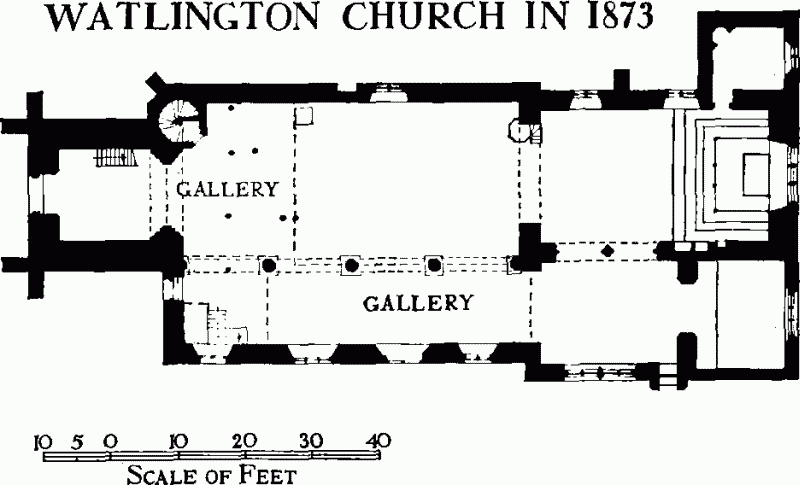
WATLINGTON CHURH IN 1873
The church of ST. LEONARD lies on the outskirts of the town: it is built of flint with stone dressings, and comprises a chancel, nave of four bays, north and south aisles, a south porch, a south chapel, a vestry, and western tower. Apart from the tower it was almost entirely rebuilt in 1877 in the Decorated style.
There seems to have been some uncertainty in the past about its dedication. Rawlinson stated in 1718 that it was dedicated as St. Bartholomew or St. Mary the Virgin, (fn. 700) and the town fair was certainly held on St. Bartholomew's Day. An early-19th-century historian of Watlington, John Badcock, gave its dedication as St. Mary. (fn. 701) In the early 14th century, however, it was undoubtedly dedicated to St. Leonard. (fn. 702)
Some remnants of an earlier Romanesque church are preserved in the present building: in the east wall of the organ-chamber there is the diapered tympanum and plain arch of an outer doorway which was in the north wall of the nave before the north aisle was added; (fn. 703) in the south wall of the choir there is a small column with a Romanesque capital; and in the west wall of the south aisle are two small capitals of the same period.
Nineteenth-century drawings made before 1877 show that the church was built mainly in the style of the late 14th century. (fn. 704) Of the medieval structure there survive the battlemented west tower, the south nave arcade, the walls of the south aisle, and the south wall of a chapel on the south side of the chancel. This chapel was added about the end of the 15th century. According to the inscription on a brass stolen by a parish clerk, but recorded by Rawlinson, Maud, the wife of Richard Warner, woolman, was the foundress of this chapel. (fn. 705) The year of her husband's death is unknown, but it is possible that he was the father of Robert Warner who died between 1478 and 1495, (fn. 706) and that Maud erected the chapel as a memorial to him. The Perpendicular window in the south wall and the two bays of Perpendicular arches on the north side might well have been constructed in the mid-15th century. The east wall of the medieval chapel was where the 19th-century arch now is, and the eastward extension was made in the 18th century. The Decorated window, of which only the upper half remains, that is now in the east wall of the 18th-century extension seems to be of about the same date as the east window in the chancel. It is likely that it was originally in the south wall of the chancel, was moved when the chapel was built and reused in the chapel's east wall, and again reused when the chapel was extended in the 18th century. It is shown in 19th-century drawings of the church made before the restration of 1877. (fn. 707)
No record has survived of any 16th- or 17th-century work. In 1721 a number of paving and building bricks were paid for, so repairs to the floor were evidently carried out. (fn. 708) In 1743 Thomas Stonor ordered the whole pavement and steps of the chancel to be taken up and 'levelled and layd down with new pavement' and 'new facing of stone to the steps.' He also ordered the tiling to be completely repaired. He examined the roof of the chancel and could not find that it had ever been ceiled; he agreed with the bishop that he was not obliged to add 'what for so many ages has never been thought necessary', but nevertheless gave orders for the chancel to be ceiled. He also agreed to put in a new east window. (fn. 709) If this was actually done the new window must have been a copy of the old one for 19th-century drawings show a Decorated east window. It was complained at the time that the churchwardens and leading men of the parish showed little regard for 'decency and beauty in their church', (fn. 710) and in 1759 the archdeacon ordered that the pavement should be 'new laid' in many places and that no burials should take place in the church unless a brick arch was built over the grave. The chancel was to be whitewashed. (fn. 711)
In 1763 Edward Horne, member of a leading family of tradesmen and landowners in and around Watlington, petitioned for a licence to carry on the south wall of the church until it became even with the east end of the chancel and to cover the roof with lead. The dimensions of the vault were to be 19 ft. by 15 ft. (fn. 712) The work was carried out as the present measurements of the eastward extension show. Externally, a buttress against the south wall marks the junction of the 15th-century wall with its 18thcentury extension. The vault was entered by a large iron gate placed in the original east wall of the chapel. There was no direct entry from the vault into the chancel, the south wall of which was left intact. From an early-19th-century drawing and description of the mausoleum it appears that the Horne memorial inscriptions were arranged on white marble shields; that the mausoleum was about 8 feet high, contained eighteen compartments, and was placed under the east window. (fn. 713) The interior of this vault was largely rebuilt in the course of the 19th-century restoration.
The only other information about the church before its restoration concerns its internal fittings. In 1681 Mr. Deane (i.e. Simon Adeane, d. 1686) promised to refloor the women's seats which were next to the 'parsonage' seat. He himself was to have the uppermost seat next the minister and permission to make a pew there. He also promised to wainscot the wall from the reading pew to the belfry and repair all benches or seats that were broken. (fn. 714) In the next century growing population led to the building of galleries by the gentry and better-class tradesmen: in 1704 Richard Lamborne and Francis Nash petitioned to build a gallery (12 ft. × 12 ft.) on pillars; (fn. 715) in 1723 the vicar, Thomas Toovey, asked for one; and in 1738 when Mr. John Duncombe petitioned for yet another it was stated that Mr. Horne had one, 'handsomely adorned and beautified with carved work' which was 'ornamental to the church' and would be obscured if Duncombe's was erected in the proposed spot. (fn. 716) A few years later Ralph Towney, a draper, wanted a gallery near the singers' one. (fn. 717) The singers' gallery was a public one and had been paid for by subscription. (fn. 718) Meanwhile, the church was otherwise somewhat neglected. In 1743 the Lord's Prayer and the 'Belief' were reported out of repair; there were no Commandments; (fn. 719) and the font had not been moved in accordance with Bishop Secker's wish. (fn. 720) The purchase of the existing beautiful chandelier, now in the south chapel, from Mr. Cooke in 1778 marks a revival of interest. (fn. 721) In 1781 the king's arms were painted by Mr. Chapman for £13 13s. (fn. 722) In 1808 a new font was installed near the south door, the old one having been broken when it was moved in 1806; it was made by Hudson of Oxford for £13 17s. and was a 'Gothic stone font with marble bason and top compleat, carved dove etc.'. (fn. 723) Payments were made in 1806 and 1808 to Mr. Chapman for rewriting the Commandments, the 'Belief', and the Lord's Prayer, and the inscriptions on the monuments of the donors of charities; and in 1815 a new window at the west end of the church cost £5 1s. 4d. (fn. 724) In 1817 Robert Exton new-faced the two outer doors on the south side of the church 'in Imitation of antient Gothic work'. (fn. 725)
In 1842 the vicar and churchwardens petitioned the 'Society for the Enlargement of Churches' for a grant to extend the church, (fn. 726) and it was probably at this time that unsigned plans by an architect, now in the parish chest, were made, but nothing came of this scheme and it was not until 1874 that restoration was undertaken. The curate-in-charge, Arthur Lloyd, and his churchwarden William Wiggins, were the chief promoters of the work; the architects were H. J. Tollit of Oxford and Edwin Dolby of Abingdon. (fn. 727) The builder was Martin of Hereford. The nave and chancel were reroofed, a north aisle, vestry, and organ chamber were added. The wall of the south aisle was heightened and a south porch was built. The south aisle was reroofed and the first two windows counting from the west were rebuilt. A 14th-century cusped tomb recess was preserved in the south wall. The south doorway into the 15th-century chapel, shown in Buckler's drawing of 1822, was blocked up. The Horne vault to the east of the south chapel was remodelled. A window was inserted in the south wall and arches were made between the vault and the chancel arch and between it and the south chapel. All the other windows in the church were repaired.
A considerable amount of work was done on the interior: the galleries at the west end and over the south aisle were removed. The Horne mausoleum in the south chapel was taken down and the iron gates which inclosed the entrance to it were removed, although the original petition for a faculty stated that these were to be preserved. The Horne memorial tablets were reset in the south wall of the chapel; the altar rail, pulpit, and reading-desk were renewed. All the old seating was removed, except for the oak seats in the chancel, (fn. 728) and the church was repewed. The reopening took place in March 1875, but the work of restoration was not completed until 1876. In 1877 the Diocesan Church Building Society was asked for a further grant, as £400 had had to be borrowed. (fn. 729)
Some further work was done to the fabric in the 20th century. The pinnacles of the tower were blown off in 1906 and 'the design of 1873 by Mr. Dolby' (i.e. Edwin Dolby of Abingdon), which was not carried out because of lack of funds, was completed. The architects Tollit and Lee of Oxford supervised the new work. (fn. 730)
In 1913 it was proposed to insert dormer windows in the roof to give light and ventilation, but the outbreak of war prevented the scheme being carried through. Electric lighting was installed in 1937, and in 1957 the stone steps and surrounding stonework were made in the choir. (fn. 731)
During the two decades after the restoration, much effort was spent on beautifying the restored building, particularly in the insertion of stained glass windows. Only a few fragments of medieval glass remained. These are now in the vestry and they include a shield with half the arms of Stonor in the dexter, which is thought to have represented originally the marriage of Sir Richard Stonor with Margaret, daughter and heir of Sir John Harnhill (Glos.). (fn. 732) It was in the east window, certainly as late as c. 1750, (fn. 733) and was replaced in 1887 by glass by C. E. Kemp, which was dedicated as a memorial of the golden jubilee of Queen Victoria; in the same year the stained glass in the east window of the south chapel, also designed by Kemp, was inserted in memory of the Revd. William Hulton who was lord of the manor; and the window of St. Paul of Athens in the north aisle in memory of a curate was made by Messrs. Atkinson of Newcastle. Stained glass in the west window of the tower, also by Kemp, commemorates the Revd. Basil T. S. Carter (vicar 1886–96). Three more windows each of two lights by Kemp were placed in the south aisle and dedicated in 1902.
Besides stained glass Kemp designed in 1889 the carved oak reredos, now on the south wall of the south chapel, but originally in the sanctuary. In 1897 Messrs. Blackler & Sons made a new alabaster and marble font to commemorate the diamond jubilee of Queen Victoria. They also made a low screen for the sanctuary with ornate brass gates, which was taken down in 1948 as it had become unsafe. (fn. 734)
A new screen was erected in the south aisle in 1903 and in 1904 the church acquired new clergy stalls in the choir, made by Whippell & Sons of Exeter. The stalls were the gift of the Revd. S. C. Saunders and his wife. Saunders also gave in 1905 the organ at a total cost of £1,000. It was built by Hill & Sons of Islington. (fn. 735) The rood was erected to Saunders's memory after 1914; a clock by Smith & Son of Derby was placed in the tower in about 1914; the present high altar and panelling in the south chapel were given in memory of Annie Wiggins (d. 1926): they were designed by C. O. Skilbeck of Bledlow; and the lectern was given in memory of Marion Gunston in 1896.
The church also possesses an ancient parish chest; an oil painting, presented to the church in 1906, which is considered a copy of an altar piece by Annibale Carraci, (fn. 736) some fine sets of modern vestments and copes, and a finely worked banner done by some ladies of Watlington and completed in 1957.
There are three brasses: William Frankleyn (d. 1485), his wife Sibilla, and four children; William Gibson (d. 1501) and his wife Maud, who are represented in shrouds; (fn. 737) and Jerem Ewstes (Eustace), yeoman (d. 1587), who was the eldest son of Robert Ewstes and donor of the treble bell. (fn. 738) He is depicted in doublet, hose, and short cloak. His inscription also states that his brother John (d. 1588) was buried with him. A fourth brass once in the south chapel is now missing. It was to Richard Warner, woolman, and his wife Maud, 'foundress of this chapel'. (fn. 739)
Memorials to the following are still in the church: William Buckland (d. 1597/8), yeoman; Robert Parslowe (d. 1683); Thomas Toovey (d. 1719), son of Thomas Toovey, vicar; Anne Burt (d. 1730), relict of Edward Burt; Mr. Richard Hester (d. 1736); John North, gent. (d. 1763); John Tilson (d. 1779), only son of George Tilson Esq., Under Secretary of State to Queen Anne; Richard Birkhead, vicar (d. 1784); George Tilson Esq. (d. 1795), son of John Tilson; the Revd. James Relton (d. 1795), Vicar of Shirburn; Thomas Barnes (d. 1829); George Hester (d. 1833); General Christopher Tilson Chowne (d. 1834), son of John Tilson of Watlington Park; John Henry Tilson (d. 1836), magistrate and eldest son of John Tilson; William Hester Wiggins (d. 1840); William Cozens (d. Feb. 1844); Robert Cozens (d. Dec. 1844); Daniel Burton (d. 1865); Moses Wiggins (d. 1878); Arabella Annie Wiggins (d. 1926); John Morris (d. 1938), physician; A. E. Snow (d. 1945), vicar for 22 years.
The south chapel contains many memorials to the Horne family, including the following: Edward Horne (d. 1765), son of Edward and Frances Horne; Charles Horne (d. 1772); Edward Horne (d. 1777), son of Samuel Horne, merchant of London; Samuel Horne (d. Jan. 1777); John Yardley Horne (d. 1789), son of Edward Horne and his wife Sarah; Samuel Horne, 3rd son of Samuel and Jane (d. 1797). These and other memorials (e.g. to Edward Horne, gent, (d. 1745), and his wife Frances (d. 1740), daughter of Richard Cornish), were once fixed to a mausoleum below the east window erected in 1765 by two sons of Edward and Frances Horne. (fn. 740) It was removed at the restoration of the church.
The following monuments and inscriptions have been lost or are not now visible: a brass in the south chapel, already mentioned, to Richard Warner, his wife Maud, and their sixteen children; Edmund Wadbury the younger (d. 1513) and his wife Jane; Mr. Anthony Mollynes (d. 1582), his wife Agnes (d. 1610), and two children, also in the south chapel; Sir George Simeon, Kt. (d. 1665); Simon Adeane Esq. with arms (d. 1686); Ralph Wells, vicar (d. 1681); John Ovey (d. 1694/5) and son-in-law Richard Lamborn Esq.; John Greendown, surgeon (d. 1700); and Thomas Cornish, vicar (d. 1711). (fn. 741)
The medieval church had five bells, (fn. 742) but none survived after 1663. The new bells were inscribed as follows: (1) Thomas Stonor Esq., Symon Bartlett, Thomas Gregory, C.W.H.K. 1663; (2) Jeram Eaustas [sic] gave this bell in 1587 H.K.: (3) Simon Bartlet [sic], Thomas Gregory, W.C.C.W. 1663; (4) Feare God 1635; (5) Prayes ye the Lord 1635; (6) Feare God, Honour the King 1660. (fn. 743) Between 1736 and 1743 the bells were rehung on a new frame; in 1785 the fifth bell was recast by C. I. Rudhall and a new frame was again made, at a total cost of some £90; in 1867 £62 15s. was paid for a seventh bell. (fn. 744) A faculty for two bells was obtained in 1905: (fn. 745) one new bell was paid for by subscription and the other out of Mrs. Maria Cook's and Mrs. Whetton's charity; both were cast by Messrs. Mears & Stainbank. All the bells were hung on a new frame. (fn. 746)
At the time of the Edwardian inventory the church seems to have been not far behind Thame in the richness of its possessions. These included satin copes, vestments of damask, and cloth of tissue flowered with gold; altar cloths, pillows, a corporal of cloth of gold with the five wounds on it, and a canopy with four staves. There were two silver chalices and patens, and many other silver and gilt items. Again, like Thame, Watlington church had a pair of organs and as at Thame its churchwardens seem to have forestalled the king's commissioners by selling some of the church goods; two chalices and a ship of silver were sold for £10 11s. and apparently other items as well for twelve more entries are missing. (fn. 747) The present silver includes an Elizabethan chalice with no hallmark; a paten with the arms of Adeane impaling Whorwood (1688), which was given by Mrs. Mary Adeane; (fn. 748) a large flagon of 1757 given by Samuel Horne 'for the more decent celebration of the Holy Communion' (fn. 749) and an Elizabethan ciborium given in 1955. (fn. 750)
The registers for baptisms, burials, and marriages date from 1634. (fn. 751)
The churchyard is well stocked with trees, both limes and yews. It was extended in 1867 and a wall was built on the eastern side with money from bequests. (fn. 752) There is a memorial to Thomas Toovey of Howe (d. 1720), and a tomb to the Revd. Thomas Williams (d. 1801). A lych-gate was erected in 1901 by the parishioners in memory of the glorious reign of Queen Victoria (1837–1901).
The Church of the HOLY NATIVITY at Christmas Common was built in 1891 as a chapel of ease to Watlington parish church. (fn. 753) It is of red brick. The stained glass in the east window is a memorial to the Revd. B. T. S. Carter (vicar 1887–96); another window, erected in 1908, in memory of Dr. Henry Dixon, coroner for south Oxfordshire, was designed by L. Muirhead of Haseley Court. (fn. 754) A vestry was added in 1937. (fn. 755) The church has an open central turret containing one hemispherical 'bell' or gong. (fn. 756)
Roman Catholicism.
After Henry VIII's death there was considerable religious unrest in Oxfordshire and in 1549 Lord Gray of Wilton was empowered by the Government to suppress disaffection and to execute 'evil disposed persons'. He ordered William Boolar, a papist of Watlington, to be hanged in the town as an example. (fn. 757) About fifteen people, mainly of the yeoman class except for Thomas Bennett Esq. and his wife, appear in the surviving recusant lists of the early 17th century. (fn. 758) At this time the Roman Catholic families of Simeon of Brightwell and Britwell Prior, Chamberlain of Shirburn, Stonor, and Weld all held land in the parish. (fn. 759) After the Restoration five papists were reported and ten were indicted at Quarter Sessions between 1690 and 1728, among them members of the Callis and Shepherd families. (fn. 760) The Shepherds' house at Greenfield hamlet along with Watlington Park, which then belonged to the Stonors, were fruitlessly searched for arms and horses in 1704. (fn. 761) The isolated character of the Chiltern villages and the influence of a group of Catholic families enabled Roman Catholicism to survive in this area after the Hanoverian succession and at a time when the fortunes of the whole English community were at their lowest, particularly in the south of England. Great encouragement and support came from Bishop John Talbot Stonor, appointed in 1716 Vicar Apostolic of the Midland District and Bishop of Thespiae. Until his death in 1756 he was often at Watlington Park. The sixth Thomas Stonor had resided there in the 1670s and had a chapel, but in the first half of the 18th century the house was mostly leased to Roman Catholic tenants. There is a record in 1730 of two converts being 'reconciled to the Church' by the bishop before the whole congregation in this Stonor chapel. (fn. 762) From here and his chief Oxfordshire headquarters at Stonor he was constantly visiting and confirming members of his flock. (fn. 763) The chief burden of parochial work at Watlington and Christmas Common, however, fell on the chaplain to Sir Edward Simeon, a cousin of the Stonors who had come to live at Britwell Prior in 1729. (fn. 764) The Roman Catholic congregation in Watlington, however, was small: in 1738 the vicar reported that there were seven papists in Watlington and one or two of 'mean rank' at Christmas Common; (fn. 765) among then were two women converts. Numbers fluctuated, but in 1767 there were said to be as many as eighteen papists. (fn. 766) There were chaplains at Britwell until at least 1788, in which year the Britwell register ends. Thereafter Watlington was served from Stonor. (fn. 767) The church of the Sacred Heart was built in the village in 1930 by the efforts of Father William Brown, the chaplain at Stonor Park, and in 1956 the priest moved from his house in Stonor to a newly built one at Watlington; the congregation numbered 100 in 1958 and was drawn from neighbouring villages as well as from Watlington. (fn. 768) Since the restoration of the hierarchy in 1850 Watlington and the Chiltern area have been in the diocese of Birmingham. (fn. 769)
Protestant Nonconformity.
The influence of Puritanism had made itself felt in Watlington before the Civil War, for in 1642 the inhabitants paid for a lecturer, Henry Langley, later Master of Pembroke College, Oxford, and well known as a Presbyterian. (fn. 770) Parliamentary forces were in and about the town during the war and interest in radical views was probably stimulated. In September 1652 a public debate was held in the church 'on infant baptism' between Jasper Mayne, the royalist Vicar of Pyrton, and the Baptist, John Pendarves. Mayne preached a sermon 'against schism' and Pendarves was said to be 'backed with a great party of Anabaptists and the scum of the people, who behaved themselves very rude and insolent'. (fn. 771) In the following year Watlington was represented at the first meeting of the Berkshire Association of Baptists at Tetsworth. (fn. 772)
There is little doubt that Nonconformity continued to flourish after the Restoration, though reports of the total numbers involved are difficult to interpret and it is not possible to distinguish with any certainty between the sects. The Baptist community, however, seems to have been the most important.
Among the 'professors of religion' John Ovey was outstanding. From the account given of him by the Quaker, Thomas Ellwood, it appears that he was a fell-monger, accustomed 'to ride upon his pack of skins', and had always been profoundly religious 'from his childhood to his old age'. He was so well thought of for 'his zeal and honesty' by the Parliamentarians that, though otherwise unsuited for office, he was made a justice of the peace, a 'register' of births, deaths, and marriages, and an Oxfordshire commissioner for ejecting scandalous ministers. Ellwood says that as a justice of the peace he had neither an estate to defray the expenses of the office, nor sufficient knowledge of the law, nor a presence of mind or body 'to keep offenders in some awe'. He also relates how Ovey, an old friend of his, had read and 'greatly esteemed' the writings of Isaac Pennington, written before he became a Quaker, and how Ellwood had taken Ovey to visit Pennington at his house at Chalfont. The two men walked there from Stokenchurch, 'entertaining each other with grave and religious discourse'. At Chalfont Ovey met not only Pennington but George Whitehead and other Quakers from London and elsewhere, who had assembled for a monthly meeting. Such meetings were illegal and Ovey escaped arrest by a party of soldiers, who broke up the meeting, by hiding while the Quakers made no attempt to avoid arrest. He was afterwards very ashamed of his 'cowardice'. (fn. 773) Ellwood states that he could not remember whether Ovey was an Independent or a Baptist teacher, and those who were meeting at Ovey's house in 1669 were reported to be 'mixt of Presbyterians, Anabaptists etc.'. He himself was then described by the authorities as a 'notorious ringleader'. (fn. 774) In 1672 Ovey, or possibly a relation of the same name, for the family was widespread in the neighbourhood, applied for a licence to teach in a Mr. Rusden's house in Wallingford, (fn. 775) and a John Ovey died at Watlington in 1694. (fn. 776)
In 1669 another regular Watlington meeting was being held at the houses of both Mary East, widow, and Gregory West, a weaver. This was described as Sabbatarian and was taught by Stephen Coven, an Independent, an ejected minister of Sampford Peverell in Devon, and 'a wandering seditious seminary' who was preaching at Dorchester in 1675 and 1676. (fn. 777)
After the Declaration of Indulgence in 1672 licences were obtained to hold meetings in the houses of John Harper, a Baptist, (fn. 778) and of Thomas Ovey, John Ovey's brother. Stephen Coven received a licence to teach in Thomas Ovey's house. (fn. 779) The numbers of those attending these meetings are not given, but the Compton Census of 1676 gives 47 dissenters in Watlington. The numbers of those excommunicated, possibly for not attending church, were also considerable, but there is no indication whether the offenders were Catholic or Protestant. (fn. 780)
The Sabbatarians or Seventh Day Baptists reported in 1669 seem to have been the dominant sect in the town until the arrival of Methodism. In 1690 they were described as a 'Remnant' (i.e. a church not fully organized) and their teacher was Edward Stennett, the elder. (fn. 781) They attracted the attention of Dr. Plot who says that they were 'a sort of Sectaries perhaps never heard of in the world before … called Anointers from the ceremony they use of anointing all persons before they admit them into their Church'. The Elders were 'poor tradesmen of the town, and the oil they use, that commonly sold in shops, with which the proselyte being smeared over, and fired with zeal, he presently becomes a new light of this church'. (fn. 782)
In the early 18th century a member of the Stennett family was won over to the Church and was baptized in 1713, but later became an apostate. (fn. 783) The most prominent Sabbatarians in this century, however, were members of the Nash family. In 1738 a monthly meeting was being held at the house of Nathaniel Nash, a prosperous tanner; he was described as 'very wary' and as 'expounding but little to promote their interest'. The 'Meeters' were of every sort except Quakers, and their teacher was a tailor or shoemaker named Hoare from Haddenham (Bucks.). (fn. 784) In 1759 the Nash family were still Sabbatarians, but the vicar reported that he had not been able to find the names of any of their teachers as they 'keep themselves pretty much to themselves and do not seem to endeavour to draw others over to their persuasion'. (fn. 785) In 1768, though the Nash house had been licensed some years before, they were said to have no teacher. (fn. 786) Thomas Hiller of Tewkesbury was teacher from 1774 until about 1793 when two families in the town were said to be Sabbatarians. (fn. 787) Hiller was probably followed by James Hinton, who in 1792 was riding out weekly from Oxford to preach at Watlington. (fn. 788) The congregation of about 40 officially recorded in 1798 was presumably partly drawn from neighbouring villages. (fn. 789) With the death of Mary Stringer the last member of the Nash family, in 1808, the Seventh Day Baptists in Watlington came to an end. She left a number of bequests to dissenting organizations and dissenters, including £100 to the Seventh Day Baptists and £1,000 to James Hinton. Hinton recommended the formation of a Congregational Church as there were several Congregational families in the town. (fn. 790) In 1812 a cottage in Barber's Cross was being used as a chapel which about ten Independents and two Baptists attended; it was apparently open as late as 1835 when a minister from Stokenchurch was visiting it, and then after being closed for 'some time' it was reopened in 1842 by John Young from Tetsworth. (fn. 791) An average congregation of 25 was recorded in 1851. (fn. 792) Nevertheless, in the next year services were again discontinued. Later, there was a 'free church' in Watlington which in 1881 had a membership of eight. David Harris took charge of it and eleven persons are stated to have formed themselves into a Congregational Church, holding their services in a hired room until 1888 when Jubilee Hall was built. Harris then applied for membership of the Congregational Association. This was refused on the ground that the church was Congregational only in name. (fn. 793) The strength of the local Baptist tradition is indicated by this comment and by the fact that Harris himself was evidently a Baptist, for he left in 1899 to become a Baptist minister in Devon. After his departure the Jubilee Hall was used for undenominational services. (fn. 794)
There were Quakers in Watlington in the 17th and 18th centuries. The Quaker, Thomas Ellwood of Crowell, who was an old friend of John Ovey, visited him in 1661 with a London Quaker, also an old friend, who 'declared the truth' to a meeting in Ovey's house. He was attentively heard and not opposed, which was an unusual experience. (fn. 795) The chief Quaker families lived outside Watlington: they were the Whites, who owned a brick kiln at Christmas Common, and the Tooveys of North End, who also owned land at Christmas Common. (fn. 796) Both families were regularly distrained on for failure to pay tithes: the Whites from 1699 to 1792 and the Tooveys from 1700 to 1716. In both families women were outstanding for their resistance. Watlington was in the Warborough division of the county and Quarterly Meetings were held either at Henley, Turville Heath, or Warborough until 1698 when they began to be held at Roke as well. (fn. 797) At Bishop Secker's visitation in 1738 the vicar reported two Quaker families, the widow White (fn. 798) and her children, and widow Haynes, who kept an ale-house in Watlington, and had been 'of no very good fame' in her youth. The vicar obtained his tithes from the Whites by ordering kilnware and then paying only the residue of the bill when he had subtracted the amount owing to him for tithes. White acquiesced in this arrangement and gave the vicar a receipt in full, (fn. 799) though he generally said at the same time that he did not know he owed anything. Thirty years later three Quaker families were reported, two very 'low in the world' and the third the Whites. (fn. 800) After 1778 the vicar ceased to report any Quakers, but the local historian of Watlington said in 1816 that there were still one or two. (fn. 801)
Methodist preachers first came to Watlington at the invitation of William Chapman, a painter. (fn. 802) Although he and his wife were devout members of the Established Church they attended a Wesleyan meeting 'five miles away', possibly at Chinnor where dissent was already firmly established. (fn. 803) In 1764 a Methodist, T. Bryant, preached in Chapman's yard; the next year Thomas Tobias, the preacher formally in charge of the Oxfordshire circuit in 1765, came to Watlington and in 1766 John Wesley himself. (fn. 804) Chapman's house was licensed as a meeting-house in 1771. His daughter Patty was the chief support of the society. (fn. 805) Another daughter, Hannah, married in 1766 Thomas Stonill, a currier, who became a local preacher. She died in 1806, but her husband was still active as late as 1807. (fn. 806) He was 'much respected for his primeval and great simplicity of manners . . .' . Early in life he could repeat nearly the whole Bible by heart. (fn. 807)
Wesley came again to Watlington in 1774 and 1775 and in 1796 a meeting-house was built. (fn. 808) In 1811 the vicar reported to the bishop that there were 25 Wesleyans in the parish, with three licensed travelling preachers, but in the same year a petition presented by Watlington Methodists in protest against the Protestant Ministers' Bill was signed by 88 people, including William and Joseph Chapman and other prosperous inhabitants. (fn. 809) Many of the signatories were doubtless Methodists who came in from the neighbouring villages. A new chapel was built in Shirburn Street in 1812 which could seat 328 persons, and to which Badcock said 'a considerable number resort of an evening', although in his parish history he gave the numbers of Methodists as eighteen. (fn. 810) The vicar in 1820 said there were only six Methodist families, but many chapel-goers still came to church and took the Sacrament regularly, and so were not numbered as dissenters in Visitation returns. (fn. 811)
The movement continued to spread: a meeting was licensed at Christmas Common in 1822 and a chapel seating 145 was built in 1824, when Watlington first became the head of a circuit under George Birley and Thomas Kempshall. (fn. 812) Before 1843, however, a split had taken place, for in that year Primitive Methodists obtained a licence for a meeting-house. (fn. 813) In 1849 they were renting a room which could seat 100, although the average attendance at meetings was twenty to thirty, (fn. 814) and in 1853 they were able to take over the old Independent Chapel, a cottage in Barber's Cross, which had closed the year before. (fn. 815) In 1910 the trustees were authorized to sell the building. (fn. 816) At the time of the 1851 census the main Methodist chapel was reported to have an average attendance of 150 in the morning and 280 in the evening; by contrast in 1854 the vicar told the bishop that the chapels were indifferently attended and the dissenters only a small proportion of his parish. (fn. 817) Nevertheless, in a visitation return of 1866 the dissenters were reported to number 600 to 700 as against an average church congregation of 200 or 300, (fn. 818) and in 1872 the new curate Lloyd found crowded dissenting chapels and an empty church. (fn. 819) In 1959 the Wesleyan chapel in Watlington with a membership of 63 was the best supported in the Thame and Watlington Circuit. There was a resident minister. The Christmas Common chapel had a membership of four. (fn. 820)
Schools.
There was provision for boys' education in Watlington from 1664 when Thomas Stonor agreed to include in the new Town Hall an upstairs room, which could be used as a free grammar school. Stonor endowed the schoolmaster's salary and in 1731 Dame Alice Tipping of Ewelme endowed the education of four other poor boys, who were to be taught elementary subjects. (fn. 821) By the 19th century the school no longer kept to its original purpose, but gave an elementary education. (fn. 822) In 1818 there was provision for 20 scholars on the Stonor and Tipping foundations and the master also instructed another 20 boys. (fn. 823) The growing elementary character of the school was encouraged by the fact that a National school for boys was united with it. In 1841 the Vestry resolved to establish a National school and to endow it from Hester's charity and part of the church charity. (fn. 824) It was opened in 1842 and the churchwardens gave £28 towards it. (fn. 825) As the school-room in the Town Hall was used for it, the old free grammar school came to be regarded as a part of it and in 1853 was described as a National school taught by James Bartlett. (fn. 826) Numbers had risen from 40 scholars (i.e. 20 free scholars and 20 others) in 1818 to 80 in 1853, but they began to decline in the next decade. (fn. 827) In 1866 the endowed school held above the market place was described as 'merely an elementary school' with 42 boys in four classes and James Bartlett, who had been teaching for 36 years, was described as untrained and uncertificated. Apart from the endowed scholars, the boys paid 3d. a week. Instruction was given in the Bible and catechism, in reading, writing, arithmetic, dictation, a little geography and grammar. The two rooms over the Town Hall were said to be in only moderate repair and ill supplied with furniture, and there was neither playground nor offices. The school on the whole was regarded as inferior to a National or British school under inspection and did not quality for a grant as an elementary school. (fn. 828) Because of this report a Board school was set up and the free school was forced to close soon after. (fn. 829) Part of the endowment money was used for school prizes, but part at least continued to be paid to James Bartlett (d. 1880) as a pension and after his death to his widow (d. 1881). An attempt by his heirs to claim the rent of the Tipping endowment was resisted and the Charity Commissioners organized the election of a new committee of trustees to administer the income from the endowments for the benefit of the children for whom it had been intended. (fn. 830) From 1885 scholarships were awarded annually, tenable in any public elementary school in Watlington, and in 1900, for example, six scholarships were given. (fn. 831) The trustees also administered part of the income of the Church Estate, which at first was used for prizes. (fn. 832) In 1896 it was used to encourage regular attendance and in 1900 the trustees pointed out that there were 18 full attendances as against none in 1896. (fn. 833) After 1905 the income was used to provide extra facilities for education. (fn. 834)
There was no endowment for girls' education until well into the 19th century. In 1816 a Mrs. Horne of Southampton financed the instruction of six poor girls of the parish, (fn. 835) but it was not until 1843 that a girls' National school, connected with the boys' school and financed partly by subscription and partly out of the proceeds of some of the charities in the town, was built on the south side of the church for £275. (fn. 836) Fifty to 60 girls were taught daily in 1853 and 1854 for a small fee. (fn. 837) There were 60 girls in 1871, but the school was presumably incorporated in the new Board school after the reorganization in 1872. (fn. 838)
There were other unendowed schools in the early 19th century, which were connected with various religious bodies. In 1815 the vicar reported that there were two day-schools, apart from the free school and the newly founded day-school for 35 boys instructed on 'the plan of the National Society'. (fn. 839) These may have been the two small day-schools, each with 35 children, which were recorded in 1818, and the two day-schools for 30 girls paid for by their parents in 1834. (fn. 840) A day-school for boys was recorded in 1834 also, and there were two day-schools conducted by the Independents and the Wesleyans respectively. The children started school at the age of six or seven and left at thirteen or fourteen. (fn. 841)
The fate of these schools is not known, but after 1872 their place was probably taken by the Board school. (fn. 842) The latter was affiliated to the National Society. The School Board consisted of four churchmen and one Wesleyan until 1884, when there was a contested election. The Free Church minister and one other dissenter were then elected. The vicar noted that though this might appear disadvantageous to the Church the result was probably beneficial. Both the vicar and his very active churchwarden, William Wiggins, were two of the church members elected and the votes cast for the church candidates were 761 as against 275 for the dissenters. (fn. 843) In 1889 there was an attendance of 127 at the National school, of 233 in 1902 and of 77 boys, 84 girls, and 88 infants in 1906. (fn. 844) In 1927, following reorganization after the Fisher Education Act of 1918 and the Hadow Report of 1926, the school was divided into a senior school with 96 pupils and a junior school with 72 pupils. Some seniors came by bus from Chalgrove and by bicycle from Brightwell while juniors walked from Cuxham. In 1954 there were 196 seniors and 93 children at the primary school. A new County Secondary School was built in 1956 to house all the senior pupils and the old buildings were taken over by the primary school. (fn. 845)
There are many records of private schools, both boarding and day, and in 1813 the vicar reported that the National school did not flourish because some preferred these other schools. (fn. 846) One of the earliest was the 'very respectable and well-conducted academy' kept by the vicar Richard Birkhead (d. 1784), (fn. 847) and another was that of a Mrs. Treacher, who advertised in 1801. (fn. 848) In 1833 there were two boarding schools, one for 19 boys, the other for 20 girls. (fn. 849) One of these schools may have been Miss Kent's school at Hill House, which was advertising for an apprentice in 1829. (fn. 850) Another must have been the Commercial Academy which was seeking pupils in the same year, and whose headmaster, Thomas Barnes, announced in 1835 that his recent appointment as Inspector of Weights and Measures would not be allowed to interfere with his scholastic duties. (fn. 851) Barnes still had a private day and boarding-school in Couching Street in 1844 and Mrs. Maria Barnes of High Street was a schoolmistress in 1854. (fn. 852) There were also private day and boarding-schools kept by a Miss Neal in Church Lane and Mary White in High Street in 1844, and by 1871 79 children were attending four private schools in the town. (fn. 853) Private schools seem to have declined after the opening of the Board school. In 1891 only two advertised: a boarding and day-school 'for young gentlemen' was kept by William Slater in High Street and a dayschool for ladies managed by Miss M. K. Spyer in Barn House. (fn. 854) Mrs. Ada Matlock kept a girls' school in Gorwell in the first quarter of the 20th century, (fn. 855) but by 1960 private schools no longer flourished.
There were training schools in Watlington from the early years of the 19th century. In 1816 parties of children and grown-girls are described as marching daily to their lace-making school, each with a lace pillow under her arm and a 'comfort-pot' in her hand, which was to be filled with glowing coals and placed between the feet. (fn. 856) In 1865 a training school for domestic servants, built by the 6th Lord Macclesfield, was opened by the Countess, who was responsible for its management and maintenance. The building was the present Chiltern Gate Hotel, situated just outside the town. Ten or twelve girls were boarded and trained by a matron, who received a salary of £35 a year, in cooking, housework, and laundry for between one and three years according to their ability. Any spare time was given to reading, writing, and needlework. The girls also received an hour's instruction from a clergyman once a week and religious instruction from the ladies of Shirburn on Sundays. Lady Macclesfield selected eight poor girls, who paid 6s. a quarter, while other pupils paid 4s. a week. The girls supplied their own clothing when at school, but the Countess gave them an outfit worth about £5 10s. when they left. They were allowed a fortnight's holiday a year. (fn. 857)
Before the provision of universal education in the 20th century, the poorer classes received much of their instruction in reading as well as in religion from the Sunday schools, which were very active in Watlington from the beginning of the 19th century. In 1800 the vicar, Thomas Williams, started a Sunday school in which 'he constantly exerted himself with un-wearied industry and increasing pleasure'. (fn. 858) By 1815 the attendance was 147 boys and girls, and a second girls' Sunday school, founded about 1801, was supported by Mrs. Tilson of Watlington Park and had 30 or more children from the Uphill area. (fn. 859) It was thought the 'the poor in general are able to have their children instructed in reading'. (fn. 860) In 1833 there were three Sunday schools, one for 80 children belonging to the Established Church, one for 70 children conducted by Independents, and one at Greenfield with 104 children conducted by the Wesleyan Methodists. (fn. 861) These schools were still in existence in 1864 and were attended by many children from Pyrton, Shirburn, and Turville. (fn. 862) In 1878 boys attended a Sunday school held by a clergyman with six men teachers and one woman, and the girls' Sunday school had six lady-teachers under a male superintendent. (fn. 863)
Evening classes for adults also provided instruction and in 1878 a school for men and women was being held nightly and employed two paid teachers as well as voluntary assistants. (fn. 864) The night school was still active in 1885. (fn. 865)
Charities.
A charity commission of 1614 found that before that time various lands, known as the Church Estate, had been settled in trust for the repair of Watlington church and the relief of the poor of the parish. (fn. 866) Not all the sources of these benefactions could then or can now be traced. The gift, however, in the 13th century of a ½-acre in Watlington by Agnes daughter of Richard the clerk of Watlington, for the upkeep of the fabric and the ornamentation of the church may have formed one element. (fn. 867) The benefaction of Richard Hutchins or Buckland, blacksmith, was certainly another. Buckland (will proved 1578) devised his freehold dwelling-house in Watlington, possibly in Shirburn Street, (fn. 868) subject to his wife's life interest, for the benefit of the poor. (fn. 869) A house in High Street called Watts (but called The George public house in 1820 and The Greyhound public house from 1843), a cottage, and 12 acres had been given by a William Dancaster and had been administered for 50 years or more by the churchwardens as successors to an extinct body of feoffees. (fn. 870) The donor was probably the William Dancaster who held a tenement in the town, late Watts's, in 1492, but had been succeeded in it by another tenant by 1509. (fn. 871) The rest of the property, which consisted of a cottage, an orchard, two former barns, a ½-acre in Watlington, and 1 acre in Britwell, was of unknown origin. The commissioners decreed that a quarter of the proceeds of all this property should be devoted to church repairs and the residue to the poor. The estate became known as the Church Estate. (fn. 872) In the later 17th century the profits from it were called the 'house and use money'. (fn. 873)
It seems probable that in the 18th century some additions were made to the property. In particular 5 or 6 'huts' in Church Street, which within Rawlinson's recollection had been perverted to wrong uses, were rebuilt as 2 cottages between 1711 and 1757. (fn. 874) In 1820 the estate consisted of 4 cottages, a garden, and an orchard in Hog Lane (later Chapel Street), 3 cottages in Shirburn Street, and 2 in Church Lane, the 'George', a meadow 'adjoining the Fleet' and a field adjoining the meadow, and 2 acres in Britwell. The Shirburn Street houses were only restored to the estate in 1816, having for some time previously been confounded with the parish property. (fn. 875) By 1883 some further additions seem to have been made, for there were then 8 cottages in Chapel Street instead of 4, and there were also 2 gardens not included in the list of 1820. (fn. 876)
The parish accounts show that between 1660 and 1672 rents from the property and interest on loans from accumulated capital varied from £3 to £6 a year. This income was not always spent in full, for balances were sometimes allowed to accumulate. Expenditure took the form of money doles to varying numbers of poor—64 in 1666, 73 in 1672—and payments to the sick, for nursing, and for boarding out orphans. (fn. 877) Between 1714 and 1828 the rent income gradually rose from £11 10s. in 1714 to £51 12s. in 1811–12. During this period the whole income was spent on church purposes, (fn. 878) for there was then no church rate. (fn. 879) But for these purposes the charity moneys were inadequate and it is therefore not surprising that the trustees should have ignored the other objects of the charity. Only in 1732–5 is there a hint of a distribution to the poor. (fn. 880)
In 1821 the vestry had resolved to adhere to the provisions of the 1614 decree, (fn. 881) but in 1844 rescinded the resolution and decided to apply the whole income to the repair of the church. (fn. 882) The income amounted to £70 in 1850 (fn. 883) and £100 in 1882. (fn. 884) The Charity Commissioners, after an inquiry, ruled in 1883 that the application of the income, as settled in 1844, was illegal. (fn. 885) The inquiry led in 1884 to the formulation of a Scheme whereby a quarter of the income was to be applied to maintaining the church fabric. Of the residue a part was to go to maintaining a prospective recreation ground, and thereafter to the benefit of children living in the parish who were attending or had attended an elementary school. These benefits were to take the form either (i) of prizes, of bonuses to encourage the children to continue their primary education, and of exhibitions to further their postprimary education, or (ii) to provide them with lectures or evening classes. (fn. 886) By a Scheme of 1897 the first quarter was constituted as the 'Church Repair Charity'. Of the residue, to be called the 'Recreation Ground and Educational Charity', one half was to go to the recreation ground and the other to the governors of Watlington school to be applied as directed in the 1884 Scheme. (fn. 887)
In 1896 a cottage in Shirburn Street was added to the estate by purchase (fn. 888) and in 1957 another (or the same) cottage in that street sold. (fn. 889) Between 1948 and 1957, by six separate orders, most if not all of the Chapel Street property was sold and the proceeds invested in stock. (fn. 890) In 1952–3 the income from rents and interest totalled £166 and £160 respectively and sums of £95 and £93 were carried to the church repairs account. (fn. 891)
Chibnals's Charity. Joan Chibnal, by will dated 1646, directed that 8 gowns and 8 ells of linen should be given yearly to 8 widows or 'ancient maids' of Watlington. The cost was to be charged upon her estate in Princes Risborough (Bucks.) and in 1823 was still being paid regularly by the owner of the property. (fn. 892) By 1883 the estate had devolved upon Sir Nathaniel Mayer de Rothschild, Bt. (created Lord Rothschild, 1885), who was then making the distribution. (fn. 893) The records show that the distribution was made regularly in 1757–8 and from 1774 to 1883. In 1865 the gowns were reduced to 7 and limited to widows, and the surplus cloth used for petticoats. (fn. 894) By a Scheme of 1884 the trustees were directed to apply the charity to the poor of Watlington, preferably to widows or 'ancient maids' by providing clothes, linen, or bedding or supporting a local clothing club. (fn. 895) In 1934 the trustees seem to have begun distributing blankets instead of clothing (fn. 896) and this was the form that the charity took in 1953. (fn. 897) In 1952–3 the charity was receiving a regular yearly income of £8 (fn. 898) which suggests that the obligation of 1646 had been by that time redeemed.
Hart's Charity. John Hart, of Cottisford, by will dated 1664, left a yearly rent of £9 charged on the manor of Easington for apprenticing two 'honest godly poor' boys to 'good trades'. (fn. 899) It was the custom to allow the money to accumulate until there was enough to bind out one boy, (fn. 900) although in 1738 the trustees were suspected of using it, in part at least, to ease the rates. (fn. 901) Premiums varied from £7 4s. in 1769 (fn. 902) to £20 in 1819, (fn. 903) 1835, (fn. 904) and 1882. (fn. 905) In the last year the owner of Easington manor was still paying the rent less the land tax. (fn. 906) Between 1846 and 1881 18 boys were apprenticed. (fn. 907) By a Scheme of 1884 the charity was to be applied to apprenticing a boy to an occupation, trade, or service, or, in default, in the payment of exhibitions to enable boys educated at an elementary school in the parish to undergo technical, professional, or industrial instruction or towards the cost of outfit. (fn. 908) The rent was still paid in 1953 and in 1952 a grant of £10 was made. (fn. 909)
Parslowe's Charity. Robert Parslowe, by will dated 1683, (fn. 910) left £200 to be laid out in the purchase of land, the rent from which was to be used to distribute yearly on the anniversary of the testator's funeral 10s. to the preacher of a sermon and 10s. for tolling the church bell. The residue was to be used to purchase yearly 10 suits, gowns, or coats, marked with 'R' and 'P' on the breast, for 10 poor persons of Watlington. At first the charity was secured on land bought at Aston Clinton (Bucks.) and Weston Turville, and produced a rent of £8 7s. In 1716 this land was exchanged for 9 acres in Watlington, reduced on inclosure in 1810 to 6 acres quit of common rights and tithe. (fn. 911) From the early 18th century the trustees accumulated a surplus and its existence seems to have encouraged them to spend their funds on charitable objects outside the terms of the trust—bread (1718), food and drink (1727), apprenticing both boys and girls (1727, 1730, and later years), or a dole (1742). From 1735 surpluses tended to be applied towards increasing the number of coats. In 1760, less appropriately, they were applied in aid of the poor rate. By the early 19th century the funds were once again being spent exclusively on clothing. The number of beneficiaries, which had stood at the conventional 10 in 1765, rose to 24 in 1810 and 47 in 1813. For some years before 1813 the recipients were all men, but thereafter women shared. (fn. 912) The rent from the charity lands amounted to £39 in 1810, and £28 in 1823, (fn. 913) i.e. after inclosure, and £26 in 1882. (fn. 914) Between 1813 and 1883, coats and gowns were distributed in roughly equal numbers, 22 of each being given in 1882. (fn. 915) By a Scheme of 1884 the charity was so varied as to provide for the distribution of clothing to such of the unrelieved poor as the trustees might choose. (fn. 916) By a Scheme of 1897 the provision for the vicar out of this charity was joined with provision for him made under the Hester, Greendown, and Burt charities to form the 'Charity for the Vicar'. By the same Scheme the provision for bell-ringing was likewise separated as the 'Charity for the Parish Clerk'. (fn. 917) In 1952 the income from rent was £15 and in 1953 £22, and in the latter year £27 was spent on blankets. (fn. 918)
Greendown's Brut's and Hester's Charities. John Greendown, surgeon, by will dated 1700, left £100 for the purchase of land, the rent from which was to provide 10s. for an annual sermon on St. John Baptist's Day and the remainder spent on bread for the poor of Watlington. (fn. 919) Land (c. 4a.) was bought in Fleet Meadow, Watlington, and was let at £6 16s. in 1766 and £5 in 1779. (fn. 920) In 1823, i.e. after inclosure, it yielded £14 3s. 4d. (fn. 921) but only £8 15s. in 1881. (fn. 922) In 1824–36 an average of 230 benefited from the Midsummer's Bread, as it was then called. (fn. 923) In 1881, after the needs of the sermon charity had been met, the income was distributed to widows in bread. (fn. 924) In 1883 the distribution was said to be conducted in a 'somewhat wholesale manner'. (fn. 925) From the time of inclosure the charity was administered with Burt's (see below). (fn. 926)
Anne Burt, widow, by will dated 1730, (fn. 927) left 1 acre in Watlington for the benefit of 10 poor widows of the parish. (fn. 928) In 1738 small doles were being so paid. (fn. 929) At the time of inclosure the remaining portion of Fleet Meadow was allotted in exchange. In 1823 the rent amounted to £1 4s. 2d. and was distributed, as directed, in doles. (fn. 930) In 1881 this and Greendown's charity were being administered together. (fn. 931)
Richard Hester, by will proved 1737, gave £200 for the purchase of land, the rent of which was to be distributed to the unrelieved poor on St. Thomas's Day. (fn. 932) The money was spent in buying land at Rotherfield Greys, (fn. 933) the rent of which was £10 in 1737–9, (fn. 934) £12 in 1786, (fn. 935) and £28 in 1811. (fn. 936) For some time before 1823 the income was being distributed to the poor indiscriminately, and the Brougham Commissioners recommended that thenceforward the trustees should comply with the founder's requirements. (fn. 937) In 1841–3 a part or the whole of the income was spent on the National school. (fn. 938) In 1881 the charity land was sold and the proceeds invested in stock yielding £64. In 1882 the money was spent in doles to the poor varying from 1s. 6d. for one person to 7s. 6d. for a family. (fn. 939)
By a Scheme of 1884 these three charities were placed under joint administration. The first charge upon the funds was to be the sermon charity, and the residue was to be applied in one of the following ways: for the benefit of poor needy persons (with a preference in the case of Burt's for widows) living in Watlington, subscriptions to hospitals, contributions towards providing nurses and purchasing annuities, subscribing to coal or clothing clubs and friendly societies, contributions to the outfit of minors entering a trade or occupation, supplying clothes, bedding, fuel, tools, medicines, or food up to £25 yearly, or supplying loans or gifts in cash to meet unexpected emergencies. (fn. 940) In 1918 the trustees were empowered to form a sinking fund. (fn. 941) In 1953 the income from the three charities in the form of interest (all arising from Hester's charity) amounted to £53 and in the form of rent (all arising from Greendown's and Burt's charities) to £5, and about £15 was distributed as a coal and clothing bonus. (fn. 942)
Ryder's Charity. William Ryder, by will proved 1839, left £40, the interest upon which after investment was to be distributed to the aged poor in bread. The capital was paid over to the vicar and churchwardens in the year of probate and in 1842 and 1844 four years' interest arising from it was added to the revenue from the Poor's Allotment (q.v.) and so distributed. No further interest was paid and though efforts were made to recover the charity moneys in 1856–7 they were not effectually pursued. (fn. 943)
Hayward's Charity. Elizabeth Jemima Hayward, by will proved 1841, left £100 stock, the interest on which was to be divided among such of the aged, infirm, necessitous, and deserving poor as the incumbent should choose. In 1882 £1 of the interest was given to the local clothing club and £2 to the coal club. In 1926–32 about £2 10s. a year was being distributed mainly through what were called 'Mothers' Meetings disbursements'. There was no evidence of distribution in 1954–6. (fn. 944)
Cook's and Welton's Charities. Maria Cook, of Brighton, widow, by will proved 1858, left, at the request and in memory of her son the Revd. J. C. Cook and subject to two life interests, £1,000, the income on which was to be applied to the repair and improvement of the church and churchyard; any surplus was to be distributed annually to the poor in doles of not more than £1 a head. (fn. 945) The charity became payable in 1862 on the death of Mrs. Welton (see below), (fn. 946) and was applied between 1862 and 1868 to the extension of the churchyard. (fn. 947) In 1882 the income amounted to £32. (fn. 948) Since 1878 it had been applied to discharge the debt upon the Church Estate incurred in 1873 (see above). (fn. 949) By a Scheme of 1884 the service of this debt was formally made a first charge upon the income. (fn. 950) In 1954–6 the income amounted to £21 and was used for church repairs. (fn. 951)
Mrs. Caroline Welton, Mrs. Cook's sister, by will proved 1862, gave £200 the interest on which was to be applied in the same way as the Cook charity. (fn. 952) In 1882 the income was £6, (fn. 953) and in 1954–6 £5 was still being so applied. (fn. 954)
William Wheeler, of Cadwell Farm, Brightwell Baldwin, by will proved 1915, left £100, the income of which was to be applied to the repair of the Wesleyan chapel [i.e. in Shirburn Street]. The money was invested in the purchase of a cottage beside the chapel, which was let to tenants. In 1931 £4 3s. was being spent on repairs to the chapel. (fn. 955)
Poor's Allotment. In 1786 woodland of the annual value of £40 was held in trust for the purpose of furnishing the poor of the parish with fuel and other necessaries. In addition the poor had the right to cut dwarf wood growing upon the waste. (fn. 956) At the inclosure of 1810 an allotment of 41 acres out of the commons and wastes, at Minigrove, was set aside so that the rent on it might be applied to buying fuel for distribution among 'the poor', i.e. those occupying lands below the net yearly value of £10. Any unleased part of the allotment was to be appropriated to sowing furze to cut for fuel. In c. 1823 the land was let for £18 and the rent distributed in coals every other year to such poor as chose to claim them. (fn. 957) In 1865–76 the rent was £24, but in 1877 rose to £30 (fn. 958) and so remained in 1882. (fn. 959) In 1928–30 the rent was £20 and in 1953–5 £35. (fn. 960) Between 1865 and 1882 the whole or part of the income was spent on coal for the poor, whether or not relieved. (fn. 961) In 1928–30 and in 1954–5 the income was being spent in coal and in the last two years sums of £108 and £120 were distributed in coal by drawing upon unexpended balances. (fn. 962)
Rawlinson mentions in 1718 that an estate of woodland (500 a.) at Minigrove common had been given to the poor. (fn. 963) The common spreads into several parishes (Pishill, Bix, and Watlington) and, in a different (and somewhat obscure) context, Rawlinson went so far as to declare that it belonged to Pishill, but also that it was in dispute between Watlington and 'the lords'. (fn. 964) It is possible but not certain that Watlington's share in this common is the origin of this charity.
Lost Charities. The charity commissioners of 1614 recorded the existence at that time of six charities (fn. 965) of which there is no later trace. Four of these were bequests at unknown dates of sums of money to be lent, free of interest, to the poor. The testators were Thomas Nash, John Quartermains, Ann Molins, widow, and John Colbroke. Nash left £5 to be lent yearly to five poor men, Quartermains left £2, and the other two £1 each. At an unknown date Richard Wells left 6s. for the yearly benefit of the poor. Finally, Augustine Knapp, perhaps he who founded Henley Grammar School in 1602, (fn. 966) had given to the town of Watlington £20 so that the poor might be 'set on work'. The Wells and Nash charities were being distributed at the time of the inquiry.