A History of the County of Oxford: Volume 3, the University of Oxford. Originally published by Victoria County History, London, 1954.
This free content was digitised by double rekeying. All rights reserved.
'Merton College', in A History of the County of Oxford: Volume 3, the University of Oxford, ed. H E Salter, Mary D Lobel (London, 1954), British History Online https://www.british-history.ac.uk/vch/oxon/vol3/pp95-106 [accessed 30 April 2025].
'Merton College', in A History of the County of Oxford: Volume 3, the University of Oxford. Edited by H E Salter, Mary D Lobel (London, 1954), British History Online, accessed April 30, 2025, https://www.british-history.ac.uk/vch/oxon/vol3/pp95-106.
"Merton College". A History of the County of Oxford: Volume 3, the University of Oxford. Ed. H E Salter, Mary D Lobel (London, 1954), British History Online. Web. 30 April 2025. https://www.british-history.ac.uk/vch/oxon/vol3/pp95-106.
In this section
MERTON COLLEGE
Buildings
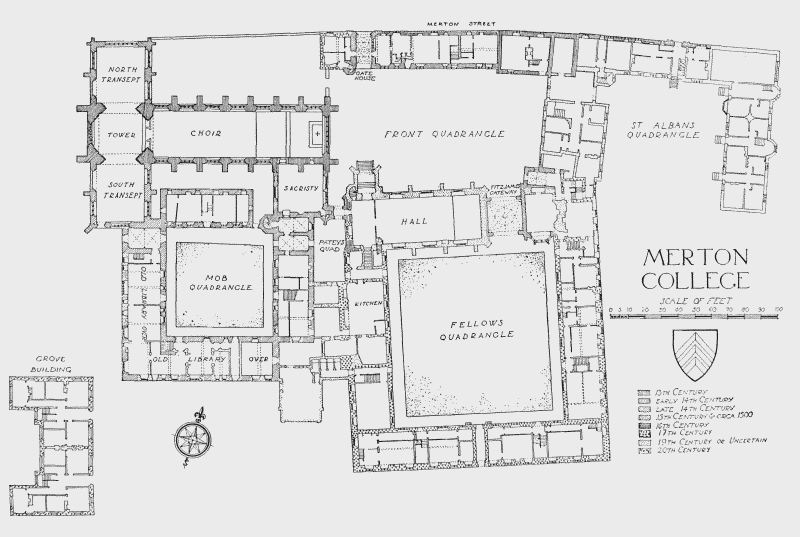
The street upon which the college fronts is called to-day Merton Street. In the Survey of 1772 it has the humbler title of Merton Lane. On the map of 1750 it appears as King Street, the strip at the east end of it, leading into High Street, figuring as Coach and Horses Lane. But in the time of Walter de Merton, and indeed half a century and more before he founded his college, it was called St. John Street (vicus sancti Iohannis), taking its name from the old church of St. John Baptist, which stood a little south of the present church or chapel. For some four centuries after the college was founded it continued to be called after the collegiate church, its name sometimes corrupted to Jones Street or Jones Lane.
The beginning of the college was a plot of land, bought by Walter de Merton, 11 Jan. 1266, from the Abbot of Reading, extending southward from the street almost to the city wall; it is described as a plot of ground, formerly built upon, lying on the west side of the church, to which pertains the advowson of the church. (fn. 1) It was unusual that the advowson of a parish church should be attached to the ownership of a particular tenement, but there are other instances. In this way the college became patrons of the church, and ultimately rectors; for on 2 Nov. 1292 dom. Will. de Chetyndon, rector of St. John's, being now dead, Merton 'obtained possession of the church, according to the grant made to them 13 Sept. 1266 by the Bishop of Lincoln'. (fn. 2) As we know the position and size of the original church, as will be shown below, we are able to state that this original tenement was large, perhaps 40 yards wide. None of the tenements on the south side of the street reached the city wall, for though there was no road close to the wall on the south side of Oxford, as there was on the north, yet a strip of ground, perhaps 10 to 20 yards wide, was retained by the king, that access might be had to the walls by soldiers in case of war. But on 30 Aug. 1266 the king gave permission to the bishop to extend his holding to the town wall, provided that he made 'posterns under (i.e. close to) the wall on the east and on the west that there might be access to the wall in time of war'. (fn. 3)
MERTON COLLEGE
MERTON COLLEGE THE GARDEN BUILDINGS
In 1267 this holding was converted into something like a square by the purchase of two tenements on the east side, the one known as Herprut's house, belonging to the Priory of St. Frideswide, the other, known as Halegod's house, belonging to Jacob the Jew, son of Moses the Jew. In the year following yet a third tenement was purchased; the house of Robert Flixthorpe. The site of all three houses can be certainly identified from documents still extant. (fn. 4) Herprut's house stood where the existing Gatehouse stands. That building, 'restored' by Blore in 1838, dates from c. 1418. It was built by Warden Rodebourne. As a crenellated tower it required a licence from the Crown; and the licence from Henry V (14 Apr. 1418) is preserved among the college archives. (fn. 5) But it is likely that the original Herprut's house was reconstructed before the end of the 13th century—a Merton document of 1287 (fn. 6) speaks already of a Domus Portarum. Immediately to the east was Halegod's house, the house of Jacob the Jew. This house may have survived until 1591. In that year Warden Savile rebuilt the block then occupying the site of it. The block adjoining it on the east he spared. Here, in 1268, stood Flixthorpe's house. Here to-day, mercilessly reconstructed in the early part of the 19th century, stands a building which has still some title to be called 'the earliest collegiate structure in England'. (fn. 7) Until the second quarter of the 19th century it stood as it may be seen in Skelton's engraving of it. It had then an east wing jutting south into the quadrangle to a point a few feet short of the door which now leads to the Estates Bursary. In 1904 what remained of this east wing was demolished by Mr. Basil Champneys. The north wing remains; a small medieval hall, measuring some 4 yards by 5, now a two-story building, once a single story, the modern ceilings hiding a 13th-century roof. How much, if anything, of Flixthorpe's house survives in the existing structure it would be difficult to say. But the timber roof (now hidden by ceilings) and the outline of the north window go back to a date not far removed from the foundation of the college. In 1282 the Merton records speak of an Aula Custodis (Rec. 3614), called in a slightly later document (1285, Rec. 4052) parva Aula, in contrast to the great hall of the college; and the first Warden's House is believed to have stood where this much reconstructed house still stands. Until the last thirty years the building was familiarly spoken of as the Refectory. The deed by which Cristiana Sewy conveyed this property to Flixthorpe (c. 1260) is endorsed in an early hand de area domus custodis.
Within a few years of acquiring Flixthorpe's house, the founder obtained a lease of what was known as Nun Hall (Aula Monialis). This was a building belonging to the convent of Littlemore (hence its name), and it stood on the western half of the site of the existing Alban Hall building, and adjoined Flixthorpe's on the west. No stone of it survives to-day. But at an early date it was used to house the boys of founder's kin (pueri de genere Fundatoris). (fn. 8)
The depopulation of Oxford, which began early in the 14th century and was hastened by the Black Death of 1349, enabled the college to acquire at a cheap rate almost the whole of the land on the south side of the street from the city wall on the east to St. Frideswide's on the west. Beginning at the east end there were four tenements of St. Frideswide's named Runceval Hall, Marshall's tenement, Great Bileby, and Little Bileby. Of the last three we know nothing but their names as recorded about 1290 in the Cartulary of St. Frideswide's; but of Runceval we know that it was an academic hall until 1328 or later. There is a record at Merton (fn. 9) of Nov. 1328, being an inventory of goods at Runceval Hall, which probably gives us the date when the college acquired a long lease of these sites from St. Frideswide's, renewable at will. On the west side was a property of Godstow known as Elm Hall in 1286, but probably only a toft in the next century. In 1407 the college obtained a lease of it for 80 years at a rent of two shillings. (fn. 10) Next on the west was St. Stephen's Hall, acquired by the college in 1329 when it was described as a messuage and two tofts, (fn. 11) but two years earlier as two messuages and a cottage. (fn. 12) A Coroner's roll of 1346 speaks of the death of a scholar in St. Stephen's Hall in St. John's parish, and a document at Merton records that it was demolished in 1360. (fn. 13) On the west was a property of Balliol known as Hertheved Hall. The history of this holding is given in Balliol Records (O.H.S.), which shows that in 1497 it was waste land and was leased to Merton for 99 years at two shillings a year and that the lease was renewed with a fine regularly at the same rent until 1804 when it was sold to Merton for £74. On the west were two adjacent halls, the property of Littlemore priory, St. Alban's Hall on the east, and Nun Hall on the west. The Registrum Cancellarii shows that they were academic halls in 1461, but in 1462 the Prioress of Littlemore engaged that she would grant to Merton a lease for 99 years of St. Alban Hall and Nun Hall, between Balliol on the east and Merton on the west, and received £20 as rent for 30 years. (fn. 14) From this time the two halls were united, and in 1496 Littlemore leased 'Alban Hall, anciently called Nun Hall, between Balliol E. and Merton W.' to the college for 67 years. (fn. 15) In 1549 Merton bought 'Alban Hall, formerly of Littlemore priory', from John Pollard and Rob. Perott for £10. (fn. 16) On the west side of the college, it acquired in 1317 an academic hall called Goter Hall, (fn. 17) the name no doubt being derived from the large stone drain which runs south to the city wall and was uncovered when the Butterfield buildings were erected. It probably fell into decay after 1349. Properties of the college to the west of Goter Hall need not be mentioned as they passed to Corpus Christi College. On the south of the tenements of the college Edward II granted the vacant land inside the city wall both east and west of what had been granted by Henry III. On the west side it was 9 perches long; on the east side it was 17 perches long and 3 perches wide; the land might be enclosed right up to the wall, provided that the college made posterns in the walls they erected on the east and on the west, and permitted the mayor to have the keys of the posterns in time of disturbance. The grant is dated 20 Mar. 1318. (fn. 18)
The scholars of 1274 were, we must suppose, human; and we must take it that one of the first cares of the founder was to provide for them a dining-hall and kitchen. The hall is first mentioned in a document of 1277 (Rec. 3964 a); (fn. 19) the kitchen in a document some eleven years later (Rec. 4052 b). The Warden's Hall, it may be noticed in passing, had its own kitchen, separate from that of the college—the two are distinguished as magna coquina and parva coquina (from 1296 on: Rec. 3623). In 1291 the College Hall was glazed (Rec. 4054). The original hall stood, there is little reason to doubt, where it still stands; and for six centuries it stood there little changed—the only recorded alteration in it during that long period being the addition of an entrance porch in 1579. (fn. 20) The form of it is preserved to us in Loggan's print (1675), in which the bell-tower is a notable feature—it may perhaps be identified with the campanarium mentioned in a document of 1285 (Rec. 4051). The odd and unpleasing transomes which divide the windows, as restored by Gilbert Scott, are already in Loggan; these, perhaps, it is difficult to think original. The hall was reconstructed by James Wyatt in 1794, and further 'restored' (by Scott) in 1874, in the fever of Gothic revival. The stone-seated window-recesses, due to Scott, are said to reproduce a feature of the original building. How much of the ancient building survives this double reconstruction it would be difficult to say—perhaps not much more than the east and west walls (in the west wall four ancient corbels at the gable-base suggest interesting speculations). The oak doorway on the north, with its iron-work tracery, is perhaps the door of the Founder's Hall.
The position of the hall is notable in more ways than one. Like the halls of University, Oriel, Lincoln, Wadham, and Jesus, but unlike those of the other Oxford colleges, it faces you as you enter the lodge gates. This arrangement, found in Oxford only in these colleges, is the normal arrangement in Cambridge. But the orientation of the hall, in relation to the other buildings, is in itself peculiar. With the existing Great Quadrangle it forms a rectangle. But its axes are not parallel with those either of the chapel or of Mob Quadrangle—the buildings nearest to it in date. The explanation may be that, when it was built, its axes were made parallel with those of the old church of St. John.
The hall, then the Magna Aula, was built some time before 1277. It seems not unreasonable to suppose that it was already standing when, in 1274, the first Warden, Peter of Abingdon, took up his residence in Flixthorpe's house. The advent of the Warden left available for housing his scholars within the college only the houses of Herprut and Jacob the Jew. Of the building of living-rooms within the college the Merton archives preserve no record earlier than 1299–1300. In 1278, however, Peter of Abingdon began the acquisition of the tenements upon the north side of Merton Street immediately to the east of Beam Hall; and before 1290 he was possessed of the three houses which constituted the property later known as Postmasters Hall. These houses were, technically, his personal property. In effect, they were the property of the college—magister Petrus was merely a means of evading the Statute of Mortmain. (fn. 21) The college records speak of the property as Curia magistri Petri; sometimes as alia Curia (Recc. 4055 b, 4076, 3973 b). Alia Curia stands for the more correct altera Curia, the other Court. The college was, in fact, regarded as consisting of two Curiae, two enclosed placiae; the Curia Domus (the court, that is, within the college gates, the front quadrangle), and the Curia magistri Petri on the other side of Merton Street. Peter's Curia, consisting of three houses, may well have housed as many scholars as the college court—it was not, at this date, used, as it was later, to accommodate the 'boys of Founder's kin' (who were, in fact, lodged in Nun Hall).
The building accounts of the college begin in 1287. From 1287 to 1311 there survives a series of accounts rendered to the college by one of its fellows, a kinsman of the founder, whose name deserves to stand high among the benefactors of the foundation, Walter of Cuddington. (fn. 22) Cuddington seems never to have held any of the regular college offices. He was never at any time—so far as can be discovered from the extant records—bursar, or chaplain, or sub-Warden, or dean. Nor is he anywhere spoken of as procurator or supervisor operis—these were the titles given, in a later period, to persons supervising any building operation of the college. In respect of his care of buildings he speaks of himself once or twice as custos of some undertaking. He was, in fact, for more than thirty years custos operum omnium collegii. From 1289 to 1311 it was he who, when any building operation was in hand, dealt with the builders, bought the materials, and saw to the detailed execution of the work. (fn. 23) Under his supervision were built the choir of the chapel, the sacristy, and the north and east wings of Mob Quadrangle. In addition, he supervised, in 1290–1300, a good deal of building, or rebuilding, of living-rooms (camerae). (fn. 24)
The question of the date at which the choir of the existing church, or chapel, (fn. 25) was built has been a good deal canvassed. Cuddington's accounts (hitherto not assembled nor correctly dated) resolve most of our difficulties. Work upon the choir of the church began in the summer of 1290. (fn. 26) By the summer of 1294 it was in effect completed.
The glass of the lateral windows of the choir and that of the tracery of the east window is contemporary with the building of the choir. The rest of the stained glass is of the 15th century (see H. W. Garrod, Ancient Painted Glass of Merton College).
The old church of St. John was still standing. For ten years, at the least, it stood side by side with the new church, the choir of the present chapel. But fallen on evil days, and 'ruinous'. So much so that between 1304 and 1307 what remained of it was incorporated in the north wing of Mob Quadrangle. The north and east wings of that quadrangle took their first form (a good deal refashioned later) during that four-year period. On the destruction of the old church followed the demolition of the sacristy, or vestry, which had belonged to it. By 1311 a new vestry had been built, the existing sacristy. (fn. 27)
Between the death of Cuddington (1313) and 1330 no further work seems to have been done upon the new church. In 1330 work was begun on the crossing. The records of it are defective. But there were employed on it, during the period August 1331—July 1332, more than fifty workmen—at no other date in the history of the college do the documents show so many persons employed on any building operation. The work was not finished until, at the earliest, 1335. (fn. 28) To this period belong, not only the arches of the crossing (other than the east arch), but the two blocked arches either side of the great west window. That window is a 15th-century reconstruction; in 1335, it was the west arch of the crossing, built—like the two blocked arches—to lead to a projected nave.
The transepts, as we see them to-day, are the work of later generations. The south transept, it seems likely, was built some time about the year 1367. Between July 1367 and July 1368 Adam Sclatter—who describes himself as 'Procurator of the House called Merton Halle in Oxford' (fn. 29) —spent some £60 on building and repairs, of which some perhaps two-thirds is listed under the heading Expense facte circa campanile. This account (Rec. 4101) is isolated; nothing precedes or follows that throws any light upon it. But that the work which it details connects with the transepts is probable. (fn. 30) If it be so, it is the south transept which is in question. The north transept belongs, almost certainly, to the years 1419–25. The Liber Aerarii (fn. 31) records in 1419 large sums spent ad fabricam ale borealis ecclesiae, and, in 1425, monies spent on the glazing of the church—on the glazing of the 'great window' in ala boreali £10 was spent.
On 6 November 1425 the church was solemnly re-dedicated. (fn. 32) But the building of it was not yet complete. On 19 October 1425 the Liber Aerarii records an expenditure of £40 pro novis campanis emendis, to which a further £18 6s. 8d. was added in the January following. (fn. 33) On 14 December 1426 the same record notes £14 spent pro edificacione campanilis. How far work upon the tower had proceded at this date it is difficult to say. Nothing further is heard of it until March 1446, when the Liber Aerarii once again tables expenditure (£10) ad opus campanilis. The completion of the tower belongs to the years 1448–50. (fn. 34) The roofs of the chapel were renewed by Edward Blore during the years 1838–43, and there was a further restoration by Butterfield in 1854.
The roll of Adam Sclatter, Procurator, is followed immediately in the Merton procuratorial rolls by four accounts for the years 1373–8. (fn. 35) These concern the library, and furnish an almost complete record of its construction. A library the college already had forty years earlier. At a 'Scrutiny' (or college meeting) of 1338 suggestions were made de Libraria reparanda (fn. 36) and a bursarial roll of 1346–7 (fn. 37) mentions the plastering and whitewashing of the library. A roll of 1349, again, records repairs to the library (Rec. 4094). Where this earlier building was situated, or when it was built, is not known. Of the new undertaking the presiding genius would appear to be John Bloxham, (fn. 38) who became Warden in the year in which his three-year account ends. His principal mason was William Humbervyle. Together he and Humbervyle journeyed to London to view the Library of the Preaching Friars. Was that building the model of the Merton building? Bloxham was ready to find ideas everywhere; and he visited also Sherborne, Salisbury, and Winchester. More than once he rode to London to see Bishop Rede. The object of at least one of his visits to Rede is stated crudely: 'Item equitando versus episcopum Cicestrensem pro ampliore pecunia habenda.' The amount of Rede's initial donation to the library building fund is given in the forefront of Bloxham's account, but is now no longer legible. The stone for the library came from Taynton, Wheatley, Elsfield, and Bladon; part at least of the timber from the college estates in Maldon, Leatherhead, and Ibstone. Poor scholars were paid for assisting the masons. So too were some of the pueri—a phrase which usually denotes the nepotes Fundatoris. A servant was crushed by the fall of an old wall; a payment was made for the doctor attending him, but of 'workman's compensation' nothing is said. An interesting item in Bloxham's account is 'for a new door bought from the Carmelite Friars'—presumably the Oxford Carmelites. Is this the existing main door, the door in the south-west angle?
The area enclosed by the library and the camerae of 1304–9 constitutes the earliest of the Oxford quadrangles. But it is a quadrangle by accident and accretion, not by design. Called to-day (mysteriously) 'Mob Quad', it was known in earlier times as 'Bachelors' Quad'—the bachelors being the junior fellows. In a good many of the Merton rolls it is styled, after 1610, parva area, the Little Quadrangle. The Great Quadrangle, the magna area, called to-day, familiarly but inappropriately, (fn. 39) the Fellows' Quadrangle, was the undertaking of Warden Savile. (fn. 40) Savile was still a young man (he was just 36) when he became Warden. He had a liking for large enterprise and an instinct for sumptuosity. He had also a strong instinct for the dignity of the institution over which he presided. Accordingly, he had no sooner become Warden than he set himself, first to rebuild the central north front of the college, and secondly to erect the Great Quadrangle. The foundation stone was laid on 13 Sept. 1608. (fn. 41) But between that date and March 1610 almost nothing was done; the work, according to the express statement of the register, went no further than merely laying the foundations of about one-third of the projected building. The whole of the actual building operations, including the foundations for two-thirds of it, was crowded into the period 6 March–29 Sept. 1610. (fn. 42) The reason for the delay between Sept. 1608 and Mar. 1610 is stated to have been the fact that craftsmen had to be secured who were equal to an undertaking so considerable. (fn. 43) On 28 Jan. 1609 the college decided to secure the services of John Acroyd of Halifax, faber lapidarius. (fn. 44) He had already visited the college in Dec. 1608; and the Bursar's account for 22 Dec. of that year records the provision of 'an extra special fare for Acroyde and Bentley, with whom a contract was to be made about the new Building'. The terms of this contract, apparently settled after dinner, but ratified at a college meeting next month, were that Acroyde should do all the mason's work for £570 plus his travelling expenses. In May of the same year the college contracted with Thomas Holt, faber lignarius, that he should do the whole of the timber-work for £430 plus his travelling expenses.
What these contracts were intended to cover we are not told. Though the actual building work did not begin until nearly a year after they were made, payments to Acroyde's two partners, John and Anthony Bentley, and to the faber lignarius, Holt, began immediately. By Nov. 1610 the total bill of costs was well over £2,000.
The contractors certainly accomplished their work in an astonishingly short space of time. Acroyde received a gratuity of £40. But not all the work was well done. In 1666 the wall of the eastern wing began to give outwards. One Nicholas Woodward proposed to the college a cheap and safe method of securing the wall; and after consulting masons architectonicae rei periti the college agreed to pay Woodward £1 a day, with free rooms in college, and supply him with 'wood and iron', in order that he should carry out his scheme.
The iron clamps which may still be seen on the second story of the east wall, facing the quadrangle, testify to the excellence of Woodward's work.
The gateway on the east side of the hall is part of the new Lodgings built for the warden by Warden Fitzjames in 1497. The work can be dated exactly from the circumstance that Fitzjames had a horoscope cast for his new house; a window of the house gave 'the figure of heaven' when the foundation-stone was laid, at 10.20 a.m., 12 March 1497. The window has disappeared, but the detail of it is recorded in John Chamber's Treatise against Judicial Astrology, 1601, p. 36.
The gate into the garden, behind the tower of the four orders, was not made until 1625–6. (fn. 45)
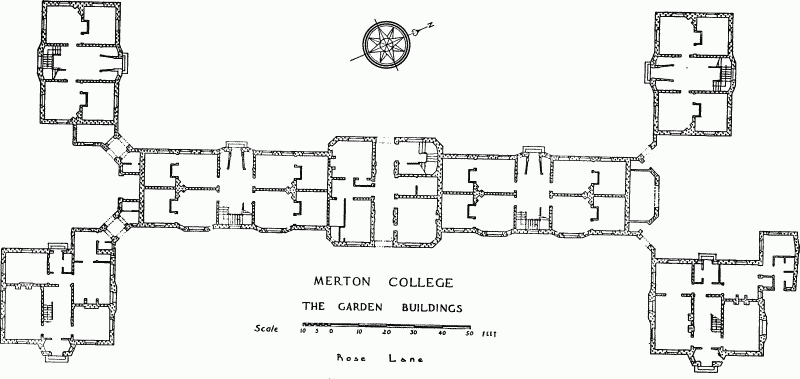
Since Savile, three new quadrangles have been added to the college. In the south-west corner of the college, where once stood the Grove, stand now the 'Grove Buildings', erected in 1864 from the design of William Butterfield. Warden Marsham, and Butterfield, would have preferred to pull down Mob Quadrangle, (fn. 46) and build there. Butterfield's building was reconstructed in 1930 by Mr. T. Harold Hughes. Between 1905 and 1910 the quadrangle of St. Alban Hall was demolished, and a new quadrangle built from the design of Basil Champneys; the same architect was responsible for the present Warden's Lodgings on the north side of Merton Street. In 1939–40 the existing Rose Lane Buildings were erected from the design of Sir J. H. Worthington.
History
The 'House of the Scholars of Merton' takes its name, not from the founder, but, like the founder himself, from the Augustinian Priory of Merton in Surrey. On 7 May 1262 Walter de Merton, 'some time Chancellor of the illustrious lord, Henry, King of England', obtained from Richard Clare, Earl of Gloucester, his feudal overlord, a licence to vest his manors of Maldon and Farleigh in the Priory of Merton, for the support of 'clerks' studying at a university (in studio degentium). Between June 1263 and 9 Sept. 1264 he so far carried his intention into effect as to establish at the University of Oxford eight of his nephews, the sons of five sisters; making provision at the same time for increasing the number of his beneficiaries so as to include persons not of his own kin. An Ordinatio regulating the detail of this benefaction was approved by the king, the Bishop of Winchester, and the Chapter of Winchester. This lost Ordinatio has some claim to be regarded as the first body of statutes made for Merton College.
On 9 Sept. 1264 the founder obtained from Gilbert Clare—son of Richard Clare—a new licence for the disposition of his properties; and upon this new licence followed immediately a new Ordinatio, approved, like the old one, by the king, the Bishop of Winchester, and the Chapter of Winchester. This new Ordinatio—the first existing 'Statutes' of the college—provides for the maintenance at Oxford, or at some other university (vel alibi ubi studium vigere contigerit), of twenty scholars. The scholars are to be of the kin of the founder; but failing a sufficiency of 'honest, able and industrious persons' from the founder's family, other persons may be elected, preference being shown to youths from the diocese of Winchester. The Patron of the college (i.e. the Visitor) is to be the Bishop of Winchester. (fn. 47) The scholars are to 'be ever grateful to the Priory of Merton, from which they take their name, and to honour it as the helper of the undertaking'. But the properties which support them are no longer—as in the earlier Ordinatio—vested in the Priory of Merton. Instead, a Warden, assisted by certain 'brothers', is to reside at Maldon, administering there, for the benefit of the scholars in Oxford, the founder's estates of Maldon and Farleigh. The scholars are spoken of as living in an academic hall (in hospicio).
In 1270 the founder issued a new code of statutes, providing for an indefinite ampliatio numeri Scholarium. New lands are devoted to the maintenance of his scholars. The number of them is to be, no longer a mere twenty, but such a number as the properties assigned can support. Four years later a new code, the third and last of the Founder's Statutes (dated Aug. 1274), translated the Warden from Maldon to Oxford.
With him he brought a band of parvuli—indigent, or orphan, children of his parentela. Under the statutes of 1264 and 1270 these parvuli—always the special care of the Warden—had been lodged in his house at Maldon. They became now a part of the Domus Scholarium in Oxford. Under the statutes of 1274 it was the duty of the Warden to see that they were instructed in the elements of learning until such time as they could profitably take part in the exercises of the University (donec in scholis proficere possint). Those who showed proficiency in these exercises were to be advanced to the status of scholars. At what point in their studies they became eligible for election as scholars the 1274 statutes do not tell us. The statutes of 1270 plainly envisaged two classes of scholars, a graduate class and an undergraduate class, scholars who had 'determined'—bachelors of arts, that is—and scholars who had not 'determined'. For those who have not 'determined' a lower rate of allowance is prescribed. (fn. 48) But the statutes of 1274 recognize only one rate; and nowhere in them is any word said of scholars who have not 'determined'. It may well be that, in 1274, the founder envisaged a situation in which the boys of his parentela would be admitted as scholars only on 'determination'.
The Domus Scholarium, even so, cannot fairly be spoken of as a purely graduate society. Not only are the pueri de genere Fundatoris an integral part of the Domus, but they are a first charge on its revenues. Archbishop Peckham, in 1284, insists that there shall be no fresh elections to fellowships until the claims of the pueri have been satisfied. In a college of undergraduates, as such, neither he nor the founder is in any degree interested. They are primarily interested in the kin of the founder. Some of these kin are mere parvuli, learning their elements. Others of them, perhaps the majority, are boys, or youths, reading for the bachelor's degree. They are, in fact, undergraduates. The undergraduate element is reinforced, again, by a class about which the histories of the college are mostly silent, though the earliest documents have a good deal to say about them. This is the class of Scholares in villa. The statutes of 1274 make no mention of them. But it seems probable that they are to be identified with the 'poor secondary Scholars' (Scholares pauperes secundarii) who figure in a 'Memorandum' appended to the statutes of 1270. They do not belong to the Scholares proper; and a Memorandum suffices for them, a Memorandum not carried over into the 1274 statutes. They are first mentioned specifically in the injunctions of Archbishop Kilwardby in 1276, who speaks of Scholares extra domum agentes and Scholares in villa. Under the latter name they figure, year after year, in the early bursarial rolls of the college. (fn. 49) In a roll of 1296 (Rec. 3625) they are spoken of as 'pueri in villa', in an earlier roll, 1283–4 (Rec. 3614) the term puer is applied to three of them. All of them, it seems likely, were boys when elected, and perhaps not many advanced beyond the status of bachelors. At least two of them, however, attained fellowships. Among the fellows attending the scrutiny of 1338 (Rec. 4249) are John Doyly, whose name occurs in the lists of Scholares in villa for 1330–6 (Recc. 3660–71), and John Esyndon (or Ashendon), esteemed the greatest of the Merton mathematicians, who was a Scholar in villa in 1331 (Rec. 3651). Others certainly took the degree of master—in Rec. 3621 three of them (Petersfield, Clive, and Elam) are styled magistri. Of Adam Petersfield, it is notable that he held his scholarship for nearly fifty years; his name appears first on a roll of 1283 (where he is styled puer) and last on a roll of 1331.
The number of 'poor secondary Scholars' was limited by the statutes of 1270 to twelve; and from the extant documents it would seem that a number not much short of this was in fact maintained until about the middle of the 14th century—in the fifth decade of that century, the number drops to four, and three, and two; after 1348–9 (Rec. 3684) all record of these town scholars ceases. The number of boys of founder's kin was limited by the statutes of 1274 to thirteen. The statutes of 1270 had contemplated as many as fifteen. But in general (apart from Peckham's complaint in 1284) the records suggest that the numbers were often below the statutory minimum. (fn. 50) At an early date, both the Pueri de genere and the Scholares in villa were spoken of as Portionistae, (fn. 51) a name borne later by the 'poor Scholars' of Wylliot's foundation, and—corrupted to 'Postmasters'—still borne by the undergraduate scholars of the college.
The number of fellows was fixed, in 1264, at twenty; in 1270 it was ordered to be such a number as the revenues could maintain. Over how many fellows the Warden presided when, in 1274, he took up residence in Oxford cannot be certainly said. But six years later a Bull of Pope Nicholas III, confirming the foundation of the college, speaks of forty fellows; and the bursarial rolls suggest that this is not an over-estimate. Rolls for the period 1285–8 yield the names of forty-four fellows. (fn. 52) In its early years, accordingly, the Domus Scholarium may be envisaged as a community of some forty fellows living in college and some five-and-twenty 'undergraduates' living in the town. It is interesting to compare the figures for the five other colleges founded between the middle of the 13th and the middle of the 14th century. Balliol and Exeter each furnish 16 scholars; Oriel has ten; University and Queen's can supply, between them, perhaps another ten. The Merton community, that is, outnumbers easily all the others put together. It is worth noting, in addition, how small a part of the University these earliest colleges are. Conjunctly, they supply, perhaps, one-fifteenth of the students. Take away Merton, and they make a meagre 3 per cent.
The University was a collection of Scholares in villa, students domiciled in hospices. That it was not in the mind of the founder of Merton to kill the hospice, his own Scholares in villa, and Nun Hall, the hospice of the boys de parentela, sufficiently indicate. For the young student, and for the average poor student, he thought the hospice good enough. But for a chosen few—persons chosen primarily from his own kin—he wished to do something better. He wished them to be better clothed, better housed, better fed than the average university student. To his scholar in domo he assigns, accordingly, emoluments just double that of the scholar in villa. The fellows of his college are, in truth, something of an aristocracy. So much an aristocracy, certainly, that he hardly dreamed of a university which should one day be a collection of colleges.
The foundation of Merton is memorable as the first great permanent endowment of learning in England. Two other colleges, University and Balliol, claim (doubtfully) a greater antiquity. But Merton has, what these lack, scale and magnificence. Oxford had to wait for more than a century—it had to wait for William of Wykeham—before it saw a like magnificence.
Of this century of uncontested magnificence the historical records are meagre. The history of the college as a house of learning is, in truth, for the whole period, not much more than a string of considerable names. Not for nothing, however, was the college founded by a bishop; not for nothing had it, for Patron, or Visitor, the Primate of all England. During the first hundred years of its life it was, in truth, an amazing breeding-ground of bishops. When in 1284 Peckham 'visited' the college (and soundly rated the fellows), it would have surprised him to be told that, of his seven immediate successors in the archiepiscopal see, all but one were to be Merton men. Yet this is said to have happened; and that four fellows of the college were, in succession, archbishops of Canterbury seems certain. Between 1304 and 1338 London had three bishops: two of them were Merton men, accounting between them for twenty-nine out of the thirty-four years. During the period 1305–85 there were four bishops of Chichester, three of them Mertonians, and the fourth a brief episode—he held the see for seven only out of these eighty years. The records for the fourteenth century show four other Merton bishops, and three archbishops of Dublin. A bishop must be accounted always a great man; and some of these prelates had a title to greatness still cognizable. The most considerable of them was Thomas Bradwardine, Archbishop of Canterbury in 1349. Chaucer remembers him in his Nun's Priest's Tale—'an hundred thousand men' have bothered their heads over the problem of destiny; three only have 'bulted it to the bren', 'the hooly doctour Augustyn', Boethius, and Bishop Bradwardyn. The records of the Merton Library afford evidence of an intensive study of the Augustinian theology during the 14th century; and it seems likely that this was due directly to Bradwardine.
But the Augustinian theology did not exhaust the interests of the 14th-century scholars of Merton. A distinguished seminary of bishops, Merton was also a playground of scientists and mathematicians. Of the bishops themselves, two, Bradwardine and Rede, were distinguished for their interest in mathematical studies. Other names of fellows of the college associated with the study of mathematics and astronomy are those of John Maudit, John Ashenden, and Simon Bredon. These three, it is notable, won distinction also in the study of medicine. Medicine lay outside the field of studies envisaged by the founder for his scholars. The scholars of Merton were dedicated to Arts and Theology. The Arts did not exclude mathematics. But medicine was a 'gainful occupation'; excluded, implicitly by the Founder's Statutes, explicitly by the injunctions of Archbishop Peckham. Medicine, said Peckham, was not philosophy; and it had to go. But scientific curiosity is like nature; you may expel it with a pitchfork, tamen usque recurrit. With the Rosa Medicinae of Ashenden, it came back—to stay. (fn. 53)
That Merton was ever in any especial degree a home of dialectical studies—though this is often assumed—there seems to be no good evidence. Walter Burley, some time the pupil of Duns Scotus, seems to have as little claim as Duns Scotus himself to have been a fellow of Merton. Nor is there adequate ground for identifying the Merton Heytesbury with the logician. Of the dialectian Richard Kilmington, again, the Merton records know nothing.
Another doubtful Merton name is that of Wycliffe. If he was ever a fellow, it was 'on approval'. That he did not complete his annus probationis (if ever he began it) is admitted. That in a later period his doctrines found approval in Merton, that they influenced in any degree the opinions and sentiment of fellows of the college, nothing suggests. Brodrick, indeed, speaks of Merton as one of the 'chief strongholds' of Wycliffism. Henderson's History of the College echoes this. But neither of these writers adduces any evidence for what he alleges. Nor is there any. The only proved Merton Wycliffite is John Aston. The fellows of Merton were, for the most part, 'southerners'; Wycliffe was a northern cause. One or two of the fellows of Merton are known to have written and spoken against Wycliffe. None of them is known to have written or spoken for him. Of the twelve commissioners appointed in 1411 to examine the doctrines of Wycliffe, three (Rodebourne, Gylbert, and Luk) were members of Merton. In the spring of the same year, 'malefactors [presumably "northerners"] armed and arrayed in warlike fashion' entered Merton and carried away divers goods and chattels of the Warden and fellows. The Warden was Beckynham; who, later in the year, as vice-gerent for the Chancellor, 'corrected with rod and ferule' some of the younger Lollard students who had affronted the visiting Archbishop.
In the year in which Bradwardine was advanced to the see of Canterbury, a 'tumultuous election' gave the office of Chancellor of the University to another fellow of Merton, John Wylliot. In 1375 Wylliot was considered for the wardenship of the college; but Archbishop Sudbury passed him by for John Bloxham. Wylliot had considerable possessions; had they been more considerable, it was in his mind to found a college. Ultimately (1380) he devised the greater part of his wealth to Merton for the support of a new class of poor scholars. (fn. 54) Walter de Merton's Scholares in villa had been allowed to lapse. Wylliot's 'portionists', except that they enjoy their scholarships for five years only, seem not different from the founder's 'poor secondary Scholars'. They reintroduce a lapsed undergraduate class; destined to be, henceforth, a permanent element in the life of the college.
When Wylliot died, in 1380, Merton—its amenities newly enriched by the addition of a beautiful library, might fairly claim to be the most distinguished home of learning in England. In the same year was laid the foundation stone of New College; and seven years later William of Wykeham's scholars celebrated a service of thanksgiving in a chapel which for beauty challenged that of Merton. The challenge was taken up. In 1416 the fellows of Merton resolved to complete their chapel; and in 1425 the transepts were completed. But in the desire to be as splendid as New College Merton, it would seem, neglected nobler interests. In 1425 Archbishop Chichele 'visited' the college, not to assist at the rededication of the chapel—at that ceremony the Bishop of Dromore officiated—, but to issue angry injunctions. Merton, he complained, once a 'burning torch' which had 'given light to the whole Church of England', was now dark and covered with shame. It had wasted its substance, and diminished the number of its fellows. In particular, there had been 'reckless felling and cutting of woods and forests, pledging and alienation of possessions, land, books and goods'. So far as the felling of woods was concerned, the complaint could be justified out of the still extant Liber Aerarii, from which it appears that the extensive building operations of the college over a period of ten years had been largely paid for by the sale of woodlands in Farleigh, Maldon, and Gamlingay. The Visitor enjoined that, within fourteen days of Easter, the number of fellows should be raised to forty-four. If this number was achieved, it was hardly sustained. The register of the college, which begins with Warden Fitzjames, records against the year 1483 the names of twenty-six fellows—of whom sixteen are masters, ten bachelors. In the year in which Fitzjames resigned (1507) there were twenty-one fellows.
Fitzjames passes for one of the great benefactors of the college; indeed, he has been called its 'second Founder'. Yet that much of his influence was not for good seems certain. His tenure of office coincided in time with the rise of the New Learning in Oxford. But if he liked learning at all, Fitjames liked only the old learning; and into the college which he ruled for five-and-twenty years the humanities might not enter. With the office of Warden he combined three successive bishoprics. In the last of them, London, he was the active persecutor of the greatest and best of the Oxford humanists, Colet. He had been Vice-Chancellor of the University while Colet was still teaching in Oxford. A 'superstitious and unyielding Scotist' Erasmus calls him. The college which, a century earlier, had rejected Wycliffe, necessarily, under Fitzjames, rejected the New Learning. Fifty years later it liked the Reformation no better than it had liked the Renaissance. In 1545 it elected as Warden Thomas Reynolds. A Protestant under Edward VI, Reynolds became chaplain, later, to Queen Mary. When he offered his devoted service to Queen Elizabeth she would have none of him. Depriving him of his wardenship, and of the deanery of Exeter, she consigned him to the Marshalsea Prison, where he died. No other head of the college is known to have died in jail. Warden Gervase, who succeeded him, is believed to have been removed from office for his Popish sympathies. In 1562 Archbishop Parker imposed on a rebellious college Warden Man—and Protestantism.
Queen Elizabeth called Man (perhaps properly) a 'goose'—and sent him to be her ambassador in Spain. He left behind him in the college two warring factions; an ultra-Protestant faction, of which one of the leaders was Thomas Bodley, and a rebel faction which, if Protestant, had at any rate no use for Archbishop Parker. Among the rebels we encounter, surprisingly, Henry Savile. A youth of 17, Savile put his name to a mutinous document still extant in the archives of Lambeth. (fn. 55) The mutineers were gently dealt with. Savile lived to be Warden of Merton and a close friend of Bodley. Under his régime Protestantism and the humanities found a quiet home in Merton. Under his successor, Brent, Merton became a college distinctively Puritan. In no other college, at any rate, did the Parliamentary Visitors of 1647 find so few recalcitrants. In the 18th century Merton seems to have been one of the Whig colleges. In the 19th it cultivated a moderate highchurchism. Among its fellows were two notable Tractarians, Manning and Hope-Scott. Manning vacated his fellowship after holding it for a year; the Catalogus Sociorum speaks of his leaving the college on getting married (uxore ducta). Hope-Scott had a longer tenure (1833–47), but ceased to be a fellow for the same reason. Under his influence the college decreed that all its fellowships save six should be clerical. To-day there are no clerical fellowships. The statutes provide that there shall be two chaplains, but they need not necessarily be fellows. During the period 1905–7 there were no clerical fellows at all.
Seals.
The college uses two seals: (i) The Sigillum ad causas, used as the common seal of the college. This is an oval seal, showing the Virgin and Child, with a child beneath, praying. Round it runs the inscription 's[Igillvm] Scolarium De Mertona Ad c[Avs]as.' The Virgin and Child probably derive from the 13th-century seal of the Priory of Merton. (ii) The Sigillum testimoniale, used for presentations to benefices and testimonials for Holy Orders. This is a round seal, showing Christ gathering to his bosom five children. Round it runs the inscription 'Sigillum Scholarium de Merton'. There is a transverse inscription 'd[Omi]ni est Assumc[I]O N[Ost]ra'. The existing Sigillum testimoniale reproduces an earlier and somewhat larger seal. The earlier seal was discarded in 1716, having become cracked.
The Sigillum testimoniale is used as the common seal in the earliest college documents. The Sigillum ad causas does not occur on any extant document before the beginning of the 14th century.
The college at one time possessed (and used as early as the 13th century) a third seal (reproduced in Kilner's Pythagoras Hall, frontispiece 2). This is a small round seal, showing the head of St. John the Baptist, and inscribed 'Capud Ioh[Ann]is P[re]Cursoris'. Kilner thinks that it may have been, originally, the seal of the Hospital of St. John at Basingstoke.
The earliest statutes of the college (1264) are sealed with the founder's private seal—an oval seal showing a male figure carrying (?) an olive branch; round the seal runs the inscription 'Qui Timet Deum Faciet Bona' (adopted as the motto of the college).
Plate
Of plate belonging to the period before the Civil War the college possesses only two pieces, a communion-cup of 1568–9, and a rose-water dish of 1605–6. But of plate subsequent to 1660 it has a fine and varied collection; all the items of which are listed in A Catalogue of the Plate of Merton College by E. Alfred Jones, Oxford, 1938.
Library.
In 1852 H. O. Coxe listed 346 manuscripts still in possession of the college (Catalogus Codicum MSS. in Collegiis Aulisque Oxoniensibus, Pars i). Of these 29 are Oriental manuscripts, 3 Greek, the rest Latin. A chronological and annotated description of the manuscripts (with a valuable historical introduction), was published in 1931 by F. M. Powicke (Medieval Books of Merton College, Oxford, 1931). The printed books in the library of the college number some 40,000. A Catalogue of the Printed Books of Merton College was published in 1880 (Oxford, Pickard Hall & Stacy).
Portraits.
The college portraits acquired before 1926 have been catalogued by Mrs. R. L. Poole, (fn. 56) the most interesting artistically being the fifteen portraits in pastel, drawn between 1779 and 1796 by Lewis Vaslet of Bath. Since 1926 there have been added oil paintings by R. G. Eves, G. Goldsborough, W. Anderson, R. Moynihan, W. Nicholson, and four by H. Rivière.
In the chapel there is a distinguished altar-piece after Tintoretto, and in the antechapel two noteworthy monuments, one to Sir Thomas Bodley by Nicholas Stone, and the other to Sir Henry Savile (possibly by Stone).
Wardens
Peter of Abingdon, 1264–86
Richard Werplysdon, 1286–95
John de la More, 1295–9
John de Wantynge, 1299–1328
Robert Trenge, 1328–51
William Durant, 1351–75
John Bloxham, 1375–87
John Wendover, 1387–98
Edmund Bekyngham, 1398–1416
Thomas Rodebourne, 1416–17
Robert Gilbert, 1417–21
Henry Abyndon, 1421–37
Elias Holcot, 1437–55
Henry Sever, 1455–71
John Gigur, 1471–82
Richard Fitzjames, 1482–1507
Thomas Harper, 1507–8
Richard Rawlins, 1508–21
Roland Philips, 1521–5
John Chambers, 1525–44
Henry Tindall, 1544–5
Thomas Reynolds, 1545–59
James Gervase, 1559–62
John Man, 1562–9
Thomas Bickley, 1569–85
Henry Savile, 1585–1621
Nathaniel Brent, 1621–45
William Harvey, 1645–6
Nathaniel Brent, 1646–51
Jonathan Goddard, 1651–60
Edward Reynolds, 1660–1
Thomas Clayton, 1661–93
Richard Lydall, 1693–1704
Edmund Martin, 1704–9
John Holland, 1709–34
Robert Wyntle, 1734–50
John Robinson, 1750–9
Henry Barton, 1759–90
Scrope Berdmore, 1790–1810
Peter Vaughan, 1810–26
Robert Bullock Marsham, 1826–80
George Charles Brodrick, 1881–1904
Thomas Bowman, 1904–36
John Charles Miles, 1936–47
Geoffrey Reginald Gilchrist Mure, 1947–