A History of the County of Oxford: Volume 3, the University of Oxford. Originally published by Victoria County History, London, 1954.
This free content was digitised by double rekeying. All rights reserved.
'The Queen's College', in A History of the County of Oxford: Volume 3, the University of Oxford, ed. H E Salter, Mary D Lobel (London, 1954), British History Online https://www.british-history.ac.uk/vch/oxon/vol3/pp132-143 [accessed 30 April 2025].
'The Queen's College', in A History of the County of Oxford: Volume 3, the University of Oxford. Edited by H E Salter, Mary D Lobel (London, 1954), British History Online, accessed April 30, 2025, https://www.british-history.ac.uk/vch/oxon/vol3/pp132-143.
"The Queen's College". A History of the County of Oxford: Volume 3, the University of Oxford. Ed. H E Salter, Mary D Lobel (London, 1954), British History Online. Web. 30 April 2025. https://www.british-history.ac.uk/vch/oxon/vol3/pp132-143.
In this section
THE QUEEN'S COLLEGE
Sources for the College History: the main sources are described in Provost J. R. Magrath, The Queen's College (1921, cited below as Magrath), vol. i (Appendix A), pp. 277–301. There are about 7,000 documents in the archives (including about 2,000, some of them of the 12th century, which came to the college from the Hospital of St. Julian, Southampton). Magrath usually does not quote from or give references to the original documents, but to the transcripts made by Edward Rowe Mores, of the Berkshire family of Great Coxwell, a member of the college about the middle of the 18th century, and collected in his Calendar (cf. Magrath, i. 277–8). In 1929–36 the archives were re-calendared and rearranged by Mr. N. DenholmYoung. His typescript calendar is cited as Cal. of Arch. Almost all the medieval documents have been deposited in the Bodleian, which also has vols, i and ii of Mr. DenholmYoung's calendar describing them. Vols, iii and iv describing the later documents are kept in the bursary of the college. These later documents are now rearranged in boxes in the new muniment room below the bursary.
References below to the Computus accounts (called by Magrath Long Rolls) down to 1470 are to the transcripts made by Mr. C. L. Stainer (cf. Magrath, i, 298–9).
The Liber Obituarius (or Obitalis; edited by Magrath, O.H.S. 1910; cited as Lib. Obit.) is a Kalendar contemporary with the founder, in which the obits of benefactors down to the 17th century were entered. Magrath's notes give information about the benefactors and transcriptions of their Wills.
A general bibliography will be found in Magrath, vol. i, pp. xxv–xxxiii. To his list there should now be added: C. E. Mallet, History of the University of Oxford (1924), i, 267–87, and iii, 86–91, 404–6; A. B. Emden, An Oxford Hall in Medieval Times (1927, cited as Emden); Royal Commission on Historical Monuments (England), City of Oxford (1939), 96–100; The Queen's College Record (1928–45); R. H. Hodgkin, Six Centuries of an Oxford College; and other works cited below.
History
In a charter granted by Edward III on 18 Jan. 1341, licence was given to Robert of Eglesfield to construct a collegiate hall 'under the name of the Hall of the Queen's scholars of Oxford'. (fn. 1) The idea of establishing such university halls was then in fashion on the Continent as well as in England. Robert of Eglesfield, chaplain of Queen Philippa, was really the founder, but he was able to draw his mistress into the scheme, and he described her as patroness and foundress. (fn. 2)
Eglesfield's statutes (fn. 3) were sealed on 10 Feb. 1341. They were more detailed than any drawn up by previous founders, and show how varied were his aims. He was establishing a home where a provost and twelve scholars, or socii (fellows), might study theology, 'a fruitful tree', about which he rhapsodized. (fn. 4) His plan was made on a grand scale, grander than any for any earlier college. If funds permitted, the fellows were to be served by chaplains up to thirteen in number, and by Poor Boys up to seventy-two. The boys, educated by informatores, were to supply choristers for the divine offices. Prayer was to be made for the souls of the founders and their families, for Eglesfield's friends, and for the benefactors, whose names should be set out in an obituary book (liber obitalis).
Eglesfield's chief aim was to increase the number of learned clergy, especially in Cumberland, his native county, and in Westmorland, where he held a living (Brough) and owned a manor (Ravenwyk, now Renwick) which he gave to the Society. The college was also be to a centre of charity. Thick pea-soup was to be distributed at its gates, and indigent persons (blind, deaf, dumb, and others) were to be entertained daily in its hall.
Eglesfield had somehow seen enough of university life to have strong views about the ways in which a college should be conducted. His precise rules for an eighteen-year course in theology required a standard higher than that of the University. (fn. 5) The emoluments of his scholars were also higher than those prescribed for earlier Oxford colleges. They were to live generously, to wear in hall blood-red robes in memory of Christ's death, (fn. 6) and to be summoned to hall by a trumpet. French might be spoken in hall as well as Latin.
The personality of Eglesfield is stamped on his statutes, especially in his insistence on courtly behaviour and in his rules for the washing of the scholars' hair, for the grinding of their corn, for the maintenance of high standards of work, and lastly, in his regard for the north and its frugal ways.
It is strange that statutes which contain so much worldly wisdom should have badly over-estimated the immediate prospects of the society. As time went on, this defect was corrected, and Eglesfield's statutes as a whole remained in force for five centuries. Some of his provisions have lasted to the present day. It is in accordance with them that Queen Elizabeth, the Queen Mother, succeeded Queen Mary as patroness in 1936; and that the college is still summoned to dinner by the sound of a trumpet. Other provisions, such as one about the college brewing its own beer, have only recently lapsed. Many clauses, such as those about the daily giving of alms, the speaking of French at meals, and the colour of the fellows' robes, were soon forgotten.
Eglesfield's failure to estimate the probable revenue of his society was evident from the first. The Provost and most of the twelve fellows nominated seem to have refused his offer. For some time the college could only afford two or three fellows. It only reached the number twelve at the end of the 16th century. The chaplains never numbered anything like the thirteen planned by Eglesfield; the Poor Boys rarely more than one or two in the Middle Ages, and three or four in the 16th century. They only rose to about sixteen at times in the following centuries.
The causes of Eglesfield's comparative failure are also evident. He himself could not afford to build and endow, as did Wykeham in the next generation. He gave what he could: his possessions in Cumberland and the nucleus of an admirable site in Oxford. (fn. 7) Shortly before his death he added £40, to be kept for ever as ready money (prae manibus). (fn. 8) Besides this his influence with Philippa secured first an annuity of 40 marks and then the Wardenship of St. Julian's Hospital (commonly called God's House), Southampton, (fn. 9) a grant which was to bring the college a large income in the 20th century. He commended his foundation to the generosity of future Queens Consort. He gave it a splendidly mounted auroch's horn for a loving-cup, and, to encourage benefactors, a beautiful calendar to be used for an obituary book. Finally, he gave his services as Provost. In such ways he and his friends (fn. 10) helped the college through its first years.
Eglesfield died, probably from the Black Death, in 1349. By 1361 there seemed to be a danger that the plague might wipe out the Provost and the two fellows who alone survived. The three therefore met and chose three others who might fill vacancies when they should arise.
The provostship of Henry Whitfield (1361–c. 1377) began well. He journeyed to Avignon and obtained needed papal bulls; (fn. 11) but after 1369 in disregard of the statutes he had more west-countrymen than northerners elected to fellowships. Thomas Carlisle, a Cumbrian fellow, who had been first employed to collect the northern revenues, (fn. 12) appealed in 1376 to the Archbishop of York as Visitor. When the Visitor, advised by Chancery, decided for Carlisle against Whitfield and his friends, the friends refused to accept Carlisle as Provost, elected a rival, carried off the college seal, muniments, and books, &c., (fn. 13) and only submitted after four years' strife.
The college, however, in spite of poverty and discord, gained some fame in other directions. To increase its revenues it let some of its rooms to graduates. The lodgers, later called commentates, disqualified by wealth or by being born outside the two counties for fellowships, were usually more distinguished than the fellows. Among them was John Wyclif. He probably had rooms in Queen's from 1363 to 1365/6, and from 1374/5 to 1381, decisive years in his career. This tenancy is longer than has hitherto been supposed (fn. 14) because in the past, allowance has not been made for the fact that the 'indentures of receipts' where Wyclif's payments would have been entered are missing from 1375 to 1380. It has long been realized that the internal quarrels at Queen's did not turn on 'Wycliffism', though some of his friends (fn. 15) were fellows under Whitfield. Both parties at Queen's welcomed the leading scholastic of his day, until in 1381 he openly attacked Transubstantiation. It is noteworthy that 'Master Nicholas', (fn. 16) who like Wyclif paid 20s. for a room in 1380–1, probably began to translate the Bible into English within the walls of Queen's. The bad impression which the quarrels at Queen's left on Wyclif's mind can probably be seen in his Dialogus. (fn. 17)
The connexion of Henry V with Queen's was much slighter than that of Wyclif, but it is attested by John Rouse, who resided at Oxford soon after Henry's death. He says (fn. 18) that Henry studied at Queen's 'under the guardianship of his uncle Henry Beaufort, then Chancellor of Oxford'. (fn. 19)
Among the commensales of the early 15th century was Richard Courtenay, cousin and friend of Henry V. A payment of £25 in 1413, when he became Bishop of Norwich, points to his having rented five rooms for five years. During this period, in 1411, he had championed the rights of the University against Archbishop Arundel. (fn. 20) After this quarrel Queen's received special treatment. The rights of the Archbishop of York over it were recognized by the King and the Pope. (fn. 21)
Another distinguished commensalis who rented rooms from 1411 to 1416 was Richard Fleming. Later he became Bishop of Lincoln and was the 'first founder' of Lincoln College.
Towards the middle of the 15th century the college declined in numbers and influence. The principle confirmed by Chancery in 1377 (fn. 22) that in elections to fellowships some preference should be given to men from Cumberland and Westmorland came to be interpreted in practice as an absolute preference. For 400 years the fellows and Poor Boys of Queen's were natives of 'the two counties'. The restriction had good results as well as bad. It gave the society a strong sense of solidarity. The northerners seldom revisited their distant homes. Old customs, such as the Boar's Head gaudy and the Needle and Thread gaudy—a pun on the founder's name (aiguille et fil)—took firm root.
The northern provosts of the mid-15th century distinguished themselves by securing new endowments. In 1461–2 Edward IV granted to St. Julian's Hospital (and thus indirectly to Queen's) the alien priory of Sherborne (Hants). Since this had previously been granted by Henry VI to Eton College, strong influence was needed to retain it. Accordingly Queen's elected to its provostship in 1483 Henry Bost, Provost of Eton; in 1487 Thomas Langton, Bishop of Salisbury (afterwards of Winchester and Archbishop-elect of Canterbury); and in 1496 Christopher Bainbridge, afterwards Archbishop of York and Cardinal. Thus for about twenty-five years Queen's was governed by heads who, owing to their other offices, can have been little more than absentees. Langton and Bainbridge had some acquaintance with the New Learning; but Queen's only benefited from them and their contemporaries by receiving new estates, especially at the Baldons and Denton, near Oxford. Thus Queen's emerged from the Middle Ages as a comfortably endowed college with about ten Cumbrian fellows.
The 16th century was, as elsewhere, the decisive period. As elsewhere, the new growth became more vigorous when the Elizabethans found themselves freed from their anxieties. In religion Queen's registered a normal graph of the Tudor changes. It produced no one who withstood the dictates of the Crown until Provost Hodgson, who, in 1558, refused to take the Oath of Supremacy. As elsewhere, the results of the instability were bad. The number of fellows sank to four under Queen Mary. No fellows incepted in theology (1526–89). The lowering of moral standards brought 'great unquietness and trouble' among the fellows. (fn. 23) This led to commissions to investigate various charges against members of the college in 1541–2, 1543, and 1545. Ralph Rudde, the fellow who had caused much of the dissension, when expelled from Queen's established himself as Principal of St. Edmund Hall, and continued to be a thorn in the side of Provost Denysson. The latter therefore purchased the HALL in 1553, and in 1559 he made a Composition with the University empowering Queen's College thenceforth to appoint the Principal of the Hall. (fn. 24) There was more trouble in the early years of Elizabeth's reign, partly because she disregarded the statutes and herself nominated a Provost, and partly because the Provost whom the fellows then elected had to be removed by the Visitor for fraud and drunkenness.
Meanwhile a great transformation of the society was being effected. Cromwell's Visitors of 1535 had made a splash by recommending that Queen's and five other colleges should be given one or more classical lectureships. But the lectureships in Grammar, Logic, and Theology which thereafter appear in the computi do not seem to have been paid for by the Crown. Later, under Edward VI, a praelector in Philosophy, and about 1563 one in Greek also appear.
The will of N. Myles (fn. 25) indicates that commoners, i.e. unendowed undergraduates, were already coming to the college about 1500. It seems that by 1535 there were fourteen of them. Under Elizabeth and James I their numbers increased remarkably—70 in 1581 and 194 in 1612. (fn. 26) This expansion was linked with the development of the tutorial system. Fellows, to meet the rising cost of living, became tutors; and prosperous gentry and members of the middle class were glad to send their sons to Queen's, which was in good repute because of its fellow R. Crackanthorpe, the logician, and because Henry Robinson (Provost 1581–98) and Henry Airay (Provost 1598–1616) established its reputation as a place of high standards and safe Anglicanism. Robinson was remembered as 'the second Founder', largely owing to the fact that he obtained the Act of Parliament (1585) which incorporated the college as 'the Queen's College'.
The society flourished for a century and a half. Throughout this period its history is unusually well illustrated. The diary of one of its fellows, Thomas Crosfield (fn. 27), throws light on subjects such as the fruits of Renaissance education (Latin coming as easily as English to his pen), the small duties remaining to a regent master, the relations between the college and its tenants, and the growth of rivalry between the undergraduates of different colleges. The correspondence of the royalist G. Langbaine (Provost 1646–58) with his Parliamentarian friends, Dr. Mills (fn. 28) and John Selden, (fn. 29) shows how Queen's managed to come successfully through the troubles following the Great Rebellion by making reasonable compromises.
With the Restoration Queen's reached its Golden Age. T. Barlow (Provost 1658–77) was the most learned of its heads, an expert in Casuistry and a pungent writer. One of its fellows, Joseph Williamson, who had been admitted as a Poor Boy in 1650, rose to be Secretary of State (1674–9) and was allowed by royal dispensation to retain his fellowship. The fortune he amassed enabled him to entice the society into the great building plans described below. (fn. 30) He also gave it some of its finest plate and manuscripts, and left the whole of his valuable library to the college. His college correspondence is mixed up with his official papers, and contains such flotsam as speeches made at gaudies, disputes over the rights of absent fellows, and gossip about the Provost. In the happy riot of the Restoration the envious complained that all the 'encouragements', such as bishoprics, were going to Queen's men. (fn. 31)
From this period to the end of the 18th century we also have various collections of illuminating letters. Those of the Flemings were published by J. R. Magrath. (fn. 32) They reveal the working of the college system, the strong influence of the college in Cumberland and Westmorland, and, in letters not intended for the paternal eye, the loose life and talk of the idler commoners.
The hardships endured by a poor parson's son are exemplified in the Diary and Letter-book of T. Brockbank, (fn. 33) and the duties of servitors and 'Poor Children' in The Fothergils of Ravenstonedale (fn. 34). These sources make it clear that there were two sorts of undergraduates who might, if natives of the two counties, aspire to the foundation—battelers (probationers, with some remission of charges) and servitors (their tariff in 1724 was 5s. a quarter for waiting on a commoner, 10s. on a gentleman-commoner). On the foundation the grades were: (1) Poor Boys, with free commons but varied 'slavery', e.g. waiting on the fellows; (2) taberdars, chosen from the boys after the B.A. degree; (3) 'M.A.s on the Foundation'; (4) fellows, who waited their turn for a college living with its chance of matrimony.
The system worked well till about 1720. The Provosts were active—if necessary, admonishing fellows and birching boys. Some fellows encouraged learning, like E. Thwaites, who helped to make Queen's a centre of 'Saxonists', i.e. of Old English scholars. Even upper(or gentlemen-) commoners had to work.
The Provostship of Joseph Smith (1730–56) brought the culminating point both of the college's building policy and of its benefactions. (fn. 35) Many of these had provided exhibitions for scholars educated at northern schools—those of E. Rigge (1516) for Heversham; of Archbishop Grindal (1583) for St. Bees; of H. Wilson (1638) for Kirkby Lonsdale and Kendal; of Lord Thanet (1720) for Appleby. But some were for other regions—the foundation of Lady Margaret Hungerford (1676) for natives of Gloucestershire and Wiltshire; of Lord Tilney (1733) for natives of Hampshire; of Sir Francis Bridgeman (1683, secured 1734) for natives of Lancashire, Cheshire, and Wiltshire; and of John Michel (1751) for eight fellowships of £50 a year open to all M.A.s, besides scholarships and exhibi tions. None, however, can compare in importance with the codicil which Lady Elizabeth Hastings, on the advice of Provost Smith, in 1739 added to her will. This said, that every five years candidates were to be selected from twelve schools of Cumberland, Westmorland, and Yorkshire, after examination in Greek, Latin, and the Catechism. In the 19th century the working of coal under the lands bequeathed for this foundation enabled the number and value of its exhibitions (now called scholarships) to be increased, thus bringing to Queen's a new stream of able boys from the north.
While these new benefactions helped to fill the college, a dispute in 1748 about the quality of the dinners in hall (fn. 36) led to a secession of many of the wealthier students.
For the next hundred years (1756–1855) provosts and fellows alike were undistinguished. The general lowering of standards throughout the University was accentuated at Queen's by the decline of the northern grammar schools which had so long sent up boys of ability to the college for the foundation. The tutors, it is true, never became as negligent as at some colleges, but complaints about them in the latter half of the 18th century are to be found in the Letters of Radcliffe and James. (fn. 37) More general grumbling about 'stupidity' within the college is found in the letters of Francis Jeffrey (fn. 38) and in the reminiscences of Jeremy Bentham. (fn. 39) But letters which Bentham wrote as an undergraduate (fn. 40) show that he was then less critical. The college went to sleep, and was scarcely disturbed even by the Oxford Movement. Its first signs of returning life were some minor administrative reforms; next, in 1837, the victory of a Queen's eight over the head boat of the Cambridge colleges; and then an agitation for university reform by two Queen's fellows, George Johnson and William Thomson. Thomson called the attention of Lord John Russell to the scandal of the closed fellowships at Queen's and thus contributed to the appointment of the Oxford Commission of 1850. When eight years later the new Ordinances for Queen's at last emerged, replacing the original statutes, the college was remodelled. The foundations of Eglesfield, Michel, Bridgeman, and Lady Margaret Hungerford, were merged. The local preferences for fellowships were abolished. Four exhibitions were left closed for the natives of Cumberland and Westmorland, a very small consolation for the loss of their former monopoly.
Instead of enumerating the other provisions resulting from the three series of university Commissions—those of 1850–8, of 1872–82, and of 1922–6—it will be better to compare the college of 1846 with that of 1950. As for numbers, in 1846 there were on the Eglesfield foundation 15 fellows, 6 M.A.s waiting for fellowships, 2 taberdars, and 6 probationary scholars (a name which had replaced that of Poor Boys). The fellows could retain their fellowships as long as they were in Orders and unmarried. There were also 8 fellows on the Michel foundation, mostly in Orders, whose fellowships could not be held for more than eleven years. In 1950 there were 26 fellows. The words 'Michel Fellow' were placed after four of the juniors, but it was only a name. Five were 'professorial' fellows. Of these only one (the Sedleian Professor of Natural Philosophy) received part of his salary from Queen's; the others are members of the Governing Body of the college by a device of 1926 for dovetailing the colleges into the University. There was 1 'Ordinary', i.e. pensioned, fellow under the statutes of 1881; he died during 1950. All other fellowships were held under the statutes of 1926. There were a Senior Research Fellow, a Browne Research Fellow, and 3 'Supernumerary' fellows (two of them were former official fellows who had retired from active work for the college, the third was the organist: they received no stipend in respect of their fellowship); 15 official fellows; one of these is bursar, the others praelectors and tutors. There are also 7 lecturers who are on the teaching staff without having fellowships in the college.
The contrast between this complex body of 1950 and the two simple groups of 1846 calls for other explanations besides that of the series of Commissions. The increased number of teaching fellows reflects the great increase in the number of students in residence. In 1846, 114 B.A.s and undergraduates were 'on the books', and probably about 80 actually resident. During the Crimean War those resident sank to (fn. 40), and during the rest of the 19th century remained at about 80 to 100. Since then there has been a steady rise interrupted only by the two World Wars. The lowest figure has been 24 in 1916; higher numbers have been 240 in 1920, 220 in 1939, 335 in 1947, and 293 in 1950.
The increase of the teaching staff also reflects the raised standards of the University. As late as 1889 only 17 men at Queen's read for Honours. They had to choose between the five ancient Faculties. In recent times all men are required to read for Honours; they can choose between the examinations of twelve Faculties. To meet the extra cost the college has a net income from its endowments more than four times as large as that of the unreformed college. (fn. 41)
Old members and others have helped to re-endow the college, as in earlier centuries. Since 1918 considerable donations have been given by or in memory of members of the college. Thus, in 1924 Henry Laming gave £50,000 to promote the study of living modern languages. Another important benefaction was made by Robert Styring in 1936, to provide scholarships and exhibitions for those studying modern subjects.
On the whole the changes effected by the Commissions have been less profound than those which have come about in other ways. For example, in 1950 only one official fellow is in Orders, and few are unmarried. (Before 1881 the Statutes had laid down that at least nine fellows must be in orders. This statutory number has been steadily diminished by later statutes, and the obligation to have even one fellow in orders was removed in 1948. Official recognition has been given, also, to the existence of wives and families of fellows by allowing the college to assign houses or flats to fellows, and to pay extra allowances to official fellows with children. Restriction upon the marriage of junior research fellows, taberdars, and scholars has been relaxed.) The repeal of the Test Act in 1870 has slowly changed the Anglican character of the college. Until the 1880's most men on coming up said that they intended to take Holy Orders. Now theologians are rare, and the Civil Service, teaching or business appointments are the commonest aims.
In the 19th century the scholars of the college were sharply distinguished from the commoners. They were made to sit at different tables in hall in the hope of preserving a higher level of conversation. Now, owing to the new foundations, to that of Cecil Rhodes and, since the Education Act of 1918, to the coming of State, County, and Borough scholars, those with endowments outnumber those without them. The former contrast has also been blurred by the raising of the standard of the commoners, the entrance examination being now a serious test of ability. Changes like these have in fact transformed the colleges as greatly as they were transformed in the 16th century.
At Queen's some old terms mask institutions which have counterparts elsewhere. 'Taberdarships', revived by the statutes of 1926, are only well-paid research scholarships for B.A.s who show unusual promise. The Taberdars' Room is unconnected with them and since 1873 has been a Junior Common Room. Its committee since 1920 has represented the views of 'Junior College' to 'Senior College' (the term now commonly used to denote the fellows).
The men who have done most to shape the fortunes of Queen's College during the last hundred years have been: William Thomson (Provost 1855–62, Archbishop of York 1863–90), a founder of the Musical Society (1842), the Debating Society (1838), and the choir (1861), and the chief sponsor of the reforms of the 1850's; J. R. Magrath (Provost 1871–1931), whose long reign and devotion to the history of the college helped to preserve continuity; A. H. Sayce (fellow 1869–1933), who contributed more than anyone to a revival of learning; and T. H. Grose (fellow 1870–1906), who established traditions of friendship between dons and undergraduates and old members.
Looking back over the six centuries of Eglesfield's college, we see that for two of them (1340–1558) it fulfilled his main purpose of educating a few secular clergy in catholic theology. For about three and a half centuries (1558–1900) it was a stronghold of moderate Anglicanism. During its last hundred years it has undergone radical changes. Now, like other colleges, it is dovetailed in a new way into the University, and is being fitted into the machinery of the State. While many of Eglesfield's aims have been abandoned, that of providing a society in which north-countrymen might find a home at Oxford has been well preserved throughout its six centuries. It hoped that the War of and other old customs. It is hoped that the War of 1939–45 has only interrupted other ancient traditions, such as those of brewing its own beer and of generous hospitality.
Notabilities.
The names of those mentioned in the above account need not here be repeated. Other outstanding names to be added are: Bernard Gilpin (fellow 1550–3), 'the Apostle of the North'; Henry Bost (fellow 1572–4 and 1578–80), the Catholic martyr; Sir Henry Wotton (1586–7); Michael Hudson (fellow 1630–48), the hard-fighting chaplain of Charles I; Sir Edward Nicholas (1611–13), his Secretary of State (1641–6). After the Restoration: Wycherley (1659), the playwright; Edmund Halley (1673–6), the astronomer; Henry Compton (1649–52), the Bishop of London who was a leader in the Revolution of 1688. In the 18th century: Joseph Addison (1687–9), the essayist, and William Collins (1740–1), the poet, who both migrated to Magdalen for exhibitions; and William van Mildert (1784–7), Bishop of Durham, founder of Durham University. In the 19th century: Walter Pater (1858–62), the essayist; I. Bywater (1858–63), the classical scholar; B. P. Grenfell (fellow 1894–1926), and A. S. Hunt (fellow 1906–34), the papyrologists. In the 20th century: William Temple (fellow 1904–11), Archbishop of Canterbury; and B. H. Streeter (fellow 1905–34, Provost 1934–7), the biblical scholar. Full lists of others will be found at the end of Magrath's chapters.
The Library.
A sufficient account of this will be found in Magrath, ii (Appendix H), 257–80, and in the pages of his History to which he refers on page 257. For Halton's library (built 1692–6) see B. H. Streeter, The Chained Library (1931), 232–49; W. G. Hiscock, Christ Church Miscellany (1946), 26–9; infra pp. 138–40.
To bring Magrath up-to-date it is necessary to mention the changes made in 1938–9. These included the absorption of the undergraduates' Reading Room in the library; the restoration of the Upper Library to its original beauty by the removal of various collections and book-cases added in the Victorian period; the introduction into the Upper Library of heating, electric light, and tables for readers (fn. 42); the loaning of the Morfill and Moore bequests (cf. Magrath, ii, 279–80) to the Taylorian Library; and the removal of many less used books to the basements of the Back Quadrangle, now made accessible from the library. Above all, the books, numbering about 90,000 volumes, were rearranged and re-catalogued. Thus the library, which for centuries had been almost reserved for the use of the fellows, and which as late as 1900 was only open to undergraduates for about half an hour a day, now plays a part in the life of the college as great as that which it had before the development of cheap printing.
The chief benefaction since those mentioned in Magrath, ii, 279–80, is the bequest of Dr. A. Sayce. This included rare books on oriental art and antiquities and over 100 volumes of incunabula.
The library can claim to be among the largest, the most beautiful, the most varied, and the most used, in Oxford.
College Plate.
The college possesses rarities such as the magnificent Wassail Horn of the 14th century, said to have been given by the founder, a cocount cup of the early 16th century, an ostrich-egg cup mounted in the year of the Armada, and silver-gilt flagons made in 1616–17 and presented for use in the chapel in 1637. It is also specially rich in silver mugs, ring-handled cups (at Queen's called 'plates'), and tankards large and small. Most of these were given in the later 17th and in the 18th centuries. The whole collection is described in the Catalogue of the Plate of the Queen's College (1938), by E. A. Jones.
College Pictutes.
The college portraits have, for the most part, greater historical than artistic interest. Much of the best work is amongst the earlier unattributed portraits such as those of Henry V (perhaps early Tudor work), Henry Robinson (1553 ?–1616) Richard Crackanthorpe (1567–1624), Barnaby Potter (1577–1642), Gerard Langbaine (1609–58), and Thomas Barlow (1607–91). The outstanding attributed portraits are: the self-portrait of Isaac Fuller (1606–72); Christopher Potter by Gilbert Jackson (working 1610–30); Thomas Cartwright by Gerard Soest (d. 1681); Thomas Tickell and Thomas Lamplugh, both by Sir Godfrey Kneller (1646–1723); Henry Compton by John Riley (1646–91); Joseph Addison by Simon Du Bois (d. 1708); Joseph Smith by James Maubert (d. 1746); Queen Charlotte by Henry Robert Morland (c. 1730–97); John James by Daniel Gardner (1750–1805); Jeremy Bentham by Andrew Geddes (1789–1844); John Richard Magrath by the Hon. John Collier (1850–1934); and Archibald Henry Sayce by Fiddes Watt. Amongst other portraitpainters represented in the college are: Sir Peter Lely (1618–80), William Wissing (1656–87), Thomas Murray (1666–1724), John Vanderbank (1694–1739), Lewis Vaslet (d. c. 1790), Edward Penny (1714–91), Sir William John Newton (1785–1869), George Richmond (1809–96), and George Frederick Watts (1817–1904). Other forms of painting are represented by pictures attributed to Richard Wilson (1714–82) and John Sell Cotman (1782–1842).
There is a fine life-sized coloured wooden figure of Queen Philippa, which is probably 16th-century work; a terra cotta bust of Richard Miller by Michael Rysbrack (1693 ?–1770); and a marble statue of Queen Caroline by Sir Henry Cheere (1703–81).
Seal.
The original seal ordained by the Founder (Feb. 1340–1) is circular. It represents Queen Philippa in an arched niche flanked by other arched niches and bears the arms of the college (argent three eagles displayed two and one gules) and two shields of royal arms. The legend is s. Comune Prepositi Et Scolariu[m]aule Regine de Oxonia. This ceased to be used when new seals were ordained in Queen Elizabeth's time. In 1586 £5 was paid for two new silver seals, one for general use, the other for the college's use as Warden of God's House, Southampton. In both these seals the greater part of the field is occupied by the queen standing gorgeously robed, crowned, and holding in her hands the sceptre and the orb; below her on a shield are the arms of the college. The legends are: (1) S[igillum] prep[ositi] et schol[arium] Col[legii] reg[ine] in acade[mia] Oxon[iensi] stabilit[i] per Elizab[etham] Regin[am] 1584. (2) S[igillum] Hosp[itii] Domus Dei in villa South [amptoniensis] stabilit[i] per Elizab[etham] Regin[am] 1584.
For full descriptions and illustrations see J. R. Magrath, The Queen's College, 1. xviii, plate vi; xxi, plate xxi.
The Provosts
[The dates are those of the Long Roll or Register in which the earliest mention of the Provost or date of election is found.]
Buildings
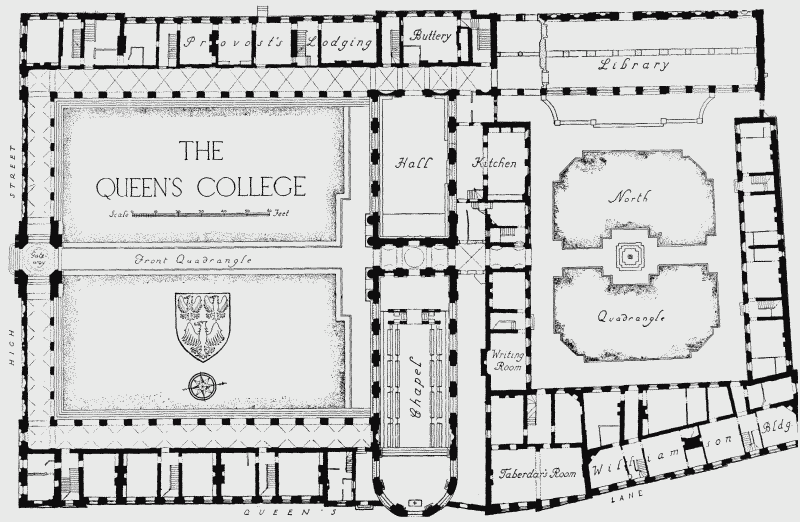
The College was first housed on a site in the angle of New College Lane and Queen's Lane nearly identical with that now occupied by the Fellows' garden and the yards and buildings to the west of it. Eglesfield bought this property from University College in May 1340 and conveyed it to his new foundation in May 1341. (fn. 43) In the following November William de Muskham bought for the college a tenement occupying the remainder of the angle, which extended its property eastwards, incorporating the area of the present north quadrangle. (fn. 44) The buildings already standing on these two tenements must have been adapted to the use of the scholars; no attempt was made to plan collegiate buildings until the site had been enlarged by expansion southwards towards the High St. (fn. 45) Between 1341 and 1347 the college acquired six shops facing St. Edmund Hall, (fn. 46) thus obtaining a continuous frontage from the angle of Queen's Lane almost to the High St. corner, which was occupied by cottages not acquired until 1496. (fn. 47) This continued to be the main front of the college until its rebuilding in the 18th century, but by 1367 a frontage on the High St. had been obtained by the acquisition of five contiguous tenements lying to the west of the corner cottages, with gardens running northwards to the boundary of the original site. (fn. 48) The college was thus in possession of almost all its existing area except its south-east and south-west corners: part of the latter was acquired in 1442, (fn. 49) too late to affect the plan of the medieval buildings.
These were begun in 1352 with the building of a gateway with adjoining chambers in Queen's Lane, facing the northern corner of St. Edmund Hall (fn. 50) and the adjoining churchyard; drawings of it by Bereblock, 1566, Loggan, 1675, and James Green, c. 1720, were reproduced by Mr. Aymer Vallance in The Old Colleges of Oxford, 1912. The quadrangle into which it opened was completed before the end of the 14th century; on the south side was the chapel, on the west the hall, (fn. 51) with the Provost's lodging adjoining it on the south and the kitchen on the north, with the latrines behind it, approached by a passage which still exists; the north range lay just within the present north quadrangle, its south wall being almost on the line of that now facing northwards.
A vaulted passage in the south-west corner of the large quadrangle led into a smaller one formed by the library on the west, the antechapel on the east, the Provost's lodging on the north and a boundary wall on the south, beyond which were the shops and houses on the High St. which had been left standing when their gardens were taken into the site of the college. The antechapel was added in 1516, (fn. 52) when the Provost's lodging was improved by the addition of the great bay window conspicuous in Loggan's drawing. The east window of the chapel, of five lights with late Decorated tracery, faced the south end of St. Edmund Hall and its south-west corner is marked on the flagstones of the central pathway of the front quadrangle: the dimensions are given in a plan engraved by Michael (see below), and are known also by measurements taken when the foundations were exposed by modern excavations. (fn. 53)
The large rectangular area to the north of the great quadrangle was used as garden ground throughout the Middle Ages and provided a site for the extension of the college when, in 1671–2, Sir Joseph Williamson spent £1,700 in building a new block of rooms on the northern part of the Queen's Lane frontage. (fn. 54) Its façade, as may be seen by a comparison with Loggan's contemporary drawing, has since been altered to harmonize with later work, but Williamson's crest, a demieagle, still remains on its northern end, facing New College. He evidently had a larger scheme in mind, for he left £6,000 'ad Collegium amplificandum et ad antiquas aedes ornandas, seu de novo extruendas'. (fn. 55) Anthony Wood, writing soon after the erection of this range, says 'there is a north and west side to be added to it, so that with the help of the north side of the old quadrangle there will be another quadrangle added to the College'. (fn. 56)
Among Williamson's papers in the Public Record Office, there are several relating to the erection of his new building at Queen's. In January 1671 Dean Fell wrote to inform him that 'Since Mr. Surveyor (i.e. Christopher Wren, then Surveyor of the King's Works) desires a more exact measure of the ground, Mr. Crosse will take care to have it sent', and in March he was assured by the same correspondent that 'Mr. Surveyor will assist you in the particulars of your contract, besides the measures of the whole building and order of it, with reference to strength and ornament; the scantlings of your timbers, the thickness of your walls, and binding them with porpine stones'. (fn. 57) There can therefore be no doubt that the Williamson Building was designed by Wren, and its architectural features are closely paralleled in his work elsewhere. (fn. 58) The 'undertaker', or contractor, was Anthony Deane of Uffington, a well-known master-mason who built several great houses, including Horseheath, Cambridgeshire (1663–5), and Battlesden, Beds. (1672). (fn. 59)
The plan for the new quadrangle hung fire for twenty years until a large bequest of books from Bishop Barlow made the provision of a new library an urgent necessity. 'Antiqua bibliotheca ex occidentali veteris capellae situ posita tot voluminum incapax', the Liber Benefactorum tells us, (fn. 60) 'ardens omnium animis excitavit desiderium ut nova aedificaretur.' The college lengthened the site for the new building by acquiring a strip of New College Lane 20 in. wide; (fn. 61) the foundationstone was laid in May 1692 and the exterior was finished in 1694; (fn. 62) the fine stucco ceiling by James Hands, which cost £148 9s. 8d., bears the date 1695: it was altered in 1756 when Thomas Roberts was employed 'to add new ornament in the oval space in the middle and the compartments at the ends'. (fn. 63) The master-mason employed was John Townesend, the carpenter was Thomas Heughes, the joiner-carvers Thomas Minn, senior and junior, and the eagles on the pediment, with the carved keystones with the statues of benefactors in the niches on the west front were done by J. Vanderstein. Chains and locks for the books cost £67 11s. 8d. and remained in use until 1780, (fn. 64) with benches and desks between the bookcases. Modern cases were fitted into the recesses in 1871 but were removed in 1938. The eastern half of what is now the lower library was originally an open loggia, and the enclosed western half was divided into two rooms by a tunnel leading into the garden. Provost Halton's account of expenditure on the library shows that the total expenditure was £5,427, of which Halton himself contributed nearly £2,000. (fn. 65)
There is no record of fees paid to an architect. Mr. W. G. Hiscock, in A Christ Church Miscellany, 1946, p. 28, suggests that the design was given by Dean Aldrich whose collection includes a variant of it, dated 1693, engraved by Burghers and reproduced in Mr. Hiscock's volume, plate v; he notes the marked resemblance to the design for Trinity College chapel, about which the Dean was consulted. Blomfield, Renaissance Architecture, 4 to ed. i, 173, says that Wren designed Queen's Library in 1682, but gives no authority for the statement, for which, in fact, no evidence has been found.
The new quadrangle was completed in 1707 by the building of a range of rooms on its north side between the library and Williamson's block, 'one half of it … at the sole charge of Dr Lancaster … and the other half at the common expense of the Society'. (fn. 66) To facilitate this the City had conceded another strip of New College Lane. (fn. 67) As John Townesend acted as the college mason from 1688 until his retirement in 1712 (Hiscock, p. 44), he was no doubt the builder, and probably the designer, of the new range.
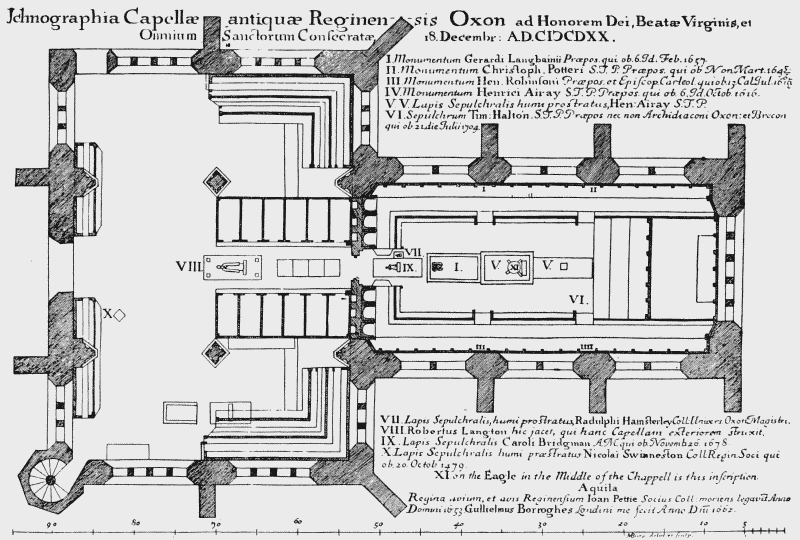
Ichnography Of The Queen's College Chapel. Engraved by William Borroghes, 1662.
Till now there had been no project for reconstructing the medieval college, for when the old library had been pulled down on the completion of the new one, a few years before, the site had been used to enlarge the Provost's lodgings and to build new chambers for the chaplains. (fn. 68)
A portfolio of plans in the college muniment room, unsigned and undated, but apparently prepared by Hawksmoor in 1709, shows that by this date the college had decided on a new layout for the whole of their site; all the medieval buildings were to be swept away and even Williamson's range of 1672, which was slightly out of square with the new quadrangle; and the library and north range were to be incorporated in the new plan. Ultimately Williamson's range was spared and the quadrangle was made a true square by the addition of rooms on its inner side.
In order that the proposed new west range should be in line with the library and meet the High St. at a right-angle a tenement adjoining that acquired in 1442 was leased from Magdalen College in Aug. 1709 (fn. 69) and permission to encroach 5 ft. on the High St. at this point was obtained from the city. (fn. 70) Thus, when the houses and shops were demolished in Dec. 1709 the High St. frontage of the site ran square between Queen's Lane corner and the newly acquired plot.
Although Hawksmoor's plans are preserved in the Muniment Room—and there are others in the library of Worcester College—none of them agrees with the buildings actually put up. The present west range was begun at the end of 1709 and the foundation-stone was laid by Lancaster on the 6th of February, the Queen's birthday. (fn. 71) The master-mason in charge of the work was William Townesend, son of John, who had already built Peckwater quadrangle at Christ Church for Dean Aldrich, and the Fellows' building at Corpus. The building accounts preserved at Queen's show that he received £60 'for my own time in drawing and directions in carrying on the work'. (fn. 72) Whereas his father is referred to in the accounts as a mason, 'lapicidae Townesend', William is styled architect, 'architecto Townesend', a distinction implying some difference of status, though perhaps not in the modern sense. By reproducing Hawksmoor's original design for the new entrance to the college (pl. 24) and by printing a letter in which Townesend informs Provost Smith that 'I have made some alteration in ye design of ye Cupola wch I have here fixed to ye drawing & think it has a better effect', Mr. Hiscock shows that the credit for the existing south front must be shared by Townesend, and he believes that this is true of the south quadrangle as a whole. A list of Wren's works, apparently compiled about 1720 by his son, includes the undated item 'q— Capellam Collegii Regin. apud Oxon. extruxit'. (fn. 73) The Dictionary of National Biography, ignoring the quaere, asserts that Wren built a new chapel for Queen's College in 1682; the date is demonstrably wrong, and no other evidence has ever been discovered to suggest that Wren was in any way concerned with the later buildings at Queen's.
The west range of the new quadrangle was completed by the end of 1711 when Townesend's bill amounted to £2,697 19s. 9d., including quarrymen's accounts for £621 19s. 4d. and £235 13s. 8d. for carriage of the stone. The carpenter, Jeremiah Franklin, was paid £1,384, about half of which was the cost of materials. Franklin worked with Townesend on many other Oxford buildings of the period, and in March 1720, at the request of the Vice-Chancellor, they made a joint report on the stability of the Sheldonian Theatre, printed by Elmes in his Memoirs of Sir Christopher Wren, p. 517. 'Mr. Fiefield's bill for slating & plastering', came to £241 18s. 3½d. (fn. 74)
The adjustment of this building to the library involved a reconstruction of the staircase leading to the latter, which was enclosed in a building projecting from its south wall, but divided from it on the groundlevel by the passage leading to the latrines. The entrance to the stairway was in the south wall of this passage, where a portion of the arch may still be seen. The first flight of stairs originally ran eastwards, in the opposite direction from its present one. The new plan, however, provided for the present common rooms and galleries immediately to the south of the library; the staircase was therefore reversed and pushed farther to the west, so that it gave access both to the door of the library and to the common room gallery. (fn. 75) Beyond the common rooms was the new Provost's lodging, and the carpenter's accounts mention the removal of wainscot from the former parlour to 'a chamber in the lodging'.
The next of the new buildings to be erected were the hall and chapel. These were to run across the medieval quadrangle from west to east, and consequently involved a good deal of demolition. In Feb. 1713/14 Thomas Hearne noted that a part of the east side of Queen's was being pulled down, and that the old hall had already been cleared away. (fn. 76) Townesend's accounts begin again in Jan. 1713/14, and show that about fifty men were employed until Aug. 1715, by which time the hall was finished and the chapel probably roofed; a smaller number worked continuously until March 1716, and thenceforward work became intermittent until the end of 1718. As the old hall had been destroyed and the chapel left standing, there was naturally more haste to replace the former. It was dined in for the first time on 24 May 1715. (fn. 77) At that time the old kitchen must still have been in use, for the masons did not begin work on the new kitchen until July. From August to November work on the chapel was suspended while the kitchen was put up with all possible speed; the account mentions 'nine pounds of candles to work by at night'. The chapel was not finished for another four years. In Apr. 1716 Franklin was supplying 'board for Mr. Thornhll', so that the work must by then have been far enough advanced for James (afterwards Sir James) Thornhill to begin his painting of the Ascension on the ceiling of the apse. In August workmen were letting in the window bars and digging the vault under the east end. In the autumn the arch between the hall and the chapel was vaulted. Little more was done until the winter of 1717/18, when the marble pavement was laid inside the chapel, (fn. 78) and a mason received £5 5s. for 'carving the arms in the mettops of the grand entablature between hall and chapell'. The seating was installed in 1718, and the same year saw the construction of a muniment room over the passage between hall and chapel, facing south and divided from the rooms behind and above it by a brick wall and vault. Finally, the marble facing which enriches the east wall of the chapel, behind the altar, was finished in Oct. 1719, just in time for the consecration by the Archbishop of York on 1 Nov. (fn. 79)
THE QUEEN'S COLLEGE
All the windows in the new chapel, with one exception, are largely composed of glass taken from the medieval chapel. The absence of mullions in the 18thcentury windows, and their round heads, must have necessitated a large amount of reconstruction. The work was entrusted to Joshua Price, who appears to have been engaged on it from 1715 to 1717. (fn. 80) The two westernmost windows on each side contain glass which was made for Robert Langton's antechapel in 1518. The others, apart from the east window, which is Price's own work, were originally done by Abraham van Linge in 1635. Of the remaining interior details of the chapel, the screen, carved by Townesend, was paid for on 9 Nov. 1723, and the marble for the reredos, also by Townesend, cost £300. (fn. 81) The lectern, which bears the dates 1653 on the ball and 1662 on the pedestal, was moved from the old chapel. A note in the building accounts gives the weight of iron in the branches of the two candelabra as over 2 cwt., and their cost as £46 17s., but without saying who made them.
For the hall, chapel, and kitchen Townesend's bill was £3,797, again including a payment (of £100) 'for my own time in drawing and carrying on the work'. Stone, which accounted for £873, apart from £349 for carriage, was brought from Headington, Bladon, and Burford, the last being used for the pediment, balustrade, and cupola. Franklin's bill was £1,000.
The demolition of the medieval buildings was carried farther in 1719. Workmen began to puli the chapel down on 20 May, and the college services were held, during the next six months, at St. Peter's in the East. (fn. 82) Of more immediate purpose was the destruction, recorded by Hearne on 28 Feb., of 'a part of Queen's College building butting against St. Peter's in the East Ch. Yard'. (fn. 83) This note refers to the rooms at the northeast corner of the medieval quadrangle, and whatever was still standing of its north side must have been removed at this time. The ground was thus cleared for the erection of the south side and south-east corner of the north quadrangle. The carpenters were still busy in the chapel, but Townesend's men were at work on these buildings from the beginning of January until the end of November. The carpenters followed them in Jan. 1719/20 and worked until July 1721. In these two and a half years the north quadrangle was completed by the addition of the eastern half of the south side, its extension over the chapel archway and above the kitchen to form a unified façade, its junction with the Williamson building and the modification of the latter. This consisted, on the inner side, in building on the side of its loggia a wedge-shaped addition, broadening towards the south, in order to make the quadrangle rectangular. The original outer doorways are still to be seen, some yards behind the present ones, at the foot of staircases III and IV. At the same time Williamson's building received an additional story, which brought its west front into harmony with the rest of the modern college.
The mason's and carpenter's bills for this work amounted to £1,744. The total cost of the building done between Williamson's death and the completion of the north quadrangle cannot have been much less than £14,000. Apart from Williamson's bequest of £6,000 the largest contributions to this sum were made by Provost Lancaster, who spent £4,000 on the College in his lifetime and left a further £1,000 when he died in 1717. (fn. 84) This was largely spent on the interior of the chapel. By 1718 the two major benefactions were exhausted, and the College was faced with the problem of paying for the completion of the north quadrangle. Having already bought the timber for this work, they were anxious to continue without delay, and therefore circulated an appeal for funds. This pamphlet, An Account of the Progress made in the New Buildings of Queen's College in Oxford, and how much remains unfinished, for Want of Abilities in the College to complete that Work, is dated Feb. 1718 (1719). It estimates the sum still required for the north quadrangle, 'with what is still wanting in the new chapel', at £2,400; this appears to have been an underestimate, and the appeal not altogether successful, as the building accounts show that over £2,000 was raised from the sale of timber between 1720 and 1728. As has been seen, however, the work was finished in 1721, and it was paid for by 1728.
Provost Gibson, who had succeeded Lancaster, did not attempt to carry the new design any further, but Dr. Joseph Smith, on becoming Provost in 1730, immediately issued a second appeal. Two hundred copies of this, The Present State of the New Buildings of Queen's College in Oxford, were circulated, and at the same time a petition was sent to the patroness of the college, Queen Caroline. It was estimated that the completion of the south quadrangle in accordance with the plans of 1709 would cost £5,000. The queen promised £1,000, and the first instalment of this was paid in Nov. 1733. In the same month Thomas Hearne recorded the laying of a foundation stone 'at the South East end of Queen's College, Oxon., with this inscription ... Carolina Regina, Nov. 12, 1733'. (fn. 85) In the spring the last instalment of the £1,000 was paid, and there followed a pause both in the queen's payments and in building activity. In 1737 Caroline died, leaving a promised second £1,000 of her further benefaction, as the Liber Benefactorum wistfully remarks, (fn. 86) adhuc nobis insoluta, sed non insperata.
Thus thwarted, Provost Smith was unable to carry out his intention of finishing the new buildings, and it was under his successor, fifty years after the drafting of the plans, that they were carried to completion. The section begun in 1733 (and finished in 1735) consisted of the screen and cupola on the south, with half of the southernmost staircase in the east wing. The gap between this corner and the new chapel was filled partly by houses which were left standing, partly by the ruined east wall of the old chapel, and also by the medieval gateway, which continued in use until 1757.
The direct labour system, under which the bills for masons', carpenters', and labourers' wages were presented in detail to the college, was at this time abandoned in favour of inclusive contracts. An account including the estimates of Townesend and Franklin, who were employed on the buildings of 1733–5 as on the earlier reconstruction, shows that masons' work and material for the cloister and cupola cost £1,000, for the half-staircase £678; the carpenter's estimate for the latter was £530. Other items included payments to Henry Cheere of £130 5s. for the statue of Queen Caroline over the gateway, and of £135 for the three statues, representing 'Law, Physick and Poetry', over the end of the east wing; and a sum of £45 16s. 6d. for the new gate. The total, which does not include any payment for tiling, glazing, or painting, was £2,800.
The queen's statue does not appear in the original plan, and the college's desire to commemorate her benefaction in this way called for a modification of the cupola. (fn. 87) A minor alteration, made at the same time, was the substitution of the balls which now stand on the parapet of the colonnade for the urns which occupy their place in the original design.
Though the queen's death held up the rebuilding, a new financial resource was already in sight. By the terms of John Michel's will the revenue from the estates which he bequeathed to the college in 1739 (fn. 88) was first to be accumulated to pay for the existing half-staircase in the east wing and for the erection of a further staircase and a half. These rooms were then to house the fellows and scholars of his benefaction. The period of accumulation was lengthened by disputes between the Michel Visitors and the college, and it was not until 1757 that money was released for the building. The college then received £1,265 5s. 4d. for the halfstaircase already built, with a further sum of £2,000. (fn. 89)
Estimates for the Michel building had been obtained in 1751, but by 1757 the college had decided to complete the east wing, and additional estimates were made for the final staircase. Building began in the autumn of 1757, and seems to have been finished in 1759; on 30 May 1760 the Bursar gave notice to the Michel Visitors that the rooms were ready for occupation. (fn. 90) John Townesend (fn. 91) and Edward King, the mason contractors, received £2,122 12s. 2d. for these two and a half staircases, including £41 for carving the pediment; Robert Tawney, who had succeeded Franklin as the carpenter, was paid £1,539 19s. 0¼d.; glazing and plumbing cost £590 3s. 4d., slating and plastering £179 8s. 9d., painting £68 8s. 4d.; the whole amounting to £4,500. 11s. 7¼d. Together with the part already standing, the east wing had cost a little over £5,750; as far as can be seen from a comparison based on the less complete accounts of 1710–11, this is approximately £1,000 more than had been spent on the corresponding but longer west wing half a century before.
The college was now substantially in its present form, and the building account was closed in 1770. But eight years after the completion of the task a considerable part of it had to be undertaken again. In the early morning of 18 Dec. 1778 a fire broke out in the staircase to the south of the Provost's lodging, spread to the lodging, and destroyed both. A London builder, George Shakespear, contracted to restore the damaged range for £5,025 2s. in accordance with the designs of Kenton Couse, of H.M. Board of Works. The college issued an appeal for subscriptions; Queen Charlotte gave £1,000, and contributions were made by ten Oxford colleges. (fn. 92) A second fire, on the night of 11 Dec. 1886, partially destroyed the southernmost staircase of the same wing; by that date the buildings were insured.
There have been two noteworthy alterations since 1760. In 1841 Robert Mason left £30,000 to Queen's for the purchase of books, of which £8,000 were expended on converting the lower part of the library building, then for the most part an ambulatory, into an extension of the library. The architect for the work was C. R. Cockerell. A new ceiling was introduced and the library cloister was enclosed. The wall dividing it from the rest of the ground floor being removed, the present lower library came into being, at the cost of cutting short the west cloister and sacrificing the view from the north quadrangle into the garden. (fn. 93) The latter was to some extent restored in 1935 by the removal of the wall in the central archway and the insertion of an ironwork gate. At the same time an attempt was made, by means of a stone terrace and lawns, to mask the asymmetry from which that quadrangle had suffered as a result of the College's inability to carry out the whole of the 1709 plan. The original proposal had provided for the demolition of Williamson's building, for its replacement by a range which should continue the line of the south quadrangle, and for the construction of an archway in the north wing, as a terminus for the vista from the main gateway through the tunnel between the chapel and the hall. (fn. 94) In 1935 a modification of this last intention was carried out by the erection of the present leaden vase, on its stone pedestal, in the centre of the north quadrangle. (fn. 95)