A History of the County of Oxford: Volume 3, the University of Oxford. Originally published by Victoria County History, London, 1954.
This free content was digitised by double rekeying. All rights reserved.
'Hertford College', in A History of the County of Oxford: Volume 3, the University of Oxford, ed. H E Salter, Mary D Lobel (London, 1954), British History Online https://www.british-history.ac.uk/vch/oxon/vol3/pp309-319 [accessed 30 April 2025].
'Hertford College', in A History of the County of Oxford: Volume 3, the University of Oxford. Edited by H E Salter, Mary D Lobel (London, 1954), British History Online, accessed April 30, 2025, https://www.british-history.ac.uk/vch/oxon/vol3/pp309-319.
"Hertford College". A History of the County of Oxford: Volume 3, the University of Oxford. Ed. H E Salter, Mary D Lobel (London, 1954), British History Online. Web. 30 April 2025. https://www.british-history.ac.uk/vch/oxon/vol3/pp309-319.
In this section
HERTFORD COLLEGE
History
Hertford College, as it at present exists, derives from two ancient halls of the University. Its site, some of its buildings, and its name it owes to Hart Hall, but its continuity to Magdalen Hall. This is doubly unfortunate for the historian. Halls kept few records. Their government was entirely in the hands of the Principal, and the record of his arrangements, financial and disciplinary, were his private property and passed with his other papers to his heirs-at-law, and not to his successors in office. The documents in the possession of Exeter College which relate to Hart Hall are simply those governing the relationship of landlord and tenant and throw no light on the daily life within it. There are no records of admissions except the matriculation rolls of the University, and that is an unreliable method of computing the numbers resident in halls, as it does not show how long the students remained in residence. No attempt, therefore, has been made to decide the numbers resident in Hart Hall, or in Magdalen Hall, at any particular date; but the gradual extension of the buildings gives a clue to the periods of prosperity of Hart Hall.
The first mention of Hart Hall by name occurs in a conveyance dated 1301 by which Elias, son of Elias de Hertford, gives and quitclaims to John de Dokelynton, burgess of Oxford, his messuage called Hert Hall, situate between the tenement of the University called Black Hall on the west side, and the tenement of the Prioress and Convent of Studley called le Micheldhall (rectius Sheld Hall) on the east side. (fn. 1) There is a series of earlier deeds dated 1267, 1283, 1269, 1301 dealing with this same piece of land, which Elias de Hertford, his wife and Elias their son purchased in 1283, in which the tenement is defined by measurement but is nameless. (fn. 2) It has been assumed, therefore, that Hart Hall is a pun on the owner's name, such as appealed to contemporary wit. John de Dokelynton, who bought the hall, had also acquired another tenement in the parish of St. Peter-in-the-East, (fn. 3) which was later called Arthur Hall, and he sold the two to Walter de Stapeldon, Bishop of Exeter, in 1312. (fn. 4) Stapeldon was at this time intending to found a college for poor students in Oxford, and in 1314 he installed twelve scholars in Hart Hall to which he gave the name of Stapeldon Hall, but a year later he removed his scholars to the site of what is now Exeter College, and Hart Hall recovered its old name.
Hart Hall and Arthur Hall remained in the possession of Exeter College and were let out on lease separately to M.A.s as academic halls. (fn. 5) Receipts of rent for halls are recorded in the Computus Rectoris (fn. 6), as are also building expenses for the halls, but only eleven Computi exist previous to 1354. Four only were published by Boase, but S. G. Hamilton, who wrote the college history in 1902, went through the manuscripts in search of items referring to Hart Hall and was rewarded by a very meagre harvest. (fn. 7) The rent paid to Exeter was at first 60s. per annum, but by the middle of the 16th century it had been reduced to 33s. 4d. at which sum it was stabilized by the Taxors. (fn. 8) The only other references to the Hall in the Computus Rolls are to sums expended on repairs to buildings. Thus in 1505 'xxis expensis circa ariam igneam in Aula Cervina. xs soluc[ion] pro reparacionibus serarum et clavium in eadem aula'. In 1506 8d. was spent in repairing the well, and 19d. on the latrine. In 1507 'xxd pro preparacione domus jocalium in aula Cervina.' There may have been articles of value belonging to the hall that needed safe keeping, but none of them have come down to us; the Principal certainly required a safe place in which to keep the cash he received from his scholars, for he himself only paid his rent to Exeter three times a year, and in unequal portions.
The only endowment of the hall was the Bignell Exhibition. Some time in the 15th century Sir John Bignell had founded ten exhibitions of 5 marks each for the maintenance at Hart Hall of ten scholars from Glastonbury Abbey. (fn. 9) At the time of the suppression of the monasteries the University, in a letter to Thomas Cromwell, asks that he would be pleased to see that the Exhibitions for ten scholars given by one Bignell, who left lands for the payment of them in the hands of the Abbot of Glastonbury, should not be lost or taken from them. The Exhibitions were paid out of the Exchequer (fn. 10) until the estates passed from the Crown to private owners, and then the University was unable to obtain payment. They were allowed to lapse, until in 1653 Stephens, the Principal intruded by the Parliamentary Commissioners, learned of their existence, and forced the proprietors to pay them to him.
From the list of Principals given by Wood (fn. 11) it appears that he could find nothing of the history of Hart Hall until it was leased by William of Wykeham, together with other halls on the east side of it, for the use of his scholars while New College was being built for them. Richard Tonworth, the Warden-elect, appears as Principal in 1378. He died there in 1380 and was succeeded by Nicholas Wykeham, the new Warden. After him followed four fellows of New College, Thomas Cranleigh, afterwards Archbishop of Dublin, 1384, John Walter 1387, William Ware 1388, John Wytham 1397–8; the scholars and fellows of New College had moved into their own college buildings in 1386. Academic halls were usually taken by their Principals on a ten-year lease (fn. 12) but New College held the hall for twenty-one, which was longer than necessary for their own temporary occupation. We have an account of a tenth levied by the city in 1384 in which Exeter College pays for Hart Hall, 'que valet per annum 20s. decima 2s.', (fn. 13) so that either the value of the hall had declined, as many did after the Black Death, or Exeter was charging a lower rent for a longer lease, with a fine, or, as we should say, a premium.
From 1436 onwards the Principal was usually a fellow or a former fellow of Exeter College. No one seems to have held the office for very long. It appears to have been quite common for fellows of Exeter to be Principals of halls as a means of supplementing their fellowships, and to pass on from one hall to a more lucrative one. The Customs of Exeter College, (fn. 14) December 1539, lay down that 'bachelors should accustom themselves to public lectures and sophisms, either at Hart Hall or any other place they may prefer', and that 'all Fellows leading the life of Scholars that they may the sooner acquire learning, according to Walter de Stapeldon's statutes, should attend public lectures at Hart Hall, and since logic lectures profit little unless there is constant practice in disputations, they should attend the sophisms and variations kept up there with such care, and if they do not, the Principal or his deputy shall punish them and report defaulters to the Rector for severer chastisement. The same holds good of battellars.'
This close connexion between Hart Hall and Exeter College was weakened during the second half of the 16th century. In 1549–50 Philip Randell (fn. 15) was appointed Principal. For a while he kept his Exeter fellowship, as others had done before him, but after his year as Rector from 1556–7 he resigned it and continued as Principal of Hart Hall. In 1559 he obtained from Exeter a lease of Hart Hall for twenty-one years at the old rent of £1 13s. 4d. He also rented Blackhall next door, of which Exeter held the lead lease from the University. He renewed the first lease in 1572 for another twenty-one years. Secure in his tenure Randell rebuilt the hall, (fn. 16) giving it a dining-hall (now a lecture room) with a buttery to the east of it, and a kitchen at right angles on the south side. From Agar's map drawn in 1578 it appears that the Principal's Lodgings were in a house at right angles to these kitchen buildings, with a garden behind it abutting on All Souls' land. Blackhall, which Wood saw about a hundred years later, and opined to be of the time of Edward III (fn. 17) had been repaired by the University in 1544, but was again repaired by Randell as part of his scheme. The main entrance to Hart Hall was a passage with a gateway between Randell's new hall and Blackhall. Hart Hall seems to have flourished under Randell's Principalship, and it has been said that this was because he made it a refuge for Catholics. The evidence for this is slender, and rests largely upon Wood's statement 'that in his heart he was a Papist and durst not shew it'. (fn. 18) Randell retained his Principalship for 39 years, and obtained before his death a new lease of 21 years in favour of his Vice-Principal, John Eveleigh. In 1552 there were 45 members on the buttery books; in 1567 there were 65 scholars and 8 servientes and for a long period after that date an average of 20 matriculations was kept up. (fn. 19)
Eveleigh succeeded Randell as Principal in 1598/9 apparently without difficulty, though the appointment must have been confirmed under the new Aularian Statute by the Chancellor, Lord Buckhurst. He did not long remain Principal, because he died of the plague in 1604. At his death the Chancellor nominated Dr. Theodore Price, of Jesus; he at once refused to pay rent for the Hall to Exeter, but after six years' litigation the next Chancellor, Archbishop Bancroft, decided in favour of the college. There is an interesting account of Hart Hall under Dr. Price in an answer given to the 8th article of the Visitatio Aularum in 1613. (fn. 20)
We have a manciple, which hath vii d. weekly wages and viii d. of every commoner and batteler in our house at the end of every quarter; he hath 11s. vjd. a pound as he himself confesseth, and we heare and thinke that he hath iii s. iiij d. of the baker and xij d. a pound of the bruer; and in Cates he taketh what gaynes it pleaseth himself. A porter have we none, but our bible clerke doth supplie the porter's place. We have an under-manciple, which serveth in the hall for the manciple and the manciple payeth him noe wages at all; who helpeth the butler to serve in the buttery, and for that the commoners pay him pence (sic) a piece weekly. We have a butler which hath vij d. weekly wages and iiij d. of every commoner at the end of every quarter, and j d. a weeke of every commoner in our house. We have a boy which healpeth the butler to draw beere, whose wages the butler himself payeth. We have a Cooke, who hath vij d. weekly wages and iiij d. of every commoner at the end of every quarter besides his fees; he hath a boy to whom he payeth wages himself. We have a bible-clearke who hath a halfpenny every week of every Commoner in our house.
As there was no college officer except the Principal, we must suppose it was he who paid the wages, and worked out each student's share of the expenses on food, drink, &c. from the bills submitted by the manciple, who had already added his admitted 12½ per cent.
Dr. Price made sufficient profit out of his hall to build new lodgings for himself, which he added on to the kitchen built by Dr. Randell and continued southwards, pulling down the old lodgings, and making walled gardens to the south and west of the new lodgings. The lodgings can be seen in Loggan's view after they had been further enlarged by his successor, Dr. Iles. These buildings are still standing, but the oriel windows looking south are blocked, and the gardens, of course, have vanished.
Dr. Price resigned in March 1622, and Dr. Thomas Iles of Christ Church succeeded him. The aulares who voted for him were 3 masters, 5 bachelors, and 19 commoners, a number very much smaller than those in the buttery books in Queen Elizabeth's reign. Dr. Iles, however, enlarged the accommodation, first by taking over for himself the common kitchen, which Randell had built, and by building another with some chambers over it for the scholars, adjoining the west end of the dining-hall and covering the site of the entrance passage. A small door was made in its north wall, which still gave access to the lane, and was used as a tradesmen's entrance, and a passage leading between private houses in Catte St. was made the principal entrance to the hall. Dr. Iles built some new chambers alongside this gateway, and his building can probably be seen in the print of the old gateway published in 1820 and used as an illustration in Hamilton's History of the College. (fn. 21) It is of two stories with attics and dormers, and had mullioned windows with three lights, being on the north side of the ornamental gateway erected by Thornton about 1690. (fn. 22)
In 1633 Dr. Iles was succeeded by Dr. Philip Parsons of St. John's. Exeter College sent in a protest, which was disregarded, but the Chancellor looking into the matter discovered that the lease of Black Hall and Cat Hall granted to Exeter for ninety-nine years in 1525 (fn. 23) had expired in 1624, and new leases were thereupon granted to townsmen.
When the Parliamentary Visitors arrived in 1646 only four members of Hart Hall appeared before them. Three of the four having submitted were provided with forfeited fellowships in other colleges; the fourth was the cook. The Principal, who had taken part in the resistance did not appear, but he was not deprived. He died in 1653 and Oliver Cromwell as Chancellor appointed Dr. Philip Stephens as Principal by patent, (fn. 24) adding a clause 'so long as he shall well demeane himself therein'. Dr. Stephens was a thoroughgoing Government partisan. On the news of an expected Royalist rising 'a troop of scholars was raised, and armed, and put in a posture of defence under the command of Captain Stephens, Doctor of Physic, and Principal of Hart Hall. (fn. 25) In 1654 he was appointed to the new Commission of Visitors to make a third purge of the University. It was natural that he should be ejected at the Restoration, and on 21 June 1660, Timothy Baldwin, fellow of All Souls, was appointed Principal.
Baldwin only remained Principal for three years until he obtained office in the ecclesiastical courts. During his Principalship an undergraduate, who was caught out late in the streets, told the Proctor that 'our Hall doors are open all night'. (fn. 26) Dr. Lamphire was Principal 1665–88. Dr. Thornton, who was Principal from 1688 to his death in 1707, undertook extensive schemes of building with insufficient means. He built a monumental gateway in Catte St. next to Dr. Iles's building. It was in the classical style and framed by two Doric pilasters carrying an entablature, and was decorated with a device of a drinking stag. The doors which hung in it have been rehung in the modern gateway of Hertford College. Above the gateway and porter's lodge was built a large room as a library, and above that again we see dormer windows, which show that there must have been some additional chambers up there. (fn. 27) The erection of the library was helped by a benefaction from Emmanuel Pritchard, Janitor of the Bodleian Library, a former member of the hall, who died in 1704; (fn. 28) Dr. Hudson, Bodley's Librarian, also contributed, but Dr. Thornton fell heavily into debt, which was outstanding until it was paid by Dr. Richard Newton, who became Principal in 1710, after Dr. Thomas Smith had been for three years an ineffective successor to Thornton.
Dr. Newton was a different type of Head from any that the hall had had before him. He was an educational theorist. He had formed his theories while he was a private tutor, taking pupils in his rectory at Sudborough, and the fact that he came to Oxford ready primed with a plan for making Hart Hall a reformed college is proved by the fact that within six years he had completed the first quarter of a scheme of rebuilding, which was intimately bound up with his scheme of educational reform. In 1720 he published his 'Scheme of Discipline with Statutes intended to be established by a Royal Charter for the education of youth in Hart Hall in the University of Oxford'. In 1747 he published the 'Statutes of Hertford College' which is the same scheme modified by twenty-seven years' experience. Newton's plan was to provide for thirty-two undergraduates, eight of them to come up each year and be put in charge of a tutor, (fn. 29) with whom they were to live in one angle of the quadrangle; the eight would be served by a bedmaker, and one servitor, who was also a student and was to receive money from the foundation. The financial part of the scheme seems to have been based on the Bignell exhibition of five marks or £3 6s. 8d. each. The undergraduate when he came up as a probationer was to receive twice this amount; in his second and subsequent years twice as much again (£13 6s. 8d.). The tutor received the same amount, but also the fees of the students, and rooms rent free for himself and his servant. The fees were supposed to amount to £65 a year, and a capitation fee on all students resident in hall to £17. Between the first draft of his plan and its last revision Dr. Newton introduced a class of junior fellows who were to receive £26 13s. 4d. He himself gave the first endowment to his college, a rentcharge on certain lands in the parish of Lavendon which was to pay the fellowships of the four tutors (£53 5s. 8d.). The same tutor remained in charge of the same class of eight students and servitor throughout their four years' residence, (fn. 30) and he held in turn the offices of Moderator, Catechist, Chaplain, and Vice-Principal. The tutors were to be M.A.s and had to retire eighteen years after their matriculation. Dr. Newton inserted in his Statutes a provision that there might be given to the Society or purchased by it six livings of the value of not less than £100 a year for the tutors to succeed to on retirement, but this endowment never materialized and in practice the rule about retirement was waived. The tutors and assistant tutors were nominated by the Principal, and he had the right to dismiss them after two admonitions. It thus can be seen that though Hertford College was incorporated as 'The Principal and Fellows of Hertford College' it retained the characteristic organization of a hall, more particularly so because the Principal was also Bursar and had financial control.
Dr. Newton laid down a scheme of education for his college. He tried to make 'disputations' a reality by making his undergraduates dispute in philosophy, and his bachelors in theology every week. He himself lectured every Thursday to all the undergraduates, and the tutors lectured to their own pupils on the other days of the week, Saturdays excepted. There were evening lectures three times a week to the whole college, but the tutors could depute these to their assistants. A lecture consisted of reading aloud and commenting upon a set book. Every undergraduate had to do one piece of written work each week, and to read it aloud before the whole college on Saturday.
The college was intended to be for the education of clergymen, and as the supposed endowment would not have been sufficient to maintain an undergraduate, it must have been Dr. Newton's intention that with the exception of the servitors his scholars should be boys from middle-class families. He was prepared to take gentlemen commoners, provided they would submit to the same discipline as the other members of his foundation. He permitted them to wear 'tufts', and obliged them to pay double fees, but they had the same rooms, food, and tuition as the others. In his pamphlet 'The Expence of University Education Reduced' Dr. Newton says that gentlemen commoners should accept the standards of the majority, and points out that their high standard of living is usually maintained on credit, and that if credit were refused by the college or hall, and their entertainments had to be paid for in cash, it would lead to a reduction in their expenditure. In the same way he says that his intention is 'not to decry the use, but only to change the situation of Ale'. The Ale of the 18th century was of course what is now known as 'old ale', and the 'small beer', which was the common drink in Hart Hall, was certainly stronger than the liquid now known as ale. Another common usage he did not allow was the tipping of college servants by giving them chits entitling them to draw food and drink from the buttery at the writer's expense. A third reform was to refuse to allow charitable appeals, to which undergraduates were allowed to contribute by signing their names for an amount to be put on their battels. Actually his regime proved very popular with parents, and there was a large number of gentlemen commoners at Hart Hall, which enabled the hall to pay its way in the absence of the expected endowments.
Dr. Newton's scheme raised very great opposition in Oxford. On the legal side the opposition came from Exeter College as landlords. Dr. Newton presented his petition for a royal charter on 18 May 1723, and the college immediately entered a caveat. The AttorneyGeneral made his report in October 1724 in favour of the Principal of Hart Hall. He considered that the long and uninterrupted tenure at the rent of 33s. 4d. had created a trust in the Principal's favour which the college could not disturb. The Rector of Exeter would then have dropped his opposition, but three of the fellows, led by John Conybeare, gained the ear of the Visitor, the Bishop of Exeter, and persuaded him to use his political influence against it. Conybeare accused the Rector of locking him out of the muniment room, and so preventing him finding the documents which would have proved his case, and after he himself became Rector he hinted that Dr. Newton had stolen Bishop Stapeldon's original grant. (fn. 31) Dr. Newton was naturally angry and the rest of his life was embittered by this quarrel, but he had already quarrelled with several prominent members of the University and had earned the reputation, according to Hearne, of being 'a crackbrained Man, being mad with Pride and Conceit'. (fn. 32) Amhurst gives a description of him from an undergraduate's point of view which goes far to explain his unpopularity. (fn. 33)
I may not like my governor, and perhaps for very good reasons; he may be a proud imperious man, rigidly observant of little nicities and trifles in discipline and the government of his college; he may perhaps be a wellmeaning man, and a good scholar in university learning; but withal a pedant, an humourist, and by his affectation of singularities and adherence to punctilios, a meer tyrant. He may besides be not only monstrously whimsical with regard to his own oeconomy and method of living; but likewise so unreasonable, as to expect the same individual formalities from all those under his power, however their ages, constitutions and appetites may disagree; he may not only demand the direction of my company … but be so rigid and tyrannical in this particular that he will not allow me the conversation of my dearest friends, and most intimate acquaintance, nay perhaps of my nearest relations or even of my own Brother. Then as to diet he may be full as oppressive again in that particular; not content with restraining me from extravagances, which are not proper and what I cannot afford, he may force me into a contrary extreme … and from a ridiculous sort of reasoning, because intemperance is bad for health and study, confine me to a regimen of bread and water or what is little better of small beer and Apple Dumplings.
To such a man the Prime Minister, an old pupil of his, wrote a letter telling him he must 'make the Bishop easy' before his charter could go through. (fn. 34) Conybeare, though he had passed on to be Dean of Christ Church, did not withdraw his opposition, and went so far as to publish a book to justify himself. (fn. 35) He obstructed Dr. Newton's foundation of a college as long as anyone of his party was in power at Exeter, but after Dr. Atwell retired in 1737, the bishop discontinued his opposition, and Newton was able to petition for his charter and to receive it on 8 September 1740. Unfortunately, the one benefactor on whom Newton had relied for his endowments, Thomas Strangways, had died in 1726, and Newton was determined not to accept any benefactions which did not conform with his scheme; Hertford College therefore started with insufficient endowment.
In 1753 Dr. Newton died and his successor was appointed according to his statutes from among the Westminster Students of Christ Church, but the new Principal resigned after only four years, and the Chancellor appointed a fellow of the college, David Durell. Durell did not appoint a new tutor to take his place, and when another fellow resigned on obtaining preferment, the college continued to have only two. The statutable number of assistant fellows was not kept up either, but the number of undergraduates was satisfactory, and by the time of his death in 1775 the college had received a few more benefactions. Under his successor, Dr. Hodgson of Christ Church, the college began to decline. It ceased to attract gentlemen commoners, whose numbers were everywhere falling off, and so lost its financial support. The Principalship therefore ceased to be an office which would attract an ambitious man, and when Dr. Hodgson died in 1805, none of the Westminster Students of Christ Church was willing to take it on. The Dean of Christ Church then disputed the legality of the revised statutes, issued by Newton in 1747, by which alone anyone else could be appointed, and so blocked the appointment of the Vice-Principal Hewitt, who considered himself very much aggrieved. It seems obvious that the plan afterwards followed of closing down Hertford College and handing over the buildings to Magdalen Hall must have already taken shape in the minds of some interested parties, although Hewitt as Vice-Principal was allowed to carry on the affairs of the college until his fellowship expired in 1818.
Magdalen College was particularly anxious to get rid of Magdalen Hall, which had grown up as an independent University Hall in part of the buildings originally intended by Waynflete for the Grammar School. Magdalen College appointed its Principal from amongst its fellows until 1602, when the Chancellor appointed Dr. James Hussey, a fellow of New College. His successor, Dr. Wilkinson, greatly enlarged the buildings about 1614, and under his principalship the membership of the hall became very large. He was one of the Commissioners appointed by Parliament to visit the University. Fifty-five members of Magdalen Hall submitted to the Visitation, and many of them obtained vacant fellowships and other places in the University. After the Restoration the hall seems to have been governed, under a series of nominal Principals, by a long-lived Vice-Principal, Josiah Pullen. Near the end of the century the fellows of Magdalen made efforts to regain possession. Their first attempt was during a vacancy in 1681, and was suppressed by the Visitor of the college. In 1694 they tried again. (fn. 36) This time the college locked the doors of the hall against the Chancellor's nominee, and took the case to the Court of Common Pleas, where it was decided against them. These attempts to recover possession had presumably been made not with the object of suppressing the hall, but merely of obtaining the headship as a perquisite for one of their fellows, but by the end of the 18th century the fellows had evolved a more thoroughgoing plan. This was that Hertford College through the failure to appoint a qualified Principal, should be held to have lapsed, and its property to be escheated to the Crown, so that the Crown could grant its site and building to the University in trust for Magdalen Hall. This was duly done by Letters Patent, and in 1813 Dr. Macbride was appointed Principal of Magdalen Hall and took charge of the migration to the Hertford site. A sum of money was reserved from the escheated property to provide a small pension for Vice-Principal Hewitt, and when he died this sum was used for the foundation of the Hertford Scholarship.
Magdalen College undertook to put the Hertford buildings into a state of repair, and to defray the other expenses of the migration. This included paying the old rentcharge to Exeter College, and eventually redeeming it. On 9 January 1820, most of the buildings of Magdalen Hall were destroyed in a fire, which broke out after an undergraduates' supper party, and in the same year the new buildings on the Hertford site were begun; they were completed in 1822.
In 1832 a very vigorous reformer, William Jacobson, was appointed Vice-Principal, and in 1832 the hall received three Lusby scholarships of the then exceptional value of £100 a year, which attracted ambitious competitors. Dr. Macbride used the Hampton Lucy scholarships, given to Magdalen Hall in the 18th century for the benefit of scholars of Hampton Lucy Grammar School, as Exhibitions for promising undergraduates, as the school had ceased to exist. Magdalen Hall, which had gone through a bad period in the 18th century under a series of absentee principals, had come to rank as a hardworking institution by the time of the University Commission of 1855. This threw open the Hampton Lucy scholarships, and also the Meeke scholarships (in default of candidates), which had been founded at Magdalen Hall by John Meeke in 1665 for pupils of Worcester grammar school.
Dr. Michell, the next Principal, planned like Newton to turn the hall into a college again, and to revive the old name of Hertford College, and found a benefactor in Thomas Charles Baring, the banker. The conversion of the Hall into a college was a matter for a Parliamentary Bill. It was feared that Mr. Baring's scheme for a foundation restricted to members of the Church of England might not, however, gain approval. But before the Bill was presented Baring placed the sum of £30,000 in the hands of the Chancellor of the University. This was later declared to be the endowment for five unrestricted fellowships, while by a clause of the Bill establishing the college, permission was given for the future acceptance of restricted endowments. The Bill named certain fellows on the old foundation who, with the Principal and scholars of Magdalen Hall, were to be incorporated as 'the Principal, Fellows and scholars of Hertford College'. The Bill passed through both Houses of Parliament and received the royal assent in the summer of 1874.
The first meeting of the Governing Body of the new college was attended by the Principal and 3 fellows, who proceeded to admit the first 3 fellows on the Baring foundation. This foundation was completed by 1881. There were the 5 unrestricted fellowships originally given; 2 fellowships restricted to married members of the Church of England, and only to be held for a maximum period of 21 years; and a number (which has never been specifically laid down) of fellowships for unmarried members of the Church of England. The total number of fellowships is in fact determined by the Governing Body. (fn. 37) In addition, Baring endowed 30 scholarships for undergraduates. Of these, some are restricted to persons born or educated in Essex (the founder's county), some to pupils of Harrow (the founder's school), some to founder's kin, and some to sons of former fellows of the college.
The new college was constituted and is governed as a Corporation of Principal and Fellows, on the model of the older Oxford colleges. The statutes, which received approval by the Queen in council in 1875, and were revised in 1923, are distinguished by the vesting of the appointment of the Principal in the Chancellor of the University, who acts as Visitor to the college, as he had been to Magdalen Hall.
The college was early submitted to the test on the matter of the Baring fellowships. In 1875 a Nonconformist asked to be examined for a fellowship. In point of fact a candidate had already been selected, but the Nonconformist candidate took the case to the Queen's Bench, and later to the court of appeal, where it was ruled that the recently passed Universities' Tests Act (1871) did not debar the foundation of new colleges of which the endowments might be restricted to members of one particular religious community. The position of Hertford over these fellowships was thus firmly established, and has never since been called in question.
Dr. Michell was succeeded as Principal in 1877 by the Rev. Henry Boyd, under whom the position of the college was consolidated. During his long term of office (until 1922) the number of students rose steadily. In 1874–5 the number was approximately 80, in 1900 some 100, and in 1913–14 about 120. Hertford had also established itself in University sports, being head of the river in 1881, only 7 years after the new foundation.
In 1910, it was resolved by the Governing Body that some exhibitions should be given, not on examination results, but to those who required financial assistance. (fn. 38) In 1919 it was decided that 'owing to the greatly improved position of the building fund and the desirability at the present time of removing the impression that Hertford is an expensive college', the charges of the college should be reduced to come into line with the average charges elsewhere, and regardless of financial loss. (fn. 39) The college was in fact prospering, as a result of careful husbanding of its resources, and the firm resolution not to undertake expansion beyond what these could support.
When Doctor Boyd died in 1922, the college's position in the University testified to his unfailing energy. On his appointment in 1877, Hertford was 'a society newly established and faced with many difficulties, which was viewed with considerable suspicion; and most inadequately equipped'. He left behind him 'a flourishing community with a recognized position, adequate and beautiful buildings, and an assured future'. (fn. 40) The Governing Body recorded this tribute to his remarkable reign: 'Henry Boyd's own personality has throughout been the chief influence in the development of the college. His patience, his quiet determination, his generosity, his humour and knowledge of men gradually and insensibly surmounted difficulties, removed suspicions and established a high standard for the college. … The loyalty and the sense of unity which others derive from the traditions of their older foundations, Hertford has found through the affection which has been won from all its members by the charm of Henry Boyd's wholly unselfish character'. (fn. 41) Seeing his work from the wider perspective of its national importance, the obituary notice in The Times referred to Boyd as 'the maker of the college', a scholar, artist, sportsman and administrator, whose tenure of the Vice-chancellorship had also been notable. It mentioned his labours to secure the most distinguished classical scholars as fellows and students, and his untiring support of the college, whether on the river or on the sports field. In this connexion, it is worthy of mention that he was the first to introduce the royal game of golf into the University; it had been unknown in the seventies, but was firmly established (thanks to him) in the eighties. (fn. 42)
Since 1922, when Boyd died, the college has continued to prosper. The number of students (graduates and undergraduates) was about 150 in 1938–9, and is now (1952) over 170. Sir W. R. Buchanan-Riddell, a former history tutor, was Principal from 1922 to 1930. He was a distinguished administrator and 'committee man', whose influence was felt throughout the University, and whose success at Hertford was shown in the increasing number of students, and the fact that, when he left, almost every man in the college was reading for an honours degree. (fn. 43) During his term of office an organ scholarship was founded.
His successor, Mr. C. R. M. F. Cruttwell, also a history tutor, was Principal during the period of new building across New College Lane, the final proof of Hertford's growing importance. Mr. Cruttwell actively promoted college interests in the University, and was concerned to cultivate good and close relations between the college and the public schools. He was succeeded in 1939 by the present Principal, Mr. N. R. Murphy, former senior tutor and bursar.
Among recent notable endowments is the foundation of a Lectureship and/or Fellowship in modern subjects by the Drapers' Company of London.
The Library.
The college library includes two earlier collections, that of the first Hertford college, and that of Magdalen Hall. The history of the latter library is recorded in its registers which run from 1656 to 1740. Dr. Wilkinson was its first benefactor. He gave amongst other books, a 'Mathew's' Bible of 1549. Dr. Hyde, Dr. Wilkinson's successor, gave a large number of books, chiefly medical, and a Sarum Missal of 1556.
In view of the geographical work of Magdalen Hall men it is not surprising that the Hall's library includes much geographical literature. Only a few of the books date from before 1600. There were fairly strong accessions of geographical items in the first half of the 17th century, but the formative years of the collection lay between 1650 and 1775, about four-fifths of the geographical books dating from that period. After 1775 very few geographical books were added until modern times. This chronological distribution not only indicates the phases of the Hall's geographical interest but also reflects the comparative poverty of English geographical literature before the Restoration and its rapid growth thereafter and in the 18th century.
All the main themes of Restoration geography are well represented in the library in contemporary editors; astronomy and mathematical geography by the works of Halley, Flamsteed, Newton, Hooke, Lilly, Joseph Moxon, Henry Bond, and Leybourn; 'cosmography' by Burnet and Wharton; topography by Dugdale, Aubrey, Thoroton, Plot, Wright, and John Adams; 'promotion literature' at home by Andrew Yarranton and overseas by Ligon, John Stevens, and others.
In the 18th century the library reflects the general development of interest in British topography indicated by the county histories and maps, and in trade and colonial projects, which brought in a great number of travel books and similar literature. After about 1775 the Hall seems to have lost interest in these topics. The scanty 19th-century material relates almost wholly to geology and physical geography and include the works of Conybeare, Miller, Lyell, and Mary Somerville.
In 1818 the Hall acquired the old Hertford college library. This had been enriched in 1777 by a bequest from John Cale of Barming, Kent. These books included a large number of archaeological works, some 18th-century political tracts, county histories, and many early printed books. In 1855 a valuable bequest was received from Edward Phillipps, a member of the Hall.
Since 1874 gifts have been received from the Earl of Winchilsea, one of the first fellows on the new foundation; another fellow, Lord Francis Hervey (who gave a portion of the library of Canon Pearson); the Rev. T. M. Gorman, and others. (fn. 44)
Seal.
Pointed oval 68 mm. by 46 mm. In the upper centre a scroll with the legend 'Fund. A.D. 1874' and below it a shield of arms of the college: (hatched) gules a hart's head caboshed argent the antlers or and between the antlers a cross paty fitchy or. Legend: † Sigillum Coll. Hertford Oxon †
Principals
| Richard Newton | 1740–53 |
| William Sharpe | 1753–7 |
| David Durell | 1757–1805 |
| Richard Michell | 1874–7 |
| Henry Boyd | 1877–1922 |
| Sir W. R. Buchanan-Riddell | 1922–30 |
| C. R. M. F. Crutwell | 1930–9 |
| N. R. Murphy | 1939– |
Site And Buildings
The original tenement, mentioned in the deed of 1283, which was bought by Elias de Hertford from Walter de Grendon, mercer, (fn. 45) lay between a tenement of the University (Blackhall) on the west, and a tenement of the Prioress of Studley on the east. In the deed by which Elias de Hertford sells it to John de Dokelynton in 1301, this last tenement is called Micheldhall. (fn. 46) In another deed of the same year it is called Scheldhalle. (fn. 47) As Scheldhalle has the authority of other documents behind it, we may assume that Micheldhall is a copyist's error. The lane which gave access to these properties is nowhere mentioned, but it was that which is now called New College Lane, and it ran straight on past Scheldhalle parallel with the City Wall. When William of Wykeham bought the properties of Scheldhalle and those lying eastward of it, he diverted this lane in order to make it run outside his cloister; Hart Hall thereby became a corner house.
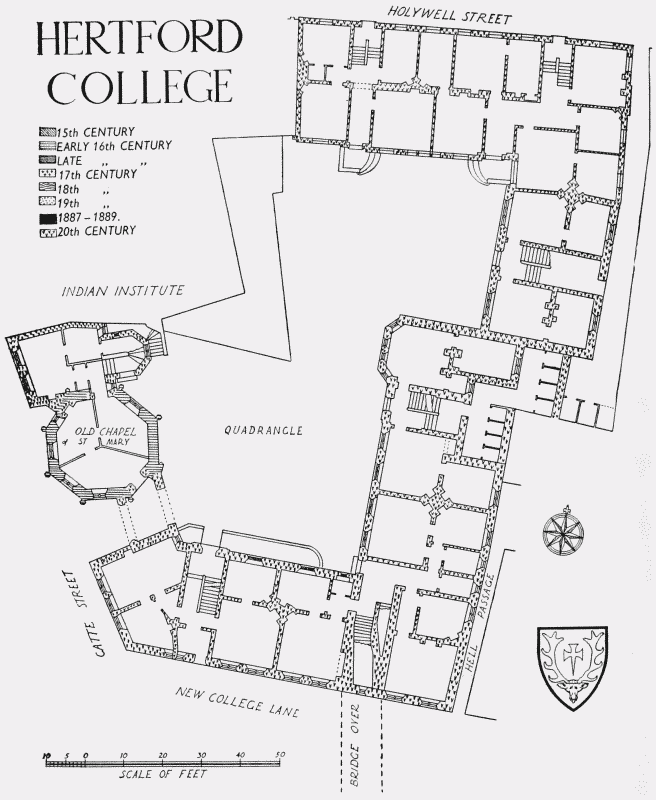
HERTFORD COLLEGE
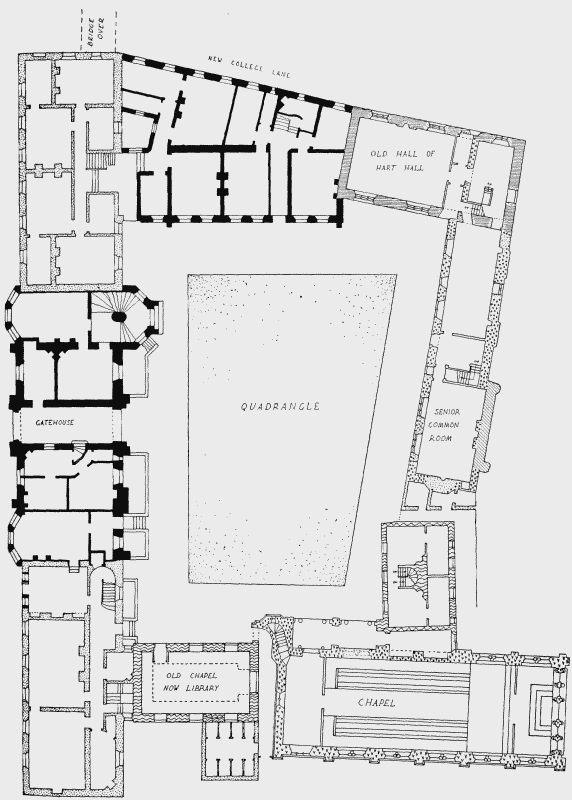
When Walter de Stapeldon bought Herthall for his scholars in 1312, he purchased with it another tenement called Arthur Hall, which is described in a deed of 1308 (fn. 48) as situate between the tenement of the Abbot of Oseney on the east and the tenement of Adam de Spalding on the west. This tenement Dr. Salter has identified as being in the north-east district of Oxford between the east wall of the city and the church of St. Peter-in-the-East. It was occupied by the scholars of Stapeldon Hall, and when they moved to the site of Exeter College they let it as an academic hall independently of Hart Hall. A lease granted to Walter de Plescye by Exeter College in 1334 (fn. 49) is the last mention of Arthur Hall, and, as property belonging to other owners in this part of the city became unoccupied after the Black Death, and was abandoned by the owners to the Corporation of Oxford to avoid payment of subsidies, it seems likely that Arthur Hall was likewise abandoned by Exeter College.
Adjoining Hart Hall on the west was Blackhall, belonging to the University. (fn. 50) Its dimensions were from east to west 23 yds., and north to south 48 yds., part of this unusual depth being a projection from the main block southward only 8 or 9 yds. wide. Apparently it was bounded on the south by Cat Hall. Blackhall was rented from the University by Exeter College for ninety-nine years in 1507 and by it rented to the Principal of Hart Hall. (fn. 51) It was again leased by principals of Hart Hall after that date, but Exeter did not always hold the headlease. (fn. 52)
Cat Hall, which adjoined Hart Hall in the rear and had become a garden by 1451, was leased to Exeter College in 1525, at 4s. per annum. Both these properties continued to be leased to Hart Hall until 1816, when the University granted the freehold to Magdalen Hall.
At the corner of New College Lane and Catte Street was a tenement belonging to the City of Oxford. (fn. 53) This tenement was sold to the Paving Commissioners in 1823, and other small houses along the frontage of Catte Street; they were demolished when the road was widened in front of the new Magdalen Hall.
In the 18th century Dr. Newton, when making his extensions to the Hall, found that he had built upon a piece of land claimed by Christ Church, to whom, therefore, he agreed to pay rent. (fn. 54) The whole of the site was planned as a quadrangle when it was occupied by Magdalen Hall in 1822. In the north-east corner of that quadrangle are the oldest remaining buildings of Hart Hall—the block built by Philip Randell when he was principal. These consist of the old hall, now a lectureroom, which has its two original windows looking into the quadrangle, and a coved ceiling. It was panelled in the 18th century. The screens are at the east end, and beyond them the buttery, built at the same time. It was originally only two stories high, but a third story with attics was added in the late-17th or early18th century.
The range of buildings on the east side of the quadrangle, adjoining the buttery building, was built by Dr. Philip Price, principal 1604–31. The northern building was planned as chambers for undergraduates, and the southern was a residence for the principal. They are shown in Loggan to be two stories high, and it is also evident that the Principal's Lodgings have encroached on the undergraduates' block. (fn. 55) The Principal's Lodgings was now used as the senior common room and the south rooms on the ground and first floors have their original oriel windows, facing south but with the lights blocked. The ground-floor room is lined with 18th-century panelling. The second story of these buildings and that over the old hall were added by Dr. Macbride at his own expense and completed in 1849. (fn. 56)
The building to the south of this is all that remains of one of Dr. Newton's angles. This was built as a prototype for the four angles of the quadrangle planned by Dr. Newton and illustrated by Williams. (fn. 57) Each was to contain eight sets of chambers for students and two larger sets for the fellow in charge of them and the junior fellow. The attics provided rooms for the 'servitor' and the tutor's servant. Each undergraduate was provided, rather frugally for 18th-century notions, with a large living-room facing on the quadrangle, and a room at the back, now used as a bedroom but then divided into two very small rooms—bed place and study. Dr. Newton's plan for rebuilding the quadrangle of Hart Hall was intimately bound up with his scheme of discipline for his new foundation. The four angles would have been symmetrical, and have left room in the middle of each of the four sides of the quadrangle for one of the communal buildings necessary to a college. The chapel, now used as a library, on the south side of the quadrangle is the only one of these projected buildings ever completed. It is of simple 18th-century design, slightly varied from the plan in Williams's Oxonia Depicta. The north and south walls each have three round-headed windows instead of four as depicted by Williams, with moulded architraves, imposts, and key blocks. The doorway has a moulded architrave and cornice, but the cornice is not ornamented with pilasters and flaming urns as was intended. It was Dr. Newton's intention that the hall, a building of similar design, should occupy the centre of the northern range; the Principal's Lodgings would be rebuilt as a decent 18th-century mansion in three stories, with five windows on the first floor, corresponding to the library, which was to be over the main entrance in Catte St.
The next buildings in historical order are those built by Magdalen College for Magdalen Hall in 1820–2, to the design of E. W. Garbett, namely, the two blocks on either side of the main entrance in Catte St. The one on the right has since been converted into the Principal's Lodgings. When the street was widened, the 17th-century entrance to Hart Hall had perforce to be pulled down. There is an interesting print of this group of buildings in the common room at Hertford College. (fn. 58) The house on the left of the great gate is in three stories and was built by Dr. Iles early in the 17th century. The gate itself was built by Dr. William Thornton, 1688–1707, who first employed the device of the drinking stag and the present motto of the college. The room over the gate was built as a library by Mr. Martin, vice-principal of the hall, with £200 from the bequest of Emmanuel Pritchard, janitor of the Bodleian Library, a former member of the hall who died in 1704. (fn. 59) There were other benefactors, but the funds proved insufficient, and the hall was burdened with a debt, which Dr. Newton had to pay. The only remaining part of the old building is the wooden gate itself, which has been reset in the new gateway of Hertford College, which was built with the hall over it in 1887 to the design of T. G. Jackson.
In 1889 the college rebuilt the west end of the north range of buildings, the architect again being Jackson. To the west of the old hall was the kitchen built for the hall by Dr. Iles when he took over the kitchen which adjoined the buttery at the east end of the old hall. Next to that must have been the buildings of Black Hall which Anthony Wood saw erected in 1669 on the site of the older building, which he judged to have been built 'about the latter end of Edward III'. (fn. 60) He states that these buildings included the 'paper building standing on wooden pillars erected on the back part of Blackhall' (fn. 61) and 'were built by inhabitants of the City to no other end but to rent them to Scholars after the chambers belonging to the Hall are supplied'. This so-called 'paper building' had disappeared some time in the 18th century, and the other buildings had been altered by Magdalen Hall in 1822 to accommodate its library.
The extension of Hertford College in the 20th century on the other side of New College Lane covers the site of houses belonging to the city, (fn. 62) including the octagonal chapel called 'the Round House' in the city leases, and a block of houses in Holywell, formerly the property of Merton College. The chapel of Our Lady at Smith Gate (sometimes incorrectly termed St. Catherine's Chapel) was restored and altered in the scheme of 1931. Wood says that the chapel was built 'as tis said by one Whobberdie or de Hyberdine' about 1521. There seems to be no more recent information of a more precise nature as to its origin. It was built on the site of a bastion of the city wall where was the entrance called Smith Gate. Until 1931 it was of two floors: one was about 4 ft. above the ground, the other was below the ground-level; both were lighted by five windows. The original plan can best be seen from within the college, where the old windows remain unaltered.