A History of the County of York North Riding: Volume 2. Originally published by Victoria County History, London, 1923.
This free content was digitised by double rekeying. All rights reserved.
'Parishes: Hawnby', in A History of the County of York North Riding: Volume 2, ed. William Page (London, 1923), British History Online https://www.british-history.ac.uk/vch/yorks/north/vol2/pp31-37 [accessed 1 May 2025].
'Parishes: Hawnby', in A History of the County of York North Riding: Volume 2. Edited by William Page (London, 1923), British History Online, accessed May 1, 2025, https://www.british-history.ac.uk/vch/yorks/north/vol2/pp31-37.
"Parishes: Hawnby". A History of the County of York North Riding: Volume 2. Ed. William Page (London, 1923), British History Online. Web. 1 May 2025. https://www.british-history.ac.uk/vch/yorks/north/vol2/pp31-37.
In this section
HAWNBY
Halmebi (xi cent.); Haunneby (xiii cent.).
Hawnby parish is a large tract of moorland lying between the Cleveland Hills on the north and the Hambleton Hills on the south-west. Its area altogether is about 16,000 acres. Most of this is permanent grass, only about one-third of the whole parish being in cultivation. (fn. 1) The subsoil is for the most part lower lias, and wheat, barley and oats are grown. The divisions of the parish are formed by rivers which rise in the moorland to the north. The River Rye has its source where Snilesworth Moor runs up to the Cleveland Hills. It is joined by several tributaries in Snilesworth; one of them, Blow Gill, forms the eastern boundary of that township and joins the Rye in the south-east corner. The course of the river after the junction divides Hawnby on the east from its townships of Arden and Daletown on the west. The boundaries between Arden and Snilesworth and Arden and Daletown are formed by little streams which join the Rye in this part of its course.
On the east Ladhill Beck separates Hawnby from Bilsdale Westside, its other township, and Bilsdale Westside is separated from the neighbouring parish of Bilsdale Midcable by the Seph. Both these streams fall into the Rye.
The village of Hawnby stands in the loop formed by the junction of the Ladhill Beck with the Rye where it curves to the south-east. The village is about 400 ft. above the ordnance datum; this is the lowest part of the parish, the ground gradually rising to the moorland in the north and south, where it reaches a height of more than 1,000 ft.
From the cluster of stone-built houses which form the village three roads run at right angles, one, Shawdlose Lane, to Ladhill Beck, which it crosses by a ford, one south to Hawnby Bridge over the Rye, and one west to the Church Bridge over the same river. All Saints' Church stands on the river bank, and the Wesleyans have a small chapel, built in 1770. A mile to the west of the village is New Hall, a small two-storied rectangular building of the early 17th century, once lighted by two-light mullioned windows, of which all but two have been modernized. The Lodge is the residence of the Hon. George Savile.
Daletown contains only a few scattered farms. Here several brooks run east to join the Rye, each through a deep wooded valley.

New Hall, Hawnby
A spring in Daletown called 'Wudekelde' was granted to the Abbot of Byland in or about 1170 by William Ingram 'with a free and sufficient way to the spring for the abbot and all his men and cattle at his grange of Morton.' (fn. 2) This was probably the spring in the wood called Plumpton Wood, from which a path leads south-west to the grange of Murton, on the high ground between the Dale and Sledhill Beck, the northern boundary of Old Byland. The township of Murton, which has an area of 1,754 acres, is extra-parochial.
Arden, like Daletown, is mostly moorland and woodland. In both the remains of old stone workings are very numerous, but the population of the present day is entirely agricultural. In the south of Arden there is the valley of Thorodale, through which flows another of the Rye's tributaries. On its south bank stands the manor-house, Arden Hall, the seat of the Hon. J. H. Savile. The building, which is high up in the hills on the site of the nunnery of Arden, is rectangular with two projecting wings behind. It dates from the 17th century, but incorporates portions of earlier work, and has recently received extensive additions which largely obscure its original form. The south front of the house, erected about 1680, is built of faced stone with rusticated angles, and between the ground and first floors is a moulded cornice carried over the entrance in a curved pediment. The doorway itself has a stone architrave, and the windows are all square-headed with moulded sills. The top or third story is a modern addition, the lines of the original gabled roof being visible on the west wall. Internally most of the front rooms on the ground and first floors are panelled, with moulded architraves to the fireplaces and a deep cornice below the ceiling. The main staircase is of the well type, with turned balusters supporting a handrail ramped over the square newels, which have moulded pendants. The rail is repeated against the wall with a panelled dado, the whole being of late 17th-century date. The back staircase is also old and has turned balusters of an early type. Built into the modern east wing is a massive 16th-century chimney stack, the lower fireplace opening retaining its oak lintel. Preserved in the house is a handsome Jacobean bedstead with canopy and a certain amount of panelling of similar character. Incorporated in an outbuilding behind the house are portions of ancient walling, but nothing now remaining on the site can be definitely assigned to the time of the nunnery. On one side of the gardens is a fine yew hedge some 15 ft. or 20 ft. high.
There was a water corn-mill in Arden in the 16th century (fn. 3); it has long since fallen down, but stood on the other side of the stream from the nunnery, close to which is a circular basin known as the Nun's Well.
Bilsdale Westside and Snilesworth consist only of a few farms in a waste of moorland. There is a Wesleyan chapel in the latter and a meeting-house of the Society of Friends in Bilsdale Westside.
Manors
HAWNBY at the time of the Domesday Survey formed two fees. One, consisting of 1½ carucates, was Crown land, and was held of the king by a Saxon, Fredgist (fn. 4); the other, of equal extent, formed part of the fee of Robert Malet. Ulf was his sub-tenant. (fn. 5) The whole vill was probably granted after the forfeiture of Robert Malet to Niel Daubeney, of whose descendants the Mowbrays the manor was subsequently held. The overlordship followed the descent of their manor of Thirsk (fn. 6) (q.v.).
Lands here and in Dale were granted by Roger de Mowbray to Hugh Malbis or Malebiche early in the 12th century. (fn. 7) Hugh had two sons, Hugh and William, (fn. 8) of whom the former died without issue. (fn. 9) William succeeded to his father's lands, but by an agreement confirmed in 1201 assigned Hawnby, Scawton and Dale (fn. 10) to his cousin Richard Malebiche, (fn. 11) son of William Malebiche of Acaster. (fn. 12)
In 1190 Richard Malebiche was a leader in the massacre of the Jews of York. (fn. 13) His lands were forfeited in consequence, and ten years later he paid four palfreys, two hawks and two greyhounds for seisin of Hawnby, Dale and other places which he had before he was disseised. (fn. 14) He made an agreement in the next year with the Abbot of Rievaulx to settle the boundaries between their estates. (fn. 15) In 1206 Robert Luttrington and Constance his wife, widow of the younger Hugh Malebiche, released her claim to dower in Hawnby in return for rents in Murton. (fn. 16)

Malebiche. Argent a cheveron between three foxes' heads razed gules.

Beckwith. Argent a cheveron between three hinds' heads razed gules.
Richard Malebiche had a son John, (fn. 17) who had succeeded him before 1214. (fn. 18) John was succeeded by a son and heir William, (fn. 19) whose heir seems to have been another Richard. (fn. 20) The latter was holding 2 carucates in Hawnby of Roger de Mowbray in 1284–5. (fn. 21) He was succeeded by his son John, (fn. 22) who died in or about 1316, leaving a son William Malebiche. (fn. 23) William died in or about 1365, (fn. 24) after conveying the manor to a younger son Walter, (fn. 25) from whom it passed to Elizabeth daughter and heir of an elder son Thomas and wife of Adam Beckwith. (fn. 26) William Beckwith, probably son of Adam, (fn. 27) held in 1428 the lands in Hawnby which had been held by William Malebiche. (fn. 28) He was succeeded by Thomas Beckwith, who settled the manor on his son William and Elizabeth his wife and their heirs. (fn. 29) William died without issue in 1494, and was succeeded by his nephew Thomas Beckwith, (fn. 30) who died in 1519, leaving a son and heir William. (fn. 31) In 1534 the manor was in possession of another Thomas, who appears to have conveyed it to trustees. (fn. 32) It must have been sold by these trustees to Sir John Aleyn, alderman of London, who in his will dated 1545 gave to his son Christopher his manors and lands in Hawnby, Clynt, Otterington and elsewhere. (fn. 33) Ten years later Christopher Aleyn and his wife Etheldreda sold the manor of Hawnby to Robert Meynell. (fn. 34)
Robert Meynell's son and heir Roger succeeded him in 1563. (fn. 35) Edmund son and heir of Roger married Thomasina daughter of Ralph Tancred of Arden, and the manor was settled on them and their heirs male with remainder to the other sons of Roger. (fn. 36) Edmund Meynell had livery of the manor in 1602. (fn. 37) He settled it on his son Thomas in fee tail-male, with remainder to his younger son Charles. (fn. 38) Thomas, however, died in his father's lifetime, and Charles succeeded on the death of Edmund in 1616. (fn. 39) He was still lord of the manor in 1623, (fn. 40) but in the next year it was in the possession of James Morley, (fn. 41) to whom presumably it was sold by Charles Meynell.
James Morley was succeeded by his son Cuthbert. (fn. 42) The latter was prosecuted as a delinquent, and was forced to leave the country. (fn. 43) His estates were sequestered by Parliament, and William Burroughs was put in possession of Hawnby. (fn. 44) After the Restoration, however, Cuthbert Morley recovered his lands against the occupier Roger Lee. (fn. 45)
Cuthbert Morley died in or about 1669; Anne his daughter, the wife of Bernard Grenville, was his heir. (fn. 46) Between 1661 and 1673–4 litigation was proceeding between Cuthbert Morley and the Grenvilles and one Jeremy Elwes, to whom Cuthbert Morley had made a release of his estates on a secret trust during his absence from England. (fn. 47) Jeremy Elwes insisted on his claim, and finally a special Act of Parliament was passed to enable him to sell his interest to Bernard and Anne. (fn. 48)
In 1682 Bernard Grenville and Anne, with Katherine Morley, widow, sold the manor to Christiana Berkeley. (fn. 49) Her son William Lord Berkeley of Stratton (fn. 50) presented to the church in 1703, (fn. 51) and seems to have been in possession of the manor in 1718. (fn. 52) John Lowther was also concerned with it at that time, (fn. 53) and, as he presented to the church in 1732, (fn. 54) it seems probable that his family came into sole possession at some time between those dates, though the manner of the transfer is not quite clear. (fn. 55)
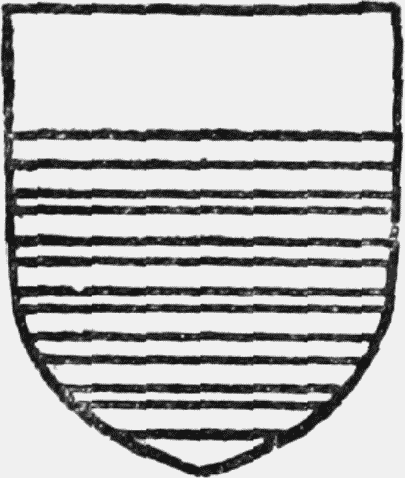
Meynell of Hawnby. Azure three gimel bars and a chief or.
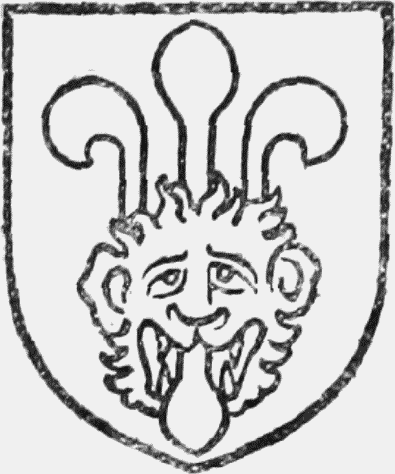
Morley of Normanby. Sable a fieur de lis or coming out of a leopard's head argent.
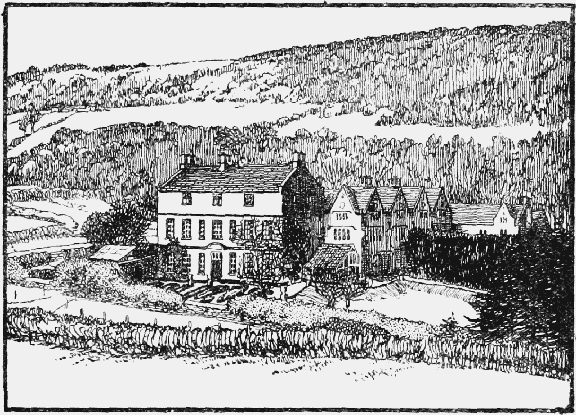
Arden Hall, Hawnby, from the South-east
In 1749 Jane Lowther, perhaps John Lowther's widow, was patron of the living. (fn. 56) Less than twenty years later, however, the Lords Frederick and John Cavendish, younger sons of the third Duke of Devonshire, were in possession of the manor and advowson, (fn. 57) which they had probably acquired by purchase. Their descendants remained in possession till the middle of the 19th century. (fn. 58) During the latter half of that century the manor passed through various hands. In 1872 Mr. Robert Tennant was in possession; six years later it was purchased from him by Mr. George Wood (fn. 59); the present owner is the Hon. George Savile.
ARDEN (Herdena, Erden, xii cent.) is not mentioned in the Domesday Survey. In the middle of the 12th century it was held of the Mowbray fee by Peter 'de Thirsk' or 'de Hutton.' (fn. 60) He founded a nunnery there and endowed it with 3 carucates of land in the vill. (fn. 61) The grant was confirmed by Roger de Mowbray (fn. 62) and by Elizabeth Carlton, heiress of Peter de Hutton, (fn. 63) who quitclaimed her right in Arden to the prioress in 1262. (fn. 64)
After the Dissolution the site of the priory was leased to Thomas Welles. (fn. 65) It was granted in 1540 to Thomas Culpepper, one of the gentlemen of the king's chamber, (fn. 66) who alienated it in the same year to Sir Arthur Darcy. (fn. 67) The manor did not long remain in the Darcy family. Sir Arthur Darcy died seised in 1561, (fn. 68) leaving Arden to his son Arthur, who sold it in 1574 to Ralph Tancred. (fn. 69)
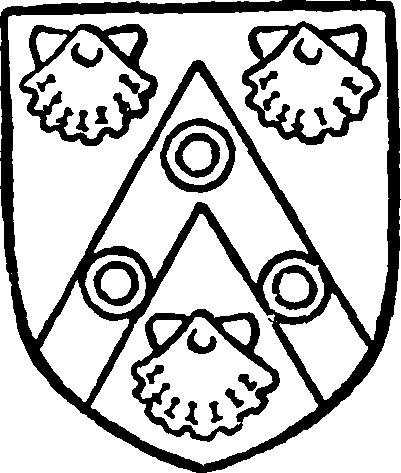
Tancred of Arden. Argent a cheveron between three scallops gules with three rings argent upon the cheveron.
Ralph Tancred was accused of treason in 1590, with his 'sons, servants and others of his confederates,' (fn. 70) but no more is heard of this charge and he died in possession in 1602. (fn. 71) He had settled the manor on his younger sons Richard and Henry. (fn. 72) Henry executed a further settlement, in default of issue to himself, on Charles son of his eldest brother William, with various remainders. (fn. 73) Charles succeeded on the death of his uncle in 1626 (fn. 74) and had livery of the manor in the next year. (fn. 75) He made a return of his estates as a delinquent during the Commonwealth, and described them as lying 'neare the Northeren roade betweene the citye of Yorke and Durham, of small yearly value now, nor hath been valuable these 3 yeares past.' (fn. 76) He was succeeded by his son Charles, (fn. 77) the 'Tankerd of Arden' who was reported to be threatening the 'peace and safety of the Commonwealth' in 1659–60. (fn. 78) He died in 1711 and his son William (fn. 79) in 1736; William was succeeded by another Charles. (fn. 80) The latter had a son Charles, who died unmarried in 1819. (fn. 81) His brother D'Arcy Tancred succeeded him, (fn. 82) and was in his turn succeeded by his son Charles. (fn. 83) The manor was sold to the Hon. John Savile, the present lord of the manor, in 1900. (fn. 84)
One of the liberties of this manor was a fishery in the Rye. (fn. 85)
BILSDALE WESTSIDE was in the possession of the Abbot of Rievaulx as early as the 12th century. (fn. 86) The land in Bilsdale granted to Rievaulx by Walter Espec in his charter of foundation (fn. 87) does not seem to have included Bilsdale Westside, which was probably added by Walter Espec's successors.
Bilsdale Westside was apparently never a manor, but was part of the manor of Bilsdale, or Bilsdale Rievaulx, which, with part of Bilsdale Kirkham, was made in 1898 into a separate parish with the name of Bilsdale Midcable. Numerous disputes arose between the Abbot of Rievaulx and the Prior of Kirkham with regard to the boundaries of their manors in Bilsdale. (fn. 88)
After the Dissolution the estate was granted to the Earl of Rutland. (fn. 89) It followed the descent of Helmsley (q.v.) in his family, (fn. 90) and was sold with that manor by the trustees of George Duke of Buckingham to Charles Duncombe in 1695. (fn. 91) It has remained in the Duncombe family, (fn. 92) and the Earl of Feversham is the present owner.
DALETOWN (Dale to xv cent.) was with Hawnby the possession partly of the Crown and partly of Robert Malet at the time of the Domesday Survey, (fn. 93) and came with that vill into the possession of the Mowbrays. Its overlordship followed the same descent. (fn. 94) The family of Malebiche held a mesne lordship in Daletown. (fn. 95)
The tenant in demesne in the late 12th century was Ralph de Turp, who in or about 1170 granted land in Dale to Byland Abbey. (fn. 96) He had previously given it to his daughter Ymenea, who had surrendered it in exchange for other land. Ralph had also a son Roger alive at this time. (fn. 97) The manor of Dale, however, passed to neither of his children, but to the family of Walter Ingram, who is described in another charter of about the same date as Ralph's brother. (fn. 98) William Ingram, son of Walter, (fn. 99) was lord of the manor shortly afterwards. (fn. 100) In 1201 Thomas Dale and Idonia his wife quitclaimed to him 6 oxgangs of land in Dale. In return William granted them half a carucate of land in Dale and land in other places to hold of him for one-sixteenth of a knight's fee. (fn. 101) The same lands were held by William 'son of William Clericus de Dala' forty-five years later of William Ingram's son Robert. (fn. 102)
Robert Ingram was succeeded by John, whose lands in Dale were granted by Richard de Malebiche in 1270 to Simon de Clervaux till William son of Philip Colvill, the heir of John, should be of age. (fn. 103) William's right was derived from Ingelisa daughter of Robert Ingram, (fn. 104) who had married Philip Colvill, and his family became famous as the 'Colvills of the Dale.'

Colvill of the Dale. Or a fesse gules with three roundels gules in the chief.
William Colvill was holding the manor in 1284–5 (fn. 105) and was succeeded by his brother Robert, (fn. 106) to whom a third brother Philip released in 1306 all claim to the manor of Dale and land in Arncliffe. The latter had two sons, both called Robert, of whom the younger succeeded. (fn. 107) His son William was his heir, and confirmed charters of his ancestors to Byland in 1365. (fn. 108) He settled the manor on himself and his wife Joan (fn. 109) with remainder to their heirs male. After their death it was inherited by their second son John, (fn. 110) who was beheaded for treason in 1405. (fn. 111) His estates passed in accordance with the settlement to his grandson John, (fn. 112) who died without issue. (fn. 113) His aunts Joan and Isabel inherited his lands, Joan, who was the wife of Sir William Mauleverer of Wothersome, coming into possession of Daletown. (fn. 114) Her grandson Edmund Mauleverer, son of Robert, (fn. 115) was lord here in 1468. (fn. 116) He died in 1493–4, and was succeeded by his son Robert, (fn. 117) whose son Sir William Mauleverer died seised in 1551. (fn. 118) The manor had been settled on him with remainder to Edmund, son of Robert Mauleverer his second son. (fn. 119) In 1568 Edmund Mauleverer sold Daletown to Gilbert Gerrard. (fn. 120) It was conveyed almost immediately by Gilbert Gerrard to Leonard Dacre in exchange for other lands, (fn. 121) and was among the possessions of the latter when they were forfeited for his treason in 1570. (fn. 122) Sir Thomas Gargrave petitioned several times for a grant of Daletown 'to keep some sheep for his house.' (fn. 123) It was not, however, granted to him, but to Henry Lord Hunsdon in consideration of the service he had done against the rebels. (fn. 124) He conveyed it back to the Crown a few years later, (fn. 125) probably in exchange for other lands, and in 1610 it was leased to his brother John Lord Hunsdon. (fn. 126) In the early part of the reign of Charles I the manor was granted to trustees for money advanced to the king by the City of London. (fn. 127) Sir Hugh Cholmeley bought it with Aislaby (q.v.) in 1632. (fn. 128) He or his heirs must have sold it to the Bellasis family. It was registered among the estates of the recusant Lord Fauconberg in 1717. (fn. 129) The reversion belonged under his uncle's will (fn. 130) to Sir Thomas Frankland, bart., of Thirkleby, whose elder son Thomas quitclaimed it to his brother Frederick in 1737. (fn. 131) The estates of Frederick Frankland were inherited by his daughter Anne, who married Thomas Lord Pelham. (fn. 132) Lord Pelham was holding the manor in 1778. (fn. 133)
In 1857 Daletown belonged to Mr. S. Bamford Hamer. It passed on his death to his widow and was subsequently held by her trustees.
The manor of MURTON belonged in 1086 to Robert Malet (fn. 134) and came to the Mowbray family. Roger de Mowbray granted the fee of lands in Hawnby, Dale, Murton and elsewhere to Hugh Malebiche, and the Malebiche family continued to hold a mesne lordship here which was in the possession of Hugh Malebiche in 1284–5. (fn. 135) About the middle of the 12th century Hugh Malebiche granted the manor to the abbey of Byland, a grant which was confirmed by Niel de Mowbray and by the grantor's son. It also received royal confirmation. (fn. 136) The abbot was in possession as early as 1170, when William Ingram granted the monks of Byland a spring in his territory of Dale and a sufficient approach to it for his men and cattle from the grange of Murton. (fn. 137)
In 1206 Richard Malebiche granted the service of 20s. per annum rendered him by the abbot to Constance widow of Hugh Malebiche for her life in dower. (fn. 138) It appears from a suit of 1267, in which William Malebiche claimed the manor against the abbot, that this yearly payment had been granted by the Malebiche family to the abbey of Newbo in Lincolnshire. (fn. 139) William Malebiche was unsuccessful in his suit, and the abbot remained in possession.
After the Dissolution Murton was granted with other lands of Byland Abbey to the Bellasis family, (fn. 140) in whose possession it still was in 1717. (fn. 141) It passed with Daletown (q.v.) to the family of Frankland of Thirkleby a few years later, (fn. 142) and has since followed the same descent as that manor (fn. 143) (q.v.). Both are now in the possession of the trustees of the late Mrs. Hamer.
Hugh Malebiche granted the manor of SNILESWORTH (Snyghelesworth, xiv cent.; Snailsworth, xvi cent.) to the monks of Byland towards the end of the 12th century. (fn. 144)
Early in the 13th century Robert Breth of Carleton quitclaimed to the abbot his right to common of pasture in the moor between Whorlton and Snilesworth Grange. (fn. 145)
In the 16th century the grange appears to have been leased by the abbey to the Dayvills, as Robert Dayvill left for the use of his son Roland 'the farmholde called Snylesworthe Grange.' (fn. 146)

Manners, Duke of Rutland. Or two bars azure and a chief quartered azure two fleurs de lis or with gules a leopard or.
After the Dissolution Snilesworth was granted with other lands of Byland to Sir William Pickering. (fn. 147) In 1541 he had licence to alienate the grange to George Sandwith. (fn. 148) It appears soon afterwards among the possessions of the Earl of Rutland, and was held by successive earls (fn. 149) till the middle of the 18th century, when John Manners, called the Marquess of Granby, son and heirapparent of John the twelfth Earl and third Duke of Rutland, (fn. 150) was in possession. He must have left it with the manor of Boltby (q.v.) to his naturalson William Manners. (fn. 151) Edward Manners, presumably the heir of William, was in possession in 1830, (fn. 152) but in 1857 the estate had come into the hands of Mr. J. W. Calvert. Miss Calvert had inherited it in 1872, but in 1889 it was once more in the hands of the Manners family. Mr. J. E. Manners is the present owner.
Church
The church of ALL SAINTS consists of a chancel measuring internally 21 ft. 9 in. by 14 ft. 5 in., a north vestry, nave 38 ft. 2 in. by 22 ft. 3 in. and a south porch.
The church was doubtless built in the 12th century, when it appears to have had a western tower and a narrower nave, as well as a small chancel. Probably the building suffered, like others in the neighbourhood, from the incursions of the Scots after Bannockburn and was left a ruin. In the rebuilding, which took place late in the 14th century, only the south walls of the nave and tower, which was not rebuilt, and perhaps part of the west wall of the latter, were retained on their old foundations, while the chancel was entirely reconstructed and the nave widened by moving the north wall outward. The church has continued in its present state since then, apart from the usual restorations, the most important of which was undertaken in 1874.
The 15th-century east window is of three trefoiled lights under a traceried pointed head; the outer of the two chamfered orders appears to have been renewed with the outside face of the wall. There are no windows north of the chancel, the wall being pierced only by a modern doorway into the vestry. On the south side are a small trefoiled piscina and two windows, each of two trefoiled lights with semiquatrefoils above, under square heads. Between them is a blocked doorway with a plain ogee head of one stone. The chancel arch has modern semi-octagonal jambs with fluted capitals and a restored two-centred arch of two orders, the inner chamfered, the outer square.
There are three windows in the north wall of the nave, two on the south and one on the west, all similar in detail to the south windows of the chancel. With the exception of the south-east window, they have all been renewed. The south doorway is also modern and the porch was probably added or rebuilt at the same time. To the west of the south doorway the wall returns in 1 ft. 9 in. This, no doubt, was the original west wall of the nave at its junction with the tower. The angle has a stone edge roll, at the head of which is a carved capital with a small human head and intertwining foliage. The abacus above is grooved and chamfered and extends about 3 ft. 6 in. along the wall westward on the one side, and returns to the south wall of the nave on the other. All traces of the arch which sprung from it have entirely disappeared. Between the second and third windows in the north wall is a small blocked doorway with single chamfered jambs; these have chamfered abaci on which are carved small human heads. The pointed arch is of a single order with a square label. The doorway, which has been reset, is partly contemporary with the first church.
The walls generally are of rough ashlar irregularly coursed, and over the west wall is a gabled open bellturret. The roof of the chancel is a low gabled one with plastered ceiling and open wood trusses; that of the nave is gabled and boarded below. Both are modern and are slated outside.
The font is octagonal, and from the staples in its top is apparently old but much recut. The other furniture is modern.
Two marble mural monuments on the east wall of the chancel are of somewhat unusual design. That north of the east window is to Ann daughter of Sir Henry Tancred (Tankarde), kt., of Arden and Lady Ann his wife. She died, aged two years, in 1608. At the top is cut and painted a clock-dial with the inscription 'Vita hora' and two shields, one on either side, one of Tancred, the other of Lawson. Below the inscription is painted a child in a cradle with sprays of flowers. The other marble slab south of the window is to Ralph Tancred (Tankarde) of Arden, who by Mary his wife had seven sons and four daughters; he died in 1601. Below the inscription is painted his portrait between two shields, with arms as above. On the same slab is also an inscription to Sir Henry Tancred; he died in 1626. On the south wall is a monument to Charles Tancred and Barbara his wife, daughter of John Dalton of Hauxwell—she died in 1687 and her husband in 1711—also to William Tancred, son and heir of the last, who died in 1736. There are several other 18th and 19th-century monuments.
There are two small bells, one inscribed 'Sanctus, Sanctus, Sanctus,' and the other 'Jesu be our speed 1716.'
The plate includes a silver cup, bearing the Newcastle mark of 1750, and given by Jane Lowther of Upleatham, and a silver-gilt paten of 1901.
The registers begin in 1653.
Advowson
The church of Hawnby was in existence at the end of the 12th century, when the Prioress of Arden and the Abbot of Byland settled a dispute there before the archdeacon 'and many good men.' (fn. 153)
The advowson has till quite recently belonged to the lords of the manor. William Malebiche presented a clerk in 1265, (fn. 154) and his successors have all been patrons. Between 1893 and 1905, however, the advowson was acquired by the Earl of Feversham, the present patron.
The mention of a chaplain of Dale in the 12th (fn. 155) and 13th (fn. 156) centuries suggests that a chapel existed there, but no record of it has been found.
Charity
John Smales, by deed dated 23 November 1757, charged certain lands in Hawnby with an annuity of £3 to be paid to a schoolmaster for instructing six boys of the parish. The sum of £3 is regularly received and applied.